Amelea Kim. Overdue Fines in the Academic Library: Undergraduate Student and Staff Perceptions of Overdue Fines at the UNC Undergraduate Library. A Master's paper for the M.S. in L.S. degree. April, 2018. 61 pages. Advisor: Mary Grace Flaherty
In recent years, libraries have started to examine their fines policy more critically to see the effects on patrons, workflow, and staff, as well as to see how their policies can be changed, or in some cases, removed. This study looks at the overdue fines policy at the Undergraduate Library at the University of North Carolina at Chapel Hill, specifically analyzing how experiences with the fines policy among undergraduate students affects their use of the library, as well as how the experiences of staff members with fines affects their workflow. The results of the study show that while many students feel that fines are an effective means of incentivizing book return, the financial burden does play a role in producing a negative impression of the libraries and can dissuade some patrons from using its services.
Headings:
Library circulation & loans -- library overdues Library finance – library fines
Academic libraries - undergraduate libraries Library use studies – Academic library use studies Libraries & schools – Libraries & students
OVERDUE FINES IN THE ACADEMIC LIBRARY: UNDERGRADUATE STUDENT AND STAFF PERCEPTIONS OF OVERDUE FINES AT THE UNC
UNDERGRADUATE LIBRARY
by Amelea Kim
A Master's paper submitted to the faculty of the School of Information and Library Science of the University of North Carolina at Chapel Hill
in partial fulfillment of the requirements for the degree of Master of Science in
Library Science.
Chapel Hill, North Carolina April, 2018
Approved by:
Table of Contents
Introduction ... 3
Literature Review ... 4
Fines in the Library: A Short Overview ... 4
Fines in Libraries: Early Research ... 5
Exploring Fines More In Depth: Localized Studies at University Libraries ... 7
Revising Fines: Striking a Compromise ... 9
Fines at UNC: A Brief Overview ... 10
Fines at UNC: The Undergraduate Library ... 12
Fines at UNC: Research Focus of This Study ... 13
Fines at UNC: Justification for Research Focus ... 14
Methods Used in this Study ... 14
Overview ... 14
Part 1: Survey and Distribution ... 15
Part 2: Semi-structured Interviews ... 16
Data Analysis ... 18
Limitations of the Study ... 18
Data Results and Discussion ... 19
Part 1: Survey Results – Quantitative Data... 19
Part 2: Survey Results – Qualitative Data ... 27
Part 3: Semi-Structured Interviews with Students ... 30
Part 4: Semi-Structured Interviews with UL Staff ... 35
Part 5: Comparing Staff and Student Responses ... 37
Conclusions ... 39
Reflections ... 41
Bibliography ... 43
Secondary Print Sources ... 43
Primary Sources ... 45
Appendices ... 48
Appendix 1 – The Undergraduate Library Fines Policy ... 48
Appendix 2 – Adult IRB Consent Form ... 50
Introduction
This past fiscal year, the Chapel Hill Public Library (CHPL), NC, submitted a proposal to get rid of its overdue fines system in order to lower barriers to access for the public. While the motion was ultimately unsuccessful, CHPL’s proposal itself is a sign of changing times in the library world, a world where previously sacrosanct rules like overdue materials fines may not be as sacred anymore. In recent years in particular, there has been a flurry of opinion pieces, studies, and articles put forth by various institutions that show a lively debate between those who think that fines should be abolished,
embraced, or revised. This debate is not just limited to the public library world, however. Many academic libraries have started to look more closely at their overdue fines policy, and more and more research is being done on the effects of fines on patrons, library use, library attitudes, and general library practice. Particularly in the past decade or so, there has been a spate of studies focused on individual academic libraries across the world that have sought to provide a clearer and more detailed picture of overdue fines in the
academic library context.
work, taking a step back and looking systemically at the fines policy overall has often led to interesting insights in areas such as patron perceptions of the library, effects of fines on usage, and staff experiences with fines. It is to this part of the overdue fines conversation that I hope to contribute to with my research.
This project focuses on overdue fines in the academic library context, specifically at the University of North Carolina at Chapel Hill. Data collection and research is
localized around the Undergraduate Library (UL) branch of the UNC Libraries, with the aim of analyzing how undergraduate students view the overdue fines policy at the UL, how their experiences with the overdue fines policy affects their use of the library, and also how that contrasts with UL staff member perceptions of the fines policy.
Literature Review
Fines in the Library: A Short Overview
A fine, as defined by the Merriam Webster Dictionary, is a, “sum imposed as punishment for an offense,” and is often thought as part and parcel of the traditional library system, particularly in the context of overdue materials. It has an established presence in the history of American libraries – a Madison, Nebraska library from 1911 has “Library Fines” recorded as part of its operating budget and costs – and are often an assumed part of many library circulation policies across many different types of libraries. (Bobinski, 1968) The American Library Association has a Fines and Overdues page where they state:
“Most public and college libraries do collect fees, which is usually part of their circulation policy toward maintaining the collection. As far as collecting the fees themselves, it depends on the individual library and their own individual
Delving further beyond generalizations, a recent study that surveyed circulation policies among the Association of Research Libraries (ARL) found that 163 of 165 academic libraries charged overdue fines. (Wilson, Frazier, & Harter, 2015) However, as library practices and services change over time, even such firmly established traditions as fines are being subjected to revision and scrutiny to make sure policy is matching up with institutional goals and user needs. In the next section, I will be discussing the background of fines at the Undergraduate Library at UNC Chapel Hill, what research has been done regarding fines in the academic library in general, as well as how my research will address some of the gaps in the existing literature.
Fines in Libraries: Early Research
The conversation around fines in academic libraries has gone through a slow metamorphosis over the years. Early research and articles tended to approach the topic of overdue fines from a one-dimensional point of view, one in which it is assumed that overdue fines are charged, and the big question is how to manage fines more efficiently, and to get a better idea of what common practice is among libraries for collecting fines. One of the earlier books that addresses overdues in the library stated that the purpose of their book is an attempt to:
“…bring together…statistical data on overdues, systematic presentations of overdues procedures from various libraries, a closer look at certain reactions of libraries to the overdues problem…and a consideration of the theory behind many of our overdues practices.” (Burgin & Hansel, 1984)
existence”, and are “undoubtedly one of the biggest circulation problems for academic libraries.” (Farrington, 1984) Overdue materials and fines are painted as an
administrative burden, but a necessary evil in order to maintain egalitarian access of the collection.
Other early articles went in a different direction and give a brief overview of the two opposing positions, to fine or not to fine, and list a few philosophical points to support each view. Another earlier article, from 1974, written on the topic of fines in the academic library wrote:
“This effort to keep its materials under control may give a library greater strength in the community served, but it could also make for bad publicity resulting from reader’s reactions to fines…it is general felt that the only person deterred in their use is the person who cannot afford the fine, and he may be the one who badly requires library materials.” (Nwamefor, 1974)
This quote rather succinctly summarizes much of the discussion in early debates surrounding fines – the desire of the library to provide access to all by making the
collection as available as possible warring against the desire to encourage use and inspire good relations with patrons. However, while Nwamefor frames fines as a way to make collection materials available, others portray fines in a more punitive light:
“The threat of a fine provides the patron with an incentive for returning materials on time, a penalty for returning materials late, and an education in being a
responsible citizen.” (B. Anderson, 1984)
As for the research conducted in these early articles, while some of the points mentioned are supported by specific studies, some of the points are supported by anecdotal stories and generalizations. Both Nwamefor and Anderson use questionnaire studies conducted in the public library realm for figures and statistics quoted in their papers, and the Library Overdues book also mentions a thorough questionnaire of North Carolina libraries that was conducted in the 80s. However, the studies mentioned are used to compare what different libraries are doing in terms of fines and to discern what trends and patterns exist in library practices. As such, the research at this point does not delve beyond general questions and broad policy and is heavily intertwined with personal experience and opinion.
Exploring Fines More In Depth: Localized Studies at University Libraries
After this initial group of general discussions regarding fines in the academic library, there was a spate of more research-based articles that focused on a variety of aspects regarding fines in the library, with a large group of them happening
internationally. Though these studies are similar in that they were conducted with a more formal research structure in mind, they focus on different aspects of overdue fines, and can be split up into various themes.
One major theme within this research focuses on patron attitudes towards overdue fines. One of the more prominently cited studies within these theme is Esharenana
Adomi’s study on “Attitudes of university library users towards overdue fines in
conclusion of her research showed that “60.5% of the respondents would not like the collection of overdue fines to be discontinued,” and that many respondents believed overdue fines were an effective system to keeping as many books as possible available for use.(Adomi, 2003) Many of the other international studies found similar results from the data they collected. In some cases, the similarity of results might be explained
because a handful of studies after Adomi’s used a very similar survey. (Edewor, 2010) In others, however, such as Anderson’s dissertation “Are Fines Fine?” at the University of Canterbury Library in New Zealand, similar results were found through a mixed-methods approach of survey that had both qualitative and quantitative questions. Her analysis noted that “the majority of respondents to the questionnaire did not think library fines should be abolished.”(C. V. Anderson, 2008) Another important study done in 2013 compared two libraries and patron return behavior and found that:
“…fines indeed make a difference in patron book return behavior. Patrons who borrowed books under a fines policy returned books before due dates at a
statistically significantly higher rate. As a result of this study, it is determined that a fines policy is an effective tool to ensure that books are returned on time and available to the maximum number of library users.” (Sung & Tolppanen, 2013) Despite the fact that patrons do not necessarily relish the experience of paying an overdue fine, the above-mentioned studies found that patrons do believe it is an effective system in encouraging users to return items on time. It is important to keep in mind, however, that while these international studies do show general trends regarding overdue fines, patron responses might be also affected by different cultural attitudes and might be another area of exploration for further research.
return books late, and proposed improvements to their overdues policy as a result. This was one of the few studies that looked at both student and staff perspective, as the researchers conducted a questionnaire with students and qualitative interviews with the library staff members. Another study looked at a medical library, and analyzed the reasons for overdues. (Shontz, 1999) However, that study might be slightly outdated as most of their suggestions, such as sending multiple overdue notices, are now staples in automated library systems today.
Revising Fines: Striking a Compromise
The last major theme within this area of research focuses on the broader
circulation policies in academic libraries, of which fines are included. Many library users, patrons and staff alike, do not like fines, but many seem them as a necessary evil. As David McMenemy states:
“It is utterly perverse to me that a punitive action that is designed to prevent inefficient use of the service…is essential to the functioning of the
library…however, despite the calls to abandon fines altogether, it seems to me that they serve a vital function for any library that requires efficient and equitable circulation of stock.” (Mcmenemy, 2003)
Another study that surveyed 165 academic libraries reported that while a majority of libraries thought that fines help get overdue materials back, some staff members also noted that fines do not have positive effects, or they have negative effects for employees. (Wilson et al., 2015) As such, many people seem to aim for a compromise between the two sides of the fine debate resulting in a revision of the fines policy that still has
Brigham Young University’s series of studies that examined their circulation and loan policies to see how they could change things to better fit user needs, the University of Arizona Library’s decision to use peer institution data to help them decide circulation policy changes, the College of William and Mary’s study that proposed changes to their circulation policy, as well as the NYU Bobst Library study that examined statistical data and anecdotal evidence to make a new fines and circulation policy for current patron needs. (Boyce, 2014; Hartse & Lee, 1993; Mosley, 2004; Rupp, Sweetman, & Perry, 2010; Wilson, 2014) Many of these libraries used a variety of data and methodologies to make these decisions – in some cases, the libraries conducted surveys among patrons, such as with BYU, and in other cases, libraries relied on peer institution data, such as with the College of William and Mary and the University of Arizona. (Boyce, 2014; Hartse & Lee, 1993; Wilson, 2014) Yet others merely looked internally in their department, through their records and the money trails to get a better sense of how patrons were using their services, such as with Texas A&M. (Mosley, 2004)
While each library prioritized change in different parts of their policies, the effects have largely reported to be positive, and the authors have encouraged other institutions to follow suit and reexamine their circulation policies to make sure they are still effective and appropriate for patrons.
Fines at UNC: A Brief Overview
Records from 1939 summarizing overdue fines from the past seven years support this idea, as it shows that fines were a well-documented and well-practiced policy in UNC library administration at that time, with data habitually collected and readily available for comparisons. (Fines in the Library During the Past Seven Years, Wilson Library, 1939)
In general, records in the University Archives show fines to be an administrative routine, fairly uncontroversial and faithfully done, but a few letters of correspondence here and there also showed that the fines policy was occasionally revisited and
suggestions proposed. Some of the suggestions were more administrative in nature, such as a series of letters from 1942 that discuss whether or not the Library, or the Cashier’s office should be in charge of fine collection, and how to best clear or hold student
accounts with overdue fines. (Collecting Fines, Wilson Library, 1942) Other suggestions were more radical, such as the suggestions put forth by a concerned faculty member in a document from the Adhoc Committee on Fines, proposed sometime in the early 70s. A Dr. Daniel Eisenberg proposed that the present fine system “be replaced with a two-step fine system of 5 cents per day for the first week a book is overdue and 25 cents per day for each day after the first week.” UNC Libraries said in response:
“The committee recommends that the present fine system remain unchanged for the following reasons. The present fine system was approved unanimously by the Administrative Board of Library in October, 1969, and has been in operation for over two years with little or no objection. Mr. Crawford has discussed the matter with a number of students and reports that he has encountered little interest in a change in the present system. The library levies fines only to promote the prompt return of library materials for the benefit of all borrowers. The fine must be significant, otherwise it will be ignored.” (Adhoc Committee on Fines, Wilson Library, n.d.)
emphasis is on the general benefit of all library users, as opposed to punishing those to keep books overdue.
Fines at UNC: The Undergraduate Library
The UL papers in the UNC Archives had administrative records of fines, particularly from the Annual Reports that gave statistics on how many overdue notices were sent, from what parts of the UL collection were materials most overdue, and how much money was billed vs. how much money was collected. Notable mentions include the fact that the UL began to process its own fines sometime during the 1967 – 1968 school year (Annual Report, Undergraduate Library, Wilson Library, 1967 – 1968), and a mention that most of the fines processing in the early years of the UL was done by
students. (Contingency Plan for Reduced Student Assistant Budget for Undergraduate Library, Wilson Library, February 1983)
where the thief left a note saying “It took a while to figure out how to repay you people for unfair fines.” (Memorandum, Wilson Library, 1983) Clearly, while perhaps many overdue fines transactions happened with little to no fuss, there were a few instances where patron displeasure was readily felt and made loudly known.
Fines at UNC: Research Focus of This Study
This research study focuses on overdue fines among undergraduate students at UNC, specifically within the context of the Undergraduate Library. Similar to how many studies have taken a closer look at their circulation policies and proposed revisions, this research project will do the same at UNC as this type of systematic research regarding overdue fines has not been conducted here before. Especially given the rather separated nature of overdue fines as administrative processes vs. the effects of fines on patrons and staff in the UNC Archive papers, this research will provide a bridge between the two entities and give both patron and staff perspectives on fines policies. Below are the specific research questions:
1. What experiences do undergraduate students at UNC have with the UL fines policy, and how do those experiences affect their perceptions of the UL fines policy?
2. How do those perceptions and experiences affect undergraduate student use of the UL and its services?
Fines at UNC: Justification for Research Focus
Although all sections of the UNC population are avid users of the Undergraduate Library, due to the time constraints of this research project, the area of focus of this study will be the undergraduate student population at UNC. Additionally, this study was further limited to the Undergraduate Library in order to provide one, definite fines policy to guide data collection and research, as opposed to figuring out ways to account for all the different fines policies of UNC’s branch libraries. Finally, within the Undergraduate Library, the focus has been narrowed to exclude the Media Resources Center (MRC) as they have a separate fines policy and fines department, and in the view of this paper, acts like a separate branch library from the Undergraduate Library. While the use of MRC materials, for example electronic equipment, computer adapters, etc., do result in many opportunities for overdue fines research, the UL also provides electronic equipment and technology for students to borrow. As such, even though the MRC is excluded from the scope of this study, those patterns of use for electronic equipment would still be included. For further details on the current UL overdue fines policy, please see Appendix 1.
Methods Used in this Study
Overview
semi-structured interviews conducted with both UNC undergraduate students and UNC UL staff members. The data analysis for the interviews and the free-response survey questions involved hand-coding and noting general trends and patterns in answers, as well as noting general trends from the quantitative data. In order to conduct the survey and the interviews, this research study was submitted to the UNC IRB, and was approved on January 26th, 2018 with an assigned study number of 17-2654. Conclusions were
drawn from synthesizing the two groups of data trends together and discussing the implications for fines at the UL, and overdue fines at UNC in general.
Part 1: Survey and Distribution
The Qualtrics survey used in this study consisted of 11 multiple choice questions and 4 free response questions, with the free response questions being optional. Not all questions were displayed to respondents, as there was some display logic and skip logic depending on what answers were selected. As such, before it was sent out, the survey was pre-tested eight times to make sure the display and skip logic worked properly for
respondents. The survey is comprised of three different sections, with the first section asking for information regarding general use of the UL, the second section asking questions about personal experiences with fines, and the last section asking about overdue fines as a concept.
For distribution, the survey was sent to UNC’s mass email system, along with an email describing the study and its purpose. Once the message was approved by
when this study was designed and proposed, it was possible to send emails through the UNC mass email system to segmented populations, for example only to undergraduates, or only to graduate students. However, due to parts of the UNC system breaking, the segmenting option was no longer available, and the only two options were to send the survey to no students, or to all students. To account for this and ensure that only
undergraduate student responses were used in the data analysis, the first question asked what year the respondent was. In this way, it was possible to filter for undergraduate responses only. To incentivize response, all survey participants were entered into a raffle for two $50 Amazon gift cards which were awarded at the end of the survey collection period.
After the survey collection period finished, all of the names of respondents who wished to be considered for the raffle were entered into an Excel spreadsheet and assigned a number. Using a random number generator, two winners were selected and notified. After this, and after the semi-structured interviews were set up, all names were deleted from Qualtrics, and a PDF report of the results were downloaded, with only the undergraduate student responses displayed.
Part 2: Semi-structured Interviews
Recruitment for the undergraduate interviews was conducted through the Qualtrics survey which asked for volunteers to participate in the semi-structured interview. Twenty-four students indicated their interest by submitting their names and contact information. These names were then assigned a specific number, and ten numbers were randomly drawn to determine which students to interview. The participant’s survey responses did not factor into the decision to interview them or not – the only deciding factors were whether they were willing and available during the interview time-frame.
This section of the semi-structured interviews was incentivized by promising $10 Amazon gift cards for participating in the survey. The study planned to have ten student interviews total, and while ten students were originally selected for the semi-structured interviews, seventeen students were contacted overall due to unresponsiveness, inability to meet, or other unforeseen circumstances that prevented a handful of students from participating. Student participants were contacted via email to set up an interview time, and the interview, with student consent, was audio recorded. All students agreed to be recorded, and none asked that parts of their interview be redacted or not used in the study.
Recruitment for the UL staff interviews was channeled through UL
significantly to the research study, and only two staff members ended up volunteering for the interview.
Data Analysis
For the survey information, data analysis was split up into the qualitative and quantitative parts. For the quantitative data, general trends and patterns were observed and discussed, noting which parts were unexpected and surprising. For the qualitative data (i.e. the free-response questions), respondent answers were hand-coded in Excel. The coding of the free-response questions happened over multiple stages, where the researcher went through and coded individual responses, and then drew out the main themes from those codes with each subsequent pass. As the datasets tended to have only two or three main code categories that had significant numbers of responses, with a handful of others that hand one or two responses, only the top three code categories were discussed for this section.
For the semi-structured interviews, the data was also hand-coded in a similar manner. As responses varied more with the interviews compared to the survey answers, all code categories were discussed and analyzed
Limitations of the Study
sample size is only a fraction of the undergraduate population at UNC and is not generalizable to the entire population.
Additionally, a significant amount of the people who participated in the survey, as well as the interviews, did not check out materials from the UL, and as such did not have any experience with fines from the UL. Although this is an important section of the user population to study, some skewing probably happened due to the large percentage of respondents who fell into this specific category. Future research should take the potential for overrepresentation of certain perspectives into consideration in order to attain a more holistic view.
Data Results and Discussion
Part 1: Survey Results – Quantitative Data
The following section describes the results of the quantitative survey questions from the undergraduate participants. The survey was sent to 2757 students, with 115 responses within the week-long collection period. Within those 115 responses, 89 were from undergraduates. The 26 responses that were from graduate students were deleted from the Qualtrics survey. To view the complete list of questions asked in the survey, please see Appendix 4.
The first section of the survey asked about general use of the UL, specifically regarding what materials students check out most, and how often. Surprisingly, a
times a week, and 3 students said they check out materials once or twice a year, as described in Figure 1.
Regarding the types of materials that students check out, students were able to select all choices that applied to their library usage. Physical print materials were by far the most popular with 37 counts, with electronic equipment at 23, the Media Resource Center at 21, reserve materials at 14, and other at 2, as described in Figure 2.
0 5 10 15 20 25 30 35 40 45
I don't check out materials from the
UL
1 - 3 times a
semester 1 - 3 times a month 1 - 3 times a week Other
FIGURE 1
How often do you check out materials from the
Undergraduate Library (UL)? Please exclude the MRC
The second section consisted of questions regarding personal student experiences with fines. Regarding the number of times a fine was incurred from the UL, excluding the MRC, most students did not have personal experiences with fines as 27 students
responded with 0 times, 20 students responded with 1 – 5 times, and 2 students responded with 6 – 10 times. Figure 3 represents these results. Further analyzing the fines
breakdown, Figure 4 displays the monetary effects of fines and shows how within the 45% of students who had incurred fines, 12 students incurred fines within the range of $1 - $10, 5 students incurred fines within the range of $11 - $20, 1 student incurred fines within the range of $21 - $30, 2 students incurred fines within the range of $31 - $40, and 2 students incurred fines totaling over $50. Of the 22 students who had incurred fines, all
0 5 10 15 20 25 30 35 40
Physical Print
Materials Reserve Materials Electronic Equipment MRC Materials Other
FIGURE 2
of them chose “overdue materials” as the reason for their fine, as shown in Figure 5, even though there were five other choices to select from.
0 5 10 15 20 25 30
0 times 1 - 5 times 6 - 10 times 11 - 15 times 16+ times Other
FIGURE 3
How many times have you received a library fine from the
UL? Please exclude the MRC (Media Resource Center) from
your answer.
0 2 4 6 8 10 12 14
$1 - $10 $11 - $20 $21 - $30 $31 - $40 $41 - $50 Over $50
FIGURE 4
As an estimate, what is the TOTAL of your combined UL
fines? Please exclude the MRC (Media Resource Center)
Regarding the fines, the survey also asked questions regarding payment and appeals. Figure 6 shows that of the 22 students who had incurred fines, 4 students paid their fine in person at the UL, 1 student paid their fine through the Cashier’s office in person, 16 students paid their fine online through the Cashier’s office, and 1 student selected “Other” and wrote that their fine had been appealed. The next question asked for specifics on student experiences with appeals, and whether they were successful in their appeal or not. The results were shown in Figure 7, where 3 students said they had appealed and were successful, 1 student said they had appealed and were not successful, and 18 students have never appealed.
0 5 10 15 20 25
Overdue
materials materialsRecalled Lost materials Damagedmaterials I don't remember Other
FIGURE 5
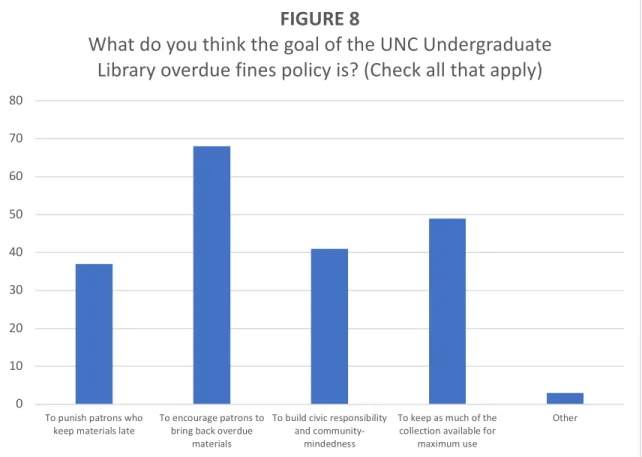
The last section of quantitative data questions from the survey asked about student understanding and perceptions of the UL fines policy, as well as student experiences with the fines policy. When asked what they think the goal of the UL overdue fines policy is,
0 2 4 6 8 10 12 14 16 18
In person at the UL Through the Cashier's
office in person Through the Cashier'soffice online Other
FIGURE 6
How did you pay your library fine?
0 2 4 6 8 10 12 14 16 18
Yes, I appealed and was
successful appeal was not successfulYes, I appealed, but my No, I have never appealed Other
FIGURE 7
Figure 8 shows that the most popular response was “to encourage patrons to bring back overdue materials.” When asked about how they felt when they received a fine from the library in, Figure 9 shows that most students responded with “irritated at myself”, and “irritated at the library.” Finally, when asked about their satisfaction with the current fines policy, Figure 10 shows that 53 students said they felt “neither satisfied nor
dissatisfied”, 11 students felt extremely satisfied, 11 students felt moderately satisfied, 5 students felt slightly satisfied, 5 students felt moderately dissatisfied, 2 students felt extremely dissatisfied, and 1 student felt slightly dissatisfied.
0 10 20 30 40 50 60 70 80
To punish patrons who
keep materials late To encourage patrons tobring back overdue materials
To build civic responsibility and
community-mindedness
To keep as much of the collection available for
maximum use
Other
FIGURE 8
Overall, these results show that students primarily view the UL as a source of print and electronic equipment, although many students don’t use the UL for checking
0 5 10 15 20 25 Irrita ted at
myse lf
Irrita ted at
the l
ibrary Neutral Appr
eciat ive
Guilty Happ y Surp rised Unsu rpris ed Othe r
FIGURE 9
If you received a library fine from the Undergraduate
Library, how did that make you feel? (Check all that apply)
0 10 20 30 40 50 60 Extremely
satisfied Moderatelysatisfied satisfiedSlightly satisfied norNeither dissatisfied
Slightly
dissatisfied Moderatelydissatisfied dissatisfiedExtremely
FIGURE 10
out materials. As electronic equipment is the second-most popular item used by the students surveyed, this may have interesting implications for student experiences with fines and their perceptions as electronic equipment has a higher fine, ranging from a dollar to thirty dollars an hour rate, rather than the daily rate of $0.50 with regular printed material.
In regards to feelings towards the fines policy and the UL, students generally seemed to feel neutral to satisfied about the overdue fines policy as only 8 students total selected negative choices when asked about satisfaction. Additionally, rather than
viewing the fines policy as a punishment or a tool to shame users, most students reported that they thought the goal of the UL overdue fines policy was “to encourage patrons to bring back overdue materials,” implying that students view the policy as a defensive measure rather than offensive. However, these perceptions contrast slightly with the question that asked how students felt when they received a fine, as the most popular choices were “irritated at myself” and “irritated at the library”. Even though students in general may perceive the library and the fines policy positively on a broad level, when confronted with the actual experience of incurring a fine, their reaction is more negative.
Part 2: Survey Results – Qualitative Data
For the first free-response question, students were asked why they appealed their fine. Only four students responded to this, and each gave a different answer, saying that the fine was unfair, that they had failed at renewing the item, that they forgot to renew the item, or that they were unable to return the item.
For the second free-response question, students were asked what emotions they felt when getting a fine, and while most students selected one of the multiple-choice options, one student mentioned in the “other” category that they felt discouraged from using the library again.
For the third free-response question, students were asked why they had selected the emotions they did about receiving a fine. This question had a wide variety of
For the fourth free-response question, students were asked to explain their level of satisfaction with the fines policy. The top three themes for these responses were 1)
student unfamiliarity with the fines policy, 2) students thinking the fines policy is reasonable, and 3) students not having direct experience with the fines policy.
For the last free-response question, students were asked about general suggestions or changes they had for the overdue fines policy. The top three themes for these
responses were 1) no suggestions to make, 2) lowering fine rates, and 3) changing the fines policy structure. Many students who said they had no suggestions to make
mentioned that they did not know current policies and did not feel like they could make useful or knowledgeable suggestions. For students who responded with lowering fine rates, most did not go into specifics. However, a handful did mention that having a lower daily fee or putting a cap on daily overdue charges would still provide the financial incentive to get patrons to return books without putting excessive burden on them. For changing the fines policy structure, many students mentioned that the per hour fines were undesirable and were not understanding of student situations, where they are often in class and can’t immediately make it to the library to return items.
In particular, students who thought that the fines were too high had the most emotional responses, and in some extreme cases stated that they thought they were being taken advantage of by the library. In these cases, while these same students agreed that some sort of fine should be charged, they also had suggestions for changes to the fines policy structure that will still provide that financial incentive without the burden. Interestingly enough, the theme of personal responsibility came up more often than expected. Though students were rarely ever happy about paying fines, many of them stated that the fine resulted from their own lack of care and foresight and that they understood why they had received the fine. The actual payment of the fine was undesirable, but students did not begrudge the library for charging.
Part 3: Semi-Structured Interviews with Students
The ten semi-structured interviews that were conducted with students consisted of five questions that were asked to all students, and then a few additional questions
depending on student responses. The questions that were asked to all students covered topics such as use of the UL, personal experience with fines, opinions of the fines policy, and whether these factors affected student use of the UL. To see a full list of the
questions asked, please see Appendix 5.
At the top level, responses were divided up into four different categories: 1) money, 2) complaints and suggestions, 3) perceptions and feelings, and 4) perception and use of the UL. While much of the information stated in these interviews were
allowed for much more explanation of participant responses and a much more holistic view of student perceptions of fines.
In responses coded under money, some students again mentioned the financial burden of paying fines, especially in combination with the fees that many students pay for textbooks, tuition, and other expenses. In some cases, some students expressed feeling like the library was profiting off of fines, which seemed unfair to them. However, one student had the exact opposite opinion, where they believed that the fines were not a big monetary impact at all and created little financial stress with their presence. One area that students did seem to be in agreement, however, was that the fine payment process was inconvenient and confusing. Students described going to the library to pay their fine, only to be told to go to the Cashier’s office to pay in person, or that the fine would post to their Connect Carolina account. There didn’t seem to be clear understanding as to what the exact process was for paying, which added to the annoyance of some students at having the fine.
taking school breaks into consideration with due dates. One surprising suggestion that stood out from all the others was one student suggesting that the fines rates should be increased in order to make more patrons return books. While such a suggestion would probably be very unpopular with many other students, it does show that some students, although they may be a small minority, think that the current policy is too lenient and is not as effective as it could be.
The code category with the most amount of responses and information was the perceptions and feelings category. The feelings section was subdivided into negative, neutral/positive, mixed, and other feelings, and the perceptions section was subdivided into fine benefits, effects, and purposes. In regards to feelings about the fines policy, most responses were neutral to positive, with matches with the results from the survey above. The most often used words to describe the policy were “reasonable”, “fair”, and “makes sense.” Most people were in support of having a fines policy, and in some cases, students commented how it was necessary, otherwise the library would not have as many
resources available for everyone to use.
interviews and in the survey. However, there were some students in the interview who did express a positive view of the fines policy, even after having to pay one themselves.
A few people did not have a binary view of the fines policy and expressed mixed feelings in their interview. As mentioned from the survey analysis above, some students disliked having to pay money, but didn’t want to take away from other patron access and understood the necessity of the fines system. Other students mentioned the idea of personal responsibility and being surprised that they had forgotten a due date, and in a very unique opinion, one student commented on how they thought the fines should be higher, as many times the books that they needed were listed as unavailable and overdue in the catalog and so current fine rates were not high enough to get people to return things on time.
Beyond personal feelings that students had about the fines policy, students also expressed what they thought the purpose of the fines policy was. By far, the most popular response was to keep things available for people to use and to ensure that people return things. Many students mentioned how they didn’t think the library was trying to actively punish or penalize people with overdue materials, that they believed the fines system helped to keep things available as much as possible, and that the fines system helped students be responsible and accountable. Additionally, on a more basic level, students said that the fines system helped serve as a reminder to return books as one student said that they would probably never remember when books were due without the financial incentive.
reserve being the second most popular usage. Print materials were third on the list, with computers/printing, and sleeping and tech items coming in at fourth, fifth, and sixth. These results give a clearer picture to the survey question above which asked about which materials students check out from the UL. Many students responded with “I don’t check out materials from the UL”, and their use of the UL as a study space helps explain this.
When asked about their perceptions of the UL, many students said that it was loud, had great services, and was very welcoming. Students enjoyed the 24 hours schedule of the UL, and also liked the variety of materials and spaces it offered. While the overall view of the UL was positive, one or two students mentioned how the UL seemed creepy, or depressing, or small, and that they didn’t like spending that much time in there.
When asked about if their experiences with fines changed how they use the library, most students said there was no change at all, regardless of if they had incurred a fine before or not. A few students mentioned how the fines made them more careful in returning books on time, but one student explicitly said that need of books and materials overrides fear of fines and they would use them regardless of potential fines in the future.
On the other side, however, two students mentioned that their experiences with fines did change the way they used the library. In both cases, the students try to avoid checking out books and only use the materials they need in the library, and they only use the library for class purposes, not for pleasure reading or personal use.
and have not yet had personal experience with a fine at the UL but still view the policy as a whole in a neutral to positive way. Some suggestions were made for changes to the policy, the most popular of which was getting rid of hourly fines, but most students agreed that having a fines policy kept more books available for everyone to use and thought it was a reasonable and necessary system to have.
Part 4: Semi-Structured Interviews with UL Staff
The semi-structured interviews conducted with two UL staff members consisted of five questions. A couple of the questions were similar to the ones asked of the students in the semi-structured interviews, such as how the fines policy affected staff workflow, as well as their general opinion on the fines policy. For a complete list of the questions asked in these interviews, please see Appendix 5.
The first question asked was whether or not the fines policy had changed at all during their time at the UL, and the general consensus was that it hadn’t changed very much. They noted that with the laptops, the per hour fine was changed from 15 dollars for partial hours and 30 dollars for full hours to a flat rate of 30 dollars for both partial and full hours. Besides that, however, everything else has stayed the same in the past three or four years.
responses. Another comment was that it was fairly common to have to explain the fines policy multiple times a week to patrons, as well as explain that unawareness of policies does not excuse patrons from their effect. Often times, once policies were explained to patrons, staff members said that most of them were understanding and saw the reason behind their fine and were satisfied with the explanation. However, one staff member made the interesting observation that patrons seemed to get more upset with the per hour fine, such as getting a dollar fine for turning in a computer charger late, as opposed to a larger monetary fine, such as being charged twenty dollars for turning in 15 books after they were overdue for a week. This seems to suggest that in some cases, the amount of the fine isn’t the main reason for anger; rather, it’s the circumstances and the perceived “price” of the amount of time overdue. This might also explain the high number of complaints over the per hour fines, as well as the many suggestions to get rid of them.
The third question asked what UL staff members thought of the fines policy overall. Responses were somewhat mixed over this – both staff members understood the reasons behind the fines policy but still had concerns and suggestions for change.
However, the areas of concern were very different. One person had more philosophical concerns with the fines policy, particularly regarding the financial burden that is
simplify those parts of the policy for greater understanding. Additionally, they mentioned that a lesser daily overdue fine, such as 25 cents a day instead of 50 cents, might still provide the financial incentive to get patrons to return books without putting as much of a financial burden on them.
The fourth question asked what staff members thought the purpose of the fines policy was. Both staff members talked about how the fines policy was meant to
encourage people to bring things back to the library. One staff member talked about how the fines policy helps to guard against the instinct to think only of yourself, particularly with items that are in high demand. They talked about how there are certain resources that would never be on the shelves if it weren’t for a fines policy, and how demonstrated consequence can help ensure access to everyone. One other thing that staff members noted is that often times, students don’t seem displeased with the fines policy. They noted that it is fairly common for students to ask why they received a fine, but once it was explained to them, their reaction is one of understanding. With a few exceptions, they have not noted negative reactions from students who have received fines.
Part 5: Comparing Staff and Student Responses
given that they have to explain it so often and that many students are surprised or confused as to what they are being fined for. As staff members commented on how unawareness of fines is often what led to more negative emotions in patron reactions, it would be interesting to see what the effects of a more concentrated publicity campaign might be on student perception of fines, as well as patron-staff interactions.
Not surprisingly, students seem to be a little more aware of the financial effects of fines as opposed to staff members. While staff members did comment on the potential for financial burden, students were much more vocal about the effects of fines and how they disliked paying money. In some cases, this was enough to make some students not use the library anymore, although there were also many students who did pay fines and continued to use the library in the same manner. Interestingly enough, some of the suggestions from students who no longer used the library because of fines matched up with some of the staff member suggestions, particularly the one about reducing the daily fine rate. It seems like a lower rate could still provide incentive for people to return without the stress of large fine amounts.
some ways, perhaps that limited their ability to talk in more nuanced terms about the fines policy, in comparison to the staff members.
Conclusions
Looking at the data collected above, it is possible to now revisit and answer the research questions put forth at the beginning of this study:
1. What experiences do undergraduate students at UNC have with the UL fines policy, and how do those experiences affect their perceptions of the UL fines policy?
hour fines, and these students saw the fines policy as a way for the library to make money off of students.
2. How do those perceptions and experiences affect undergraduate student use of the UL and its services?
Almost all of the students interviewed said that their experience with the fines policy did not affect their use of the UL and its services. In some cases, they said that their experiences with fines made them be more careful about returning books on time, but in terms of actually using their library, the fines policy had no effect. Need was cited as more important than the consequence in other cases and many people said the fine amount was small enough where it wasn’t a big deal to pay it if they needed to.
However, a handful of students did say that they no longer used the UL and its services because of their fine experiences. While all of the fine experiences of the
students who continued to use the library in the same manner had been fairly neutral, the fine experiences of this group of students was overwhelmingly negative to the point that they no longer check out books and materials.
3. What experiences do UL staff members have with the UL fines policy and how do those experiences affect their perceptions of the UL fines policy?
collection accessible was most important and the fines policy played a vital role in that, whereas another staff member felt like the fines policy created a barrier to access and perhaps dissuaded use for students. However, it was interesting to note that staff
members and students overlapped in one suggestion for change, which was lowering the daily overdue rate so that the financial incentive to return books was still present without creating large fine amounts for students to pay.
Reflections
While these results do provide an in-depth look at how undergraduate students and staff members view the fines policy at the UL, there are still many other areas for research that could be pursued in more detail. Questions that are still left unanswered include:
1. What do students consider to be a fair price for a fine? Does this differ between per hour and daily fines?
2. What in particular about the fines experience led students to classify it as a negative or a positive one? Was it the payment process, the notification process, interaction with staff, unawareness of the fines policy beforehand?
4. How do results change with larger sample sizes? How do these results change if the project scope included all UNC libraries as opposed to one specific branch library?
5. How do appeals affect student perceptions of the fines policy? Is staff interaction more important in determining if an experience is positive/negative, or is it whether or not an appeal is successful?
Bibliography
Secondary Print Sources
Adomi, E. E. (2003). Attitudes of university library users towards overdue fines in Nigeria. Library Review, 16(1511), 19–24. Retrieved from
https://doi.org/10.1108/08880450310464027.
Anderson, B. (1984). The Fines#No Fines Debate. Library and Archival Security, 6(2–3), 105–111.
Anderson, C. V. (2008). Are fines fine? A mixed methods study of the effectiveness of and attitudes to overdue fines among various borrower groups (age, gender,
ethnicity, student status, faculty and degree) of the University of Canterbury Library, (June), 1–264. Retrieved from
www.library.canterbury.ac.nz/files/news/AndersonCINFO580ResearchReport.pdf Association, A. L. (2014). Fines and Overdues. Retrieved October 11, 2017, from
http://www.ala.org/tools/atoz/fines-and-overdues
Bobinski, G. S. (1968). Carnegie Libraries their history and impact on american public library development. ALA Bulletin, 62(11), 1361–1367. Retrieved from
http://www.jstor.org.libproxy.lib.unc.edu/stable/pdf/25698025.pdf
Boyce, C. (2014). Practice Makes Perfect: Updating Borrowing Policies and Practices at a Small Academic Library. Journal of Access Services, 11(4), 282–297.
https://doi.org/10.1080/15367967.2014.945119
Overdues: Analysis, Strategies, and Solutions to the Problem (pp. 1–5). New York:
The Haworth Press.
Edewor, N. (2010). Staff Users and Overdue Fines in Nigerian Polytechnic Libraries. Library Philosophy & Practice, 1–5. Retrieved from
http://search.ebscohost.com/login.aspx?direct=true&db=lxh&AN=56660088&site=e
host-live&scope=site%5Cnhttp://search.ebscohost.com/login.aspx?direct=true&db=lxh& AN=51841384&site=ehost-live&scope=site
Farrington, J. W. (1984). Overdues and Academic Libraries: Matters of Access and Collection Control. Library Overdues: Analysis, Strategies, and Solutions to the Problem, 6(2–3), 67–75. https://doi.org/10.1300/J114v06n02
Hartse, M. A., & Lee, D. R. (1993). Changing Circulation Policies at an ARL Library: The Impact of Peer Institution Survey Data on the Process. Collection Management, 17(1–2), 133–148. Retrieved from
http://www.tandfonline.com.libproxy.lib.unc.edu/doi/pdf/10.1300/J105v17n01_09?n eedAccess=true
Mcmenemy, D. (2003). On library fines: Ensuring civic responsibility or an easy income stream? Library Review, 59(8), 78–81. Retrieved from
https://doi.org/10.1108/00242531011023835
Mosley, P. A. (2004). Moving Away from Overdue Fines: One Academic Library’s New Direction. Journal of Access Services, 2(1). https://doi.org/10.1300/J204v02n01_03 Nwamefor, R. C. (1974). Problem of Fines in University Libraries Reconsidered. New
Rupp, E., Sweetman, K., & Perry, D. (2010). Updating Circulation Policy for the 21st Century. Journal of Access Services, 7, 159–175.
https://doi.org/10.1080/15367967.2010.484787
Shontz, D. (1999). Effect of fines on length of checkout and overdues in a medical library. Bulletin of the Medical Library Association, 87(1), 82–84. Retrieved from http://search.proquest.com/docview/57452299?accountid=12543%5Cnhttp://opurl.bi
b.umontreal.ca:9003/sfx_local?url_ver=Z39.88-2004&rft_val_fmt=info:ofi/fmt:kev:mtx:journal&genre=article&sid=ProQ:ProQ%3 Alisashell&atitle=Effect+of+fines+on+length+of+checkout+a
Sung, J. S., & Tolppanen, B. P. (2013). Do Library Fines Work?: Analysis of the Effectiveness of Fines on Patron’s Return Behavior at Two Mid-sized Academic Libraries. The Journal of Academic Librarianship, 39(6), 506–511.
https://doi.org/10.1016/j.acalib.2013.08.011
Wilson, D. (2014). Why Can’t They Keep the Book Longer and Do We Really Need to Charge Fines? Assessing Circulation Policies at the Harold B. Lee Library: A Case Study. Journal of Access Services, 11, 135–149.
https://doi.org/10.1080/15367967.2014.914815
Wilson, D., Frazier, C., & Harter, D. (2015). Circulation Policies in Major Academic Libraries. The Journal of Academic Librarianship, 41, 798–803.
https://doi.org/10.1016/j.acalib.2015.08.019
Primary Sources
Public Service, Subseries 1: Committees - Fines, no date. The Louis Round
Wilson Special Collections Library. University of North Carolina at Chapel Hill.
Annual Report, Undergraduate Library, 1964 - 1965. Academic Affairs Library, Librarian’s Records, Series 4: Public Service, Subseries 13: Undergraduate Library, Annual Reports 1962 - 1965. The Louis Round Wilson Special Collections Library. University of North Carolina at Chapel Hill.
Annual Report, Undergraduate Library, 1967 - 1968. Academic Affairs Library, Librarian’s Records, Series 4: Public Service, Subseries 13: Undergraduate Library, Annual Reports 1962 - 1965. The Louis Round Wilson Special Collections Library. University of North Carolina at Chapel Hill.
Collecting Fines. Academic Affairs Library Librarian’s Records, Series 4: Public
Service, Subseries 1: Fines and Fees, 1927; 1939 - 1942. The Louis Round
Wilson Special Collections Library. University of North Carolina at Chapel Hill.
Contingency Plan for Reduced Student Assistant Budget for Undergraduate
Library. Academic Affairs Library Librarian’s Records, Series 4: Public Service, Subseries 13: Undergraduate Library, Correspondence 1983 - 1985. The Louis Round Wilson Special Collections Library. University of North Carolina at Chapel Hill.
Fines in the Library During the Last Seven Years. Academic Affairs Library
Librarian’s Records, Series 4: Public Service, Subseries 1: Fines and Fees, 1927;
1939 - 1942. The Louis Round Wilson Special Collections Library. University of
North Carolina at Chapel Hill.
Librarian’s Records, Series 4: Public Service, Subseries 13: Undergraduate Library, Correspondence 1958 - 1974. The Louis Round Wilson Special Collections Library. University of North Carolina at Chapel Hill.
Letter from Philip Koltun to Susan H. Ehringhaus. Academic Affairs Library, Librarian’s Records, Series 4: Public Service, Subseries 13: Undergraduate Library,
Correspondence 1980 - 1982. The Louis Round Wilson Special Collections Library. University of North Carolina at Chapel Hill.
Memorandum from David Taylor to Karen Seibert. Academic Affairs Library
Librarian’s Records, Series 4: Public Service, Subseries 13: Undergraduate Library,
Correspondence 1983 - 1985. The Louis Round Wilson Special Collections Library.
Appendices
Appendix 1 – The Undergraduate Library Fines Policy Loan Periods
General Collection and Popular Reading Collection: 30 days
Media Resources Center Collection: Videos, other media, and MRC equipment vary by format. See MRC Policies for loan periods.
Reserve Materials: Most reserve books can be checked out for 2 hours, overnight, 24 hours, or 7 days. Some items are for use only in the Undergraduate Library. All reserve loans convert to two-hour loans during exams. Alternatively, most reserve books may be used in the Reserve Reading Room. If you wish to use a reserve book outside of this room, you must check it out at the Reserve Desk. A scanner and photocopier are available in the Reserve Reading Room computer area.
Equipment and accessories: Most equipment can be checked out for 3 hours to be used in the Undergraduate Library. See the complete equipment list for more details.
Magazines and Newspapers (Serials/Periodicals): Current and bound periodicals are for in library use only and cannot be checked out. However, scanners and copiers are available for duplication of materials.
Borrowing Limits
General and Popular Reading Collection Books: no limits. Reserve items: 3 at a time.
Videos and DVDs: 3 DVDs and a total of 3 of any other Media Resources Center items. See MRC Policiesfor specific information.
Renewals
• Books may be renewed in-person or online for three additional loan periods, with some exceptions.
• Online renewal is not available between 2 a.m. and 6 a.m.
• Items not renewed on or before their due dates may lead to overdue fines, which could disallow further renewals on the account until the fines are paid.
• Renewals may be denied due to outstanding fines, expired borrower’s card, or book recalls (request by another patron or for course reserves).
• Reserve renewals can only be made in person at the Reserve Desk from which it was checked out.
• Only Screenplays can be renewed in person at the Media Resources Center. See MRC Policies.
• Laptops may be renewed once. Fines
Fines on items borrowed from the Undergraduate Library are $0.50 per day, per item (up to $25 maximum per item) with the following exceptions:
• Recalled items: Additional $0.50 per day each day past the recall adjusted due date.
• Reserve items and computer accessories: $1 per hour per item; up to $50 maximum per item.
• Overdue laptop: $30 per hour, with no maximum overdue charge.
• Media Resources Center materials: $1 a day per item; up to $25 maximum per item.
• Media Resources Center equipment: $30 per hour, with no maximum overdue charge.
• Lost or damaged books. See the libraries’ lost or damaged book policy.
• Lost or damaged Reserve Books: 7 days after due date, patrons are billed replacement cost of $125 ($100 replacement plus $25 processing).
• Lost or damaged media charges vary by item type. See MRC Policies.
• Appeal of Library Charges form
• If you have any questions about fines and billing, please email [email protected].
Recalls
Appendix 2 – Adult IRB Consent Form University of North Carolina at Chapel Hill Consent to Participate in a Research Study Adult Participants
Consent Form Version Date: ______________ IRB Study # 17-2654
Title of Study: Overdue Fines in the Academic Library: Undergraduate Student Perception at the UNC Undergraduate Library and How it Affects Use of Borrowing Services
Principal Investigator: Amelea Kim
Principal Investigator Department: School of Information and Library Science Principal Investigator Phone number: 636-675-4319
Principal Investigator Email Address: [email protected] Faculty Advisor: Mary Grace Flaherty
Faculty Advisor Contact Information: 919-962-5982
_________________________________________________________________ What are some general things you should know about research studies?
You are being asked to take part in a research study. To join the study is voluntary. You may choose not to participate, or you may withdraw your consent to be in the study, for any reason, without penalty.
Research studies are designed to obtain new knowledge. This new information may help people in the future. You may not receive any direct benefit from being in the research study. There also may be risks to being in research studies.
Details about this study are discussed below. It is important that you understand this information so that you can make an informed choice about being in this research study. You will be given a copy of this consent form. You should ask the researchers named above, or staff members who may assist them, any questions you have about this study at any time.
What is the purpose of this study?
The purpose of this research study is to determine UNC undergraduate student
This research study will collect data from undergraduate students at UNC using a
Qualtrics survey, as well as voluntary semi-structured interviews with both undergraduate students and UL staff members.
Are there any reasons you should not be in this study?
You should not be in this study if you are not a current undergraduate student at UNC-Chapel Hill.
How many people will take part in this study?
There will be approximately 200 people in this research study. How long will your part in this study last?
For undergraduate students: Participation in the Qualtrics survey will require approximately 10 minutes of your time. If you wish to further participate, you can volunteer for a semi-structured interview with the researcher that will take about 30 minutes. There will not be any follow-up for the Qualtrics survey, however, there may be follow-up questions sent via email or in-person to students who participate in the semi-structured interview.
For UL staff members: You can choose to participate in a semi-structured interview with the researcher that will take about 30 minutes. Depending on the interview, there may be follow-up questions that will be sent via email or in-person to participants.
What will happen if you take part in the study?
For undergraduate students who participate in the Qualtrics survey:
• Your participation will be limited to a 10-minute Qualtrics survey that you will access through a link sent to you via email.
• You can choose to write your name or not. If you write your name, you will be entered into a drawing for two $50 prizes that will be awarded once the Qualtrics survey collection finishes in February.
• If you wish to participate in the semi-structured interview, you must write your name so that the researcher can contact you and set up an interview time.
• Your answers will be kept strictly confidential and will not made publicly available.
• At any point in time during the survey, you can choose to exit and not finish. For undergraduate students who participate in the semi-structured interview:
• In order to participate in the semi-structured interview, you must first fill out the Qualtrics survey, described above.
• The interview will take place on campus.
• The interview, with your consent, will be recorded for the researcher’s reference. If consent for recording is not given, then the researcher will take notes by hand. For UL staff members who participate in the semi-structured interview:
• Participation in the semi-structured interview is entirely voluntary.
• The researcher will contact you via email to set up an interview time. The
researcher will schedule a one-hour time slot, though the actual interview itself is only estimated to take 30 minutes.
• The interview will take place on campus.
• The interview, with your consent, will be recorded for the researcher’s reference. If consent for recording is not given, then the researcher will take notes by hand. What are the possible benefits from being in this study?
Research is designed to benefit society by gaining new knowledge. You will not benefit personally from being in this research study.
What are the possible risks or discomforts involved from being in this study?
There is little to no risk involved in participating in this study. There may be uncommon or previously unknown risks. You should report any problems to the researcher.
What if we learn about new findings or information during the study?
You will be given any new information gained during the course of the study that might affect your willingness to continue your participation.
How will information about you be protected?
The researcher has taken care to make sure that the privacy of all study participants will be respected. The Qualtrics survey is onyen-protected and the results will only be
accessible to the primary researcher. Participants in the survey can choose whether or not they would like to write their name, and the questions asked in the survey are very broad, so it would be difficult to determine identity from the answers.
For the semi-structured interviews, only the researcher will have access to the notes and transcripts of the interview and will not make those materials publicly available. All materials, including questions, notes, transcripts, and audio files, will be stored in onyen-protected locations to further ensure that only the researcher can access this information. Once the researcher has finished with the study in May 2018, all materials will be deleted and disposed of.
Participants will not be identified in any report or publication about this study. Although every effort will be made to keep research records private, there may be times when federal or state law requires the disclosure of such records, including personal