Staff Nurse Perceptions:
Exploring Management, Burnout and Patient Safety
Jennifer R. Reynolds
A project presented to the faculty of
The University of North Carolina at Chapel Hill in fulfillment of the requirements
for Undergraduate Honors
Date Completed: April 8, 2016
Honors Advisory Approval: _____Rebecca R. Kitzmiller______ Rebecca Kitzmiller, PhD, MHR, RN, BC
Abstract:
Nurse burnout is a problem affecting patient safety in all hospitals. Studies suggest that perception of management and teamwork are inversely related to level of burnout and can potentially be related to perception of patient safety. Therefore this study explored the relationships between perceptions of management, teamwork, burnout and patient safety. A secondary data analysis was completed on an AHRQ survey done in early 2015 that explored nurse perceptions of management, teamwork, burnout and patient safety. Responses from 595 nurses on 27 units were analyzed through One-Way ANOVAs and Tukey-Kramer Least Square Means comparisons to explore these perceptions. Relationships between perceived management support, burnout and patient safety as well as perceived teamwork, burnout and patient safety were observed at the hospital level. There were interactions found based on intensity of care (intensive care units: lower management, teamwork and patient safety; higher burnout) and patient populations (Children’s Hospital: lower management, teamwork and patient safety; higher burnout) compared to those within each groups. Results were as expected and comparable to other studies for perceptions based on hospital and intensity of care groupings. Patient
population findings were not as expected with the Children’s Hospital having greater burnout and lower perceptions of management, teamwork and patient safety compared to adult
Staff Nurse Perceptions:
Exploring Management, Burnout and Patient Safety
Burnout, its effects on work output and how to prevent it have been studied for a long time in a number of career fields. Studies examined burnout among nurses for many decades documenting burnouts prevalence across the profession. If high levels of burnout are present, a nurse’s work output or quality of care is affected and potential patient safety issues can occur (Poghosyan,Clarke, Finlayson, & Aiken 2010). Many different determinants of burnout have been examined extensively in order to try to determine key aspects for prevention (Cañadas-De la Fuente, Vargas, San Luis, García, Cañadas, & De, la Fuente 2015) with management and teamwork having key roles (Buffington, Zwink, Fink, DeVine, & Sanders 2012; Laschinger, Wong & Grau2014; Van Bogaert, Clarke, Roelant, Meulemans, & Van de Heyning, 2010). Therefore, this study will explore how nurse perceptions of management and teamwork affect nurse-reported levels of burnout and perceptions of patient safety.
Literature Review
Burnout Affects Patient Safety
Research findings note that burnout is a major contributing factor in lower patient safety levels (Poghosyan, et. al. 2010). Defined as a psychological syndrome comprised of emotional exhaustion, a tendency to depersonalize client encounters, and a reduced sense of personal accomplishment, burnout has been shown to negatively influence job performance of professionals that are unable to combat it (Maslach, 1982). For nurses, burnout is prevalent throughout the profession despite the type of unit or patient population and is associated with low perception of patient safety (Profit, Sharek, Amspoker, Kowalkowski, Nisbet, Thomas, Chadwick, Sexton, 2014; Teng, Shyu, Chiou, Fan, & Lam, 2010) regardless of nurse
characteristics and working conditions such as nurse to patient ratios and lack of flexibility in self-scheduling shifts and off days (Poghosyan, et. al. 2010, Buffington, et. al., 2012).
Studies show that as the degree of burnout increases, nurses becoming increasingly dissatisfied with their jobs and report greater intent to leave (Buffington, et. al., 2012; Vargas, Cañadas, Aguayo, Fernández, & De la Fuente, 2014; Liu, Wu, Chou, Chen, Yang, & Hsu, 2016). As more nurses leave, workloads increase which causes an increase in stress and higher levels of exhaustion and depersonalization which cause higher job dissatisfaction among nurses that are still working on the unit (Alonazi & Omar, 2013; Vargas, et al., 2014). Halbesleben, Wakefield, Wakefield, & Cooper (2008) found that as the reported levels of exhaustion and
Perception of Management
As a whole, nurses report feeling a lack of support and recognition from management, which has led to higher rates of reported burnout and intent to leave (Buffington, et. al., 2012), especially when higher job strain is involved such as those experienced when new safety initiatives are mandated by higher level management (Nei, Snyder, & Litwiller, 2015). When nurses believe their immediate supervisors and higher level managers are more supportive, the level of reported burnout decreases (Cañades-De la Fuente et al., 2015; Nei, Snyder, & Litwiller, 2015; Laschinger, Wong, & Grau, 2014) and perception of quality of care increases (Van
Bogaert, et al., 2010). Further, as nursing management involvement in patient safety decisions and support increases, nurses report lower levels of burnout and higher perceptions of patient safety (Sexton, Sharek, Thomas, Gould, Nisbet, Amspoker, Kowalkowski, Schwendimann & Profit, 2014).
While many studies have explored the relationships between management support, burnout and patient safety on a one-to-one basis, only one other study has explored how
Teamwork As A Mediator
Studies have shown that unit teamwork is a possible way to combat low leadership support and high burnout in order to prevent negative patient safety outcomes. Nursing units that foster high levels of teamwork by reported aspects like showing respect and caring for one another can be a protective buffer against high levels of burnout, despite the amount of
disorganization and work overload (Pereira, Fonseca, & Carvalho, 2012). Also, in a study done by Van Bogaert, Timmermans, Weeks, Van Heusden, Wouters, & Franck (2014), higher reported values for teamwork components, such as trust and working together, along with management support positively affected the nurse-reported quality of care and patient safety. However, there have been no studies that examined how teamwork could possibly mediate low perception of management support. This study will explore how the perception of teamwork effects burnout and patient safety in relation to management support.
Aims
Methods
Southern Hospital (pseudonym) participates in a biennial assessment of hospital staff’s perception of patient safety culture using the Agency for Healthcare Research and Quality’s Hospital Survey on Patient Safety Culture (AHRQ, February, 2016). For the 2015 assessment,
Southern Hospital also used an abbreviated version of Maslach’s Burnout Inventory called the
Resilience Survey. This secondary data analysis was conducted following Institutional Research
Board approval.
Interest in burnout among direct care nurses who work on 24-hour care units guided the
sample selection. (Van Bogaert, et al., 2010). The sample included completed surveys only from
registered nurses that typically had direct interaction or contact with patients.. Units were
excluded if they had less than 10 respondents. Individuals were excluded if they failed to
complete at least 50% of the survey. Of those respondents that had less than 50% of missing
numerical data, values were imputed based on the unit average. The resulting data set included
595 nurses from 27 different units.
Measures
Surveys were distributed electronically in early 2015 by management and unit
champions encouraged staff to participate. Unit staff were informed that this survey was part of a
hospital initiative to better understand how hospital staff perceived patient safety on their unit. All surveys were completed on a voluntary basis with no incentives. Surveys included The
Agency for Healthcare Research and Quality’s Hospital Survey on Patient Safety Culture Survey
and an abbreviated version of Maslach’s Burnout Inventory called the Resilience Survey
Nurse perception of management was measured by summing each individual’s ratings on
the Hospital Survey on Patient Safety for questions B1 (“My supervisor/manager says a good
word when he/she sees a job done according to established patient safety procedures”), B2: (“My supervisor/manager seriously considers staff suggestions for improving patient safety”), B3: (“Whenever pressure builds up, my supervisor/manager wants us to work faster, even if it means
taking shortcuts”), and B4: (“My supervisor/manager overlooks patient safety problems that happen over and over”). Questions B3 and B4 were reverse scored in order for all high scores to reflect positive perception of management. Participant responded to each question using a Likert Scale of 1 to 5 (1= Strongly Disagree, 2=Disagree, 3=Neither, 4=Agree, 5=Strongly Agree). Summed together, individuals’ overall responses could range from 4 to 20, with 4 reflecting low perception of management and 20 reflecting high perception of management.
Nurse perception of patient safety was measured by summing each individual’s ratings for the following questions: A5: (“Staff in this unit work longer hours than is best for patient
care”), A6: (“We are actively doing things to improve patient safety”), A13: (“After we make changes to improve patient safety, we evaluate their effectiveness”), A15: (”Patient safety is never sacrificed to get more work done”), A17: (“We have patient safety problems in this unit”), and A18: (“Our procedures and systems are good at preventing errors from happening“) .
Nurse perception of teamwork was measured by summing each individual’s ratings for questions A1: (“People support one another in this unit“), A3: (“When a lot of work needs to be
done quickly, we work together as a team to get the work done”), A4: (” In this unit, people treat each other with respect”), and A11: (“When one area in this unit gets really busy, others help out”). Participant responded to each question using a Likert Scale of 1 to 5 (1= Strongly
Disagree, 2=Disagree, 3=Neither, 4=Agree, 5=Strongly Agree). Summed together, individuals’ overall responses could range from 4 to 20 with 4 reflecting low perception of teamwork and 20
reflecting high perception of teamwork.
Nurse perception of burnout was measured by summing each individual’s rating of the four Resilience Survey questions: “I feel frustrated by my job”, “I feel burned out from my work”, “I feel fatigued when I get up in the morning and a have to face another day on the job”
and “I feel like I’m working too hard on my job”. Participant responded to each question using a
Likert Scale of 1 to 5 (1= Strongly Disagree, 2=Disagree, 3=Neither, 4=Agree, 5=Strongly Agree). Summed together, individuals’ overall responses could range from 4 to 20 with 4 reflecting low levels of burn out and 20 reflecting high levels of burn out.
Analysis
We used descriptive statistics to describe the mean and standard deviation for responses
grouped by units, intensity of care and patient population to our four areas of interest:
perceptions of management, team work, burnout and patient safety. One-Way ANOVAs were
done to compare the differences in scores of perceptions of management, teamwork, patient
safety and burnout versus one another. For further analysis, Tukey-Kramer Least Square Means
comparisons were done to analyze the means of comparison in order to find which perception
compare the groups of level of care and patient population versus perceptions of management,
teamwork, patient safety and burnout in order to explore relationships between unit groups and
perceptions. Tukey-Kramer Least Square Means comparisons were then run to analyze the
means of comparison in order to find which unit groups significantly differed based on the type
Results
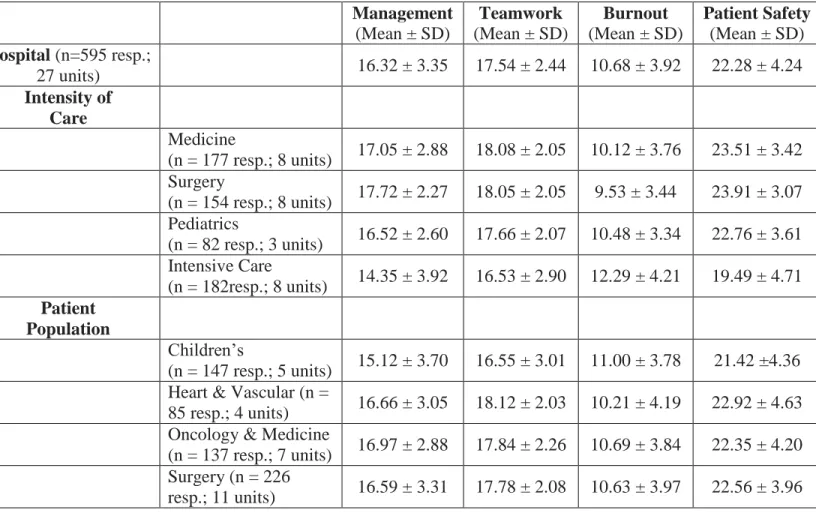
Initial review of data observed 2,436 individuals on 106 different units, which equated to > 60% response rate. The data set was reduced for this secondary analysis to 595 nurses on 27 different units after constraints were put in place. The 27 units were first categorized into four groups based on intensity of care as they identified in the survey (Medicine, Surgery, Pediatrics and Intensive Care) for one comparison of perceptions and again categorized into four groups based on patient population as organized by hospital organizational structure (Children’s Hospital, Heart & Vascular Services, Oncology & Medicine Services and Surgery Services) for an additional comparison of perceptions (Table 1).
Table 1: Descriptive Statistics Based on Groupings for Perceptions of Management, Teamwork, Burnout and Patient Safety
Management (Mean ± SD)
Teamwork (Mean ± SD)
Burnout (Mean ± SD)
Patient Safety (Mean ± SD) Hospital (n=595 resp.;
27 units) 16.32 ± 3.35 17.54 ± 2.44 10.68 ± 3.92 22.28 ± 4.24 Intensity of
Care
Medicine
(n = 177 resp.; 8 units) 17.05 ± 2.88 18.08 ± 2.05 10.12 ± 3.76 23.51 ± 3.42 Surgery
(n = 154 resp.; 8 units) 17.72 ± 2.27 18.05 ± 2.05 9.53 ± 3.44 23.91 ± 3.07 Pediatrics
(n = 82 resp.; 3 units) 16.52 ± 2.60 17.66 ± 2.07 10.48 ± 3.34 22.76 ± 3.61 Intensive Care
(n = 182resp.; 8 units) 14.35 ± 3.92 16.53 ± 2.90 12.29 ± 4.21 19.49 ± 4.71 Patient
Population
Children’s
(n = 147 resp.; 5 units) 15.12 ± 3.70 16.55 ± 3.01 11.00 ± 3.78 21.42 ±4.36 Heart & Vascular (n =
85 resp.; 4 units) 16.66 ± 3.05 18.12 ± 2.03 10.21 ± 4.19 22.92 ± 4.63 Oncology & Medicine
(n = 137 resp.; 7 units) 16.97 ± 2.88 17.84 ± 2.26 10.69 ± 3.84 22.35 ± 4.20 Surgery (n = 226
Perceptions of Management, Teamwork, Patient Safety and Burnout
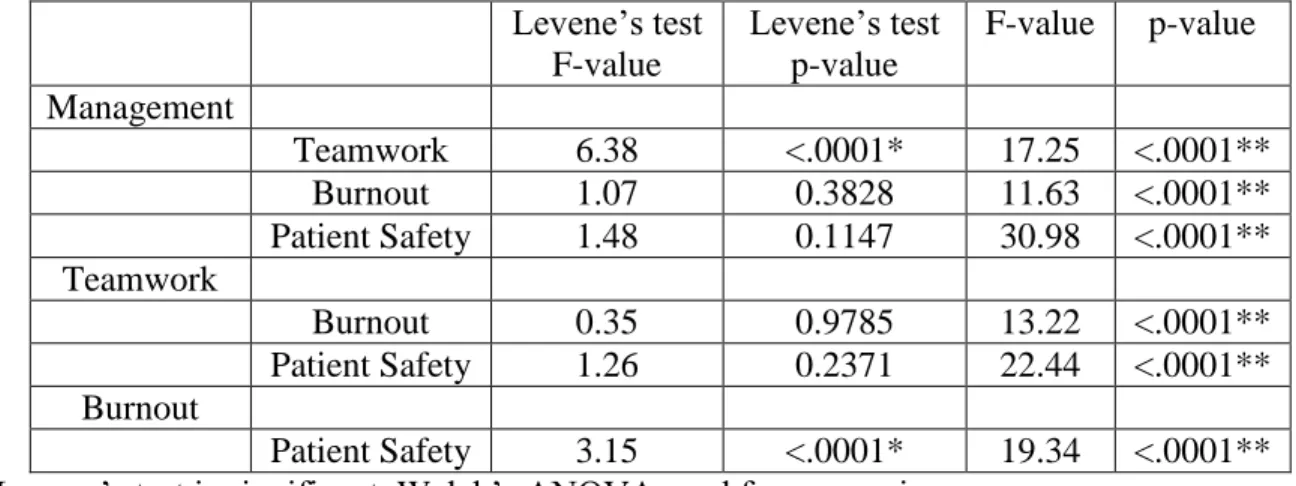
There were significant differences between the scores of perception in all variables (Table 2). As perception of management increased, perception of patient safety and teamwork increased while perception of burnout decreased. Also, as perception of teamwork increased, perception of patient safety increased and perception of burnout decreased. Furthermore, as perception of burnout increased, perception of patient safety decreased.
Table 2: Summary of ANOVAs for Perceptions of Management, Teamwork, Burnout and Patient Safety
Levene’s test F-value
Levene’s test p-value
F-value p-value Management
Teamwork 6.38 <.0001* 17.25 <.0001**
Burnout 1.07 0.3828 11.63 <.0001**
Patient Safety 1.48 0.1147 30.98 <.0001** Teamwork
Burnout 0.35 0.9785 13.22 <.0001**
Patient Safety 1.26 0.2371 22.44 <.0001** Burnout
Patient Safety 3.15 <.0001* 19.34 <.0001** * Levene’s test is significant, Welch’s ANOVA used for comparison
** Significant difference in means (a = 0.05)
Intensity of Care vs. Perceptions of Management, Teamwork, Patient Safety and Burnout
difference between Intensive Care versus Pediatrics, Medicine and Surgery with Intensive Care reporting the highest perception of burnout (12.29/20) and Surgery reporting the lowest
perceptions of burnout (9.53/20). For perception of patient safety, there was a significant difference between Intensive Care versus Pediatrics, Medicine and Surgery with Intensive Care reporting the lowest perception of patient safety (19.49/30) and Surgery reporting the highest perception of patient safety (23.91/30).
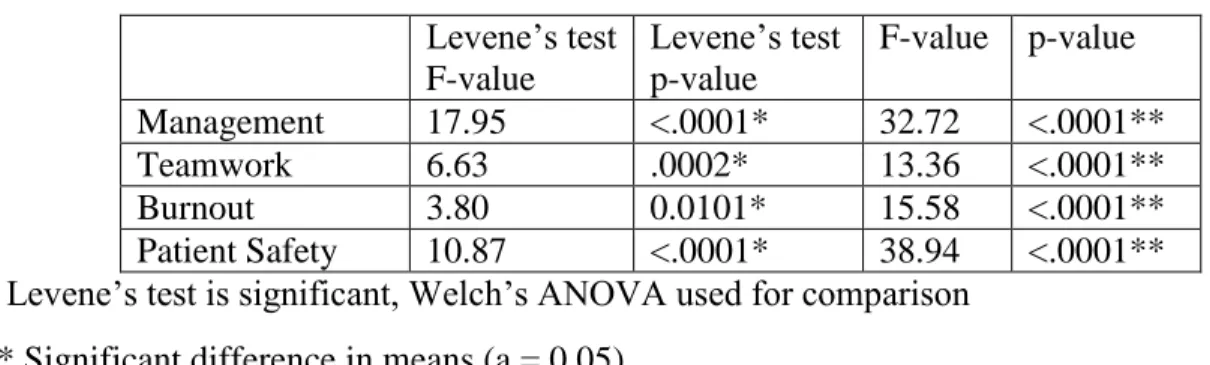
Table 3: Summary of ANOVAs for Intensity of Care
Levene’s test F-value
Levene’s test p-value
F-value p-value Management 17.95 <.0001* 32.72 <.0001**
Teamwork 6.63 .0002* 13.36 <.0001**
Burnout 3.80 0.0101* 15.58 <.0001**
Patient Safety 10.87 <.0001* 38.94 <.0001** * Levene’s test is significant, Welch’s ANOVA used for comparison
** Significant difference in means (a = 0.05)
Patient Population vs. Perceptions of Management, Teamwork, Patient Safety and Burnout
For perception of management, there were significant differences between Children’s versus Heart & Vascular, Oncology & Medicine and Surgery with Children’s reporting the lowest perception of management (15.12/20) and Surgery reporting the highest perception of management (16.97/20). For perception of teamwork, there were significant differences between Children’s versus Heart & Vascular, Oncology & Medicine and Surgery with Children’s
reporting the lowest perception of teamwork (16.55/20) and Heart & Vascular reporting the highest perception of teamwork (18.12/20). For perception of patient safety, there were
perception of patient safety (22.92/30). There was no significant difference for the perception of burnout across patient populations (means averaging 10.63 ± 0.21).
Table 4: Summary of ANOVA for Patient Population
Levene’s test F-value
Levene’s test p-value
F-value p-value
Management 2.46 0.0621 9.12 <.0001**
Teamwork 6.92 0.0001* 8.57 <.0001**
Burnout 0.56 0.6396 0.74 0.5282
Patient Safety 0.85 0.4684 3.02 0.0295** * Levene’s test is significant, Welch’s ANOVA used for comparison
Discussion
The results obtained in this study suggest that relationships exist between leadership support, teamwork, burnout and patient safety. Specifically, as the perception of leadership support increases, reported levels of burnout decrease. Further, as reported levels of burnout decrease, perceptions of patient safety increase. These results coincide with other studies where these relationships were examined independently (Buffington, et al., 2012; Laschinger, Wong & Grau, 2013; Liu, et al., 2016; Nei, Snyder, & Litwiller, 2015). The results also suggest that high perception of teamwork also coincides with low reported burnout and high perceptions of patient safety. Here too, study findings are similar, to others (Pereira, Fonseca, & Carvalho, 2012; Profit, et al., 2014; Van Bogaert, et al., 2014). Interestingly, we did not find mediator effects for
teamwork. At the hospital-level, high perceptions of teamwork did not negating low perceptions of leadership support. Therefore, this evidence suggests there is a relationship between high perception of leadership support and high perception of patient safety with no mediating effect of high perception of teamwork.
Regarding intensity of care, the results suggest that intensity does play a role in perception of leadership support, teamwork, burnout and patient safety. The Intensive Care setting reported the lowest perceived leadership support, lowest teamwork scores, highest
example, Surgery (L: 17.72 and TW: 18.05) and Medicine (L: 17.05 and TW: 18.08) show no significant differences between means in both categories.
Regarding patient populations, the results demonstrate that patient population may effect perceived leadership support, teamwork and patient safety, but not burnout. Children’s Hospital nurses reported the lowest perceptions for across these three categories. These results suggest that challenges are present that need to be addressed in providing care for children and their families that are not present in the adult populations of Heart & Vascular Services, Oncology & Medicine Services and Surgery Services. The population results could be skewed since intensive care units were distributed into each patient population based off of hospital allocation, for example. While studies have found that palliative care and certain ethnic races has been challenging (Pereira, Fonseca, & Carvalho, 2012; Cañadas-De la Fuente et al., 2015), this finding is relatively new in the literature.
Limitations
Implications for Practice
The findings of this study indicate that perception of management support and teamwork are both large components of unit culture. In response to this, nurse leaders should receive more information and training on offering support to their staff to ensure burnout levels decrease or remain low on their units thus ensuring optimal patient safety can be achieved with each patient interaction. Additionally, nurse leaders should also support teamwork initiatives on their units as an additional way to prevent burnout and ensure patient safety standards are followed.
Implications for Research
The findings of this study indicate a significant interaction between management support, burnout and patient safety as well as teamwork, burnout and patient safety. While no units or groupings saw incidents of low management perception and high teamwork perception, further research should be done to explore this possibility more.
Conclusion
References
Agency for Healthcare Research and Quality (AHRQ). (February, 2016). Hospital survey on patient Safety Culture. Retrieved from http://www.ahrq.gov/professionals/quality-patient-safety/patientsafetyculture/hospital/index.html.
Alonazi, N. A., & Omar, M. A. (2013). Factors affecting the retention of nurses. A survival analysis. Saudi Medical Journal, 34(3), 288-294 7p. Retrieved from https://auth-lib-unc-edu.libproxy.lib.unc.edu/ezproxy_auth.php?url=http://search.ebscohost.com.libproxy.lib.unc
.edu/login.aspx?direct=true&db=rzh&AN=107902768&site=ehost-live&scope=site
Berry, J. C., Davis, J. T., Bartman, T., Hafer, C. C., Lieb, L. M., Khan, N., & Brilli, R. J. (2016). Improved Safety Culture and Teamwork Climate Are Associated With Decreases in Patient Harm and Hospital Mortality Across a Hospital System. Journal of Patient Safety, Publish Ahead of Print. doi:10.1097/pts.0000000000000251
Buffington, A., Zwink, J., Fink, R., DeVine, D., & Sanders, C. (2012). Factors affecting nurse retention at an academic magnet® hospital. Journal of Nursing Administration, 42(5), 273-281 9p. doi:10.1097/NNA.0b013e3182433812
Halbesleben, J. R. B., Wakefield, B. J., Wakefield, D., & Cooper, L. B. (2008). Nurse burnout and patient safety outcomes nurse safety perception versus reporting behavior. Western Journal of Nursing Research, 30(8), 560-577. doi:10.1177/0193945907311322
James, J. (2013). A new, evidence-based estimate of patient harms associated with hospital care. Journal of Patient Safety, 9(3), 122-129.
Kohn, L. T., Corrigan, J., & Donaldson, M. S. (2000). To err is human: Building a safer health system. National Academy Press,
Laschinger, H. K. S., Wong, C., A., & Grau, A., L. (2013). Authentic leadership, empowerment and burnout: A comparison in new graduates and experienced nurses. Journal of Nursing Management, 21(3), 541-552. doi:10.1111/j.1365-2834.2012.01375.x
Liu, Y., Wu, L., Chou, P., Chen, M., Yang, L., & Hsu, H. (2016). The influence of work-related fatigue, work conditions, and personal characteristics on intent to leave among new
nurses. The Journal of Nursing Scholarship,48(1), 66-73. doi:10.1111/jnu.12181
Maslach, C. (1982). Burnout: The cost of caring. Prentice Hall
Nei, D., Snyder, L. A., & Litwiller, B. J. (2015). Promoting retention of nurses: A meta-analytic examination of causes of nurse turnover. Health Care Management Review, 3, 237-253.
Poghosyan, L., Clarke, S. P., Finlayson, M., Aiken, L. H. (2010). Nurse burnout and quality of care: Cross-national investigation in six countries. Research in Nursing and Health, 33(4), 288-298. doi:10.1002/nur.20383.
Profit, J., Sharek, P.J., Amspoker, A. B., Kowalkowski, M.A., Nisbet, C. C., Thomas, E. J., Chadwick, W. A., Sexton, J. B. (2014). Burnout in the NICU setting and its relation to safety culture. British Medical Journal of Quality and Safety, 23, 806-813.
doi:10.1136/bmjqs-2014-002831
Sexton, J. B., Sharek, P. J., Thomas, E. J., Gould, J. B., Nisbet, C. C., Amspoker, A. B., . . . Profit, J. (2014). Exposure to leadership WalkRounds in neonatal intensive care units is associated with a better patient safety culture and less caregiver burnout. British Medical Journal of Quality and Safety, 23(8), 814-822. doi:10.1136/bmjqs-2013-002042
Teng, C., Shyu, Y. L., Chiou, W., Fan, H., & Lam, S. M. (2010). Interactive effects of nurse-experienced time pressure and burnout on patient safety: A cross-sectional
survey . International Journal of Nursing Studies, 47, 1442-1450. doi:10.1016/j.ijnurstu.2010.04.005
Van Bogaert, P., Clarke, S., Roelant, E., Meulemans, H., & Van de Heyning, P. (2010). Impacts of unit-level nurse practice environment and burnout on nurse-reported outcomes: A multilevel modelling approach. Journal of Clinical Nursing, 19(11-12), 1664-1674. doi:10.1111/j.1365-2702.2009.03128.x
work characteristics, and burnout on nurse reported job outcomes, and quality of care, and patient adverse events—A cross-sectional survey. International Journal of Nursing Studies, 51, 1123-1134.
doi:http://dx.doi.org.libproxy.lib.unc.edu/10.1016/j.ijnurstu.2013.12.009