Not That Kind of Croft: A Feminist Textual Analysis of the 2013 Tomb Raider Video Game
By Lydia McInnes
Senior Honors Thesis
Women’s and Gender Studies Department University of North Carolina at Chapel Hill
2018
Table of Contents
Chapter One ... 4
“Adventure Found Me”: An Introduction ...4
“You’re a Croft, Lara”: #Gamergate and The Necessity of Feminist Game Studies ...6
ESA numbers and the lack of gender parity. ... 8
Video game history and the lionization of geek masculinity. ... 9
The importance of Lara Croft. ... 11
Chapter Two ... 16
“Remember What I Taught You”: Scholarly Readings of Lara Croft ... 16
“She’s Just One Girl!”: A Queer, Oppositional Reading... 23
“You’ve Got Good Instincts, Girl”: Strategies of Reading and Game Basics ... 30
Chapter Three ... 37
“You Can’t Stop Me!”: Lara at the ‘Crossroads’ and the Misogyny that Threatens to Define Her ... 37
Chapter Four ... 52
“If I Don’t Survive, None of Us Will”: The Presentation of Lara’s Body in the Game World and the Real World... 52
The game space of Yamatai. ... 54
Violence and the female body. ... 58
Ingenuity, exception, and satisfaction. ... 61
From the game world to the real world. ... 67
Chapter Five ... 70
“Lara Croft, You Are My Hero!”: Queering the Damsel, Queering the Character ... 70
Roth, queered through reciprocation. ... 72
Alex, queered through failure and geek male representation. ... 76
Sam, queered through queerness and Lara’s success. ... 82
Not your damsel. ... 90
Chapter Six ... 92
“Run, You Bastards! I’m Coming For You All!”: A Conclusion (For Now) ... 92
Acknowledgements
Chapter One
“Adventure Found Me”: An Introduction
Gaming’s bravest (and bustiest) archaeologist crashed back onto the scene in 2013 after
nearly five years since her last [main] video game appearance. Ever since the beginning
of her crypt-hunting career, tomb raider Lara Croft has been both a figure of female
empowerment and an objectified sex symbol meant entirely for the male gaze. However
problematic she may be, Lara is also an example of ideal female representation and how
future gamers, designers, and programmers can start to change the traditionally
male-dominated industry.
Lydia McInnes, “Lara Croft in Gaming: Feminism in a Hypermasculine Industry,” 2016 Or so I thought in 2016, when I wrote the above UNC PIT Journal essay. Upon
reflection, however, I have felt alternately heartened and discouraged by the tone of my article: heartened by the enthusiasm and passion with which I examined and defended the Lara Croft I met and fell in love with in late 2013, and discouraged by the way I defended her without an appreciation of her long-running status as a geek-male fembot fantasy and the 2013 game’s problematic characterization of her as a vulnerable and victimized female protagonist.
When I wrote that paper, I was a first-year still finding my way at college. I had a passion for writing, and a fledgling feminism that had yet to be tested. After its publication, I took my first Women’s and Gender Studies class, and, in 2017, as a rising junior, I declared the major and took my first class on feminist theory.
have surely revisited their work, my first “true” scholarly work is, essentially, a response to my own optimistic, but untested earlier work.
I mention this in observation of feminist research traditions of reflexivity and to provide some context for this analysis, which is itself the result of a long fascination with Lara and her history as a pioneer of female representation in the male-dominated video game industry (Hesse-Biber, 2014). Even as I wrote the PIT essay, I knew there was more to read from Lara’s character and the 2013 game named for her. In this way, my thesis has been a long time coming – almost my entire collegiate career, in fact.
So much of the work I have done (and will continue to do) is in response to my personal experience playing and analyzing video games. For several years now, I have (sporadically) written articles about feminism in gaming and popular culture on my blog, Cosmetics and Consoles, and I have talked at length to everyone and anyone who will listen about the need for critical study and reform in the gaming industry.
Thus, this project represents a synthesis of the academic and personal realms of my life, my passion for writing and feminism, and my interest in video games and cultural studies. It combines cultural and content analysis with feminist understandings of gender and power toward the goal of building a database of narrative and character representation recommendations for future games. Further, it is a step toward my ultimate goal of writing and designing Triple-A video games with unabashedly feminist protagonists. This critical feminist analysis of Lara will illuminate encoded meanings in Tomb Raider, that will, in turn, help me to be a more
conscientious feminist game producer.
Critical discourse about video game representation and portrayal will benefit the gaming industry and its current and future players: It will encourage more diverse female and minority
representations in games, and increase the potential for less harmful, more engaging story lines and game elements to become the industry norm rather than the exception.
This project and the intensive feminist research accompanying it were almost certainly not what 15-year-old me had in mind when I first installed Tomb Raider in 2013. But this adventure -- like the one Lara Croft encounters in the game -- found me.
“You’re a Croft, Lara”: #Gamergate and The Necessity of Feminist Game Studies In August 2014, after the Steam1 release of independent game designer Zoë Quinn’s
Depression Quest,2 Quinn’s ex-boyfriend Eron Gjoni wrote a series of blog posts about her that, among other things, accused her of engaging in a relationship with a journalist in exchange for a positive review of her game. This moment is cited by many as triggering the vicious
“Gamergate” controversy, a loosely defined “movement” among traditional geek masculine gamers that was characterized by a backlash toward feminism and progressivism in video games.
#Gamergate, as it came to be known, was a savage online movement disparaging women and minority representation in video games under the guise of protesting unethical practices in game reporting. It was a violent, misogynistic, right-wing response to a perceived threat to geek masculine dominance in the video game industry, an attempt to bar women and other minority groups from entering traditionally masculine game spaces (Shaw, 2014). Although it raged primarily from late 2014 to 2016, such behavior continues in many forms to this day, from a backlash against “historically inaccurate”3 WWII female soldiers in Battlefield
character models that have changed little, if at all, from the original release 23 years ago (Farokhmanesh, 2018; Regan, 2018). Quinn and others, including game developer Brianna Wu and feminist media critic Anita Sarkeesian, were among the individuals targeted by trolls and hackers in the months following the release of Depression Quest. They faced sustained online attacks that included doxing,4 hacking of their social media accounts, and rape and death threats. The response to Sarkeesian was particularly vicious after the start of her 2013 video series,
Tropes vs. Women in Video Games, which aired on her website, Feminist Frequency. Her likeness was even made the subject of a Canadian internet game in which players could punch her in the face, transforming it into a bruised and bloodied image (Consalvo, 2012).
#Gamergate is important to mention within the context of my thesis, as it was a response to increasing female and minority representation in video games and can even be interpreted as a direct response to the 2013 Tomb Raider video game, the subject of this project, which featured a female protagonist relentlessly mowing down an entire island of male cult survivors in order to save her (female) friend’s life and rescue her shipwrecked crew. Despite the care5 taken by its predominantly male developers to assuage male fears of a strong, powerful, indomitable female protagonist, far-right6 male audiences of the 2013 Tomb Raider witnessed Lara’s character evolve: She learned how to strap a grenade launcher onto a rifle and fire it at her would-be murderers. She used the tip of her climbing axe to bash a man’s head, screaming: “Run you bastards! I’m coming for you all!” And they were afraid.
has been a steady increase in the number of female playable protagonists featured in Triple-A console titles. Yet despite this and, despite the fact that the percentage of female players has hovered around the 50% mark for the past several years, the number of games with female protagonists pales in comparison to the number of games with all-male or predominantly-male playable protagonists (ESA, 2018).
ESA numbers and the lack of gender parity. Evidence of the gender discrepancy in video games comes primarily from the annual report of the Entertainment Software Association (ESA), the major trade association for the video game industry and the central regulating body for most intellectual property protection policies, government outreach and lobbying, and business and consumer outreach and research. In the 2018 edition of the organization’s annual report Essential Facts About the Computer and Video Game Industry,the average age of the US gamer was found to be about 34 years old (32 average for men, 36 average for women), with gamers ages 18 and older representing more than 70% of the total game-playing population (ESA, 2018, n.p.). Interestingly, adult women (ages 18 and older) represent a larger portion of players than boys 18 and under, an estimated 33% women compared to 17% men (ESA, 2018, n.p.). This is contrary to many cultural assumptions about gamers, which tend to depict them as overwhelmingly young, cis-gendered, white heterosexual men (Consalvo, 2012; Shaw, 2014; Humphreys, 2017).
option to play as a female character (Destiny 2, Mario Kart 8, For Honor, Injustice 2 and
Overwatch), and just two games feature a female-only protagonist (Horizon Zero Dawn and the single-player campaign of Star Wars: Battlefront II) (ESA, 2018). Perhaps then, there is a relationship between “frequent purchasers” and player gender that influences the types of games produced (and the representations therein).
The report goes on to parse the ages of male and female players before declaring in semi-bold type near the end of the page that “45% of US gamers are women” (ESA, 2018, n.p.). The question then becomes, if nearly half of all gamers are women, why did over half of the most popular games of 2017 feature male-only playable characters? Why wasn’t that number closer to 10, closer to parity, and why are female-led games like Horizon Zero Dawn and the single-player campaign of Star Wars: Battlefront II still the exception and not the rule of the gaming industry? The history of the video game industry offers some clues.
Video game history and the lionization of geek masculinity. From its beginnings in the late 1970s, to its post-1980s boom, video games have lionized a type of “hard-core” geek
masculinity, one that exists in two places at once: outside the traditional boundaries of
considerations, and continually depicted as stereotypical victims and damsels-in-distress. This has happened while geek male gamers and producers have canonized themselves and their identity – straight, white, male – as the ideal video game character, the ideal video game
consumer, and the ideal video game producer (for elaboration, e.g., Consalvo, 2012; Shaw, 2014; and Lien, 2013).
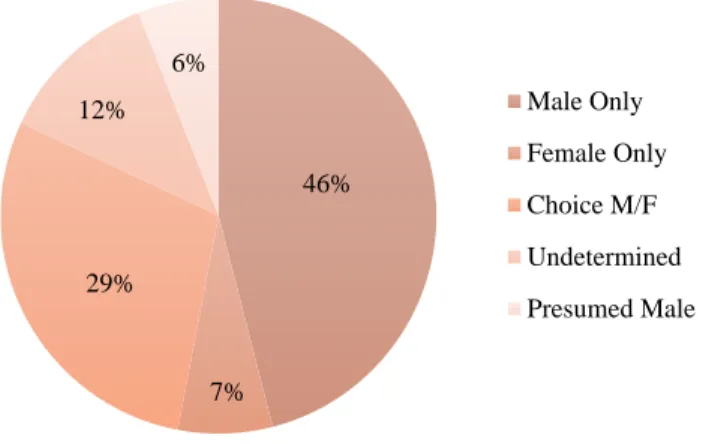
In order to determine the degree to which female identities have been erased, or annihilated, from the video game canon, I used the media review aggregator site Metacritic to isolate the top 100 games from 2010 to 2017 and found that, of the 431 games cited on Metacritic, only 7% of games featured female-only protagonists. This means that a pitiful 30 games of 431 games counted for that period had a female protagonist as the main and only
Figure 1: Gender breakdown of main playable protagonist in Metacritic top 100 games (2010-2017)
It is important to note that 29% of total games (mostly fighting, action-adventure, and role-playing, or RPG, games) gave players a choice between male and female players. While allowing players to choose between a male or female protagonist might sound like progress, “it takes another level of commitment to have your game be led [by] a preordained female
character” (Tassi, 2014, n.p.). On the speculation that Halo 5 could have had a lead female protagonist, Paul Tassi, a Forbes reporter notes that “only a few established legends get [the] honor” of being a lead female protagonist. Lara Croft and Samus Aran (protagonist of
Nintendo’s Metroid series) are perhaps the two most (in)famous, and new female leads are “few and far between” (Tassi, 2014, n.p.).
The importance of Lara Croft. It is because these female characters are “few and far between” that it is important to consider the ones we have, as they often serve dual roles as cultural icons of female representation in a male-dominated industry, and as lighting rods of feminist praise and criticism (Tassi, 2014, n.p.). This study examines the character of Lara Croft
46%
7% 29%
12% 6%
Male Only
Female Only
Choice M/F
Undetermined
through a feminist critical lens, looking specifically at her character and how it is depicted throughout the 2013 game.
In this thesis, I examine Lara as she is presented in the 2013 Tomb Raider reboot, a Triple-A,8 action-adventure video game developed by Crystal Dynamics and published by Square Enix as the tenth installment in the wildly successful Tomb Raider franchise. Following Lara’s journey from castaway to cult-island survivor, Tomb Raider constructs a new and updated origin story for the famed archaeologist, one of the only playable female video game characters to withstand the test of time and remain culturally relevant.
I am looking specifically at Lara because, as previously mentioned, she was one of the first examples of female representation in video games and is, arguably, the most enduringly popular female video game character of all time. Critically analyzing the discourse surrounding Lara in all her video game iterations and, more importantly, her character and depiction in the 2013 game, will, I hope, encourage broader deconstruction of traditional gamer norms and expectations that will stop geek masculine gamers from symbolically annihilating women and other minority identities from video game discourse (Tuchman, 1979). Additionally, I will argue that celebrating the parts of Lara that make her different from her male video game protagonist counterparts – i.e., her female presentation and her feminist characteristics – will establish a precedence for future video games in which the harmful, negative views of women and minority populations, so often perpetuated through stereotypical character depictions and tired narrative tropes, are challenged and counteracted with more positive character representations.
fixed, objective truth is antithetical to the feminist mode of research. Further, the idea of whether or not it is feminist depends on the person reading the text and their ability to understand and decode the cultural messages contained within (Hall, 1999). Finally, asking the question of whether or not Lara is a feminist does her a disservice, reducing her to a good/bad binary that cannot account for the multiplicity of potential interpretations players can read from her character (Kennedy, 2002).
Thus, while I am asking if her character and the 2013 game in which she is depicted “can be” read as feminist, my study will focus on how she and the 2013 game can be read as such, looking specifically at Lara’s power and agency as the protagonist and main playable character of the game, how she progresses through the game space using her wit and ingenuity to conquer a male-dominated island of cult survivors (and how her character growth and progression through the island and the game’s levels can be interpreted as a metaphor for female movement through a male-dominated world), and how her friendship and ultimate rescue of the “damsel in distress” character Sam Nishimura functions as a lesbian “queering” of the traditional video game rescue narrative. It is my goal to encourage further critical analysis of this game and others, something that will, I hope, encourage more diverse representation among video game
protagonists and a more welcoming video game culture as a whole.
Following a review of relevant literature, my analysis begins by looking at and
– as it may be hard to judge as strongly feminist a work that includes such a blatant disregard for female players and sexual assault survivors – it is important to acknowledge the scene as a cautionary tale for game developers and games to come.
After the analysis of the attempted sexual assault scene – the literal and figurative
“Crossroads” of the 2013 game and this study – the thesis moves to a feminist textual analysis of the game, focusing particularly on the depiction of gender and power relations between Lara and other NPCs in the game and between Lara and the player.
This project is heavily influenced by feminist, media, and cultural studies traditions. Its approach is feminist, as it pays attention to “assessing the relations and expression of power within texts” with the ultimate goal of placing “central focus on the lives of women and members of other groups who have not traditionally held cultural and political power” (Hesse-Biber, 2014, p. 267). It acknowledges the centrality of media in representing issues of power and focuses on the discourse surrounding and meanings embedded in the video game – a nontraditional textual body, perhaps, but undeniably, an “object that generates the meanings you want to know more about” (Brummett, 2010, p. 25). This study emphasizes culture in that it is dedicated to
understanding the meanings and implications constructed and disseminated by cultural artifacts, including video games (Hesse-Biber, 2014).
and her game in a way that gives future game developers and designers (including myself), a reference on what to do and what not to do in designing a future feminist video game
Chapter Two
“Remember What I Taught You”: Scholarly Readings of Lara Croft
Before my analysis of Lara Croft and the 2013 game can continue, it is important to review what other scholars have said about the development of her character since her video game debut. Throughout the years, she has been hailed as both a geek male fembot fantasy and a female pop culture icon, but scholarly feminist opinions of her have shifted of late, moving away from her blatant demonization in such works as From Barbie to Mortal Kombat (1998). In particular, contemporary scholars recognize her potential as an “empty sign” by which various gender-subversive interpretations can be realized (Mikula, 2003, p. 83).
Three of the four articles I have chosen to highlight in this study were published before the release of the 2013 Tomb Raider game and thus focus on previous iterations of the game franchise. The fourth article, published in late 2014, almost a full year after the game’s 2013 release, makes explicit references to the game I will be discussing, but the scope of the article also includes the history of Lara’s character and her “to-be-looked-at” body
(MacCallum-Stewart, 2014, n.p.). I mention this to lend further justification to my study. While scholars have had plenty to say about the character of Lara Croft, there has not been an in-depth critical analysis of the 2013 game and its multiple cultural messages. I have chosen to focus on these four recent articles for their contributions to the study of Lara and Tomb Raider and because they share a common theme: the recognition and promotion of Lara’s potential for resignification through audience interpretations, something I am actively doing in this textual analysis and something I believe is important to most, if not all, cultural and media studies projects.
This article examines the various “gender-subject configurations” that Lara’s character offers to players, allowing a “multiplicity of sometimes quite contrary positions and subjectivities,” to be read from her, including Female Frankenstein Monster, Dominatrix, Femme Fatale, Drag Queen, Positive Role Model, and Vehicle for the Queer Female Gaze (Schleiner, 2001, p. 222-224). By using a “cyborgian, piece-meal and polymorphous” analytic approach to studying Lara,
Schleiner is examining her character from multiple theoretical angles in order to emphasize the queered potentials Lara’s character offers nontraditional players, or any who do not identify with the geek masculine player stereotype (Schleiner, 2001, p. 222).
Each of the positions takes a different approach to the character of Lara and how the player understands their relationship and gender configuration in comparison to her. For example, the “Frankenstein Monster” position posits Lara as a “fetish object of the male gaze” while the “Drag Queen” position emphasizes the potential for male players to be
“transgendered”10 by playing her, thus rejecting rigid gender roles and encouraging them to “experiment with ‘wearing’ a feminine identity” (Schleiner, 2001, p. 222-223).
through their active participation (Schleiner, 2001, p. 224). Ultimately, the involvement of women and girls will reshape the gaming industry, and perhaps more enduringly, gamer culture.11
Using the multiple gender-subject configurations presented by Schleiner, Helen Kennedy’s article, “Lara Croft: Feminist Icon or Cyberbimbo? On the Limits of Textual Analysis” (2002), functions as an attempt to reframe the feminist debates about Lara with an emphasis on moving beyond the binary “either/or answer” to whether or not she is a positive female character. Kennedy’s article highlights the ways in which feminist debates about Lara tend to focus on her body and the dominant masculine, heterosexual reading of her character. The article begins by critiquing the question posed in its title – “Feminist Icon or Cyberbimbo?” – for its limitations. According to Kennedy, this question “presupposes an either/or answer, thereby neatly expressing the polarities around which most popular media and academic discussions of Lara Croft tend to revolve” (Kennedy, 2002, n.p.).
Lara is a “visual spectacle” for players, a “fantasy female figure” to be sure, but one that has a unique “bimodal” appeal for both women and men (Kennedy, 2002, n.p.).
Other feminist scholars, however, have focused on Lara’s role as an “eroticized object of the male gaze” in which she provides “fetishistic and scopophilic pleasures” for the male viewer (Kennedy, 2002, n.p.). In particular, Kennedy highlighted the way Lara’s body is layered with “fetishistic signifiers” – the round glasses, the holster/garter belts, the long braid of her hair – and how they turned her female body into an object of sexual desire when it had previously been viewed as a threat to the male order (Kennedy, 2002, n.p.).
Kennedy argues that these frameworks, while helpful to understanding the character of Lara as she has been perceived by feminists in the years since her first game, are not able to account for the full meaning of her character. It is “impossible to securely locate Lara within existing feminist frameworks, nor is it entirely possible to just dismiss her significance entirely” (Kennedy, 2002, n.p.). Kennedy does not have an answer as to how Lara’s character should be interpreted or how further meaning can be uncovered, but she argues current textual analysis methods are “inadequate to explore the range of pleasures available from playing as Lara” (Kennedy, 2002, n.p.). Any feminist critique of Lara must also involve a critique of the masculine games discourse of which her game is a part, she writes (Kennedy, 2002, n.p.). She stresses the importance of moving beyond debates over Lara’s sexual appeal and instead taking seriously girl gamers’ complaints about contemporary portrayals of women in video games.
In an expansion of Kennedy’s critique of the polarized debate on Lara, and of Schleiner’s gender-subversive readings of her character, Maja Mikula’s “Gender and Videogames: The Political Valency of Lara Croft” (2003), highlights the ways in which Lara has been conceived as an “empty sign” in the years since her original appearance, to allow for “diverse, often
use or interpretation. It refers to an object that combines both a signifier – the tangible presence of something – and a signified – the abstract idea or concept of something – to create meaning (de Saussure, 1966).12 In Lara’s case, her signifier is her digital body or her presence in the virtual space of the masculinized game world, and her signified is the various ideas and interpretations that have been read onto her through the years (e.g., a highly sexualized and stereotyped representation of the female body, a badass action heroine acting as a positive role model for female players, etc.).
Mikula argues that the appeal of Lara comes from her being “everything that is bad about representations of women in culture, and everything good” (Mikula, 2003, p. 79-80). Her
“‘femaleness’ is clearly shaped by a desire to embody male sexual fantasies,” she wrote, but her character, her intelligence and independence, her adventurous and resourceful spirit is a
representation – a complete sign, made up of both its signifier and signified parts – of women and femininity that is undoubtedly positive (Mikula, 2003, p. 79-80). In Mikula’s estimation, the most interesting aspect of Lara’s character is the way it is adaptable, “easily taken up by fan-producers” in a way that can be so “readily detached from the circumstances of her initial production” and that renders suspect any claims about what her character really means or is supposed to represent (Mikula, 2003, p. 80).
Referencing the ways in which our global market is unpredictable and highly erratic in terms of its likes, dislikes, and audience reactions, Mikula argues that in the years since her original appearance, Lara has transitioned from a two-dimensional sex symbol to an “empty sign,” or a signifying digital body onto which no single signified meaning can be located
meanings. The most interesting part of this argument is the gendered ways in which audiences produce potential meanings, or the ways in which players are encouraged to identify with or to objectify Lara’s character.
As Mikula notes, previous research suggests “identifying” with a character is a gendered act, in that female gamers are more likely to identify with the character they are playing than men, and are more likely to become “irritated” when they can’t identify with a female character (Mikula, 2003, p. 80-81). However, the idea of having a subject/object binary with female
identifying gamers on one side and male objectifying gamers on the other is, in reality, much more complicated. Returning briefly to Schleiner, there is a gender-subject configuration in which lesbian or bisexual female players are invited to objectify Lara just as much as a heterosexual male player. In this position – “Lara as Vehicle for the Queer Female Gaze” – female players are invited to objectify and enjoy the pleasures of playing and controlling Lara as much as they are invited to enjoy the pleasure of playing by identifying with Lara or playing as though they were “being” her.
The last article I will discuss in this literature review is the most recent, titled “‘Take That, Bitches!” Refiguring Lara Croft in Feminist Game Narratives,” by Esther MacCallum-Stewart (2014). This article, published in Games Studies, uses a YouTube player
walkthrough/gameplay of the 2013 game to emphasize the need to move beyond good and bad constructions of Lara’s sexuality. Using fan-produced content, MacCallum-Stewart is attempting to separate Lara’s body from her gender in a way that allows for the multiple interpretations Mikula, Schleiner, and Kennedy call for in their work. Refusing to act as an “apologist” for Lara’s body, while addressing her past as a sex symbol and a “to-be-looked-at body,”
literature review (MacCallum-Stewart, 2014, n.p.). She uses one female fan’s game playthrough as an example of how players can look beyond Lara’s hyperfemininized body and beyond her past to read their own meanings onto the character.
These articles represent only some of the scholarly material about Lara and her Tomb Raider video game series. Additional articles reference Lara Croft but do not study her at length; Layne and Blackmon’s “Self-Saving Princess: Feminism and Post-Play Narrative Modding” (2013) is a prime example. The article itself is centered around their definition of “post-play narrative modding” as “any significant change to the narrative or to a gamer’s perception of the narrative” after the game’s release and how it can be used to enact creative feminist resistance to otherwise ambivalent or misogynist game narratives (Layne and Blackmon, 2013, n.p.). While this idea is compelling and worthy of further exploration, Layne and Blackmon mention Lara only in passing, describing the ways in which her character has been changed by fan
participation since her 1996 release (Layne and Blackmon, 2013, n.p.). Although I find Layne and Blackmon’s work intriguing, I have limited this synthesis to literature with the most in-depth character analysis of Lara, as Layne and Blackmon’s article, among others, only briefly mentions Lara Croft without going into detail or making her the focus of the study.
The articles described above are useful for my study as they provide both a theoretical background and a proof-of-concept for my feminist textual analysis of the 2013 Tomb Raider
game. All the articles reference the “potential” of Lara and of Tomb Raider for producing multiple meanings depending on the person playing the game and their beliefs, ideas, or
“She’s Just One Girl!”: A Queer, Oppositional Reading
To do a queer, oppositional reading of Lara Croft and Tomb Raider is to read and think through many layers of communications, feminist, and cultural studies theories as they apply to a video game, a nontraditional textual medium, but one rich with analytical potential (Brummet, 2010). This work is feminist because it is paying attention to the ebb and flow of Lara’s power and agency as she moves through the game world and as she navigates the traditionally geek masculine video game space. This work is part of the larger genre of cultural studies because it is focusing on this game as a cultural artifact shaped and influenced by larger ideological structures of power and patriarchy. This work is also heavily influenced by fan studies and the work that fans and media consumers do in resignifying their favorite media texts in ways that resonate with their personal circumstances or identities. Finally, this work is deeply personal, for me and many other female and nontraditional gamers, as we try and find our place in a male-dominated video game culture.
I mention this to stress the fact that there are multiple influences for this work, and many ways to approach the study of this and other video games. In this project specifically, I am performing a feminist critical analysis in a way that allows me to develop a queer, oppositional position to the main encoded messages that, in turn, allows me to read queerness and feminism into the video game and Lara’s character. This is not the only way to read this text, nor is it the only way to read and connect with the character, but it is one that resonates for me.
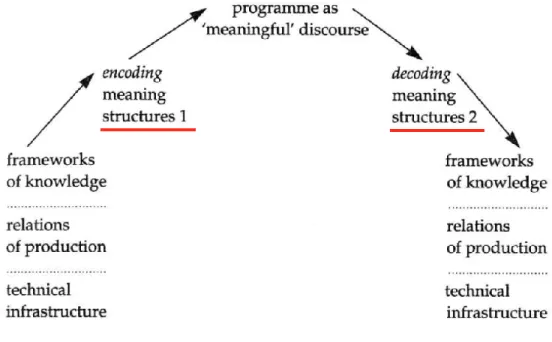
Before I elaborate on the methodologically queer part of my queer, oppositional Tomb Raider reading, it will be helpful to address Stuart Hall’s encoding-decoding model of
realm of media, fan, and cultural studies, posited a four-stage model of communication that follows the life cycle of a message’s meaning from production to circulation to use (also known as distribution or consumption) and reproduction (Hall, 1999). The model emphasizes the asymmetrical positions of message producers and receivers (see Figure 2).
Figure 2: Stuart Hall’s Encoding-Decoding Communications Model13
Referring to those messages that have been intentionally programmed into media content by their producers as encoded messages, and those that are inferred or read by the audience or consumers after the fact as decoded messages, Hall stresses the ways in which the “codes of
connotation or implied meaning is received and understood depends on the content receiver and their pre-existing ideas and social biases.
As a result, audiences can decode media messages from a range of positions, including “hegemonic,” “negotiated,” and “oppositional” (Hall, 1999, p. 101). A dominant-hegemonic reading position is one in which the audience or receiver decodes meaning from the media text in a way that is consistent with the producer’s intended meaning. A negotiated, or “corporate,” reading position is one in which the audience understands the dominant definitions and signifiers through “particular or situated logics” (Hall, 1999, p. 102). In this case, the original message is accepted and rejected at different points in the text. Essentially, negotiated-corporate positions “acknowledge the legitimacy of the hegemonic definitions” that are readily accepted in dominant-hegemonic readings, while “reserving the right to make a more negotiated application” of certain details according to the particular circumstance or understanding of the receiver (Hall, 1999, p. 102). Lastly, an oppositional reading position is one in which the receiver understands the originally encoded message but decodes it in a “globally contrary way” using an “alternative framework of reference” to reject the original message and read new meanings in the text (Hall, 1999, p. 103). There are multiple examples of this from erotic “slash” fanfiction on popular sites like Archive of Our Own (AO3) to Eve Sedgwick’s work on analyzing homoerotic subplots in the work of authors likes Charles Dickens and Henry James. More recent examples include “Of Bread and Blood,” a book of critical essays about Suzanne Collins’ Hunger Games
series (Clark & Pharr, 2012); and “Harry Potter and Convergence Culture,” a collection of essays about the Harry Potter fandom (Clark & Firestone, 2018).
text. I say oppositional rather than negotiated or corporate, since I believe the main feminist message – i.e., Lara’s ultimate success in navigating the hostile, male-populated game world as a parallel for women navigating a male-dominated world and eventually achieving parity – was not originally encoded in the game, and thus requires an oppositional reader position in order to decipher it. Despite having two female writers (Rhianna Pratchett and Susan O’Connor) credited with most of the game’s writing and story, and despite marketing dependence on the “girl
power” potential of Lara and her story as an against-all-odds survivor, this was a game designed by men for men, as the executive producer’s comments and the “Crossroads” trailer clearly show.14
Despite using the term “code” to describe the process of reading text in an oppositional way, there is no strict key on how to do so. For now, it is enough to understand Hall’s encoding-decoding theory and the various reading positions one can adopt in relation to a text. I will explain my oppositional reading of the main encoded message of the Tomb Raider text in the following chapters.
To unpack the “queer” part of my queer, oppositional Tomb Raider reading, I draw on the work of two foundational feminist and queer studies scholars, Eve Sedgwick and Judith Butler; specifically, their definitions of what the “queer” in queer studies means and what it can be.
In a 2013 essay adapted from her pioneering 1993 book Tendencies, Sedgwick offers several possible definitions of “queer.” Its first and perhaps most theoretically important meaning was that of gender-dissonance, a classification of difference compared to socially prescribed norms regulating a person’s sex, gender, and sexual orientation.15
the term queer that defies a singular definition: one that draws on the social and personal history of the word and allows for theoretical “loose ends” in which not all meanings directly equate to each other; one in which “common sense” normative views of sex and sexuality are interrogated and critically questioned; one in which a person’s individual use of the term “queer” can function differently from its use as a descriptor for someone else.
Sedgwick argues that the popularity of “queerness” and queer studies comes from its multiple uses, from its conceptual fluidity, and from its promise of possibility:
That’s one of the things that “queer” can refer to: the open mesh of possibilities, the gaps, overlaps, dissonances and resonances, lapses and excesses of meanings when the constituent elements of anyone’s gender, or anyone’s sexuality aren’t made (or can’t be made) to signify monolithically. The experimental linguistic, epistemological, representational political adventures. (Sedgwick, 2013, p. 8) Judith Butler, in “Critically Queer,” likewise emphasizes the multiple potentials of the term queer, specifically as a “site of collective contestation, the point of departure for a set of
historical reflections and futural imaginings” (Butler, 2013, p. 21). Using concepts of gender and queer performativity and identity categories and formation, Butler highlights several possible definitions and meanings of the term “queer” and how it functions in queer studies – most notably, as a performative political act of self-identification and reclamation – before stressing the ways in which it should remain a “discursive rallying point” with meanings that change and adapt to future generations in a way that cannot be fully anticipated (Butler, 2013, p. 22).
Going further, Butler asks how “‘queering’ persists as a defining moment of
on concepts of gender performativity from her seminal work Gender Trouble: Feminism and the Subversion of Identity (1990) and Sedgwick’s work on queer performativity, Butler reflects on
the nature of performativity and how it is not an act of self-expression or self-presentation, but an “unanticipated resignifiability of highly invested terms” in which the
signifiability cannot be controlled by the one who utters or writes, since such productions are not owned by the one who utters them. They continue to signify in spite of their authors, and sometimes against their authors’ most precious intentions. (Butler, 2013, p. 28-29)
Thus, queer performativity, for Butler, is the resignification of the term “queer” in a way that changes from generation to generation, and that which, “in the present, is never fully owned, but always and only redeployed, twisted and queered from a prior usage and in the direction of urgent and expanding political purposes” (Butler, 2013, p. 21). This notion of queerness and queer performativity as a site of potential resignification of meaning is particularly important to my work with Tomb Raider, as it echoes Mikula’s concept of Lara’s character as an “empty sign” to be resignified in new and multiple ways, including those Lara’s original creators – her encoder-producers – might never have imagined. My own reading of Lara is a resignification of her character with feminist meaning in a way that echoes other resignifications that come about as more people come to know her character through the Tomb Raider games. Understanding Lara, then, is less about discerning her one, true, fixed meaning and instead, recognizing her potential as a powerful signifying character with multifaceted meanings.
movies, TV shows, books, and even video games – with queerness, she describes the responsibility of queer studies as one that comes from a promise to
make invisible possibilities and desires visible; to make the tacit things explicit; to smuggle queer representation in where it must be smuggled and, with the relative freedom of adulthood, to challenge queer-eradicating impulses . . . where they are to be so challenged. (Sedgwick, 2013, p. 5)
To Sedgwick, to study “queer” is to invite the possibility of alternate meanings, to read queerness and gay or lesbian emotions and representation in places it may not have been originally invested. To study queer is to embrace sexual differences and radical
self-determination, to interrogate heterosexual normality and the lack of queer representation in popular culture. And that is exactly what I intend to do with Tomb Raider and Lara. In particular, I will identify later in this thesis and elaborate on the homoerotic subtext in the game and the ultimately victorious rescue of Sam Nishimura by Lara in a way that will queer the game’s story and the “damsel-in-distress” trope that functions as much of its narrative foundation.
Queer studies and communications/media studies are dynamics fields, and this literature review has focused on the work of but a few scholars. However, this brief look at some
“You’ve Got Good Instincts, Girl”: Strategies of Reading and Game Basics
In any textual or critical analysis, there will be some degree of subjectivity based on the existing knowledge and preconceived biases of the reader. My analysis of this game in particular is (perhaps obviously, given the title of this work) influenced by my feminist positioning. It is also influenced by my prior history (or should I say, lack of) with Lara Croft. Immediately after finishing the game and in preparing for this thesis, I read many reviews of the game that
compared this iteration of the (in)famous tomb raider to her predecessors. However, I had no such experience with the pixelated, triangle-chested avatar of the 1990s and the slick, sexier versions in the early 2000s. Perhaps that gives me a degree of clarity some of the reviewers and players who remembered her early run do not have. Conversely, perhaps I lack some critical insight into how her character was originally represented and how it has evolved.
I have tried to do my best by Lara and this version of Tomb Raider, using multiple coding methods and lens of analysis to critically assess her character and her role in the narrative of the game as a whole. I do want to recognize that this process was perhaps made easier by the fact that I had played the game a total of eight times before playing it once more for this analysis. I have played the game in its entirety almost 10 times since it came out, and, thus, even before I began this thesis, I had some idea of what issues I wanted to explore. Still, with each new playing, I catch things that previously escaped my notice. Further, in the process of writing I have come to more fully realized conclusions about that which I had already noted in the game.
sexuality was raised (i.e., moments when the camera focused on Lara’s slight, tank-top-clad form, or pretty much every moment of the scene of attempted sexual assault), specific mentions of violence against women or Lara, instances in which Lara cried out for help or for her friends, times in which Lara engages in affirming thoughts or speech (i.e., saying “I can do this” before climbing a particularly steep cliff), and moments in which Lara expresses her emotions (i.e., crying, hugging her friend Sam, getting angry at Mathias and yelling at him, etc.).
I also kept track of three key events in the game, what I have categorized as Moments of Ingenuity (Ingenuity), Violent Death Events (VDEs), and Cataclysm Events (CEs). Ingenuity was used to measure and keep track of times in which Lara uses some aspect of her environment to progress in a way that is independent of the player and, through the narrative of the game, seems to come from Lara’s own intelligence and survivor skills. One example of this is when Lara frees herself from a snare by shooting the winch, then thinks to grab the bundle of rope and tie it to her arrows, thus crafting the rope arrows that become an important mechanic throughout the rest of the game. These moments are important as they emphasize Lara’s resourcefulness and agency and stress her independence from the player otherwise controlling her.
The VDEs are mini-cutscenes that focus on Lara’s death as a result of player failure, usually during a Quick Time Event (QTE) that requires players to press certain buttons in certain sequences to perform actions. These deaths are distinguished from death in combat or by falling in that they feature special animations and an intense camera zoom on Lara as she struggles from the moment of the failure until she succumbs to her wounds. These are – in my opinion – the worst part of playing Tomb Raider, and there is no option to skip or forego seeing these
dies. I will discuss these scenes and their effect on players in detail in later chapters, but for now, I will highlight one example of what I looked for while playing. After unlocking the Shipwreck Beach map in the later part of the game and proceeding to an area that involves climbing on broken ship pieces and cliff edges to reach the wreck of the Endurance, if the players fails to time Lara’s jump right she will fall into the water, at which point a VDE cutscene will start. In this particular scene, Lara, after falling into the water, is forced back into a rocky outcropping by the power of the waves and she breaks her neck. Blood trickles from her mouth as she floats limply in the water before the screen fades to black.
The CEs, and the last major game event I coded for, are sequences common to most action-adventure video games, from Tomb Raider to Dead Space 2 to Uncharted: A Thief’s End. I have dubbed them “Cataclysm Events” because they are characterized by a period of intense chaos and action in which the player controls the protagonist through a veritable landmine of destruction, involving everything from collapsing cave floors to earthquake-induced fissures. There are about ten CEs in the entirety of the game, and they often require a QTE in which the player must press a certain button at the right time to make a long-range jump or to escape out of the path of a falling boulder. What is notable about the CEs in Tomb Raider is that it is Lara’s female body that is performing the actions necessary to survive a CE, feats that take significant athletic skill and endurance.
that no woman could do what male characters in video games do. The reality of the CEs is that they feature the kind of earth-shaking destruction that no one in the real world would survive, regardless of gender. Thus, while there are some who would discredit Lara and other female video game protagonists by arguing that a “real” woman would be incapable of the athletic stunts performed by video game women, that same argument -- especially in the context of Tomb Raider’s CEs -- can be turned on the male characters, since in her CEs, Lara is performing the
same actions a male character would. Thus, if anything is “unrealistic” about her performance, it is that she emerges from these CEs with her ponytail intact.
While those are the main things I coded for in playing the game, I also made sure to note any actions, scenes, or pieces of dialogue that seemed to align with my pre-established themes: the threat of sexual assault in the “Crossroads” scene early in the game, representation of female power and sexuality, metaphors for patriarchy in the game world and Lara’s progress in spite of it, and queerness and queered power in the “damsel-in-distress” narratives. As I have previously mentioned, a lot of my knowledge of this game, its symbols, meanings, characters, narratives, and other ludological features came from my previous experience playing the game and reading the cultural conversation about the game and about Lara Croft.
Before I proceed further with my analysis, I think it will be beneficial to briefly explain a few particulars about the game’s plot, mechanics, and characters. The game’s main characters and the ones I will be referring to most often are:
• Lara Croft, the protagonist and player-controlled character, a young archaeologist from
England, following in the footsteps of her father.
• Conrad Roth, or Roth, Lara’s father figure, legal guardian, and captain of the ship the
• Sam Nishimura, Lara’s best friend, filmmaker and videographer, and descendant of the
Sun Queen Himiko, the Priestess-Queen of the Ancient Japanese kingdom of Yamatai. • Father Mathias (or Mathias), the leader of the Solarii, a cult of former shipwreck
survivors who washed up on the island and decided that worshipping Himiko was the key to leaving.
• Alex, a geeky tech-guy working on the Endurance who has a crush on Lara and wants to impress her.
Additional, minor characters (Jonah, Reyes, Grim) and a few named cult members (Dmitri, Nikolai), will be mentioned, but the five characters listed above are the most important for this analysis and the ones I will be discussing the most.
The plot of the game is fairly simple. Determined to find the lost island of Yamatai, Lara Croft and the crew of the Endurance sail into a stormy patch of sea known as the Dragon’s Triangle off the coast of Japan only to wind up shipwrecked on Yamatai. They must fight for their lives against a group of cultists that believe Sam, descendant of the Sun Queen, is the key to getting off the island. The cultists, led by Father Mathias, believe that sacrificing Sam to the Sun Queen is the key to stopping the storms that surround the island and prevent everyone from leaving. It is later revealed that the storms are actually controlled by a supernatural being, the undead Himiko, who is going to use Sam’s body as a vessel for her soul so she can regain her full power and re-establish her empire.
boundaries of the game space the player can physically move about in and explore, and challenge tombs for Lara to raid for rewards and experience points (XP), which can be used by the player to buy skills that enhance Lara’s performance in some way. There are also upgrades to be crafted onto Lara’s existing weapons – the bow is her primary weapon, but upgrades include a machine gun, a shotgun, and a pistol – and new weapons to be found. There is also a fast travel and base camp mechanic in which players, upon discovering a base camp, can have Lara sit down by a fire to access a special menu that allows them to purchase skills with their accumulated XP, or to fast travel, or jump, between base camp locations.
At various points throughout the game, usually through a cutscene or specific sequence, Lara acquires a specific set of Gear – capitalized to highlight the fact that this Gear cannot be obtained anywhere else – that is then featured throughout the rest of the game. For example, at the beginning of the game, Lara stumbles across some empty lifeboats and supply crates and finds a two-way radio that becomes an important piece of Gear, as it allows her to communicate with the other members of the Endurance crew.
However, there are also moments, usually accompanied by cutscenes and triumphant music, in which Lara uses her Ingenuity, as described above, to gain a skill or obtain a piece of Gear independent of the player. It is through these moments that the flow of power and agency is shifted from the person on the other side of the screen controlling her character to the figure of Lara Croft herself. These are important moments in the playthrough and read as proud moments for Lara as she uses her wit and intelligence to perform a task or create something the player never would have thought to do. I will return to this point later, especially in the chapter “If I Don’t Survive, None of Us Will,” but I felt it was important to mention here in the context of describing the game’s mechanics.
Chapter Three
“You Can’t Stop Me!”: Lara at the ‘Crossroads’ and the Misogyny that Threatens to Define Her
In order to proceed with the bulk of my analysis, it is important to discuss the proverbial elephant in the room in terms of feminist study: Relatively early in the game (roughly 40-45 minutes in), there is a depiction of attempted sexual assault against Lara by a male non-player character (NPC). This scene, according to the predominantly male production team that worked to design and package the game, is supposed to establish a “turning point” for Lara and is a “defining moment” of the reboot series (Schreier, 2012b, n.p.). In order to continue with a feminist analysis of the game, I think it is important to take a moment to talk about this scene in detail, break down its encoded, or imbedded, cultural messages, and begin to discuss how we can move forward from this scene to decode a larger feminist narrative in a queer, oppositional reading of the game as a whole.
The scene begins slowly, opening with a shot of Lara’s determined face as she leaves the game’s first map, weapon in hand and makeshift axe hanging from her side. Lara and her
out of the nearby undergrowth with his hands raised in supplication. In accented English, he entreats Lara and Whitman to follow him to where he has found their injured friends.
The scene quickly devolves, as more men appear out of the brush holding makeshift bows similar to Lara’s, and Whitman, despite being the only one wielding a firearm, puts down his gun and surrenders. Lara backs away from the men and hastily nocks an arrow just as a dark-clothed man jumps out of the trees behind her, knocking her to the ground.
The man – whose name is later revealed to be Vladimir, captain of the Mountain Village group of the Solarii Brotherhood – exchanges a few words in Russian with another scavenger before dragging Lara away and pinning her against a nearby tree. Brandishing his gun, he threatens her – “Don’t you fucking move” – before instructing the other scavengers to round up the last of the Endurance survivors (Tomb Raider, 2013). After this cutscene, Lara engages in a quick stealth sequence, slipping undetected past patrols of scavenger mercenaries by ducking behind walls and bushes, all while her hands remain bound behind her back.
Everything about this scene is meant to invoke anxiety and to heighten the tension of this dramatic moment. It takes place at night in a Kamakura-period mountain village. A fire,
Ducking into a nearby ruined house ends this sequence and another cutscene starts as Lara attempts to hide from the scavengers. The camera zooms in on her terrified face as Vladimir paces in the background, moving once past her hiding place before circling back with his gun drawn. Lara pants and closes her eyes as Vladimir sticks his gun in between the slats of the ruined house and orders her out.
Speaking in Russian and broken English, Vladimir’s full dialogue during this and the previous sequence is chilling, something that previously escaped my notice since the subtitles when he speaks Russian do not provide a translation of what he says. “You’re quite a pretty girl, huh? You remind me of my sister,” he says when he first captures her. Then, “Thought to escape, baby? Do you think you can escape?” and “[My sister] was a bitch, too!” as Lara struggles to break free from his grip (Tomb Raider, 2013).
The cutscene ends with Lara being dragged out of the hut by Vladimir, who pins her against the wall, sticks his face in the crook of her neck, and slides a hand down her thigh. The Quick Time Event (QTE) that follows involves the player pressing a series of buttons in quick succession in order to fight back. If followed correctly, Lara knees Vladimir in the groin before she is dragged back and he again pushes his face into her neck and smellsher – the sniffing noise is an uncomfortably audible sound effect. Another QTE prompt follows, and Lara bites
Vladimir’s ear before they fall to the ground and he drops the gun.
They wrestle for a moment before the crude binding around Lara’s wrists breaks and she lunges for the gun. Yet another QTE takes place in which the player needs to quickly aim and fire the gun, but, regardless of the aim, Vladimir falls on top of Lara and they struggle for the gun. If the player fails the QTE, Lara is shot in the head and dies. If the player succeeds,
point-blank range, falls sideways off Lara, struggling for breath as the camera lingers on his bloodied and broken face.
The scene ends with a close-up on a bloody Lara as she drops the gun. She falls to her knees and bends forward, dry-heaving into the dirt as she comes to terms with what she has done. The entire sequence focuses on Lara’s first human kill and sets the tone for the rest of the game, marking a significant transition from young, fragile shipwrecked archaeologist to an armed survivor, wary and afraid, but ultimately willing to do whatever it takes to survive.
This scene, which debuted at the 2012 E3 conference in a trailer titled “Crossroads,” was heralded as a “defining moment” for the character of Lara Croft, a moment in which she is “turned into a cornered animal,” according to executive producer Ron Rosenberg (Schreier, 2012b, n.p.). In an interview with Kotaku writer Jason Schreier, Rosenberg said the scene was “a
huge step in [Lara’s] evolution. She’s forced to either fight back or die” (Schreier, 2012b, n.p.). While the scene with Vladimir was a “defining moment” for Lara, it wasn’t necessarily for the reason Rosenberg or Crystal Dynamics intended.
beyond that breaking point where she realizes the severity of the situation and she’s willing to fight to stay alive” (Schreier, 2012a, n.p.).17
While Stewart was right in that the “Crossroads” scene does involve “close physical intimidation,” it does so by depicting sexual assault and implying a completed rape of Lara will occur if the player does not respond to the QTE prompts in time. While Rosenberg, Stewart, and other Crystal Dynamics executives were quick to point out that the scene ends with Lara’s death by strangulation at the hands of Vladimir if the player does not respond to the prompts correctly, this “violent death event” (VDE) plays out differently from the ones encountered before and after this point.
Normally, the VDEs involve a graphic depiction of Lara’s death while the screen dims to grey with red accents – presumably Lara’s blood – appearing at the corners. Up to this point there have been three other VDEs, distinguished from “regular” deaths from falling or gunshot wounds by their intense camera zoom and a mini-cutscene. The deaths, to this point, have involved being: stabbed in the chest by a crazed male scavenger, crushed by falling rocks, and killed by a wolf. More importantly, all of these VDEs end with a definitive death in which Lara stops moving/struggling and dies.
What’s different about the strangulation VDE at the hands of Vladimir is that it ends with Lara still moving. The screen dims as Lara gasps for breath and Vladimir leans in menacingly, but she does not stop moving or struggling when the screen finally fades to black completely. While this difference is small enough to go unnoticed by most, it is a significant enough
Even without this subtle examination of the “Crossroads” VDE, the scene and the narrative it is involved in is disturbing enough in its reliance on the trope of sexual violence against women to create a compelling plot point. A press release issued by Darrell Gallagher, studio head of Crystal Dynamics, denied the existence of rape in this scene and in the game as a whole. According to the release, “In this particular section, while there is a threatening undertone in the sequence and surrounding drama, it never goes any further . . . Sexual assault is
categorically not a theme we cover in this game” (Foxx-Gonzalez, 2012b, n.p.). However, Gallagher’s declaration “misses [the] point entirely,” wrote Kellie Foxx-Gonzalez for the feminist pop culture blog The Mary Sue. “Regardless of whether we are calling it an attempted
rape, sexual assault, or a ‘threatening undertone’ . . . a man makes a movement toward Lara Croft’s hips in a way that simultaneously threatens her life and conveys sexual assault . . . Call it whatever you’d like, that is sexual violence” (Foxx-Gonzalez, 2012b, n.p.).
It is important to note here that Gallagher’s denial of audience interpretations – of their recognition of sexual assault as depicted in the game – reflects a breakdown of the
communicative structure Stuart Hall outlined in his landmark essay, “Encoding and Decoding in Television Discourse.” In detailing the three audience reading positions (dominant-hegemonic, negotiated, and oppositional) that occur in the decoding process, Hall notes that
the great majority of so-called “misunderstandings [of meaning]” arise from the contradictions and disjunctures between hegemonic-dominant encoding and negotiated-corporate decodings. It is just these mismatches in the levels which most provoke defining elites and professionals to identify a “failure in
Referring to the way in which the structural position of media producers and audience members is often unequal, Hall is highlighting how the end result – asymmetrical encoded-decoded
meanings – can lead to negotiated or oppositional readings of media texts. These readings, which stray from the original “imprinted” or encoded meaning, can then irritate or “provoke” the “defining elite” (Hall, 1999, p. 103). This leads the elite to cite a breakdown in the
communicative structure as the moment of misunderstanding between audiences and producers. Thus, “sexual assault is categorically not a theme we cover in this game,” is less a statement of fact and more an attempt by Gallagher and the Crystal Dynamics executive team to reframe negative audience responses as “misunderstandings” of meaning (Foxx-Gonzalez, 2012b; Hall, 1999, p. 103).
In the case of Tomb Raider and the “Crossroads” scene in particular, it is clear through Schreier’s interviews with Stewart and Rosenberg and Gallagher’s press release, that the “defining elite” were the game’s producers, a mostly-male cast and crew that relied on hegemonic ideas of femininity and female sexuality to construct a narrative in which Lara’s sexuality and gender identity, the two things that set her apart from most other video game protagonists, were wielded against her, converted to tools of male dominance and aggression.
The encoded message, the dominant-hegemonic position and reading of the scene, outlines a narrative of inevitability. Of course, Lara would face sexual assault: She is pretty and young and she washed up on an island of male shipwreck survivors – many of whom probably haven’t seen a woman in months, if not years. Of course, this is her “defining moment:” She
Hall, on the inevitable or naturalized nature of certain codes or messages, writes, “Certain codes may, of course, be so widely distributed in a specific language community or culture, and be learned at so early an age, that they appear not to be constructed . . . but to be ‘naturally’ given” (Hall, 1999, p. 95, emphasis added). And it seems the nature of sexual assault and of sexual violence against women is one such universally naturalized code -- it is almost expected. It is not a new plot point; popular culture is riddled with examples of this and other violent acts against women. From the Twilight franchise to “Blurred Lines” and everything in between, pop culture has normalized sexual violence in its myriad forms: From name-calling and degrading, to stalking and intimidation; from coercion and assault, to rape and murder; these are the subjects of our songs, our movies, our TV shows, and, now, our video games. However, just because it is common to feature sexual violence against a female protagonist does not mean it is advisable.
When asked about whether or not rape is too taboo a subject to raise in video games, Stewart responded,
That is a hard subject because I believe and the studio believes that it is a subject that we see played out in many ways through movies and TV shows . . . in all the research and all the work that we do in building the story and building this game, we take it to many different places. And this isn’t something that’s uncommon in story narrative. (Schreier, 2012a).
unwanted sexual contact while an additional one in six women (16.1% or approximately 19.2 million) reported giving in to sexual coercion at some point in their lives (Smith et al., 2015, n.p.). The CDC survey defines both rape and unwanted sexual contact, the latter being, “touch but not sexual penetration, such as being kissed in a sexual way, or having sexual body parts fondled, groped, or grabbed” (Smith et al., 2015, n.p.).
While this definition is problematic in the way it limits unwanted sexual contact to specific body parts, thereby failing to factor sexual intent into touch involving nonsexual body parts like hips, legs, or shoulders, it can still apply to the touch depicted in the “Crossroads” scene as Vladimir runs his hand down Lara’s hip to her thigh and lower. Nothing is explicit, but the threat is there and plain to see, as most audiences have been primed by media narratives to equate Vladimir’s gestures with an expression of desire or sexual intent. The result is an informal cultural “script”18 with which audiences and consumers can recognize expressions of desire. In this scene in particular, threats and sexual violence are superimposed onto normative expressions of desire in a way that presents a problematic conflation of sex and violence.
By far, the worst part about the “Crossroads” scene and the player’s involvement in it, is that it penalizes players for failing the QTE prompts by punishing Lara with rape. It is even possible to read this scene as though the player is Lara’s rapist, as though, in failing the QTE prompts, the player has become the instrument of rape, or the means by which it is ultimately accomplished. While this scene and its subsequent implications can be disturbing for male players, even those who regard themselves as separate from Lara, it is extremely Othering for those who have experienced sexual assault, for female players, and for those who play as if they
The creation of the Other, or the fundamental human expression of duality or separation from the Self, in which a group, person, or social process is regarded with hostility and treated as inferior – a concept attributed to Simone de Beauvoir and her pivotal The Second Sex – comes
about in the way the camera focuses on Lara and her expressions as the scene unfolds. We, the players, witness her desperation and fear as she slips between the boards of a ruined hut. We see her close her eyes and gasp for breath as she hides. We see her reluctantly slide out only to be forced back against the wall and pinned by the full weight of her attacker. We see her terror, her wide-eyed expression as he leans into her, and we watch the path of her attacker’s hand run down her hip and leg. The QTE prompt even appears at knee-height, separate from and yet a part of Lara, just as the player is separate and yet is Lara.
Those who have experienced sexual assault will recognize the fear in her eyes as she tries desperately to flee and to defend herself. They will also recognize the pattern of behavior
Vladimir engages in leading up to and during the assault. They will recognize his tone even if the words are in another language, and they will recognize the position Lara has been thrust into as one they may have faced.
But the more I played this game and others, including the Uncharted series of games, which has been heralded by many as the male-protagonist successor/equivalent of the Tomb Raider franchise, the more I realized just how unfair, how misogynistic the scene was by definition. The protagonist of the Uncharted series, a cocky, ruggedly handsome white man named Nathan Drake, has never been sexually assaulted or been threatened with sexual assault by his enemies, has never had to face the type of “close physical intimidation” Lara did in the 2013 game. Karl Stewart even admitted that he could not imagine such a thing happening in
Uncharted. In his 2012 interview with Schreier, Stewart offered a comparison: “If a male hero
like Nathan Drake had been placed in the same situation, the thigh-rubbing would not have happened” (Schreier, 2012a, n.p.).
That begs the question: Why did Lara Croft have to face sexual assault if Nathan Drake did not? Why did Lara, female protagonist of Tomb Raider, have to be sexually assaulted for the game’s plot, if Nathan, male protagonist of Uncharted, did not? While it is true that the first reboot Tomb Raider and the first Uncharted game20 tell two very different stories, and that comparing Lara to Nathan (as many game players and critics have done) is unfair to both characters, the fact remains that Lara is female, and Nathan is not. Gender explains why Lara Croft was assaulted and Nathan Drake was not.
The point I am trying to make with this detailed analysis of the “Crossroads” scene, its reception, its justification by the game’s producers, its depiction of sexual assault, and its
encoded and decoded meanings, is that it functions, in many ways, as an attempt to assuage male players’ fears of a powerful, empowered, ass-kicking, gun-wielding Lara Croft. As mentioned in the first chapter of this thesis, that most of Tomb Raider’s players are male is not an