INVESTIGATING THE USE OF ACOUSTIC ANGIOGRAPHY AS A TOOL FOR EVALUATING TUMOR RESPONSE TO RADIATION THERAPY
By: Sneha Rao
Honors Thesis Biomedical Engineering
Abstract
Acoustic angiography is a novel method that uses a dual frequency ultrasound transducer to image vasculature while eliminating noise from the surrounding tissue7. Given the fact this imaging technique was recently developed, its effectiveness as an imaging technique for clinical applications has not yet been fully verified. Studies have shown that this technique is capable of capturing changes in vascular structure due to tumor angiogenesis7. However, the use of this method in evaluating the efficacy of radiation therapy has not yet been characterized. The purpose of this study was to verify a pilot study that suggested that acoustic angiography was in fact a viable method of evaluating radiation therapy tumor response in a rat model7. To provide additional support for this claim, this study used a rat model with a sample size of seven to assess which metric, tumor size or volume vascularity ratio, were more sensitive to changes in tumor due to radiation. Due to problems with the tumor model and possible tumor necrosis, a clear correlation between the two metrics and diagnostic sensitivity could not be made. While the study was not able to provide conclusive evidence to support the claims made in the previous study, the study did yield insight on better experimental methods and future applicable projects.
Introduction
helping reduce cancer rates, preemptive diagnostic imaging has become one of the main tools for patient diagnostics. In today’s hospitals, patients receive a multitude of imaging procedures to help clinicians determine the diagnoses and potential treatments. The results of various different imaging techniques have become so standardized that physicians will rarely make a significant diagnosis without the help of several scans. Since imaging modalities like magnetic resonance imaging (MRI), positron emission tomography PET, and Ultrasound provide such valuable patient information, major advances in these areas will change the face of medical diagnostics. A study that analyzed over a million inpatient hospitalizations in over 100 hospitals shows that hospitals requiring imaging services for patients had lower mortality than hospitals that do not place emphasis on using imaging as a diagnostic tool10.
morphological characteristics of the tumor. And while morphological changes can be a very useful metric for tumor response analysis, there are many instances in which the tumor size remains constant even though it is responding to the treatment5. In such cases, other metrics must be used to determine whether or not the tumor is responding to treatment. Tumors can remain constant in size and experience changes in the internal perfusion or vascular structure. The current RECIST standards only use changes in tumor size to classify changes in tumor response. Using only the tumor morphology to gauge tumor response will be problematic because other criteria such as changes in vascular density might be more sensitive to changes in tumor response7.
Ultrasound and its role as a diagnostic tool
Ultrasound imaging, due to portability, safety and its real time imaging capability make it an excellent diagnostic tool in the clinic. Thanks to recent advances in ultrasound machinery, the use of ultrasound imaging is extending beyond the traditional uses in the diagnostic clinics. A combination of contrast ultrasound and dual frequency imaging has led to the development of a new type of ultrasound modality known as acoustic angiography6.
surrounding tissue and provides a very clean image of the blood vessels. One of the major benefits of this method of imaging is that it virtually eliminates all the tissue noise that seems to limit the functionality of other imaging modalities6.
Compared to other imaging techniques such as power Doppler sonography, which also has the capability to characterize tumor angiogenesis, acoustic angiography has the added benefit of being able to image micro vessels that are less than 200µm in size6. The increased sensitively of acoustic angiography to the microvascular structure is especially useful in detecting early changes in perfusion at the capillary level, which is one of the early markers for tumor response4.
Obtaining an accurate map of the vasculature can be a very useful diagnostic tool to identify certain diseases and cancers, and to detect the effectiveness of cancer drugs5. At the onset of cancer, the growth of vasculature surrounding cancerous tissue is one of the first indicators of potentially tumorous tissue growth5. When cancer cells begin to grow and divide rapidly they require more nutrients and thus release angiogenic factors to stimulate the growth of nearby vascular networks5. Excess VEGF has been found near areas of tumor metastases indicating that the protein might be a good marker for molecular imaging studies to look for early signs of tumor metastases7.
volume was a better criterion for early detection of tumor response to radiation therapy. The rats were implanted with 9L glioblastoma xenograft tumor cells and allowed to grow until the tumors were palpable and at about 1cm wide. Once the tumors reached a palpable size, seven rats were treated with 20Gy broad beam radiation and imaged every two days with B-mode ultrasound and acoustic angiography. Post-imaging analysis included measuring the dimensions of the tumor using B-mode images and analyzing the volume vascular ratio using acoustic angiograph images.
Materials and Methods
Tumor Model:
Our institutional animal care and use committee (IACUC) approved all animal protocols used in this prospective study. Animals used in this study were seven female Fischer rats obtained from Charles River Laboratories, Durham, NC. Six female rats of about 3 months were anesthetized using isoflurane solution and were then injected subcutaneously in the right hind leg with glioblastoma xenograft tumor cells. After two weeks of inoculation, the tumors were palpable and approximately 1 cm in diameter.
Treatment Protocol
Tumor Injection
contrast agent used was a lipid-encapsulated microbubble solution containing bubbles of about 1 µm diameter. Prior to tail vein injection, the microbubble solution was diluted at a ratio of 1:1 with saline. The microbubble contrast agent was infused with a syringe pump (Harvard Apparatus, Holliston, Mass) at a rate of 40 ul/min.
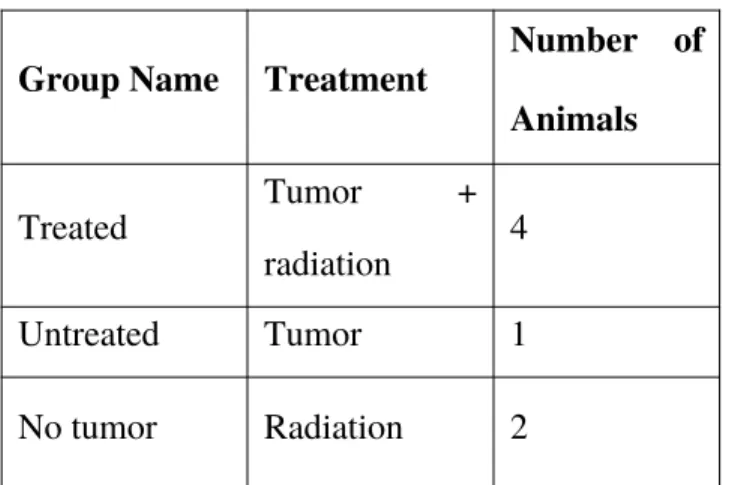
Group Name Treatment Number of Animals
Treated Tumor +
radiation 4
Untreated Tumor 1
No tumor Radiation 2
Table 1: The table shows the treatment groups that were used for the experiment.
Radiation Treatment Protocol
The animals were anesthetized with isoflurane and were shaved and debilitated to clear an area of the rat for treatment. The animal was oriented on the heating pad underneath a linear accelerator. The heating pad is necessary because the animal cannot self-regulate its body temperature. The animal was strapped down to prevent animal breathing respiratory artifact from disturbing the imaging acquisition. The field size was chosen to be 2.5 cm x 2.5 cm and the radiation dose rate was 300mu/min. The animal was treated with the radiation for approximately 7 minutes for a total dosage of 20Gy. All of the treatments were conducted on 2/26/14 at UNC Cancer Hospital Radiology.
All images were acquired by Sneha Rao and PhD graduate student, Sunny Kasoji. A VisualSonics Vevo 770 micro-imaging system was used with the adapted dual frequency transducer (adapted from the RMV 707) with a 4-MHz element added confocal outside of the inner 30-MHz element. This enables the transducer to activate the bubbles at the low frequency of 4-MHz and acquire the higher frequency non-linear bubble response while ignoring the lower frequency tissue signal. For each rat that was imaged, a b-mode 3-D scan and a contrast scan was obtained. The transducer probe positioned above the right hind leg and the 3-D motion stage was allowed to move while the 3-D scan was being acquired. This resulted in imaging the entire region where the tumor was implanted.
The images were acquired with a frame rate of 3 Hz and the 3-D smoothing feature was only used for the contrast mode images and not the B-mode images. The imaging began less than 1 minute after the initiation of contrast material infusion and probe was positioned so that it was at the center of the tumor. The distance form the center to either end of the tumor was found to determine the distance to image. A B-mode 3-D scan was acquired prior to injecting the contrast agent and the contrast scan was performed after the microbubbles had been infused for about 15 seconds. After obtaining the scans, the weight of the rat was noted to assess the health of the animal.
Image analysis
Tumor Volume
area. The width of the tumor was determined by measuring the distance between the two ends of the tumor.
Equation used for ellipsoid volume:
V¿4
3 πab c (equation 1)
Where V is the volume, a, b and c are the radii of the three axes respectively
Volume Vascularity Ratio
A tumor ROI was isolated on the B-mode image by enabling the user to define the dimensions of the tumor at the largest cross sectional area. Once the ROI was established, it was used to identify the corresponding region in the contrast image. A threshold value was established to distinguish between voxels that represent blood vessels and voxels that represent the surrounding tissue. The following equation was used to calculate a ratio between the vessel voxels and the tissue voxels:
Theoretically the ratio should represent the voxels of blood vessels per total voxel intensity so that one can compare the volume of blood vessels to the total volume of the tumor. This yields a number between 1 and 0, where 1 indicates that the entire tumor volume is filled with perfused vessels and 0 indicates that in the entire tumor volume there are perfused vessels.
The Matlab routine calculated the ratio based on the equation described below;
Results and Discussion
Tumor Volume
After the first day post radiation treatment, the normalized tumor volume of the radiation treated group was calculated to be 1.15 ± 0.64 mm3 and that of the negative
control group was found to be 1.4 mm3. The standard deviation of the tumor treatment
group is nearly50% of the actual measurement; this indicates that there is a significant amount of variability in the tumor volume measurements in the radiation treated group. The observed variability could be due to variability in tumor growth and inaccuracy when measuring the tumor volume. While the same amount of tumor tissue was implanted in all the rats, they all grew differently in each animal thus leading to the differences in size. The final volume measured at the end of the study, 0.125 mm3 ± 0.093 mm3 has a very
low standard deviation indicating that toward the end of the study the tumor volume for the treated rats became very similar. The actual average volume measurement was also the lowest it had been throughout the study indicating that all tumors in the treated group were responding well and decreasing in size. Furthermore, the significant decrease in the standard deviation between the baseline volume and the last data point indicate that not only did the tumors decrease in size overall, they also became more similar in size.
problematic because the shape of the tumor no longer resembles an ellipsoid and so if an ellipsoid volume was applied over the total area of the combined tumor, we would inadvertently be adding background tissue noise into the volume calculation.
Figure 1. A chart showing the normalized tumor volume of rats in the treatment group (received radiation) and untreated group (no radiation). The major trend observed in the treatment group is that there is a spontaneous increase in tumor size in the middle of the study. Where as in the untreated group the size increases and then decreases back to the baseline value.
Volume Vascularity Ratio
8-Apr 7-Nov 7-Jun 4-Jan 5-Aug 5-Mar 3-Oct 3-May 2-Dec 2-Jul 31-Jan 0
0.0175 0.035 0.0525
0.07
Volumteric Vascular Density
747 747 746 746 TIme points Vo lu m te ric V as cu la r D en si ty R at io
Figure 2. The chart above shows the volumetric vascular ratio compared to time through the experiment. Since the value of the ratio is very low, it is hypothesized that the threshold that was chosen for the analysis was too high and thus skewed the data.
Conclusions
For the untreated rat, we expected the tumor volume to increase steadily with time because there was no anticancer treatment delivered to the rat; however we observed a contradictory trend. The volume initially increased until 3-2-14. However, after that point the volume continually decreased back to its original size. One possible explanation for this observation is that the tumor may have become necrotic and stopped growing at time point 3-2-14. Once the tumor became necrotic it could no longer proliferate and the cancer cells underwent premature death due to lack of nutrients14. The early necrosis of this tumor might be due to the fact that this tumor model experienced very rapid growth. Using a tumor model that has a slower growth rate might ameliorate the issue of pre-mature tumor necrosis. In the future histological data will be obtained in order to verify that tumor necrosis occurred.
One of the underlying purposes of this study was to gauge whether or not the tumor model derived from the University of Virginia, the 9L glioblastoma xenograft tumor cells, were a viable option for acoustic angiography studies. Based on the results of this study and the complications that were faced, this tumor model does not appear to be stable enough for these studies. One of the biggest complications that were experienced was that the tumors grew very quickly and thus the imaging time-line was too infrequent to capture precise changes in the tumor size and vascularity. Furthermore, once the tumors were of palpable size, it was observed that the tumor shape was not uniform on the animal. Some animals, namely, 746, had two tumors that coalesced into one and made it difficult to obtain an accurate tumor volume and volume vascularity ratio measurement. Conversely the tumor in animal 873 became so flat that it had to be removed from the data set because it was an outlier. In future studies, one would utilize tumor models that are known to deliver stable tumors that are uniform in shape so that the error in tumor volume calculation can be minimized. Also to further increase the resolution of our data set, we will image the animals at small intervals so that we can detect more minute changes in the size and vascularity of the tumor.
acoustic angiography might attempt to quantify the structural differences between radiated tumor vasculature and radiated non-tumor bearing vasculature12. The present study attempted to do such a comparison by measuring vascular density in a tumor. However, examining the structural differences with vessel segmentation analysis might yield more indicative results as to how the radiation affects vascular structure5. To study the effect of radiation on vascular function, future experiments should use Doppler imaging to analyze the change in flow.
Next Steps
sensitivity to various different conditions, using acoustic angiography to map and analyze vascular structure might be the next big step in medical imaging.
Works Cited
1. "Comparing Different Types of Imaging." Medical Imaging Comparison. N.p., 23 May 2013. Web. 23 Apr. 2014.
2. "Surveillance, Epidemiology, and End Results ProgramTurning Cancer Data Into Discovery." Cancer of All Sites. N.p., n.d. Web. 23 Apr. 2014.
3. Bullitt E, Muller KE, Jung I, Lin W, Aylward S. Analyzing attributes of vessel populations. Med Image Anal. 2005;9(1):39-49.
4. Gessner R, Lukacs M, Lee M, Cherin E, Foster FS, Dayton PA. High-resolution, high-contrast ultrasound imaging using a prototype dual-frequency transducer: in vitro and in vivo studies. IEEE Trans Ultrason Ferroelectr Freq Control. 2010;57(8):1772-81.
5. Gessner RC, Aylward SR, Dayton PA. Mapping microvasculature with acoustic angiography yields quantifiable differences between healthy and tumor-bearing tissue volumes in a rodent model. Radiology. 2012;264(3):733-40.
6. Gessner RC, Frederick CB, Foster FS, Dayton PA. Acoustic angiography: a new imaging modality for assessing microvasculature architecture. Int J Biomed Imaging. 2013;2013:936593.
8. Grabham P, Sharma P, Bigelow A, Geard C. Distinct mechanisms of the inhibition of vasculogenesis by different species of ionizing particles. J Radiat Res. 2014;55 Suppl 1:i44-i45.
9. Grabham, Peter, and Preety Sharma. "The Effects of Radiation on Angiogenesis." Vascular Cell 5.1 (2013): 19. Vascular Cell. 26 Oct. 2013. Web. 23 Apr. 2014.
10. Lee DW, Foster DA. The association between hospital outcomes and diagnostic imaging: early findings. J Am Coll Radiol. 2009;6(11):780-5.
11. Nishida N, Yano H, Nishida T, Kamura T, Kojiro M. Angiogenesis in cancer. Vasc Health Risk Manag. 2006;2(3):213-9.
12. Oh ET, Park MT, Song MJ, et al. Radiation-induced angiogenic signaling pathway in endothelial cells obtained from normal and cancer tissue of human breast. Oncogene. 2014;33(10):1229-38.
13. Sirsi SR, Flexman ML, Vlachos F, Huang J, Hernandez SL, Kim HK, Johung TB, Gander JW, Reichstein AR, Lampl BS, Wang A, Hielscher AH, Kandel JJ, Yamashiro DJ, Borden MA. “Contrast ultrasound imaging for identification of early responder tumor models to anti-angiogenic therapy,” Ultrasound Med Biol. 2012 Jun;38(6):1019-29. doi: 10.1016/j.ultrasmedbio.2012.01.014. Epub 2012 Mar 16.
14. Weber WA. Assessing tumor response to therapy. J Nucl Med. 2009;50 Suppl 1(Suppl_1):1S-10S.