Jesse Moore. Product, Process, and Photographs: Archival Workflows and More Product Less Process (MPLP) in Large Film Photography Collections. A Master’s Paper for the M.S. in L.S. degree. April, 2018. 78 pages. Advisor: Christopher A. Lee
This study explored the workflows used by institutions for processing large film
photography collections. I conducted semi-structured interviews with professionals from seven cultural heritage institutions and created workflow maps to visualize the
procedures that each institution followed when processing their collections. By creating these workflow maps, I intended to demonstrate the similarities and differences between the institutions’ arrangement and description practices for processing large film
photography collections. I also asked participants questions to investigate whether Greene and Meissner’s More Product Less Process recommendations influenced how their institutions processed large film photography collections. Although each of the participating institutions described some or all of their collections at the item level, many used aspects of minimal processing in their workflows.
Headings:
Photography archives Archival processing
PRODUCT, PROCESS, AND PHOTOGRAPHS:
ARCHIVAL WORKFLOWS AND MORE PRODUCT LESS PROCESS (MPLP) IN LARGE FILM PHOTOGRAPHY COLLECTIONS
by Jesse Moore
A Master’s paper submitted to the faculty of the School of Information and Library Science of the University of North Carolina at Chapel Hill
in partial fulfillment of the requirements for the degree of Master of Science in
Library Science.
Chapel Hill, North Carolina April 2018
Approved by
Table of Contents
Introduction ... 2
Literature review ... 6
Methods ... 15
Findings ... 22
Brooklyn Historical Society Archive ... 22
Outer Banks History Center ... 27
Haverhill Public Library Special Collections ... 32
Chicago History Museum ... 37
Forsyth County Public Library Special Collections ... 41
Greensboro History Museum Archives ... 46
Duke University Technical Services ... 51
Discussion ... 56
Conclusion ... 66
Bibliography ... 69
Appendix A: Recruitment Email ... 72
Appendix B: Research Information Sheet ... 73
Introduction
Since its beginnings, photography has transitioned from being a rare and highly specialized medium to becoming a ubiquitous part of contemporary culture. As Norris (1985) writes, “the evolution of photography from an arcane and highly technical craft practiced by a few professionals to a popular pastime of millions and a standard tool for documenting news, science, and business has resulted in voluminous collections” (p. 129). As early as the 1880s, consumers were able to produce hundreds of photographs using the Kodak Box camera, which came pre-loaded with enough film to take one hundred exposures and was later returned to the manufacturer by customers for
developing services and to be loaded with more film (Tisdale, Singer, Seppala, Geysbeek, & Purrazzo, n.d.).
Many archives have acquired large collections of film photographs in recent decades, as a result of digital formats becoming the dominant medium for both
Large collections of photographs are often some of the most popular and useful resources found in their respective archives (McCann, 2017). Ritzenthaler and Vogt-O’Connor (2006) write that “while photographs are used increasingly to support a broad range of research topics and outreach services, archival practice regarding their
organization and management remains far from standardized” (p. xiv). Chaudron (2012) also notes that “images have particular appeal to users and convey information which cannot be found in textual materials. In addition, images are vulnerable to deterioration and damage in different ways than paper documents” (p. 7).
Even though they are valuable resources for archives and their users, photography collections present unique physical and intellectual challenges to archivists. Many of the typical issues concerning photography collections relate to their arrangement, description and preservation, and managing large collections of film photographs can exacerbate these concerns. While surveying newspaper photo morgue collections, McCann (2017) “observed a wide range of processing strategies, from item level to minimal” and concluded that a lack of resources for processing was the primary obstacle to managing those collections (p. 177-80). To put these observations in simpler terms, McCann (2017) also writes that managing large photography collections is “complex and resource
demanding” (p. 176).
Dennis Meissner’s (2005) foundational article, “More Product, Less Process: Revamping Traditional Archival Processing,” were directed toward managing unwieldy backlogs of documents and records, archivists have also successfully applied More Product Less Process (MPLP) principles to large film photography collections (Chaudron, 2012; Foster, 2006). When considering MPLP for certain cases, Chaudron (2012) states that minimal processing may be the only way to make some large photography collections accessible (p. 6). Nevertheless, archivists must consider their available resources and potential user needs to determine what level of processing is appropriate when working with specific large film photography collections.
The purpose of this exploratory study was twofold. First, I conducted semi-structured interviews with seven library, archives, and museum professionals who were involved with processing large film photography collections. I interviewed these
professionals to gather more detailed information about the arrangement and description practices that their institutions used when processing large film photography collections. By researching the ways that participating institutions arranged and described these collections, I expected to gain a better understanding of their specific processing procedures.
After interviewing each participant, I created workflow maps to visualize the procedures that their institutions followed when processing large film photography collections. These visual workflow maps are intended to demonstrate the similarities and differences between each institution’s processing workflows.
Literature review
Traditionally, managing and processing photographic materials has been regarded as a niche, and at times undesirable, specialization within the archives profession (Schlak, 2009). As Ritzenthaler and Vogt-O’Connor (2006) note, “[p]hotographs have not always been recognized as important assets within archival repositories” (p. xiii). Visual
illiteracy is believed to be one contributing factor that has “relegated photographs to the margins of archivy” (Schwartz, 2002). Schwartz (2002) argues that the field’s insistence on defining photographs as “special media” only further marginalizes their status within archives (p. 57). Archivists have been urged to strive toward improved visual literacy, so that they might be better-equipped to interpret and work with photographs and other non-textual materials (Kaplan & Mifflin, 1996; Moix, 2011). Kaplan and Mifflin (1996) note that improved visual literacy in archives could ultimately lead to the creation of better finding aids and catalog records that are able to meet the needs of researchers.
with each photograph, complex relationships between photographs and textual materials, varying storage requirements, missing or insufficient identifying information, copyright and usage concerns, and collections without any apparent original order (Ritzenthaler & Vogt-O’Connor, 2006). Matusiak and Johnston (2014) note that “collections of visual materials have not benefited from the same level of information organization and
intellectual control as… books and periodicals,” and preserving film-based photographic materials “remains a major challenge of the twenty-first century” (p. 242). A lack of literature about processing photography collections has also been noted as an issue that contributes to archivists being “afraid of photographs” (Gotwals, 2008, p. 74).
Processing archival photographs often requires more attention to individual items than other collections, and the practices regarding their management also lack
standardization (Ritzenthaler & Vogt-O’Connor, 2006; Foster, 2006). This tailored approach to managing photography collections can be demanding for institutions that do not have adequate enough resources for the intensive, item-level processing that it may require. Blackburn, Bower, and Starkey (2008) detail their experiences in this regard when describing the process of organizing, describing, and digitizing 11,000 unlabeled photographs. They write that “as box after box of photos were opened and sifted through, it became overwhelmingly apparent how difficult sorting, much less inventorying, the entire group of boxes would be for the staff” (Blackburn, Bower, & Starkey, 2008).
do so as an additional step in their processing workflows. However, photography collections must at least be arranged before they are digitized, and the descriptive
information for each item will need to be reviewed and possibly refined to account for the detailed level of processing that is required for digitization (Ritzenthaler &
Vogt-O’Connor, 2006). Ritzenthaler and Vogt-O’Connor (2006) state that “the time and effort to expand information or verify its accuracy cannot be discounted” when digitizing photography collections (p. 382). For example, Blackburn et al. (2008) estimated that completely arranging, describing, and digitizing their previously unsorted collection would take a maximum of ten years at an average rate of about 1,100 photographs per year (p. 37).
Benefits for researchers
Despite these challenges, photography collections are still considered to have a high degree of cultural and research value (McCann, 2017; Teper, 2013; Peek, 2015). Matusiak and Johnston (2014) note that “archival film-based photographic collections provide rich and often untapped sources of historical evidence” (p. 242). Along with this evidential value, photography collections are regarded as having artifactual, informational and associational value that warrant their preservation in archives or special collections (Ritzenthaler & Vogt-O’Connor, 2006). Blackburn et al. (2008) elaborate on the informational and associational research values of photographs when writing, “Would the telling of history be as powerful without photographs of Anne Frank’s attic or those of Martin Luther King Jr.’s March on Washington in which to associate these events?” (p. 31).
Ritzenthaler and Vogt-O’Connor (2006) also note that photographs with evidential, informational, and artifactual values “usually are the most heavily used images in a repository” (p. 105). In a survey of repositories that managed newspaper photo morgues, respondents reported that the collections’ photographs were some of the most requested items held by their institutions (McCann, 2017). Surveys have also shown that historians frequently use photographs for their research (Chassanoff, 2013).
More Product Less Process (MPLP)
The issues that arise from managing photographs in an archival setting are compounded when working with large photography collections, which often contain thousands or millions of items (Evans, 1977; McCann, 2017). With this in mind, Norris (1985) writes that “the photo-archivist frequently encounters large collections to which item-oriented processing techniques are poorly suited” (p. 129). Blackburn et al. (2008) also note that “photograph collections tend to be expansive” (p. 32). They attribute this expansiveness to the fact that photographs are inexpensive, easy to acquire, and can serve as records of our environment and activities (Blackburn et al., 2008).
Greene and Meissner’s (2005) article, “More Product, Less Process: Revamping Traditional Archival Processing,” urges archivists to rethink their approaches for processing large collections of records in an effort to reduce backlogs. The main tenet stemming from Greene and Meissner’s (2005) article is for institutions to increase the accessibility of collections to patrons by streamlining their processing procedures. In doing so, Greene and Meissner (2005) recommend that institutions define minimal processing guidelines when evaluating collections based on the specific needs of the materials and their institutions.
recommend against rehousing materials “unless the folders are in poor condition or the collection is supremely valuable” (p. 251).
However, a degree of flexibility is also implied in Greene and Meissner’s (2005) More Product Less Process recommendations. The authors emphasize that they “are not
interested in simply replacing one set of processing prescriptions with some other set” (Greene & Meissner, 2005, p. 209). Instead, they encourage archivists “to adopt a more flexible concept of what it means to ‘process’ a collection” (Greene & Meissner, 2005, p. 233). Using this approach allows archivists to complete the steps involved with
arrangement, description, and preservation on a continuum that varies between series and supports intermediary rather than fixed levels of processing within collections (Greene & Meissner, 2005, p. 233).
Although Greene and Meissner’s (2005) recommendations largely address the processing of papers and manuscripts, their call to action has implications for
professionals working with photography collections. Additional publications by Foster (2006) and Chaudron (2012) provide details about the decisions involved when
Ritzenthaler and Vogt-O’Connor (2006) promote similar recommendations in their guide to the archival care and management of photographs published by the Society of American Archivists. In particular, Ritzenthaler and Vogt-O’Connor (2006)
recommend addressing the overall needs of photography collections in order to “ensure a useful level of control over many photographs rather than a few” (p. xiv). They also discourage archivists from describing photography collections at the item level if series contain similar or duplicate images (Ritzenthaler & Vogt-O’Connor, 2006).
Prior to the popularity of MPLP, Norris (1985) also encouraged archivists to carefully evaluate and plan their strategies before processing large photography collections. When processing these collections, Norris (1985) suggests describing photographs as groups of records rather than individual items and maintaining a
collection’s original organizational system if the archive can use it. Norris’ (1985) main suggestion is that “something is better than nothing” (p. 133). He explains that “[a]ny accession of a hundred thousand images or more is unlikely ever to be entirely accessible, but less than satisfactory access is far more desirable than none at all” (p. 133). By
processing large collections of photographs at a minimal level and making them at least partially accessible, researchers are able to review collections that would otherwise be hidden. In addition, archivists can revisit minimally processed collections to refine them at a later time “should resources become available” (Norris, 1985, p. 133).
Archival workflows
“ecosystems” because of “the active and complex internal systems that are imposed on the archives and their contents” (Peabody, 2016). These internal systems, including “photo mounts, accompanying ephemera, related acquisitions and research files, inventories, card catalogs, databases, etc. … interact with each other and with their surrounding institutional or private environments” (Peabody, 2016). Schuster also explains that “it is within these ecosystems that archivists, librarians, and scholars interact” (Peabody, 2016).
Due to the complexity of these systems, libraries and archives have had to evaluate their practices using techniques from the business world (Mitchell, 2007). Process mapping is one method that academic libraries have adapted from a business context in order to visualize and reorganize their services (Mitchell, 2007). Libraries and archives have also adapted process maps to visualize digital forensics workflows for managing born-digital content (Gengenbach, 2012). Gengenbach (2012) explains that creating process maps based on interview data can “provide additional documentation and context for archives and special collections seeking to develop their own processes” (p. 6). This type of transparency is also apparent when examining the applications of process mapping in academic libraries and the sharing of results between institutions (Mitchell, 2007).
Flowcharts are “one of the most basic methods of process mapping” and show a series of steps that form a process (Gengenbach, 2012). In this style of diagram, arrows represent the path that a workflow follows “from one step to the next” (Sharp &
indicate specific actions that users or organizations must complete in order to continue following the workflow (Sharp & McDermott, 2008).
Methods
This study applied qualitative research methods while investigating the workflows of libraries, archives, and museums that process large film photography collections. I collected this data by conducting semi-structured interviews with professionals who work closely with large photography collections. These professionals volunteered to participate in the study and work in various cultural heritage institutions including museum archives, university archives, state archives, public library special collections, and historical
societies. A total of seven participants completed interviews over the phone or in-person for this study. I chose interviews as the method of data collection in order to gain detailed descriptions of the workflows and practices that participating institutions used when arranging and describing their large film photography collections, as well as the factors they considered when processing or planning to process those materials.
I recorded audio from each interview, and then transcribed and analyzed the data to identify common themes found in the participants’ responses. I also created illustrated models of the processing workflows used by participating institutions based on each participants’ interview responses. Visualizing these workflow maps was meant to demonstrate the similarities and differences between each institutions’ arrangement and description practices as they pertain to processing large film photography collections.
suggestions that could improve the visualization. I then created subsequent drafts of the workflow maps based on these suggestions and sent them to participants for additional comments before finalizing the visualizations.
In addition, I analyzed the participants’ interviews in order to identify and compare responses to questions that addressed whether their institutions considered Green and Meissner’s More Product Less Process (MPLP) recommendations when developing workflows for processing large film photography collections. I also identified additional common themes that participants discussed in their interviews when analyzing the qualitative data and have included those responses in the study’s results.
Recruitment and sampling
I selected a convenience sampling approach as the primary method of recruitment for this study because it was the most effective way of contacting experienced
professionals who worked with relevant collections. Since processing photographic materials is a specialization of its own within the archival field, and this is especially true as it relates to large film photography collections, I contacted participants by sending recruitment messages to email lists hosted by professional organizations for archivists.
I identified two professional mailing lists for recruitment: the Visual Materials Section (VMS) of the Society of American Archivists (SAA) and the Society of North Carolina Archivists (SNCA). I selected the VMS section of SAA for recruitment over the association’s more general discussion lists, because the group’s discussions focus
SNCA email list due to its active discussions and the general proximity of the professional group’s members to the University of North Carolina at Chapel Hill.
I distributed one recruitment email to each of these discussion lists (Appendix A). This recruitment email explained the study’s purpose and its data collection methods, and asked candidates to respond by sending an email off of the discussion list if they were interested in participating. The recruitment email also included contact information for myself, the principal investigator, as well as the study’s faculty advisor, should the candidates have any further questions before deciding to participate.
I replied to each candidate who responded to the recruitment email with an attached information sheet that included more details about the study, which potential recruits reviewed for additional details before continuing to participate (Appendix B). I also included information about scheduling an interview for the study and asked
participants to respond with possible interview times if they had an interest in participating.
When planning this study, I expected between six and ten participants to complete semi-structured interviews. In total, eleven interested candidates responded after I sent the initial recruitment messages to the VMS SAA and SNCA email lists. I contacted each of these candidates with follow-up materials about the study. Of the initial eleven
Data collection
I conducted semi-structured interviews with seven participants to collect qualitative data for this research study. When recruiting each participant, I contacted them via email and asked to schedule a convenient time for conducting an interview that would last approximately one hour. If participants were located within a reasonable driving distance of Chapel Hill, North Carolina, I also presented the option of completing an interview either in-person or over the phone, depending on which method would be best for their schedules and institutions. I considered meeting participants at their institutions to be preferable for data collection, since it would provide a better
understanding of each archive, including their photography collections and policies for processing materials. However, if participants were unable to meet in-person or if travel was not possible, I conducted and recorded the interviews over the telephone. Overall, I completed three of the interviews in person and four through telephone calls.
Prior to beginning each interview, I reminded participants about the study’s purpose. I explained that its research focus was to collect data about the large
photography collections they worked with and how their institutions processed those collections. After briefing them about the study, I asked participants for their verbal consent to record audio of the interviews, so that I could review and transcribe their responses at a later date. I recorded each interview using an iPhone and took additional notes to supplement the audio recordings and interview responses.
for each interview and a consistent set of questions that I asked all of the participants. However, because data collection relied on conducting semi-structured interviews, I also asked additional probing questions to clarify a participant’s responses when they were necessary.
The study’s recruitment materials stated that I expected each interview to last about one hour. Overall, the seven interviews ranged from 32 minutes to 95 minutes in length. The mean time for all seven interviews was 59 minutes. Whenever interviews became close to exceeding one hour, I notified participants that their expected time commitment was approaching and that they could bring the interview to a close if they would like to. Although I offered this option to all study participants whose interviews were longer than one hour, none of the participants decided to end their interviews when they exceeded the expected time commitment.
Analysis
Following each of the seven interviews, I reviewed the recorded audio files from that interviews and partially transcribed them into separate text documents. I then completed a first pass of the qualitative data in the transcribed documents to review the participants’ answers and make note of any particularly relevant responses to the interview questions.
to check the interview transcriptions for accuracy a second time while coding the data according to their emergent themes. During this stage of analysis, I identified similar themes in many of the interviews. I coded responses that coincided with these common themes and organized them into common categories or nodes. Using this method of qualitative analysis allowed me to be review each interview individually at first, and then to categorize the responses across all of the identified nodes based on their common themes. Performing this analysis helped to inform the process of creating workflow visualizations for each participating institution, along with addressing the study’s secondary research question of whether the institutions considered MPLP when developing their archival workflows.
Finally, after reviewing the responses and emergent themes from the interviews, I created high-level workflow visualizations to illustrate the processes that participating institutions used when arranging and describing their large film photography collections. Analyzing the data from participants’ interview responses about how each of their
institutions arranged and described large photography collections informed the process of creating workflow maps for this study. I then illustrated these workflow maps using Lucidchart, an online platform for creating flowcharts and other diagrams.
Findings
Brooklyn Historical Society Archive
The Brooklyn Historical Society features a world-renowned archive with thousands of holdings that contribute to the historical record of Brooklyn, New York (Brooklyn Historical Society, 2017). These holdings include several large photography collections featuring the work of both amateur and professional photographers. During the interview, the participant discussed four large photography collections that they noted as being both significant in terms of their size and the importance of their contents to researchers. The largest of these collections remains unprocessed and is comprised of approximately 20,000 negatives. The remaining three collections document the built environment in Brooklyn at different periods ranging from the early and middle parts of the 20th century. Of these collections, two contain approximately 4,000 negatives each, and the remaining collection contains approximately 2,000 negatives. Altogether, these four photography collections contain about 30,000 negatives dating from the 1910s to the mid-1960s.
digitized images in the institution’s catalog. Links to item-level catalog records in PastPerfect were added to the finding aid, and the catalog records also contained links to the finding aid, in order to promote accessibility between the two sources.
Although the three collections that the participant discussed during the interview were being digitized and processed at the item-level, they noted that this was not the case for all of the Brooklyn Historical Society’s photography collections. Instead, the archive determines the necessary level of description prior to processing its photography
collections. This is a result of their “accessioning as processing” approach to ingesting new collections, which aims to reduce the institution’s processing backlog. Shortly after accessioning, the archives staff creates a collection-level finding aid for each collection and they assess its materials for processing. In some cases, the staff may process photography collections at either the series or the collection level, especially if the
collections are not candidates for digitization or item-level processing. However, the staff may revisit the processing level for a collection if researchers request it more frequently than expected or the staff determines that it does not have an adequate level of
description when working closely with its materials.
Initial acquisition of collection
Create collection-level
finding aid
Will the collection be digitized? Add series-level descriptions to finding aid Re-house all items according to format Re-house negatives and tintypes in Mylar
sleeves
Re-house prints and cabinet cards
in individual folders
Store slides in high-volume
boxes
Re-house glass plate negatives in
four-flap enclosures Re-house and store daguerreotypes separately Perform more detailed description if requested Organize items in series by subject Intern begins digitization process Create folders to organize digitized files
Digitize items in the collection
Track digitization progress using a spreadsheet Supervisor verifies intern's progress Perform quality assurance checks
on digitized files
Move approved files to a new
folder Intern continues digitization process Create XMP metadata file, apply to digitzed files Upload thumbnail images to PastPerfect Add item-level description in PastPerfect Supervisor finalizes digitization process Perform quality assurance checks on PastPerfect records Upload item-level records to online image gallery
Add links to the finding aid for each
item-level record No
Process Decision Document
Hard Disk Database
Terminator Manual Input
Primary process Future process
Workflow Legend
Outer Banks History Center
The Outer Banks History Center is a branch of the State Archives of North
Carolina dedicated to supporting research about the coastal region of North Carolina and its surrounding areas (Outer Banks History Center, n.d.). When conducting the interview, the participant from the Outer Banks History Center specifically mentioned that its photography collections are one of the Center’s strengths. The participant also noted that the Outer Banks History Center has collected photographs continuously since founding its archive.
Two collections at the Outer Banks History Center were the focus of the interview, because they are the largest photography collections in the archive. The Aycock Brown collection contains an estimated 50,000 to 75,000 images that span from the 1940s to the 1970s. The second collection features photographs by Drew C. Wilson and contains approximately 10,000 images from the 1980s and 1990s. Both Brown and Wilson were professional photojournalists who had instrumental roles in promoting the Outer Banks as a vacation destination and showcasing activities in the region throughout the twentieth century.
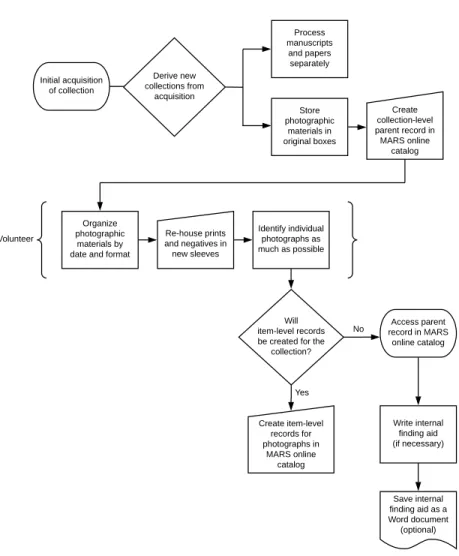
Historically, collections at the Outer Banks History Center that contained photographs and other materials like manuscripts were split into different collections, which would be processed separately by the archives. Both the Aycock Brown and Drew Wilson collections have collection-level records in the archive’s catalog. However, volunteers are largely responsible for processing these two collections, which they arrange and describe at the item level. The processing workflow followed by volunteers includes arranging and organizing these collections into series based on their
photographic formats and the chronological dates of each item. Volunteers also identify the subjects of each photograph whenever possible after they re-house each item.
Previous Outer Banks History Center staff who accessioned both of these large photography collections are thought to have made the decision to use item-level
processing approaches for their contents. Volunteers are now continuing this item-level processing approach in order to provide consistency within the collections.
Figure 2. Outer Banks History Center Initial acquisition of collection Derive new collections from acquisition Store photographic materials in original boxes Process manuscripts and papers separately Create item-level records for photographs in MARS online catalog Organize photographic materials by date and format
Volunteer and negatives in Re-house prints new sleeves
Identify individual photographs as much as possible
Will item-level records be created for the
collection?
Create collection-level parent record in MARS online
catalog
Write internal finding aid (if necessary) No record in MARS Access parent
online catalog
Yes
Save internal finding aid as a Word document
Process Decision Document
Hard Disk Database
Terminator Manual Input
Primary process Future process
Workflow Legend
Haverhill Public Library Special Collections
The Haverhill Public Library established its Special Collections Department in 1923 with the goal of preserving the library’s existing special materials and acquiring new collections pertaining to the town’s local history (Haverhill Public Library, 2018). Along with its holdings of manuscript collections and genealogy papers, the Haverhill Public Library Special Collections Department features a large collection of photographs estimated to contain approximately 50,000 images. About twenty percent, or 10,000, of these images are either nitrate or acetate negatives, while the remaining portion of the collection is comprised of photographic prints.
Within the past year, the Haverhill Public Library began a grant-funded project to digitize their photography collections and make the images available online. Although other institutions that completed interviews for this study were also digitizing the entirety or portions of their photography collections, the Haverhill Public Library was unique because they were having an external vendor complete the processing and digitization portions of their project. The workflow visualization for the Haverhill Public Library highlights these vendor-provided digitization and processing services while detailing the procedures that the special collections staff follow before and after sending materials to the vendor.
At the onset of the digitization project, staff members arranged the collection’s photographic prints and negatives into further subseries. The staff arranged the
the digitization project because the library is digitizing their nitrate and acetate negatives and placing them into cold storage before processing other items in the collection.
Once the staff arranged the images and they were ready for digitization, the vendor began collecting negatives from the library and processing them externally. This processing includes re-housing each item in new enclosures, assigning the enclosures unique identifiers and barcodes, creating digitized versions of each image, and storing the materials in new archival boxes. When the vendor completes these processing steps for each batch of photographs, they return the physical materials, along with a hard drive that contains the digitized images. After receiving the physical materials and digitized images from the vendor, the Haverhill Public Library places any nitrate or acetate negatives into cold storage, while storing other items on-site in the Special Collections Department.
The staff then imports the digitized photographs into PastPerfect and catalogs the images at the item level. The cataloging staff also adds additional descriptions to the catalog records in the form of keywords that are based on the Haverhill Public Library’s own controlled vocabulary and Library of Congress subject headings. The library derives low-resolution versions from the digitized images and saves them with watermarks that identify the photographs as being part of the Haverhill Public Library’s special
Start digitization project
Maintain original order for
collection Arrange negatives by format (nitrate, acetate, polyester, glass plate) Arrange prints by subject subseries Vendor returns digitized images on hard drive Pioritize digitizing negatives first
Vendor picks up batches of negatives from
library
Vendor
Vendor re-houses negatives in new
enclosures Vendor assigns unique barcodes to enclosures Vendor digitizes negatives in each batch Organize negatives in batches for digization Vendor returns physical items in
new archival boxes
Return other materials to the
collection Store nitrate and acetate negatives
in cold storage Import digital
images into PastPerfect
Use existing barcodes as unique
identifiers
Catalog digital images at the
item level Add additional descriptions to catalog records Save low-resolution images with watermarks Upload watermarked images and descriptions to website Make collection website public
Process Decision Document
Hard Disk Database
Terminator Manual Input
Primary process Future process
Workflow Legend
Chicago History Museum
The Chicago History Museum’s archival collections contain an estimated two million photographs including daguerreotypes dating back to the 19th century as well as contemporary born-digital images. The museum’s prints and photographs holdings are “the single largest source of pictorial information for the Chicago metropolitan area from the early nineteenth century to the present” (Chicago History Museum, 2017). The most common format found in the museum’s prints and photographs collection are black and white silver gelatin prints, and nearly half of all the photographs are located in two of the museum’s collections. The largest of these two collections, the Hedrich-Blessing
architectural collection, consists of approximately 550,000 photographs that were produced from the late 1920s through the 1980s. In addition, the museum manages the Chicago Daily News photo morgue, which includes approximately 400,000 photographs that were produced from the early 1900s until the 1970s.
Of these two collections, the Hedrich-Blessing architectural collection is
completely processed and described at the job or series level. The museum retained the collection’s original numbering system at the donor’s request and used it to identify jobs in the collection. Each job was re-housed in new folders and then stored separately by format. The archive stores all of its color prints and negatives, along with its black and white negatives, in varying degrees of cold storage within the museum.
Chicago. Unlike the Hedrich-Blessing collection, materials from the Chicago Daily News are only re-housed if their enclosures are damaged or if researchers request them for digitization. Otherwise, the staff keeps the materials in their original enclosures and stores them in the appropriate area of the archive depending on their format. After the staff completes this physical processing and re-housing, they assign each series or photograph a call number that designates where to store the items in the archive.
The Chicago History Museum describes collections that receive more detailed processing beyond the collection level in finding aids that reflect their level of
Initial acquisition
of collection Create skeletal record in catalog Assign accession number to collection Assess collection to determine processing level Will collection materials be re-housed?
Only re-house if enclosures are
damaged
Separate and store formats for best preservation
Will the collection be digitized? Is the collection
described at the collection-level? Update catalog record with collection-level description No
Create a finding aid if collection is described at more
granular levels Re-house all prints in new folders Re-house all negatives in new sleeves
Black and white prints (regular storage) Color prints and
negatives (cold storage, 38-42 degrees)
Black and white negatives (cold storage, 55-65 degrees)
Assign call numbers for materials based on storage location
Figure 4. Chicago History Museum
Describe materials at the pre-determined processing level Yes No Yes Yes
Send collection to be digitized by the Rights and Reproductions
Department
Receive collection and scans after
materials are digitized
Access materials through the catalog
and/or finding aid and/or DAMS (each
contains links to the other systems)
No
Rights and Reproductions creates
records in the Digital Asset Management System (DAMS) for images at the item level or using extant minimal description for
Process Decision Document
Hard Disk Database
Terminator Manual Input
Primary process Future process
Workflow Legend
Forsyth County Public Library Special Collections
The Forsyth County Public Library’s North Carolina Room includes six large photography collections that contain an estimated total of 300,000 images. The images in these collections “feature people, events, buildings, and street scenes” from Winston-Salem, North Carolina and date back to the late 19th century (Forsyth County Public Library, 2018). The largest of these collections was accessioned from Coppedge Studio, a professional photography studio that operated locally from the mid-20th century until the early 1990s. The Coppedge Studio collection includes about 250,000 images and is mostly comprised of black and white negatives. The Frank Jones collection is the North Carolina Room’s second largest photography collection and contains approximately 20,000 images dating from 1937 to 1975 that were created by a former photographer for the Winston-Salem Journal newspaper.
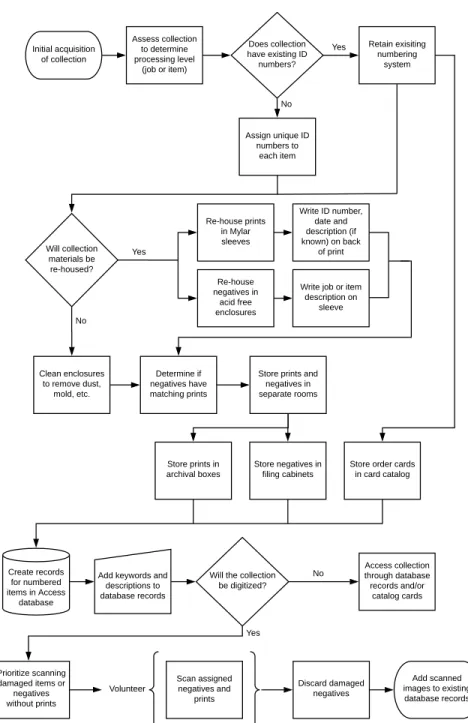
Although the Frank Jones collection was taken out of its original order at one time, it has since been processed at the item level and re-arranged in chronological order. As part of this processing workflow, the library staff assigned unique identification numbers to the prints and negatives and re-housed them in Mylar sleeves and acid-free enclosures. Any identifying information that was associated with the images was either written on the back of the prints or on the negative enclosures. During processing, the library’s staff also determined whether negatives from the Frank Jones collection had any matching prints prior to storing each format in separate rooms.
or series in the collection and included them on the existing enclosures. The studio also stored additional data about the photographs in each job on order cards that they labeled with the same numbering system. Because the collection already included this method for accessing its extremely large number of photographs, the staff chose to perform a
minimal level of processing for those materials. The library kept the photographs in their original enclosures, cleaned the sleeves to remove dust, and inspected the collection for mold or other types of deterioration. After cleaning and inspecting the negatives, the staff members arranged them in filing cabinets, and stored the order cards with descriptive information for each job separately in a card catalog.
The library’s special collections staff is now entering descriptions of the materials in both the Frank Jones and Coppedge Studio collections into a Microsoft Access database. These descriptions vary according to their levels of processing. For example, the library indexes each job or item number that is assigned to the materials in the database, along with any descriptive information from their enclosures or order cards. When more information is known about the photographs, the staff also includes
additional descriptions or keywords in the database records during the indexing process. Library staff members then use the Access database as the primary method for searching each collection, along with consulting the Coppedge Studio collection’s card catalog.
In addition, staff members add scanned images from the collection to their corresponding database records after digitizing any photographs. Currently, the North Carolina room is prioritizing digitization for any negatives that show signs of
Initial acquisition of collection
Assess collection to determine processing level
(job or item)
Will collection materials be
re-housed?
Clean enclosures to remove dust,
mold, etc.
Will the collection be digitized?
No
Yes
Prioritize scanning damaged items or negatives without prints Re-house prints in Mylar sleeves Re-house negatives in acid free enclosures Does collection have existing ID
numbers?
Retain exisiting numbering
system Yes
Assign unique ID numbers to
each item No
No
Yes
Write ID number, date and description (if known) on back
of print
Write job or item description on
sleeve
Determine if negatives have matching prints
Store prints and negatives in separate rooms
Store negatives in filing cabinets
Store order cards in card catalog Store prints in
archival boxes Access collection through database records and/or catalog cards Create records for numbered items in Access
database
Add keywords and descriptions to database records Scan assigned negatives and prints Add scanned images to existing
database records Discard damaged
negatives Volunteer
Process Decision Document
Hard Disk Database
Terminator Manual Input
Primary process Future process
Workflow Legend
Greensboro History Museum Archives
The Greensboro History Museum Archives features four large film photography collections from local professional photography studios, as well as images from
individual photographers in the area (Greensboro History Museum, 2018). The museum acquired the largest of these collections from Martin’s Studio. The Martin’s Studio collection includes approximately 300,000 to 400,000 images that were photographed between the 1930s and the 1990s. There are similarities between the Martin’s Studio collection and the previously-mentioned Coppedge Studio collection. Both collections already included job-level series when their current institutions received them, and each photography studio labeled the collections using their own numbering systems. In addition, like the Coppedge Studio collection, the Martin’s Studio collection consists mostly of black and white negatives.
After evaluating the Martin’s Studio collection, the Greensboro History Museum Archives decided to retain its existing series arrangement and numbering system. The museum also left the prints and negatives in their original enclosures and stored the materials in new archival boxes. The collection’s order cards were filed in card catalogs, and the photographers’ calendar books, which contained additional descriptive
information about the jobs, were stored in an adjacent section of the archive.
To begin with, the archivist assigns a group of negatives to a volunteer who re-houses them. This first volunteer examines the negatives from each job and arranges them in sequence if additional information about their order can be determined from proof prints, the negatives themselves, or the other documentation. If the photographs are studio portraits, the volunteer also weeds duplicate negatives from the collection at that time. The volunteer re-houses the negatives in polypropylene sleeves. Then, the volunteer copies job-level information from the original enclosures onto adhesive labels and
attaches them to the new polypropylene sleeves.
A second volunteer receives the materials after they have been re-housed and labeled. This second volunteer indexes information about each enclosure or job into a Microsoft Access database. The volunteer is primarily responsible for entering the titles and descriptions written on the labeled enclosures, along with any information that is on the order cards or in the calendar books. However, the cataloging volunteer often
includes rich, item-level descriptions for each photograph in a job, which they enter into an additional field in the database. After the volunteer creates database records for each batch of photographs, the archivist reviews their descriptions and makes any necessary edits to the information. At this time, the museum stores descriptions of items in the collection exclusively in the Access database, but the staff plans to export the database records and make them available online in the future.
Lastly, a third volunteer is responsible for completing the final digitization
component of the processing workflow for the Martin’s Studio collection. The volunteer primarily digitizes the items in chronological order, beginning with the earliest
based on their dates and then selects which photographs to digitize. However, they only digitize a portion of the images from each job. The volunteer selects and scans images based on their interests and whether the photographs would address any relevant research questions that the archive has received.
After scanning the photographs, the volunteer enters descriptive information from the enclosure into the digitized images’ EXIF metadata. EXIF, or Exchangeable Image File Format, is a metadata standard for digital images that includes descriptive
information for each file (Camera & Imaging Products Association, 2016). While EXIF metadata may automatically contain certain information about each digitized image, including its creation date and file type, volunteers also enter other descriptive
information into the EXIF metadata fields (Ritzenthaler & Vogt-O’Connor, 2006). This additional descriptive information may include the photographer’s name and any
captions, dates, or descriptions from the photographs’ enclosures that the volunteer enters into the digital images’ corresponding EXIF metadata fields.
Save records for each job / enclosure in database Initial acquisition of collection Enter information from enclosures into Access database Retain numbering system, series, and arrangement
Keep negatives in original sleeves, store in archival
boxes Store prints in
archival boxes
Store order cards in card catalogs
Store calendar books on shelf
Archivist assigns unprocessed materials Weed duplicate studio portrait negatives Re-house negatives in polypropylene sleeves Volunteer 2 Enter additional item / job-level descriptions into
database
Export descriptions from Access database
to Re:discovery Proficio museum collection software and
make available online
Save scanned images in shared directory Retrieve enclosures in chronological order (oldest - newest)
Enter information from enclosures into image EXIF
data
Volunteer 3
Review images to be
scanned
Copy information from original sleeves onto labels and adhere to new enclosures
Archivist reviews / edits database
records Volunteer 1
Figure 6. Greensboro History Museum Archives
Choose images and scan selected photographs
Enter preservation metadata for scanned
images into Access database produced by NC ECHO digital cultural
heritage project
Produce low-resolution JPEG image files by batch processing in Adobe
Photoshop
Import low-resolution images into Re:discovery Proficio
Process Decision Document
Hard Disk Database
Terminator Manual Input
Primary process Future process
Workflow Legend
Duke University Technical Services
The Duke University Technical Services Department processes large collections of film photographs for the Archive of Documentary Arts and other archives within the David M. Rubenstein Rare Book and Manuscript Library. The Rubenstein Library established the Archive of Documentary Arts after acquiring the photographs and papers of Paul Kwilecki in 1991 (Duke University Libraries, n.d.). During the following year, the archive also acquired the photographs and writings of William Gedney, which strengthened the institution’s commitment to collecting the complete archives of documentary artists including their negatives, proofs, prints, journals, and other items (Duke University Libraries, n.d.).
The acquisitions of both Kwilecki and Gedney’s collections still remain two of the largest photography collections in the archive. The Paul Kwilecki collections contains approximately 9,480 items including negatives, contact sheets, and black and white photographic prints (Duke University Libraries, 2017). The William Gedney collection contains approximately 56,871 items in various formats including “negatives, contact sheets, work prints, exhibit-quality prints, test prints, personal snapshots, and slides” (Duke University Libraries, 2015).
After acquiring these artists’ archives and similar large photography collections, the Technical Services staff works with the curator to assess the collections and determine which level of processing is appropriate for their materials. To assist with this
When the level of processing has been determined, the staff often drafts a proposal that addresses the expected processing strategy, including the planned series to feature in a collection, the necessary levels of description and housing for items, and the required staffing needs.
Once processing begins for a collection, the staff inspects its contents for any urgent conservation issues that they need to address before continuing. If the collection already has an identification system for its images, the staff tries to incorporate that original system into the institutional identifiers that they assign to the collection.
Otherwise, the staff assigns unique institutional identifiers to items in the collection based on the planned levels of processing.
If the photographs are candidates for digitization, the collection receives Level 4 processing, which involves re-housing and describing those materials at the item-level. Staff members may also complete more intensive conservation measures for this level of processing or generate additional metadata at this stage to prepare for the digitization process.
After the staff arranges and describes a collection, they separate its various
Initial acquisition of
collection
Re-house some or all materials at
the item level
Separate black and white / color
negatives and prints Draft proposal for
processing and description strategy
(series, metadata, housing, staff, etc.)
Check for urgent conservation issues (send to conservation staff
if necessary)
Did the creator employ a system of image
identification?
Try to incorporate legacy system into institutional identifiers Yes Staff assigns numbering sequence for institutional identifiers No Create barcodes and box labels
Document processing and
description strategy and progress on Trello
tracking board
Store loose materials in new
enclosures
Re-house materials if original
folders are damaged
Create series and subseries
if necessary
Arrange folders in order (chronologic or alphabetic) Complete more intensive conservation if necessary
Describe some or all materials at the item level using required metadata elements
Capture additional option metadata if
needed (dimensions, inscriptions, subject terms, etc.)
Format metadata to meet digitization standards Create catalog record from finding aid data Describe materials at the folder level
Create finding aid according to level of description Figure 7. Duke University Technical Services Photograph Collections
Create accession record and preliminary catalog
record for collection
Add project to Trello tracking
board
Separate black and white / color
negatives and prints Will the collection
be digitized? No
Yes
Discuss metadata and arrangement to conform to
digitization standards
Wait for Manuscript Unit
head to assign processor to
collection Alert curator of
collection's arrival
What level of processing and description will be
applied?
Level 3 Processing
Process Decision Document
Hard Disk Database
Terminator Manual Input
Primary process Future process
Workflow Legend
Discussion
After reviewing the workflows for each participating institution, several similarities and differences became clear when comparing their processing procedures. Many of the institutions emphasized the need to assess the contents of a collection as an important initial step in their workflows. By assessing the collections early on, institutions were able to determine an appropriate level of processing based on the collection materials and their expected uses. To some extent, assessing collections allowed institutions to
determine if they could apply minimal processing strategies to those materials. These processing decisions contributed to subsequent steps in their workflows, including whether or not to retain an existing numbering system for identifying images, what degree of re-housing was necessary, and the level of description they would apply to the collections’ materials. Although several institutions followed workflows that included options for processing large photography collections at the collection, series or folder levels; the majority of participating institutions arranged and described their materials at the item level.
the seven institutions stored some materials from their large film photography collections in separate cold storage areas.
Two other institutions included weeding as an additional step in their processing workflows. One of these institutions weeded damaged negatives from their collection after digitizing the images. Another institution weeded duplicate or redundant studio portraits when arranging and processing their collection.
Institutions also demonstrated different approaches to creating finding aids and catalog records when describing their collections. Several institutions created initial catalog records soon after accessioning the collections and updated these initial catalog records with additional information during later stages of processing. In some cases, institutions created finding aids prior to physically processing the collections. Other institutions included finding aid creation in the final stages in their workflows.
The differences in these approaches may be a reflection of the varying practices followed by library, archives and museum professionals. However, the discrepancies between the workflows in this study demonstrate the range of practices that cultural heritage institutions use when processing large film photography collections.
Influence of More Product Less Process (MPLP)
When asked about Greene and Meissner’s More Product, Less Process recommendations and their potential influence on processing large photography
collections at participating institutions, six of the seven interviewees noted that they were familiar with the basic concepts of MPLP. Although every participating institution described some or all of their collections at the item level, many used aspects of minimal processing in their workflows. Interviewees frequently reported that their institutions considered a variety of factors when determining the necessary levels of arrangement, description, and preservation for large film photography collections. One participant described the factors considered by her institution for processing large photography collections as “a combination of internal needs, research requests, and digitization projects.”
What MPLP acknowledged or rather shouted was that… we have huge backlogs because we adhere to this kind of excruciatingly granular level of description, when in fact we should be analyzing our collections more and applying different
descriptive practices to them based on criteria that is institution specific.
Furthermore, several of the participants pointed out that previous archivists made the decisions to process large photography collections at the item level in their
institutions, and that their institutions were continuing that level of processing in order to maintain consistency within each collection. As one participant noted, “[b]efore MPLP, it was item-level for photographs all the way… Now it's a little bit different.” In fact, Greene and Meissner (2005) specifically wrote that they were “not arguing that some exceptional collections do not deserve more meticulous—even item-level—processing” (p. 254). Rather, they urged archivists to rethink their practices, in order to reduce backlogs and avoid the prescriptive approaches for arrangement, description, and preservation that the profession previously considered to be the standard for processing large collections.
A lasting takeaway that several participants mentioned about MPLP was the flexibility it offers to institutions in terms of how they define what it means to completely process a collection. As one participant stated,
What I really like is the flexibility… you know, we don't do all item-level work, and there's no way we can. So, we've decided with these big photographic collections to really apply different levels and process them into different components… I think that's been one of the best things we did.
a starting point for processing large collections and the option of tailoring their workflows to what is determined to be the best option for their institutions.
This flexibility was apparent both in terms of the initial accessioning and
processing of collections, and the potential for reevaluating their levels of arrangement and description at a later time. When elaborating on this approach, one participant mentioned that “the way to build off of MPLP… is to acknowledge that maybe it's not enough and you need to go back and describe further, and that's okay.”
Processing considerations
Condition
Participants cited a variety of considerations that influenced the level of
processing that their institutions applied to large photography collections. Among these considerations were the overall condition of a collection, its original order, and any identifying information that was already associated with the photographs at the time of accessioning. When discussing the importance of having existing identifying information for photography collections one participant joked, “I told someone that I'm pretty crazy, but I wouldn't take [thousands of] negatives unidentified.”
Institutions were likely to leave collections in their original order if they included
series and identification systems from their creators or donors. Although maintaining
original order is now a common practice when processing many kinds of archival
collections, Greene and Meissner (2005) specifically recommended this approach as one
this when explaining that receiving collections with existing series and numbering
systems helped to expedite the arrangement process. As one participant explained, “We
just took it out of the boxes that [the photographer] had and put it in archival boxes just as
it was, and it was fine.” When discussing a similar decision about retaining a collection’s
existing numbering system for identifying items, another participant noted that it “was
kind of the pivot around which everything else revolved… so it was wonderful.”
Value
Participants also emphasized that the perceived value of materials in a collection was a main factor in determining what level of processing it would receive. As one participant stated, “it isn't just the size, but it's also the value of the collection.” Many of
the participants noted that the large photography collections at their institutions had a
high research value and were among their most requested and frequently used resources:
They have very high research value, and one of the reasons is because they are well labeled by the photographers.
The… collections I mentioned, as I said, high research value, frequently requested by pretty much all of our researchers… So everybody loves these photographs, right?
We get a lot of requests for portraits… let's say they want portraits of all the YMCA presidents or all the people who were the board presidents for the Salvation Army… I really get asked that, so we use the collection quite a bit.
In addition, participants mentioned that comparing the potential value of certain materials within collections, as well as the different values of separate collections, was one way of determining how to prioritize the institution’s processing resources:
We might decide you know what, the paper materials in these institutional records are high research value, and we're going to describe those down to the series level. But we're going to leave the photographs at the series level, and if we get a request for these photographs then we might do some further processing.
Ultimately, one participant noted that taking this approach toward processing collections at her institution contributed to having some unprocessed or partially processed
collections, but it also prioritized making the most valuable material accessible,
“so the result is that we have a lot of manuscript collections that aren’t described, but on the other hand the collections that probably contain the richest material are described.”
Digitization and Exhibits
One of the main factors for how we're going to treat something is whether or not it's going to be digitized. That's like a big, big deal. If we think that something might be digitized, we will give it some sort of item-level work.
Institutions that frequently used collection materials in exhibits were also more likely to undertake detailed levels of processing for their large photography collections. One participant explained this difference in processing priorities when stating,
I was looking at specific collections… and processing them, but processing them not at the MPLP level because it was for an exhibition and a big elaborate narrative.
In addition, another participant noted that applying minimal processing to a collection actually placed their institution at a disadvantage later on, due to the popularity of its materials and their use in exhibits and other projects.
The archivist basically applied MPLP to good portions of it; and that turned out to be our downfall really, because it became… a very desirable collection that was pursued for various reasons. Either book projects [or] exhibits.
Processing challenges
Common themes about the challenges that participants faced when processing large photography collections at their institutions were also apparent in the interview responses. These challenges primarily consisted of a lack of resources, including the number of staff and the available storage space at their institutions, as well as the amount of time that their institutions required to complete detailed levels of processing for photographic materials.
When joking about the amount of time involved with the item-level processing at one institution, one participant said “as I tell my cataloguing guy… he's going to finish cataloging when he's around 160 years old.” Another participant explained that rather than feeling burdened by the amount of time and effort involved in processing a large collection,
you just have to just chip away at it and not be overwhelmed by the fact that there are so many [photographs] that need to be indexed, there's so many that need to be scanned; you’ve got to do this, and that, and the other.
The number of staff at each institution was another factor that contributed to the amount of time it took to process their collections. The majority of participants noted that their institutions relied on volunteers or interns to complete some or all of the processing responsibilities for their collections. One participant explained that this challenge was not unique to their institution, but rather, “everybody seems to always be one step behind in terms of staffing. You're perpetually sort of understaffed.”