Mary A. Kallem. The Domestic Clutter Practices of Artists. A Master’s Paper for the M.S. in L.S degree. April, 2018. 50 pages. Advisor: Brian Sturm
This study describes a series of interviews with artists regarding their organizational strategies for household clutter. The interviews were conducted to deepen an
understanding of clutter’s role within domestic taxonomies, situating clutter not as a failure of homemaking but as a residual category integral to an individual’s sense of home.
Five artists were interviewed about a self-selected area of clutter within their homes. Each participant practiced within a unique medium; participants included a zinemaker, fiction author, DJ, sculptor, and a musician. All five participants discussed clutter as sites of active labor and categorical negotiation, places where multiple aspects of their
identities comingled to form ecologies unique to their senses of self.
Headings:
Domestic Clutter
Household Organization
Artists
THE DOMESTIC CLUTTER PRACTICES OF ARTISTS
by Mary A. Kallem
A Master’s paper submitted to the faculty of the School of Information and Library Science of the University of North Carolina at Chapel Hill
in partial fulfillment of the requirements for the degree of Master of Science in
Library Science.
Chapel Hill, North Carolina
April 2018
Approved by
_______________________________________
Table of Contents
Introduction ... 2
Literature Review... 8
Methodology ... 19
The Five Participants ... 21
The Zinemaker ... 21
The Writer ... 22
The DJ ... 23
The Magpie Sculptor... 24
The Musician ... 25
Recurrent Themes ... 28
Demographics ... 28
Definitions of Clutter ... 28
Description and Value... 30
Systems for Clutter Management... 33
Ideal Domiciles ... 34
Object Retention and Deaccession ... 37
Identity Construction ... 39
Conclusion ... 41
Introduction
Clutter, by nature, is difficult to define. It is irreverent in its parameters, allowing
even the most precious of objects to be subsumed in its scope: family photographs, when
left to pile on the kitchen table for too long, resemble clutter. The necessity of tax
documents, when splayed across a study floor, recedes, while their impedance rises in the
economy of domestic space. To organize these objects is to salvage them from the
category of clutter, reasserting their situated value in the private sphere of the home. As
such, clutter is less an ontological category than a circumstance: a discordant nexus of
time, space, and material. The war against matter out of place is never over, as clutter
accompanies the act of living. Self-help texts urge the incorporation of maintenance tasks
into the routine syncopations of domestic life (Cwerner, 2003, p. 234), asserting that
perhaps the best we can do is to keep pace with clutter production. However, the specifics
of how, why, and where this keeping pace occurs is just as variable as definitions of
clutter itself: for every home, a potentially unique relationship to cluttered spaces.
It is the purpose of this qualitative study to develop a deeper understanding of
domestic clutter ecologies within the lives of artists. This will be done through
semi-structured interviews with five individuals about sites of clutter in their own homes. The
sites featured will be of their specification, and the definitional scope of “clutter” will be
recursively modified to account for the varied rhythms, habits, and vocabularies of
profiled homes. The interviews will be exploratory, inviting participants to explain how
around and within these spaces. This study does not aim to abolish the ambiguity
surrounding the cultural category of clutter. Instead, it aims to carve out a space for
narratives of categorical negotiation, a labor that has been naturalized into the invisibility
of common sense. In other words, this study will not stabilize “clutter,” but attempt to
learn from others’ domestic meaning-making in the face of categorical instability.
Within the post-industrial paradigm of accelerated cycles of consumption and
planned obsolescence, clutter has become a pervasive condition of existence. Art critics
argue that, much like the Romantics were typified by their interest in nature, we inhabit a
historical moment of junk, rubbish, and spent objects (Yaeger, 2008). Artistic movements
and practices, such as found object art, trash art, bricolage, and assemblage, negotiate the
omnipresence of ambiguous or stagnant objects. Meanwhile, science fiction’s beloved
Philip K Dick offers a unified theory of matter, ephemerality of utility, and persistence of
form by way of kipple:
“‘Kipple is useless objects, like junk mail or match folders after you use the last match or gum wrappers ... When nobody's around, kipple reproduces itself. For instance, if you go to bed leaving any kipple around your apartment, when you wake up there is twice as much of it. It always gets more and more. ... No one can win against kipple,’ he said, ‘except temporarily and maybe in one spot, like in my apartment I’ve sort of created a stasis between the pressure of kipple and nonkipple, for the time being.’” (1996, p. 65)
In this excerpt, the protagonist acknowledges his temporary success in keeping pace with
the production of kipple, the detritus of a life entangled within late capitalism. He goes on
to acknowledge that, after his death, kipple will reign supreme in an eschatological vision
of a world dominated by its own Bataille-inspired excess (p. 65). While the humanities
negotiate the conceptual nuances of human-resistant objects, homemakers operationalize
realities of forging systems of categorization within the home can be frustrating,
laborious, and tiresome.
Kipple, junk, bric-a-brac, clutter, or any other name may be wielded to discuss
this category of objects engorged with an exacerbated sense of stuff-ness. This semantic
excess appropriately mirrors the diversity of junk drawers, but it also bears a striking
resemblance to Mary Douglas’ framework for dirt.
In Douglas’ Purity and Danger (1966), dirt is presented as an ambiguous concept
that references any matter out of place. Soil, grease, stray food, or bodily fluids may be
contained within the category of “dirt,” however “dirt” cannot offer itself as a synonym.
Instead it finds definitional kinship with the ambiguous “grime,” “filth,” and
“contagion”—all terms denoting circumstances that need tending, tidying, and a return to
normalcy. Because matter out of place carries great symbolic power through its
disruption of social orders, it is met with emotions and rituals to further entrench the
transgressed systems.
Sociologist Basil Bernstein objected to her universalizing assertion of order as a
transcendent priority, offering artists and their studios as a counterpoint. Acknowledging
this oversight, Douglas writes:
“Some people feel no anxiety about dirt and disorder. Take an artist passionately involved in his painting, [Bernstein] said, the only disorder he (sic) minds about is on his palette and canvas. He (sic) can’t be bothered to go to the toilet; he (sic) relieves himself (sic) without a qualm in the studio sink even if the coffee mugs are standing there.” (1970, p. 2)
The artistic process makes no promises of palatability or conventional arrangement: the
only demands of a space is its functionality. As long as an artist’s studio yields creative
cupboards, or urine in bathrooms. Douglas agreed that her work needed revision in order
to “differentiate between weak and strong classification systems,” (p. 2) allowing space
for this trouble-making artist of categorical (and theoretical) violation.
Anecdotal associations between mess and creativity abound but few studies have
been conducted to formally understand any correlation. Vohs, Redden, & Rahinel’s 2013
study affirmed a connection between disorder and creativity, although more work on the
subject is warranted.
The present study is not comparative in structure and does not aim to substantiate
any correlation between creativity and mess. It does not hypothesize that artists have a
paradigmatically different relationship to clutter than non-artists, nor that artists have a
monolithic orientation toward mess. Instead, it considers individuals’ relationships to
clutter in light of their identity as an artist. Does mess relate to their creative practice? Is
artistic disorder integrated into domestic clutter, or does it remain quarantined within
studios, basements, or other creative spaces? If clutter can be seen through ecological or
archaeological lenses, what knowledge can be gleaned about the inhabitants of these
environs?
Through this approach, clutter will not be viewed as a failure to perform
normative scripts of domestic maintenance. Instead, this study aims to destigmatize
clutter not only as an inevitable byproduct of living, but as an intimate positive
epistemology belonging to each house-made-home. By providing space for
object-oriented narratives of the domestic to be constructed and shared, this study aims to
disrupt the supremacy of a monolithic tidiness. With its upper- and middle-class values of
with godliness betrays malignant implications. Although participants may express
frustration with their clutter, there is room for the acknowledgement of immanence
within these mundane ecologies. By understanding the anatomy of junk drawers, personal
cosmologies are revealed.
Different logics of retention will be explored within each case study,
acknowledging that matter gains relevance through a variety of mechanisms. Utility is
conventionally seen as the primary justification for keeping things around; however,
sentimentality and aesthetic appreciation can also keep an object out of the rubbish bin.
The comingling of objects and rationales within specific clutter zones will be
interrogated, as well as the importance (or lack thereof) it has for the owner.
It is worth acknowledging that this is not a study on hoarding behaviors, which
are a specific pattern of object accumulation that manifests as pathology. The temptation
to conflate clutters and hoards signals an inclination toward the spectacular—or rather,
the spectacle of social transgression and a fascination with “deviant” behavior. Although
research on hoarding behavior is necessary and valuable for the lives of people with
hoarding disorder and their loved ones, this study asserts a value in interrogating the
mundane.
This study is conducted in hopes of better understanding clutter as a household
phenomenon, disrupting social conventions of tidiness as the default state of domiciles,
and enfranchising individual’s systems of classification as legitimate and coherent. By
better understanding realms of clutter, scholarship can better understand autochthonous
may create systems of classification that operate less as disciplinary forces, but instead
Literature Review
An Amazon search for “clutter” underneath the sub-category of “Books:
Self-Help” yields 785 distinct results. The rhetoric of the best-selling titles offers the erasure
of clutter as a method to “find happiness” (Smallin, 2014), “reclaim your life”
(Richardson, 2017), “find your life” (Blanke, 2010), “discover who you are” (Bennett
Vogt, 2012), and related pronouncements not of self-actualization, but of uncovering an
occluded self. Additionally, numerous titles turn to the militaristic, offering methods of
“conquering” (Walsh, 2009) or “winning the war against” (Felton, 2010) clutter.
This popular association of clutter as the nemesis of a balanced domestic space
echoes into scholarship, with a trove of multidisciplinary research completed on the
complexities of hoarding. Defined by the Diagnostic and Statistical Manual of Mental
Disorders, Fifth Edition (2013), hoarding disorder is typified by a “persistent difficulty
discarding or parting with possessions, marked distress associated with discarding items,
and excessive accumulation of objects” (242). As a medical condition that critically
lowers the quality of individuals’ lives, the topic of hoarding warrants serious
consideration. Work has been done by psychologists and other medical practitioners to
understand the efficacy of different forms of interventions and across varying
demographics. There has also been an interest in the aesthetics of hoarding from the
humanities (Lobdell, 2005; Moran, 2009; Krasner, 2017).
Although lives may be markedly improved because of this scholarship, it is
significantly less work has been done outside of hoarding studies. Reflected in the
popularity of A&E’s 2009 television show Hoarders and ensuing spin-offs (Hoarders:
Family Secrets, Hoarders: Then and Now, and most recently, 2016’s Hoarders:
Overload) is a cultural fascination and spectacularization with the illness. By constructing
a singular orientation toward mess, clutter, and material excess through a lens of
pathology, the multiplicity of accumulation patterns has gone ignored by scholars and
society at large. Devalued in this discussion are commonplace or mundane instances of
object retention, patterns that are absolved from interrogation through their failure to
signal the grotesque.
Shows such as Hoarders offer the consolation that viewers’ messy households
“aren’t that bad.” Meanwhile, common sense—and a prospering self-help industry—
signals that clutter is a pervasive household presence. However, failure to perform
domestic tidiness is still met with feelings of shame: past studies have documented
participants’ embarrassment over domestic mess (Cwerner & Metcalfe, 2003). “She was
ashamed because the disorder in her kitchen revealed by her sister-in-law affects her
identity as a wife” (p. 573) writes Dion, Sabri, & Guillard, demonstrating the identity
construction involved in domestic presentation. Other studies have typified messiness as
a “dirty little secret” (Belk & Yong, 2007).
While shame enables clutter-keeping to become clandestine and obfuscated
behavior, it also concentrates the conversation solely around the individual (Bettany,
2007). Broadening the focus, Cwerner & Metcalfe argue for a historical contextualization
of domestic clutter and storage economies. That these topics have gained traction in
globalization and the network society” (p. 232). As global materialities shift, so do local
and domestic reckonings: although the war against clutter may feel like a battle against
laziness, irresponsibility, lack of commitment, or, less personally, a metaphysical
entropy, it is also imagined as a palliative against the capitalist will to acquire. “The
seemingly irreversible growth of consumption in the post-war years has meant an
increasing array of things … flowing into our homes,” (p. 232) writes Cwerner &
Metcalfe. The domestic space has gained a new porosity, with commodities entering and
exiting its confines at accelerated rates. While tidiness may diffuse the stress caused by
an influx of objects, it fails to address the root cause—instead, it creates anticipatory
spaces ready to provide shelter for future acquisitions. These spaces do not staunch
consumption: they make consumption viable. In parallel, while self-help books and the
burgeoning trend of minimalism may present themselves as rhetorically and aesthetically
antithetical to the materiality of late capitalism, they ultimately exist to generate revenue
and reify capitalism.
As residue has “a way of haunting the commodity” (Yaeger, p. 335), it is
perpetually up to inhabitants of domestic spaces to implement culturally appropriate
responses to goods becoming clutter, junk, trash, or residue. Successful conformity with
socially accepted responses to clutter reaffirms an individual’s “personal boundaries and
propriety” (Edensor, p. 315). Additionally, particular responses flag inclusion within
certain organizational trends or fads—specifically the “modish desire for minimalistic
designs which make an enemy out of clutter” (p. 314). The ability to comport private
spaces in response to larger, industry-wide trends reveals a class-based dynamism: it
Additionally, the luxury of hiring housekeepers or professional organizers to keep a
household in check is one that starkly signals a class divide: the rich live in clean houses
because the poor keep them that way. This is but one example of how systemic power
structures are deployed within the domestic sphere.
Long-acknowledged is the feminization of domestic labor, even within
double-income households of heterosexual couples. Termed “the second shift” in Arlie
Hochschild’s eponymously titled book (1989), the completion or distribution of domestic
chores is coded as a woman’s responsibility. As such, the onus of clutter management is
inequitably distributed, and the social cost of failing to maintain a tidy house is frequently
at the woman’s expense. Some studies have gone so far as to exclusively interview
women (Makovicky, 2007), while others predominately feature female participants
(Dion, Sabri, & Guillard, 2014; Swan, Taylor, & Harper, 2008). This gendered division is
compounded by a specific interest in the clutter of families with young children (Luzia,
2011; Stevenson & Prout, 2015), where mothers are consulted as a point of authority on
both domesticity and child-rearing. Although these studies ultimately highlight the
perspectives of women, they do little in the way of explicitly examining clutter in
relationship to a gendered division of labor, or how clutter may have divergent
connotations for different identities within a household.
As mentioned above, clutter is normatively perceived as a demonstration of
failure across class, gender, and, as Mary Douglas’ work on purity maintenance
demonstrates, moral lines. In her seminal anthropological text Purity and Danger,
Douglas discusses contagion heuristics as they relate to social order. For Douglas,
propriety. Following Emile Durkheim’s definition of dirt as matter out of place, she
argues that symbolic defilement occurs when systems of classification are violated.
Matter out of place gains the status as contagion and is socially expected to be met with
ritual practices to both restore order and reify the social codes that initially deemed it a
contagion. Although Douglas proposed this anthropological theory as a macro-level
framework for understanding cultural structures, scholars have tied it to micro-level
practices of the daily and mundane. Within the domestic sphere, untidiness is viewed as
morally dangerous and “tidying reinforces both the structure of social reality and the
subsequent moral order that is infused into our structuring of reality by categories and
classifications” (Dion, Sabri, & Guillard, p. 573).
Scholarship has largely painted clutter as an agent of chaos, a symbol of a life and
home out of balance, and a correlate for pathology. However, scholarship has also
worked to destigmatize clutter and reassert its status as a necessary component of
domestic taxonomies. While self-help texts and normative domestic organization studies
focus on legible storage spaces, clutter is positioned as a residual category whose
ontological status must be reckoned with in order to find its rightful place. Coined by
Bowker & Star, a residual category is “that which is left over after a classification is
built—‘none of the above’ and ‘not otherwise specified’ are typical locutions” (2007, p.
274). Clutter, in its status as not-quite-trash but not-quite-useful operates as a residual
category, an ambiguity that troubles rigid domestic classifications.
Bowker & Star argue that residual categories are necessary for a system’s
usability, echoing Derrida’s sentiment that “there is always a category of utterance within
lieu of an ordered universe, the universe is populated with attempted organizational
structures that, by proposing a fixed order, set the conditions for inexorable
transgressions. The welling up of residual categories is inevitable and, for Bowker &
Star, a harbinger of beauty:
“They are the defining white space around a formal system’s objects, just as in art. They limn purpose, suffering, exclusion and centrality. Just as voices of the other, the subaltern, and the silenced in literature may expose a master narrative, so do residual categories expose the taken for granted and the axiomatic, in any formal system.” (p. 275)
To acknowledge clutter as the residual category of domestic spheres is to endow it with
great power, much like Douglas’ matter-out-of-place grants a power of symbolic
contamination and disruption of social norms. Although comparing clutter to the literary
voices of the subaltern might seem hyperbolic, this connection resonates with cultural
associations of clutter with the middle and lower class, and tidiness with high-brow
propriety (Edensor, 2005; Cwerner & Metcalfe, 2003). Additionally, headlines such as
“Mom goes on strike, stops cleaning for a week, chaos ensues” (Macario, 2012) and
“Parliament House cleaners strike for a week” (The Canberra Times, 2015) remind
readers that it is not only objects within a system that are taken for granted, but the
stewards as well.
By reframing clutter as transmissions worth listening to—artefactual testimonies
of sociological conditions in situ—scholarship works to construct a positive epistemology
around mess. Clutter is not to be considered an impediment to the “perfect series of
flows” (Cwerner, p. 233) that compose a household’s routines. Instead, clutter
“constitutes alternative modes of ordering the home based on practices, habits and
that cannot be subsumed under that rationalist gaze that conceives of time, space and
objects as fully measurable and manageable entities” (p. 236). Clutter resists stabilization
of value, operating as objects slippery against logics of utility. In this ambiguous state of
value, clutter is placed aside in attics, junk drawers, and other designated areas in order to
avoid a constant re-assessment of worth; the owner and the object’s relationship is placed
on hold, shifting from kinetic to potential energy. For Baudrillard, these marginal objects
“appear to run counter to the requirements of functional calculation, and answer to other
kinds of demand such as witness, memory, nostalgia or escapism” (1968, p. 73). It is the
later re-discovery of an object that ties together sentimental cosmologies in unexpected
ways.
Much like “dirt” is used to discuss soil, sweat, stray food particles, or grease,
“clutter” is also a term deployed with a lack of definitional clarity. The failure to reach
semantic consensus “is part of its quiddity. Not only does clutter consist of different
things across cultures, it means … different things to people under the same roof” (Swan,
Taylor, & Harper, p. 4). When junk drawers, tables, garages, or other clutter spaces are
allotted as an accepted organizational space, do they become absolved from their status as
“mess”? Is it still clutter if it is tucked away in a closet, non-confrontational in optics?
Scholarship has included these categories as constitutive of a greater definition of clutter,
and by doing so has attached codes of etiquette to human-clutter interactions. Referred to
as “schemes of material order” (Maycroft, p. 357), clutter obeys certain principles of
containment and scope in order to prevent drifting into more socially maligned forms of
In this regard, clutter is not necessarily the inverse of storage, but a form of it
(Cwerner & Metcalfe). Scholarship has been done to outline the specifics behind certain
cultural practices of clutter composition and display, such as Central Slovakian
glass-fronted cabinets and linen closets that operate as historically material objects that bring
Slovakian pasts into the Slovakian present (Makovicky, 2007). Studies of families with
young children also chart patterns in functionalist maintenance of clutter, such as the
allowance of toy messes in spaces for play (Stevenson & Prout, 2013). These messes are
a spatio-temporal arrangement that signal where and when it is appropriate to engage in
“play”: a storage of both objects and behaviors.
This constructed grammar of where’s, when’s, and how’s coalesce as an internal
culture for a household. This home-knowledge is “fundamental to the ordering of the
self” (Hawkins and Muecke, 2003: xiii), as well as ordering of the family or other
domestic unit. It is common practices of clutter maintenance that “transform built spaces
into homes’” (Swan, Taylor, & Harper, p. 3), with clutter not an agent of friction but a
signifier of a lived-in domicile. Jacobs and Smith (2008) refer to this as an “assemblage
of dwelling” (p. 518), where objects, habits, and architectural space commingle to form a
holistic sense of housing and home.
As a term, “assemblages of dwelling” semantically acknowledges the bricolage
present in spaces routinely used, allowing for a sense of depth to be inferred. As objects
recede from view and circulation into places of designated clutter, they instantiate levels
of interaction: the frequently used, the dusty but regularly dusted, and the ignored, for
example. The tendency for objects to fade into obscurity, signaling recesses within our
compel readers to “open everything up to knowledge and vision in order to make
everything present in the here and now,” (Cwerner & Metcalfe, p. 233), allowing
everything to be visible, known, unhaunted, and immune to the unheimlich.
Marginal objects resist this legibility as their identity is forgotten or lost, as with
anonymous family heirlooms or broken appliances emptied of their utility. As they create
levels of sedimentation within the ecology of a domestic landscape, their obscurity can
spawn unexpected sentimental meanings. It is only when they are stumbled upon at a
later date that they reveal their status as an unplanned time capsule to a past accreted with
nostalgia—hence regaining a utility not of original function but of reminiscence. Writes
Edensor, “stripped of their use and exchange values and the magic of the commodity,
they can be reinterpreted anew, perhaps bearing the utopian, collectively oriented visions
unconsciously embodied within them” (p. 330). In this instance, it is only when objects
have lost their identity that they can gain a new status within the household’s orrery of
memory.
Serendipity as a mode of information encounter and information-seeking behavior
is typified by coming across unexpected information in unexpected locations, wholly by
chance, or in likely places that have been approached unsystematically (Foster & Ford, p.
332). Put simply, serendipity is the act of coming across information that an individual
was “not in quest of” (Remer, 1965, p. 20). Zones of clutter may operate as breeding
grounds for serendipitous encounters, where the perceived unlikelihood of rediscovery
limns objects with novelty or wonder.
This wonderment may be compounded by the intermingling of sacred and profane
to the broken or starkly useful (rubber bands, thumbtacks, etc.) to present a comportment
of space that makes meaningful encounters seem unlikely or absurd (Swan, Taylor, &
Harper, p. 15). The unearthing of these materials thrusts contemplative or reminiscent
affects into mundane household encounters, imbuing ordinary spaces with extraordinary
meanings.
Lastly, spaces apprehended as clutter may present a different code of values in the
eyes of another. Kirk and Sellen (2010) document the taxonomies of home archives,
listing four origin stories of objects: gift/inheritance, bought/found, created, or collected
(p. 3). Additionally, archives may operate on three tiers of visibility: display (such as
Makovicky’s Slovakian glass-fronted cabinets), functional storage (Makovicky’s
Slovakian closets), and deep storage (p.7). Although Kirk and Sellen are discussing the
same material objects as those featured in clutter studies, they are enfranchised as
artifacts within an archive—not lowly clutter. By providing a theoretical structure for
where and how sentimental objects are kept, this study implements a rhetoric that was
once reserved for institutions decidedly outside the domestic sphere. What is considered
clutter may have an implicit organizational schema that has yet to be verbalized or
enfranchised. Clutter to one may be invaluable heirlooms to another and eccentric
systems of organization are not to be dismissed.
Clutter scholarship has gained application in the realm of Human-Computer
Interaction (HCI), where developers strive to emulate analog organizational environments
within their digital ones. By providing richly detailed accounts of individual’s object
storage and retrieval within the most intimate and comfortable of spaces (such as the
& Sellen, 2012; Kirk & Sellen; Odom, Zimmerman, & Forlizzi, 2014; Swan, Taylor, &
Harper).
It is the aim of this study to continue Douglas’ work differentiating between weak
and strong classification systems. The domestic spaces of artists will be examined for
their anatomies of clutter, allowing participants to voice their personal relationships to
Methodology
This study was conducted through qualitative methods using open-ended
interviews. Participants were recruited through snowballing methods. Participants were
asked to volunteer other artists within their community; no particular domestic styles or
clutter management practices were favored when selecting participants. This study
consisted of five households, valuing rich narratives over a large sample size.
For this study, individuals are considered artists if they either 1) self-identify as an
artist or 2) regularly engage in creative practices (visual art, writing, musicianship,
theater, etc.) professionally or as a hobby. Their domestic space does not have to be their
primary location for creative production—for example, they may have a studio or
practice space elsewhere. However, participants were permitted to discuss creative spaces
if located within their living space.
Interviews were conducted during a home visit with one individual from the
household; however, cohabitants were allowed to participate if present and interested.
Collaborative responses between members of a household were difficult to avoid in
homes where people shared close quarters and sound traveled easily; people were eager
to share thoughts on the cadence of organization within their house. Provided all
participants’ consent, interviews were audio recorded. Participants were first asked to
introduce themselves, their house, and their creative practices. Participants were allowed
to answer this question in any fashion; however, they were specifically asked about the
were then asked to provide a personal definition of clutter, having not received a
definition from the researcher. They were then asked to identify a specific zone of clutter
in their house, with no parameters placed on what location. The space could be a
bedroom, common area, studio space, storage, or otherwise; no size constraint was
provided, so participants were welcome to discuss localized areas or entire rooms. We
visited this zone of clutter and discussed its constituent objects. Conversation was
allowed to flow organically but guiding questions (found in Figure 1) were implemented
when discussion came to a lull. Because of the open-ended nature of this study,
participants were allowed to meander through topics they were most enthusiastic to share.
At the end of the interview, participants were asked to once again define clutter. The
interviews took between 45 to 90 minutes.
The interviews were transcribed and coded inductively, drawing from the
interviews’ emergent themes.
Fig. 1: Guiding Questions
-Can you tell me about yourself and your house?
-How many people live here, and how long have you lived here? -What does “clutter” mean to you?
-Can you show me a place where you keep personal clutter? -What types of objects are these?
-How did they make their way to this [junk drawer/closet/etc]? -How long have these objects been here?
-How would you feel if the items in this [junk drawer, closet, etc.] disappeared?
The Five Participants The Zinemaker
The Zinemaker has lived at his current residence with his partner and one
housemate for five months. His definition of clutter was based in an unwieldy impulse of
wanting: wanting to retain objects but not having the space, or not know how to store
them. He brought me to a tower of cardboard boxes in the corner of his “extra room,” a
space he and his partner use as a walk-in closet and storage: “clothes and pretty much
everything else that doesn’t fit other places.” Interspersed among the boxes—remains
from their move-in—were broken tennis rackets, an axe, seasonally inappropriate clothes,
old notebooks, and unseen, forgotten objects within the boxes.
While he accumulates ideas for future zines throughout his day, his creative
practice largely occurs within the home. Composition, production, and storage are located
at home, and as such, his domestic organization allocates space for projects both finished
and in-process. This organization may not be intentional, as reflected in the forgotten
objects hiding among the stack of boxes in his extra room. As we discussed the pile, he
opened boxes and disinterred their enclosed objects: “I think that these are posters that I
feel ashamed about. Let’s see... oh wow, nevermind this is different than I thought it
would be. This is perfect!” Found inside the boxes were screen printed posters,
The Writer
Cohabiting with her domestic partner in their apartment for under a year, the Writer
brought me to their shared study as her primary clutter zone. While two desks occupy the
room, her partner seldom—if ever—uses the space. Instead, the room is used for her
writing practice and storage. She defined clutter as transient objects that “need to be dealt
with,” but found it difficult to narrow her definition any further. She acknowledged that
most of the objects in their apartment belonged to her, a claiming of space she attributed
to gender: owning more things is “probably typical for women,” she stated. She also
expressed an indexical knowledge of storage, with most of the organizational work done
by her and not her partner.
She discussed the objects in her study as tools for cultivating creativity and
inspiration: while she tidies the space prior to working, she keeps colorful, decorative, or
sentimental objects around the periphery of her working space. She still considers these
objects clutter, but the “good” kind. However, not all objects in this space facilitated
inspiration—she expressed a frustration with objects that had no place. Toward the end of
the interview she revealed that the most burdensome objects came into her life as gifts.
She referred to gifts as “traps” as they demanded retention not out of utility or
appreciation, but obligation.
Echoing Philip K. Dick’s maxim, “No one can win against kipple” (p.65), the
Writer said, “I feel like we’re constantly just fighting entropy and everything is like,
you’re always in this constant war.” When asked if the war could ever be won, she
stated, “maybe when you’re dead.” While macabre, this statement pithily acknowledged
dialectically enmeshed, and the cadence with which we switch between the two
constitutes an aspect of life at its most intimate.
The DJ
The DJ has lived in their current residence for five months, sharing a duplex with
one other housemate and a dog. They defined clutter as a conditional status of a room
(i.e. to be cluttered); while other participants principally considered clutter a noun, they
apprehended it as an adjective: “clutter is too much shit in a space that … makes the
space nonfunctional or difficult to work in and is distracting and unnecessary.” Their
definition implied a volume threshold, capable of turning even a manicured collection
into clutter if overgrown—like an indoor plant that flourishes to its detriment, too large
for its pot. In our interview, they showed me a pile of objects tucked behind a standing
mirror in the corner of their bedroom. This pile included a hairdryer, books, chains, and
strobe lights—the latter two used for hosting parties, a central component of their creative
practice. These were objects they needed but weren’t sure what to do with; this stood in
contrast to the Zinemaker, whose retention logic was rhetorically introduced as wanting,
not needing. There was a noticeable discontinuity in aesthetics between the DJ’s room
and the rest of the house. While their room was tidy, the common area (that held none of
the DJ’s belongings) was allowed to be far messier—they acknowledged they spent little
time in the common area, citing discomfort and lack of ownership.
Unlike other participants who saw redeeming or valuable aspects to clutter, they
viewed clutter as exclusively negative. Unlike the Writer or Zinemaker, the taxonomy of
“interesting” clutter. Their clutter aversion was attributed to growing up with a father
struggling with clinical hoarding behavior.
They claimed that they both have “a lot of stuff” and that, because they have a
general pattern of moving every six months, they have given away most of their
possessions out of convenience. “I guess I don’t have clutter but I still feel like my room
has too much shit,” they stated. Of all participants, the DJ’s clutter zone was the smallest
and most contained.
The Magpie Sculptor
Prior to the birth of his daughter five years ago, the Magpie Sculptor discussed a
history of short-term renting similar to other participants. He has now lived at his current
house for three years, alongside his daughter who lives with him part-time and one
housemate. By living in one residence for longer than a year he produces a “stable
consistent environment for my daughter,” that also “allow[s him] to like, you know, have
more stuff.” His capacity to retain objects is complemented by having a devoted studio
space for his sculpture practice, which heavily uses found materials. Because of this
medium, he relies on the accumulation of “junk” in order to continue making art—
operationalizing objects’ potential, emergent values into an artistic practice. Just as these
objects drift in time between kinetic and potential utility, these found objects also drift
between studio and home as he allows his creative process to permeate his domestic
sphere.
He brought me to the desk in his bedroom, a piece of furniture that represents a
nexus between his multiple spheres: creativity and maintenance, art and home. His desk
daughter’s school events, and his own schoolwork. Atop the desk were piles of paper
interspersed with “nice things that I have around that I like and I don’t know what to do
with,” both of which operated as categories of clutter. He went on to describe the latter
category of objects, the “nice things”:
“When I’m touching and thinking about an object that I find aesthetically interesting … it’s sort of transcendent, there’s something sort of ecstatic about that that sort of doesn’t have anything to do with the rest of my life. It’s just a pure sort of moment of aesthetic exaltation that it doesn’t matter that I already have too much shit. I’m just enjoying this thing and I want it.”
Yet, that feeling of transcendence and irrelevance of utility doesn’t linger: the desk is a
place that “invariably depresses” him, provides stress and intensity, and is ultimately
comical in its eccentricity. This is a space characterized by ambivalence and frequent
negotiation. While he defined clutter as “things that are not in their place, or things that
don’t have a place,” a definition shared amongst other participants, he also stated that
clutter was “the things that are disrupting the visual and surface continuity of space,”
addressing a compositional understanding of his room. He was the only participant to
acknowledge class as a determining force in his domestic habits, noting that poverty
impacts the type of objects that come into his house, his time spent maintaining a stable
household, and the stress associated with domestic maintenance.
The Musician
Of all the participants, the Musician was the most enthusiastic about mess. He
remarked, “it’s unsettling to me when things are very tidy all the time,” and showed me
his primary place for creative work: the desk in his bedroom. While his desk hosted a
large pile of items unrelated to his recording practice, underneath lay a four-track
use. He described his current project as one grounded in “infinite layers of sound, with no
blank spaces on the tape at all,” and later drew parallels between his artistic practice and
his general relationship to organization. He intentionally allows objects to accumulate
atop his desk and regards his cluttered desk as “comforting” and “beautiful.” He referred
to his desk as a “sacred space” and “altar” for himself. Additionally, he has a practice of
digitally photographing his cluttered desk as a form of graphic journaling. He reorganizes
his desk only to “make it clean again for the next mountain”—suggesting that tidiness is
a temporary, preparatory state that beckons new comportments of mess. This tidiness is
not a static resting position, but one that induces a will to acquire. His domestic
organization demonstrates the same ebb and flow as the Writer’s war on clutter, except
his cadence emphasizes mess-making instead of tidying. This accretion of objects and
sporadic re-organization is framed as joyful and artful, not burdensome.
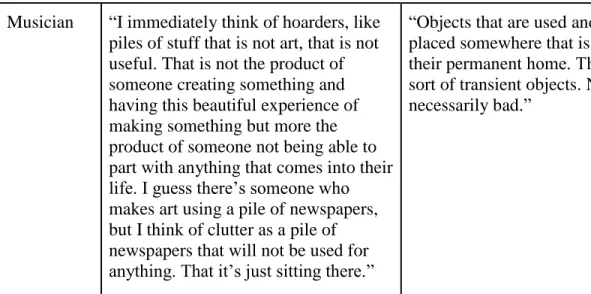
That said, the Musician reported negative associations with clutter at the beginning
of the interview: unlike junk or trash, words he worked to reclaim in his artistic practice,
clutter signified objects that went unused. The failure of an artist to use objects as raw
materials for artistic endeavors engendered their status as clutter. Toward the end of the
interview, he reneged on this association and said he viewed clutter in a more positive
fashion.
While he’s been renting an apartment with two housemates for about a year, he
provided details on his favorite past residence. “I lived in a really huge mansion in rural
[state redacted] that was full of weirdos and other people that made lots of weird art that
was strewn over the whole house. The house was incredibly chaotic even when it was
participants’ perspectives, whose appreciation of the out-of-place was an exception, not a
Recurrent Themes Demographics
All participants lived at their current residence for a year or less, with the
exception of the Magpie Sculptor who lived at his house for three years. However, he
was the only parent interviewed and acknowledged that he tended to “moved around a
lot” before having his daughter. All participants were renters, in their mid-30s or
younger, and either in school or employed in addition to maintaining an artistic practice.
No participant wholly supported themselves financially through their art.
Definitions of Clutter
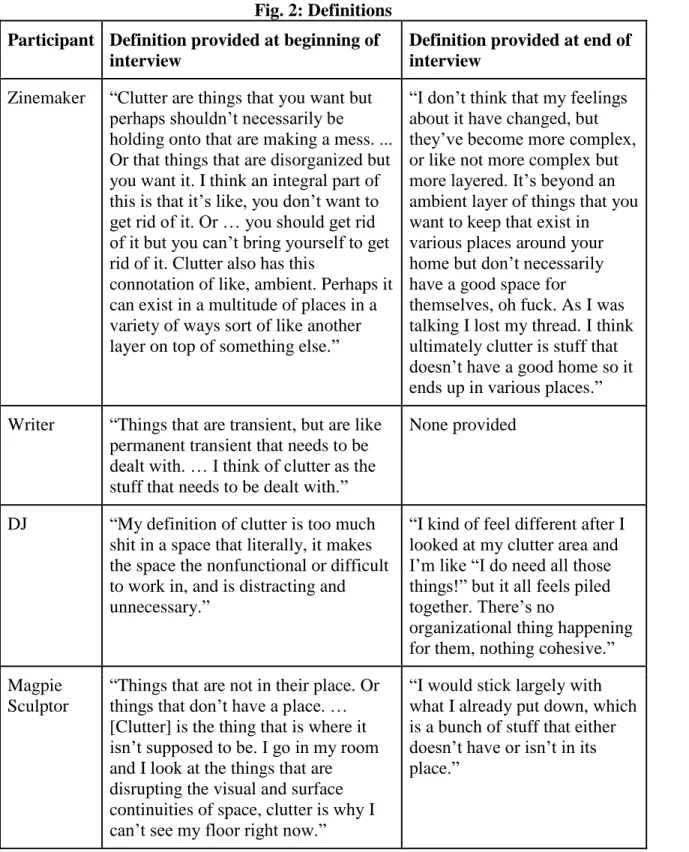
Definitions provided by participants were varied, but seldom conflicting.
Definitions stress disruption, ambient coverage, household obligations, distraction, and
stagnation. Not all were explicitly condemning: some signaled an uncertainty of what to
do, acknowledging the misfit and interstitial nature to cluttered objects.
Participants were asked to provide a second definition at the end of the interview;
after taking time to discuss a cluttered space, negative conceptualizations tended to be
tempered, acknowledging affinity for their possessions. Across the board, definitions of
clutter generally had little to do with the form or function of objects, and more with them
Fig. 2: Definitions Participant Definition provided at beginning of
interview
Definition provided at end of interview
Zinemaker “Clutter are things that you want but perhaps shouldn’t necessarily be holding onto that are making a mess. ... Or that things that are disorganized but you want it. I think an integral part of this is that it’s like, you don’t want to get rid of it. Or … you should get rid of it but you can’t bring yourself to get rid of it. Clutter also has this
connotation of like, ambient. Perhaps it can exist in a multitude of places in a variety of ways sort of like another layer on top of something else.”
“I don’t think that my feelings about it have changed, but they’ve become more complex, or like not more complex but more layered. It’s beyond an ambient layer of things that you want to keep that exist in various places around your home but don’t necessarily have a good space for
themselves, oh fuck. As I was talking I lost my thread. I think ultimately clutter is stuff that doesn’t have a good home so it ends up in various places.”
Writer “Things that are transient, but are like permanent transient that needs to be dealt with. … I think of clutter as the stuff that needs to be dealt with.”
None provided
DJ “My definition of clutter is too much shit in a space that literally, it makes the space the nonfunctional or difficult to work in, and is distracting and unnecessary.”
“I kind of feel different after I looked at my clutter area and I’m like “I do need all those things!” but it all feels piled together. There’s no
organizational thing happening for them, nothing cohesive.”
Magpie Sculptor
“Things that are not in their place. Or things that don’t have a place. … [Clutter] is the thing that is where it isn’t supposed to be. I go in my room and I look at the things that are disrupting the visual and surface continuities of space, clutter is why I can’t see my floor right now.”
Musician “I immediately think of hoarders, like piles of stuff that is not art, that is not useful. That is not the product of someone creating something and having this beautiful experience of making something but more the product of someone not being able to part with anything that comes into their life. I guess there’s someone who makes art using a pile of newspapers, but I think of clutter as a pile of newspapers that will not be used for anything. That it’s just sitting there.”
“Objects that are used and placed somewhere that is not their permanent home. They’re sort of transient objects. Not necessarily bad.”
All participants asserted a definitional difference between clutter and its sisters:
junk, trash, crap, shit, debris, bric-a-brac, and other words pertaining to troublesome
objects. However, all participants went on to use these terms interchangeably throughout
the interview, muddling the definitions they set forth at the beginning. Both the concept
of clutter and the objects considered clutter presented a parallelism of loose, drifting
indeterminacy.
Description and Value
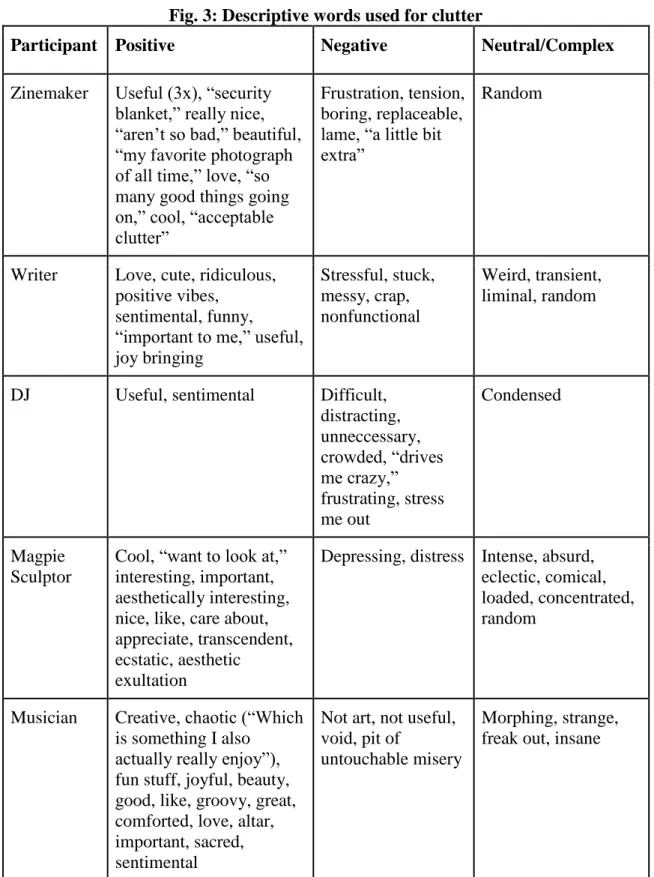
Figure 3 displays words used by participants to describe their clutter, both the
objects themselves and the emotional repercussions of their current organization. While
the positive terms generally outnumber the negative ones, the positive ones were
frequently explanatory or used as justification for object retention. For example, the
Writer acknowledged that she loved her cute, ridiculous stuffed animals, even though she
has approached “a point in my life where… I’ve gotten rid of a lot of stuffed animals
Fig. 3: Descriptive words used for clutter
Participant Positive Negative Neutral/Complex
Zinemaker Useful (3x), “security blanket,” really nice, “aren’t so bad,” beautiful, “my favorite photograph of all time,” love, “so many good things going on,” cool, “acceptable clutter”
Frustration, tension, boring, replaceable, lame, “a little bit extra”
Random
Writer Love, cute, ridiculous, positive vibes,
sentimental, funny, “important to me,” useful, joy bringing Stressful, stuck, messy, crap, nonfunctional Weird, transient, liminal, random
DJ Useful, sentimental Difficult, distracting, unneccessary, crowded, “drives me crazy,” frustrating, stress me out Condensed Magpie Sculptor
Cool, “want to look at,” interesting, important, aesthetically interesting, nice, like, care about, appreciate, transcendent, ecstatic, aesthetic
exultation
Depressing, distress Intense, absurd, eclectic, comical, loaded, concentrated, random
Musician Creative, chaotic (“Which is something I also
actually really enjoy”), fun stuff, joyful, beauty, good, like, groovy, great, comforted, love, altar, important, sacred, sentimental
Not art, not useful, void, pit of
untouchable misery
When positive words were sincerely used, they were frequently tempered by an
unknowing or uncertainty: participants acknowledged an appreciation for these objects
but did not have an organizational way forward for finding better places for their storage.
“Y’know, Bed, Bath and Beyond doesn’t make an organizing unit to put [a category of
clutter] in. Like, my nesting brass pyramids, there’s nowhere to put that, society doesn’t
have a place for that. There’s not like a thing that that belongs in,” stated the Magpie
Sculptor, at a loss of where to place his transcendent ephemera. The value of beloved
objects sometimes receded behind their status as clutter, their disorganization obfuscating
their treasured status. The Magpie Sculptor went on, “There’s more things on [my desk]
than I like and care about than maybe I anticipated. When I’m recounting what they are
and what they mean to me, that’s an opportunity to appreciate them. Whereas when I
come in and see [a treasured wicker ring] on my desk, I’m like ‘man I gotta get all this
shit off my desk.’” The interview functioned as a way of pausing the cadence of everyday
life and parsing the nebulous spread of clutter: in this time, the participants recalled their
reasons for retention. Even the DJ, the participant most averse to clutter, acknowledged
that they needed their cluttered objects but felt limited by their room’s storage: “Honestly
I wish I just had a bigger closet.”
Included in these descriptive words are visceral or emotional reactions to clutter,
the feelings elicited by thinking or confronting cluttered spaces. All participants instituted
systems to maximize positive visceral reactions to these objects, whether through
cultivating “good” clutter, incorporating objects into their artistic practice, or through
purging. These systems were sometimes intentional and active—such as the Musicians
objects, organizational compulsions, and naturalized states of feeling “at home” while
surrounded by encroaching chaos. These systems to keep the emotionally negative at bay
were only one form of system implemented; other systems will be discussed in the
following section.
Systems for Clutter Management
While clutter typically carries connotations of untamed disorder, all participants
reported systems used for tending to their cluttered areas. Some reported passive
organization present in these cluttered areas: the DJ discussed their pile of books, where a
book’s position in space denoted certain conditions: if propped up, the book has yet to be
read. If placed, cover down, on the top shelf, the books is in the process of being given
away. The Magpie Sculptor separated his clutter into categories: dishes, laundry, trash,
and ephemera, each residing in its own island of clutter. The Zinemaker acknowledged
strategic placement of his pile of boxes behind a door, allowing them to go generally
unseen. He also spoke in great detail about their decision to keep their axe among the
boxes, a tool that could be used in case of nighttime emergencies as their bedroom was
located across the hall.
In contrast to these passive or storage-based systems, other participants reported
active or procedural systems that rendered chaos into “acceptable clutter” (as termed by
the Writer). The Writer discussed her habit of asymptotic “herding,” where she “mov[es]
things closer and closer to where they belong” although they may never quite reach that
devoted place of belonging. The Musician allows the mountain of objects on his desk to
build until he has “a freak out and I’m like ‘this is insane!’ and I clear everything off and
This cadence of accretion and dissolution does not aim to wholly abolish the existence of
clutter but facilitate its existence in manageable—even pleasurable—ways. Just as
objects have positive and negative associations, the process of clutter management too
holds joys and exasperations. The efficacy of these systems may be measured in more
than just their capacity to suppress clutter: do these systems magnify positive qualia? Do
these systems vivify precious objects, do they facilitate joy?
These systems are notable as they demonstrate that, although clutter has
connotations of neglect, labor and management is still enacted. These spaces are not
objects gone ignored, but areas of thought, negotiation, and utility—logics particular to
each participant, constitutive of how individualized notions of “home” are enacted.
Exactly how participants developed cluttered areas were just as diverse as the objects
themselves, providing heterogeneous examples of how and why the category of “other” is
enacted.
Ideal Domiciles
Present in every interview was a reference to domestic ideals. This included
aesthetics, feelings, ideologies, or media references that constructed their version of a
consummate interior. The DJ and the Writer both cited minimalism as a guiding
inspiration that they found ultimately untenable. “I aspire toward a minimalist lifestyle
but fail regularly,” said the Writer, eliciting a laugh from her partner in the other room. “I
wouldn’t really describe you as a minimalist,” he said, to which she replied, “I said
The DJ echoed this sentiment: “I like super minimalism but I actually can’t do it.”
While not mentioned by name, minimalism was alluded to in other interviews. The
Zinemaker said that he likes his home “to feel light,” while the Magpie Sculptor stated:
“I want there to be a progression to increasingly nicer, cleaner, more pleasant to be in
houses. Yeah. In my life I’d like that to be a trajectory. Until in the end I’m just in a
white room like that room in the end of 2001: A Space Odyssey with the glowing floors
with the really old person in a really nice room. No clutter. Beautiful furniture … It’s a
pretty white room. It’s full of ornate furniture but the floor is glowing white.”
It’s worth dwelling on the room featured in the 1968 science fiction film 2001: A
Space Odyssey by Stanley Kubrick, with its finely detailed furniture contrasted by an
almost total absence of objects. While the Magpie Sculptor referenced this scene in
humor, it provides a concrete example of the unattainable ideals carried in regard to
living spaces. It is a room in which no evidence of living occurs, with little residue of
action or movement aside from the folds in the bedding. The emphasis on lightness and
whiteness within the Zinemaker and Magpie’s interviews limn a simpler space, one that
presents less uncertainty and ongoing negotiation around the creation of homes for
troublesome objects. This was a peace of absence, calm because it lacks; meanwhile,
other participants spoke of clutter as the peace of presence, calm in its impinging,
Kubrick, S. (1968). 2001: A Space Odyssey’s interior
Alternately, the Musician’s household ideals were not grounded in a formalized
ideology such as minimalism, nor by way of media. Instead, he referenced a prior
housing situation as representative of his ideal, one characterized by the proliferation of
art and art objects. This was a mansion inhabited by ten other artists, one he described as
messy, joyful, and creative. Because almost every participant in the house had a creative
practice, art objects and used materials would accumulate in every room. He went on to
express how tidiness made him uncomfortable, and that he prefers “the process of
building up things that I use.”
Not all forms of mess bring him the same satisfaction, as he mentions that raw
materials that go unused for too long turn into “a void, or a pit of untouchable misery.”
The Musician has honed a relationship to mess that ultimately serves him and his creative
practice: never seeking to eliminate mess, he instead defines the mess’ emotional tenor
around him, they refrain from turning into negative objects. While this approach is
clearly in the minority, it may be more tenable than the alternatives provided by other
participants. Because his system for household objects tolerates (or rather, actively
anticipates and encourages) the residue of living, these objects are not “out of place”—
they are in the place of ongoing use. He does not frame his room as a site of performative
failure, but evidentiary of his creative process.
Object Retention and Deaccession
Participants reported varying logics behind their decision to keep or dispose of
objects. All five cited affinity or appreciation as a reason to keep objects; for example,
they thought the objects were “cool” or “interesting,” or they simply “liked it.” The
Magpie Sculptor presented this logic at its most extreme, discussing an aesthetic
appreciation that facilitated “transcendence” and “aesthetic exaltation,” terms with
religious connotations. Appreciation was frequently expressed in tandem with
acknowledging a not-knowing: they liked an item, but did not know what to do with it,
why they liked it, or if liking something was a good enough reason to keep it. The
Zinemaker spoke of when “you should get rid of [things] but you can’t bring yourself to.”
Appreciated objects were seldom useful—or “utility clutter,” in the Zinemaker words—
and their unrestrained accumulation was a source of stress for some. The Magpie
Sculptor spoke of the difficulty of “integrating” these objects into the rest of his life. He
expressed interest in cultivating the ability to “predict what entertaining that impulse (of
aesthetic exaltation) leads to enough to be able to anticipate having more stuff and what
Meanwhile, the Musician reported his own extreme version of object
appreciation, where he would intentionally display useful objects among clutter,
preventing them from being used for their traditional purpose. Instead of housing them in
the kitchen, he kept his three favorite mugs on his desk because “they make me feel great.
They make me feel very comforted.”
While the Writer shared the sentiment of appreciation, she also addressed a more
obligational ownership. “Especially if someone gives it to me as a gift, then I feel this
weirdness about it. … People gave me this crap. I feel I can’t just get rid of all these
things. So that’s kind of the trap.” Her office space was dominated by gifts she received
from friends and family, many decorative objects like ambient lamps and stuffed animals.
While she expressed appreciation of gift-giving, the gifts themselves did not stir warmth.
She later stated that “a certain amount of time has to elapse” before purging these objects
felt appropriate, with her study acting as holding chamber for the interim. These objects
seemingly held no future value; following this station as clutter, they were to arrive in
their terminal evolution as trash.
The impulse to purge was stronger in others, as with the DJ. Citing their father’s
hoarding behavior, “whenever I feel like I’m trying to hoard stuff, I’m like “I don’t want
to be like my dad!” so I purge.” Unlike the other participants, all of the DJ’s clutter
objects were kept out of necessity—it was all utility clutter. Sentimental objects were
either carefully arranged atop their dresser or hidden in storage. “I think I’m so
Identity Construction
“I was thinking about this before you came over that I sort of felt anxious about the fact that our house doesn’t have a lot of good clutter to talk about right now and I think that’s because ... we haven’t had enough time to accumulate clutter yet. ... This is baby clutter, infant clutter. This clutter has only been living and metastasizing for four months, so it needs time to mature and ripen. … I think clutter is like moss, you have to stop moving for it to get good.” -The Zinemaker
Located within the Zinemaker’s anxieties of a lack of “good clutter” was
the concern of misrepresentation: because he and his partner had only lived at
their current residence for less than year, the current clutter threatened to
insufficiently index the particularities of their lives. As the interview progressed
and he began recovering intimate possessions from the stack of cardboard boxes
(remnants of past projects, trinkets collected from road trips, etc.), his anxieties
were assuaged; he exclaimed “this is perfect!” as he began recounting object
histories, integrating mementos into a narrative of his life and identity.
The Zinemaker was not the only participant to locate a sense of self
amongst the clutter, drawing connections between objects and lifestyle. The
Magpie Sculptor described his desk clutter as absurd, “truly eclectic,” comical,
and indicative of “disparate and weird aspects” of his life. Meanwhile, the
Musician directly acknowledged his desk as a “sacred space” and “altar” to
himself, acknowledging his subjectivity as the cohesive force within this pile. The
Musician, Magpie Sculptor, and the Writer shared an interest in decorating their
spaces in parallel to their artistic production: the Musician’s desk scattered with
raw material, the Writer’s full of inspiring and colorful objects, and the Magpie’s
objects facilitated their artistic processes, they also interpellated the artists’
identity. These were not just any rooms, but the rooms of artists.
While it may seem obvious that a person’s lifestyle has a direct bearing on
the objects brought into their domestic sphere, more work is warranted on how
identities are continuously performed through objects and their organization. Put
another way, this study only began to address the performative nature of
Conclusion
This paper attempts to emphasize the interminable labor that goes into domestic
organization. In this, clutter is not seen as a failure of domestic performance, a
categorical hemorrhage, a place of laziness, or the inability to deaccession. Instead,
clutter is the site of categorical negotiation at its most “condensed” and “concentrated,” in
the words of the DJ and the Magpie Sculptor, respectively. Clutter is considered a point
of uncertainty, where the destabilization of household flows allows for new systems to be
forged with unique, tacit logics. Scholars have referred to this as the
“thrown-togetherness” (Luzia, 2011) of a household—a sense of domestic identity grounded not in
rigid, stable categories but in the residual categories of otherness. While self-help texts
urge the eradication of clutter, this study acknowledges that an integral component of a
home is found within clutter and that sociological and organizational lessons may be
gleaned from these tacit strategies.
The clutter discussed in this study enacted aspects of Mary Douglas’ notions of
symbolic contamination, as discussed within Purity and Danger. While participants
executed cleansing rituals operationalized as organizational systems, some participants
explicitly thrived in disorder—running contrary to Douglas’ theories. Most participants
shared an ambivalent appreciation for their objects, framing them not as contaminating or
polluting but instead an unwieldy comingling of aspects of their identity, the convergence
production. In these examples clutter is not simply clean or dirty but a hybrid of the two,
a quasi-dirt wavering in and out of redemption. Affording the time to appreciate
accumulated objects was enough of a sanitizing ritual for some, such as the Magpie
Sculptor’s wicker ring; attention reversed the production of kipple, revivifying treasured
objects.
Individual household strategies for dealing with clutter provide grounded insight
into the non-linear and discontinuous nature of object relevance. An oscillation between
object appreciation and invisibility within the morass of clutter was present in all
participants’ households, with each presenting individual logic for retention and
deaccession. Deaccession policies, present in libraries and households alike, are
complicated by this uncertainty of value—especially under the pressurized circumstances
of financial instability common for artists and young people. While taxonomy design
traditionally frowns upon the inclusion of an “other” category, household ecologies do
not have the freedom to forbid its existence. Instead, the presence of otherness signaled a
just-in-case retention (such as the Zinemaker’s emergency axe), or a sublime
accumulation of objects taken out of circulation because of their preciousness (the
Musician’s mugs or the Magpie Sculptor’s transcendent objects).
Keeping the inevitability of otherness in mind, the affordances of clutter are worth
exploring and operationalizing. Within the domestic sphere, these areas operated as
signatures of identity; they allowed a comingling of both sacred and profane objects in
tide pools of precious tokens and almost-trash; they deferred the burden of categorization
and holistic assessments of value by providing murky, ambiguous places for emergent
opportunities for serendipitous information encounters or the emergence of new
categories, elided by culturally-restricted perspectives. “Widespread consent to specific
opacities is the most straightforward equivalent of nonbarbarism,” writes postcolonial
theorist Éduard Glissant (p.194), “We clamor for the right to opacity for everyone.”
While transparency allows for efficient categorization, what might be gained from
information and library science consenting to specific opacities of indeterminacy? Is a
form of shelter provided in the eaves of residual categories, a home for the inchoate or
syncretic? If nothing else, what can information and library science learn from
information resistant to classification, acting as a mirror to our own disciplinary
syncopations and rituals? While the proposition of a “cluttered library” is a difficult sell
to information professionals, connotations of magic continue to accompany cultural
representations of overfilled, dusty, and labyrinthine reservoirs of books. There is a
lurking reverence for lacunae of taxonomic specificity; can information systems
participate in the appreciation of this magic?
Breaking from bourgeois notions of domestic propriety, participants’ homes were
sites of trauma, responsibility, aspirations, and relationships—all messes that constitute a
life. In his 1961 interview with Tom Driver, Samuel Beckett states, “To find a form that
accommodates the mess, that is the task of the artist now." In addition to forms, this study
encourages artists and homemakers alike to continue developing systems that
accommodate their mundane and sublime messes: the places we call home.
While studies of domestic clutter have developed lush narratives of personal
experience, further research must be done to understand it on a quantitative level. The