DETERMINANTS OF
SULFADOXINE-PYRIMETHAMINE PRESCRIPTION DURING
ANTENATAL VISITS IN KENYA
Approved by:
A paper presented to the faculty of The University of North Carolina at Chapel
Hill in partial fulfillment of the requirements for the degree of Master of Public
Health in the Department of Maternal and Child Health.
Chapel Hill, N.C.
April 4, 2014
By
Leigh Anne Tally
2
Abstract
ObjectiveTo determine facility-level and service-related factors affecting the prescription of sulfadoxine-pyrimethamine (SP) for intermittent preventive treatment for malaria during antenatal clinic visits in Kenya.
MethodsUsing data from the 2010 Kenya Service Provision Assessment, data analysis was performed on 1,183 client antenatal visits. Logistic regression was used to analyze the effects of facility and service-related factors on sulfadoxine-pyrimethamine prescription.
Results Facility managing authority, drug availability, and number of previous SP doses were significantly associated with prescription. No statistically significant relationships were found between IPTp guideline availability, supervision, quality assurance, or water and SP prescription.
3
Table of Contents
Abstract………2
Introduction………..4
Conceptual Model………6
Methods………7
Analysis………10
Results………..10
Discussion………18
Conclusion………...21
4
Introduction
Despite great progress in prevention and treatment, malaria caused nearly 700,000 deaths and an estimated 207 million infections in 2012.1 Pregnant women and children are at particularly high risk for malaria transmission and adverse outcomes.1 Malaria in pregnancy (MIP) poses great risk to not only the woman, but also to the fetus and the newborn child through increased risk of maternal and infant anemia, low birth weight, spontaneous abortion, and premature birth.1 In 2007, approximately 32 million women in Africa became pregnant in malaria endemic areas, making the prevention of malaria in pregnancy a high priority for governments and
policymakers.2
The World Health Organization (WHO) recommends a package of highly effective interventions to prevent and treat malaria in pregnancy: provision of insecticide-treated bed nets and
intermittent preventive treatment (IPTp) for prevention and proper clinical management for treatment.1 IPTp using sulfadoxine-pyrimethamine (SP) has been shown to prevent adverse consequences of malaria on both maternal and fetal outcomes and is extremely cost-effective.3 Many Sub-Saharan African countries integrate these interventions into routine antenatal clinic (ANC) visits in regions with stable malaria transmission.4 Current IPTp guidelines recommend prescribing SP at every ANC visit beginning in the second trimester, with at least one month between doses.4 The WHO recommends a minimum of 4 ANC visits, with the initial visit occurring in the first trimester.4 SP/IPTp should not be administered to HIV+ women who are receiving co-trimoxazole prophylaxis due to contraindication.4 IPTp guidelines have evolved through multiple iterations, with the most recently released guidelines in 2012 simplified to increase provider comprehension and uptake.
5 women obtained ANC care in their first trimester and only 52% before the sixth month of
pregnancy.6 Kenya’s current malaria control strategy recommends that all pregnant women living in moderate to high malaria transmission areas should receive at least two free SP/IPTp doses, and strives to achieve 80% coverage.7,8 This strategy was in place in 2010 when the survey was conducted. In 2010, despite high ANC attendance, only 46% of women received at least one dose, and 25% received >2 doses of SP during their pregnancy in the previous two years.9
However, this is still an increase from 4% receiving >2 doses in 2003.6 High ANC attendance rate coupled with low SP/IPTp uptake highlights a large number of missed opportunities for malaria prevention amongst this high-risk group.
The majority of studies on SP/IPTp delivery have focused on individual characteristics of women and their households to identify factors related to SP/IPTp uptake, such as education, income, maternal age, and parity.10,11 Service-delivery barriers to SP/IPTp delivery have been previously identified as well, such as: unclear guidelines and policies, medicine stock outs, lack of water and cups, and lack of supervision, training, and quality assurance.10,11,12,13 In 2013, a systematic review and meta-analysis on MIP literature was conducted to identify the determinants of
6 number of SP/IPTp doses. In particular, we predict a positive association between training, IPTp guideline availability and supervision variables and SP/IPTp prescription. These variables were selected based on previous studies or because of an anticipated potential association.
Conceptual Model
+/-
+
+
+
_
_
FA C ILIT Y -LEVEL FA C T O R S Management Authority(NGO, Private, Government, or Faith-Based)
Facility Infrastructure Water Availability Drug Availability SE R V ICE -RELATED F ACTO RS Education
IPTp guidelines present in ANC clinic Training of service providers on malaria in pregnancy
Management
Quality Assurance
Supervision of service providers C L IEN T C H A R A C T E R IST ICS Pregnancy Information Gestational Age
Gravidity (1st pregnancy)
Previous ANC History
# of prior SP doses (client)
SP/IPTp Prescription
7
Methods
Data
The 2010 Kenya Service Provision Assessment (KSPA) is a nationally representative survey of 703 health facilities and is designed to provide information on the availability and quality of health services. Data was collected from January 21, 2010 – May 18, 2010 by the Kenya National Coordinating Agency for Population and Development along with the Ministry of Public Health and Sanitation (MOPHS), Ministry of Medical Services, and Kenya National Bureau of Statistics. Data collection tools – facility audit, exit interview, observation protocol, and provider
questionnaire – were adapted from MEASURE Demographic and Health Surveys (DHS) for Kenya and administered in all provinces in hospitals, health centers, clinics, maternities,
dispensaries, and stand-alone voluntary counseling and testing facilities. Facilities were randomly selected from a Kenya Master Facility List, but hospitals, maternity facilities and stand-alone VCTs were oversampled. Health providers were selected based on presence in the facility on the day of the survey. The observations are associated with 389 health facilities and 455 health workers.
Clients were selected based on the number of expected clients divided by five to determine the
nth interval for selecting the next observed client. Client and provider response rates were not available. Data for both health providers and clients were weighted to account for over or under sampling. Health providers and clients were not compensated for their participation in the survey. In this study, ANC visits during the second and third trimester were analyzed to assess the factors that influence the prescription of SP/IPTp. Pregnancies in their 15th or fewer weeks were
8 region was excluded from the analysis because although malaria transmission zones vary
dramatically between them, the proportion of SP/IPTp prescription did not.
Each observation in the sample (n=1,183) utilizes data from all four of the collection tools previously mentioned and each client is considered an observation and is measured only once. IRB approval was requested and, due to the nature of the data, we were granted an exemption.
Measures
SP/ITPp Prescription. The dependent variable, and our outcome of interest, is the prescription or administration of SP/IPTp during an ANC visit. Prescription and administration are combined in the observation questionnaire. The data were collected during the provider-client observation by the observer and have a binary outcome of “prescribed” or “not prescribed”. Observations with an “unknown” outcome were dropped (n=9).
Managing Authority. Facilities may be classified based on ownership into 1 of 4 categories: government/local municipality, non-governmental organization (NGO), private (for-profit), or faith-based.
Water Availability. The facility audit questionnaire assessed facilities’ most common water source. Due to over 14 potential water source options, our definition of water availability
collapsed water source into four categories: “non-piped offsite”, “non-piped onsite”, “piped onto grounds”, and “piped into facility”. Less than 500 meters from the facility is considered “on-site”, while >500 meters is “off-site”. Water availability is included in the analysis because
SP/IPTp should be administered through directly observed treatment (DOT); therefore, water inaccessibility may inhibit a provider from prescribing the treatment.
9
IPTp Guideline Availability. The facility audit captured the availability of IPTp protocol guidelines in the ANC consultation room. Guidelines were determined to be: 1, available and observed; 2, reported available but unobserved; or 3, unavailable. Following KSPA convention, items reported available but unobserved by the interviewers were also considered unavailable; therefore, we combined 2 and 3.16
IPTp Training. Providers reported to have received IPTp-specific training (pre-service or in-service) within the previous year, within the previous 2-3 years, or never.
Quality Assurance. Quality assurance means that the facility has a formal review system or comparison of work to a standard, which is measured through the facility audit. The following question was used to collect this information: “Does this facility routinely carry out quality assurance activities? By this I mean some formal review system or comparison of work or system to a standard?” Responses were recorded as either “Yes”, “No” or “I don’t know”. An “I don’t know” response was considered “No” in this analysis.
Provider Supervision. This variable measures the last time a provider received supervision, as reported by the provider. In this analysis, outcomes were grouped into three categories: receiving supervision in the past year, receiving supervision over a year ago, and never receiving
supervision. We collapsed providers receiving supervision in the past 3 months, 6 months, and 7-12 months into one category due to the similarities between these three groups and to reduce number of variables in the model.
Client characteristics. Client characteristics included gestational age, gravidity, and previous SP doses. Gestational age ranges from 16-40 weeks. Gravidity is binary and based on a provider’s yes/no response to the question: “Is this the client’s first pregnancy?” Previous SP dose is a
constructed variable based on the assumption that a provider would note giving SP on the client’s health card. This assumption is supported by over 99% of observed providers writing on the client’s health card in this survey. Information on number of SP doses was obtained from the
10 subtracted one SP dose to determine doses prior to the ANC visit. Those with 3 or more doses were grouped together because there were only a few observations with 4 doses, there was not a difference in prescription between them and those with 3, and the current literature only provides a distinction between 1, 2, and >3 doses of SP/IPTp.
Analytic techniques
Observations studied in this analysis are based on individual client ANC visits (n=1,183). Cross tabulation and descriptive analyses were used to describe general characteristics of the study population and sample facilities.
Binomial logistic regression was used to examine the relationship between service-delivery factors and prescription of SP/IPTp, controlling for a variety of client characteristics. The first model tests the multivariate effects of facility-level factors on the likelihood of SP/IPTp
prescription. The second model tests these relationships again but adds service-related variables. The third model controls for client characteristics. Data were weighted during analysis to account for differentials caused by oversampling and under sampling and thus to represent the actual distribution of facilities in the country.
Margin estimates (predictive margins) were produced based on the fitted final logistic regression model. These estimates illustrate the predicted prescription of SP/IPTp given that other variables have been controlled for under the model. All data analyses were completed with STATA 13 software.
Results
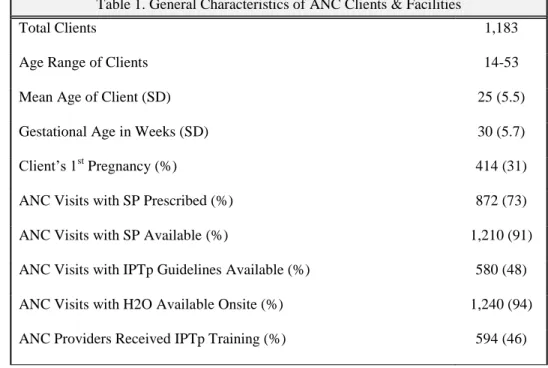
11 and 46% of providers interviewed had received training on IPTp. Table 1 summarizes some of these key, general findings and provides an overview of the study population and some of the variables.
Table 1. General Characteristics of ANC Clients & Facilities
Total Clients 1,183
Age Range of Clients 14-53
Mean Age of Client (SD) 25 (5.5)
Gestational Age in Weeks (SD) 30 (5.7)
Client’s 1st Pregnancy (%) 414 (31)
ANC Visits with SP Prescribed (%) 872 (73)
ANC Visits with SP Available (%) 1,210 (91)
ANC Visits with IPTp Guidelines Available (%) 580 (48)
ANC Visits with H2O Available Onsite (%) 1,240 (94)
ANC Providers Received IPTp Training (%) 594 (46)
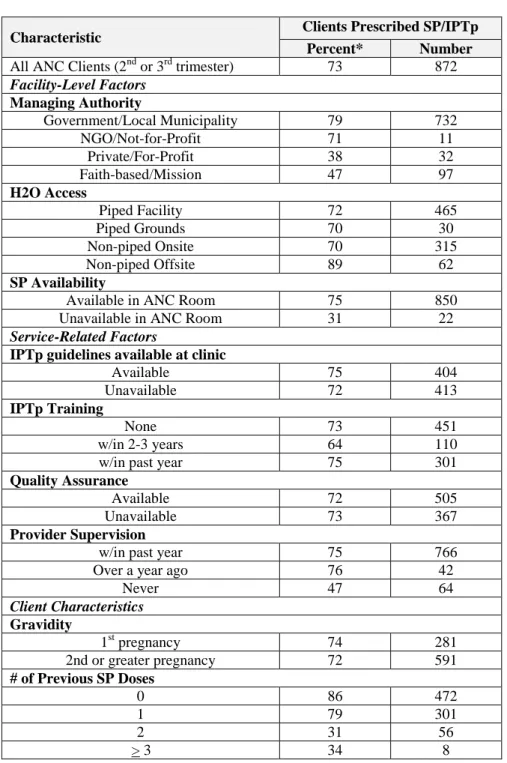
12 in SP/IPTp prescription by all facility-level, service-related, and client characteristics in the
conceptual model.
Table 2. % of Clients Prescribed SP/IPTp by Facility-Level Variables, Service-Related Factors, and Client Characteristics
Characteristic Clients Prescribed SP/IPTp
Percent* Number
All ANC Clients (2nd or 3rd trimester) 73 872
Facility-Level Factors Managing Authority
Government/Local Municipality 79 732
NGO/Not-for-Profit 71 11
Private/For-Profit 38 32
Faith-based/Mission 47 97
H2O Access
Piped Facility 72 465
Piped Grounds 70 30
Non-piped Onsite 70 315
Non-piped Offsite 89 62
SP Availability
Available in ANC Room 75 850
Unavailable in ANC Room 31 22
Service-Related Factors
IPTp guidelines available at clinic
Available 75 404
Unavailable 72 413
IPTp Training
None 73 451
w/in 2-3 years 64 110
w/in past year 75 301
Quality Assurance
Available 72 505
Unavailable 73 367
Provider Supervision
w/in past year 75 766
Over a year ago 76 42
Never 47 64
Client Characteristics Gravidity
1st pregnancy 74 281
2nd or greater pregnancy 72 591
# of Previous SP Doses
0 86 472
1 79 301
2 31 56
> 3 34 8
*Calculated from weighted population totals and exclusion of Nairobi
13 Logistic regression revealed significant associations in all three of our models. In our first model, which included facility-level factors only, managing authority, water access, and SP availability were all found to significantly affect the prescription of SP/IPTp. Table 3 summarizes these results. Attending ANC at a private facility versus a government facility resulted in reduced odds of prescription, with the odds of prescription at a private facility 0.20 (95% CI: 0.10-0.41) times the odds of prescription at a government facility. A similar negative association was found with faith-based facilities: the odds of prescription at a private facility were 0.30 (95% CI: 0.17-0.52) times the odds of prescription at a government facility. If SP is available in the ANC consultation room, the provider was 5.9 (95% CI: 2.42-11.10) times more likely to prescribe SP/IPTp than if SP was unavailable. Out of the four categories of water sources, the only one found to
15
Table 3. ORs for Client Receipt of SP/IPTp Prescription, Kenya Service Provision Assessment, 2010 SP Prescription Characteristic Model 1: Adjusted OR Facility Level Characteristics (95% CI) Model 2: Adjusted OR Model 1 + Service-Related
Characteristics (95% CI)
Model 3: Adjusted OR Model 2 + Client
Characteristics (95% CI)
Facility-Level Factors Managing Authority Government NGO/Not-For-Profit Private/For-Profit Faith-Based 1.00 [Referent] 0.81 (0.28-2.34) 0.20 (0.10-0.41)*** 0.30 (0.17-0.52)*** 1.00 [Referent] 1.22 (0.36-4.09) 0.16 (0.08-0.34)*** 0.35 (0.21-0.58)*** 1.00 [Referent] 1.18 (0.16-8.74) 0.12 (0.04-0.32)*** 0.24 (0.13-0.45)*** H2O Access Piped Facility Non-piped Offsite Non-piped Onsite Piped Grounds 1.00 [Referent] 2.45 (1.07-5.61)* 0.84 (0.53-1.31) 0.10 (0.34-2.91) 1.00 [Referent] 2.01 (0.83-4.88) 0.87 (0.54-1.40) 0.42 (0.19-1.22) 1.00[Referent] 1.58 (0.63-3.94) 0.94 (0.53-1.66) 0.75 (0.28-2.05) SP Availability
Available 5.9 (2.42-11.10)*** 4.34 (1.91-9.87)*** 9.21 (3.91-21.64)***
Service-Related Factors
Guideline Availability
Available 1.13 (0.71-1.80) 1.38 (0.80-2.38)
IPTp Training None w/in 2-3 years w/in past year
1.00 [Referent] 0.59 (0.33-1.04) 0.71 (0.42-1.21)
1.00 [Referent] 0.45 (0.24-0.85)* 0.61 (0.32-1.16)
Quality Assurance
Available 1.08 (0.68-1.73) 1.01 (0.56-1.83)
Provider Supervision
w/in past year over a year ago never 1.00 [Referent] 1.50 (0.66-3.41) 0.54 (0.27-1.10) 1.00 [Referent] 1.56 (0.62-3.98) 0.60 (0.24-1.92) Client Characteristics
Gestational Age2 0.96 (0.91-1.01)
Gravidity
First Pregnancy 1.17 (0.71-1.92)
# of Previous SP Doses3
0 1 2 >3 1.00 [Referent] 0.58 (0.33-1.03) 0.06 (0.03-0.14)*** 0.06 (0.02-0.17)***
*p value < 0.05 ** p value < 0.01 *** p value < 0.001 2. Continuous variable ranging 16-40 weeks pregnant
16 After completing the third logistic regression model, a post estimation of the marginal
17
Table 4. Marginal Probabilities* for Client Receipt of SP/IPTp Prescription, Kenya Service Provision Assessment, 2010
Characteristic Clients Prescribed SP/IPTp Percent* Facility-Level Factors Managing Authority
Government/Local Municipality 76 (0.73-0.80)
NGO/Not-for-Profit 79 (0.54-1.03)
Private/For-Profit 40 (0.23-0.58)
Faith-based/Mission 54 (0.42-0.64)
H2O Access
Piped Facility 72 (0.67-0.77)
Piped Grounds 68 (0.55-0.81)
Non-piped Onsite 71(0.65-0.77)
Non-piped Offsite 77 (0.68-0.87)
SP Availability
Available in ANC Room 75 (0.72-0.79)
Unavailable in ANC Room 38 (0.23-0.52)
Service-Related Factors
IPTp guidelines available at clinic
Available 74 (0.69-0.78)
Unavailable 70 (0.64-0.75)
IPTp Training
None 76 (0.71-0.80)
w/in 2-3 years 65 (0.58-0.72)
w/in past year 69 (0.63-0.76)
Quality Assurance
Available 72 (0.66-0.77)
Unavailable 72 (0.69-0.77)
Provider Supervision
w/in past year 72 (0.68-0.76)
Over a year ago 78 (0.68-0.88)
Never 65 (0.52-0.78)
Client Characteristics Gravidity
1st pregnancy 73 (0.68-0.78)
2nd or greater pregnancy 71 (0.67-0.76)
# of Previous SP Doses
0 83 (0.79-0.87)
1 77 (0.71-0.83)
2 35 (0.22-0.47)
>3 35 (0.18-0.52)
18
Discussion
The analysis found two facility-level characteristics (managing authority and SP availability), one service-related factors (IPTp training), and one client characteristic (number of previous SP/IPTp doses) significantly affecting the odds of SP/IPTp prescription. Water source, guideline
availability, quality assurance, provider supervision, gestational age, and gravidity were not associated with SP/IPTp prescription.
The association between facility managing authority and SP/IPTp prescription is one of the most significant results of this study: women who attend faith-based or for-profit facilities are
significantly less likely to receive a prescription than women who attend government or not-for-profit facilities. This presents an opportunity for the government and its partners to ensure that outreach, education, and supervision is occurring at private and faith-based facilities. These facilities and their significantly reduced odds of prescription cannot be overlooked as 11% of pregnant women in our data set attended faith-based facilities and 5% attended for-profit.
Although a facility’s main water source did not significantly impact drug prescription in the final model, the results show an overall protective effect of non-piped, offsite water. The lack of significance and slight protective effect of non-piped, offsite water was unexpected; water is needed to implement DOT and several previous studies have shown that water access affects IPTp uptake.14,17 The effect of water should be further explored both in this dataset and
elsewhere. Alternatively, water source was found to indeed affect the administration of directly observed treatment (DOT). Nearly 36% of those prescribed SP/IPTp had the pills in their
19 policymakers and health programs because although water source may not affect prescription, it may affect correct administration and eventual coverage of SP/IPTp. Fortunately, 96% of clients with the pills in their possession after their appointment claim they were told how to take it.
The relationship of SP availability to IPTp prescription intuitively makes sense: If a medication is not available a provider is less likely to prescribe or provide it.14,17 Out of the 333 clients not prescribed SP, 15% of them were at a facility with no SP that day. It was encouraging to see that 94% of facilities had SP available at the time of the survey and only 8% reported having a stock out within the previous 6 months. According to the FY2014 Kenya Malaria Operational Plan, no facilities have experienced stock outs in the previous three years.5 If this is true, this is a
significant accomplishment and every effort should be made to ensure the continued strength of their supply chain and commodity management system.
Surprisingly, the third model in our analysis showed that provider training on IPTp guidelines in the previous 2-3 years was significantly negatively associated with IPTp prescription when compared with providers who had no training. Providers who received training in the previous year were expected to have a higher likelihood of SP/IPTp prescription, but they were found in this study to be slightly less likely than those without training to prescribe (69% and 76%, respectively).11,14,17,19,20 Training quality may be an important factor in this variable, but we are unable to take this into account. Similar to the effects of water source, the effect of IPTp-specific training on SP/IPTp prescription should be further examined.
Guideline availability did not have a significant impact on SP/IPTp prescription in our analysis, but was found to be a significant predictor in previous studies.20,21 Our finding could be a result of the available guidelines being unclear, which has been previously documented in several
20 provider’s behavior. Without having information on provider’s perceptions of the guidelines it is
hard to determine their clarity, although the release of a new WHO IPTp policy in 2012, and an initiative by the U.S. President’s Malaria Initiative in Kenya to simplify the guidelines, will
hopefully improve guidelines to ensure that they are a supportive tool for providers.4,5
Previous SP/IPTp doses significantly impacted prescription in this study: women who had previously received 2 or more doses were much less likely to receive a prescription than those who had previously received only 1 or 0 doses. This finding may highlight the potential impact of policy wording on coverage. The national policy in 2010, when this survey was administered, stated that women should receive “at least 2 doses.” Service providers appear to have focused on
the attainment of at least two doses rather than the continued protection afforded by additional doses. A recent meta-analysis and systematic review found that 3 or more doses of SP were associated with fewer low birth weight infants, higher birth weight, and less placental malaria than those women who received 2 or fewer doses.22 The findings from this meta-analysis and systematic review support the WHO’s recent recommendation that women should receive at least 3 doses; but, it is important for policymakers and programmers to recognize that service providers might now focus on achieving 3 doses, rather than striving to attain additional doses, even if the timing is appropriate and a positive dose-dependent association exists.3,23
21 important information about its true availability and cup stock information is unavailable.
Unfortunately, this study is unable to account for either actual or perceived level of malaria transmission, which varies dramatically across Kenya. Upon grouping regions according to their overall malaria prevalence status, a statistically significant effect was not found. The ability to utilize smaller geographic areas and their relevant transmission level may reveal more of an association. Additionally, although IPTp training, and its timing, was documented in the dataset, it is impossible to determine the quality of the training nor the provider’s understanding of the material covered. Furthermore, the enabling environment is incredibly complex, making it hard to truly capture what may be driving SP/IPTp prescription.
Despite these weaknesses, the Kenya Service Provision Assessment collected a large, representative sample of facilities, ANC clients, and ANC providers, which allows for these results to likely be generalizable at the country level. The survey provided comprehensive facility data but also sufficient information on clients and providers to control for a variety of potential confounders. Additionally, the outcome variable measured the prescription of SP/IPTp, allowing us to focus on the behavior of the provider rather than the client. To the author’s knowledge, this is the first study to quantitatively study the intersection of facility, service, and client
characteristics to predict SP/IPTp prescription.
Conclusion
23
References
1. World Health Organization. World Malaria Report: 2013. 2013.
2. Dellicour S, Tatem AJ, Guerra CA, Snow RW, ter Kuile FO. Quantifying the number of pregnancies at risk of malaria in 2007: A demographic study. PLoS medicine.
2010;7(1):e1000221.
3. World Health Organization Malaria Policy Advisory Committee. WHO evidence review group: Intermittent preventive treatment of malaria in pregnancy (IPTp) with sulfadoxine-pyrimethamine (SP). 2012.
4. World Health Organization. WHO policy brief for the implementation of intermittent preventive treatment of malaria in pregnancy using sulfadoxine-pyrimethamine (IPTp-SP). Geneva, Switzerland: WHO. 2013.
5. President's Malaria Initiative. Kenya: Malaria Operational Plan FY 2014. 2013.
6. Kenya National Bureau of Statistics (Nairobi). Kenya Demographic and Health Survey 2008-09. Kenya National Bureau of Statistics. 2010.
7. Division of Malaria Control [Kenya Ministry of Public Health and Sanitation]. Kenya National Malaria Strategy: 2009 - 2017. 2009.
8. Kenya Division of Malaria Control. Malaria in Pregnancy.
http://www.nmcp.or.ke/section.asp?ID=7. Updated 2014. Accessed February 10, 2014.
9. Division of Malaria Control [Kenya Ministry of Public Health and Sanitation], Kenya National Bureau of Statistics, and ICF Macro. 2010 Kenya Malaria Indicator Survey. Nairobi, Kenya: DOMC, KNBS and ICF Macro. 2011.
10. Florey L, Kalyango J, Alfven T, et al. Preventing malaria during pregnancy in Sub-Saharan Africa: Determinants of effective IPTp delivery. Malaria Journal. 2013;12(6):340.
11. Holtz TH, Patrick Kachur S, Roberts JM, et al. Use of antenatal care services and intermittent preventive treatment for malaria among pregnant women in Blantyre District, Malawi. Tropical Medicine & International Health. 2004;9(1):77-82.
12. Ashwood-Smith H, Coombes Y, Kaimila N, Bokosi M, Lungu K. Availability and use of sulphadoxine-pyrimethamine (SP) in pregnancy in Blantyre District: A safe motherhood and BIMI joint survey. Malawi Medical Journal. 2002;14(1):8-11.
13. Hill J, Dellicour S, Bruce J, et al. Effectiveness of antenatal clinics to deliver intermittent preventive treatment and insecticide treated nets for the control of malaria in pregnancy in Kenya.
PloS one. 2013;8(6):e64913.
14. Hill J, Hoyt J, van Eijk AM, et al. Factors affecting the delivery, access, and use of
24 15. President's Malaria Initiative. Kenya: Malaria Operational Plan FY 2010. 2009.
16. National Coordinating Agency for Population and Development (NCAPD) [Kenya], Ministry of Medical Services (MOMS) [Kenya], Ministry of Public Health and Sanitation (MOPHS) [Kenya], Kenya National Bureau of Statistics (KNBS) [Kenya], ICF Macro. Kenya Service Provision Assessment Survey 2010. 2011.
17. Pell C, Straus L, Andrew EV, Meñaca A, Pool R. Social and cultural factors affecting uptake of interventions for malaria in pregnancy in Africa: A systematic review of the qualitative research. PLoS One. 2011;6(7):e22452.
18. Kenya Ministry of Public Health and Sanitation, Kenya Ministry of Medical Services. National guidelines for the diagnosis, treatment, and prevention of malaria in Kenya. 2010. 19. Ouma P, Van Eijk A, Hamel M, et al. The effect of health care worker training on the use of intermittent preventive treatment for malaria in pregnancy in rural western Kenya. Tropical Medicine & International Health. 2007;12(8):953-961.
20. Webster J, Kayentao K, Diarra S, et al. A qualitative health systems effectiveness analysis of the prevention of malaria in pregnancy with intermittent preventive treatment and insecticide treated nets in Mali. PloS one. 2013;8(7):e65437.
21. Gross K, Alba S, Schellenberg J, Kessy F, Mayumana I, Obrist B. The combined effect of determinants on coverage of intermittent preventive treatment of malaria during pregnancy in the Kilombero Valley, Tanzania. Malar J. 2011;10:140.
22. Kayentao K, Garner P, van Eijk AM, et al. Intermittent preventive therapy for malaria during pregnancy using 2 vs 3 or more doses of sulfadoxine-pyrimethamine and risk of low birth weight in Africa: Systematic review and meta-analysis. JAMA. 2013;309(6):594-604.