Denise Anthony.
This paper describes a research study focused on the management practices of solo archivists, known in SAA as the “Lone Arrangers.” Following a literature review, a gap in information about solo archivists and their actual daily practices was identified. An initial survey was used to identify a pool of archivists to interview. The following
interviews sought to discover how solo archivists, in their challenging positions, manage the day-to-day tasks and decisions required by their jobs. The findings showed that these archivists develop a strong intuition informed by priorities, flexibility, and personal boundaries which allows them to balance multiple duties every day.
Headings:
One-person archives Archives administration Small archives
WRANGLING THE LONE ARRANGER:
THE MANAGEMENT PRACTICES OF SOLO ARCHIVISTS
by
Lauren E. Murphree
A Master’s paper submitted to the faculty of the School of Information and Library Science of the University of North Carolina at Chapel Hill
in partial fulfillment of the requirements for the degree of Master of Science in
Library Science.
Chapel Hill, North Carolina April 2018
Approved by
Table of Contents
Table of Contents ... 1
Introduction ... 2
Literature Review ... 4
Introduction ... 4
Best Practices ... 4
Solo Archivists ... 6
Existing Literature for Solo Archivists ... 11
Management for Solo Archivists ... 13
Methods ... 15
Findings ... 18
Surveys ... 18
Interviews ... 22
Challenges ... 23
Management ... 27
Resources ... 29
Discussion ... 32
Conclusion ... 38
Bibliography ... 41
Appendices ... 43
Appendix A: Recruitment Letter ... 43
Appendix B: Recruitment Letter Follow-Up ... 44
Appendix C: Initial Survey ... 46
Appendix D: Interview Questions ... 47
Introduction
As long as the human race has created physical records, it has maintained archives.
Record formats and management practices may have changed over centuries, but archives
and archivists remain an essential part of preserving history - from the financial records
of a corporation to priceless documents such as the United States’ Declaration of
Independence. In the last few centuries, especially the most recent, archives have
emerged as a separate field encompassing everything from the National Archives and
Records Administration of the United States to local history societies which are
completely volunteer run. Throughout this time and up to the present day, different
voices have expressed what the “best practices” and standards for archives are and should
be. These instructions change as materials and times change: as technology increases our
abilities, and professional organizations such as the Society of American Archivists bring
together the best minds to discuss and decide upon standards for archivists across
America. This summer in Portland, OR, nearly two thousand archivists attended the 2017
SAA Annual Conference. It was my first attendance, and I quickly noticed that everyone
was talking about the best possible way to do things: the “right way,” or waiting for
grants to pay for the “right way,” about not touching things you couldn’t handle. It really
got me thinking, because I noticed that something was missing. What about small
archives? Every archivist will say that he or she needs more resources, but small archives
larger archives that have more trained archivists, professional development budgets,
money, and a longer tradition of archives in their institution. So what about the little guy,
the “lone arranger” as the Society of American Archivists (SAA) calls them? Processing
takes time, reference takes time, appraisal takes time – and as we all know, time is
money. Preservation, processing materials, folders, electricity, maintenance, computers,
staff – it’s an expensive business. As we will see in the literature, there is a gap in both
instructional literature for and literature written by solo archivists about their daily
practices. The realities of the archival profession, when viewed in light of this gap, raises
important questions that this research seeks to address:
● How do “solo” archivists in small institutions manage the day-to-day tasks
involved with their specific jobs?
● What does the daily decision-making process of a “lone arranger” look like in the
Literature Review
Introduction
As evidenced by the thousands of people who are members of the SAA “Lone Arrangers”
Section, and the hundreds of small institutions which hold and collect artifacts and papers
of archival value, “a significant portion of our nation’s documentary heritage” is
controlled by solo archivists (Carmicheal, 2012). And unlike those archivists who work at
large centers of memory such as the National Archives, many of these archivists are
amateurs and volunteers, people who stood up to the task when it was handed them but
have little to no formal training in library science or archival studies. Their stories are
just as important as those at larger institutions, but are often overlooked. The purpose of
this literature review is to explore how past and present literature for archivists has
addressed the difficulties of maintaining archival practice in an archive where there is
only one archivist in charge of everyday management.
Best Practices
First, what are archivists called upon to follow? Beginning in the late 1800s, a plethora of
literature has been published discussing the purpose of archives, the archivist, and the
goals of archival practice. Every discussion contributes valuable theory for the archivist
to consider, and even if they differ, each guideline requires mental, physical, and fiscal
resources - whether it be Jenkinson’s “keep everything” or Schellenberg’s levels of value
Helen Samuels, Terry Cook, Terry Eastwood, Luciana Duranti, and many more, archival
theory abounds in “best practice” advice, with archivists each taking a different side or
combining materials from different authorities to create an amalgamation of guidelines.
For the student studying to be an archival professional, this literature can be confusing as
each requires application to a different setting. Theory and discussion in the classroom is
wonderful, but what happens when you are required to make a real-world decision?
According to Randall Jimerson, “Theory and practice cannot be separated. They must
work together, to ensure the preservation of archival records and the rights and
guarantees they protect” (R. C. Jimerson, 2000, p. 190). However, for those who are new
to the archival profession or have not received formal training, figuring out how to blend
theory and methodology in real-world scenarios can be very difficult. How would a solo
archivist trying to salvage a poorly organized small institutional archive respond to Laura
Millar’s requirement that description involve “[explaining] the history of the creator, their
records and how they came to be in that institution” (Millar, 2002, p. 2)? It is evident that best-practice literature has an impact on the profession, yet advice for small archives is
rarely addressed as a part of this theory.
More recently, Greene’s “More Product, Less Process” articles, widely utilized by the
archival community, have come the closest to presenting a feasible practice for small
archives with solo archivists. The statement that “we should be paying more attention to
achieving basic physical and intellectual control over, and thus affording research access
to, all our holdings, rather than being content to process a few of them to perfection” has
archives (Greene & Meissner, 2005, p. 237; R. Jimerson, 2013). In the last few years the archival community has finally begun to place more emphasis on the user than the
records themselves. Timothy L. Ericson’s mission statement for the archival world that
our purpose is “to ensure the availability and use of records of enduring value by
identification, acquisition, description, and preservation” is a noble and high calling, but
one that as will be shown below, can be stressful to archivists ill-equipped to manage the
requirements of the user (McFarland, 2007, p. 146). Overall, while archival theory and
best practice literature is useful and good in its own right, it does little to address the
problems faced by solo archivists working with a large portion of our historical
information in small institutions around the globe.
Solo Archivists
Solo archivists have not kept quiet about their struggles, publishing a number of articles
in The American Archivist and other journals outlining real-life experiences working at
small archival institutions. In these articles, they report on particular projects or events
while highlighting some of the challenges either unique to or intensified by the
environment of a small archive with a small, paraprofessional staff. To be clear, these
articles are not about bemoaning the plight of the solo archivist, but instead a collection
of stories of triumph in the midst of the pressures of the “lone arranger.”
Let’s consider first the “lone arranger.” In his book Organizing Archival Records, D. W.
Carmichael points out that many of the “lone arrangers” sitting in small archives and
local historical societies across the country do not have the training of archivists at larger
training is not particularly old - the incoming generation for the most part have such a
degree, but many of the older, accomplished archivists do not. This does not mean that
they cannot do the job at hand, but it does make it more overwhelming to approach a
large collection with no prior training in archival theory. This is supported by archivists
in the literature. For example, in their article covering the Religious Archives Technical
Assistance Project (RATAP) of the late 1980s, Wash and Yakel note that many of the
religious institution archivists arising in the late 1980s had no professional training,
which led to a sense of uncertainty and distance from other members of the profession.
The purpose of RATAP was to address these and other problems in the small religious
archives (Wosh & Yakel, 1992).
In other places, a trained historian might be doing the job of an archivist, and while these
trainings can be similar in respects to the ability to appraise and describe documents of
historical value, a historian is not equipped to deal with collections as they are processed
today. After a lengthy article explaining how she took an archive with little to no usable
finding aids and granted them an online presence through EAD, Elizabeth Dow, MA,
History, says “I can hear the real archivists among you bemoaning the devaluation of the
neighborhood, and I sympathize” (Dow, 1997, p. 454). Despite her apparent abilities,
Dow speaks of herself in a self-deprecating way because of her lack of “formal archival
training” (Dow, 1997). Beyond just “not formally educated,” these archivists don’t give us much else information on how that aspect of their career affects them. Perhaps they
Another big problem which affects everyone but especially small archives is the issue of
funding. If an archivist ever says “we just have too much money and we don’t know what
to do with it,” lock him up in the looney bin or send him to a therapist because he has lost
his mind. In a chapter from the book Archives For the Future, Grace Koch mentions
several challenges that solo archivists in Australian ethnographic archives face. More
than once she discusses funding. She points out that growth is always expected of
archives, at least in her circumstances, yet funding cuts continue (Koch, 2004). More recently, in an article about a small archive in northern Michigan, Marcus Robyns and
Jason Woolman set the context for their archive by saying that its “operating budget has
remained flat while its collections, use rate, and services continue to grow” (Robyns & Woolman, 2011, p. 242). This can become especially problematic when digital records come into play, as is the case with Joseph Williams and Elizabeth Berilla’s article on
establishing a digital repository at a small institution “with limited funds and staff”
(Williams & Berilla, 2015, p. 88).
Beyond just growing your archive, a lack of funds can inhibit the archivists ability to
process already existing collections. As Dow says, and this may be true for many other
archives, “UVM (the University of Vermont) fully processes manuscript collections only
when we have special grant money or other beneficial circumstances” (Dow, 1997, p.
454). This reflects back on the “best practices” of functional processing and the present issue of making the archives user focused. Dow used EAD to publish container lists so
that there is at least a small amount of intellectual access instead of none whatsoever. For
Priorities and Getting the Job Done,” it presents another problem: can the archive even
handle reference requests if it does not have the time or funds to process? “It just does not
make sense to me to take steps that could lead to an increase in reference requests that we
are not yet prepared to handle” (Pevar, 2005).
Pevar’s comment about handling requests leads into one of the most important challenges
to understand for the solo archivist - the pressure of performing multiple duties that under
other circumstances might instead be split up among a number of different archivists.
Here is the issue at hand, explicitly expressed by Suzanne Pevar in her introduction: “The
archivist who works alone in a repository…has the responsibility of handling all areas of
archives management, including appraising, accessioning, processing, arrangement and
description, reference and outreach” (Pevar, 2005). This long list is further expounded upon by Mary Manning and Judy Silva in the article “Dual Archivist/Librarians:
Balancing the Benefits and Challenges of Diverse Responsibilities.” Their list includes
over twenty responsibilities that an archivist or librarian working in any repository might
find themselves required to perform on a regular or semi-regular basis.
In his article, outlining the establishment of an archive at a university in the late 1960s,
W. Kent Hackmann revealed that the archivist had no prior training, yet was responsible
for building an archive from the ground up - establishing intellectual control over a body
of records that had been miraculously saved yet otherwise neglected - all while working
phenomenon of overwhelming duties, Koch discusses the issues of “coping with
increased demand and less staff” (Koch, 2004).
Solo archivists are well aware of these pressures bringing unneeded anxiety into the
workplace. In their survey of archivists, librarians, and those with both duties, Manning
and Silva found that “survey respondents voiced concerns about performing all of their
work competently. They expressed anxiety both about the quality and the quantity of
their work because ‘of the diversity of responsibilities’” (Manning & Silva, 2012, p. 175). In larger archives such as tier one research universities, the institution might hire a
processing archivist, an outreach archivist, a reference archivist, and so on, and while
each of these will share other duties as well, none will find themselves being stretched so
greatly as the “lone arranger.”
So, where do solo archivists go to find advice on their multiple duties? Not the literature,
according to the authors discussed above. There is a lack of literature addressing the
challenges of small archives, and these archivists see that as being a challenge in and of
itself. For example, while trying to prepare for building a digital archives, Williams and
Berilla found that there is not a lot of discussion about the practical application of digital
preservation at small archives, resulting in extra work for the archivists as they tried to
figure out the best solution to their situation (Williams & Berilla, 2015). Thirty years earlier, in analyzing the results of the RATAP from the later 1980s, Wosh found evidence
of “the profession’s failure to address realistically the nature, role, importance, and
Existing Literature for Solo Archivists
Not only is there little literature written by solo archivists, who comprise over a thousand
members of SAA as participants in the Lone Arranger Section, but for those archivists
who wish to consult “best practices” or even basic training literature for archivists, it is
lacking in its ability to address the complexities of small archives. Recently, two books
have been published on the subject: The Lone Arranger: Succeeding in a Small
Repository, by Christina Zamon, and Organizing Archival Records by D.W. Carmicheal,
but they are the first after many years of nothing. Throughout the literature written by
solo archivists, from 1968 through 2015, the refrain referencing a “lack of literature” on
management in small archives is echoed. It is important to note that there is literature
written for solo archivists. Not much, but it does exist. Specifically, there are three books
which contain advice intended to be directed at the “lone arranger.” One of the earliest
works about small archives and/or solo archivists, written before the majority of the
articles discussed above, is A Manual for Small Archives. Originally published in 1988, it
came as a response to the writers’ own personal discussions about the need for such a
book, which they verified by a survey to small archives throughout the Association for
British Columbia Archivists (Baird & Coles, 1998). Essentially, it is a “how-to” manual for archivists with limited professional training. Although it includes important mantras
such as “each archives is unique, with its own priorities, goals, and problems,” it does not
directly address the particular issues facing solo archivists, such as juggling duties and
dealing with a lack of funding (Baird & Coles, 1998). Because this manual provides instructions on how to process materials, focusing on those archivists without masters in
Similar problems arise with D. W. Carmicheal’s Organizing Archival Records, first
published in 1993, a year before the Association of British Columbia Archivists released
a version of their Manual with revisions. Carmicheal also aims his advice and instruction
at those who have “little or no formal training in archival work but who [are] responsible
for the care of historical records” (Carmicheal, 2012). This book covers mainly
processing, particularly arrangement and description. The instructions are detailed and
would be very helpful to a person who did not have professional training in this area, a
real issue already discussed. However, a solo archivist learning about these things for the
first time might be terribly overwhelmed by the level of detail that Carmichael goes into.
Carmicheal is definitely not advising the use of “More Product, Less Process,” not even
in his updated 2012 edition of Organizing Archival Records. His instructions for solo
archivists require a level of detail which is not compatible with MPLP, although that
framework might work better for the busy lone arranger.
In contrast to these two manuals for the under-trained professional is Christina Zamon’s
relatively recent work The Lone Arranger: Succeeding in a Small Repository. As a solo
archivist herself, Zamon demonstrates a much better level of understanding about the
challenges of small archival institutions. She echoes Wosh and Yakel’s observation in
1992 about the separation of solo archivists from the general profession, citing it as a
potential reason why small repositories “are often underrepresented or overlooked in
archival literature” (Zamon, 2012). Like Baird, Cole, and Carmicheal’s, Zamon’s book
has a manual-like feel, but it appears to be oriented towards archivists with a variety of
budgeting, reference, outreach, disaster planning, student and volunteer workers, the
digital age, and basic administration alongside collections management. In fact,
guidelines for processing methods only involve one chapter. Each chapter includes a set
of questions to help the reader understand where they are situated in their own archive.
While providing instructions for best practices, she also includes important caveats for
solo archivists such as “when it comes to processing collections, lone arrangers must
learn to let go a little bit” (Zamon, 2012). As Zamon says in the introduction to her volume, a book of this level aimed with advice that can actually be helpful has been
searched for among solo archivists for years. In her take on advising archivists, informed
by her research and experiences as a lone arranger, Zamon rises beyond instructions on
processing to a high-level view of managing the myriad of jobs that come in addition to,
and as we shall see, may be more important than, actually processing collections.
Management for Solo Archivists
One of the more useful articles other than Suzanne Pevar’s that seeks to advise solo
archivists is Colleen McFarland’s now ten-year-old paper entitled “Rethinking the
Business of Small Archives.” In this paper, she challenges the assumption that processing
is the most important job of an archivist, pointing instead to the essential aspects of
proper management in small archives. Boldly, McFarland asserts that “the worldview of
the solo archivist is most visible in his or her management practices - how the solo
archivist uses his or her time, prioritizes tasks, and nurtures the archival program”
(McFarland, 2007, p. 138). Pointing out that the management of solo archives “is largely overlooked in our profession,” she goes on to prove “that every solo archivist is a
(McFarland, 2007, p. 138). A solo archivist herself, McFarland is well aware of the difficulties facing lone arrangers. She is not by any means approaching the world of lone
arrangers and telling them what they should do from an uninformed perspective.
After searching the literature for articles written by solo archivists and librarians, she
observes that “lone arrangers tend to focus on the limitations of their environments, while
solo librarians seek the possibilities inherent in those same limitations” (McFarland, 2007, p. 141). McFarland notices in her research and personal experience that the lone arranger tends to retreat to processing while potentially neglecting areas of outreach and
reference. This is an issue that Pevar, Dow, and Koch all brought up in discussions of
their environments, all particularly being worried about their capabilities for providing
access to users (Dow, 1997; Koch, 2004; Pevar, 2005). Pevar discusses the importance of
“prioritizing” tasks, and McFarland shows that it is not just about managing the archive;
success for solo archivists is rooted in personal management (McFarland, 2007; Pevar,
2005). However, McFarland’s solution for this is to change to a user-centered approach. This is not a wrong solution, but it is just one solution, based more on literature than
research with individual archivists in their own settings. Therefore, ten years after
McFarland’s call to management, there is a need to explore how individual archivists
working today in real environments are approaching the management of both their
archives and themselves. In this study, I will attempt to explore this area and add to the
Methods
Before undertaking this research project, I contacted members of the Lone Arrangers
Section of SAA to gauge what type of interest solo archivists might have in this type of
study. The response was overwhelming, with nearly fifty members replying within a few
days to offer their support and indicate that they were interested in being interviewed.
Because this large number is out of scope for the range of a master’s paper, I first
conducted a survey of these members, in order to decide who to interview. The survey
provided me with information about each archivists’ institution, mainly, what type
(educational, collecting, federal, etc.), staffing information, and basic statistics about the
archive as well as information about the archivist themselves. The goal of this survey was
to allow me to choose members of the section from a variety of institutional and
educational backgrounds to interview.
After sending an official recruitment letter to invite more members of the Lone Arrangers
Section to participate, follow-up emails were sent to the fifty-odd members who
expressed interest in the study, inviting them to take the initial survey and explaining the
confidentiality measures that would be taken in addition to how the study would progress.
Twenty-four people participated in the initial survey, which was administered over the
latter half of January 2018 and ended on February 15, 2018. One of the respondent’s
answers were set aside because the archivist worked at an institution which employed
of the respondents were given code names based on their institution (Educational 1, Local
4, etc.). Those that indicated in the survey that they were available to be interviewed were
then separated again and a combination of purposive and random sampling was used to
choose interviewees.
First, because the intention of the research was to talk to archivists with a variety of
backgrounds, the sampling was purposive and based on type of institution. I divided the
willing participants by institution type, with two sections for educational based on
location, as the majority of survey respondents worked in archives at academic
institutions. They were separated into Educational East and Educational West based on
the location of the archive either east or west of the Mississippi River. Each participant
was numbered and a random number generator was used to select one participant from
each section. Afterwards, the selections were quickly analyzed to see if the other data
points of staffing and educational background were also well distributed across the
candidates. Educational background was of particular interest based on the findings in the
literature about the challenges faced by those who have received only on the job training.
None of those participants with only on the job training were selected, so a list of those
with such a background was made and the random number generator utilized again. A
collecting archivist was chosen and thus replaced the previous candidate for that group. I
also made a change for the corporate archivist section, because of the difficulties of
international correspondence combined with the time constraints on research. I used the
random number generator again to choose another archivist. After I sent out invitations to
thus repeated the process. Finally, an additional archivist from each education section
was chosen because of the large number of respondents, bringing the number of
interviewees up to seven lone arrangers.
I conducted semi-structured interviews with those chosen from the results of the survey.
The purpose of these interviews was to hear a narrative from solo archivists and gather
information about how each archivist manages both themselves and the functions of their
archive. The interviews were performed via phone and recorded using the iPhone app
“TapeACall.” Assent was taken verbally from each participant before recording. The
questions were designed to help the researcher learn more about the context of the
interviewee and the daily challenges, tasks, and decisions that she/he faces, so not every
question applied to all interviewees. The “tell me about your archive” portion of the
survey was used to inform the structure of the interview.
The main questions I asked are found in Appendix D, but occasionally in each interview I
also asked a clarifying question or a question specific to that archivist’s situation and
experience. The interviews ranged in duration from 21 minutes to 59 minutes with an
average of 38 minutes. After the interviews were completed, I transcribed the sessions
and analyzed them for trends as I soughtto both write the narrative of how solo archivists
manage their tasks and discover if there werecommon themes either discussed or not
discussed in the literature that would be useful to those practicing in small archives.
Findings
Surveys
Because I intended the surveys not to address the research questions but to provide me
with a pool of archivists from which to interview, the questions asked were quantitative
in nature. The surveys focused on information about four data points from which I
wanted to make sure that I interviewed a sample: educational background, staffing,
location (determined from institution), and type of institution. After weeding out one
respondent’s answers because they did not fit the purview of this study, the total number
of completed surveys was twenty-three. One question from the survey, has been omitted
from these results because it contains identifying information and I used it only to inform
interviews, not choosing interviewees.
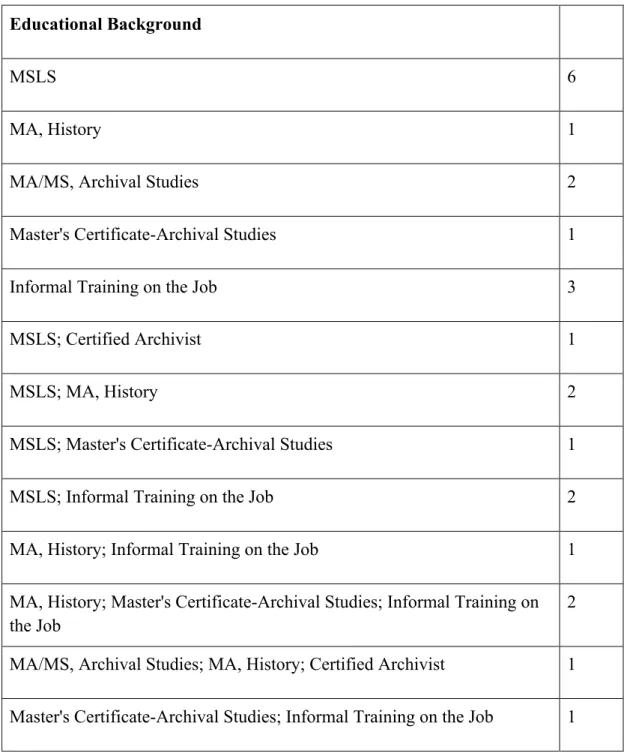
As shown below in Table 1 and Chart 1, archivists with a wide variety of educational backgrounds and degree combinations responded to the initial survey. Over half of the participants either had received a Master’s of Science in Library Science (or the
comparable MLIS) or were in the process of completing it. Several participants had also combined a Master’s of Arts in History with other education and experience. While only three respondents had only informal training, several archivists indicated it as an
Table 1: Educational Background: Survey Responses
Educational Background
MSLS 6
MA, History 1
MA/MS, Archival Studies 2
Master's Certificate-Archival Studies 1
Informal Training on the Job 3
MSLS; Certified Archivist 1
MSLS; MA, History 2
MSLS; Master's Certificate-Archival Studies 1
MSLS; Informal Training on the Job 2
MA, History; Informal Training on the Job 1
MA, History; Master's Certificate-Archival Studies; Informal Training on the Job
2
Chart 1: Educational Background of Survey Respondents
When it came to institution types, the archivists responding to the survey were
overwhelmingly from educational institutions such as colleges and universities. The
other, slightly smaller half was divided almost equally between corporate, collecting, and
local archives, as shown below in Chart 2. Staffing, on the other hand, was almost
equally split. Only one responding archivist indicated that the archive was only managed
by paraprofessional staff, while an equal number of respondents worked in archives
managed by a single archivist or one archivist plus paraprofessional staff such as
Chart 2: Institution Types of Survey Respondents
Interviews
I interviewed seven people following a combination of random and purposive sampling,
detailed above in the methods section: One local archivist, one collecting archivist, one
corporate archivist, and two each of archivists from educational institutions east and west
of the Mississippi River. Table 2 below shows the relevant information about each
interviewee. I did not realize until analyzing my results that while the survey at large
included an equal number of participants working by themselves and working with
paraprofessional staff, only two participants with additional staff were interviewed. The
rest were solo archivists, and one part-time archivist, the only archivist in that situation to
respond to my survey. Their education, however, was well spread out and representative
of the larger group, as shown in Chart 4 below.
Table 2: Interviewee Information
Interviewee Institution Type
Staffing Educational Background
Location
Corporate 1 (Interview 2)
Corporate
Archive One Archivist
MSLS, Certified
Archivist Virginia
Collecting 4
(Interview 7) Collecting Archive Paraprofessional Staff
Informal Training on the
Job
Tennessee
Local 1
(Interview 6) Local Archive One Archivist MA, History
North Carolina Educational 11 (Interview 3) University Archive One Archivist, Paraprofessional Staff MSLS, MA,
History Alabama
Educational 6 (Interview 1)
University
Archive One Archivist MSAS California
Educational 12 (Interview 4) Secondary School Archive One Archivist, Paraprofessional Staff
MSLS, MCAS New
York Educational 4
(Interview 5)
University
Archive One Archivist
MSLS, Informal Training on the
Chart 4: Interviewee Educational Background
The interviews focused on finding information that would be useful in answering the
research questions addressed by this study. This concentrated the questioning around a
few main points: the challenges of being a “lone arranger,” what a “typical day” looked
like in their situation, how they prioritized tasks, and what resources they found useful or
wanted to see more often. The main interview questions can be found in Appendix D.
Generally, the findings from the interviews supported and expanded on information
found in the literature, despite the fact that many answers were contingent upon the
archivist’s specific situation.
Challenges
Each archivist detailed challenges that were situation-specific, but even so common
themes ran through, stated in various ways. Findings about the challenges faced by solo
archivists echoed those found in the literature, especially regarding the pressure of
performing multiple duties. One interviewee summed up her challenges this way: “it’s a
(Interview 1). Another archivist expressed her experience with this challenge by saying
“as a solo archivist you’re doing all the conservation work you can, you’re doing all the
digitizing, all the transferring, you really are doing so many different things that you
constantly have to be teaching yourself new tools and tricks, and then every six months it
changes” (Interview 4). As lone arrangers, the archivists interviewed were responsible
not just for processing, but also for collection development, program building, reference,
outreach and engagement, and then of course, their own professional development. Of the
seven archivists interviewed, four were also required to work in the library in which the
archives dwelled. This duty, separate from but in addition to their archival
responsibilities, contributes to another challenge which all of the participants expressed:
time.
Time is a challenge which is also well documented in the literature, and no doubt is
familiar to all information professionals. With solo archivists, however, that challenge
seems to be intensified. For some of the interviewees, the nature of their position and
institution meant that they were required to do that job on top of working in a busy
library, as was the case with three of the educational archivists. Between that struggle and
the “balancing act” discussed earlier, one archivist said that his main challenge is
“actually finding time to do the job you were hired to do” (Interview 3). Juggling
institutional obligations such as teaching and committees, responding to research
requests, and supervising paraprofessional staff takes up most of the time that would be
otherwise spent gaining intellectual control of the collections and advertising about the
immediately responded to the question with “Time, because I didn’t lose a job and gain a
job, I just got added on top of a job” (Interview 5). This was the situation for a couple of
the archivists, who got added to jobs which they did not have prior training for, leading
into a third challenge which was discussed in the literature by authors such as D.W.
Carmicheal: a lack of formal archival training.
Three of the seven archivists interviewed did not have formal archival training in the
form of an MSLS, Masters of Archival Science, or Certificate in Archival Science,
leading two of them to seek out such education in addition to their full-time jobs. For two
of them it really made a difference, requiring them to seek out a lot of information and
learn on the go. This could be difficult without prior training in information science, as
one archivist shared that she could not say much about her experience with literature
because she really didn’t know how to find it. Other archivists expressed that they had to
spend a lot of time looking for materials which would be useful, and as has already been
established, that time is precious to a lone arranger.
Another challenge discussed earlier in the literature review is funding. Interestingly, this
was not a topic that seemed to be bemoaned as much by the interviewees as it has been
by solo archivists in the literature. Only a few of the archivists had experience with
grants, whether because it wasn’t necessary, as with a couple of well-funded participants,
or because grants did not apply, as with the corporate archivist. However, for those that
did utilize grants, those grants were essential to their work. “I could not have done what I
who had used a few different grants to fund conservation efforts, and was replying to a
question about whether or not grants were worth the time they required to write the initial
grant, perform the work, and write up the report (Interview 3). Grants are not the only
issue with funding, however, although they may be the most discussed in the literature
through articles such as Suzanne Pevar’s “Success as a Lone Arranger: Setting Priorities
and Getting the Job Done”and Elizabeth Dow’s “EAD and the Small Repository.” More
than one archivist interviewed discussed how they had to justify everything that they
needed funds for, leading to a final and complex challenge faced by archivists who are
working alone: facing the expectations and understandings of others, especially those
who control the funds.
When asked about challenges she faced, the first archivist interviewed said “expectation
[of] what is doable and what is needed” (Interview 1). That theme was echoed throughout
the interviews. “That has been the big wall, is explaining to the bosses and explaining to
the board of commissioners every year justifying my budget, and of course they give me
a very tiny budget, which is funny because they’re always coming to me saying I need
this…” (Interview 6). Justifying budgets to people with no archival background and
perhaps not even a library background, as in the case of the local archivist, is a major
challenge faced by the lone arrangers. This is a challenge that is not really covered in the
literature, but one that is very familiar to solo archivists, who do not have the support of
other archivists to back up their expertise. One of the interviewees said, “of course you’re
the campus expert and people are going to listen to you but if you want them to take you
get the archives space expanded by the university (Interview 3). Before the “higher-ups”
would grant that expense, he had to write a NEH Preservation Assistance Grant which
brought an “expert” down to convince the administration.
Management
Being the only archivist in the room makes for an interesting management situation, as
discussed in Colleen McFarland’s article “Rethinking the Business of Small Archives.”
To learn about each solo archivist’s experience and management perspectives, I asked a
few questions about what handling their tasks looked like. Unsurprisingly, everyone had
tasks that they wanted to get to but just didn’t have the time - a phenomenon which I defy
you to counteract in today’s fast-paced world. For each archivist it was something
different, from writing more in depth metadata to increasing the archives’ web presence.
When it came to asking the interviewees about their typical day, the responses were
rather interesting. For some, they had an answer ready: their days are loosely structured
around types of tasks like answering emails, processing analog materials, and working
with digital materials (Interview 2). Those with multiple “jobs,” however, discussed
earlier as having both library and archives duties, with the other, normal institutional
responsibilities stacked on top, had different answers. The local history archivist probably
summed it up the best for the group when he answered “Typical day, what’s that? No, I
will say this the lady who helps me summed it up well when she said ‘Your day comes at
you like a freight train’” (Interview 6). This relates back to the challenges of juggling
duties and finding enough time to “do the job you were hired to do” (Interview 3). When
answering emails, working on research requests, and processing, in all of its
many-faceted glory.
What about priorities? Setting priorities is one of the major points McFarland discusses in
her article on small archives management. This aspect of managing yourself and your
archives as a solo archivist ties back to the challenge of expectations from on high. For
some of the archivists, their priorities were generally decided through discussions with
supervisors, normally the head of the library to which the archive was attached. With
others, setting priorities was a more loose rule, decided by “whichever one’s causing the
biggest bleeding ulcer” (Interview 6), or “whatever I feel like doing” (Interview 7).
However, setting those priorities was still an important part of the daily routine for most
of the archivists, even if it was not as conscious as McFarland might hope. In general,
each archivist set his/her priorities based on the priorities of the institution, a decision that
may be common sense but which, as we will see later, I believe is very important to the
management process of the lone arranger.
When asked “do you see yourself as a manager,” the responses were rather mixed. Most
of the interviewees responded by discussing how they were the head of their department
within the larger institution, but that they reported to someone else. Perhaps some
answers might have been slightly different had I better been able to communicate my
interest in whether or not they view themselves as their own personal manager, as
outlined in Colleen McFarland’s article. The first two times I asked this question I
yourself?” Phrasing it this way elicited better responses, as shown in the large quote
below, and should have been done throughout the interviews. This is a question,
however, where the answers are very much influenced by the specific situation, for
example, how involved the archivists’ library superiors are with the management of the
archives. Only two of the seven archivists interviewed worked in archives that were not
attached to libraries. Of these, one worked only a few hours a week with no supervision,
and had the ability to choose to work on what she felt like doing. The other was the
corporate archivist, and the only one to immediately understand and answer the question.
However, I do believe that in hearing what the corporate archivist had to say, most if not
all of them would agree.
“Do you see yourself as a manager, not only of your archive but of yourself?”
“Oh yeah absolutely. Yeah cause I, and I think especially in this sort of situation where I’m in no one understand what I do...they don’t really understand the nitty gritty so I really do have to manage my own time and my own thinking and how far do I want to go on this collection. There really is no one else to ask, because before the library director had some idea of what I was talking about but here the company just doesn’t have the background to understand why I’m doing these sorts of things.” (Interview 2)
Resources
Given the challenges of solo archivist management, plus the evident lack of literature
regarding lone arrangers, I was interested to know how these archivists find supporting
resources to advise them and help them in their endeavors. As expected, nearly all of the
archivists had a copy of Christina Zamon’s book The Lone Arranger: Succeeding in a
Small Repository. However, although they named it quickly, none of them seemed to
applied to the big universities,” said one participant (Interview 6). The most common answer was that finding resources to help them in their situation as a solo archivist was a “piecemeal effort” (Interview 2). Resources from state archives, from SAA, from state associations, preservation associations, and various peer-reviewed articles were all commonly mentioned by the archivists. In addition, they all praised the Lone Arrangers Section Listserv for its helpfulness in bringing the solo archivists together and for the willingness of its members to answer the same questions over and over again with useful information. “Relying on the archivist down the road who’s in the same situation is almost as reliable as the literature itself” (Interview 3).
When asked whether or not they would like to see more literature about solo archivists, each archivist replied in the affirmative. “Yes, I’ve been an advocate for years because well as you know for centuries archives have been the priority of the big boys,
Discussion
The findings from the surveys and interviews are not necessarily surprising given the
literature and reasonable expectations of what being a lone arranger might entail.
However, tallying the challenges of solo archivists was not the purpose of this study.
Generally, the relevant data was acquired in the seven interviews, and generated a picture
of how each archivist operated within their specific situation. There are a few limitations
which constrain this study. First, time - the short period in which this research had to be
conducted resulted in speaking to only seven archivists, and each of them only once.
Second, although the selecting the interviewees was purposive and random, this process
did not represent the staffing results well, favoring heavily those who work only on their
own without paraprofessional staff. Third, both during a few of the interviews and when
analyzing the transcribed materials, I realized that the question about management was
phrased in a way that was confusing to the archivists and did not necessarily generate the
results I intended.
Nevertheless, the findings still provide an interesting picture into the lives of solo
archivists, granting an opportunity to address the specific research questions that this
study set out to answer. First, how do “solo” archivists in small institutions manage the
day-to-day tasks involved with their specific jobs? To be completely blunt, they just do.
The solo archivist’s set of tools includes a seemingly intangible quality that allows them
efficiently perform. Managing a lone arranger’s archive requires an intuition honed by
their experiences and their individual situation, such as that of Educational Archivist 12,
who splits her time between working directly in the archives and working on archive
materials while also supervising a school library. This is one of the hallmarks of our
profession - any advice really must include a caveat that “it depends” based on one’s
context, because best practice literature is meant to serve as a guide which must be
interpreted and applied with the archivist’s best judgment based on their own
circumstances.
If this quality is “intangible,” in the form of tacit skills, what hope is there for the current
or future lone arranger to figure out how to handle their own personal “freight train”?
Thankfully, the findings from these interviews present some helpful information on how
solo archivists develop their own best practices. Their practice is divided into two main
categories: prioritize and find helpful resources. While generally these two actions lead
the solo archivist’s way in management, it is important to remember one other finding
from this study: that despite many general similarities, the practical application can look
very different for each archivist.
Given the challenges discussed earlier, how does a lone arranger prioritize? As with any
position functioning within a larger institution, prioritization often begins with supervisor
input. Educational Archivist 6 describes sitting down with her supervisor to decide on the
big things that need to get done. Other archivists described similar situations, where
arranger. What about situations like Local Archivist 1, Collecting Archivist 4, or
Educational Archivist 4, where the supervisors are not as hands-on? In these situations, as
with all, the most common theme extrapolated from speaking with the archivists is that
the mission of the institution - its collecting policy, its goals, its purpose in serving the
community – effects how the archivist deals with the day-to-day. For example,
Educational Archivist 11, when asked about his priorities and daily tasks, answered with
a focus on serving the students.
“So, how do you prioritize your tasks?”
“*Laughs.* Whatever is the most pressing. I try, I typically prioritize by servicing the students and faculty requests. I mean the whole reason we’re here is students taking classes and working and all, and I want them to use the archives as much as possible, so that’s priority one, and with that my student workers and my interns...because some of them are considering it as a career.” (Interview 3)
Other archivists agree with the sentiment behind his prioritizing, if not the specific
decision. For each archivist, such as Educational Archivist 11, operating within a
University Library focused on serving its students, contextual information about the
institution provided the strongest catalyst for prioritizing, a fact that I believe is very
important for current and future lone arrangers to consider. For some, following the
mission of the institution included prioritizing its patrons and its donors above the more
minute details of processing, which may be difficult for many archivists and potential
processors to accept, but is a complex relationship that requires a delicate balance.
Within the operating bounds of the institutional mission, the archivists identified the
importance of being flexible when setting priorities. Solo archivists manage the
day-to-day tasks involved in their jobs by remaining flexible, able to move from processing to
needed, and then back again. It is interesting to see how dealing with the very challenges
that they face - juggling multiple duties - is a challenge in and of itself. One archivist in
particular noted how his priorities had to be “floating” throughout the day depending on
what walked in the door. “I learned many years ago in museums and it’s served me very
well to be extremely flexible in my priorities and the schedule of my day...but I do try to
have, I do try to set those as the priorities, these [as] sort of the general top priorities”
(Interview 6). Managing the complex nature of a solo archivist’s position requires setting
priorities and then adopting a flexible position within that framework that allows them to
manage the various tasks and problems that present themselves to the lone arranger on a
daily basis.
In addition to prioritizing, the archivists interviewed made use of helpful resources when
managing various tasks, whether processing or communicating with supervisors. A full
list of the resources identified by archivists interviewed as helpful for their jobs is
included in Appendix F. Useful resources for the solo archivist have already been
discussed in the findings section, but there are two main groups of resources which stood
out as aiding in the day-to-day. First, description guidelines. Almost every single
archivist mentioned having a couple of guidelines, such as DACS, on hand for aiding in
description while processing. These standards, while incredible important, are difficult to
remember, and having them on hand is good advice for other archival professionals.
Second, the solo archivists managed their day-to-day tasks by seeking help from other
professionals. This collaborative element, focused on but not limited to the Lone
Arrangers Section Listserv, emerged from in the interviews as a vital part of archivists’
collective activity, because I feel like solo archivists do spend a lot of time reinventing
the wheel the world over, everyone else more or less comes out with the same conclusion
but we’re so separate, it doesn’t necessarily get passed along” (Interview 4). Each
archivist spoke of times when that collaborative effort was extremely helpful in getting
them past a particular situation or task.
To manage the day-to-day tasks involved with their specific jobs, solo archivists use the
context of their institution to set big priorities and then move flexibly among the
changing priorities of their everyday jobs, consulting resources such as guidelines and
other archivists when needed. These two areas combine together over the lifecycle of a
solo archivist’s career, changing with career moves, adding in materials with experience,
and flowing with the institution to become a strong intuitive sense which guides everyday
task management. While it may appear that lone arrangers handle their challenging
situations by just working, their experience working with priority setting and
continuously adding resources to their arsenal allows them to develop this seemingly
intangible quality.
That leads into the secondary research question which this study sought to address: what
does the daily decision-making process of a “lone arranger” look like in the real world?
Perhaps the first archivist interviewed said it best: it looks like a “balancing act” between
all the different duties and priorities accumulated at and informed by the archivist’s
particular situation and context (Interview 1). It looks like managing these priorities and
the intuition discussed above with an understanding of each archivist’s personal
wished that they could get to were almost all things that they enjoyed doing - writing in
depth metadata, spending more time on the ‘detective’ aspect of reference and
processing, and more. A couple of the archivists in particular pointed out situations where
they had to balance what they needed to do with what their instinct indicated they should
do. “I can spend an hour looking for stuff on one single piece, but sometimes you just
have to go ‘there’s nothing there, go on, go to the next thing,’ and that’s kind of the
hardest part is to know when to stop looking and just get it done and go on to the next
thing, cause I’m a researcher” (Interview 5). With the other interviewees, this balance
was more of an implied fact. All decision making required that balance, not just
restrictions based on institutional resources or missions. Keeping in check the desire to
follow the rabbit trail of a particular manuscript or spend a lot of time on super
Conclusion
This study painted an interesting picture of the daily management practices of solo
archivists as well as the world in which these lone arrangers operate. Hopefully, the
findings both from the literature and from the research provide information for those who
may not know much about the lone arrangers and act as a source of encouragement for
the archivists themselves. While they face multiple challenges that are not unique to
archives but are compounded in the context of the lone arranger, these archivists still
manage a large amount of the nations’ heritage. And how? The study showed that lone
arrangers manage the day-to-day tasks involved in their jobs by setting priorities,
consulting resources, and balancing the needs of their situation with their own personal
inclinations.
Over the course of this study, a few questions were raised which were not in the purview
of the research questions, but which I believe are important to consider going forward.
One of the archivists interviewed did not have any prior education or training aside from
that which she received on the job. Finding resources was particularly difficult for this
archivist, leading me to wonder - whose responsibility is it to ensure that these lone
arrangers have the resources that they need? Not folders and boxes, but guidelines, best
practice articles, and books of advice. Is that solely the prerogative of the institution
where the archive is located, which may have very little understanding of what is
situations? The aforementioned archivist indicated that she would only know about and
utilize a resource if she learned about it from another archivist or through the Lone
Arrangers Section Listserv. There are issues with expecting the archivist themselves to
find these materials or the organization in which they operate to provide them. As has
already been discussed, lone arrangers have time constraints which restrict their ability to
spend time looking for these types of resources, and a lack of formal training in library
science can make that process take even longer, as is the case with this particular
archivist. The institutions, on the other hand, do not necessarily understand the processes
of archives enough to know what information and help their employees need to properly
perform their job duties. I think that this is a conversation which is important for those in
the Lone Arranger Section and larger SAA body to consider in thinking about how it
provides support for all archivists across the country.
For the Lone Arrangers Section in particular, based on what I was told by the interviewed
archivists I recommend attempting to compile organized lists of references similar to
LibGuides at universities. Reference lists and glossaries of technical terms were both
mentioned as resources which solo archivists would like to see, especially when it comes
to topics which frequently come up on the Lone Arrangers Section Listserv. Additionally,
multiple interviewees mentioned a desire to see more specialized versions of the Lone
Arrangers Section. After all, there are other sections such as University Archives,
Government Archives, Business Archives, etc., and all of these types of institutions also
have lone arranger counterparts participating in SAA. Because of the collaborative nature
of subsections within the Lone Arrangers might help to put archivists in similar situations
in better, closer contact, at least virtually.
Finally, I think that this study has implications for the classrooms in which future Lone
Arrangers are being educated. In general, I think that more acknowledgment of the reality
of the solo archivists within the classroom environment would be helpful in preparing the
next generation. The classroom tends to be a place where the “best practice” ideas and
situations are taught without much acknowledgment of the difficult context of the small
archive. Going off of the findings, an emphasis on the importance of both setting and
interpreting the mission of the institution in practicing archives and records management
would prepare future archivists not only for the general archival field, but especially for
the context of the lone arranger, should they end up in that position. The informed
intuition which drives the management practices of lone arrangers is a specialized ability,
but one which can be developed and can be prepared for with an open mind and
Bibliography
Dow, E. (1997). EAD and the small repository. The American Archivist, 60(4), 446–455. doi:10.17723/aarc.60.4.83n2005k00n27411.
Hackmann, W. (1968). Small college archives: problems and solutions. The American Archivist, 31(3), 271–275. doi:10.17723/aarc.31.3.g5p8h4683h367663.
Pevar, S. (2005). Success as a lone arranger: setting priorities and getting the job done. Journal of Archival Organization, 3(1), 51–60. doi:10.1300/J201v03n01_05.
Williams, J. A., & Berilla, E. M. (2015). Minutes, migration, and migraines: establishing a digital archives at a small institution. The American Archivist, 78(1), 84–95. doi:10.17723/0360-9081.78.1.84.
Wosh, P., & Yakel, E. (1992). Smaller archives and professional development: some new york stories. The American Archivist, 55(3), 474–482.
doi:10.17723/aarc.55.3.rm3162605j570413.
Baird, D., & Coles, L. M. (1998). A Manual for small archives. Vancouver, B.C :
Association of British Columbia Archivists, 1988.: Association of British Columbia Archivists.
Carmicheal, D. W. (2012). Organizing archival records (3rd ed.). Walnut Creek, Calif; AltaMira Press: AltaMira Press.
Dow, E. (1997). EAD and the small repository. The American Archivist, 60(4), 446–455. doi:10.17723/aarc.60.4.83n2005k00n27411
Fisher, R. (2009). In Search of a Theory of Private Archives: The Foundational Writings of Jenkinson and Schellenberg Revisited. Archivaria, 67, 1–24.
Greene, M., & Meissner, D. (2005). More product, less process: revamping traditional archival processing. The American Archivist, 68(2), 208–263.
doi:10.17723/aarc.68.2.c741823776k65863
Hackmann, W. (1968). Small college archives: problems and solutions. The American Archivist, 31(3), 271–275. doi:10.17723/aarc.31.3.g5p8h4683h367663
American Archivist, 76(2), 335–345. doi:10.17723/aarc.76.2.2627p15350572t21
Jimerson, R. C. (2000). Book Review: American Archival Studies: Readings in Theory and Practice. Archivaria, 51.
Koch, G. (2004). Challenges to a small ethnographic archives. In A. Seeger & C. Chaudhuri (Eds.), Archives for the future: Global perspectives on audiovisual archives in the 21st century (pp. 170–182). Calcutta, India: Seagull Books.
Manning, M., & Silva, J. (2012). Dual Archivist/Librarians: Balancing the Benefits and Challenges of Diverse Responsibilities. College and Research Libraries, 73(2), 164– 181.
McFarland, C. (2007). Rethinking the Business of Small Archives. Archival Issues, 31(2), 137–149.
Millar, L. (2002). The Death of the Fonds and the Resurrection of Provenance: Archival Context in Space and Time. Archivaria, 53.
Pevar, S. (2005). Success as a lone arranger: setting priorities and getting the job done. Journal of Archival Organization, 3(1), 51–60. doi:10.1300/J201v03n01_05
Robyns, M., & Woolman, J. (2011). Institutional Functional Analysis at Northern Michigan University: A New Process of Appraisal and Arrangement of Archival Records. The American Archivist, 74.
Williams, J. A., & Berilla, E. M. (2015). Minutes, migration, and migraines: establishing a digital archives at a small institution. The American Archivist, 78(1), 84–95. doi:10.17723/0360-9081.78.1.84
Wosh, P., & Yakel, E. (1992). Smaller archives and professional development: some new york stories. The American Archivist, 55(3), 474–482.
doi:10.17723/aarc.55.3.rm3162605j570413
Appendices
Appendix A: Recruitment Letter
Members of the Lone Arrangers Section,
My name is Lauren Murphree, and I am a student at UNC-SILS working on my master's paper for graduation in May 2018. I am focusing on the practices of archivists at small institutional archives, as I would like to explore how archivists in such
situations, with various limited resources, approach the many different types of tasks which face them.
Earlier this school year, in September, I sent out an email asking if anyone was interested in taking part in this study. I received over forty responses, which was incredibly encouraging - thank you so much, Lone Arrangers! Since then, I have completed my literature review and planning and am ready to move on to the next stage. If you did not see my email or did not get a chance to reply, please indicate your interest to me quickly. Participation in this study would require filling out a short survey with the potential to be selected for an interview, which would be audio-recorded. It’s thanks to the amazing response that I even have to take that step!
I am so excited to speak with members of this section and hear about what you are doing - and how you are doing it - in your positions as solo archivists. If you are interested in taking part or just learning more about what I am working on, please email me at [email protected]. Thank you for taking time to read this email, and I hope that my study can be useful for this section.
Sincerely,
Lauren Murphree MLIS 2018
Research Assistant
Appendix B: Recruitment Letter Follow-Up
Dear ______,
Thank you so much for your reply to my recruitment letter expressing interest in the research I am doing as part of my graduate degree in library science at the University of North Carolina – Chapel Hill.
The purpose of this research study is to explore the management practices of solo archivists in order to add to a small body of literature and make the voices of solo archivists heard in the archival community. You are being asked to take part in a research study because you are a solo archivist who has expressed interest in supporting this study.
Being in a research study is completely voluntary. You can choose not to be in this research study. You can also say yes now and change your mind later.
If you agree to take part in this research, you will be asked to take an initial survey. Your participation in this study will take between fifteen minutes and two hours. If you agree to take part in this research, you will be asked to take an initial survey. Your participation in this study will take between fifteen minutes and two hours. The initial survey should take no more than fifteen minutes to complete. Please respond to this email to receive the survey. Responding to this email will be regarded as consent.
If you are selected for and agree to an interview, participation in this portion will take about an hour, with the potential to extend depending the discussion and your availability and willingness to continue. We expect that forty people will take part in the initial survey, with eight to ten being chosen for interviews. The interviews will be audio-recorded unless you do not wish to have your interview audio-recorded. Consent will be confirmed verbally on record.
You can choose not to answer any question you do not wish to answer. You can also choose to stop taking the survey at any time. You must be at least 18 years old to participate. If you are younger than 18 years old, please stop now.
The possible risks to you in taking part in this research are:
● In the unlikely event that confidentiality of data is lost, there is a risk of potential discomfort at having someone else find out that you were in a research study or what your views on archives are.
The possible benefits to you for taking part in this research are:
● Increased recognition in the archival community for the challenges facing solo
To protect your identity as a research subject, the researcher(s) will not share your information with anyone. In any publication about this research, your name or other private information will not be used.
Thank You,
Lauren Murphree MSLS 2018 Research Assistant
UNC Health Sciences Library
If you have any questions about this research, please contact the Investigator named above by calling 256-682-5970 or emailing [email protected]. If you have questions or concerns about your rights as a research subject, you may contact the UNC