Economies of Expansion:
Chinese Peacekeeping Contributions Bolster "China's Peaceful Development"
By
Morgan Alderman
Senior Honors Thesis
Curriculum in Peace War and Defense University of North Carolina at Chapel Hill
April 26, 2019
Approved:
Abstract
Over the past thirty years China has shifted its approach to United Nations (UN) peacekeeping operations from determined opposition to leading supporter. During this time period, China has also become a dominant force globally. With the second largest economy and expansive global infrastructure projects, China is positioning itself as the next great power. Under China’s “peaceful development” strategy, its global engagement with UN peacekeeping and international development are key components of China’s rising power. As a part of this, China’s continued economic success is not only a central aspect of Chinese grand strategy, but also plays an integral role in its peacekeeping contribution decision-making. Particularly
Acknowledgements
I would like to take this opportunity to thank those who have helped me in the process of writing this thesis. First, I would like to thank my advisor, Dr. Jennifer Hazen, for pushing me to become a better writer and find my voice as a researcher. Second, I would like to thank my friend, Connor Von Steen, for teaching me how to use excel, and always answering my
Table of Contents
INTRODUCTION
1
CHAPTER I. WHY DOES CHINA CONTRIBUTE TO UN PEACEKEEPING
OPERATIONS? 6
CHAPTER II. ECONOMICS AND CHINESE GRAND STRATEGY 21
CHAPTER III. ECONOMIC INTERESTS IN AFRICA
32
CHAPTER IV. TARGETED PEACEKEEPING CONTRIBUTIONS 40
CHAPTER V. RESOURCES, MARKETS, AND PEACEKEEPING 56
CONCLUSION
73
Abbreviations
AIIB: Asian Infrastructure Investment Bank ASEAN: Association of Southeast Asian Nations CAD: China-Africa Development Fund
CNPC: China National Petroleum Company DRC: the Democratic Republic of the Congo FDI: Foreign direct investment
FOCAC: Forum on China-Africa Cooperation GDP: Gross domestic product
GNPOC: Greater Nile Petroleum Operating Company IMF: International Monetary Fund
MINURSO: United Nations Mission for the Referendum in Western Sahara
MINUSMA: United Nations Multidimensional Integrated Stabilization Mission in Mali MINUSTAH: United Nations Stabilization Mission in Haiti
MONUC: United Nations Organization Mission in the Democratic Republic of the Congo MONUSCO: United Nations Stabilization Mission in the Democratic Republic of the Congo MOOTW: Military operations other than war
NATO: North Atlantic Trade Organization ONUB: United Nations Operation in Burundi
ONUMOZ: United Nations Operations in Mozambique PEOC: Petro Energy Operating Company
UN: United Nations
UNAMA: United Nations Assistance Mission in Afghanistan UNAMIC: United Nations Advanced Mission in Cambodia UNIFIL: United Nations Interim Force in Lebanon
UNIKOM: United Nations Iraq-Kuwait Observer Mission UNISFA: United Nations Interim Security Force for Abyei UNFICYP: United Nations Peacekeeping Force in Cyprus UNMEE: United Nations Mission in Ethiopia and Eritrea UNMIBH: United Nations Mission in Bosnia and Herzegovina UNMID: United Nations Mission in Darfur
UNMIK: United Nations Mission in Kosovo UNMIL: United Nations Mission in Liberia UNMIS: United Nations Mission in Sudan
UNMISS: United Nations Mission in South Sudan UNOCI: United Nations Operation in Côte d’Ivoire UNOMIL: United Nations Observer Mission in Liberia UNSMIS: United Nations Mission in Syria
UNTAET: United Nations Transitional Administration in East Timor UNTAC: United Nations Transitional Authority in Cambodia
UNTSO: United Nations Truce Supervision Organization US: United States
Introduction
On September 28, 2015, China’s President Xi Jinping gave a speech to the United
Nations (UN) announcing China would delegate a portion of the China-UN Peace and
Development Fund towards UN peacekeeping activities.1 Earlier that same year, China sent its
first infantry battalion to the UN mission in South Sudan (UNMISS), and equipped it with drone
technology, armored carriers, antitank missiles, mortars and other heavy weapons.2 By the end of
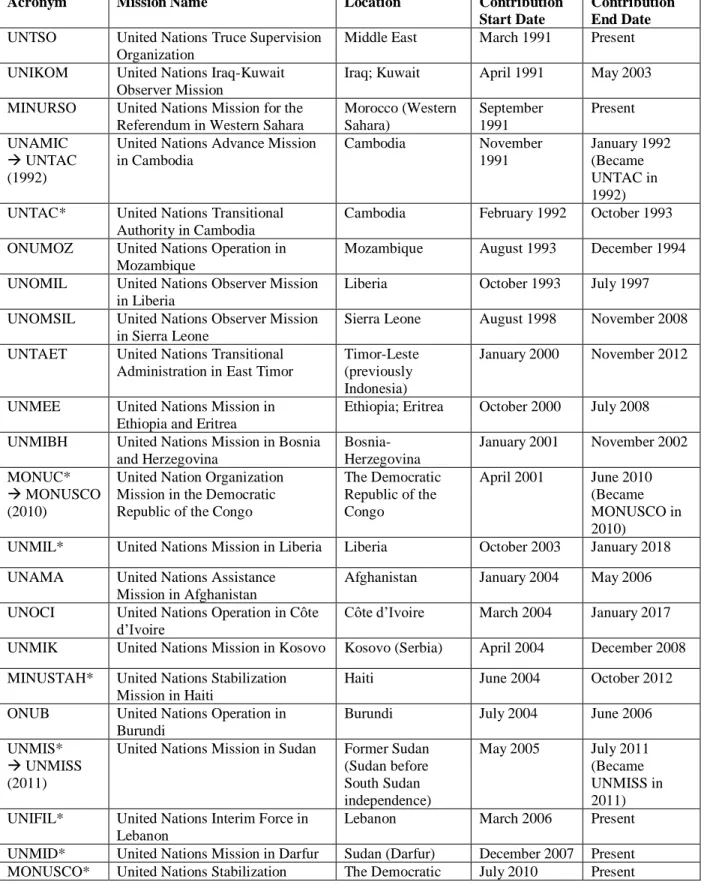
2018, China had over 2,500 deployed personnel across eight missions, and created an 8,000
strong UN peacekeeping standby force, dedicated to carrying out the .3 It is now the tenth largest
UN troop contributor, and the second largest financial contributor to UN peacekeeping
operations.4 Though China has been contributing to UN peacekeeping operations since 1991,
China’s commitment to UN peacekeeping is greater than ever been before. Increasingly, China’s
peacekeeping contributions have become a central aspect of China’s rising global power as a part
of “China’s Peaceful Development” strategy.
China’s economic dominance is omnipresent in any discussion of China’s rising power.
China currently has the third largest Gross Domestic Product (GDP) behind Europe and the
United States, respectively.5 According to a recent PriceWaterhouse Coopers report the Chinese
economy will surpass the US sometime around 2030, and by 2050 it “will be the largest
economy in the world by a significant margin.”6 China’s economic dominance can also be seen
in its increased investments abroad and expanding international trade networks. Through
initiatives such as the Belt and Road, and extensive foreign direct investment (FDI) in Africa and
Latin America in particular, Chinese economic expansion is a central point of China’s recent
Solidly grounded in former Chinese President Deng Xiaoping’s economic reform,
Chinese global engagement has always centered around economic expansion.7 This is true both
of China’s internal adjustments, namely introducing a national market economy, and
international adjustments, including increased international trade.Internally, China has
undergone significant changes to its economic system. Through domestic economic reforms
stemming from Deng Xiaoping’s “Socialism with Chinese Characteristics,” the Chinese
economy has shifted from a strict Marxist economy to allow for economic liberalization.8
Similarly, China’s external engagement has also been characterized by its “Going Out” (走出去)
policy, which has pushed Chinese economics towards international investments.9 In particular,
one area that has garnered significant international attention is China’s investments in Africa.
Chinese economic interests in Africa are increasingly diverse in nature. From granting
large development loans to states across the continent to formalized foreign direct investment,
China and Chinese companies have an increasingly high economic stake in African
development. During the 2018 Forum on China-Africa Cooperation (FOCAC) summit, China
committed 60 billion United States dollars (USD) to government assistance and investment
financing over the course of three years. Proposing to set aside 10 billion USD of China’s overall
financing to go towards development, Xi Jinping committed to increasing private sector
investment across Africa.10
Over the last few decades the African continent has not only been at the heart of Chinese
development financing, but has also been home to some of the globe’s greatest instability.
Currently seven out of the fourteen active UN peacekeeping missions are located in Africa, with
five of the seven being the largest missions in terms of deployed personnel overall.11 Given the
increasingly important. China has a vested interest in promoting security across the African
continent to protect its economic investments. One way to accomplish that is through UN
peacekeeping operations. Of the seven current missions across the African continent, China
currently contributes to five.12
China has had a complex relationship with the international community for decades.
China did not join the International Monetary Fund (IMF), nor the World Bank, until the 1980s,
and was largely inactive in the UN until the 1990s. Often viewed by China as mechanisms of
Western dominance and US control, China has been hesitant to engage with established
international institutions despite its desire to engage globally. Stressing non-hegemony, the
Chinese have long appreciated and pushed for alternative options to the established international
“liberal world order”. Most notably, China has made historic shifts economically, attempting to
establish itself as the leader of the developing world facilitating South-South relations, and the
creation of the Belt and Road Initiative, which place the Chinese as economic leaders outside the
realm of the World Trade Organization (WTO), IMF or World Bank.13 China has also
established a number of conferences and regional investment organizations that mark its rising
global influence, including FOCAC and the Asian Infrastructure Investment Bank (AIIB), which
set it apart from established international institutions.
Combined with China’s growing global footprint, China’s interactions with the UN, and
UN peacekeeping in particular, should be seen as strategic moves that simultaneously result from
and support China’s rising power. Often, emerging powers seek to establish themselves within
the established international order and build their own international pacts and bonds.14 China’s
global engagement has increased dramatically over the past twenty years and has culminated in a
peacekeeping contributions, however, go beyond Chinese interests in changing its engagement as
the result of its rising power status. Its contributions are targeted in a manner that bolsters
China’s rise by supporting its strategic interests.
As China’s global power continues to grow, so too has its engagement with the
international order, specifically with regard to UN peacekeeping operations.Now the largest
contributor of peacekeeping forces among the UN Security Council Permanent Five, China has
become an avid supporter of UN peacekeeping missions. This marks a definite shift from the
1990s, and even the early 2000s, when Chinese support was relatively limited.15
For a country that has long been skeptical of the current international order, China’s
commitment to UN peacekeeping marks a significant shift in Chinese international interactions.
Especially with regards to international institutions, China’s peacekeeping contributions should
be read as both a product of and support to China’s global rise. As China has stepped onto the
global stage, it has made strategic contributions to UN Peacekeeping Operations which support
China’s financial investments abroad and its broader economic interests, as a broader
contribution to Chinese grand strategy and China’s “peaceful rise”.
Beginning with an overview of the current literature on Chinese motivations for making
peacekeeping contributions to the UN in the first Chapter, I offer a discussion surrounding
China’s peacekeeping contribution motivations. In Chapter Two, I explore China’s grand
strategy, and the central role of economics. In Chapter Three, I layout the economic interests
China has across the African continent, highlighting their resource-oriented nature. In Chapter
Four, I explore the trends in Chinese peacekeeping contributions, underscoring the strategic
calculus behind increases in China’s peacekeeping contributions. In Chapter Five, I compare
peacekeeping forces. Highlighting South Sudan as a case study of China’s international
economic engagement, security concerns, and large peacekeeping contributions, I display how
China’s economic interests influence Chinese peacekeeping contributions in practice. Finally, I
conclude that China utilizes peacekeeping contributions in a strategic manner, aimed at
safeguarding economic interests abroad and furthering Chinese grand strategy objectives.
1Xinhua News, “Xi Jinping Speaks at the UN Peacekeeping Summit,” [习近平出席联合国维和峰会并发表讲话]
Xinhua News, September 9, 2015. http://www.xinhuanet.com/world/2015-09/29/c_1116705308.htm; Translation available through UN at https://gadebate.un.org/sites/default/files/gastatements/70/70_ZH_en.pdf
2 David Smith, “China to Send 700 Combat Troops to South Sudan,” The Guardian, December 23, 2014.
3 Xinhua News, “Xi Jinping Speaks at the UN Peacekeeping Summit,” [习近平出席联合国维和峰会并发表讲话]
Xinhua News, September 9, 2015. http://www.xinhuanet.com/world/2015-09/29/c_1116705308.htm; Translation available through UN at https://gadebate.un.org/sites/default/files/gastatements/70/70_ZH_en.pdf ; United Nations Department of Peacekeeping Operations, Summary of Troop Contributions to UN Peacekeeping by Country, Mission and Post, United Nations Department of Peacekeeping Operations December 31, 2018 Report, (2018). https://peacekeeping.un.org/sites/default/files/3_country_and_mission_10.pdf
4 United Nations Department of Peacekeeping Operations, Summary of Troop Contributions to UN Peacekeeping by
Country, Mission and Post, United Nations Department of Peacekeeping Operations December 31, 2018 Report, (2018). https://peacekeeping.un.org/sites/default/files/3_country_and_mission_10.pdf
5International Monetary Fund, World Economic Outlook Database, International Monetary Fund (January 2019
updated) Accessed: February 21, 2019. https://www.imf.org/external/pubs/ft/weo/2018/02/weodata/index.aspx
6PriceWaterhouse Coopers, “The Longview: How will the Global Economic Order Change by 2050?”
PriceWaterhouse Coopers, February 2017, 3.
7Vance Cable, “Deng: Architect of the Chinese Superpower,” in From Deng to Xi: Economic Reform, the Silk
Road, and the Return of the Middle Kingdom, LSE Ideas special report 23, May 2017, 2.
8Ibid.
9Hongying Wang, “A Deeper Look at China’s ‘Go Out’ Policy,” CIGI Commentary, March 2016.
https://www.cigionline.org/sites/default/files/hongying_wang_mar2016_web.pdf
10Yun Sun, “China’s 2018 Financial Commitments to Africa: Adjustment and Recalibration,” Brookings Institute
(blog), September 5, 2018.
11 United Nations Department of Peacekeeping Operations, Summary of Troop Contributions to UN Peacekeeping
by Country, Mission and Post, United Nations Department of Peacekeeping Operations December 31, 2018 Report, (2018). https://peacekeeping.un.org/sites/default/files/3_country_and_mission_10.pdf
12Ibid.
13Xinhua, “‘China is a Leader of South-South Cooperation’ —the Third ‘Developing Country Research Leadership’
Summit Discusses China’s Development Achievements, [“中国是南南合作积极领导者—第三届发展中国家金融 领神研讨项目专家热议中国发展成就]” Xinhua News, May 28, 2018.
http://www.xinhuanet.com/world/2018-05/28/c_129881174.htm
14Pinar Tank, “The Concept of ‘Rising Power’,” NOREF Policy Brief, June 2012, 3-4.
15United Nations Department of Peacekeeping Operations, Summary of Troop Contributions to UN Peacekeeping
by Country, Mission and Post, United Nations Department of Peacekeeping Operations December 31, 2018 Report, (2018). https://peacekeeping.un.org/sites/default/files/3_country_and_mission_10.pdf
Chapter I. Why Does China Contribute?
China’s increasing involvement in peacekeeping operations is highly particular. It has not
contributed troops evenly across time or location. Rather, China’s troop contribution shifts have
been targeted. Sending more troops after Hu Jintao became president in 2003, and again shifting
towards greater training commitment and establishing a standby force under current president Xi
Jinping, China’s contributions are not linear.1 China’s contributions have also been concentrated
to certain missions. Though China currently contributes to eight missions, a majority of the
contribution are located in one mission: the UN mission in South Sudan (UNMISS).2
Understanding the nature with which China contributes to UN peacekeeping operations is a
central aspect of understanding why China has become such a dominant peacekeeping
contributor.
Ascertaining where and why China sends peacekeepers requires analyzing both China’s
specific deployments, and the context within which these deployments are made. Though
China’s rhetoric surrounding its peacekeeping contributions overwhelmingly portrays China’s
contributions as altruistically motivated, the costs associated with large contributions are high.3
For instance, the death of three Chinese peacekeepers in 2015 sparked domestic concern that
perhaps China’s contributions were not worth the cost.4 Compounded with China’s vocal
commitment to sovereignty and noninterference, if China were not benefiting in some way from
its contributions, it would likely choose not to send troops.
Understanding when and why China has stepped up its UN peacekeeping troop
contributions centers around two foundational explanations: (1) Chinese troop contributions are a
rational decision, made by rational actors, and (2) China’s troop contributions function within a
China’s actions are rational and rationally driven is useful to extrapolate cost/benefit analyses
surrounding Chinese decision-making with regard to peacekeeping contributions. This
assumption also asserts that if China is making large contributions in the manner that it has, then
the benefits must outweigh the costs. This means that even if China does not say it has made a
strategic calculous in favor of certain benefits, its actions do. The later, on the other hand,
assumes that this decision must be part of a larger strategy. This situates the benefits China
perceives and receives from these contributions within a larger context of Chinese grand
strategy, underscoring the implications of China’s shifting approach to UN peacekeeping
operations within China’s foreign policy. Together, these two explanations form the core of both
the larger literature surrounding China’s peacekeeping contributions, and my analysis.
While the current literature offers important insight into the strategic calculations that
drive Chinese peacekeeping contributions, it tends to lack in one particularly important aspect —
Chinese economic considerations. Often focusing on the role that China’s peacekeeping
contributions play in China’s “peaceful rise” narrative, underscoring the political and military
benefits that come along with the ways that China contributes to UN missions, the current
literature largely ignores the centrality of Chinese economic interests within peacekeeping
contributions and Chinese grand strategy more broadly. Though political and military
considerations are a strong component of China’s peacekeeping contribution decision-making,
economic considerations appear far more central. This is true both in terms of when and where
China has decided to contribute troops, and as a part of greater Chinese grand strategy.
Economic interests not only serve as a foundational element of China’s global engagement but
also as a continued interest of the state. Therefore, evaluating the economic benefits is necessary
deployment of Chinese foreign policy to support its grand strategy concerns. China’s economic
interests also offer a better explanation for how and why China contributes to UN missions in
such a targeted manner.
China Benefits
When exploring the ways in which China’s contributions to UN peacekeeping operations
interact with larger Chinese national interests, it is important to focus on the benefits to these
interests that troop contributions can offer. In order words, understanding what interests drive
China to continue contributing troops to UN peacekeeping operations, and equally important,
what drives China to increase its contributions to UN peacekeeping operations are critical. One
way to determine the driving mechanisms is through the lens that examines benefits China
receives both directly, and indirectly from UN peacekeeping contributions. China’s continued
commitment to UN peacekeeping operations suggests that the benefits China receives must
outweigh the costs and hold sway over Chinese decision-making processes. Often, the literature
focuses on the military and political benefits as the interests which drive China’s commitment to
UN peacekeeping operations.
Military Benefits
Since Hu Jintao announced that China would begin to undertake “historic new missions”
(新的历史使命) on Christmas Eve in 2004, the Chinese military has gradually prioritized
conducting military operations other than war (MOOTW) to further develop the Chinese military
and otherwise project China’s military capacity to engage with global peace and security
objectives.5 As outlined in the 2008 White Papers, China views participating in UN
MOOTW.6 Participating in UN peacekeeping has also provided practical experience for Chinese
security forces, which have bolstered other MOOTW, including Chinese anti-piracy campaigns
in the Gulf of Aden, and domestic riot-control capabilities.7
Scholars assert that China’s peacekeeping contributions serve to benefit the Chinese
military both by providing China with “boots on the ground experience,” and furthering Chinese
military diplomacy. For instance, Lieutenant Phillippe D. Rogers asserts that China’s experiences
in Western Sahara, in particular, have given Chinese military observers valuable tactical and
operational experience.8 More broadly, Chinese military officers also have the opportunity to
interact with foreign military personnel and develop and strengthen Chinese military clout.9
Working alongside foreign troops, Chinese personnel, often trained for specialized tasks such as
engineering, logistical and medical support, exhibit highly skilled qualities that offer tangible
support (such as rebuilding roads or needed medical support, which are more tangible to local
population in the short term than democracy or other intangible goods) and further develop the
role of China’s desired image as a peacefully rising power. In particular, these troop
contributions give credence to China’s claim as a “responsible power”, a term associated with
Chinese government officials and intellectuals assertion that China is responsibly using its power
to promote “mutually beneficial development” and greater peace.10
While military modernization plays a role in China’s peacekeeping contributions, the role
of MOOTW is often overstated. Specifically, though MOOTW were an early component of
China’s peaceful rise campaign, aiming to project China’s rise and China’s growing military
capacity as an apparatus for furthering peace, they do not explain the targeted nature of China’s
peacekeeping contributions. If China were sending troops mainly to expand their MOOTW
deployments rather than target increases based on location. Larger deployments across a wide
range of missions would yield the most beneficial outcome for the Chinese military, in that it
would allow the Chinese to gain experience across a variety of climates and interact with more
foreign troops, creating more opportunities to further modernize the Chinese military. Sending
more troops indiscriminately would also aid China’s MOOTW implementation – showing that its
commitment is broad-based. China’s peacekeeping contributions, however, do not reflect this.
Instead, China’s troop contributions have been targeted, signaling some other strategic calculous.
Political Benefits
To understand the reasons why China contributes to the UN in increasingly large
numbers and with new infantry troops it is necessary to understand the decisive nature of China’s
shifting peacekeeping contributions. Understanding the targeted nature of China’s troop
contributions is key. According to Meicen Sun, China’s targeted, or as she refers to them,
“discrete”, troop increases indicate that “abrupt shifts in the top-level political calculous [is likely
the] driving force” behind China’s peacekeeping contributions.11 She therefore, like many other
scholars, argues that China’s peacekeeping contributions must be politically motivated.12
Perceived and received political benefits are the most cited reason for China’s peacekeeping
contributions. In particular, scholars assert that contributing to UN peacekeeping missions serves
to benefit the Chinese on two main fronts: Taiwan, and the continued development and
maintenance of diplomatic relationships abroad.13
Perhaps the most contentious issue in Chinese foreign policy has long been the issue of
Taiwan. For the Chinese, Taiwan is simply a province that has not come back under the People’s
Taiwan’s constitution upholds the Chinese claim to the island nation, Taiwan’s claim to
sovereignty has gained international support, with a number of states including Honduras, Haiti
and fifteen others, recognizing Taiwan’s status as an independent state.16 For China, this
recognition is unacceptable. In recent years China has begun an at times not so quiet campaign to
regain control of Taiwan, slowly convincing internationally recognized countries to renounce
their diplomatic relations with Taiwan and recognize the People’s Republic of China (Mainland
China) as the sole government of China.17 Through carrots and sticks, the Chinese government
has successfully reduced the number of countries recognizing the Republic of China (Taiwan) to
seventeen.18 Somewhere between carrot and stick, China’s commitment to UN peacekeeping
operations can be leveraged to shift states towards the “One-China” policy which recognizes the
People’s Republic of China as the sole sovereign China.19 In Liberia, for instance, instead of
vetoing the UN mission in Liberia on the basis that Liberia recognized Taiwan, it used the
malleable state of Liberian politics to pressure the post-conflict state to recognize the
“One-China” policy, offering aid and peacekeeping support in return.20
China’s peacekeeping contributions are also deployed to promote Chinese diplomacy
abroad. More specifically, scholars assert that Chinese peacekeepers are deployed as a
mechanism to express resolve for peace and security in the case of existing relationships, and aid
Chinese projections as “responsible” global power.21 China’s peacekeeping contributions are
aimed at furthering a positive image of China.22 China’s peacekeeping contributions both give
credit to its rhetorical commitments to global peace and security, and allow China to further its
aspirations of becoming a major power by providing important material assets and contributions
at a time when multidimensional peacekeeping is overstretched.23 This physical commitment is
establish new diplomatic relations while strengthening existing diplomatic ties.24
While both Taiwan and China’s continued maintenance and development of new
diplomatic relationships might serve to explain some aspects of China’s increases, these alone
are not sufficient to explain why China’s contribution increases have been targeted. Regarding
Taiwan, China has sent troops to Liberia, which quickly recognized the People’s Republic of
China, though it has also sent troops to Haiti, which still recognizes Taiwan. Both locations
where China’s usage of peacekeeping contributions to influence support for Taiwan seem
targeted, the results differed significantly, making the targeted usage of peacekeeping
contributions to sway post-conflict states on the “One-China” policy not universally applicable.
These mixed results likely do not provide enough incentive for China to contribute troops as a
tool on the Taiwan issue. While increasing and maintaining diplomatic relations might provide
greater incentives for China to increase its troop contributions, assessing peacekeeping as a tool
for advancing China’s “peaceful rise” image, this also does not adequately explain China’s
targeted increases. If in fact China was motivated by increasing its overall diplomatic image, it
would likely send troops across all missions indiscriminately. As this is not the case for how
China has increased its troop contributions to the UN, something else must be at the heart of
China’s decision-making.
A cornerstone of China’s “peaceful rise” strategy, economic success plays an elemental
role in China’s growing global influence; both as a means to further China’s foreign policy
interests, and to strengthen the Chinese Communist Party’s legitimacy. It is thus an interest that
not only allows China to further other political interests, but is a security concern for the future
of the Chinese Communist Party regime. Political motivations, therefore, should actually be
peacekeeping contribution increases, broad political calculations regarding Taiwan or China’s
global perception do not adequately explain the strategically targeted nature of China’s large
contributions. Chinese economic interests are clear and decipherable, and often form the basis of
China’s strongest diplomatic ties, making the strategic calculous to increase peacekeeping
contributions to certain missions to promote security for the environment where Chinese
economic assets are located a better explanation for how and why China has increased its troop
contributions.
Economic Benefits
Economic interests have long played a central role in China’s growth as an emerging
global power. From the People’s Republic of China’s early interactions with the international
community in the 1970s and 1980s, economics have been a primary driver for and continued
concern of Chinese global engagement. Both as a means to legitimize the regime and reach its
strategic interests abroad, nearly every aspect of China’s rise to global power has been connected
to economic interests. Still under Chinese Communist Party rule today, this concern over
economics as a legitimizing force, and now as a projection of power, remain crucial elements of
China’s policies towards the international community.25
As a significant number of China’s larger deployments of peacekeepers have been to
Africa, where China has developed a large economic footprint, questions have arisen over the
potential economic benefits that may sway Chinese decision-making processes on the subject.
The arguments here often center around the potential protection of Chinese economic interests
abroad, focusing specifically on broad analysis of Chinese trade and investments in Africa in
comparison with China’s contributions to a number of UN missions across the continent.26 While
little comprehensive research underscoring the correlation between deployment locations and
economic considerations.27
Most economic interest analyses falls into one of two categories: tension between
decision-making government entities, and case study analysis. When viewed in terms of the
former, analyzing the intergovernmental tensions among the People’s Liberation Army and the
Ministry of Foreign Affairs, the conclusion remains that China’s economic and peacekeeping
decision-making tracks operate separately.28 Intergovernmental rivalries and bureaucratic
competition ensure that economic concerns play little if any role in China’s peacekeeping
contribution decision-making.29 In essence, the myth that China operates as a “China INC” is
misinformed, and irrelevant to Chinese peacekeeping considerations.30
The other avenue of analysis focuses on case studies into key UN peacekeeping missions
where China has contributed significant numbers of troops, and the role of Chinese economic
interests in that mission location. This analysis often demonstrates that economics play at least a
tacit role in China’s decision-making to send peacekeepers, if only to certain locations.31 For
instance, in the Democratic Republic of the Congo (DRC) and Sudan, where China had resource
considerations (minerals in the DRC, and oil in Sudan) it sent relatively large contingents of
peacekeeping troops, police, and military observers.32 In particular, case study analysis of
China’s peacekeeping deployments in the DRC, Sudan, and Liberia, the Chinese decision to
increase UN peacekeeping contributions over the past few decades have definite economic
considerations.33 For instance, Fanie Herman notes that during the Hu Jintao era, China’s
peacekeeping contributions are strategically motivated by China’s economic interests, especially
in Africa by way of important resources.34
China’s government is useful for understanding China’s foreign policy dynamics, these tensions
ultimately do not hinder China’s use of peacekeeping operations as a strategic tool tinged with
economic interest.35 Economic interests are a central concern of the Chinese Communist Party
for a number of strategic reasons. Even if bureaucratic tensions significantly hampered the
Ministry of Foreign Affairs (MFA) ability to influence People’s Liberation Army (PLA)
deployments to UN peacekeeping operations; both the MFA and PLA are ultimately controlled
by the Chinese Communist Party, which dictates what China’s most important strategic interests
are and how to pursue or protect them, making its concerns the guiding force for China’s
peacekeeping contributions. Specific case studies offer helpful insight, however, they often are
limited to a specific time or place, offering only a piece of the whole. This study focuses on
offering a more comprehensive understanding of China’s peacekeeping contributions in the
context of Chinese grand strategy. Highlighting the correlation between China’s growing
economic interests and peacekeeping contributions directly, I underscore the growing influence
that China’s economic interests play on China’s peacekeeping contributions.
“China’s Peaceful Rise” and Chinese Grand Strategy
There is no debate that China is a rising global power, and that it has developed and
implemented a strategy to facilitate its rise to great power status. China has increased its
international footprint and sought to strategically market itself as a benevolent great power,
making reference to itself as a “responsible power” (负责任的大国). Long critical of Western
powers and their dominance in the international order, China has begun to rise within the
institutions of the current order, challenging Western dominance from within the current
international community framework.36 One of the ways that it has done so is through its
peaceful development,” China’s has taken steps to portray its ascent as benevolent and peaceful
in order to counterbalance the fear of Chinese global dominance.37 According to “China’s
peaceful rise” strategy, there are two key elements to China’s rise in a benevolent and mutually
beneficial manner: peace and economics.
Projecting this image of “China’s peaceful rise” requires China interact with certain
institutions and processes in particular ways. For instance, projecting itself as a “responsible
power” requires a greater commitment to international peace and security, but in a manner that
lines up with Chinese principles.38 One important principle is China’s intense concern for
international multilateralism. Highly critical of U.S. intervention and certain NATO missions,
China has long drawn the line for its support for peace and security involvement squarely with
the stipulation that the interaction be truly multilateral.39 Not so implicitly associated with
China’s intense concern for multilateralism is China’s commitment to state sovereignty and
noninterference, which keeps precedents of intervention from being used against it in the
future.40 In order for China to engage with established international peace and security
apparatuses as expected of great powers, its involvement must be (1) multilateral, and (2) protect
state sovereignty.41
Positioning Chinese peacekeeping contributions within this narrative offers a number of
important perspectives on China’s rise more broadly and the important political and military
benefits from Chinese peacekeeping contributions. Chinese engagements with the UN in this
manner allow China to not only further its peaceful rise narrative, but to actively shape future
narratives of global power.42 Over the past twenty years, China has been aiming to portray itself
as a “responsible power,” by promoting the narrative that it is responsible through actions which
sovereignty.43 This “responsible power” narrative offers a critique of Western modes of
engagement as not “responsible” because they do not respect territorial sovereignty, and
non-interference as exhibited in extra-UN missions including NATO campaigns in Serbia, and US
invasions in Afghanistan.44 China’s support for UN peacekeeping operations not only solidifies
China’s commitment to global peace and security, but also furthers its narrative as a “responsible
power” as well.45 UN peacekeeping operations allows China to counter, co-opt, and circumvent
the United States’ influence to achieve Chinese security interests on Chinese terms (maintaining
respect for sovereignty and noninterference) without directly confronting the US or the West.46
Increasing it contributions to the UN, China is able to bolster its “responsible power” narrative
by supporting security through an organization built on the foundation of respect for state
territorial sovereignty.47 Providing tangible support for international peace in this way gives
credence to China’s principles of sovereignty and non-interference, allowing it to project itself as
a benevolent rising power, while furthering its strategic interests through the benefits it
receives.48
While this is useful to understanding Chinese peacekeeping contributions with regards to
the “peace” aspect of China’s “peaceful rise” strategy, it neglects the other prong of this strategy
— economic development. In 2011, China specifically characterized its “peaceful rise” narrative
as “China’s Peaceful Development,” highlighting the centrality of China’s economic
development in its outward engagement.49 It further stated that one of the key ways in which
China would engage globally to promote “China’s peaceful development” narrative is through
“mutually beneficial development.”50 China’s recent loans, investments, and global trade
initiatives have reflected this development-heavy approach to international engagement. This
development” strategy, it is also a means to project its growing power in a peaceful manner.
Offering “mutually beneficial development” as the mode for furthering China’s rise both furthers
Chinese economic goals and projects to other countries that China is not simply supporting
development projects out of self-concern. It is therefore important to not only underscore the role
of “peace” within China’s rise, but “development” as well. This means understanding China’s
peacekeeping contributions in the context of China’s “peaceful development” and dominating
economic considerations.
Conclusion
This paper seeks to address these gaps in research. Specifically focusing on China’s
peacekeeping contributions in Africa given the importance of Chinese economic interests in
Africa, and China’s extensive troop contributions to UN peacekeeping missions across the
African continent, it seeks to situate China’s contributions within its greater grand strategy and
economic grand strategy in particular. Arguing that China’s economic concerns have been a
driving force of Chinese foreign policy, I assert that China’s peacekeeping contributions are
driven by the same economic forces. While China also receives other benefits from its
peacekeeping contributions, economic concerns are increasingly the central interest driving
China’s peacekeeping contributions.
1 Author’s dataset based on data from the UN Peacekeeping database,
https://peacekeeping.un.org/en/troop-and-police-contributors
2 United Nations Department of Peacekeeping Operations, Summary of Troop Contributions to UN Peacekeeping by
Country, Mission and Post, United Nations Department of Peacekeeping Operations December 31, 2018 Report, (2018). https://peacekeeping.un.org/sites/default/files/3_country_and_mission_10.pdf
3Meicen Sun, “A Bigger Bang for a Bigger Buck: What China’s Changing Attitude Toward UN Peacekeeping Says
About Its Evolving Approach to International Institutions,” Foreign Policy Analysis, Vol. 13. (2017): 341-342.
4Wang Peng [王鹏], “China’s Sacrifice for Peacekeeping, Is it Worth it?” [中国维和付出代价,值得吗?] China
News Daily, June 7, 2016. http://news.china.com.cn/world/2016-06/07/content_38618184_2.htm
5James Mulvenon, “Chairman Hu and the PLA’s ‘Historic New Missions’,” China Leadership Monitor Vol. 27
(Winter 2009), 1.
6Information Office of the State Council of the People’s Republic of China, China’s National Defense in 2008,
(Beijing, 2009): 9.
7Chin-Hao Huang, Bates Gill, “China’s Expanding Peacekeeping Role: It’s Significance and the Policy
Implications,” SIPIRI policy brief, February 2009, 4-5.
8Philippe D. Rogers, “China and United Nations Peacekeeping Operations in Africa,” Naval War College Review,
Spring 2007, 88-90.
9Ibid, 88. 10Ibid, 88.
11Meicen Sun, “A Bigger Bang for a Bigger Buck,” 346.
12See Meicen Sun, “A Bigger Bang for a Bigger Buck,” 346; Chin-Hao Huang, “Principles and Praxis of Chinese
Peacekeeping,” International Peacekeeping 18, No. 3 (2011): 257; Courtney Fung, “China’s Troop Contributions to UN Peacekeeping,” United States Institute of Peace Peacebrief (July 2016): 2; Yin He, China’s Changing Policy on UN Peacekeeping Operations, Institute for Security and Development Policy, Asia Paper (2007): 10-11.
13Meicen Sun, “A Bigger Bang for a Bigger Buck,” 347; Fanie Herman, “China’s PKO in Liberia (UNMIL),” in China’s African Peacekeeping Decision-Making in the Hu Jintao Era, 122-155, (New Delhi: Vij Books, 2015): 106 ; Yin He, China’s Changing Policy on UN Peacekeeping Operations, 10-11; Chin-Hao Huang, “Principles and Praxis of Chinese Peacekeeping,” 263.
14G. Andy Chang; T.Y. Wang, “Taiwanese or Chinese? Independence or Unification? An Analysis of General
Differences in Taiwan,” Journal of Asian and African Studies, Vol. 40, No. 1. 2005, 30.
15Ibid, 30-31.
16Chris Horton, “El Salvador Recognizes China in Blow to Taiwan,” The New York Times, August 21, 2018.
https://www.nytimes.com/2018/08/21/world/asia/taiwan-el-salvador-diplomatic-ties.html
17Kevin Ponniah, “Taiwan: How China is Poaching the Island’s Diplomatic Allies,” BBC News, June 14, 2017.
https://www.bbc.com/news/world-asia-40263581
18Chris Horton, “El Salvador Recognizes China in Blow to Taiwan,” The New York Times, August 21, 2018.
https://www.nytimes.com/2018/08/21/world/asia/taiwan-el-salvador-diplomatic-ties.html
19Meicen Sun, “A Bigger Bang for a Bigger Buck,” 347 ; Fanie Herman, “China’s PKO in Liberia (UNMIL),” in
China’s African Peacekeeping Decision-Making in the Hu Jintao Era, 122-155, (New Delhi: Vij Books, 2015): 106.
20 Meicen Sun, “A Bigger Bang for a Bigger Buck,” 347.
21Meicen Sun, “A Bigger Bang for a Bigger Buck,” 351; Yin He, China’s Changing Policy on UN Peacekeeping
Operations, 10-11. ; Chin-Hao Huang, “Principles and Praxis of Chinese Peacekeeping,” 263.
22Yin He, China’s Changing Policy on UN Peacekeeping Operations, 10-11.
23 Chin-Hao Huang, “Principles and Praxis of Chinese Peacekeeping,” 257; Courtney Richardson, “A Responsible
Power?” 286.
24Chin-Hao Huang, “Principles and Praxis of Chinese Peacekeeping,” 257.
25William J. Norris, “Economics and China’s Grand Strategy,” in Chinese Economic Statecraft: Commercial
Actors, Grand Strategy, and State Control, (Ithaca, New York: Cornell University Press, 2016): 55.
26See William J. Norris, “Economics and China’s Grand Strategy,” in Chinese Economic Statecraft, 55-56; Jason G.
Tower, “Belts, Roads, and Battlegrounds: Chinese Outbound Initiatives in Conflict and Post-Conflict Settings,” Changing Landscape of Assistance to Conflict-Affected States: Emerging and Traditional Donors and Opportunities for Collaboration Policy Brief #5, (Washington, DC: Stimson Center, January 2017) 5-6; Chin-Hao Huang,
“Principles and Praxis of Chinese Peacekeeping,” 266.
27 Chin-Hao Huang, “Principles and Praxis of Chinese Peacekeeping,” 22; William J. Norris, “Economics and
China’s Grand Strategy,” in Chinese Economic Statecraft, 55-56. ; Jason G. Tower, “Belts, Roads, and Battlegrounds,” 2.
28See International Crisis Group, “China’s Growing role in UN Peacekeeping,” Asia Report No. 166, (Brussels:
April 2009), i; William J. Norris, “Economics and China’s Grand Strategy” in Chinese Economic Statecraft, 55-56.
29International Crisis Group, “China’s Growing role in UN Peacekeeping,” i; Meicen Sun, “A Bigger Bang for a
Bigger Buck,” 344.
30Ibid.
31Fanie Herman, “Conclusion,” in China’s African Peacekeeping Decision-Making in the Hu Jintao Era, (New
Hard Power Supports its Growing Strategic Interests in Africa,” Africa Center for Strategic Studies, January 17, 2019.
32David H. Shinn, Minxin Pei, Josh Kurlantzick, “China’s Africa Strategy: A New Approach to Development and
Diplomacy?”, Carnegie Endowment for International Peace debate, December 12, 2006.
https://carnegieendowment.org/2006/12/12/china-s-africa-strategy-new-approach-to-development-and-diplomacy-event-941
33Fanie Herman, China’s African Peacekeeping Decision-Making in the Hu Jintao Era, 193. 34 Ibid, 193.
35Ibid, 193.
36 Courtney J. Richardson, “A Responsible Power? China and the UN Peacekeeping Regime,” International
Peacekeeping 18, No. 3 (2011): 288.
37Zheng Bijian, “China’s Development and Her New Path to a Peaceful Rise,” Translated by John L. Thornton, The
Brookings Institution, 2005, v-vi.
38Pinar Tank, “The Concept of ‘Rising Power’,” NOREF Policy Brief.
https://www.files.ethz.ch/isn/146521/aa7c23bf5887ab060f1af737a39a000a.pdf
39Ian Taylor, “China’s Foreign Policy in Context,” In China and Africa: Engagement and Compromise, (New York:
Routledge, 2006). 2-3.
40Gill Bates, “Sovereignty and Intervention,” In Rising Star: China’s New Security Diplomacy, (Washington, D.C.:
Brookings Institution Press, 2010).107.
41Ibid, 108.
42Courtney J. Richardson, “A Responsible Power? China and the UN Peacekeeping Regime,” International
Peacekeeping, Vol. 18, No. 3. June 15, 2011. 286-287.
43 Courtney J. Richardson, “A Responsible Power? China and the UN Peacekeeping Regime,” International
Peacekeeping, Vol. 18, No. 3. (June 2011): 286-287.
44 Ibid, 288. 45Ibid, 288.
46Gill Bates, “Sovereignty and Intervention,” In Rising Star: China’s New Security Diplomacy, (Washington, D.C.:
Brookings Institution Press, 2010), 105.
47 Courtney J. Richardson, “A Responsible Power? China and the UN Peacekeeping Regime,” International
Peacekeeping, Vol. 18, No. 3. June 15, 2011. 286-287.
48Courtney Fung, “China’s Troop Contributions to UN Peacekeeping,” 2.
49Information Office of the State Council, China’s Peaceful Development, White Paper, September 2011.
Accessible at http://english.gov.cn/archive/white_paper/2014/09/09/content_281474986284646.htm
Chapter II. Chinese Economics and Grand Strategy
China’s rise has been built on the basis of its economic success. This success is both the
force that has projected China forward and safeguarded its larger strategic interests. In the late
1980s when Deng Xiaoping began to implement his domestic economic reforms, commonly
referred to as “Socialism with Chinese characteristics,” Chinese state-owned oil companies were
the first to go out and engage with global markets, breaking Chinese isolationism.1 In 2001,
China became a member of the World Trade Organization (WTO) as China’s Gross Domestic
Product (GDP) increased sharply and their presence as an international trading powerhouse
became undeniable.2 Moreover, China’s economy is set to surpass the US as the largest economy
by 2030.3 In 2013, China announced the Belt and Road Initiative, a global economic
development initiative linking China to new and existing economic trade partners. In nearly
every stage of China’s growth into its new role as a global power, China’s economic interests
have played a prominent role in not only facilitating its rise but also solidifying its power.
The continuation of this economic success is a central element of China’s grand strategy,
both in terms of how China defines itself as an international actor and as a strategic concern.
China often refers to itself as a leader of the developing world by facilitating “south-south
cooperation.” In May 2018, during a “Developing Country Leadership Seminar” held in Beijing,
Xi Jinping expressed that China’s economic projects such as the Belt and Road Initiative, the
Asian Infrastructure Investment Bank, and the China Development Bank, underscore China’s
commitment to economic cooperation and solidify its role as a leader of the developing world.4
Expressly stating that China’s economic development has created a model for other developing
continued growth.5
While economic interests are a concern for any state actor, China’s concern in this regard
is especially deep. China’s economic interests have not only been the bedrock of China’s global
engagement, but have been a key element of Chinese security as well. Though the Chinese
Communist Party maintains a strong grip over the Chinese state through repressive measures
including strict censorship and mass surveillance, it does so because the government’s legitimacy
is constantly under question. Established under Mao Zedong, China’s current Communist Party
has shifted away from state-controlled industry to a more market-based economy, leaving it
separated from its original Marxist revolutionary roots.6 Having brought large swaths of the
Chinese population out of poverty, China’s economic reforms have also allowed the Chinese
Communist Party to distance itself from the tyranny of Mao’s regime by connecting to the very
Marxist roots of Mao’s revolution – social and economic prosperity.7 Continued economic
success is therefore, of high priority to keep domestic unrest at bay, and make good on promises
to bring prosperity to the Chinese masses.8 Further, China’s economic prosperity also benefits
Chinese foreign policy interests. Garnering more economic wealth and power, China is, in turn,
able to leverage this power to further its interests abroad in a manner in line with its larger
security and political objectives.9
China’s economic success forms the bedrock of much of Chinese grand strategy. For
security of the regime, and for the continued success of China’s great power projections, China
must continue to develop its own economy and further its economic interests abroad. As such,
China’s economic interests dominate Chinese foreign policy. Seen in China’s large investment
and development projects globally, Chinese grand strategy is centrally concerned with the
China to contribute troops to UN peacekeeping operations should be viewed in the context of
China’s overarching economic grand strategy.
Grand Strategy
Broadly defined as the way a state views itself in the international context and the
strategies it employs to further its interests abroad, grand strategy can provide important
explanations for the motivations and actions of states. The top-down structure of the Chinese
government does allow for remarkable consistency regarding China’s grand strategy. Though
China’s grand strategy objectives are carried out by the People’s Liberation Army, the Ministry
of Foreign Affairs, the Ministry of Commerce, and other actors, the Chinese Communist Party’s
centralized control China’s grand strategy policy objectives are largely subject to the interests
and strategies of the party. For the Chinese Communist Party, and therefore, the People’s
Republic of China, two of the most important facets of China’s grand strategy are increasing
China’s global influence through “China’s Peaceful Development,” and protecting the continued
growth and stability of the country.
In 2003, in response to growing Western ideas of the “China threat theory”, Chinese
intellectual Zheng Bijian conceived of a new theory to explain China’s rise. He called it “China’s
Peaceful Rise”(中国和平的崛起).10 Asserting that Deng Xiaoping’s economic reforms form the
basis for China’s growth, China has the ability and political intention to rise peacefully. Instead
of plundering and invading, “China’s emergence thus far has been driven by capital, technology,
and resources acquired through peaceful means.”11 Despite China’s commitment to a peaceful
rise, Zheng Bijian does assert that there are “three transcendences” that China must perform in
resource competition; (2) transcend traditional means of great-power emergence, finding
alternatives to the plundering and pursuit of global dominance as previous great powers; and (3)
transcend outdated modes of social control, finding ways to construct a more harmonious
socialist society, namely through democratization.12 Since 2003, Zheng Bijian’s “peaceful rise”
concept has become a central aspect of China’s grand strategy, though with a few caveats.13 In
particular, democratization is not an active priority for the Chinese government.
Now referred to as “China’s Peaceful Development” (中国和平的发展), China remains
highly concerned with conducting a peaceful rise to power. As stated in China’s 2011 White
Paper, “China will unswervingly follow the path of peaceful development.”14 Explicitly
reaffirming China’s commitment to development through Deng Xiaoping’s “socialism with
Chinese characteristics,” China’s current notions of “China’s peaceful rise” as expressed by the
government are slightly different from Zheng Bijian’s theory.15 Advocating that “China should
develop itself through upholding world peace and contribute to world peace through its own
development,” the core of China’s path to a peaceful rise is through development in line with
Chinese values — namely, state-controlled development.16 Essentially, China has taken on a
“China’s Peaceful Rise” projection in line with its communist values. Highlighting its
commitments to pursuing a “harmonious world” and an “independent foreign policy of peace”,
China aims to project as a benevolent power, committed to peace and development.17
Referring often to the importance of “mutually beneficial development,” one of the key
mechanisms by which China has pursued a “peaceful development” strategy in through
economic engagement. Specifically, focusing on global investments, trade, and financial
cooperation, China’s “peaceful development” is deeply linked to economic interactions, these
loans and infrastructure deals, China seeks to entice other developing countries to develop
favorable relations with China not only to further Chinese development, but also China’s global
influence.19 China has also begun to assert itself as a leader of the developing world, stating that
its path to development should be viewed as a model for developing countries.20 This projection
– that China is a leader of the developing world based upon its economic success – indicates that
China’s economic success represents a path by which China aims to pursue greater international
influence.
Economics and Chinese Grand Strategy
Central to both the Chinese Communist Party’s legitimacy and stability, and China’s
expanding global influence in a manner in line with “China’s Peaceful Rise,” is the continued
success of the Chinese economy. Following Mao Zedong’s oppressive and violent rule, Deng
Xiaoping shifted the Chinese Communist Party’s legitimacy away from revolutionary Marxism
towards what has been called “socialism with Chinese characteristics.” As he did so, he
liberalized the Chinese economy, pulling millions out of poverty, and establishing the Chinese
Communist Party’s future commitment to both economic prosperity and continued socialist
control.21 The economic prosperity China has felt since Deng has also recently allowed China to
leverage its economic might to further other foreign policy objectives through economic
statecraft. Maintaining the continued success of the Chinese economy, therefore, is a core
element of China’s grand strategy.
Regarding the Chinese Communist Party, economic success has been the policy upon
which it has justified its economic shift away from Mao’s strict Marxist economy to the hybrid
“socialism with Chinese characteristics” that dominates China’s current economic and political
Party remained wedded to Mao as the legitimating force of the party. He had won the Chinese
Civil War, and installed the Chinese Communist Party as the legitimate government of the
People’s Republic of China. In fact, Mao was also the founder of the “People’s Republic of
China,” leaving his legacy entangled with the legitimacy of the party. Mao’s regime, however,
also left some 2.95 million dead, and millions more traumatized, leaving the current Chinese
Communist Party with the particularly difficult task of simultaneously drawing connections to
Mao Zedong, while disassociating from the tyranny of his rule.22 The way former President Deng
Xiaoping, and other Chinese leaders have chosen to do so is through economic success.
Tackling the crippled economic system Mao had left behind, and maintaining strict
control over national issues, Deng Xiaoping established the bedrock of China’s current economy
under the theory of “socialism with Chinese characteristics” (中国特色社会主义).23 Aimed to
keep China socialist, tying back to its party roots, while allowing for capitalist mechanisms of
efficiency and productivity to bring about a more prosperous China, Deng argued that capitalism
and socialism were essentially peas in the same pod aimed at granting prosperity to the masses.24
He claimed that the only difference was that socialism relied on state planning, whereas
capitalism relied on market forces of supply and demand.25 Accepting that market economics
could possibly help modernize the Chinese economy, he then hinted that the way forward for
Chinese socialism was through capitalist practices.26
Under “socialism with Chinese characteristics” Deng Xiaoping constructed a
fundamentally new China. A China that shed isolationism and embraced aspects of market-based
capitalism, while maintaining its socialist political roots and strong state control. Aiming to bring
prosperity to the Chinese people, his reforms soon bore fruit. Embracing Special Economic
decentralization, Deng’s policies resulted in annual economic growth at 9 percent from 1978 to
1989.27 After a short lull in growth attributed to Chinese efforts to rein in budget deficits and
inflation from 1989 to 1990, Chinese economic growth again exploded at the unprecedented rate
of 12 percent.28 This growth can be attributed to grain production increases, which skyrocketed
from 300 million tons in 1977 to 400 million tons in 1984 and, in the process, lifting hundreds of
millions of Chinese peasants out of poverty.29 It is estimated that peasant income doubled from
1977 to 1984.30 He delivered the economic prosperity he had promised, paving the way forward
for the Chinese Communist Party and wedding it to providing strong economic goods to the
people.
Recently, as China’s economy has grown, it has also been able to leverage its economic
success to further other foreign policy goals through economic statecraft. Keeping in line with its
“peaceful development” strategy, China is able to pursue greater international power through
non-military means. As William Norris writes, “China is entering a phase where it has the luxury
of leveraging its growing economic clout to further its foreign policy goals.”31 Though China’s
economic statecraft has produced varied results, economic leverage has become a central
element of China’s rise because it allows China to further its own interests, including further
economic interests, in a manner in line with the image of being a “responsible power” in line
with its “peaceful development” strategy.
China has successfully deployed economic statecraft in a number of cases. For instance,
in Cambodia, China offered 1.2 billion USD in grants and loans to the Cambodian government a
few weeks after it had agreed to deport twenty ethnic Uighurs back to China to be prosecuted in
conjunction with anti-government protests in China’s Xinjiang province back in 2009.32 Then,
protest of the move, China responded by donating 257 trucks in their place.33 Three years later,
China’s pledged loans to Cambodia reached 2.7 billion USD.34 That same year, Cambodia
blocked a joint statement at the ASEAN summit criticizing Chinese advances in the South China
Sea.35 On both accounts, China used the economic wealth it had accumulated to influence
Cambodian actions. Accomplishing its goals through non-military means, China is able to
simultaneously pursue foreign policy interests while upholding the image of being a “responsible
power”.
Emboldened, China has recently pursued more aggressive economic statecraft as well. In Sri
Lanka, for instance, China continually granted Sri Lankan requests for loans and assistance on an
ambitious port project despite reports that Sri Lanka could not feasibly repay them. Sri Lankan
debt ballooned as the government struggled to make payments. After negotiations with the
Chinese in late 2017, Sri Lanka handed the Hambantota port and over 15,000 acres of land to the
Chinese for 99 years.36 The port is only a few hundred miles off the shore of India, one of
China’s biggest rivals, and has potential strategic military and intelligence use.37
A clear win for Chinese economic statecraft strategically, the move was strongly condemned.
Referencing this particular incident, the United States Vice President Mike Pence stated that
“China has chosen economic aggression,” and that the United States should attempt to counter its
economic advances.38 On the other hand, even the negative reactions against some of China’s
more recent economic statecraft are far less damaging to China’s “Peaceful Rise” narrative than
other forms of Chinese statecraft. China’s more militaristic advances have received heavy
international condemnation. For instance, China’s aggressive advances in the South China Sea
have been highly controversial, especially after China decided to ignore an International Court of
China Sea have been condemned by many South East Asian states, Chinese economic statecraft
in in the region has been generally well received.40 Therefore, wielding economic statecraft in
the place of military power as a means to further foreign policy interests abroad without using
militaristic force which aids China’s “peaceful rise” narrative.
In order to both support Chinese economic statecraft and CCP party legitimacy, China must
maintain a strong and prosperous economy. The ability to effectively wield economic statecraft
lies not only in state control, but also in economic size. The bigger the economy, the greater the
capacity a state has to leverage its economics to pursue other foreign policy goals. For instance,
if China were not able to afford to finance Sri Lanka’s Hambantota port, it would not have been
able to leverage Sri Lanka’s subsequent debt as a way to obtain the port. Further, the
maintenance of the Chinese Communist Party’s legitimacy and stability relies on China’s ability
to deliver continued economic prosperity. Consequently, a prime concern of the Communist
Party is the maintenance of China’s economy both for regime legitimacy and stability, and the
growth of its global power in line with its “peaceful rise” narrative. Providing the Chinese
population with an elevated standard of living, the current Chinese Communist Party bases its
legitimacy on the ability to continually guarantee this stability. This means that when and where
China’s economic assets are at risk, China has strong incentives to protect those assets for the
sake of economic strength.
1William J. Norris, “Securing Strategic Raw Materials,” in Chinese Economic Statecraft: Commercial Actors,
Grand Strategy, and State Control, 67-106, (Ithaca: Cornell University Press, 2016), 72.
2World Bank, “China,” worldbank.org, date accessed: February 22, 2019, https://data.worldbank.org/country/china 3PriceWaterhouse Coopers, “The Longview: How will the Global Economic Order Change by 2050?”
PriceWaterhouse Coopers, February 2017, 3.
4Xinhua, “‘China is a Leader of South-South Cooperation’ —the Third ‘Developing Country Research Leadership’
Summit Discusses China’s Development Achievements, [中国是南南合作积极领导者—第三届发展中国家金融