Cameras are included as a standard piece of equipment on many electronic devices, which make it increasingly easier for people to document their lives with photographs as moments occur. As a result, personal photographic collections continue to grow in size, and assume a wealth of complications related to an individual’s ability to manage the size of their collection and considerations for preservation. The purpose of this study is to determine the long-term preservation techniques of the personal digital photographic collections of the Millennial Generation, and to inform archivists and others involved with memory institutions about the ways this generation thinks and acts upon the preservation of these collections. The population for this study was chosen using a non-probability, convenience sample of students and employees between the ages of 18 and 37 at the University of North Carolina at Chapel Hill. The data was collected using an anonymous multiple-choice survey.
Headings:
Personal Photograph Management Digital collections
Photographic Archives Photographs
Digital Photography
MILLENNIALS’ APPROACH TO PRESERVING DIGITAL PHOTOGRAPHIC COLLECTIONS
by
Jessica M. Rayman
A Master’s paper submitted to the faculty of the School of Information and Library Science of the University of North Carolina at Chapel Hill
in partial fulfillment of the requirements for the degree of Master of Science in
Library Science.
Chapel Hill, North Carolina April 2017
Approved by
Contents
List of Figures ... 2
Introduction ... 3
Literature Review... 5
Data Collection ... 15
Results ... 17
Analysis ... 27
Discussion ... 30
Further Research ... 32
Conclusion ... 34
List of Figures
Figure 1. Age Distribution of Participants. ... 17
Figure 2. Size of Personal Collections. ... 18
Figure 3. Preservation Goals ... 19
Figure 4. Preservation Goals, Breakdown ... 20
Figure 5. Overall Response for Preservation Techniques ... 21
Figure 6. One Preservation Technique Selected ... 22
Figure 7. Two Preservation Techniques Selected ... 22
Figure 8. Three Preservation Techniques Selected ... 23
Figure 9. Four Preservation Techniques Selected ... 23
Figure 10. Five Preservation Techniques Selected ... 24
Figure 11. Six Preservation Techniques Selected ... 24
Figure 12. Seven Preservation Techniques Selected ... 25
Introduction
Preserving personal memories for future generations continues to be of interest to many people worldwide, as we naturally want our descendants to have access to their past and pass on our own memories and life experience. While there are many formats in which we create memories, photographs provide a lens for others to visually experience our lives in a specific time and place as we document the world around us. Coupled with the popularity of social media to share images and provide a level of organization for memories, photographic preservation becomes an increasingly important topic. Earlier generations faced issues with preserving analog collections consisting entirely of prints and negatives or hybrid collections consisting of both analog and digital format. But how does a generation that takes significantly more digital photographs ensure those images survive into the future? While some millennial’s photographs will still be analog, most— if not all—of the images they create will be in digital format. Since scientists have made no significant progress in predicting the future, understanding how potential future donors save their potentially important materials of the present can provide information professionals with some foresight into how collections of the future differ from
collections in the past in order to develop improved practices in good stewardship.
unique subset of the population has relied almost entirely on digital formats to document their lives, and, with decreasing costs for digital storage, these individuals have the ability to save everything if they choose to do so. Rebecca Solomon’s 2015 master’s paper titled “Personal Digital Photograph Management and the Impact of Social Media,” explored the ways in which undergraduates at the University of North Carolina at Chapel Hill
Literature Review
Photography began as a way to capture realistic life moments in the
mid-nineteenth century, and has continuously grown in popularity from that moment forward. As photographic technologies developed, pioneers in the field developed new formats that allowed for less expensive processes. As these new formats developed, so did the efforts to preserve these images for future generations. As our society moves away from photographic collections predominantly composed of negatives and print images,
archivists need to focus on preserving the growing personal and professional collections of digital images on our laptops, tablets, smart phones, social media accounts, and in the cloud. From this perspective, it is important to look at the past and current trends in both analog and digital photographic preservation, how individuals approach personal digital archiving, the view of social media within a preservation mindset, and the attitudes and behaviors of the millennial generation.
The Millennial Generation (also known as Digital Natives or Generation Y1) is a difficult generation to define. Some researchers agree that this generation begins with those born in the late 1970’s through mid-1990’s,2 while others believe this generation begins with those born in the mid-1980’s through the early 2000’s.3 4 The Pew Research Center uses the definition “those born after 1980 and the first generation to come of age in the new millennium.”5 For the purposes of this research proposal, the Millennial
1 Ana Tkalac Verčič and Dejan Verčič, “Digital Natives and Social Media,” Public Relations Review 39,
no. 5 (December 2013): 600–602, doi:10.1016/j.pubrev.2013.08.008.
2 The New Strategist Editors, ed., The Millennials : Americans Born 1977 to 1994, 6th ed., The American
Generation Series (Amityville, New York: New Strategist Press, LLC, 2015).
3 Michael Simonson, “Millennials-Oh Really?,” Distance Learning 7, no. 2 (2010): 2.
4 Neil Howe and Bill Strauss, Millennials Rising: The Next Generation (New York: Vintage Books, 2000). 5 “Millennials | Pew Research Center,” accessed October 8, 2016,
generation will encompass the years 1979-2005 to be generous. This generation differs from the generations before it because these individuals have grown up
understanding and using digital technologies, not adapting to the introduction of these technologies. As a result, this subset of the population depends on digital records to document their lives. Millennials have also come of age using social media platforms to share information about themselves and shape their identities, creating an abundance of digital “baggage” as they shift from one device to the next, updating their online presence through the years. As a generation accustomed to using visual elements to learn and understand the world around them, it is not surprising that Millennials use their easy access to image capturing technology to document their unique life stories. The
culminating outcome of rapidly changing technology and ability to document experiences through images easily is large, scattered collections of images preserved haphazardly.
Photographic preservation is far from a new concept. Each new format—from glass negatives to polyester based film—presents challenges for archival preservation. These challenges primarily stem from the need to provide access to these images in the future with descriptions that provide the context in which the photographer created the image. According to Joan Schwartz, an advocate of approaching the preservation of photographic resources differently than textual archival resources, “visual images carry important social consequences and…the facts they transmit in visual form must be understood in social space and time.”6 For analog collections, this process involves an appraisal of the materials, recording all metadata, providing description, rehousing the
6Joan M. Schwartz, “Negotiating the Visual Turn: New Perspectives on Images and Archives,” The
images in the appropriate containers to slow down the degradation of the images and the emulsion base, and providing a dark and climate controlled environment to store the materials for posterity. These “policies define the ways in which photographs may be used, handled, duplicated, and exhibited.”7 The authoritative resource for the
preservation of physical (or analog) photographic materials is the Society of American Archivists publication Photographs: Archival Care and Management (2006) by Ritzenthaler et al. This in-depth guide establishes best practices for archival
photographic materials while also providing information on other resources that might assist an archivist in making decisions regarding the materials in her repository.
Ritzenthaler et al. do provide some insight into born-digital photographs, but there is only a brief paragraph in the Preservation chapter concerning digital photographs and light documentation on the subject throughout the book. Two other foundational works concerning the preservation of photographic images, Photographs of the Past: Process and Preservation and A Guide to the Preventative Conservation of Photographic Collections both by Bertrand Lavédrine, provide detailed information on photographic processes and the best practices for preserving images from different eras. Much like
Photographs: Archival Care and Management, both of Lavédrine’s works focus primarily on analog materials with only brief consideration given to digital images. While these resources do not provide detailed methods for handling digital materials, each one establishes the importance of the photographic image and the necessary metadata that an archivist would collect from the materials to provide description and access for potential users of the collections as well as the proper storage of various
7 Mary Lynn Ritzenthaler et al., Photographs: Archival Care and Management, 2nd ed. (Chicago: Society
photographic formats. Many of the processing steps for analog materials apply to the ingest of born-digital materials; however there are different concerns for long-term access and preservation. This gap in the literature forces the archivist to be familiar with both traditional methods of preserving photographic materials and current trends and best practices of digital materials.
The challenges concerning born-digital photographic materials, such as bit rot and fluctuating formats, and the body of archival literature addressing these challenges has grown since the early-2000s, but still remains scant in comparison to the literature for other born-digital records. In order to preserve born-digital materials without a major loss of bits and in formats that will endure for continued access, the creator needs to care for these materials properly from the beginning of their lifecycle. Karen Rae Simonson provides a comprehensive view of the many challenges archivists face when accepting born digital materials into an archival repository in her dissertation "Becoming Digital: The Challenges of Archiving Digital Photographs.”8 Simonson indicates that
photographs created toward the beginning of the personal digital photography phenomenon are at the highest risk for becoming unrecoverable due to storage on unstable media. With the relative newness of digital photography, archivists will
undoubtedly continue to receive collections with images stored on these various media in the coming years. Understanding the types of materials to expect and establishing workflows for these materials has become an increasingly important aspect of archival theory. In their article “Moving the Archivist Closer to the Creator: Implementing
8 Karen Rae Simonson, “Becoming Digital the Challenges of Archiving Digital Photographs.” (Library and
Integrated Archival Policies for Born Digital Photography at Colleges and Universities,” Keough and Wolfe explore the transition from predominantly analog collections to those that are born-digital, noting that the “ease in shooting images that digital photography affords has dramatically increased the number of images of enduring value.”9 The low cost of digital cameras and the elimination of film and developing costs coupled with the relatively low cost and availability of digital storage—both hardware and cloud-based— allows even the most amateur photographer to amass an overwhelming and large
collection of digital images. The dependence on visual materials to communicate adds to this large collection of digital images, as people document nearly every aspect of their lives—from the mundane to the extraordinary—with ease through digital cameras, smartphones, tablets, and personal computers. Many individuals do not consider the long-term management and preservation of their collection with the effortlessness of collecting a large body of digital images and the affordability of digital storage.
The progression of digital photography in the new millennium is also affected by the integration of digital cameras into mobile devices and the utilization of social media to upload and share those images with an audience. It is now easier than ever to
document life as it happens and share those experiences with the world. In her 2014 article “Convergence, Connectivity, Ephemeral and Performed: New Characteristics of Digital Photographs,” Jessica Bushey examines the link between digital photography and social media.10 She acknowledges that while interest in this field is growing—especially
9 Brian Keough and Mark Wolfe, “Moving the Archivist Closer to the Creator: Implementing Integrated
Archival Policies for Born Digital Photography at Colleges and Universities,” Journal of Archival Organization 10, no. 1 (January 2012): 69–83, doi:10.1080/15332748.2012.681266.
10 Jessica Bushey, “Convergence, Connectivity, Ephemeral and Performed: New Characteristics of Digital
in the social sciences—there has not been significant progress in surveying the new characteristics of digital photography such as using photography as a tool to form identity and as social communication.11 Traditional archival theory concentrates heavily on the trustworthiness of materials held in repositories, as this provides evidentiary value of those materials. Archivists employ substantial time and effort in authenticating materials during the appraisal process in order to uphold the integrity of the archival field. These new developments in digital photography, especially within the context of social media, force archivists to approach the traditional view of materials in a different way. After an individual captures the original image, he or she could potentially replicate that image so that it stays the same. Of course, replications also have the potential to lose data when an individual changes formats and quality standards. In many cases, the original image only represents a working copy, and any manipulations (i.e. filters, cropping, color
enhancements) represent the image the photographer wishes to preserve for posterity. Additionally, sites like Facebook and Instagram allow users to capture images within the application on the mobile device and edit those images simultaneously—making the edited copy the original to some degree. These images represent the vision the creator has of herself and her life, and would traditionally find their place on the walls of her home or in a scrapbook or photo album. With the popularity of social media, individuals now share and store their images on different social media platforms. This creates an interesting, and perhaps challenging, new area for archivists to consider. Before making the assumption that these images only exist on social media platforms, archivists need to
know if this is indeed how the millennial generation has chosen to preserve their digital images—an area in which this research proposal seeks to fill a gap.
Two areas of research that concentrate on the management of personal materials are Personal Information Management (PIM) and Personal Digital Archiving (PDA). When contemplating the preservation techniques of the upcoming generation of potential donors to archival repositories, one must take into account popular methods for managing personal digital information. William Jones and Jaime Teevan define Personal
Information Management (PIM) as “both the practice and the study of the activities people perform to acquire, organize, maintain, retrieve, use, and control the distribution of information items such as documents (paper-based and digital), Web pages, and email messages for everyday use to complete tasks (work-related and not) and to fulfill a person’s various roles (as parent, employee, friend, member, of community, etc.)” (2007).12 Management of personal collections indicates the measures needed to ensure ongoing preservation and access to the materials. While Jones and Teevan do not explicitly identify photographs as a personal information item, photographs record information about both mundane and monumental life events; therefore their definition serves the purpose of this research proposal. Jones and Teevan have divided PIM into three distinct areas: information keeping, information organizing, and information
maintaining.13 Information keeping involves the actions people take to decide whether or not they will discard or keep an information item, and is described by Lush (2014) as
12 William P. Jones and Jaime Teevan, eds., Personal Information Management (Seattle: University of
Washington Press, 2007).: 3.
“driven by the prediction of ‘future value’ of the information.”14 Information organizing
involves the steps a person would take to create some way of refinding the information item by assigning some sort of organizational scheme, such as filing tax documents in a file folder labeled “Taxes.” The most important aspect, for the purposes of this study, concerns the information maintaining area. This area focuses on the ways in which an individual preserves a personal information collection by asking questions such as: “Where? In what formats? In what kind of storage? Backed up how?”15 Individuals who are aware of the many places in which their digital photographs are stored can make better decisions about storing those images, backing them up, and ensuring ongoing access to their materials. Looking at the ways in which Millennials preserve their images can help inform future studies, thus filling a gap in the literature between
recommendations made by Information and Library Science professionals and the actual techniques employed by the creator.
Important distinctions to acknowledge about PIM is that it encompasses all materials acquired in an individual’s collection—both physical and digital—and the main focus is on how the user accesses their own materials.16 The frequency of access and the organization—or management—of a collectioncan play a major role in how people view their own collections and whether they view those materials as worthy of long-term preservation. Solomon’s paper found that participants viewed a majority of their social
14 Antoinette Lush, “Fundamental Personal Information Management Activities – Organisation, Finding
and Keeping: A Literature Review,” The Australian Library Journal 63, no. 1 (January 2, 2014): 45–51, doi:10.1080/00049670.2013.875452.
15 Ibid., 40.
16 Christopher A. Lee and Robert Capra, “And Now the Twain Shall Meet: Exploring the Connections
media photographs as essentially temporary, and as images taken in the moment with little enduring value for long-term preservation.17 Solomon’s study links the effects of managing one’s personal collection to the decisions and effort that go into preservation, and does lightly touch on the subject in relation to the management of photographic collections. Importantly, Solomon notes that management techniques are changing due to the popularity of social media sites such as Facebook, Instagram, Tumblr, and others. She found that participants curated their collections depending on the intended audience of the different social media sites, and that the images maintained on those sites often did not reflect a true representation of their lives.
Personal Digital Archiving (PDA) aims to address the specific needs and concerns with managing and appraising personal collections of digital materials and preserving those materials of enduring value. The Library of Congress first began to provide guidance for personal digital collections in 2007 when it became apparent that the growing amount of digital materials required an individual to understand the importance of managing the size of the collection, file formats, and the many types of storage available for preservation purposes.18 The Library of Congress continues to update and refine their guide as digital collections grow, and more individuals are concerned about the preservation of their images. These guidelines are further reinforced by Catharine Marshall in her chapter in I, Digital titled “Challenges and Opportunities in Personal Digital Archiving.” In this chapter, Marshall provides detailed explanations of the
17 Rebecca Solomon, “Personal Digital Photograph Management and the Impact of Social Media”
(Master’s Paper, University of North Carolina, 2015).
18 National Digital Information Infrastructure and Preservation Program (U.S.), Perspectives on Personal
importance of digital preservation of personal materials as they represent evidence of “life’s milestones” that create the legacy of the individual.19 In a report from the Digital Preservation Coalition (DPC), Gabriela Redwine and Neal Beagrie state that the
importance or meaning of these digital materials changes over time, and can often be distributed over several devices and held by other parties.20 This can make the
preservation process for personal archives an overwhelming experience as individuals assess their digital assets and decide what to keep and how best to keep it for future generations.
An important resource dedicated to the personal digital archiving of photographs is the American Society of Media Photographers (ASMP) “Digital Photography Best Practices and Workflow,” a website created to disseminate information to a wider audience.21 Sponsored by the Library of Congress in 2007, the project ran through 2012 and provides detailed information about the lifecycle of digital files, promotes the care of digital images from the point of capture, necessary steps for properly ingesting images, and explains what an archive is and how to approach archiving images. The site also provides best practices for each step of the workflow and the care of different types of images. This resource is aimed at professional photographers, but the information contained on the site delivers excellent information for preserving large collections of digital photographs. This could potentially be a source of information to direct
19 Catherine Marshall, “Challenges and Opportunities for Personal Digital Archiving,” in I, Digital, ed.
Christopher A. Lee (Chicago: Society of American Archivists, 2011): 97.
20 Gabriela Redwine and Neil Beagrie, “Personal Digital Archiving” (Digital Preservation Coalition,
December 14, 2015), http://www.dpconline.org/component/docman/doc_download/1460-twr15-01.
participants in this research study for proper information on handling their personal digital photograph collections, as the information is free and easily accessible.
Data Collection
The purpose of this study is to determine the long-term preservation techniques of the personal digital photographic collections of the millennial generation. I initially believed in-person interviews would provide the most comprehensive and detailed data; however, this would limit the size of my sample population. Based on these restrictions, I chose to create an anonymous multiple-choice survey that had the potential to reach more participants. Using Qualtrics, a survey creation tool available through the
University of North Carolina at Chapel Hill, I constructed a six-question survey. As an incentive for participation, I offered two $15 Visa gift cards to two participants chosen at random after the end of the survey period. To facilitate name and email collection, I created a data collection form through Qualtrics, and included a statement that informed participants that this data would remain separate from the survey responses and was only for participants who wished to enter the drawing for one of the gift cards.
were also directed away from the remaining questions. These two initial questions limited the respondents to those between the ages of 18 and 37 who took digital images.
Results
The survey went out through the mass email service on March 24, 2017 to 7500 Employees and 2986 Students. Of the 10,486 recipients of the email, 215 individuals responded. Of the 215 responses, 145 of the participants were within the correct age bracket, took digital photographs, and completed the entire survey. The average age of the participants was 27.73, which roughly corresponds with the median age of the desired age bracket (28). Two of the ages, 19 and 35, tied for the greatest number of participants, with 12 respondents per age. Figure 1 represents the age distribution of the participants.
Figure 1. Age Distribution of Participants.
last option indicating a collection of “3001 or more” images. Of the 145 responses, 68 participants (47.22%) identified their collection as containing 3,001 or more images, seven participants (4.86%) selected 2,501-3,000 images, ten participants (6.94%) selected 2,001-2,500 images, fourteen participants (9.72%) selected 1,501-2,000, twelve
participants (8.33%) selected 1,001-1,500, eighteen participants (12.5%) selected 501-1,000, and fifteen participants (10.42%) selected 101-500 images. Based on these responses, more than half of the sample population held large collections of 2,500 or more digital photographs. See Figure 2 for a visualization of the size of personal collections.
Figure 2. Size of Personal Collections.
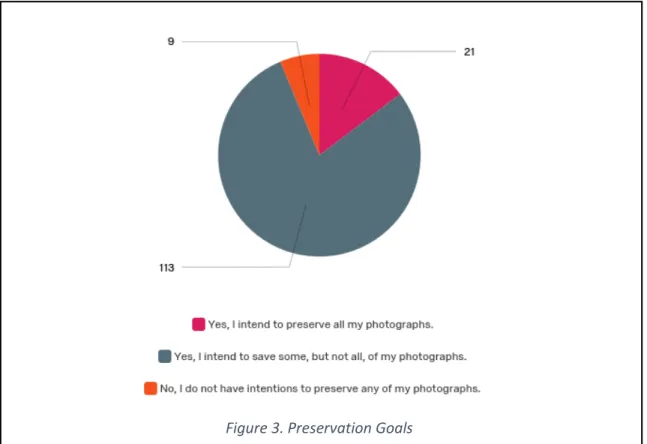
Participants were then asked whether they had an interest in long-term, multi-generational preservation of their photographs. Of the 142 responses to this question, 21 indicated that they intended to preserve all (100%) of their digital photographic
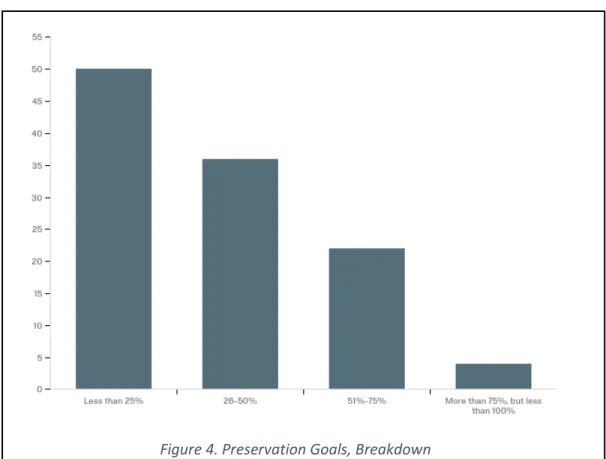
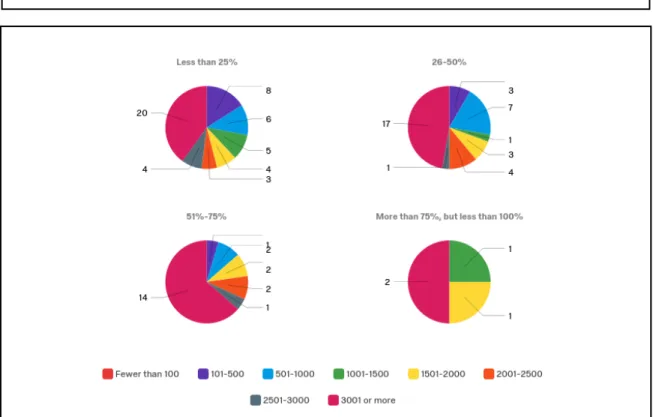
varying percentages of their collection they believed they would want to preserve long-term. Fifty participants (44.64%) indicated that they would preserve less than 25% of their current collection, thirty-six participants (32.14%) indicated that they would preserve 26-50% of their current collection, twenty-two participants (19.64%) indicated they would preserve 51-75% of the current collection, and four participants (3.57%) wanted to preserve more than 75% but not nearly 100% of their current collection. Figures 3 and 4 provide visuals for these numbers.
Figure 4. Preservation Goals, Breakdown
Next, participants were presented with several options as to how they currently preserve their collections. They were instructed to choose all that apply from the following list:
• I save my photographs on a laptop or desktop computer.
• I save my photographs to a cloud.
• I save my photographs on an external hard drive.
• I copy my images onto CDs/DVDs, or I have done so with parts of my collection.
• I use a service such as Snapfish or Shutterfly to create photo books.
• I make prints of my images and organize them in a scrapbook or photo album.
• I make prints of my images and store them in a container.
• I upload my images to a social media site such as Instagram, Facebook, or Flickr.
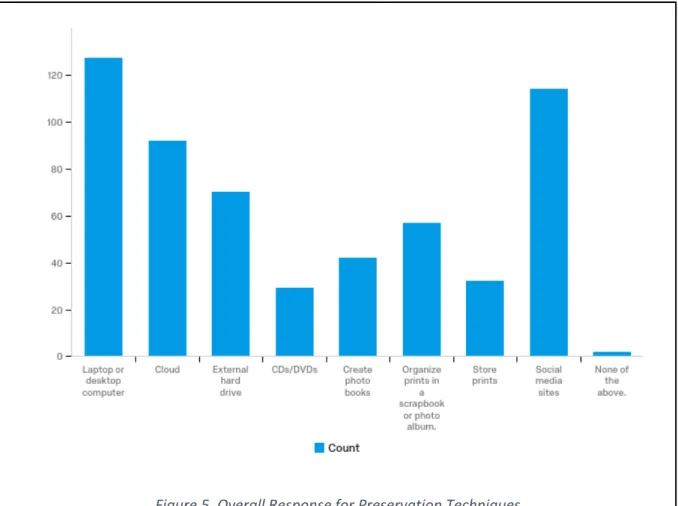
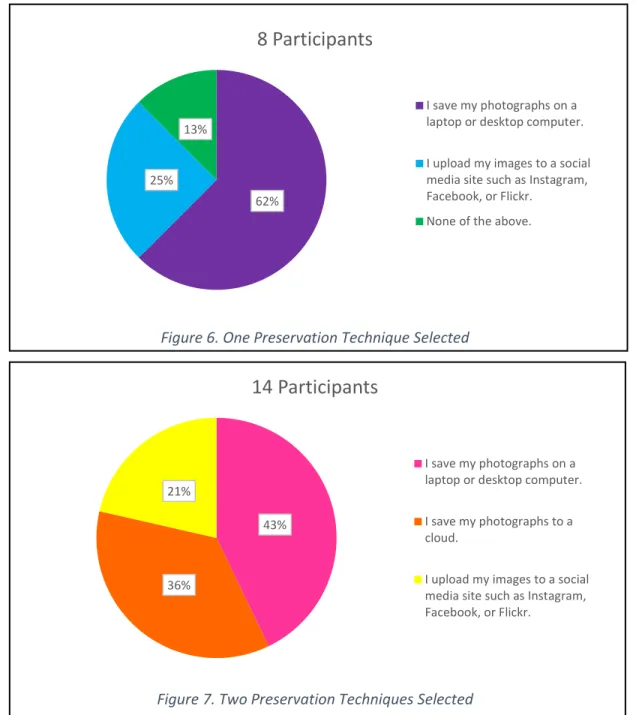
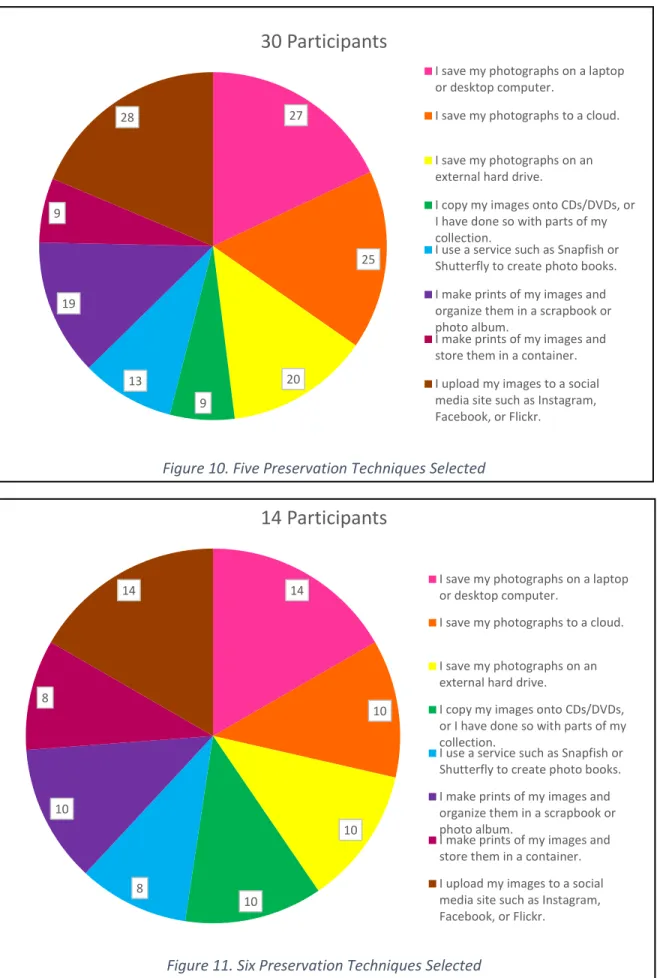
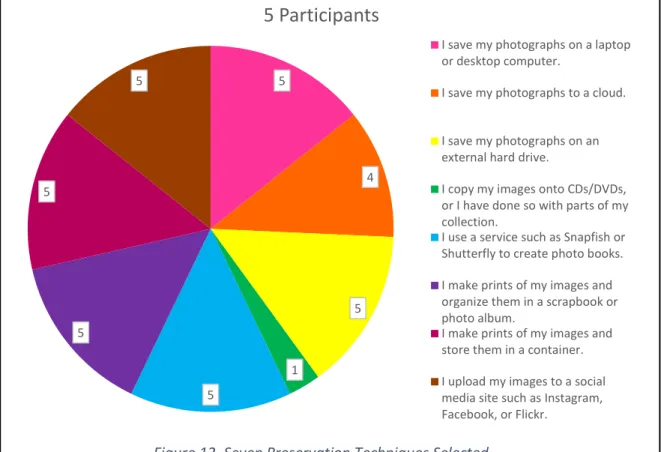
One hundred and forty-two participants provided responses for this question. The overall results are represented in Figure 5. Eight of the participants chose only one of the options (Figure 6), fourteen participants chose two options (Figure 7), thirty-six participants chose three options (Figure 8), thirty-two participants chose four options (Figure 9), thirty participants chose five of the options (Figure 10), fourteen participants chose six of the options (Figure 11), five participants chose seven options (Figure 12), and three
participants chose all eight of the options.
Figure 6. One Preservation Technique Selected
Figure 7. Two Preservation Techniques Selected 62%
25% 13%
8 Participants
I save my photographs on a laptop or desktop computer.
I upload my images to a social media site such as Instagram, Facebook, or Flickr.
None of the above.
43%
36% 21%
14 Participants
I save my photographs on a laptop or desktop computer.
I save my photographs to a cloud.
Figure 8. Three Preservation Techniques Selected
Figure 9. Four Preservation Techniques Selected 30 21 8 1 6 7 5 30
36 Participants
I save my photographs on a laptop or desktop computer.
I save my photographs to a cloud.
I save my photographs on an external hard drive.
I copy my images onto CDs/DVDs, or I have done so with parts of my collection.
I use a service such as Snapfish or Shutterfly to create photo books.
I make prints of my images and organize them in a scrapbook or photo album.
I make prints of my images and store them in a container.
I upload my images to a social media site such as Instagram, Facebook, or Flickr. 30 23 22 5 7 13 2 26
32 Participants
I save my photographs on a laptop or desktop computer.
I save my photographs to a cloud.
I save my photographs on an external hard drive.
I copy my images onto CDs/DVDs, or I have done so with parts of my collection.
I use a service such as Snapfish or Shutterfly to create photo books. I make prints of my images and organize them in a scrapbook or photo album.
Figure 10. Five Preservation Techniques Selected
Figure 11. Six Preservation Techniques Selected 27 25 20 9 13 19 9 28
30 Participants
I save my photographs on a laptop or desktop computer.
I save my photographs to a cloud.
I save my photographs on an external hard drive.
I copy my images onto CDs/DVDs, or I have done so with parts of my collection.
I use a service such as Snapfish or Shutterfly to create photo books. I make prints of my images and organize them in a scrapbook or photo album.
I make prints of my images and store them in a container. I upload my images to a social media site such as Instagram, Facebook, or Flickr.
14 10 10 10 8 10 8 14
14 Participants
I save my photographs on a laptop or desktop computer.
I save my photographs to a cloud.
I save my photographs on an external hard drive.
I copy my images onto CDs/DVDs, or I have done so with parts of my collection.
I use a service such as Snapfish or Shutterfly to create photo books. I make prints of my images and organize them in a scrapbook or photo album.
Figure 12. Seven Preservation Techniques Selected
The survey then instructed the participant to indicate the importance of saving the original image defined as an image free of filters and manipulations. Of the 141
responses for this question, thirty-four participants selected “extremely important,” forty participants selected “very important,” forty-five participants selected “moderately important,” nineteen participants selected “slightly important,” and three participants selected “not important at all.” I included this question to determine whether the original image retains its importance after manipulations are applied through various programs and applications. Multiple copies of the same image with slight differences may hinder storage capabilities, and determining the importance of the original image is important for making appraisal decisions for both the creator and the archivist.
5 4 5 1 5 5 5 5
5 Participants
I save my photographs on a laptop or desktop computer.
I save my photographs to a cloud.
I save my photographs on an external hard drive.
I copy my images onto CDs/DVDs, or I have done so with parts of my collection.
I use a service such as Snapfish or Shutterfly to create photo books.
I make prints of my images and organize them in a scrapbook or photo album.
I make prints of my images and store them in a container.
Lastly, participants were asked to rate their confidence in their current
preservation practices. Using five degrees of confidence, which included “extremely confident, “somewhat confident,” “neither confident nor insecure,” “somewhat insecure,” and “extremely insecure,” participants selected the most appropriate level for their
collections. Of the 141 responses received for this question, thirteen participants responded that they were “extremely confident,” fifty-four participants responded that they were “somewhat confident,” thirty-eight participants responded that they were “neither confident nor insecure,” thirty participants responded that they were “somewhat insecure,” and six participants responded that they were “extremely insecure.” I included this question in the survey to gauge how the participants felt about their current actions with their photographic collections. After reviewing the other questions about the size of the collections and the various preservation techniques, my hope is that some may
Analysis
The purpose of this study was to determine the millennial generation’s long-term preservation techniques for their personal digital photographic collections in order to provide insight into the collections archives will receive in the future. The population sample for this study was evenly distributed across the selected age range, with seventy-two participants younger than 28 (the median age), and seventy-seventy-two participants older than 28, plus the seven participants that were 28 at the time of the survey. This even distribution of ages signifies an appropriate representative sample of the Millennial Generation.
Figure 13. Size of Personal Collections and the Number of Images for Long-Term Preservation
The top three ways that these participants are preserving their collections are by saving them on a laptop or desktop computer, uploading them to social media sites, and uploading them into the cloud. Between these three techniques, individuals are able to amass very large and diverse collections that differ greatly from place to place. Preserving the original image, free of filters and manipulations is important to these individuals, and it is important to note that images free of manipulations and filters may be images that are most often preserved on the original device or cloud, while those with manipulations and filters are often uploaded to social media sites. Further exploration of this topic would be needed to verify this theory.
Most participants were somewhat confident about their preservation techniques, with 67 participants choosing either “extremely confident” or “somewhat confident,” 38 participants identifying as neutral, and only 36 participants choosing “somewhat
insecure” or “extremely insecure.” Those participants that identified as confident,
engaged with more (3-5) preservation techniques, while those that identified as extremely insecure engaged with only 1-3 preservation techniques. This does provide some
Discussion
Based on the data from this study, archivists should expect large collections of digital photographs from the Millennial Generation. These collections may include images from a number of different storage mediums, resulting in a high rate of duplicates as individuals seek to create robust backups of their collections. Social media accounts may also contain images an individual would want to include in their personal collection. Many of these collections will continue to include analog prints, which could be
organized in photographic albums or scrapbooks or loosely held in containers. The ease of creating a bound photographic book, similar to a yearbook, will increase the likelihood that these bound books will also be incorporated into a personal collection. All of these factors show that photographic collections of the future will be more varied than those archives receive today, including the known mediums in which images are received and those that would be considered nontraditional, such as social media.
The importance of creating multiple backups of digital data creates an opportunity for archivists to reach out to communities by offering personal digital archiving
workshops and classes aimed at spreading knowledge about proper preservation
preserving digital data, particularly photographs. Informing the public about the threat of these services disappearing at some point in the future, may encourage better preservation practices of personal collections. While uploading images to a social media site or other web-based program is great for sharing with friends and family, photographs of
children’s first steps, weddings, and other major life moments could be lost without proper backup.
Further Research
The research conducted for this study is best categorized as exploratory, and there are several opportunities for conducting further research. First, the sample population represents a very miniscule portion of the Millennial Generation. The participants for this study are all students or employees at the University of North Carolina at Chapel Hill. This representative sample does not include those outside the academic realm, which would include Millennials that never attended college and went straight into the workforce and those who have careers outside of UNC-CH. These individuals could offer a better representation of the general Millennial population.
As I obtained the data for this study through an electronic survey distributed through email, opportunities exist to acquire more in-depth information from participants. One potential avenue for gaining more information from participants would be
conducting follow-up interviews with a portion of the survey participants. This would allow the researcher to ask specific questions about each of the preservation techniques used by the participants, and to what degree the participant depended on those to save photographic images. This would also allow participants the opportunity to voice
opinions about photographic preservation that otherwise remain absent from responses to a simple survey.
Conclusion
Appendix A.
Photographic Preservation Techniques of the Millennial Generation
Preface You are invited to take part in a research survey about the preservation of your personal photographic collection. Your participation will require approximately 10 minutes and is completed online. There are no known risks or discomforts associated with this survey. In gratitude for your participation, two participants will be chosen at random to receive a $15 Visa Gift Card at the end of the survey period. Taking part in this study is completely voluntary. If you choose to be in the study you can withdraw at any time without negative consequences. Your responses will be kept strictly
confidential, and digital data will be stored in secure computer files. Any report of this research that is made available to the public will not include your name or any other individual information by which you could be identified. If you have questions or want a copy or summary of this study’s results, you can contact the researcher at
I understand.
Q1 Please select your age
1 7 1 8 1 9 2 0 2 1 2 2 2 3 2 4 2 5 2 6 2 7 2 8 2 9 3 0 3 1 3 2 3 3 3 4 3 5 3 6 3 7 3 8 3 9 4 0 A g e:
Q1 Do you take digital photographs?
Yes
Q2 Approximately how many photographs do you have saved? Please consider images stored on all various devices and cloud storage.
Fewer than 100
101-500
501-1000
1001-1500
1501-2000
2001-2500
2501-3000
3001 or more
Q3 Do you have an interest in multi-generational, long-term preservation of your photographs?
Yes, I intend to preserve all my photographs.
Yes, I intend to save some, but not all, of my photographs.
No, I do not have intentions to preserve any of my photographs.
Q3a Roughly speaking, which percentage of your saved photographs do you think would be candidates for long-term preservation?
Less than 25%
26-50%
51%-75%
More than 75%, but less than 100%
Q4 Do you use any of the following preservation techniques: (choose all that apply)
I save my photographs on a laptop or desktop computer.
I save my photographs to a cloud.
I save my photographs on an external hard drive.
I copy my images onto CDs/DVDs, or I have done so with parts of my collection.
I use a service such as Snapfish or Shutterfly to create photo books.
I make prints of my images and organize them in a scrapbook or photo album.
I make prints of my images and store them in a container.
I upload my images to a social media site such as Instagram, Facebook, or Flickr.
None of the above.
Q5 Please choose an option below to indicate the importance of preserving the original image (an image free of filters and manipulations):
Extremely important
Very important
Moderately important
Slightly important
Q6 How confident are you with your current preservation practices?
Extremely confident
Somewhat confident
Neither confident nor insecure
Somewhat insecure
Bibliography
Bushey, Jessica. “Convergence, Connectivity, Ephemeral and Performed: New Characteristics of Digital Photographs.” Archives and Manuscripts 42, no. 1 (January 2, 2014): 33–47. doi:10.1080/01576895.2014.881262.
Howe, Neil, and Bill Strauss. Millennials Rising: The Next Generation. New York: Vintage Books, 2000.
Jones, William P., and Jaime Teevan, eds. Personal Information Management. Seattle: University of Washington Press, 2007.
Keough, Brian, and Mark Wolfe. “Moving the Archivist Closer to the Creator: Implementing Integrated Archival Policies for Born Digital Photography at Colleges and Universities.” Journal of Archival Organization 10, no. 1 (January 2012): 69–83. doi:10.1080/15332748.2012.681266.
Lee, Christopher A., and Robert Capra. “And Now the Twain Shall Meet: Exploring the Connections between PIM and Archives.” In I, Digital, edited by Christopher A. Lee, 29–77. Chicago: Society of American Archivists, 2011.
Lush, Antoinette. “Fundamental Personal Information Management Activities – Organisation, Finding and Keeping: A Literature Review.” The Australian Library Journal 63, no. 1 (January 2, 2014): 45–51.
doi:10.1080/00049670.2013.875452.
Marshall, Catherine. “Challenges and Opportunities for Personal Digital Archiving.” In I, Digital, edited by Christopher A. Lee, 90–114. Chicago: Society of American Archivists, 2011.
National Digital Information Infrastructure and Preservation Program (U.S.).
Perspectives on Personal Digital Archiving. Washington D.C.: National Digital Information Infrastructure and Preservation Program, Library of Congress, 2013. http://purl.fdlp.gov/GPO/gpo35595.
Redwine, Gabriela, and Neil Beagrie. “Personal Digital Archiving.” Digital Preservation Coalition, December 14, 2015.
http://www.dpconline.org/component/docman/doc_download/1460-twr15-01. Ritzenthaler, Mary Lynn, Diane Vogt-O’Connor, Helena Zinkham, Brett Carnell, and Kit
Peterson. Photographs: Archival Care and Management. 2nd ed. Chicago: Society of American Archivists, n.d.
Schwartz, Joan M. “Negotiating the Visual Turn: New Perspectives on Images and Archives.” The American Archivist 67, no. 1 (2004): 107–22.
Simonson, Karen Rae. “Becoming Digital the Challenges of Archiving Digital
Photographs.” Library and Archives Canada = Bibliothèque et Archives Canada, 2007.
Simonson, Michael. “Millennials-Oh Really?” Distance Learning 7, no. 2 (2010): 2. Solomon, Rebecca. “Personal Digital Photograph Management and the Impact of Social
Media.” Master’s Paper, University of North Carolina, 2015. “Start Here | dpBestflow.” Accessed October 8, 2016.
http://www.dpbestflow.org/node/633.
The New Strategist Editors, ed. The Millennials : Americans Born 1977 to 1994. 6th ed.
The American Generation Series. Amityville, New York: New Strategist Press, LLC, 2015.
Tkalac Verčič, Ana, and Dejan Verčič. “Digital Natives and Social Media.” Public