Edward J Moss. Toward the Next Generation: A Comparison of Next Generation Library Catalog Implementations. A Master’s Paper for the M.S. in I.S degree. April, 2012. 33 pages. Advisor: Lew Hassell.
Traditional Online Public Access Catalogs (OPACs) are no longer satisfying information seekers who have grown accustomed to features commonly available in Internet search engines. As a result, modern libraries are looking to next generation catalogs to replace or supplement the existing OPAC. This paper will examine common shortcomings of traditional OPACs, explore advantages offered by next generation catalogs, and, through examination of log data furnished by the TRLN, examine two implementations of the next generation catalog software Endeca at two similar research institutions.
Headings:
Academic libraries -- Statistics
Library catalogs -- Evaluation
IMPLEMENTATIONS
by Edward J Moss
A Master’s paper submitted to the faculty of the School of Information and Library Science of the University of North Carolina at Chapel Hill
in partial fulfillment of the requirements for the degree of Master of Science in
Information Science.
Chapel Hill, North Carolina
April 2012
Approved by
_______________________________________
Introduction
Researchers and other library patrons are rapidly adopting new information
seeking strategies that are largely self-service and removed from physical library
facilities. Between 2007 and 2008, 81 percent of University of Nebraska-Lincoln (UNL)
library catalog searches were conducted outside of a library compared to only 57 percent
in 2002-2003 (Allison, 2010, p.376). This rapid shift toward search independence is,
naturally, owed directly to the growth of Internet access among researchers and library
patrons. While liberated from the confines of a library, searchers are now also further
removed from assistance that could be provided by trained library professionals.
Consequently, traditional online public access catalogs (OPACs) that require knowledge
of specific search techniques are becoming increasingly unpopular and have been
“bombarded with criticism.” (Mi & Weng, 2008, p.5)
The ubiquitous influence of online search providers such as Google has caused
users to largely abandon the search strategies required to operate the traditional OPACs
employed by many libraries. To account for the changing habits and needs of catalog
users, many libraries are now employing next generation catalogs designed to enhance
the searching experience. Developed specifically to increase functionality of library
catalogs, these next generation catalogs emulate the keyword-based and relevancy-ranked
search options commonly found on the Internet. These “next generation catalogs have
enough to be effective in the Age of Google.” (Ballard, 2010, p.272) With intuitive
interfaces and now familiar arrangements of search results, this new wave of catalogs is
allowing libraries to reclaim some patron interest and provide a more complete and
successful search experience.
These catalogs have assumed the role of gateways to a library’s collection and
“guide library users to the appropriate resources that return relevant answers to research
questions.” (Caswell & Wynstra, 2010, p.391) Several commercial vendors now provide
these enhanced catalog options and each is highly customizable to suit the preferences of
the library staff. It should be noted, however, that the performance of a next generation
catalog is closely linked to its configuration by library staff and that the addition of too
many features could lead to a decrease in catalog performance and user satisfaction.
Brown-Sica, Beall, and McHale point out that;
An eye-catching interface and valuable content are lost on the end user if he or she moves on before a search is completed. Added functionality and features in library search tools are valuable, but there is a tipping point when these features slow down a product's response time to where users find the search tool too slow or unreliable. (Brown-Sica, Beall, & McHale, 2010, p.222)
Balancing the features and functionality of a next generation catalog with basic retrieval
performance is a fundamental requirement of implementation and cannot be overlooked.
However, library staff must not overcompensate and remove all features leaving bland
“interfaces that are too basic to be useful when drill-down is needed for large result sets.”
(Allison, 2010, p.377)
The University of North Carolina at Chapel Hill (UNC-CH) and North Carolina
State University (NCSU) have each implemented the Endeca Information Access
Library Network (TRLN), UNC-CH and NCSU enjoy an institutional collaboration that
enables greater cooperation than might otherwise exist between major research
universities. As a result, UNC-CH and NCSU libraries share the server infrastructure
required to manage the Endeca platform while maintaining separate catalogs that reflect
their unique research interests. This sharing of resources between similar institutions
affords the unique opportunity to compare catalog performance while keeping a number
of variables constant, thus allowing a more direct comparison of factors that might
potentially degrade catalog performance.
The TRLN has graciously provided Endeca log data for both universities that will
be examined to determine the variability of performance and scalability of this particular
Literature Review
With the growth and development of the Internet, libraries have been given the
opportunity to increase access to their library catalogs through the use of Online Public
Access Catalogs. These catalogs allow researchers and library patrons to view the library
catalog from outside the confines of the library and conduct research wherever is
considered most convenient. As put by DeeAnn Allison in 2010, “research activity is
taking place wherever the researcher is located – wherever they can find a network
connection.” (p.376) Allison goes on to cite figures from the University of
Nebraska-Lincoln (UNL) which show a nearly 50% increase in remote catalog access from 2003 to
2008 (p.376). Online access has been extremely popular amongst users and “the online
catalog has been embraced by both librarians and library patrons.” (Larson, McDonough,
O’Leary, Kuntz, & Moon, 1996, p.555).
Years of innovation and development in Internet based search has resulted in
traditional OPACs being left behind. Traditional OPACs are lacking in a number of
features now commonly found in Internet search providers which have come to be
expected by researchers and other users. As described by Sharon Yang and Kurt
Wagner;
commonplace at commercial sites such as Amazon. (Yang & Wagner, 2010, p.691)
Decades of neglect have seen the traditional OPAC losing support as users shift to
Internet search engines such as Google and Bing. These Internet resources are greatly
preferred by young information seekers in particular due to a perceived simplicity in use
and access compared to OPACs (Kani-Zabihi, Ghinea, & Chen, 2008, p.492). Part of the
problem stems from an effective yet antiquated method of search required to utilize the
OPAC. As described by Jia Mi and Cathy Weng;
The basis of current OPAC search systems is Boolean logic. The ease of using Google-like search engines comes from its implicit "AND" feature, which
eliminates the need to enter Boolean connectors (AND,OR,NOT) between search terms. This is logical because users usually look for records that contain all of the terms they enter. (Mi & Weng, 2008, p.5)
The inclusion of implicit operators, compared with the OPACs explicit Boolean logic,
allows for more natural language based queries and does not require knowledge of a
specialized search language. Required knowledge of a search language “is a significant
problem in the case of online library catalogs, which are used by untrained searchers.”
(Buckland, 1992). Successful use of Internet search providers, on the other hand, does
not require the user to take information literacy classes in order to correctly word their
search (Mi & Weng, 2008, p.5). This question of accessibility in terms of usability is an
extremely important one and is not adequately satisfied by traditional OPACs.
Another shortcoming of traditional OPACs is the method with which results are
ranked for the user. Traditional OPACs commonly make use of a “last out, first shown”
technique that displays results in the reverse order that they were pulled from the library
toward potential relevancy to the user and requires a thorough examination of each
retrieved result before determining whether the search has been satisfied. One basic
expectation for a web-based interface today is the inclusion of relevancy ranking of
search results (Breeding, 2007, p.43). According to Jia Mi and Cathy Weng, “presenting
the most relevant results at the top of the results page is crucial because it enhances
library resource discovery and access.” (2008, p.8) This method of ranking is extremely
commonplace in Internet search providers and allows a user to quickly determine whether
the information need has been satisfied or if the search needs to be refined. While some
OPACs have been updated to rank search results “based on the frequency and positions
of terms in bibliographical records during keyword searches, relevancy has not worked
well in OPACs.” (Yang and Hoffman, 2010, p.143) This inadequacy of ranking in
OPACs compared to Internet search providers is a common problem that is likely
contributing to the overall decline of OPAC popularity.
A further weakness of traditional OPACs is the lack of system correction or
browsing capabilities. To perform an authoritative search one is expected to know
specific details from an items record such as author, title, or record number. If a user
makes some error in entering the information no effort us made by the system to correct it
– the search is performed “as is.” Additionally, no technique exists for refining a search
once it is underway and the user is forced to perform a completely new search if they
discover a specific thread that interests them. Internet search providers have long offered
spelling correction and alternative suggestions (Yang & Hofmann, 2010, 143).
Furthermore, Internet search providers sometimes employ faceted search options that
“Faceted browsing works to reduce the information overload caused by the return of too
many hits.” (Ballard & Blaine, 2010, p.264) This means of refining search on-the-fly can
aid in browsing behavior among researchers and patrons. “With more books moving to
online formats and off-site storage (and therefore, unable to be browsed), enhancing
virtual browsing in the catalog becomes increasingly important.” (Antelman, 2006,
p.130) Without the means to correct minor errors, suggest alternative search topics, or
allow users to browse by means of steadily narrowing a search, traditional OPACs have
no hope of approaching the level of service provided by Internet search providers.
Faced with these issues, libraries have begun a move from traditional OPACs to
next generation catalogs better equipped to handle the needs of today’s information
seekers. Traditional OPACs were failing in the face of Internet search providers and
“despite the fact that some vendors diligently enhance their systems’ functionalities,
overall performance is still disappointing.” (Mi & Weng, 2008). Beth Camden described
in 2008 the dilemma faced by libraries;
Once considered the crowning-jewel of the integrated library system (ILS), the Online Public Access Catalog (OPAC) has lost its luster as our users have moved to Web search engines as their primary research tools. The development of next-generation catalogs (NGC) may give libraries a new chance to attract users to our resources.
Several software vendors have begun to offer next generation catalog solutions that seek
to reinvent the approach rather than repair the traditional OPACs. Offering a wide range
of options, these next generation catalog solutions all seek to resolve shortcomings of
traditional OPACs and present researchers with what they desire - an experience similar
to that of a Web search engine (Allison, 2010, p.377). Various options exist and are
These catalog solutions, such as AquaBrowser from Medialab Solutions BV, Encore
from Innovate Interfaces, Primo from Ex Libris, and the Endeca Information Access
Platform have been developed and expanded to meet the requirements of a next
generation catalog (Nagy, 2011, p.13). A 2009 OCLC study of library users enumerated
several of these requirements, determining that “direct linking to online content,
evaluative content, relevant search results, item availability, and a simple keyword search
with an available advanced guided search” were all fundamental features for a fully
functioning next generation catalog (Allison, 2010, p.377). Endeca, while not initially
thought of as a next generation catalog, has been widely adopted due to its vast
customizability, feature-rich back end, and high scalability (Nagy, 2011, p.13).
North Carolina State University (NCSU) was an early adopter of the Endeca
technology, acquiring the software in May of 2005, beginning implementation in August,
and fully deploying the new catalog in January of 2006 (Antelman, Lynema, & Pace,
2006, p.129). This process was not undertaken lightly. Early adoption of a new
technology, especially one not universally known for the purpose it is being adopted for,
can be extremely complicated but NCSU felt this was the best course given the current
state of the traditional OPAC. Antelman, Lynema, and Pace explain;
In recognition of the severity of the catalog problem, particularly in the area of keyword
searching, and seeing that Integrated Library System (ILS) vendors were not addressing
it, the North Carolina State University (NCSU) Libraries elected to replace its keyword
search engine with software developed for major commercial Web sites. The software,
Endeca's Information Access Platform (IAP), offers state-of-the-art retrieval
The retrieval technologies and customizable interface were applied as a new discovery
layer over the traditional SirsiDynix OPAC which enables “faceted browsing and
leverages the rich data in the MARC record in ways previous catalogs had not.”
(Camden, 2008, p15) The traditional OPAC search option has been kept available to
accommodate user preference, but the new deployment aroused immediate interest in
researchers and library patrons. “While authority searching using the library's old Web2
catalog is still available in the new interface, search logs show that authority searching
has decreased 45 percent and keyword searches have increased 230 percent.” (Antelman,
Lynema, & Pace, 2006, p.133) While these numbers are potentially skewed by the
adoption of Endeca as the default search option, an independent analysis of Endeca’s
performance seems to justify the increased usage. “On average, 40 percent of the top
results in Web2 were judged to be relevant, while 68 percepts of the top results in Endeca
were judged to be relevant. That represents a 70 percent better performance for the
Endeca catalog.” (Antelman, Lynema, & Pace, 2006, p.134) The simplified searching
and relevancy ranking capabilities are accompanied by a regained ability to browse.
Antelman, Lynema, and Pace explain;
Using the Endeca application, library catalogs can once again give users the ability to
browse the entire set of records without first entering a search term. Any of the
dimensions can be used to browse the collection in this fashion, and the ability to assign
item-level information (e.g., format, availability, new book), as well as
bibliographic-record elements, to the dimensions further enhances the browsing functionality.
Endeca’s deployment has resolved many of the issues facing traditional OPACs and has
been widely accepted by researchers and library patrons.
Other libraries and consortia have since adopted the Endeca Information Access
Platform based upon NCSU’s success. The Triangle Research Libraries Network
(TRLN), a collaborative enterprise between NCSU, the University of North Carolina at
Chapel Hill (UNC-CH), Duke University, and North Carolina Central University
(NCCU) libraries, received a license for Endeca IAP and, in 2008, “Search TRLN” was
launched to provide faceted searching and browsing, request functionality, and enhanced
content for shared resources between members of the Network. (Antelman & Couts,
2009, p.230). UNC-CH followed with its own implementation and, due to the close
relationship with NCSU through the TRLN, has arranged a shared server infrastructure
that serves as a discovery layer for both universities’ library catalogs. The efforts made
by NCSU in the development of a gateway has proved invaluable for the TRLN and has
“resulted in greater control over the way resources are presented to the user community.”
(Caswell & Wynstra, 2010, p.400)
System Description and Log Details
North Carolina State University (NCSU) and the University of North Carolina at
Chapel Hill (UNC-CH) are both part of North Carolina University System and are
considered major research institutions. Both library systems are members are the
Triangle Research Library Network (TRLN) and have enjoyed a collaborative partnership
since the Network’s founding in the 1930s. Both library systems use the Endeca
Information Access Platform as a discovery layer atop their traditional OPAC and house
the Endeca servers required for back end configuration and management at Wilson
Library on UNC-CH campus. The large number of similarities between these
universities allows an interesting comparison of their individual Endeca configurations to
be conducted, though several differences do exist.
NCSU’s Endeca implementation has been deployed since 2006, a full two years
longer than UNC’s implementation and, as a result, has had more opportunity for
adjustment from default configuration and customization. Additionally, NCSU’s library
catalog is composed of 4.5 million records (including 4 million physical volumes) while
UNC’s library catalog holds over 15 million records (excluding 25 million manuscripts).
This wide disparity in number of searchable records will provide a basis for examining
The TRLN generally maintains Endeca transaction logs for 8 weeks before
discarding them and has graciously furnished the NCSU and UNC Endeca log data
between February 20th, 2012 and April 9th, 2012 which is analyzed below. The NCSU log file contained data on approximately 3.4 million individual transactions and the UNC
log on approximately 2.5 million individual transactions. The Endeca log files appear in
a proprietary format and contain what could be considered personal patron information in
the form of search query strings. In the interest of protecting Endeca’s log format and the
privacy of library patrons the logs have been reduced to only two fields – total processing
time (milliseconds) and number of results. The total processing time field displays the
total computational time required for the Endeca server to handle the request, excluding
network and queue time. The number of results field displays the number of results
retrieved by the individual query.
To simplify the analysis of the data and in response to several software limitations
raised by such large datasets these log files have been reduced to the first 1 million listed
transactions. Through exploration of the data the log files have been further reduced in
size and manipulated in various ways outlined in the description of results.
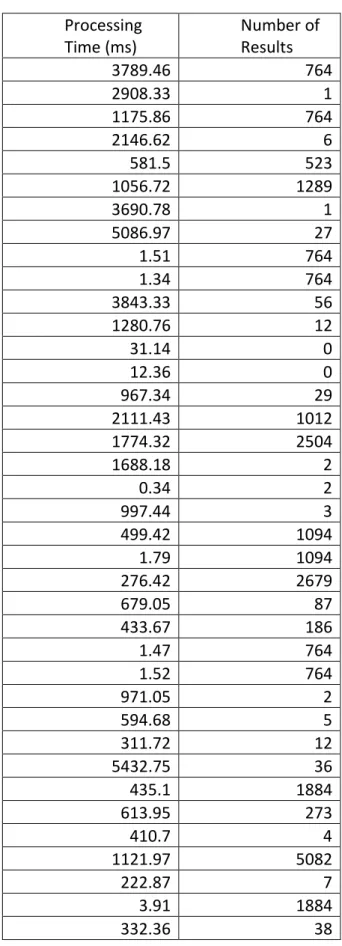
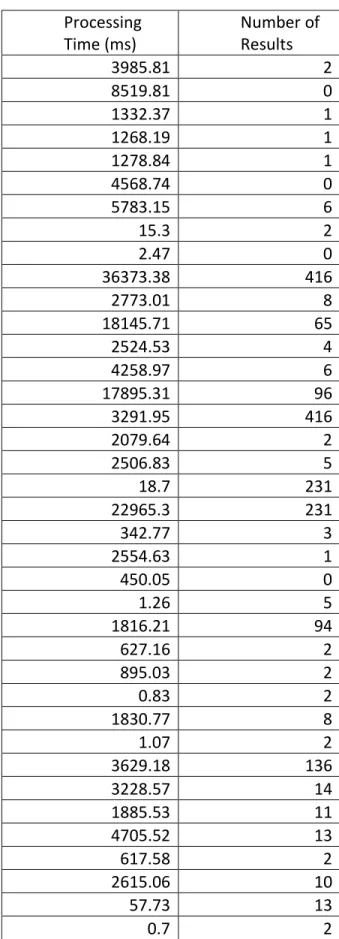
An excerpt of the first 38 log file entries from each university can be viewed in
Table 1 – UNC
Processing Time (ms)
Number of Results
3789.46 764
2908.33 1
1175.86 764
2146.62 6
581.5 523
1056.72 1289
3690.78 1
5086.97 27
1.51 764
1.34 764
3843.33 56
1280.76 12
31.14 0
12.36 0
967.34 29
2111.43 1012
1774.32 2504
1688.18 2
0.34 2
997.44 3
499.42 1094
1.79 1094
276.42 2679
679.05 87
433.67 186
1.47 764
1.52 764
971.05 2
594.68 5
311.72 12
5432.75 36
435.1 1884
613.95 273
410.7 4
1121.97 5082
222.87 7
3.91 1884
Table 2 - NCSU
Processing Time (ms)
Number of Results
3985.81 2
8519.81 0
1332.37 1
1268.19 1
1278.84 1
4568.74 0
5783.15 6
15.3 2
2.47 0
36373.38 416
2773.01 8
18145.71 65
2524.53 4
4258.97 6
17895.31 96
3291.95 416
2079.64 2
2506.83 5
18.7 231
22965.3 231
342.77 3
2554.63 1
450.05 0
1.26 5
1816.21 94
627.16 2
895.03 2
0.83 2
1830.77 8
1.07 2
3629.18 136
3228.57 14
1885.53 11
4705.52 13
617.58 2
2615.06 10
57.73 13
Analysis of Results
The over 5.5 million individual transactions reported in the NCSU and UNC-CH
logs were far too much for basic computer hardware and statistical software available to
analyze the data. To compensate, the initial 1 million results were pulled from each log
file and entered into Microsoft Excel for initial analysis. Assuming queries were entered
at a stable rate, these 1 million transaction records represent approximately 3 weeks of
activity at UNC-CH and 2 weeks of activity at NCSU. Due to the size of the dataset it
has been determined that these slight differences in time representation pose no problems
for analysis.
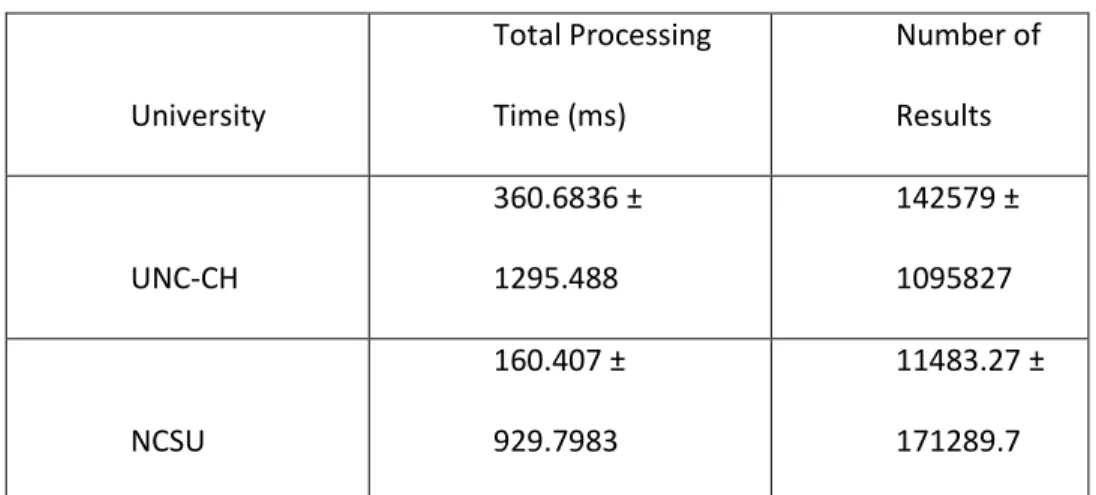
The basic computations of mean and standard deviation, calculated by Microsoft
Excel, are shown in Table 1.
Analyzing the 1 million initial results from each university’s log file for mean and
standard deviation immediately reveals a great deal of variability. The standard deviation
for each figure is extremely large and results in each mean value being within
comfortable range of one another. Nevertheless, it is also shown that the mean total
processing time for UNC-CH is slightly more than double that of NCSU and the mean
number of results for UNC-CH is 10 times larger than that of NCSU.
The 1 million initial log entries analyzed for each school was further reduced to
the initial 500 thousand log entries for each university. This reduction allowed the use of
Prism statistical analysis and visualization software developed by GraphPad. The 500
thousand log entries for each school were ordered by number of results, the zero results
were discarded, the remainder grouped by 100 (100 consecutive log entries were
averaged to comprise 1 data point), and the results were mapped in a log-scale scatterplot
Figure 1
It appears from this visualization that the processing time for NCSU increases
with the number of results while UNC’s processing time actually decreases as the number
of results increases. A number of points representing greater processing time and larger
A bar graph displaying the number of queries yielding different ranges of number
of results for each university (Figure 2) further corroborates the mean values shown in
Figure 2 clearly shows a long tail of greater number of results in UNC-CH’s log files that
accounts for the substantially higher mean number of results seen in Table 1.
Additionally, NCSU sees a substantially drop between the 10-100 results range and the
100-1000 results range that is not seen in UNC’s log file. Furthermore, NCSU displays a
near zero number of queries resulting in a range higher than 1000-10000 results.
Comparing these ranges of number of results to processing time begins to
Here the trends initially observed in Figure 1 become somewhat clearer – processing time
for NCSU increases as the number of results increase while processing time for UNC-CH
decreases as the number of results increases. While NCSU’s processing time appears
substantially higher than UNC-CH’s in higher ranges of numbers of results it is important
to note that NCSU had relatively few queries falling within these numbers of results
ranges.
Breaking the 0-10 number of results bar down into its composite result count
reveals the trend first seen in Figure 1 more clearly. Figure 4 below reproduces the data
seen in Figure 3 but divides the 0-10 range into the composite result count and displays
A two-way ANOVA was calculated using the values shown in Figure 3 –
University represents the column variable and number of results (grouped into ranges)
represents the row variable. The graph shows significance at the p < 0.001 level for
UNC’s processing time being slower than NCSU for the first three results ranges, no
significant difference for the 1000-10000 number of results range, and a faster processing
time for UNC-CH in the final two ranges. The results are unchanged after undergoing
both Sidak and Bonferroni corrections and a statistically significant interaction has been
Figure 5
An asterisk (*) is positioned above those columns in which UNC-CH’s processing time
which UNC-CH’s processing time was found significantly faster. These graphs are
overlaid in Figure 6.
Figure 6
It is unclear what has caused such a pronounced interaction to appear. The information
provided in Table 1 indicates that UNC-CH is more prone to provide high numbers of
results, indicating a retrieval model and index that favors high recall. If this is the case,
UNC-CH may be attempting to compensate for their large catalog by rapidly presenting
information seekers with a large number of results. Similarly, NCSU may favor
precision due to greater frequency of specific queries yielding relatively few results.
With query strings removed to preserve patron anonymity and without targeted relevancy
Conclusion and Future Research
Online access to library catalogs has become a fundamental aspect of library
catalog management. Information seekers are increasingly conducting searches remotely
and require an intuitive and effective interface through which to browse a library’s
catalog. Internet users have grown accustomed to options widely available on Web
search providers that have limited to no implementation on traditional library Online
Public Access Catalogs (OPACs). Libraries require an alternative to these traditional
OPACs that presents search functionality that rivals that of Internet search engines.
Specifically; speed, relevancy ranking, natural-language keyword searching, and faceted
browsing,
One option that has been deployed at several university libraries is the Endeca
Information Access Platform. Endeca has been demonstrated to be superior to traditional
OPACs in nearly every aspect and provides information seekers with a number of search
features not otherwise available. It has proven to be fast, effective, and scalable to
catalogs of differing sizes.
An examination of Endeca log data graciously provided by Derek Rodriguez and
the Triangle Research Library Network (TRLN) reveals that even catalogs of widely
differing sizes can be configured to deliver hundreds of thousands of results in mere
be customized to favor either relative large or small numbers of results while not having a
pronounced negative impact on the alternative.
Further research is required to fully utilize the results gathered from the provided
log data. One possible avenue is query-string evaluation to determine why the observed
interaction between UNC-CH and NCSU occurred when comparing server processing
time and range of number of results. Another possible avenue is measuring perceived
relevancy of retrieved results when the result is large and small to determine if server
processing time decreases as the perceived relevancy of retrieved results goes down.
Finally, the most logical area of future research could center on the configurations for
UNC-CH and NCSU’s individual deployments of Endeca. Exploration into these areas
could potentially compromise personal information or proprietary aspects of the Endeca
system and appropriate permission would need to be collected.
Endeca is but one option for libraries considering a next generation catalog
solution to replace or supplement their existing OPAC – careful planning and
consideration must be paid to the needs of the information seekers as well as the
References
Allison, D. (2010). Information Portals: The Next Generation Catalog. Journal of Web Librarianship, 4(4), 375-389.
Antelman, K., Lynema, E., & Pace, A. (2006). Toward a Twenty-First Century Library
Catalog. Information Technology and Libraries, 25(3), 128-139.
Antelman, K. & Couts, M. (2009). Embracing Ambiguity…or not: What the Triangle
Research Libraries Network learned about collaboration. Coll Res Libr News, 70(4), 230-233.
Ballard, T. & Blaine, A. (2010). User search-limiting behavior in online catalogs:
Comparing classic catalog use to search behavior in next-generation catalogs. New
Library World, 112(5/6), 261-273.
Breeding, M. (2007). Recasting Library Catalogs: New library interfaces take the stage.
Brown-Sica, M., Beall, J., & McHale, N. (2010). Next-Generation Library Catalogs and
the Problem of Slow Response Time. Information Technology and Libraries, 12,
214-223.
Buckland, M. (1992). Agenda for Online Catalog Designers. Information Technology and Libraries, 6, 157-162.
Camden, B. (2008). OPAC – Going, Going, Gone!. Technicalities, 28(5), 15-17.
Caswell, J. & Wynstra, J. (2010), Improving the search experience: federated search and
the library gateway. Library Hi Tech, 28(3), 391-401.
Kani-Zabihi, E., Ghinea, G., & Chen, S. (2008). User perceptions of online public library
catalogues. International Journal of Information Management, 28, 492-502.
Larson, R., McDonough, J., O’Leary, P., & Kuntz, L. (1996). Cheshire II: Designing a
Next-Generation Online Catalog. Journal of the American Society for Information
Science, 47(7), 555-567.
Mi, J., & Weng, C. (2008). Revitalizing the Library OPAC: Interface, Searching, and
Nagy, A. (2011). Defining the Next-Generation Catalog. Analyzing the Next-Generation Catalog, 10, 11-15.
Nagy, A. (2011). The Impact of the Next-Generation Catalog. Analyzing the
Next-Generation Catalog, 10, 18-20.
Parry, M. (2010). After Losing Users in Catalogs, Libraries Find Better Search Software.
The Education Digest, 2, 54-57.
Yang, S. & Hofmann, S. (2010). The Next Generation Library Catalog: A Comparative
Study of the OPACs of Koha, Evergreen, and Voyager. Information Technology and Libraries, 9, 141-150.
Yang, S. & Wagner, K. (2010). Evaluating and comparing discovery tools: how close are