Mary K Barnes. A Case Study of the Digital Library of Georgia and Inter-organizational Collaboration. A Master’s Paper for the M.S. in L.S degree. July, 2008. 40 pages.
Advisor: Deborah Barreau
The Digital Library of Georgia (DLG) serves as a model of inter-organizational and cross-departmental collaboration. This paper will highlight resources involved, problems faced with collaborating, and different types of projects created with respect to
collaboration. Holding no actual physical assets or artifacts of their own, the DLG is able to use assets belonging to the University of System of Georgia, the Public Library System of Georgia, and smaller historical societies, in order to provide information to middle and high school students, researchers, and life-long learners, as well as to help and assist smaller institutions (and larger departments of the University of Georgia) digitize and provide sustainable resources.
Headings:
Collaboration--Academic-industrial
Communities of Practice
Digital libraries
ORGANIZATIONAL COLLABORATION
by Mary K. Barnes
A Master’s paper submitted to the faculty of the School of Information and Library Science of the University of North Carolina at Chapel Hill
in partial fulfillment of the requirements for the degree of Master of Science in
Library Science.
Chapel Hill, North Carolina July 2008
Approved by
Table of Contents
Introduction...3
Literature Review...4
Partners Involved in Collaboration...5
Collaborative Digital Projects...8
Targeted Audiences of Collections...8
Collection Funding………....……..9
Problems That Arise from Collaboration...10
Summary………12
Research Study...13
Research Methodology...13
Results...14
The Questionnaire………..……14
The Interviews………....………..…….16
Partners Involved in Collaboration……….………….……..17
Collaborative Digital Projects………..…….18
Collection Audiences...20
Collection Funding……….21
Problems That Arise from Collaboration...……….22
Software and Hardware Used in Collaboration...24
Future and Long-term Goals for Collaboration………...……….25
Summary…...……….…………26
Bibliography……….…….28
Appendices……….……...30
Appendix I (Library Manager Interview Questions) Appendix II (Questionnaire) Appendix III (Letter of Consent for Interview) Appendix IV (Letter of Consent for Questionnaire) Table of Illustrations Figure One: Involvement In Digital Library Projects...………15
Figure Two: Efficiency in Collaboration…...………...………..16
Introduction
The Digital Library of Georgia, http://dlg.galileo.usg.edu/?Welcome&Welcome, located on the fourth floor of the University of Georgia’s Main Library, creates,
maintains, and manages digital projects related to Georgia and the research needs of the University. The DLG collaborates regularly with other institutions in the state of Georgia and shares metadata on a national scale. The targeted audiences of the DLG’s projects vary, ranging from K-12 students to Post Doctorate and individual researchers. Some of the major collaborative projects of the DLG now include he Civil Rights Digital Library project (CRDL), the Cherokee Phoenix project, and the Vanishing Georgia Project. The media of different projects digitized includes film, newspapers, historical papers and photographs. Currently collections from institutions, including the Auburn Avenue Research Library on African American History and Culture as well as the City of Savannah Municipal Research Library are linked via the DLG’s homepage.
Literature Review
With the onset of digital repositories and preservation becoming more and more prevalent and widespread in academic and government libraries, the potential for collaboration and cooperation among these different institutions ensures more complete collections cost effectively. library collaboration is not a new phenomenon. Inter-library loans and academic consortia have been around for ages. Consortia for digital libraries (DL) and preservation started to appear in the mid 1990s and are still popular today. The Digital Library Federation, chartered in 1995, “operates through a
professional director with a small staff and a Board of Trustees on which each member institution is represented” (About the Digital Library Federation). The Library of Congress also started the National Digital Information Infrastructure and Preservation Program (NDIIPP) whose main purpose is “dedicated to ensuring that the digital information that conveys our history and heritage is available and accessible for
generations to come” (Importance of Digital Preservation – Digital Preservation (Library of Congress). The NDIIPP “charges the Library of Congress to lead a nationwide planning effort for the long-term preservation of digital content, as well as to capture current digital content that might be disappearing” (Kwon et al. 277). The NDIIPP is a partnership among “state libraries, archives, and other state agencies” as well as the Library of Congress (Kwon et al. 277)
website from their own library’s websites. From a user’s perspective, this also provides access and visibility to many different digital projects hosted over the internet. A DL makes “it possible for users to access the library anytime, anywhere and to search and view documents in proper ways for an individual user (Iwamoto et al. 370). DL would not be able to exist without cooperation and collaboration (Hedman 147). Academic libraries already have partnerships among “archivists, librarians, and information technologists,” and for future sustainability, these partnerships will need to concentrate on the “long term preservation of information” (Kwon 280). Libraries naturally center around “communal resources” and this communality is easily implemented in digital libraries and repositories (Hedman 147).
Partners Involved in Collaboration
In 1999, Anders Hedman published a paper in Communications of the ACM, entitled “Creating Digital Libraries Together—Collaboration, multimodality, and plurality.” Hedman’s study centered mostly on students and teachers developing and collaborating with each other using the Universal Simulator, “a substrate technology, and an authoring tool allowing its patrons to generate their own information structures, and to create or add existing content to those structures” (148). The possibilities for
collaboration are endless because potential partners can be inside and outside of a department, institution, and even country.
system rather than a separate entity. Jose Luis Borbinha cited this as one of the most pressing issues of the National Library of Portugal’s Digital Library (BND). Borbinha creates a goal for “long-term sustainable strategies for development and convergence with the traditional library because in the end we do not want to have two different libraries, but rather one coherently functioning library” (19). Collaboration here seems to be the key, especially in determining who the “actors” will be in the building, managing, and use of the digital library (Borbinha 19). Many national libraries depend on the collaboration of multiple public, private, and non profit organizations, which also transcends into digital libraries as well, especially since the digital library provides a supplement for the physical library not a replacement. In a later, 2005, study of actors and roles in Digital Libraries, Borbinha (et al.) defines the relationships in Digital Libraries, as “users,” “agents,” and “professionals.” This relationship is vital to the success and upkeep of a digital library, including the collaboration between professionals at different organizations or institutions.
In November 2003, the North Carolina State Archives and State Library collaborated with state governments in a digitization project of state government information. The resulting white paper defined and differentiated between the “traditional” definitions of librarians and archivists as related to the State Library and government information. According to Kristen Martin and Jan Reagan, librarians
come and conduct research. By digitizing these artifacts and records, the scholar has less contact with the actual artifact, preserving the integrity and quality of the asset. The white paper looks at how roles and definitions change with digital preservation.
If we look at libraries as communities, and take into account Etienne Wenger’s “Communities of Practice” idea to “cultivate” and “promote cross boundary action learning” we can address the problem of separatism in institutions (Snyder 18).
Communities of practice will build a support network that is able to address all the issues that pop up with inter-organizational collaboration. In 1991, Jean Lave and Etienne Wenger first used the term “communities of practice.” Wenger has since broadened and elaborated on that phrase to include “groups of people who share a concern, set of problems, or a passion about a topic, and who deepen their knowledge and expertise in this area by interacting on an ongoing basis” (4). Communities of practices cannot be cultivated “in the same way you develop traditional organizational structures. Design and development are more about eliciting and fostering participation than planning, directing, and organizing their activities” (Wenger 13). Communities of practice have been adopted by the business world, and have been spreading quickly in the realm of Academia.
Communities of Practice are “boundary-crossing entities,” making them a “particularly appropriate structural model for cross-agency and cross-sector collaborations” (Snyder 17). An academic library serves the local population immediately but also has ties to other library communities through association membership and interaction. Therefore, by showing how librarians can create
his “knowledge structure.” I will further take this structure to look at collaborations between academic libraries and other institutions and the digital projects that they create. Collaborative Digital Projects
The nature of a collection can determine the feasibility of collaboration. In Portugal, all printing houses are required by Portuguese law to “deposit materials of any kind in [the National Library of Portugal (BN)],” and the library encourages a “voluntary deposit model based on agreements with publishers and authors” (Borbinha, 20). These cooperative efforts, as well as those with the Networked Digital Library of Theses and Dissertations (NDLTD) will contribute much of the media in the National Library of Portugal’s Digital Library (BND) (Borbinha 20). Eventually, the BN will start depositing newspapers in the BND (Borbinha 20).
Targeted Audiences of Collections
Digital libraries tend to appeal to broader audiences, appealing to more
demographics than traditional university libraries, as the information can be accessed any time anywhere. These audiences range from grade school students, college students, and life-long learners, as well as genealogical research.
Collection Funding
IMLS (Institute of Museum and Library Services) issues grants to support library projects, such as the National Leadership Grants for Libraries and Information
Technology Service Act. In 2002, the California Digital Library (partnered with the UC Berkley Library) received $374,736 from the National Leadership Grants for Libraries to “create a model preservation repository for multi-institutional digital materials following the Open Archival Information System (OAIS) reference model” (Grant Search). IMLS also supports the Library Services and Technology Act (LSTA), which gives smaller amounts of money to help public libraries with digitization. The focus of the Library Services and Technology Act according to the IMLS website is:
• To promote improvements in library services in all types of libraries in
order to better serve the people of the United States.
• To facilitate access to resources and in all types of libraries for the purpose
of cultivating an educated and informed citizenry; and
• To encourage resource sharing among all types of libraries for the purpose
of achieving economical and efficient delivery of library services to the public
This last bullet emphasizes collaboration on a broad scale not only for efficiency but for the good of the patrons and users of these libraries. These grants supplement money from other institutions and help to get projects started.
Problems That Arise from Collaboration
September 2004” (Kwon et al. 277). The workshops held on April 27th, May 11th and May 25th, had representatives from all 50 states, Washington DC, and three territories, consisting of “67 librarians, 53 archivists, 13 records managers, and 20 IT professionals” (Kwon et al. 278). Each workshop addressed “what kinds of digital content are at-risk and what are the priorities for preservation, how can states extend or build partnership networks, and what preservation related roles do states and the Library need to fill?” (Kwon et al. 278). The results of the workshops found the following barriers to partnerships: “competing priorities, lack of funding, lack of knowledge, and different perspective of IT people” (Kwon et al. 278). The workshop found that “creating a new community of practice for digital preservation” was among the top solutions for handling these problems (Kwon et al. 278).
In “Working Together: New Collaborations Among Information Professionals,” Gerry Bernbom, Joan Lippincott, and Fynnette Eaton cite the following items as “factors impeding collaboration”:
• Lack of financial resources
• Difficulties with inter-unit communication and organizational issues such as
territoriality.
• Lack of support from upper management. • Fear of change.
• Absence of standards or agreed-upon practices for long-term management of
digital information.
Of the major problems that Bernbom, Lippincott, and Eaton mention, they focus primarily on that of communication problems experienced by different information professionals, due to the nature of their professions. Computer programmers tend to speak a different language than an American historian, but each brings a necessary function and expertise to a digital library on American Memory. Similarly, within the world of information professionals, there are curators, archivists, librarians, information technology professionals who all can contribute to digital projects. They bring with them specialized knowledge of their fields, as well as specialized languages. To an
information technologist, the term “record” is “a subset of data about an entity; it is a discrete unit of computer-readable information stored in a file,” but to an archivist, a record is “a document created or received by an agency, organization, or individual in carrying out a legal obligation or in the transaction of business” (Bernbom et al). Even the term “archive,” has different meanings. For archivists, an archive is a place, but “for information technologists, archive is a verb meaning to transfer information to a storage location containing infrequently used files, for example from a disk to tape” (Bernbom).
The question then arises as to why this relationship is being ignored, especially since “the problem generally is not a lack of good intentions or a shared purpose…it is mainly an ‘organizational problem’” (Snyder 17).
Summary
There is already a strong infrastructure to help support digital library
Research Study
Research Methodology
The subject population consists of approximately 20 employees (faculty, staff, or student positions) of the Digital Library of Georgia (DLG) and three participants outside of the DLG who are connected to the University System of Georgia and collaborate directly with the DLG. Two of the latter are employed with the University of Georgia directly and work in the Russell Memorial Library. The third is an employee of the Georgia Board of Regents/GALILEO and works with the Georgia HomePLACE.
interview questions). There were no control groups in this study, nor were there any differential assignment of participants to different study “arms.”
I asked employees of the Digital Library of Georgia as well as the five
interviewees mentioned above if they would like to participate in a brief questionnaire that I had created for the study (See Appendix II for the questionnaire). The participants who chose to participate returned the questionnaire and consent form (Appendix D) in a stamped envelope that I provided.
This research study consists of mostly qualitative data (the interviews), with a smaller amount of quantitative data (the short-answer questionnaires) that I statistically analyzed by hand, due to the small size of the survey pool. My analysis of the qualitative data is prepared similarly to the study in 2003, North Carolina State Government
Information: Realities and Possibilities, prepared by Kristin Martin, Digital State
Documents Librarian, Jan Reagan, Head, Documents branch, and the State Library of North Carolina Department of Cultural Resources.
Results
The Questionnaire
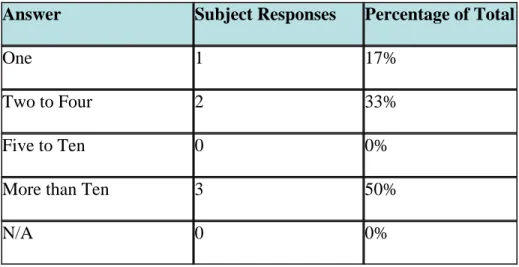
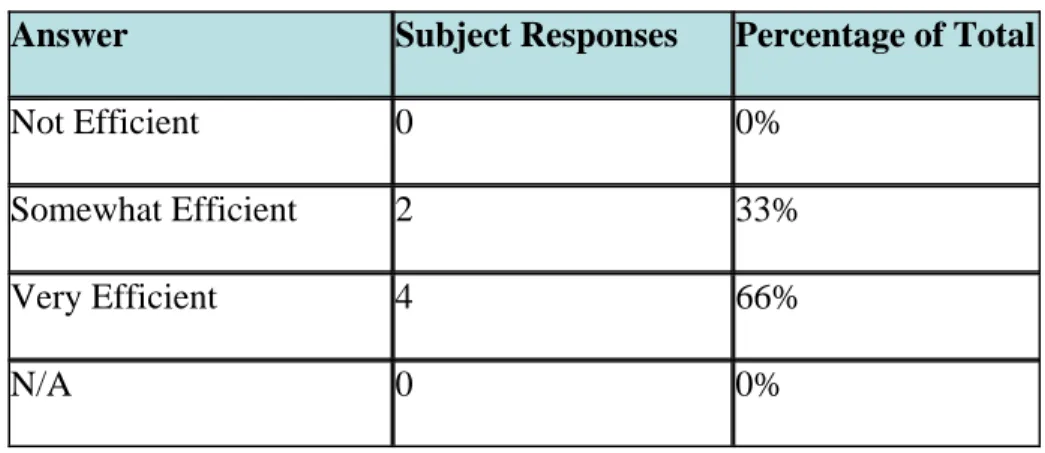
were affiliated with other institutions. One of the six questioned had been at the DLG less than six months, two had been at the DLG for 2-5 years, and one had been at the DLG for more than five years. Three of the six questioned said that in regard to the projects they have worked on, the possibility for collaboration is extremely likely, one responded “likely,” one responded “unlikely,” and one responded “not applicable.” Four of those questioned responded that collaboration needs of the University of Georgia met were very efficiently, and two responded that the needs were met some-what efficiently (Figure Two). Two of the six surveyed responded that collaboration with institutions outside of the university occurred daily, one said collaboration outside of Georgia and the University System of Georgia occurred weekly, and two said it occurred monthly. One answered unsure. Similarly, Two respondents had contact with other institutions Daily, one survey respondent answered weekly, and two responded that they had occasional contact with other institutions (See Figure Three).
Figure One: Involvement in Digital Library Projects
Answer Subject Responses Percentage of Total One 1 17%
Two to Four 2 33%
Five to Ten 0 0%
More than Ten 3 50%
Figure Two: Efficiency in Collaboration
Answer Subject Responses Percentage of Total
Not Efficient 0 0%
Somewhat Efficient 2 33%
Very Efficient 4 66%
N/A 0 0%
Figure Two: Frequency of Contact with Other Institutions
Answer Subject Responses Percentage of Total Daily 2 33%
Weekly 1 17%
Monthly 1 17%
Occasionally 2 33%
Never 0 0%
These survey results show that collaboration occurs often as more than half of those questioned have contact with other institutions at least monthly. Additionally, it seems that collaboration is efficient, as the majority of those questioned responded “very efficiently.” The question specifically asked about the needs of the University of
Georgia, and not those outside the system. The Interviews
funding, problems with collaboration, ownership and hosting, software and hardware used in collaborative projects, and future and long term goals for collaboration. Partners Involved in Collaboration
The Digital Library of Georgia (DLG) is supported by the Board of Regents (BOR) of the University System of Georgia, which supports GeorgiA LIbrary LEarning Online (GALILEO), as well as the Georgia Public Library System. Because of this structure/base, the DLG works closely with other academic institutions as well as public library systems, and the projects produced by the DLG reflect this relationship.
Generally most of the institutions that the DLG collaborates with are Georgia institutions. Through the Board of Regents and GALILEO, the DLG works closely with the Georgia Public Library System and college and university libraries across the state. However, the DLG does collaborate on a national scale as well. For example, the “Southeastern Native American Documents include institutions in Tennessee and North Carolina” (Graham). Currently, the DLG is collaborating with 75 national institutions on the Civil Rights Digital Library (CRDL). These national institutions are content partners, which “are people who are hosting their own content, that have their own digital collection, but [the DLG is] providing another route of access to that content through the DLG metadata catalog and…site” (Graham). The project partners, those whom “[the DLG works] with to digitize their collections…and build digital sites on a project,” for the CRDL are all Georgia Institutions (Graham).
advice on how to do it, and we contacted them with some option on how we could help out if [they] would like to partner with [us]” (McAlister). The Georgia HomePLACE project, a collection of collaborative projects through the BOR and public libraries across the state, mostly elicits collaboration from the smaller libraries with help an extensive survey created by Ed Johnson based on the needs of the library patrons and users (McAlister). Once the survey is completed, the DLG will “go back to these digital partners and talk to them about the collections that they have and propose a project, but quite often it happens the other way around” (Graham).
Collaborative Digital Projects
The largest project in the making at the DLG right now is the Civil Rights Digital Library project (CRDL). The CRDL began as an idea from English professor Dr.
support the use of this content in class rooms (K12 and also college)” (Graham). The DLG has also created a “national portal on the civil rights movement that connects together by process of metadata aggregation the digital collections that have been created by institutions across the country” (Graham). This metadata aggregate links the above mentioned 75 content partners to the DLG. This portal, however, is part of the DLG as a whole. According to the Digital Library of Georgia Homepage:
The DLG Portal Service links historical and cultural collections digitized by the DLG and held locally in GALILEO with digital collections, materials, sites, items or similar resources held by cultural and/or other non-profit organizations
throughout the state and elsewhere by means of a selective portal service. The core of the portal service is a metadata catalog containing descriptive information about each resource. (Collection Development Policy)
This portal makes the “DLG itself…a giant collaboration…for the [DLG’s] basic website we get other institutions to donate their metadata” (McAlister).
Georgia HomePLACE is collection ofcollaborative project of the DLG and the BOR/ University System of Georgia “to digitize valuable collections on Georgia local and family history and to support partnerships between public libraries and the Digital Library of Georgia” (Digital Library of Georgia and Partners and Sponsors). The first Georgia HomePLACE project was created in 2002, the Vanishing Georgia Project, and since 2004, there have been fourteen new digital projects from the Georgia HomePLACE (Graham). Ed Johnson, Director of the Georgia HomePLACE, created a survey
technique “to understand what type of collections [public libraries] have and what their needs are” (Graham). Ed presents this information to the Georgia History Committee (Johnson).
assist planning future collaborative digitization” (HomePLACE Survey Abstract 1). The survey sought what assets different Public Libraries housed and had access needs for, as well as input from patrons of what they would like to see digitized and made available as well. The survey results showed that “newspapers are clearly the most widely held and most actively collected materials” (HomePLACE Survey Abstract 1). The survey further looked at how/which assets were widely held and collected (HomePLACE Survey
Abstract 1). Patrons of these institutions mostly wanted cemetery information, marriage records, family history and genealogy information, as well as thematic types of items (HomePLACE Survey Abstract 1). Newspapers, which the institutions actively hold and collect have many of the needs of “genealogical” information (HomePLACE Survey Abstract 2).
Collection Audiences
The intended audience of the Digital library of Georgia includes “five segments: Casual User, Student/K12/Lifelong Learner, Information Seeker/Hobbyist,
DLG’s] resources” (Graham). Similarly, projects from GALILEO are targeted towards “K-12 education, [the] state library system, and USG member institutions along with several private colleges/universities (Peacock). Additionally, the Georgia HomePLACE caters itself to public library patrons and users, librarians, K-12, university students, “local history buffs, genealogists, curious citizens, and life-long learners,” which include “everybody in the state with curiosity” (Johnson).
Collection Funding
When asked about whether funding helps or hinders collaboration, all who were interviewed generally agreed that it does help but also adds complications. As Sheila McAlister notes, “all of [the DLG’s] projects are collaborative, so it certainly doesn’t hurt [to have grant funds].” Grant money can help make decisions about which projects that the DLG is going to do, “but the decision to collaborate, that’s just what we do”
(McAlister). As Toby Graham notes, “the lure of grant dollars can bring people together in a room and give them the sense that there is a possibility to move forward with
collections with the help of the DLG. The CRDL (Civil Rights Digital Library Project) was written into a grant as an afterthought (Abolins). Having sources outside the University of Georgia help “make it more attractive” and (Graham). Furthermore, “funding sources tend to generate revenues for personnel and equipment” (Peacock). Problems That Arise from Collaboration
Both Sheila McAlister and Toby Graham cite communication as the key concern for problems encountered with digital collaboration. As Sheila McAlister points out, “[communication] is so important in creating a shared vision and workable work flows and getting other people to be happy with the progress that we are making” (McAlister). If stakeholders and institutions “feel like decisions…are made without their input, that sours them on collaboration and that’s something we have to guard against and be diligent in communicating with our partners” (Graham). Graham further explains that sometimes no matter how diligent you try to be, facilitating successful collaboration is very difficult because you need to “make sure it is a win for everyone…collaboration should be based on enlightened self interest” (Graham).
Ed Johnson, Georgia HomePLACE, doesn’t want to put too much emphasis on the problems, as the possibilities are so strong, but he mentions the same communication problems around the amount of time it takes to digitize collections, and the time it takes to get to future collections in the Georgia Public Library System (Johnson). Sheila McAlister, of the DLG, says, “I think the biggest and hardest thing about any project is communication. If institutions who are stake holders in digital projects “feel like decisions are made without their input, [it] can sour them on collaboration, and that’s something we have to guard against and be diligent in communicating with our partners” (Graham).
Different metadata standards can create problems with the collection of metadata from other institutions. These variations in practice are not necessarily a problem for the DLG, since
we have less of an issue with that than programs that are decentralized because we’re doing so much of that work according to our internal standards, and our external standards, internal guidelines that we use to implement things like Dublin Core and our imaging standards (Graham).
This issue leads to the final problem listed by Graham, that of “digital preservation and sustainability” (Graham). The DLG is in a better position than models similar to it around the country because of the support that the DLG gets from the University of Georgia and GALILEO (Graham).
Ownership and Hosting
convenience (McAlister). The DLG has a “permanent non exclusive right to provide online access” (Graham).
The Vanishing Georgia project is the only current example where the same digital object would be hosted multiple places (Graham). The DLG does “share metadata [through the metadata aggregator] and point to those digital objects where they reside” (Graham).
Software and Hardware used in Collaborative Projects
The DLG has created “a metadata union catalog that is a web based form,” called META, and they encourage its use with “people from other smaller institutions”
(McAlister). Sometimes though, “larger institutions will have their own software solutions,” such as ContentDM (McAlister). If an institution is working “mostly
independently from [the DLG], they would be using their own software and equipment to digitize a collection.” These institutions would either digitize the material themselves or outsource it to other vendors (McAlister). GALILEO has software “that was written by and maintained by UGA personnel” (Peacock). The Walter J. Brown Media Archives and Peabody Awards use the same software that the DLG uses for the CRDL, but for
hardware, they use Mac computers (Abolins). Since the DLG in the same building as the Walter J. Brown Media Archives and Peabody Awards, their digitization staff can use the PCs in the DLG and they can “jockey between the two systems” when needed (Abolins). Future and Long Term Goals for Collaboration
The CRDL which “brings together librarians, archivists, and information
projects. This collaboration helped shape “the degree to which our collaborations need to be cross institutional but also interdisciplinary and cross areas of expertise in ways that they most often aren’t” (Graham).
When asked about future projects in the DLG, Sheila McAlister mentioned the effort to digitize all of Georgia’s Newspapers. Taking into account the HomePLACE survey results previously mentioned this direction makes sense. There had been a Newspaper project in the past, which turned out not to be sustainable (McAlister). Now the DLG is using Optical Character Recognition software, versus hand transcriptions and SGML tagging. Sheila McAlister elaborates, “we’re in the process of evaluating
Summary
The DLG already resembles a community of practice. It has core members who contribute and meet with other stakeholders as well as active members, peripheral members, and outside members. The DLG also has an open dialogue with perspective partners and project coordinators. Many of these open dialogues include outside perspectives, as generally, anyone could be considered a future collaborator. At the moment, the DLG’s focus is more on institutions in Georgia, but the scope of the DLG is national as well. In that case by opening up dialogue to outside perspectives, the DLG is also opening up dialogue to future participants in collaboration. This open dialog will help thwart communication issues from the beginning, since communication is
unanimously the most challenging issue felt by the survey respondents as well as representative of the challenges faced in the literature.
Funding was a major issue in the literature for collaboration. All of the projects for the DLG are funded (either by outside grants or the University of Georgia). Having the IMLS grants available has helped some collections come to fruition, since otherwise there might not have been money in UGA’s budget to create that project.
Bibliography
Abolins, Ruta. Personal interview. 12 February 2008.
About the Digital Library Federation. 29 May 2008. Digital Library Federation, Washington DC. 4 July 2008 <http://www.diglib.org/about.htm>.
Bernbom, Gary, Joan Lippincott, and Fynnette Eaton. “Working Together: New Collaborations Among Information Professionals.” Cause/Effect: a
Practitioner’s Journal about managing and using Information resources on college and university campus. 22.2 (1999): 6-9
Borbinha, Jose Luis. “An Approach to Creating a National Digital Library.” International Journal of Digital Libraries. 4 (2004): 19-22.
Borbinha, Jose et al. "Reference Models for Digital Libraries: Actors and Roles." International Journal on Digital Libraries (2005): 325-331.
Collection Development Policy. Sept. 2004. Digital Library of Georgia, Athens, GA. 21 04. 2008 <http://dlg.galileo.usg.edu/AboutDLG/CollectionDevelopment.html> Crane, Gregory and Clifford Wulfman. “Towards a Cultural Heritage Digital Library.”
Proceedings / Joint Conference on Digital Libraries. (2003): 75-86.
Digital Library of Georgia Partners and Sponsors. Digital Library of Georgia, Athens, GA. 04 03. 2008 <http://dlg.galileo.usg.edu/AboutDLG/Partners.html?Welcome> Graham, Toby. Personal interview. 18 February 2008.
Grant Search. Institute of Museum and Library Services, 08 July 2008.
<http://www.imls.gov/results.asp?State=0&city=&description=on&inst=&keyword =&program=gt_1006&sort=year&year=7>
Importance of Digital Preservation - Digital Preservation (Library of Congress). 05 May 2008. Library of Congress, Washington, DC. 04 07. 2008
<http://://www.digitalpreservation.gov/importance/index.html>.
Johnson, Edward A. Georgia HomePLACE Survey. Dec. 2003. Digital Library of Georgia, Athens, GA. 21 April 2008
<http://dlg.galileo.usg.edu/AboutDLG/HomePLACESurvey.html?Welcome&We lcome>
Johnson, Edward A. Personal interview. 02 February 2008.
Kwon, Hyuckbin, Theresa A. Pardo, and G. B. Burke. "Building a State Government Digital Preservation Community: Lessons on Interorganizational Collaboration." Proceedings of the 2006 International Conference on Digital Government Research May (2006): 277-284.
Kristen Martin & Jan Reagan. North Carolina State Government Information: Realities and Possibilities. Nov. 2003. State Library of North Carolina, Raleigh, NC. 15 Dec. 2007
<http://statelibrary.dcr.state.nc.us/digidocs/workgroup/whitepaper.pdf>. McAlister, Sheila. Personal interview. 12 February 2008.
McDonough, Jerome P. “METS: Standardized Encoding for Digital Library Objects.” International Journal on Digital Libraries 6.2 (2006): 148-158.
Peacock, Tim. Personal interview. 29 January 2008.
Torres, Roberto et al. "Collaboration and Group Work: Enhancing Digital Libraries with TechLens." Proceedings of the 4th ACM/IEEE-CS Joint Conference on Digital Libraries JCDL '04 June (2004): 228-236.
Snyder, William M. et al. "Reference Models for Digital Libraries: Actors and Roles." The Public Manager 32.4 (2003): 17-22.
UGA Libraries News & Events. 17 Oct. 2005. University of Georgia Libraries, Athens, GA. 08 07. 2008 <http://www.libs.uga.edu/blog/?p=157>.
Welcome to the Digital Library of Georgia. 2006. Digital Library of Georgia, Athens, GA. 21 04. 2008. <http://dlg.galileo.usg.edu/>
Wenger, Etienne. Communities of Practice: Learning, Meaning, and Identity. Cambridge: Cambridge University Press, 1998.
Appendix I
Library Manger Interview Questions
1. Are there any digital library projects in the making at the moment, which are a collaboration among UGA and other Institutions?
2. If yes, How many institutions generally collaborate together? 3. Which institution generally enlists the other for collaboration? 4. What about in the past?
5. Who is the intended audience for different projects?
6. Are grant funded projects (outside the University of Georgia) more or less likely to encourage collaboration?
7. Do you know of any problems that come along with inter-library collaboration among projects shared and created between a few institutions?
8. Who has hosting rights? Do you ever share hosting rights?
9. Does each institution use their own software for such collaborations?
10. Does one institution generally do most of the work and contribute mostly material as opposed to work force?
11. Are most of the institutions that you collaborate with connected to the University Systems of Georgia?
12. Are most of the institutions in Georgia?
Appendix II
Questionnaire examining the frequency of inter-organizational collaboration among the Digital Library of Georgia and other institutions inside and outside the state of Georgia and Library Systems of Georgia
1. Please check all that apply to you: __Faculty
__Staff
__Graduate Student __Undergraduate Student
__Other:_______________(Please specify)
2. How many projects in the digital library have you been involved in? __One
__Two to Four __Five to Ten __More than Ten __N/A
3. How much contact do you have with other institutions including GALILEO, State Archives, and other academic Universities?
__Daily __Weekly __Monthly __Occasionally __Never
4. With which department are you officially affiliated? __the DLG
__History __English __Anthropology __Sociology
__Other (Please Specify):___________________
5. How many years have you been at the Digital Library of Georgia? __Less than 3 Months
__ 3-6 Months __6-12 Months __1-2 Years __2-5 Years __5-10 Years
6. In regards to the project(s) that you have worked on what is the likelihood of collaboration with other institutions regarding the scope and subject of the projects?
__Unlikely __Likely
__Extremely Likely __N/A
7. With what efficiency are the needs of the University of Georgia met in regards to collaboration with other institutions (in your opinion)?
__N/A
__Not Efficient
__Some-what Efficient __Very Efficient
8. How often is collaboration done with institutions outside of Georgia and the University of Georgia Libraries?
Appendix III
University of North Carolina-Chapel Hill Consent to Participate in a Research Study
Adult Participants: Managers of the Digital Library of Georgia Social Behavioral Form
________________________________________________________________________ IRB Study # 07-1978
Consent Form Version Date: October 3, 2007
Title of Study: Inter-Organizational Collaboration: A Case Study Principal Investigator: Mary Katherine Barnes
UNC-Chapel Hill Department: School of Information and Library Science UNC-Chapel Hill Phone number: 919-962-8366
Faculty Advisor: Dr. Deborah Barreau
Faculty Advisor phone number: 919-966-5042 Faculty Advisor email: [email protected] Study Contact telephone number: 706-254-6338 Study Contact email: [email protected]
_________________________________________________________________ What are some general things you should know about research studies?
You are being asked to take part in a research study. To join the study is voluntary. You may refuse to join, or you may withdraw your consent to be in the study, for any reason, without penalty.
Research studies are designed to obtain new knowledge. This new information may help people in the future. You may not receive any direct benefit from being in the research study. There also may be risks to being in research studies.
Details about this study are discussed below. It is important that you understand this information so that you can make an informed choice about being in this research study. You will be given a copy of this consent form. You should ask the researchers named above any questions you have about this study at any time.
What is the purpose of this study?
The purpose of this research study is to learn about inter-organizational collaborations and partnerships in Digital Libraries.
You are being asked to be in the study because you are principle managers and project coordinators of the Digital Library of Georgia.
How many people will take part in this study?
How long will your part in this study last?
If you decide to participate, I will interview you for approximately one hour. The questionnaire will take only a few minutes to fill out.
What will happen if you take part in the study?
If you take part in this study, I will ask a series of open-ended questions regarding inter-organizational/institutional collaboration, focusing on problems that arise when
collaborating or choosing not to collaborate with different libraries and academic institutions when a similar scope and project possibility exists outside the realm of your library as well as your library system.
I will also give you and the staff of the DLG a voluntary small questionnaire to fill out about collaborations in your Digital Library.
What are the possible benefits from being in this study?
Research is designed to benefit society by gaining new knowledge. You may not benefit personally from being in this research study, but there will be educational or professional benefits, as information we obtain will be communicated to researchers and
professionals. There is no cost to you or financial benefit for your participation What are the possible risks or discomforts involved from being in this study? There are no risks anticipated with this study.
There may be uncommon or previously unknown risks. You should report any problems to the researcher.
How will your privacy be protected?
The interviews will be held privately in a conference room or designation of your choice. I will give stamped envelopes with the questionnaires that will be addressed to me. At the end of my study all information on my laptop will be deleted and paper copies of the questionnaire will be shredded.
Although every effort will be made to keep research records private, there may be times when federal or state law requires the disclosure of such records, including personal information. This is very unlikely, but if disclosure is ever required, UNC-Chapel Hill will take steps allowable by law to protect the privacy of personal information. In some cases, your information in this research study could be reviewed by representatives of the University, research sponsors, or government agencies for purposes such as quality control or safety.
I will quote and identify you in the research paper. If you choose, I will not identify you by name but by pseudonym. Upon your consent, our interviews will be recorded. During the time of my study, I will have all information including the recording of our
word processor. Upon your request, I will provide you a copy of the transcription to meet with your approval and to prevent misquotations. All files will be kept for a year after completion of the study and then will be erased.
Audio-recordings may be requested to be turned off, if you wish. Check the line that best matches your choice:
_____ OK to record me during the study _____ Not OK to record me during the study Will you receive anything for being in this study? You will not receive anything for taking part in this study. Will it cost you anything to be in this study?
There will be no costs for being in the study What if you have questions about this study?
You have the right to ask, and have answered, any questions you may have about this research. If you have questions, or concerns, you should contact the researchers listed on the first page of this form.
What if you have questions about your rights as a research participant?
All research on human volunteers is reviewed by a committee that works to protect your rights and welfare. If you have questions or concerns about your rights as a research subject you may contact, anonymously if you wish, the Institutional Review Board at 919-966-3113 or by email to [email protected].
- - - Title of Study: Inter-organizational Collaboration: A Case Study
Principal Investigator: Mary Katherine Barnes Participant’s Agreement:
I have read the information provided above. I have asked all the questions I have at this time. I voluntarily agree to participate in this research study.
_________________________________________ _________________ Signature of Research Participant Date
_________________________________________ Printed Name of Research Participant
_________________________________________ _________________ Signature of Person Obtaining Consent Date
Appendix IV
University of North Carolina-Chapel Hill Consent to Participate in a Research Study
Adult Participants: Questionnaire for the Digital Library of Georgia Staff Social Behavioral Form
________________________________________________________________________ IRB Study # 07-1978
Consent Form Version Date: October 3, 2007
Title of Study: Inter-Organizational Collaboration: A Case Study Principal Investigator: Mary Katherine Barnes
UNC-Chapel Hill Department: School of Information and Library Science UNC-Chapel Hill Phone number: 919-962-8366
Faculty Advisor: Dr. Deborah Barreau
Faculty Advisor telephone number: 919-966-5042 Faculty Advisor email: [email protected] Study Contact telephone number: 706-254-6338 Study Contact email: [email protected]
_________________________________________________________________ What are some general things you should know about research studies?
You are being asked to take part in a research study. To join the study is voluntary. You may refuse to join, or you may withdraw your consent to be in the study, for any reason, without penalty.
Research studies are designed to obtain new knowledge. This new information may help people in the future. You may not receive any direct benefit from being in the research study. There also may be risks to being in research studies.
Details about this study are discussed below. It is important that you understand this information so that you can make an informed choice about being in this research study. You will be given a copy of this consent form. You should ask the researchers named above who may assist them, any questions you have about this study at any time. What is the purpose of this study?
The purpose of this research study is to learn about inter-organizational collaborations and partnerships in Digital Libraries.
How many people will take part in this study?
If you decide to be in this study, you will be one of approximately 20 people in this research study.
How long will your part in this study last?
The study consists of 8 questions short-answer items. The questions will take no more than a few minutes to complete. You may add comments as you wish to the
questionnaire. All feedback is greatly appreciated. What will happen if you take part in the study?
I will give you a list of questions that you can fill out at your earliest convenience. I will include a stamped envelope that will be addressed to me for you to mail off at your earliest convenience.
There will be no information identifying you on the questionnaire but you are free to answer or not answer at your own will.
If you decide to participate, simply include the signed portion of this consent form with the questionnaire and drop it in the mail. All information regarding your identity will be kept confidential, as I will be the only one who has access to this information.
What are the possible benefits from being in this study?
Research is designed to benefit society by gaining new knowledge. You may not benefit personally from being in this research study. There will be educational or professional benefits from this study, as information we obtain will be available to researchers and professionals.
What are the possible risks or discomforts involved from being in this study? There are no risks anticipated with this study.
There may be uncommon or previously unknown risks. You should report any problems to the researcher.
How will your privacy be protected?
I will give stamped envelopes with the questionnaires that will be addressed to me. Therefore, besides myself, no one will know of your involvement with this study. All files will be kept for a year after the study is completed and then will be erased.
Participants will not be identified in any report or publication about this study. Although every effort will be made to keep research records private, there may be times when federal or state law requires the disclosure of such records, including personal
Will you receive anything for being in this study? You will not receive anything for taking part in this study. Will it cost you anything to be in this study?
There will be no costs for being in the study What if you have questions about this study?
You have the right to ask, and have answered, any questions you may have about this research. If you have questions, or concerns, you should contact the researchers listed on the first page of this form.
What if you have questions about your rights as a research participant?
All research on human volunteers is reviewed by a committee that works to protect your rights and welfare. If you have questions or concerns about your rights as a research subject you may contact, anonymously if you wish, the Institutional Review Board at 919-966-3113 or by email to [email protected].
- - - Title of Study: Inter-Organizational Collaboration: A Case Study
Principal Investigator: Mary Katherine Barnes Participant’s Agreement:
I have read the information provided above. I have asked all the questions I have at this time. I voluntarily agree to participate in this research study.
_________________________________________ _________________ Signature of Research Participant Date