Riding Out the Green Wave of Gentrification in Atlanta
By
Ansley Katherine Jones
A Masters Project submitted to the faculty of the University of North Carolina at Chapel Hill in partial fulfillment of the requirements for the degree of Master of City and Regional Planning in the
Department of City and Regional Planning.
Chapel Hill
Contents
I. Introduction ... 3
II. Literature Review... 5
A. Defining Gentrification ... 5
B. Environmental Gentrification ... 8
C. “The Just City” and Other Relevant Theoretical Frameworks ... 9
III. Methodology ... 11
A. Data Collection Methods ... 11
B. Analytical Methods and Risk-Reduction Measures ... 11
IV. Background on Atlanta Beltline... 12
A. General Atlanta Context ... 12
B. History of Atlanta Beltline ... 15
C. Impacts of Atlanta Beltline ... 19
V. Evaluation of Beltline Planning and Implementation Process ... 21
A. Equity ... 21
1. Planning Process ... 21
2. Implementation Process ... 24
B. Diversity ... 39
1. Planning Process ... 39
2. Implementation Process ... 41
C. Democracy ... 45
1. Planning Process ... 45
2. Implementation Process ... 46
VI. Lessons Drawn from Atlanta Beltline Case ... 49
A. Power Differentials between Decision-Making Bodies ... 50
B. Garbage Can Model ... 51
C. Lack of Affordable Housing Implementation Plan ... 53
D. New Commitments to Affordable Housing ... 54
VII. Best Practices in Affordable Housing and Community Development ... 55
A. Case Studies ... 56
1. Greenpoint, Brooklyn, New York ... 56
2. Philadelphia, Pennsylvania ... 58
3. Portland, Oregon ... 60
B. Emerging Community Development Tools and Strategies ... 65
VIII. Recommendations for Atlanta ... 67
References ... 70
Appendix A. Geographic Context... 79
Appendix B. Summary of Atlanta’s Community Development Tools and Strategies ... 80
1. Equity Strategies ... 80
2. Diversity Strategies ... 84
I.
Introduction
This paper explores the complexities of the Atlanta Beltline project, with a specific focus
on the affordable housing policy direction and how it has evolved over time. The Beltline
project has generated a lot of negative publicity over the past couple of years because of the role
it has played in stimulating gentrification in many of Atlanta’s disinvested central
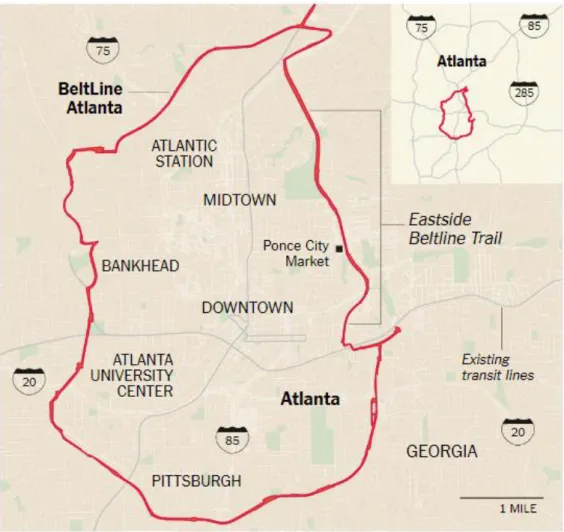
neighborhoods. Ryan Gravel, who originally developed the Beltline concept in his Georgia Tech
Master’s thesis in 1999, imagined that the project would include the conversion of 22 miles of
abandoned railroads into walking and biking trails, as well as the construction of a streetcar
transit system and a variety of housing choices. Policymakers, business leaders, and the public
bought into the vision, with the belief that the Beltline would truly transform the urban landscape
and lead to a higher quality of life for all Atlanta residents.
In his thesis, Gravel emphasized that measures needed to be taken to ensure that the
implementation of the Atlanta Beltline was an equitable development process. However,
equitable development has different meanings for different people, which is evident in the fact
that residents of Atlanta have various opinions regarding the outcomes they believe the Atlanta
Beltline should deliver. Some people believe that ‘equitable development’ means that public
funding should be spent equally among the geographic areas involved, while others claim that
equitable development means devoting the most funding to those areas that are worst-off in
terms of disinvestment and poverty levels.
In the early years of the Beltline planning process, project leaders also did not have a
clear sense of what equitable development should entail. The first Beltline plan in 2005 called for
the construction of 5,600 affordable housing units by 2030, but it did not include any strategies
Plan, which finally defined equitable development and laid out supporting policies. However, it
still lacked actionable strategies to address gentrification and the rapidly-disappearing affordable
housing stock in Atlanta’s central core.
As of 2016, the Atlanta Beltline Inc. had only delivered about 1,000 affordable housing
units in the Beltline Tax Allocation District. When Gravel resigned from the Board of the Atlanta
Beltline Partnership in 2016, the Atlanta Beltline Inc.’s lack of progress on its affordable housing
goal was brought to the attention of the public. Preserving naturally-occurring affordable
housing, developing new affordable housing for both renters and homeowners, and preventing
displacement became major topics of concern in the 2017 mayoral race. In fact, Mayor Keisha
Lance-Bottom made a campaign promise to create a one billion-dollar public-private initiative to
address these affordable housing issues. A new wave of activism was unleashed, as citizens
demanded more public benefits from the huge public investments associated with the Beltline.
In this paper, an evaluation technique, introduced by Susan Fainstein’s “The Just City,” is
used to assess Atlanta’s progress on its affordable housing provision goals and complimentary
actions aimed at creating a city where justice can be realized. The dilemma of how to pursue
sustainability and enhance public health for residents across all racial and income categories is an
area of research that is lacking on the solutions-side. This paper helps to fill the gap by
presenting a range of revitalization models, evaluating their effectiveness using the “Just City”
lens, and making recommendations. While no city has yet found a silver bullet for addressing
housing affordability, many new strategies are emerging across the country. This paper
highlights successful implementation examples of strategies that focus on tenant protections,
affordable housing development and preservation, and equity planning. Although the Atlanta
beginning, the Atlanta Beltline Inc. and the City of Atlanta have demonstrated a renewed sense
of urgency for working together to meet the growing affordable housing needs in central Atlanta
neighborhoods.
II.
Literature Review
A. Defining Gentrification
Gentrification has no single definition. Academics, policymakers, and the general public
offer variations on the definition of the term. The term ‘gentrification’ was originally coined by a
British sociologist, Ruth Glass, in a book titled, London: Aspects of Change (1964). Her
definition introduces the important concept of displacement, which many argue is a critical
component of the gentrification definition (Kennedy & Leonard 2001; Levy, Comey, & Padilla
2006). Displacement occurs when middle-income people, referred to as the “gentry,” move into
disinvested areas and cause housing prices to increase, which forces the lower-income residents
to leave the neighborhood. Notably, Glass (1964) recognized that gentrification not only causes
the displacement of people from their homes; it can also cause small businesses to relocate. In
much of the recent literature, a phenomenon known as ‘cultural displacement’ has been used to
describe situations when people are not physically displaced from their homes, but their cultural
identity is threatened as staples of their neighborhood, such as longstanding institutions, begin to
disappear. In addition, cultural displacement can be the result of the neighborhood shifting to a
less racially diverse composition (Hyra 2014). As this occurs, the people with the most political
influence, typically the more affluent newcomers, gain greater say in neighborhood
decision-making, further shutting out the voices of the existing residents. Hyra (2014) found qualitative
evidence that cultural displacement causes existing residents to feel resentment and
Rothenburg and colleagues (1991) set out one of the most simplified definitions of in the
literature, positing that gentrification is the upgrading of a neighborhood through individual
dwelling-level improvements. Property owners are likely to upgrade units when there exists a
higher profit potential from selling or renting in a higher quality submarket, even after the costs
of upgrading are considered. Smith (1979) refers to this concept as the rent gap theory. This idea,
which stemmed from Marxism, was developed through an analysis of how capital has
historically been deployed in cities. Areas where the state previously disinvested are now viewed
as prime targets for redevelopment because investors can capitalize on the rent gap. This is not to
say that gentrification only occurs due to redevelopment of existing properties. Investors are also
prone to support new developments in disinvested areas when the market conditions reveal a
profit potential (Smith 1979). Cities are not innocent in this process; they play a huge role by
adopting policies that facilitate and even subsidize reinvestment in disinvested areas, which is
very evident in the “back-to-the city-movement” that is occurring across the United States. The
actions taken by government that stimulate this economic restructuring are referred to as
“state-sponsored gentrification” (Bridge, Butler, and Lees 2012; Zuk et al. 2015).
In Rothenberg and colleagues’ book (1991), The Maze of Urban Housing Markets:
Theory, Evidence and Policy, the concept of gentrification is illustrated through supply and
demand graphs for three general housing submarkets: the low-quality submarket, the
medium-quality submarket, and the high-medium-quality submarket. It is shown that upgrading housing units in
the low-quality market results in a ripple effect, causing an upward shift in the quality of the
housing units in the medium- and high-quality submarkets as well (Rothenberg et al. 1991).
as dwellings are upgraded, so prices rise. As the process continues, prices escalate quickly, and it
becomes increasingly difficult to stabilize the market.
Residential development and redevelopment are not the only drivers of gentrification.
Private commercial development is notorious for stimulating gentrification as new uses attract
newcomers to a neighborhood. Public investments, such as infrastructure, parks, and transit, are
also key contributors to property value appreciation, which many researchers use as an indicator
of gentrification (Freeman 2005; Zuk et al. 2015). Public policies related to community
development such as the HOPE VI public housing revitalization program and the historic tax
credit program are also viewed by some as gentrification promoters (Zuk et al. 2015). Freeman
and Braconi (2005) define ‘direct displacement’ as a situation where a demographic or ethnic
group is succeeded by another due to a specific program. ‘Secondary displacement,’ or
‘involuntary displacement’, refers to the common occurrence where low-income residents can no
longer afford to stay in their neighborhoods because of property value appreciation or rent
increases (Kennedy and Leonard 2001).
Although gentrification is not a new occurrence, its prevalence may be increasing as
cities push for smart growth agendas, which entail the upgrading of land uses to their “highest
and best use.” (Simpson 2017). For instance, a popular development type that planners seem to
view as a panacea to a range of urban problems is the transit-oriented development, or TOD.
Advocates of TODs say that situating a housing development in an area that is well-served by
public transit will help expand economic opportunities for residents who do not have a vehicle.
The irony is that TODs tend to be more luxurious, so low-income people who would most
benefit from living in them are often excluded. Various studies demonstrate this narrative, such
and Ley’s account of Metro Vancouver’s Skytrain Corridor (2016). These examples highlight the
fallacy of the “garbage can model,” devised by Cohen, March, and Olsen (1972). This model of
decision-making describes the case where a project concept is developed, and subsequently, the
project visionaries search for a range of problems that their concept would solve.
B. Environmental Gentrification
Another common manifestation of gentrification results from the provision of green
space, which has been termed ‘environmental gentrification.’ In the literature, many authors have
discussed the paradigm shift from focusing on the distribution of “environmental bads” or
“locally-unwanted land uses (LULUs),” such as landfills and chemical plants, to the spatial
structure of “environmental goods” such as parks and greenways (Anguelovski 2015). Wolch
and colleagues (2014) discuss this urban greening paradox, postulating that urban greening can
do more harm than good in park-poor neighborhoods because these actions heighten the risk of
displacement. In fact, numerous examples validate this hypothesis. Greenways in particular are
bringing massive neighborhood changes in cities across the United States. Munroe, Parker, and
Campbell (2016) found that property values surrounding the Catawba Regional Trail
experienced appreciation, regardless of whether the housing was in the metropolitan,
micropolitan, or rural context. The New York Economic Development Corporation (2011)
reports that property values around the High Line rose by up to 103 percent from 2003 to 2011,
despite the recession. Wolch and colleagues (2014) assert that urban greening projects such as
these are closely linked to gentrification because the underlying concept of rails-to-trails projects
is the upgrading of underutilized spaces; similarly, Flink (2008) describes greenways as a way of
that greenway projects spur real estate development that appeals to people who prefer to live in a
dense, walkable environment.
C. “The Just City” and Other Relevant Theoretical Frameworks
Over the last century, planning in America can be characterized by the four following
themes: “City Beautiful” from 1900 to 1920, “City Efficient” from 1920 to 1960, “City Social”
from 1960 to 1990, and from then to today as “City Sustainable” (Hirt 2016). As explicated in
Campbell’s “Green Cities, Growing Cities, Just Cities” (1996), sustainability has always been an
underlying motive of planning, but this paper was the first to break down the concept into three
pillars: equity, economics, and environment. Campbell (1996) says that sustainable development
rests in the center of this “Planner’s Triangle,” and it can never fully be reached; rather, planners
must constantly work to resolve the conflicts between each angle. He suggests that throughout
history, planners have prioritized one of these goals over the others, most frequently economic
development. This idea aligns with Molotch’s theory of the ‘growth machine,’ which refers to
the never-ending pursuit of growth in cities (1976). The problem with this pursuit of growth is
that the benefits typically accrue to the socially elite, while exacerbating the inequality
throughout the city (Loughran 2014). In Harvey’s famous “Right to the City” essay, he states
that there needs to be “greater democratic control over the production and utilization of the
surplus,” referring to the unequal accumulation of wealth. He discusses the intensifying power of
private entities in shaping cities, such as New York, and suggests that new modes of urbanization
are needed to shift power to those who have traditionally been left out of the decision-making
process. Loughran (2014) discusses this theory in light of the High Line and makes the claim that
Lewis (2017) refer to this phenomenon as the urban green growth machine, and they claim that
public-private partnerships are often to blame for this privatization of parks.
Susan Fainstein’s “The Just City” introduces the idea that planning processes that
incorporate “just” principles will not necessarily yield “just” outcomes. For example, a highly
participatory planning process does not automatically mean that it was inclusive of all relevant
interests. In many cases, those who are inclined to participate in public meetings are middle-class
homeowners who are concerned with property value impacts, and barriers may prevent
lower-class individuals from partaking (Fainstein 2010). Fainstein’s framework breaks down justice
into three components: equity, diversity, and democracy. Equity is defined in a variety of ways—
geographic equity, which refers to “a distribution of both material and nonmaterial benefits
derived from public policy that does not favor those who are already better off at the beginning”
(Fainstein 2010); intergenerational equity, which ensures that future generations can enjoy the
same quality of life experienced today; and interspecies equity, which calls for fair treatment of
all living organisms (Fainstein 2010). Fainstein’s description of diversity refers to the
heterogeneity of a variety of factors, such as income, educational attainment, race, age, sexuality,
building and use types, economic opportunities, ease of use of different transportation modes,
and more. Fainstein discusses several theories of democracy, but many revolve around the
importance of meaningful citizen participation in public decision-making, as elected officials
have a responsibility to hear the voices of all whom they represent. Furthermore, a democracy is
meant to address the capabilities approach, meaning it must protect basic rights and ensure that
III.
Methodology
A. Data Collection Methods
Qualitative methods, including review of historic plans and other archival sources and
interviews of stakeholders in the development and nonprofit communities, were used to explore
Atlanta’s history and current work towards justice. Historic plans were found on the websites of
the Atlanta Beltline Inc., the Atlanta Housing Authority, Invest Atlanta, and the Georgia
Department of Community Affairs, and news articles were located through reputable local news
sources such as the Atlanta Journal-Constitution. Interview participants were selected through
research on key players driving the Beltline project and affordable housing development in
Atlanta. Emails that explain the research, including its minimal risks, were used to recruit
participants. In addition, a snowball sampling technique was used to identify more candidates for
interviews throughout the process. In total, ten interviews of Atlanta affordable housing
stakeholders, Beltline planners, and community members were conducted. Of the ten, nine were
over the phone, and one was face-to-face. The face-to-face interview was recorded with
permission of the interviewee, and shorthand notes were used for the phone interviews.
B. Analytical Methods and Risk-Reduction Measures
Both the historic plans and the interview notes were coded by how well the topics fit
within the definitions of the three pillars of a just city—equity, diversity, and democracy.
Through this categorization technique, it was easy to compare Atlanta’s progress in the three
areas and to identify gaps in the Atlanta Beltline’s planning and implementation processes. The
case studies and strategies presented in the “Best Practices in Affordable Housing and
planning tools that correct some of the identified faults in the Atlanta Beltline’s planning and
implementation.
To reduce risks associated with this research, preventative measures were taken. For
example, interview subjects were told that their names would not be used in the analysis. Instead,
they are referred to with generic titles such as “planner,” “developer,” or “community member.”
Direct quotes can pose a threat to confidentiality, so the personal communications are
paraphrased and discussed thematically in the “Evaluation of Beltline Planning and
Implementation Process” section. The interviews were meant to supplement the deep dive into
the archives, so interview information is only integrated into the evaluation as necessary to shed
light on motivations and explanations that could not be gleaned from the archival research.
IV.
Background on Atlanta Beltline
A. General Atlanta Context
The City of Atlanta was born in 1837 when land surveyors recognized that it was a prime
location for a railroad hub. Seven miles east of the Chattahoochee River, a place was established
called ‘Terminus,’ because it was identified as the point where a rail line from Tennessee should
end. After a forced removal of the Cherokee Native Americans who had originally lived on the
land, new settlers flooded into the area. In 1842, Terminus was renamed ‘Marthasville,’ after
Georgia Governor Lumpkin’s daughter. Three years later, it was renamed ‘Atlanta’ as a tribute to
the railroad that had put the city on the map, the Western and Atlantic Railroad. In 1847, Atlanta
was officially incorporated as a city, though a quite small one. A circle with a one-mile radius
was drawn from the original zero milepost at Terminus to delineate the city’s boundaries
Not long after the construction of the first rail line in Atlanta, three others converged at
Terminus. Mills and other industries popped up around the railroads, and by 1859, the population
had reached 10,000 (Pendergrast 2017). During the Civil War, Atlanta was almost entirely
burned down by General Sherman, and the railroads were key to the Union victory. After the
war, Atlanta branded itself as the ‘Phoenix City’ because it “rose from the ashes” as a bustling
activity center, and in 1866, Atlanta was named Georgia’s capital (Pendergrast 2017). Businesses
took actions to set themselves apart from the state’s Confederate history, and Henry Grady,
editor of the Atlanta Constitution, helped spread the word about Atlanta representing the ‘New
South’ (Pendergrast 2017).
With investment streaming in from New England, more rail lines and later streetcar
networks were built in and around Atlanta. Streetcars were originally powered by the coal-fired
power plants built along the Southern Belt Line. This railroad was the first that had purposefully
been built to avoid the central terminus because of its congestion; later, other “belt lines” on the
northeast, northwest, and southwest were built in the same fashion (Pendergrast 2017). These are
the same railroads that would one day be transformed into the Atlanta Beltline greenway trail
system.
In 1901, the Locomobile became the first car to drive into Atlanta, and it did not take
long for automobiles to become the preferred mode of travel throughout the city (Pendergrast
2017). In the early 1920s, traffic congestion was already one of the main topics of concern
discussed by the new Planning Commission. As highways became prevalent throughout the
mid-twentieth century, those with means moved away from the city center, and industries followed.
In fact, in the Metropolitan Planning Commission’s 1952 report Up Ahead: A Regional Land Use
proposal to convert the belt line railroads into an “Inner Belt Highway” for trucks, which points
to the reality that the railroads had become obsolete. Fortunately, the Inner Belt Highway plan
did not come to fruition (Pendergrast 2017).
Atlanta was at the heart of the Civil Rights Movement in the 1960s, as Martin Luther
King Jr. grew up on Auburn Avenue in a neighborhood called Old Fourth Ward, one of today’s
quickly gentrifying areas near the Beltline. Some of Atlanta’s white business leaders at the time,
including Coca-Cola CEO Robert Woodruff, wanted peace between whites and blacks, if not for
moral reasons, for city branding purposes. In fact, the mayor at the time, William Hartsfield
created Atlanta’s new slogan, “the city too busy for hate” (Ambrose & Dobbs 2017).
Meanwhile, as the Civil Rights Movement progressed, racism persisted. As in most metropolitan
areas around the country, desegregation led to a mass exodus from the central city, known as
white flight. Neighborhoods such as Inman Park, Grant Park, and Grove Park, which had each
started off as primarily white areas, transitioned to being predominately black. A phenomenon
known as ‘black flight’ was also observed, as wealthier black families made their way to the
suburbs as well. Communities such as Pittsburgh, Bankhead, English Avenue, and Vine City,
which had always been majority black, were left inhabited only by the poor black families that
could not afford to leave (Pendergrast 2017). Though these neighborhoods were once viewed as
stable black communities, they went downhill quickly as vacancies in both housing and
commercial spaces were never filled and became hotspots for crime.
Beginning as early as the 1990s but accelerating today, the trend of white residents
moving out of the central core of the city is reversing. Much of this growth can be attributed to
the Beltline and the urban lifestyle it promises. Communities around the Eastside Trail such as
neighborhoods, while Atlanta’s westside neighborhoods are fighting to hold onto their culture
and their disappearing unsubsidized affordable housing. Dr. Immergluck of Georgia State
University has shown empirically that homes in historically disinvested parts of the city—the
south and west sides—have experienced the largest jumps in property valuations since the
Beltline project was first announced, so the low-income residents of these neighborhoods face
growing displacement pressures.
Despite its efforts to promote peaceful race relations and integrated communities, Atlanta
remains highly segregated by income and race. It also ranks as one of the lowest mobility
metropolitan areas in the country, meaning that children who are born into poverty have a very
low chance of rising above the poverty line (Annie E. Casey Foundation 2014). A report by the
Brookings Institution, “Opportunity for Growth,” made the case that if Atlanta could increase its
rate of upward mobility to that of Washington D.C., which is described as a “high-mobility
metro,” its metropolitan Gross Domestic Product would increase by $18 billion, which is
equivalent to $3,000 per person (Parilla 2017). The Atlanta Beltline is a key economic
development strategy for addressing these challenges, but it remains to be seen how successful it
will ultimately be.
B. History of Atlanta Beltline
The Beltline is within a Tax Allocation District (TAD), which is Georgia’s name for
districts that uses tax increment financing. This mechanism freezes the property tax allocations
so that, for example, public schools will receive the same allocation of tax revenue as they did
before the project began. Then, when property values inevitably increase due to the revitalization
efforts, the increment of property tax revenue above the preexisting levels would go toward
bonds in the amount that the property tax revenue is expected to increase, and then the
bondholders are repaid with the gains in tax revenue. Because of the nature of this development
tool, the project leaders focused primarily on attracting luxury development because the City
needed to see property values increase in order to repay the bondholders who supported the
project. In other words, the state sponsored gentrification.
From the beginning, some Atlanta stakeholders were concerned about gentrification. For
instance, a nonprofit called the Georgia Strategic Alliance for New Directions and Unified
Policies (Georgia STAND-UP) advocated for affordable housing and the hiring of local residents
for the Beltline’s construction (Pendergrast 2017). Thus, the legislation for the Beltline TAD
included the provision that fifteen percent of the proceeds from bonds issued to pay for the
Beltline must be diverted to the City’s Housing Trust Fund. The Housing Trust Fund could be
used to support any affordable housing activities, such as down payment assistance and grants
for development and rehabilitation.
Acquiring the right-of-way for the planned trail alignment proved challenging as the City
had to negotiate with stubborn stakeholders, such as railroad owners Norfolk Southern, Amtrak,
Georgia Department of Transportation, and profit-driven developers.For instance, a developer
named Wayne Mason purchased a 4.6-mile rail corridor in 2004 for $25 million. The City of
Atlanta initially celebrated that a developer was interested in kicking off the redevelopment
project. Soon after, though, Mason became a huge barrier for pushing forward the Beltline plan.
He had his own vision, which included two high-rise apartments bordering Piedmont Park,
which some consider Atlanta’s equivalent to New York’s Central Park. Neighborhood activists,
notably from the white “Not-in-my-backyard”—NIMBY—crowd, wholeheartedly opposed the
public criticism and a lack of City support for rezoning, Mason decided to sell the land to the
Beltline Inc. for a hefty $66 million. Because the Beltline Inc. did not have the cash on hand, it
negotiated a $45 million short-term loan directly from Mason.
The three taxing authorities, including the Atlanta City Council, Fulton County, and
Atlanta Public Schools (APS), also struggled to reach agreements while drafting the legislation
for the Beltline TAD. The negotiated contract between APS and the City laid out a payment plan
under which the City would pay APS $150 million, rather than a percentage of the TAD
proceeds, with payments starting five years after the initial bond issuance. In addition, the City
promised to deliver a new recreational facility for another $10 million, as well as 840 housing
units specifically for teachers. Any developers that received TAD funding were legally bound by
this contract to pay $25,000 to APS. Fulton County also negotiated a contract through which $27
million of TAD funds would be allocated to the Atlanta-Fulton Public Library System.
A lawsuit slowed down the TAD approval process. In 2006, John Woodham filed suit in
the Fulton Superior Court, arguing that the City of Atlanta could not legally divert money from
the public schools. The Fulton Superior Court ruled against him in 2007, but the Georgia
Supreme Court ruled in his favor in February 2008. The City overcame this issue, though, by
amending the Georgia constitution, a measure that passed in November of 2008. The City
Council voted on a bond issuance in October, a risky move since the TAD’s legality was still not
established. The City had to act fast though, because October 31 was the deadline for repaying
Wayne Mason’s loan (Pendergrast 2017). Due to the recession, the bond issue raised only about
$64 million for the Beltline, which was $55 million less than planned. Of that, $45 million was
used to cover Mason’s loan, while $8.8 million went to the Housing Trust Fund. In 2009, a new
After the recession, the Beltline area recovered quite quickly, and the Beltline Inc. started
pulling their funding directly from the increasing property tax increment. However, because the
TAD legislation called for a percentage of bond proceeds, rather than tax dollars, to be allocated
to the Housing Trust Fund, the Beltline Inc. was not legally obligated to devote fifteen percent of
its budget to affordable housing. An investigation by the Atlanta Journal-Constitution pointed
out this legal loophole in 2016, explaining that the Atlanta Beltline Inc. “passed up on millions of
dollars of potential funds” (Mariano et al. 2017).
More lawsuits ensued in the following years. John Woodham filed another suit
concerning the City’s enactment of the TAD prior to the adoption of the constitutional
amendment. This lawsuit blocked the Beltline Inc. from receiving its agreed-upon portion of
school taxes up until 2011. Then, another controversy fired up between the City Council and
APS in 2013. Despite APS withholding a portion of the tax increment from the TAD fund, APS
filed suit when the City fell behind on its contractual repayment schedule and continued to miss
payment deadlines for the next couple of years. Finally, in 2016, a new repayment schedule was
negotiated, which increased the amount that the City would pay to APS overall, but the payment
amounts would start off lower and increase incrementally. Both the City and APS were satisfied
that the new terms decreased the uncertainty that the bonds would be repaid. The dynamic
between these groups changed after this renegotiation because a trustee, rather than the City
itself, is now responsible for repaying APS (Bloom 2016).
Another lawsuit, which has not been resolved to date, pitted the Atlanta Housing
Authority against a development group called Integral. This group claims that the previous
leadership of AHA promised them a deal on 100 acres of land, a deal which would enable them
Buell, argued that allowing this transaction would go against AHA and HUD’s policies, as well
as the Georgia state constitution (Atlanta Housing Authority 2017).
In 2016, project leaders, including the Beltline’s original visionary Ryan Gravel, resigned
from the board of the Atlanta Beltline Partnership, citing equity concerns (Saporta 2016). Several
articles in the Atlanta Journal-Constitution reported on the Atlanta Beltline Inc.’s
mismanagement of funds. When the Atlanta Beltline Inc. proposed spending less than one
percent of their budget on affordable housing in 2017, Invest Atlanta, the City’s economic
development authority, withheld approval until 2.2 million of the TAD allocation was budgeted
for affordable housing (Mariano et al. 2017).
C. Impacts of Atlanta Beltline
Dr. Daniel Immergluck, a professor at Georgia State University, has conducted several
sophisticated studies focused on home values in proximity to the Beltline. In one study,
Immergluck (2007) analyzed how the housing market reacted to the early news coverage of the
Beltline. He isolated the impact of the distance from the Beltline corridor on the surrounding
residential property values by controlling for other housing and locational variables. His findings
suggest that even modest coverage in the media can cause speculation (Immergluck 2007). From
2000 to 2006, the median sales prices of properties within one-eighth of a mile from the Beltline
increased by more than 130 percent in some areas, particularly in southwest Atlanta. The sales
price increases were similar within quarter-mile and half-mile buffers but dropped off to a lesser
extent as broader buffers were analyzed (Immergluck 2007).
To demonstrate the harm that could accompany these sharp increases in property values,
Immergluck presents an example of two similar homes valued at $100,000 located at varying
observed one-eighth of mile from the Beltline corridor compared to one mile from the TAD, the
owner within one-eighth of a mile would see their property taxes increase by 160 percent over
the six-year period, while the owner one mile away from the Beltline corridor would experience
property tax increases of 74 percent. With the large proportion of low-income households that
reside in the areas where property values are quickly rising, Immergluck warns that displacement
is an imminent threat as households are not prepared to cover increasing property taxes.
In a later study, Immergluck and Balan (2015) carry out the same type of hedonic
analysis, and they find that that the median sales price of properties within one-half mile from
the Beltline corridor increased between 40 to 68 percent from 2011 to 2015 (Immergluck &
Balan 2015). Meanwhile, the median sales price of properties outside the half-mile buffer only
rose by about 17 percent. Again, Immergluck discusses the results in terms of property taxes, but
with the additional complexity of considering homestead exemptions. Because of Atlanta’s
$30,000 homestead exemption, when a property valued at $100,000 appreciates by 50 percent,
the resulting property taxes would triple (Immergluck & Balan 2015). The following table
illustrates this point. Immergluck uses this example to show that low-income households are hurt
the most from rapid property appreciation (Immergluck & Balan 2015).
V.
Evaluation of Beltline Planning and Implementation Process
A. Equity
1. Planning Process
From its conception, the Atlanta Beltline has been framed as an equitable public health
solution to many of the city’s problems. According to the Beltline’s Equitable Development
Plan, “equitable expands beyond equal treatment, and focuses on effectively meeting the needs
of the diverse groups of individuals and communities that share the Beltline, enabling all areas to
experience healthy growth” (Atlanta Beltline Equitable Development Plan 2009).
Atlanta grew rapidly during the 1990s, and the growth continued to pick up pace into the
next century. Prior to the announcement of the Beltline project, though, growth was mainly
concentrated in the north and northeastern parts of the city. As such, wealth accumulated in these
areas as investment poured into them, and other parts of the city were largely ignored. This
narrative was introduced in the 2005 Atlanta Beltline Redevelopment Plan as a way of setting the
stage for a huge shift in development patterns. According to this plan, the Beltline is a way to
promote economic development equitably throughout the city, including investment in
affordable housing, transportation improvements, workforce training, and open space provision
(Atlanta Beltline Redevelopment Plan 2005).
The major topic of discussion in the Redevelopment Plan is the use of a Tax Allocation
District to fund the Beltline project, from its housing and public service investments to the trail
and transit infrastructure construction. Though ‘workforce housing’ is referenced throughout the
plan, the section of the plan purely devoted to this important topic is a mere three paragraphs. It
sets the expectation that 20 percent of residential units built in the Beltline Redevelopment Area
Redevelopment Area would include 50,000 new housing units by 2030, yet the affordable
housing goal was only set at 5,600 housing units, just over 10 percent of the total residential
construction. The Redevelopment Plan (2005) defines workforce housing as rental units
affordable to households making up to 60 percent of the Area Median Income (AMI) and
ownership units affordable to households making up to 100 percent AMI. Had there been any
analysis of the existing income ranges of the populations residing in the Beltline neighborhoods,
the planners may have realized that this definition was inadequate for protecting the existing
residents from displacement.
The Redevelopment Plan (2005) also fails to discuss strategies for how to meet the
workforce housing goal. Table 7.1 of the plan introduces the activities that are eligible for TAD
funding, how much TAD funding should be budgeted for each, as well as additional sources of
funding. For workforce housing, it is estimated that $220 to $260 million dollars would be
needed. The table denotes that all of this funding would come from the TAD, and no additional
sources of funding are cited (Atlanta Beltline Redevelopment Plan 2005). For most of the other
initiatives, especially those related to transportation, multiple sources of funding are included.
Although much of the analysis in this plan is geared toward transportation rather than housing,
many questions are left unanswered. The plan admits that transportation cost estimates are the
most uncertain because the transit mode and alignment had not been decided. In fact, these
questions are still up in the air today.
Despite these deficiencies, the Redevelopment Plan does have some redeeming qualities
in terms of equity planning. It does acknowledge that coordination with housing partners such as
the Atlanta Neighborhood Development Partnership, City of Atlanta, local CDCs, the Enterprise
Redevelopment Plan 2005). It also includes a $100-million budget item for “incentives,” and the
project team recommends that these funds only be tapped in “areas of unusual physical challenge
and market distress, including portions of the southeast, southwest and northwest areas” (Atlanta
Beltline Redevelopment Plan 2005). The boundaries of the proposed Beltline Tax Allocation
District were also specifically drawn to exclude single-family neighborhoods and “protect the
integrity of the residential fabric,” and compatibility of new development with the surrounding
areas is touched on multiple times (Atlanta Beltline Redevelopment Plan 2005). Additionally, the
plan notes that residential and business relocation is not expected by the project, but tenants
would be fairly compensated in the case that relocation was necessary (Atlanta Beltline
Redevelopment Plan 2005).
Finally, a couple safeguards are included to protect Atlanta residents from burdensome
tax increases. First, the plan mentions that the City cannot raise the tax rate if the TAD increment
does not meet projections; rather, debt service reserves and excess reserve coverage are proposed
as backup sources (Atlanta Beltline Redevelopment Plan 2005). Secondly, the Georgia
Redevelopment Powers Law includes a provision that that only ten percent of a city’s eligible tax
base can go into TADs (Atlanta Beltline Redevelopment Plan 2005). This precautionary
provision is commendable because it ensures that the City can maintain a healthy fiscal balance
necessary to carry out its functions and protect the welfare of all of its residents. Prior to the
Beltline TAD adoption, existing TADs comprised 5.6% of the eligible tax base, so the addition
of the Beltline TAD, which made up 2.7% of the tax base, was legal since the City would still
2. Implementation Process
i) Equitable Funding
Many critics of the Beltline’s implementation have spoken out about the inequitable
distribution of funding between the Beltline’s four quadrants during the early years. In fact, the
Beltline Equitable Development Plan is forthcoming about these inequities, as it reports that of
the total $291 million spent in 2009, 45 percent was allocated to the Northeast quadrant; 22
percent was allocated to the Northwest quadrant; 14 percent was allocated to the Southeast
quadrant; 9 percent was allocated to the Southwest quadrant; and about 10 percent could not be
attributed geographically. The explanation given for these disparities was that acquisition of the
right-of-way of the Northeast section was more expensive than expected after all of the
negotiations with the stubborn developer Wayne Mason (Atlanta Beltline Equitable
Development Plan 2009).
The 2006-2010 Five Year Plan budgeted $42 million for affordable housing in the first
five years, yet less than $20 million were earmarked for affordable housing in that time. As
described in the “History of Atlanta Beltline” section above, there are many reasons that
affordable housing was underfunded in the early years, namely the recession, multiple lawsuits,
and the legal loophole in the TAD legislation. Another explanation is that the Atlanta Beltline
Inc. did not have a clear direction for its housing initiatives, given the lack of implementation
planning in the workforce housing section of the 2005 Atlanta Beltline Redevelopment Plan.
Terri Montague, the founding President and CEO of the Atlanta Beltline Inc., believed that trail
construction should not begin until the entire 22-mile corridor had been designed and approved.
She also spoke out against building the Eastside Trail first, as it “would appear racially and
However, the Atlanta Beltline Inc. faced mounting pressure from its private partners to
construct the Eastside Trail after the land had been acquired from Wayne Mason. Montague
initially pushed back when the Atlanta Beltline Inc. Board decided to move forward with the
Eastside trail development. Through negotiations, she convinced the Board to allocate more
funding to revitalization efforts in south Atlanta as an attempt to counterbalance the amount of
money that would be spent on the Eastside trail.
ii) Transit versus Housing
To ensure that the Eastside trail could one day accommodate transit, the Atlanta Beltline
Inc. spent exorbitant amounts of money on the engineering work required to design a
transit-friendly corridor. Ed McBrayer of the PATH Foundation opposed this overstretching of funds,
claiming that it would have been a more responsible funding choice to construct a bike and
pedestrian trail in the middle of the corridor and to come back to the streetcar concept once the
money and studies supported it (Pendergrast 2017).
One of the problems to which McBrayer alluded was that Georgia Tech professors from
the Department of City and Regional Planning, as well as other transportation professionals,
wrote a white paper that criticized the Beltline’s lack of ridership studies. They said that it would
be a poor use of public funding to plan for streetcar on the Beltline because it lacked the density
of jobs that can sustain a transit system. Although the Beltline is an economic development
engine that creates jobs, these professors did not think the jobs would be concentrated in enough
nodes for streetcar to be a viable investment—they said that it would not work because “it’s all
origins and no destinations” (Pendergrast 2017). Meanwhile, Ryan Gravel, the Beltline visionary
from Georgia Tech, and perhaps more importantly, prior Mayor Shirley Franklin, firmly held
2017). From Gravel’s perspective, transit is crucial for expanding opportunity to disabled and
handicapped people who receive no benefit from the walking and biking trails (Gravel 2014).
Other urbanists argue that affordable housing is not truly affordable if it does not account for the
affordability of transportation options needed to get to work.
Transit on the Beltline is still heavily debated today, even though a special purpose local
option sales tax to fund expansion of MARTA recently passed with a huge margin. City leaders
are still discussing what that expansion will look like, and whether it will include streetcar on the
Beltline. Mike Dobbins, one of the Georgia Tech professors who has historically vocalized his
opposition to transit on the Beltline, wrote another paper in 2016 titled, “Transit Planning 101 for
the City of Atlanta: It’s Not Too Late.” In it, he advocated for improvements to the existing
MARTA system, rather than the creation of a streetcar network on the Beltline. He noted that the
city already lacks transit accessibility to major job centers, such as the airport, Perimeter Mall,
and the Buckhead business district. He also brought up the idea of expanding the City’s existing
streetcar from downtown to Ponce City Market, which has become a major destination on the
Beltline. While this may be a way for the City to “make good” on its downtown streetcar
investment, which has had very little ridership since its conception in 2010. Dobbins pointed out
that this would result in even more of the Beltline’s funding being skewed toward the eastside,
again accentuating the project’s inequities (Dobbins 2016).
Given this conundrum, Atlanta Beltline Inc. CEO Brian McGowan mentioned informally
that he thinks it is important to consider alternatives to streetcar, such as bus rapid transit (“Brian
McGowan Ask Me Anything” Event 2017). With limited funding from the federal and state
levels, bus rapid transit may be the most cost-efficient and equitable strategy moving forward,
who have fought for streetcar over the years. The Beltline Inc. must grapple with whether
streetcar transit is still a major priority, or if the mission of the Beltline has evolved. Given
public outcries over Atlanta’s worsening affordability, it seems that attacking affordability issues
head-on should be the first and greatest priority of the Atlanta Beltline Inc.
iii) Revitalization Models
1. Atlanta Land Trust Collaborative and its Evolution
The Atlanta Land Trust Collaborative (ALTC) incorporated in 2009 as community
groups, private companies, nonprofits organizations, philanthropic foundations, university
researchers, and public agencies came together to address the gentrification concerns generated
by the Atlanta Beltline. Modeled after a similar approach taken by the New Orleans
Redevelopment Authority, the ALTC organized as a “central server community land trust,”
meaning it was meant to be an overarching entity that could provide funding and technical
assistance to smaller, neighborhood-based community land trusts (CLTs). The CLT model is
supposed to yield permanent affordable homeownership opportunities, as the CLT retains
ownership of the land while offering a ground lease to its members. With a resale formula, the
CLT controls the amount of equity to be gained upon sale so that homes can remain affordable
for the next household in need.
Though the ALTC was touted as the Atlanta Beltline Partnership’s “solution” to
gentrification, the Partnership raised very little funds to support the venture in its early days. In
fact, the ALTC only directly financed the preservation of three properties at the Lofts at
Reynoldstown (HUD USER #1). The ALTC also provided technical assistance to smaller,
neighborhood-based CLTs, and these CLTs are credited with preserving the affordability of
Community Improvement Association experimented with the CLT model, and it had mixed
results. Attaining loan financing proved challenging as many banks did not see the value in
homes that would only be marketed at $80,000 (Baldwin 2016). Compared to the rest of the
Pittsburgh neighborhood, the land trust properties were overpriced. The Pittsburgh community
was hit hard by the Recession, as it experienced the greatest rate of mortgage fraud in the country
and its average housing values dropped from about $85,000 in 2006 to $13,000 in 2012 (Torpy,
2014). In addition, the poor neighborhood upkeep and notorious crime in the area did the
opposite of drawing in newcomers.
Pendergrast (2017) discusses the irony that the Beltline is somewhat responsible for
stifling this neighborhood’s revitalization, as absentee owners are holding onto vacant properties
with hopes that the Beltline will eventually cause property values to rise. Since these owners
have put no money into improving their properties, there has been little interest from other
investors to clean up the neighborhoods.
Community organizations and Atlanta-based foundations are actively working to improve
conditions in Pittsburgh, though, by forming a joint venture called the Partnership for the
Preservation of Pittsburgh (Youngblood & Barnette 2011). With technical assistance from
Georgia Tech and Emory students, the PCIA has not given up on the CLT model (AECF 2012).
By creating a “Preservation of Pittsburgh Master Plan” in 2012, the residents have expressed
support for revitalization, as greater access to economic opportunities is greatly needed. This
plan highlights the neighborhood’s assets that need to be preserved, while also pointing out areas
that need improvement, especially with regards to transportation connectivity and environmental
cleanup. Though the PCIA still must contend with absentee owners, it has had some success with
community gardens and murals (AECF 2012). Some remaining challenges include overcoming
the negative perceptions associated with the neighborhood and building neighborhood services
such as grocery stores since the zoning code prohibits these kinds of uses (Hoffman 2016).
Residents in the neighborhood are encouraged to advocate for the changes they would like to see
through their formal Neighborhood Planning Unit-V. The Annie E. Casey Foundation and the
Partnership for Southern Equity launched a program in 2018 to boost civic participation by
creating a training program called “Resident Leaders for Equity” (AECF 2018).
In multiple interviews conducted for this analysis, Atlanta planners and developers
acknowledged that the Atlanta Land Trust Collaborative has essentially fizzled out, and the
entity’s name has changed to the Atlanta Land Trust (Personal Communications 2017-2018).
Though it has yet to be seen how this change will affect the implementation of new land trust
properties, a conclusion can be drawn that a new organizational structure was needed to promote
collaboration and leverage funds in a more productive manner.
2. Historic District Development Corporation
The Old Fourth Ward neighborhood, the birthplace of Dr. Martin Luther King Jr., is one
of the Beltline’s claims to fame for revitalization. However, community-based efforts have been
underway long before the Beltline, specifically in the part of the neighborhood characterized as
the Sweet Auburn Historic District. Because Auburn Avenue was once considered “the richest
Negro street in the world,” the surrounding neighborhood was designated as the Sweet Auburn
Historic District in order to preserve the cultural heritage while restoring the economic activity
(National Trust for Historic Preservation 2018).
In 1980, Coretta Scott King founded the Historic District Development Corporation
This Community Engagement Committee has a mission of implementing Dr. King’s “Beloved
Community” philosophy, under which people come together despite differences and recognize
their shared humanity (Historic District Development Corporation 2018). With the Community
Engagement Committee’s assistance, the HDDC nonprofit ran a successful “block-by-block”
strategy to develop infill homes and restore existing properties without displacing the existing
residents. In the late 1990s, though, some homeowners sold their properties to affluent
newcomers for great profits (Pendergrast 2017). The HDDC quickly learned that affordability
mechanisms were needed. They started placing covenants on the properties’ deeds, which set out
rules regarding subsidies. The HDDC would provide these subsidies under the condition that
they must be paid back if the home is sold within five years (Pendergrast 2017). Mtamanika
Youngblood, one of the HDDC’s leaders, went on to serve on the board of the Atlanta Beltline
Partnership, and she was one of the major advocates for affordability provisions in the Tax
Allocation District legislation (Pendergrast 2017).
The HDDC’s efforts have resulted in a more stable residential neighborhood. However,
the once-thriving commercial corridor on Auburn Avenue is still not what it used to be. In 2013,
a nonprofit called Sweet Auburn Works incorporated as the entity that would lead the
preservation-focused commercial revitalization process, including the strategic planning and
fundraising (National Trust for Historic Preservation 2018). In 2017, the National Trust for
Historic Preservation announced its African American Cultural Heritage Fund, which is “the
largest preservation campaign ever undertaken on behalf of African American history,”
according to its website (National Trust for Historic Preservation 2018). In addition, the National
Trust plans to open an office on Auburn Avenue, which could help strengthen preservation
3. Purpose Built Communities
Purpose Built Communities is a nationally-renowned nonprofit that has championed a
model of revitalization that has proven effective in communities across the country. Its founder,
Tom Cousins, first tested the model with the revitalization of the Eastlake community in Atlanta.
Built on the pillars of mixed-income housing, cradle-to-college education, and community
wellness, Purpose Built Communities improves quality of life in a variety of realms.
Since the success at Eastlake, Cousins expanded the reach of Purpose Built Communities.
Thirteen neighborhoods across the country are part of the Purpose Built network. To join the
network, a local organization, referred to as the “community quarterback,” must unite other local
organizations under a common mission. Purpose Built Communities provides consulting services
to the local partners, who are then responsible for doing the groundwork.
In 2017, the Grove Park Foundation joined the Purpose Built Communities network.
Grove Park is a historic neighborhood located in Northwest Atlanta that experienced a similar
fate as the Old Fourth Ward, where flight of both affluent whites and blacks caused the
once-prosperous economic center to decline. Building on prior efforts by the Emerald Corridor
Foundation to improve environmental conditions along Proctor Creek, the Grove Park
Foundation was founded to drive holistic community revitalization. Some of the
accomplishments of the Grove Park Foundation thus far include securing funding from Atlanta
Public Schools for the construction of a new academy for kindergarten through eighth grades and
partnering with the YMCA of Metro Atlanta to build a new wellness and early childhood
intervention center next to the new academy. In order to promote housing stability, the Grove
Park Foundation has worked to educate residents on their rights and the resources available to
Atlanta Volunteer Lawyer’s Foundation. The Grove Park Foundation also promises to construct
100 new mixed-income housing units by 2019. Other ongoing efforts include collaborating with
Callanwolde Fine Arts Center to boost arts education and bringing the “Soccer in the Streets”
program to Grove Park, which is a soccer program devoted to instilling leadership and teamwork
values in Atlanta’s underserved youths.
Another organization, Purpose Built Schools, grew out of the Purpose Built Communities
concept. Purpose Built Schools, which consists of a team of educators and community-based
developers, works to diagnose issues with underperforming public schools and introduce new
teaching models. Purpose Built Schools, the Atlanta Volunteer Lawyers Foundation, and Atlanta
Public Schools recently announced an initiative to explore the suitability of kids’ housing
conditions, with the intent of connecting families with assistance (English 2017).
4. Westside Community Benefits Plan
The Westside Community Benefits Plan was developed as a condition of the approval for
the massive Mercedes-Benz Stadium built in proximity to some of Atlanta’s poorest
neighborhoods in 2017. Notably, this plan is not a binding Community Benefits Agreement, so
nothing in the plan is legally required to be implemented. However, Arthur Blank, the
co-founder of Home Depot and owner of the Atlanta Falcons, has expressed, “It’s not about how
many buildings you build, but how you change the quality of life of the people living there,” and
his financial contributions to the Vine City, English Avenue, and Castleberry Hill neighborhoods
have already been significant. As laid out in the Westside Community Plan, the Arthur Blank
Foundation would donate $15 million to the Westside Neighborhood Prosperity Fund, and Invest
Atlanta would match the donation by designating the Westside Tax Allocation District (Westside
training center called Westside Works, starting business and arts incubators, investing in various
educational initiatives, implementing a range of affordable housing strategies such as land
banking and tax abatements, and exploring different community beautification projects such as
transportation improvements and environmental remediation (Westside Community Benefits
Plan 2013).
Westside Works, which has already come to fruition, boasts on its website that it is a
“long-term neighborhood program focused on creating employment opportunities and job
training for the residents of the Westside community” (Westside Works 2018). In its first year of
operations, it placed 458 residents into full-time jobs, in the fields of construction, culinary,
nursing, and information technology (Westside Works 2018). Beyond the Blank Foundation and
Invest Atlanta, Westside Works also partners with the Construction Education Foundation of
Georgia, Integrity Community Development Corporation, the Center for Working Families, Inc.,
Per Scholas, Metro Atlanta YMCA, and the Atlanta Workforce Development Agency (Westside
Works 2018). Hopefully this deep level of involvement with a number of community
organizations will hold Westside Works accountable for continuing its efforts for the long run, as
its website claims.
Called to action by previous mayor Kasim Reed in 2014, a coalition of private CEOs and
nonprofit leaders known as the Atlanta Committee for Progress created the Westside Future
Fund. This new nonprofit organization engaged with the westside communities and developed a
Land Use Framework Plan. Affordable housing is prioritized in this plan, as it calls for 20
percent of all new housing units to be set aside for households with incomes between $14,000
and $24,000 (Westside Land Use Framework Plan 2017). The Westside Future Fund has already
protection is a property tax circuit breaker program, which essentially means that if the ratio of
property taxes to household income rises above a certain level, the Westside Future Fund will
cover the portion of property taxes that is unaffordable to the qualified households (Westside
Future Fund 2018). In addition, the Westside Future Fund recently launched a
“renter-to-homeowner” initiative, which involves the purchase and rehabilitation of existing properties to
enable perpetual affordable homeownership opportunities. The Westside Future Fund made its
first real estate investment for this program in February 2018. With support from Invest Atlanta,
the Atlanta Police Foundation, Pulte Homes, and philanthropists, the Westside Future Fund is
moving forward with the rehabilitation of 51 housing units, to be sold at an affordable price to
“legacy renters,” meaning long-term community members who need assistance such as police
officers, seniors on fixed incomes, and others who work full-time for minimum wage (Westside
Future Fund #2 2018). Another new initiative is the Westside Future Fund’s Data Dashboard,
which presents baseline data, and will continue collecting data, in the categories of safety and
security, health and wellness, mixed-income communities, and cradle-to-college education
(Westside Future Fund #3 2018). Some other achievements of the Westside Future Fund include
the development of the “On the Rise” Financial Center, the creation of the Westside Volunteer
Corps, and the implementation of the At-Promise Center for youth crime diversion which has
already cut crime rates by 35 percent (Westside Future Fund 2018).
Though many positive outcomes have already come out of the Westside Community
Benefits Plan, some residents remain concerned about gentrification, and many are doubtful that
the Blank Foundation will sustain its financial support after the recommendations of the
Community Benefits Plan are carried out. One community member said that the Westside is no
2018). For instance, over $100 million has been invested in Atlanta’s Westside since the
Olympics, yet blight conditions remain with nearly 40 percent of the housing stock vacant and
half the school-aged population dropping out of high school (Pendergrast 2017). Only time will
tell if the Westside Community Benefits Plan will truly create long-term solutions.
iv) Atlanta’s New Policy Direction
In 2016, an inclusionary ordinance was passed that requires any developers who receive
government subsidies to set aside either fifteen percent of the total units for those making 80
percent of the area median income or ten percent of the total units for those making 60 percent of
the area median income. Former Beltline Inc. President Paul Morris was fired, and an
experienced affordable housing financier Brian McGowan was appointed for the position. The
City of Atlanta also passed a new bond referendum, so the fifteen percent set-aside for the
Housing Trust Fund was reestablished.
The inclusionary zoning ordinance was strengthened as of November 2017, as it now
requires all rental multifamily developments with ten or more units in the Beltline Overlay
District or the Westside Overlay District to include affordable housing set-asides, regardless of
the receipt of public subsidies (Green 2018). This mandated inclusionary housing program also
allows the developer to select three of the following four incentives: a 15 percent density bonus,
a reduction in parking, priority application review, or “major project” designation which
expedites the meeting schedule with department representatives during the development
application process (Green 2018).
Another major affordable housing win for the City occurred in the spring of 2017 when
City Council unanimously passed the Housing Opportunity Bond. During Shirley Franklin’s
housing. The first bond issue totaled $35 million in 2007, and this second issue, which occurred
in May 2017, comprised the remaining authorized $40 million (Anderson 2017). Notably, this
second installment of the Housing Opportunity Bond included more specific language than the
first installment, which was directly attributable to advocates pushing for inclusion of groups
who are most in need of housing. In particular, these include renters making up to 60 percent
AMI and homeowners making up to 80 percent AMI, especially the most vulnerable owners
including seniors, disabled, and veteran headed households (Anderson 2017). Comparatively, the
first bond called for workforce housing initiatives for the benefit of households making up to 120
percent AMI (Anderson 2017).
Though it is still very early in her tenure, Mayor Keisha Lance-Bottom seems to be
taking seriously her campaign promise of a billion-dollar public-private investment in affordable
housing. Branding the effort as “Atlanta: A City for All,” the Mayor’s new Housing Commission
hopes to build off the Atlanta City Design plan and leverage support from various players from
the public and private sectors (City for All 2018).
Atlanta was selected in 2016 as one of six cities across the country to participate in the
Strong, Prosperous, and Resilient Communities Challenge (SPARCC), which is a 90
million-dollar initiative that provides grant funding and technical assistance to the selected cities. The
Transformation Alliance, which is a team of 17 governmental, philanthropic, and nonprofit
organizations, was born through SPARCC. Its mission is to promote “equitable transit-oriented
development (ETOD)” and “racial equity” initiatives in Atlanta (Atlanta Regional Commission
2018). The Atlanta Regional Commission and Enterprise Community Partners lead this coalition.
Their focus brings together housing and transit, as various studies have documented that these
of Atlanta’s populations spends more than 45 percent of their income on combined housing and
transportation costs (Transformation Alliance 2018).
Working directly with the Transformation Alliance, the Mayor’s Housing Commission
developed ten guiding principles, which are divided into the following categories: production,
inclusion, protection, and preservation. Under production, the City for All team identified
working with public agencies such as Atlanta Public Schools, the Atlanta Housing Authority,
and MARTA to reclaim underutilized spaces and blighted properties and convert them to
affordable housing. Each of these entities already has their own affordable housing policies. For
instance, Atlanta Public Schools recently convened an Affordable Housing Task Force to
develop recommendations on how to adapt their 70 underused properties for affordable housing
purposes (English 2017). Additionally, Atlanta Public Schools and the other taxing authorities,
the City of Atlanta and Fulton County, aid the Atlanta Land Bank Authority with acquiring
tax-delinquent properties and conveying them to local community development corporations (HUD
USER 2009). The Atlanta Housing Authority has also moved forward with affordable housing
adaptive reuse initiatives, including a new plan to redevelop the Atlanta Civic Center for
low-income housing. In 2014, MARTA adopted “TOD Guidelines,” which among other strategies,
include offering 99-year ground leases on MARTA-owned lots with the condition that
developers include 20 percent affordable housing (Jaffe 2014). This policy and the efforts by the
Transformation Alliance have already resulted in several “ETOD” sites going up around the
City.
To catalyze the ‘equitable transit-oriented development’ mission to an even greater
extent, the City for All team is considering a “Livable Transit Fund,” which will dedicate a