Environmental Lobbying Effectiveness in North Carolina: Case Studies in Hydraulic Fracturing and Coal Ash Regulation
By Carol A. Abken A Thesis submitted to the faculty of the University of North Carolina in partial fulfillment of the require- ments of a degree with Honors in
Political Science
Table of Contents
1. Introduction………..3
II. Literature Review………6
III. Theory………..…15
IV. Data and Methodology………19
V. Analysis……… 31
VI. Lobbyist Interviews: Strategies of Environmental Lobbyists……….………36
VII. Conclusion………..…40
I. Introduction
In February 2014, a coal ash pond in Eden, North Carolina spilled into the Dan River, unleashing up to 82,000 tons of the toxic black sludge from a retired coal plant. Coal ash, a byproduct of burning coal for electricity, contains toxic and carcinogenic elements such as arsenic and heavy metals (Shoichet 2014). There are 14 coal-fired power plants that produce coal ash and 32 unlined coal ash ponds throughout the state, which risk further water contamination from potential leakages (Gabriel 2014). Environmental groups aspire to require the cleanup and strict regulation of coal ash impoundments, and hold state agencies and Duke Energy
accountable for preventing similar ecological disasters in the future (Shoichet 2014). North Carolina is also embroiled in a dispute over the development of horizontal
hydraulic fracturing (fracking), a relatively new technology that enables the extraction of natural gas from previously inaccessible underground sources. To remove the natural gas, large
quantities of water are combined with sand and a mixture of chemicals and shot down into wells under high pressure. This process is an environmental concern due to the potential for ground and surface water contamination, as some of the chemicals used in fracking are carcinogenic. Fracking also requires high volumes of water that may exacerbate water scarcity in water stressed areas (Hagström and Adams 2012). Interest groups are involved in both sides of the argument, as industrial interests and pro-fracking legislators are pushing for the legislature to expedite the process to allow fracking, while environmental groups want to keep fracking out of the state or require additional research on its safety before allowing natural gas companies to drill (Moskowitz 2014).
and non-renewable energy production. As a whole, these organizations seek to influence government to pass legislation aimed at reducing greenhouse gas emissions, protecting endangered species and wilderness areas from agriculture and development, and reducing the harmful byproducts of industrialization such as air and water pollution. This form of public advocacy commonly includes lobbying legislators, filing amicus briefs, utilizing citizen suits, conducting media campaigns, and backing certain political candidates (Szarka 2013).
The question of environmental NGOs’ ability to effectively bring about environmental conservation is important because their potential failure implies the need for different methods to further environmental protection. Environmental issues such as climate change, biodiversity loss, and habitat degradation pose a myriad of problems to environmental health and sustainability as well as to human health (Intergovernmental Panel on Climate Change 2014). As the United States contains both a multitude of environmental issues that necessitate mitigation and a
considerable number of environmental NGOs, I focus on domestic NGOs and their influence on governmental policy toward environmental issues. Specifically, I am examining the role of environmental NGOs in North Carolina and the effectiveness of their efforts to prevent the development of hydraulic fracturing and the occurrence of coal ash leakages caused by inadequate disposal. Both fracking and coal ash disposal are currently controversial political issues in the state, and are reflected in the legislation of the North Carolina General Assembly (NCGA).
In this thesis, I investigate if lobbying enables environmental NGOs to effectively instigate the passage of pro-environmental legislation. My major focus is the role of
bills in the NCGA with favorable environmental outcomes. I examine the lobbying effort of members of the following environmental organizations, which comprise all of the environmental organizations that lobbied the NCGA about coal ash regulation and fracking in 2014: Southern Environmental Law Center, American Rivers, Upper Neuse Riverkeeper Foundation, Sierra Club N.C. Chapter, Environmental Defense Fund, N.C. Conservation Network, Environment North Carolina, and the N.C. League of Conservation Voters.
The structure of this thesis is as follows: first, there is a literature review on the strategies environmental NGOs utilize to achieve their goals and an examination of the overall
II. Literature Review
Strategies of Environmental Non-profit Organizations
Many scholars have examined the strategies of environmental NGOs and of advocacy organizations in general, and have identified the mechanisms by which these organizations attempt to exact change. An understanding of the breadth of the work of NGOs is important to understand where lobbying fits into the overall picture of environmental non-profit advocacy. Andrews and Edwards (2004) identify that advocacy organizations attempt to drive policy decisions through “agenda setting, accessing decision-making arenas, achieving favorable policies, monitoring and shaping implementation, and shifting the long-term priorities and resources of political institutions” (497). Through agenda setting, NGOs bring awareness to their chosen issues in order to shape public opinion and policy, often through education campaigns and demonstrations. More directly, NGOs aim to influence policy by lobbying administrative agencies and legislative bodies (Andrews and Edwards 2004). I focus on the effectiveness of environmental NGO lobbying on legislature, specifically the N.C. General Assembly.
Szarka (2013) expands on the advocacy strategies of environmental NGOs focused on climate change mitigation. He finds that environmental NGOs divide their focus between mustering public support via “naming and shaming” organizations at fault, and litigation and “extra-legal pressure” (Szarka 2013, 13). Similarly to Andrews’ and Edwards’ analysis of general NGO tactics, Szarka finds that environmental NGOs practice “issue framing, knowledge generation and dissemination, attribution of responsibility, political lobbying, public
mobilization, and agenda setting” (Szarka, 2013, 13).
environmental issues such as climate change through the lens of having negative repercussions on ecosystem health, as an economic problem needing advanced technical solutions, or as a social injustice. Environmental NGOs disseminate knowledge of their chosen issues to the public in order to raise awareness, influence consumer choices, and publicize political parties
responsible for environmental problems (Szarka 2013). Dreiling, Lougee, and Nakamura (2008) identify methods by which environmental non-profits conduct public awareness campaigns and disseminate information about their chosen issues. These campaigns include publicity and awareness for non-members, action alerts, canvassing, lobbying, and petitioning (Dreiling, Lougee, and Nakamura 2008).
In addition to raising awareness, NGOs assign blame to groups responsible for creating environmental problems such as emitting high amounts of greenhouse gases, called “naming and shaming” (Szarka 2013, 13). NGOs hope to increase the accountability of these groups in order to motivate them to mitigate the environmental degradation they create. NGOs also lobby national governments on environmental issues by formulating proposals, attempting to affect policy negotiations, and policing policy implementation. Most environmental NGOs use public mobilization to increase issue visibility and put pressure on policymakers, which is related to knowledge generation and dissemination. Lastly, environmental NGOs often set strict standards in their agendas in order to raise public expectation for the actions of policymakers (Szarka 2013). This may also hold true for the policy recommendations of environmental lobbyists seeking to influence legislators.
environmental NGOs apart from other NGOs is their active role in litigation; they are mentioned four times as often in federal court documents than non-environmental NGOs (Grossman 2006, 633). Environmental NGOs are also less involved in Political Action Committees, have larger political staffs, and hire fewer external lobbyists than other advocacy organizations (633). Yet in terms of public awareness and mobilization, environmental NGOs do not significantly differ from other NGOs (634). Due to these general similarities, it is feasible to utilize literature that examines the role of non-profit and advocacy groups as a whole in order to glean more
information and develop hypotheses about the effectiveness of the lobbying efforts of environmental NGOs specifically.
Interest Groups and Lobbying
In a review of hundreds of case studies concerning American interest groups and lobbying, Baumgartner and Leech (1998), find that despite decades of analysis on the role of interest groups in American politics, the empirical findings of their lobbying success are often contradictory and inconclusive. In their analysis of 15 quantitative lobbying studies,
Many previous studies of interest group influence ignore the role of groups before role call voting, such as in committees where bills are drafted and in the interpersonal relationships between legislators and lobbyists. There are subtleties to the ways groups influence a bill; lobbyists may be able to change the content of a bill but not manage to pass or defeat the bill in its entirety. Also, groups lobbying Congress may be effective in changing the terms of a debate rather than convincing individual legislators to change their minds about a given issue. Lobbyists that work on controversial issues known to the public are more likely to concentrate their efforts on the floor of House and Senate than lobbyists working on noncontroversial issues, who more often lobby in committees (Baumgartner and Leech 1998, 138). As fracking and coal ash legislation are controversial issues closely followed by the public, this research focuses on the votes of legislators on the floor, after a bill has gone through committee.
Despite the prevalence of inconclusive findings in lobbying literature, two main approaches to lobbying stand out. They are characterized by lobbying as an exchange of information among allies and as the persuasion of legislators of the opposite camp (Hall and Deardorff 2006). Lobbyists are known to concentrate their efforts on legislators who also hold their views toward the issue that they lobby. Hall and Deardorff propose a complementing approach to lobbying as an exchange of information with a model of lobbying as legislative subsidy. Lobbying serves as a legislative subsidy when lobbyists seek to influence their political allies by providing information and labor, and legislators seek information and services from likeminded lobbyists. Legislators trust lobbyists that hold their views and are furnished with the material to create proposals and amendments, formulate strategies, and make arguments. In turn, lobbyists allocate their resources only towards the legislators who are likely to further lobbyists’ policy preferences. An implication of this model is that public interest groups may have less influence over legislative behavior, as business interests with greater financial resources dominate federal lobbying and are more able to support legislators who share their preferences (Hall and Deardorff 2006, 81). This thesis will investigate this implication and determine if the relative strength of group interests, such as the oil and gas industry, overpower the efforts of environmental lobbyists.
Lowery (2013) investigates the prevalence of null findings in research on the influence of interest organizations and lobbying in democratic politics. He argues that the concept of
deeper influence of shaping what issues come to legislative attention may account for the
difficulty in finding evidence of interest groups successfully achieving their policy goals through lobbying. In addition to losing out against opposing interest groups over policy proposals,
interest groups may fail to secure space on crowded policy agendas. In this case, simply getting onto the legislative agenda may constitute a victory for interest groups regardless of final legislative outcomes. Additionally, given the plethora of both competing policy issues and
interest groups, it is difficult to identity the cause of an interest group’s failure. Lowery notes that many previous studies of interest group influence that have null findings neglect to analyze the role of lobbyists working on the opposing side of an issue (11). My thesis attempts to guard against this omission with the inclusion of industrial interests in North Carolina with a vested interest in coal ash and fracking regulation.
Theories of Environmental Lobbying
The organizations that lobby environmental policy issues at the federal level tend to fall into three groups: the industrial sector and business associations, nonprofit public interest groups, and scientific and research organizations. Of these groups, industrial groups are the most well funded and well staffed, and are often accompanied by Political Action Committees that have their own lobbying operations. Environmental groups attempt to counter the lobbying and financial power of industrial interests by increasing membership and calling for contributions to their organizations (Chepesiuk 1994).
lobbying, particularly from the standpoint of industrial interests. Tim Friehe (2013) asserts that environmental lobbying may lead polluting industries to install advanced emissions abatement technologies in order to lower environmental lobbyists’ effort on pushing for emissions taxes. The framework establishes that a monopolistic polluting industry would adopt a more advanced emissions reduction technology than it would otherwise choose if doing so diminishes the environmental lobbying effort for higher emissions taxes (Friehe 2013). Similarly, Polk and Schmutzler (2005) show that the concentrated effort of environmental lobbyists against polluting industries that participate in loophole lobbying detracts the polluting industries away from more general lobbying against environmental regulation. Loophole lobbying is defined as lobbying for laxer regulations for a specific industry, whereas general lobbying against environmental
regulations is not industry-specific. When an industry has a limited budget, it will focus on loophole lobbying at the expense of general lobbying. Concentration on industry-specific loophole lobbying diverts industries away from general lobbying for less strict environmental policy, and enables environmental lobbyists to successfully push for greater environmental regulation and fewer emissions (Polk and Schmutzler 2005).
Tetsuo Ono (2009) examines the effect of environmental lobbying in terms of public spending over generations with a model analyzing the interplay of an environmental coalition of the young that desires increases in environmental protection and an older generation that seeks to preserve public spending towards social security benefits. The presence of environmental
lobbying may realize higher environmental quality, but at the expense of lower lifetime utility over the long run as government resources are allocated away from social security spending and household consumption increases in turn (Ono 2009).
In summary, existing literature about environmental NGOs identifies the causal mechanisms by which these NGOs aim to influence government policy and conduct public awareness campaigns. Andrews and Edwards explain in detail how many varieties of NGOs attempt to impact policy. Szarka delineates the specific advocacy strategies utilized by
environmental NGOs, which are similar to those of other types of NGO. Grossmann finds that environmental NGOs are similar to all other non-profit groups in Washington, although one of their defining factors is the increased role of litigation. Dreiling, Lougee, and Nakamura have findings that imply that environmental NGOs that have an emphasis on lobbying and litigation may be better organized than other NGOs.
Notwithstanding the wide variety of lobbying techniques, previous research about the role, strategies, and effectiveness of interest groups and lobbying in American politics are often contradictory and inconclusive. Baumgartner and Leech identify that the majority of previous studies about interest groups find that lobbying has a positive effect on their success. They find that of the wide array of tactics employed by interest group lobbyists, the lobbyists rate direct lobbying as one of the most effective. Hall and Deardorff and Chepesiuk conclude that public interest groups may be disadvantaged in federal lobbying by the greater financial resources of business interests. Lowery asserts that the complexity of observing and measuring interest group influence often leads to null findings in studies of interest group lobbying effectiveness,
particularly when concerning agenda setting.
Lastly, theoretical models of environmental lobbying propose that business interests may react to environmental lobbying in ways that benefit environmental quality, but do not lead to the passage or blockage of legislation per se. Friehe finds that polluting industries may install
from pushback from environmental lobbying groups. Polk and Schmutzler argue that environmental groups may help obtain stricter environmental regulations against polluting industries by countering the loophole lobbying of polluting industries with greater lobbying for general environmental regulations. Tetsuo Ono shows that based on assumptions of young and old political actors, environmental lobbying can bring about higher environmental quality, though at the expense of intergenerational lifetime utility.
However, few scholars have quantified environmental organizations’ effectiveness on successfully influencing government policy specifically through their lobbying efforts. This thesis contributes to this existing literature by examining the effectiveness of environmental NGOs on influencing government legislation through their advocacy efforts, specifically through lobbying. It aims to discover if NGOs can aid in bringing about laws that seek to mitigate
III. Theory
It is hypothesized that environmental NGOs can influence government policy through lobbying members of state or federal legislatures in order to influence the passage of policy with favorable environmental outcomes. Favorable environmental outcomes are defined as
government action that aims to mitigate harmful effects of human activity on the environment, such as climate change or water pollution from insufficient industrial waste disposal or runoff. When analyzing my case studies of fracking and coal ash in North Carolina, I define favorable environmental outcomes as the passage of legislation in the General Assembly or the enactment of policies within state environmental regulatory agencies that do not further the possibility of water pollution from these activities. Thus, favorable environmental outcomes are legislation that prohibits the inadequate storage of coal ash and forbids further unlined and uncapped coal ash impoundments, and either prohibits the establishment of fracking in North Carolina or minimizes its impact in the state through increased environmental safety measures, zoning restrictions, and restricted permits.
My theoretical argument is that lobbying leads to the education and persuasion of
this is a tactic taken by prominent environmental NGOs, and a critical look at its effectiveness has implications for future actions taken to further environmentally sustainable policies.
Within my analysis of environmental NGOs and their effects on state legislation in North Carolina is the necessity to take into account the effect of the political situation within the state legislature.The political party in control of the General Assembly heavily influences the passage or failure of pro-environmental legislation. The party in control of the General Assembly may reduce the effectiveness of environmental NGOs on shaping policy because the political
objectives of a party may directly oppose those of an NGO, which can alter the outcome of their lobbying efforts. The effectiveness of an NGO’s lobbying may differ depending on partisan control and the value a party places on environmental protection as opposed to industrial interests.
Institutional Backdrop
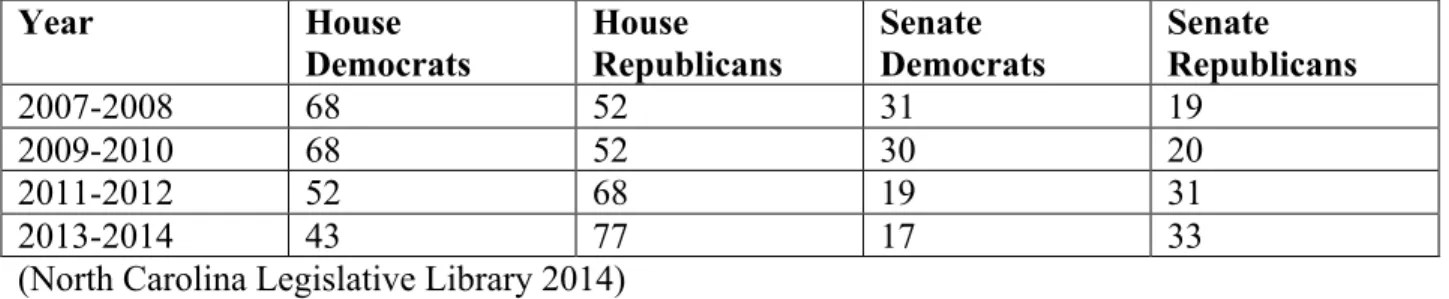
Governors Association 2014). The partisan control of the state government may affect how environmental NGOs interact with legislators and the type of strategies that they utilize.
Table 1: N.C. General Assembly Party Affiliations 2007-2014
Year House
Democrats
House Republicans
Senate Democrats
Senate Republicans
2007-2008 68 52 31 19
2009-2010 68 52 30 20
2011-2012 52 68 19 31
2013-2014 43 77 17 33
(North Carolina Legislative Library 2014)
Positions of the Parties
The national Republican Party platform emphasizes the importance of job creation and continued use of coal-fired power plants, in addition to supporting the development of hydraulic fracturing to increase the exploitation of America’s oil and natural gas reserves. The platform calls for the elimination of environmental regulation on energy sources in favor of “the free market and the public’s preferences to determine the industry outcomes” (Republican National Committee 2012). The N.C. Republican Party platform calls for an energy policy that includes onshore oil and natural gas drilling, explicitly through hydraulic fracturing. It presents a negative attitude on environmental regulation and favors regulation based on cost-benefit analysis.
Additionally, the platform supports the repeal of the state renewable energy mandate (North Carolina Republican Party 2014).
Democratic Party platform calls for environmental protection and emphasizes sustainable and renewable energy sources, though it does not specifically mention its stance on hydraulic fracturing. The platform calls for alternative ways to dispose of chemical and waste byproducts and supports initiatives to protect air and water quality (North Carolina Democratic Party 2012).
As the Democratic Party tends to be more amenable to environmental concerns and the Republican Party generally favors business interests and economic growth over environmental conservation, it is likely that environmental NGOs will have had to adjust their strategies towards influencing the state government. As the General Assembly gradually became more Republican and therefore less likely to achieve favorable environmental outcomes,
environmental NGOs would likely have had to concentrate less on supporting bills that would further environmental conservation and more on attempting to block bills that would potentially harm the environment. The definition of success for environmental NGOs may shift as the partisan environment becomes more hostile towards conservation measures. When faced with a Republican majority, NGOs may need to concentrate on blocking the most environmentally harmful legislation instead of supporting bills that further environmental interests.
--- Here are my two hypotheses:
Hypothesis 1: Lobbying serves as an educational tool for legislators, and the lobbying efforts of
Hypothesis 2: My null hypothesis is that legislative decisions are unaffected by environmental
lobbying. Legislators’ attitudes towards environmental issues such as fracking and coal ash regulation are not influenced by environmental NGOs lobbying efforts.
Once again, I define “better environmental outcomes” as government action that aims to lessen the detrimental effects that human activity causes the natural environment. I expect that environmental NGOs’ lobbying efforts towards state legislators and environmental agencies like the N.C. Department of Environment and Natural Resources will positively influence the
legislation of those bodies. Under Republican leadership this may not mean the passage of bills that include conservation measures, but rather the rejection of bills that increase the likelihood of environmental damage.
IV. Data and Methodology
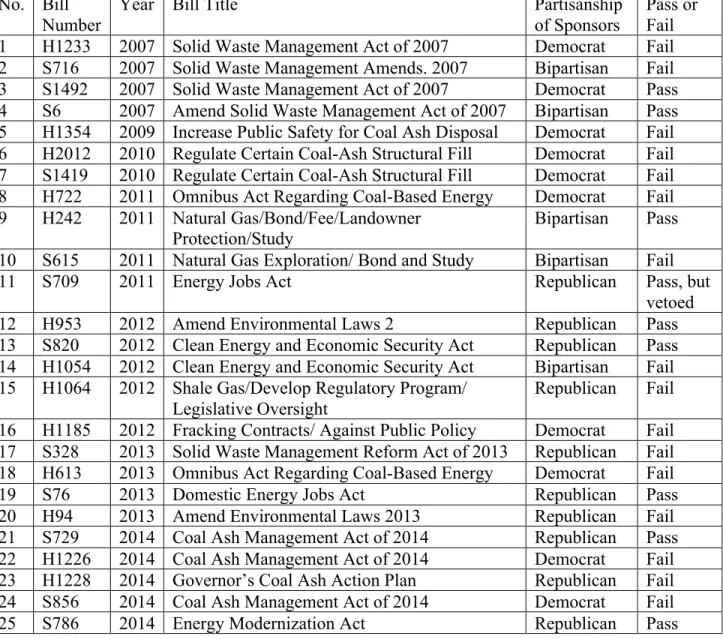
I explore my hypotheses by looking at legislative proposals involving the issues of coal ash and hydraulic fracturing in North Carolina between the years 2007 and 2014. This time span allows me to analyze how the strategies and effectiveness of environmental NGOs changed with the turnover in partisan leadership. I examine the effectiveness of environmental NGOs on influencing government policy towards legislation that affects environmental health through analyzing bills involving coal ash regulation and hydraulic fracturing in North Carolina.
Table 2: Bill Descriptions No. Bill
Number
Year Bill Title Partisanship
of Sponsors
Pass or Fail 1 H1233 2007 Solid Waste Management Act of 2007 Democrat Fail 2 S716 2007 Solid Waste Management Amends. 2007 Bipartisan Fail 3 S1492 2007 Solid Waste Management Act of 2007 Democrat Pass 4 S6 2007 Amend Solid Waste Management Act of 2007 Bipartisan Pass 5 H1354 2009 Increase Public Safety for Coal Ash Disposal Democrat Fail 6 H2012 2010 Regulate Certain Coal-Ash Structural Fill Democrat Fail 7 S1419 2010 Regulate Certain Coal-Ash Structural Fill Democrat Fail 8 H722 2011 Omnibus Act Regarding Coal-Based Energy Democrat Fail 9 H242 2011 Natural Gas/Bond/Fee/Landowner
Protection/Study
Bipartisan Pass 10 S615 2011 Natural Gas Exploration/ Bond and Study Bipartisan Fail
11 S709 2011 Energy Jobs Act Republican Pass, but
vetoed
12 H953 2012 Amend Environmental Laws 2 Republican Pass
13 S820 2012 Clean Energy and Economic Security Act Republican Pass 14 H1054 2012 Clean Energy and Economic Security Act Bipartisan Fail 15 H1064 2012 Shale Gas/Develop Regulatory Program/
Legislative Oversight
Republican Fail 16 H1185 2012 Fracking Contracts/ Against Public Policy Democrat Fail 17 S328 2013 Solid Waste Management Reform Act of 2013 Republican Fail 18 H613 2013 Omnibus Act Regarding Coal-Based Energy Democrat Fail
19 S76 2013 Domestic Energy Jobs Act Republican Pass
20 H94 2013 Amend Environmental Laws 2013 Republican Fail 21 S729 2014 Coal Ash Management Act of 2014 Republican Pass 22 H1226 2014 Coal Ash Management Act of 2014 Democrat Fail 23 H1228 2014 Governor’s Coal Ash Action Plan Republican Fail 24 S856 2014 Coal Ash Management Act of 2014 Democrat Fail
25 S786 2014 Energy Modernization Act Republican Pass
1. DENR to direct a comprehensive solid waste management program, solid waste facilities forbidden in environmentally sensitive and culturally significant areas, no franchise required for coal ash landfills, owner responsible for landfill for the life of the facility, increased penalties for violations of nonhazardous waste, environmental compliance review for applicants and permit holders, required buffer zones between waterways, establish a commission on solid waste management, tax imposed on solid waste; proceeds go towards remediation of orphan landfills and hazardous waste sites. 2. Establish a moratorium on new landfills until further study, DENR to establish a
required for coal ash landfills, financial responsibility requirements for lifetime of solid waste facility, environmental compliance review requirements for applicants, 3-tiered lining for coal ash landfills, response plan with remedial actions in the event of coal ash leaks, Environmental Review Commission to study franchise of solid waste.
3. DENR to direct a comprehensive solid waste management program, DENR to deny applications for solid waste facilities that would violate water quality standards established by the Environmental Management Commission (EMC), threaten
ecologically sensitive or culturally significant areas, or negatively impact minority or low-income communities, no franchise required for coal ash landfills, increased fees for violations involving nonhazardous waste, financial responsibility requirements for permit holders for the lifetime of the facility, environmental compliance review requirements for applicants, 3-tiered lining for coal ash landfills, response plan with remedial action in case of coal ash leaks, required study of environmental impact and local ordinances, required buffer zones between water sources, leachate collection system established, but more stringent requirements do not apply to coal ash landfills, tax imposed on solid waste; proceeds go towards remediation of orphan landfills and hazardous waste sites. 4. The more stringent solid waste management requirements will not apply to landfills
permitted before June 2006 or coal ash landfills, and reimbursement is possible for landfill applicants who applied for permits prior to August 2006.
5. The definition of coal ash “combustion products” is clarified to expand requirements for permitting coal ash combustion products landfills and structural fill facilities, no
combustion products landfills may be constructed or expanded in ecologically sensitive areas, landfills must be covered and have 3-tiered bottom liners, applicants must have emergency response plans, coal ash impoundments are forbidden to be constructed after 2010, and those existing will be monitored and phased out, regulation of coal ash impoundments moves from N.C. Utilities Commission to DENR.
6. Expands the definition of “fully encapsulated” coal ash impoundments and “structural fill,” directs DENR to develop a permit system for the reuse of combustion products in solid waste disposal sites unless the end product is fully encapsulated, and establishes application fees.
7. See 6.
8. Prohibit electric utilities from purchasing coal that was extracted via mountaintop removal, expands the definition of “fully encapsulated” coal ash impoundments and “structural fill,” directs DENR to develop a permit system for the reuse of combustion products in solid waste disposal sites unless the end product is fully encapsulated, establishes application fees, and places a moratorium on the construction of additional non-carbon neutral coal-fired power plants.
9. $5,000 bond fee set for proposed natural gas drilling operations, as well as a $3,000 fee for each well and a $450 fee in case of well abandonment, oil and gas developers must give notice of entry to property owners, surface owners are owed compensation for damages to water supply and personal property, maximum lease term is 10 years, DENR shall conduct an in-depth study of fracking and its potential impacts in the Triassic Basin, and DENR shall hold two public hearings regarding fracking in the Triassic Basin. 10. Raise the bond fee required for natural gas drilling from $5,000 to $10,000; direct DENR
11. Plans to establish an emergency response fund of $500,000,000 from royalties and revenue from offshore and onshore energy production, develop a Governors’ Regional Interstate Offshore Energy Policy Compact between North Carolina, South Carolina, and Virginia in order to direct the Governor to hasten the development of offshore oil drilling, direct DENR and the Energy Jobs Council to develop a comprehensive report on fracking and develop a regulatory framework, and create an Energy Jobs Council to direct
increased energy production in North Carolina.
12. Pushes back the date that the fracking study delineated in S820 would be presented to the Joint Legislative Commission on Energy Policy, and allows for a seven day, rather than a three day, right of rescission for leases of oil and gas rights.
13. Authorizes oil and gas drilling but prohibits the issuance of permits until the development of a regulatory program for fracking, establishes the N.C. Mining and Energy
Commission to issue orders pursuant to the Oil and Gas Conservation Act, determines how members of the N.C. Mining and Energy Commission (MEC) will be selected, orders a Committee on Civil Penalty Remissions from those members, orders that the MEC regulate the lifecycle of oil drilling, protect environmental health, prevent water pollution from drilling activities, collect baseline data, manage fracking waste, and develop emergency protocols, exempts the disclosure of fracking chemicals that are protected as trade secrets, establishes that DENR and the MEC have the authority to conduct inspections, increases daily fines for those who violate the provisions of this bill, the Environmental Management Commission and Commission for Public Health will adopt rules pertaining to fracking regulation, order the study of compulsory pooling, states that the general statute on toxic discharges cannot prohibit the injection of fracking fluid, oil and gas drillers will be presumed liable for water contamination and will be obliged to provide the surface owner with replacement water supply when necessary, landowner’s rights must be presented to the surface owner prior to drilling, pre-drilling testing of water supplies on drilling property is required, property owner has a three-day right of rescission for gas and oil rights, oil and gas drillers must minimize damage to the property owner’s land, and creates a Joint Legislative Commission on Energy Policy to monitor the actions of the MEC.
15. Directs DENR to develop an oil and gas regulatory program, evaluate the efficacy of creating an Oil and Gas Board in lieu of the Environmental Management Commission and Mining Commission, develop recommendations on levels of funding to operate the regulatory program, study fracking’s potential impact on localities, prepare emergency response plans, propose landowner and consumer protections, develop proposals holding drilling operators liable for groundwater contamination, and develop a fracking
permitting process, states that oil and gas drillers will be presumed liable for water contamination, landowner’s rights must be presented to the surface owner prior to drilling, pre-drilling testing of water supplies on drilling property is required, oil and gas drillers must minimize damage to the property owner’s land, delineates increased daily fines for those who violate the provisions of this bill, orders a study of compulsory pooling, and creates a Joint Legislative Commission on Energy Policy to monitor all state agents involved in fracking regulation.
16. Declares fracking a threat to public health and safety and deems contracts conveying the lease of oil and gas rights for the purpose of extraction void and unenforceable, and directs $25,000 to the Department of Justice to study the voided fracking contracts. 17. Extends the duration of sanitary landfill permits for up to 30 years, with limited review
every 5 years, repeals the Solid Waste Management Act of 2007, removes provision that would prohibit the construction of landfills in ecologically or culturally significant areas and floodplains, no franchise is required for coal ash landfills, riparian buffers are required but can be less than 100 feet, landfills are permitted up to 1,500 feet away from national and state-protected land, removes provision stating that landfill leachate lines must be cleaned, landfill covers do not need to be location-specific, more stringent requirements for new landfills do not apply to coal ash, landfill operators no longer have to establish the $2,000,000 cost for potential assessment and corrective action, and solid waste transfer containers are no longer required to be leak-proof.
18. Prohibits electric utilities from purchasing coal that was extracted via mountaintop removal, expands the definition of “fully encapsulated” coal ash impoundments and “structural fill,” directs DENR to develop a permit system for the reuse of combustion products in solid waste disposal sites unless the end product is fully encapsulated, and establishes application fees, places a moratorium on the construction of additional non-carbon neutral coal-fired power plants, and orders a report on the divestment of public funds in any company involved in the extraction of fossil fuels.
20. Prevents disclosure of fracking fluids designated as trade secrets, exempt commissions charged with fracking regulations from preparing fiscal notes, directs the EMC to develop a permitting system for private drinking water wells near contamination sites, and repeals the Mountain Resources Planning Act.
21. Prohibits cost recovery from coal ash spills, the definition of “structural fill” allows for the disposal of coal ash in open pit mines, establishes a Coal Ash Management
Commission, provides for expedited permit review by DENR for coal ash impoundments, invalidates local ordinances that regulate coal ash, sets deadlines for the prohibition of the construction or expansion of new coal ash impoundments, sets deadlines by which Duke Energy must either convert impoundments to dry handling or retire their facilities, creates requirements for groundwater assessment plans and corrective action plans, mandates well surveys and the replacement of contaminated water, creates requirements for assessing and correcting unpermitted discharges, and mandates those discharges be eliminated or permitted, Duke Energy must file annual surface water protection and restoration plans, directs DENR to classify all coal ash impoundments in terms of their risk, Duke Energy must submit impoundment closure plans to DENR, high risk
impoundments must be closed by Dec. 2019, intermediate risk impoundments by Dec. 2024, and low risk impoundments by Dec. 2029, high and intermediate risk
impoundments must be dewatered and converted to industrial landfills with 300 foot buffers from surface waters or moved to a landfill, low risk impoundments must be dewatered to the maximum extend practicable and capped in place, moved to an industrial landfill or be put to beneficial use, mandate structural fill requirements for buffer zones to ensure surface water protection, the Dan River, Riverbend, Asheville, and Sutton plants are to be classified as high risk and closed by August 2019, establishes a partial moratorium on coal ash as structural fill until Aug. 2015, requires that coal ash impoundment operators reports spills into surface water to DENR within 24 hours and dam owners to report to DENR upon the discovery of the need for emergency repairs, and creates new positions within DENR to study and regulate coal ash.
22. Electric utilities cannot recover the costs of the coal ash spills, moratorium established on constructing impoundments starting July 2014 and disposing coal ash into impoundments starting July 2014, after Aug. 2014 ash must be disposed of in permitted landfills or put to beneficial use, owner of impoundment must test water quality within one-half mile boundary of impoundment, impoundments owners must supply potable water to residents when contamination is found, closing impoundments prioritized and classified according to risk, and closed in order of urgency, impoundment owners must remove all ash from impoundments and enclose them in enhanced solid waste landfill on the same property, quarterly reports on status of closures, high risk impoundments must be closed as soon as possible, moratorium on coal ash as structural fill until further study, wastewater systems must report water quality to consumers, high and intermediate hazard dams on coal ash impoundments must have emergency action plans, impoundment owners to inspect dams on coal ash impoundments weekly, and have them inspected by an engineer annually 23. Wastewater systems must report water quality to consumers, wastewater treatment
impoundment operators must submit annual water quality reports to DENR,
impoundments causing water quality violations can either be stopped, captured and regulated with an NPDES permitted outfall, operators can address the discharge with their own proposed plan, or apply for a discharge permit, high and intermediate hazard dams must formulate emergency action plans, owner of impoundment to inspect impoundments weekly, DENR to prioritize closing all impoundments, impoundment owners propose their own closure plans to restore groundwater standards to economically feasible levels, closure may include covering impoundment with a layer of soil, owners must develop 30 year post-closure plans, impoundments are exempted from the Dam Safety Law of 1967, and expedited closure plans developed for the four highest risk impoundments.
24. See 22.
25. Extends the deadline for developing the fracking regulatory program to Jan. 2015, exempts all commissions involved in fracking activities from preparing fiscal notes, DENR and the MEC are authorized to issue fracking permits 61 days after the fracking regulatory program becomes effective, the newly renamed N.C. Oil and Gas Commission (OGC) shall issue annual as opposed to quarterly reports, delineates how members of the OGC will be appointed, makes changes to how members of the N.C. Mining Commission will be appointed, makes the formula for fracking fluid accessible to the state geologist, relevant state agencies, and emergency responders, but not to the public, establishes a drilling fee of $3,000 for the first well and $1,500 for each subsequent well on the same pad, and an abandonment fee of $450 per well, presumptive liability for water
contamination is reduced to a one-half mile radius around a well, developers must provide a million-dollar bond to the state in case of environmental damage, required pre-drilling testing of water supplies around pre-drilling areas is reduced to a one-half mile radius, local ordinances against fracking are declared invalid, though zoning restrictions still hold, the injection of fracking waste into ground or subsurface water is prohibited, an environmental compliance review is required for those seeking a fracking permit,
establishes a severance tax on natural gas and oil obtained from fracking, issues studies on the effect of energy minerals on property taxes, the possibility of constructing a liquefied natural gas export terminal in the state, the effect of energy-related transport on traffic, the possible establishment of an oil and gas drilling education program in
community colleges, the issue of compulsory pooling, the construction of midstream fracking infrastructure, and a long-range statewide energy policy.
Independent Variables
Republican majority at the same time, I combine the two into one measure of overall NCGA partisanship.
Environmental Aggression: Using the last edition of each bill before it either passed or died in committee, I assigned each bill a quantitative measure of the aggressiveness of the sum of its provisions. Aggressiveness is defined as how environmentally favorable or unfavorable a bill is towards coal ash and fracking regulation. The significant provisions of each bill were coded on a 7-point scale of 3 to -3, with positive numbers denoting provisions favorable to environmental health, such as increased studies of the environmental impacts of fracking, and negative numbers denoting provisions unfavorable to environmental health, such as repealing strict requirements for monitoring solid waste landfills.
support or in opposition of a bill, and lobbied hard on it. Lobbying effort was averaged by bill to ascertain the overall effort of each environmental group towards each bill.
Number of Environmental Lobbyists: This is the number of environmental lobbyists that were active in all environmental groups at a given time, gleaned from my interviews and the Lobbyists Registry on website of the N.C. Department of the Secretary of State. This number is specific to each bill to show the exact number of lobbyists that worked on each coal ash or fracking-related bill.
Number of Industry Lobbyists: This is the number of lobbyists employed by industries in the state affiliated with fracking and coal ash, as found on the Lobbyist Directory on the website of the N.C. Department of the Secretary of State. The electric utilities that operate coal ash disposal sites are Duke Energy and the former Progress Energy Carolinas. The companies that have an interest in expanding natural gas production through fracking are the natural gas companies PSNC Energy, Piedmont Natural Gas, Triassic Energy Resources, and Koch
Industries, and the electric utilities that are expanding their natural gas use are Duke Energy and Dominion Resources. The number of industry lobbyists is specific to each bill and varies
according to the year and whether it is coal ash or fracking-related.
congressional roll call voting, particularly concerning non-salient issues (Peoples 2013). Given the similar structure between Congress and state legislatures, campaign contributions are assumed to similarly affect members of the NCGA.
PAC contributions from industrial interests were found on the N.C. State Board of Elections website. The companies associated with fracking that gave campaign contributions through their PACs are Duke Energy, PSNC Energy, Piedmont Natural Gas, Koch Industries, and Dominion Resources. Duke Energy is the only utility currently contributing to coal ash impoundments, and campaign contributions from Duke Energy’s two active PACs were
compiled. The campaign contributions from either the fracking-associated PACs or the coal ash-associated PACs were compiled by year in order to be linked to each specific bill.
Type of Bill: Bills are identified as either being coal ash or fracking-related.
Dependent Variable
Environmental Victory: My dependent variable is the legislative success of the eight environmental groups that lobbied the NCGA between 2007 and 2014. The bills that the
Table 3: Variables by Year
Bill Year NCGA
Partisan- ship Type of Bill Aggression of Bills Enviro. Lobby Effort Number Enviro. Lobbyists Number Industry Lobbyists PAC money (dollars) Enviro. Victory
H1233 2007 Dem Coal 1.67 0 0 7 140,300 No
S716 2007 Dem Coal 1.64 0 0 7 140,300 No
S1492 2007 Dem Coal 1.56 100 1 7 140,300 Yes
S6 2007 Dem Coal -2 0 0 7 140,300 No
H1354 2009 Dem Coal 2.65 5 2 9 262,500 No
H2012 2010 Dem Coal 2 5 2 9 482,250 No
S1419 2010 Dem Coal 2 5 2 9 482,250 No
H722 2011 Rep Coal 2 3.3 2 14 178,500 No
H242 2011 Rep Frack 0.55 -33.3 4 20 265,925 No
S615 2011 Rep Frack 1 5 1 20 265,925 No
S709 2011 Rep Frack -0.57 -100 5 20 265,925 No
H953 2012 Rep Frack 0.33 -50 2 20 497,680 No
S820 2012 Rep Frack 0.16 -90 7 20 497,680 No
H1054 2012 Rep Frack -0.03 -30 4 20 497,680 Yes
H1064 2012 Rep Frack 0.79 -15 2 20 497,680 Yes
H1185 2012 Rep Frack 2.5 2.5 1 20 497,680 No
S328 2013 Rep Coal -1.21 -55 7 10 134,806 Yes
H613 2013 Rep Coal 1.87 8.3 7 10 134,806 No
S76 2013 Rep Frack -0.22 -91.6 9 26 219,936 No
H94 2013 Rep Frack -0.89 -77.5 9 26 219,936 Yes
S729 2014 Rep Coal 0.67 -39.3 9 10 307,000 No
H1226 2014 Rep Coal 2.01 16.4 6 10 307,000 No
H1228 2014 Rep Coal 0.37 -22.8 8 10 307,000 Yes
S856 2014 Rep Coal 2.01 15 5 10 307,000 No
S786 2014 Rep Frack -1.08 -100 9 26 500,450 No
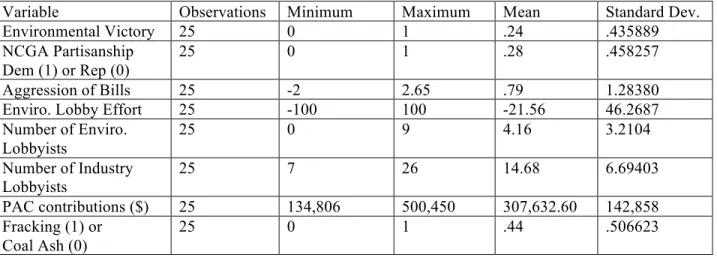
Table 4: Descriptive Statistics for All Variables
Variable Observations Minimum Maximum Mean Standard Dev.
Environmental Victory 25 0 1 .24 .435889
NCGA Partisanship Dem (1) or Rep (0)
25 0 1 .28 .458257
Aggression of Bills 25 -2 2.65 .79 1.28380
Enviro. Lobby Effort 25 -100 100 -21.56 46.2687
Number of Enviro. Lobbyists
25 0 9 4.16 3.2104
Number of Industry Lobbyists
25 7 26 14.68 6.69403
PAC contributions ($) 25 134,806 500,450 307,632.60 142,858
Fracking (1) or Coal Ash (0)
The dependent variable environmental victory in Table 3 shows that there are few instances of legislative successes for environmental groups regardless of legislative session. Out of the 25 bills, only six bills demonstrated success for environmental groups. In Table 4, the mean of environmental victory is .24, demonstrating little overall legislative success for the environmental groups.
The independent variable partisanship of the NCGA has a mean of .28, showing that the NCGA was Republican-majority for most of the time period studied. Environmental aggression has a range of scores from -2, the baseline of environmentally unfavorable bills, to 2.65, the highest score of environmentally favorable bills. The mean score of environmental aggression is .79, designating that the average bill was coded as having provisions slightly favorable to
environmental health. Lobbying effort of environmental groups ranges from -100 to 100, with a mean of -21.56. This negative mean for the average of lobbying effort shows that environmental groups were overall in opposition to the bills. The range of environmental lobbyists is from 0 to 9, with a mean of 4.16. The range of industry lobbyists is from 7 to 26, with a mean of 14.68. This shows that on average, there were about 10 more industry lobbyists at a given time than environmental lobbyists. Monetary influence of industrial interests, measured via PAC
V. Analysis
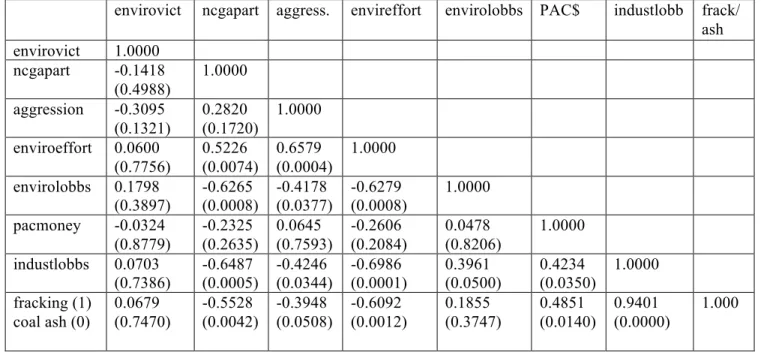
Logistic regression was used to assess the relationship between the dependent variable and the independent variables. Table 5 shows correlations between all variables. Table 6 shows the results of the first logistic regression, and Table 7 shows those of the second.
Table 5: Correlation Matrix for All Variables
envirovict ncgapart aggress. envireffort envirolobbs PAC$ industlobb frack/ ash
envirovict 1.0000
ncgapart -0.1418
(0.4988)
1.0000
aggression -0.3095
(0.1321)
0.2820 (0.1720)
1.0000
enviroeffort 0.0600 (0.7756) 0.5226 (0.0074) 0.6579 (0.0004) 1.0000
envirolobbs 0.1798 (0.3897) -0.6265 (0.0008) -0.4178 (0.0377) -0.6279 (0.0008) 1.0000
pacmoney -0.0324
(0.8779) -0.2325 (0.2635) 0.0645 (0.7593) -0.2606 (0.2084) 0.0478 (0.8206) 1.0000
industlobbs 0.0703
(0.7386) -0.6487 (0.0005) -0.4246 (0.0344) -0.6986 (0.0001) 0.3961 (0.0500) 0.4234 (0.0350) 1.0000 fracking (1)
coal ash (0)
0.0679 (0.7470) -0.5528 (0.0042) -0.3948 (0.0508) -0.6092 (0.0012) 0.1855 (0.3747) 0.4851 (0.0140) 0.9401 (0.0000) 1.000
p-values are given in parentheses
Unexpectedly, no meaningful relationships were found between the dependent variable and any of the independent variables. Such a lack of statistically significant relationships
Table 6: Results of Logistic Regression 1
envirovict Coefficient Standard Error z-value P > | z |
ncgapart -0.1118 1.7737 -0.06 0.950
enviroeffort 0.02916 0.0215 1.35 0.177
envirolobbs 0.3306 0.2686 1.23 0.218
pacmoney 1.7100 4.3200 0.04 0.968
industlobbs 0.1154 0.1265 0.91 0.362
N=25 R-squared=0.1141
Table 7: Results of Logistic Regression 2
envirovict Coefficient Standard Error z-value P > | z |
ncgapart -0.5423 1.2919 -0.42 0.675
aggression -0.5587 0.4035 -1.38 0.166
N=25 R-squared=0.0930
The full model failed to converge on all six independent variables and was unable to be completely determined. The model successfully ran up to five iterations of the log likelihood, but failed on the sixth iteration. This may be attributable to the relatively small number of
observations in the data. It is possible that 25 observations is too small a population size to support a logistic regression with six independent variables.
Therefore, the first regression was run without the aggression variable, and the second regression was run with aggression and NCGA partisanship. However, neither of these models implies that environmental lobbying, when taking into account the aggression of the
environmental bills, the partisanship of the NCGA, and the lobbying strength and monetary influence of industrial interests, has a positive effect on passing environmentally favorable bills. These models support the null hypothesis that legislative decisions are unaffected by
environmentally favorable legislation, there are many possible explanations for this outcome in addition to the null hypothesis.
This lack of relationship may be attributed to the relatively small population of fracking and coal ash bills generated in the NCGA. The time frame 2007-2014 was chosen to account for the change from a Democratic to a Republican majority in both houses of the NCGA, and the 25 bills are the entire population of bills pertaining to coal ash and fracking regulation in that time period. Prior to the partisan turnover in the legislature and the introduction of fracking bills, there were fewer environmental lobbyists active lobbying the NCGA on the bills examined in this thesis. One of the most prominent environmental organizations did not even lobby the NCGA until 2011, as there were fewer environmentally harmful bills to counter. More environmental lobbyists began lobbying the NCGA when environmental groups were playing defense against the Republican-dominated legislature. The number of both environmental and industry lobbyists gradually increased from 2007 to 2014.
Another problem may be present in the dependent variable. The dependent variable environmental victory has very little variation, with only six out of 25 bills demonstrating
legislative success for the environmental groups. Contrary to my hypothesis, environmental groups actually have marginally more legislative successes after the partisan switchover, with five of the environmental victories occurring after 2011. Yet according to representatives from the eight environmental groups who lobbied the NCGA during this time frame, the passage of pro-environmental legislation has declined drastically after 2011 because environmental issues are not a priority for the Republican-majority legislature. While the dependent variable
Additionally, it is plausible that the inclusion of the entire population of fracking and coal related-bills generated in the NCGA from 2007-2014 incorrectly influenced the data with bills that were not very important to the environmental groups. The bill population includes bills that were greatly influential as well as bills that received little to no attention from environmental groups due to their small scope. For example, S716, S6, and H94 were less consequential to environmental groups because they only constitute minor amendments to existing bills. The inclusion of such bills may have lessened the strength of the data with bills into which
environmental groups exerted little effort. Another potentially problematic aspect is the fact that for bills that were widely supported by environmental groups, such as H1354, H2012 and S1419, S615, H1185, and H613, the groups exerted little to no lobbying effort because the bills had no feasible chance of making it through committee without being tabled. For example, one
prominent environmental group drafted H1226 to give the legislature the option of a robust alternative to the Republican’s coal ash bill, yet they did not put forth any lobbying effort on their own bill because they knew it had little chance of getting past committee in the Republican-dominated legislature.
happens in committee is the single most important determinant of success or failure [for a lobbyist]” (1998, 138). Through this pre-roll call voting activity, bills often change drastically from their first version to the final wording that is codified into session law. Both Baumgartner and Leech (1998, 138) and Lowery (2013, 13) caution against treating lobbying influence as a dichotomous variable of whether a policy proposal passes or fails, as I have done in the research design of this thesis. The focus on roll call voting may have contributed to the null finding, as this research design omits other avenues for lobbying influence such as agenda setting and policy formation in committee.
In addition, it is naïve to reduce lobbying effort to a single number. This does not account for bills in which lobbyists supported some of its provisions but heavily opposed others,
particularly in omnibus bills. For example, all environmental groups fully supported that there would be a coal ash management bill after the Dan River spill, but generally opposed S729, the Coal Ash Management Act 2014, because they did not consider its provisions strict enough to avoid further environmental damage. Some groups coded this bill as heavily negative in their lobbying effort due to its unfavorable provisions, while others coded it as positive due to their desire to have a bill regulating coal ash passed. The overall environmental effort for S729
amounted to -39, a measure that may or may not accurately portray the groups’ assessment of the bill.
environmental lobbying effort may be insufficient to quantify the strength of interpersonal
relationships between lobbyists and legislators in direct lobbying, as strong relationships between lobbyists and legislators may require little effort but still be effective to support the lobbyist’s favored legislation. Another lobbyist noted that lobbying is often less about specific bills than about an overall issue and the direction that the lobbyist wants legislators to take on that issue. Lobbyists often furnish legislators with fact sheets and advice about their take on an issue, but this type of effort does not always pertain to a specific bill rather than an environmental issue itself.
VI. Lobbyist Interviews: Strategies of Environmental Lobbyists
The eight environmental groups I interviewed often work together and divide up lobbying work. Some groups focus only on coal ash while others work exclusively on fracking, and others work on both. All of the environmental lobbyists are in-house lobbyists that are a part of the NGOs on behalf of whom they lobby. In contrast, one lobbyist relayed that the majority of industrial lobbyists, such as those who work for Duke Energy, are contracted from external law and lobbying firms. Most environmental groups that I interviewed practiced similar lobbying strategies towards members of the NCGA concerning both coal ash and fracking. All eight groups oppose fracking on the grounds that it cannot be done safely in the state in its current form, but want to ensure that the necessary safeguards are in place in the likelihood that it does happen. All groups agreed that coal ash should be regulated as a hazardous waste and existing impoundments should be relocated and put in safe storage away from water sources.
public and that are outlined in Baumgartner and Leech (1998, 152), including the organization of protests and demonstrations, participation in litigation, conferences with the press, the
endorsement of candidates, the funding of political advertisements, the circulation of petitions, and conduction of campaigns to mobilize public support. The groups’ environmental lobbyists engage in the direct lobbying of legislators, testify at legislative and committee hearings and present research, draft legislation for legislators, and form coalitions with the other
environmental lobbyists.
A point that was continually repeated in interviews with environmental lobbyists was that environmentalists have been on the defensive since the Republican takeover in both houses of the NCGA and the governorship (Refer to Table 1). On top of this ideological divide, the mean number of environmental lobbyists between 2007-2014 is only 4.16, compared to the industrial lobbyists’ 14.68. Industrial interests such as Duke Energy have the personnel and resources to out-lobby the environmentalists. Non-profits do not give campaign contributions on the scale that industrial groups do; industry groups gave an average of $307,632 to members of the NCGA from their PACs across the time period studied. According to several lobbyists, industrial groups hold a large amount of influence in the legislature. One lobbyist reported that legislators in discussion with environmental lobbyists would refuse stricter environmental provisions on a bill because Duke Energy lobbyists had “vetoed” the stricter provisions the environmentalists proposed.
lobbying Republicans is often in vain because many oppose the environmental lobbyists’ viewpoints on principal. One lobbyist specified that with Republicans in charge of both chambers, much of the environmental lobbyists’ work is trying to prevent environmentally harmful bills from ever getting out of committee and coming to a vote. The lobbyist described that for both Democrats and Republicans, lobbyists try to make the environmental issue at hand pertinent to each legislator and specialized to their individual district if possible to show how their voters could be affected. Another lobbyist in a different group specified that their strategy for lobbying Republicans began with finding common ground, such as desiring clean water, and phrasing certain regulations as strictly necessary for public health in order to be considered. The lobbyist related that Republicans are more likely to support hard path measures such as building infrastructure like dams and reservoirs, as opposed to the soft path measures like water efficiency measures. When referring to environmental issues such as water conservation or energy policy, hard path measures refer to centralized infrastructure and technology-driven solutions to increase the supply of a resource, whereas soft path measures focus on decentralization and decreasing the demand for resources (Sovacool 2011). Another lobbyist stated that environmental lobbyists are not the best source to argue for environmentally favorable measures to Republicans, and that business interests who have a stake in environmental protection are more likely to have a
positive effect.
Less attention is focused on Democrats, as the NCGA is so divided that Republicans in power have little incentive to consider the policy preferences of Democrats. The environmental lobbyists collectively stated that part of Republican ideology is lessening governmental
Environmental lobbyists spend less time on Democratic members except to maintain relationships and ensure their continued support, as they are more likely agree with
environmental lobbyists’ policy preferences. One lobbyist relayed that while Democrats have had little power since 2011, lobbyists can go through Democratic legislators to mobilize public support against environmentally detrimental bills. Environmental lobbyists furnish amenable legislators with fact sheets and information about the issues at hand, and draft new
environmental bills and amendments to existing bills for the Democrats to present on the floor. Though more environmentally harmful bills passed than favorable ones, environmental groups may have mitigated some of the potential damage through adding amendments to bills likely to pass. When reflecting on the overall effectiveness of environmental lobbying, a lobbyist from a prominent environmental NGO stated that while environmental lobbyists may not be able to wholly prevent environmentally unfavorable bills from passing, environmental lobbying is effective in ways that are more difficult to quantify. The lobbyist believes that environmental lobbying is effective by helping to push forward environmentally favorable amendments to unfavorable bills when bills are deliberated during committee meetings, and giving legislators agreeable towards their viewpoints talking points during floor debates. The lobbyist holds that environmentally positive amendments signify the effectiveness of the practice, though
VII. Conclusion
This thesis joins the abundance of research on interest group influence that produces null findings of lobbying success. As concluded by Lowery (2013, 19), “Influence – in all its forms – is very complex and hard to observe. At best, our research designs capture only brief snapshots – however important – of influence in democratic systems.” The empirical results of this study do not show that environmental lobbying has a statistically significant effect on the passage of environmentally favorable legislation. However, this null finding may be due to a myriad of factors, including the small population of the 25 bills, the difficulty of quantifying lobbying effort, and the lack of inclusion of legislative activity before roll call voting such as policy changes made in committee. Given the Republican majority in both houses of the NCGA and the governorship, it is likely that smaller environmental victories and “damage control” amendments were prevalent before the bills when to a final vote, but my empirical study does not take this into account. Interviews with environmental lobbyists show that the legislative activity that precedes roll call voting, such as discussions during committee meetings, drafting policy, influencing agenda setting, and one-on-one discussions with legislators may have a positive effect on moving bills in a more environmentally favorable direction, though bills that are generally environmentally unfavorable still pass.
legislature and their greater numbers of lobbyists than those of environmental groups. Further studies should seek to investigate not only whether or not environmental lobbying brings about environmentally favorable legislation, but also how this can be done more effectively to counter the greater influence of industrial groups.
I have several recommendations to improve future study of this topic, stemming from my experience and findings during this thesis. First, given the small population of coal ash and fracking bills during 2007-2014, the time period under consideration should be expanded to allow for the inclusion of more bills. Extending the time frame back in time and up until the present would still account for the partisan turnover that occurred in 2011. Second, the
environmental issues at hand could be expanded to include more than coal ash and fracking in order to increase the population size of the bills and to gain a more inclusive view of
VIII. Reference List:
Andrews, Kenneth T., and Bob Edwards. 2004. "Advocacy Organizations in the U.S. Political Process." Annual Review of Sociology. 30: 479-506.
Baumgartner, Frank R., and Beth L. Leech. 1998. Basic Interests. Princeton: Princeton University Press.
Chepesiuk, Ron. 1994. “The Environmental Lobbying Game: Who Plays It on Capitol Hill and How.” Environmental Health Perspectives. 102(8): 640-642.
Democratic National Committee. 2012. “2012 Democratic Platform.”
http://www.democrats.org/democratic-national-platform (December 4, 2014). Dreiling, Michael, Nicholas Lougee, and Tomoyasu Nakamura. 2008. "Environmental
Organizations and Communication Praxis: A Study of Communication Strategies Among a National Sample of Environmental Organizations." Organization and Environment. 21(4): 420-445.
Friehe, Tim. 2013. “The Role of Investment in Environmental Lobbying Contests.” Environmental and Resource Economics. 56: 337-352.
Gabriel, Trip. 2014. “Ash Spills Shows How Watchdog Was Defanged.” The New York Times, February 28.
http://www.nytimes.com/2014/03/01/us/coal-ash-spill-reveals-transformation-of-north-carolina-agency.html?_r=0 (March 12, 2015).
Grossmann, Matt. 2006. "Environmental Advocacy in Washington: a Comparison with Other Interest Groups." Environmental Politics. 15(4): 628-638.
Hall, Richard L., and Alan V. Deardorff. 2006. “Lobbying as Legislative Subsidy.” The American Political Science Review. 100(1): 69-84.
Intergovernmental Panel on Climate Change. 2014. “Summary for Policymakers.” Climate Change 2014: Synthesis Report.
http://www.ipcc.ch/pdf/assessment-report/ar5/syr/SYR_AR5_SPMcorr2.pdf (March 12, 2015).
Lowery, David. 2013. “Lobbying Influence: Meaning, measurement, and missing.” Interest Groups and Advocacy. 2(1): 1-26.
Moskowitz, Peter. 2014. “North Carolina Senate passes pro-fracking bill.” Aljazeera America, May 22. http://america.aljazeera.com/articles/2014/5/22/fracking-north-carolina.html (December 4, 2014).
National Governors Association. 2014. “North Carolina: Past Governors Bios.”
http://www.nga.org/cms/home/governors/past-governors-bios/page_north_carolina.html (December 4, 2014).
North Carolina Democratic Party. 2012. “2011-2012 Platform.”
http://www.ncdp.org/sites/ncdems/files/2012NCDPPlatform.pdf (December 4, 2014). North Carolina Legislative Library. 2014. “N.C. General Assembly Party Affiliations.”
http://ncleg.net/library/Documents/GAPartyAffiliations.pdf (December 4, 2014). North Carolina Republican Party. 2014. “2014 Platform.”
http://www.ncgop.org/wp-content/uploads/2014/06/Platform-2014.pdf (December 4, 2014).
Peoples, Clayton D. 2013. “Campaign Finance and Policymaking: PACs, Campaign
Contributions, and Interest Group Influence in Congress.” Sociology Compass. 7(11): 900-913.
Polk, Andreas, and Armin Schmutzler. 2005. “Lobbying against environmental regulation vs. lobbying for loopholes.” European Journal of Political Economy. 21(4): 915-931. Republican National Committee. 2012. “2012 Republican Platform.”
https://www.gop.com/platform/ (December 4, 2014).
Shoichet, Catherine E. 2014. “Spill spews tons of coal ash into North Carolina river.” CNN, February 9. http://www.cnn.com/2014/02/09/us/north-carolina-coal-ash-spill/ (December 4, 2014).
Sovacool, Benjamin. 2011. “Hard and soft paths for climate change adaptation.” Climate Policy. 11(4): 1177-1183.
Szarka, Joseph. 2013. "From Climate Advocacy to Public Engagement: An Exploration of the Roles of Environmental Non-Governmental Organisations." Climate. 1(1): 12-27.