Identifying and Addressing Heirs Property:
A Case Study of Wake County, North Carolina
Catherine T. Bartels
A Masters Project submitted to the faculty of the University of North Carolina at Chapel Hill
in partial fulfillment of the requirements
for the degree of Master of City and Regional Planning in the Department of City and Regional Planning
Chapel Hill 2012
Abstract
Catherine T. Bartels: Identifying Heirs Property: A Case Study of Wake County, North Carolina
(Under the direction of William Rohe)
If a property owner dies without a will in the United States, their property becomes known as heirs property. Heirs property is a significant legal issue for
Acknowledgements
A special thanks to the helpful people that assisted with my research on this project: Melanie Allen, Conservation and Diversity Coordinator, Conservation Trust for North
Carolina
Ray Aull, Planner II, City of Raleigh
Craig Baab, Senior Fellow, Alabama Appleseed Center for Law and Justice Chris Brook, Staff Attorney, Southern Coalition for Social Justice
Table of Contents
List of Tables ... vi
Introduction ... 1
Literature Review ... 3
Chapter 1: Prevalence of Heirs Property in Wake County, NC ... 5
Introduction to this Study ... 5
Methodology... 6
Results and Analysis ... 10
Dispersion of Heirs Property Throughout Wake County ... 10
Characteristics of Heirs Property ... 14
Summary of Statistical Analysis ... 24
Chapter 2: Policy Solutions for Government Officials and Planners ... 26
Existing Policy Solutions ... 26
Preventative Measures – Will Creation ... 26
Education and Awareness... 26
Creation of an LLC or Family Land Trust ... 27
Obtaining Clear Title ... 28
Support of Future Legislation ... 28
Proposed Policy Solutions ... 28
Uniform Partition of Heirs Property Act... 29
Amendment to the Disaster Relief and Emergency Act ... 30
Modifications to the Road Home Relief Act ... 31
Tenancy-In-Common Policies outside of the United States... 31
Conclusion ... 32
List of Tables
Table 1. Conclusive and Semi-Conclusive Indicators……….………..……….…….9
Table 2. Dispersion of Heirs Property throughout Wake County……….……….10
Table 3. Total Heirs Property by Township……….………12
Table 4. Cost per Acre for Property by Township ... 17
List of Figures or Illustrations
Figure 1. Graph of Clustered Value Significance ... 12
Figure 2. Heirs Property in Wake County ... 13
Figure 3. Land Use of Heirs Property in Wake County, by Percentage ... 15
Figure 4. Land Use of all Property in Wake County, by Percentage ... 16
Figure 5.Heirs Property Size and Value compared to Neighboring Property ... 19
Figure 6. Percentage of Population which is Black, Wake County……….22
Figure 7. Percentage of Black Population in Raleigh... 23
Figure 8. Townships in Wake County………..37
Figure 9. Heirs Property, Barton Township………38
Figure 10. Heirs Property, Buckhorn and Holly Springs Townships... 39
Figure 12. Heirs Property, Little River Township ... 40
Figure 13. Heirs Property, Marks Creek Township ... 40
Figure 14. Heirs Property, Neuse, House Creek, and Leesville Townships ... 41
Figure 15. Heirs Property, New Light Township ... 41
Figure 16. Heirs Property, Panther Branch and Middle Creek Townships ... 42
Figure 17. Heirs Property, Raleigh and Meredith Townships ... 42
Figure 18. Percentage of Households that are Renter Occupied, Wake County ... 43
Figure 19. Percentage of Households that are Renter-Occupied, Raleigh area ... 44
Figure 20. Percentage of Households which are Vacant, Wake County ... 45
Figure 21. Percentage of Households which are Vacant, Raleigh area ... 46
Figure 22. Median Age of Population, Wake County ... 47
Introduction
In 1910, African American families across the country owned 15 million acres of property. By 1997, that number had fallen to 2.4 million (Federal of Southern
Cooperatives Land Assistance Fund). One of the primary causes of this reduction in land was unstable property ownership in the form of heirs property.
Heirs property, also known as tenancy-in-common property, is real property that is owned by family members who are descendants of an original, deceased owner who did not have a will. Over generations, if additional descendants do not leave wills, the number of descendants (and property owners) can become unwieldy. Hundreds of people may own one piece of property.
Heirs property is highly unstable. Heirs property owners are more vulnerable to losing their property through tax liens, forced partition, or family disagreements than any other type of land owner (Land Loss Prevention Project 2005). In addition, because no one owner of heirs property retains clear title to the land, co-tenants do not enjoy most of the benefits of property ownership, such as unilaterally deciding when and how to sell land, receiving aid from FEMA or USDA in the case of a disaster, and using the equity in their home to take out college or small business loans.
In the United States, heirs property ownership is especially common among African-American families in the southeast. After the Civil War, African-American families were finally able to buy and own property in the United States. However, these early black landowners often encountered discrimination, intimidation and other
left wills. When the property owner died, one of their descendants would stay on the land and live in the house, usually through verbal agreement.
Today, while one descendant may live in a house or pay property taxes, dozens of descendants own a “share” of that land. Each descendant who owns a share of an heirs property is known as a co-tenant. Regardless of the size of a co-tenant‟s share, how long they‟ve owned that share, whether they live on the land, or pay property taxes, all co-tenants have the same property rights. These rights include being able to sell one‟s share to anyone, even a non-family member; being able to bequeath their share in a will; and being able to file a lawsuit petitioning a court to partition the property (National Conference of Commissioners on Uniform State Laws 2010). This means that anyone with an ownership stake, even a non-family member, can demand that an entire property be sold. Because the property must be sold immediately after a partition order is given, this often results in the property being sold at fire-sale prices at a public auction. In contrast, a shareholder who owns one piece of company stock cannot demand that the entire company be sold so he can recover his investment. Yet, this is the process that plays out frequently through heirs property law.
For two-thirds of American homeowners, their home is their biggest asset (Homeownership 2003). Most U.S. housing policies that subsidize home mortgages and the issuance of long-term, fixed-rate mortgages, champion homeownership and
access the equity in their homes and property. This lack of access to capital leaves them further marginalized and dispossessed.
While most policymakers agree that heirs property policy creates problems for individuals, few realize the significant issues that it creates for other property owners, whole neighborhoods, and the entire municipalities. Because heirs property deeds usually remain under the name of a deceased owner (and not under the name of the current owners), it is difficult to identify heirs property, and therefore, it is difficult to assess its impact on a region (Dyer, Bailey, & Van Tran 2009). The first part of this paper aims to use a quantitative methodology to identify heirs properties in Wake County, NC, and then provide an analysis of these properties to assess the impact on Wake County. The second part of this paper looks to cover current resources and policies available to communities, planners, and elected officials that seek to mitigate the impact of heirs property.
Literature Review
Academic literature of heirs property has well established the impediments to wealth and rights encountered by individual heirs property owners (Chandler 2005, Geisler 1995, Mitchell 2001). Much of the literature also recognizes heirs property as an issue among African Americans and black landowners (Clark 2005, Dyer & Bailey 2008, Geisler 1995, Reid 2003).
community redevelopment and raises costs for local governments, and Rowland (2011) offers a comprehensive look at existing zoning, planning, and policy strategies to help combat rural gentrification, these articles do not cover community-level impacts as their primary focus.
While discussions of heirs property policy and problems generate a bulk of the literature, some literature has used systematic methods to study heirs property. A study by Tinubu and Hite showed that heirs property owners in South Carolina are more likely to have lower incomes, less education, and are more likely to be older and African-American (1978). Other quantitative studies have focused on proving the disparity of land value price between market value and forced sale value (Mitchell, Malpezzi, & Green 2010) or that rural land that was heirs property was less likely to be used for commercial agriculture production (Zabawa 1991). Deaton (2005) used a survey method in Kentucky to conclude that heirs property owners are the most likely to state their form of property ownership limited their ability to use their property.
However, the literature does not address a systematic method for assessing the quantity and location of heirs property. This gap is partially addressed by Dyer, Bailey and Van Tran (2009) in their study of Macon County, Georgia. The authors studied property tax records to identify heirs property that was labeled “heirs,” and then created an initial study of the characteristics of these properties. However, this study did not address methods by which to find other properties which were likely to be heirs property, but were not listed as such. At the end of their study, Dyer, Bailey and Van Tran
Chapter 1: Prevalence of Heirs Property in Wake County, NC
Introduction to this Study
Many scholars have attempted to categorize the amount of heirs property without the benefit of systematic methods. As Dyer, Connor, and Van Tran note, “The literature on heirs property speaks in broad terms, with some authors offering estimates of between one-third to one-half of all land owned by African Americans being heirs property. However, these estimates are made without the careful and often tedious examination of court house or property tax records necessary to document the true extent of heirs property” (2009, p. 193). More systematic study is needed to more accurately assess the number of families affected and implications to the region. The first part of this study attempts to categorize the prevalence of heirs property in Wake County, North Carolina.
Wake County, North Carolina sits in the middle of the “Black Belt” in the American southeast (Dyer, Bailey, & Van Tran 2009, Rowland 2011). It is in the
decreased in comparison to the rest of the population in Wake County; in 1940, African-Americans made up 33.6% of the population in the county, but in 2010, they made up only 20.7% (1940, 2010 Census Data). However, as we have seen from the literature review, the presence of an African-American population is an important correlation to the presence of heirs property.
This study of heirs property in Wake County differentiates between properties that are „almost certainly‟(conclusive) heirs property, and properties that are
„likely‟(semi-conclusive) heirs property. This differentiation is established by studying Property Tax Records of Wake County, and matching property tax records with
conclusive and semi-conclusive indicators that I created. Then, I compared the dispersion and characteristics of these properties to understand where heirs property occurs, how it differs from non-heirs property, and what these differences mean for neighborhoods and government officials in Wake County.
Methodology
All of the property tax information in this report was downloaded from the Wake County website in September 2011 (last updated August 2011). This property tax
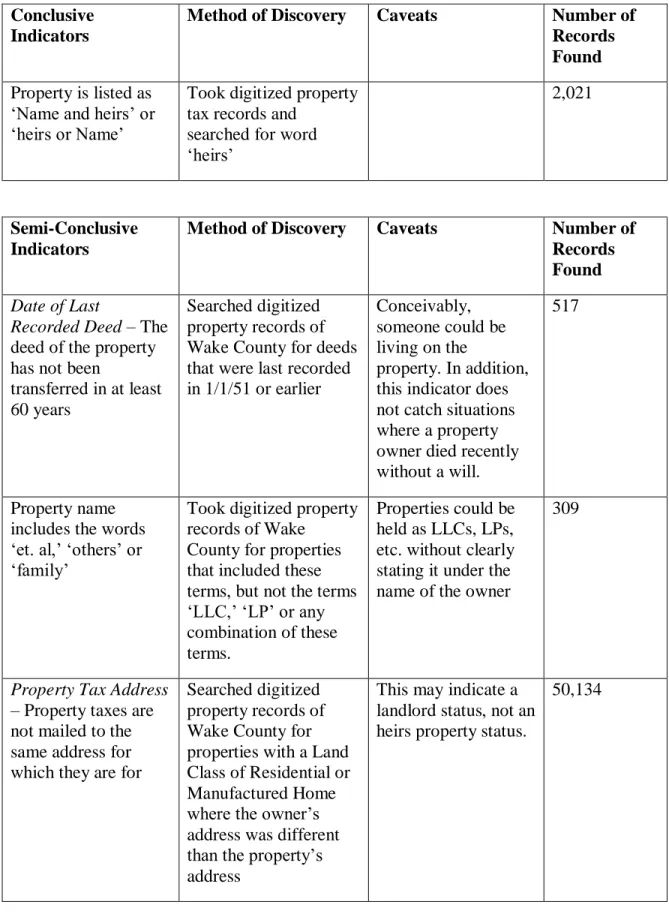
Heirs property in this analysis were broken into two levels that I created: conclusive heirs property, and semi-conclusive heirs property (See Table 1). For conclusive indicators, I looked for properties where the property owner was listed as „heirs of __‟ or „__ family heirs.‟ Then, I limited the search so that property owners with the words „LLC,‟ „LP‟ or „Limited Partnership‟ would be excluded, as these words denote that a property could not be heirs property.1 This search returned 2,021 properties out of 325,278 in Wake County.
Next, I identified three semi-conclusive indicators. If a property met at least two indicators, I determined that it was likely to be heirs property. The first indicator was the date of the last recorded deed. One characteristic of an heirs property is that the deed of the property is not transferred, leaving the property under the name of a deceased, previous owner (Dyer, Bailey, & Van Tran 2009). Thus, deeds that have not been transferred in a long time (for the purposes of this analysis, 60 years) have an increased likelihood of being heirs property. This indicator, however, has some margin of error, as a property owner either could have owned the property for more than 60 years, which would overestimate the amount of heirs property; or could have died quite recently, which would underestimate the amount of property. When I searched for properties that hadn‟t been transferred since 1/1/1951, the search returned 517 properties.
The second semi-conclusive indicator was presence of the words “et. al,” or “others” under the name of the owner. These words both denote that there are multiple property owners, another indicator of heirs property. Again, I searched for these words
only in property tax entries that did not contain the words „LLC‟, „LP‟, or any variant of these words, which would indicate that the property was not held as a
tenancy-in-common. This search returned 309 properties in Wake County.
The third semi-conclusive indicator was the presence of a non-resident owner. In order to eliminate properties where a resident owner was not possible (undeveloped and commercial land), the search was limited to properties which contained either a single family home or a mobile home. Because heirs property have multiple owners responsible for its upkeep, property taxes that are mailed to someone that does not live in the home can be an indicator of heirs property. However, as this indicator also catches owners of residential investment properties, it is the least likely indicator of heirs property and has the largest room for error. This search returned 50,134 properties in Wake County.
Table 1. Conclusive and Semi-Conclusive Indicators
Conclusive Indicators
Method of Discovery Caveats Number of
Records Found Property is listed as
„Name and heirs‟ or „heirs or Name‟
Took digitized property tax records and
searched for word „heirs‟
2,021
Semi-Conclusive Indicators
Method of Discovery Caveats Number of
Records Found Date of Last
Recorded Deed – The deed of the property has not been
transferred in at least 60 years
Searched digitized property records of Wake County for deeds that were last recorded in 1/1/51 or earlier
Conceivably, someone could be living on the
property. In addition, this indicator does not catch situations where a property owner died recently without a will.
517
Property name includes the words „et. al,‟ „others‟ or „family‟
Took digitized property records of Wake
County for properties that included these terms, but not the terms „LLC,‟ „LP‟ or any combination of these terms.
Properties could be held as LLCs, LPs, etc. without clearly stating it under the name of the owner
309
Property Tax Address – Property taxes are not mailed to the same address for which they are for
Searched digitized property records of Wake County for properties with a Land Class of Residential or Manufactured Home where the owner‟s address was different than the property‟s address
This may indicate a landlord status, not an heirs property status.
Results and Analysis
Dispersion of Heirs Property Throughout Wake County
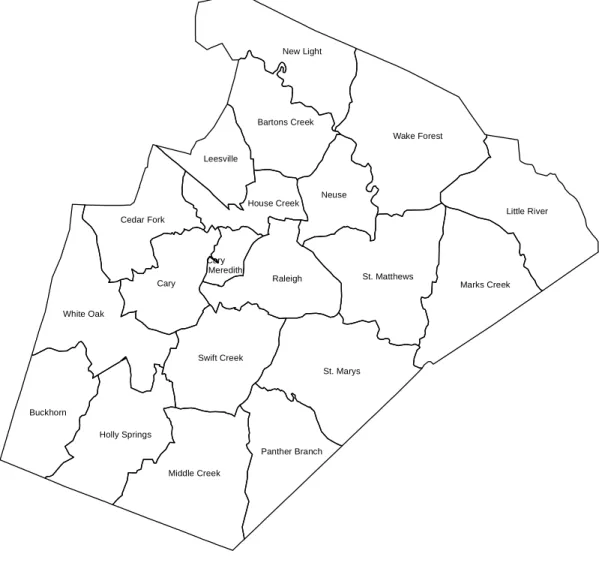
Although the previous section tells us how much heirs property exists in Wake County, it is important to understand where that property is located in the county. In order to look at the county in smaller parcels, I broke the county down into townships (See Appendix A, Figure 7). Then, I calculated the percentage of heirs property in the township (as compared to the total number of properties in that township) and the percentage of Wake County heirs property in that township (See Table 2).
In the county overall, 0.66% of all properties were identified as conclusive or semi-conclusive heirs property. Within townships, the percentage of heirs property ranged from 2.08% of all properties in Little River township, to 0.16% of all properties in Leesville township (See Table 2). 279 non-heirs properties could not be associated with a specific township due to lack of information on property tax records.
When considering which township had the most overall heirs property, greater stratifications emerged (See Table 2). For example, while only 1.36% of all properties in Raleigh township are heirs property, 20.27% of heirs property in Wake County is in Raleigh township. St. Mary‟s township comes in second with 13.73% of heirs property in Wake County. For a detailed map of heirs property in each township, see Appendix B.
A third way to view distribution of heirs property is by total acreage (See Table 3). Predictably, rural townships will have higher acreage for each heirs property. Thus, Little River had the highest total acreage of heirs property at 1009.1 acres. Marks Creek and St. Matthews had 952.4 and 947.8 acres of heirs property, respectively, while Raleigh
Table 2. Dispersion of Property Throughout Wake County
In order to further observe the dispersion of heirs property values, I ran an Average Nearest Neighbor analysis in ARC-GIS to see if dispersion was clustered or random. This analysis showed that heirs properties were highly clustered, given a p-values of 0.00000 and a z-score of -38.68928 (see Figure 1).
Township No. of Semi-Conclusive Heirs Properties No. of Conclusive Heirs Properties Total Prop. in County Percentage of Heirs Property out of total properties in township
Percentage of Heirs Property out of total Heirs Property in Wake County
Bartons Creek
0 37 8941 0.41% 1.73%
Buckhorn 5 33 1922 1.98% 1.77%
Cary 8 68 25263 0.30% 3.55%
Cedar Fork 0 33 13425 0.25% 1.54%
Holly Springs
10 77 14237 0.61% 4.06%
House Creek 0 44 18360 0.24% 2.06%
Leesville 0 23 14561 0.16% 1.07%
Little River 9 135 6937 2.08% 6.73%
Marks Creek 5 126 9716 1.35% 6.12%
Meredith 0 26 3870 0.67% 1.21%
Middle Creek 10 124 19455 0.69% 6.26%
Neuse 3 65 21228 0.32% 3.18%
New Light 2 50 4101 1.27% 2.43%
Panther Branch
1 51 9752 0.53% 2.43%
Raleigh 35 399 31870 1.36% 20.27%
St. Marys 8 286 24248 1.21% 13.73%
St. Matthews 6 121 25950 0.49% 5.93%
Swift Creek 4 89 17274 0.54% 4.34%
Wake Forest 10 150 27257 0.59% 7.47%
White Oak 4 84 26632 0.33% 4.11%
Table 3. Total Acres of Heirs Property by Township
Township Total Heirs Property (in acres)
Bartons Creek 415.6
Buckhorn 139.7
Cary 55.6
Cedar Fork 170.5
Holly Springs 231.7
House Creek 32.1
Leesville 40.5
Little River 1009.1
Marks Creek 952.4
Meredith 33.6
Middle Creek 838.2
Neuse 48.0
New Light 657.8
Panther Branch 538.6
Raleigh 156.9
St. Marys 646.9
St. Matthews 947.8
Swift Creek 561.5
Wake Forest 832.8
White Oak 403.7
Unacct. Prop. 0
Total Acres 8713.02
Figure 2. Heirs Property in Wake County
Cary
St. Marys
Wake Forest
White Oak
Little River
Raleigh New Light
Middle Creek
St. Matthews Neuse
Buckhorn
Marks Creek
Swift Creek
Holly Springs Cedar Fork
Bartons Creek
Panther Branch Leesville
House Creek
Meredith Cary
Legend
Township Boundary Conclusive Heir Property Semi-Conclusive Heir Property
Characteristics of Heirs Property
Land Use
Literature on heirs property has noted that heirs property is often rural farmland (Land Loss Prevention Project 2005, Mitchell 2001). However, most of this evidence is anecdotal. Knowing land use is important to communities for several reasons. First, land that lies fallow without being used or developed reduces property taxes. It also fails to generate income for owners, reducing personal income and income tax. In urban areas, vacant land or buildings decreases community cohesion and is associated with higher crime (Taylor, Shumaker, & Gottfredson 1985). When analyzing land use of heirs property in Wake County, I looked at two different measures: If the land was developed at all (contained a building) and the classified zoning use of the land. I then compared this data to all property in Wake County.
I determined which properties contain buildings by comparing properties which contain a Tax Assessed Value for Building Value greater than zero (0) to those properties where the building value was zero. I was thus able to reasonably approximate which properties contain development and which are undeveloped/vacant/do not contain a building. This analysis showed that 62.3% of all heirs property was developed/contained a building, but 85.2% of all property in Wake County was developed/contained a
building. Thus, heirs property is less likely to be developed.
0.79% of all properties are zoned this way. Other property types overrepresented by heirs property as compared to all property include Manufactured Homes and Floriculture – Farm. This data reinforces the anecdotal idea that heirs property is less likely to be developed, more likely to be vacant, and more likely to be farmland than other property.
Figure 4. Land Use of all Property in Wake County, by Percentage
Value
Table 4. Cost per Acre for Property by Township
Township Ave. Cost per Acre of HP
Ave. Cost per Acre of all Prop.
Difference ($)
Difference (%)
Bartons Creek $42,242 $74,978 $(32,736) -44%
Buckhorn $18,086 $16,062 $2,024 13%
Cary $138,370 $179,614 $(41,244) -23%
Cedar Fork $119,207 $156,581 $(37,374) -24%
Holly Springs $31,554 $56,020 $(24,466) -44%
House Creek $133,192 $212,793 $(79,601) -37%
Leesville $79,625 $137,642 $(58,017) -42%
Little River $15,088 $18,842 $(3,753) -20%
Marks Creek $19,117 $25,024 $(5,907) -24%
Meredith $227,652 $167,258 $60,394 36%
Middle Creek $28,681 $43,571 $(14,890) -34%
Neuse $131,519 $169,871 $(38,352) -23%
New Light $20,722 $39,147 $(18,425) -47%
Panther Branch $16,760 $29,596 $(12,836) -43%
Raleigh $305,216 $339,664 $(34,447) -10%
St. Marys $29,994 $52,261 $(22,266) -43%
St. Matthews $36,270 $68,757 $(32,487) -47%
Swift Creek $46,755 $94,119 $(47,365) -50%
Wake Forest $29,985 $65,112 $(35,127) -54%
White Oak $55,619 $116,645 $(61,025) -52%
Unacct. Prop. N/A
Total $76,283 $103,178 $(26,895) -31%
With few exceptions, the cost per acre of non-heirs property land in each township was valued significantly higher than the heirs property land in that township. The average cost differential was $26,895 per acre, and the average percentage differential was 31%.
rural heirs property is more likely be valued lower because of its location, and not necessarily due to its status as heirs property.
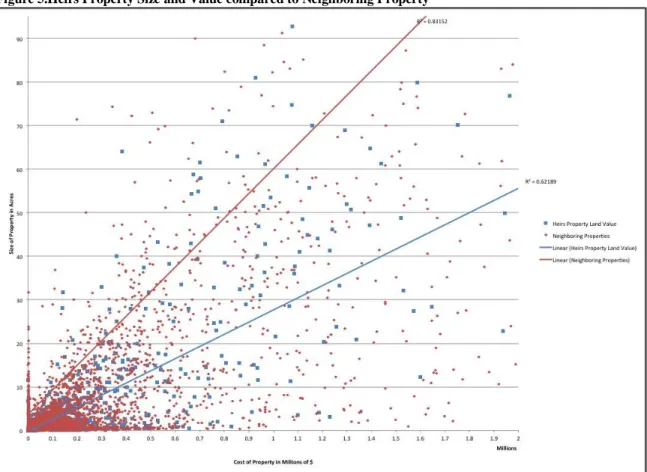
In order to see if we could observe a lower land value simply due to status as heirs property, I used the „intersect‟ function in ARC-GIS to identify properties that shared a border with an heirs property (either semi-conclusive and conclusive). Then, I ran the land price comparison of price per acre again, using these neighboring properties instead of all of Wake County. When using this comparison, heirs properties were valued at an average of $38,142 per acre, while neighboring properties were valued at an average of $48,834 per acre (an increase of 28%), and all properties in Wake County were valued at an average $84,740 per acre (an increase of 122%). When comparing all heirs property value and neighboring property values, linear trendlines for both heirs properties and neighboring properties show that a formula can be used for neighboring Properties, where x equals the cost of the properties in millions of dollars, and Y equals the size of the property in acres. This formula has an R2 value of 0.83152, which shows a strong relationship. Heirs property, however, has a linear trendline with the formula , with an R2 value of 0.62189, or a moderate correlation. Although these trendlines don‟t exactly match the trends of the data,
Figure 5.Heirs Property Size and Value compared to Neighboring Property
status as heirs property. If this analysis used market value and not tax assessed value, I could see how legal complications in acquiring heirs property would lower land values. However, as this analysis does not use market value, this is unlikely. Another explanation could be that status as heirs property changes the tax assessor‟s assessment. However, I have no evidence that this is the case and I do not think that this explanation is very likely. A third explanation could be that because heirs property suffers from the „tragedy of the anti-commons‟ (Deaton, 2005). This theory posits that co-tenants don‟t invest money in their property for maintenance and upkeep, etc., because they don‟t see a rise in the value of their property share proportional to investment into a „common pool‟ resource (Deaton, 2005). In any case, the simple fact that heirs property is valued less than even the
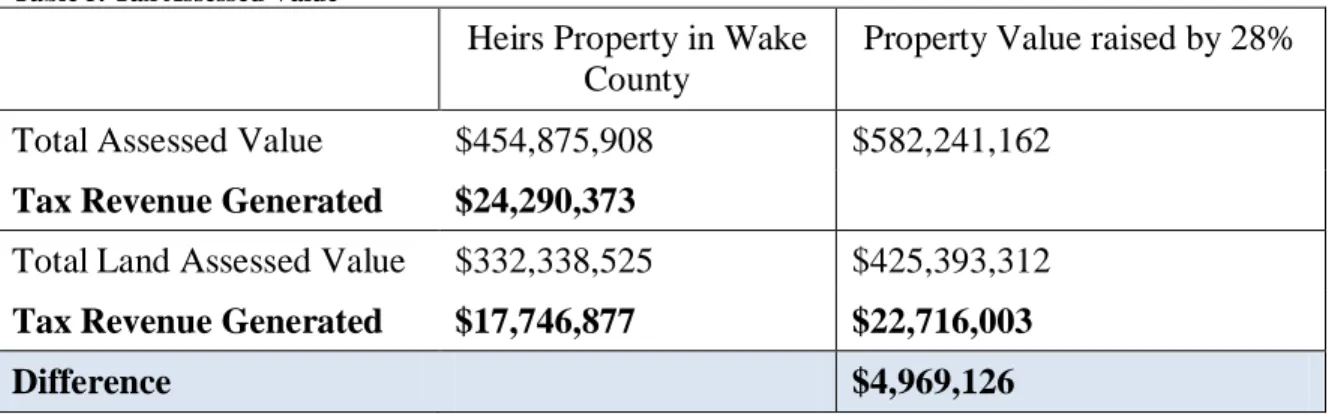
translate into lower tax revenue for municipalities, and lower land values for surrounding properties. In Wake County, heirs property has a total Tax Assessed Value of
$454,875,908, including a total land assessed value of $332,338,525. As of 2011, Wake County charged a property tax rate of 5.34% of tax value. If we assume that heirs
property land is undervalued by at least 28%, this translates to over 4.9 million dollars of lost tax revenue (See Table 5). This is a staggering figure, considering that this number assumes a conservative decrease in value for heirs property land, and does not account for possible decreases in building value or lost revenue in the form of lower rates of development or additional income. If we assume that the total tax assessed value (land + buildings) is also devalued by 28%, this becomes over 6.8 million dollars of lost tax revenue in 2011.
Table 5. Tax Assessed Value
Heirs Property in Wake County
Property Value raised by 28% Total Assessed Value $454,875,908 $582,241,162
Tax Revenue Generated $24,290,373
Total Land Assessed Value $332,338,525 $425,393,312 Tax Revenue Generated $17,746,877 $22,716,003
Difference $4,969,126
Size
Race
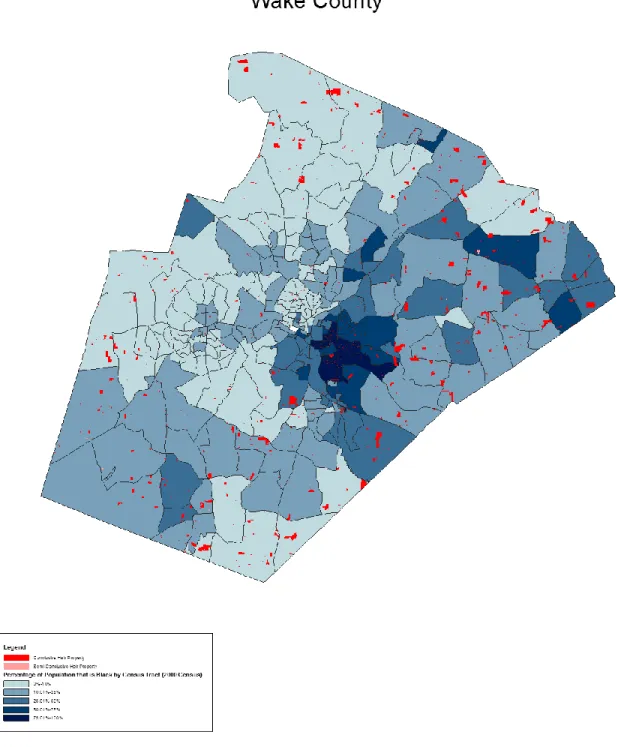
Today, heirs property is often thought of as a „black issue‟ that primarily affects the American Southeast (Federal of Southern Cooperatives Land Assistance Fund, Geisler 1995, Lewan, Barclay, & Allen 2010, Mitchell 2001). Heirs property loss is sometimes even referred to as “African-American land loss.” Most of this evidence is anecdotal; practitioners who deal with land loss prevention most often work with African American families. All quantitative research that has been done in the American
Figure 7. Percentage of Black Population in Raleigh
Other factors
In an attempt to identify other factors that characterize heirs property, median age, percent renter-occupied, and percentage of households that were vacant were also
considered (See Appendix C). While there was a correlation between vacancy and heirs property, it was not great enough to be statistically significant. However, I have
Summary of Statistical Analysis
This analysis allows us to draw several conclusions about heirs property in Wake County. Heirs property occurs more frequently in urban areas, like Raleigh township. However, it makes up a larger percentage of land (in both percentage of all properties and total acres) in the townships farthest away from the urban core (Little River and
Buckhorn). In terms of land use, heirs property is more likely to be classified as vacant or agricultural land, and is less likely to be developed. Thus, heirs property, in general, has lower property tax values because of the lack of a building on the property. In addition, higher levels of vacancy mean that the land is not contributing towards the economic development of the region. In urban areas, increased vacancy is also associated with higher levels of crime, lower community safety and less community engagement, which further hurts a community (Jacobs 1961, Taylor, Shumaker, & Gottfredson 1985). In terms of land value, heirs property is also located in poorer areas of the county. Even within these regions, the property that neighbors heirs property is valued higher than heirs property itself. These lower property values hurt co-tenant owners as well as local
Chapter 2: Policy Solutions for Government Officials and
Planners
The data analysis in the first part of this report shows how heirs property can impact communities as well as individuals. Communities need to take proactive steps to minimize heirs property. The information contained in this report will help Wake County planners and non-profit groups target communities with higher levels of heirs property for education and legal aid work. While current heirs property policy is limited, many non-profit groups offer education and outreach programs for heirs property owners.
Existing Policy Solutions
Preventative Measures – Will Creation
For planners looking to reduce the impact of heirs property in their jurisdiction, the easiest way is to encourage current owners who do not have heirs property to leave wills. Several non-profit groups in North Carolina offer Will Clinics and public
information about the importance of leaving wills, such as the Southern Coalition for Social Justice. However, these will clinics only limit heirs property from spreading; it does not cure the existing problem.
Education and Awareness
Assistance Fund). Some of these non-profit organizations also hold outreach sessions or clinics. Again, this approach has many limitations; it only raises awareness without actually solving the problem of heirs property. However, education is an important step in getting co-tenants to be proactive about their property.
Creation of an LLC or Family Land Trust
Obtaining Clear Title
Having clear property title is very important for heirs property owners, because it is often necessary to:
1. Obtain Financing
2. Obtain Homeowner‟s Insurance
3. Establish proof of residency for a driver‟s license or a passport 4. Obtain disaster relief aid
5. Lease property
6. Sell the property to a third party (Georgia Appleseed)
Obtaining and clearing title is primarily a legal issue that should be handled by a lawyer. Again, communities should look to engage non-profit legal groups to help co-tenants to clear title. Clearing title means that lawyers have to work with recorders of deeds and county clerks to identify how the property is held. Thus, communities should make sure that this information is easily available and publicly accessible.
Support of Future Legislation
As outlined in the next section, there are several policy proposals in the works designed to mitigate the negative implications of forced partition sales and the ownership structure of heirs property. Policy makers with long range goals should consider
advocating for one of the methods outlined below.
Proposed Policy Solutions
result, policy makers have begun to write, and in some cases implement, laws that try to treat some of the problems associated with owning heirs property.
Uniform Partition of Heirs Property Act
Recently, the most significant proposed legislation for heir property reform is the Uniform Partition of Heirs Property Act. Endorsed by the American Bar Association, the Uniform Partition Act attempts to minimize some of the negative effects which normally occur after one owner of an heirs property has filed a lawsuit to request a partition of the property.
While the Uniform Partition of Heirs Property Act (UPHPA) does not “replace in any comprehensive way existing partition laws,” (National Conference of
options after a partitioning lawsuit has been filed. Unfortunately, it does not stop partitioning if the family cannot afford to buy out other groups.
UPHPA raises several good points about how to mitigate losses when partition occurs, it is a band-aid; it treats the symptoms of owning heirs property, and not the problem at the heart of this type of unstable ownership. It is also a reactionary solution; it only deals with issues that arise after a request for partition has been filed. Finally, it does not guarantee that, even if a buy-out occurs, that the family will be able to obtain clear title to the land; in most cases, the family can buy-out the land but will still hold the land in an heirs property structure. However, UPHPA places a high value on keeping property within the family, and forces courts to consider the „human cost‟ of partition by sale. It is the goal of the Uniform Laws Commission, who drafted this act, to get it passed in every state; currently, it is only enacted in Nevada, although it has been introduced in Georgia and South Carolina.
Amendment to the Disaster Relief and Emergency Act
In addition to properties that consider partition policies, other policies have tried to address limited access to disaster relief programs by heirs property owners. Currently, the Disaster Relief and Emergency Assistance Act, FEMA, and USDA only give disaster relief to those who can prove clear title. One policy that attempted to change this was H.R. 1059 (111th Congress). This policy was a proposed amendment to the Disaster Relief and Emergency Assistance Act that provided eligibility for heirs of deceased homeowners to receive certain housing-related disaster assistance. Funds would be distributed to
Modifications to the Road Home Relief Act
Another solution to limited access to disaster relief funds for heirs property owners are modifications of specific acts. One example of this is the modifications to the Road Home Relief Act. The Road Home Relief Act was instituted after hurricane Katrina hit the American Southeast in 2005 and devastated large areas of land. However, the original version of the act only provided relief to those that could prove clear title to their land (The Road Home Homeowner Program Policies, 2008). It soon became clear that large portions of homeowners were ineligible for this aid because they owned heirs property. However, the Road Home Relief Act – Revision 6.0, enacted in 2008, allowed homeowners to prove occupancy if applicant was at least one of the names listed on property tax records, not just deeds (The Road Home Homeowner Program Policies, 2008). This allowed many heirs property owners to claim FEMA funds after Katrina. However, it still excluded some heirs property owners who could not prove that they were heirs, or were not living in the home and paying the property taxes (e.g., if an
elderly relative was living in the home but another relative was paying the property taxes). Furthermore, because the revision was not made until three years after the Road Home Act was enacted, many homeowners had already personally invested in rebuilding their homes, or had permanently abandoned the property. If homeowners had already invested their own money, they could not apply for the costs of those revisions to be covered by FEMA. In addition, because this revision only affects the Road Home Act, it is extremely limited in its scope. However, it is a move in the right direction.
Tenancy-In-Common Policies outside of the United States
management of heirs property on Native American reservations. While heirs property is quite common on Native American reservations, heirs properties on Native American Reservations can only be partitioned with the consent of all property owners or at the discretion of the Secretary of the Interior, who retains ultimate control over Native American lands (Mitchell T. W., 2001). These requirements have two benefits: it is difficult to sell and partition properties, and tenants are not left homeless or forced off their land. However, this policy has no provisions for fractionalization of land, still does not allow homeowners to have clear title, and does not allow owners to access equity in their land.
Another example of different heirs property policies exists in St. Lucia and other Caribbean countries. In these countries, owners of “family land” (their word for heirs property) have trouble securing credit and “marketable title” (clear title); this limits the productivity of their land. However, there has been little land loss of heirs property in St. Lucia because partition rules dictate that one common owner cannot “seek partition without the consent of all the other common owners” (Mitchell T. W., 2001).
Conclusion
Heirs Property is a significant problem that is currently ignored and
Works Cited
Homeownership. (2003). Retrieved October 1, 2011, from Solutions for America: http://www.solutionsforamerica.org/thrivingneigh/homeownership.html
Limited Liability Companies. (2007). Retrieved April 2012, from How to LLC: http://www.howtollc.com/what-is-llc-llc-definition/
Text of H.R. 1059 (111th). (2009, February 13). Retrieved from
http://www.govtrack.us/congress/billtext.xpd?bill=h111-1059
Students Help Southern Families Successfully Resolves Disputes and Keep Land. (2011). Retrieved October 1, 2011, from Harvard Negotiation & Mediation Clinical Program:
http://www.law.harvard.edu/academics/clinical/hnmcp/web/index6493.ht ml?option=co m_content&view=article&id=124&template=alumni
Chandler, A. B. (2005). "The Loss in My Bones": Protecting African American Heirs' Property with the Public Use Doctrine. William & Mary Bill of Rights Journal, 14(1), 387-414.
Clark, M. M. (2005). So Near, Yet So Far: The Past, Present, and Future of the
Complaints Process within the USDA. Southern University Law Review, 32(2), 139-196.
Deaton, B. (2005). Land 'in Heirs': Building a Hypothesis Concerning Tenancy in Common and the Persistence of Povery in Central Appalachia. Journal of Appalachian Studies, 11(1&2), 83-94.
Dyer, J. F., & Bailey, C. (2008). A Place to Call Home: Cultural Understandings of Heirs Property among Rural African Americans. Rural Sociology, 73(3), 317-338.
Dyer, J. F., Bailey, C., & Van Tran, N. (2009). Owernship Characteristics of Heir Property in a Black Belt County: A Quantitative Approach. Southern Rural Sociology, 24(2), 192-217.
Federal of Southern Cooperatives Land Assistance Fund. (n.d.). What is African American Land Ownership? Retrieved September 28, 2011, from
http://www.federationsoutherncoop.com/aalandown04.htm
Geisler, C. (1995). Land and Poverty in the United States: Insights and Oversights.
Land Economics, 71(1), 16-34.
Heirs' Property Retention Coalition (HPRC). (2009, July). Preserving Your Property: A Guide to Heirs' Property in North Carolina. Retrieved September 22, 2011, from Heirs Property Retention Coalition:
http://southerncoalition.org/hprc/sites/default/files/NCheirspprop.pdf Jacobs, J. (1961). The Death and Life of Great American Cities. New York: Random
House.
Land Loss Prevention Project. (2005). Ten Ways to Save Your Land. Retrieved October 1, 2011, from Land Loss Prevention Project, 5th Edition:
http://www.landloss.org/Ten%20Ways%20To%20Save%20Your%20Land %20ed.5.pdf
Lewan, T., Barclay, D., & Allen, B. G. (2010, December 3). Landownership made blacks targets of violence and murder, an AP investigation shows. (PBS, Producer) Retrieved September 28, 2011, from Torn from the Land:
http://www.theauthenticvoice.org/Torn_From_The_LandII.html
Mitchell, T. W. (2001). From Reconstruction to Deconstruction: Undermining Black Landownership, Political Independence, and Community Through Partition Sales of Tenancies in Common. Northwestern University Law Review, 95(2), 505-580.
Mitchell, T. W. (2005). Destabilizing the Normalization of Rural Black Land Loss: A Critical Role for Legal Empiricism. Wisconsin Law Review, 557-616.
Mitchell, T. W., Malpezzi, S., & Green, R. K. (2010). Forced Sale Risk: Class, Race, and the Double Discount. Florida State University Law Review, 37(589).
National Conference of Commissioners on Uniform State Laws. (2010). Uniform Partition of Heirs Property Act. Chicago: National Conference of
Commissioners on Uniform State Laws.
Reid, D. A. (2003). African Americans and Land Loss in Texas: Government Duplicity and Discrimination Based on Race and Class. Agricultural History, 77(2), 258-292.
Rivers, F. R. (2007). Inequity in Equity: The Tragedy of Tenancy in Common for Heirs.
Retrieved October 1, 2011, from SelectedWorks.
Rowland, A. B. (2011). A Planning Framework for African American Heirs' Property in Rapidly Suburbanizing Locales. Master's Thesis, Clemson University, City and Regional Planning.
Taylor, R., Shumaker, S., & Gottfredson, S. (1985). Neighborhood-level links between physical features and local sentiments: Deterioration, fear of crime, and confidence. Journal of Architectural and Planning Research, 2, 261-275. The Road Home Homeowner Program Policies. (2008, July 9). The Road Home:
Building a Safer, Stronger, Smarter, Louisiana. Retrieved from
https://www.road2la.org/Docs/policies/Homeowner_Program_Policies_070 908.pdf
Tinubu, G., & Hite, J. (1978). Intestate Holding of Rural Land in South Carolina: Empirical Evaluation of the Dimensions of Heirs Property Problem. South Carolina Agricultural Experiment Station. Clemson University.
United States Census Bureau. (2001). Census 2000.
United States Census Bureau. (2011, December). 2010 Census Data.
Way, H. K. (2010). Informal Homeownership in the United States and the Law. Saint Louis University Public Law Review, 29(113), 113-192.
Appendix A
. Wake County
Figure 8. Townships in Wake County
Cary
St. Marys
Wake Forest
White Oak
Little River
Raleigh New Light
Middle Creek
St. Matthews Neuse
Buckhorn
Marks Creek
Swift Creek
Holly Springs Cedar Fork
Bartons Creek
Panther Branch Leesville
House Creek
Meredith Cary
Legend
Township Boundary
Appendix B.
Maps of Heirs Property in Wake County
Figure 9. Heirs Property, Bartons Creek Township
Bartons Creek
New Light
Leesville
Neuse
Cedar Fork
House Creek
Wake Forest
House Creek Legend
Township Boundary Conclusive Heir Property Semi-Conclusive Heir Property
Figure 10. Heirs Property, Buckhorn and Holly Springs Townships
Figure 11. Heirs Property, Cedar Fork Township
Cary
White Oak
Cedar Fork
Swift Creek Raleigh Meredith House Creek
Buckhorn
Cary
Legend
Township Boundary Conclusive Heir Property Semi-Conclusive Heir Property
Heirs Property, Cary Township
Cary Cedar Fork
Leesville
White Oak
Meredith House Creek
Raleigh Cary
Legend
Township Boundary Conclusive Heir Property
Semi-Conclusive Heir Property
Figure 12. Heirs Property, Little River Township
Figure 13. Heirs Property, Marks Creek Township
Little River Wake Forest
Marks Creek St. Matthews
Neuse Neuse
Legend
Township Boundary
Conclusive Heir Property
Semi-Conclusive Heir Property
Heirs Property, Little River Township
St. Matthews
Marks Creek
St. Marys
Little River Neuse
Raleigh
Wake Forest
Legend
Township Boundary Conclusive Heir Property
Figure 14. Heirs Property, Neuse, House Creek, and Leesville Townships
Figure 15. Heirs Property, New Light Township
Neuse
Cary
Leesville
Bartons Creek
Raleigh House Creek
Wake Forest
St. Matthews Cedar Fork
Meredith
New Light
Cary Legend
Township Boundary Conclusive Heir Property Semi-Conclusive Heir Property
Heirs Property, Neuse, House Creek, and LeesvilleTownships
New Light
Bartons Creek
Wake Forest
Leesville
Neuse Legend
Township Boundary Conclusive Heir Property Semi-Conclusive Heir Property
Figure 16. Heirs Property, Panther Branch and Middle Creek Townships
Figure 17. Heirs Property, Raleigh and Meredith Townships Middle Creek
Panther Branch Holly Springs
St. Marys Swift Creek
White Oak
Legend
Township Boundary
Conclusive Heir Property
Semi-Conclusive Heir Property
Heirs Property, Panther Branch and Middle Creek Townships
Raleigh Cary
St. Matthews
Swift Creek
Neuse
St. Marys Meredith
House Creek Cedar Fork
Cary
Legend
Township Boundary Conclusive Heir Property