Rebecca B. Carlson. Virtual Reference at U.S. Academic Libraries: A Website Analysis. A Master’s Paper for the M.S. in L.S. degree. April, 2012. 48 pages. Advisor: Chad Haefele
This study describes a website content analysis of virtual reference services at
all U.S. academic libraries in the Association of Research Libraries (ARL). The
study was conducted to determine the technology, terminology, visibility,
accessibility, and design elements of virtual reference programs currently
provided by academic libraries to their patrons. Analysis revealed that virtual
reference is a widely popular service at ARL member libraries, though its
application varies from institution to institution.
Headings:
Library reference services
Academic libraries -- Reference services
By
Rebecca B. Carlson
A Master’s paper submitted to the faculty of the School of Information and Library Science of the University of North Carolina at Chapel Hill
in partial fulfillment of the requirements for the degree of Master of Science in
Library Science.
Chapel Hill, North Carolina
April, 2012
Approved by
_______________________________________
Table of Contents
Introduction ... 2
Literature Review... 3
Methodology ... 14
Results ... 17
Discussion ... 23
Conclusion ... 31
References ... 32
Appendix A: Websites Analyzed ... 36
Introduction
Rapid changes in information technology over the last twenty years
revolutionized academic library resources and services. As library users increasingly
turned to the Internet for information retrieval, academic libraries responded by making
more of their resources and services available electronically. This process is ongoing, but
libraries have evolved into virtual as well as physical information centers. Their websites
now link to full-text databases, online catalogs of books and multimedia resources,
digitized materials, and other diverse electronic collections of information. As reference
sources and research information moved online, libraries continued to try to provide
point-of-need assistance, developing virtual reference services to offer real time research
help to their online patrons. These virtual reference services have expanded in the last
twenty years to become a popular emerging technology. This is particularly true at
academic libraries, where a large portion of the patron population is students who prefer
internet-based research to traditional library resources. Today, an academic library’s
website plays a key role in meeting patrons’ information needs. Many librarians have
recognized this and provide these numerous online patrons with instantaneous, virtual
help.
Academic libraries’ virtual reference programs differ widely in their features.
Some libraries require users to log in to access a virtual reference program, others have
patrons use their existing instant messaging accounts, and still others require no
the web presence of virtual reference services at academic research libraries in the United
States will show the number of libraries that offer virtual reference and how libraries
promote their virtual services via their web pages. The study will take into consideration
the technology, terminology, visibility, accessibility, and design used by each library as
methods of understanding the state of virtual reference today. Understanding how these
libraries are incorporating virtual reference into their services will be beneficial for
current information professionals, in order to understand the trends across academic
libraries and see how the services can still be improved.
Literature Review
This analysis is guided by previous studies on website effectiveness, Web 2.0
tools, and virtual reference. Examining the arguments and outcomes of these studies will
provide a strong background to this examination of the current state of virtual reference.
Website Effectiveness
More than ever before, it is essential for service-oriented businesses to have
effective and efficient websites which allow them to successfully market their services,
provide products, and communicate directly with their customers. Inés López and
Salvador Ruiz, in their 2011 study on website effectiveness, state that “corporate websites
are the most important tool in the communication process” because so much of modern
communication takes place online (p. 49). Younghwa Lee and Kenneth A. Kozar (2012)
argue that “developing usable websites is pivotal for e-business success,” as without an
effective website a business cannot conduct any online transactions or attract potential
Effective websites are not only necessary for commercial enterprises; they are
also important for academic institutions as the face the school presents to the world. Kate
Peterson (2006) wrote about the history of academic websites and how in the last twenty
years they “have become a vital part of postsecondary institutions” (p. 217). The
indispensability of academic websites stems from the young, online-oriented audience
that higher education attracts, a group of students who have mainly grown up with
computers and the internet and prefer to access information online (Granfield and
Robertson, 2008). Because of this, colleges are placing as much material as possible
online “to allow both prospective and current students to do what they need to do
twenty-four hours a day” (Peterson, p. 220).
The purpose of academic websites, according to Peterson, is to “communicate the
brand and mission of an institution,” just as corporate websites wish to convey their
trademark products (p. 217). As a central part of any academic institution’s mission is to
increase learning and conduct research, academic libraries are traditionally a large part of
any college’s physical or virtual presence. All studies of academic library websites
highlight how “academic library Web sites are gateways to information that supports
faculty and student research and educational needs” (Lui, 2008, p. 6). Academic
librarians provide essential services to their institutions; consequently, libraries and
librarians have been at the heart of campus since the establishment of modern
universities. That status continues into the internet age at almost all institutions; Peterson
found that academic libraries have “the most visited Web pages on a university’s Web
Patrons have come to expect that they will be able to access their academic
library’s collections online and find information quickly and easily; Peterson reports,
“More than 90 percent of students access the library from their home computers and 78
percent prefer this form of access” (p. 217). With such a high number of visitors to their
webpages, the nature of an academic library’s virtual presence is crucial. Even as a
school’s website presents the virtual face of their institution, “academic library Web sites
are libraries’ virtual presentation to the world” and should effectively market their
resources and services (Lui, 2008, p. 6).
However, academic librarians cannot expect patrons to find their way to and
through a complicated, unorganized library website. Lee and Kozar present this point
from a business point of view: “consumers are turning away from unusable sites. The
‘build it and they will come’ attitude has led to the demise of several e-commerce sites
which are too slow, too buggy, or too complex for ease of use” (p. 450). As Lee and
Kozar aptly put it, “the usability of a website is a fundamental component of the entire
user experience” (p. 459). If a website is not user-friendly it negatively affects both the
user’s attitude toward the website and the likelihood of that user returning to the website
in the future (Lee and Kozar). López and Ruiz argue that not only do patrons want a
website that is fast and simple to use, they also want the library’s website to be enjoyable
to use. Accessing a website is a subjective experience because “more than information,
websites offer experiences that favor fun and entertainment, that is, the generation of
positive emotions which, in turn, can affect attitudes and behaviors” (López and Ruiz, p.
49). Library websites can and should be fun and entertaining as well as informative and
Academic librarians need to apply what the business community has learned and
use it to shape their development of their websites. In short, “Librarians must be
knowledgeable about Web site usability and trends in Web site design in order to
communicate effectively” with their patrons (Peterson, p. 220). Peterson goes on to say
that the primary reason for creating a well-designed, usable library website is so
academic librarians can “advocate for library users and continue to help students and
faculty access…the fantastic world of information available in today’s academic
libraries” (p. 220).
The question found across library literature is how to develop and maintain an
effective website (Lee and Kozar, 2012; López and Ruiz, 2011; Peterson, 2006). What
does an effective academic library website look like? There is no one answer that will
work for all academic libraries, and in general there is “a lack of consensus” among
theories of what components make websites usable (Lee and Kozar, p. 450). Lee and
Kozar provide lists of usability constructs proposed by other researchers (p. 451) plus
suggestions of their own including consistency, navigability, supportability, learnability,
simplicity, interactivity, readability, content relevance, and credibility (p. 460-61). An
exhaustive study of academic library website usability is beyond the scope of this paper,
but usability needs to be mentioned as the way librarians measure whether their websites
are meeting patrons’ needs.
Future of the Academic Library Website
In recent years, academic librarians have continued to adapt and revise their
websites to maintain website usability standards and keep up with constant internet
user preferences; there is “stiff competition” between library websites and databases and
internet resources and searching tools, “despite the fact that academic library Web sites
provide considerably higher quality and better scholarly information” (Lui, p. 6). In order
to keep patrons interested in and knowledgeable about library resources, academic
librarians need to provide for the changing needs of their constituency; Lui states the case
this way: “the opportunity to be responsive to the changing information environment and
rejuvenate academic library Web sites is now in our hands… It is time to rejuvenate the
‘Library’ brand” (Lui p. 6, 14).
One way that academic librarians are doing this is by incorporating Web 2.0 tools
into their organizations’ websites. Web 2.0 applications are online, interactive
multimedia tools that are designed to allow users to easily engage with and create
information (Chua and Goh, 2010). As Jack Maness (2006) describes it, the model of
Web 2.0 stems from the evolution of the internet from a textual publication tool to a web
of multi-sensory communication. As the internet becomes more and more interactive and
multi-media driven, “personal web-pages are evolving into blogs, encyclopedias into
Wikipedia, text-based tutorials into streaming media applications…and
question-answer/email customer support infrastructures into instant messaging (IM) services”
(Maness). This evolution of the web is especially relevant to academic librarians who are
adjusting their resources and services to meet the Web 2.0 expectations of their patrons.
After acknowledging this fundamental shift in the nature of web content, Maness
proposes a theory of “Library 2.0,” wherein the thinking and technologies of the
“user-centered Web” are applied to online library services and collections. Because Web 2.0 is
contributions of users, Web 2.0 tools fit nicely with the user engagement principles that
academic libraries have always had (Lui, p. 10). Maness defines “Library 2.0” as “the
application of interactive, collaborative, and multi-media based technologies to
web-based library services and collections” and Lui echoes this thought, with the recognition
that “each library implements technology and services in ways appropriate to its
community” (p. 14).
Web 2.0 technologies are being widely implemented at academic libraries as
librarians welcome these new information tools as ways to reach out to online,
technologically savvy patrons. Chua and Goh organized a survey of 120 academic and
public library websites across North America, Europe, and Asia and found that “libraries
all over the world are striving to offer high-quality online experiences on their websites”
in order to keep up with the “rapidly expanding universe of digital information resources”
(p. 203). Harinarayana and Raju (2010) studied the websites of 100 prominent university
libraries around the world and found that 57 were offering one or more Web 2.0 services.
Of particular note, 37 of the libraries had implemented some form of instant messaging
service. In general, Web 2.0 applications are prevalent on North American library
websites, as it is not sufficient anymore “for libraries to post static Web pages… Rather,
libraries are expected to support multilateral flows of information among users and
librarians” (Chua and Goh, p. 210).
At the 120 libraries that Chua and Goh surveyed, the popularity of individual Web
2.0 application implementation was as follows: “blogs, RSS, instant messaging, social
networking services, wikis, and social tagging applications,” with blogs being the most
academic library websites shows that instant messaging is the second most popular Web
2.0 application, slightly less popular than RSS but more popular than social networking
or blogs (Mahmood and Richardson, p. 269). Another study by Tripathi and Kumar
(2010) looked at university library websites in the United Kingdom, Australia, Canada,
and the United States. Of the 277 library websites they studied, instant messaging
services were the most widespread Web 2.0 tool, being used at 43.7 percent of libraries.
The extensive implementation of Web 2.0 services at academic libraries, particularly
instant messaging, means that libraries are well positioned to adopt future related
technologies. For example, “much as a patron in a physical library is almost by definition
never far from a librarian, [instant messaging] becoming more pervasive could provide a
similar circumstance in the world of the Web” (Maness).
Virtual Reference
As academic librarians have adopted instant messaging into their proffered
services, they have renamed it to suit their institutional branding and to reflect the unique
aspects of their program. Consequently, library online messaging programs are called by
many terms in the literature, with no clear consensus as to the best terminology. Articles
term this service virtual reference, chat reference, instant messaging (IM), electronic
reference, digital reference, live reference, etc. Titles abound, and while it will be
interesting to compare the terminology that libraries use, this paper will refer to all such
services by the term virtual reference. As far as a comprehensive definition of virtual
reference services, Matteson, Salamon, and Brewster (2011) provide the best one: “a
synchronous, computer-based question answering service where users of the service ask
There has been much written recently on virtual reference’s parameters, its role in
the library, question answering processes at different libraries, user satisfaction, and best
practices for implementation and ongoing integration into reference services (Anderson,
2009; Bedwell, 2009; Brietbach and DeMars, 2009; Cummings et. al, 2007; Mathews,
2007; Mounce, 2010; Rourke, 2010; Strothmann, 2009; Ward, 2010). These articles
describe the growing popularity of virtual reference among academic librarians and
library patrons. Virtual reference as a means of librarian-patron communication was
developed not too long ago, and already there is a deep body of literature on how
librarians can use it to better serve their constituencies.
Virtual reference was first implemented as an academic library service
approximately fifteen years ago (Matteson, Salamon, and Brewster). The first libraries to
experiment with virtual reference were North Carolina State University and the
University of Michigan in 1996, SUNY-Morrisville and Temple University in 1998, and
the University of North Texas in 1999 (Matteson, Salamon, and Brewster). Virtual
reference was seen as a logical extension of reference services that librarians in the late
1990s and early 2000s already provided in person and by phone and email; virtual
reference was implemented to meet the information needs of patrons outside of the
physical library (Stormont, 2001). Long before such technology existed, reference
librarians have defined their professional role around meeting the research, education,
career, and social information needs of their patrons. The history of reference services in
libraries is a long one; in America it dates back to the 1870s (Duncan and Gerrard, 2011).
At the first American Library Association conference in 1876, Samuel Swett Green gave
Readers in Popular Libraries” that was “quite revolutionary and controversial for the
time” (Duncan and Gerrard, p. 284). Green argued that librarians should not only be “the
keepers of books and organizers of information,” but that librarians needed to include
reference services in their responsibilities; this was the first time that reference was
“clearly identified as an important component of librarianship” (Duncan and Gerrard, p.
284).
Today, reference services are found at every library and in 2008 over 72 percent
of all American academic libraries offered reference service by email or the web (Phan
et. al, 2009). After a comprehensive look at user satisfaction studies, Bergman and
Holden (2010) found that the approval rating for all forms of virtual reference is high
across library patron communities, regardless of the methodologies employed by
individual researchers. Overall, virtual reference is “a satisfactory experience regardless
of the questions asked” (Bergman and Holden, p. 506). This explains why so many
libraries have implemented virtual reference and other Web 2.0 tools, but does not mean
that librarians should not conduct usability tests to continue to improve their reference
services.
Past usability studies of library virtual reference services in academic libraries
have focused on issues such as terminology of virtual reference programs (Duncan and
Fichter, 2004), placement of IM request buttons (Wells, 2003; Rod-Welch, 2011), and
providing effective chat widgets (Bedwell, 2009). Overall, the literature emphasizes the
importance of website design in contributing to virtual reference visibility, from basic
design principles such as “important items should be placed at the top center of the page,
clear what is ‘clickable,’ and provide a button to click” when providing links to services
such as virtual reference (Duncan and Fichter, p. 219).
When it comes to the names used for virtual library services, Mark Aaron Polger
(2011) argues that librarians should always choose “language that can be understood” by
patrons instead of library jargon. Others agree, stating that library jargon and acronyms
“present major obstacles to users” (Duncan and Fichter, p. 219) and “acts as a barrier to
communication,” preventing patrons from accessing services such as virtual reference
(Schneider, 2010, p. 4; Boyer, 2001). Joshua Boyer recommends that natural language be
used to name online library services whenever possible, especially on top-level pages,
with library jargon being used sparingly and consistently across webpages. This is part of
making the academic library website user-centered and relevant to patrons who are not
necessarily familiar with library terminology such as “virtual reference” (Polger).
The literature also offers suggestions for the placement of virtual reference
request buttons. Catherine Wells conducted a one year study in 2003 on the location of
virtual reference buttons on library webpages and how that affected the number of
questions asked. Her conclusion was that “the chat request button needs to be on all the
heavily used Web pages, and the more the better,” since it is counterproductive to ask
patrons who need help to remember that immediate help is available on another library
webpage and then navigate to that page (p. 136). Instead, as academic librarians “We
must be where they need us when they need us,” which for her study was primarily the
library home page, the catalog, and database pages (p. 136). Boyer (2001) and Bedwell
(2009) agree, both pointing out that patrons’ time should not be wasted by making it
placement of chat widgets is crucial…anywhere your patrons could realize they need
some library help” is crucial” (Bedwell, p. 23).
For chat widgets used in academic library reference services, Bedwell offers
suggestions from a study conducted at Dalhousie University. She points out that while
virtual reference software can offer many “librarian-valued features” such as reporting
statistics and automatically creating transcripts of reference transactions, at the same time
the software can create barriers for patrons, like “slow-responding messaging systems,
patron login forms, and required browser settings” (Bedwell, p. 20). Because of these
findings, Bedwell supports “employing ready-to-use chat widgets,” boxes embedded in
library webpages that allow clearly indicate to patrons that librarians are online and
available to help them and enable librarians and patrons to communicate with fewer
technological barriers (p. 20-22).
Association of Research Libraries SPEC Kits
Beyond usability studies, past research on virtual reference includes two surveys
on its adoption by research-oriented libraries and information centers in North America.
The Association of Research Libraries, or ARL, conducted two studies in 1999 and 2002
on virtual reference at its member institutions. The results of these studies were compiled
in ARL SPEC Kits, which are periodically produced by the Association. The SPEC Kits
summarize surveys conducted of ARL member institutions and act as resource guides to
“help libraries learn about current practice in research libraries, implement new practices
and technologies, manage change, and improve performance” (ARL, 2011).
In 1999, SPEC Kit 251’s topic was electronic reference service, and 96% of the
question-answering service through email, web form, or the brand new option- virtual reference
(Goetsch, Sowers, and Todd, p. 7). Three years later in 2002, ARL produced another
SPEC Kit on electronic reference service, this one entirely concerned with what Ronan
and Turner titled “chat reference.” The survey results in Kit 273 were that virtual
reference was available at 54% of the 66 respondents. Almost all of these services had
been implemented less than two years ago, and libraries were adding virtual reference
services while the survey was being distributed and the results collated. The survey also
reported that the libraries were “using a variety of software packages and services” that
ranged from free or inexpensive to very sophisticated, expensive software (Ronan and
Turner, p. 9). When the librarians were asked their reasons for choosing a particular
software program, 81% replied that “easy access for users” was of “prime importance” in
their decision (p. 10).
Both of these ARL surveys were able to gather in-depth data on a large
percentage of their member libraries by asking librarians at each institution to self-report
their virtual reference services. However, the data is now ten or more years old and much
has changed with virtual reference since then as the technology has improved and
become more widespread. This study is intended as a follow-up to these two ARL SPEC
Kits since it studies almost exactly the same population and asks the same main questions
as in 1999 and 2002: what number of libraries offer virtual reference and how is the
service available to users.
Methodology
The usability testing studies that have already been done at academic libraries
and preferences. While most of the existing studies were completed by one or more
librarians of their home institution, it is helpful to take a broader view of virtual reference
as a growing Web 2.0 technology and study its implementation and presentation at
academic libraries across the United States. While such a study cannot be as in-depth as a
study of one institution, there is much information to be gathered from a comprehensive
survey.
For the purpose of assessing virtual reference at academic libraries it is helpful to
identify institutions with similar characteristics, aspirations, and achievements. This
makes the 126 institutional members of the Association of Research Libraries an ideal
subset to study. The Association of Research Libraries, or ARL, is made up of libraries at
research-oriented institutions in the US and Canada that share common values, goals,
interests, and needs. These libraries are at the forefront of the North American library
community and are often known for their innovative programs and services. To provide a
focused examination of virtual reference, it is desirable to sample from this subset and
only study academic libraries in the United States. This will remove all Canadian member
libraries, research-oriented public libraries in the United States, and other non-academic
research centers, leaving a set of 99 libraries with presumably comparable parent
institutions, patron populations, and similar priorities and resources dedicated to their
public services.
The library websites were identified via the membership page of the ARL website
(http://www.arl.org/arl/membership/members.shtml), which provides an alphabetical list
of all member libraries and links to the homepage of their websites. A list of the libraries
presence of virtual reference at these libraries was assessed according to five factors:
Technology, Terminology, Visibility, Accessibility, and Design.
1. The Technology factor is a measure of what Web 2.0 tools are being utilized for
online, synchronous reference assistance requests at academic libraries. Each library’s
website was evaluated on the technology it used for virtual patron-librarian
interactions and the presence or absence of any type of virtual reference program was
noted. For the libraries that offered virtual reference, the programs were additionally
evaluated by the companies whose software was used.
2. The Terminology factor is an assessment of the jargon being employed on
academic library websites. The terms used within the profession of librarianship for
virtual reference programs are varied, but almost all are librarian-specific jargon
without meaning for most patrons. The library websites were analyzed according to
the names each institution used for its virtual reference service, and whether those
names were different on top-level and lower-level webpages.
3. The Visibility factor is used to evaluate how virtual reference is promoted on
academic library websites. The successful marketing of virtual reference is a key
component in its popularity with patrons, so it is important to know how librarians are
making the service visible to library users. Each website was assessed according to
where the service was available: on (or directly linked from) the library’s homepage,
on a library contacts webpage, and/or in (or linked from) the library online catalog.
4. The Accessibility factor refers to two usability elements of libraries’ virtual
reference services. First, the library websites were assessed on whether patrons had to
program. Second, the websites were also analyzed on the window of availability of
the service to see the range of hours and days that patrons were able to obtain virtual
reference assistance.
5. The Design factor is a subjective rating of the visibility, simplicity, and intuitive
nature of each library’s virtual reference service. After an objective look at the other
factors important to evaluating virtual reference, this is a chance to employ a patron’s
perspective on the service after seeing it for the first time. Is it easy to learn about or
locate? Is it simple to access? Does it seem intuitive to use? These are all questions
that it is hard to answer objectively, but whose answers are important to both patrons
and librarians.
These factors do not stand alone; together they allow for a comprehensive
evaluation of virtual reference on academic libraries’ websites that will allow librarians to
better understand the state of virtual reference today and draw conclusions about the
future of virtual reference services.
Results
Analysis revealed that virtual reference is a widely popular service at ARL
member libraries, though the terminology, visibility, accessibility, and design varies from
institution to institution.
Technology
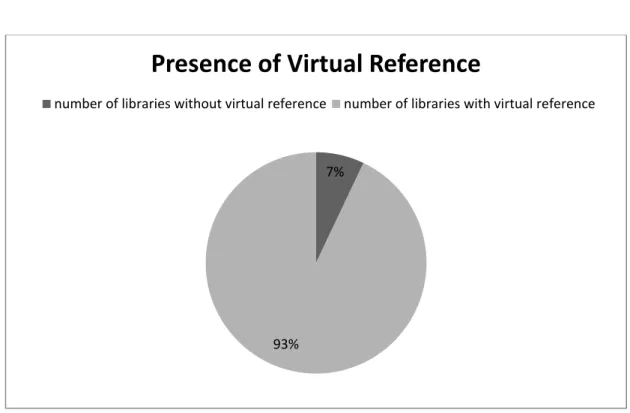
Each of the ARL member library websites was analyzed in March 2012 for virtual
reference programs. Of the 99 total libraries, 92 (92.92%) offered virtual reference, either
on their own or through a library consortium. Only 7 (7.07%) out of all the libraries did
reference options on their websites instead: help in-person; on the phone; through email;
and with online frequently-asked-question lists.
The 92 libraries that offered virtual reference did so through many different
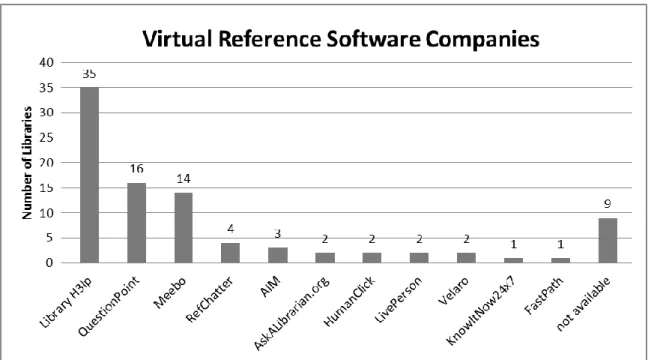
companies’ software products. Eleven companies were identified through branding,
website descriptions, and links to company webpages (Figure 2).
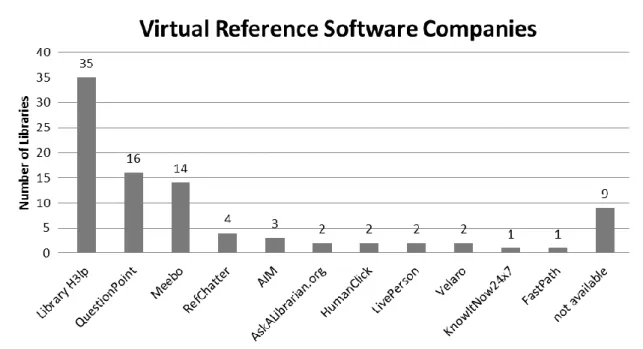
Figure 2: The Virtual Reference Software Companies Used by ARL Member Libraries
For the 92 libraries, there were three programs that together accounted for over
70% of the total. Library H3lp was the most widely used, being utilized by 35 libraries,
38.04% of the total; this is more than twice the number of libraries than those who used
the next most popular virtual reference software. QuestionPoint, the second most popular,
was used by 16 libraries and had 17.39% of the total. Meebo was close behind, being
used by 14 libraries to make up 15.21% of the total. The other companies were each used
by only a few libraries at the most, accounting for very small percentages of the total.
HumanClick, LivePerson, and Velaro were each used by 2 libraries, accounting for
2.17% each. KnowItNow24x7 and FastPath were both used by one library, or 1.08% of
the total. For nine libraries it was impossible to discover what company they used for
virtual reference, so 9.78% of the total is unaccounted for.
Terminology
Library literature does not have one term that is consistently used when referring
to virtual reference and this was reflected in the study sample; the ARL member libraries
used many different titles for their virtual reference services. This was compounded by
the fact that 17 of the institutions, 18.47% of all those with virtual reference, used two or
more names for their virtual reference programs, varying the titles on top-level and
lower-level library webpages.
Overall, the institutions preferred “Ask” or “Chat” and “Librarian” or “Us” in
their titles, as these terms were found in numerous variations (see Figure 3). The most
common title was “Ask a Librarian,” or some personalized version thereof, such as “Ask
a UC Librarian” or “Ask a Penn State Librarian.” This title was used at 46 of the 92
libraries, exactly 50% of the total. Another term used at many libraries was “Chat;” 27
libraries, 29.34 % of the total, used the term “Chat” as the basis for their title, including
programs called “Chat Now,” “Chat with Us,” “Chat 24/7,” and “Live Chat.” A large
subset of this group was 10 libraries whose virtual reference services were titled “Chat
with a Librarian” or “Chat Live with a Librarian.” Other libraries, 10 (10.86 %) in total,
titled their virtual reference program around the term “Ask Us;” examples of this are
“Ask Us Now!” and “Ask Us: Chat with a Librarian.” The final large group of libraries
(6.52%) having services titled “IM with a Librarian,” “IM Reference,” “IM Us,” etc. The
remaining six libraries each used a different name for their virtual reference service, one
not found at any other library.
Visibility
As a judge of how visible virtual reference services are, each website was
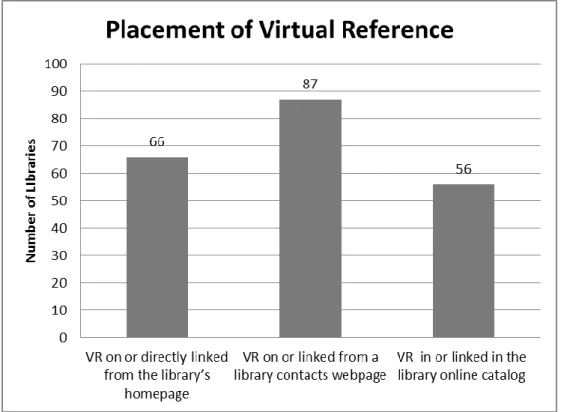
analyzed based on where virtual reference was available. Almost all of the libraries with
virtual reference provided the service on (or linked it from) the webpage that listed their
contact information; 87 (94.56%) of the libraries had their virtual reference on one or
more contact pages, only five libraries did not. The library’s homepage was the next most
popular page for virtual reference; 66 libraries (71.73%) provided an embedded widget or
a direct link to a widget on their main webpage. Other libraries mentioned virtual
reference on the homepage but did not have a direct link to the service. Over half of all
libraries also linked to their virtual reference program in the library online catalog, with
56 (60.86%) libraries offering this point-of-need service. In total, 38 libraries (41.30%)
offered virtual reference assistance to patrons on their contact page, from their online
catalog, and on (or through a direct link on) the homepage. 76 libraries (82.60%) had
virtual reference available in two or more of these places (see Figure 4).
Accessibility
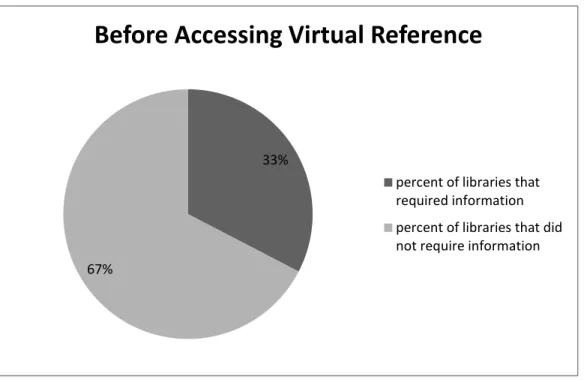
All 92 library websites were also analyzed according to their virtual reference
availability, assessing whether patrons had to provide personal information before using
the service and what amount of time a librarian was online to answer questions. 30
libraries (32.60%) required patrons to give some identifying information, such as their
0 5 10 15 20 25 30 35 40 45
Available 24/7 Available 7
days/week Available 6 days/week Available 5 days/week Availability unknown N u m b e r o f LI b rai e s
Availability of Virtual Reference
while 62 of the libraries (67.39%) did not require any information at all (see Figure 5).
Some libraries gave patrons the option of using their real name for personalization or
providing an email address to receive a session transcript, but kept such information
optional. These libraries were included in the 67% that did not require contact
information.
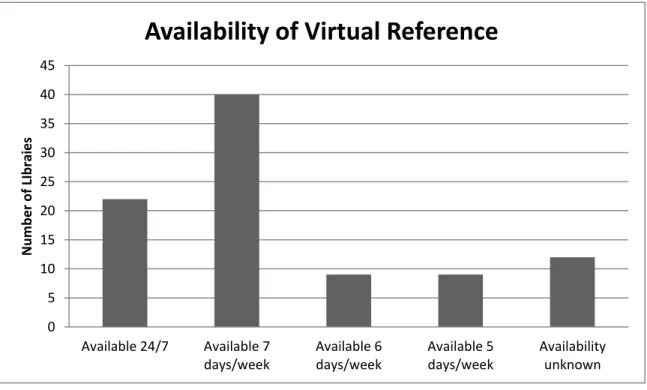
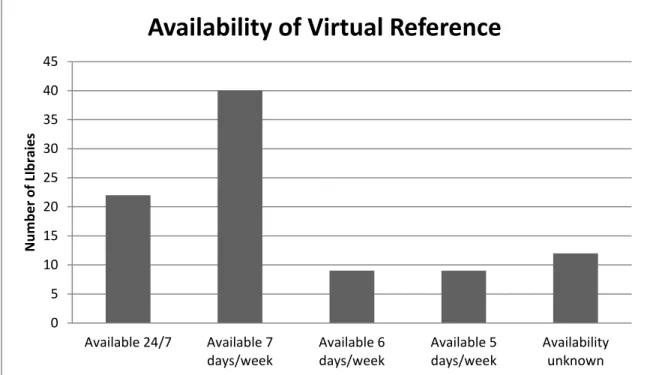
The amount of time that virtual reference was available to patrons varied
significantly amongst the study population from those that offered virtual reference
continually to those that only offered it for limited hours each day. The breakdown of
virtual reference availability is shown in Figure 6:
A large percentage of libraries, 40 in total (43.47%), made their virtual reference
programs available to patrons for at least some hours every day. Common among these
libraries was day and evening hours Monday to Thursday, day hours Friday and
Saturday, and evening hours on Sunday. At 22 libraries (23.91%), virtual reference was
available 24 hours a day, seven days a week. Some of these libraries offered continuous
hours through a cooperative library consortium while others had their own library staff
available around the clock. Nine libraries (9.78%) hosted virtual reference five or six
days a week; the most common pattern was availability on four or five weekdays and
Saturday or Sunday. Another nine libraries had virtual reference available from Monday
to Friday, but not at all over the weekend. Finally, there were twelve libraries (13.04%)
that did not state anywhere on their websites what their virtual reference availability was,
even though they offered the service.
Design
The previous factors were all objective assessments of virtual reference on
academic library websites, but this factor is a subjective evaluation designed to represent
the user’s experience. Each library's virtual reference service was assigned a rating from
1-5 after accessing it on the website and examining its visibility, ease of access, and any
user-oriented features it offered (see Figure 7). Six libraries (6.52%) were assigned the
top rating of 5 for excellent features such as high visibility on the website, an embedded
widget in the online catalog, a pop up chat window that appears when the virtual
reference link is clicked, or a virtual reference sidebar that appears on all library pages
during a chat session. 26 libraries (28.26%) were assigned a high rating of 4 for
user-friendly features such as selecting virtual reference programs by library branch, high
visibility on the library homepage, or a prominent link to the service on all library
webpages. A majority of libraries, 48 (52.17%), were given a middle rating of 3 for their
their helpful features. Eleven libraries (11.95%) were assigned a low rating of 2 for
lacking key usability features present at other libraries or for presenting potentially large
problems to users such as having to scroll down a webpage to see the virtual reference
service or having to link through several webpages before reaching the actual widget.
Only one library (1.08%) received the lowest rating of 1 for not having a user-oriented
virtual reference program.
Discussion
The analysis of 99 ARL member libraries’ websites provided information on five
factors of virtual reference: technology; terminology; visibility; accessibility; and design.
A discussion of these trends will show how they are of practical importance to academic
librarians. This study’s limitations are also provided.
Technology
A surprisingly high percentage of the libraries surveyed offered virtual reference
as a service. Almost 93% of the libraries studied had a virtual reference program, which
is a high number compared to similar previous studies. In 2010, Harinarayana and Raju
examined the websites of 100 international university research libraries, but only found
37% with virtual reference services. Another international study of university websites
found virtual reference at approximately 44% of the libraries (Tripathi and Kumar, 2010).
These international studies supposedly chose institutions comparable to their counterparts
in the United States, but their slower adoption of virtual reference is a striking difference.
This does not mean that these academic libraries are far behind those in the US though, as
In 2007, a study of approximately 1,100 academic libraries in the United States
found 60% of them offered virtual reference (Dehart and Viles). In 2011, a study of all
125 ARL member libraries found 80% with “live chat” services, a number roughly twice
the previous percentages of Harinarayana and Raju, Tripathi and Kumar, and Rod-Welch,
and 20% greater than the figures reported by DeHart and Viles three years earlier. This
number is again less than the percentage found in this analysis, which studies almost
exactly the same population. Overall, the literature shows that virtual reference is
growing in popularity as a service offered by academic libraries. While virtual reference
was recently considered an emerging technology for academic libraries to experiment
with, it is becoming a standard online reference tool offered by most academic
institutions. As library patrons have moved online, librarians at academic research
institutions have responded by offering virtual, synchronous reference help and advice.
Terminology
In library and information science literature, virtual reference is referred to by
almost as many names as there are articles, with researchers calling it chat reference,
instant messaging (IM), electronic reference, digital reference, live reference... The terms
used, while similar, reflect different conceptions of the service. These are also reflected in
the title choices made by librarians at the academic libraries studied, which can be
divided into two groups.
Half of the study population used a variation on the phrase “Ask a Librarian,” and
even those that chose a different name for their virtual reference service often used that
phrase on their contact page. “Ask a Librarian” has become a popular phrase because it
nature of the providers (information professionals; librarians). A smaller group of
libraries took the same idea and focused more on the community aspect of the library as a
unit, titling their service “Ask Us” or “Ask Us Now,” sometimes even with an
enthusiastic exclamation mark. The second group focused less on who was providing the
service (“a librarian” or “us”) or why to use the service (to “ask” a question) and more on
the nature of the service. The titles for these virtual reference programs emphasize the
type of technology being utilized with names such as “Chat Now,” “Chat 24/7” or “IM
Reference.” Some combine the focus on instant messaging technology with the same
recognition of the librarian as an essential part of the service with names like “Chat with
a Librarian” and “IM Us.” All of these titles have their own merits, and so it is each
library’s decision on what title will best represent their own service to their unique
community of patrons.
Almost 20% of the libraries could not decide on one title, and their websites
revealed a lack of continuity for their virtual reference program. A service referred to on
a top level page as “24/7 Chat Reference” might be called “Ask a Librarian” on a lower
level page. Or the page heading might refer to the service as “Ask a Librarian” while the
widget is titled “Chat Live Now.” These inconsistencies will make the service difficult
for users to find, since they may not recognize an unfamiliar title as referring to the
service they are looking for. It is disorienting for patrons to be forced to understand one
use of unfamiliar library jargon, asking them to interpret multiple technical terms and
recognize that these refer to the same program is too much. Academic libraries should
and then market that service using only the one title in order to increase name recognition
and usage satisfaction among users.
Visibility
Another way that academic librarians can successfully market their virtual
reference services is through online visibility. Where virtual reference widgets, or links to
the widgets, are located is of crucial importance. Access from the library’s homepage is
important for users who are specifically accessing the website to ask a virtual reference
question or have a question about main library services on the homepage after viewing it.
For these patrons, direct access to a librarian who can address their information need is
crucial. Patrons who must click through several webpages before even seeing a virtual
reference widget may give up before reaching it. At ARL member libraries, this means
36.95% of the libraries may not be attracting as many users to their virtual reference
program as they could by linking it directly from the homepage. If, as Lui (2008) argues,
“the core value of libraries is the service they provide to their users,” then academic
libraries should optimize their virtual reference through effective web design, making it
quicker and simpler for users to access their virtual librarians (p. 11).
This means also improving access beyond the library homepage and contact page.
Most ARL members already promote virtual reference through the homepage (71.73%)
or contact page (94.56%), but a lesser percent (60.86%) offer virtual reference as a part of
their online catalog. While it can be challenging to embed or link to a widget in the
OPAC depending on the integrated library system involved, it is there that users are
actively searching for library resources and commonly have reference questions arise.
programs, so logically the programs should be conspicuous within the catalog as well.
The natural extension from this is to provide virtual reference to users of other online
library services, such as article databases, electronic book collections, and course guides.
It was beyond the scope of this study to evaluate the potential availability of virtual
reference in these arenas at all ARL member libraries, making this an opportunity for
future research into virtual reference as an embedded tool in all online library resources.
Accessibility
This study looked at virtual reference accessibility according to requirements for
contact information and the service’s hours of availability. Because of time constraints
the accessibility of virtual reference for disabled library users was not studied.
For online library patrons to use virtual reference, it is important that they are not
only able to easily get to the service, but also can quickly and simply access it. This is
where the issue of logging in to a system or providing personal information before being
able to use a widget comes in, balancing ease of access with customer service goals and
individual needs with those of the community. Individual users are more likely to use a
service that does not require them to provide personally identifiable information, thus
preserving their ability to ask potentially embarrassing questions. Thus, virtual reference
that does not require information from users, as is available through 67.39% of ARL
member libraries, protects the privacy of library patrons.
From the other direction, librarians are able to provide better customer service
through virtual reference when they have access to information on who they are chatting
with. The 32.60% of ARL members who require some contact information before giving
restricting access to their primary service community. By not giving access to those
unconnected with the university community. the librarians prevent the potential demands
of non-affiliates from outstripping available resources. It is not a straightforward question
of whether librarians value their virtual users’ privacy or not, or whether they value
customer service or not; instead, it is an issue that should involve input from the user
community, assessment of current virtual reference statistics and practices, and a
thoughtful decision that takes into account the benefits and disadvantages of both
positions.
Another issue for academic librarians regarding the accessibility of virtual
reference is its hours of availability. As libraries are facing tighter budgets and potentially
shortened staff, it is hard to provide extended or expanded hours for a time-intensive new
program such as virtual reference. At ARL member libraries, a preponderance (43.47%)
are offering virtual reference services for at least some hours every day, providing a
balance between the libraries whose virtual reference is provided twenty four hours a day,
every day (23.91% of libraries) and those who only have virtual reference available five
or six days a week (19.56% of the libraries). The libraries that offer virtual reference 24
hours a day, 7 days a week often do so through a consortium, whether local or national,
so that no one group of library personnel is responsible for virtual reference all the time.
The other libraries, for which ceaseless virtual reference is not practical, attempt to align
the times virtual reference is most needed with the hours of their physical service desk,
providing virtual and in-person assistance at these key times without maintaining around
afternoon and evening of weekends, when students and researchers are most likely to be
using library resources and potentially to need assistance through virtual reference.
Design
While objectively noting the virtual reference information on each library website
gives librarians an idea of the scope of the service and its common attributes, a discussion
of the more subjective usability features is helpful to understand how patrons view and
interact with it.
Library patrons are becoming more familiar with virtual reference-type services
as many businesses offer online, real-time help services. Public libraries are also
implementing virtual reference at about the same rate as academic libraries (Chua and
Goh, 2010), meaning that academic library patrons may have also used virtual reference
previously at a public library. This means that academic library websites do not need to
explain in as much detail what a virtual reference service is, and can focus on making
online users aware that (like other online websites) the academic library also offers
synchronized virtual assistance. The website design should point patrons to the
availability of virtual reference and then the design of the service should be user friendly.
Some libraries are already implementing design techniques to make sure their
virtual reference programs are easy to learn about or locate, simple to access, and
intuitive to use. These libraries received a 4 or 5 design rating, and together account for
34.78% of libraries with virtual reference. Their virtual reference services were a highly
visible part of the website and made it simple for users to engage in an instant messaging
conversation while continuing to access library resources. These libraries have integrated
token Web 2.0 tool offered for the appearance of relevancy, but that virtual reference is
an important part of ongoing patron-librarian communication. This should be the future
of virtual reference, where the remaining 65.22% of academic libraries that received
lower design ratings take steps to remove potential barriers from their virtual reference
presentation.
Limitations
The results of this analysis have several limitations. First, by limiting the website
assessment to only members of the Association of Research Libraries, other academic
institutions were left out by necessity. While the ARL member libraries provide a good
sample population for studying US academic libraries, it is not a perfect group since
findings may not be generalizable to other types of libraries. A follow up study would do
well to survey academic libraries that are not members of ARL to compare virtual
reference at large, research-oriented schools with smaller, liberal arts schools and other
non-ARL institutions.
A second limitation is in the nature of the study. Because this was a content
analysis conducted entirely by studying the library websites, there was some information
that could not be gathered. Twelve libraries did not provide their virtual reference hours
and nine libraries did not make clear what software they were using to provide virtual
reference. This data could have been gathered by surveying academic librarians instead.
As well, while some judgments can be made about a virtual reference program’s
effectiveness based on its accessibility through the library website and design elements, a
true comparison between libraries needs usage statistics and patron surveys from each
each academic library and how patrons at each institution view the service, it is hard to
say how the online shortcomings noticed by outside observers are being experienced or
encountered by patrons.
Conclusion
Virtual reference has come a long way since the 1990s when it was first
implemented as a service by a few pioneering academic libraries. Today it is found at 92
out of 99 academic, research-oriented libraries in the United States, a service that only a
few libraries choose to do without. This is one part of “a meaningful and substantive
change in the history of libraries” as academic libraries shift focus from providing
controlled information access to facilitating information transfer and increased
information literacy (Maness, 2006, p. 9). As libraries continue to move online, they
should continue to improve their virtual services, making user-oriented technology design
decisions that provide streamlined access pathways to library resources and information.
The future of academic libraries will be an integration of physical and virtual services,
References
Anderson, C. (2009). How to be a Person: Tips and Tricks for Virtual Reference. College
& Research Libraries News, 70 (10), 577-9.
Association of Research Libraries. (2002). Chat Reference. SPEC Kit 273. Washington,
DC: Office of Leadership and Management Services.
Association of Research Libraries. (1999). Electronic Reference Service. SPEC Kit 251.
Washington, DC: Office of Leadership and Management Services.
Bedwell, L. (2009). Making Chat Widgets Work for Online Reference. Online, 33 (3),
20-3.
Bergman, E. M. L. and Holden, I. I. (2010). User Satisfaction with Electronic Reference:
A Systematic Review. Reference Services Review, 38 (3), 493-509.
Boyer, J. (2001). Virtual Reference at North Carolina State: The First One Hundred
Days. Information Technology and Libraries, 20 (3), 122-128.
Brietbach, W. and DeMars, M. J. (2009). Enhancing Virtual Reference: Techniques and
Technologies to Engage Users and Enrich Interaction. Internet Reference Services
Quarterly, 14 (3), 82-91.
Chua, A. Y. K. and Goh, D. H. (2010). A Study of Web 2.0 Applications in Library
Websites. Library & Information Science Research, 32 (3), 203-211.
Cummings et. al.. (2007). User Preferences in Reference Services: Virtual Reference and
DeHart, D. L. and Viles, A. (2007). Virtual Reference Service in Southeastern Academic
Libraries: A Study of Availability. The Southeastern Librarian, 55 (1), 36-40.
Duncan, V. and Fichter, D. M. (2004). What Words and Where? Applying Usability
Testing Techniques to Name a New Live Reference Service. Journal of the
Medical Library Association. 92 (2), 218–225.
Duncan, V. and Gerrard, A. (2011). All Together Now! Integrating Virtual Reference in
the Academic Library. Reference & User Services Quarterly, 50 (3), 280–92.
Granfield, D. and Robertson, M. (2008). Preference for Reference: New Options and
Choices for Academic Library Users. Reference & User Services Quarterly, 48
(1), 44–53.
Lee, Y. and Kozar, K. A. (2012). Understanding of Website Usability: Specifying and
Measuring Constructs and their Relationships. Decision Support Systems, 52 (2),
450-463.
Liu, S. (2008). Engaging Users: The Future of Academic Library Web Sites. College &
Research Libraries, 69 (1), 6-27.
Mahmood, K. and Richardson, J. V. Jr. (2011). Adoption of Web 2.0 in US Academic
Libraries: A Survey of ARL Library Websites. Program: Electronic Library and
Information Systems, 45 (4), 365-375.
Maness, J. M. (2006). Library 2.0 Theory: Web 2.0 and Its Implications for Libraries
Webology, 3(2), Article 25.
Mathews, B. (2007). Moving Beyond the Reference Desk: Being Where Users Need Us.
Matteson, M. L., Salamon, J. and Brewster, L. (2011). A Systematic Review of Research
on Live Chat Service. Reference & User Services Quarterly, 51 (2), 82–100.
Mounce, M. (2010). Ask a Librarian Link: Analyzing Its Usefulness. Mississippi
Libraries, 74 (1), 3-5.
Peterson, K. (2006). Academic Web Site Design and Academic Templates: Where Does
the Library Fit In? Information Technology and Libraries, 25 (4), 217-221.
Phan, T. A. et. al. (2009). Academic Libraries: 2008. National Center for Education
Statistics, Institute of Education Sciences, Washington D.C.
Polger, M. A. (2011). Student Preferences in Library Website Vocabulary. Library
Philosophy and Practice, Annual volume 2011.
Rod-Welch, L. J. (2012). Incorporation and Visibility of Reference and Social
Networking Tools on ARL Member Libraries’ Websites. Reference Services
Review, 40 (1), 138 - 171.
Rourke, L., et. al. (2010). Learning from Chatting: How our Virtual Reference Questions
are Giving us Answers. Evidence Based Library and Information Practice, 5 (2),
63-74.
Schneider, K. G. (2010). Death to Jargon [PowerPoint slides]. Retrieved from
http://www.opal-online.org/LibraryJargon200710_files/frame.htm
Stormont, S. (2001). Going Where the Users Are: Live Digital Reference. Information
Technology and Libraries, 20 (3), 129-134.
Strothmann, M., et. al. (2009). “Ask a Librarian” Pages as Reference Gateways to
Ward, J., et. al. (2010). Best Practices in Chat Reference Used by Florida's Ask a
Librarian Virtual Reference Librarians. The Reference Librarian, 51 (1), 53-68.
Wells, C. A. (2003). Location, Location, Location: The Importance of Placement of the
Appendix A: Complete List of ARL Member Library Websites Analyzed
Institution URL
University of Alabama Libraries http://www.lib.ua.edu/
University at Albany SUNY Libraries http://library.albany.edu/
University of Arizona Libraries http://www.library.arizona.edu/
Arizona State University Libraries http://lib.asu.edu/
Auburn University Libraries http://www.lib.auburn.edu/
Boston College Libraries http://www.bc.edu/libraries/
Boston University Libraries http://www.bu.edu/library/
Brigham Young University Library http://lib.byu.edu/
Brown University Library http://library.brown.edu/index.php
University at Buffalo SUNY Libraries http://library.buffalo.edu/
University of California Berkeley Library http://www.lib.berkeley.edu/index.html
University of California Davis Library http://www.lib.ucdavis.edu/
University of California Irvine Libraries http://www.lib.uci.edu/
University of California Los Angeles Library http://www.library.ucla.edu/
University of California Riverside Libraries http://library.ucr.edu/
University of California San Diego Libraries http://libraries.ucsd.edu/
University of California Santa Barbara
Libraries
http://www.library.ucsb.edu/
Case Western Reserve University Libraries http://library.case.edu/ksl/index.aspx
University of Chicago Library http://www.lib.uchicago.edu/e/index.html
University of Cincinnati Libraries http://www.libraries.uc.edu/
University of Colorado Boulder Libraries http://ucblibraries.colorado.edu/
Colorado State University Libraries http://lib.colostate.edu/
Columbia University Libraries http://library.columbia.edu/
University of Connecticut Libraries http://www.lib.uconn.edu/
Cornell University Library http://www.library.cornell.edu/
University of Delaware Library http://www.lib.udel.edu/
Duke University Libraries http://library.duke.edu/
Emory University Libraries http://web.library.emory.edu/
University of Florida Libraries http://www.uflib.ufl.edu/
Florida State University Libraries http://www.lib.fsu.edu/
George Washington University Library http://www.library.gwu.edu/
Georgetown University Library http://www.library.georgetown.edu/
University of Georgia Libraries http://www.libs.uga.edu/
Georgia Tech Library http://www.library.gatech.edu/
Harvard University Libraries http://lib.harvard.edu/
University of Hawaii at Manoa Library http://library.manoa.hawaii.edu/
University of Houston Libraries http://info.lib.uh.edu/
Howard University Libraries http://www.howard.edu/library/
University of Illinois at Chicago Library http://library.uic.edu/
University of Illinois at Urbana-Champaign
Library
www.library.uiuc.edu
Indiana University Bloomington Libraries http://www.libraries.iub.edu/
University of Iowa Libraries http://www.lib.uiowa.edu/
Iowa State University Library http://www.lib.iastate.edu/
Johns Hopkins University Libraries http://www.library.jhu.edu/
University of Kansas Libraries http://www.lib.ku.edu/
Kent State University Libraries http://www.library.kent.edu/
University of Kentucky Libraries http://libraries.uky.edu/
Louisiana State University Libraries http://www.lib.lsu.edu/
University of Louisville Libraries http://louisville.edu/library/
University of Maryland Libraries http://www.lib.umd.edu/
University of Massachusetts Amherst
Libraries
http://www.library.umass.edu/
Massachusetts Institute of Technology
Libraries
University of Miami Libraries http://www.library.miami.edu/
University of Michigan Library http://www.lib.umich.edu/
Michigan State University Libraries http://www.lib.msu.edu/
University of Minnesota Libraries http://www.lib.umn.edu/
University of Missouri–Columbia Libraries http://mulibraries.missouri.edu/
University of Nebraska–Lincoln Libraries http://libraries.unl.edu/
University of New Mexico Libraries http://www.unm.edu/libraries/
New York University Libraries http://library.nyu.edu/
University of North Carolina at Chapel Hill
Libraries
http://www.lib.unc.edu/
North Carolina State University Libraries http://www.lib.ncsu.edu/
Northwestern University Library http://www.library.northwestern.edu/
University of Notre Dame Libraries http://library.nd.edu/
Ohio State University Libraries http://library.osu.edu/
Ohio University Libraries http://www.library.ohiou.edu/find/
University of Oklahoma Libraries http://libraries.ou.edu/
Oklahoma State University Library http://www.library.okstate.edu/
University of Oregon Libraries http://libweb.uoregon.edu/
University of Pennsylvania Libraries http://www.library.upenn.edu/
Pennsylvania State University Libraries http://www.libraries.psu.edu/psul/home.html
University of Pittsburgh Libraries http://www.library.pitt.edu/
Princeton University Library http://library.princeton.edu/
Purdue University Libraries http://www.lib.purdue.edu/
Rice University Library http://library.rice.edu/
Rutgers University Libraries http://www.libraries.rutgers.edu/
University of South Carolina Libraries http://library.sc.edu/
University of Southern California Libraries http://www.usc.edu/libraries/
Southern Illinois University Carbondale
Library
http://www.lib.siu.edu/
Stony Brook University SUNY Libraries http://www.library.stonybrook.edu/
Syracuse University Library http://library.syr.edu/
Temple University Libraries http://library.temple.edu/
University of Tennessee Knoxville Libraries http://www.lib.utk.edu/
University of Texas Libraries http://www.lib.utexas.edu/
Texas A&M University Libraries http://library.tamu.edu/
Texas Tech University Libraries http://library.ttu.edu/
Tulane University Library http://library.tulane.edu/
University of Utah Library http://www.lib.utah.edu/
Vanderbilt University Library http://www.library.vanderbilt.edu/
University of Virginia Library http://www.lib.virginia.edu/
Virginia Tech Libraries http://www.lib.vt.edu/
University of Washington Libraries http://www.lib.washington.edu/
Washington State University Libraries http://www.wsulibs.wsu.edu/
Washington University in St. Louis Libraries http://library.wustl.edu/
Wayne State University Libraries http://www.lib.wayne.edu/
University of Wisconsin–Madison Libraries www.library.wisc.edu/
Appendix B: Figures
Figure 1: The Percentage of ARL Member Libraries with and without Virtual Reference
7%
93%
Presence of Virtual Reference
33%
67%
Before Accessing Virtual Reference
percent of libraries that required information
percent of libraries that did not require information
Figure 6: Approximate Availability of Virtual Reference Services at ARL Member Libraries
0 5 10 15 20 25 30 35 40 45
Available 24/7 Available 7
days/week Available 6 days/week Available 5 days/week Availability unknown N u m b e r o f LI b rai e s
Figure 7: Subjective Rating Scale of Virtual Reference Application at ARL Member Libraries
1
11
48 26
6
0 10 20 30 40 50 60
1 2 3 4 5
Number of Libraries
R
ating Scae