Hungarian Association of Agricultural Informatics
European Federation for Information Technology in Agriculture, Food and the Environment
Journal of Agricultural Informatics. 2015 Vol. 6, No. 4 journal.magisz.org
Requirements
specification for mobile software for e-commerce and its adoption
by small organic farmers in Costa Rica
Jose Francisco Aguilar 1
I N F O Received Accepted Available on-line Responsible Editor:
Keywords:
ICT adoption, e-commerce, rural development, digital divide, mobile software.
A B S T R A C T
Rural development can be favoured not only with the development of new and sustainable agricultural practices, but also with information communication technology applications. Requirements analysis and specification for mobile software has been recognized as a key factor for economic success and as a support to E-commerce. With the aim to develop a mobile application for a small group of farmers, a partnership among the Ministry of Agriculture and Livestock (MAG), the Institute Costa Rican Electricity, Telecommunications (ICE), the University of Costa Rica (UCR), and a group of organic farmers was established. Here we describe the different processes and the connection between the user needs and the software development team. After defining the specific roles of each organization, we provided especial consideration for the adoption phase, due to digital divide of the target group of small organic farmers. The analysis conducted concluded that the creation of the mobile application had both benefits and challenges. On one hand, it represented an important first step into the world of Information Communication Technology (ICT) applied to organic farming activities in Costa Rica that can surely boost e-commerce. The needs were potentially solved by the inherent advantages of ICT in an increasingly competitive world, with equity of opportunities, and the important challenge to preserve the biodiversity with sustainable agricultural practices. The specifications of mobile software requirements established in this project were supported by considerations of adoption and of collaboration, cooperation and communication strategies among key stakeholders to follow-up, the implementation phase and to assure success.
1. Introduction
The World Conference on Computers in Agriculture (WCCA), held in San Jose Costa Rica in 2014, provided a forum where professionals from different disciplines exchanged research findings and experiences on the use of Information Communication Technology (ICT) in a wide variety of contexts. This paper was originated after this WCCA meeting, with the aim to develop apps for mobile devices, in order to provide an e-commerce service to small organic farmers, and in this way, to allow them to be more competitive through improved information and communication processes. The development of mobile applications is having both an enormous global impact in e-commerce networks, as well as in information services. Besides, there is an urgent need to consider the adoption of methods of software engineering, that reduce the intrinsic complexity in specific features of the environment (eds Alencar &
Cowan 2012, p.413). The required analysis and specifications for mobile software have been recognized
as key factors for success.
The Government of Costa Rica, well aware of the benefits of organic practices in agriculture, has recently created a Department of Organic Agriculture within the Ministry of Agriculture and Livestock (MAG). A recent study requested by MAG showed the need to foster these practices by assisting farmers in their products commercialization; particularly, farmers will benefit with current higher earnings if they sell directly to consumers. MAOCO (Costa Rican Organic Agriculture Movement) is a not-profit
organization that is working closely with farmers, promoting the offer and demand of organic products in local spaces like “farmer markets”. MAOCO is a lead social movement that seeks to promote and develop the production of organic products by integrating producers, consumers, and other actors, while focusing on the respect to life, biodiversity, and indigenous knowledge; among their objectives are to promote a common vision to change politics, society, and economics, in order to improve rural livelihoods. MAOCO, has a central office in San Jose and other 11 regional branches to give support to different rural groups.
ICE (the government’s telecoms arm), MAG, MAOCO and the University of Costa Rica started a collaboration and are working together in order to develop a mobile app to assist small organic farmers to sell their products via “the web”. This way, the app will provide consumers with information in order
to locate particular dealers where they can buy the desired products. This paper describes the detail of
software development, considering a close partnership between the user needs and the development team, and keeping all the considerations for the adoption, due to digital divide for the target group of small organic farmers.
2. Materials and methods
2.1. Project background and organic agriculture in Costa Rica
With the objective to define a reference framework of the organic agriculture activity in Costa Rica, (managed by the Ministry of Agriculture and Livestock (MAG)), official information and documents regarding the action plans for the promotion of organic agriculture, within the State Policy for the Agrifood Sector and Rural Development in Costa Rica, were reviewed from 2010 to 2021. Besides, the information contained in the organic agriculture activity census conducted in 2013, constituted a valuable document that comprised a national and international study that showed its evolution in the last 15 years and its current status. On the other hand, the implementation of the Law 8591 (CR. MAG 2013) and information of the agricultural census conducted in 2014 (CR. INEC 2015) were additionally considered.
With this information available, the current and potential actors within the organic farming development were detected. This way, for this project and this contribution, a synergy between MAG, MAOCO, ICE and UCR was established; these actors were characterized and their roles as participants in the project were defined. Additionally, the current marketing procedures of organic farmers were analysed and characterized through questionnaires.
2.2. Analysis of cell phone coverage and limitation of ICT for digital commerce
The evaluation of cell phone coverage provided by ICE was performed according to the report of the Superintendence of Telecommunications (Sutel) of Costa Rica. The analysis evaluated the quality of service to locate the members of MAOCO organic producers group, as well as the conventional farmers markets and organic farmers markets.
Besides, the reports prepared by the Institutional Program of Information Society and Knowledge of the University of Costa Rica for 2014 (Universidad de Costa Rica, PROSIC 2015) and 2012 (Universidad de Costa Rica, PROSIC 2013), showed the importance and increase of ICT use in production processes and social networks in marketing. Finally, an analysis of ICT access in rural and urban areas was conducted, focusing on householders engaged in agricultural activities, with the aim to evaluate the limitations in the use of ICT and digital divide.
2.3. Software requirements specification and prototype
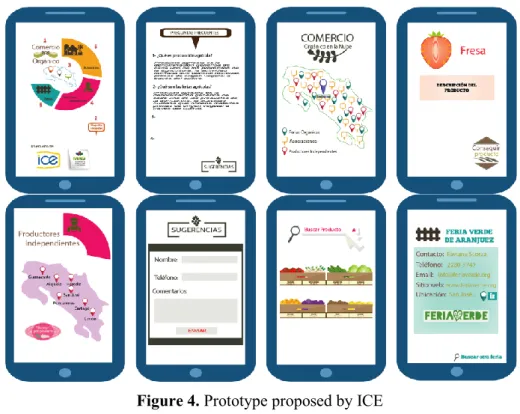
Besides, recommendations for the specifications of the software requirements of IEEE 830-1998 were used for mobile applications, such as detailing use cases, navigation and others. Finally, a prototype was designed, which included the specifications and the functional and non-functional features, to support quality assurance and validation consultation processes.
3. Results
3.1. Project background in organic agriculture in Costa Rica
The national organic production export-oriented proportion is of 69%, and the national consumption is 31%. Exporting producers indicated that the national market does not pay the right price, so they look for ways to market their products in countries that pay a fair and competitive price. Products that do not meet the minimum requirements of abroad markets are selling within the country at a lower price. Producers indicated the need to develop actions aimed at encouraging the marketing of organic products nationwide, due to the lack/limitations of market (CR. MAG 2013). In this sense, policies and actions should promote domestic consumption, favouring both producers and consumers, and allowing the local market to offer export quality products.
In a study of local organic agriculture in Costa Rica (CR. MAG 2013), different sectors such public, private, academic, support and union were featured as linked to organic agriculture, or that can potentially participate as actors. Currently, there are 48 actors working on at least one topic related to organic agriculture, and other 20 actors having the structure and conditions to implement activities to strengthen organic agriculture. According to current and potential actors related to organic agriculture, there has been a synergy between MAG and MAOCO, which are considered as current actors, and ICE and UCR, which are featured as potential actors, who will participate and were committed to this project.
3.1.1. Characterization of the project participants
MAOCO is a social movement that promotes and develops organic farming. It recognizes peasant, indigenous and technical knowledge. It has 15 years of experience with representatives throughout the country through partnerships and farmer markets. This organization worked for seven years for the creation of the Law on Promotion of Organic Agriculture, which is now in MAG for approval.
The interviews conducted highlighted that organic producers in the country do not have the resources for advertising campaigns, through which they may make their products locally known. A mobile application for organic products would provide the producers with the ability to make themselves known throughout the country as well as to collect data that enable them to determine a specific product demand, allowing them to produce according to a specific place and time to sell their products. Besides, this application would potentially allow prices regulation across the country.
MAG's mission is to promote the dignity of rural families of small and medium producers, promoting the development of technical skills and business management in production systems and in agricultural organizations, to promote competitiveness, equity and social, economic and environmental sustainability of farming. This ministry ensures the development of producers and their families. Recently, there is an initiative in process to create a new department focused on organic farmers.
In the country, to be certified as biologically or ecologically organic by the state or a third agency, according to the law and its regulations, a product must be certified, but many producers do not have these certifications because of the high cost and time it takes to process. In this sense, the MAG seeks to facilitate producers if they are coordinated as a group of farmers and could take less time if they can show that in the last 10 years there has been no toxics or chemicals used.
UCR is a public higher education institution, dedicated to teaching, research and extension. The University seeks in this project to promote the integration of alliances with social commitment to promote innovation, and transfer the knowledge generated in this project.
3.1.2. Characterization of marketing procedures made by farmers
There are six points within the country in which organic producers place their products for marketing. Figure 1 shows the proportions using these marketing channels by domestic producers.
Figure 1. Marketing channels for organic producers in Costa Rica (CR. MAG 2013)
The 35% of producers sell their products in farmers markets; according to the 2013 census they must compete with the prices of non-organic products (despite their certifications), since many domestic customers are unwilling to pay more. These marketing channels have several difficulties such as the lack of support for the promotion and dissemination (38%), little product and variety (21%), lack of price control policy (22%) and deficient producers location information (19%) (CR. MAG 2013). This project is highly relevant because it greatly solves the promotion and dissemination, where consumers can learn more about the benefits of these organic products, and at the same time, get the location of the organic farmers markets. The mobile application can access a database with product information in addition to its location, facilitating greater producer trust to help them place larger quantities of products.
3.2. Analysis of mobile phone coverage and accessibility situation of ICT for digital trade in small organic farmers
3.2.1. Coverage and quality of cellular signal in producing areas
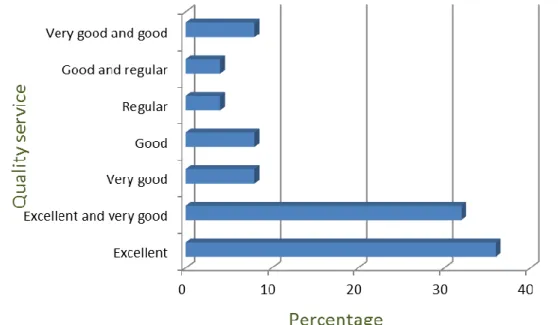
The coverage and quality of the service provided by ICE (ICE 2015) were analysed in areas defined by MAOCO which include organic farmers’ members, associations and organic farmer’s market locations. The results obtained are shown in Figure 2.
In 68% of the places evaluated, ICE had an excellent or very good coverage, which is a positive sign for the project. Farmers will have access to cell phone and internet services, this way they will able to use of the application.
Farmers market 35%
Intermediary 20% Restaurants and
hotels 15% Supermarkets
10% Organic farmers
market 10%
Figure 2. Cellular coverage and quality service in organic producer’s locations
3.2.2. Access to technology by Costa Rican society and agricultural producers
The incorporation of ICT in production processes can generate large benefits for people who depend on the competitiveness of local businesses. However, a lot of them still base their production processes in obsolete methods in a contemporary society, having great difficulty in meeting the demands of information requirements, customer service and product quality (Universidad de Costa Rica, PROSIC 2015). It has been found that the use of social networks as a mean of advertising and communicating have been heavily exploited, and has been one of the tools most commonly used by small and medium enterprises. In general, most companies (66%) use social networks as marketing means, and 47% for sales (Universidad de Costa Rica, PROSIC 2013, Universidad de Costa Rica, PROSIC 2012). Mobile applications are to constitute the centre of the broadband ecosystem which facilitates the interaction between farmers and consumers, and the potential of social networks which bring together the same organic farmers.
In terms of the evolution of ICT access in Costa Rican households from 2010 to 2013, it was found that by 2013 (92%) of Costa Rican households had at least one cell phone; in addition, Internet service have had the highest growth rate of all technologies, since it almost doubled between 2010 (24%) and 2013 (47%) (Universidad de Costa Rica, PROSIC 2013). Analysing this by rural and urban areas, both areas have electricity, colour television and cell phone (holding percentage higher than 90% households in both areas). However, the difference between these areas in computer and Internet access is negative. In urban areas, both the percentage of households with a computer and Internet access is 20 % higher than in rural areas. Residents in rural areas must leave their homes to get access to a computer or Internet connection. In rural areas, the transfer is much more complicated and much more distances; thus, many of these people have not a real choice to access these technologies that are key to their development (Universidad de Costa Rica, PROSIC 2015). In rural areas, the majority of households with Internet access are connected through mobile devices (59%), followed by cable modem (17%) and high-speed system ICE (10%). This is a positive finding, since the idea of using a telephone application, even though it may not have access to the entire rural population, the Internet access via mobile phone is high.
Table 1.Heads of household farmers and qualified agricultural, forestry and fishing workers
Service Number of
households
Percentage
Rural area with desktop 6,791 16.6%
Rural area with laptop 5,085 12.4%
Rural area with cell phone 31,399 77.0%
Rural area with internet 4,569 12.6%
Urban area with desktop 4,690 31.7%
Urban area with laptop 3,461 23.4%
Urban area with cell phone 12,965 88.0%
Urban area with internet 4,265 28.8%
3.3. Software requirements specification and prototype
3.3.1. Analysis of the needs and requirements of farmers
The surveys submitted electronically to farmers had poor response, however, the best gathering was through telephone calls. It is imperative to highlight the importance, for the processes of ICT adoption by small organic farmers, that governmental institutions such as the Ministry of Education (MEP) and the Ministry of Science, Technology and Telecommunications (MICITT), be part of the strategy, in order to promote the inclusion of young people in agriculture and ICT. This is more relevant if we consider that in the agricultural census of 2014, the producer average age was 53.9 years, with 54.1 for men and 52.6 for women, where there is a marked aging of the population, especially if one considers that 22.5% are 65 years and older (INEC 2015).
Many organic farmers commercialize their products in traditional markets with other farmers having to sell at similar prices. On the other hand, Figure 3 shows the percentages according to the type of operation performed by the organic farmer.
Figure 3. Type of operation for organic farmers in Costa Rica (CR. MAG 2013)
opportunities they have for adding value to their products, especially for those producers who are only engaged in production, currently represented by 27% (CR. MAG 2013).
3.3.2. Requirements specification and prototype mobile application
Based on the context of small organic farmers need and considerations for adoption in the use of ICT, two mobile applications were strategically defined. Besides, a developmental sequence for its implementation and commissioning was established in order to monitor the evolution of adoption and to start promoting its use, facilitating the scaling to ensure the capacity building among farmers. Both applications were specified with IEEE 830, which provides guidelines for proper specification of software requirements, describing the application purpose, functional requirements (Table 2) and non-functional requirements (Table 3), use cases were established for each module and extended use cases.
The first application provides consumers with organic products information supplied by farmers. The development of this application is part of the E-Commerce, which according to the International Organization for Standardization (ISO) is an exchange of information and requirements from businesses or between businesses and their customers (Qin et al. 2014). This definition characterizes very precisely this application, because the aim is an exchange of information between farmers, organic farmers markets and organic associations and potential customers. It is noteworthy that this application do not include electronic payment, a valuable feature in terms of competitiveness; however, this feature will be implemented later, based on the response from the use and ICT adoption.
Table 2. Main functional requirements for farmer and Consumer mobile application Main functional requirements
Farmer mobile application Consumer mobile application
1. The system must run applications for those modules that do not require internet connection and should be synchronized once the connection return.
2. The system must allow connections to social networks.
3. The system must allow to connect to mobile applications or web pages such as weather, official produce prices, farm supplies, etc. 4. After the user is authenticated by MAG, the
system must be able to enter, modify and delete the user and farm data.
5. The system must be able to download documents of all types to provide, to enter, modify and delete information related to system costs.
6. Once accredited by MAG, the system must be able to enter, modify and delete information from the user and organic crops. 7. The system must able to send and receive
user messages, which should be recorded and stored.
1. The system must be able to indicate the current geographical location of the user and to get the farmer address through the connection of a navigation application. 2. The system must be allow to evaluate
independent producers, farmer fairs and trade associations with a grade from 1 to 10, and left comments.
3. The system must have a main menu with the following modules: Organic Commerce
(Overview and benefits), FAQs and
suggestions, points of sale in a map categorized as independent farmer, green fairs and trade associations.
4. The system must have a search engine for product, point of sale, and proximity. The results of the query should have different levels of detail.
5. The system must be able to send and receive user messages, which should be recorded and stored.
Table 3. Main non-functional requirements for farmer and Consumer mobile application Major non-functional requirements
1. Reliability: the application functions must be discontinue as minimum as possible due to faults in the cell or network. In case of problems with the network, the restart time for the application should be the minimum.
2. Usability: it must be user friendly. This is very important because the average age of the farmer target group is 54 years.
3. Efficiency: The application must have fast responses without delay to the user, for example, the response time in the navigation in between the modules should be the minimum. Must be taken noted that the cell used by farmers could be not so modern affecting the processing capacity. 4. Maintainability: This is associated with the changes suffered by the application, it must adapt to
the updates to be made to both the application and the phone software. 5. Portability: the application has to run on all types of cell.
Figure 4. Prototype proposed by ICE
The second application is aimed at fostering social network of organic farmers involved in the National Program for Organic Agriculture of MAG. Once registered, users can access templates related to certification processes, templates to keep track of the farm, finance templates, trends of products prices, offer and demand trends for products, news and events related to organic production, weather information, discussion forums on various topics where the user can create your own topics, FAQs, tips and contacts module.
4. Conclusions
From the analysis conducted, it can be concluded that the creation of the organic farmers’ mobile application in Costa Rica has benefits and challenges. It is an important first step into the world of ICT applied to organic farming to boost e-commerce. The needs are potentially solved by the inherent advantages of ICT in an increasingly competitive world where access to information will force the pace of the economic world, where equity of opportunities is undoubtedly a challenge. The specifications of mobile software requirements established in this project are supported by considerations of adoption and strategies of collaboration, cooperation and communication among key stakeholders for follow-up,
implementation and success
Acknowledgements
Raúl Sequeira, Josue Vargas y Rodrigo Cordero de la División de Innovación y Estrategia del Negocio, Instituto Costarricense de Electricidad y Telecomunicaciones (ICE).
María Fernanda Reyes, Coordinadora del Programa Nacional de Agricultura Orgánica Costa Rica, Ministerio de Agricultura y Ganadería (MAG).
Miguel Castro y Xinia Chaves miembros del Movimiento de Agricultura Orgánica Costarricense (MAOCO).
Didier Hernández, Fabio Herrera y Mario Chacón, Instituto Nacional de Estadística y Censo de Costa Rica (INEC).
Luke Reese, Agriculture and Biosystem Engineering Department, Michigan State University (MSU). Karina Vargas and Guillermo Aguilar students from Escuela de Ingeniería Industrial, Universidad de Costa Rica (UCR).
Alencar, P & Cowan, D (eds) 2012, ‘Handbook of research on mobile software engineering: design,
implementation, and emergent applications’ Hershey, PA: Engineering Science Reference, USA, pp. 413-426. doi: 10.4018/978-1-61520-655-1
Costa Rica, Ministerio de Agricultura y Ganadería MAG 2013, ‘Estudio sobre el entorno nacional de la agricultura orgánica en Costa Rica’. MAG, San José. C.R.
Costa Rica, Instituto Nacional de Estadística y Censos INEC 2015, ’VI Censo Nacional Agropecuario: Resultados Generales’. Instituto Nacional de Estadística y Censos. -- 1 ed. --San José. C.R.
Instituto Costarricence de Electricidad (ICE) 2015, Mapa de cobertura. Available from: <http://www.grupoice.com/Mapadecobertura/index.html>. [10 April 2015].
IEEE Recommended Practice for Software Requirements Specifications," IEEE Std 830-1998, vol., no., pp.1, 40, Oct. 20 1998. doi: 10.1109/IEEESTD.1998.88286
Muñoz, D & Nicaragua, R 2014, ‘Un acercamiento a la brecha digital en Costa Rica desde el punto de vista del acceso, la conectividad y la alfabetización digital’ e-Ciencias de la Información, vol.4, no. 1, 1-29. doi:
10.15517/eci.v4i1.12866
Universidad de Costa Rica, Programa de la Sociedad de la Información y el Conocimiento PROSIC 2015, ‘Hacia la Sociedad de la Información y el Conocimiento: informe 2014’. Universidad de Costa Rica, San José. Costa Rica
Universidad de Costa Rica, Programa de la Sociedad de la Información y el Conocimiento PROSIC 2013, ‘Hacia la Sociedad de la Información y el Conocimiento: informe 2012’. Universidad de Costa Rica, San José. Costa Rica
Universidad de Costa Rica, Programa de la Sociedad de la Información y el Conocimiento PROSIC 2012, ‘Hacia la Sociedad de la Información y el Conocimiento: informe 2011’. Universidad de Costa Rica, San José. Costa Rica