UTILIZATION OF SUGARCANE BY-PRODUCTS AS COMPLETE RATIONS FOR MEAT
PRODUCTION IN BUFFALOES
RAGHAVA RAO.E1
Director of Research, SVVU, Tirupati, Andhra Pradesh state. E.mail ID:[email protected]
PRASANNA KUMAR.R2
Senior Scientist & Head, Krishi Vigyan Kendra,Mamnoor,Warangal District, Telangana
State-506166 E.mail ID:[email protected]
PAKALA VENKATA S.B3
Researcher,Singapore. E.mail ID:[email protected]
SAHITYA RANI.M4
Assistant Professor, Department of Livestock Products Technology,College of Veterinary
Science,Koratla,Jagitial District, Telangana state-534326
Email ID:[email protected]
ABSTRACT
Keywords: Carcass characteristics, Dressing percentage, Meat production, Murrah buffalo bull calves, Sugarcane by-products.
Introduction
Developing a feeding system using crop residues or agro-industrial by-products will not only lower the cost of animal feed and improve the economic efficiency of animal production, but also reduce the environmental pollution caused by the disposal of these organic wastes (Kajikawa, 1996). The issue of bio energy (seeking a source of renewable energy), is a serious issue in Brazil and has led to a big rush to increase ethanol production, which in turn has increased the size of areas planted with sugar cane; thereby leading to the production of more waste from distillation. Within this new scenario, it creates the need for more detailed nutritional information on the use of such waste in ruminant feed (Barros et al., 2009). To improve animal productivity, it is important to use proper food handling technique (especially in the dry seasons of the year) and adopt intensive systems of exploitation, such as confinement or semi-confinement; making it necessary to rely on food of good nutritional value and low cost. One way to achieve this is the use of agro-products, but most of these foods have not been studied, and their compositions and appropriate concentrations for economic and biological use in animal. Through the technologies available, the nutritional qualities of several unconventional feed resources has been improved and are being used successfully as the major source of roughages for livestock in several regions of India.Bulle et al., 1999, studied the effect of use of bagasse as the only source of bulk for crossbred bulls. Feed and fodder scarcity is a major limiting factor in developing countries resulting in low productivity, poor growth and reproduction of animals (Krishnamoorthy and Moran, 2011). Currently in India, there is a deficit of feed resources to the tune of 7.58%, 56.73% and 30.37% for dry roughages, green grasses and concentrates respectively (Ramachandra et al., 2007). The high demand for animal products could only be met in a sustained manner through the efficient use of crop residues and unconventional feed resources that do not compete with human food (Makkar, 2003).
Materials and Methods
Required quantity of sugarcane (Sacharamafficinarum) by-products viz., sugarcane
(7805) tops and trash were procured from the farmers fields of sugarcane production areas surrounding the Buffalo Research Station, Venkataramannagudem, and remaining crop residues
like maize stover (Zea mays), jowar straw (Sorghum bicolor), Paddy straw (Oryza sativa) and
sunhemp hay (Crotalaria juncea) and Pillipesara ( Phasiolus mongo) were procured within the
Godavari District, Andhra Pradesh and were equally allotted at random to six groups. The experimental animals were maintained in individual housing system with feeding and watering arrangements throughout the experimental period. Before the starting the experiment, the animals were weighed and recorded body weights and continued at every fort-nightly interval upto 168 days of the feeding experiment.
Three representative animals from each group were slaughtered at the end of growth trial to study the carcass characteristics like dressing percentage, hot carcass weight, weight of edible and non-edible organs etc. All the observations were recorded for the parameters indicated in the experiment.
The animals were slaughtered by “Halal” method after overnight starving. The live weights of animals were recorded before slaughter. Stripping, legging, dressing and evisceration were performed by adopting the standard procedure described by Gerrard, 1964.
The weights of hot carcass, edible (liver, heart, testes, diaphragm, kidney and spleen) and non-edible organs (lungs, trachea, stomach and intestines) were recorded.
The carcass was then divided into 5 cuts viz., leg, loin, rack, shoulder and neck and fore shank and brisket as suggested by the National Livestock and Meat Board of United States of America (Brandly et al., 1968).
Results and Discussion
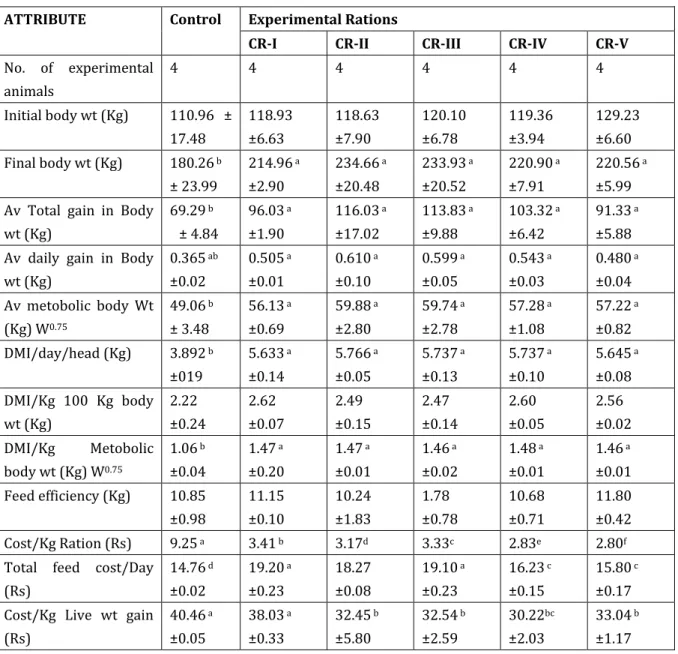
The average daily weight gains of growing buffalo bull calves fed with complete rations I, II, III, IV, VI during the period of growth study were 0.505 ± 0.01, 0.610 ± 0.10, 0.599 ± 0.05, 0.543 ± 0.03, 0.480 ± 0.04, respectively, which were significantly higher than the control, 0.365 ± 0.02 kg (Table 2) on par with the total gains of 96.03 ± 1.90, 116.03 ± 17.02, 113.83 ± 9.88, 103.32 ± 6.42, 91.33 ± 5.88 and 69.29 ± 4.84 kg in calves fed with complete rations CR-I, II, III, IV, VI and control ration, respectively. The results obtained in the present study were in agreement with Prasanna et al., 2015, who found higher total body weight gains in the buffalo bull calves fed sheanut cake based complete rations than the control diet. Prasanna et al., 2015 also reported that the buffalo bull calves fed sugarcane byproducts based ration showed the higher total body weight gains than the control diet.
The average cost per kg live weight gain in calves fed experimental complete rations
Prasanna et al., 2015 also found the cost of complete ration per kg live weight gain was higher for control diet than experimental diets.
The average daily gain (ADG) in experimental buffalo calves fed complete diets ranged from 0.365 ± 0.02 to 0.610 ± 0.10 kg. The average daily gains did not differ significantly (P<0.01) among the buffalo bull calves fed on sugarcane by-products based complete rations but was found to be lowest in the calves fed conventional diet. These results are similar to the results obtained by Naik and Sengar, 1998 in buffalo heifers, Reddy et al., 1993 in crossbred bulls and Prasanna et al., 2015 in male buffalo calves fed sugarcane byproducts based ration. This might be due to higher feed efficiency in the experimental groups when compared to control. Further it is observed that the processed diets had a better digestibility of proximate nutrients, higher intakes of DM, which might have resulted in higher growth rates. The drymatter intake per day per head ranged from 5.64 to 5.77 kg among the complete diets, which was higher (P>0.01) that of control ration (3.89kg). The present findings were in agreement with the Fundora O Stuart et al., 1999a who found higher efficiency in crossbred heifers fed sugarcane harvest residue based complete diets compared to control group.
The average weights of calves slaughtered ranged from 159.8 to 225.8 kg. The mean weight of hot carcass yield for bull calves ranged from 70.76 to 94.46 kg and dressing percentage on live weight and empty body weight ranged from 32.95 to 44.93 per cent and 33.5 to 45.68 per cent, respectively (Table 3). The dressing percentages on live weight (kg) and empty body weight were significantly higher in calves fed CR II (42.68%, 43.4%), than the calves fed conventional diet (35.33%, 35.9%), which were lower than the dressing percentages (ranging from 52.29 to 54.27% on live weight and 64.20 to 66.82% on empty body weight basis in male murrah buffalo calves fed SNC based diets) observed by Prasanna et al., 2015. The results were on par with the results obtained by Prasanna et al., 2015 who also found lower dressing percentages in the male buffalo calves fed sugarcane by products based experimental diet compared to control diet group. Prasanna et al., 2016, found the higher dressing percentages in the lambs fed SNC and probiotic based diets than the control group. The percentages of inedible organs were found to be higher in the calves fed experimental rations compared to control diet group. Reddy et al., 2003 also found higher percentage of non edible organs in the ongole bull calves fed processed complete diet containing sugarcane bagasse. The hot carcass weight was observed to be significantly higher in calves fed CR-II (94.46 kg). The ratio of non-edible organs to edible organs was lower in calves fed experimental diet than the conventional diet.
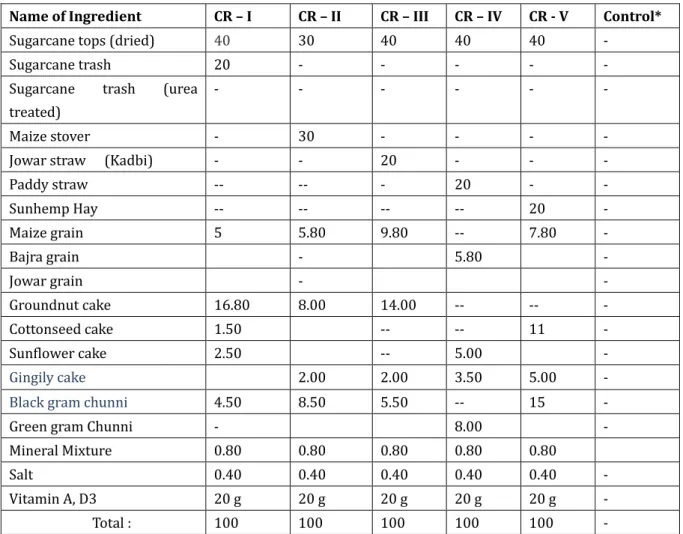
and concentrate feed ingredients for feeding of buffalo bull calves
Name of Ingredient CR – I CR – II CR – III CR – IV CR - V Control*
Sugarcane tops (dried) 40 30 40 40 40 -
Sugarcane trash 20 - - - - -
Sugarcane trash (urea treated)
- - - -
Maize stover - 30 - - - -
Jowar straw (Kadbi) - - 20 - - -
Paddy straw -- -- - 20 - -
Sunhemp Hay -- -- -- -- 20 -
Maize grain 5 5.80 9.80 -- 7.80 -
Bajra grain - 5.80 -
Jowar grain - -
Groundnut cake 16.80 8.00 14.00 -- -- -
Cottonseed cake 1.50 -- -- 11 -
Sunflower cake 2.50 -- 5.00 -
Gingily cake 2.00 2.00 3.50 5.00 -
Black gram chunni 4.50 8.50 5.50 -- 15 -
Green gram Chunni - 8.00 -
Mineral Mixture 0.80 0.80 0.80 0.80 0.80
Salt 0.40 0.40 0.40 0.40 0.40 -
Vitamin A, D3 20 g 20 g 20 g 20 g 20 g -
Total : 100 100 100 100 100 -
*Calves are fed with ad libitum green fodder and 2 kg of concentrate mixture (Traditional feeding)
ATTRIBUTE Control Experimental Rations
CR-I CR-II CR-III CR-IV CR-V
No. of experimental animals
4 4 4 4 4 4
Initial body wt (Kg) 110.96 ± 17.48 118.93 ±6.63 118.63 ±7.90 120.10 ±6.78 119.36 ±3.94 129.23 ±6.60 Final body wt (Kg) 180.26 b
± 23.99
214.96 a ±2.90
234.66 a ±20.48
233.93 a ±20.52
220.90 a ±7.91
220.56 a ±5.99 Av Total gain in Body
wt (Kg)
69.29 b ± 4.84
96.03 a ±1.90
116.03 a ±17.02
113.83 a ±9.88
103.32 a ±6.42
91.33 a ±5.88 Av daily gain in Body
wt (Kg)
0.365 ab ±0.02
0.505 a ±0.01
0.610 a ±0.10
0.599 a ±0.05
0.543 a ±0.03
0.480 a ±0.04 Av metobolic body Wt
(Kg) W0.75
49.06 b ± 3.48
56.13 a ±0.69
59.88 a ±2.80
59.74 a ±2.78
57.28 a ±1.08
57.22 a ±0.82 DMI/day/head (Kg) 3.892 b
±019
5.633 a ±0.14
5.766 a ±0.05
5.737 a ±0.13
5.737 a ±0.10
5.645 a ±0.08 DMI/Kg 100 Kg body
wt (Kg) 2.22 ±0.24 2.62 ±0.07 2.49 ±0.15 2.47 ±0.14 2.60 ±0.05 2.56 ±0.02 DMI/Kg Metobolic
body wt (Kg) W0.75
1.06 b ±0.04
1.47 a ±0.20
1.47 a ±0.01
1.46 a ±0.02
1.48 a ±0.01
1.46 a ±0.01 Feed efficiency (Kg) 10.85
±0.98 11.15 ±0.10 10.24 ±1.83 1.78 ±0.78 10.68 ±0.71 11.80 ±0.42 Cost/Kg Ration (Rs) 9.25 a 3.41 b 3.17d 3.33c 2.83e 2.80f Total feed cost/Day
(Rs)
14.76 d ±0.02
19.20 a ±0.23
18.27 ±0.08
19.10 a ±0.23
16.23 c ±0.15
15.80 c ±0.17 Cost/Kg Live wt gain
(Rs)
40.46 a ±0.05
38.03 a ±0.33
32.45 b ±5.80
32.54 b ±2.59
30.22bc ±2.03
33.04 b ±1.17
Sl. No
Parameter Experimental Rations
CR1 CR2 CR3 CR4 CR5 Control
1 Av. body wt (kg) 212.37a ± 3.4 223.9a ±17.01 216.83a ±10.10 213.8a ±0.92 225.83a ± 2.32 159.8b ±12.18 2 Av. empty body
wt (kg)
208.96 a ±3.25
220.16 a ±16.69
213.23 a ±9.99
210.2 a ±0.87
222.1 a ± 2.35
157.2 b ±12.01 3 Hot carcass wt
(kg)
74.96 b ±3.03
94.46 a ±0.96
74.6 b ±6.09
75.9 b ±4.38
74.53 b ±0.64
70.76 b ±1.46 4 Dressing % on
live wt (kg)
35.33ab ±1.75
42.68 a ±3.24
34.28 b ±1.23
35.5 ab ±2.12
32.95 b ±0.25
44.93 a ±4.35 5 Dressing % on
empty body wt (kg)
35.9 ab ±1.75
43.4 a ±3.29
34.86 b ±1.24
36.11ab ±2.14
33.5 b ±2.61
45.68 a ±4.43
6 Edible organs (kg)
3.571 a ±0.19
3.55 a ±0.37
2.71 a ±1.05
3.834 a ±0.01
4.057 a ±0.04
2.683 b ±0.12
7 Non Edible organs (kg) 23.1 ±0.45 24.86 ±1.6 23.73 ±0.37 24.46 ±0.47 24.03 ±0.08 21.56 ±0.17 8 Edible: non edible
organs
1:6.47 1:7.00 1.875 1:6.38 1:5.92 1:8.03
Means bearing different super scripts in the row differ significantly (P 0.01)
References
Barros.R.C., Rocha Junior.V.R., and Silva.F.V, 2009, Sugarcane or sugarcane bagasse ammoniated with urea replacing for sorghum silage for beef cattle in feedlot, Rev. Bras. Saude Prod. An. 10(2):278-292.
Brandly.P.J., George Migaki., Kenneth.E., and Taylor., (1968). Meat hygiene, 3rd Edn. Lea and
Febiger, Philadedphia, USA.
Bulle.M.L.M., Ribeiro.F.G., Leme.P.R, 1999, Use of Sugarcane Bagasse as the only bulk in high concentrate diets. 1. performance. in: Annual meeting of the brazilian society of zootecnia, 36., porto alegre. anais. porto alegre: brazilian society of animal science, cd-rom. nutrition of ruminants. confinement and beef cattle.
Fundora.O.Stuart.J.R., Sierra.J.F., Regarlado.E., and Lerandi.R,1999a, Ammonia treatment for harvest residues, Digestibility and crude protein content. Cuban Journal of agricultural science 26 (3): 313-317.
Gerrard.F., (1964). Meat Technology 3rd edition Leonard Hell Limited, London.
Kajikawa.H., 1996, Utilization of by-products from food processing as livestock feed in Japan. Ext. Bull. August, Food & Fertilizer Technology Center, Taipei. pp. 1-8.
Krishnamoorthy.U., and Moran.J., 2011, Rearing young ruminants on milk replacers and starter feeds, FAO Animal Production and Health Manual No. 13. Rome.
feed resources: what we should measure? Proceedings of 4th Asian buffalo congress, New Delhi, 25-28 Feb, Pp. 103-115.
Naik.P.K., and Sengar.S.S., 1998, Feed intake and nutrient utilization in buffalo heifers offered wheat straw based complete diets. Indian Journal of Dairy Science 51 (4):239 – 243.
Prasanna Kumar.R., Raghunandan.T., and Sahityarani.M., 2016, Effect of feeding shea nut cake based diets on growth and carcass characteristics in nellore x deccani ram lambs, International Journal of Research in Economics and Social Sciences Volume 6, Issue 5, pp 231-239.
PrasannaKumar.R., Shashi Kumar.M., and SahityaRani.M., 2015, Effect of feeding sugarcane Byproducts Based Ration on Growth and Carcass Traits of Male Buffalo Calves, Journal of Meat Science, 10(2):44-47.
Prasanna Kumar.R., Raghunandan.T., Sahityarani.M., and Shashi Kumar.M., 2015, Effect of feeding shea nut cake based diets on growth and carcass characteristics of graded murrah male buffaloe calves, International Journal of Research in Engineering and Applied Sciences, volume 5, Issue 10, pp 21-29.
Ramachandra.K.S., Taneja.V.K., Anandan.S., and Angadi., 2007, Livestock feed resources in different agro ecosystems of India: availability, requirement and their management, National Institute of Animal Nutrition and Physiology, Bangalore, India,pp.100.
Reddy.D.V., Ramachandra Reddy.R., and Subba Reddy.K.V., 1993, Effect of urea-ammoniation of moist sorghum hay on chemical composition and rumen degradable kinetics, Indian Journal of Animal Nutrition 10 : 45 – 48.