Lucrări ştiinţifice Zootehnie şi Biotehnologii, vol. 42 (2) (2009), Timişoara
METHODS FOR CALF WELFARE EVALUATION
METODE DE EVALUARE A BUN
Ă
ST
Ă
RII LA VI
Ţ
EI
L.T.CZISZTER1, G. STANCIU1, S. ACATINCĂI1, E. SZUCS2, SILVIA ERINA1,
I. TRIPON1, SIMONA BAUL1
1Faculty of Animal Sciences and Biotechnologies, Timişoara, România,
[email protected], 2Szent István University, Gödöllő, Hungary
This paper reviews the welfare assessment with reference to calves. Assessment methods were divided into individual level and farm (system) level. At the farm level the ANI 35L is discussed and the ANSVSA, Romanian evaluation from is presented. Also, the EFSA opinion on poor welfare in intensive calf farming systems is presented.
Keywords: calf, welfare, assessment
Introduction
There are three intersecting views about what constitutes satisfactory animal welfare (Weary and Fraser, 2006).
1. The view that is traditional among veterinarians and livestock producers emphasizes the animal’s biological functioning, such as health, growth, and productivity. From this point of view farming methods are acceptable if they keep animal healthy and producing well, even if living conditions are barren or restricted.
2. The view common among critics of the intensive agriculture is that animals should be provided more natural living conditions and be able to express their normal behaviour.
3. The third view focuses on the animal’s feelings and emotions (affective states) such as pain. From this perspective methods of animal care can be evaluated by how much suffering or pleasure they provide the animals.
These different views can sometimes lead to different conclusions about how to promote animal welfare; the ‘biological functioning’ view may favour cages for laying hens because of the reduced risk of disease transmission in cage system, whereas the ‘natural living’ view would favour less restrictive housing that permits hens to express their natural behaviour. In many cases the three views will concur. For example, if a sow in hot weather is allowed to wallow, this should improve her welfare by all three criteria: heat stress will be reduced (biological functioning), wallowing is the sow’s natural means of thermoregulation (natural living), and the sow will feel less uncomfortable (affective states).
Welfare assessment at the individual level
At the individual level the assessment of comfort and well-being could be discussed in terms of physical damage, physiological responses and behaviour (Gonyou, 1986). Evaluation of injuries requires a methodical assessment of specific areas of the body and examination of the facilities and behaviour of the animal to determine the cause. The physiological response of an animal is dependent upon its psychological state. Inadequate or excessive motivation results in behavioural problems and facilities must be accommodating the behaviour of the animals. All of the methods used to assess comfort and well-being must consider the animal’s ability to adapt different environments.
According to Broom, 1991 the welfare of an individual is its state as regards its attempts to cope with its environment. This definition of welfare has several implications:
1. Welfare is a characteristic of an animal, not something that is given to it.
2. Welfare will vary from very poor to very good, that is to say, the
individual may be in a poor state at one end of the welfare continuum or in a good state at the other.
3. Welfare can be measured in a scientific way that is independent of moral considerations.
4. Measures of failure to cope and measure of how difficult it is for an animal to cope both give information about how poor the welfare is.
5. A knowledge of the preferences of an animal often gives valuable
information about what conditions are likely to result in good welfare, but direct measurements of the state of animal must also be used in attempts to assess welfare and improve it.
6. Animals may use a variety of methods when try to cope
The environmental effects on animals that involve poor welfare are defined as follows (Broom, 1991):
- Pain, which is a state of an individual and is extremely aversive.
- Fear that appears in either a preparation for danger or is a response to detectable danger.
- Lack of control: difficulties in movements. - Lack of control: frustration.
- Lack of control: absence of specific input. - Lack of control: insufficient stimulation - Lack of control: overstimulation.
Measures of welfare at the individual level, defined by Broom, 1991, are lifetime reproductive success, body damage, disease level, impaired immune system function, behaviour, life expectancy, responsiveness, stereotypies.
calves is not controlled, some problems may occur. On the opposite, Raussi, 2005 found that although repeated regrouping causes more agonistic interactions among heifers and increases the distance kept between animals, it lowers heifers’ emotional reactivity to novelty, suddenness, and fear eliciting situations in comparison with rearing heifers in stable pairs. While lower reactivity is undesirable for fitness of prey animals in the wild, it may be an advantage for production animals, which are handled by humans. The effects of repeated changes of partners and pens on heifers were confusing. Social skills of heifers are likely developed around puberty. Diversity rather than stability of the social environment thus appears to be more beneficial to heifers in modern dairy husbandry, particularly when the rearing group has previously been small.
Applying different rearing systems of calves (group or individual, indoor or outdoor, and cold or warm housing) together with different milk feeding methods (dam suckling or teat bucket, acidified milk replacer, and water offered in bucket or by nipple) Hepola, 2008 found out that the feed intake and growth results did not always revealed differences in rearing systems for dairy calves in terms of welfare. Behaviour should also be taken into account when comparing rearing strategies for young calves.
Welfare assessment at the farm (system) level
An “Animal Needs Index” (ANI) (German Tiergerechtheitsindex – TGI) has been developed (Bartussek, 1999; Bartussek et al., 2000). The ANI does not assess the full range of the essential needs that the respective farm animals might possess It assesses animla housing conditions on the basis of what is known to be important for meeting animals’ needs and ensuring their well-being. Therefore, Bartussek suggested the term ‘Housing Condition Score’ (HCS) instead of ANI.
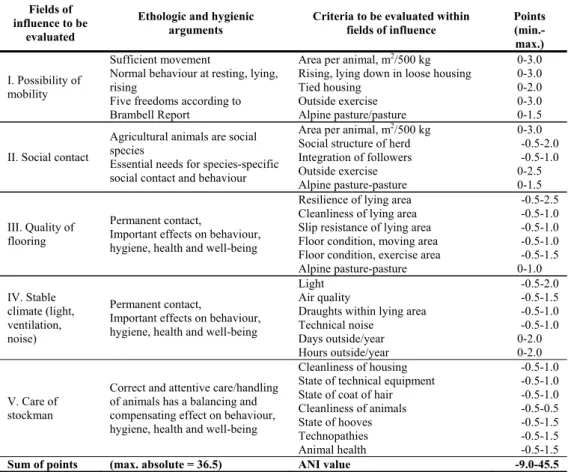
The version of ANI for cows, young calves and beef cattle from 7 months of age is called ANI 35L, which uses a graded point system with which five aspects (area of influence or categories) of the housing system is assessed. These five categories were chosen because of their importance for the animals’ welfare (Bartussek et al., 2000):
1. affording movement and locomotion; 2. affording social interaction;
3. type and condition of flooring; 4. light and air conditions; and 5. stockmanship.
The ANI 35L is shown in Table 1.
By application of ANI 35L in Austria, six welfare categories were considered, according to the percentage of the range points (in parentheses, Bartussek, 1999):
<11 = not suitable with respect to welfare (0-15%)
11-<16 = scarcely suitable with respect to welfare (16-30%)
>24-28 = suitable with respect to welfare (61-75%) >28 = very suitable with respect to welfare (>75%).
Table 1 Structure of ANI 35L for young cattle, beef cattle and cows
(Bartussek, 1999)
Fields of influence to be
evaluated
Ethologic and hygienic arguments
Criteria to be evaluated within fields of influence
Points (min.-max.)
I. Possibility of mobility
Sufficient movement
Normal behaviour at resting, lying, rising
Five freedoms according to Brambell Report
Area per animal, m2/500 kg Rising, lying down in loose housing Tied housing Outside exercise Alpine pasture/pasture 0-3.0 0-3.0 0-2.0 0-3.0 0-1.5
II. Social contact
Agricultural animals are social species
Essential needs for species-specific social contact and behaviour
Area per animal, m2/500 kg Social structure of herd Integration of followers Outside exercise Alpine pasture-pasture 0-3.0 -0.5-2.0 -0.5-1.0 0-2.5 0-1.5
III. Quality of flooring
Permanent contact,
Important effects on behaviour, hygiene, health and well-being
Resilience of lying area Cleanliness of lying area Slip resistance of lying area Floor condition, moving area Floor condition, exercise area Alpine pasture-pasture -0.5-2.5 -0.5-1.0 -0.5-1.0 -0.5-1.0 -0.5-1.5 0-1.0 IV. Stable climate (light, ventilation, noise) Permanent contact,
Important effects on behaviour, hygiene, health and well-being
Light Air quality
Draughts within lying area Technical noise Days outside/year Hours outside/year -0.5-2.0 -0.5-1.5 -0.5-1.0 -0.5-1.0 0-2.0 0-2.0
V. Care of stockman
Correct and attentive care/handling of animals has a balancing and compensating effect on behaviour, hygiene, health and well-being
Cleanliness of housing State of technical equipment State of coat of hair Cleanliness of animals State of hooves Technopathies Animal health -0.5-1.0 -0.5-1.0 -0.5-1.0 -0.5-0.5 -0.5-1.5 -0.5-1.5 -0.5-1.5
Sum of points (max. absolute = 36.5) ANI value -9.0-45.5
In Austria, the ANI 35L proved to be practical and satisfactory (Bartussek, 1999). Evaluating the animal welfare in organic farms in Finland, Roiha, 2000 found out that the ANI 35L/1995 was suitable in Finland for monitoring husbandry systems in organic farming and as part of the quality systems of agriculture it could satisfy the interests of producers, advisors and consumers. 81% of the farms passed the point level needed for organic animal husbandry.
In a scientific opinion on the risk of poor welfare in intensive calf farming systems, EFSA, 2006 that the major risks for poor calf health and welfare were:
- inadequate ventilation, inappropriate airflow, airspeed, temperature for some husbandry systems
- exposure to pathogens causing respiratory and gastrointestinal disorders - continuous restocking (no “all in – all out”)
- mixing calves from different sources.
Minor risks associated with poor calf health and welfare were: - inadequate colostrum intake – quantity
- inadequate colostrum intake – quality - insufficient access to water
- insufficiently balanced solid food
- high humidity
- indoor draughts
- inadequate ventilation, inappropriate airflow, airspeed, temperature for some husbandry systems
- poor air quality (ammonia, bioaerosols, and dust)
- poor floor conditions: gaps too large, too slippery, wet floor for lying, no bedding, insufficient light for response to visual stimuli
- exposure to pathogens causing respiratory and gastrointestinal disorders - poor response of farmer to health problems, especially necessary dietary
changes
- lack of maternal care - separation from the dam.
For the following hazards there were not enough data available to assess the risks (EFSA, 2006):
- iron deficiency resulting in haemoglobin levels below 4.5 mmol/l - allergenic proteins
- too rich diet (overfeeding) - insufficient floor space allowance - inadequate health monitoring
- inadequate haemoglobin monitoring.
In order to assess the risks of calf welfare in intensive farming systems EFSA, 2006 have used three categories of hazards. Fist included the comparison of systems and factors. This category included the feeding and housing systems,
weaning strategies and quality of solid and liquid feed, space and pen design, flooring and bedding material, degree of social contact, temperature, ventilation and air hygiene, human-animal relationships, dehorning and castration. The second referred to the calf diseases and use of antibiotics, and the third to food safety aspects of calf farming. Following this risks analysis EFSA, 2006 made some
conclusions and recommendations regarding the calf welfare in intensive farming systems.
Romanian case
Sanitary Veterinary Agency and for Food Security (ANSVSA). Based on the Council Directive 91/629/EC and the Animal Welfare Act, 2001 the ANSVSA laid down the norms in Romania. For calves there is the Order No. 72/2005 laying down the minimum standards for calves’ protection. According to this order, ANSVSA set up an evaluation form regarding the protection and welfare of calves. This from is used by the vets to assess the welfare status of the calves in farms, and at the end there is a place where recommendations are made. Also, a guide for farmers was set up regarding the protection and welfare of calves.
The ANSVSA from includes 76 lines of problems to be answered to. Forty four questions address the minimum standards to be fulfilled in valves rearing, which are: calves are not kept in individual pens after 8 wks of age, pen dimensions, free area according to their weight, facilities materials, electric system and equipment, procedures to fix troubleshoots, ventilation system, inspection frequency of the equipment, lighting, animal inspections, area for laying down, tying systems, manure removal, cleaning and disinfection, bedding, feeding calves (iron content, fibre content, feeding frequency, water access, feeding equipment, colostrum feeding). The remaining 32 questions are called supplementary requirements and they address the following issues: personnel, documents and document handling, rearing facilities temperature, relative humidity, air drafts, lighting, and gases concentration.
Based on the EU and Romanian legislation Cziszter et al., 2008 developed a questionnaire to assess the welfare of calves in dairy and fattening farms. Provisional results were published, from farms in the South-western Romania based on this questionnaire. Results showed that all the farms provided good rearing conditions for calves, less the requirements regarding provision of clean, dry bedding and access to a good quality feed that were not well complied with.
References
1. *** - Scientific Opinion on the risks of poor welfare in intensive calf farming systems, EFSA-Q-2005-014, The EFSA Journal, vol. 366, p. 1-36, 2006.
2. Bartussek, H. – A review of the animal needs index (ANI) for the
assessment of animals’ well-being in the housing systems for Austrian proprietary products and legislation, Livestock Production Science, vol. 61, p. 179-192, 1999.
3. Bartussek, H., Leeb, Ch., Held, S. – Animal needs index for cattle, ANI 35L/2000.
4. Broom, D.M. – Animal welfare: concepts and measurement, J. Animal
Sci., 1191, vol. 69, p. 4167-4175, 1991.
6. Gonyou, H.W. – Assessment of comfort and well-being in farm animals, J. Dairy Sci., vol. 62, p. 1769-1775, 1986.
7. Hepola, H. – Rearing strategies of young dairy calves in relation to production, behaviour and welfare, PhD. Thesis, Faculty of Agriculture and Forestry of the University of Helsinki, Finland, 2008.
8. Raussi, S. – Group management of young dairy cattle in relation to
animal behaviour and welfare, PhD Thesis, Faculty of Veterinary Medicine of the University of Helsinki, Finland, 2005.
9. Veissier, I., Boissy, A., dePassille, A.M., Rushen, J., van Reenen, C.G., Roussel, S., Andanson, S., Pradel, P. – Calves’ responses to repeated social regrouping and relocation, J. Animal Sci., vol. 79, p. 2580-2593, 2001.