RESEARCH
Neonatal hypotension remains one of the most controversial topics in neonatology. The physiological range of blood pressure (BP) that ensures adequate tissue perfusion in neonates is unknown.The clinical significance of BP measurements remains controversial[1] as
it is well known that BP does not equate to systemic blood flow.[2]
Various definitions for neonatal hypotension are used: (i) mean BP less than the gestational age (in weeks);[3] (ii) mean BP less
than 30 mmHg;[4] and (iii) systolic and diastolic BP below the 10th
centile for age.[5] These references are based on very little research,
with the averaging of BP data over wide time periods, inclusion of appropriate for gestational age (AGA) and small for gestational age (SGA) infants, a combination of invasive and non-invasive BP measurements, and small numbers of patients.[6] BP below the
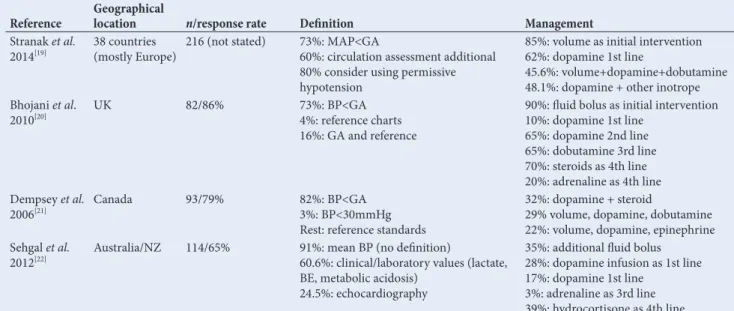
gestational age (GA) remains one of the most common definitions used, despite no research to substantiate its use (Table 1).
Studies comparing different definitions have not been able to show superiority of one definition above another.[7] Varying definitions
have led to varying inclusion criteria for research trials, leading to uncertainty in evidence-based clinical practice.
Clinical signs[8] and echocardiographic investigation[9] have been
suggested as supplementary and alternative diagnostic methods to determine whether a low BP requires intervention.
Optimal management of neonatal hypotension is unclear despite widespread pharmacological manipulation of neonatal BP,[10] with
minimal evidence of improved short- or long-term outcomes.[11]
No intervention (volume expansion,[11] dopamine, dobutamine,[12]
adrenaline[13]) has been shown to positively affect short-term
outcomes, despite these remaining the most common interventions in neonatal hypotension.
It is unclear whether hypotension per se,[14] its definition[7] or its
treatment[15] are associated with abnormal neurological outcomes.
Inotropes have also been shown to adversely affect amplitude
integrated electroencephalography (aEEG)[16] as well as variably
affecting cerebral regional oxygen saturation (CrSO2).[17,18]
It remains unclear what the aim of BP management is – prevention of mortality, improved cerebral and systemic blood flow, or the prevention of long-term adverse neurodevelopmental outcomes.
The aim of the present research was to determine (i) the diagnostic criteria for neonatal hypotension and (ii) management strategies for neonatal hypotension in South Africa.
Method
A 29-point questionnaire was designed to determine the criteria used by South African neonatologists and paediatricians to diagnose and manage neonatal hypotension.
The survey was conducted by two means: (i) a web-accessible survey (www.surveymonkey.com) was sent via an email link to clinicians (February - April 2017) with monthly reminders. Clinicians (paediatricians and neonatologists) were identified from university email lists, clinician management groups (Paediatric Management Group(PMG)) and MedPages; and (ii) a paper-based survey was conducted at a South African national neonatal congress (USANA, Durban, September 2017).
Responses to the web- and paper-based surveys were considered as consent to participate in the research. For the web survey, confidentiality was maintained by providing a web-accessible survey as well as an email link to the survey. Email and IP (internet protocol) addresses were not recorded. For the paper-based survey, confidentiality was maintained by anonymous placing of the survey in a sealed box at the congress. In neither survey were any personal, identifiable data collected.
The research was approved by the Health Research Ethics Committee of the University of Stellenbosch, South Africa (ref. no. N17/01/003).
Background. Neonatal hypotension remains one of the most controversial topics in neonatology. Various definitions are used but lack an evidence base. Owing to the variation in defining a low blood pressure (BP), significant differences in pharmacological manipulation of BP are evident.
Objectives. The aim of the present research was to determine (1) the diagnostic criteria for neonatal hypotension and (2) management strategies for neonatal hypotension in South Africa.
Methods. A 29-point questionnaire was designed to determine the criteria used by South African neonatologists and paediatricians to diagnose and manage neonatal hypotension. The survey was conducted at two different time points in 2017.
Results. The combination of the two surveys resulted in a 9.3% (47/507) response rate. A BP below the gestational age (in weeks) was the most common definition used for neonatal hypotension (75%). Most clinicians (86%) administered fluid prior to initiating inotrope therapy. Dopamine, dobutamine and adrenaline were the most common first-, second- and third-line anti-hypotensive drugs used. Most clinicians (77%) did not use a hypotension management guideline.
Conclusion. Neonatal hypotension definition and management in South Africa are similar to international patterns, despite a lack of evidence to support the diagnosis and management strategies.
S Afr J Child Health 2019;13(2):73-77. DOI:10.7196/SAJCH.2019.v13i2.1568
Neonatal hypotension survey: A South African
perspective
L van Wyk,
1MB ChB, FCPaed, Cert Neonatol, BSc (Hons) (MedSci); J Smith,
1MB ChB, MMed, FCPaed, PhD;
M Hall,
2MB ChB, FRCPH, FRCP, DCH
1Department of Paediatrics & Child Health, Stellenbosch University and Tygerberg Hospital, Cape Town, South Africa 2 Department of Neonatal Medicine, Southampton University Hospital NHS Trust, Southampton, United Kingdom
Corresponding author: L van Wyk ([email protected])
RESEARCH
Statistical analysis was performed using MedCalc Statistical Software version 17.6. Categorical data were represented as number and percentage.
Results
Respondent demographics
For the electronic survey, 512 electronic questionnaires were distributed and 52 completed questionnaires were received – 5 questionnaires were eliminated (4 respondents did not treat hypotension; 1 partial response). This represented a 9.2% (47/512) response rate.
For the paper-based survey, 135 questionnaires were distributed and 111 were returned. Eighty-five completed questionnaires were available for analysis (11 were incomplete and 15 marked ‘nursing personnel’ were excluded). This equated to a response rate of 70.8% (85/120).
The combination of the 2 surveys resulted in a 20.8% (132/632) response rate. Demographics of respondents are shown in Table 2.
Availability of monitoring and
treatment modalities
Onsite echocardiography (57%) and electroencephalography/amplitude-integrated electroencephalography(EEG/ aEEG) (69%) were widely available, with various other modalities less available: central venous pressure (CVP) monitoring (40%), perfusion index (5%), and near-infrared spectroscopy (NIRS) (4%). Clinicians considered echocardiography useful in determining initial therapeutic intervention (34%) and to change initial management (34%).
Dopamine, dobutamine and adrenaline were available to all respondents. Vasopressin, noradrenaline and milrinone were less available (22%, 23% and 36%, respectively).
Criteria for diagnosing neonatal
hypotension
Most clinicians (76%) used a BP below the gestational age (in weeks) as a criterion to diagnose neonatal hypotension. All respondents used clinical and biochemical parameters, in combination, to diagnose hypotension. Most clinicians (67%) considered a low BP, independent of other diagnostic modalities, to be sufficient to diagnose neonatal hypotension (Table 3).
When escalating hypotension therapy, most clinicians (75%) utilised a combination of BP, clinical signs and laboratory values. Only 15% of clinicians utilised echocardiography to escalate or change antihypotensive therapy.
Neonatal hypotension management
Most clinicians (86%) administered fluid prior to initiating inotrope therapy. A volume of 20 mL/kg was administered by most respondents (79%) with 12% of clinicians administering more than 30 mL/kg prior to initiating inotropes. Crystalloid fluids were most commonly used (87%).
Dopamine was the most common first-line inotrope (71%), with dobutamine (23%) and adrenaline (6%). Dobutamine (57%) and adrenaline (47%) were the most common second and third line anti-hypotensive drugs used, respectively. The most common antihypotensive combination was dopamine, dobutamine and adrenaline as first-, second- and third- line, respectively (Fig. 1). Adrenaline was not used by 14% of clinicians. Steroid choice and dose were not surveyed.
Inotropic drug choice would not be changed by 66% of repondents, irrespective
Table 1. Neonatal hypotension definitions: International comparison
Reference Geographical location n/response rate Definition Management
Stranak et al.
2014[19] 38 countries (mostly Europe) 216 (not stated) 73%: MAP<GA60%: circulation assessment additional
80% consider using permissive hypotension
85%: volume as initial intervention 62%: dopamine 1st line
45.6%: volume+dopamine+dobutamine 48.1%: dopamine + other inotrope Bhojani et al.
2010[20] UK 82/86% 73%: BP<GA4%: reference charts
16%: GA and reference
90%: fluid bolus as initial intervention 10%: dopamine 1st line
65%: dopamine 2nd line 65%: dobutamine 3rd line 70%: steroids as 4th line 20%: adrenaline as 4th line Dempsey et al.
2006[21] Canada 93/79% 82%: BP<GA3%: BP<30mmHg
Rest: reference standards
32%: dopamine + steroid
29% volume, dopamine, dobutamine 22%: volume, dopamine, epinephrine Sehgal et al.
2012[22] Australia/NZ 114/65% 91%: mean BP (no definition)60.6%: clinical/laboratory values (lactate,
BE, metabolic acidosis) 24.5%: echocardiography
35%: additional fluid bolus 28%: dopamine infusion as 1st line 17%: dopamine 1st line
3%: adrenaline as 3rd line 39%: hydrocortisone as 4th line
BE = base excess; GA = gestational age; MAP = mean arterial pressure; NZ = New Zealand.
Fig. 1. Antihypotensive combinations.
Dopamine/Dobutamine/Adrenaline
Dopamine/Dobutamine/Steroid
Dopamine/Dobutamine/Other
Dopamine/Other
Dopamine/Adrenaline/Other
Vasopressin/Other 52%
11% 5% 17%
RESEARCH
Table 2. Demographics of questionnaire respondents
Demographic variable Option n (%) (N=132)
Specialist level Paediatrician 80 (61) Neonatologist 52 (39) Neonatal experience level <5 years 28 (21) 5 - 10 years 34 (26) >10 years 70 (53) Hospital affiliation Public health sector 56 (42) Private health sector 76 (58) Province (location of hospital) Eastern Cape 6 (5)
Free State 6 (5) Gauteng 55 (42) KwaZulu-Natal 20 (15)
Limpopo 0
Mpumalanga 2 (1.5) Northern Cape 2 (1.5) North West 1 (1) Western Cape 40 (30) Level NICU available Level 1 9 (7)
Level 2 (high care) 36 (27) Level 3 (ventilator-capable)* 87 (66) Annual VLBW admissions <50 per year 34 (26) 51 - 99 22 (17) >100 76 (58) Number of NICU beds <5 26 (20) 6 - 10 66 (50) 11 - 20 35 (27) >21 5 (3)
NICU = neonatal intensive care unit; VLBW = very low birthweight.
*Level 3 (ventilator-capable) implies the ability to provide life-supporting care, i.e. invasive ventilation capability.
Table 3. Criteria for neonatal hypotension diagnosis
Item Option n (%) (N=132)
Hypotension diagnosis BP <GA in weeks 99 (75) BP < 30 mmHg 11 (9) BP <10th centile 21 (16) Clinical signs utilised in diagnosis of hypotension BP only 13 (10) Capillary refill >3 s 92 (70) Capillary refill >4 s 14 (11) Oliguria <1 mL/kg/h 56 (42) Oliguria <0.5 mL/kg/h 41 (31) Poor colour 65 (49) Temperature differential 21(16) Tachycardia 80 (61) Metabolic acidosis 98 (74) Increased serum lactate 85 (64) Other useful diagnostic modalities prior to initiating antihypotensive therapy None – BP only 88 (67)
CVP 9 (7)
Echocardiographic parameters 22 (17) Perfusion index 6 (5) Mixed venous saturation 6 (5) Heart rate variability 23 (17) aEEG 6 (5) NIRS 3 (2)
RESEARCH
of whether the neonate was term or preterm. Reasons provided for different inotrope choices were stated as the presence of hypoxic-ischaemic encephalopathy, persistent pulmonary hypertension and the age of onset of hypotension.
Hypotension management guidelines were not used by 77% of respondents. Varying hypotension management guidelines were used by 23% of clinicians: in-house guidelines (88%), American Academy of Pediatrics guidelines (3%) and other international hospital neonatal guidelines (6%).
Aim of hypotension management
The aim of hypotension treatment was stated to be: prevention of morbidity (61%), reduction of mortality (62%), increase BP (24%), and increase cardiac output (48%). Some clinicians (18%) stated that hypotension treatment was appropriate management according to neonatal consensus.
Discussion
The present study is the first to report on the diagnostic criteria and management of neonatal hypotension in South Africa. Respondent demographics reflect the state of medicine in South Africa. Survey respondents were mostly paediatricians, employed in the private sector, and originating from Gauteng and Western Cape provinces.
Very low birth weight (VLBW) infant admission numbers were high[23] (55% of respondents having >100 admissions per annum)
and in keeping with the VLBW rate (3.04 per 1 000 live births)[24] in
South Africa. The availability of NICU beds per unit was generally low (6 - 10 beds per unit) but is in keeping with the management of most neonates in high-care units as well as the designation of NICU bed applicable only to beds with invasive ventilation capability.
Despite a significant lack of evidence and research to support any specific neonatal hypotension definition, the most commonly used is a BP less than the gestational age (in weeks).This trend was also seen in this survey (Table 3) and is similar to international studies’ results (Table 1). Published normative data exist for systolic, diastolic and mean BP in neonates of various gestational ages, birth weights and postnatal ages.[25,26] These data, however, are not utilised and
not reflected in the Standard Treatment Guidelines and Essential Medicines List for South Africa (mean BP at least 5 - 10 mmHg above the mean gestational age (in weeks)).[27]
Very few survey respondents used a hypotension guideline, which underscores the international lack of clear diagnostic and management guidelines regarding neonatal hypotension management. Comments left by respondents seem to reinforce this concept: ‘more guidance would be appreciated’, and ‘general lack of consensus and insight’.
Similar to international neonatal hypotension management studies, most respondents administered crystalloid fluid prior to inotrope initiation, despite a lack of evidence.[11] Dopamine, dobutamine
and adrenaline were the most commonly used inotropes, similarly to other international studies. Also similar to other international studies, dopamine, dobutamine and adrenaline represented first-, second- and third-line therapy, despite a lack of evidence for this sequence of therapy.[13,28] Dopamine is the recommended inotrope
for neonatal hypotension in the South African Standard Treatment Guidelines and Essential Medicines List,[27] despite insufficient
evidence.
Steroid administration in the current survey was low compared with international studies (20% and 39 - 70%, respectively). The reason for this discrepancy is unclear but is possibly due to the lack of clear hypotension management guidelines and the fear of steroid side-effects on the preterm infant.[29]
The relatively high availability of on- and off-site echocardiography in a low-middle-income country, such as South Africa, is reassuring. However, echocardiography was considered useful for initiating or
changing inotrope choice, and not as an initial method to diagnose the underlying pathophysiology of hypotension. This action is contrary to research showing that echocardiographic identification of pathophysiology may aid in therapeutic decisions.[9]
A majority of respondents stated that inotrope therapy would reduce morbidity and mortality. However, this is not consistently supported in the literature. It is unclear whether hypotension, irrespective of the definition used, or inotropic therapy itself, leads to adverse outcomes.[7] This uncertainty leads to diverse management
strategies, thereby further compounding the uncertainty of outcomes and the choice of management.[30]
Study limitations
Although ours is the first published study to report on the criteria used by paediatricians and neonatologists for neonatal hypotension diagnosis and its treatment, its results and conclusions are hampered by the low response rate (20.4%). It is also unclear how many respondents completed both surveys, as identifying details were not collected, which may further decrease the response rate and thus the reliability of the study.
Data presented reflect personal choices of respondents. It is unclear how many responding clinicians worked in the same neonatal unit, as these data were not collected for ethical confidentiality reasons, which may influence the data interpretation.
Recommendations
South Africa uses definitions and management strategies for neonatal hypotension which are similar to those used by many international institutions. The international controversy of when and how to manage neonatal hypotension remains apparent in South Africa. More research is required to develop appropriate, evidence-based neonatal hypotension protocols, also in low-resource settings, such as South Africa. These include establishing normative BP data for clinical use and the definition of neonatal hypotension.
Acknowledgements. We acknowledge the help from the Paediatric
Management Group, South Africa, for electronic circulation of the survey to neonatologists and paediatricians registered with the group. We also thank the USANA Organising Committee for allowing the survey to be conducted during its bi-annual congress.
Author contributions. LVW was responsible for research
conceptua-lisation, data collection and analysis, and drafting of the article. JS was responsible for research conceptualisation, data interpretation and critical revision of the article. MH was responsible for research conceptualisation, research supervision and critical revision of the article.
Funding. None.
Conflicts of interest. None.
1. Escourrou G, Renesme L, Zana E, et al. How to assess hemodynamic status in very preterm newborns in the first week of life. J Perinatol 2017;37(9):987-993.
https://doi.org/10.1038/jp.2017.57
2. Bauer K, Linderkamp O, Versmold HT. Systolic BP and blood volume in preterm infants. Arch Dis Child 1993;69(5 Spec No):521-522. PMCID: PMC1029597 3. Levene M, Chiswick M, Field D, et al. and the Joint Working group of the
British Association of Perinatal Medicine and the Research Unit of the Royal College of Physicians. Development of audit measures and guidelines for good practice in the management of neonatal respiratory distress syndrome. Arch Dis Child 1992;67(10 Spec No):1221-1227.
4. Miall-Allen VM, De Vries LS, Whitelaw AL. Mean arterial blood pressure and neonatal cerebral lesions. Arch Dis Child 1987;62(10):1068-1069.
5. Nuntnarumit P, Yang W, Bada-Allzey HS. Blood pressure measurements in the newborn. Clin Perinat 1999;26(4):981-996.
RESEARCH
7. St Peter D, Gandy C, Hoffman SB. Hypotension and adverse outcomes in prematurity: Comparing definitions. Neonatology 2017;111(3):228-233.
https://doi.org/10.1159/000452616
8. De Boode WP. Clinical monitoring of systemic hemodynamics in critically
ill newborns. Early Hum Dev 2010;86(3):137-141. https://doi.org/10.1016/j.
earlhumdev.2010.01.031
9. Giesinger RE, McNamara PJ. Hemodynamic instability in the critically ill neonate. An approach to cardiovascular support based on disease
pathology. Semin Perinatol 2016;40(3):174-188. https://doi.org/10.1053/j.
semperi.2015.12.005
10. Laughon M, Bose C, Allred E, et al. for the ELGAN study investigators. Factors associated with treatment for hypotension in extremely low gestational age newborns during the first postnatal week. Pediatrics 2007;119(2):273-280.
https://doi.org/10.1542/peds.2006-1138
11. Osborn DA, Evans N. Early volume expansion for prevention of morbidity and mortality in very preterm infants. Cochrane Database Sys Rev 2004: CD002055.
https://doi.org/10.1002/14651858.CD002055.pub2
12. Osborn DA, Paradisis M, Evans NJ. The effect of inotropes on morbidity and mortality in preterm infants with low systemic or organ blood flow. Cochrane Database Sys Rev 2007: CD005090. DOI: 10.1002/14651858.CD005090.pub2 13. Paradisis M, Osborn DA. Adrenaline for the prevention of morbidity and
mortality in preterm infants with cardiovascular compromise. Cochrane
Database Sys Rev 2004: CD003958. https://doi.org/10.1002/14651858.
CD003958.pub2
14. Fanaroff AA, Fanaroff JM. Short- and long-term consequences of hypotension in
ELBW infants. Semin Perinatol 2006;30(3):151-155. https://doi.org/10.1053/j.
semperi.2006.04.006
15. Fanaroff JM, Wilson-Costello DE, Newman NS, et al. Treated hypotension is associated with neonatal morbidity and hearing loss in extremely low birth
weight infants. Pediatrics 2006;117(4):1131-1135. https://doi.org/10.1542/
peds.2005-1230
16. Shah D, Paradisis M, Bowen JR. Relationship between systemic blood flow, BP, inotropes and aEEG in the first 48h of life in extremely preterm infants. Ped Res
2013;74(3):314-320. https://doi.org/10.1038/pr.2013.104
17. Bonestroo HJ, Lemmers PM, Baerts W, et al. Effect of hypotensive treatment on cerebral oxygenation of preterm infants without PDA. Pediatrics
2011;128(6):e1502-1510. https://doi.org/10.1542/peds.2010-3791
18. Kooi EMW, van der Laan ME, Verhagen EA, et al. Volume expansion does not alter cerebral tissue extraction in preterm infants with clinical
signs of poor perfusion. Neonatology 2013;103(4):308-314. https://doi.
org/10.1159/000346383
19. Stranak Z, Semberova J, Barrington K, et al. International survey on diagnosis and management of hypotension in extremely preterm babies. Eur J Pediatrics
2014;173(6):793-798. https://doi.org/10.1007/s00431-013-2251-9
20. Bhojani S, Bannerjee J, Rahman MM. Management of neonatal hypotension – a national questionnaire survey. Infant 2010;6(5):152-154.
21. Dempsey EM, Barrington KJ. Diagnostic criteria and therapeutic interventions for the hypotensive very low birth weight infant. J Perinatol
2006;26(11):677-681. https://doi.org/10.1038/sj.jp.7211579
22. Sehgal A, Osborn D, McNamara PJ. Cardiovascular support in preterm infants: A survey of practices in Australia and New Zealand. J Paed Child Health
2012;48(4):317-323. https://doi.org/10.1111/j.1440-1754.2011.02246.x
23. Phibbs CS, Baker LC, Caughey AB, et al. Level and volume of neonatal intensive care medicine and mortality in very low birth weight infants. New Engl J Med
2007;356(21):2165-2175. https://doi.org/10.1056/NEJMsa065029
24. Pattinson RC, Rhoda N. Saving babies 2012-2013: Ninth report on perinatal
care in South Africa. Tshepesa Press, Pretoria, 2014. https://www.ppip.co.za/
wp-content/uploads/Saving-Babies-2012-2013.pdf. (accessed 18 January 2018). 25. Engle DW. Blood pressure in the very low birth weight neonate. Early Hum Dev
2001;62(2):97-130. Pejovic B, Peco-Antic A, Marinkovic-Eric J. Blood pressure in non-critically ill preterm infants and full-term infants. PediatrNephro
2007;22(2):249-257. https://doi.org/10.1007/s00467-006-0311-3
26. Standard Treatment Guidelines and Essential Medicines List: Paediatric Hospital Level STGS and EML. 4th ed. (accessed 18 January 2018). http:// www.health.gov.za/index.php/standard-treatment-guidelines-and-essential-medicines-list
27. Subhedar NV, Shaw NJ. Dopamine versus dobutamine for hypotensive
preterm infants. Cochrane Database Sys Rev 2003: CD001242. https://doi.
org/10.1002/14651858.CD001242
28. Ibrahim H, Sinha IP, Subhedar NV. Corticosteroids for treating hypotension
in preterm infants. Cochrane Database Sys Rev 2011:CD003662. https://doi.
org/10.1002/14651858.CD003662.pub4
29. Dempsey EM. Challenges in treating low BP in preterm infants. Children
2015;2(2):272-288. https://doi.org/10.3390/children2020272