Using Network Processor to Establish
Security Agent for AODV
Routing Protocol
Chen Hongsong
1,2, Fu Zhongchuan
2, Wang Chengyao
1, Ji Zhenzhou
2,
Hu Mingzeng
21Department of Computer Science, University of Science and Technology Beijing 2Department of Computer Science and Technology, Harbin Institute of Technology
Network processor(NP)is optimized to perform network tasks. It uses massive parallel processing architecture to achieve high performance. Ad hoc network is an exciting research aspect due to the characters of self-organization, dynamically topology and temporary network life. How-ever, all the characters make the security problem more serious. Denial-of-Service (DoS) attack is the main puzzle in the security of Ad hoc network. A novel NP-based security scheme is proposed to combat the attack. Security agent is established by a hardware thread in NP. Agent can update itself at some interval by the trustworthiness of the neighbor nodes. Agent can trace the RREQ and RREP messages stream to aggregate the key information and analyze them by intrusion detection algorithm. NS2 simulator is expanded to validate the security scheme. Simulation results show that NP-based security scheme is effective to detect DoS attack.
Keywords: network processor, AODV routing proto-col, security Agent, DoS attack, intrusion detection, performance evaluation.
1. Introduction
With the ever-increasing performance and flex-ibility requirements seen in today’s networks, programmable network processors have been developed to meet the need. Network proces-sor(NP) is a programmable device with archi-tectural parallel features and special optimiza-tion for packet processing[1]. Most network processors use hardware multithreading com-puting model. Separate register files and con-texts for separate threads ensure fast context switching. The multithreading parallel archi-tectures fit to multi-task execution environment in network. Thus each thread is related to a
task. New general programmable routers are designed by network processor, especially for security application.
Ad hoc networks are dynamic collections of self-organizing mobile nodes with links that are changing in an unpredictable way. They are characterized by a dynamic topology. Nodes can perform the roles of both hosts and routers with intrinsic mutual trust. In Ad hoc network, every node acts as router to form the network, security is very important to ad hoc networks. In wireless Ad hoc network, wireless nodes require process flexibility with low power consumption and high security, network processor is very fit to the need. So we use network processor to build the node of Ad hoc security scheme is designed by the network processor.
2. Related Research Work
There are two main approaches in current Ad hoc securing environments. The first is intru-sion prevention measures, such as authentica-tion and encrypauthentica-tion. The second is intrusion detection and response approach[2].
Because cryptography-based prevention tech-nique consumes much energy, it is invalid to internal attacks[3]. Intrusion detection and re-sponse are a necessity in MANET. We introduce them by the system architecture.
partic-corresponding change in its routing table as the trace data to build the anomaly detection model.
Because all the nodes run local detection engine that analyzes local data for anomalies, it is too expensive to detect some special attacks. 2) Hierarchical IDS architectures have been
proposed for multi-layered[5], wireless Ad hoc networks. In a multilayered wireless Ad hoc network, cluster-head nodes centralize routing for the cluster and may support addi-tional security mechanisms. The whole net-work is logically divided into several clus-ters, each of them consists of one special node as the cluster head and several normal nodes as the cluster members.
Because the cluster heads are the main commu-nication and intrusion detection center, if the cluster heads have been attacked by malicious attackers, the network will be destroyed. 3) Oleg Kachirski proposes Multiple Sensors
intrusion detection system for Ad hoc wire-less networks based on mobile agent tech-nology [6]. They introduce a multi-sensor intrusion detection system employing coop-erative detection algorithm. A mobile agent implementation is chosen, to support such features of the IDS system as mobility of sensors, intelligent routing of intrusion data throughout the network and lightweight im-plementation.
Because of scarce computational and power re-sources in mobile nodes, multiple sensors and agent communication impose heavy pressure on Ad hoc network.
3. The Ad hoc On-Demand Distance Vector (AODV) Protocol
The Ad Hoc On-Demand Distance Vector
(AODV)algorithm enables dynamic, self-start-ing, multi-hop routing between participating mobile nodes wishing to establish and maintain an Ad hoc network[7]. AODV allows mobile nodes to obtain routes quickly for new desti-nations and does not require nodes to maintain
source node wants to send data packets to a destination node, but cannot find a route in its routing table, it broadcasts RREQ messages to its neighbors. Its neighbors then rebroadcast the RREQ message to their neighbors if they do not have a fresh enough route to the destination node. This process continues until the RREQ message reaches the destination node or an in-termediate node that has a fresh enough route. After accepting a RREQ message, the desti-nation or intermediate node updates its reverse route to the source node using the neighbor from which it has received the RREQ message. When the source or an intermediate node receives a RREP message, it updates its forward route to the destination node, using the neighbor from which it has received the RREP message. The source node, or an intermediate node, updates its routing table if it receives a RREP message.
4. Denial-of-Service Attack to AODV Protocol
A “denial-of-service” attack is characterized by an explicit attempt by attackers to prevent le-gitimate users of a service from using that ser-vice. It can consume scarce resources or de-stroy network connection. These attacks do not necessarily damage data directly or perma-nently, but they intentionally compromise the availability of the resources[8]. They can con-sume much useful resource to disrupt network usability. DoS attacks in AODV protocol rout-ing level can be classified into two categories by the type of message – RREQ flood attack and RREP route loop attack.
4.1. RREQ Flood Attack
a)flood attack by malicious node.
b)after RREQ flood attack.
Fig. 1.Flooding attack caused by RREQ flood.
As shown in Figure 1, malicious node sends a mass of fake RREQ broadcast to flood the net-work. Other nodes process and response the flood RREQ, the flood makes great impact on the storage and communication resource of the nodes. It almost causes the network communi-cation breakdown.
4.2. RREP Route Loop Attack
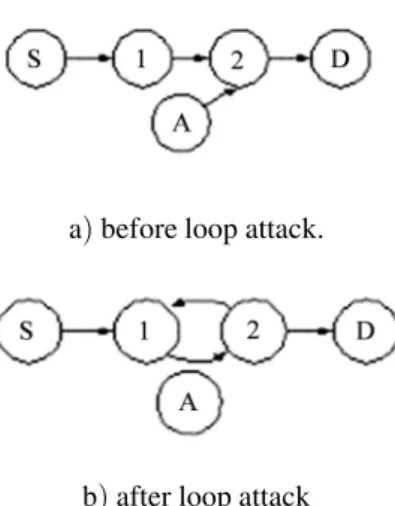
A routing loop is a path that goes through the same node more than once. Routing loops cause packets to be sent by the same nodes over and over again until the TTL-field in the packet is exhausted to zero. Routing loops can be used to create DoS, because they consume node re-sources in the loop. The destination node can also be isolated from the network, because only few packets reach their destination. Figure 2 shows that a route loop is formed between node 1 and node 2.
As Figure 2 shows, there are two intermediate nodes in a route from node S to node D. The at-tacker can form a route loop between node 1 and node 2, by pretending to be node 1 to forward a RREP message with increased RREP sequence. When node 2 receives the fake RREP message, it updates the next hop from node D to node 1. After updating the destination sequence number
a)before loop attack.
b)after loop attack
(Node S: originating node; nodes 1 and 2: intermediate nodes; node D: destination node; node A: attack node).
Fig. 2.The attacker forms a loop between node 1 and node 2 by a fake RREP message.
in the route table, these packets will be first sent to node 1, then node 2 and back to node 1 again. As a result, a route loop is formed between node 1 and node 2.
5. NP-based Security Scheme in Ad hoc Network
Recently, main attention has been paid to the security processor design for wireless Ad hoc devices. However, there is a lack of research for combining security application and network processor in wireless communication. In this paper, we present the design of security agent by network processor to meet the security need of wireless Ad hoc network. Ad hoc networks are characterized by dynamic topology and the lack of fixed infrastructure. Ad hoc wireless networks allow people to set up computer net-works and access information at any place and time. Nodes can perform the roles of both hosts and routers with intrinsic mutual trust. The na-ture of mobile computing environment makes it vulnerable to malicious attacks.
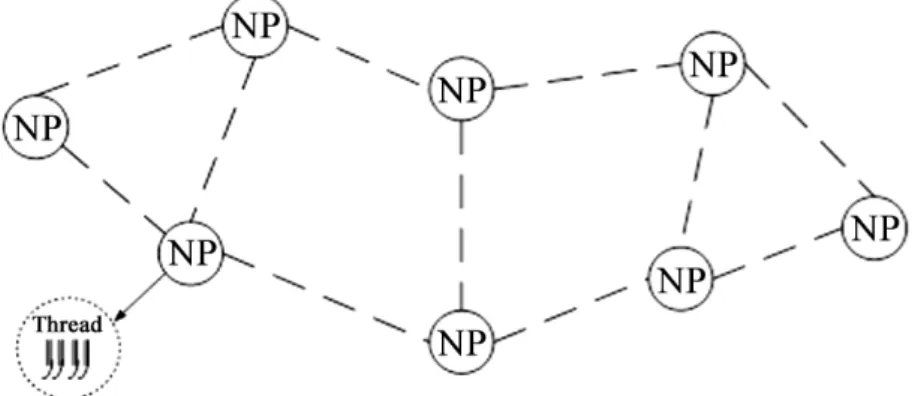
Fig. 3.NP-based distributed Wireless Ad hoc network.
programmable NP is used to establish mobile node in out security scheme. It can execute multi-task, such as routing tables management, packet classification and forwarding, security computation. Most of security processors exist-ing in today’s market are designed to function as security co-processors. Security co-processor is attached to network processor and invoked whenever the host processor decides that se-curity processing is needed[9]. The approach moves the burden of security processing from the NP to the co-processor. The main limitation of this method is the need for a packet to tra-verse the memory many times. The communi-cation between network processor and security co-processors brings long delay. This makes the network security performance depressed.
Therefore, finding new solutions that enhance security processing in Ad hoc network is es-sential. In fact, the security co-processor ex-ecutes some types of algorithm for encryption and decryption. While in Ad hoc network, in-trusion detection method is better than tradi-tional encryption, especially for some types of DoS attacks, such as flooding attack. Because most network processors use hardware multi-thread architecture to fit multi-tasks in network environment, we use one of the threads as se-curity agent to do sese-curity computing, while other threads do other network processing such as packet forwarding. So the advantage of the hardware multithread can be fully utilized with-out using security co-processor. This solution can save power consumption to meet the need of wireless network.
5.1. NP-based Intrusion Detection and Security Scheme
Lee’s distributed IDS for Ad hoc network is the basic system model. The cost of intrusion detec-tion increases with the number of nodes. Hierar-chical IDS architecture is a model partitioned by node space location. Multiple Sensors intrusion detection system is a model partitioned by the functions of intrusion detection sensor. AODV routing protocol is an on-demand routing pro-tocol, which initiates route discovery process when needed. As we use one thread of NP as security agent, and the thread owns dynamical lifetime, agent-based dynamic lifetime security scheme is proposed to improve the efficiency of intrusion detection. It is an intrusion detec-tion modelfirstly partitionedby route existent lifetime. The number of IDS is equal to the number of AODV RREQ-RREP stream. The cost of intrusion detection decreases greatly. The NP-based Ad hoc network architecture is shown in Figure 3.
As seen in Figure 3, multithreading NP is used to be a node of Ad hoc network. One thread of NP is used as security agent. In artificial intelli-gence context,agentis an entity that perceives its environment with sensors, it acts on its en-vironment with effectors [10]. Such an agent can be a hardware multithread with sensors and effectors. Theagentis certain kinds of artificial intelligence programs with user’s goal.
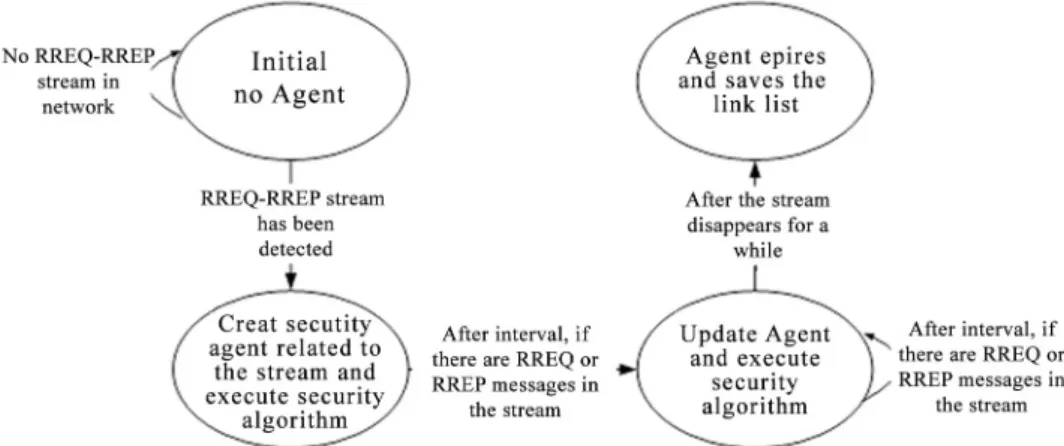
Fig. 4.Thread state transition diagram.
The following programming section shows the class definition of NP-based node:
Static class NP-node: public wireless-node{ public: - - -;
int thread-num; int thread-state; int lifetime;
int thread-create();int thread-run(); int thread-wait();
int thread-destroy();};
The derivative relation of node class is shown in Figure 5.
The thread is created as security agent by the need of ADOV routing. Agent can change its state to reflect the state of the ADOV routing process. Security Agent is given dynamic life to avoid being attacked. Security Agent not only executes code and collects data, but also has multi-timed states. Security agent can cre-ate, execute, update and expire by the state of RREP stream. When there is RREQ-RREP stream in network, there is a related se-curity agent to monitor the stream by intrusion detection algorithm. After the RREQ-RREP
Fig. 5.Derivative relation of node class.
stream disappears, the related security agent ex-pires. Agent can update itself to improve trust-worthiness and security. The timed finite state machine of security Agent is shown in Figure 6. Seen from Figure 6, security protocol detects RREQ-RREP routing message periodically. If any RREQ-RREP stream is detected, security agent related to the stream is created to exe-cute the intrusion detection algorithm. In fact, it is the hardware thread to execute the secu-rity code. After some interval, if the stream already exists in network, the current agent mi-grates to high trustworthiness neighbor node. Then another thread in the neighbor node will go on executing security code. So the intru-sion detection algorithm is executed by many high trustworthiness neighbors in turns to dis-tribute the cost of security computing and avoid the agent to be attacked. If there is no RREQ-RREP stream in network for some interval, the related agent expires by the stream. That is to
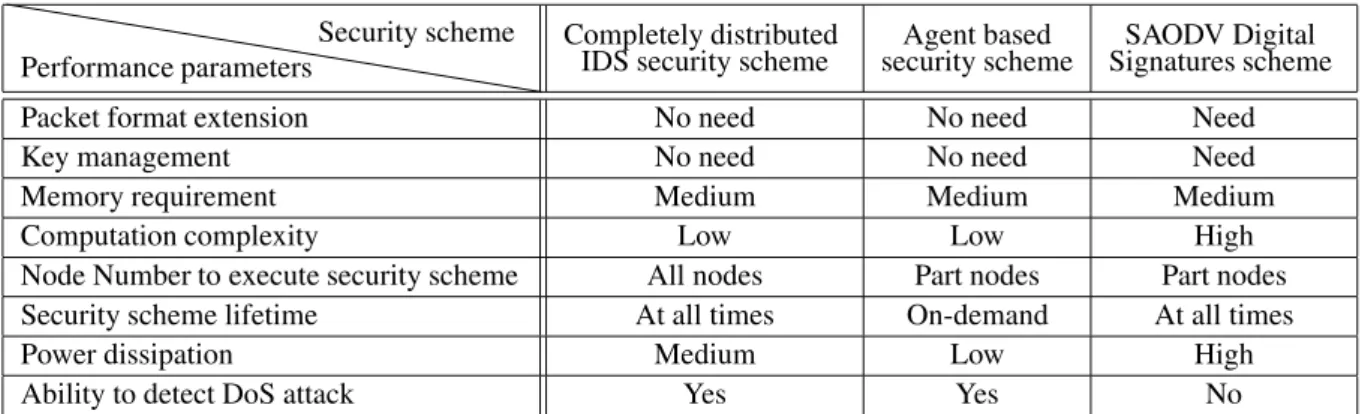
Memory requirement Medium Medium Medium
Computation complexity Low Low High
Node Number to execute security scheme All nodes Part nodes Part nodes
Security scheme lifetime At all times On-demand At all times
Power dissipation Medium Low High
Ability to detect DoS attack Yes Yes No
Table 1.The comparison of the current security scheme in MANET.
say, the agent has dynamic lifetime to execute the security scheme. The comparison of cur-rent security scheme in MANET is listed in the Table 1.
We make the following assumptions in the se-curity scheme.
1)Agent is a hardware thread that executes the security scheme. It can migrate between the high trustworthiness nodes.
2)Agent has the ability to access routing tables of nodes related to the stream. It should also have the capability of controlling node and inter-cepting RREQ and RREP related to the stream.
5.2. RREQ Flood Attack Detection and Response
In AODV routing process, when a source node needs a route to destination, it initiates a route discovery process. In route discovery, a route request can be uniquely identified by the RREQ ID, source sequence, source and destination route request address. In a route reply, reply message goes back to the source node over the shortest path. The routing information is stored in a trace link list shown in Table 2. It includes table head and table items. Every table head
stands for a route discovery entrance. RREQ-Countstands for the number of RREQ broadcast in a period of time. It can be used to detect flood attack. Every table item stands for a message in the RREQ-RREP stream. Because the source and destination IP address in RREP message is reverse to the corresponding RREQ message, a Tag flag is used to distinguish them. If it is RREQ message, the Tag flag is 0; else it is RREP message, the Tag flag is 1. The con-struction of the trace link list is shown in Table 2.
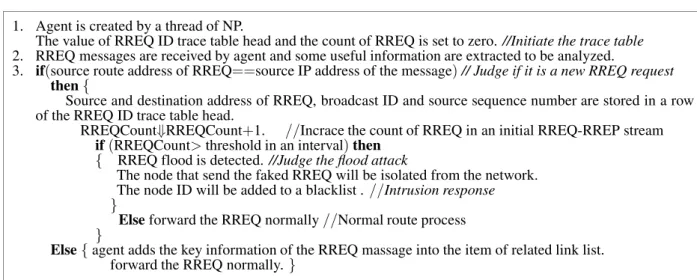
The agent monitors the RREQ-RREP messages at real-time to fill in the trace link list. In NS2 simulator, the security agent monitors the RREQ and RREP messages by calling rece( ) function. Once the RREQ messages are received, they will be processed by secu-rity agent. The Agent exists with the stream. After the RREQ-RREP stream disappears for some interval, the Agent expires, but the link list already exists in the node. RREQ flood attack will be processed by the following algo-rithm shown in Table 3.
When the Agent hears a RREQ message, it firstly compares if the IP address in IP header of the RREQ message is equal to AODV source route address. If they are equal, it is a new RREQ-RREP stream, the key information of
rreq src1 rreq dst1 rreq bid1 PREQCount1 source seq1 dest seq1 →
rreq src2 rreq dst2 rreq bid2 PREQCount2 source seq2 dest seq2 −→
- - - −→
rreq srcn rreq dstn rreq bidn PREQCountN source seqN dest seqN −→
ipsrc1 ipdst1 Tag . . .
1. Agent is created by a thread of NP.
The value of RREQ ID trace table head and the count of RREQ is set to zero.//Initiate the trace table
2. RREQ messages are received by agent and some useful information are extracted to be analyzed.
3. if(source route address of RREQ==source IP address of the message)// Judge if it is a new RREQ request
then{
Source and destination address of RREQ, broadcast ID and source sequence number are stored in a row of the RREQ ID trace table head.
RREQCount⇓RREQCount+1. //Incrace the count of RREQ in an initial RREQ-RREP stream if(RREQCount>threshold in an interval)then
{ RREQ flood is detected. //Judge theflood attack
The node that send the faked RREQ will be isolated from the network. The node ID will be added to a blacklist .//Intrusion response
}
Elseforward the RREQ normally//Normal route process
}
Else{agent adds the key information of the RREQ massage into the item of related link list. forward the RREQ normally.}
Table 3.RREQ flood intrusion detection and response algorithm.
the RREQ message is saved in the head of the link list to record the stream. If they are not equal, the Agent looks up the head of link list to validate if the related link list was built to the stream. If the related head of the link list is found, the Agent goes on to check the pre-vious node to send the RREQ message. If the previous node is found, the Agent validates the data and directs consistency between the cur-rent RREQ message and the RREQ message re-ceived by previous node. The source sequence number of the current RREQ message should be equal to that of the RREQ message received by previous node. The hop count should be in-creased by 1. When all the above validation has passed, the Agent adds the key information of the RREQ message into the item of related link list, the RREQ is forwarded correctly. Other-wise fake RREQ attack is detected, the message is dropped; the node to send the RREQ is iso-lated and recorded into blacklist.
6. RREP Loop Attack Detection and Response
The biggest difference between the intrusion de-tection for RREQ and RREP is in that the former builds the link list, the latter checks and updates the link list.
As Table 4 shows, the Agent monitors the RREP at real-time to update the trace table, it detects the route loop attack by RREP route loop detec-tion algorithm and drops the malicious RREP message.
When a RREP message is heard by Agent, it checks the head of link list to validate if the related link list was built to the RREQ-RREP stream. If it finds the head related to the stream, Agent goes on to find the correspond-ing RREQ item and the previous node. If the value of tag is more than 1, at the same time the source-destination IP address in RREP is equal
1. RREP messages are received by agent and some useful information are extracted to be analyzed. 2. RREP messages are grouped by their RREP source and destination address.
3. if(one source IP address of RREP message==destination IP address of previous RREP message &&its destination IP address of RREP==the source IP address of previous RREP message)
then
{RREP route loop is detected. //Route loop detection
The malicious RREP message will be dropped.
The node ID relating to the malicious RREP message will be added to the blacklist.
//Intrusion response
}
else{Update the Tag value in the related item of trace link list. forwarding the RREP normally.}
7. Performance Evaluation and Simulation Results
The measurements of the network performance are made by the NS2[11]. In order to validate NP-based security scheme, we extend the node type to multithreading architecture, it is real-ized by node configure, we add multithreading description to the node architecture. Table 5 shows the parameters used in our experiments. Continuous bit rate (CBR) is used in our ex-periments. There are 20 nodes in the Ad hoc network. The simulation runs for 300 seconds. The field configuration is 1 000 m×600m. The physical link bandwidth is 2 Mbps. The node architecture is multithreading.
Communication Type CBR
Number of Nodes 20
Node architecture multithreading
Simulation Area 1000m*600m
Simulation Time 300 seconds
Pause Time 2 seconds
Packet Rate 4packets/second
Number of Connections 5
Transmission Range 250m
Physical Link Bandwidth 2Mbps Number of malicious nodes 1
Table 5.Simulation parameters.
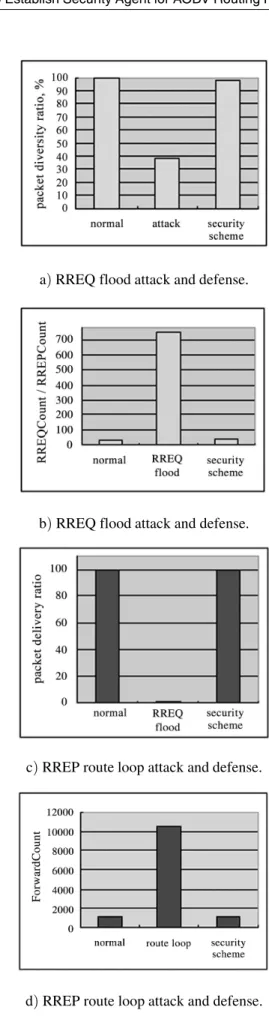
DoS attacks in AODV protocol routing level can be classified into RREQ flood attack and RREP route loop attack. Performance evaluation to the two types of DoS attacks are shown in Figure 6. Figure 7 shows that the two types of DoS attacks have great effect on the performance, while NP-based security scheme can effectively de-tect the attacks and block the attackers. Seen from Figure 7a), packet delivery ratio in nor-mal is 100%; under RREQ flood attack, the
a)RREQ flood attack and defense.
b)RREQ flood attack and defense.
c)RREP route loop attack and defense.
d)RREP route loop attack and defense.
metric decreases to 47% while under security scheme, the malicious node is detected and iso-lated, the metric recovers to 98%, it is near to the normal level. Seen from Figure 7b), the ratio RREQCount/RREPCount in normal is 2848/86=33, the ratio value under attack increases to 250059/332=751, while the ra-tio value under NP-based security scheme de-creases to 6208/159=39. Agent-NP security scheme can detect the RREQ flood attack on time, yet there is little influence at the begin-ning of attack.
In route loop attack, the packet delivery ratio greatly decreases from 100% to 1.1%, while the ratio value increases to 100% under NP-based security scheme as shown in Figure 7c). For-wardCount – the number of forwarded packet in normal is 1117, it greatly increases to 10491 in attack, while it decreases to 1143 in NP-based security scheme. As shown in Figure 7d), when the malicious RREP message is dropped, the route loop disappears, so the performance re-sumes near normal level. Simulation results show that the security scheme is most effective with the two types of DoS attacks.
To research the effect of number of nodes and packet rate on security scheme, we change the number of nodes and packet rate to analyse the result. The parameters can be easily changed in NS2 simulator.
When the number of nodes is increased to 40, packet delivery ratio under attack is 59%, it is more than the ratio in node number 20; while the metric increases to 96% in my security scheme. Since AODV is an on-demand routing protocol, it is sensitive to this metric, my security scheme is efficient to DoS attack.
When packet rate is increased to 8packets/second, the ratio RREQCount/RREPCount under at-tack is 391559/473=823, while the metric de-creases to 8673/223=39 in my security scheme. It shows that the scheme is efficient.
8. Conclusion
In this paper, DoS attacks for AODV routing protocol are classified and analyzed. A novel intrusion detection scheme based on NP is pro-posed to combat the attacks. It is an intru-sion detection and response modelfirstly
par-titionedby the route existent lifetime. A hard-ware thread in NP acts as security agent to ex-ecute intrusion detection and response. The se-curity Agent can change its state with the AODV routing process to save energy. The Agent can update itself to a higher trustworthiness neigh-bor to keep the high trustworthiness of network. The number of Agents is equal to that of RREQ-RREP stream. The Agent can build and up-date link list to trace the RREQ-RREP message stream.
Simulation results show that the attacks have great effect on the system performance. NP-based dynamic lifetime security scheme can ef-ficiently detect the attacks and isolate the ma-licious node to make the network security per-formance metricrecover to normalquickly. In the future, Intel IXP 425 Network Processor will be usedas process core to establish Secu-rity Association in MANET. The research about the attack and security scheme for AODV pro-tocol is meaningful to Ad hoc network security and future application.
Acknowledgments: The research has been sup-ported by the National Natural Science Founda-tion of China (Grant No. 60475012) and Na-tional Defense Foundation of China(Grant No. 413460303). The authors wish to thank the anonymous reviewers for their detailed reviews andmany constructive suggestionswhich have improved the paper significantly.
References
[1] BJORN¨ LILJEQVIST,Visions and Facts–A Survey of
Network Processors,[Master’s Thesis], 2003.
[2] L. ZHOU ANDZ. J. HAAS, Securing ad hoc networks,
Journal of IEEE Networks, 1999, 13(6): pp. 24–30.
[3] J. P. HUBAUX, L. BUTTYAN ANDS. CAPKUN, The
quest for security in mobile ad hoc networks, In Proc. ACM MOBICOM, 2001.
[4] Y. ZHANG ANDW. LEE, Intrusion Detection in
Wire-less Ad Hoc Networks,In Proceedings of the Sixth Annual International Conference on Mobile Com-puting and Networking (MobiCom 2000), August, 2000, pp. 275–283.
[5] HONGMEIDENG, QING-ANZENG ANDDHARMAP.
AGRAWAL, SVM-based Intrusion Detection System
[7] PERKINS, E. S. DAS, Ad hoc on-demand distance vector(AODV) routing, Internet Draft, draft-ietf-manet-aodv-13.txt(February 2003).
[8] KARLOF ANDD. WAGNER, Secure routing in
wire-less sensor networks: Attacks and countermeasures.
In First IEEE International Workshop on Sensor Network Protocols and Applications, 2003, pp. 1–15.
[9] KHAN, ESAM, Network Processors for
Commu-nication Security: A Review, IEEE Pacific RIM Conference on Communications, Computers and Signal Processing, 2003, pp. 173–176.
[10] WONGS. K. JOHNNY ANDMIKLERR. ARMIN,
Intel-ligent Mobile Agents in Large Distributed Systems,
In the Journal of systems and software, 1999, 47, pp. 75–87.
[11] http://www.isi.edu/nsnam/ns
Received:September, 2005
Revised:March, 2006
Accepted:May, 2006
Contact addresses:
Chen Hongsong Department of Computer Science University of Science and Technology Beijing, 100 083
Fu Zhongchuan Department of Computer Science and Technology Harbin Institute of Technology Beijing, 150 001
Wang Chengyao Department of Computer Science University of Science and Technology Beijing, 100 083
Ji Zhenzhou Department of Computer Science and Technology Harbin Institute of Technology Beijing, 150 001
Hu Mingzeng Department of Computer Science and Technology Harbin Institute of Technology Beijing, 150 001
FUZHONGCHUANwas born in 1970. He is a Ph.D. candidate in the Department of Computer Science and Technology of Harbin Institute of Technology. His research interest is high performance processor design.
WANGCHENGYAOwas born in 1966. He works as a professor at the University of Science and Technology Beijing. His current research field includes AI, soft test.
JIZHENZHOUwas born in 1965. He works as a professor in the Harbin Institute of Technology. His current research field includes parallel processes and Ad hoc/sensor net routing protocol research.