Vol. 9, No. 4, 2016, 367-382
ISSN 1307-5543 – www.ejpam.com
Hypergroups Associated With Ternary Relations And The
Associated Join Space Of The Spherical Geometry
Sakarapani Govindarajan
PG and Research Department of Mathematics, A.V.C. College (Autonomous), (affiliated to Bharathi-dasan University, Trichy) Mannampandal, Tamil Nadu, India
Abstract. The paper deals with hypergroupoids obtained from ternary relations.The correspondence between ternary relation and hypergroups, studied by the author, especially in the case when the rela-tionρis symmetric and reflexive, is analyzed here in the most general context.A necessary and sufficient condition on a ternary relationρis obtained for the associated hypergroupoid to be a hypergroup or a join space. Extension of a hyperoperation associated with a ternary relation being employed to obtain a associated join space of the spherical geometry.
2010 Mathematics Subject Classifications: 20N20; 04A05
Key Words and Phrases: Ternary relation, Hypergroups, Join Spaces, Spherical Geometry, Associated join space
1. Introduction
Hyper structure theory was born during the 8th Congress of Scandinavian Mathematicians in 1934, when F. Marty[17]defined hypergroups, a natural generalization of the concept of group, and began to analyze their properties and applied to them to non commutative groups, rational fractions and algebraic functions etc,. Since then various connection between hyper-groups and other subjects of theoretical and applied mathematics have been established. The most important applications to geometry, topology, cryptography and code theory, graphs and hypergraphs, probability theory, binary relations, theory of fuzzy sets and rough sets, automata theory are found in[8]. The first association between binary relation and hyperstructures ap-peared in J. Nieminen [18], who studied hypergroups related to connected simple graphs. In the same direction P. Corsini[3]worked, considering different hyperoperations associated with graphs.
J. Chvalina[1]used ordered structures for the construction of semihypergroups and hyper-groups. Later on, I. Rosenberg[20]introduced a hyperoperation obtained by a binary relation; the new hypergroupoid has been investigated by P. Corsini[5, 6], P. Corsini and V. Leoreanu[7]
Email address:[email protected]
and recently by I. Cristea and M. ¸Stefanescu[10]. P.Corsini introduced a new hyperoperation obtained by a binary relation[4].
Another approach to the connection between hypergroups and ordered set is initiated by M. ¸Stefanescu [12] and recently hypergroupoids associated with n-ary(n ≥ 3)relations are studied by I. Cristea and M. ¸Stefanescu [11] and I. Cristea [9] alone. B. Davvaz and T. Vougioklis[13]introduced the concept of n-ary hypergroups as a generalization of hyper-groups in the sense of Marty. I. Cristea[9]introduced a new hypergroupoid associated with n-ary relations and obtained necessary conditions for the new hypergropoid to be a hypergroup or a join space; the new hypergroupoid has been investigated by S. Govindarajan (the author) and G. Ramesh[14] to find sufficient condition if any so that the hypergroupoid introduced by I. Cristea to be a hypergroup or a join space. In the same direction, albeit with different hyperoperations went the paper by the author and G. Ramesh[15].
Next, the author and G. Ramesh established a new correspondence betweenn-ary relations and hypergroupoids and found conditions on a ternary relationρ, such thatHρis a hypergroup or a join space[16]. In the same paper, the author and G. Ramesh studied these hypergroups under the union and intersection of relations. In the papers [14] and[16], we obtained a necessary and sufficient condition on then(n≥3)-ary relationρforHρ to be a hypergroup, especially in the case whenρ is reflexive and symmetric relation. In this paper, the analysis of connection between hyperpgroups and then(n=3)-ary relations is continued. We confine with ternary relations, by remarking that any results obtained with regards to n(n= 3)-ary relation can be obtained analogously to the case ofn(n≥4)-ary relation. Here, we consider the ternary relation in a most general context and, we find a necessary and sufficient con-ditions such that Hρ is a hypergroup or a join space. Several extensions of hyperoperations being employed, among them, one for which coincides with W. Prenowitz[19]extension of hyperoperation associated with spherical geometry is remarkable, but in a little different form. That is, W. Prenowitz extended the hyperoperation by adjoining an ideal elementeande6∈S, but we sete∈S.
The n-ary relations were studied for their applications in theory of dependence space. Moreover, they are used in database Theory, providing a convenient tool for database mod-eling. The operations such as union, intersection, difference and Cartesian product on n-ary relations are useful to describe information manipulations in databases. These operations are useful in the construction of new database.
First we recall some necessary definitions:
For a non empty set H, we denote by P∗(H)the set of all non empty subsets of H. • A non empty set H, endowed with a mapping, called hyperoperation
• ◦:H×H−→P∗(H)is called a hypergroupoid.
• Ahypergroupoidwhich verifies the following conditions: (1) (x◦y)◦z=x◦(y◦z), for all x,y,z∈H,
• If, for anyx,y∈H,x◦y=H, then(H,◦)is called thetotal hypergroup.
• If A and B are nonempty subsets of H, then we denote the setA◦B=Sba∈∈ABa◦b.
• If A and B are nonempty subsets of H, then we denoteA/B=Sab∈∈BAa/b.
• A commutative hypergroupoid(H;◦) is called ajoin spaceif the following implication holds: for any(a,b,c,d)∈H4,a/b∩ c/d6=;=⇒a◦d∩b◦c6=;(transposition axiom). For more details on hypergroup theory, see[2, 8, 21].
2. Properties of the n-ary Relations
In this section we present some basic notions about the n-ary relations defined on a non-empty set H, n∈N a natural number such that n ≥3, and ρ⊆ Hn is an n-ary relation on H.
Definition 1([9, 11]). The relationρis said to be : (1) reflexive if for any x∈H, the n-tuple(x,x, . . . ,x)∈ρ; (2) n-transitive if it has the following property: if (x1, . . . ,x
n) ∈ρ, (y1, . . . ,yn) ∈ρhold and if there exist natural numbers i0 > j0 such that 1 < i0 ≤ n, 1 ≤ j0 < n, xi0 = yj0, then the n-tuple (xi1, . . . ,xi
k,yjk+1, . . . ,yjn) ∈ ρ for any natural number 1 ≤ k < n and i1, . . . ,i
k,jk+1, . . . ,jn such that1≤i1<. . .<ik<i0, j0< jk+1<. . .< jn≤n; (3) symmetric if(x1,x2, . . . ,xn)∈ρimplies(xn,xn−1, . . . ,x1)∈nρ
(4) strongly symmetric if(x1, . . . ,xn)∈ρimplies(xσ(1), . . . ,xσ(n))∈ρfor any permutationσ
of the set{1,. . . ,n};
(5) n-ary preordering on H if it is reflexive and n-transitive;
(6) an n -equivalence on H if it is reflexive,strongly symmetric and n-transitive;
(7) diagonal n-ary relation on H ifρ={(x,x, . . . ,x)| x∈H}.
2.1. Projections and Join Relations
Definition 2([9]). Letρbe an n-ary relation on a nonempty set H and k<n. The(i1, . . . ,ik) -projection ofρ, denoted byρi1,ik, is a k- ary relation on H defined by: if(a1,a2,a3,an)∈ρ, then
(ai1, . . . ,ai
k)∈ρi1,...,ik
Letρbe a ternary relation onH. The join relationJ2(ρ,ρ) denoted byαis a 4-ary relation such that(x,y,z)∈J2(ρ,ρ)⇐⇒(x,y,z),(y,z,t)∈ρ.
If we denote the join relation J2(ρ,ρ) by the symbol αthen its projection relations are
denoted byα1,2,4 andα1,3,4.
2.2. Some Results on Hypergroupoids Associated with
n
- ary Relations
To each ternary relationρonH, the hyperproduct is defined in[9]as follows: (β) for anyx,y ∈H,x⊗ρ y={z∈H |(x,z,y)∈ρ}.
The hyperproduct defined in(β)associated to ternary relationρis generalized to the case of ann-ary relationρ(n≥3), using projection as in the following:
(δ1) For anyi∈ {2, . . . ,n−1}, x⊗i y={z∈H|(x,z,y)∈ρ1,i,n}
(δ2) x⊗ρy ={z∈H|(x,z,y)∈Sni=−21ρ1, i,n}=
Sn−1
i=2 x⊗i y.
This(H,⊗ρ) is a hypergroupoid if and only if the projectionρ1,n is the total relation, that is
ρ1,n=H×H. The necessary and sufficient condition onρfor the hypergroupoidHρ to be a quasi hypergroup and necessary condition onρforHρto be a semihypergroup are obtained by I. Cristea[9]. They are useful in the succeeding sections and so stated below.
Proposition 1([9, Proposition 11]). Letρbe an n-ary relation on H. Then(H,⊗ρ)is a quasi-hypergroup if and only if ρ1,n = H×H, and there exists i,j with 2≤ i, j ≤ n−1, such that
ρ1,i=ρj,n=H×H.
Using the projection ofJ2(ρ,ρ), necessary condition for a hypergroupoid(H,⊗ρ)to be a semihypergroup is obtained in[9]as follows:
Proposition 2 ([9, Proposition 16]). Letρ be a reflexive and symmetric ternary relation H. If
ρ6⊂α1,2,4orρ6⊂α1,3,4, then the hyperoperation⊗ρis not associative.
Corollary 1([9, Corollary 17]). Letρbe a reflexive and symmetric ternary relation H. If(H,⊗ρ)
is a semihypergroup, thenρ⊂α1,2,4∩α1,3,4.
Proposition 3. Letρbe a reflexive and symmetric n-ary relation H which satisfies the condition (S) (x,a1, . . .an−2,y)∈ρ⇐⇒(x,aσ(1), . . .aσ(n−2),y)∈ρfor any permutationσof the set
{1,2,. . . ,n-1}.
If, there exists j ∈ {2, . . . ,n−1} such that ρ1,j,n 6⊂ α1,n,2n−2 or ρ1,j,n 6⊂ α1,n−1,2n−2, then the hyperoperation⊗ρis not associative.
Proposition 4([9, Proposition 14]). Letρbe a ternary relation on H such thatρ1,3=ρ1,2= H×H orρ1,3=ρ2,3Ifρis3-transitive, then(H;⊗ρ)is the total hypergroup.
Example 1. A ternary relationρis3-transitive if and only if it satisfies the following conditions: (i) If(x,y,z)∈ρ,(y,u,v)∈ρ, then(x,u,v)∈ρ
(ii) If(x,y,z)∈ρ,(z,u,v)∈ρ, then(x,y,u)∈ρ,(x,y,v)∈ρ,(x,u,v)∈ρ,(y,u,v)∈ρ
3. Hypergroups Associated with Ternary Relations
We begin by remarking that the hypergroupoid(H,⊗ρ)is a semihypergroup if and only if: the following bi-implication holds:
(β1) ¨
∀a,b,c,z∈H, there exists x ∈H, such that(a,x,b),(x,z,c)∈ρ ⇐⇒there exits y∈H, such that(a,z,y),(b,y,c)∈ρ
Now, letρbe a ternary relation on H such thatρ1,3=ρ1,2=ρ2,3=H×H. The expression(β1) together withρ1,3=ρ1,2=ρ2,3=H×H and Example 1 shows thatρis 3-transitive. That is, if(H,⊗ρ)is a quasi hypergroup and⊗ρ satisfies the associative axiom, thenρis 3-transitive.
Therefore, from Proposition 4 and from the above paragraph it derives that:
Theorem 1. Letρbe a ternary relation on H such thatρ1,3=ρ1,2=ρ2,3=H×H. If(H,⊗ρ)
is a hypergroup, then it is the total hypergroup.
However, we can prove the existence of a hypergroup(H,⊗ρ)which is different from the total hypergroup by restricting elements ofρ.
Proposition 5. Letρbe a ternary relation on H such thatρ1,3=H×H. Consider the following condition:
(τ1)
(x,x,y),(x,y,y)∈ρ ∀(x,y)∈H2
(x,y,z)6∈ρ if x,y,z are distinct
(x,y,x)6∈ρ if x6= y
(τ2) ¨
if a,b,c,d are distinct, then(a,b,c)∈ρ,(b,c,d)∈ρ ⇐⇒(a,b,d)∈ρ,(a,c,d)∈ρ.
Then(H,⊗ρ)is a hypergroup if and only if: either(τ1)alone holds or both(τ1) and(τ2) are simultaneously holds.
Proof. Case(1): Suppose (τ1) alone holds. Then, ∀(x,y) ∈ H2 (x,x,y),(x,y,y) ∈ρ. Hence,∀(x,y)∈H2,{x,y} ⊂x⊗ρ y . Therefore,(H,⊗ρ)is a quasi-hypergroup. We clearly have
∀(x,y,z)∈H3,x⊗ρ(y⊗ρz) =
[
a∈y⊗ρz
x⊗ρa={x,y,z}= (x⊗ρ y)⊗ρz.
So,⊗ρ is associative, whence. (H,⊗ρ)is a hypergroup.
Case(2): Suppose both(τ1)and(τ2)simultaneously hold.
It follows fromCase (1)that(H,⊗ρ)is a quasi-hypergroup. All that remains to be proved is that⊗ρ associative, and we dispose of this by showing that
∀(x,y,z)∈H3,(x⊗ρ y)⊗ρz⊂x⊗ρ(y⊗ρz),
and conversely. Leta∈(x⊗ρ y)⊗ρz. Thus=⇒there existsu∈x⊗ρ y such thata∈u⊗ρz. Hence, for anya∈(x⊗ρ y)⊗ρz, we have(x,u,y)∈ρand(u,a,z)∈ρ(η).
(i) Let (x,u,y) ∈ ρ with (u,a,z) ∈ ρ. Using the (u,a,z) ∈ ρ in (τ2), we obtain that (u,y,a),(y,a,z) ∈ρ. By the (τ1) and from(y,a,z) ∈ρ, it follows that (x,a,a)∈ρ with(y,a,z)∈ρ. Thus, there exista = v ∈ y ⊗ρz witha ∈ x⊗ρa. So, in this case
a∈x⊗ρ(y⊗ρz).
(ii) Now, we consider the(η)withx= y. From(τ1), we obtain, for anyx∈H,(x,x,x)∈ρ. From (η), we obtain that u= x and(x,a,z) ∈ ρit follows a ∈(x⊗ρ x)⊗ρz. Thus
a∈x⊗ρ(x⊗ρz).
We have,(x,a,z)∈ρand (by the(τ1))(x,a,a)∈ρ. Thus, there existv=a∈H such that(x,a,z)∈ρwith(x,a,a)∈ρ, so, in this case, a∈x⊗ρ(x⊗ρz).
(iii) Finally, we consider the(η)with y =z. Put y=zin(η). Then, it follows that
(x,u,z)∈ρ and(u,a,z)∈ρ. By the(τ2), we obtain that(x,u,a)∈ρ. Now, we have (x,u,a)∈ρand(u,a,z)∈ρ. Using(x,u,a)∈ρand(u,a,z)∈ρin (τ2), we obtain that (x,a,z)∈ρ. Now,(τ1)yields that(z,z,z)∈ρ. Hence,(x,a,z)∈ρwith(z,z,z)∈ρ
and soa∈x⊗ρ(z⊗ρz).
We have proved that, for anyx,y,z,a∈H,a∈x⊗ρ(y⊗ρz) =⇒a∈x⊗ρ(y⊗ρz); i.e.
(x⊗ρ y)⊗ρz⊂x⊗ρ(y⊗ρz).
Similar argument establishes the other inclusion
x⊗ρ(y⊗ρz)⊂(x⊗ρ y)⊗ρz.
Conversely, we suppose that Hρ is a semihypergroup and(x,y,z)6∈ρwith x,y,zare all distinct. Assume to the contrary that(x,x,z),(x,z,z)6∈ρ, for somex,z∈H. Then, it follows that
z6∈x⊗ρ(y⊗ρz) =x⊗ρ{y,z}={x,y} ∪x⊗ρz
z∈(x⊗ρ y)⊗ρz={x,y} ⊗ρz={y,z} ∪x⊗ρz
which is a contradiction to thatHρ is a semihypergroup. Thus(τ1)holds.
Next, we prove that (τ2) holds. Suppose to the contrary that (τ2) does not holds. Let (x,u,y),(u,y,z)∈ρwith x,u,y,zare all distinct. Suppose that(x,y,z)6∈ρ. We have from (τ1)that(z,z,z)∈ρas(z,z)∈H2. It follows that
y6∈x⊗ρz⊂ x⊗ρ(z⊗ρz)
but
y∈u⊗ρz⊂(x⊗ρ y)⊗ρz
which is a contradiction to thatHρ is a semihypergroup. Thus(τ2)holds.
Proof. It follows by(τ1)of Proposition 5.
Remark 2. If Hρis a hypergroup, thenρis reflexive relation on H.
Proof. According to Proposition 5, we have∀(x,y)∈H2,(x,x,y)∈ρ, so, for(x,x)∈H2, (x,x,x)∈ρ, whenceρis reflexive.
Remark 3. (H,⊗ρ)is a quasihypergroup does not imply the condition(τ1)of Proposition 5, as we can see in the following example.
Example 2. Let H={x,y,z}and
ρ={(x,x,x),(y,y,y),(z,z,z),(x,y,z),(z,y,x),
(x,x,y),(y,x,x),(x,x,z),(x,z,z),(y,z,z),(z,x,x),(z,z,x),(z,z,y)}.
We have clearly,
∀x ∈H, x⊗ρx ={x}, x⊗ρ y={x}= y⊗ρx,
x⊗ρz={x,y,z}=z⊗ρx, y⊗ρz={z}=z⊗ρ y.
So, we obtain the hypergroupoid:
Table 1: Example 2 Hypergroupoid
⊗ρ x y z
x x x x,y,z
y x y z
z x,y, z z z
We have∀x∈H, x⊗ρH=H=H⊗ρx. So,(H;⊗ρ)is a quasi hypergroup, but we find also
(x,y,y),(y,y,x)6∈ρ. Notice that(x,y,z)∈ρand x 6= y6=z. Moreover,(H,⊗ρ)is a hypergroup.
Remark 4. If(x,y,z)6∈ρwith x,y,z are all distinct, then the condition(τ2)is neither necessary nor sufficient for(H,⊗ρ)to be a hypergroup as we see in the following example.
Example 3. Let us consider the ternary relationρon a non empty set H defined as follows:
ρ={(x,x,y), (x,y,y)|(x,y)∈H2}.
We find
ρ1,3=ρ1,2=ρ2,3=H×H
and
∀(x,y)∈H2, x⊗ρ y={x,y}=x⊗ρ y.
We clearly have
Now, we give an example to show that (τ2)is a sufficient condition for (H,⊗ρ) to be a semihypergroup though(H,⊗ρ)is a quasi-hypergroup.
Example 4. On the set H={1, 2, 3, 4}, we consider the ternary relationρdefined as follows:
ρ={(x,x,y), (x,y,y)|(x,y)∈H2} ∪ {(1, 2, 1),(1, 2, 3),(1, 3, 2),(1, 2, 4),(2, 3, 2), (2, 3, 1),(2, 3, 4),(3, 2, 1),(4, 2, 1),(4, 3, 2)}.
We obtain the hypergroupoid:
Table 2: Example 4 Hypergroupoid
⊗ρ 1 2 3 4
1 1,2 1,2,3 1,2,3 1,2,4 2 1,2,3 2,3 2,3 2,3,4
3 1,2,3 2, 3 3 3,4
4 1,2,4 2,3,4 3,4 4
Clearly, we have
ρ1,3=ρ1,2=ρ2,3=H×H.
So,(H,⊗ρ)is a quasi-hypergroup, but⊗ρ is not associative. Indeed, we have(1, 2, 3)∈ρ and
(2, 3, 4)∈ρ, but(1, 3, 4)6∈ρwhile(1, 2, 4)∈ρ. Therefore,
1⊗ρ(4⊗ρ4) ={1, 2, 4} 6={1, 2, 3, 4}= (1⊗ρ4)⊗ρ4.
If we suppose(1, 3, 4)∈ρthen(τ2)is satisfied, and then⊗ρis associative.
Proposition 6. Letρbe a reflexive and symmetric ternary relation H such thatρ1,3 =H×H. Then(H,⊗ρ)is a hypergroup, which is different from the total hypergroup if and only if : (1) ρ1,2=ρ2,3=H×H
(2) ρ⊂α1,2,4∩α1,3,4
(3) either(τ1)alone holds or both(τ1)and(τ2)are simultaneously holds.
Proof. (=⇒)It results by Proposition 5 and Corollary 1.
(⇐=)The conditions of Proposition 5 are verified. Further,(3) =⇒(2).
3.1. Hypergroups Associated with Reflexive Symmetric Ternary Relations
Recall now what a spherical geometry is (see[19],[8, defn. 25, p.37 in]). This definition is useful in order to characterize the hypergroupHρ
(i) If(x,y,z)∈R, then x,y,z are distinct; (ii) if(x,y,z)∈R, then(z,y,x)∈R;
(iii) for any x, there exists a unique x0such that x6=x0and the following implication holds:
(x,u,v)∈R=⇒(u,v,x0)∈R;
(iv) if y6=x and y6=x0, then there exists u such that(x,u,y)∈R.
W. Prenowitz[19]defined the following hyperoperation onS:
∀(x,y)∈S2,y 6=x,y 6=x0,x◦y={t |(x,t,y)∈R},x◦x ={x}.
Now, let us set: R =ρ. Again, recall that the join relationJ2(ρ,ρ) denoted byα is a 4-ary relation such that
(x,y,z)∈J2(ρ,ρ)⇐⇒(x,y,z),(y,z,t)∈ρ.
Suppose that ρ is betweenness relation. Then the postulates (iii) and (iv) of Definition 4 together with the definition of join relation and projection relations shows that, for any (x,y,z)∈ρ, there exists a uniquex0such thatx6=x0and(x,y,x0)∈α1,2,4,(x,z,x0)∈α1,3,4. We observe that the product ⊗ρ and◦are identical and the relationρ=Rif and only ifρis reflexive and symmetric ternary relation on H. Hence, we obtain the following proposition: Proposition 7. Letρbe a reflexive and symmetric ternary relation on H with|H| ≥3such that
ρ1,3=H×H. Ifρsatisfies the following the postulates, then ⊗ρ is not associative
(i) If(x,y,z)∈ρ, then x,y,z are distinct; (ii) if x6= y, then(x,y,x)6∈ρ;
(iii) for any (x,y,z) ∈ρ, there exists a unique x0 such that x =6 x0 and (x,y,x0) ∈ α1,2,4,
(x,z,x0)∈α1,3,4.
Proof. The ρ verifies the postulates of the betweenness relation on H. Now, the proof follows from[8, Theorem 27, p.39].
Letρbe a reflexive ternary relationHsuch thatρ1,3=H×H. Let(x,a,y)∈ρbe arbitrary andx,a,y are distinct. Let(H;◦ρ)be the hypergroupoid defined as follows.
∀(x,y)∈H2,x 6= y,x◦ρ y={a|(x,a,y)∈ρ} ∪ {x,y} ∀x ∈H, x◦ρa={x}.
Indeed,◦ρis an extension of⊗ρ. If we suppose,
∀(x,y)∈H2, (x,y,x)6∈ρwhen x6= y; (1) then, we have clearly:
∀x ∈H,x◦ρx={x}=x⊗
ρ x ⇐⇒(x
∀(x,y)∈H2,x6= y,x◦ρ y={x,a,y}=x⊗ ρ y∪ {x
,y} ⇐⇒ ∀x 6= y,(x,a,y)∈ρ
∀x ∈H, x◦ρa={x}=x⊗
ρ
a⇐⇒(x,x,a)∈ρ
If(x0,a0,y0)∈ρandx0,a0,z0,aare distinct, then we extend the product as follows:
a◦ρa0={a,a0}whenever 6 ∃u∈H such that(a,u,a0)∈ρ. Again, if(a,u,a0)∈ρ, then we define the product recursively as above.
Proposition 8. Letρbe a reflexive and symmetric ternary relation on H with|H| ≥3such that
ρ1,3=H×H. Ifρsatisfies the following conditions:
(i) any(a,b,c)∈ρwith a,b,c distinct=⇒(x,b,y)∈ρ,∀(x,y)∈H2and x6= y (ii) ∀(x,y)∈H2, x 6= y,(x,y,x)6∈ρ
(iii) ∀x∈H,(x,x,b)∈ρ
then the extension(H;◦ρ)of(H;⊗ρ)defined by setting
∀(x,y)∈H2,x 6= y,x◦ρ y ={z|(x,z,y)∈ρ} ∪ {x,y} is a join space.
Proof. Suppose(x,z,y)∈ρ. Then, we clearly have
∀(x,y)∈H2,x 6= y,x◦ρ y ={z|(x,z,y)∈ρ} ∪ {x,y} ∀x ∈H, x◦ρx={x}
∀x ∈H, x◦ρz={x}
Since, for any x,y ∈H,{x,y} ⊂x◦ρ y; it follows that(H;◦ρ)is a quasihypergroup.
Moreover, since ρ is symmetric, it follows that x ◦ρ y = y◦ρ x, for any x,y ∈ H, and therefore(H;◦ρ)is commutative.
Now, we prove that the hyper operation<◦ρ>is associative. We have clearly,
x◦ρ(y◦ρz) =x◦ρ{y,z0,z|(y,z0,z)∈ρ}
=x◦ρ y∪x◦ρz0∪x◦ρ{z0|(y,z0,z)∈ρ}
=x◦ρ y∪x◦ρz, since x◦ρz0={x} ⊂x◦ρ y
=x◦ρ y∪x◦ρ{x,z00,z|(x,z00,z)∈ρ}
, since x◦ρz={z00| {x,z00,z)∈ρ} ∪ {x,z}
=(x◦ρ y)◦ρz, since{x,z00} ⊂(x◦ρ y)
It remains to check the condition of the join space. Seta,b,c,d∈H such thata/b∩c/d6=;; then there existsx ∈a/b∩c/d, that is
(i) Leta,b,c,d,zare distinct andz∈a◦ρd. Recall that, for any x6= y 6=z,
(x,z,y) ∈ρ =⇒ (x0,z,y0)∈ ρ, for all x0 6= y0. Then, it follows that z ∈ b◦ρc and thereforez∈a◦ρd∩b◦ρc. Similarly, ifz∈b◦ρcthenz∈a◦ρd∩b◦ρc.
(ii) Ifa,b,c,d,zare distinct anda=x thenc∈a◦ρd, and sincec∈b◦ρc, it follows that
c∈a◦ρd∩b◦ρc.
(iii) Ifa,b,c,d,zare distinct andc=x thena∈c◦ρb. By the symmetry ofρ, it follows that
a∈b◦ρc, and sincea∈a◦ρd, it follows thata∈a◦ρd∩b◦ρc.
By the same way, we establish thata∈a◦ρd∩a◦ρcandc∈a◦ρc∩a◦ρc in the casea=b andc=drespectively.
We can conclude thata◦ρd∩b◦ρc6=;, so(H;◦ρ)is a join space.
Let<◦ρ>be the extension of< ⊗ρ >as it is defined in Proposition 8 andρbe a ternary relation on H. Letα be the join relation J2(ρ,ρ). Using the projections of α, we give the
following proposition.
Proposition 9. Letρbe a reflexive and symmetric ternary relation on H with|H| ≥3such that
ρ1,3=ρ1,2=ρ2,3=H×H. Ifρsatisfies the following condition:
(1) If x,y,z are distinct and(x,y,z)∈α1,2,4∩α1,3,4, then(x,y,z)∈ρand conversely; then(H;◦ρ)is a hypergroup.
Proof. Sinceρ1,2=ρ2,3=H×H, it follows, by Proposition 1, that(H;◦ρ)is a quasihyper-group.
It remains to check the associative axiom. First of all, we shall check the following equality:
∀(x,y,z)∈H3,x◦ρ(y◦ρz) =x◦ρ y∪y◦ρy∪y◦ρz. (2)
We suppose that(x,y,z)∈α1,2,4∩α1,3,4andx,y,zare distinct, then(x,y,z)∈ρandx,y,z
are distinct. Then(1) =⇒(x,y,z)∈ρandx,y,zare distinct. Now, we verify:
u∈x◦ρ(y◦ρz)⇐⇒u∈x◦ρ y∪y◦ρ y∪y◦ρz.
=⇒There existsv∈y◦ρzsuch thatu∈x◦ρv. Hence(x,u,v)∈ρwith(y,v,z)∈ρ. Recall that,
(x,y,z)∈α1,2,4∩α1,3,4⇐⇒(x,y,t,z)∈J2(ρ,ρ)⇐⇒(x,y,t),(y,t,z)∈ρ. (3)
Sett=v. Then, we have(x,y,v),(y,v,z)∈ρ, whence(x,u,v)∈ρand(x,y,v)∈ρ. By the condition specified and by the (3), if
(a,t,b)∈α1,2,4∩α1,3,4and(a,s,b)∈α1,2,4∩α1,3,4∈ρ, t6=s
then
it follows that(a,t,s) ∈ρ or (a,s,t) ∈ρ. Therefore, from (x,u,v) ∈ρ, (x,y,v) ∈ρ and
u6= y it results(x,u,y)∈ρor(x,y,u)∈ρ.
If(x,u,y)∈ρ, thenu∈x◦ρ y. If(x,y,u)∈ρ, then
(x,y,z)∈α1,2,4∩α1,3,4=⇒(y,u,z)∈ρ, whenceu∈y◦ρz. Ifu= y, thenu= y ∈y◦ρy (by the reflexivity ofρ). Therefore,u∈x◦ρ y∪y◦ρy∪y◦ρz.
⇐=Supposeu∈x◦ρ y. Then(x,u,y)∈ρ. Let(x,y,z)∈ρ⊂α1,2,4∩α1,3,4. Since(x,u,y)∈ρ⊂α1,2,4∩α1,3,4, it follows that there exists a v∈H such that (x,u,v)∈ρ,(u,v,z)∈ρ. Thusu∈x◦ρv. Again,
(x,y,z)∈ρ⊂α1,2,4∩α1,3,4=⇒(y,v,z)∈ρ.
Hence, from (x,u,v) ∈ρ and (y,v,z) ∈ ρ, it follows that u ∈ x ◦ρ v with v ∈ y ◦ρz. Thereforeu∈x◦ρ(y◦ρz).
Now, supposeu= y. Then we obtain(x,y,v),(y,v,z)∈ρsince(x,y,z)∈α1,2,4∩α1,3,4. Hence, from(x,y=u,v)∈ρand(y,v,z)∈ρ, it followsu∈x◦ρvwithv∈y◦ρz. Therefore
u∈x◦ρ(y◦ρz).
Finally, suppose u ∈ y ◦ρz. By the definition of the product ◦ρ, u ∈ x ◦ρu, whence
(x,u,u)∈ρand sou∈x◦ρ(y◦ρz).
Thus, we have established the following result:
u∈x◦ρ(y◦ρz)⇐⇒u∈x◦ρ y∪y◦ρ y∪y◦ρz.
By the same way, we prove the following result:
u∈(x◦ρ y)◦ρz⇐⇒u∈x◦ρ y∪y◦ρ y∪y◦ρz.
We find x◦ρ(y◦ρz) = (x◦ρ y)◦ρz. This completes the proof.
4. The Associated Join Space Of The Spherical Geometry
Proposition 10. Letρbe a reflexive and symmetric ternary relation on H with|H| ≥3such that
ρ1,2=ρ2,3=ρ1,3=H×H. Letρsatisfies the following postulates:
(i) If(x,y,z)∈ρ, then x,y,z are distinct;
(ii) for any x, there exists a unique x0such that(x,y,x0)∈α1,3,4; (iii) if x6= y,then(x,y,x)6∈ρ.
Then the extension(H;e◦ρ)of (H;⊗ρ)defined by the following setting is a join space. ∀x 6= y, choose t∈H such that x6=t6=x0.
Set∀x 6= y, xe◦ρy ={x,t,y}∀x∈H, xe◦ρt={x}=x◦eρe={x}and for any t,t 0∈x
Proof. Suppose ρ be a reflexive and symmetric ternary relation on H. Then, from the hypothesis, we obtain the following implications:
(i) If(x,y,z)∈ρ, then x,y,zare distinct; (ii) if(x,y,z)∈ρ, then(z,y,x)∈ρare distinct.
(iii) For anyx, there exists a unique x0such that(x,y,x0)∈α1,3,4=⇒for anyx, there exists a uniquex0and an elementu∈H such that(x,u,y)∈ρand(u,y,x0)∈ρ,
(iv) if x 6=y, then(x,y,x)6∈ρ=⇒ ∀x ∈H, xe◦ρ x ={x}.
Hence,ρis thebetweennessrelation onH.
Sinceρ1,2=ρ2,3=H×H, it follows, by Proposition 1, that(H;e◦ρ)is a quasihypergroup. Moreover, since ρ is symmetric, it follows that x e◦ρy = y e◦ρx, for any x,y ∈ H, and
therefore(H;e◦ρ)is commutative.
Now, we prove that the hyper operation〈e◦ρ〉is associative. We shall check the following inclusion:
∀(x,y,z)∈H3,(x e◦ρ y)e◦ρ z⊂x e◦ρ(y e◦ρ z). (4)
Letu∈(x e◦ρ y)e◦ρ z. Then, there existsv∈x e◦ρ y such thatu∈xe◦ρ v. Hence,(x,v,y)∈ρ
with(v,u,z)∈ρ. We distinguish the following cases:
(i) If x 6= y and y 6= x0 then(v,y,x0)∈ρ; it follows(x,y,x0)∈α1,3,4 ⊂ρ. Set: y =e. Hence, fromx e◦ρe ={x}andv∈x e◦ρ y, it followsv=x. Thus,(x,u,z)∈ρ. On the
other hand, fromze◦ρ y =zand from the symmetry, it follows(y,z,z)∈ρ. Therefore, u∈x e◦ρ(y e◦ρz).
By the same way, we check the following other inclusion:
∀(x,y,z)∈H3,(x e◦ρ y)e◦ρz⊇x e◦ρ (ye◦ρz) (5)
(ii) If y =x0, then
(x e◦ρ y)e◦ρz={x,t,x 0}
e
◦ρz
={x,e,x0}e◦ρz =x e◦ρz, ∪ {z} ∪ x
0 e◦ρz ={x,e,z} ∪ {z} ∪ x0e◦ρz
={x,e,z} ∪ {x0,e,z,}={x,e,x0,z}
=x e◦ρ(x0e◦ρ z)
so(H;e◦ρ)is a commutative hypergroup. Now, let us check the following implication:
a/b∩c/d6=;=⇒ae◦ρd ∩ be◦ρ c6=;.
So,
a/b∩c/d =6 ;=⇒ae◦ρ b 0 ∩ c
e◦ρd 06=;
whence{a} ∩ be◦ρ(ce◦ρ d
0)6=;, hencea/d0∩ b e
◦ρ c6=;, that is,ae◦ρ d ∩ be◦ρ c6=;(By
[8, Theorem (64, 2), p.12]).
Therefore,(H;e◦ρ)is a join space. Thus, we obtain a join space with identitye 0inH. To illustrate the application of this proposition, let us consider a ternary relation defined on the setH={1, 2, 3, 4}with
ρ⊃ {(1, 2, 3),(2, 3, 4),(1, 3, 2),(3, 2, 4),(3, 2, 1),(4, 3, 2),(2, 3, 1),(4, 2, 3)}
and
ρ1,3=ρ1,2=ρ2,3=H×H.
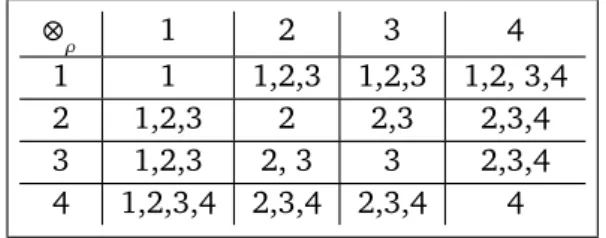
Let x = 1,x0 = 4. Choose t = 2 and t0 =3 and set: ∀x ∈ H, x ◦ρ x = {x}. Applying the hyperoperation defined in the proposition, we obtain the hypergroupoid:
Table 3: Join Space Associated with Spherical Geometry
⊗ρ 1 2 3 4
1 1 1,2,3 1,2,3 1,2, 3,4
2 1,2,3 2 2,3 2,3,4
3 1,2,3 2, 3 3 2,3,4
4 1,2,3,4 2,3,4 2,3,4 4
Clearly, we have(H;◦ρ)a join space.
We have consider only one element x =1 and its inverse x0 =4. For the remaining ele-ments 2, 3, we can easily find their inverses in infinite case which is necessary for the spherical geometry.
5. Conclusion
We have characterized all the ternary relationρsuch that the hypergroupoidHρ is a hy-pergroup or a join space. We have stated some connections between a general ternary relation
ρand hypergroups and then proved them. Moreover, a correspondence between this hyper-groupoid and the join space obtained by W. Prenowitz from betweenness (ternary) relation has been established.
In future work we intend to study the properties of hypergroupoid associated with the Cartesian product and join of two ternary relations. Moreover, We try to associate a directed connected graph with the hypergroupoids which have been considered in this paper.
References
[1] J Chavlina. Commutative hypergroups in the sense of marty and ordered sets. In I Cha-jada, R Halas, and F Krutsky, editors,Proceedings of the Summer School on General Algebra and Ordered Sets, pages 19–30, Olomouc, Czech Republic, 1994. Verlag Johannes Heyn. [2] P Corsini. Prolegomena of hypergroup theory. Aviani Editore, Aviani Editore, Udine, Italy,
1993.
[3] P Corsini. Hypergraphs and hypergroups. Algebra Universalis, 35(4):548–555, 1996. [4] P Corsini. Binary relations and hypergroupoids. Italian Journal of Pure and applied
Mathematics, 7:11–18, 2000.
[5] P Corsini. On the hypergroups associated with binary relation.Multi Valued Logic, 5:407– 419, 2000.
[6] P Corsini. Binary relations, interval structures and join spaces. Journal of applied Math-ematics and Computing, 10(1-2):209–216, 2002.
[7] P Corsini and V Leoreanu. Hypergroups and binary relations. Algebra Universalis, 43(4):321–330, 2000.
[8] P Corsini and V Leoreanu. Applications of hyperstructure theory. In Jeno Szep, editor,
Advances in Mathematics, pages 1–20. Kluwer Academic Publishers, Dordrecht, 2003. [9] I Cristea. Several aspects on the hypergroups associated with n-ary relation. Ovidius
Constanta, Series Maths, 7(3):90–110, 2009.
[10] I Cristea and M ¸Stefanescu. Binary relations and reduced hypergroups. Discrete Maths, 308(16):3537–3544, 2008.
[11] I Cristea and M ¸Stefanescu. Hypergroups and n-ary relations. European Journal of Com-binatorics, 31(3):780– 789, 2010.
[12] M ¸Stefanescu. Some interpretations of hypergroups. Bulletin of Mathematical society: Science and Maths Roumanie Tome, 1(97 No. 1):99–104, 2006.
[13] B Davaaz and T Vougiouklis. N-ary hypergroups. Iranian Journal of Science and Technol-ogy Transaction, 30(2):165–174, 2006.
[14] S Govindarajan and G Ramesh. On the hypergroups associated with n-ary relations.
Journal of Informatics and Mathematical Sciences, 6(2):61–76, 2014.
[15] S Govindarajan and G Ramesh. A generalization of corsini’s hyperoperation to the case of n-ary relation. Mathematics Applied in Science and Technology, 7(1):7–26, 2015. [16] S Govindarajan and G Ramesh. Hypergroups associated with union and intersection of
[17] F Marty. Sur une generalization de la notion de group. In F. Marty, editor,Eight Congress Mathematics Scandenaves, Stockholm, pages 45–49, Sweden, 1935. Lund: H . Ohlsson botryckeri.
[18] J Nieminen. Join space graphs. Journal of Geometry, 33(1):99–103, 1988.
[19] W Prenowitz. Spherical geometries and multigroups. Canadian journal of Mathematics, 2:100–119, 1950.
[20] I G Rosenberg. Hypergroups and join spaces determined by relations. Italian Journal of Pure and applied Mathematics, 4(4):93–101, 1998.