1239
Does Habit Strength Predict Junk Foods Consumption? An Extended Version
of Theory of Planned Behavior
Aref Faghih
1, Mahnaz Solhi
*2, Abolghasem Jajayeri
3, Davod Shojaeizadeh
4, Abbas Rahimi
5,
Teimoor
Aghamolaei
61) Social Determinants in Health Promotion Research Center, Hormozgan Health Institue, Hormozgan University of Medical Sciences, Bandar Abbas, Iran
2) Department of Education and Health Promotion, School of Health, Iran University of Medical Sciences, Tehran, Iran 3)Center for Community Nutrition, School of Nutritional Sciences and Dietetics, Tehran University of Medical Sciences, Tehran, Iran
4) Department of education and health promotion, School of Health, Tehran University of Medical Sciences, Tehran, Iran 5) Department of Epidemiology and Biostatistics ,School of Health, Tehran University of Medical Sciences, Tehran, Iran 6) Department of Public health ,School of Health, Hormozgan University of Medical Sciences, Bandar Abbas, Iran *Author for Correspondence: [email protected]
Received: 30 Sep. 2017, Received:14 Apr. 2017, Accepted: 18 May 2018
ABSTRACT
This study examined the utility of adding habit strength to the Theory of Planned Behavior (TPB) in predicting the intention and behaviour of junk food consumption.A Cross-sectional data were performed on 271 high school boy that sampled randomly from ten high schools in Bandar Abbas, Iran. Participants completed measures of the TPB, habit strength and food frequency in relation to junk food consumption. Hierarchical multiple regression analysis was performed to test the predictive power of the model. The traditional model explained 15% and 10% of the variance in intention and behaviour, respectively. Subjective norm and PBC (Perceived Behavioral Control) emerged as significant predictors of intention. Also, PBC and intention revealed as a significant predictor of behaviour. The extended model accounted for 28% and 11.6% of the variance in intention and behaviour, respectively. Habit significantly increased the explained variance in both intention and behaviour and emerged as the strongest predictor. Also, subjective norm and PBC remained as a significant predictor of intention and behaviour, respectively. The intention was a non-significant correlate of junk food consumption. Junk food consumption is more controlled by habit and PBC, rather than intention.
Keywords
: Junk Foods, Students, Habit, The Theory of Planned BehaviourABBREVIATIONS
PBC: Perceived Behavioral Control TPB: Theory of Planned Behavior
SN: Subjective Norm
M: Mean
SD: Standard Deviation
INTRODUCTION
Evidence correlate with Iranian families’ nutritional position showing that during the last two decades, dramatically changes occurred in their food intakes and Iranian community experience a nutrition transition period [1]. This nutrition transition can lead
to various health problems including different diet related and chronic diseases [2]. It is well proved that many adolescents always don’t meet healthy nutrition guidelines .for example they eat a low amount of fruits and vegetables and instead eat a large proportion of high energy dense foods [3]. Based on the findings of a national study, unhealthy eating habits (e.g.,
consumption of junk foods) were highly prevalent among Iranian students [4]. Junk food is defined as energy dense foods, contents high fat, salt and sugar [5]. Theory of Planned Behavior (TPB) is of the most employed theory framework in behavior study [6,7] and the investigators frequently used TPB to survey different health-related behavior 7-13 including dietary
behavior [9.14-16]and unhealthy eating habit such as ready meals 6, fast foods 8 and junk foods [17]. Some
1240 of behaviour. Furthermore, the intention is determined by three sets of consideration. First beliefs about the outcome of the behaviour as well as the importance or evaluations of these likelihood outcomes together formed the attitude toward behaviour. Second individuals beliefs in relation to important other expectations as well as the individuals motivation to comply with other desires and expectations, together shaping the subjective norm (SN) and finally beliefs’ about the factors that either facilitating or impeding the behaviour as well as the strength of each of this belief that together produce PBC. The utility of this model for predicting intention and behaviour was proved by different studies. For example a meta-analysis on 185 TPB- based studies showed that this model accounted for 39% of the variance in intention and 27% of the variance in behavior [20].
The TPB was successfully applied by a number of researchers for explaining healthy food choices but relatively few studies used the model for determining the predictors of less healthy food choices and we are not aware of any published research that has used the TPB extended by the habit strength in explaining factors influencing adolescents junk foods consumption. Also, the role of habits has received little attention in the junks foods consumption field and there is a growing tendency for concentration on the role of habits in health behaviours [21-23]. This study highlights the role of habit strength for junk foods consumption in the framework of the theory of planned behaviour. Therefore The aims of the current study were to determine the utility of TPB construct for predicting junk food consumption intention and behaviour and to identify that to what extent the habit strength increased the predictive power of the TPB.
MATERIAL AND METHODS
Study Design, Recruitment, and Participants
The present study used a cross-sectional baseline data from a group of male adolescents as a part of an interventional trial to survey the effect of a TPB based intervention on reducing junk food consumption and intention among a group of 15-18 years old students. The ethical approve and study protocol for this investigation was obtained from the Iran University of Medical Science Ethics Committee. In a cross-sectional study in the path analysis of the correlation matrix, the number of samples was determined so that if the members of this matrix were more than 0.2, then statistical significance was statistically significant with 95% confidence and included in the analysis. Which was obtained from the following formula:r= .2
w=½
𝒍𝒏
𝟏+𝒓𝟏−𝒓=
𝟏𝟐𝒍𝒏
𝟏+𝟎/𝟐𝟏−𝟎/𝟐= 𝟎. 𝟐𝟎𝟑
𝒏 =
(𝒛𝟏 −
𝜶
𝟐 + 𝒛𝟏 − 𝜷)²
𝒘²
+ 𝟑
=
(𝟏. 𝟗𝟔+. 𝟖𝟒)²
(. 𝟐𝟎𝟑)²
+ 𝟑 = 𝟏𝟗𝟑
According to the cluster selection of samples, the effect of the sampling plan was considered 1.5. The sample volume for this research stage was as follows. N*= 0/93 * 1/5 = 290
The final stage of this study was a comparison of the mean score of the behaviour of unhealthy snacks in the experimental and control groups. Therefore, the number of samples was determined so that if the mean difference in these two groups was 10, then 95% confidence and 80% test power were statistically significant. The questionnaire for frequency snacks consumption has 25 questions and the range of total score is between 0 and 25. Based on this, the standard
deviation was considered 42 ( 250
6 ) and the following formula was used to calculate the number of students needed in each group.
𝒅 =
𝟏𝟎
𝟒𝟐 × √𝟐
= 𝟎/𝟏𝟕
𝒏 =
(𝟏/𝟗𝟔 + 𝟎/𝟖𝟒)²
(𝟎/𝟏𝟕)²
= 𝟐𝟕𝟏
1241
Data Collection
Junk foods consumption was assessed based on a validated food frequency questionnaire [24]. The FFQ consisted of 26 food items that contribute to most regular junk foods in the Iranians adolescent diet. A panel of specialist reviewed the instrument and proposed some revision for a better understanding of the questionnaire. Then the instrument pilot tested among 50 students (correlation between baseline measurement and 1 month follow up was 0.7) and again some trivial changes, based on students opinions, executed. The participants were asked how often consumed each type of these foods (e.g, Candy, chips, cake, biscuit, puffs …) during the past week (answers were range from never, 1, 2, 3…7 and more than 7 times per week). The sum of all junk foods consumption considered as weekly total junk food consumption.
We used an indirect measure (belief-based) of TPB and model variables were constructed by relevant beliefs to the each of attitude, subjective norm and PBC. Intention was measured by three questions: I plan to eat junk food during the next week (extremely agree=7, extremely disagree=1), for the next week I intend to eat junk food (extremely likely=7, extremely unlikely=1), I am sure I will eat junk food during the next week (strongly agree=7, strongly disagree=1). The mean score of these three questions considered as intention score in the subsequent analysis. Cronbach alpha for this scale was 0.73. In order to elicit the most commonly salient beliefs (behavioral, normative and control beliefs) regarding the junk food consumption, according to the Ajzen [25] and Francies [26] recommendations, initially we wanted 50 boys high school student to write advantages or disadvantages, factors that facilitate or difficult and individuals or groups that approve or disapprove junk food eating freely in an open-ended questionnaire. In the second step, we analyzed this information content, listed themes in order of frequency, labelling them and selected the most frequent themes. Finally, a questionnaire was developed based on Ajzen [25] and Francies [26] instructions. The questionnaire reviewed by 5 faculty member expert in TPB and scale development and based on their recommendation some changes were made to the instrument. The instrument items were again pilot tested among 20 students from the relevant population for survey the readability and clarity. Some questions reworded or modified in the final version.
Regarding behavioral beliefs, student indicated on a 7 point likers scales (extremely likely=7; extremely unlikely=1) whether they think that eating junk food would: (1) Cause them to illness; (2) Give them pleasure sense; (3) Cause them to teeth cavity; (4) Cause them to bone emptiness; (5) Make them obese;
(6) Help them gain energy; (7) Cause them don’t eat main meals(r=0.72). Outcome evaluations were measured by: for me: (1) Illness; (2) pleasure sense; (3) Teeth cavity; (4) Bone emptiness ;( 5) obesity ;( 6) Gain energy; (7) don’t eat main meals; is (extremely important=7; extremely unimportant=1) (r=0.93). Normative beliefs’ was measured by: (1) my friends think that I(should=7; should not=1) consume junk foods, (2) my parents (approve=7;disapprove=1) my junk food consumption, (3) my sibling (do=7;do not=1)consume junk food themselves(r=.76).
Motivation to comply was measured by: (1) what my friends think I should do matters to me, (2) parents approval of my junk food consumption is important to me, (3) doing what my sibling do is important to me(very much=7; not at all=1) (r=.75).
Control beliefs strength was measured by (1) junk foods are always available for me, (2) when I have enough money I eat more junk foods, (3) I am accustomed to consuming junk foods(strongly agree=7; strongly disagree=1) (r=.8).
Control beliefs power was measured by: (1) when junk foods are available, it is difficult for me don’t eat them, (2) when I have enough money, it is difficult for me don’t buy them, (3) since I accustomed to consume junk foods, it is difficult for me don’t eat them(more likely=7; less likely=1), (r=.73).
Students were given a definition and examples of junk foods (e.g., chips, candy, pop, sweets, and cakes) on each survey to ensure that they understood the mentioned behaviour. In order to create overall attitude, subjective norm and PBC, each behavioural belief were multiplied by outcome evaluation and the resulting products were summed over all behavioural outcomes, normative beliefs multiplied by motivation to comply and the resulting product were summed over all regarding beliefs and each control beliefs strength were multiplied control belief power and the resulting product were summed over all relevant beliefs. Then relevant attitude, subjective norm and PBC scores divided by a number of questions. Habit strength regarding junk foods consumption was assessed by applying the self-report habit index, developed by Verplanken and Orbell in 2003 [27]. The validity and reliability of this index have been established by several studies 27-29. students were
1242 completely disagree=-2) this sentence. The mean of these 12 items considered as an overall score of habit strength. The instruments take approximately 40 minutes to complete.
Data Analytic Strategy
Data were analyzed using the statistical package for social science for windows (SPSS, Version19). Simple descriptive statistics such as frequencies, means and standard deviation obtained for all study variables. Pearson correlations were used to assess the simple association between main study variables (TPB constructs, habit strength and junk foods consumption). A significant level of p<0.05 was employed. Finally, two hierarchical multiple regressions were conducted to identify the predictors of intention and junk foods consumption and test the additive effect of habit strength to predict intention and behaviour. First analyze regression, to predict intention was performed in two steps. In step 1, attitude, subjective norm and PBC and in step 2 habit strength were entered to the equation as the independent variables. Second, analyze regression to predict junk food consumption was performed in two steps. In step 1, intention and PBC and in step 2 habit strength were entered to the regression as the independent variables.
RESULTS
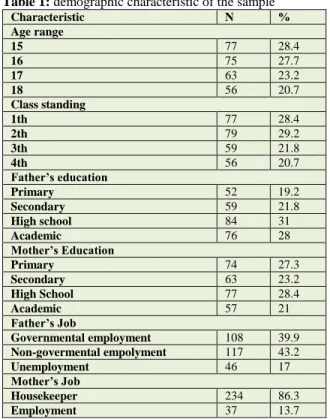
As can be seen in table 1, demographic variables were included students age and class level, parent’s literacy level and employment status. Class level was distributed with 28.4%, 29.2%, 21.8% and 20.7% in the 9, 10, 11 and 12 grade levels respectively. Most of students father were employed in nongovernmental section (43.2%) and 39.9% and Major of student’s mothers was housekeeper (86.3%). the dominant educational level of parents was high school (31% of father and 28.4% of the mother)
The participants averagely consumed 29 times per week (almost 4 times per day) junk foods (any type). The score of intention to consume junk food was above mid-scale (4.49±1.57), suggesting that participants had a positive intention to consume junk food. Mean and standard deviation for other TPB variable and habit strength are presented in table 2.
Bivariate correlation showed Positive significant correlations between junk food consumption and all TPB variables (with the exception of attitude) and habit strength. This means that those who had a more positive intention, subjective norm, perceived behavioural control and habit strength consumed more junk foods. Also, TPB variables (with the exception of attitude) and habit strength were positively correlated with intention. Habit strength was the stronger correlates of both intention(r=0.485, p<0.01) and junk foods eating(r=0.301, p<0.01). The highest correlations were found between PBC(r=0.562, p<0.01) and intention(r=0.485, p<0.01) and habit strength, respectively. The relationship between attitude and intention and junk foods consumption was negative and adolescents with a more negative attitude toward junk foods had the lower intention and junk foods consumption (however these relations were not significant).
Table 1: demographic characteristic of the sample
Characteristic N %
Age range
15 77 28.4
16 75 27.7
17 63 23.2
18 56 20.7
Class standing
1th 77 28.4
2th 79 29.2
3th 59 21.8
4th 56 20.7
Father’s education
Primary 52 19.2
Secondary 59 21.8
High school 84 31
Academic 76 28
Mother’s Education
Primary 74 27.3
Secondary 63 23.2
High School 77 28.4
Academic 57 21
Father’s Job
Governmental employment 108 39.9
Non-govermental empolyment 117 43.2
Unemployment 46 17
Mother’s Job
Housekeeper 234 86.3
Employment 37 13.7
Table 2: The bivariate correlation, mean and standard deviation of study variables
*Correlation is significant at the .05 level **Correlation is significant at the.01 level
Note: A high mean value for intention, subjective norm and attitude indicate that this variable in favour of junk food consumption for
PBC a high mean indicates the lower perceived control to avoid junk food consumption.
Variables Mean SD 1 2 3 5 6
1. Junk food consume 28.9 17.94 -.216** -.233** .293 .056 .085
2. Intention 4.49 1.57 - -.133*. .455** .299** .5**
3. PBC 5.65 1.05 - - --.132* -.024 -.034
4. Attitude 3.63 1.36 - - - .442** .343**
5. Subjective norm 4.07 1.51 - - - - .305**
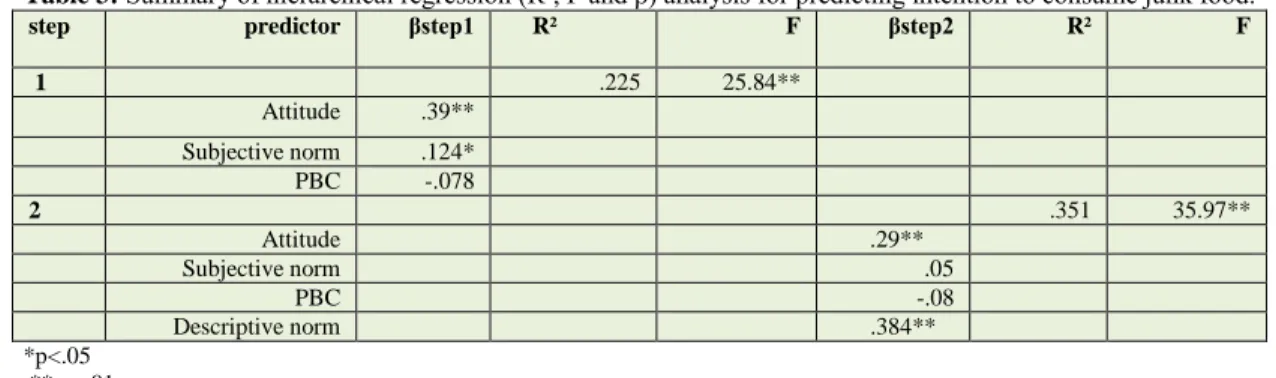
-1243 Results from the first hierarchical linear regression analysis for determine the relative importance of TPB variables(attitude, subjective norm, Perceived control) and habit strength to predict intention(see table 3), showed that in step 1, TPB variables together accounted for 15% of variance in intention (R²=0.15, F (3, 267) =15.65, P<0.01). PBC (β=0.308, p<0.01) and subjective norm (β=0.213, p<0.01) were significant predictors of intention. The addition of habit in step2 produced significant increase (12.9%) in the explained variance in intention (R²=0.279, F (4, 266) =25.71, P<0.01).habit was the strongest predictor of intention (β=0.435, p<0.01). also, subjective norm remained a significant predictor at this step (β=0.201, p<0.01), while attitude (β=-0.006, p<0.05) and PBC (β=-0.065, p<0.05) were not.
A second hierarchical multiple linear regression was performed to determine the predictor of junk foods consumption (see table 4). In the first step both PBC (β=0.242, p<0.01) and intention (β=0.137, p<0.05) were the significant predictors of behaviour and model accounted for nearly 10% of the variance in junk food consumption (R²=0.099, F (2, 268) =14.76, P<0.01). Adding habit strength in the second equation significantly increased the amount of explained variance in behaviour (R²=0.116, F (3, 267) =11.66, P<0.01). Habit strength was the most significant predictor of behaviour (β=-0.169, p<0.05). Also, PBC remained an independent predictor (β=-0.166, p<0.05), while the intention was a non-significant predictor of junk food consumption (β=-0.08, p<0.05).
Table 3: Summary of hierarchical regression (R², F and β) analysis for predicting intention to consume junk food.
step predictor βstep1 R² F βstep2 R² F
1 .225 25.84**
Attitude .39**
Subjective norm .124* PBC -.078
2 .351 35.97**
Attitude .29**
Subjective norm .05
PBC -.08
Descriptive norm .384**
*p<.05 **p< .01
the β= standardized regression coefficient
Table 4: Summary of hierarchical regression (R², F and β) for predicting junk food consumption.
*p<.05 **p<.01
DISCUSSION
Our finding showed high consumption rate of low quality and junk foods amongIranians adolescents.in line with our finding, Results of earlier study among Iranian students, also, indicated the prevalence of unhealthy dietary behaviour including consumption of junk foods among adolescents [4]. Supported by this fact unhealthy dietary behaviours such as junk foods consumption, especially by adolescents, is an obvious target for behaviour intervention.
Perception of the target behaviour and factors that influencing perform or impede this behaviour, is an essential precondition to design effective intervention strategies.
Thus, the present study aimed to understand the factors influencing junk food consumption in the framework of TPB. Furthermore, we explore the additive role of habit strength in the explanation of junk food consumption intention and behaviour. To our knowledge, it is the first study that explored the additive effect of habit strength in the explanation of junk food consumption in adolescents.
Traditional TPB model predicted 15% of the variance in intention, with the subjective norm and perceived behavioural control emerging as significant predictors. Perceived behavioural controls were the strongest predictor of intention. Although most of the TPB studies e.g., Armitage and Conner in 2001[30] found that the subjective norm was a weak or non-significant
step predictor βstep1 R² F βstep2 R² F
1 .089 13.11**
Intention .189**
PBC -.208**
2 .139 8.552**
Intention .118
PBC - .185**
Attitude .27**
Subjective norm - .08
1244 predictor of intention, over results showed that subjective norm had a determinant role in predicting junk food consumption intention in adolescents. In fact, the effect of different TPB constructs is variant across various studies [31]. Although it is not surprising that adolescents be under influence of social pressure, because adolescence period is of the utmost times that social norm influence the behaviour of human [32] and expectations and desires of reference groups (e.g., parents, household, siblings, peers and friends) may influence the perceptions and behaviours of individual through observation and imitation [33]. Although our findings were in line with earlier evidence [34] that showed only subjective norm and perceived behavioural control (but not attitude) were a significant predictor of intention toward fast food consumption among a group of middle school students. Also, the study showed that the PBC was the strongest predictor of intention. Also, results of another study on soft drink consumption in adolescents, showed PBC was the strongest correlate of intention to limit soft drink consumption, while attitude was not a significant correlate of intention.35Another study to increase fruit and
vegetable consumption showed subjective norm and PBC, but not attitude, was a significant predictor of fruit and vegetable consumption [36].
Also in line with TPB hypothesis traditional model predicted about 10% of behaviour, with both intention and perceived behavioural control emerging as a significant predictor. Howbeit, according to Ajzen statements 13, the influence of TPB variables on
intention and behaviour is supposed to vary among different populations, behaviours or situations. Notwithstanding, in our study, TPB predict fewer variance in intention and behaviour, in comparison with other TPB-based studies e.g., Armitage and Conner in 2001[30], yet, our findings demonstrate the moderate-sized effect in social science [37].Indeed, Predictive power of TPB, between various studies, is different [31]. In one hand some evidence showed that the predictive power of the TPB is weaker when applied to dietary behaviours e.g., Ried and Hammersley in 2001 [38] and Williams et al. in 1993 [39] than for others behaviours. This may be explained, to some extent, by the complex nature of dietary behaviours [16].
In another hand because surveyed behaviour in our study (junk foods) was a wide behavioural domain, cognitions measure did not have a high degree of specificity, this may have decreased the predictive validity of TPB in our study. When we survey a complex behaviour the predictive power of the model may decreases because based on Fishbein and Ajzen recommendation 40 behaviour needs to be specific.
Thus, whatever behaviour is more specific (e.g., chips
or candy instead of junk foods) the TPB is stronger in predict behaviours. For example results of a study on junk foods consumption showed that the TPB predicted only 28% and 12% of explained variance in intention and behaviour, respectively [41]. Nonetheless, some other evidence in this field supports our finding in relation to TPB predict power in unhealthy behaviors. For example results of a study for predicting saturated fat consumption showed that perceived behavioral control and intention together explained only 8% of the variance on behavior [42]. Also, the results of another study showed that TPB explained 10% of the variance on intention not to drink and drive.43
Habit strength significantly increased the amount of the explained variance in both intention and behavior at the second steps of regression analysis (13% and 1/7% respectively). The habit was the strongest predictor of intention and behavior in the extended model. In the second step for predict intention, subjective norm remained a significant predictor of intention and, PBC remained a significant predictor behavior. Intention did not emerge as a significant predictor of junk food consumption at this step, suggesting that junk food consumption in adolescents is more under control of habit and PBC, but not the intention. Also, habit may play a mediational role between intention and behavior. In the other hand when behavior is habitual, the intention is less determinant for behavior [44]. Many studies have shown that the utility of intention in behavior prediction diminish when the behavior has a strong habitual nature [45, 46].This finding is in line with a growing body of studies that support the role of habit strength in dietary behaviors [32,42,47,48].
Since results showed high consumption of junk foods in adolescents, it is not strange that repetition of this behavior, during a long time, causes forming a habit and consequently behavior executing unconscious and less intentional.
Parents always give spending money to their child’s and since junk foods are cheaper than other healthy foods and readily available in the city stores and Cafeterias in schools, they have easy access to this kind of foods. Adolescent regularly buys and eat this food during school times and leisure times, therefore it maybe form a habit and become routine behavior. According to Triandis, in stable contexts and familiar situation (for example school cafeterias) behavior chiefly will be guided by habit and intention will have trivial or non-significant effect 49].
1245 context the influence of traditional interventions (information based) attended to less success.76
Dietary behavior often become habitual and in such case, the intention – behavior relationship decreased and rational decisions didn’t play important role in predict behavior [51-52].
Effective habit change interventions that target the environmental cues of a specific habitual behavior or self-regulation techniques may be effective. These include techniques such as stimulus control [53], vigilant monitoring 54 and implementation intention.55
Also perceived behavioral control over refrain from junk food consumption should be increased.
Although the present study provides noteworthy insight into a determinant of junk foods consumption, few limitations of this study should be noted. First, we used cross-sectional data so causality cannot be inferred. Also, we used the self-report measurement of junk food consumption and as a result, the participant may underestimate or overestimate the behaviour. Although TPB based study often used this method 17, 56 because measuring actual behaviour intake is very
laborious.
Despite these limitations, overall, our results revealed that Junk foods consumption in adolescents was more under habit control than cognitive control. Then Junk food consumption is more habitual behaviour than intentional and also facilitators or inhibitor factors influence behaviour and finally including habit strength in the framework of the TPB enhanced the explanatory value of the model in predict intention to consume junk food and actual behaviour.
This finding may be unique to junk foods consumption by adolescents, although our finding adds to the recent empirical evidence that showed the importance of habit in behaviours prediction.
CONCLUSION
When researchers want to plan for decreasing unhealthy snacks consumption, especially in adolescent boys, considering and working on subjective norms and perceived behaviours control is very important. Also adding habit strength to the TPB and considering influential factors on habitual behaviour, while we want to implement the intervention in this field, can an effective role in reducing unhealthy snacks consumption.
ETHICAL ISSUE
Ethical issues have been completely considered by the authors
CONFLICT OF INTEREST
The authors have declared that there are no conflicts of interest
Author CONTRIBUTION
All authors equally participated in drafting, revising and approving of the manuscript.
FUNDING AND SUPPORT
This article was adopted from a PhD thesis research project which was approved by Vice Chancellor for Research and Technology of Iran University of Medical Sciences under grant number 91-01-27-17298.
ACKNOWLEDGEMENTS
The authors would like to thank the officials of the education and heads of high schools in Bandar-Abbas and high school boy students who participated in this study.
REFERENCES
[1] Ghassemi H, Harrison G, Mohammad K. An accelerated nutrition transition in Iran. Public Health Nutrition. 2002; 5(1A):149-55.
[2] Bidad K, Anari S, Tavasoli S. Dietary Intakes of Adolescent Girl in Relation to Weight Status. Iranian Public Health. 2008; 37(1):114-18.
[3] Story M, Neumark-Sztainer D, French S. Individual and environmental influences on adolescent eating behaviours. Journal of American Diet Association. 2008; 102(3suppl):S40-51.
[4] Kelishadi R, Ardalan G, Gheiratmand R, Gouya M, Razaghi E, Delavari A, et al. Association of physical activity and dietary behaviours in relation to the body mass index in a national sample of Iranian children and adolescents: CASPIAN Study. Buellton World Health Organization. 2007a; 85(1):19-26.
[5] Kaushik JS, Narang M, Parakh A. Fast Food Consumption in Children. Indian Pediatrics. 2011; 48(2): 97-01
[6] Kelishadi R, Alikhani S, Delavari A, Alaedini F, Safaie A, Hojatzadeh E. Obesity and associated lifestyle behaviours in Iran: Finding from the first National Non-communicable Disease Risk factor Surveillance Survey. Public Health Nutrition. 2007b; 11(3): 246-51.
[7] Azizi F, Rahmani M, Emami H, Mirmiran P, Hajipour R, Madjid M, Ghanbili J, Ghanbarian A, Mehrabi Y, Saadat N, et al. Cardiovascular risk factors in an Iranian urban population: Tehran lipid and glucose study (phase 1). Soz Praventivmed. 2002; 47(6):408-26.
1246 [9] WHO: Globalization, diets and non-communicable diseases. Geneva: WHO; 2002. 1-5
[10] Fila SA, Smith Ch. Applying the Theory of Planned Behavior to healthy eating behaviors in urban Native American youth. International Hournal of Behavior Nutrition Physical Activity. Published online. 2006; 3: 11. DOI: 10.1186/1479-5868-3-11 [11] Gardner B, De Bruijn GJ, Lally P. A Systematic Review and Meta-analysis of Applications of the Self-Report Habit Index to Nutrition and Physical Activity Behaviors. Annals of Behavioral Medicine. 2011; 42:174-87.
[12] Goldstein MG, Whitlock EP, DePue J. Planning Committee of the Addressing Multiple Behavioral Risk Factors in Primary Care Project. Multiple behavioural risk factor interventions in primary care. Summary of research evidence. American Journal of Preventive Medicine. 2004; 27(2 suppl): 61-79. [13] Cameron R, Ginsburg H, Westhoff M, Mendez R. Ajzen’s Theory of Planned Behavior and Social Media Use. American Journal of Psychological Research. 2012; 8(1):1-20.
[14] Mahon D, Cowan C, McCarthy M. The role of attitudes, subjective norm, perceived control and habit in the consumption of ready meals in Great Britain. Food Quality and Preference. 2006; 17(6): 474-81. [15] Verbeke W, Vackier I. Individual determinants of fish consumption: Application of the theory of planned behaviour. Appetite. 2005; 44(1): 67-82.
[16] Dunn KI, Mohr PB, Wilson CJ, Wittert GA. Determinants of fast food consumption. An application of the Theory of Planned Behavior. 2011; Appetite. 57(2): 349-57.
[17] Lien N, Lytle LA, Komro KA. Applying the theory of planned behaviour to fruit and vegetable consumption of young adolescents. Am J Health Promot. 2002; 16(4): 189-97.
[18] Collins A, Mullan B. An extension of the theory of planned behaviour to predict immediate hedonic behaviours and distal benefit behaviours. Food Quality and Preference. 2011; 22(7): 638-46.
[19] Elliott MA, Armitage CJ. Promoting drivers compliance with speed limits. Testing an intervention based on the theory of planned behaviour. British Journal of Psychology. 2009; 100(1): 111-32. [20] Louis WR, Chan MKH, Greenbaum S. Stress and the theory of planned behaviour. Understanding healthy and unhealthy eating intentions. Journal of Applied Social Psychology. 2009; 39(2): 472-93. [21] Thompson FE, Willis GB, Thompson OM, Yaroch AL. The meaning of ‘fruits’ and ‘vegetables’. Public Health Nutrition. 2011; 14(7): 1222-28. [22] Povey R, conner M, Sparks P, James R, Shepherd R. Application of the theory of planned behavior to two dietary behaviors: roles of perceived control and
self-efficacy. British Journal of Psychology.2000; 5(2): 121-39.
[23] Conner M, Norman P, Bell. The Theory of Planned Behavior and Healthy Eating. Health Psychology. 2002; 21(2): 194-01.
[24] Mirmiran P, Azadbakht L, Azizi F. Dietary behavior of Tehranian adolescents does not accord with their nutritional knowledge. Public Health Nutrition. 2007; 10(9): 897-01.
[25] Ajzen I. Constructing a TPB Questionnaire: Conceptual and Methodological Considerations. 2002b; Available from:
http://www.people.umass.edu/aizen/pdf/tpb.measure ment.pdf
[26] Francis JJ, Eccles MP, Johnston M, Walker A, Grimshaw J, Foy R, Kaner EFS, Smith L, Bonetti D.. Constructing Questionnaires Based on The Theory of Planned Behavior: A Manual for Health Services Researchers. Gentre for Health Services Research University of Newcastle. 2004. Available at:
http://pages.bangor.ac.uk/~pes004/exercise_psych/do wnloads/tpb_manual.pdf.
[27] Verplanken B, Orbell S. Reflections on past behavior: A self- report index of habit strength. J Appl Soc Psychol. 2003: 33(6): 1313-30.
[28] Verplanken B, Myrbakk V, Rubi E. The measurement of habit. In: Betsch T, Haberstroh S, Eds. The routines of decision making. Mahwah, NJ: Lawrence Erlbaum. 2005; 231-47.
[29] Murtagh S, Rowe DA, McMinn D, Nelson NM. Reliability and validity of a measure of active and inactive travel habit in primary school aged children. Presented at the British Association of Sport and Exercise Sciences Annual Conference. Glasgow, Scotland. 2010
[30] Armitage CJ, Conner M. Efficacy of the Theory of Planned Behavior: a meta-analytic review. British Journal of Social Psychology. 2001; 40(pt:4): 471-99. [31] Kiriakidis S. Theory of Planned Behavior: the Intention-Behavior Relationship and the Perceived Behavioral Control (PBC) Relationship with Intention and Behavior. International Journal of Strategic Innovative Marketing. 2015; 2(3):40-51, DOI: 10.15556/IJSIM.02.03.004
[32] De Bruijn GJ. Understanding college student’s fruit consumption. Integrating habit strength in the theory of planned behavior. Appetite. 2010; 54(1): 16-22.
[33] Bandura, A. Social cognitive theory. In P. A. M. van Lange, A. W. Kruglanski, & E. T. Higgins (Eds.). Handbook of social psychological theories. 2th ed, London: Sage 2011; 349-73.
1247 behaviors. Nutrition Research and Practice. 2011; 5(2): 169-78.
[35] De Bruijn GJ, Van Den Putte B. Adolescent soft drink consumption, television viewing and habit strength. Investigating clustering effects in the Theory of Planned Behavior. Appetite. 2009; 53(1): 66-75. [36] Kothe EJ, Mullan BA, Butow P. Promoting fruit and vegetable consumption. Testing an intervention based on the theory of planned behavior. Appetite. 2012; 58(3): 997-04.
[37] Cohen J. A Power Primer. Psychological Bulletin. 2007; 112(1); 155-59. DOI:10.1037/0033-2909.112.1.155
[38] Ried M, Hammersley R. Breakfast outcome expectancies modestly predict self-reported diet. Appetite. 2001; 37(2): 121-22.
[39] Williams HM, Woodward DR, Ball PJ, Cumming FJ, Hornsby H, Boon JA. Food perceptions and food consumption among Tasmanian high school students. Australian Journal of Nutrition and Dietetics. 1993; 50(4): 156-63.
[40] Fishbein M, Ajzen I. Predicting and changing behavior: The reasoned action approach. Psychology press. 2010; 303-22.
[41] Karimi-shahanjarini A, RASHIDIAN A, Majdzadeh R, Omidvar N, Ghazi Tabatabai M, Shojaeezadeh D. Parental Control and Junk-Food Consumption: A Mediating and Moderating Effect Analysis. Journal of Applied Social Psychology. 2012; 42(5): 1241-65.
[42] De Bruijn GJ, Kroeze W, Oenema A, Brug J. Saturated fat consumption and the Theory of Planned Behavior: Additive and interaction effects of habit strength. Appetite. 2008; 51(2): 318-23.
[43] Moan IS, Rise J. Predicting intentions not to “drink and drive” using an extended version of the theory of planned behavior. Accident Analysis and Prevention. 2011; 43(4): 1378-84.
[44] Van’t Riet J, Sijtsema SJ, Dagevos H, De Bruijn GJ. The importance of habit in eating behavior. An overview and recommendations for future research. Appetite. 2011; 57: 585-96.
[45] Danner UN, Aarts H, de Vries NK. Habit vs. intention in the prediction of future behavior: The role of frequency, context stability and mental accessibility of past behaviour. British Journal of Social Psychology.2008; 47: 245–265
[46] Verplanken B, Wood W. Interventions to break and create consumer habits. J Public Policy Mark. 2006: 25(10): 90-03.
[47] Reinaerts E, De Nooijer J, Candel M, De Vries N. Explaining school children’s fruit and vegetable consumption. The contributions of availability, accessibility, exposure, parental consumption and habit in addition to psychosocial factors. Appetite. 2007; 48(2): 248-58.
[48] Norman P. The theory of planned behavior and binge drinking among undergraduate students: Assessing the impact of habit strength. Addictive Behaviors. 2011; 36(5): 502-07.
[49] Triandis H C. Individualism and Collectivism. New York, Routledge: USA: 2018.
[50] Webb TL, Sheeran P. Does changing behavioral intentions engender behavior change? A mete-analysis of the experimental evidence. Psychological Bulletin. 2006; 132(2): 249-68.
[51] Neal DT, Wood W, Labrecque JS, Lally P. How do habits guide behavior? Perceived and actual triggers of habits in daily life. Journal of Experimental Social Psychology. 2011; 48 (2): 492-98.
doi:10.1016/j.jesp.2011.10.011
[52] Rebar AL, Doerksen SE., Elavsky S, Maher JP., Conroy DE. Habits predict physical activity on days when intentions are weak. Journal of Sport and Exercise Psychology. 2014; 36(2):157-65.
[53] Sobal J, Wansink B. Kitchenscapes, tablescapes, platescapes, and foodscapes: Influence of microscale built environments on food intake. Environment and Behavior. 2007; 39(1): 124-42.
[54] Quinn JM, Pascoe AM, Wood W, Neal DT. Can’t help yourself? Monitor those bad habits. Personality and Social Psychology Bulletin. 2010; 36(4): 499-11. [55] Gollwitzer PM. Implementation intentions: Strong effects or simple plans. SAGE Publications: 2006.