Aliso: A Journal of Systematic and Evolutionary Botany
Volume 15 | Issue 2
Article 4
1996
Problems in Cladistic Classification: Higher-Level
Relationships in Land Plants
Peter R. Crane
The Field Museum
Paul Kenrick
Swedish Museum of Natural History
Follow this and additional works at:
http://scholarship.claremont.edu/aliso
Part of the
Botany Commons
Recommended Citation
Crane, Peter R. and Kenrick, Paul (1996) "Problems in Cladistic Classification: Higher-Level Relationships in Land Plants,"Aliso: A Journal of Systematic and Evolutionary Botany: Vol. 15: Iss. 2, Article 4.
Aliso, 15(2), pp. 87-104
© 1997, by The Rancho Santa Ana Botanic Garden, Claremont, CA 91711-3157
PROBLEMS IN CLADISTIC CLASSIFICATION: HIGHER-LEVEL RELATIONSHIPS IN LAND PLANTS
PETER
R.
CRANEDepartment of Geology, The Field Museum,
Roosevelt Road at
Lake
Shore Drive, Chicago, Illinois, 60605-2496, USA
AND
PAUL KENRICK
Department of Palaeobotany, Swedish Museum of Natural History,
Box 50007, S-104 05, Stockholm, Sweden
ABSTRACT
Recent cladistic analyses of green plants recognize an extensive hierarchical series of relatively well-supported monophyletic groups. Translating this hierarchical pattern of relationships into a usable and informative written classification is important for purposes of scientific communication, research and teaching. However, in the context of the "Linnean" hierarchy, as manifested in the current Inter-national code of Botanical Nomenclature (ICBN), effecting this translation confronts substantial prac-tical difficulties--especially the proliferation of hierarchical levels. These problems are exacerbated by the current emphasis of the ICBN on a hierarchy in which different ranks have different formal rank-based endings. These difficulties could be ameliorated by de-emphasizing the importance of ranks in the ICBN and relaxing the constraints on how they are treated, especially at the higher taxonomic levels. Modifications are needed that permit a more straightforward integration of systematic knowl-edge and botanical nomenclature, and at the same time foster increased stability in the association between names and the groups of organisms that they designate.
Key Words: botanical code, classification, fossils, ICBN, land plants, nomenclature.
"The Code is a living and adapting body of law, and as long as it keeps evolving in tune with changing needs and new challenges, it
will keep its authority and strength."
International Code of Botanical Nomenclature (ICBN 1994, Preface)
INTRODUCTION
Systematics-the science of biological
diversity-fulfills three fundamentally important and
intercon-nected roles in modem biology. First, systematics has
the primary responsibility for synthesizing knowledge
about organisms and for integrating information from
all other areas of biology into a single internally
con-sistent and coherent understanding of the diversity of
life. Second, by developing a classification that reflects
patterns of evolutionary interrelationships, systematics
provides a maximally predictive framework for
com-parative biology, and the foundation for evolutionary
studies of all kinds. Third, systematics has the
respon-sibility to develop an explicit, universal, and stable
system of names that allows precise communication
about the diversity of living things.
Through synthesis and analysis, systematics seeks
to build new knowledge about how organisms are
in-terrelated, and strives to improve the conceptual
framework for comparative studies. But at the same
time, through biological nomenclature, systematics is
concerned with communicating current knowledge in
a way that is effective for a great diversity of users.
These two basic goals are, to some extent, in conflict.
Acquiring and synthesizing new data results in
im-proved knowledge of relationships, which should
be
reflected in improved, and ultimately more stable,
clas-sifications. But changes in formal classifications
in-evitably introduce ambiguity, and are antithetic to the
notion of stability. These contrasting goals generate
tension and raise basic questions about why we do
systematics and how we can best contribute to the
ad-vancement of science.
On
the one hand, in order to
sustain itself as a scientific discipline and develop
maximally predictive classifications, systematics must
view patterns of relationships as hypotheses, which are
subject to testing and open to falsification. But on the
other hand the service function of systematics places
great emphasis on stability--even tradition-as the
most effective way to meet the communication needs
of users in biology and other disciplines.
paleobo-88 Crane and Kenrick ALISO
tanical data-have resulted in a new understanding of
relationships atnong major groups of land plants.
Based on this new understanding of relationships we
present a revised classification of land plants, focusing
particularly on the "higher" categories. Second, we
use this case study to briefly consider some of the
broader issues involved in accurately translating
cur-rent knowledge of relationships into written
classifi-cations, and especially in attempting to reconcile
ad-vances in systematic knowledge at higher taxonomic
levels with clarity and stability of communication. In
particular, this example raises the question of whether
the current system of formal "Linnean" ranks
embod-ied in the International Code of Botanical
Nomencla-ture (ICBN 1994) eases the tension between
incorpo-rating new knowledge and nomenclatural stability, or
exacerbates the problem. We conclude, that as
cur-rently formulated, some aspects of the Code do not
contribute positively to its primary aims- "the
pro-vision of a stable method of naming taxonomic groups,
avoiding and rejecting the use of names which may
cause error or ambiguity or throw science into
con-fusion," and "the avoidance of the useless creation of
names" (ICBN 1994, Preamble 1).
PATIERNS OF RELATIONSHIP
Over the last 20 years there has been rapid progress
toward developing detailed hypotheses of relationships
among green plants that include both extant and
ex-tinct taxa. The basis for this progress has been the
development of explicit methods of phylogenetic
anal-ysis (cladistics) and the use of the principle of
parsi-mony to test and discriminate among competing
phy-logenetic hypotheses. Progress has also been greatly
facilitated by: i) new investigative techniques (e.g.,
molecular systematics) that have made available many
new characters of great phylogenetic utility; ii)
de-tailed comparative studies and increased integration
and systematization of the relevant neobotanical and
paleobotanical data; and, iii) the widespread
availabil-ity of new computer-assisted analytical techniques that
have increased the speed and accuracy with which
large datasets can be analyzed and competing
hypoth-eses can be compared.
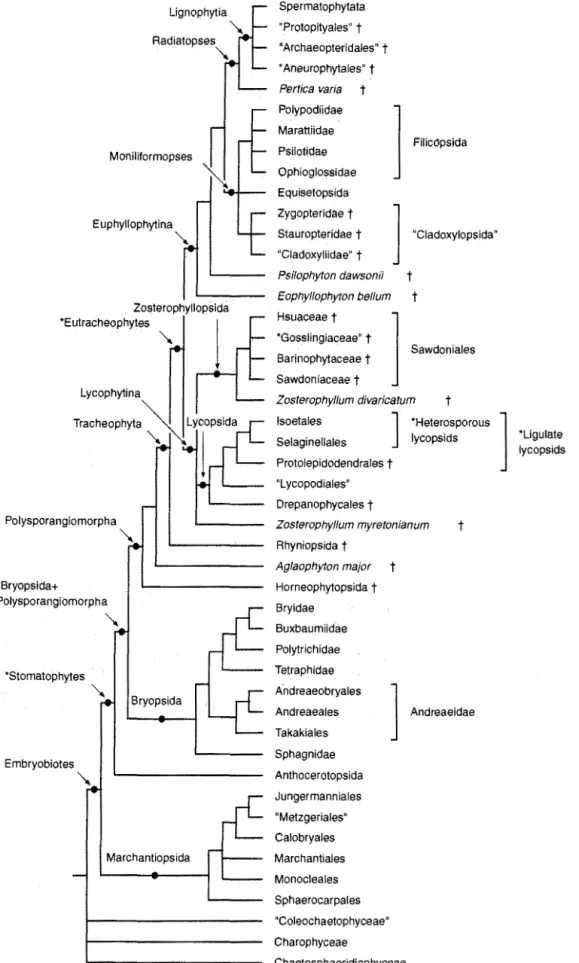
Based on a cladistic approach the major features of
green-plant classification can be summarized in terms
of a simple model that includes five progressively less
inclusive groups: green plants (chlorobionts), land
plants (embryophytes), vascular plants
(tracheo-phytes), seed plants (spermatophytes) and flowering
plants (angiosperms) (Crane 1985). Under this model
the "green algae," "bryophytes," "pteridophytes"
and "gymnosperms," as traditionally circumscribed,
are paraphyletic and cannot be defined by derived
fea-tures that they alone possess. In effect, "green algae"
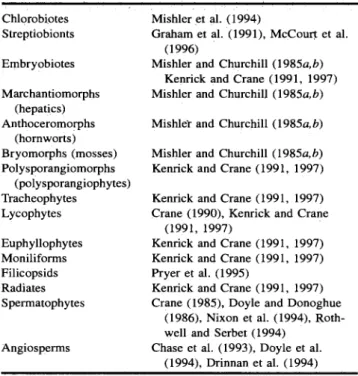
Table l. Selected cladistic studies of relationships among major groups of land plants that provide the basis for the patterns of re-lationships summarized in Fig. l.
Chlorobi0 tes Streptiobionts
Embryobiotes
Marchantiomorphs (hepatics) Anthoceromorphs
(horn worts) Bryomorphs (mosses) Polysporangiomorphs
(polysporangiophytes) Tracheophytes
Lycophytes
Euphyllophytes Moniliforms Filicopsids Radiates Spermatophytes
Angiosperms
Mishler et al. (1994)
Graham et al. (1991), McCou~ et al. (1996)
Mishler and Churchill (1985a, b)
Kenrick and Crane (1991, 1997) Mishler and Churchill (1985a,b)
Mishler and Churchill (l985a,b)
Mishler and Churchill (l985a,b) Kenrick and Crane (1991, 1997)
Kenrick and Crane (1991, 1997) Crane (1990), Kenrick and Crane
(1991, 1997)
Kenrick and Crane (1991, 1997) Kenrick and Crane (1991, 1997) Pryer et al. (1995)
Kenrick and Crane (1991, 1997) Crane (1985), Doyle and Donoghue
(1986), Nixon et al. (1994), Roth-well and Serber ( 1994)
Chase et al. (1993), Doyle et al. (1994), Drinnan et al. (1994)
are the "residue" of green plants after the land plants
have been removed. Similarly, "bryophytes" are
merely nonvascular land plants, "pteridophytes" are
those vascular plants that are not seed plants, and
"gymnosperms" are the "residue" of seed plants after
angiosperms are excluded.
Using this model as the framework, and utilizing
other studies that provide more detailed treatments of
extinct and extant plants (Table 1), it is now possible
to develop a classificatory scheme that recognizes and
defines a large number of nested groups. These groups
describe the relationships among living and fossil land
plants in greater detail than has previously been
pos-sible, and the resulting scheme provides a useful basis
for comparative studies in the plant sciences. The
pat-tern of relationships for part of this hierarchy (land
plants up to but not including seed plants) is
summa-rized in the form of a cladogram in Fig. 1.
TOWARD A PHYLOGENETIC CLASSIFICATION
VOLUME 15, NUMBER 2 Classification of Land Plants
lignophytia
Radiatopses ~
Moniliformopses
Euphyllophytina ~
Zosterophyllopsida
"E"'"'""'hyt..
j
Polysporangiomorpha
*Bryopsida+ Polysporangiomorpha
~
*Stomatophytes ~
Embryobiotes ~
~
Bryopsida
Marchantiopsida
~
Spermatophytata
"Protopityales"
t
'Archaeopteridales"
t
"Aneurophytales"
t
Perlica vari/3
t
Polypodiidae
Marattiidae
Psilotidae
Ophioglossidae
Equisetopsida
Zygopteridae
t
Stauropterldae
t
"Ciadoxyliidae"
t
Psilophyton dawsonii
Eophyllophyton bellum
] "CI•doxy<p•l"''
t
Hsuaceae
t
'Gosslingiaceae"
t
Barinophytaceae
t
Sawdonlaceae
t
t
Zosterophyllum divaricatum
t
lsoetales
Selaginellales
J
*Heterosporous ] lycopsids
Protolepidodendrales
t
"Lycopodlales"
Drepanophycales
t
Zosterophyllum myretonianum
Rhyniopsida
t
Aglaophyton major
t
Horneophytopsida
t
Bryidae
Buxbaumii&~e
Polytrlchldae
Tetraphidae
t
A'ndreaeobryales
] A""""""
AndreaealesTakakiales
Sphagnidae
Anthocerotopsida
Jungermanniales
"Metzgeriales"
Calobryales
Marchantiales
Monocleales
Sphaerocarpales
"Coleochaetophyceae"
Charophyceae
Chaetosphaeridiophyceae
*Ligulate lycopsids
89
90 Crane and Kenrick ALISO
Thble 2. Classification of the higher taxa of embryophytes (Cronquist et a!. 1966).
Division Rhyniophyta Class Rhyniatae Division Bryophyta
Class Anthoceratae Class Marchantiatae Class Bryatae Division Psilotophyta
Class Psilotatae Division Lycopodiophyta
Class Lycopodiatae Class Isoetatae Division Equisetophyta
Class Hyeniatae Class Sphenophyllatae Class Equisetatae Division Polypodiophyta
Class Polypodiatae Subclass Protopteridiidae Subclass Archaeopteridiidae Subclass Ophioglossidae Subclass Noeggerathiidae Subclass Marattiidae Subclass Polypodiidae Subclass Marsileidae Subclass Salviniidae Division Pinophyta
Subdivision Cycadicae Class Lyginopteriidatae Class Cycadatae Class Bennettitatae Subdivision Pinicae
Class Ginkoatae Class Pinatae
Subclass Cordaitidae Subclass Pinidae Subdivision Gneticae
Class Gnetatae Subclass Ephedriidae Subclass Welwitschiidae Subclass Gnetidae Division Magnoliophyta Class Magnoliatae Class Liliatae
years ago. Cronquist et al. ( 1966) presented a new
classification based on their combined experience with
botanical phylogeny (Table 2), but the availability now
of a refined, more explicit and relatively
well-sup-ported understanding of the relationships among major
groups of land plants (Kenrick and Crane 1997) offers
a new opportunity to develop a revised classification.
The objective of this new classificatory scheme is to
reflect accurately patterns of relationships-in the
same way that Cronquist et al. believed (1966,
p.129-130) "that any proper taxonomic classification must
be consistent with phylogeny."
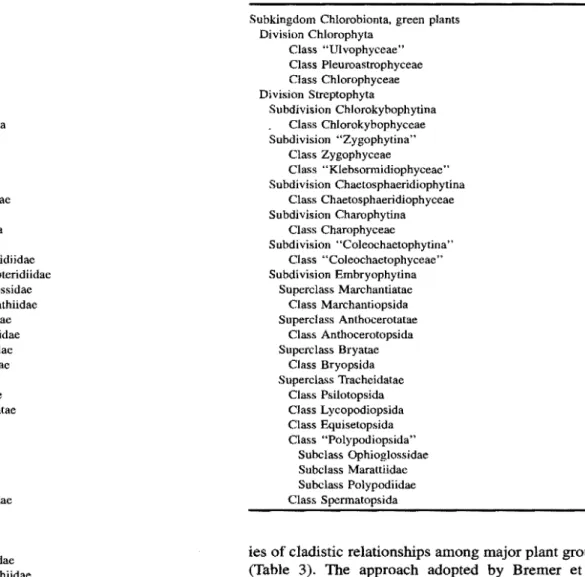
Bremer (1985) and Bremer et al. (1987) were
among the first to attempt a comprehensive
"higher"-level classification of land plants based on early
stud-Table 3. Cladistic classification of green plants from Bremer (1985). Paraphyletic taxa or taxa of uncertain monophyly are indi-cated in quotes.
Subkingdom Chlorobionta, green plants Division Chlorophyta
Class "Uivophyceae" Class Pleuroastrophyceae Class Chlorophyceae Division Streptophyta
Subdivision Chlorokybophytina Class Chlorokybophyceae Subdivision "Zygophytina"
Class Zygophyceae
Class "Klebsormidiophyceae" Subdivision Chaetosphaeridiophytina
Class Chaetosphaeridiophyceae Subdivision Charophytina
Class Charophyceae
Subdivision "Coleochaetophytina" Class "Coleochaetophyceae" Subdivision Embryophytina
Superclass Marchantiatae Class Marchantiopsida Superclass Anthocerotatae
Class Anthocerotopsida Superclass Bryatae
Class Bryopsida Superclass Tracheidatae
Class Psilotopsida Class Lycopodiopsida Class Equisetopsida Class "Polypodiopsida"
Subclass Ophioglossidae Subclass Marattiidae Subclass Polypodiidae Class Spermatopsida
ies of cladistic relationships among major plant groups
(Table 3). The approach adopted by Bremer et al.
( 1987), as well as that advocated by most of the
cla-distic literature (e.g., Wiley 1981), is based on two
axioms. First, all groups recognized must be
mono-phyletic (see Brummitt 1996, for a contrasting view
and Table 4 for a list of selected paraphyletic or
oth-erwise problematic groups of land plants). Second, the
pattern of relationships should be directly retrievable
from the formal classification. To follow this second
axiom, but to avoid excessively proliferating the
num-ber of hierarchical levels in their classifications,
Bre-mer et al. (1987), Wiley (1981) and others have
ad-hered to several formal conventions in constructing
their classificatory schemes. We have followed these
axioms and similar conventions in attempting to
trans-late Fig. 1 into a written classification, but because the
extent of phylogenetic resolution has resulted in
nu-merous hierarchical levels, the process confronts a
va-riety of practical difficulties.
VOLUME 15, NUMBER 2 Classification of Land Plants 91
Table 4. Commonly used paraphyletic or otherwise problematic groups.
"Green algae"
"Charophycean algae"
"Bryophytes"
"Protracheophytes"
"Rhyniophytina" sensu
Banks ("rhyniophy-tes")
''Zosterophyllophytina''
sensu Banks
("zostero-phylls")
"Trimerophytina" sensu
Banks ("trimerophy-tes")
"Pteridophytes"
"Progymnosperms"
"Pteridosperms"
"Gymnosperms"
Paraphyletic with respect to land plants (embryophytes). Comprises green plants that are not embry-ophytes.
Paraphyletic with respect to land plants (embryophytes). Comprises embryophyte stem-group taxa such as Chlorokybophyceae, Zygnemo-phyceae, KlebsormidioZygnemo-phyceae, Chaetosphaeridiophyceae, Charo-phyceae, Coleochaetophyceae. Probably paraphyletic with respect to
vascular plants (tracheophytes). Comprises three monophyletic groups: liverworts (Marchantiopsi-da), homworts (Anthocerotopsi(Marchantiopsi-da), and mosses (Bryopsida).
Paraphyletic with respect to tracheo-phytes. Comprises extinct, nonvas-cular polysporangiophytes such as
Aglaophyton major and Homeophy-ton lignieri and some nonvascular Cooksonia-like fossils.
Paraphyletic (possibly polyphyletic) with respect to eutracheophytes. Much disagreement over scope and definition.
Paraphyletic with respect to Lycopsi-da. Comprises extinct zosterophylls and basal lycophytes.
Paraphyletic with respect to Monilifor-mopses and Radiatopses. Comprises taxa such as Psilophyton and Perti-ca.
Paraphyletic with respect to seed plants (Spermatophytata). Compris-es nonseed plant tracheophytCompris-es. Paraphyletic with respect to seed
plants (spermatophytes). Comprises woody seed plant stem-group taxa such as Tetraxylopteris and Ar-chaeopteris.
Paraphyletic or polyphyletic assem-blage of extinct basal seed plants (spermatophyte&). Comprises taxa in the seed plant stem-group, such as hydraspermans and medullosans, as well as taxa that are more closely related to extant seed plants, such as Callistophyton, Caytonia,
glos-sopterids, etc.
Paraphyletic with respect to angio-sperms. Comprises all non-angio-sperm seed plants.
(1977) at an early stage in the development of
cladis-tics. These authors were particularly concerned with
difficulties that arise from incorporating fossils into
classifications based on extant taxa. They noted
(Pat-terson and Rosen 1977, p.155)
"Ifwe accord equal
rank to sister-taxa, even a single paleospecies will have
to be accorded a rank equal to its recent sister group,
and the two sister-groups together a still higher
inclu-sive rank. The addition of fossils to the classificatory
system, while according them taxonomic rank on an
equal basis with Recent organisms, can only further
compound the growing problem of nomenclatorially
representing phylogenetic hypotheses."
In
response to this difficulty Patterson and Rosen
(1977), Wiley (1981) and others, have advocated
clas-sifying fossils with Recent organisms, but treating
them in a different way. This approach also persists in
more recent cladistic discussions (e.g., de Queiroz and
Gauthier 1992, Appendix). Patterson and Rosen
( 1977) proposed that fossils should be designated as
"plesions," and in doing so suggested that "it should
no longer be necessary to rank fossils formally"
(Pat-terson and Rosen 1977, p.l60). Plesions may be
in-serted at any level in a classification without altering
the rank or name of any other group. This convention
does not go as far as Crowson (1970) and Hughes
(1976, 1994) in advocating completely separate
clas-sifications of extant and fossil organisms, but it does
treat fossils differently from extant taxa.
In
particnlar,
it circumvents the need to assign new higher formal
ranks to fossils and thereby conserves levels in the
hierarchy, and the formal name endings associated
with them. Used in conjunction with the sequencing
convention (Nelson 1974)-in which consecutive taxa
of the same rank and indentation are the sister group
of all those succeeding them-the plesion convention
minimizes the contributions of fossils to the
prolifer-ation of formally recognizing hierarchical levels.
In
considering how to translate our current
under-standing of land plant relationships (Fig. 1) into a
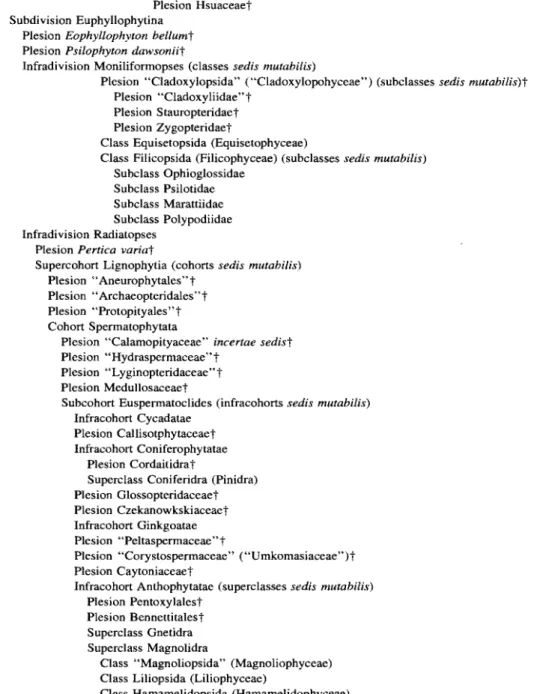
meaningful classification (Table 5) we have gone
fur-ther than Nelson (1974) and Patterson and Rosen
(1977) in applying the sequencing convention not only
to fossils but also to extant taxa. We have also
fol-lowed Wiley (1981) in using two annotations to
indi-cate uncertainty in the pattern of systematic
relation-ships. Use of
sedis mutabilis indicates that the taxa
which follow at the next level of the hierarchy are of
uncertain relationship (i.e., form a polychotomy). The
use of
incertae sedis indicates that the taxon to which
this epithet is attached is of uncertain relationship.
Groups for which monophyly is equivocal are marked
with quotes (e.g., "Aneurophytales").
re-92 Crane and Kenrick ALISO
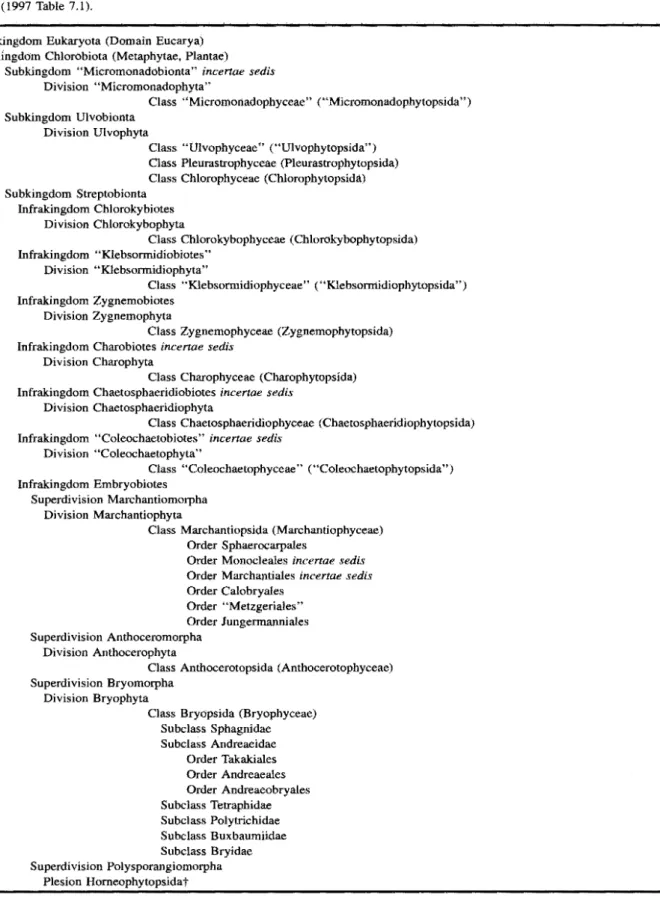
Table 5. Cladistic classification of green plants from Kenrick and Crane (1997) using a modified "Linnean" hierarchy (indented at the level of categories and incorporatirtg the sequencing convention for both fossil and extinct taxa: plesion convention also used for fossils which are indicated t). At the level of Class the tWo alternative standardized endings given in the ICBN for classes of algae (-ophyceae) and "higher" green plants (-opsida) are shown throughout to emphasize their application to the same level of the hierarchy. Taxa that are of questionable monophyly. or that are only weakly supported in the cladistic analysis are marked with quotes. Sedis mutabilis indicates
that the taxa which follow at the next level of the hierarchy are of uncertain relationship (i.e., form a polytomy). /ncertae sedis indicates
that the taxon to which this epithet is attached is of uncertain relationship. This classification is identical to that presented by Kenrick and Crane (1997 Table 7.1).
Superkingdom Eukaryota (Domain Eucarya) Kingdom Chlorobiota (Metaphytae, Plantae)
Subkingdom "Micromonadobionta" incenae sedis
Division "Micromonadophyta"
Class "Micromonadophyceae" {"Micromonadophytopsida ") Subkingdom Ulvobionta
Division Ulvophyta
Class "Ulvophyceae" ("Uivophytopsida") Class Pleurastrophyceae {Pieurastrophytopsida) Class Chlorophyceae (Chlorophytopsida) Subkingdom Streptobionta
Infrakingdom Chlorokybiotes Division Chlorokybophyta
Class Chlorokybophyceae (Chlorokybophytopsida) Infrakingdom "Klebsormidiobiotes"
Division "Klebsormidiophyta"
Class "Klebsormidiophyceae" ( "Klebsorntidiophytopsida") lnfrakingdom Zygnemobiotes
Division Zygnemophyta
Class Zygnemophyceae (Zygnemophytopsida) Infrakingdom Charobiotes incenae sedis
Division Charophyta
Class Charophyceae (Charophytopsida) Infrakingdom Chaetosphaeridiobiotes incertae sedis
Division Chaetosphaeridiophyta
Class Chaetosphaeridiophyceae (Chaetosphaeridiophytopsida) Infrakingdom "Coleochaetobiotes" incenae sedis
Division "Coleochaetophyta"
Class "Coleochaetophyceae" ( "Coleochaetophytopsida") lnfrakingdom Embryobiotes
Superdivision Marchantiomorpha Division Marchantiophyta
Class Marchantiopsida (Marchantiophyceae) Order Sphaerocarpales
Order Monocleales incertae sedis
Order Marchantiales incertae sedis
Order Calobryales Order "Metzgeriales" Order Jungermanniales Superdivision Anthoceromorpha
Division Anthocerophyta
Class Anthocerotopsida (Anthocerotophyceae) Superdivision Bryomorpha
Division Bryophyta
Class Bryopsida (Bryophyceae) Subclass Sphagnidae Subclass Andreaeidae
Order Takakiales Order Andreaeales Order Andreaeobryales Subclass Tetraphidae Subclass Polytrichidae Subclass Buxbaumiidae Subclass Bryidae Superdivision Polysporangiomorpha
VOLUME 15, NUMBER 2 Classification of Land Plants
Table 5. Continued.
Plesion Aglaophyron majort
Division Tracheophyta Plesion Rhyniopsidat Subdivision Lycophytina
Plesion Zosterophyllum myretonianum incertae sedist
Class Lycopsida (Lycophyceae) Plesion Drepanophycalest Order "Lycopodiales" Plesion Protolepidodendralest Order Selaginellales
Order Isoetales
Plesion Zosterophyllopsida (Zosterophyllophyceae )t Plesion Zosterophyllum divaricatumt
Plesion Sawdoniales (families sedis mutabilis)t
Plesion Sawdoniaceaet Plesion Barinophytaceaet Plesion "Gosslingiaceae"t Plesion Hsuaceaet Subdivision Euphyllophytina
Plesion Eophyllophyton bellumt
Plesion Psilophyton dawsoniit
Infradivision Moniliformopses (classes sedis mutabilis)
Plesion "Cladoxylopsida" ("Cladoxylopohyceae") (subclasses sedis mutabilis)t
Plesion "Cladoxyliidae"t Plesion Stauropteridaet Plesion Zygopteridaet
Class Equisetopsida (Equisetophyceae)
Class Filicopsida (Filicophyceae) (subclasses sedis mutabilis)
Subclass Ophioglossidae Subclass Psilotidae Subclass Marattiidae Subclass Polypodiidae lnfradi vision Radiatopses
Plesion Pertica variat
Supercohort Lignophytia (cohorts sedis mutabilis)
Plesion "Aneurophytales"t Plesion "Archaeopteridales" t Pies ion "Protopityales" t Cohort Spermatophytata
Plesion "Calamopityaceae" incertae sedist
Plesion "Hydraspermaceae"t Plesion "Lyginopteridaceae"t Plesion Medullosaceaet
Subcohort Euspermatoclides (infracohorts sedis mutabilis)
Infracohort Cycadatae Plesion Callisotphytaceaet Infracohort Coniferophytatae
Plesion Cordaitidrat
Superclass Coniferidra (Pinidra) Plesion Glossopteridaceaet Plesion Czekanowkskiaceaet Infracohort Ginkgoatae Plesion "Peltaspermaceae"t
Plesion "Corystospermaceae" ("Urnkomasiaceae")t Plesion Caytoniaceaet
Infracohort Anthophytatae (superclasses sedis mutabilis)
Plesion Pentoxylalest Plesion Bennettitalest Superclass Gnetidra Superclass Magnolidra
Class "Magnoliopsida" (Magnoliophyceae) Class Liliopsida (Liliophyceae)
Class Hamamelidopsida (Hamamelidophyceae)
94 Crane and Kenrick ALISO
Table 5. Continued.
Subclass Ranunculidae
Subclass Hamamelididae (infraclasses sedis mutabilis) lnfraclass Caryophyllidna
lnfraclass "Rosidna" Infraclass "Dilleniidna" Infraclass Lamiidna Infraclass Asteridna
spect to the five principal ranks (excluding genera and
species) and their hierarchical order
(Art.
3.1) and we
have also used the prefix "sub" to designate additional
levels (Art. 4.2). Because there is an insufficient
num-ber of ranks in the Code to accommodate the numnum-ber
of hierarchical levels in our classification, we have
in-troduced the rank Cohort between Division and Class.
This is permissible under the ICBN, but differs from
usage in some zoological classifications in which
Co-hort is often used as equivalent to Class. The ICBN
provides that "Further ranks may also be intercalated
or added, provided that confusion or error is not
there-by introduced"
(Art.
4.3). Therefore, to create further
hierarchical levels we have also used the prefix
"in-fra" to designate ranks immediately below the levels
Subkingdom, Subclass and Subdivision; and used the
prefix "super" in conjunction with Division, Cohort
and Class. We considered using the prefix "intra" to
create an additional
hierarchicallevel-Intradivision-between Division and Subdivision (e.g., for
eutrach-eophytes, Fig.1) but for the· time being we have not
utilized this level in our classification.
The resulting classification (Table 5), constructed
within the framework provided by the ICBN,
incor-porates 16 different ranks as follows: Superkingdom,
Kingdom, Subkingdom, Infrakingdom, Superdivision,
Division, Subdivision, Infradivision, Supercohort,
Co-hort, SubcoCo-hort, InfracoCo-hort, Superclass, Class,
Sub-class and InfraSub-class. To avoid the need for further
ranks between Kingdom and Division we differ from
Bremer (1985) in recognizing green plants as a
King-dom rather than a SubkingKing-dom. Eukaryotes are
sidered a Superkingdom and embryophytes are
con-sidered an Infrakingdom. Angiosperms are treated as
a Superclass with monocots and eudicots treated as
Classes.
PROBLEMS AND ALTERNATIVE APPROACHES
It
is self-evident that as sampling of botanical
di-versity increases based on new knowledge of living
and fossils plants, as relationships become better
un-derstood, and as phylogenetic resolution improves, the
hierarchy of cladistic relationships that needs to be
ex-pressed as a classification will become steadily more
complex and will obviously require an increasingly
large number of hierarchical levels (Fig. 1, Table 5).
As suggested by previous authors, the number of
hi-erarchical levels needed can be reduced by applying
the sequencing and plesion conventions. However,
from Fig. 1 and Table 5, it is clear that these
approach-es fail to solve the fundamental problem of the
prolif-eration of ranks. Also, these approaches have their
own limitations. In the context of evolutionary
biolo-gy, the plesion convention makes an arbitrary
distinc-tion between living and fossil organisms, while the
sequencing convention will ultimately fail because it
precludes the naming of potentially important clades.
For example, in Table 5, to reduce the proliferation of
ranks, the eutracheophytes (Lycophytina plus
Euphyl-lophytina) of Kenrick and Crane (1991) are not named.
It is also clear that, the sequencing convention will
become less and less effective in "conserving"
hier-archical levels as cladograms become more highly
branched and less pectinate. In addition, while
previ-ous authors have highlighted fossils as major
contrib-utors to the problem of proliferation of ranks (e.g.,
Patterson and Rosen 1977), exactly the same
difficul-ties arise in dealing with any diverse group of extant
organisms-single species can be the sister group to
larger clades. For example, continuing to apply the
approach adopted here within angiosperms would
re-quire establishing many more hierarchical levels
be-tween Infraclass and Order, and bebe-tween Order and
Family. Even moderate resolution of relationships in
the Orchidaceae, Asteraceae or Fabaceae would also
undoubtedly require many more ranks between family
and genus than the three mentioned in the Code
(Art.
4.2). Additional ranks become necessary because
res-olution of relationships within a group with a large
number of members-whether extant, extinct or a
mix-ture of the two--inevitably results in a hierarchy with
many levels.
VOLUME 15, NUMBER 2 Classification of Land Plants 95
would be a major practical inconvenience to
research-ers and a serious barrier to students and other usresearch-ers.
It
is also clear that the associated problems would
mul-tiply rapidly as different systematists used the same
name and rank for slightly different groups--or
arbi-trarily used different names and ranks for the same
groups. Both of these problems are already especially
prevalent at the higher levels of plant classification
where they are a major cause of confusion and
ambi-guity. Compare, for example, the very different
cir-cumscriptions of angiosperm families by different
au-thors, the very different concepts of Magnoliidae
adopted by Cronquist (1981) and Takhtajan (1987), or
the variety of different rank-based names that have
been used for the clubmoss clade that contains
Lyco-podium s.I., Selaginella, and Jsoetes.
In our view the proliferation of formal hierarchical
levels that is permitted under the Code, and previous
attempts to sidestep the problem (e.g., sequencing
con-vention, plesions), do not provide a satisfactory
meth-odology for developing modem higher-level
classifi-cations based on phylogenetic results. They undermine
the main objective of equivalency between
phyloge-netic hierarchies and formal written classifications, and
have serious practical limitations. As knowledge of
re-lationships increases, as the number of ranks
prolif-erates, and as the ranks and their formal endings are
used more frequently with conventions such as
se-quencing, plesions,
sedis mutabilis and incertae sedis,
it will inevitably become increasingly difficult to
readi-ly retrieve the pattern of relationships from a written
classification. Also, from the standpoint of
evolution-ary biology, it is clear that equivalency in rank
be-tween sister groups is lost by use of the sequencing
convention. For example, within mosses, the
Sphag-nidae and Bryidae are not equivalent units, and of
course there is no equivalence between taxa assigned
to the same rank in different parts of the classification.
Sphagnidae and Ranunculidae, for example, are not
equivalent evolutionary units--even though that is
im-plied by their equivalent rank-based endings.
In the face of these difficulties, and other problems
with current approaches to nomenclature, several
au-thors (e.g., de Quieroz and Gauthier 1992, 1994) have
proposed an alternative approach to hierarchical
clas-sification that rejects many aspects of the current
("Linnean") system, and especially the emphasis
placed on taxonomic rank by current approaches to
nomenclature. These authors suggest that
ad hoc
mod-ifications of the "Linnean" system by the use of
se-quencing, plesions and other conventions do not
ac-complish their stated objectives of retrievability of
phylogenetic information. Instead they propose a more
radical approach to revising nomenclatural methods
that would render such
ad hoc solutions unnecessary.
The
aim
of the approach they propose is to create a
"phylogenetic system of taxonomy" that provides a
system of names for taxa that is "stable, universal and
unambiguous ... with regard to what they signify about
common ancestry." This approach seeks to replace the
"Linnean" categories with the principle of descent as
the basis for taxonomic convention (de Quieroz and
Gauthier 1992). If fully implemented such a radical
system would remove the need for the formal
cate-gories (ranks) currently recognized by the ICBN,
de-fine taxon names in terms of common ancestry, and
change the way that binomials are employed. Under
such a system taxon names would only be
synony-mous if they referred to the same clade, and priority
would be based not on "first use of a name in
asso-ciation with a particular Linnean category, but on first
use of a name in association with a particular clade"
(de Quieroz and Gauthier 1992, p. 465). Formal ranks
with formalized Latin endings would be discarded in
favor of a simple indented system. Abandoning these
formal ranks would also have the incidental advantage
of reducing the inappropriate use of supraspecific
cat-egories as the units of comparison in evolutionary
studies.
While these proposals may seem excessively
radi-cal, with the potential to cause nomenclatural chaos,
the issues that have been raised are substantive and
deserve careful consideration. There is also an
inter-esting convergence between some of the phylogenetic
(de Queiroz and Gauthier 1992, 1994) and more
con-ventional criticisms (e.g., Bisby and Hawksworth
1991) of current nomenclatural practices.
It
is
there-fore important that phylogenetic systematics be part of
the debate on the future of botanical nomenclature and
discussions of how well the current Code is serving
science and meeting its objectives of universality,
clar-ity and stabilclar-ity in communication.
ALTERNATIVE CLASSIFICATlONS OF LAND PLANTS
As a case study, to inform discussions about
con-structing cladistic classifications of plants at the
"high-er" taxonomic levels, we developed three different
classifications that provide contrasting representations
of the same pattern of phylogenetic relationships (Fig.
1, Tables 5-7). All three classifications seek to
recog-nize only monophyletic groups. Taxa that are of
ques-tionable monophyly, or that are only weakly supported
in the cladistic analysis, are marked with quotes. The
structure of the original cladogram (Fig. 1) has been
fully retained in all three classifications through the
application of various conventions relating to the
lay-out on the printed page.
ad--···~--·~----,---~
96 Crane and Kenrick ALISO
ditional ranks were required. These were created in
accordance with Articles 4.2 and 4.3 of the ICBN
(1994). Relationships among taxa are represented
us-ing the indentation and sequencus-ing conventions
rec-ommended by Wiley (1981) and thus not all clades are
named. Naming additional clades would have required
the use of additional "Linnean" categories. For
ex-ample, following the sequencing convention,
subclass-es in Bryopsida have a pectinate relationship (e.g.,
Sphagnidae is sister group to an unnamed clade
com-prising all other subclasses) that is retrievable from
their layout on the page, but not from their "Linnean"
ranks. This relationship could also be represented by
inserting further "Linnean" categories and changing
subclass names to names of successively lower rank.
Table 5 also makes use of the terms
sedis mutabilis
and
incertae sedis to override the sequencing
conven-tion and to indicate polytomies among taxa of the
same rank and same indentation (e.g., the four plesions
within Sawdoniales form a polytomy). The plesion
convention is used for extinct taxa (Wiley 1981),
which are marked
"t".
We regard the classification in Table 5 as
problem-atic for several reasons. First, in terms of written
clas-sification, the formal endings associated with the
var-ious "Linnean" ranks communicate no additional
in-formation (i.e., are redundant) because the topology of
the cladogram is entirely represented by indentation
and sequencing. Second, in order to name additional
clades (e.g., Eutracheophyta-named in Table 6 and 7,
but not in Table 5) the creation of further "Linnean"
categories would be necessary. This would result in a
potentially very large number of additional ranks in
some groups, for example within angiosperms. Most
of these would be redundant in other less species rich
groups, although under the Code these ranks need not
be filled. Third, there are several categories that are
required by the Code (ICBN 1994, Art. 3.1) but that
are redundant under certain circumstances (e.g., Class
Marchantiopsida and Division Marchantiophytata
within the Superdivision Marchantiomorpha). Fourth,
certain rank endings are not used consistently (e.g., the
class and subclass endings in "green algae" and land
plants are not identical (ICBN 1994, Recommendation
16A.3). Fifth, the different treatment of fossil and
liv-ing taxa (use of the plesion convention) results in a
potentially confusing juxtaposition of rank-based
end-ings. For example, the plesion Rhyniopsida has a class
level ending but is used at the subdivisional rank.
In our view however, the most unsatisfactory
ele-ment of the classification in Table 5 is that it requires
arbitrary decisions as to the rank at which particular
clades should be recognized. It is appropriate that the
ICBN should not seek to restrict the freedom of plant
scientists to make necessary taxonomic modifications
to classifications that result from new knowledge. But,
it is more question,able whether the Code should create
the conditions under which purely arbitrary decisions
are effectively encouraged by the formal requirement
to use rank-based endings for order, suborder, family,
subfamily and tribe (ICBN 1994,
Arts
17 -19).
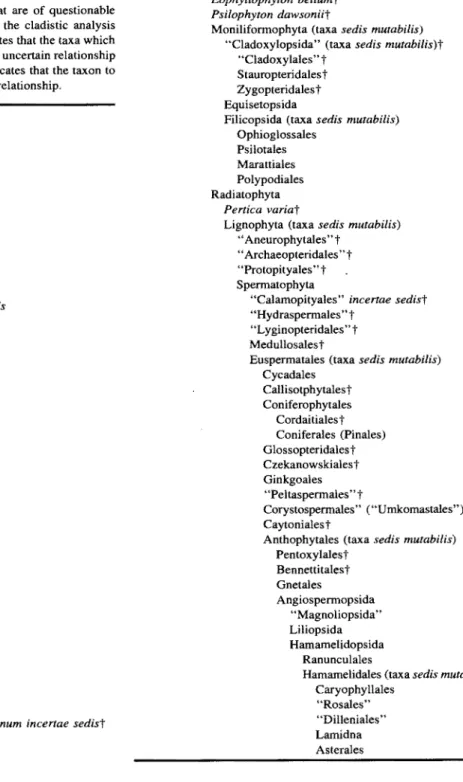
The classification in Table 6 represents relationships
among taxa using the indentation and sequencing
con-ventions recommended by Wiley (1981). The main
difference from the classification in Table 5 is that
commonly used taxonomic names have been
con-served and the relative rank order convention has
not
been followed
(contra ICBN 1994,
Arts
3, 4, 5). In
Table 6 "Linnean" ranks are not recognized and the
latinized name endings formerly associated with
spe-cific ranks have no meaning. In this classification
tax-on names have a unique purpose-they are simply a
means of referring to a taxon (a clade )-instead of the
dual purpose stated in the ICBN-a means of referring
to a taxon
and a means of indicating rank. New
tax-onomic names would be simple Latinized adjectival or
substantive terms appropriate to the group. The
end-ings of such terms would not be indicative of a
par-ticular rank. As in the classification in Table 5, that in
Table 6 also makes use of the terms
sedis mutabilis
and
incertae sedis to override the sequencing
conven-tion and to indicate polytomies among taxa of the
same indentation.
One consequence of the approach taken in Table 6
is that traditional Linnean taxonomic rank-based
end-ings become mixed into an unfamiliar order, and this
may be confusing unless it is clearly recognized that
under the approach adopted here such endings have no
meaning. For example, in this classification the
"di-vision/phylum" Embryophyta contains other taxa of
the same rank such as Tracheophyta and
Spermato-phyta. Similarly, the "order" Euspermatales contains
the "class" Angiospermopsida (c.f. examples in de
Queiroz and Gauthier 1994). The main advantage of
the classification in Table 6 is that commonly used
names are conserved at all levels in the hierarchy and
that "stability" is achieved by ignoring the strict
hi-erarchy of ranks specified in the Code. Furthermore,
with this approach, the recognition of additional taxa
(fossil or extant) does not require the creation of
ad-ditional Linnean ranks and does not result in
nomen-clatural changes that are merely the consequence of
the relative rank order convention.
VOLUME 15, NUMBER 2 Classification of Land Plants 97
Table 6. Indented and sequenced cladistic classification of green plants using commonly applied names for individual units without regard to their rank or hierarchical ordering of ranks and rank-based endings. Fossil taxa are indicated t. Taxa that are of questionable monophyly, or are only weakly supported in the cladistic analysis are marked with quotes. Sedis mutabilis indicates that the taxa which follows at the next level of the hierarchy are of uncertain relationship (i.e., form a polychotomy). lncertae sedis indicates that the taxon to which this epithet is attached is of uncertain relationship.
Eukaryota Chlorophyta
"Micromonadophyceae" incertae sedis Ulvophyta
"Ulvophyceae" Pleurastrophyceae Chlorophyceae Streptophyta
Chlorokybophyceae "Klebsorrnidiophyceae" Zygnemophyceae
Charophyceae incertae sedis
Chaetosphaeridiophyceae incertae sedis "Coleochaetophyceae" incertae sedis Embryophyta
Marchantiopsida Sphaerocarpales
Monocleales incertae sedis Marchantiales incertae sedis Calobryales
"Metzgeriales" Jungerrnanniales Anthocerotopsida Bryopsida
Sphagnales Andreaeopsida
Takaki ales Andreaeales Andreaeobryales Tetraphidales Polytrichales Buxbaumiales Bryales Polysporangiophyta
Horneophytopsidat
Agiaophyton majort
Tracheophyta Rhyniopsidat Lycophytina
Zosterophyllum myretonianum incertae sedist
Lycopsida
Drepanophycalest "Lycopodiaceae" Protolepidodendralest Selaginellaceae Isoetales Zosterophyllopsidat
Zosterophyllum divaricatumt
Sawdoniales (taxa sedis mutabilis)t Sawdoniaceaet
Barinophytaceaet "Gosslingiaceae" t
Hsua robustat
Euphyllophytina
Eophyllophyton bellumt
Table 6. Continued.
Eophyllophyton bellumt Psilophyton dawsoniit
Moniliforrnophyta (taxa sedis mutabilis) "Cladoxylopsida" (taxa sedis mutabilis)t
"Cladoxylales" t Stauropteridalest Zygopteridalest Equisetopsida
Filicopsida (taxa sedis mutabilis) Ophioglossales
Psilotales Marattiales Polypodiales Radiatophyta
Pertica variat
Lignophyta (taxa sedis mutabilis) "Aneurophytales" t
"Archaeopteridales" t "Protopityales" t Spermatophyta
"Calamopityales" incertae sedist "Hydraspermales"t
"Lyginopteridales"t Medullosalest
Euspermatales (taxa sedis mutabilis) Cycadales
Callisotphytalest Coniferophytales Cordaitialest Coniferales (Pinales) Glossopteridalest Czekanowskialest Ginkgoales "Peltaspermales" t
Corystospermales" ("Umkomastales")t Caytonialest
Anthophytales (taxa sedis mutabilis) Pentoxylalest
Bennettitalest Gnetales
Angiospermopsida "Magnoliopsida" Liliopsida Hamamelidopsida
Ranunculales
Hamamelidales (taxa sedis mutabilis) Caryophyllales
"Rosales" "Dilleniales" Larnidna Asterales
98 Crane and Kenrick ALISO
Thble 7. Fully indented cladistic classification of green plants. Table 7. Continued. Consecutive or numbered (superscript) taxa of similar indentation
are either sister groups or unresolved polytomies. Fossil taxa are indicated t. Taxa that are of questionable monophyly, or are only weakly supported in the cladistic analysis are marked with quotes. Superscripts indicate widely separated taxa recognized at the same rank.
Eukaryota Chlorophyta
1 "Micromonadophyceae" 1Ulvophyta
"Ulvophyceae" unnamed clade
Pleuroastrophyceae Chlorophyceae 1Streptophyta
Chlorokybophyceae unnamed clade
"Klebsormidiophyceae" unnamed clade
Zygnemophyceae unnamed clade
Charophyceae
Chaetosphaeridiophyceae "Coleochaetophyceae'' Embryophyta
2Marchantiopsida Sphaerocarpales unnamed clade
Monocleales Marchantiales Jungermanniidae
Calobryales unnamed clade
"Metzgeriales" Jungertnanniales
2Stomatophyta
Anthocerotopsida unnamed clade
-'Bryopsida Sphagnales unnamed clade
4 Andreaeopsida Takakiales unnamed clade
Andreaeales Andreaeobryales 4unnamed clade
Tetraphidales unnamed clade
Polytrichales unnamed clade
Buxbaumiales Bryales 3Polysporangiophyta
Horneophytopsidat unnamed clade
Aglaophyton majort
Tracheophyta Rhyniopsidat Eutracheophyta
5Lycophytina
6Zosterophyllum myretonianumt
6Zosterophyllum myretonianumt
6Lycopsida
Drepanophycalest unnamed clade
"Lycopodiaceae" Ligulateae
Protolepidodendralest Heterosporales
Selaginellaceae Isoetales
0Zosterophyllopsidat
Zosterophyllum divaricatumt
Sawdonialest Sa wdoniaceaet Barinophytaceaet "Gosslingiaceae" t
Hsua robustat
'Euphyllophytina
Eophyllophyton bellumt
unnamed clade
Psilophyton dawsoniit
unnamed clade
7Monilifortnophyta 8"Cladoxylopsida"t
"Cladoxylales"t Stauropteridales t Zygopteridalest Equisetopsida
8Filicopsida
Ophioglossales Psilotales Marattiales Polypodiales
7Radiatophyta Pertica variat
Lignophyta
"Aneurophytales" t
"Archaeopteridales" t "Protopityales" t Spermatophyta
"Calamopityales" t unnamed clade
"Hydraspermales" t unnamed clade
"Lyginopteridales"t unnamed clade
Medullosales t Euspermatales
Cycad ales Callistophytalest Coniferophytales Cordaitialest Coniferales (Pinales) Glossopteridales t Czekanowskialest Ginkgoales "Peltaspermales" t ''Corystospermales ''
("Umkomasiales") Caytonialest Anthophytales
VOLUME 15, NUMBER 2
Table 7. Continued.
Classification of Land Plants 99
Bennettitalest Gnetales
Angiospermopsida "Magnoliopsida" unnamed clade
Liliopsida Hamamelidopsida
Ranunculales Hamamelidales
Caryophyllales "Rosales" "Dilleniales" Lamidna Asterales
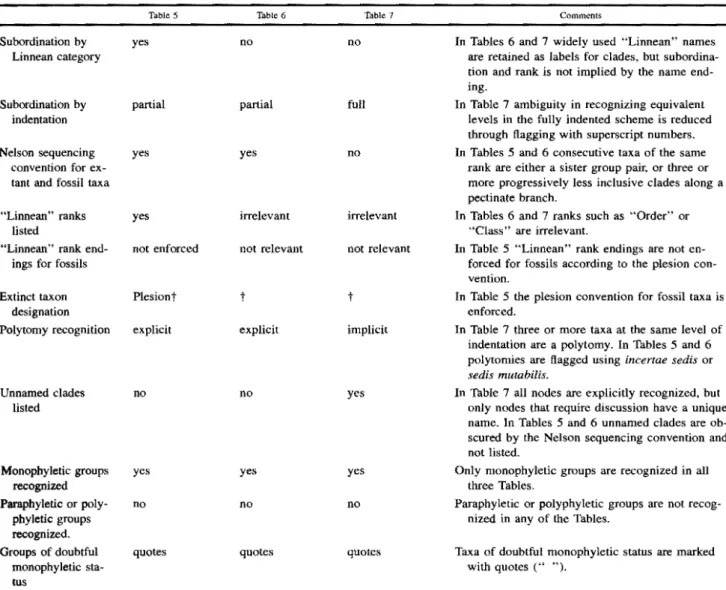
Table 6 is that the underlying phylogeny is represented
with a single consistent convention (full indentation)
rather than a combination of two conventions
(inden-tation and sequencing). A
full
comparison of the three
cladistic classifications in Tables 5-7 is given in Table
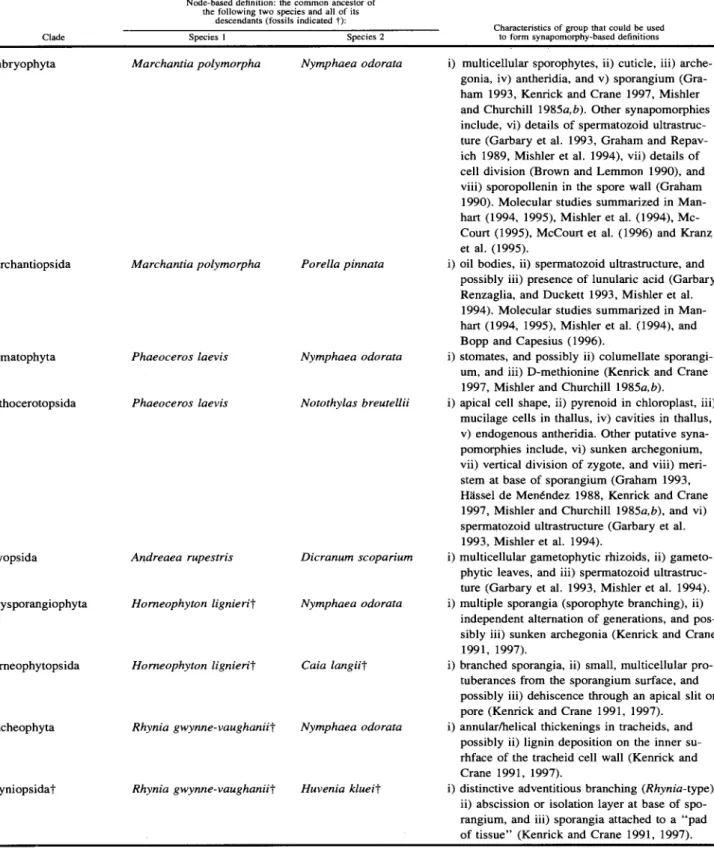
8. Definitions of the major groups recognized are
giv-en in Table 9.
CONCLUSIONS
in Table 6, commonly used names are conserved at all
levels in the hierarchy and the recognition of
addition-al taxa does not require the creation of additionaddition-al
Lin-nean ranks or the associated nomenclatural
adjust-ments. The main advantage over the classification in
The conflict between stability and change in the
par-ticular taxonomic treatments of organisms finds an
in-teresting parallel in the discussion over the future of
the Linnean hierarchy. On the one hand the concepts
of orders, families, and other categories are deeply
em-bedded in the history of biology. On the other hand,
the system is clearly not working well, particularly at
the "higher" taxonomic levels that are so important
for the rational design of comparative studies of all
kinds, as well as research and teaching in evolutionary
biology. At the same time that the botanical
commu-Table 8. Comparison of the three cladistic classifications in commu-Tables 5-7.
Subordination by Linnean category
Subordination by indentation
Nelson sequencing convention for ex-tant and fossil taxa
"Linnean" ranks listed
"Linnean" rank end-ings for fossils
Extinct taxon designation Polytomy recognition
Unnamed clades listed
Monophyletic groups recognized Paraphyletic or
poly-phyletic groups recognized. Groups of doubtful
monophyletic sta-tus
Table 5 Thble 6 Table 7
yes no no
partial partial full
yes yes no
yes irrelevant irrelevant
not enforced not relevant not relevant
Plesiont
t
t
explicit explicit implicit
no no yes
yes yes yes
no no no
quotes quotes quotes
Comments
In Tables 6 and 7 widely used "Linnean" names are retained as labels for clades, but subordina-tion and rank is not implied by the name end-ing.
In Table 7 ambiguity in recognizing equivalent levels in the fully indented scheme is reduced through flagging with superscript numbers. In Tables 5 and 6 consecutive taxa of the same
rank are either a sister group pair, or three or more progressively less inclusive clades along a pectinate branch.
In Tables 6 and 7 ranks such as "Order" or "Class" are irrelevant.
In Table 5 "Linnean" rank endings are not en-forced for fossils according to the plesion con-vention.
In Table 5 the plesion convention for fossil taxa is enforced.
In Table 7 three or more taxa at the same level of indentation are a polytomy. In Tables 5 and 6 polytomies are flagged using incertae sedis or sedis mutabilis.
In Thble 7 all nodes are explicitly recognized, but only nodes that require discussion have a unique name. In Tables 5 and 6 unnamed clades are ob-scured by the Nelson sequencing convention and not listed.
Only monophyletic groups are recognized in all three Tables.
Paraphyletic or polyphyletic groups are not recog-nized in any of the Tables.
100 Crane and Kenrick ALISO
Table 9. Node-based definitions and characters for selected higher taxa recognized in the classification given in Table 7, based on the recommendations of de Queiroz and Gauthier (1994). Synapomorphy-based definitions are derived from cladistic analysis. Stability in the relationship between names and the taxa that they designate is addressed by associating names (irrespective of their latinized ending) with two specific taxa (in this cases species). For example, Embryophyta can be defined as the clade that contains the liverwort Marchantia polymorpha and the angiosperm Nymphaea odorata. These two taxa provide a fixed reference point for the name Embryophyta. The effect of this approach is to conserve the names of groups that are subsequently shown to be paraphyletic or polyphyletic by allowing the group name to be applied at a more inclusive level in the hierarchy of relationships. In other words, the name remains the same but its level of generality may be adjusted as knowledge of relationships changes. Groups defined in this way are always monophyletic. For further details see de Queiroz and Gauthier (1992, 1994).
Clade
Embryophyta
Marchantiopsida
Stomatophyta
Anthocerotopsida
Bryopsida
Polysporangiophyta
Homeophytopsida
Tracheophyta
Rhyniopsidat
Node-based definition: the common ancestor of the following two species and all of its
descendants (fossils indicated t):
Species 1 Species 2
Marchantia polymorpha Nymphaea odorata
Marchantia polymorpha Porella pinnata
Phaeoceros laevis Nymphaea odorata
Phaeoceros laevis Notothylas breutellii
Andreaea rupestris Dicranum scoparium
Homeophyton lignierit Nymphaea odorata
Homeophyton lignierit Caia langiit
Rhynia gwynne-vaughaniit Nymphaea odorata
Rhynia gwynne-vaughaniit Huvenia klueit
Characteristics of group that could be used to form synapomorphy-based definitions
i) multicellular sporophytes, ii) cuticle, iii) arche-gonia, iv) antheridia, and v) sporangium (Gra-ham 1993, Kenrick and Crane 1997, Mishler and Churchill 1985a,b). Other synapomorphies include, vi) details of spermatozoid ultrastruc-ture (Garbary eta!. 1993, Graham and Repav-ich 1989, Mishler eta!. 1994), vii) details of cell division (Brown and Lemmon 1990), and viii) sporopollenin in the spore wall (Graham 1990). Molecular studies summarized in Man-hart (1994, 1995), Mishler eta!. (1994), Mc-Court (1995), McMc-Court eta!. (1996) and Kranz et a!. (1995).
i) oil bodies, ii) spermatozoid ultrastructure, and possibly iii) presence of lunularic acid (Garbary, Renzaglia, and Duckett 1993, Mishler eta!. 1994). Molecular studies summarized in Man-hart (1994, 1995), Mishler eta!. (1994), and Bopp and Capesius (1996).
i) stomates, and possibly ii) columellate sporangi-um, and iii) D-methionine (Kenrick and Crane 1997, Mishler and Churchill 1985a,b).
i) apical cell shape, ii) pyrenoid in chloroplast, iii) mucilage cells in thallus, iv) cavities in thallus, v) endogenous antheridia. Other putative syna-pomorphies include, vi) sunken archegonium, vii) vertical division of zygote, and viii) meri-stem at base of sporangium (Graham 1993, Hassel de Menendez 1988, Kenrick and Crane 1997, Mishler and Churchill 1985a,b), and vi) spermatozoid ultrastructure (Garbary eta!. 1993, Mishler eta!. 1994).
i) multicellular gametophytic rhizoids, ii) gameto-phytic leaves, and iii) spermatozoid ultrastruc-ture (Garbary eta!. 1993, Mishler eta!. 1994). i) multiple sporangia (sporophyte branching), ii)
independent alternation of generations, and pos-sibly iii) sunken archegonia (Kenrick and Crane 1991, 1997).
i) branched sporangia, ii) small, multicellular pro-tuberances from the sporangium surface, and possibly iii) dehiscence through an apical slit or pore (Kenrick and Crane 1991, 1997).
i) annular/helical thickenings in tracheids, and possibly ii) lignin deposition on the inner su-rhface of the tracheid cell wall (Kenrick and Crane 1991, 1997).
VOLUME 15, NUMBER 2 Classification of Land Plants
Table 9. Continued.
Clade
Eutraeheophyta
Lycophytina
Lycopsida
Drepanophycalest
Lycopodiaceae
Ligulateae
Protolepidodendralest
Heterosporales
Selaginellaceae
Isoetales
Zosterophyllopsidat
Sawdonialest
Sawdoniaceaet Barinophytaceaet
Node-based definition: the common ancestor of the following two species and all of its
descendants (fossils indicated t):
Huperzia selago
Zosterophyllum myreton-ianumt
Huperzia selago
Drepanophycus qujingensist
Huperzia selago
Leclercqia complexat
Leclercqia complexat
Selaginella selaginoides
Selaginella selaginoides
Paralycopodites pulcherrima
Zosterophyllum divaricatumt
Sawdonia ornatat
Sawdonia omatat
Protobarinophyton obrutsch-eviit
Nymphaea odorata
Huperzia selago
lsoetes engelmannii
Asteroxylon mackieit
Lycopodium clavatum
lsoetes engelmannii
Minarodendron cathay-siensist
lsoetes engelmannii
Selaginella martensii
lsoetes engelmannii
Gosslingia breconensist
Gosslingia breconensist
Anisophyton gothaniit Barinophyton citrulli-formet
Characteristics of group that could be used to form synapomorphy~based definitions
101
i) thick, lignified wall layer in tracheid, ii) pitlets between thickenings or within pits in tracheid and iii) sterome (peripheral zone of decay resistant cells in stem) (Kenrick and Crane 1991, 1997). i) more or less reniform sporangia, ii) marked spo-rangia! dorsiventrality, iii) isovalvate dehiscence, iv) conspicuous cellular thickening of the dehis-cence line, v) sporangia on short, laterally inserted stalks, and vi) exarch xylem differentiation (Di-Michele and Bateman 1996, Hueber 1992, Ken-rick and Crane 1997).
i) microphylls, ii) stellate xylem strand, iii) the close developmental association of sporangium and microphyll, iv) pitted tracheids, and v) loss of sporangium vasculature (DiMichele and Bateman 1996, Kenrick and Crane 1997).
i) bulbils or small lateral buds-a parallelism with extant Lycopodiaceae in the Huperzia selago
group (Kenrick and Crane 1997).
i) foveolate-fossulate microspore wall morphology (DiMichele and Bateman 1996, Kenrick and Crane 1997).
i) ligule, ii) terete, ribbed stele, and iii) possibly radial extension of sporangium (reversed in Sela-ginellaceae) (DiMichele and Bateman 1996, Ken-rick and Crane 1997).
i) forked microphylls, and possibly ii) anisoto-mous branching, iii) nonsinuate sporangia! epider-mal cells, and iv) radial dehiscence of sporangium (Kenrick and Crane 1997).
i) heterospory, ii) strobili, and possibly iii) reduc-tion of gametophyte, iv) endosporic microgameto-phyte, and v) free nuclear cell divisions in early stages of megagametophyte (DiMichele and Bate-man 1996, Kenrick and Crane 1997).
i) more or less spherical microsporangia, and pos-sibly ii) distal dehiscence (reversal to plesio-morphic condition from radial dehiscence), iii) 4 megaspores per sporangium, iv) suspension of ste-le in cavity by trabeculate endodermal cells, and v) echinate microspores (Kenrick and Crane 1997).
i) cambium, ii) pseudobipolar growth involving rhizomorphic root system, and iii) monarch xylem strand in root (Bateman et al. 1992, DiMichele and Bateman 1996).
i) circinate growth, ii) two-rowed sporangia! ar-rangement, and possibly iii) elliptical xylem strand (Hueber 1992, Kenrick and Crane 1997).
i) pseudomonopodial branching, ii) planated branching system, and iii) a unique form of subor-dinate axillary branching (Kenrick and Crane
1997).
102
Table 9. Continued.
Clade
"Gosslingiaceae"
t
Euphyllophytina
Moniliformophyta
Equisetopsida
Polypodiales
Radiatophyta
Lignophyta
Spermatophyta
Crane and Kenrick
Node-based definition: the common ancestor of
the following two species and all of its descendants (fossiJs indicated t):
Species I
Gosslingia breconensist
Eophyllophyton bellumt
Equisetum arvense
Equisetum arvense
Cephalomanes thysano-stomum
Pertica varia+
Rellimia thompsoniit
Elkinsia polymorphat
Species 2
Oricilla bilinearist
Nymphaea odorata
Thelypteris dentata
Protocalamites longiit
Thelypteris dentata
Nymphaea odorata
Nymphaea odorata
Nymphaea odorata
Characteristics of group that could be used to form synapomorphy-based definitions
ALISO
i) unique "auricular" sporangia! orientation (Ken-rick and Crane 1997).
i) pseudomonopodial or monopodia! branching, ii) helical arrangement of branches, iii) small, "pin-nulelike" vegetative branches (nonplanated in ba-sal taxa), iv) "recurvation" of branch apices, v) tracheids with scalariform bordered pits, vi) spo-rangia in pairs grouped into terminal trusses, vii) sporangia! dehiscence along one side through a single slit, viii) radially aligned xylem in larger axes, and possibly ix) multiflagellate spermatozo-ids (convergent in /soetes engelmannii) (Bremer et
a!. 1987, Kenrick and Crane 1997, Stein et al. 1984). Molecular data summarized in (Albert et al. 1994, Kranz and Huss 1996, Raubeson and Jansen 1992).
i) mesarch protoxylem confined to lobes of xylem strand (Beck and Stein 1993, Kenrick and Crane
1997, Stein 1993).
i) whorled appendages, ii) sporangiophore mor-phology, iii) stelar mormor-phology, iv) regular alter-nation of appendages at successive nodes, v) mi-crophyllous "leaves", vi) possibly cambium (lost in Equisetaceae), and vii) the presence of a peris-pore (possibly more general) (Stein et al. 1984). Additional characters noted by Bateman (1991) in-clude: i) a medullated stele, ii) operculate strobili, and iii) columnar wall thickenings on sporangia! epidermis. Characters supporting a close relation-ship between the early fossil Jbyka and
sphenop-sids include i) whorled branching (Stein et al. 1984), and ii) protoxylem disintegration to form lacunae (Kenrick and Crane 1997, Skog and Banks 1973).
Leptosporangiate ferns (including Osmundaceae) i)
distinctive annulate dehiscence of sporangium, ii) superficial antheridia, iii) operculate cell in anther-idium, iv) "C" shaped leaf trace (Bierhorst 1971), and v) possibly siphono-dictyostelic anatomy (see also Pryer et al. 1995).
i) tetrastichous branching, and ii) a distinctive form of protoxylem ontogeny with multiple strands occurring along the mid-planes of the pri-mary xylem ribs (Beck and Stein 1993, Kenrick and Crane 1997, Stein 1993).
i) bifacial cambium producing secondary xylem, phloem and wood rays (Crane 1985, Crane 1990, Doyle and Donoghue 1986). Certain aspects of cambial activity convergent with Isoetales, sphen-opsids, and some early clepsidropsids (Kenrick and Crane 1997).
i) single megaspore per megasporangium and ii)