A Review on Cloud Computing:
Design Challenges in Architecture
and Security
Fei Hu
1, Meikang Qiu
2, Jiayin Li
2, Travis Grant
1, Draw Tylor
1,
Seth McCaleb
1, Lee Butler
1and Richard Hamner
11Department of Electrical and Computer Engineering, University of Alabama, Tuscaloosa, AL, USA 2Department of Electrical and Computer Engineering, University of Kentucky, Lexington, KY, USA
Cloud computing is becoming a powerful network archi-tecture to perform large-scale and complex computing. In this paper, we will comprehensively survey the concepts and architecture of cloud computing, as well as its security and privacy issues. We will compare different cloud models, trust/reputation models and privacy-preservation schemes. Their pros and cons are discussed for each cloud computing security and architecture strategy.
Keywords: cloud computing, security, privacy, computer networks, models
1. Introduction
Cloud computing is quickly becoming one of the most popular and trendy phrases being tossed around in today’s technology world. “It’s be-coming the phrase du jour”, says Gartner’s Ben Pring [1]. It is the big new idea that will supposedly reshape the information technol-ogy(IT)services landscape. According to The Economist in a 2008 article, it will have huge impacts on the information technology industry, and also profoundly change the way people use computers [2]. What exactly is cloud comput-ing then, and how will it have such a big impact on people and the companies they work for? In order to define cloud computing, it is first necessary to explain what is referenced by the phrase “The Cloud”. The first reference to “The Cloud” originated from the telephone in-dustry in the early 1990s, when Virtual Pri-vate Network (VPN) service was first offered.
Rather than hard-wire data circuits between the provider and customers, telephone companies began using VPN-based services to transmit data. This allowed providers to offer the same amount of bandwidth at a lower cost by rerout-ing network traffic in real-time to accommo-date ever-changing network utilization. Thus, it was not possible to accurately predict which path data would take between the provider and customer. As a result, the service provider’s network responsibilities were represented by a cloud symbol to symbolize the black box of sorts from the end-users’ perspective. It is in this sense that the term “cloud” in the phrase cloud computing metaphorically refers to the Internet and its underlying infrastructure. Cloud computing is in many ways a conglom-erate of several different computing technolo-gies and concepts like grid computing, virtu-alization, autonomic computing [40], Service-oriented Architecture(SOA) [43], peer-to-peer
formally, the National Institute of Standards and Technology(NIST)defines cloud computing as a model for convenient, on-demand network ac-cess to computing resources such as networks, servers, storage, applications, and services that can be quickly deployed and released with very little management by the cloud-provider[4]. Al-though the word “cloud” does refer to the In-ternet in a broad sense, in reality, clouds can be public, private, or hybrid(a combination of both public and private clouds). Public clouds provide IT services to anyone in the general pub-lic with an Internet connection and are owned and maintained by the company selling and dis-tributing these services. In contrast, private clouds provide IT services through a privately-owned network to a limited number of people within a specific organization.
As two examples of public consumer-level clouds consider Yahoo!RMail and YouTube. Through these two sites, users access data in the form of e-mails, attachments, and videos from any device that has an Internet connection. When users download e-mails or upload videos, they do not know where exactly the data came from or went. Instead, they simply know that their data is located somewhere inside the cloud. In reality, cloud computing involves much more complexity than the preceding two examples illustrate and it is this behind the scenes com-plexity that makes cloud computing so appeal-ing and beneficial to individual consumers and large businesses alike.
Cloud computing is an emerging technology from which many different industries and in-dividuals can greatly benefit. The concept is
simple; the cloud (internet) can be utilized to provide services that would otherwise have to be installed on a personal computer. For ex-ample, service providers may sell a service to customers which would provide storage of customer information. Or perhaps a service could allow customers to access and use some software that would otherwise be very costly in terms of money and memory. Typically, cloud computing services are sold on an “as needed” basis, thus giving customers more con-trol than ever before. Cloud computing ser-vices certainly have the potential to benefit both providers and users. However, in order for cloud computing to be practical and reliable, many ex-isting issues must be resolved.
With ongoing advances in technology, the use of cloud computing is certainly on the rise. Cloud computing is a fairly recent technology that re-lies on the internet to deliver services to paying customers. Services that are most often used with cloud computing include data storage and accessing software applications(Figure 1). The use of cloud computing is particularly appealing to users for two reasons: it is rather inexpensive and it is very convenient. Users can access data or use applications with only a personal com-puter and internet access. Another convenient aspect of cloud computing is that software ap-plications do not have to be installed on a user’s computer, they can simply be accessed through the internet. However, as with anything else that seems too good to be true, there is one cen-tral concern with the use of cloud computing technology – security[44].
In the internet, people like to use email for communication because of its convenience, ef-ficiency and reliability. It’s well known that most of the contexts have no special meaning, which means it’s more likely our daily com-munication. So, such context is less attractive for the hacker. However, when two people or two groups, even two countries, want to com-municate using the internet secretly, for each communication partners they need some kind of encryption to ensure their privacy and confi-dentiality. For sake of that such situation occurs rarely, users don’t want to make their processor slower by encrypting the email or other docu-ments. There must be a way for the users to easily encrypt their document only when they require such service.
In the rest of the paper, we will first survey typical architectures from networks layers view-point. Then we will discuss cloud models. Next we move to security issues such as encryption-on-demand. The privacy preservation models will be described. In each part where multiple schemes are presented, we will also compare their pros and cons.
2. Cloud Computing Architecture
2.1. Abstract Layers
To begin understanding cloud computing in some sort of detail, it is necessary to examine it in abstraction layers beginning at the bottom and working upwards. Figure 2 illustrates the five layers that constitute cloud computing[44]. A particular layer is classified above another if that layer’s services can be composed of ser-vices provided by the layer beneath it.
Figure 2.The five abstraction layers of cloud computing[5].
The bottom layer is the physical hardware, namely the cloud-provider owned servers and switches that serve as the cloud’s backbone. Customers who use this layer of the cloud are usually big corporations who require an extremely large amount of subleased Hardware as a Service
(HaaS). As a result, the cloud-provider runs, oversees, and upgrades its subleased hardware for its customers. Cloud-providers must over-come many issues related to the efficient, smooth, and quick allocation of HaaS to their customers, and one solution that allows providers to ad-dress some of these issues involves using re-mote scriptable boot-loaders. Rere-mote script-able boot-loaders allow the cloud-provider to specify the initial set of operations executed by the servers during the boot process, meaning that complete stacks of software can be quickly implemented by remotely located data center servers.
cloud customers in the form of virtual machines
(VMs). Virtualization technologies such as para-virtualization [44], hardware-assisted vir-tualization, live-migration, and pause-resume enable a single, large server to act as multi-ple virtual servers, or VMs, in order to better utilize limited and costly hardware resources such as its central processing unit (CPU) and memory. Thus, each discrete server appears to cloud users as multiple virtual servers ready to execute the users’ software stacks. Through virtualization, the cloud-provider who owns and maintains a large number of servers is able to benefit from gains in resource utilization and efficiency and claim the economies of scale that arise as a result. IaaS also automatically al-locates network resources among the various virtual servers rapidly and transparently. The resource utilization benefits provided by virtu-alization would be almost entirely negated if not for the layer’s ability to allocate servers’ resources in real-time. This gives the cloud-provider the ability to dynamically redistribute processing power in order to supply users with the amount of computing resources they re-quire without making any changes to the phys-ical infrastructure of their data centers. Several current examples of clouds that offer flexible amounts of computational resources to its cus-tomers include the Amazon Elastic Compute Cloud(EC2) [9], Enomaly’s Elastic Computing Platform (ECP) [10], and RESERVOIR archi-tecture[6]. Data storage, which is also referred to as Data-Storage as a Service(DaaS), allows users of a cloud to store their data on servers lo-cated in remote locations and have instant access to their information from any site that has an In-ternet connection. This technology allows soft-ware platforms and applications to extend be-yond the physical servers on which they reside. Data storage is evaluated based on standards re-lated to categories like performance, scalability, reliability, and accessibility. These standards are not all able to be achieved at the same time and cloud-providers must choose which design criteria they will focus on when creating their data storage system. RESERVOIR architecture allows providers of cloud infrastructure to dy-namically partner with each other to create a seemingly infinite pool of IT resources while fully preserving the autonomy of technologi-cal and business management decisions [6].In the RESERVOIR architecture, each
infrastruc-ture provider is an autonomous business with its own business goals. A provider federates with other providers(i.e., other RESERVOIR sites)
based on its own local preferences. The IT man-agement at a specific RESERVOIR site is fully autonomous and governed by policies that are aligned with the site’s business goals. To opti-mize this alignment, once initially provisioned, resources composing a service may be moved to other RESERVOIR sites based on economi-cal, performance, or availability considerations. Our research addresses those issues and seeks to minimize the barriers to delivering services as utilities with guaranteed levels of service and proper risk mitigation.
Two examples of data storage systems are Ama-zon Simple Storage Service(Amazon S3) [11]
and Zecter ZumoDrive [12]. The communi-cation subcategory of the software infrastruc-ture layer, dubbed Communication as a Service
(CaaS), provides communication that is reli-able, schedulreli-able, configurreli-able, and(if neces-sary) encrypted. This communication enables CaaS to perform services like network secu-rity, real-time adjustment of virtual overlays to provide better networking bandwidth or traffic flow, and network monitoring. Through net-work monitoring, cloud-providers can track the portion of network resources being used by each customer. This “pay for what you use” concept is analogous to traditional public utilities like water and electricity provided by utility com-panies and is referred to as utility computing. Voice over Internet Protocol(VoIP)telephones, instant messaging, and audio and video con-ferencing are all possible services which could be offered by CaaS in the future. As a result of all three software infrastructure subcompo-nents, cloud-customers can rent virtual server time (and thus their storage space and pro-cessing power)to host web and online gaming servers, to store data, or to provide any other service that the customer desires.
flexible management of computing infrastruc-tures. It is able to implement a cloud with several features that allows the automatic de-ployment of services. It supports different vir-tualization technologies and format conversion during migration. OpenNebula is an open and flexible tool that fits into existing data center en-vironments to build a Cloud computing environ-ment. OpenNebula can be primarily used as a virtualization tool to manage virtual infrastruc-tures in the data-center or cluster, which is usu-ally referred as Private Cloud. Only the more recent versions of OpenNebula are trying to support Hybrid Cloud to combine local infras-tructure with public cloud-based infrasinfras-tructure, enabling highly scalable hosting environments. OpenNebula also supports Public Clouds by providing Cloud interfaces to expose its func-tionalities for virtual machine, storage and net-work management. Nimbus provides two levels of guarantees: 1) quality of life: users get ex-actly the(software)environment they need, and 2) quality of service: provision and guarantee all the resources the workspace needs to func-tion correctly(CPU, memory, disk, bandwidth, availability), allowing for dynamic renegotia-tion to reflect changing requirements and condi-tions. In addition, Nimbus can also provision a virtual cluster for Grid applications(e.g. a batch scheduler, or a workflow system), which is also dynamically configurable, a growing trend in Grid Computing.
The next layer is called the software environ-ment, or platform, layer and for this reason is commonly referred to as Platform as a Service
(PaaS). The primary users of this abstract layer are the cloud application developers who use it as a means to implement and distribute their pro-grams via the cloud. Typically, cloud applica-tion developers are provided with a programming-language-level environment and a pre-defined set of application programming interfaces(APIs)
to allow their software to properly interact with the software environment contained in the cloud. Two such examples of current software en-vironments available to cloud software devel-opers are the Google App Engine and Sales-force.com’s Apex code. Google App Engine provides both Java and Python runtime envi-ronments as well as several API libraries to cloud application developers[13], while Sales-force.com’s Apex code is an object-oriented programming language that allows developers
re-sources on an infrastructure-as-a-service cloud. VI management provides primitives to sched-ule and manage VMs across multiple physical hosts. VM managers provide simple primitives
(start, stop, suspend)to manage VMs on a single host. Wang et al. presented a cloud computing architecture, the Cumulus architecture[45]. In this architecture, there are also three layers: vir-tual network domain, physical network domain, and Oracle file system.
2.2. Management Strategies for Multiple Clouds [17]
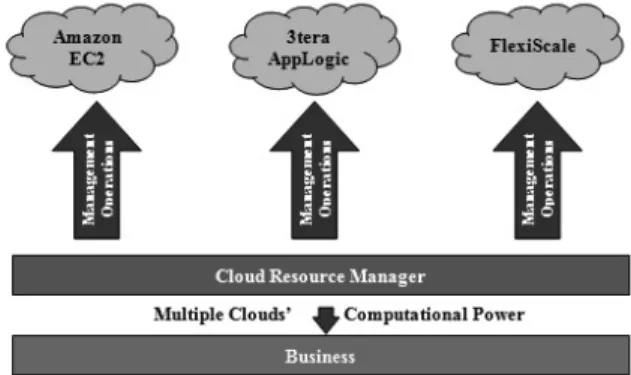
In order to mitigate the risks associated with un-reliable cloud services, businesses can choose to use multiple clouds in order to achieve adequate fault-tolerance – a system’s ability to continue functioning properly in the event that single or multiple failures occur in some of its compo-nents. The multiple clouds utilized can either be a combination of 1)all public clouds or 2) pub-lic and private clouds that together form a single hybrid cloud. A lack of well-defined cloud com-puting standards means that businesses wishing to utilize multiple clouds must manage multi-ple, often unique cloud interfaces to achieve their desired level of fault-tolerance and com-putational power. This can be achieved through the formulation of cloud interface standards so that any public cloud available to customers utilizes at least one well-defined standardized interface. As long as all cloud-providers use a standardized interface, the actual technology and infrastructure implemented by the cloud is not relevant to the end-user. Also, some type of resource management architecture is needed to monitor, maximize, and distribute the compu-tational resources available from each cloud to the business.
There are several multiple clouds managements, including the Intercloud Protocols [20], and some method of cloud federation [5, 7, 48]. The Intercloud Protocols consist of six layers: actual physical layer, physical metaphor layer, platform metaphor layer, communication layer, management layer and endpoints layer. The possibility of a worldwide federation of Clouds has been studied recently[3, 5, 48]. Some of the challenges ahead for the Clouds, like monitor-ing, storage, QoS, federation of different orga-nizations, etc. have been previously addressed
by grids. Clouds present, however, specific ele-ments that call for standardization too; e.g. vir-tual images format or instantiation/migration APIs [5]. So enhancing existing standards is granted to ensure the required interoperability.
Figure 3.Architecture for resource management that allows fault-tolerance cloud computing.
preferences, the development of a suitable algo-rithm for the cloud manager to implement could be a seemingly complex task.
One such instance of a hybrid cloud resource manager has been realized through the collab-oration of Dodda, Moorsel, and Smith [15]. Their cloud management architecture managed in tandem the Amazon EC2 via Query and Simple Object Access Protocol (SOAP) inter-faces as well as their own private cloud via a Representational State Transfer (REST) inter-face. The Query interface of EC2 uses a query string placed in the Uniform Resource Loca-tor (URL) to implement the management op-erations of the resource manager. Amazon, as the cloud-provider, provides a list of defined parameters and their corresponding values to be included in a query string by the resource manager. These query strings are sent by the cloud resource manager to a URL called out by the cloud-provider via HTTP GET messages in order to perform necessary management oper-ations. In this way, EC2’s interface is mapped to a generic interface that can be manipulated by the resource manager. The SOAP interface of EC2 operates very similarly to the Query in-terface. The same operations are available to resource managers using the SOAP interfaces as are available when using the Query interface, and HTTP GET messages are sent to a URL specified by the cloud-provider in order to per-form cloud management operations. The only difference between the two interfaces is the ac-tual parameters themselves that are needed to perform each operation.
The REST interface of the private cloud assigns a global identifier, in this case a Uniform Re-source Identifier(URI), to each local resource. Each local resource is then manipulated via HTTP and mapped to its generic interface in much the same way as EC2’s SOAP and Query interfaces. After each cloud-specific interface had been successfully mapped to its generic in-terface, the resource manager was able to ef-fectively oversee both the EC2 and the private cloud at the same time by using a single, com-mon set of interface commands.
However, one might wonder whether the choice of interface that the resource manager uses to oversee a cloud has a significant influence on the cloud’s performance. To answer this question, a series of 1,000 identical management operation
commands were issued by the resource manager to EC2 via the Query interface. Each command was issued a timestamp upon transmission from and arrival to the resource manager. Then, the same process was repeated for EC2 using the SOAP interface. A comparison of both inter-faces’ response times yielded a mean response time of 508 milliseconds (ms) for the Query interface and 905 ms for the SOAP interface. Thus, the SOAP interface’s response time was nearly double the response time of the Query interface. In addition, the variance of the SOAP interface response times was much larger than the variance exhibited by the response times of the Query interface. So, the Query interface’s response time is not only faster on average, but also more consistent than the response time of the SOAP interface. Based on these results, it should come as no surprise that most businesses use EC2’s Query interface instead of its SOAP interface. This comparison clearly shows that when using a particular cloud, businesses must be careful in choosing the most responsive inter-face to connect to their resource manager so as to maximize performance and quality of service
(QoS). The less amount of time required for pro-cessing commands issued by the resource man-ager, the more responsive the resource manager can be at maximizing and distributing the com-putational resources available from each cloud to the business.
base load resource zone, while the elastic com-putational power to meet the needs of the tres-passing load can be accessed on-demand via a public cloud supplied by a cloud-provider, which is also known as the trespassing load re-source zone. Base load management should proactively seek to use base zone resources ef-ficiently by using predictive algorithms to an-ticipate the future base load conditions present at all times in the company’s network. In con-trast, trespass load management should have the ability to devote trespass zone resources to sud-den, unpredictable changes in the trespass load in a systematic, yet agile fashion. Part of the IWF model’s task is to ensure that the base load remains within the amount planned for by the company’s IT department; in most cases, this is the computing capacity of the business’s pri-vate cloud (i.e. on-site servers in data center). By doing this, the computational capacity that the business’s on-site data center has to be over-planned for is considerably decreased, resulting in less capital expenditure and server underuti-lization for the business. The other part of the IWF model’s job is to make sure a minimal amount of data replication is required to process the services obtained from the public cloud. One instance of such an IWF management scheme was created by H. Chen and his colleagues[14]. Their system employed a private cloud in the
form of a local cloud cluster as its base load resource zone and the Amazon EC2 as its tres-passing load resource zone. The architecture used in this IWF hybrid cloud management sys-tem is depicted in Figure 4.
The IWF module, located at the very front of the management architecture, has a job that’s two-fold: first, it should send a smooth, constant workload to the base zone while at the same time avoid overloading either zone by exces-sively redirecting load traffic; second, the IWF module should effectively break down the over-all load initiated by users of the network, both by type and amount of requested data. The pro-cess of load decomposition helps to avoid data redundancy in the management scheme. The base zone of the IWF system is on 100% of the time, and, as mentioned previously, the volume of the base load does not vary much with time. As a result, the resources of the private cloud that handle the base load are able to be run very efficiently. Nonetheless, a small amount of over-provisioning is still necessary in order for the local cloud cluster to be able to handle small fluctuations in the base load volume and to guarantee an acceptable QoS to the business’ employees. The trespassing zone of the system is only on for X% of the time, where X is typi-cally a small single-digit number. Because the
trespassing zone must be able to adequately han-dle large spikes in processing demand, its com-putational capacity must be over-provisioned by a considerably large amount.
The procedure for implementing IWF can be modeled as a hypergraph partitioning problem consisting of vertices and nets. Data objects in the load traffic, such as streaming videos or ta-bles in a database, are represented by vertices, while the requests to access these data objects are modeled as nets.
The link between a vertex and a net depicts the relationship that exists between a data object and its access request. Formally, a hypergraph is defined as
H = (V,N) (1)
where V is the vertex set and N is the net set. Each vertexvi ∈ V is assigned weights wi and si that represent the portion of the workload caused by the ith data object and the data size of theith data object, respectively. The weight
wiis computed as the average workload per ac-cess request of the ith data object multiplied by its popularity. Each net nj ∈ N is assigned a cost cj that represents the expected network overhead required to perform an access request of type j. The cost cj attributed to each net is calculated as the expected number of typej ac-cess requests multiplied by the total data size of all neighboring data objects. The problem that must be solved in the design of the IWF manage-ment system involves assigning all data objects, or vertices, to two separate locations without causing either location to exceed its workload capacity while at the same time achieving a min-imum partition cost. This is given by
Min(
nj∈Nexpected
cj+
vi∈Vtrespassing
si) (2)
where the first summation is the total cost of all nets that extend across multiple locations (i.e. the data consistency overhead), the second sum-mation is the total data size of objects located in the trespassing zone(i.e. the data replication overhead), and is a weighting factor for each of the two summations.
The IWF management scheme consists of three main components: workload profiling, fast fac-toring, and base load threshold. A flow diagram of how these three components interact is shown in Figure 5. The workload profiling component
continually updates the system load as changes occur to the number and nature of computing requests initiated by users of the network. By comparing the current system load with the base load threshold(the maximum load that the base zone can adequately handle), the workload pro-filing component places the system in one of two states – normal mode if the system load is less than or equal to the base load threshold or panic mode if the system load is greater than the base load threshold. The base load threshold can either be set manually by those in charge of the system or automatically by utilizing the past history of the base load. When the system is in normal mode, the fast factoring component for-wards the current system load to the base zone. However, when the system is in panic mode, the fast factoring component implements a fast frequent data object detection algorithm to see if a computing request is seeking a data object that is in high demand.
Figure 5.Flow diagram of IWF management scheme components[17].
If the object being requested is not in high de-mand, the fast factoring component forwards that portion of the system load to the base zone; if the requested object is in high demand, that portion of the system load is immediately for-warded to the trespassing zone. In essence, the fast factoring component removes the sporadic surges in computing power from the base zone
(which is not equipped to handle such requests)
the algorithm depends largely on how correct the counters are that measure the numbers of access requests for each data object For a data objectT, its access request rate,p(T), is defined as
p(T) = requestsrequestsT
total (3)
where requestsT is the number of access re-quests for data objectT andrequeststotalis the total number of access requests for all data ob-jects combined. The algorithm can approximate
p(Tˆ) (where the hat indicates an approximation instead of an exact result)such that
p(Tˆ)∈
p(T)·
1− 2
,p(T)·
1+ 2
(4)
where is a relatively small number that repre-sents the percent error in the request rate approx-imation for a data objectT. Obviously, a lower
(and thus percent error in approximating ac-cess request rates)allows the algorithm to more accurately determine which data objects are in high demand so that the frequent requests for such data objects can be passed on to the tres-passing zone of the IWF management system and processed accordingly. Therefore, through the use of the fast frequent data object detection algorithm the performance of the IWF hybrid cloud management system is greatly improved. As a way to compare the costs of different cloud computing configurations, H. Chen and his col-leagues[17]used the hourly workload data from Yahoo! Video’s web service measured over a 46-day period to serve as a sample workload. The workload (measured in terms of requested video streams per hour)contained a total of over 32 million stream requests. The three cloud computing configurations considered were: 1) a private cloud composed of a locally operated data center, 2)the Amazon EC2 public cloud, and 3) a hybrid cloud containing both a local cloud cluster to handle the bottom 95-percentile of the workload and the Amazon EC2 public cloud provisioned on-demand to handle the top 5-percentile of the workload. For the Amazon EC2, the price of a single machine hour was assumed to be $0.10. The cost results of the study are shown in Table 1, where for the sake of simplification, only the costs associated with running the servers themselves are considered. From Table 1, implementing a private cloud that could handle Yahoo! Video’s typical video
streaming workload would require the yearly cost of maintaining 790 servers in a local data center. To handle the same workload using only a public cloud like Amazon EC2’s would cost a staggering $1.3 million per year! Needless to say, although $0.10 per machine hour does not seem like a considerable cost, it adds up very quickly for a load of considerable size. Finally, the hybrid cloud configuration imple-menting IWF still maintains the ability to han-dle large fluctuations in load demand and re-quires a yearly cost of approximately $60,000 plus the cost of operating 99 servers in a local data center. This is by far the most attractive configuration among the three cloud computing models and should warrant strong consideration by any small or midsize business.
Cloud Computing
Configuration Annual Cost
Private Cloud Cost of running a data centercomposed of 790 servers Public Cloud $1,384,000
Hybrid Cloud with IWF
$58,960 plus cost of running a data center composed of 99 servers
Table 1.Cost comparsion of three different cloud computing configurations[17].
2.3. Integrate Sensor Networks and Cloud Computing [18]
earthquakes, hurricanes, etc. could be analyzed by scientists to help predict further disasters. All of the data made available using WSNs will need to be processed in some fashion. Cloud computing is a very real option available to sat-isfy the computing needs that arise from pro-cessing and analyzing all of the collected data. A content-based publish/subscribe model for how WSNs and cloud computing can be in-tegrated together is described in [18]. Pub-lish/subscribe models do not require publishers, or sensor nodes, to send their messages to any specific receiver, or subscriber. Instead, sent messages are classified into classes and those who want to view messages, or sensor data, pertaining to a particular class simply subscribe to that class. By disconnecting the sensor nodes from its subscribers, the abilities of a WSN to scale in size and its nodes to dynamically change position are greatly increased. This is necessary as nodes are constantly reconfiguring themselves in an ad-hoc manner to react to sud-denly inactive, damaged nodes as well as newly deployed and/or repositioned nodes. In order to deliver both real-time and archived sensor in-formation to its subscribers, an algorithm that quickly and efficiently matches sensor data to its corresponding subscriptions is necessary. In ad-dition, the computing power needed to process and deliver extremely large amounts of real-time, streaming sensor data to its subscribers may (depending on the transient spikes of the load)force cloud providers to be unable to main-tain a cermain-tain QoS level. Therefore, a Virtual Organization(VO)of cloud-providers might be necessary to ensure that this scenario does not occur. In a VO, a dynamic partnership is formed with a certain understanding regarding the shar-ing of resources to accomplish individual but broadly related goals.
In the model described by M. M. Hassan et al. [18], sensor data is received by the gateway nodes of each individual WSN. These gateway nodes serve as the intermediary between the sensor nodes and a publisher/subscriber broker. The publisher/subscriber broker’s job is to de-liver sensor information to the SaaS cloud com-puting applications under dynamically chang-ing conditions. In this way, sensor data from each WSN need only to be sent to one fixed lo-cation, the publisher/subscriber broker, instead of directly to multiple SaaS applications simul-taneously; this reduces the amount of complex-ity necessary in the sensor and gateway nodes
and allows for the cost of the nodes that com-prise WSNs to remain minimal. The pub-lisher/subscriber broker consists of four main components: the stream monitoring and pro-cessing component (SMPC), registry compo-nent(RC), analyzer component(AC), and dis-seminator component(DC). The SMPC receives the various streams of sensor data and initi-ates the proper method of analysis for each stream. The AC ascertains which SaaS appli-cations the sensor data streams should be sent to and whether or not they should be delivered on a periodic or emergency basis. After proper determination, the AC passes this information on to the DC for delivery to its subscribers via SaaS applications. The DC component utilizes an algorithm designed to match each set of sen-sor data to its corresponding subscriptions so that it can ultimately distribute sensor data to users of SaaS applications. SaaS supplications are implemented using cloud resources and thus can be run from any machine that is connected to the cloud. SaaS packages the sensor data produced from WSNs into a usable graphical interface that can be examined and sorted by its users.
2.4. Typical Applications of Cloud Computing
In describing the benefits of cloud computing, one cannot help being bombarded by reasons related to economics. The two main reasons why cloud computing can be viewed as bene-ficial and worthwhile to individual consumers and companies alike are its cheap cost and ef-ficient utilization of computing resources. Be-cause cloud computing users only purchase the on-demand virtual server time and applications they need at little to no upfront cost, the capi-tal expenditure associated with purchasing the physical network infrastructure is no longer re-quired. Moreover, the physical space needed to house the servers and switches, the IT staff needed to operate, maintain, and upgrade the data center, and the energy costs of operating the servers are all suddenly deemed unneces-sary.
never have been able to acquire. Because com-puting power costs are calculated based on us-age, small businesses do not have to take on the unnecessary risk associated with commit-ting a large amount of capital to purchasing net-work infrastructure. The ability of a company to grow or shrink the size of its workforce based on business demand without having to scale its network infrastructure capacity accordingly is another benefit of on-demand pricing and sup-ply of computing power[21].
While operating completely without any on-location, physical servers might be an option for some small companies, many colleges and large companies might not consider this option very feasible. However, they could still stand to benefit from cloud computing by construct-ing a private cloud. Although a private cloud would still require on-site server maintenance and support and its relatively small size would prevent benefits related to economies of scale from being realized, the efficiency gains real-ized from server virtualization would be large enough in most cases to justify the effort. The IT research firm Infotech estimates that distributed physical servers “generally use only 20 percent of their capacity, and that, by virtualizing those server environments, enterprises can boost hard-ware utilization to between 60 percent and 80 percent” [22]. In addition, the private cloud could be connected to a public cloud as a source of on-demand computing power. This would help combat instances where spikes in compu-tational power exceeded the capacity of the pri-vate cloud’s virtualized servers. Part of section V, entitled ‘Management Strategies for Multiple Clouds’, explicates in considerable detail how multiple clouds, whether public or private, can be usefully utilized together in this manner.
2.5. Comparisons on Cloud Computing Models
From the preceding discussion it might seem as if cloud computing has virtually no downsides associated with it as long as the cloud is large enough in size to realize economies of scale; yet, cloud computing does have several draw-backs. Because cloud computing is still a new concept and still in its infant stages of develop-ment, there is currently a lack of well-defined
market standards. This also means that a con-stant flow of new cloud-providers is entering the cloud computing market in an effort to each secure a large and loyal customer base.
As is the case with any developing technol-ogy, a constantly changing marketplace makes choosing the right cloud-provider and the proper cloud computing standards difficult. Customers face the risk of choosing a wrong provider who will soon go out of business and take the cus-tomer’s data with them or backing a cloud com-puting standard that will eventually become ob-solete. Once an individual consumer or busi-ness has chosen a particular provider and its associated cloud, it is currently difficult (but not altogether impossible) to transfer data be-tween clouds if the customer wants to switch cloud-providers, and most likely, the customer will have to pay for the move in the form of switching costs.
Although virtualization has helped resource ef-ficiency in servers, currently, performance in-terference effects still occur in virtual environ-ments where the same CPU cache and trans-lation lookaside buffer (TLB) hierarchy are shared by multiple VMs. The increasing num-ber of servers possessing multi-core processors further compounds the effects of this issue. As a result of these interference effects, cloud-providers are currently not able to offer their customers an outright guarantee as to the spe-cific level of computing performance that will be provided.
The physical location of a cloud-provider’s ser-vers determines the extent to which data stored on those servers is confidential. Due to re-cent laws such as the Patriot Act, files stored on servers that physically reside in the United States are subject to possible intense examina-tion. For this reason, cloud-providers such as Amazon.com allow their customers to choose between using servers located in the United States or Europe.
to the cloud’s servers. For instance, Amazon S3 recommends that customers whose data will take a week or more to upload should use Ama-zon Web Services(AWS)Import/Export. This tool automates shipping an external storage de-vice to AWS Import/Export using a mail courier such as United Parcel Service (UPS). For this service, the user is charged $80 per storage de-vice handled and $2.49 per data-loading hour
(where partial data-loading-hours are billed as full hours) [23]. Until the Internet infrastruc-ture is improved several times over, transferring large amounts of data will be a significant obsta-cle that prevents some companies from adopting cloud computing.
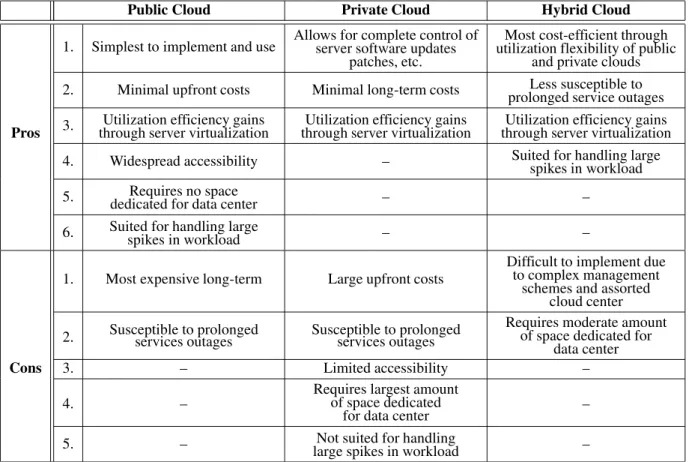
There are several different cloud pricing mod-els available, depending on the provider – the main three are tiered, per-unit, and subscription-based pricing. Amazon.com’s clouds offer tiered pricing that corresponds to varying levels of of-fered computational resources and service level agreements(SLAs). SLAs are part of a cloud-provider’s service contract and define specific levels of service that will be provided to its
customers. Many cloud-providers utilize per-unit pricing for data transfers(as mentioned in the preceding paragraph’s example of AWS Im-port/Export)and storage space. GoGrid Cloud Hosting, however, measures their server compu-tational resources used in random access mem-ory (RAM)per hour [24]. Subscription-based pricing models are typically used for SaaS. Rather than charge users for what they actually use, cloud-providers allow customers to know in advance what they will be charged so they can accurately predict future expenses.
Because transitioning between clouds is diffi-cult and costly, end-users are somewhat locked in to whichever cloud-provider they choose. This presents reliability issues associated with the chosen cloud. Although rare and only for a matter of hours in most cases, some cloud ac-cess failures have already occurred with Google and Amazon.com’s services. One such outage occurred with the Amazon EC2 as a result of a power failure at both its Virginia data center and its back-up data center in December 2009.
Public Cloud Private Cloud Hybrid Cloud
1. Simplest to implement and use Allows for complete control ofserver software updates patches, etc.
Most cost-efficient through utilization flexibility of public
and private clouds 2. Minimal upfront costs Minimal long-term costs prolonged service outagesLess susceptible to
Pros 3. through server virtualizationUtilization efficiency gains through server virtualizationUtilization efficiency gains through server virtualizationUtilization efficiency gains 4. Widespread accessibility – Suited for handling largespikes in workload
5. dedicated for data centerRequires no space – –
6. Suited for handling largespikes in workload – –
1. Most expensive long-term Large upfront costs Difficult to implement dueto complex management schemes and assorted
cloud center
2. Susceptible to prolongedservices outages Susceptible to prolongedservices outages Requires moderate amountof space dedicated for data center
Cons 3. – Limited accessibility –
4. – Requires largest amountof space dedicated
for data center –
5. – large spikes in workloadNot suited for handling –
This outage caused many east coast Amazon AWS users to be without service for approxi-mately five hours. While these access issues are inevitable with any data center (including those on-site), lack of access to a business’s cloud could occur at very inopportune instances resulting in a business’s computing capability being effectively shut down for the duration of the service outage. This issue has the poten-tial to nullify the hassle-free benefit that many cloud-providers tout as a selling point for utiliz-ing cloud compututiliz-ing.
2.6. Summary of Cloud Computing Architecture
A common misconception among many of those who would consider themselves “tech-savvy” technology users is that cloud computing is a fancy word for grid computing; grid computing is a form of parallel computing where a group of networked computers form a single, large vir-tual supercomputer that can perform obscenely large amounts of computational operations that would take normal computers many years to complete. Although cloud computing is in some ways a descendant of grid computing, it is by no means an alternative title. Instead, cloud com-puting offers software, storage, and/or com-puting power as a service to its users, whether they be individuals or employees of a company. Due to its efficient utilization of computing re-sources and its ability to scale with workload demand, cloud computing is an enticing new technology to businesses of all sizes. However, the decision each business faces is not quite as clear-cut as whether cloud computing could prove beneficial to it. Instead, each business must make a decision as to what type of cloud it will utilize: public, private, or hybrid. Each cloud type has its own set of positives and neg-atives. These benefits and drawbacks are listed in Table 2. For example, the public cloud has the minimum upfront cost due to the fact that users do not need to invest in the infrastructure. However, it has the maximum long term cost since users have to pay for the lease in long term, while the user in the private cloud need to pay less in long term due to the ownership of the cloud.
In recent years, more and more companies have begun to adopt cloud computing as a way to
cut costs without sacrificing their productivity. These cost savings stem from little or no up-keep required by their in-house IT departments as well as their ability to forego the huge capital expenditures associated with purchasing servers for their local data center. Even for those com-panies that adopt hybrid clouds which require some local servers, the number of these is dra-matically reduced due to over provisioning of the data center no longer being necessary. In addition to cost savings, cloud computing al-lows companies to remain agile and more dy-namically responsive to changes in forecasted business. If a company needs to quickly scale up or down the computing power of their net-work infrastructure, they can simply pay for more on-demand computing resources available from cloud-providers. This same level of scala-bility is simply not achievable with a local data center only. As cloud computing technology continues to mature, an increasing number of businesses are going to be willing to adopt it. For this reason, cloud computing is much more than just the latest technological buzzword on the scene – it’s here to stay.
3. Cloud Computing Security
3.1. Why Security in Cloud Computing?
By using offloading data and cloud computing, a lot of companies can greatly reduce their IT cost. However, despite tons of merits of cloud computing, many companies owners began to worry about the security treats. Because in the cloud-based computing environment, the em-ployees can easily access, falsify and divulge the data. Sometime such behavior is a disaster for a big and famous company.
Some service providers develop some technical method aimed to avoid the security treats from the interior. For instance, some providers limit the authority to access and manage the hard-ware, monitor the procedures, and minimize the number of staff who has privilege to access the vital parts of the infrastructure. However, at the provider backend, the administrator can also ac-cess the customer’s VM-machine.
Security within cloud computing is an espe-cially worrisome issue because of the fact that the devices used to provide services do not be-long to the users themselves. The users have no control of, nor any knowledge of, what could happen to their data. This is a great concern in cases when users have valuable and personal in-formation stored in a cloud computing service. Personal information could be “leaked” out, leaving an individual user or business vulnera-ble for attack. Users will not compromise their privacy so cloud computing service providers must ensure that the customers’ information is safe. This, however, is becoming increasingly challenging because as security developments are made, there always seems to be someone to figure out a way to disable the security and take advantage of user information. Aware of these security concerns, cloud computing ser-vice providers could possibly face extinction if problems which are hindering fail-proof secu-rity are not resolved.
Designing and creating error-proof and fail-proof security for cloud computing services falls on the shoulders of engineers. These engineers face many challenges. The services must elim-inate risk of information theft while meeting government specifications. Some governments have laws limiting where personal information can be stored and sent. If too much security de-tail is relayed to the users, then they may become concerned and decide against cloud computing altogether. If too little security detail is relayed to the users, then the customers will certainly find business elsewhere. If a cloud comput-ing service provider’s security is breached and valuable user information is gathered and used against them, then the user could, and likely would, sue the provider and the company could lose everything. Given these scenarios, engi-neers certainly have to be flawless in their secu-rity mechanism designs.
Engineers cannot fixate only on the present is-sues with cloud computing security but they must also prepare for the future. As cloud computing services become increasingly pop-ular, new technologies are destined to arise. For example, in the future, user information is likely going to be transferred among different service providers. This certainly increases the complexity of the security mechanism because the information must be tracked and protected wherever it may go. As businesses begin to rely upon cloud computing, the speed of services will need to be as high as possible. However, the speed of services cannot come about at the cost of lowered security, after all security is the top concern among cloud computing users. Another aspect of future cloud computing that engineers must be aware of is the increasing population of cloud computing users. As cloud computing services become more popular, the cloud will have to accommodate more users. This raises even more concern about informa-tion security and also increases the complexity of cloud computing security mechanisms. Se-curity designers must track every bit of data and also protect information from other users as well as provide a fast and efficient service.
Risk of information theft is different for ev-ery cloud computing service and thus should be addressed differently when designing security schemes. For example, services which process and store public information that could also be found in say, a newspaper, would need a very low amount of security. On the other hand, ser-vices which process personalized data about an individual or a business must be kept confiden-tial and secure. This type of data is most often at risk when there is unauthorized access to the service account, lost copies of data throughout the cloud, or security faults. Because of these concerns, a security scheme in which all data have a “tracking device” that is limited to cer-tain locations could be implemented. However, care must be taken to also ensure that the data is not transferred or processed in any way without the consent and knowledge of the user.
will certainly provide a better service to cus-tomers. The amount of valuable personal in-formation that is given to a provider should be kept to a minimum. For example, if the ser-vice being provided does not require a telephone number, then the user should not have to offer that information to the provider. Where pos-sible, personal information could be encrypted or somehow kept anonymous. Also, mecha-nisms which destroy personal data after use and mechanisms which prevent data copying could be implemented. The amount of control that a user has over their information should be in-creased to a maximum. For example, if a service requires that some personal information be sent out through the cloud and processed, then the user should be able to control where and how that information is sent. The user should also be able to view their data and decide whether or not certain information can be sent out through the cloud. Before any data processing or storing is done, the user should be asked for consent to carry out the operation. Maximizing customer control and influence will earn user trust and establish a wider consumer base.
Some organizations have been focusing on secu-rity issues in the cloud computing. The Cloud Security Alliance is a non-profit organization formed to promote the use of best practices for providing security assurance within Cloud Computing, and provide education on the uses of Cloud Computing to help secure all other forms of computing [37]. The Open Security Architecture(OSA)is another organizations fo-cusing on security issues. They propose the OSA pattern [38], which pattern is an attempt to illustrate core cloud functions, the key roles for oversight and risk mitigation, collaboration across various internal organizations, and the controls that require additional emphasis. For example, the Certification, Accreditation, and Security Assessments series increase in impor-tance to ensure oversight and assurance given that the operations are being “outsourced” to another provider. System and Services Acqui-sition is crucial to ensure that acquiAcqui-sition of ser-vices is managed correctly. Contingency plan-ning helps to ensure a clear understanding of how to respond in the event of interruptions to service delivery. The Risk Assessment controls are important to understand the risks associated with services in a business context.
Regarding practical cloud computing products, Microsoft Azure cloud computing plans to of-fer a new security structure for its multi-tenant cloud environments as well as private cloud software. Google has a multi-layered security process protocol to secure cloud data. Such a process has been independently verified in a successful third-party SAS 70 Type II audit. Google is also able to efficiently manage se-curity updates across our nearly homogeneous global cloud computing infrastructure. Intel uses SOA Expressway Cloud Gateway to en-able cloud security. Intel’s Cloud Gateway acts as a secure broker that provides security cloud connectors to other companies’ cloud products.
3.2. Encryption-on-Demand [26]
The basic idea for encryption-on-demand is that they try to use the encryption-on-demand server which can provide some kind of encryption ser-vice. For example, when the server gets a request from user, the website or server will make a unique encryption program, the so-called ‘client’ program, send a package includ-ing such program to the client. However, how to identify a client program or how to assign a client program to a client? They use a tailoring identification (TID) The user can forward the TID to the server, the server will use TID to send them the so-tailor made copy. So how do the users or communication partners compro-mise the TID? So far, there are many different ways to do that, by using cell phone, text mes-sage, or other communication tools. By using some reference information, such as birth city, birth day, or some other personal information all of which can only be known by the communi-cation partners. As long as the two partners can receive the client package including the client program, they can encrypt their messages or email easily. After communication, both users should dump the client program they used. So, every time when they want to communicate with each other privately, they need to download the package.
Figure 6.The client sending the UID to the server[26].
encrypt the message and communicate with the partner.
3.3. Security for the Cloud Infrastructure: Trusted Virtual Data Center
Implementation [27, 28]
For managing the hardware or resources in the same physical system, the VMM (virtual ma-chine monitor)can create multiple VMs(virtual machines). For the server, this infrastructure provides a very convenient way to create, mi-grate, and delete the VMs. The cloud comput-ing concept can easily achieve the big scale and cheap services. However, using one physical machine to execute all the workloads of all the users, it will make some serious security issues. Because this infrastructure needs many likeli-hood components, it will easily lead to the mis-configuration problems. The so-called trusted virtual data center has different VMs and as-sociated hardware resources. In this way, the VM will know which resource it can access. TVDc can separate each customer workloads to different associated virtual machines. The advantages are very obvious, 1) make sure no workload can leak to other customers, 2)in case of some malicious programs like viruses, they cannot be spread to other nodes, 3)prevent the misconfiguration problems.
TVDc uses the so-called isolation policy, so it can separate both the hardware resource and users’ workload or data. The isolation policy can manage the data center, access the VMs,
and switch from one VM to another VM. TVDc consists of a bunch of VMs and the associ-ated resources which can be used for one user’s program. In TVD, the VMs have some labels which can be identified uniquely. For example, one label is corresponded with one customer or the customer’s data. TVDc isolation policy in-cludes two major tasks: (1) label that can be used to indentify the VMs which are assigned to the customers, (2)allow all the VMs to run on the same TVD. Based on the security label, the control management can assign the author-ity to the users for the accessibilauthor-ity. Figure 7 illustrates such a principle.
There are three basic components in the net-work (Figure 8), such as Client: the laptop, desktop or PDA which can be seen as the data resource. These data need to be processed by the cloud servers. Cloud storage server(CSS)
has a huge space to store the data. Third party auditor (TPA) can be responded with the data verification. In Figure 8, the client can deliver the data to the cloud server, the admin will pro-cess the data before storage. Since all these data aren’t processed in the local computer, the cus-tomer needs to verify whether or not the data is correct. Without monitoring the data, the user needs a delegate like the TPA to monitor the data.
Figure 7.Enabling public verifiability and data dynamics for storage security[27].
Figure 8.The architecture of cloud data storage[27].
the adversary can play a role of a monitor or TPA. In this way, the adversary can easily cheat the user during the verifying of the data’s cor-rectness. Generally, the adversary can use some methods to generate the valid acknowledgments and deliver the verification. Both the server and user can hardly detect such attack.
3.4. Towards Trusted Cloud Computing [28]
Figure 9.The simple architecture of Eucalyptus[28].
A traditional trusted computing architecture can provide some-degree security for the customers. Such system can forbid the owner of a host to interfere all the computation. The customer can
also run the remote testing program which can let the customer know if the procedure of the host is secure or not. If the users or customers detect any kind of abnormal behavior from the host, they can immediately terminate their VM-machines. Unfortunately, such apparent perfect platforms also have some fatal flaws. For exam-ple, as we know, the service providers always provide a list of available machines to the cus-tomers. Afterwards, the customer will be au-tomatically assigned a machine. However such dynamical assigned machine from the provider backend can incur some kinds of security threat which cannot be solved by such system.
Many cloud providers allow customers to access virtual machines which were hosted by service providers. So user or customer can be seen as the data source for the software running in the VM in the lower layer. In contrast, in the higher layer, the server side can provide all the appli-cation on-demand.
we just focus on the lower layer in the customer side, because it is managed more easily.
In Eucalyptus(Figure 9), this system can man-age multiple clusters in which every node can run a virtual machine monitor which can be used to host the user’s VM. CM is the cloud manager which responds to a set of nodes in one clus-ter. From the user side, Eucalyptus can provide a bunch of interfaces to use the VM which is assigned to the customer. Every VM needs a virtual machine image for launching it. Before launching a VM, VM needs to load VMI. For CM, it can provide some kind of services which can be used to add or remove VMI or users. The sys admin in the cloud has some kind of privilege and ability to use the backend perform various kind of attacks such as access to the memory of one user’s VM. As long as the sys admin has the root privileges at the machine, he or she can use some special software to do some malicious action. Xen can do the live migration, switching its physical host. Because Xen is run-ning at the backend of the provider, Xenaccess can enable the sys admin to run as a customer level process in order to directly access the data of a VM’s memory. In this way, the sys admin can do more serious attacks such as the cold boot attacks. Currently we don’t worry about such vulnerability because most of IaaS( infras-tructure as a Service)providers have some very strict limitation in order to prevent one single person to accumulate all the authorities. Such
policy can efficiently avoid the physical access attacks.
We assume the sys admins can log in any ma-chine by using the root authority. In order to access the customers’ machine, the sys admins can switch a VM which already runs a cus-tomer’s VM to one under his or her control. Thus, the TCCP limit the execution of VM in the IaaS perimeter and sys admin cannot access the memory of a host’s machine running a VM. The Trusted Computing(Figure 10)is based on a smart design which uses a so-called trusted platform module(TPM)chip which has a kind of endorsement private key (EK). Moreover, each TPM is bundled with each node in the Perimeter. The service providers can use public key to ensure both the chip and the private key are correct.
At the boot time, the host’ machine will gener-ate a list of ML which include a bunch of hashes which is so-called the BIOS, further, both the boot loader and the software begin to run the platform. ML will be stored in the TPM of a host. In order to test the platform, the platform will ask the TPM in the host machine to make a message including the ML, a random num-ber K, and the private EK. Moreover, the sender will send this message to the remote part. In the remote part, by using the public key, it can easily decrypt the message and authenticate the
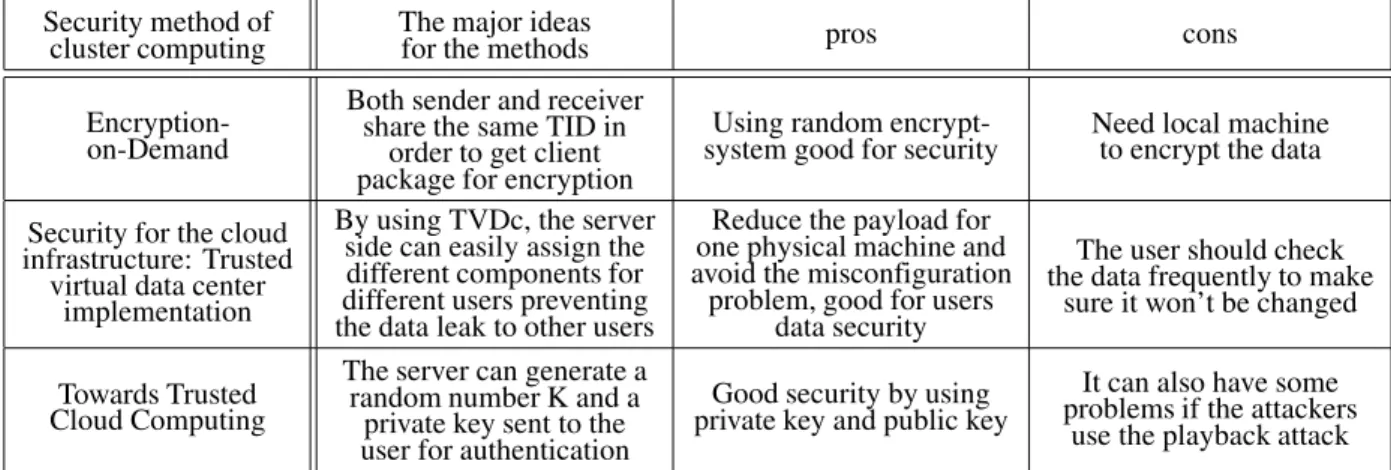
correspond host. Here, we use a table to rep-resent the major ideas and differences for the above 3 security methods.
Table 3 compares the above three security sche-mes.
3.5. Privacy Model [29]
Privacy is a fundamental human right; secu-rity schemes in cloud computing services must meet many government regulations and abide by many laws[29]. These laws and regulations are primarily aimed toward protecting information which can be used to identify a person (such as a bank account number or social security number). Of course, these stipulations make cloud computing security even more difficult to implement. Many security schemes have been proposed, but the factor of accountability must be included in all systems, regardless of specific components.
Reasonable solutions to cloud computing secu-rity issues involve several elements. First, users must constantly be informed of how and where their data is being sent. Likewise, it is just as important to inform users of how and where their incoming information is received. Second, service providers should give users contractual agreements that assure privacy protection. This type of accountability will provide a control mechanism which will allow users to gain trust of their providers. Third, service providers must accept a responsibility to their customers to es-tablish security and privacy standards. Having
standards will certainly help to provide some organization to all security schemes. Lastly, service providers should work with their cus-tomers to achieve some feedback in order to continuously update and improve their security schemes.
It is very obvious that cloud computing will greatly benefit consumers as well as internet providers. In order for cloud computing ap-plications to be successful however, customer security must be attained. Presently, the secu-rity of cloud computing users is far from certain. Cloud computing security must be greatly im-proved in order to earn the trust of more people who are potential cloud computing customers. One tempting solution, which has been focused on in the past, is to hide user identifiable infor-mation and provide means of anonymous data transfer between user and a cloud computing service. However, this solution is not the best way to provide cloud computing security be-cause users often need to communicate identifi-able information to the cloud computing service provider in order to receive the requested ser-vice. A concept will now be presented in the context of a group or business participating in a cloud computing service[29].
One suggestion for information privacy in cloud computing services is not to hide identifiable data tracks, but rather to encrypt user identi-fiable data tracks. This particular method is based on a vector space model which is used to represent group profiles as well as group mem-ber profiles. Suppose that a group, consisting
Security method of
cluster computing The major ideasfor the methods pros cons
Encryption-on-Demand
Both sender and receiver share the same TID in
order to get client package for encryption
Using random
encrypt-system good for security Need local machineto encrypt the data
Security for the cloud infrastructure: Trusted virtual data center
implementation
By using TVDc, the server side can easily assign the different components for different users preventing the data leak to other users
Reduce the payload for one physical machine and avoid the misconfiguration
problem, good for users data security
The user should check the data frequently to make
sure it won’t be changed
Towards Trusted Cloud Computing
The server can generate a random number K and a
private key sent to the user for authentication
Good security by using private key and public key
It can also have some problems if the attackers
use the playback attack
of several members, is participating in informa-tion exchange via a cloud computing service. When the members are logged on to the service, any information that each member transfers is continuously tracked. While all information is being tracked, false information is continuously generated. The actual information and gener-ated false information are randomly mixed to-gether. This information mixture disrupts the ability of any potential hacker to obtain user identifiable information. The false information generated is not completely random, but rather it is constructed to be similar to the actual infor-mation in order to further deceive any potential hacker. Furthermore, the generated false data is cleverly constructed such that is appears to have been generated by the users. This method also allows users to adjust the level of desired privacy. Of course, however, different levels of security have desirable and undesirable trade-offs(less privacy allows for faster data transfer, etc.).
The vector space model used for this privacy protection method is used to represent user pro-files. All information within the vector space model is represented as a vector of weighted terms, where the terms are weighted by level of importance. Suppose some data,d, is repre-sented as ann-dimensional vector
d = (w1,w2,w3, . . .wi, . . . ,wn)where wi rep-resents the weight of the ith term. There are many ways to calculate the weight of a term but often the term’s frequency and importance are the main factors. The vector space is updated with every website visit or any other informa-tion transfer based upon user preference. For the case above, with group participation, the vector space associated with the group profile is a weighted average of all member vectors. Any new data that could possibly be transferred to a user is analyzed in vector form and if the vector representing this data closely matches the vec-tor representing the user profile, then permis-sion for data transfer is granted. The similarity between some arbitrary data and a user profile, or between two profiles, can be realized by the following relation:
S(uj,uk) = n
i=1(
tuij·tuik)
n
i=1
tu2 ij·
n
i=1
tu2 ik
(4)
where uj and uk represent the vectors them-selves, tuij and tuik represent the ith terms in each vector, and n represents the number of terms contained within each vector.
Figure 11. Falsifield transaction generation process for privacy protection[29].
from user information exchange. Using these vectors, a parameter called the Internal Group Profile (IGP)is computed. The Internal Group Profile at any time, tU, is computed using the following relation:
IGP(tU) =
Pr−1
i=0
VtUU−i (5)
wherePrrepresents the number of previous vec-tors in the profile. A similar mechanism called the Faked Group Profile(FGP)is also employed in this privacy protection method. Like the In-ternal Group Profile, the Faked Group Profile is calculated using information provided by the Group Profile Meter. The Faked Group Profile at any time,tT, is calculated using the following relation:
FGP(tT) =
Pr×Tr−1
i=0
VtTT−i (6)
WherePrandTrhave previously been defined and VT
tT is a vector of weighted terms received
from the Group Profile Meter each time a fal-sified transaction is made by the Transaction Generator. The Group Profile Meter assembles a parameter called the External Group Profile each time a user or false data vector is received. The External Group Profile(EGP)at any time,
t, is simply calculated as follows:
EGP(t) =IGP(tU) +FGP(tT) (7)
whereEGP(t) is updated any time the Internal or External Group Profiles change. Addition-ally, the Group Profile Meter can compare the Internal and External Group Profiles by calcu-lating a similarity parameter. The similarity between IGP and FGP is calculated by using the following relation:
S(IGP,EGP) = n
i=1(
tigpi·tegpi)
n
i=1tigp 2 i ·
n
i=1tegp 2 i
(8)
wheretigpi is theithterm contained within the IGP vector,tegpiis theithterm contained within the EGP vector, and n is the number of terms contained within each vector. All of the pa-rameters described allow the non-anonymous privacy protection method to be continuously updated and improved in order to provide max-imum security for user identifiable information.
3.6. Intrusion Detection Strategy [30]
![Figure 1. Cloud computing [5].](https://thumb-us.123doks.com/thumbv2/123dok_us/8041192.2129216/2.892.196.695.866.1092/figure-cloud-computing.webp)
![Figure 2. The five abstraction layers of cloud computing [5].](https://thumb-us.123doks.com/thumbv2/123dok_us/8041192.2129216/3.892.118.413.892.1097/figure-abstraction-layers-cloud-computing.webp)
![Figure 4. The IWF hybrid cloud management system [17].](https://thumb-us.123doks.com/thumbv2/123dok_us/8041192.2129216/8.892.184.704.738.1116/figure-iwf-hybrid-cloud-management.webp)
![Table 1. Cost comparsion of three different cloud computing configurations [17].](https://thumb-us.123doks.com/thumbv2/123dok_us/8041192.2129216/10.892.466.795.491.630/table-cost-comparsion-different-cloud-computing-configurations.webp)
![Figure 6. The client sending the UID to the server [26].](https://thumb-us.123doks.com/thumbv2/123dok_us/8041192.2129216/17.892.170.724.126.413/figure-client-sending-uid-server.webp)
![Figure 7. Enabling public verifiability and data dynamics for storage security [27].](https://thumb-us.123doks.com/thumbv2/123dok_us/8041192.2129216/18.892.201.695.136.306/figure-enabling-public-verifiability-data-dynamics-storage-security.webp)
![Figure 10. The trusted cloud computing platform TC (trusted coordinator) [28].](https://thumb-us.123doks.com/thumbv2/123dok_us/8041192.2129216/19.892.176.719.792.1109/figure-trusted-cloud-computing-platform-tc-trusted-coordinator.webp)