Guiding Deep Molecular Optimization
with Genetic Exploration
Sungsoo Ahn Junsu Kim Hankook Lee Jinwoo Shin
Korea Advanced Institute of Science and Technology (KAIST)
{sungsoo.ahn, junsu.kim, hankook.lee, jinwoos}@kaist.ac.kr
Abstract
De novo molecular design attempts to search over the chemical space for molecules with the desired property. Recently, deep learning has gained considerable attention as a promising approach to solve the problem. In this paper, we propose genetic expert-guided learning (GEGL), a simple yet novel framework for training a deep neural network (DNN) to generate highly-rewarding molecules. Our main idea is to design a “genetic expert improvement” procedure, which generates high-quality targets for imitation learning of the DNN. Extensive experiments show that GEGL significantly improves over state-of-the-art methods. For example, GEGL manages to solve the penalized octanol-water partition coefficient optimization with a score of31.40, while the best-known score in the literature is27.22. Besides, for the GuacaMol benchmark with 20 tasks, our method achieves the highest score for 19 tasks, in comparison with state-of-the-art methods, and newly obtains the perfect score for three tasks. Our training code is available athttps://github.com/ sungsoo-ahn/genetic-expert-guided-learning.
1
Introduction
Discovering new molecules with the desired property is fundamental in chemistry, with critical applications such as drug discovery [1] and material design [2]. The task is challenging since the molecular space is vast; e.g., the number of synthesizable drug-like compounds is estimated to be around1060[3]. To tackle this problem,de novo molecular design[4,5] aims to generate a new
molecule from scratch with the desired property, rather than naïvely enumerate over the molecular space.
Over the past few years, molecule-generating deep neural networks (DNNs) have demonstrated successful results for solving the de novo molecular design problem [6,7,8,9,10,11,12,13,14,15,
16,17,18,19,20,21,22]. For example, Gómez-Bombarelli et al. [8] perform Bayesian optimization for maximizing the desired property, on the embedding space of molecule-generating variational auto-encoders. On the other hand, Guimaraes et al. [6] train a molecule-generating policy using reinforcement learning with the desired property formulated as a reward.
Intriguingly, several works [23,24,25,26] have recently evidenced that the traditional frameworks based on genetic algorithm (GA) can compete with or even outperform the recently proposed deep learning methods. They reveal that GA is effective, thanks to the powerful domain-specific genetic operators for exploring the chemical space. For example, Jensen [24] achieves outstanding performance by generating new molecules as a combination of subgraphs extracted from existing ones. Such observations also emphasize how domain knowledge can play a significant role in de novo molecular design. On the contrary, the current DNN-based methods do not exploit such domain knowledge explicitly; instead, they implicitly generalize the knowledge of high-rewarding molecules by training a DNN on them. Notably, the expressive power of DNN allows itself to parameterize a distribution over the whole molecular space flexibly.
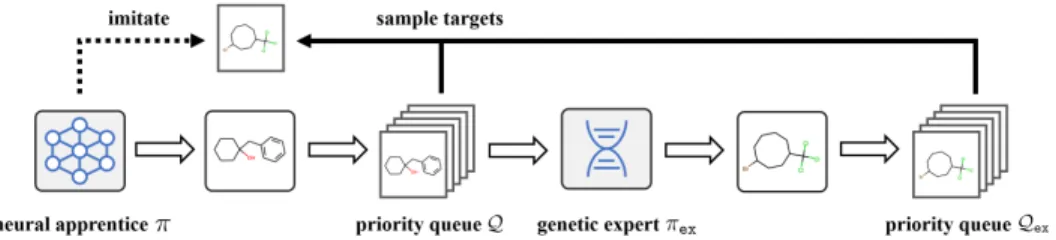
Figure 1: Illustration of the proposed genetic expert-guided learning (GEGL) framework.
Contribution.In this work, we propose genetic expert-guided learning (GEGL), which is a novel framework for training a molecule-generating DNN guided with genetic exploration. Our main idea is to formulate anexpert policyby applying the domain-specific genetic operators, i.e., mutation and crossover,1to the DNN-generated molecules. Then the DNN becomes anapprentice policythat learns to imitate the highly-rewarding molecules discovered by the expert policy. Since the expert policy improves over the apprentice policy by design, the former policy consistently guides the latter policy to generate highly-rewarding molecules. We provide an overall illustration of our framework in Figure1.
We note that our GEGL framework can be seen as a reinforcement learning algorithm with a novel mechanism for additional explorations. To be specific, the generation of a molecule can be regarded as an action and the desired property of the generated molecule as a reward. Similar to most reinforcement learning algorithms, reducing the sample complexity is crucial in our GEGL framework. To this end, we design our framework withmax-reward priority queues[13,27,28,29,30]. By storing the highly-rewarding molecules, the priority queues prevent the policies from “forgetting” the valuable knowledge.
We extensively evaluate our method on four experiments: (a) optimization of penalized octanol-water partition coefficient, (b) optimization of penalized octanol-water partition coefficient under similarity constraints, (c) the GuacaMol benchmark [31] consisting of 20 de novo molecular design tasks, and (d) the GuacaMol benchmark evaluated under post-hoc filtering procedure [32]. Remarkably, our GEGL framework outperforms all prior methods for de novo molecular design by a large margin. In particular, GEGL achieves the penalized octanol-water partition coefficient score of31.40, while the best baseline [22] and the second-best baseline [17] achieves the score of27.22and26.1, respectively. For the GuacaMol benchmark, our algorithm achieves the highest score for 19 out of 20 tasks and newly achieves the perfect score for three tasks.
2
Related works
Automating the discovery of new molecules is likely to have significant impacts on essential ap-plications such as drug discovery [1] and material design [2]. To achieve this, researchers have traditionally relied onvirtual screening[33], which typically works in two steps: (a) enumerating all the possible combinations of predefined building-block molecules and (b) reporting the molecules with the desired property. However, the molecular space is large, and it is computationally prohibitive to enumerate and score the desired property for all the possible molecules.
De novo molecular design[4] methods attempt to circumvent this issue by generating a molecule from scratch. Instead of enumerating a large set of molecules, these methods search over the molecular space to maximize the desired property. In the following, we discuss the existing methods for de novo molecular design categorized by their optimization schemes: deep reinforcement learning, deep embedding optimization, and genetic algorithm.
Deep reinforcement learning (DRL).Deep reinforcement learning is arguably the most straight-forward approach for solving the de novo molecular design problem with deep neural networks (DNNs) [6,9,13,16,18,19,22]. Such methods formulate the generation of the molecules as a Markov decision process. In such formulations, the desired properties of molecules correspond to high rewards, and the policy learns to generate highly-rewarding molecules. We also note several works using deep reinforcement learning to solve combinatorial problems similar to the task of de
1
novo molecular design, e.g., program synthesis [28], combinatorial mathematics [34], biological sequence design [35], and protein structure design [36].
Deep embedding optimization (DEO).Also, there exist approaches to optimize molecular “embed-dings” extracted from DNNs [7,8,10,11,12,15,17,20]. Such methods are based on training a neural network to learn a mapping between a continuous embedding space and a discrete molecular space. Then they apply optimization over the continuous embedding to maximize the desired property of the corresponding molecule. Methods such as gradient descent [10,15], Bayesian optimization [7,8,11,12], constrained Bayesian optimization [20], and particle swarm optimization [17] have been applied for continuous optimization of the embedding space.
Genetic algorithm (GA).Inspired from the concept of natural selection, genetic algorithms (GAs) [23,24,26,37,38,39,40,41] search over the molecular space with genetic operators, i.e., mutation and crossover. To this end, the mutation randomly modifies an existing molecule, and the crossover randomly combines a pair of molecules. Such approaches are appealing since they are simple and capable of incorporating the domain knowledge provided by human experts. While the deep learning methods are gaining attention for de novo molecular design, several works [23,24,26] have recently demonstrated that GA can compete with or even outperform the DNN-based methods.
3
Genetic expert-guided learning (GEGL)
3.1 Overview of GEGLIn this section, we introduce genetic expert-guided learning (GEGL), a novel yet simple framework for de novo molecular design. To discover highly-rewarding molecules, GEGL aims at training a molecule-generating deep neural network (DNN). Especially, we design the framework using an additional geneticexpert policy, which generates targets for imitation learning of the neuralapprentice policy, i.e., the DNN. Our main idea is about formulating the expert policy as a “genetic improvement operator” applied to the apprentice policy; this allows us to steer the apprentice policy towards generating highly-rewarding molecules by imitating the better expert policy.
To apply our framework, we view de novo molecular design as a combinatorial optimization of discovering a moleculex, which maximizes therewardr(x), i.e., the desired property.2 To solve this problem, we collect highly-rewarding molecules from the neural apprentice policyπ(x;θ)and the genetic expert policyπex(x;X)throughout the learning process. Here,θindicates the DNN’s parameter representing the apprentice policy, andXindicates a set of “seed” molecules to apply the genetic operators for the expert policy. Finally, we introduce fixed-sizemax-reward priority queues QandQex, which are buffers that only keep a fixed number of molecules with the highest rewards.
Our GEGL framework repeats the following three-step procedure:
Step A. The apprentice policyπ(x;θ)generates a set of molecules. Then the max-reward priority queueQwith the size ofKstores the generated molecules.
Step B. The expert policyπex(x;Q)generates molecules using the updated priority queueQas the seed molecules. Next, the priority queueQexwith a size ofKstores the generated
molecules.
Step C. The apprentice policy optimizes its parameterθby learning to imitate the molecules sampled from the union of the priority queuesQ ∪ Qex. In other words, the parameterθis
updated to maximizeP
x∈Q∪Qexlogπ(x;θ).
One may interpret GEGL as a deep reinforcement learning algorithm. From such a perspective, the corresponding Markov decision process has a fixed episode-length of one, and its action corresponds to the generation of a molecule. Furthermore, GEGL highly resembles the prior works on expert iteration [42,43] and AlphaGo Zero [44], where the Monte Carlo tree search is used as an improvement operator that guides training through enhanced exploration. We provide an illustration and a detailed description of our algorithm in Figure1and Algorithm1, respectively.
2
Algorithm 1Genetic expert-guided learning (GEGL)
1: SetQ ← ∅,Qex← ∅. .Initialize the max-reward priority queuesQandQex. 2: fort= 1, . . . , Tdo
3: form= 1, . . . , Mdo .Step A: addM samples generated byπintoQ. 4: UpdateQ ← Q ∪ {x}, wherex∼π(x;θ).
5: If|Q|> K, updateQ ← Q \ {xmin}, wherexmin= arg minx∈Qr(x). 6: end for
7: form= 1, . . . , Mdo .Step B: addMsamples generated byπexintoQex. 8: UpdateQex← Qex∪ {x}, wherex∼πex(x;Q).
9: If|Qex|> K, updateQex← Qex\ {xmin},wherexmin= arg minx∈Qexr(x).
10: end for
11: MaximizeP
x∈Q∪Qexlogπ(x;θ)overθ. .Step C: trainπwith imitation learning.
12: end for
13: ReportQ ∪ Qexas the output. .Output the highly-rewarding molecules. 3.2 Detailed components of GEGL
In the rest of this section, we provide a detailed description of each component in GEGL. We start by explaining our design choices on the expert and the apprentice policies. Then we discuss how the max-reward priority queues play an essential role in our framework.
Genetic expert policy.Our genetic expert policyπex(x;X)is a distribution induced by applying the
genetic operators, i.e., mutation and crossover, to a set of moleculesX. We use the genetic operators highly optimized (with domain knowledge) for searching over the molecular space; hence the expert policy efficiently improves over the apprentice policy in terms of exploration.
An adequate choice of genetic operators is crucial for the expert policy. To this end, we choose the graph-based mutation and crossover proposed by Jensen [24], as they recently demonstrated outstanding performance for de novo molecular design. At a high-level, the genetic expert policy πex(x;X)generates a molecule in two steps. First, the expert policy generates achildmolecule by
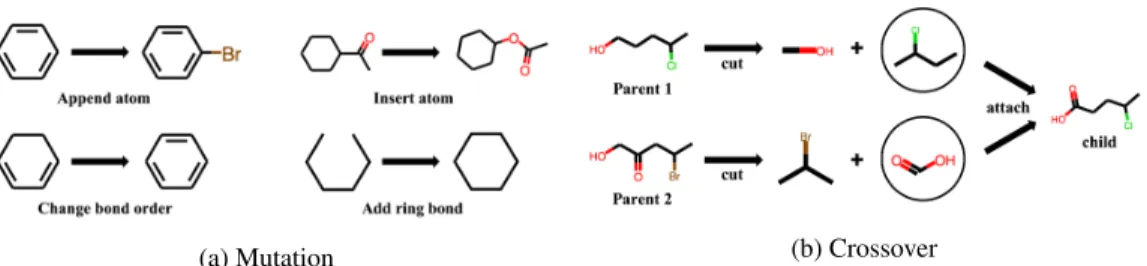
applying the crossover to a pair ofparentmolecules randomly drawn fromX. To be specific, two subgraphs extracted from the parents attach to form a child molecule. We use two types of operations for crossover: non_ring_crossoverandring_crossover. Next, with a small probability, the expert policy mutates the child by atom-wise or bond-wise modification, e.g., adding an atom. We use seven types of operations for mutation:atom_deletion,atom_addition,atom_insertion,
atom_type_change,bond_order_change,ring_bond_deletion, andring_bond_addition. We provide an illustration and a detailed description of the genetic operators in Figure2and Appendix
A, respectively.
We also note that other choices of the improvement operators are possible for the expert policy. Especially, Gao and Coley [32] demonstrated how naïvely applying the genetic operators may lead to proposing molecules that are unstable or unsynthesizable in real world. To consider this aspect, one may use exploration operators that considers the chemical validity of the molecules. For example, Polishchuk [26] proposed a genetic algorithm based on “chemically reasonable” mutations. In addition, Bradshaw et al. [15] proposed to generate molecules based on reaction models, which could also be used as an improvement operator in our framework.
Neural apprentice policy. We parameterize our neural apprentice policy using a long-short term memory (LSTM) network [45]. Moreover, the molecules are represented by a sequence of characters, i.e., the simplified molecular-input line-entry system (SMILES) [46] format. Under such a design, the probabilityπ(x;θ)of a moleculexbeing generated from the apprentice policy is factorized intoQN
n=1π(xn|x1, . . . , xn−1;θ). Here,x1, . . . , xN are the characters corresponding to canonical SMILES representation of the given molecule.
We note that our choice of using the LSTM network to generate SMILES representations of molecules might not seem evident. Especially, molecular graph representations alternatively express the molecule, and many works have proposed new molecule-generating graph neural networks (GNNs) [8,12,16,19,47,48]. However, no particular GNN architecture clearly dominates over others, and recent molecular generation benchmarks [31,49] report that the LSTM network matches (or improves
(a) Mutation (b) Crossover
Figure 2: Illustration of (a) mutation and (b) crossover used in the genetic expert policy.
Figure 3: Illustration of the apprentice policy generating a SMILES representation of a molecule. over) the performance of GNNs. Therefore, while searching for the best molecule-generating DNN architecture is a significant research direction, we leave it for future work. Instead, we choose the well-established LSTM architecture for the apprentice policy.
Max-reward priority queues.Role of the max-reward priority queuesQandQexin our framework
is twofold. First, the priority queues provide highly-rewarding molecules for the expert and the apprentice policy. Furthermore, they prevent the policies from “forgetting” the highly-rewarding molecules observed in prior. Recent works [13,27,28,29,30] have also shown similar concepts to be successful for learning in deterministic environments.
We further elaborate on our choice of training the apprentice policy on the union of the priority queuesQ ∪ Qexinstead of the priority queueQex. This choice comes from how the expert policy
does not always improve the apprentice policy in terms of reward, although it does in terms of exploration. Hence, it is beneficial for the apprentice policy to imitate the highly-rewarding molecules generated from both the apprentice and the expert policy. This promotes the apprentice to be trained on molecules with improved rewards.
4
Experiments
In this section, we report the experimental results of the proposed genetic expert-guided learning (GEGL) framework. To this end, we extensively compare GEGL with the existing works, for the optimization of the penalized octanol-water partition coefficient [50] and the GuacaMol benchmark [31]. We also provide additional experimental results in AppendixB; these results consist of relatively straightforward tasks such as targeted optimization of the octanol-water partition coefficient and optimization of the quantitative estimate of drug-likeness (QED) [51]. For comparison, we consider a variety of existing works on de novo molecular design based on deep reinforcement learning (DRL), deep embedding optimization (DEO), genetic algorithm (GA), and deep supervised learning (DSL).3 We report the numbers obtained by the existing works unless stated otherwise. All of the experiments were processed using single GPU (NVIDIA RTX 2080Ti) and eight instances from a virtual CPU system (Intel Xeon E5-2630 v4). We also provide descriptions the employed baselines in Appendix
C. A detailed illustration for the molecules generated by GEGL appears in AppendixD.
Implementation details. To implement GEGL, we use priority queue of fixed sizeK = 1024. At each step, we sample8192molecules from the apprentice and the expert policy to update the respective priority queues. Adam optimizer [52] with learning rate of0.001was used to optimize the neural network with a mini-batch of size256. Gradients were clipped by a norm of1.0. The apprentice policy is constructed using three-layered LSTM associated with hidden state of1024
dimensions and dropout probability of0.2. At each step of GEGL, the apprentice policy generates
3
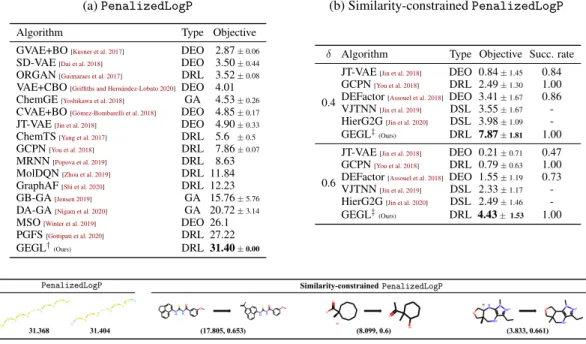
Table 1: Experimental results on the optimization of (a)PenalizedLogPand (b)PenalizedLogP
with similarity constraint ofδ. Types of the algorithms are indicated by deep reinforcement learning (DRL), deep embedding optimization (DEO), deep supervised learning (DSL), and genetic algorithm (GA).†‡We report the average and standard deviation of the objectives collected over five independent runs and 800 molecules for (a) and (b), respectively.
(a)PenalizedLogP
Algorithm Type Objective
GVAE+BO[Kusner et al. 2017] DEO 2.87±0.06
SD-VAE[Dai et al. 2018] DEO 3.50±0.44
ORGAN[Guimaraes et al. 2017] DRL 3.52±0.08
VAE+CBO[Griffiths and Hernández-Lobato 2020] DEO 4.01 ChemGE[Yoshikawa et al. 2018] GA 4.53±0.26
CVAE+BO[Gómez-Bombarelli et al. 2018] DEO 4.85±0.17
JT-VAE[Jin et al. 2018] DEO 4.90±0.33
ChemTS[Yang et al. 2017] DRL 5.6 ±0.5
GCPN[You et al. 2018] DRL 7.86±0.07
MRNN[Popova et al. 2019] DRL 8.63
MolDQN[Zhou et al. 2019] DRL 11.84
GraphAF[Shi et al. 2020] DRL 12.23
GB-GA[Jensen 2019] GA 15.76±5.76
DA-GA[Nigam et al. 2020] GA 20.72±3.14
MSO[Winter et al. 2019] DEO 26.1 PGFS[Gottipati et al. 2020] DRL 27.22 GEGL†
(Ours) DRL 31.40±0.00
(b) Similarity-constrainedPenalizedLogP
δ Algorithm Type Objective Succ. rate
0.4
JT-VAE[Jin et al. 2018] DEO 0.84±1.45 0.84
GCPN[You et al. 2018] DRL 2.49±1.30 1.00 DEFactor[Assouel et al. 2018] DEO 3.41±1.67 0.86 VJTNN[Jin et al. 2019] DSL 3.55±1.67 -HierG2G[Jin et al. 2020] DSL 3.98±1.09
-GEGL‡(Ours) DRL 7.87±1.81 1.00
0.6
JT-VAE[Jin et al. 2018] DEO 0.21±0.71 0.47
GCPN[You et al. 2018] DRL 0.79±0.63 1.00 DEFactor[Assouel et al. 2018] DEO 1.55±1.19 0.73 VJTNN[Jin et al. 2019] DSL 2.33±1.17
-HierG2G[Jin et al. 2020] DSL 2.49±1.46
-GEGL‡(Ours) DRL 4.43±1.53 1.00
Figure 4: Illustration of the highly-scoring molecule and (reference molecule, improved molecule) for the unconstrained and similarity-constrainedPenalizedLogPoptimization, respectively. Below each molecule, we denote the associated objective and (objective, similarity) for the unconstrained and similarity-constrainedPenalizedLogPoptimization, respectively.
8192molecules. Among the generated samples,invalidmolecules, e.g., molecules violating the valency rules, are filtered out from output of the apprentice policy. Next, the expert policy generates a molecule by selecting8192pair of molecules from the priority queue to apply crossover. For each valid molecules generated from crossover operation, mutation is applied with probability of0.01. Similar to the apprentice policy, invalid molecules are filtered out from output of the expert policy.
4.1 Optimization of penalized octanol-water partition coefficient
Comparing to the literature standard, we aim at maximizing thepenalized octanol-water partition coefficient(PenalizedLogP) score defined as follows:
PenalizedLogP(x) =LogP(x)−SyntheticAccessibility(x)−RingPenalty(x), where LogP, SyntheticAccessibility, and RingPenalty correspond to the (unpenalized) octanol-water partition coefficient [55], the synthetic accessibility [56] penalty, and the penalty for atom rings of size larger than 6. We also note that Kusner et al. [7] first performed this task motivated by how the octanol-water partition coefficient plays an important role in characterizing the drug-likeness of a molecule. Following prior works [12,9], we pretrain the apprentice policy on the ZINC dataset [57].
Unconstrained optimization.First, we attempt to find a molecule maximizing thePenalizedLogP
score as the objective without specific constraints. To this end, we run GEGL for200steps while limiting the generation to molecules with at most81SMILES characters (as done by Jensen [24], Nigam et al. [25], and Yang et al. [53]).
In Table1a, we observe that our algorithm indeed outperforms the existing baselines by a large margin. In particular, GEGL achieves a score of31.40, which relatively outperforms the second-best
(PGFS) and the third-best (MSO) baselines by15%and20%, respectively. This result highlights the strong performance of GEGL.
Constrained optimization.In this experiment, we follow the experimental setup proposed by Jin et al. [12]. Namely, for each moleculexreffrom 800 low-PenalizedLogP-scoring molecules from
the ZINC data set [57], we search for a new moleculexwith the maximumPenalizedLogPscore while being constrained to be similar to the reference moleculexref. To be specific, we express this
optimization as follows:
max
x PenalizedLogP(x)−PenalizedLogP(xref), s.t. Similarity(x,xref)≥δ,
whereSimilarity(·,·)is the Tanimoto similarity score [58]. In the experiments, we run GEGL for
50steps for each reference moleculexref. We initialize the apprentice’s priority queueQwith the
reference moleculexref, i.e.,Q ← {xref}. For this experiment, we constrain the maximum length of
SMILES to be100. We report the above objective averaged over the800molecules. We also evaluate the “success ratio” of the algorithms, i.e., the ratio of molecules with a positive objective.
In Table1b, we once again observe GEGL to achieve superior performance to the existing algorithms. We also note that our algorithm always succeeds in improving thePenalizedLogPscore of the reference molecule, i.e., the success ratio is1.00.
Generated molecules.We now report the molecules generated for unconstrained and constrained optimization ofPenalizedLogPscore in Figure4. Notably, for unconstrained optimization, we observe that our model produces “unrealistic” molecules that contain a long chain of sulfurs. This symptom arise from our method exploiting the ambiguity of thePenalizedLogPscore, i.e., the score spuriously assigning high values to the unrealistic molecules. Indeed, similar observations (on algorithms generating a long chain of sulfurs) have been made regardless of optimization methods for de novo molecular design. For example, Shi et al. [19], Winter et al. [17], and Nigam et al. [25] reported molecules with similar structure when using deep reinforcement learning, deep embedding optimization, and genetic algorithm, respectively. Such an observation emphasizes why one should carefully design the procedure of de novo molecular design.
4.2 GuacaMol benchmark
Next, we provide the empirical results for the GuacaMol benchmark [31], designed specifically to measure the performance of de novo molecular design algorithms. It consists of 20 chemically meaningful molecular design tasks, that have been carefully designed and studied by domain-experts in the past literature [41,47,59,60,61]. Notably, the GuacaMol benchmark scores a set of molecules rather than a single one, to evaluate the algorithms’ ability to produce diverse molecules. To this end, given a set of moleculesX ={xs}
|X |
s=1and a set of positive integersS, tasks in the GuacaMol
benchmark evaluate their score as follows:
GuacaMolScore(X) :=X S∈S S X s=1 r(xΠ(s)) S|S| , where r(xΠ(s))≥r(xΠ(s+1)) for s= 1, . . . ,|X |−1,
whereris the task-specific molecule-wise score andΠdenotes a permutation that sorts the set of moleculesX in descending order of their metrics. We further provide details on the benchmark in AppendixE.
For the experiments, we initialize the apprentice policy using the weights provided by Brown et al. [31],4that was pretrained on the ChEMBL [62] dataset. For each tasks, we run GEGL for200steps. We constrain the maximum length of SMILES to be100.
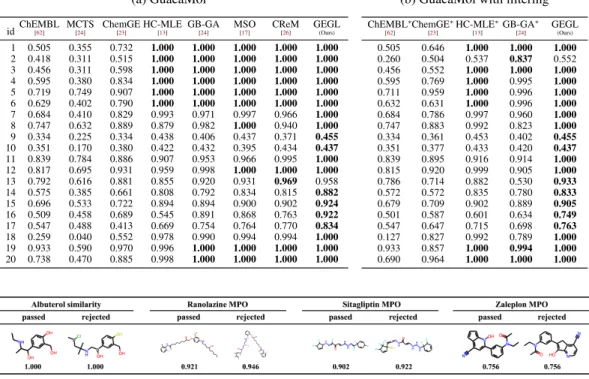
Benchmark results.In Table2, we observe that GEGL outperforms the existing baselines by a large margin. Namely, GEGL achieves the highest score for19out of20tasks. Furthermore, our algorithm perfectly solves thirteen tasks,5where three of them were not known to be perfectly solved. Such
a result demonstrates how our algorithm effectively produces a high-rewarding and diverse set of molecules.
Evaluation with post-hoc filtering.As observed in Section4.1and prior works, de novo molecular design algorithms may lead to problematic results. For example, the generated molecules may be
4
https://github.com/BenevolentAI/guacamol_baselines
5
Table 2: Experimental results for task-ids of1,2, . . . ,20from (a) the GuacaMol benchmark and (b) the GuacaMol benchmark evaluated with post-hoc filtering process. See AppendixEfor the description of each task per id.∗We re-evaluate the official implementation for baselines in (b).
(a) GuacaMol idChEMBL[62] MCTS [24] ChemGE [23] HC-MLE [13] GB-GA [24] MSO [17] CReM [26] GEGL (Ours) 1 0.505 0.355 0.732 1.000 1.000 1.000 1.000 1.000 2 0.418 0.311 0.515 1.000 1.000 1.000 1.000 1.000 3 0.456 0.311 0.598 1.000 1.000 1.000 1.000 1.000 4 0.595 0.380 0.834 1.000 1.000 1.000 1.000 1.000 5 0.719 0.749 0.907 1.000 1.000 1.000 1.000 1.000 6 0.629 0.402 0.790 1.000 1.000 1.000 1.000 1.000 7 0.684 0.410 0.829 0.993 0.971 0.997 0.966 1.000 8 0.747 0.632 0.889 0.879 0.982 1.000 0.940 1.000 9 0.334 0.225 0.334 0.438 0.406 0.437 0.371 0.455 10 0.351 0.170 0.380 0.422 0.432 0.395 0.434 0.437 11 0.839 0.784 0.886 0.907 0.953 0.966 0.995 1.000 12 0.817 0.695 0.931 0.959 0.998 1.000 1.000 1.000 13 0.792 0.616 0.881 0.855 0.920 0.931 0.969 0.958 14 0.575 0.385 0.661 0.808 0.792 0.834 0.815 0.882 15 0.696 0.533 0.722 0.894 0.894 0.900 0.902 0.924 16 0.509 0.458 0.689 0.545 0.891 0.868 0.763 0.922 17 0.547 0.488 0.413 0.669 0.754 0.764 0.770 0.834 18 0.259 0.040 0.552 0.978 0.990 0.994 0.994 1.000 19 0.933 0.590 0.970 0.996 1.000 1.000 1.000 1.000 20 0.738 0.470 0.885 0.998 1.000 1.000 1.000 1.000
(b) GuacaMol with filtering ChEMBL∗ [62] ChemGE∗ [23] HC-MLE∗ [13] GB-GA∗ [24] GEGL (Ours) 0.505 0.646 1.000 1.000 1.000 0.260 0.504 0.537 0.837 0.552 0.456 0.552 1.000 1.000 1.000 0.595 0.769 1.000 0.995 1.000 0.711 0.959 1.000 0.996 1.000 0.632 0.631 1.000 0.996 1.000 0.684 0.786 0.997 0.960 1.000 0.747 0.883 0.992 0.823 1.000 0.334 0.361 0.453 0.402 0.455 0.351 0.377 0.433 0.420 0.437 0.839 0.895 0.916 0.914 1.000 0.815 0.920 0.999 0.905 1.000 0.786 0.714 0.882 0.530 0.933 0.572 0.572 0.835 0.780 0.833 0.679 0.709 0.902 0.889 0.905 0.501 0.587 0.601 0.634 0.749 0.547 0.647 0.715 0.698 0.763 0.127 0.827 0.992 0.789 1.000 0.933 0.857 1.000 0.994 1.000 0.690 0.964 1.000 1.000 1.000
Figure 5: Illustration of the molecules generated for the GuacaMol benchmark, that have passed and rejected from the filtering procedure. Below each molecule, we also denote the associated objectives.
chemically reactive, hard to synthesize, or perceived to be “unrealistic” to domain experts. To consider this aspect, we evaluate our algorithm under the post-hoc filtering approach [32]. Specifically, we use the expert-designed filter to reject the molecules with undesirable feature. In other words, we train the models as in Table2, but only report the performance of generated molecules that pass the filter. Since the filtering procedure is post-hoc, the de novo molecular design algorithms will not be able to aggressively exploit possible ambiguities of the filtering process.
As shown in Table2b, GEGL still outperforms the baselines even when the undesirable molecules are filtered out. This validates the ability of our algorithm to generate chemically meaningful results. Hence, we conclude that our GEGL can be used flexibly with various choice of de novo molecular design process.
Generated molecules. In Figure5, we illustrate the high-scoring molecules generated by GEGL for the Albuterol similarity, Ranolazine MPO, Sitagliptin MPO, and Zaleplon MPO tasks from the GuacaMol benchmark (corresponding to task-ids of 4, 13, 15, 16 in Table2). Note that the filters used in Table2bprovide reasons for rejection of the molecules. For example, the high-scoring molecule from the Zaleplon MPO task was rejected due to containing a SMILES ofC=CO, i.e.,enol. This is undesirable, as many enols have been shown to be reactive [63]. See AppendixFfor further explanation of the molecules being passed and rejected from the post-hoc filtering process.
4.3 Ablation studies
Finally, we perform ablation studies on our algorithm to investigate the behavior of each component. To this end, we conduct experiments on the Sitagliptin MPO and Zaleplon MPO tasks from the GuacaMol benchmark. Note that Sitagliptin MPO and Zaleplon MPO tasks corresponds to task-ids of15and16in Table2, respectively.
Contribution from the DNN and the genetic operator. We start by inspecting the contribution of the DNN and the genetic operator in our algorithm. To this end, we compare GEGL with (a)
(a) Sitagliptin MPO (b) Zaleplon MPO (c) Sitagliptin MPO (d) Zaleplon MPO
Figure 6: Illustration of ablation studies for (a,b) investigating contribution from DNN and genetic operator, and (c,d) separate evaluation of max-reward priority queues.
GEGL without the expert policyπex, (b) GEGL without the apprentice policyπ, and (c) the genetic
algorithm using our improvement operators, i.e., GB-GA. To be specific, (a) trains the apprentice policy to imitate the highly-rewarding molecules generated by itself. On the other hand, (b) freezes the max-reward priority queueQby the highly-rewarding samples from the ChEMBL dataset [62], then only updatesQexbased on the expert policy. Finally, (c) is the same algorithm reported in Table
2, but using the hyper-parameter of our genetic expert. In Figure6aand6b, we observe that all the ablation algorithms perform worse than GEGL. This result confirms that the neural apprentice policy and the genetic expert policy bring mutual benefits to our framework.
Separate evaluation of the max-reward priority queues. Next, we describe behavior of the apprentice policy and the expert policy during training. To this end, we compare the GuacaMol scores for the priority queuesQandQexthat are normalized by the original GEGL score. For example,
we consider GuacaMolScoreGuacaMolScore(Q∪Q(Q)
ex)for evaluatingQwhereGuacaMolScore(·)is the GaucaMol score
evaluated on a set of molecules.
In Figure6cand6d, we observe that the samples collected from the genetic expert policy, i.e.,Qex,
indeed improves over that of the apprentice policy, i.e.,Qduring early stages of the training. However, as the training goes on, the apprentice policy learns to generate molecules with quality higher than that of the expert policy. Since Table6aand6bshows that apprentice policy cannot reach the same performance without the expert policy, one may conclude that the apprentice policy effectively learns to comprise the benefits of genetic operators through learning.
5
Conclusion
We propose a new framework based on deep neural networks (DNNs) to solve the de novo molecular design problem. Our main idea is to enhance the training of DNN with domain knowledge, using the powerful expert-designed genetic operators to guide the training of the DNN. Through extensive experiments, our algorithm demonstrates state-of-the-art performance across a variety of tasks. We believe extending our framework to combinatorial search problems where strong genetic operators exist, e.g., biological sequence design [64], program synthesis [65], and vehicle routing problems [66], would be both promising and interesting.
Broader Impact
De novo molecular design. Our framework is likely to advance the field of de novo molecular design. In this field, successful algorithms significantly impact real-world, since the discovery of a new molecule has been the key challenge of many applications. Domain of such applications includes, but are not limited to, drug molecules [67], organic light emitting diodes [68], organic solar cells [69], energetic materials [70], and electrochromic devices [71]. Improvements in these applications are beneficial to human kind in general, as they often improve the quality of human life and may broaden our knowledge of chemistry.
Combinatorial optimization with deep reinforcement learning.In a broader sense, our framework offers a new paradigm to search over a intractably large space of combinatorial objects with DNN. In particular, our algorithm is expected to perform well for domains where genetic algorithms are powerful; this includes domains of biological sequence design [64], program synthesis [65], and vehicle routing problems [66]. Hence, at a high-level, our work also shares the domain of applications impacted from such works.
Acknowledgments and Disclosure of Funding
We thank Yeonghun Kang, Seonyul Kim, Jaeho Lee, Sejun Park, and Sihyun You for providing helpful feedbacks and suggestions in preparing the early version of the manuscript. This work was supported by Samsung Advanced Institute of Technology (SAIT). This work was partly supported by Institute of Information & Communications Technology Planning & Evaluation (IITP) grant funded by the Korea government (MSIT) (No.2019-0-00075, Artificial Intelligence Graduate School Program (KAIST)).
References
[1] James P Hughes, Stephen Rees, S Barrett Kalindjian, and Karen L Philpott. Principles of early drug discovery.British journal of pharmacology, 162(6):1239–1249, 2011.
[2] Cenqi Yan, Stephen Barlow, Zhaohui Wang, He Yan, Alex K-Y Jen, Seth R Marder, and Xiaowei Zhan. Non-fullerene acceptors for organic solar cells. Nature Reviews Materials, 3(3):1–19, 2018.
[3] Regine S Bohacek, Colin McMartin, and Wayne C Guida. The art and practice of structure-based drug design: a molecular modeling perspective.Medicinal research reviews, 16(1):3–50, 1996. [4] Gisbert Schneider and Uli Fechner. Computer-based de novo design of drug-like molecules.
Nature Reviews Drug Discovery, 4(8):649–663, 2005.
[5] Gisbert Schneider. De novo molecular design. John Wiley & Sons, 2013.
[6] Gabriel Lima Guimaraes, Benjamin Sanchez-Lengeling, Carlos Outeiral, Pedro Luis Cunha Farias, and Alán Aspuru-Guzik. Objective-reinforced generative adversarial networks (organ) for sequence generation models. arXiv preprint arXiv:1705.10843, 2017.
[7] Matt J Kusner, Brooks Paige, and José Miguel Hernández-Lobato. Grammar variational autoen-coder. InInternational Conference on Machine Learning, pages 1945–1954, 2017.
[8] Rafael Gómez-Bombarelli, Jennifer N Wei, David Duvenaud, José Miguel Hernández-Lobato, Benjamín Sánchez-Lengeling, Dennis Sheberla, Jorge Aguilera-Iparraguirre, Timothy D Hirzel, Ryan P Adams, and Alán Aspuru-Guzik. Automatic chemical design using a data-driven continuous representation of molecules. ACS central science, 4(2):268–276, 2018.
[9] Jiaxuan You, Bowen Liu, Zhitao Ying, Vijay Pande, and Jure Leskovec. Graph convolutional policy network for goal-directed molecular graph generation. InAdvances in Neural Information Processing Systems, pages 6410–6421, 2018.
[10] Qi Liu, Miltiadis Allamanis, Marc Brockschmidt, and Alexander Gaunt. Constrained graph variational autoencoders for molecule design. InAdvances in Neural Information Processing Systems, pages 7795–7804, 2018.
[11] Hanjun Dai, Yingtao Tian, Bo Dai, Steven Skiena, and Le Song. Syntax-directed variational autoencoder for structured data. InInternational Conference on Learning Representations, 2018.
URLhttps://openreview.net/forum?id=SyqShMZRb.
[12] Wengong Jin, Regina Barzilay, and Tommi Jaakkola. Junction tree variational autoencoder for molecular graph generation. InInternational Conference on Machine Learning, pages 2323–2332, 2018.
[13] Daniel Neil, Marwin Segler, Laura Guasch, Mohamed Ahmed, Dean Plumbley, Matthew Sellwood, and Nathan Brown. Exploring deep recurrent models with reinforcement learning for molecule design, 2018. URLhttps://openreview.net/forum?id=HkcTe-bR-.
[14] Rim Assouel, Mohamed Ahmed, Marwin H Segler, Amir Saffari, and Yoshua Bengio. De-factor: Differentiable edge factorization-based probabilistic graph generation. arXiv preprint arXiv:1811.09766, 2018.
[15] John Bradshaw, Brooks Paige, Matt J Kusner, Marwin Segler, and José Miguel Hernández-Lobato. A model to search for synthesizable molecules. InAdvances in Neural Information Processing Systems, pages 7937–7949, 2019.
[16] Mariya Popova, Mykhailo Shvets, Junier Oliva, and Olexandr Isayev. Molecularrnn: Generating realistic molecular graphs with optimized properties. arXiv preprint arXiv:1905.13372, 2019. [17] Robin Winter, Floriane Montanari, Andreas Steffen, Hans Briem, Frank Noé, and Djork-Arné
Clevert. Efficient multi-objective molecular optimization in a continuous latent space.Chemical science, 10(34):8016–8024, 2019.
[18] Zhenpeng Zhou, Steven Kearnes, Li Li, Richard N Zare, and Patrick Riley. Optimization of molecules via deep reinforcement learning.Scientific reports, 9(1):1–10, 2019.
[19] Chence Shi, Minkai Xu, Zhaocheng Zhu, Weinan Zhang, Ming Zhang, and Jian Tang. Graphaf: a flow-based autoregressive model for molecular graph generation. InInternational Conference on Learning Representations, 2020. URLhttps://openreview.net/forum?id=S1esMkHYPr. [20] Ryan-Rhys Griffiths and José Miguel Hernández-Lobato. Constrained bayesian optimization
for automatic chemical design using variational autoencoders. Chemical Science, 2020. [21] Wengong Jin, Regina Barzilay, and Tommi Jaakkola. Hierarchical generation of molecular
graphs using structural motifs. InInternational Conference on Machine Learning, page to appear, 2020.
[22] Sai Krishna Gottipati, Boris Sattarov, Sufeng Niu, Yashaswi Pathak, Haoran Wei, Shengchao Liu, Karam MJ Thomas, Simon Blackburn, Connor W Coley, Jian Tang, et al. Learning to navigate the synthetically accessible chemical space using reinforcement learning.arXiv preprint arXiv:2004.12485, 2020.
[23] Naruki Yoshikawa, Kei Terayama, Masato Sumita, Teruki Homma, Kenta Oono, and Koji Tsuda. Population-based de novo molecule generation, using grammatical evolution.Chemistry Letters, 47(11):1431–1434, 2018.
[24] Jan H Jensen. A graph-based genetic algorithm and generative model/monte carlo tree search for the exploration of chemical space.Chemical science, 10(12):3567–3572, 2019.
[25] AkshatKumar Nigam, Pascal Friederich, Mario Krenn, and Alan Aspuru-Guzik. Augmenting genetic algorithms with deep neural networks for exploring the chemical space. InInternational Conference on Learning Representations, 2020. URLhttps://openreview.net/forum?id= H1lmyRNFvr.
[26] Pavel Polishchuk. Crem: chemically reasonable mutations framework for structure generation.
Journal of Cheminformatics, 12:1–18, 2020.
[27] Anvita Gupta and James Zou. Feedback gan for dna optimizes protein functions. Nature Machine Intelligence, 1(2):105–111, 2019.
[28] Chen Liang, Jonathan Berant, Quoc Le, Kenneth Forbus, and Ni Lao. Neural symbolic machines: Learning semantic parsers on freebase with weak supervision. InProceedings of the 55th Annual Meeting of the Association for Computational Linguistics (Volume 1: Long Papers), pages 23–33, 2017.
[29] Daniel A Abolafia, Mohammad Norouzi, Jonathan Shen, Rui Zhao, and Quoc V Le. Neural program synthesis with priority queue training. arXiv preprint arXiv:1801.03526, 2018. [30] Rishabh Agarwal, Chen Liang, Dale Schuurmans, and Mohammad Norouzi. Learning to
generalize from sparse and underspecified rewards. InInternational Conference on Machine Learning, pages 130–140, 2019.
[31] Nathan Brown, Marco Fiscato, Marwin HS Segler, and Alain C Vaucher. Guacamol: bench-marking models for de novo molecular design.Journal of chemical information and modeling, 59(3):1096–1108, 2019.
[32] Wenhao Gao and Connor W Coley. The synthesizability of molecules proposed by generative models.Journal of Chemical Information and Modeling, 2020.
[33] Brian K Shoichet. Virtual screening of chemical libraries.Nature, 432(7019):862–865, 2004. [34] Irwan Bello, Hieu Pham, Quoc V Le, Mohammad Norouzi, and Samy Bengio. Neural
combina-torial optimization with reinforcement learning.arXiv preprint arXiv:1611.09940, 2016. [35] Christof Angermueller, David Dohan, David Belanger, Ramya Deshpande, Kevin Murphy,
and Lucy Colwell. Model-based reinforcement learning for biological sequence design. In
International Conference on Learning Representations, 2020. URLhttps://openreview. net/forum?id=HklxbgBKvr.
[36] David Brookes, Hahnbeom Park, and Jennifer Listgarten. Conditioning by adaptive sampling for robust design. InInternational Conference on Machine Learning, pages 773–782, 2019. [37] David Weininger. Method and apparatus for designing molecules with desired properties by
evolving successive populations, July 18 1995. US Patent 5,434,796.
[38] Al Globus, John Lawton, and Todd Wipke. Automatic molecular design using evolutionary techniques.Nanotechnology, 10(3):290, 1999.
[39] Dominique Douguet, Etienne Thoreau, and Gérard Grassy. A genetic algorithm for the au-tomated generation of small organic molecules: Drug design using an evolutionary algorithm.
Journal of computer-aided molecular design, 14(5):449–466, 2000.
[40] Gisbert Schneider, Man-Ling Lee, Martin Stahl, and Petra Schneider. De novo design of molecular architectures by evolutionary assembly of drug-derived building blocks.Journal of computer-aided molecular design, 14(5):487–494, 2000.
[41] Nathan Brown, Ben McKay, François Gilardoni, and Johann Gasteiger. A graph-based genetic algorithm and its application to the multiobjective evolution of median molecules. Journal of chemical information and computer sciences, 44(3):1079–1087, 2004.
[42] Thomas Anthony, Zheng Tian, and David Barber. Thinking fast and slow with deep learning and tree search. InAdvances in Neural Information Processing Systems, pages 5360–5370, 2017. [43] Thomas Anthony, Robert Nishihara, Philipp Moritz, Tim Salimans, and John Schulman. Policy gradient search: Online planning and expert iteration without search trees. arXiv preprint arXiv:1904.03646, 2019.
[44] David Silver, Julian Schrittwieser, Karen Simonyan, Ioannis Antonoglou, Aja Huang, Arthur Guez, Thomas Hubert, Lucas Baker, Matthew Lai, Adrian Bolton, et al. Mastering the game of go without human knowledge. Nature, 550(7676):354–359, 2017.
[45] Sepp Hochreiter and Jürgen Schmidhuber. Long short-term memory.Neural computation, 9(8): 1735–1780, 1997.
[46] David Weininger. Smiles, a chemical language and information system. 1. introduction to methodology and encoding rules.Journal of chemical information and computer sciences, 28(1): 31–36, 1988.
[47] Marwin HS Segler, Thierry Kogej, Christian Tyrchan, and Mark P Waller. Generating focused molecule libraries for drug discovery with recurrent neural networks. ACS central science, 4(1): 120–131, 2018.
[48] Kaushalya Madhawa, Katushiko Ishiguro, Kosuke Nakago, and Motoki Abe. Graphnvp: An invertible flow model for generating molecular graphs. arXiv preprint arXiv:1905.11600, 2019. [49] Daniil Polykovskiy, Alexander Zhebrak, Benjamin Sanchez-Lengeling, Sergey Golovanov, Oktai Tatanov, Stanislav Belyaev, Rauf Kurbanov, Aleksey Artamonov, Vladimir Aladinskiy, Mark Veselov, et al. Molecular sets (moses): a benchmarking platform for molecular generation models.arXiv preprint arXiv:1811.12823, 2018.
[50] Rafael Gómez-Bombarelli, Jennifer N. Wei, David Duvenaud, José Miguel Hernández-Lobato, Benjamín Sánchez-Lengeling, Dennis Sheberla, Jorge Aguilera-Iparraguirre, Timothy D. Hirzel, Ryan P. Adams, and Alán Aspuru-Guzik. Automatic chemical design using a data-driven continuous representation of molecules, 2016.
[51] G Richard Bickerton, Gaia V Paolini, Jérémy Besnard, Sorel Muresan, and Andrew L Hopkins. Quantifying the chemical beauty of drugs. Nature chemistry, 4(2):90, 2012.
[52] Diederik P Kingma and Jimmy Ba. Adam: A method for stochastic optimization.arXiv preprint arXiv:1412.6980, 2014.
[53] Xiufeng Yang, Jinzhe Zhang, Kazuki Yoshizoe, Kei Terayama, and Koji Tsuda. Chemts: an efficient python library for de novo molecular generation. Science and technology of advanced materials, 18(1):972–976, 2017.
[54] Wengong Jin, Kevin Yang, Regina Barzilay, and Tommi Jaakkola. Learning multimodal graph-to-graph translation for molecule optimization. InInternational Conference on Learning Representations, 2019. URLhttps://openreview.net/forum?id=B1xJAsA5F7.
[55] Younggil Kwon. Handbook of essential pharmacokinetics, pharmacodynamics and drug metabolism for industrial scientists. Springer Science & Business Media, 2001.
[56] Peter Ertl and Ansgar Schuffenhauer. Estimation of synthetic accessibility score of drug-like molecules based on molecular complexity and fragment contributions.Journal of cheminformat-ics, 1(1):8, 2009.
[57] John J Irwin, Teague Sterling, Michael M Mysinger, Erin S Bolstad, and Ryan G Coleman. Zinc: a free tool to discover chemistry for biology. Journal of chemical information and modeling, 52 (7):1757–1768, 2012.
[58] Taffee T Tanimoto. Elementary mathematical theory of classification and prediction. 1958. [59] Andrea Zaliani, Krisztina Boda, Thomas Seidel, Achim Herwig, Christof H Schwab, Johann
Gasteiger, Holger Claußen, Christian Lemmen, Jörg Degen, Juri Pärn, et al. Second-generation de novo design: a view from a medicinal chemist perspective.Journal of computer-aided molecular design, 23(8):593–602, 2009.
[60] Peter Willett, John M Barnard, and Geoffrey M Downs. Chemical similarity searching. Journal of chemical information and computer sciences, 38(6):983–996, 1998.
[61] Johann Gasteiger and Thomas Engel.Chemoinformatics: a textbook. John Wiley & Sons, 2006. [62] Anna Gaulton, Louisa J Bellis, A Patricia Bento, Jon Chambers, Mark Davies, Anne Hersey, Yvonne Light, Shaun McGlinchey, David Michalovich, Bissan Al-Lazikani, et al. Chembl: a large-scale bioactivity database for drug discovery. Nucleic acids research, 40(D1):D1100– D1107, 2012.
[63] Isao Kuwajima and Eiichi Nakamura. Reactive enolates from enol silyl ethers. Accounts of Chemical Research, 18(6):181–187, 1985.
[64] Rune B Lyngsø, James WJ Anderson, Elena Sizikova, Amarendra Badugu, Tomas Hyland, and Jotun Hein. Frnakenstein: multiple target inverse rna folding.BMC bioinformatics, 13(1):260, 2012.
[65] Thomas Helmuth and Lee Spector. General program synthesis benchmark suite. InProceedings of the 2015 Annual Conference on Genetic and Evolutionary Computation, pages 1039–1046, 2015.
[66] Christian Prins. A simple and effective evolutionary algorithm for the vehicle routing problem.
Computers & Operations Research, 31(12):1985–2002, 2004.
[67] Edward J Griffen, Alexander G Dossetter, Andrew G Leach, and Shane Montague. Can we accelerate medicinal chemistry by augmenting the chemist with big data and artificial intelligence?
Drug discovery today, 2018.
[68] Rafael Gómez-Bombarelli, Jorge Aguilera-Iparraguirre, Timothy D Hirzel, David Duvenaud, Dougal Maclaurin, Martin A Blood-Forsythe, Hyun Sik Chae, Markus Einzinger, Dong-Gwang Ha, Tony Wu, et al. Design of efficient molecular organic light-emitting diodes by a high-throughput virtual screening and experimental approach.Nature materials, 15(10):1120–1127, 2016.
[69] Vishwesh Venkatraman, Sigvart Evjen, and Kallidanthiyil Chellappan Lethesh. The ionic liquid property explorer: An extensive library of task-specific solvents.Data, 4(2):88, 2019.
[70] Peter Bjørn Jørgensen, Murat Mesta, Suranjan Shil, Juan Maria García Lastra, Karsten Wedel Jacobsen, Kristian Sommer Thygesen, and Mikkel N Schmidt. Machine learning-based screening of complex molecules for polymer solar cells.The Journal of chemical physics, 148(24):241735, 2018.
[71] Daniel C Elton, Zois Boukouvalas, Mark S Butrico, Mark D Fuge, and Peter W Chung. Applying machine learning techniques to predict the properties of energetic materials.Scientific reports, 8 (1):1–12, 2018.
[72] Stephen Walter Gabrielson. Scifinder.Journal of the Medical Library Association: JMLA, 106 (4):588, 2018.
[73] David S Wishart, Yannick D Feunang, An C Guo, Elvis J Lo, Ana Marcu, Jason R Grant, Tanvir Sajed, Daniel Johnson, Carin Li, Zinat Sayeeda, et al. Drugbank 5.0: a major update to the drugbank database for 2018.Nucleic acids research, 46(D1):D1074–D1082, 2018.