SEA Group Via Vetoio, I-67100 L’Aquila, Italy http://www.di.univaq.it
PhD Thesis in Computer Science
Automated generation of architectural feedback
from software performance analysis results
Catia Trubiani
2011
PhD Advisor
Prof. Vittorio Cortellessa
c
Over the last decade, research has highlighted the importance of integrating the perfor-mance analysis in the software development process. Software Perforperfor-mance Engineering (SPE) has been recognized as the discipline that represents the entire collection of engi-neering activities, used throughout the software development cycle, and directed to meet performance requirements. Performance is in fact an essential quality attribute of every software system, it is a complex and a pervasive property difficult to understand. If perfor-mance targets are not met, a variety of negative consequences (such as damaged customer relations, business failures, lost income, etc.) can impact on a significant fraction of projects. Performance problems cause delays, failures on deployment, redesigns, even a new implementation of the system or abandonment of projects, which lead to significant costs.
All these factors motivate the activities of modeling and analyzing the performance of software systems at the earlier phases of the lifecycle by reasoning on predictive quantita-tive results in order to avoid an expensive rework, possibly involving the overall software system. To this purpose, many model-based performance analysis techniques have been successfully proposed. Nevertheless, the problem of interpreting the results of perfor-mance analysis is still critical in the software perforperfor-mance domain: mean values, vari-ances, and probability distributions are hard to interpret for providing feedback to soft-ware architects. Support to the interpretation of performance analysis results that helps to fill the gap between numbers and architectural alternatives is still lacking.
The aim of this thesis is to provide an automated feedback to make the performance anal-ysis results usable at the software architectural level. We devise a methodology to keep track of the performance knowledge that usually tends to be fragmented and quickly lost. The purpose is to interpret the performance analysis results and to suggest the most suit-able architectural reconfigurations, while the development progresses. The framework we propose is aimed at addressing this problem with performance antipatterns that are recurring solutions to common mistakes (i.e. bad practices) affecting performance. Such antipatterns can play a key role in the software performance domain, because they can be used in the search of performance problems as well as in the formulation of solutions in terms of architectural alternatives. The approach we propose is validated with two case studies: (i) E-Commerce system, modeled with UML, where the performance model has been analytically solved; (ii) Business Reporting system, modeled with the Palladio Com-ponent Model, where the performance analysis has been conducted through simulation. Experimental results finally demonstrate its applicability and validity.
Key words: Software Architecture, Performance Evaluation, Antipatterns, Feedback
Generation, Architectural Alternatives, Unified Modeling Language (UML), Palladio Component Model (PCM).
It is a great pleasure to thank the many people that supported me during my Ph.D. studies. Words will never be enough to express my gratitude to my advisor Vittorio Cortellessa for his constant and precious guidance throughout my doctoral program, for the time spent on discussing and accurately reviewing all the research work of this thesis. Besides his scientific competence, I enjoyed a lot his positive attitude to make a friendly work atmosphere. I learned much more than scientific concepts from him, and his enthusiasm has been fundamental to overcome all the difficulties which arose in these three years. Thanks also for all the opportunities to meet important people in the research field, I am really grateful for the visit of Dorina Petriu in our department in L’Aquila.
I would like to thank the external reviewers of this thesis, Ralf Reussner and Catalina M. Llad´o, for their careful reading and for their valuable comments and suggestions.
Unreserved thanks go to Antinisca Di Marco for her fundamental scientific contribution to this manuscript. She was very closed to me, I learnt really a lot from our discussions, and her encouragement was essential to believe in this research project.
Sincere thanks go to Raffaela Mirandola that showed credit in this work and my skills. She is a special person, I like her nice attitude to make me feel at ease every time we meet. I really appreciated the opportunity to collaborate with the Software Design and Quality research group headed by Ralf Reussner at the Karlsruhe Institute of Technology. I found very valuable colleagues with whom I shared work and entertainment. In particular, it was a great pleasure to work with Anne, I enjoyed our long discussions that always pointed out more questions than answers. I especially thank Lucia for her close friendship and we had a lot of laughs together, Zoya to listen my troubles and to tell me her life experiences, Heiko and Jens to involve me in barbecue events, Fabian and Niko to help me with the strange german words of the coffee machine. Thanks to you all for the funny evenings. I want to thank the Computer Science department, in particular the SEA Group, I think that all of you are special persons. I want to especially thank Alfonso Pierantonio and Romina Eramo with whom I had the chance to work with, and they gave me many useful and meaningful advices. Of course I cannot forget my roommates Alessandro, Luca, Romina E., Romina S., and Vasco whose pleasant company made easier all the obstacles along the way. They greatly alleviated the stress experienced while writing this thesis. Many thanks to my past roommates in Rome. I would like to name Francesca L.P., Gio-vanni, Andrea, Alessandro, Lorenzo, Dario, Francesca M., Vincenzo, Simone, Saverio at “Tor Vergata”. I would like to name Paolo, Gabriele, Ugo, Silvia, Ilaria at “La Sapienza”. I am really grateful for their support especially after the earthquake in L’Aquila when
Many thanks to my flatmates Fabiana, Valentina, Alessandro, Davide, and Nico with whom I enjoyed the wonderful experience to live in L’Aquila. Thanks also to my past Rome flatmates Francesco, Mariangela, and Valentina who sustain me every time.
A special thank to my travelling friends with whom I cross the Gran Sasso mountain each day. In particular I want to thank Sergio, Federica, Chiara, Gabriele, and Francesca that make all travels less boring than expected. Our complaints towards public transportation (delays, strikes, etc.) often end in front of a cappuccino and a chocolate croissant.
Best thanks to my always friends: Marina, Sara, Simona, Valeria. Although I am often far from them, they are in everything I do. They are the first persons with whom I share all my defeats and victories, and their support is indispensable to keep me smiling. To my recent, but not less important, friends: Fabiana and Anna with whom I share the membership of the jellyfish trio, thanks to let me turn off the brain from the work during the weekends. Many thanks to my secondary school friends that even remotely make me feel never alone. I would like to especially thank Egidio with whom I shared all my fears to be phD students in a country like Italy where meritocracy is only claimed but not applied, and Fabio with whom I share all my birthdays, he always remembers me that I am three days older than him and I think it is the right motivation to let him paying for both celebrations.
Last but not least, my deepest gratitude goes to my family. To Roberta and Sara for their continuous presence, to Tiziana and Valeria for their uncommon strength, to my little nephew Gianluca that makes me forget all my worries with his joyful smile. Finally, I am eternally grateful to my parents for their unflagging love and support throughout my life. Many Thanks to all of you, this thesis would have no sense without any person I named!
Abstract v
Acknowledgments vii
Table of Contents viii
List of Figures xiii
List of Tables xvii
1 Introduction 1
1.1 Motivation . . . 2
1.2 Problem statement . . . 3
1.3 Thesis Focus and Key Contributions . . . 6
1.4 Thesis Outline . . . 9
2 Software Performance Feedback: state of the art 11 2.1 Antipattern-based Approaches . . . 11
2.2 Rule-based Approaches . . . 13
2.3 Search-based Approaches . . . 14
2.3.1 Design Space Exploration Approaches . . . 15
2.3.2 Metaheuristic Approaches . . . 15
2.4 Summary . . . 16
3 Performance Antipatterns 19 3.1 Introduction . . . 19
3.2 Background: textual description . . . 21
3.3 A graphical representation . . . 23
3.3.1 Single-value Performance Antipatterns . . . 23
3.3.2 Multiple-values Performance Antipatterns . . . 42
3.4 A logic-based specification of the antipattern problem . . . 49
3.4.1 Single-value Performance Antipatterns . . . 50
3.4.2 Multiple-values Performance Antipatterns . . . 63
3.4.3 Summary . . . 66
3.5 Towards the specification of the antipattern solution . . . 69
4 Specifying Antipatterns: a Model-Driven Approach 75 4.1 Performance Antipatterns Modeling Language (PAML) . . . 75
4.2.1 Single-value Performance Antipatterns . . . 80
4.2.2 Multiple-values Performance Antipatterns . . . 97
4.2.3 Summary . . . 100
4.3 Towards the specification of a model-based framework . . . 103
5 Detecting and Solving Antipatterns in Concrete Modeling Languages 109 5.1 UML and Marte profile . . . 109
5.1.1 Foundations . . . 109
5.1.2 Detecting antipatterns with the mapping of PAML onto UML . . 111
5.1.3 Solving antipatterns in UML . . . 116
5.2 Palladio Component Model . . . 118
5.2.1 Foundations . . . 119
5.2.2 Detecting antipatterns with the mapping of PAML onto PCM . . . 121
5.2.3 Solving antipatterns in PCM . . . 124
5.3 Summary and Lessons Learned . . . 127
6 Validation 131 6.1 A case study in UML . . . 131
6.1.1 E-commerce System . . . 132
6.1.2 Detecting Antipatterns . . . 136
6.1.3 Solving Antipatterns . . . 139
6.1.4 Experimentation . . . 141
6.2 A case study in PCM . . . 142
6.2.1 Business Reporting System . . . 144
6.2.2 Detecting Antipatterns . . . 145
6.2.3 Solving Antipatterns . . . 146
6.2.4 Experimentation . . . 147
7 A step ahead in the antipatterns solution 151 7.1 A strategy to identify ”guilty” Performance Antipatterns . . . 151
7.2 An approach for ranking antipatterns . . . 152
7.2.1 Violated Requirements . . . 153
7.2.2 Complete Antipatterns List . . . 154
7.2.3 Filtering antipatterns . . . 155
7.2.4 Ranking antipatterns . . . 156
7.3 Experimenting the approach . . . 158
7.3.1 Case study . . . 158
7.3.2 Experimental results . . . 159
7.4 Discussion . . . 164
7.5 Towards the simultaneous solution of antipatterns . . . 165
8 Further steps in the antipatterns solution 169 8.1 Workload sensitivity analysis . . . 169
8.2 Stakeholders analysis . . . 170
8.3 Operational profile analysis . . . 172
9 Conclusion 175
9.1 Achievements . . . 176
9.2 Open issues and Future works . . . 177
9.2.1 Short term goals . . . 177
9.2.2 Long term goals . . . 178
References 180 A An XML Schema for performance antipattern elements 191 A.1 Static View . . . 193
A.2 Dynamic View . . . 197
A.3 Deployment View . . . 200
A.4 Conclusion . . . 203
B Modeling Notations 205 B.1 Software Architectural Model . . . 205
B.1.1 Automata . . . 205
B.1.2 Process Algebras . . . 206
B.1.3 Petri Nets . . . 207
B.1.4 Message Sequence Charts . . . 208
B.1.5 Use Case Maps . . . 208
B.2 Performance Model . . . 209
B.2.1 Markov Processes . . . 209
B.2.2 Queueing Networks . . . 210
B.2.3 Stochastic Process Algebras . . . 211
B.2.4 Stochastic Timed Petri Nets . . . 212
1.1 Automated software performance process. . . 4
1.2 Automated software performance process by introducing the antipatterns. 6 1.3 The main activities of the PANDA framework. . . 7
1.4 An antipattern-based process for the software performance process. . . . 8
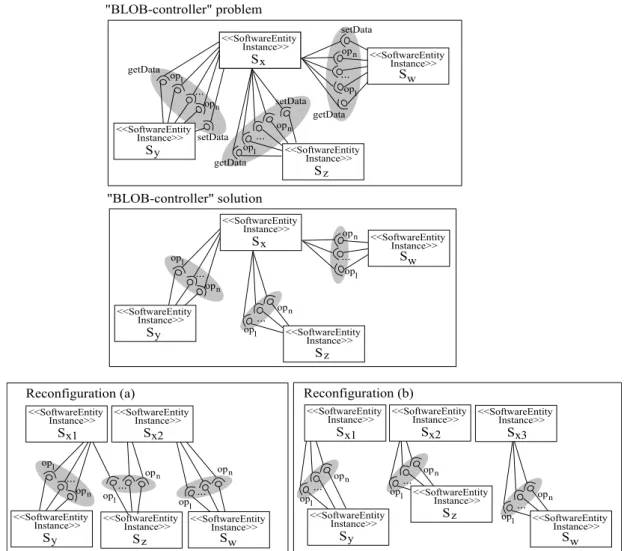
3.1 A first approach of the Results Interpretation & Feedback Generation steps. 20 3.2 A graphical representation of theBlob-controllerAntipattern. . . 25
3.3 A graphical representation of theBlob-dataContainer Antipattern. . . 26
3.4 A graphical representation of theConcurrent Processing Systems Antipat-tern. . . 28
3.5 A graphical representation of thePipe and Filter ArchitecturesAntipattern. 30 3.6 A graphical representation of theExtensive ProcessingAntipattern. . . 32
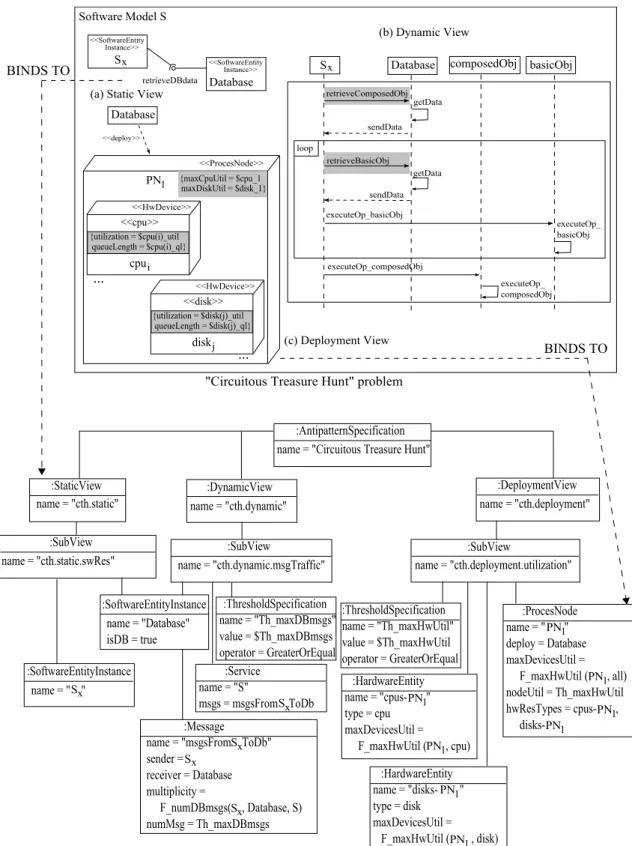
3.7 A graphical representation of theCircuitous Treasure HuntAntipattern. . 34
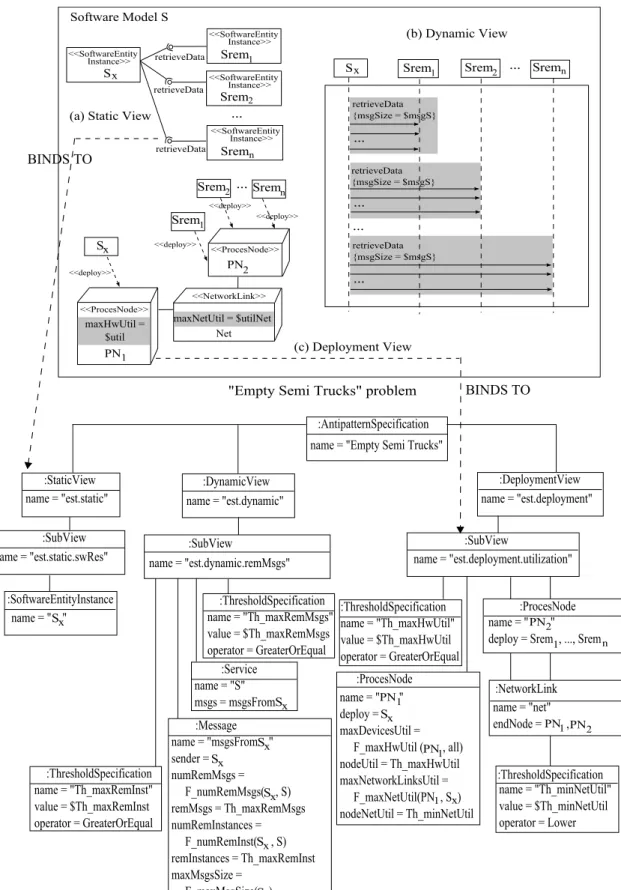
3.8 A graphical representation of theEmpty Semi TrucksAntipattern. . . 37
3.9 A graphical representation of theTower of BabelAntipattern. . . 39
3.10 A graphical representation of theOne-Lane BridgeAntipattern. . . 41
3.11 A graphical representation of theExcessive Dynamic AllocationAntipattern. 43 3.12 A graphical representation of theTraffic JamAntipattern. . . 45
3.13 A graphical representation ofThe RampAntipattern. . . 47
3.14 A graphical representation of theMore Is LessAntipattern. . . 48
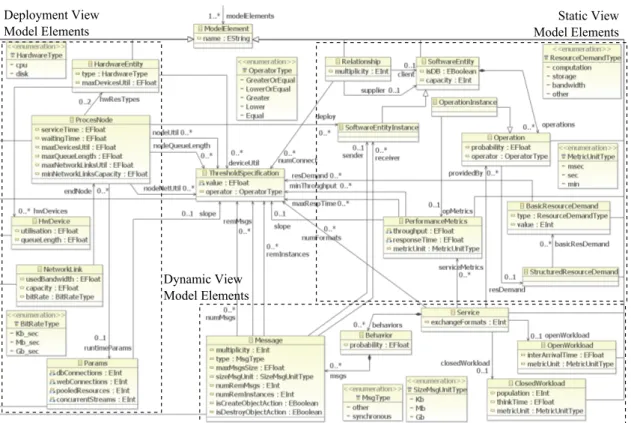
3.15 Bird’s-eye look of the XML Schema and its views. . . 50
3.16 A graphical representation of the reconfiguration actions for solving the Blob-controllerAntipattern. . . 72
4.1 The Performance Antipattern Modeling Language (PAML) structure. . . . 76
4.2 The Enriched Software Modeling Language (SML+). . . 77
4.3 PAML implementation in the Eclipse platform. . . 78
4.4 PAML Model wizard for creating new instances. . . 78
4.5 PAML Editor properties. . . 79
4.6 PAML-based model of theBlobAntipattern. . . 81
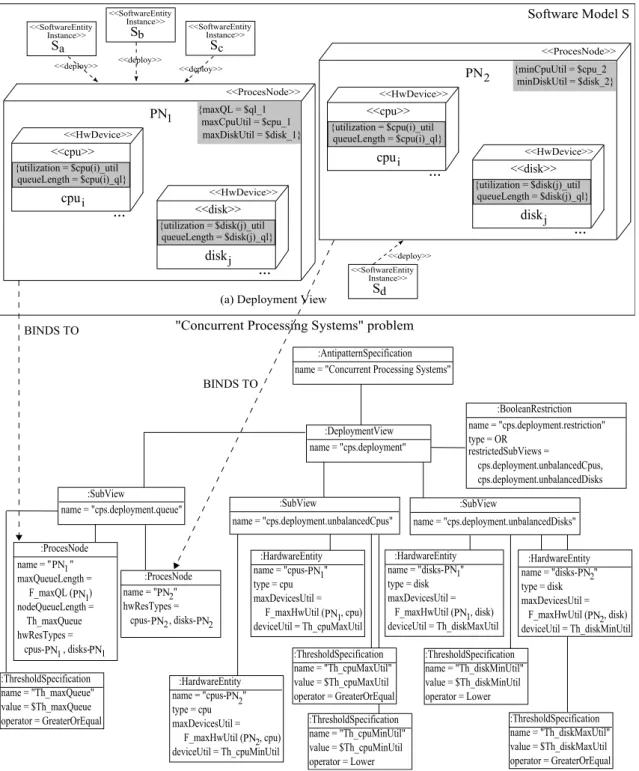
4.7 PAML-based model of theConcurrent Processing SystemsAntipattern. . 83
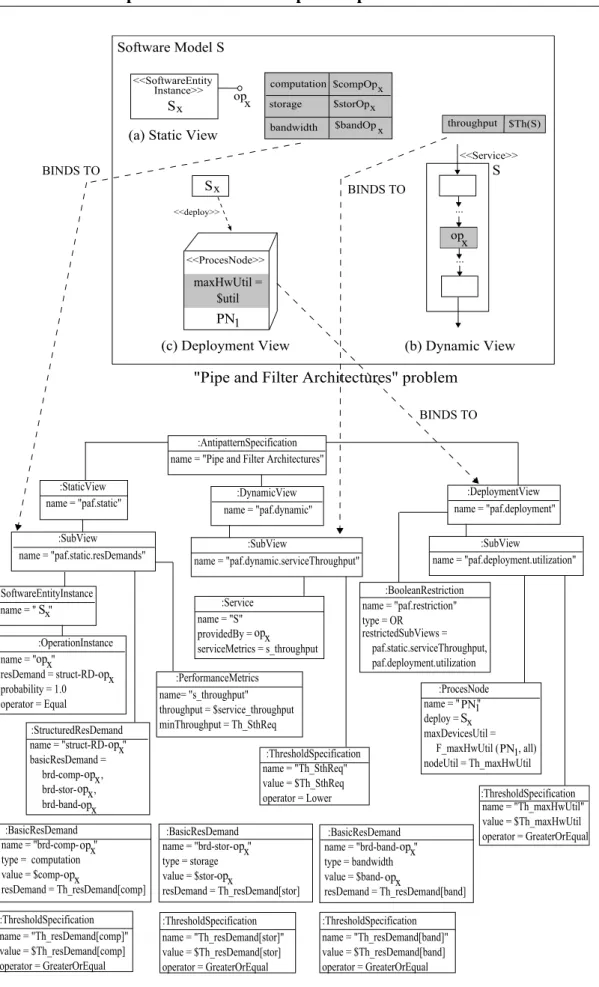
4.8 PAML-based model of thePipe and Filter ArchitecturesAntipattern. . . . 85
4.9 PAML-based model of theExtensive ProcessingAntipattern. . . 87
4.10 PAML-based model of theCircuitous Treasure HuntAntipattern. . . 89
4.11 PAML-based model of theEmpty Semi TrucksAntipattern. . . 91
4.13 PAML-based model of theOne-Lane BridgeAntipattern. . . 94
4.14 PAML-based model of theExcessive Dynamic AllocationAntipattern. . . 96
4.15 PAML-based model of theTraffic JamAntipattern. . . 98
4.16 PAML-based model of theThe RampAntipattern. . . 99
4.17 PAML-based model of theMore Is LessAntipattern. . . 101
4.18 Translating antipatterns into concrete modeling languages. . . 104
4.19 Metamodel instantiation via weaving models. . . 104
4.20 Weaving model over different software modeling languages. . . 105
4.21 Tranforming PAML-based models in OCL queries. . . 106
4.22 Feedback Generation approach by means of model-driven techniques. . . 106
5.1 UML Compliance Level 3 top-level package merges. . . 110
5.2 Informal description of the MARTE dependencies with other OMG stan-dards. . . 111
5.3 Artifacts of a PCM instance. . . 119
5.4 Example of a PCM model. . . 120
5.5 An excerpt of the MARTERunTimeContextpackage. . . 129
6.1 ECS case study: customized software performance process. . . 131
6.2 ECS case study: Use Case Diagram. . . 132
6.3 ECS (annotated) software architectural model. . . 134
6.4 ECS - Queueing Network model. . . 135
6.5 ECS- theBlobantipattern occurrence. . . 137
6.6 ECS- theConcurrent Processing Systemsantipattern occurrence. . . 137
6.7 ECS- theEmpty Semi Trucksantipattern occurrence. . . 138
6.8 ECS model refinement: reiteration of the software performance process. . 140
6.9 BRS case study: customized software performance process. . . 142
6.10 Screenshot of the PCM Bench extension providing the usage of antipat-terns knowledge. . . 143
6.11 PCM software architectural model for the BRS system. . . 144
6.12 PCM usage model for the BRS system. . . 145
6.13 Response time of thesystemacross the iterations of the antipattern-based process. . . 148
6.14 Summary of the process for the BRS system. . . 148
7.1 A process to improve the performance analysis interpretation. . . 152
7.2 BRS software architectural model. . . 158
7.3 RT(CSgraphicalReport) vs the guiltness degree of antipatterns. . . 163
7.4 RT(CSonlineReport) vs the guiltness degree of antipatterns. . . 163
7.5 T(CSgraphicalReport) vs the guiltness degree of antipatterns. . . 164
7.6 How to decide between different moves. . . 165
7.7 Process for the combination of performance antipatterns. . . 166
8.1 Workload sensitivity analysis as a support for solving antipatterns. . . 170
8.2 Stakeholders analysis as a support for solving antipatterns. . . 171
8.4 Cost analysis as a support for solving antipatterns. . . 173
A.1 An excerpt of the XML Schema. . . 192
A.2 XML Schema -Static View. . . 194
A.3 An example of theRelationshipelement. . . 196
A.4 An example of theStructuredResourceDemandelement. . . 196
A.5 An example of thePerformanceMetricselement. . . 197
A.6 XML Schema -Dynamic View. . . 198
A.7 An example of theBehaviorelement. . . 199
A.8 XML Schema -Deployment View. . . 201
A.9 An example of theNetworkLinkelement. . . 202
A.10 An example of theProcesNodeelement. . . 203
B.1 A simple example of theAutomatamodeling notation. . . 206
B.2 A simple example of thePetri Netsmodeling notation. . . 207
B.3 Basic Symbols of theUse Case Mapsmodeling notation. . . 209
2.1 Summary of the approaches related to the generation of architectural
feed-back. . . 17
3.1 Performance Antipatterns: problem and solution [123]. . . 22
3.2 Functions specification. . . 67
3.3 Thresholds specification: software characteristics. . . 68
3.4 Thresholds specification: hardware characteristics. . . 68
3.5 Thresholds specification: requirements. . . 69
3.6 Thresholds specification: slopes. . . 69
3.7 A logic-based representation of Performance Antipatterns. . . 70
4.1 A metamodel-based representation of Performance Antipatterns. . . 102
5.1 SML+ Static View Model Elements and their mapping to UML meta-model elements. . . 112
5.2 SML+ Dynamic View Model Elements and their mapping to UML meta-model elements. . . 113
5.3 SML+ Deployment View Model Elements and their mapping to UML metamodel elements. . . 114
5.4 SML+ Static View Model Elements and their mapping to PCM meta-model elements. . . 121
5.5 SML+ Dynamic View Model Elements and their mapping to PCM meta-model elements. . . 122
5.6 SML+ Deployment View Model Elements and their mapping to PCM metamodel elements. . . 123
5.7 Performance Antipatterns detectable and solvable in UML and PCM. . . . 128
6.1 Input parameters for the queueing network model in the ECS system. . . . 133
6.2 Response time requirements for the ECS software architectural model. . . 135
6.3 ECS- antipatterns boundaries binding. . . 136
6.4 ECS Performance Antipatterns: problem and solution. . . 139
6.5 Input parameters for the queueing network model across different soft-ware architectural models. . . 140
6.6 Response time required and observed. . . 141
6.7 BRS Performance Antipatterns: problem and solution. . . 146
6.8 Response time of the system across BRS software architectural model candidates. . . 149
7.1 Example of Performance Requirements. . . 153
7.2 Details of Violated Requirements. . . 154
7.3 Complete Antipatterns List. . . 155
7.4 Filtered Antipatterns List. . . 155
7.5 How to rank performance antipatterns . . . 156
7.6 BRS - Performance requirement analysis . . . 159
7.7 BRS - Violated Requirements . . . 160
7.8 BRS- Complete Antipatterns List . . . 160
7.9 BRS - Ranked Antipatterns List . . . 161
INTRODUCTION
Over the last decade, research has highlighted the importance of integrating functional analysis activities in the software development process, in order to meet non-functional requirements. Among these, performance is one of the most influential factors to be considered since performance problems may be so severe that they can require considerable changes at any stage of the software lifecycle, in particular at the software architecture level or design phase and, in the worst cases, they can even impact the re-quirements level.
In the software development process it is fundamental to understand if performance re-quirements are fulfilled, since they represent what end users expect from the software system, and their unfulfillment might produce critical consequences. The early devel-opment phases may heavily affect the quality of the final software product, and wrong decisions at early phases may imply an expensive rework, possibly involving the overall software system. Therefore, performance issues must be discovered early in the software development process, thus to avoid the failure of entire projects [74, 75].
In the research community there is a growing interest in the early validation of perfor-mance requirements. The model-based approach, pioneered under the name of Software Performance Engineering (SPE) by Smith [117, 131, 116] creates performance models early in the development cycle and uses quantitative results from these models to adjust the architecture and design [40] with the purpose of meeting performance requirements [133]. Software architectures [63, 41] have emerged as a foundational concept for the successful development of large, complex systems, since they support five aspects of the software development: understanding, reuse, evolution, analysis and management [62]. The Software Architecture is the earliest model of a software system created along the lifecycle. Perry and Wolf in [109] defined the architecture as the selection of architectural elements, their interactions, and the constraints on those elements. Garlan and Shaw in [64] defined the architecture as a collection of computational components together with a description of the interactions between these components. In this thesis we adopt the latter definition.
Several approaches have been successfully applied by modeling and analyzing the per-formance of software systems on the basis of predictive quantitative results [19, 89, 135,
134, 111]. However we are still far from considering the performance analysis as an in-tegrated activity into the software development that effectively supports all the phases of the software lifecycle. In practice it is generally acknowledged that the lack of perfor-mance requirement validation during the software development process is mostly due to the knowledge gap between software engineers/architects and performance experts (as special skills are required) rather than to foundational issues. Moreover, short time to market constraints make this situation even more critical.
The problem of interpreting the performance analysis results is still quite critical, since it is difficult to understand mean values, variances, and probability distributions. Addition-ally, a large gap exists between the representation of performance analysis results and the feedback expected by software architects. The former usually contains numbers (such as mean response time, throughput variance), whereas the latter should embed architectural suggestions useful to overcome performance problems (such as split a software compo-nent in two compocompo-nents and re-deploy one of them). Such activities are today exclusively based on the analysts’ experience, and therefore their effectiveness often suffers the lack of automation. In this scenario, we believe that the automated generation of feedback may work towards the problem solution, since it has the important role of making perfor-mance analysis results usable at the software architectural level. It means, for example, that from a bad throughput value, it is possible to identify the software components and/or interactions responsible for that bad value.
1.1
M
OTIVATION
Software performance is a pervasive quality difficult to understand, because it is affected by every aspect of the design, code, and execution environment [133]. By conventional wisdom performance is a serious problem in a significant fraction of projects. Perfor-mance failures occur when a software product is unable to meet its overall objectives due to inadequate performance. Such failures negatively impact the projects by increasing costs, decreasing revenue or both. Furthermore they cause delays, cost overruns, fail-ures on deployment, and even abandonment of projects, as documented in the following, quoted from [122]:
“Consider, as an example, that the National Aeronautics and Space Administration (NASA) was forced to delay the launch of a satellite for at least eight months. The satel-lite and the Flight Operations Segment (FOS) software running it are a key component of the multi billion-dollar Earth Science Enterprise, an international research effort to study the interdependence of the Earth’s ecosystems. The delay was caused because the FOS software had unacceptable response times for developing satellite schedules, and poor performance in analyzing satellite status and telemetry data. There were also problems with the implementation of a control language used to automate operations. The cost of this rework and the resulting delay has not yet been determined. Nevertheless it is clearly significant, and the high visibility and bad press is potentially damaging to the overall mission. Members of Congress also questioned NASA’s ability to manage the program.”
Performance management is a hot topic for the Information Technology (IT) industry and media, and it is interesting to know to what extent real organizations are getting to grips with the performance issues. A recent survey [1] has been conducted on the performance management practice inviting 150 senior IT managers (i.e. responsible for testing and performance working at large organizations across Europe) to fill a questionnaire about their experiences in the field. The survey demonstrates that performance failures are still occurring in many organizations, as more than half of organizations said they experience unexpected performance issues in 20% or more of their newly deployed applications. The primary cause of performance failures is a reactive approach to performance during the development process. Cost and schedule pressures encourage project managers to adopt a fix-it-later approach in which performance is ignored until there is a problem. When a problem is discovered, more hardware is needed, developers must try to tune the software to meet performance objectives or both, but in some cases it is simply not possible to meet performance objectives by tuning.
The fundamental lesson learned from the documented projects is that it is better to prevent performance failures and the resulting project crises. A proactive approach to software performance management has the benefit of anticipating probable performance problems, because it is based on techniques for identifying and responding to those problems early in the process. The goal is to produce a software that meets performance objectives, thus to avoid project crises due to the late discovery of performance issues.
1.2
P
ROBLEM STATEMENT
Figure 1.1 schematically represents the typical steps that are executed at a generic phase of the software lifecycle to conduct a model-based performance analysis process. Rounded boxes in the Figure represent operational steps whereas square boxes represent input/out-put data. Vertical lines divide the process in three different phases: in themodelingphase an (annotated) software architectural model is built; in theperformance analysisphase a performance model is obtained through model transformation, and such model is solved to obtain the performance results of interest; in the refactoring phase the performance results are interpreted and, if necessary, feedback is generated as refactoring actions on the original software architectural model.
Asoftware architectural model (see Figure 1.1) is an abstract view of the software sys-tem. Complementary types of model provide different system information. Such different models present the system from different perspectives, such as external perspective show-ing the system’s context or environment, behavioral perspective showshow-ing the behavior of the system, etc. [125]. We refer to(annotated)models, since annotations are meant to add information that led to execute performance analysis such as the incoming workload to the system, service demands, hardware characteristics, etc. There exists many notations to describe all these aspects of a software system (e.g. automata, process algebras, petri nets and process algebras), surveyed in [19] and shortly reported in Appendix B.1.
Performance Results (Annotated) Software
Architectural Model
Results Interpretation & Feedback Generation Model2Model
Transformation PerformanceModel
Model Solution 1 2 3 4 5.b 5.a 6
Modeling Performance Analysis Refactoring
Figure 1.1: Automated software performance process.
A performance model (see Figure 1.1) describes how system operations use resources, and how resource contention affects operations. The solution of a performance model supports the prediction of the properties of a system before it is built, or the effect of a change before it is carried out. This gives a special warning role to early modeling. However as the implementation proceeds, more accurate models can be created by other means, and may have additional uses, in particular: (i) design of performance tests; (ii) configuration of products for delivery; (iii) evaluation of planned evolutions of the de-sign, while recognizing that no system is ever final [133]. There exists many notations to describe all these aspects of a software system (e.g. queueing networks, layered queues, stochastic petri nets and process algebras), surveyed in [19] and shortly reported in Ap-pendix B.2.
Performance results(see Figure 1.1) refer to the following performance indices [81]: - Response timeis defined as the time interval between a user request of a service
and the response of the system. Usually, upper bounds are defined in “business” requirements by the end users of the system.
- Utilizationis defined as the ratio of busy time of a resource and the total elapsed time of the measurement period. Usually, upper bounds are defined in “system” re-quirements by system engineers on the basis of their experience, scalability issues, or constraints introduced by other concurrent software systems sharing the same hardware platform.
- Throughput is defined as the rate at which requests can be handled by a system, and is measured in requests per time. Throughput requirements can be both “busi-ness” and “system” requirements, depending on the target it applies; for the same motivation it can represent either an upper or a lower bound.
The modeling and performance analysis phases (i.e. arrows numbered from 1 through 4) represent the forward path from an (annotated) software architectural model all the
way through the production of performance results of interest. While in this path quite well-founded approaches have been introduced for inducing automation in all steps (e.g. [19, 89, 137]), there is a clear lack of automation in the backward path that shall bring the analysis results back to the software architecture.
The core step of the backward path (i.e. the shaded box of Figure 1.1) is where the performance analysis results have to be interpreted in order to detect, if any, performance problems; once performance problems have been detected (with a certain accuracy) some-where in the model, solutions have to be applied to remove those problems1. A
perfor-mance problem originates from a set of unfulfilled requirement(s), such as the estimated response time of a service is higher than the required one. If all the requirements are satisfied then the feedback obviously suggests no changes.
In Figure 1.1, the (annotated) software architectural model (label 5.a) and the performance results (label 5.b) are inputs to the core step that searches problems in the model. The search of performance problems in architectural models may be quite complex and needs to be smartly driven towards the problematic areas of the model. The complexity of this step stems from several factors:
(i) performance indices are basically numbers and often they have to be jointly exam-ined: a single performance index (e.g. the utilization of a service) might not be enough to localize the critical parts of a software architecture, since a performance problem might emerge only if other indices (e.g. the throughput of a neighbor ser-vice) are analyzed;
(ii) performance indices can be estimated at different levels of granularity (e.g. the response time index can be evaluated at the level of a cpu device, or at the level of a service that spans on different devices) and it is unrealistic to keep under control all indices at all levels of abstraction;
(iii) software architectural models can be quite complex, and the origin of performance problems emerges only looking at the architectural elements described in different views of a system (such as static structure, dynamic behavior, deployment configu-rations, etc.).
The problem tackled in this thesis is to interpret performance analysis results and to intro-duce automation in the backward path (label 6 of Figure 1.1) in the form of architectural alternatives (e.g. split a software component in two components and re-deploy one of them) that do not suffer of the original performance problems. Such automation provides several gains since it notifies the software architect of the interpretation of the analysis results. Performance issues and subsequent architectural emendations aimed at removing such issues are outlined without the intervention of performance experts. We believe that both the software architectural and performance models represent suitable instruments
1Note that this task very closely corresponds to the work of a physician: observing a sick patient (the
model), studying the symptoms (some bad values of performance indices), making a diagnosis (perfor-mance problem), prescribing a treatment (perfor(perfor-mance solution).
that can be refined accordingly to the feedback we provide, while the development pro-gresses, thus to act early in the software lifecycle.
1.3
THESIS
FOCUS AND
KEY
C
ONTRIBUTIONS
The research activity of this thesis is focused on the core step of Figure 1.1, and in Figure 1.2 the most promising elements that can drive this search have been explicitly repre-sented, i.e. performance antipatterns(input labeled 5.c to the core step). The rationale of using performance antipatterns is two-fold: on the one hand, a performance antipat-tern identifies a bad practice in the software architectural model that negatively affects the performance indices, thus to support theresults interpretationstep; on the other hand, a performance antipattern definition includes a solution description that lets the software architect devise refactoring actions, thus it supports thefeedback generationstep.
Performance Results (Annotated) Software
Architectural Model
Results Interpretation & Feedback Generation Model2Model
Transformation PerformanceModel
Model Solution 1 2 3 4 5.b 5.a 6
Modeling Performance Analysis Refactoring
Performance Antipatterns
5.c
Figure 1.2: Automated software performance process by introducing the antipatterns. The main reference we consider for performance antipatterns is the work done across the years by Smith and Williams [123] that have ultimately defined fourteen notation-independent antipatterns. Some other works present antipatterns that occur throughout different technologies, but they are not as general as the ones defined in [123] (more references are provided in Chapter 2).
The key contribution of this thesis is to address the problem of interpreting the perfor-mance results and generating architectural alternatives. This is achieved with a framework named PANDA:PerformanceAntipatterns aNd FeeDback in SoftwareArchitectures. The main activities performed within such framework are schematically shown in Figure 1.3:
specifying antipatterns, to define in a well-formed way the properties that lead the soft-ware system to reveal a bad practice as well as the changes that provide a solution; detect-ing antipatterns, to locate antipatterns in software architectural models;solving antipat-terns, to remove the detected performance problems with a set of refactoring actions that can be applied on the software architectural model.
Figure 1.3: The main activities of the PANDA framework.
The activity of specifying antipatterns is performed by introducing a neutral and a coher-ent set of interrelated concepts to represcoher-ent the software architectural model elemcoher-ents as well as the performance indices that occur in the definition of antipatterns (e.g. software resource, network resource utilization, etc.). Such activity is meant to be the basis for a machine-processable definition of antipatterns. An antipattern definition in fact includes: (i) the specification of the problem, i.e. a set ofantipattern-based rulesthat interrogate the system elements to look for occurrences of the corresponding antipattern; (ii) the speci-fication of the solution, i.e. a set ofantipattern-based actionsthat can be applied on the system elements to remove a performance problem.
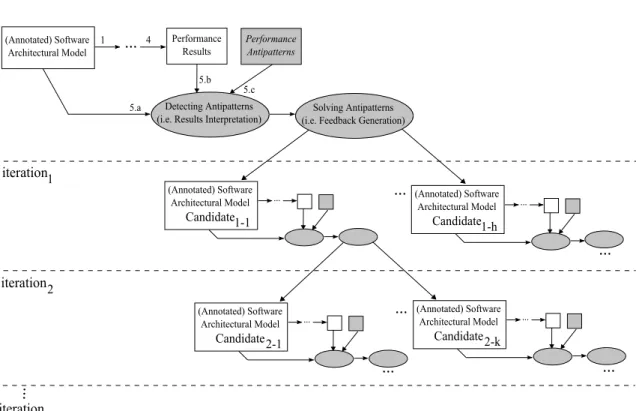
The activities of detecting and solving antipatterns are performed by respectively defining the antipattern-based rules and actions into concrete modeling notations. In fact, the mod-eling language used for the system is of crucial relevance, since the antipatterns (neutral) concepts must be translated into actual concrete modeling languages. The framework cur-rently considers two notations: a system modeling language such as UML [12], and the Palladio Component Model (PCM) [22], i.e. a domain specific modeling language. Figure 1.4 details the software performance modeling and analysis process of Figure 1.2. The core step is explicitly represented in two main operational steps: (i)detecting antipat-ternsthat provides the localization of the critical parts of software architectural models thus to address the results interpretation problem; (ii)solving antipatterns that suggests the changes to be applied to the architectural model under analysis, thus to address the feedback generation problem.
Severaliterations can be conducted to find the software architectural model that best fits the performance requirements, since several antipatterns may be detected in an architec-tural model, and several refactoring actions may be available for solving each antipattern. At each iteration the actions we propose are aimed at building a new software architec-tural model, i.e. aCandidate(see Figure 1.4), that replaces the one under analysis. For
Performance Antipatterns
(Annotated) Software Architectural Model
Detecting Antipatterns (i.e. Results Interpretation) ...
1 4
5.b
5.a Solving Antipatterns
(i.e. Feedback Generation)
(Annotated) Software Architectural Model Candidate iteration1 1-1 ... ... iteration2 ... ... ... ... iteration... n Performance Results 5.c (Annotated) Software Architectural Model Candidate1-h ... (Annotated) Software Architectural Model Candidate2-1
... (Annotated) Software Architectural Model
Candidate2-k
...
Figure 1.4: An antipattern-based process for the software performance process. example, the (annotated) software architectural modelCandidatei−j is generated at the
i-th iteration and it denotes thej-th candidate for the iteration it belongs to. Then, the de-tection and solution approach can be iteratively applied to all newly generated candidates to further improve the system, if necessary.
Different termination criteria can be defined in the antipattern-based process:
(i) fulfilmentcriterion, i.e. all requirements are satisfied and a suitable software archi-tectural model is found;
(ii) no-actionscriterion, i.e. no antipatterns are detected in the software architectural models therefore no refactoring actions can be experimented;
(iii) #iterationscriterion, i.e. the process can be terminated if a certain number of itera-tions have been completed.
It is worth to notice that the solution of one or more antipatterns does not a priori guarantee performance improvements, because the entire process is based on heuristic evaluations. However, an antipattern-based refactoring action is usually a correctness-preserving trans-formation that improves the quality of the software. For example, the interaction between two components might be refactored to improve performance by sending fewer messages with more data per message. This transformation does not alter the semantics of the application, but it may improve the overall performance.
We can conclude that performance antipatterns represent a promising instrument to in-troduce automation in the backward path of the software performance cycle. The benefit of using antipatterns is that they are descriptions of problems commonly encountered by performance engineers in practice. Such knowledge is acquired while analyzing complex software systems and exploited at the software architectural level.
1.4
T
HESIS
O
UTLINE
This thesis is organized as follows.Chapter 2 reviews the main existing approaches in the research area referring to the gen-eration of the architectural feedback. In particular, three categories of approaches are out-lined: (i) antipattern-based approaches that make use of antipatterns knowledge to cope with performance issues; (ii) rule-based approaches that define a set of rules to overcome performance problems; (iii) search-based approaches that explore the problem space by examining options to deal with performance flaws. In the context of the search-based process two techniques can be applied: design space exploration that blindly examine all architectural alternatives, and metaheuristic search techniques (e.g. genetic algorithms) that search for local changes in the architectural model.
Chapter 3 describes the performance antipatterns we consider for the generation of the architectural feedback. A classification of antipatterns (i.e. single-value, multiple-values antipatterns) is discussed on the basis of the performance analysis (i.e. analytic method, simulation) results that we need to capture the bad practices. A graphical representa-tion supports the interpretarepresenta-tion of the natural language-based definirepresenta-tions of antipatterns, followed by a logic-based specification that better formalizes such interpretation. A struc-tured description of the architectural model elements that occur in the definitions of an-tipatterns is provided in Appendix A, and it represents a groundwork for the definition of antipatterns as logical predicates.
Chapter 4 gives an overview of how model-driven engineering techniques can be applied to tackle the problem of automating the interpretation of performance analysis results and the generation of architectural feedback. A Performance Antipattern Modeling Language (PAML) is defined to build a user-friendly representation of antipatterns. They become here models conform to PAML, or in other words they are expressed by the concepts en-coded in our modeling language. The antipatterns representation as PAML-based models allows to manipulate their (neutral) definition with model-driven techniques (e.g. weaving models) by deriving important features across different modeling notations.
Chapter 5 examines the performance antipatterns within the concrete modeling languages we consider for the validation of the approach. In particular, we discuss the semantic relations between PAML and UML and PCM metamodel elements respectively, in order to investigate the expressiveness of such notations. These experiences have allowed to classify the antipatterns in three categories: (i) detectable and solvable; (ii) semi-solvable
(i.e. the antipattern solution is only achieved with refactoring actions to be manually performed); (iii) neither detectable nor solvable.
Chapter 6 provides the experimentation on the UML and PCM modeling languages to validate the whole approach. Two case studies are analyzed: (i) the first one, i.e. an E-commerce system, is modeled with UML, transformed in a Queueing Network and solved with the analytic method; (ii) the second one, i.e. a Business Reporting system, is modeled with PCM, transformed in a Queueing Network and solved with simulation. In both cases our antipattern-based approach is applied: the detection of antipatterns leads to identify the most critical parts of software architectures; the solution of antipatterns gives rise to a set of architectural alternatives that actually demonstrate performance improvements for the case study under analysis.
Chapter 7 exploits the requirements analysis to achieve a step ahead in the antipatterns solution. Requirements are used to decide the most promising refactoring actions that can rapidly lead to remove performance problems. The antipatterns detected in software architectural models are ranked on the basis of their guiltiness for violated requirements in order to give a priority in the sequential solution of antipatterns, thus to quickly convey the desired result of requirements satisfaction. In this direction several interesting issues emerge, e.g. the simultaneous solution of multiple antipatterns is briefly discussed. Chapter 8 collects the cross-cutting concerns (e.g. workload, operational profile, etc.) that influence the software performance analysis results and the generation of the architectural feedback in order to give a wide explanation of domain features that might emerge in this context. These features can be used to prioritize the solution of the detected antipatterns, thus to quickly achieve the requirements fulfillment.
Chapter 9 concludes the thesis. It gives a summary of the achieved results by pointing out the assumptions and the limitations from using the antipatterns in the software perfor-mance process. A list of open issues that remain uncovered in this thesis is provided and they represent the future works we intend to pursue.
S
OFTWARE
PERFORMANCE
FEEDBACK:
STATE OF THE
ART
In literature few related works can be found dealing with the interpretation of performance analysis results and the generation of architectural feedback. Most of them are based on monitoring techniques and therefore are conceived to only act after software deployment for tuning its performance. We are instead interested in model-based approaches that can be applied early in the software lifecycle to support design decisions.
In the following the main existing approaches for the automated generation of architec-tural feedback are surveyed. In particular, we identified three principal categories of ap-proaches: (i) antipattern-based approaches (see Section 2.1) that make use of antipatterns knowledge to cope with performance issues; (ii) rule-based approaches (see Section 2.2) that define a set of rules to overcome performance problems; (iii) search-based approaches (see Section 2.3) that explore the problem space by examining options to deal with per-formance flaws. In the context of the search-based process two techniques can be applied: design space exploration (see Section 2.3.1) and metaheuristic (see Section 2.3.2).
2.1
A
NTIPATTERN
-
BASED
A
PPROACHES
The term Antipattern appeared for the first time in [33] in contrast to the trend of fo-cus on positive and constructive solutions. Differently from patterns, antipatterns look at the negative features of a software system and describe commonly occurring solutions to problems that generate negative consequences. Antipatterns have been applied in dif-ferent domains. For example, in [128] data-flow antipatterns help to discover errors in workflows and are formalized through the CTL* temporal logic. As another example, in [31] antipatterns help to discover multi threading problems of Java applications and are specified through the LTL temporal logic.
Performance Antipatterns, as the name suggests, deal with performance issues of the soft-ware systems. They have been previously documented and discussed in different works:
technology-independentperformance antipatterns have been defined in [123]; technology-specificantipatterns have been defined in [52] and [127].
Williams et al. in [130] introduced the PASA (Performance Assessment of Software Ar-chitectures) approach. It aims at achieving good performance results [118] through a deep understanding of the architectural features. This is the approach that firstly intro-duces the concept of antipatterns as support to the identification of performance problems in software architectural models as well as in the formulation of architectural alternatives. However, this approach is based on the interactions between software architects and per-formance experts, therefore its level of automation is still low.
Cortellessa et al. in [43] introduced a first proposal of automated generation of feedback from the software performance analysis, where performance antipatterns play a key role in the detection of performance flaws. However, this approach considers a restricted set of antipatterns, and it uses informal interpretation matrices as support. Performance scenar-ios are described (e.g. the throughput is lower than the user requirement, and the response time is greater than the user requirement) and, if needed, some actions to improve such scenarios are outlined. The main limitation of this approach is that the interpretation of performance results is only demanded to the analysis of Layered Queue Networks (LQN) [110, 68, 69], i.e. a performance model. Such knowledge is not enriched with the features coming from the software architectural models, thus to hide feasible refactoring actions. Enterprise technologies and EJB performance antipatterns are analyzed by Parsons et al. in [108]: antipatterns are represented as sets of rules loaded into a JESS [2] engine, and written in a Lisp-like syntax [100]. A rule-based performance diagnosis tool, named Per-formance Antipattern Detection (PAD), is presented. However, it deals with Component-Based Enterprise Systems, targeting only Enterprise Java Bean (EJB) applications. It is based on the monitoring of the data from running systems, it extracts the run-time system design and detects EJB antipatterns by applying rules to it. Hence, the scope of [108] is restricted to such domain, and performance problems can neither be detected in other technology contexts nor in the early development stages.
By taking a wider look out of the performance domain, the management ofantipatterns
is a quite recent research topic, whereas there has already been a significant effort in the area of software design patterns. It is out of scope to address such wide area, but it is worth to mention some approaches dealing with patterns.
Elaasar et al. in [55] introduced a metamodeling approach to pattern specification. In the context of the OMGs 4-layer metamodeling architecture, the authors propose a pattern specification language (i.e. Epattern, at the M3 level) used to specify patterns in any MOF-compliant modeling language at the M2 layer.
France et al. in [59] introduced a UML-based pattern specification technique. Design patterns are defined as models in terms of UML metamodel concepts: a pattern model de-scribes the participants of a pattern and the relations between them in a graphical notation by means of roles, i.e. the properties that a UML model element must have to match the corresponding pattern occurrence.
2.2
RULE-BASED
APPROACHES
Barber et al. in [21] introduced heuristic algorithms that in presence of detected system bottlenecks provide alternative solutions to remove them. The heuristics are based on ar-chitectural metrics that help to compare different solutions. In a Domain Reference Archi-tecture (DRA) the modification of functions and data allocation can affect non-functional properties (for example, performance-related properties such as component utilization). The toolRAREguides the derivation process by suggesting allocations based on heuris-tics driven by static architectural properties. The toolARCADEextends the RARE scope by providing dynamic property measures. ARCADE evaluation results subsequently fed back to RARE can guide additional heuristics that further refine the architecture. How-ever, it basically identifies and solve only software bottlenecks, more complex problems are not recognized.
Dobrzanski et al. in [51] tackled the problem of refactoring UML models. In particu-lar,bad smells are defined as structures that suggest possible problems in the system in terms of functional and non-functional aspects. Refactoring operations are suggested in the presence of bad smells. Rules for refactoring are formally defined, and they take into account the following features: (i) cross integration of structure and behavior; (ii) sup-port for component-based development via composite structures; and (iii) integration of action semantics with behavioral constructs. However, no specific performance issue is analyzed, and refactoring is not driven by unfulfilled requirements.
McGregor et al. in [101] proposed a framework (ArchE) to support the software design-ers in creating architectures that meet quality requirements. It embodies knowledge of quality attributes and the relation between the achievement of quality requirements and architectural design. It helps to create architectural models by collecting requirements (in form of scenarios) and the information needed to analyze the quality criteria for the re-quirements. It additionally provides the evaluation tools for modifiability or performance analysis. However, the suggestions (or tactics) are not well explained, and it is not clear at which extent the approach can be applied.
Kavimandan et al. in [85] presented an approach to optimize deployment and configura-tion decisions in the context of distributed, realtime, and embedded (DRE) component-based systems. Bin packing algorithms have been enhanced, and schedulability analysis have been used to make fine-grained assignments that indicate how components are allo-cated to different middleware containers, since they are known to impact on the system performance and resource consumption. However, the scope of this approach is limited to deployment and configuration features.
Xu in [138] presented an approach to software performance diagnosis that identifies per-formance flaws before the software system implementation. It defines a set ofrules (spec-ified with the Jess rule engine [2]) aimed at detecting patterns of interaction between re-sources. The method is applied to UML [12] that employ standard profiles, i.e. the SPT or Schedulability, Performance and Time profile [14] and its successor MARTE [13].
The software architectural models are translated in a performance model, i.e. Layered Queueing Networks (LQNs) [110, 68, 69], and then analyzed. The approach limits the detection to bottlenecks and long execution paths identified and removed at the level of the LQN performance model. The actions to solve the performance issues are: change the configuration, i.e. increase the size of a buffer pool or the amount of existing proces-sors; andchange the design, i.e. increase parallelism and splitting the execution of task in synchronous and asynchronous parts. The overall approach applies only to LQN models, hence its portability to other notations is yet to be proven and it may be quite complex.
2.3
S
EARCH
-
BASED
A
PPROACHES
A wide range of different optimization and search techniques have been introduced in the field of Search-Based Software Engineering (SBSE) [70, 73], i.e. a software engineering discipline in which search-based optimization algorithms are used to address problems where a suitable balance between competing and potentially conflicting goals has to be found. Two key ingredients are required: (i) the representation of the problem; (ii) the definition of a fitness function. In fact, SBSE usually applies to problems in which there are numerous candidate solutions and where there is a fitness function that can guide the search process to locate reasonably good solutions.
A suitable representation of the problem allows to automatically explore the search space for the solutions that best fit the fitness function [72] that drives towards the sequence of the refactoring steps to apply to this system (i.e. altering its architectural structure without altering its semantics).
In the software performance domain both the suitable representation of the problem and the formulation of the fitness function are not trivial tasks, since the performance analysis results are derived from many uncertainties like the workload, the operational profile, etc. that might completely modify the perception of considering candidate solutions as good ones. Some assumptions can be introduced to simplify the problem and some design options can be explicitly defined in advance to constitute the population[72] on which search based optimization algorithms apply.
However, we believe that in the performance domain it is of crucial relevance to find a synergy between the search techniques that involve the definition of a fitness function to automatically capture what is required from the system, and the antipatterns that might support such function with the knowledge of bad practices and suggest common solutions, in order to quickly converge towards performance improvements.
In fact, as recently outlined in [71], there is a mutually beneficial relationship between SBSE and predictive models. In particular eleven broad areas of open problems (e.g. bal-ancing functional, nonfunctional properties of predictive models) in SBSE for predictive modeling are discussed, explaining how techniques emerging from the SBSE community may find potentially innovative applications in predictive modeling.
2.3.1
D
ESIGNS
PACEE
XPLORATIONA
PPROACHESZheng et al. in [140] described an approach to find optimal deployment and scheduling priorities for tasks in a class of distributed real-time systems. In particular, it is intended to evaluate the deployment of such tasks by applying a heuristic search strategy to LQN models. However, its scope is restricted to adjust the priorities of tasks competing for a processor, and the only refactoring action is to change the allocation of tasks to processors. Bondarev et al. in [53] proposed a design space exploration methodology, i.e. DeSiX (DEsign, SImulate, eXplore), for software component-based systems. It adopts multi-dimensional quality attribute analysis and it is based on (i) various types of models for software components, processing nodes, memories and bus links, (ii) scenarios of system critical execution, allowing the designer to focus only on relevant static and dynamic sys-tem configurations, (iii) simulation of tasks automatically reconstructed for each scenario, and (iv) Pareto curves [54] for identification of optimal architecture alternatives.
An evolution of [53] can be found in [30], where a design space exploration framework for component-based software systems is presented. It allows an architect to get insight into a space of possible design alternatives with further evaluation and comparison of these alternatives. However, it requires a manual definition of design alternatives of software and hardware architectures, and it is meant to only identify bottlenecks.
Ipek et al. in [79, 80] described an approach to automatically explore the design space for hardware architectures, such as multiprocessors or memory hierarchies. The multiple design space points are simulated and the results are used to train a neural network. Such network can be solved quickly for different architecture candidates and delivers accurate results with a prediction error of less than 5%. However, the approach is limited to hard-ware properties, whereas softhard-ware architectures are more complex, because architectural models spread on a wide rage of features.
2.3.2
M
ETAHEURISTICA
PPROACHESCanfora et al. in [35] used genetic algorithms for Quality of Service (QoS)-aware service composition, i.e. to determine a set ofconcreteservices to be bound to theabstractones in the workflow of a composite service. However, each basic service is considered as a black-box element, where performance metrics are fixed to a certain unit (e.g. cost=5, resp.time=10), and the genetic algorithms search the best solutions by evaluating the com-position options. Hence, no real feedback (in terms of refactoring actions in the software architectural model such as split a component) is given to the designer, with the exception of pre-defined basic services.
Aleti et al. in [16] presented a framework for the optimization of embedded system architectures. In particular, it uses the AADL (Architecture Analysis and Description Language) [57] as the underlying architecture description language and provides plug-in
mechanisms to replace the optimization engine, the quality evaluation algorithms and the constraints checking. Architectural models are optimized with evolutionary algorithms considering multiple arbitrary quality criteria. However, the only refactoring action the framework currently allows is the component re-deployment.
Martens et al. in [98] presented an approach for a performance-oriented design space exploration of component-based software architectures. An evolution of this work can be found in [99] where meta-heuristic search techniques are used for improving performance, reliability, and costs of of component-based software systems. In particular, evolutionary algorithms search the architectural design space for optimal trade-offs by means of Pareto curves. However, this approach is quite time-consuming, because it uses random changes (spanning on all feasible solutions) of the architecture, and the optimality is not guaran-teed.
2.4
S
UMMARY
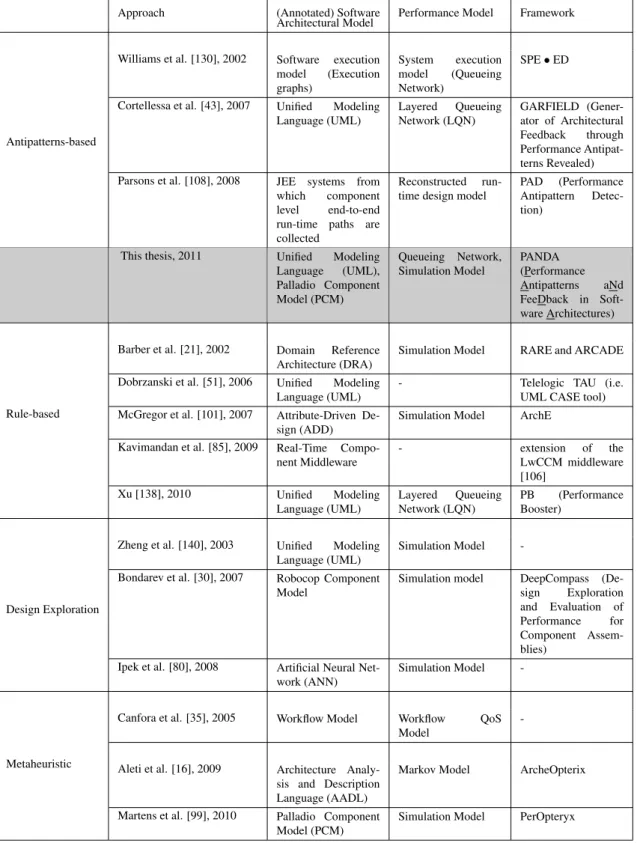
Table 2.1 summarizes the main existing approaches in literature for the automated gener-ation of architectural feedback. In particular, four categories of approaches are outlined: (i) antipattern-based approaches; (ii) rule-based approaches; (iii) design space exploration approaches; (iv) metaheuristic approaches.
The approach of this thesis somehow belongs to two categories, that are: antipattern-based and rule-based approaches. This is because it makes use of antipatterns for specifying rules that drive towards the identification of performance flaws.
Eachapproachis classified on the basis of the category it belongs to. Table 2.1 compares the different approaches by reporting the(annotated) software architectural modeland the
performance modelthey use to validate their applicability, if available. The last column of Table 2.1 denotes asframeworkthe set of methodologies the corresponding approach entails. Note that in some cases the framework was implemented and it is available as a tool (e.g. SPE•ED, ArchE, PerOpteryx).
The framework we propose in this thesis, i.e. PANDA (Performance Antipatterns aNd FeeDback in SoftwareArchitectures), is meant to denote all the methodologies we pro-pose in this research work and aimed at performing three main activities, i.e. specifying, detecting and solving antipatterns. Such framework is still a work in progress and we aim to implement it in the next future.
Approach (Annotated) Software Performance Model Framework Architectural Model
Antipatterns-based
Williams et al. [130], 2002 Software execution
model (Execution graphs) System execution model (Queueing Network) SPE•ED
Cortellessa et al. [43], 2007 Unified Modeling
Language (UML) Layered Queueing Network (LQN) GARFIELD (Gener-ator of Architectural Feedback through Performance Antipat-terns Revealed)
Parsons et al. [108], 2008 JEE systems from
which component
level end-to-end
run-time paths are
collected
Reconstructed
run-time design model
PAD (Performance
Antipattern
Detec-tion)
This thesis, 2011 Unified Modeling
Language (UML), Palladio Component Model (PCM) Queueing Network, Simulation Model PANDA (Performance Antipatterns aNd FeeDback in Soft-ware Architectures) Rule-based
Barber et al. [21], 2002 Domain Reference
Architecture (DRA)
Simulation Model RARE and ARCADE
Dobrzanski et al. [51], 2006 Unified Modeling
Language (UML)
- Telelogic TAU (i.e.
UML CASE tool)
McGregor et al. [101], 2007 Attribute-Driven
De-sign (ADD)
Simulation Model ArchE
Kavimandan et al. [85], 2009 Real-Time
Compo-nent Middleware - extension of the LwCCM middleware [106] Xu [138], 2010 Unified Modeling Language (UML) Layered Queueing Network (LQN) PB (Performance Booster) Design Exploration
Zheng et al. [140], 2003 Unified Modeling
Language (UML)
Simulation Model
-Bondarev et al. [30], 2007 Robocop Component
Model
Simulation model DeepCompass
(De-sign Exploration
and Evaluation of
Performance for
Component
Assem-blies)
Ipek et al. [80], 2008 Artificial Neural
Net-work (ANN)
Simulation Model
-Metaheuristic
Canfora et al. [35], 2005 Workflow Model Workflow QoS
Model
-Aleti et al. [16], 2009 Architecture
Analy-sis and Description Language (AADL)
Markov Model ArcheOpterix
Martens et al. [99], 2010 Palladio Component
Model (PCM)
Simulation Model PerOpteryx
P
ERFORMANCE
A
NTIPATTERNS
The goal of this Chapter is to describe performance antipatterns that, similarly to patterns, define recurring solutions to common design problems inducing performance flaws. An antipattern definition includes the problem (i.e. model properties that characterize the antipattern) and the solution (i.e. actions to take for removing the problem).
Up to now, in literature performance antipatterns have been only textually represented through informal language syntaxes [123]. The core question tackled in this Chapter is: how can a performance antipattern be represented to be automatically processed? To this aim, a notation-independent representation of performance antipatterns based on logical predicates is introduced.
3.1
I
NTRODUCTION
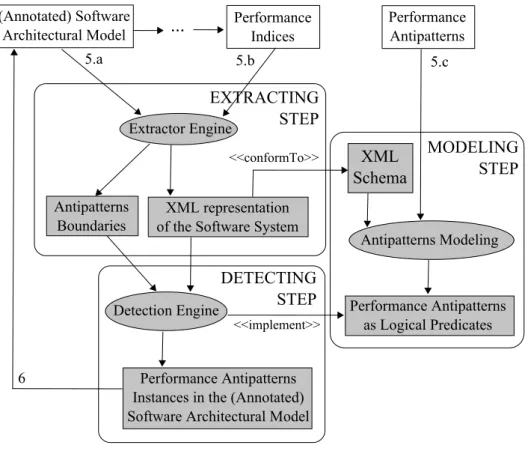
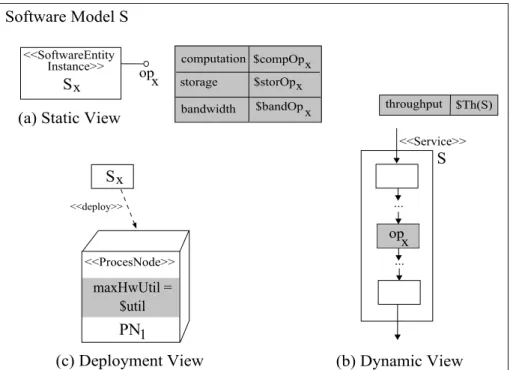
Figure 3.1 shows a first approach to the results interpretation & feedback generation steps of Figure 1.2. In order to make performance antipatterns machine-processable (that means detectable and solvable), we execute a preliminaryModelingstep, that is matter of this Chapter and is represented in the rightmost rounded box of Figure 3.1, in which we spec-ify antipatterns as logical predicates. Such predicates define conditions on architectural model elements (e.g. number of interactions among components, resource utilization, etc.), that allow to automate their detection. We have organized these architectural model elements in anXML Schema(see Appendix A).
Starting from an annotated software architectural model (label 5.a) and its performance indices (label 5.b), we execute anExtractingstep during which the extractor engine gener-ates anXML representation of the Software Systemconforming to our XML Schema and containing all and only the architectural model information we need to detect antipatterns. The modeling of antipatterns entails the introduction of a set ofBoundariesthat drive the interpretation of performance analysis results, since they define thresholds that will be compared with the predicted values in order to decide the performance critical elements of the software architectural model (see more details in Section 3.4).
TheDetectingstep is the operational counterpart of the antipatterns declarative definitions as logical predicates. In fact, the detection engine takes as input the XML representation of the software system and the antipatterns boundaries, and it returns as output a list of
performance antipatterns instances, i.e. the description of the detected problems as well as their solutions instantiated on the (annotated) software architectural model. Such list represents the feedback to the software designer, since it consists of a set of alternative refactoring actions, i.e. the backward path (label 6 of Figure 3.1), aimed at removing the detected antipatterns.
It is worth to notice that the formalization of performance antipatterns we propose is not heavily coupled with the detection engine: different types of engines can be implemented without modifying the formalization we define.
(Annotated) Software Architectural Model
XML representation of the Software System
EXTRACTING STEP Performance Indices 5.b 5.a <<conformTo>> 6
...
Performance Antipatterns Instances in the (Annotated) Software Architectural ModelDETECTING STEP <<implement>> Detection Engine Extractor Engine Performance Antipatterns 5.c XML Schema Performance Antipatterns as Logical Predicates Antipatterns Modeling MODELING STEP Antipatterns Boundaries
Figure 3.1: A first approach of the Results Interpretation & Feedback Generation steps.
This Chapter is organized as follows. Starting from the textual description of antipatterns (see Section 3.2), a graphical representation is provided to start reasoning on how an-tipattern specification may emerge from software architectural models (see Section 3.3). The logic-based formalization is explained in Section 3.4; it deals with the modeling of the antipattern problemspecification, whereas some hints about the antipattern solution