THIS DOCUMENT IS VALID FOR USE ONLY IF IT CARRIES AN SAP SYSTEM GENERATED DATE STAMP WITH A STATUS OF RELEASE GENERAL, AND FALLS WITHIN THE VALIDITY PERIOD.
NOTICE
THIS DOCUMENT AND ITS CONTENTS ARE EXCLUSIVE PROPERTY OF WATERS CORPORATION, MILFORD MASSACHUSETTS. THIS DOCUMENT MAY NOT BE REPRODUCED IN ANY FORM WHATSOEVER, WITHOUT PRIOR WRITTEN PERMISSION FROM WATERS CORPORATION. Template 730000483, Version 04TABLE OF CONTENTS
1.
∆General ... 3
1.1
Introduction ... 3
1.3
Process Approach ... 4
2.
∆Permissible Exclusions And Items Not Applicable ... 5
2.1
SCOPE ... 5
3.
Company Background ... 5
3.1
Customers ... 5
3.2
Sales Offices ... 5
3.3
Research and Development ... 6
3.4
Manufacturing ... 6
3.5
Waters and the Business of Separation Technology ... 6
3.6
∆Clinical Business Operations ... 6
4.
Quality Management System ... 7
4.1
∆General Requirements ... 7
4.2
Documentation Requirements ... 7
5.
Management Responsibility ... 11
5.1
∆Management Commitment ... 11
5.2
Customer Focus ... 11
5.3
Waters Division Mission Statement & Quality Policy ... 12
5.4
Planning ... 12
5.5
Responsibility, Authority and Communication ... 13
5.6
Management Review ... 14
6.
RESOURCE MANAGEMENT ... 15
6.1
Provision of Resources ... 15
6.2
Human Resources ... 15
6.3
Infrastructure ... 16
6.4
Work Environment ... 16
THIS DOCUMENT IS VALID FOR USE ONLY IF IT CARRIES AN SAP SYSTEM GENERATED DATE STAMP WITH A STATUS OF RELEASE GENERAL, AND FALLS WITHIN THE VALIDITY PERIOD.
NOTICE
THIS DOCUMENT AND ITS CONTENTS ARE EXCLUSIVE PROPERTY OF WATERS CORPORATION, MILFORD MASSACHUSETTS. THIS DOCUMENT MAY NOT BE REPRODUCED IN ANY FORM WHATSOEVER, WITHOUT PRIOR WRITTEN PERMISSION FROMWATERS CORPORATION. Template 730000483, Version 04 .
7.1
Planning of Product Realization ... 17
7.2
Customer-Related Processes ... 17
7.3
Design and Development ... 19
7.4
Purchasing ... 21
7.5
Production and Service Provision ... 22
7.6
Control of Monitoring and Measuring Devices ... 26
8.
MEASUREMENT, ANALYSIS AND IMPROVEMENT ... 27
8.1
General ... 27
8.2
Monitoring and Measurement ... 27
8.3
Control of Nonconforming Product ... 29
8.4
Analysis of Data ... 31
8.5
Improvement ... 31
∆Appendix I: Waters Business Operations Process Map ... 33
THIS DOCUMENT IS VALID FOR USE ONLY IF IT CARRIES AN SAP SYSTEM GENERATED DATE STAMP WITH A STATUS OF RELEASE GENERAL, AND FALLS WITHIN THE VALIDITY PERIOD.
NOTICE
THIS DOCUMENT AND ITS CONTENTS ARE EXCLUSIVE PROPERTY OF WATERS CORPORATION, MILFORD MASSACHUSETTS. THIS DOCUMENT MAY NOT BE REPRODUCED IN ANY FORM WHATSOEVER, WITHOUT PRIOR WRITTEN PERMISSION FROMWATERS CORPORATION. Template 730000483, Version 04 .
1.
∆GENERAL
1.1 Introduction
This manual provides an overview of the Quality Management System (QMS) at Waters Business Operations, Milford, Massachusetts, USA. It includes information related to the design of instrument products, development of applications software, instrument manufacturing and service support. This manual is released following the Quality System Document Control Process (730000295MP).
This manual follows ANSI/ISO/ASQ Q9001:2008 and ISO 13485:2003 Quality Management Systems Requirements and uses ISO/IEC 90003:2004, Guidelines for the Application of ISO 9001:2000 to Computer Software. The Quality
Management System complies with applicable regulatory requirements including FDA QSR, Canadian Medical
Regulations, and Directive 98/79/EC IVD Directive – Medical Devices. It also covers other specific Waters’ procedures referenced which are necessary for our business environment.
This manual includes policies, practices, objectives and reference procedures for a quality system that are necessary to consistently design, produce and deliver quality products and services.
It is the responsibility of the Senior Quality Assurance Manager as the Quality Management Representative to assure this manual is maintained as a current reflection of our Quality System.
Appendix I lists the top level Quality Management System procedures structured according to the appropriate section and sub-sections of ISO 9001:2008 / ISO 13485:2003 which further explain the topics addressed. This appendix also
references the appropriate section in Food Drug Administration (FDA) Quality System Regulation: (21 CFR Part 820) and Canadian Medical Regulations SOR/98-282 for convenience, especially, when dealing with our customers.
1.2 Reference Documents
Document Number Document Title
730000295MP Quality System Document Control
730000483 Quality Document Template
WAT000050MP Waters Record Retention Corporate Policy
N/A ANSI/ISO/ASQ Q9001-2008, ISO 9001:2008 American National Standard – Quality Management Systems – Requirements
N/A ISO 13485:2003
International Standard - Quality Management Systems – Requirements for regulatory purposes
N/A ISO/TR 14969:2004(E)
Guidance on the application of ISO 13485:2003 N/A ISO/IEC 90003:2004 Guidelines for the Application
of ISO 9001:2000 to Computer Software
N/A FDA QSR: 21 CFR Part 820
N/A TickIT Guide Issue 5.5
N/A ISO 14971:2009
Application of risk management to medical devices
N/A Canadian Medical Device Regulations (MDR)
THIS DOCUMENT IS VALID FOR USE ONLY IF IT CARRIES AN SAP SYSTEM GENERATED DATE STAMP WITH A STATUS OF RELEASE GENERAL, AND FALLS WITHIN THE VALIDITY PERIOD.
NOTICE
THIS DOCUMENT AND ITS CONTENTS ARE EXCLUSIVE PROPERTY OF WATERS CORPORATION, MILFORD MASSACHUSETTS. THIS DOCUMENT MAY NOT BE REPRODUCED IN ANY FORM WHATSOEVER, WITHOUT PRIOR WRITTEN PERMISSION FROMWATERS CORPORATION. Template 730000483, Version 04 .
1.3 Process Approach
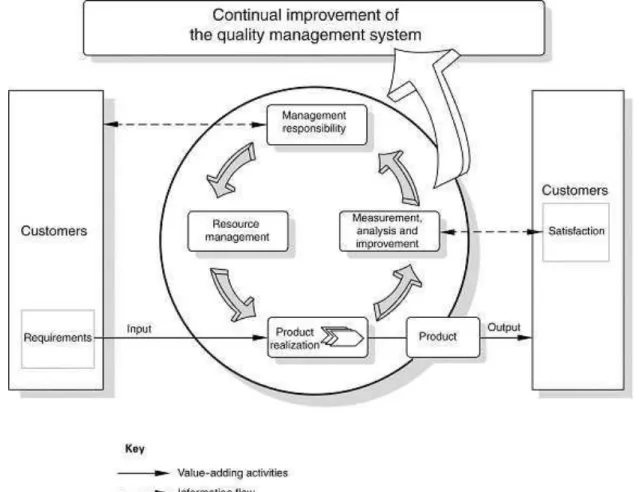
Waters uses a process-based QMS approach. Figure 1 illustrates the model used and shows that customers are the focus and an integral part of our process.
Figure 1. Model of a Process-Based Quality Management System
Reprinted with permission from ANSI/ISO/ASQ Q9001-2008 ASQ Quality Press: Milwaukee, WI
Waters monitors customer expectations and satisfaction and evaluates information related to customer perceptions as to whether Waters has met customer requirements. In addition, a Plan – Do – Check – Act (PDCA) Methodology is used.
PDCA can be described as follows:
PLAN: Objectives and processes necessary to deliver results in accordance with customer requirements and organization policies are established.
DO: The processes are implemented.
CHECK: The processes and products are monitored and measured against the policy, objectives and requirements and
the results are reported.
THIS DOCUMENT IS VALID FOR USE ONLY IF IT CARRIES AN SAP SYSTEM GENERATED DATE STAMP WITH A STATUS OF RELEASE GENERAL, AND FALLS WITHIN THE VALIDITY PERIOD.
NOTICE
THIS DOCUMENT AND ITS CONTENTS ARE EXCLUSIVE PROPERTY OF WATERS CORPORATION, MILFORD MASSACHUSETTS. THIS DOCUMENT MAY NOT BE REPRODUCED IN ANY FORM WHATSOEVER, WITHOUT PRIOR WRITTEN PERMISSION FROMWATERS CORPORATION. Template 730000483, Version 04 .
2.
∆PERMISSIBLE EXCLUSIONS
AND ITEMS NOT APPLICABLE
Waters Milford MA Quality Management System follows the applicable standards and regulations listed in Section 1.2. For exclusions and items not applicable, please see below.
7.5.1.2.1 Cleanliness of product and contamination control
The portions of section 7.5.1.2.1 addressing sterile medical devices do not apply, as Waters does not sell or distribute sterile medical devices. Sections c & d of Section 7.5.1.2.1 are applicable.
7.5.1.3 Particular requirements for sterile medical devices
The requirements for sterile medical devices are not applicable as Waters does not sterilize its medical devices or distribute sterile medical devices.
7.5.2.2 Particular Requirements for Sterile Medical Devices
The requirements for sterile medical devices are not applicable as Waters does not sterilize its medical devices or distribute sterile medical devices.
7.5.3.2.2 Particular Requirements for Active Implantable Medical Devices and Implantable Medical Devices
The requirements for implantable and active implantable medical devices does not apply as Waters does not manufacture, design, or distribute implantable or active implantable medical devices.
8.2.4.2 Particular Requirements for Active Implantable Medical Devices and Implantable Medical Devices
The requirements for implantable and active implantable medical devices does not apply as Waters does not manufacture, design, or distribute implantable or active implantable medical devices.
2.1 SCOPE
The scope of the quality management system is the design, manufacture, installation, servicing, sales, and distribution of analytical and preparative UPLC, HPLC, and MS systems.
3.
COMPANY BACKGROUND
Waters Corporation, headquartered in Milford, Massachusetts, develops, manufactures, and markets instruments,
software, accessories and supplies for analytical and preparative Ultra Performance Liquid Chromatography (UPLC), High Performance Liquid Chromatography (HPLC) and Mass Spectrometry (MS) Systems. Waters’ market includes In-Vitro Diagnostic medical device and non-medical device industries. In addition, Waters Corporation has maintained a commitment to leading edge programs in the area of service, support, customer education and compliance.
3.1 Customers
Pharmaceutical, biotechnology, semiconductor, chemical, environmental testing, and food and beverage companies; university laboratories, government and private analytical and research laboratories; defense and regulatory agencies; clinical laboratories, hospitals, dialysis centers, medical schools, and medical research institutes. Our customers work from the early stages of discovery and development through final quality control and assurance.
3.2 Sales Offices
Waters sells its products in the United States directly through its own Sales and Service organization. Sales in most European markets, Japan, China, Asia and Canada are made through subsidiaries, which specialize in Sales, Service and Support.
THIS DOCUMENT IS VALID FOR USE ONLY IF IT CARRIES AN SAP SYSTEM GENERATED DATE STAMP WITH A STATUS OF RELEASE GENERAL, AND FALLS WITHIN THE VALIDITY PERIOD.
NOTICE
THIS DOCUMENT AND ITS CONTENTS ARE EXCLUSIVE PROPERTY OF WATERS CORPORATION, MILFORD MASSACHUSETTS. THIS DOCUMENT MAY NOT BE REPRODUCED IN ANY FORM WHATSOEVER, WITHOUT PRIOR WRITTEN PERMISSION FROMWATERS CORPORATION. Template 730000483, Version 04 .
3.3 Research and Development
Waters’ Milford Massachusetts, USA, product development includes the design of new Ultra Performance Liquid Chromatography (UPLC), High Performance Liquid Chromatography (HPLC) instruments, Single Quadrupole Mass Spectrometers, software for instrument control, applicationsand accessories. Design of Waters tendem (triple
quadrupole) and other high valuemass spectrometry (MS) instruments is performed in Manchester UK, under a separate ISO 9001 certification and not covered in this manual. Since UPLC, HPLC, MS, and LC/MS instruments are
characterized by a rapid rate of technological change, Waters makes significant investments in research, development and product improvements to meet and exceed customers’ needs and expectations.
3.4 Manufacturing
Waters’ manufacturing activities are conducted at the facilities in Milford, Massachusetts as well as Wexford, Ireland. Manufacturing activities include the production of parts and assemblies used in its products.
Some of the parts are built by outside qualified suppliers. Products incorporate mechanical, electronic, chemical, and optical components. Prior to shipment to the customer, completed instruments and component products are extensively tested and evaluated to meet specified requirements.
3.5 Waters and the Business of Separation Technology
Waters is a publicly held corporation engaged in the business of developing, manufacturing and marketing products incorporating separation and detection technology. Individually, or in combination, these techniques can be used to isolate, purify, select, compare and/or quantitate chemicals in solutions. They can also be used to separate and/or remove microscopic and chemical contaminants from liquids and/or to identify individual chemical components in solutions.
3.6 ∆Clinical Business Operations
The Clinical Business works with various groups within Waters and other subcontractors for the design, development, manufacture, installation and servicing of products classified as In Vitro Diagnostics. The table below displays the responsibilities for products currently marketed as IVD products. Details of responsibilities are documented in Quality Agreements.
THIS DOCUMENT IS VALID FOR USE ONLY IF IT CARRIES AN SAP SYSTEM GENERATED DATE STAMP WITH A STATUS OF RELEASE GENERAL, AND FALLS WITHIN THE VALIDITY PERIOD.
NOTICE
THIS DOCUMENT AND ITS CONTENTS ARE EXCLUSIVE PROPERTY OF WATERS CORPORATION, MILFORD MASSACHUSETTS. THIS DOCUMENT MAY NOT BE REPRODUCED IN ANY FORM WHATSOEVER, WITHOUT PRIOR WRITTEN PERMISSION FROMWATERS CORPORATION. Template 730000483, Version 04 .
4.
QUALITY MANAGEMENT SYSTEM
4.1 ∆General Requirements
Waters has established, documented, implemented, and maintains a quality management system in accordance with the requirements of ISO 13485:2003, ISO 9001:2008, and applicable regulatory requirements (including FDA QSR, Canadian MDR, and the European IVD Directives).The Waters Quality Management System (QMS) includes the Quality Manual, policies, procedures, organizational structure, requirements and responsibilities for achieving our quality policy and objectives. The foundation for our QMS is found in Waters’ Mission and Quality Policy. They help to ensure the following objectives:
a. Focus on our Customers b. Participation of our People c. Continual Improvements
This Quality Manual and its associated policies and procedures establish and document the means by which
we implement, maintain and continually improve our QMS. The processes needed for our QMS include those identified in the ISO 9001:2008 and ISO 13485:2003 standard, as well as those developed to meet Waters’ particular business needs. Waters ensures that resources and information necessary to support the operation and monitoring of the required
processes are adequate. Resource needs are evaluated during product planning and during management reviews. Processes are monitored, measured, and analyzed to ensure they are effective and to allow for continual improvement. Waters implements actions necessary to maintain the suitability and effectiveness of the processes. These actions are recorded as part of the Corrective and Preventive Action process.
Waters controls and monitors outsourced processes. The type and extent of control and monitoring shall be
commensurate with the risk involved with the process. Control of outsourced processes may include written agreements, continuous monitoring, on-site auditing, quality surveys, ISO certification, and performance or workmanship evaluation. Specifications and/or requirements are sent to suppliers of outsourced services as appropriate. National or international standards are utilized where applicable.
Outsourced processes and services may include the following:
Finished Device Manufacturing, Labeling, and Packaging
Regulatory or Quality ConsultingThe controls and requirements of outsourced processes are outlined in document 730001504 - Outsourced Process List. Outsourced suppliers are identified in Waters’ Qualified Suppliers Listing (QSL). Supplier history information is
maintained and monitored. Records regarding the control of outsourced processes shall be maintained in the applicable supplier files. Waters Corporation works closely and has regular communication with the suppliers of these outsourced services.
Control of Waters’ sister companies is demonstrated by central control management approach utilizing the Management Review process of Waters’ Milford site.
4.2 Documentation Requirements
4.2.1 General
QMS documentation includes this Quality Manual, Policies, Procedures, Design Standards (DS’s), work instructions, reports, records, forms and other documents. Documents and data are in the form of hard copy and/or electronic media and/or other type of media. Some of the procedures are referenced in various sections of this manual and in Appendix I.
THIS DOCUMENT IS VALID FOR USE ONLY IF IT CARRIES AN SAP SYSTEM GENERATED DATE STAMP WITH A STATUS OF RELEASE GENERAL, AND FALLS WITHIN THE VALIDITY PERIOD.
NOTICE
THIS DOCUMENT AND ITS CONTENTS ARE EXCLUSIVE PROPERTY OF WATERS CORPORATION, MILFORD MASSACHUSETTS. THIS DOCUMENT MAY NOT BE REPRODUCED IN ANY FORM WHATSOEVER, WITHOUT PRIOR WRITTEN PERMISSION FROMWATERS CORPORATION. Template 730000483, Version 04 .
QMS documentation was developed based on the size, type of the related organization, the interaction of the processes, the complexity of the work, the methods used, and the skills and training needed from competent employees involved in carrying out the activities.
These documents reflect activities, materials, equipment, quality standards, and records that ensure our products / services conform to specified requirements. For additional information, see section 4.2.2 titled Quality Manual. Control of QMS documents is covered in section 4.2.3 of this manual, Control of Documents.
4.2.2 ∆Quality Manual
This Quality Manual is structured based on and addresses the clauses of ISO 9001:2008, ISO 13485:2003 and references the Software Guideline, ISO/IEC 90003:2004.
A cross-reference index to support the Quality documentation is listed in Appendix I. It also cross-references the FDA Quality System Regulation (21 CFR Part 820) and Canadian Medical Device Regulations (MDR).
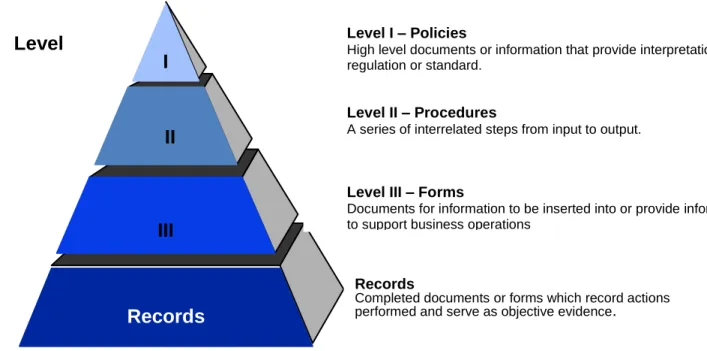
Figure 2. Waters QMS Documentation Structure
Waters integrated the Document Management Viewer, an electronic interactive tool providing easy access to documents housed within SAP. Once a document is released in SAP, it becomes available via the Document Management Viewer. This process minimizes the amount of hard copies distributed company-wide. The current system does not include all locally controlled procedures/work instructions at the department level.
This Quality Manual describes processes identified in the ISO 9001:2008and ISO 13485:2003 standards as applicable to Waters and those which are part of the Waters’ QMS.
QMS documents are controlled as described in Section 4.2.3 of this manual, Control of Documents.
I
II
III
Records
Level
Records
Completed documents or forms which record actions performed andserve as objective evidence
.
Level I – Policies
High level documents or information that provide interpretation of a regulation or standard.
Level II – Procedures
A series of interrelated steps from input to output.
Level III – Forms
Documents for information to be inserted into or provide information to support business operations
THIS DOCUMENT IS VALID FOR USE ONLY IF IT CARRIES AN SAP SYSTEM GENERATED DATE STAMP WITH A STATUS OF RELEASE GENERAL, AND FALLS WITHIN THE VALIDITY PERIOD.
NOTICE
THIS DOCUMENT AND ITS CONTENTS ARE EXCLUSIVE PROPERTY OF WATERS CORPORATION, MILFORD MASSACHUSETTS. THIS DOCUMENT MAY NOT BE REPRODUCED IN ANY FORM WHATSOEVER, WITHOUT PRIOR WRITTEN PERMISSION FROMWATERS CORPORATION. Template 730000483, Version 04 .
4.2.3 Control of Documents
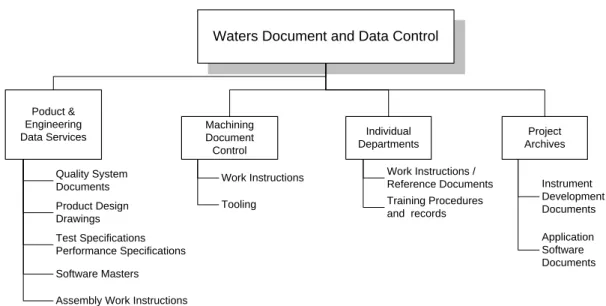
Documents and data are maintained in accordance with document control policies and procedures. There are four areas of document control.
a. Product and Engineering Data Services: controls the Quality System documentation, assembly work instruction, design documentation, including: drawings, test specifications and performance
specifications that directly affect fit, form and function of Waters products.
b. Machining Document Control: controls the work instructions and tooling of the machining process. c. Individual Department Controlled Documents: local training / work instruction / procedures are locally
controlled by the appropriate departments.
d. Project Archives: controls project documents generated by the Instrument Development Process and Software Development Process.
Quality Management System Documents are reviewed periodically for accuracy and revised as required to reflect latest practices. Each document control area is responsible for revision control coordination, processing, and distribution of the applicable procedures.
Engineering Services maintains the master list for External Documents, such as, National and International standards / regulations. Control of external documents is decentralized by the appropriate department holder. Impact on the product / process or QMS is assessed by the appropriate department holder when a document is revised.
QMS documents, including those identified as quality records, are controlled.
The following are the requirements for document and data review, approval and issue: a. Approve documents for adequacy prior to issue
b. Review, update as necessary and re-approve documents c. Identify the current revision status of documents
d. Ensure that relevant revisions of applicable documents are available at points of use e. Ensure that documents remain legible, readily identifiable and retrievable
f. Ensure that documents of external origin are identified and their distribution controlled
g. Prevent the unintended use of obsolete documents, and apply suitable controls and identification measures if they are retained for any purpose
Document changes are reviewedand approved by the individual(s) or functions approving the original version.
Changes are incorporated in accordance with documented procedures. Changes to documents are identified and communicated to the user, as appropriate. Each document control area maintains the current revision of
documents as well as the revision history.
These documents identify the records to be established to verify that specified requirements for the process and/or the product are met.
It is Waters policy that when a copy of an obsolete document is retained, it will be for a period of time that is not less than the expected lifetime of the device, but no less than the retention time required by the regulations. This is defined in the Product Support Review Process and detailed in the site Record Retention Schedule.
THIS DOCUMENT IS VALID FOR USE ONLY IF IT CARRIES AN SAP SYSTEM GENERATED DATE STAMP WITH A STATUS OF RELEASE GENERAL, AND FALLS WITHIN THE VALIDITY PERIOD.
NOTICE
THIS DOCUMENT AND ITS CONTENTS ARE EXCLUSIVE PROPERTY OF WATERS CORPORATION, MILFORD MASSACHUSETTS. THIS DOCUMENT MAY NOT BE REPRODUCED IN ANY FORM WHATSOEVER, WITHOUT PRIOR WRITTEN PERMISSION FROMWATERS CORPORATION. Template 730000483, Version 04 .
Waters Document and Data Control
Poduct & Engineering Data Services
Machining Document Control
Individual Departments
Project Archives
Quality System Documents Product Design Drawings Test Specifications Performance Specifications
Software Masters
Assembly Work Instructions
Work Instructions
Tooling
Work Instructions / Reference Documents Training Procedures and records
Instrument Development Documents
Application Software Documents
Figure 3. Document and Data Control Flow Chart
4.2.4 ∆Control of Quality Records
The following are examples of quality records that are maintained to demonstrate conformance to specified requirements and the effective operation of the quality system. Records are identified, collected, indexed, filed, stored and maintained in a manner that provides assurance that they are retrievable when required.
Quality records may consist of:
a. Results of processes performed
b. Product/process evaluation for meeting acceptance criteria.
c. Procedures, drawings or instructions used to perform an activity, including revision and/or date of document.
d. Identification of material, parts, or equipment used in the making of the product. e. Personnel qualification and training
f. Material or equipment qualifications g. Calibration information
Records are maintained for a period of time not less than the expected lifetime of the devices as defined by the organization, but no less than 2 years from the date of product release.
THIS DOCUMENT IS VALID FOR USE ONLY IF IT CARRIES AN SAP SYSTEM GENERATED DATE STAMP WITH A STATUS OF RELEASE GENERAL, AND FALLS WITHIN THE VALIDITY PERIOD.
NOTICE
THIS DOCUMENT AND ITS CONTENTS ARE EXCLUSIVE PROPERTY OF WATERS CORPORATION, MILFORD MASSACHUSETTS. THIS DOCUMENT MAY NOT BE REPRODUCED IN ANY FORM WHATSOEVER, WITHOUT PRIOR WRITTEN PERMISSION FROMWATERS CORPORATION. Template 730000483, Version 04 .
5.
MANAGEMENT RESPONSIBILITY
5.1 ∆Management Commitment
Senior Management shows evidence of its commitment to the development and improvement of our quality management system. Refer to our Quality Policy (Section 5.3). The Quality Policy documents and communicates the importance of meeting or exceeding customers’ expectations, by continually improving our processes, products, and services. We ensure that our Quality Policy is understood, implemented, and maintained at all levels of the organization through documented training, regular communication, and verbal reinforcement.
Senior leadership also demonstrates its commitment to the development and improvement of our QMS by regularly establishing quality objectives (see 5.4.1 Quality Objectives), conducting management reviews (see 5.6 Management Review), and ensuring the availability of necessary resources (see section 6.1 Provision of Resources).
5.2 Customer Focus
Our Quality Policy articulates our commitment to our customers: “Waters strives to provide innovative technological solutions, products, and services to our customers by attaining a keen understanding of their needs and requirements”. Customer expectations are determined, understood, converted into requirements, and have processes designed to exceed them in order to fulfill this Quality Policy on a daily basis.
We work hard to be an active partner with our customers, understanding their world and identifying solutions tailored to their needs and applications. Staying close to our customers is our primary method of determining and understanding their requirements and expectations. We accomplish this objective through a multitude of channels. These include Technology Seminars, user meetings, regular customer visits by our sales managers and representatives, trade shows, special customer visits by the leadership of our corporation, phone contact with multiple levels of our customers’ organization, and customer audits of our facilities. These communications and interactions ultimately yield clear, explicit customer requirements and expectations in the form of a contractual agreement and/or customer specification. The QMS ensures that these requirements are fulfilled with the aim of meeting and/or exceeding our customers’ expectations. Our Mission Statement expresses our responsibility to our customers: “Customer success is our mission”.
Waters Division Mission Statement and Quality Policy express the purpose of our organization. The integration of our Mission and Quality Policy statement symbolizes the purpose of our organization, and also guides the way we accomplish that purpose. Our Mission and Quality Policy indicate our commitment and focus on what is important to us as an
organization: meeting or exceeding customer requirements; and it prescribes the method by which we accomplish this: by continually improving our processes, products, and services. Moreover, it acts as a compass in providing the direction and a framework for establishing and reviewing quality objectives.
We ensure that our Quality Policy is communicated and understood at all levels of the organization through documented training, regular communication, and verbal reinforcement.
Our Mission Statement and Quality Policy are controlled by their inclusion in this Quality Manual, and by being reviewed annually at the Executive Management Review meeting for continuing suitability and effectiveness.
THIS DOCUMENT IS VALID FOR USE ONLY IF IT CARRIES AN SAP SYSTEM GENERATED DATE STAMP WITH A STATUS OF RELEASE GENERAL, AND FALLS WITHIN THE VALIDITY PERIOD.
NOTICE
THIS DOCUMENT AND ITS CONTENTS ARE EXCLUSIVE PROPERTY OF WATERS CORPORATION, MILFORD MASSACHUSETTS. THIS DOCUMENT MAY NOT BE REPRODUCED IN ANY FORM WHATSOEVER, WITHOUT PRIOR WRITTEN PERMISSION FROM WATERS CORPORATION.5.3 Waters Division Mission Statement & Quality Policy
Mission Statement
Customer success is our mission. Waters creates business advantages for laboratory-dependent
organizations by delivering practical and sustainable scientific innovation to enable significant advancements in
such areas as healthcare delivery, environmental management, food safety, and water quality worldwide.
Bringing keen understanding and deep experience to those responsible for laboratory infrastructure and
performance, Waters helps customers make profound discoveries, optimize lab operations, deliver product
performance, and ensure regulatory compliance.
Pioneering a connected portfolio of separation and analytical science, laboratory informatics, and mass
spectrometry, Waters’ technology breakthroughs and laboratory solutions provide an enduring platform for
customer success.
Quality Policy
Waters strives to provide innovative technological solutions, products, and services to our customers by
attaining a keen understanding of their needs and requirements.
Our quality systems are designed to have a meaningful impact on our business while meeting Statutory and
Regulatory requirements.
Quality is the responsibility of every employee within the Waters organization. We demonstrate our
commitment to quality by monitoring and maintaining the effectiveness of our quality systems through business
process metrics and by fostering an environment of continuous improvement throughout all levels of the
organization.
5.4
Planning
5.4.1 Quality Objectives
At the executive management system level, our quality objectives are to achieve our Mission Statement and Quality Policy, and to maintain the integrity of and continually improve our QMS that satisfies international requirements for ISO 9001:2008 and ISO 13485:2003registration. At the operational level, product, project, and contract objectives are developed, as appropriate, to meet or exceed our customers’ expectations
.
5.4.2 Quality Management System Planning
Our Quality Management System, as described in this Quality Manual and its associated procedures, is that part of the overall management system which implements our Quality Policy, establishes procedures by which we meet or exceed customer expectations, and satisfies international system requirements for ISO 9001:2008 and ISO13485:2003 registration, as well as, regulatory requirements. As such, it also constitutes the overall Waters quality plan.
This manual identifies the following documents / processes supporting new products quality planning: a. Waters Business Operations Quality Manual
THIS DOCUMENT IS VALID FOR USE ONLY IF IT CARRIES AN SAP SYSTEM GENERATED DATE STAMP WITH A STATUS OF RELEASE GENERAL, AND FALLS WITHIN THE VALIDITY PERIOD.
NOTICE
THIS DOCUMENT AND ITS CONTENTS ARE EXCLUSIVE PROPERTY OF WATERS CORPORATION, MILFORD MASSACHUSETTS. THIS DOCUMENT MAY NOT BE REPRODUCED IN ANY FORM WHATSOEVER, WITHOUT PRIOR WRITTEN PERMISSION FROM WATERS CORPORATION.c. Instrument Development Plan d. New Product Introduction
e. Sustaining Engineering Development f. Validation and verification
g. Change control h. Product reviews i. Test Engineering Plan j. Reliability Plan k. Service Plan l. Manufacturing Plan m. Production Planning
Quality plans for products in production are contained in documented instructions in the form of routings, process flow charts, standard operating procedures, inspection procedures and test specifications and procedures. Where required, these documents specify and identify suitable resources, controls, and process equipment, test equipment, environmental needs, verification, visual or physical criteria and/or applicable workmanship standards and records.
Executive Management will ensure the integrity of the quality management system is maintained when changes are planned and implemented.
5.5
Responsibility, Authority and Communication
Organizational charts represent management functions within the scope of our Quality System requirements.
5.5.1 Responsibility and Authority
Executive Management sets direction and ensures the success of Waters Corporation.
Responsibilities and authorities are defined in organizational charts, policies and procedures, as well as in job descriptions.
Other senior Managers, while under the direction of the Executive Staff, have primary responsibility for all operations under their control, including the Quality Management System described herein. The following have the key responsibilities and authority for maintaining the integrity of our Quality Management System:
Executive Managers – The Executive Staff is ultimately responsible for the quality of products and services provided by Waters since it controls the systems in which work is accomplished. The Executive Staff is
responsible for company-wide Strategic Planning and Quality Improvement Process Planning, the development of our Quality Policy and Mission, and provision of the necessary resources for accomplishing our group-level goals and objectives. Additionally, Executive Management is responsible for conducting quality system reviews on a semi annual basis (refer to section 5.6).
Management - Execution of the Strategic Plan, budgeting, and implementation of the quality management system and policies are the responsibility of Managers throughout the organization with the objective of adhering to specified requirements.
Employee Responsibility - All employees are responsible for the quality of their work and for their part in the overall processes used to provide products, information and services to our customers. Employees identify and
THIS DOCUMENT IS VALID FOR USE ONLY IF IT CARRIES AN SAP SYSTEM GENERATED DATE STAMP WITH A STATUS OF RELEASE GENERAL, AND FALLS WITHIN THE VALIDITY PERIOD.
NOTICE
THIS DOCUMENT AND ITS CONTENTS ARE EXCLUSIVE PROPERTY OF WATERS CORPORATION, MILFORD MASSACHUSETTS. THIS DOCUMENT MAY NOT BE REPRODUCED IN ANY FORM WHATSOEVER, WITHOUT PRIOR WRITTEN PERMISSION FROM WATERS CORPORATION.record any problems related to the product, process, and quality system. Employees are also the key participants in process improvements and the identification of measures needed to ensure the success of our continual improvement processes.
Responsibility and authority of functions affecting quality are in procedures / job descriptions available from Individual departments / the Human Resources Department.
5.5.2 ∆Management Representative
Senior Manager Quality Assurance is appointed as the Quality Management System Representative.
Responsibilities of this position are to ensure that a quality system is established, implemented, and maintained in accordance with the ISO 9001:2008, ISO 13485:2003, 21 CFR Part 820, Canadian Medical Device Regulations and ISO/IEC 90003:2004 - Guidelines for the Application of ISO 9001:2000 to Computer Software. In addition, the Quality Management System Representative is responsible for reporting to Executive Management Team on the performance of the QMS, ensuring the promotion of awareness of regulatory and customer requirements throughout the organization, and ensuring that the performance of the system is reviewed as a basis for continual improvement.
The President of Waters Business Operations and the Executive Management Team are responsible for ensuring that these standards and guidelines are implemented.
The Management team of Waters has defined authority and responsibility for ensuring that the Quality Management System is implemented effectively.
5.5.3 Internal Communication
We ensure communication regarding QMS processes and their effectiveness among all levels of our organization through documented training, the internal audit program, the corrective and preventive action programs and regular formal and informal communications. Formal communication is facilitated through regular company-wide presentations by the Chief Executive Officer, Organization-wide meetings held by the vice presidents, and department staff meetings.
5.6
Management Review
5.6.1 ∆General
There are two types of Management Reviews. One involves Vice Presidents meeting with their staff and the second type includes the executive staff made up of the President, the Vice Presidents and the Quality Assurance Senior Director or Manager, as a minimum.
The Executive Management of Waters meets minimally annually to review and ensure the continuing suitability, adequacy, and effectiveness of the QMS. At this meeting, a number of Quality Management System components are reviewed to ensure that they remain current and applicable with business trends, market shifts and customer needs. These include the Mission Statement, the Quality Policy, quality objectives, and the need for changes to the QMS. The Senior Operations staff also reviews those items that are not resolved at the local manager level, or that require a system wide resolution.
5.6.2 Review Input
The management review meetings include: a. Results of audits,
THIS DOCUMENT IS VALID FOR USE ONLY IF IT CARRIES AN SAP SYSTEM GENERATED DATE STAMP WITH A STATUS OF RELEASE GENERAL, AND FALLS WITHIN THE VALIDITY PERIOD.
NOTICE
THIS DOCUMENT AND ITS CONTENTS ARE EXCLUSIVE PROPERTY OF WATERS CORPORATION, MILFORD MASSACHUSETTS. THIS DOCUMENT MAY NOT BE REPRODUCED IN ANY FORM WHATSOEVER, WITHOUT PRIOR WRITTEN PERMISSION FROM WATERS CORPORATION.c. Process performance and product conformity, d. Regulatory requirements and compliance, e. Status of preventive and corrective actions,
f. Follow-up actions from previous management reviews, g. Changes that could affect the QMS, and,
h. Opportunities and recommendations for improvement.
5.6.3 Review Output
Outputs from the management reviews include any decisions and actions related to: a. Improvement of the QMS and its processes,
b. Improvement of product related to customer, Waters and regulatory requirements, and, c. Resource needs.
6.
RESOURCE MANAGEMENT
6.1 Provision of Resources
Appropriate resources, including trained employees, are identified and provided throughout the documented Quality Management System. These include the resources needed to ensure implementation and improvement of the QMS, conduct audits, comply with regulatory requirements, and address customer satisfaction.
We believe that our employees are our most valuable assets. We do our best to help them achieve their full potential through continuous education and training. Employees have assigned responsibilities defined in the QMS and are competent based on education, training, skills, and experience.
Individuals with the necessary education, experience and training carry out quality related activities by following defined procedures. These activities conform to specified requirements to include but not limited to instrument design, applications software design and development, product verification and validation, assembly, inspection, test, monitoring of the
production processes, complaint evaluation and audits of the product and of the QMS.
Resource needs are evaluated as part of the management review meetings, as well as part of the regular operations of individual departments. The results are process monitoring and measurement which are evaluated to determine if additional resources are needed to comply with requirements and maintain product quality.
6.2 Human Resources
6.2.1 General
Every advertised position includes details of what the requirements for the position are and what the education, skills or experience of the applicants should be. Based on this process, competency is not compromised and the employees become the most valuable resource for Waters.
6.2.2 Competence, Awareness and Training
a.Training Needs Determination
Waters hires and trains qualified and competent people. New employees are trained on processes unique to Waters.
THIS DOCUMENT IS VALID FOR USE ONLY IF IT CARRIES AN SAP SYSTEM GENERATED DATE STAMP WITH A STATUS OF RELEASE GENERAL, AND FALLS WITHIN THE VALIDITY PERIOD.
NOTICE
THIS DOCUMENT AND ITS CONTENTS ARE EXCLUSIVE PROPERTY OF WATERS CORPORATION, MILFORD MASSACHUSETTS. THIS DOCUMENT MAY NOT BE REPRODUCED IN ANY FORM WHATSOEVER, WITHOUT PRIOR WRITTEN PERMISSION FROM WATERS CORPORATION.Each department determines employee training, awareness, and competency needs through a variety of methods. Position descriptions are maintained for each position. Identified in these descriptions are activities / skills that affect the quality of products and services.
b.Provision
Waters develops and provides training that balances organizational needs with the development and career needs of our employees. Training may be executed by an expert in the subject matter. The subject matter expert is obtained by: 1) hiring an external consultant; 2) an internal employee who comes with the background in education and experience applicable to the subject matter; or 3) an internal employee only after completing an external course in the subject matter.
Quality System training covering requirements for ISO 9001:2008, ISO 13485:2003,and 21 CFR Part 820 is provided to employees. When a procedure is created / updated and implemented, those employees responsible for that specific process are trained. Individual Personal Development Plans are generated with each employee on an annual basis. Personal Development Plans are used to determine both inside and outside training needs for the fiscal year. Training / Certification records for various training sessions / courses are maintained.
c.Effectiveness
Waters evaluates the effectiveness of the training through immediate feedback and longer-term evaluation through the performance review process. Ultimately, comprehensive measures such as productivity, on-time delivery, and customer satisfaction are the most critical measures of training effectiveness. Effective training will lead to the required competency level of employees.
d.Employee Contributions
Waters ensures that our employees are aware of the relevance and importance of their activities and how they contribute to the achievement of our quality objectives. This is accomplished through QMS training.
6.3 Infrastructure
Waters provides and maintains suitable production, installation and servicing facilities needed to achieve product and service conformance. This includes physical resources (i.e. buildings), specialized equipment, workspace, associated utilities, hardware and software, and supporting services (transport and communications).
Waters ensures equipment used for production and other activities that may affect product quality are maintained in accordance to written schedules. Maintenance records are kept as objective evidence.
6.4 Work Environment
Waters identifies and manages the human and work environment factors needed to achieve product conformance and meet and/or exceed customer expectations. Our people are the key to our success, and the human and physical factors under which they work are of paramount importance. A suitable working environment is maintained.
Regarding physical factors, we employ a wide range of activities to monitor and improve workplace safety, health, and ergonomics. These include adherence to good manufacturing practices, safety team meetings, and training.
One of our objectives is to be an “employer of choice”. In addition to providing generous benefits, we accomplish this by providing flexibility, interesting work, a balance between work and family life and involvement of our employees in an empowered environment of continual improvements. We engender total participation by structuring a team environment, utilizing participative leadership styles, and involving employees in continual improvement teams.
Waters ensures environmental conditions and other factors that may negatively impact product quality are controlled and where appropriate monitored and measured. This may include basic housekeeping and ESD (Electro Static Discharge) controls.
THIS DOCUMENT IS VALID FOR USE ONLY IF IT CARRIES AN SAP SYSTEM GENERATED DATE STAMP WITH A STATUS OF RELEASE GENERAL, AND FALLS WITHIN THE VALIDITY PERIOD.
NOTICE
THIS DOCUMENT AND ITS CONTENTS ARE EXCLUSIVE PROPERTY OF WATERS CORPORATION, MILFORD MASSACHUSETTS. THIS DOCUMENT MAY NOT BE REPRODUCED IN ANY FORM WHATSOEVER, WITHOUT PRIOR WRITTEN PERMISSION FROM WATERS CORPORATION.7.
PRODUCT REALIZATION
7.1 Planning of Product Realization
Our QMS plans, identifies and documents our realization processes, and thereby ensures consistency with other requirements of the QMS. The QMS development, planning and implementation process includes the following:
a. the identification of product, process and quality objectives,
b. the need to establish processes and documentation and to provide resources and facilities specific to the product and the process,
c. verification and validation activities and the criteria for acceptability, and,
d. records necessary to provide confidence of conformity of processes and product. These elements are addressed in this manual and its associated procedures.
Whenever our standard established process cannot and does not fit customer’s specified requirements QMS develops a specific quality plan for that process or product.
Our approach to process management involves determining what the customer’s requirements are, developing a process capable of meeting these requirements, ensuring that the inputs to the process are appropriate, measuring process performance, and evaluating and improving the process to ensure it continues to perform as designed. The following sections describe our methods for achieving these objectives.
Waters maintains written procedures for risk management throughout product realization. Part of the planning process is the evaluation, analysis, and control of risk. Records of risk management are maintained. The ISO 14971:2007 Standard is used as guidance for the risk management activities at Waters.
7.2 Customer-Related Processes
Waters’ primary focus is to be an active partner with our customers, understanding their environment and identifying solutions suitable to their needs and applications, which will both meet and exceed their expectations.
We accomplish this objective through a multitude of channels, which include, but are not limited to, Technology Seminars, user meetings, routine customer visits by our sales team, trade shows, special customer visits by the Waters’ leadership team, direct phone contact with key personnel of our customers’ organizations, and customer audits of our facilities. These communications and interactions enable Waters to understand our customers’ environment, and enables Waters to identify solutions and design applications to meet, or exceed, our customers’ expectations. This process is one way that Waters continually strives to be a leader in the analytical scientific industry. The QMS ensures that these requirements are fulfilled with the aim of exceeding our customers’ expectations.
7.2.1 Determination of Requirements Related to the Product
a) We determine product requirements through market research, customer forums, individual customer inputs and Waters research groups. Customer input is the core of the process. Customer orders for standard forecasted catalog items are reviewed by Sales Support Staff and accepted based on published
specifications, quotes and delivery times. All delivery and post-delivery activities relative to the product are addressed at the time of order placement by the customer. Any differences are resolved prior to accepting the order. Changes to orders after they have been accepted are communicated internally and confirmed to the customer prior to shipment. Waters instruments are manufactured and sent to distribution as standard catalog items.
b) In addition to individual customer requirements, additional requirements may be added, including those that satisfy statutory and regulatory requirements, define delivery and post delivery activities and those that are necessary to specify intended use. Ultimately, product requirements are represented by specifications for
THIS DOCUMENT IS VALID FOR USE ONLY IF IT CARRIES AN SAP SYSTEM GENERATED DATE STAMP WITH A STATUS OF RELEASE GENERAL, AND FALLS WITHIN THE VALIDITY PERIOD.
NOTICE
THIS DOCUMENT AND ITS CONTENTS ARE EXCLUSIVE PROPERTY OF WATERS CORPORATION, MILFORD MASSACHUSETTS. THIS DOCUMENT MAY NOT BE REPRODUCED IN ANY FORM WHATSOEVER, WITHOUT PRIOR WRITTEN PERMISSION FROM WATERS CORPORATION.each standard part number. These specifications are documented in the Market Requirements Document.
The products are manufactured based on a build schedule that is delivered to Production Planning in the form of a forecast received from Global Manufacturing Planning for standard catalog items. The forecast is
reviewed and either accepted or revised. Changes are communicated to Global Manufacturing Planning (Master Planning).
c) Waters' products are manufactured in accordance with state and federal statutory and regulatory requirements, which include the FDA.
d) When required, Waters products are installed by Waters-trained service personnel, by setting up / qualifying the system and by training users in the basic operation of the equipment. When necessary, additional training can be provided by the local field support organization and/or Waters Educational Services instructors to satisfy customer expectations.
7.2.2 Review of Requirements Related to the Product
Upon receipt of an order for product and/or service, the appropriate internal support group reviews the order against the customer’s quote and any contractual agreements (i.e. Strategic Alliance Agreement), ensuring consistency between the order and established requirements. Contract and order reviews are performed in accordance with documented procedures to determine whether order criteria can be met prior to accepting and making a delivery commitment.
a. Type of Review–Product Requirements:
(i) Customer orders for standard forecasted catalog items are reviewed prior to acceptance by Sales Administration based on whether Waters can meet specific customer requirements, such as delivery schedule.
(ii) Customer orders for non-forecasted, refurbished catalog items are reviewed by the Global Manufacturing Planning and the Manufacturing Repair Department prior to their acceptance. Orders are accepted based on availability of the returned product.
(iii) Customer orders for service are reviewed against any existing contractual agreements by the Service Plan Support team and a determination is made as to whether Waters can meet the specific customer
requirements.
b. In all instances, differences are resolved prior to accepting the order. Changes to orders after they have been accepted are communicated internally and confirmed to the customer prior to shipment.
c. Acceptance of the order ensures that Waters has the ability to meet the defined requirements.
d. Record of Review: The results of the review process and follow-up action are ultimately recorded in Waters’
SAP System. Entry of the order into SAP constitutes evidence of contract review.
e. Changes to Product Requirements: Should Waters determine that a change to product requirements is necessary, the change is communicated to the customer by Sales Administration personnel in accordance with documented procedures. An update to the product file is made on SAP.
7.2.3 Customer Communication
Both domestically and internationally, communication with our customers is primarily achieved through our local Waters sales, service and support teams, as well as the Contract Administration department and Strategic Alliance Group. Communications may address information related to product, inquiries, contracts, contract amendments, order handling, complaints, and advisory notices / recalls. We pay particular attention to customer feedback in the form of customer satisfaction surveys and customer complaints.
THIS DOCUMENT IS VALID FOR USE ONLY IF IT CARRIES AN SAP SYSTEM GENERATED DATE STAMP WITH A STATUS OF RELEASE GENERAL, AND FALLS WITHIN THE VALIDITY PERIOD.
NOTICE
THIS DOCUMENT AND ITS CONTENTS ARE EXCLUSIVE PROPERTY OF WATERS CORPORATION, MILFORD MASSACHUSETTS. THIS DOCUMENT MAY NOT BE REPRODUCED IN ANY FORM WHATSOEVER, WITHOUT PRIOR WRITTEN PERMISSION FROM WATERS CORPORATION.7.3 Design and Development
7.3.1 Design and Development Planning
Overall Design Control is outlined by interconnected processes owned by various functions; Instrument Development, Evaluation, Core Product Engineering and Data Product Group (DPG) Software Development organizations. Other functions such as Reliability and Engineering Data Services support the efforts, as
applicable. The related procedures control and verify that specified requirements are met (refer to section 7.3 of Appendix I for the appropriate support procedures).
A Development Plan is created for each development project or program and outlines the following: a. Milestones
b. Development phases c. Design and code reviews
d. Qualified personnel, responsibilities and authorities e. Review, verification and validation
f. Assigned equipment
g. Sub-projects & sub-project managers h. External dependencies
i. Project schedule
j. Exit criteria for development phases A Test Plan is created for each development project.
Plans are reviewed and updated, when necessary, as the design evolves.
The Manufacturing Plan considers the requirements needed for the transfer to manufacturing. As part of the New Product Introduction (NPI), the design transfer ensures that design specifications are correctly translated into manufacturing procedures.
Design records generated during the design process are referenced or included in a Design History File (DHF) as required by Regulatory Agencies and / or QMS requirements.
7.3.2 Design and Development Inputs
The required input includes functional and performance specifications, safety requirements, outputs of risk management activities from previous designed products, applicable regulatory requirements and international compliance, information derived from previous design and other features and requirements essential for design and development. Market Requirements Documents and development plans and processes may include additional information to complement this list of documents.
Design inputs are reviewed for adequacy and approved.
7.3.3 Design and Development Outputs
The required verification procedures for Instrument Products are carried out at each phase of the development plan. The minimum set of document deliverables is outlined in the Waters instrument development process procedures referenced in Appendix I.
The required verification procedures for Application Software development carried out at each phase and a minimum set of document deliverables are outlined in the Waters DPG software development process
THIS DOCUMENT IS VALID FOR USE ONLY IF IT CARRIES AN SAP SYSTEM GENERATED DATE STAMP WITH A STATUS OF RELEASE GENERAL, AND FALLS WITHIN THE VALIDITY PERIOD.
NOTICE
THIS DOCUMENT AND ITS CONTENTS ARE EXCLUSIVE PROPERTY OF WATERS CORPORATION, MILFORD MASSACHUSETTS. THIS DOCUMENT MAY NOT BE REPRODUCED IN ANY FORM WHATSOEVER, WITHOUT PRIOR WRITTEN PERMISSION FROM WATERS CORPORATION.documents, DPG Quality Plan and the Procedure for Technical Reviews. Sign off of Task Completion Forms (electronic or paper) by the project manager and author signifies acceptance of software module(s) for submission to evaluation.
Records of design outputs are approved and maintained.
7.3.4 Design and Development Review
Suitable and systematic reviews of the design are conducted in accordance with the appropriate development procedures. Reviews are performed to evaluate the ability of the results of design and development to meet requirements. Records of reviews are archived before or at Approved for Shipment Review meeting.
Design control, input, implementation and reviews for Applications Software Products are outlined in the Waters various software development process documents and the Instrument Development Plan. Records of reviews are archived before or at a time software is released to manufacturing.
Design reviews must include participants concerned with the design stage being reviewed as well as other specialists deemed necessary. Each design review includes an individual(s) independent of the design stage being reviewed.
7.3.5 Design and Development Verification
Verification is performed based on the design, development and test plans. Verification confirms that design outputs meet the design input requirements.
Verification of instrument design occurs as the design matures progressively. Verification of the Applications Software occurs at major milestones as defined in the DPG software development process and Development Plan. A final verification of functionality occurs during the final evaluation phase. The product is validated and verified against the Marketing Requirements Document and Functional Specification under conditions similar to those existing during customer application. Final design verification is completed at the release meeting. Records of the results of the verification and any necessary actions are maintained.
7.3.6 Design and Development Validation
Design and development validation is performed based on the design, development and test plans to ensure that resulting product is capable of meeting the requirements for the specified application or intended use.
Test results confirm that required elements of the Marketing Requirements Document for Instrument or
Applications Software products are satisfied, and any other elements of the Functional Specification have been implemented. The plan assigns responsibilities for creating, reviewing and executing the test cases and scripts. Results from evaluation are collected at the instrument or application software release meeting and archived. Problems discovered by evaluation at any phase are recorded and tracked according to the Product Change System. Final design validation is done during the Final Evaluation Phase and at the Release Meeting.
Design validation establishes objective evidence that device specifications conform to user needs and intended use. Design validation during Instrument, Chemistry, and Software development life cycles includes testing under actual or simulated use conditions to assess product / device performance. Design validation includes clinical evaluation of the product / device only during the Clinical Chemistry Development lifecycle. Any clinical evaluation of a design is performed in accordance with applicable national or regional regulations.
THIS DOCUMENT IS VALID FOR USE ONLY IF IT CARRIES AN SAP SYSTEM GENERATED DATE STAMP WITH A STATUS OF RELEASE GENERAL, AND FALLS WITHIN THE VALIDITY PERIOD.
NOTICE
THIS DOCUMENT AND ITS CONTENTS ARE EXCLUSIVE PROPERTY OF WATERS CORPORATION, MILFORD MASSACHUSETTS. THIS DOCUMENT MAY NOT BE REPRODUCED IN ANY FORM WHATSOEVER, WITHOUT PRIOR WRITTEN PERMISSION FROM WATERS CORPORATION.7.3.7 Control of Design and Development Changes
Changes to the design and development are identified, controlled and recorded.
Changes are reviewed, verified and validated, as approved and appropriate before implementation. Review includes the effect of the changes on products and parts already delivered to customers. Changes are reviewed for regulatory impact on Canadian Licenses, FDA 510(k)’s, and European Technical Files.
Revision Control and Product Structure policies and practices are defined in the Instrument Development
Process, Waters Instrument Design Change Control Policy, and Waters Product Structure Development Process. Configuration management for software items and developer hardware and software is defined in the DPG Configuration Management Plan for Software. Configuration management of specifications and deliverables created by the DPG is defined in the procedures and archival policy used by DPG. Configuration management of test cases and hardware is defined in the Test Plan with any needed addenda and Test Summary Results. Configuration of Automated Test items, including automated test hardware and software, are defined in the DPG Configuration Management Plan for Software.
7.4 Purchasing
7.4.1 Purchasing Process
Waters ensures that purchased products and services that impact the final quality of our products, conform to our requirements. We accomplish this objective by clearly identifying our requirements, working in partnership with our suppliers, and utilizing appropriate verification activities. These efforts are described below.
It is the responsibility of the Purchasing Department to purchase product and services that conform to specified requirements from approved suppliers as defined in documented purchasing procedures.
Purchased material is submitted to the Incoming Material Audit Department to assure initial and continued conformance of material to stated requirements.
Specific requirements of each purchase are defined in purchase orders, which include the purchase specification, item revision, and other data, as required.
∆During design & development, material might not be submitted to Incoming Material Audit. The Design Material Control Procedure outlines the development / New Product engineer’s responsibility to make sure the material is in conformance with the requirements, controlled and identified as Research Only or Quarantined.
This manual, and associated procedures, establish the methods by which we control our purchasing process to ensure product conforms to requirements. The type and extent of control is dependent upon the effect on
subsequent realization processes and their output, as well as consideration of other characteristics including: the type of product; the potential impact of the product on our processes, products, or services; the results of supplier evaluations and past performance; Government regulations and industry requirements.
We have defined and documented the supplier approval process, including criteria for selection, the extent of control to be exercised, and periodic evaluation. Suppliers are evaluated and selected based on their ability to supply product in accordance with our requirements. The results of evaluations and follow-up actions are recorded.
∆Additionally, we maintain a record of approved suppliers. A Qualified Supplier List is maintained based on a supplier's ability to meet Waters quality requirements and design specifications. A supplier's inability to meet Waters quality and/or design requirements is reviewed and the appropriate action is initiated. A review of supplier's performance against the Waters Supplier Rating System takes place on a periodic basis by Supplier Quality Engineers and Purchasing Managers.
THIS DOCUMENT IS VALID FOR USE ONLY IF IT CARRIES AN SAP SYSTEM GENERATED DATE STAMP WITH A STATUS OF RELEASE GENERAL, AND FALLS WITHIN THE VALIDITY PERIOD.
NOTICE
THIS DOCUMENT AND ITS CONTENTS ARE EXCLUSIVE PROPERTY OF WATERS CORPORATION, MILFORD MASSACHUSETTS. THIS DOCUMENT MAY NOT BE REPRODUCED IN ANY FORM WHATSOEVER, WITHOUT PRIOR WRITTEN PERMISSION FROM WATERS CORPORATION.∆When required, one or more of the following activities will take place: a. Corrective action letter to supplier.
b. Supplier site evaluation.
c. Review Waters' design and/or Quality System.
d. Recommendation for disapproval submitted to the Supplier Quality Manager and the Materials Manager.
7.4.2 Purchasing Information
Purchasing documents contain the appropriate data to clearly and fully describe materials, which are being purchased. When appropriate, this includes requirements for approval or qualification of product, procedures, processes, equipment, personnel, and Waters’ QMS requirements.
We conduct review to ensure the adequacy of specified requirements contained in the purchasing documents prior to the placement of an order.
Design engineers are generating most of the orders, during the design phase of product development.
Following product release, orders are computer generated by the Materials Requirement Planning (MRP) System. These orders are then forwarded to Product and Engineering Data Services where the appropriate purchase specification/design drawings are added prior to delivery to Purchasing. This information is communicated to the supplier by referencing the Purchase Specification/Drawing number and revision on Purchase Orders. When Purchase Specifications/Drawings are revised, this updated information is communicated to the supplier. Any specific requirements to a Purchase Order, such as certificates, are addressed on the Purchase Specification. Purchase Orders are checked and verified and signed by the Purchasing Agent prior to issue.
7.4.3 Verification of Purchased Product
Waters has established and implemented inspection and other processes to ensure that purchased product meets specified purchase requirements.
Material used in processing or as part of the product or packaging is released for use after samples have been successfully inspected in accordance with the Incoming Material Audit Policy. The nature and degree of inspection is dependent upon the criticality of the part and the inspection history.
Release of material, prior to required verification, is neither allowed nor practiced. No material is released prior to being verified per requirements and specifications.
At this time, there is no formal customer source verification of product at the sub-contractor’s facility. Should this become a requirement, the Milford plant will comply with and assist in any such verifications. This process shall be initiated by the Quality Department. Such verification shall not supersede Waters Quality System
requirements.
7.5 Production and Service Provision
7.5.1 Control of Production and Service Provision
7.5.1.1 General Requirements
Waters plans and carries out production and service activities under controlled conditions. Controlled conditions includes availability of information related to the specifications of the product, qualified and competent personnel, documented instructions, suitable equipment, monitoring and measuring devices and the implementation of monitoring, measurement, release, delivery and post-delivery activities.