Radiation
Safety
Handbook
February 2010
Office for Research Safety
Office for ResearchContents
I. Foreword
II. General Policies and Procedures
1.0 Introduction1.1 General Policy Statement
1.2 Access to Records and Program Documents 1.3 ALARA Principle
2.0 Program Administration and Responsibilities 2.1 Administration
2.2 Radiation Safety Committee
2.3 Authorized Investigator and X-Ray Registrant Responsibilities 2.4 Radiation Worker Responsibilities
2.5 Office of Research Safety Services 3.0 University License and X-Ray Registrations
3.1 Illinois Emergency Management Agency 3.2 Broad-Scope License
3.3 Radioactive Materials in Human Subjects 3.4 X-Ray Registrations
4.0 Investigator Applications and Permits 4.1 General Information
4.2 Authorized User Qualifications 4.3 New Applications
4.4 Adding Radionuclides
4.5 Increases in Quantity of Radionuclides 4.6 Five Year Reviews
5.0 Radiation Worker Registration and Personnel Dosimetry 5.1 Registration Requirement
5.2 New Radiation Worker Packet
5.3 Radiation Worker Registration In NSIS 5.4 Training Video
5.5 Posted Radiation Worker List Requirement 5.6 Dosimetry Requirement
5.7 Types of Dosimeters
5.8 Minimum Reportable Doses 5.9 Control Dosimeters
5.10 Deep and Shallow Dose 5.11 Proper Use of Dosimeters
5.12 Instructions to Dosimetry Coordinators 5.12.1 Location Code
5.12.2 Wear Dates
5.12.3 Distributing Dosimeters 5.12.4 Collecting Dosimeters 5.12.5 Changes in Service 5.12.6 Temporary Dosimeters 5.12.7 Classes
5.12.8 Fees 5.12.9 Reports 6.0 Training
6.1 The Importance of Training
6.2 Authorized User or X-Ray Registrant Responsibilities 6.3 ORS Training Resources
7.0 Security, Theft, and Loss 8.0 Violations
8.1 IEMA Regulatory Penalties
8.2 Enforcement Actions for Items of Noncompliance
III. What is Radiation?
9.0 What is Radiation? 9.1 Definitions 9.2 Ionization 9.3 Range in Matter 9.4 Radioactive Decay
9.5 Maximum and Average Beta Energy
9.6 Characteristics of Commonly Used Radionuclides 10.0 Units of Radiation Activity
10.1 Activity Definition 10.2 SI System
10.3 Units of Activity 11.0 Dose and Exposure
11.1 Dose
11.2 Absorbed Dose 11.3 Dose Equivalent 11.4 Exposure
12.0 Time, Distance and Shielding 12.1 Three Effective Strategies 12.2 Time
12.3 Distance 12.4 Shielding
12.4.1 Shielding for Beta Particles 12.4.2 Shielding for Gamma Photons 13.0 Radiation Standards
13.1 Occupational Radiation Dose Limits 13.2 Occupational Dose Limits for Minors 13.3 Dose to an Embryo or Fetus
13.4 Permissible Levels of Exposure in Unrestricted Areas 14.0 Radiation Risks
14.1 General Information About Risk 14.2 Prenatal Radiation Exposure
IV. Radioactive Materials in the Laboratory
15.0 Authorized Laboratories15.1 General Requirements
16.0 Laboratory Guidelines for Unsealed Sources 16.1 General Information
16.2 Controlling Contamination
16.3 Recommendations for Hot Lab Conduct 17.0 Laboratory Surveys
17.1 ORS Surveys 17.2 User Surveys
17.3 Contamination Limits 17.4 Wipe Tests
17.5 Survey Instruments 17.5.1 Ratemeters
17.5.1.1 GM Detectors
17.5.1.2 Scintillation Detectors 17.5.2 Dose Rate Measuring Instruments
17.5.2.1 Ionization chambers
17.5.2.2 Tissue Equivalent Micro Rem Meters 17.5.3 Survey Meter Maintenance
17.5.4 Calibration 18.0 Radiation Emergencies
18.1 Emergency Phone Numbers 18.2 Procedure for Major Spills 18.3 Procedure for Small Spills
18.4 Radioactive Dusts, Gases, Organic Vapors 18.5 Spill Control
18.6 Decontamination
18.7 Emergencies with Radiation Producing Equipment 19.0 Bioassay
19.1 General Information 19.2 Urinalysis Procedures 19.3 Thyroid Counting Procedure 20.0 Procurement of Radioactive Materials
20.1 General Requirement 20.2 Electronic Ordering 20.3 ORS Electronic Approval 20.4 Shipping Address
20.5 Blanket Orders
20.6 Orders Placed Directly with Vendors 20.7 Delivery, Inspection and Authorized Limits 20.8 Radionuclide Inventory Form
20.9 Correlation of Inventory Forms with Stock Vials 20.10 Radioactive Material Received from Other Sources 20.11 Replacement Shipments and Samples
20.12 Radioactive Material to be Used at Other Institutions 21.0 Transfer of Radioactive Material
21.1 General Requirement
21.2 Intracampus Transfer to Another Investigator 21.3 Intercampus Transfer
21.4 Transfer to Other Institutions 21.5 Transfer from Other Institutions
22.0 Radioactive Waste
22.1 General Responsibilities
22.2 Reducing Non-Radiological Hazards 22.2.1 Reducing Biological Hazards 22.2.2 Reducing Physical Hazards 22.2.3 Reducing Chemical Hazards 22.3 Radiation Protection
22.4 Radwaste Record Keeping
22.5 Uranyl Acetate and Staining Solutions 22.6 Chelating Agents
22.7 Mixed Wastes 22.8 Biohazard Bags 22.9 Radwaste Labels 22.10 Requests for Pickup 22.11 Radwaste Containers 22.12 Liquid Radioactive Waste
22.12.1 Aqueous Waste
22.12.2 Organic Liquid Wastes
22.12.3 Phase Separation and Precipitation 22.13 Dry Radioactive Waste
22.14 Liquid Scintillation Vials/Bulk LSC Fluid 22.15 Biological Waste
23.0 Radioactive Materials in Experimental Animals 23.1 General Responsibilities
23.2 Animals Housed in CCM Facilities 23.3 Animals Housed in the Laboratory 23.4 Record Keeping
23.5 Radiation Safety
V. Other Sources of Radiation
24.0 Irradiators24.1 General 24.2 Authorization 24.3 Training 24.4 Dosimetry
24.5 Inspection and Calibration
24.6 Site-Specific Instructions for Chicago Irradiator 24.7 Site-Specific Instructions for Evanston Irradiator 25.0 X-Ray Producing Equipment
25.1 General Considerations 25.2 Analytical X-Ray
25.2.1 Dosimetry
25.2.2 Required Training 25.2.3 Required Postings 25.2.4 Required Labels 25.2.5 Required Indicators
25.2.6 Required Interlocks and Safety Devices 25.2.7 Required Monthly Checklist
25.2.8 Analytical X-Ray Emergency Procedure
25.2.9 Symptoms of Injury from Acute Local Exposure to Radiation 25.2.10 Radiation Hazards from Analytical X-Ray Units
25.2.11 Safe Working Practices for Analytical X-Ray 25.2.11.1 Beam Alignment
25.2.11.2 Sample changing
25.2.11.3 General Equipment Operation 25.3 Diagnostic X-Ray
25.3.1 Dosimetry 25.3.2 Records 25.3.3 Training
25.3.4 Written Policy Statement
25.3.5 General Equipment and Operating Requirements 25.3.5.1 Audible Signal
25.3.5.2 Technique Chart
25.3.5.3 Manual Film Processing 25.3.5.4 Automatic Film Processing 25.3.6 Required Postings
25.4 Fluoroscopy
25.4.1 Dosimetry 25.4.2 Siting
25.4.3 Required Postings 25.4.4 Training
25.4.5 Lead Aprons 25.4.6 Beam Limitation
25.4.7 Primary Barrier/Interlock 25.5 Cabinet X-Ray Systems
25.5.1 Regulations
25.5.2 Operating and Emergency Procedures 25.6 Veterinary X-Ray
25.6.1 Regulations 25.6.2 Dosimetry
25.7 Mobile/Portable X-Ray Systems 25.8 Electron Microscopes
26.0 Lasers
26.1 General Information 26.2 Registration
26.3 Safety
26.4 Signs and Labels
Appendix A: Commonly Used Radionuclides
Appendix B: General Procedure for Moving Radiation Laboratories
Glossary
Figures
9.1 Figure 9.1 Approximate Wavelengths and Photon Energies of Electromagnetic Radiation. 9.2 Radioactive Decay
Equations
9.1 Decay Constant 10.1 Activity
12.1 Intensity of a Photon Beam 17.1 Efficiency
22.1 Activity in LSC Vials
Tables
9.1 Commonly Used Radionuclides 10.1 SI Base Units
10.2 Common and SI Units of Activity 10.3 Prefixes
10.4 Conversion from Common to SI Units 13.1 Annual Allowable Occupational Dose
17.1 Contamination Limits for Beta and Gamma Emitters 19.1 Urinalysis Schedule
19.2 Thyroid Counting Schedule
Foreword
This Radiation Safety Handbook is the official training manual and policy and procedure guide for users of radioactive materials, radiation producing equipment, and sources of non-ionizing radiation at Northwestern University. This document has been reviewed by the University's Radiation Safety Committee and approved by the Vice President for Research. The Office of Research Safety (ORS) maintains it.
Radioactive materials and sources of ionizing and non-ionizing radiation are essential elements of research and teaching at Northwestern. This handbook provides answers to fundamental questions about the nature of radiation, guidance on protecting against radiation’s harmful effects, detailed University policies and procedures, and important regulatory information. Understanding the material in this handbook will help you evaluate the risks and benefits of working with these indispensable tools.
Your responsibilities as authorized investigators, supervisors, or radiation workers are described in the following pages; remember that using sources of ionizing radiation is a privilege, not a right, so review this document carefully. Responsibility for maintaining the University’s radiation safety licenses and registrations, and coordinating the safety program, is assigned to ORS. If you have questions or comments about the information contained in this handbook please contact ORS at 3-8300 (Chicago) or 1-5581 (Evanston).
The Office for Research Safety is on-call for emergencies 24 hours a day, 7 days a week by calling University Police at 456 and asking them to page Research Safety.
1.0 Introduction
1.1 General Policy Statement
It is the policy of Northwestern University to permit the use of radioactive materials and sources of ionizing and non-ionizing radiation while providing for their safe use. The use of radiation sources is a privilege; in order to retain the privilege, all persons who use sources of radiation must follow University policies and procedures for their safe and legal use.
While program emphasis is on safety, please note use of the standard regulatory language "shall" and "should" throughout this document. "Shall" is used when adherence to the recommendations is necessary to meet accepted standards of protection or to comply with regulatory requirements or University policy. "Should" indicates recommendations that are to be applied, where possible, in the interest of minimizing radiation exposure or meeting radiation safety program objectives.
1.2 Access to Records and Program Documents
State regulations require that the University inform radiation workers where they may view important radiation safety program documents. Radiation workers may request a record of their exposure to radiation or radioactive material annually or upon termination of employment.
Radiation workers may see the following documents in ORS, room B-106 Ward Building, Chicago campus:
• Regulations in Part 32 of the Illinois Administrative Code (32IAC), including Part 400 (Notices, Instructions and Reports to Workers; Inspections) and Part 340 (Standards for Protection Against Radiation).
• University licenses, registration certificates, conditions, and documents incorporated into the licenses by reference and amendment.
• Operating procedures applicable to activities under the licenses and registrations.
• Documents pertaining to license inspections.
1.3 ALARA Principle
Safe use of radioactive materials and sources of ionizing radiation means more than simple adherence to the regulations and recommendations of standards-setting agencies. Current
regulations reflect the viewpoint that some degree of risk may be associated with any exposure to radiation. In keeping with this regulatory position, it is incumbent on all authorized investigators, registrants, and radiation workers to keep doses to personnel and releases to the environment As Low As is Reasonably Achievable--ALARA.
The Illinois Administrative Code defines ALARA in 32IAC Part 340 as "making every
reasonable effort to maintain exposures to radiation as far below the dose limits in 32IAC as is practical consistent with the purpose for which the licensed or registered activity is undertaken, taking into account the state of technology, the economics of improvements in relation to the state of technology, the economics of improvements in relation to benefits to the public health and
safety and other societal and socioeconomic considerations, and in relation to utilization of nuclear energy and licensed or registered sources of radiation in the public interest.” Evaluate how the ALARA philosophy may be applied for each procedure in which you use a source of radiation.
2.0 Program Organization and Responsibilities
2.1 Administration
The vice president for research is responsible for overall administration of the radiation safety program and administers the program through the Office of Research Safety.
The Director, Office of Research Safety is the administration’s representative on the Radiation Safety Committee.
The Radiation Safety Officer (RSO) reports to the vice president for research through the Director, Office of Research Safety, and is responsible for the following:
• Managing the radiation safety program and ensuring compliance with license conditions, applicable governmental rules and regulations, and University policies and procedures. The RSO has the right to enter any University property at all reasonable times to determine whether there is compliance.
• Maintaining the broad-scope license under which the University may possess and use radioactive material.
• Distributing and reviewing applications and issuing permits granted by the Radiation Safety Committee.
2.2 Radiation Safety Committee
The Radiation Safety Committee--required by license condition--is appointed by the President of the University, upon recommendation of the Vice President for Research. It has three major purposes:
• Formulating policies governing the safe use of ionizing radiation.
• Reviewing proposals for the use of ionizing radiation and qualifications of applicants, and issuing permits for such use.
• Reviewing and evaluating the performance of the radiation safety program.
2.3 Authorized Investigator and X-Ray Registrant Responsibilities
Authorized investigator and X-ray registrant responsibilities include the following:• Conducting research, academic, and clinical activities in accordance with the applicable regulations, conditions of their permits, and University policies and procedures as set forth in this handbook.
• Training their employees and students, and ensuring their understanding of safe work practices operational and engineering controls necessary to work safely with sources of radiation.
• Ensuring that their radiation workers know and understand the regulations, license conditions, and University policies for radiation safety.
• Posting a current list of all radiation workers under their permit or registration.
• Investigating incidents related to radiation sources, taking remedial actions as necessary, and completing incident report forms.
• Ensuring that sources of radiation are safeguarded from improper use or use by unregistered or unqualified persons.
• Reporting incidents such as spills, theft, loss, or personal injury related to radiation sources.
• Posting, or otherwise making available for viewing by radiation workers under their control, their authorization documents and any attachments, results of surveys and inspections, and the Radiation Safety Handbook and any supplements.
2.4 Radiation Worker Responsibilities
Each individual who uses sources of ionizing radiation is classified as a radiation worker, except for electron microscope users. Each radiation worker is responsible for the following:
• Registering with ORS before working with sources of radiation.
• Using radiation sources only under the supervision of an authorized investigator or registrant.
• Knowing, understanding, and putting into practice the regulations, license conditions, and University policies and procedures related to their work with sources of radiation.
• Reporting work-related incidents or injuries to their supervisor.
2.5 Office of Research Safety Services
• Training. ORS develops and distributes written training information such as this handbook, Research Safety News, NUtrino newsletter, and the New Radiation Worker packet. Staff members present or participate in departmental radiation safety seminars. ORS maintains a library of training materials and publications. These materials could be from national and international standards organizations (e.g., the National Council on Radiation Protection and Measurements, the International Commission on Radiological Protection, and the National Academy of Sciences), professional organizations (the Health Physics Society), or regulatory agencies (Illinois Emergency Management Agency, Division of Nuclear Safety).
• Dosimetry. ORS provides personnel dosimetry services for qualifying radiation workers at nominal cost to the authorized investigator or registrant, and maintains associated records.
• Radioactive Waste Disposal. ORS provides empty waste disposal containers. ORS collects, processes, packages, and disposes of radioactive waste generated in University facilities. All records of disposal are maintained by ORS.
• Surveys and Inspections. ORS conducts periodic surveys of facilities in which radioactive materials are used or stored to assess the level of safety and compliance. ORS surveys most facilities on quarterly or monthly schedules, based on radionuclides used, amounts of activity, complexity of procedures, and compliance history. ORS may conduct spot checks and special surveys including surveys requested by authorized users and radiation workers.
• Bioassay. ORS provides bioassay services for individuals using specified quantities of activity. ORS performs two types of bioassay: in vivo thyroid counting for persons who use radioiodines and in vitro urinalysis for individuals using other radionuclides.
• Radionuclide Inventory. ORS prepares inventory documents for each shipment and maintains an inventory database for each radionuclide for each authorized user. ORS conducts a semiannual sealed source inventory.
• Calibrations and Leak Tests. ORS performs free calibrations of portable radiation survey instruments. ORS conducts periodic leak tests of larger sealed sources to ensure the source remains encapsulated.
• Licenses, Registrations, and Permits. ORS maintains files for all authorized users and registrants. ORS staff provides administrative support and coordinates the activities of the Radiation Safety Committee to expedite approvals of applications to possess and use radioactive materials. The RSO prepares requests for amendment to the University’s radioactive materials license as needed.
• Shipping and Receiving. ORS is the designated receiving point for all radioactive materials entering the University. ORS inspects incoming shipments for external contamination and measures external exposure rate of some packages. ORS inspects packaging, applies labels, and prepares certain shipping documents for radioactive materials that are shipped out of the University or between campuses.
• Emergency Response. ORS works closely with University Police (UP) and maintains a fully trained and equipped emergency response team on call 24 hours a day to respond to
hazardous material emergencies. ORS staff is available to lend technical assistance to authorized investigators and radiation workers during decontamination or other remediation efforts.
• Laboratory Safety. In addition to radiation safety, ORS is responsible for programs addressing many aspects of general laboratory and occupational safety including chemical and biological hazards. See the ORS documents Chemical and Biological Safety in
Laboratories, Hazard Communication Program, Bloodborne Pathogens Program, and Recombinant DNA Safety Program for more information.
3.0 University License and X-Ray Registrations
3.1 Illinois Emergency Management Agency
The Illinois Emergency Management Agency (IEMA) is the state agency responsible for regulating use of radioactive material and sources of radiation. IEMA conducts all licensing, registration, and inspection activities.
3.2 Broad-scope License
The University's broad-scope license governs possession and use of the following materials:
• Naturally occurring radioactive material.
• Source material (uranium, thorium, and certain ores of uranium and thorium).
• Special nuclear material (plutonium and certain isotopes of uranium).
bombardment of material within a nuclear reactor, so they fall under the classification of byproduct material).
• Accelerator produced radioactive material.
• Large irradiation sources.
IEMA inspects Northwestern’s license periodically—roughly on an annual basis--to determine whether the University complies with IEMA rules, regulations and license conditions. IEMA also may inspect the program on behalf of federal agencies such as the Department of Transportation or Environmental Protection Agency. IEMA may conduct spot checks of laboratories and interview authorized users and radiation workers to gauge their understanding and practice of radiation safety principles and practices and University policies and procedures.
3.3 Radioactive Materials in Human Subjects
The use of radioactive materials in human subjects for diagnosis, treatment, or research is prohibited in University facilities. Physicians desiring to use radioactive materials in human subjects must request approval from the hospital or clinic where the material will be used.
3.4 X-Ray Registrations
IEMA requires registration of all X-ray producing devices and regulates administration of medical X-rays. ORS maintains the University’s registrations. IEMA conducts annual audits that include record reviews and physical inspection of X-ray units. ORS submits annual reports and pays fees to IEMA for X-ray registrations and X-ray inspections. X-ray registrants who charge a fee to others who use their equipment or who charge for medical, dental, or analytical X-ray services are required to pay such fees.
4.0 Investigator Applications and Permits
4.1 General Information
A broad-scope radioactive materials license allows the Radiation Safety Committee to grant permits to individual users. The committee grants permits to qualified individuals for specified radionuclides with activity limits, for use in approved facilities for well-defined research, academic, and clinical objectives.
Only the Committee can approve permits to use unsealed radioactive material, sealed sources (such as check sources, calibration sources, standards, and gas chromatograph foils), and irradiators. Possession and use of any radioactive material subject to the University license in University facilities (including leased facilities) without committee authorization is prohibited.
4.2 Authorized User Qualifications
As a general rule the committee only approves permits for faculty members. The committee shall evaluate the applicant's relevant training and experience prior to granting authorization. When the committee judges an applicant has insufficient training and experience for the proposed use, the
applicant may be advised to work under supervision of an authorized investigator to gain experience. Acceptable training and experience should include, but is not limited to:
• Principles and practices of radiation protection as they apply to the requested radionuclide, activity, and procedure.
• Radioactivity measurement techniques and instruments.
• Mathematics basic to measurements of radioactivity.
• Radiobiological effects.
4.3 New Applications
New applications for authorization to use radioactive materials under the Broad-Scope license must be completed using the web-based Northwestern Safety Information System (NSIS). To access
NSIS in any browser, go to http://www.nsis.northwestern.edu/. Applicants should include
considerable detail because committee members will usually evaluate the qualifications, facilities, proposed uses, and radiation safety measures solely on the information provided on the application. The applicant should demonstrate sufficient knowledge of University policies and procedures and radiation safety practices so as to keep doses ALARA and maintain compliance for the specific radionuclides, activities, sources of radiation, and procedures requested. The RSO or his designee reviews the application and forwards a copy to each member of the committee. Authorization requires unanimous approval of the voting members. The RSO issues a permit document, which may include special conditions imposed by the Committee.
4.4 Adding Radionuclides
Investigators wishing to add a new radionuclide to their permit must complete the NSIS form “Add a New Radionuclide to my Authorization” for committee review.
4.5 Increases in Quantity of Radionuclides
Investigators wishing to increase the possession limit for a radionuclide already approved shall complete the NSIS form “Increase the possession limit for an authorized radionuclide.” The RSO is authorized to approve the increase temporarily, provided the applicant has demonstrated that any additional radiation safety precautions have been addressed. The RSO submits applications for increase to the Committee at their next regular meeting for final approval. The RSO or Committee may impose new conditions.
4.6 Five Year Renewals
A University license condition requires the committee to review each permit at five-year intervals. ORS initiates the process and distributes in advance of the anniversary date instructions on how to complete the NSIS form “Five year renewal of an authorization.” The earliest authorization date or
previous five-year approval date is the baseline. The process folds subsequent radionuclide additions and increases in quantity into the five-year review even though they may be less than five years old.
5.0 Radiation Worker Registration and Personnel
Dosimetry
5.1 Registration Requirement
All radiation workers must register with ORS prior to beginning work with any source of ionizing radiation. A radiation worker changing laboratories must re-register prior to commencing work with sources of radiation in the new laboratory.
5.2 New Radiation Worker Packet
ORS provides a New Radiation Worker Packet to each radiation worker. It contains instructions, information concerning risks from occupational radiation exposure, instruction concerning prenatal radiation exposure, and the Radiation Safety Handbook.
5.3 Radiation Worker Registration in
NSIS
Each radiation worker must view the training video and pass the test with a minimum score of 80% or better before starting the Radiation Worker Registration wizard in NSIS, the Northwestern Safety Information System. Based on the answers provided in the wizard, ORS will determine whether personnel dosimetry is required.
5.4 Training Video
New radiation workers must view the training video and pass the associated test unless excused by ORS on the basis of previous training and experience. The video and test is administered through the University’s Course management System (Blackboard). Obtain the new radiation worker packet from ORS and enroll in the video presentation by selecting one or both of two on-line courses: Radioactive Materials Safety Training and X-ray Safety. To enroll, go to the training page at the ORS web site, expand the list of Radiation Safety Training courses, and select one of the two on-line courses, depending on what source of ionizing radiation you intend to use. That link will send you to the HRIS login screen after which you will be able to choose the course offering for your campus.. A reply email will provide instructions on how to view the video, take the test and register as a
radiation worker.
5.5 Posted Radiation Worker List Requirement
Each authorized investigator must post a list of all registered radiation workers under his or her supervision. ORS staff will review the list during surveys and compare it to current records of radiation worker registration. If laboratories are contiguous there is no need to post the list in every laboratory.
5.6 Dosimetry Requirement
Although radiation workers register with ORS, most radiation workers do not wear dosimeters because the potential for significant exposures is very low. The decision whether to issue a dosimeter is based upon the use and form of radiation sources.
IEMA regulations require that the University provide personnel dosimeters to adults likely to receive in one year (from sources external to the body) a dose in excess of 10 percent of the applicable limit. Dosimeters are also required for minors and declared pregnant women likely to receive a dose in excess of 10 percent of their applicable limit.
During the radiation worker registration wizard, the worker will select the type of procedures he or she will be performing. Based on the answer to this query, NSIS will determine whether a
dosimeter is needed. On the screen labeled Dosimeter Request Form, click the available link to print the form if a dosimeter is required. This completed form must be brought to ORS before a dosimeter can be issued.
5.7 Types of Dosimeters
Thermoluminescent dosimeters (TLDs) are the types of dosimeter most widely used. They rely on analysis of a physical change that takes place in the dosimeter when it is exposed to radiation. The body badge consists of a TLD dosimeter in a plastic holder. It is usually used to measure doses to the whole body. A ring or extremity dosimeter is used when more localized exposures are of concern such as irradiation of the hands.
5.8 Minimum Reportable Doses
TLD ring dosimeters and body badges have a minimum reporting dose of 10 mrem (0.1 Sv) for X and gamma rays and for energetic beta particles. Readings falling below these levels are recorded on the report as M; M reports are added as zero to the accumulated dose equivalent. A
conservative estimate of accumulated dose for M reports would be the product of the appropriate minimum dose times the number of months the dosimeter was worn.
5.9 Control Dosimeters
Control dosimeters are used to measure dose during transit so it can be subtracted from the dose measured while being worn. A control dosimeter comes with each quarterly shipment of
dosimeters and each dosimeter delivered separately from the regular shipment. Always return the control dosimeter to ORS along with the dosimeters for which it was issued. Otherwise, the transit doses cannot be corrected for and reports may show doses that were not occupationally received.
5.10 Deep and Shallow Dose
Doses are reported as deep dose or shallow dose. The deep dose pertains to radiation that could penetrate to the blood forming organs (such as bone marrow) or other sensitive tissues. The shallow dose pertains to radiation that affects the skin. The terms deep and shallow dose therefore correspond
to the terms "penetrating" and "non-penetrating" dose. The reverse side of the dosimetry report provides detailed information.
5.11 Proper Use of Dosimeters
Dosimeters are not protective devices. They only tell us whether a dose has been received and give some information about it. Dosimetry reports are an aid in evaluating the efficacy of radiation safety measures in a laboratory, class, or clinic, assessing health effects in exposed individuals, revealing accidental exposures, and helping prevent recurring doses. They help keep doses ALARA, but only if they are properly worn and used.
Wear body badges on either a lapel or pocket, and make sure they are visible at all times. Wear ring dosimeters under protective gloves, with the sensitive element on the palm side. Always wear the ring badge on the hand closest to the source. Store dosimeters away from sources of heat and radiation when they are not in use.
If you are interested in the ambient radiation field in your work area, do not use your personal dosimeter to measure it! ORS supplies area monitors for this purpose. Also, never wear another person's dosimeter; the dosimetry report is a permanent, legal record of your occupational dose.
5.12 Instructions to Dosimetry Coordinators
Authorized investigators and registrants should select a dosimetry coordinator who is responsible for receiving and distributing dosimeters for the group, returning used dosimeters to ORS, maintaining dosimetry reports, and handling correspondence with ORS regarding dosimeter orders and billing. If the dosimetry coordinator becomes unable to fulfill the dosimetry program obligations (e.g., because of vacation, illness, or reassignment), the investigator or supervisor should designate another
individual to manage the dosimeters and notify ORS of this change.
5.12.1 Location Code
The location code is a two-or-three letter code unique to each research or clinical group. It appears on body badges and ring dosimeter labels, on mailing labels, and on top of service change orders and monthly reports. Please refer to this code when calling or corresponding with ORS about dosimetry matters.
5.12.2 Wear Dates
Most dosimeters are worn for three months, beginning on the 10th of the month. In a few cases dosimeters may be worn for longer or shorter time periods, but the quarterly schedule is the general practice. Dosimeters are issued in January, April, July, and October.
5.12.3 Distributing Dosimeters
ORS sends dosimeters via campus mail to Investigators or dosimetry coordinators just before the beginning of each wear period. Check the packing list (called the "Service Change Order") and
make sure all are accounted for and information is correct. Then distribute the dosimeters to radiation workers.
5.12.4 Collecting Dosimeters
Collect all used dosimeters on the 10th of the new wear date month. Make sure all are accounted for and mail them to ORS by campus mail or deliver in person. ORS must receive the dosimeters by no later than the 17th of the month. All dosimeters must be accounted for, so you should attach an explanation if any are missing. The investigator will be charged a fee for each lost dosimeter. Mail dosimeters in sealed envelopes to prevent their loss.
5.12.5 Changes in Service
Direct all requests for changes in service to ORS; do not deal directly with the vendor. You may request changes either by phone, e-mail or campus mail.
• Additions. Each new worker must receive the "New Radiation Worker" packet, view the training videotape, and complete the Radiation Worker Registration wizard before using any radiation source. You may pick up "New Radiation Worker" packets at ORS on either campus. ORS will order any dosimeters after the registration is approved by the authorized investigator (or the laboratory or clinic supervisor where sources of radiation other than radioactive materials--such as X-rays--are used) and the new worker brings the completed Dosimeter Request Form (see section 5.6) to ORS. A temporary dosimeter may be issued by ORS until the permanent monitor arrives.
• Deletions. Write or call ORS as soon as possible when you wish to remove a radiation worker from the list of monitored individuals. You will continue to be responsible for, and will be charged for, all dosimeters unless you request deletion from the series code.
• Transfers. Persons transferring between laboratories must re-register with ORS.
• Changes in Dosimeter Type. If new procedures require a new dosimeter type, you must coordinate the change with ORS.
5.12.6 Temporary Dosimeters
In some cases ORS may issue temporary dosimeters for short-term use while awaiting delivery of the permanent dosimeters. ORS may issue temporary dosimeters if permanent dosimeters become lost. In all cases, the radiation worker shall have met all other requirements for dosimeter use before ORS will issue a temporary dosimeter.
5.12.7 Classes
Special dosimeters are available for short courses and classes. ORS keeps only a few temporary dosimeters on hand, so place orders for large numbers of dosimeters well in advance of their intended use. These "special" dosimeters are billed separately from regular dosimeters, so you may need to arrange for separate payment. Your dosimetry coordinator should coordinate distribution and collection of dosimeters and control issuance of registration forms.
5.12.8 Fees
ORS bills investigators for the following expenses:
• Service charge for each dosimeter issued. Charges differ depending on dosimeter type.
• Lost and missing dosimeters. Ring dosimeters and TLD controls contain reusable radiation-sensitive elements; if they become lost the authorized investigator pays the cost.
Investigators or dosimetry coordinators must provide a valid chart string to be used for transferring funds.
5.12.9 Reports
Exposure reports for the previous wear period will usually be included with the current wear date shipment if the previous wear period dosimeters were returned to ORS on schedule. See the back of the form for detailed information on the analysis, dose limits, and report codes. Authorized
investigators and registrants must make dosimetry reports available for viewing by their radiation workers.
6.0 Training
6.1 The Importance of Training
Training in personal protection, contamination and exposure control may be the most important means to reduce dose. This handbook provides the first step in that training. In large measure, protection is the individual responsibility of the informed worker. A thorough grounding in radiation protection fundamentals can increase worker awareness of the hazards unique to the working environment. The knowledgeable worker knows when to seek assistance with problems. Because permits are issued to investigators for radionuclides and procedures unique to each
laboratory, the principle investigator has the responsibility to provide training in the specific aspects of radiation protection that apply to that laboratory.
6.2 Authorized User or X-Ray Registrant Responsibilities
The authorized user or registrant shall provide specific radiation safety training to all radiation workers appropriate for the types of radiation, amounts of activity, procedures, and conditions of use in the laboratory. The training shall include instruction in the policies and procedures contained in the Radiation Safety Handbook and supplemental material issued by ORS. The authorized user or registrant shall inform all individuals working in or having access to an authorized radiation laboratory of the following:
• Policies and practices regarding storage, transfer, or use of radioactive material.
• Appropriate response to any audible or visual warnings that signify potential exposure to radiation.
• Emergency policies and procedures for the laboratory.
6.3 ORS Training Resources
ORS provides general, written training information to each radiation worker, and each radiation worker is required to view the radiation safety video and pass the associated test prior to
commencing work. In addition, ORS provides the following training resources to assist the authorized investigator:
• Radiation safety seminars.
• Radiation safety videotapes.
• Guidelines issued by regulatory agencies.
• Guidelines issued by standards organizations.
• Library of radiation protection materials.
• The following publications: Research Safety News, Radiation Safety Handbook, New Radiation Worker packet, NUtrino newsletter, Chemical and Biological Safety in Laboratories, Hazard Communication Program, Bloodborne Pathogens Program, and Recombinant DNA Safety Program.
7.0 Security, Theft, and Loss
The potential for harm from willful misuse or accidental loss of radioactive materials is a serious concern that each authorized investigator must address. Regulatory agencies may pay particular attention to this issue during inspections. In the event of a theft or loss, the investigator’s security measures and record keeping may come under intense regulatory and public scrutiny. Therefore, investigators should implement and maintain all reasonable precautions to control and secure their sources, even small ones such as check sources.
Sources of radiation shall be secured against unauthorized removal from the place of storage. Lock laboratory doors when the laboratory is unattended. Keep stock materials in a designated storage location, preferably locked. Consider establishing a checkout procedure whereby persons authorized to use them sign out stock materials, record the use on inventory forms or other written documents, and sign the remaining stock back in immediately at the conclusion of the experiment. Also consider implementing “line-of-sight” rules for larger quantities or sources: if you are working where you can’t see your stock material, put it away. Challenge strangers in the laboratory. Investigators shall ensure that there is a one-to-one correlation between stock vials or sources and inventory forms. This likely will be reviewed during random IEMA laboratory inspections. Inspectors may look at each stock vial and ask to see the associated inventory and usage records. Report the theft or loss of any source of radiation to ORS immediately. Call ORS at 3-8300
(Chicago) or 1-5581 (Evanston) to report the loss. After hours call University Police at 456 and ask them to contact ORS.
8.0 Violations
8.1 IEMA Regulatory Penalties
Violation of any provision of the Illinois Radiation Protection Act is a misdemeanor offense. Violations of the IEMA rules and regulations promulgated pursuant to the Act may result in civil penalties not exceeding $1,000 per violation for each day the violation continues. ORS makes every effort to ensure that the policies and procedures in this handbook are compatible with-and accurately reflect the intent of-the Act and IEMA rules and regulations.
8.2 Enforcement Actions for Items of Noncompliance
The possession and use of radioactive material is a privilege accorded to investigators and radiation workers by the Vice President for Research through the Radiation Safety Committee. Each permit carries with it both explicit and implicit responsibilities for compliance. Authorized investigators and registrants are responsible for ensuring that radiation workers conduct their work in accordance with University policies and procedures. An instance of noncompliance by a radiation worker is charged against the investigator's permit or registration.
The privilege of possessing and using radioactive materials or sources of radiation may be lost due to noncompliance with University policies and procedures. The Radiation Safety Committee has formulated the following enforcement policy for items of noncompliance in laboratories approved for the use of radioactive materials:
• Instances of noncompliance shall be noted on laboratory survey reports or in a letter to the authorized investigator or registrant.
• The issuance of a second citation for a similar item of noncompliance shall result in a warning letter from the Radiation Safety Officer.
• The issuance of a third citation for a similar item of noncompliance within five years of the first citation shall result in the suspension of the privilege to possess and use sources of ionizing radiation.
• Reinstatement of the permit shall require meeting with the Radiation Safety Officer and written reapplication subject to approval by the Radiation Safety Committee.
Appeal of the decisions of the Radiation Safety Committee may be made to the Vice President For Research.
9.0 What is Radiation?
9.1 Definitions
Radiation is the emission and propagation of energy in the form of waves or particles. Radiation waves vary in frequency and wavelength and may be described according to their position on the electromagnetic spectrum. The electromagnetic spectrum includes X- and gamma rays, ultraviolet
radiation, visible light, infrared radiation, and radio waves.
According to the quantum theory model, electromagnetic radiation consists of bundles of energy called photons, which travel at the speed of light. Gamma rays and X-rays are identical-- they both are photons--but differ in origin. Gamma rays result from transformations that take place in the nucleus of an atom, and X-rays are formed by interactions outside the nucleus.
There are several types of particulate radiation:
• Beta particles are identical to electrons. They carry an electrical charge of -1.
• Alpha particles are heavier. They are identical to the nucleus of a helium atom, with 2 protons and 2 neutrons, and have an electrical charge of +2.
• Positrons are equal in mass to electrons and have an equal but opposite charge of +1.
• Neutrons are approximately equal in mass to the proton and have no electric charge. A nuclide is a species of atom characterized by the constitution of its nucleus, as specified by the number of protons, the number of neutrons, and the energy content. A radionuclide is a nuclide that spontaneously emits radiation in the form of electromagnetic or particulate radiation.
Figure 9.1 Approximate Wavelengths and Photon Energies of
Electromagnetic Radiation.
The emission of radiation by atoms is complex. Radioactive atoms may spontaneously emit
combinations of photons and particles; many are beta/gamma emitters. Positron emission results in the production of gamma photons. Different isotopes of a given radionuclide may emit different combinations of radiation types, or emissions of the same type but differing in energy or frequency.
9.2 Ionization
Understanding the ionization concept is fundamental to understanding how radiation causes changes and damage to the material with which it interacts and how radiation may be detected. Ionizing radiation, whether electromagnetic or particulate, differs from other kinds of radiation in that it may add enough energy to atoms to eject electrons from their orbits, leaving charged atoms or ions. On the molecular scale, ionization may break bonds and disrupt normal biochemical processes. One consequence is the formation of highly reactive free radicals.
Alpha and beta particles are directly ionizing, that is, they are capable of directly transferring energy to target atoms. Electromagnetic radiation (gamma rays and X-rays) and neutrons are indirectly ionizing. They do not carry an electrical charge but they do cause liberation of secondary charged particles (electrons) that are directly ionizing.
Charged and uncharged particles exhibit differing rates of ionization in matter. This specific ionization may be defined as the number of ion pairs produced per unit track length of the ionizing particle. The specific ionization of alpha particles may range from 40,000 to 60,000 ion pairs per centimeter of air traveled. In comparison, beta particles have a longer range but a specific ionization of roughly 50 to 300 ion pairs per centimeter of air. A relatively constant amount of energy is transferred from the ionizing particle to each ion pair produced. This value, known as the W value, averages about 33.7 electron volts (eV) per ion pair. A single beta particle with an energy of 500,000 electron volts (500 keV) could produce 15,000 ion pairs.
9.3 Range in Matter
Uncharged electromagnetic radiation such as the photon (gamma- or X-ray) has a longer range in matter than either alpha or beta particles. While charged particles make a large number of small energy transfers in matter, photons make a small number of large energy transfers. A photon's penetration in matter is described by a probability distribution rather than by a discrete range. Alpha particles may be shielded by a piece of paper, and beta particles have finite ranges in different materials; however, it cannot be said with certainty that a photon will be stopped by a given thickness of material. All we can say is that there is a certain probability it will be stopped.
9.4 Radioactive Decay
Radioactive decay occurs when an unstable nucleus rearranges its structure to achieve stability and emits particles or photons in the process. Not all of these particles or photons come from the nucleus. Some may originate in or between electron shells as the electrons themselves are ejected from an atom or as they drop into lower energy levels to fill the gaps left by ejected or absorbed electrons.
Because radioactive decay is a random process, we can say only that there is a probability it will occur within a specified interval. For a population of atoms of the same element and mass number, this probability is called the decay constant, lambda (λ). Lambda is equal to the natural logarithm of 2 divided by the half-life.
Equation 9.1 Decay Constant
λ = .693 t1/2
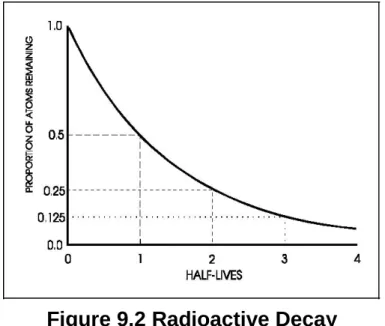
One half-life is the time during which one-half of the radioactive atoms in a sample will decay or disintegrate. This is illustrated graphically in Figure 9.2.
Figure 9.2 Radioactive Decay
The formula of this curve (an exponential function) enables us to determine, among other things, the number of radioactive atoms remaining at any time t, provided we know how many were present to begin with.
Equation 9.2 Decay Equation
N = Noe
-λt
Where N = number of atoms at time t, No = number of atoms at start (time t = 0), and e = base of
natural logarithms.
9.5 Maximum and Average Beta Energy
Beta particles are emitted from excited atoms with a spectrum of energies rather than a discrete energy. The beta particle energy in Table 9.1 is the maximum energy. The average energy is usually about one-third of the maximum. Photons, on the other hand, are emitted with discrete energies each
time an atom of the same radionuclide disintegrates.
9.6 Characteristics of Commonly Used Radionuclides
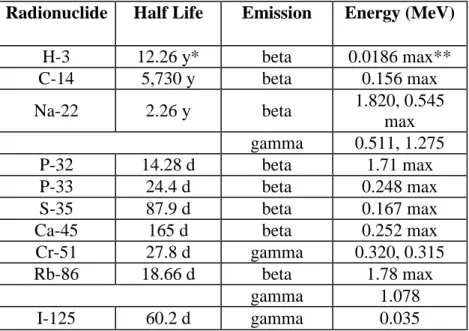
The elements of the periodic table comprise a population of more than 1,500 nuclides. Of these, Northwestern researchers use about 50 in their investigations. Fewer than a dozen are used routinely, although they may be found in many hundreds of chemical compounds. Investigators frequently select radionuclides as labels on the basis of their ability to substitute for stable atoms in molecules of interest as well as their ease of detection and measurement. Some of their physical properties are detailed in Table 9.1.
Table 9.1 Commonly Used Radionuclides
Radionuclide Half Life Emission Energy (MeV)
H-3 12.26 y* beta 0.0186 max**
C-14 5,730 y beta 0.156 max
Na-22 2.26 y beta 1.820, 0.545 max gamma 0.511, 1.275
P-32 14.28 d beta 1.71 max
P-33 24.4 d beta 0.248 max
S-35 87.9 d beta 0.167 max
Ca-45 165 d beta 0.252 max
Cr-51 27.8 d gamma 0.320, 0.315
Rb-86 18.66 d beta 1.78 max
gamma 1.078
I-125 60.2 d gamma 0.035
* d = days, y = years ** max = maximum beta energy; average energy is about 1/3 of the maximum
Table 9.1 is by no means exhaustive; only major radiations are shown. Iodine-125, for example, has a complex decay scheme in which more than 14 different particles or photons may be emitted with varying frequencies and in varying combinations. Sodium-22 emits positrons, which interact with orbital electrons and vanish, producing two photons of 0.511 MeV each that are emitted in opposite directions.
10.0 Units of Radiation Activity
10.1 Activity Definition
Activity is defined as the number of disintegrations (also known as transformations) that occur per unit time and is equal to the decay constant lambda (λ) times the number of radioactive atoms present.
Equation 10.1 Activity
A = λN
Where A = activity, λ = decay constant (0.693/half life), and N = number of atoms present.
10.2 SI System
Two systems of units are in use in the radiation sciences, the "common" system and the "SI" (Systeme International) system. This handbook uses SI units followed by common units in
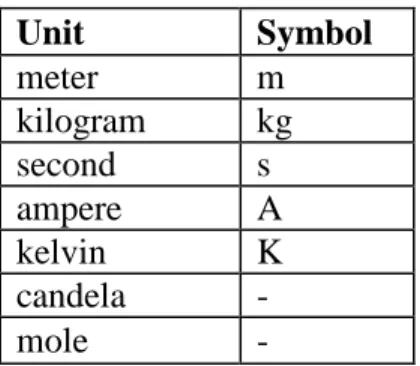
parentheses. The SI system has seven base units as its core. These base units are supplemented by a number of derived units that are products or quotients of powers of the base units. The derived unit of activity is the becquerel (Bq), equal to one transformation per second.
Table 10.1 SI Base Units
Unit Symbol
meter m
kilogram kg second s ampere A kelvin K candela -
mole -
10.3 Units of Activity
Table 10.2 Common and SI Units of Activity
Type of Unit Name Symbol Value
Common curie Ci 3.7 x 10¹⁰ transformations/second
millicurie mCi 3.7 x 10⁷ transformations/second
microcurie uCi 3.7 x 10⁴ transformations/second
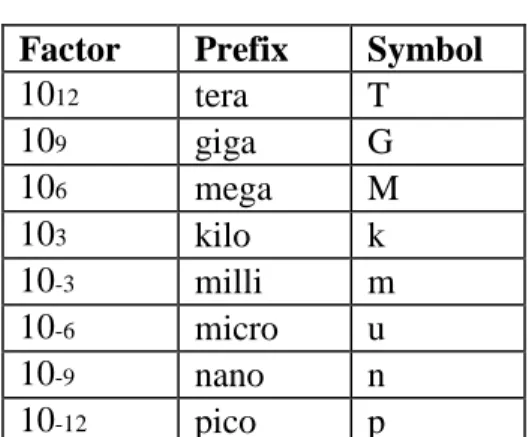
Table 10.3 Prefixes
Factor Prefix Symbol
1012 tera T
109 giga G
106 mega M
103 kilo k
10-3 milli m
10-6 micro u
10-9 nano n
10-12 pico p
Table 10.4 Conversion from Common to SI Units
Common Unit SI Unit
1 Curie (1 Ci) 37 gigabecquerels (3.7 x 10¹⁰ Bq)
1 millicurie (1 mCi) 37 megabecquerels (3.7 x 10⁷ Bq)
1 microcurie (1 uCi) 37 kilobecquerels (3.7 x 10⁴ Bq)
1 nanocurie (1 nCi) 37 becquerels (37 Bq)
1 picocurie (1 pCi) 37 millibecquerels (3.7 x 10⁻² Bq)
11.0 Dose and Exposure
11.1 Dose
The term dose routinely is used to mean "the amount of energy or radiation absorbed in matter." While true in a general sense, this definition must be more carefully qualified to fit certain conditions of irradiation.
11.2 Absorbed Dose
A reference to dose usually denotes absorbed dose, or the energy deposited by charged particles per gram of the material of interest. The SI unit of absorbed dose is the gray (Gy), equal to one joule per kilogram. The common unit of absorbed dose is the rad, equal to 100 ergs of energy deposited per gram.
1 Gy = 100 rads 1 rad = 0.01 Gy
11.3 Dose Equivalent
Dose equivalent is the dose in gray multiplied by a normalizing factor such as the quality factor, Q. The quality factor is a modifier that takes into account the varying effectiveness of different
radiations in depositing energy in matter. An example is the difference in specific ionization between alpha and beta particles. The quality factor varies significantly for different radiations, ranging from 1 for gamma and X-rays to 25 for neutrons and heavier ions. The SI unit for dose equivalent is the sievert (Sv). The common unit of dose equivalent is the rem. If you wear a body badge or ring dosimeter, your reports will be expressed as dose equivalent, in units of rem.
1 Sv = 100 rem 1 rem = 0.01 Sv
11.4 Exposure
Exposure is another term in everyday use with a more specific meaning than is usually implied. The common unit of exposure is the roentgen (R). The roentgen is used for X- or gamma radiation and is based on the ionization these radiations produce in air. It is not used for particulate radiation. The value of one roentgen is 2.58 x 10⁻⁴ coulombs per kilogram (C/kg) in air. There is no equivalent SI unit of exposure. When ORS inspects laboratories where gamma-ray-emitting radionuclides are used or where radiation-producing equipment such as X-ray machines are used, the survey may be done with an instrument that measures exposure rate, and survey results are reported as R/hour or mR/hour.
12.0 Time, Distance, and Shielding
12.1 Three Effective Strategies
Unsealed radionuclides, sealed sources, X-ray machines, irradiators, and other sources may present a hazard of external exposure. Protection from these sources is based on applying three fundamental strategies:
• Minimize the time spent near sources (a linear reduction).
• Maximize the distance from sources (an inverse square reduction).
• Use shielding of appropriate type (an exponential reduction).
12.2 Time
Simply reducing the amount of time spent near or in contact with any source results in a proportionate reduction in dose. Minimize the time and you will minimize the dose.
12.3 Distance
Exposure decreases with distance according to the inverse square law, by which the radiation
intensity varies inversely with the square of the distance from a source. Increasing the distance from a source by a factor of two reduces the intensity to one quarter. Increasing the distance from a source by a factor of three reduces the intensity to one ninth:
1/22= 1/4 1/32= 1/9
This rule has important practical applications. A source with an exposure rate of 100 mR/hr at 10 centimeters from the surface has an exposure rate of 1 mR/hr at 100 centimeters from the surface, or little more than an arm's length away.
Remote handling tools may be necessary for sources with high-energy beta particles (such as P-32), high gamma exposure rates (such as Cs-137), or both (such as Na-22). These can be forceps, tongs, vial racks, trays--in short, anything that will put distance between you and the source. In the
laboratory, place stock solutions, equipment, and wastes as far as possible from occupied areas and doorways.
12.4 Shielding
Proper shielding can result in an exponential reduction of dose for gamma emitters and a near-total reduction for beta emitters. Select appropriate shielding materials during the planning stages of any experiment or clinical procedure. Shielding design may be simple--no more complex or costly than sheets of plywood or plastic--or may involve complex calculations that depend on the type of radiation, the energy and frequency of emission, the configurations of source and room, and the occupancy factors.
12.4.1 Shielding for Beta Particles
Beta particles are relatively easy to shield. Since all beta particles have a definite range in matter, one may calculate a thickness of material that will stop them all. See Appendix A for shielding information for common beta-emitters.
Lead is not the best material for shielding beta particles. Low density material--wood, plastic, or aluminum--works better. Lead actually may increase the exposure from certain radionuclides. When a beta particle passes close to the nucleus of an atom, its path and velocity may change, giving off excess energy in the form of photons called bremsstrahlung radiation. The yield of bremsstrahlung radiation is proportional to the energy of the beta particles and to the atomic number of the shielding material. Lead has a high atomic number, so the amount of beta-particle energy converted to
penetrating bremsstrahlung photons may be large. Although only a small fraction of the beta particles may be converted in this fashion, the resulting photons are more penetrating than the beta particles, resulting in unnecessary dose.
Plastics make better shields for beta particles because they have low atomic numbers and little beta energy is converted into photons. If necessary--such as with very large or energetic beta
sources--shielding may be layered, with the plastic shield nearest the source and a higher-density shield farthest from the source. The higher-density shield absorbs photons produced by beta interaction in the plastic shield.
12.4.2 Shielding for Gamma Photons
When photons interact with matter, they lose energy through two processes, absorption, in which the photon may completely disappear, and scattering, in which some of the energy may be lost and the direction of the photon changed. These processes lead to a decrease in the intensity of a beam of photons.
There is no specific value for the range of a photon in matter; rather, there is a probability that a photon will interact within a specified thickness of absorbing material. This probability is called the attenuation coefficient, u. The value of u is primarily a function of the energy of the photons and the nature of the absorber. Denser absorbers are better for photons; lead is the material of choice. The ratio I/Io is the fraction of photons remaining after a beam passes through an absorber of thickness x:
Equation 12.1 Intensity of a Photon Beam
I = I°e-µx
Where
I = intensity of a beam after passing through an absorber
Io = original intensity of the beam
µ = attenuation coefficient e = base of natural logarithms x = absorber thickness
The term half-value layer (HVL) specifies the thickness of material required to stop half of the photons. The HVL for I-131 and Cs-137 is approximately 7 mm of lead. Most photons of I-125 will be stopped by 1 mm of lead. Another term, the tenth-value layer (TVL), is used to specify the thickness of material needed to reduce the beam intensity to one-tenth of its original value. See Appendix A for HVLs and TVLs for some common radionuclides.
Not all gamma emitters are significant exposure hazards in the quantities typically used in research laboratories. I-125, for example, is a minimal exposure hazard even in millicurie quantities. It is effectively shielded by several layers of lead foil. The most important considerations when using I125 are volatility, inhalation, and skin absorption, not exposure.
13.0 Radiation Standards
13.1 Occupational Radiation Dose Limits
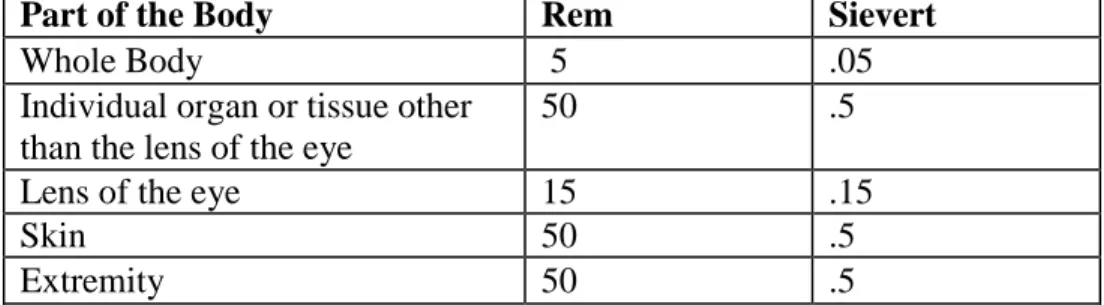
Authorized investigators and registrants shall endeavor to maintain doses to radiation workers and the general public ALARA. Table 13.1 provides the regulatory occupational dose limits.
Table 13.1 Annual Allowable Occupational Dose
Part of the Body Rem Sievert
Whole Body 5 .05
Individual organ or tissue other than the lens of the eye
50 .5
Lens of the eye 15 .15
Skin 50 .5
Extremity 50 .5
13.2 Occupational Dose Limits for Minors
Authorized investigators and registrants shall ensure that doses to individuals under 18 do not exceed 10 percent of the limits in Table 13.1.
13.3 Dose to an Embryo or Fetus
The dose to the embryo or fetus during the entire pregnancy, from occupational exposure of a
woman who informs her employer of the estimated date of conception, must be limited to 0.5 rem (5 mSv). If occupational circumstances make a dose to the embryo or fetus unavoidable, the exposure should be as uniform as possible and should not exceed 0.05 rem (.5 mSv) per month. When a woman declares that she is pregnant but does not provide an estimated date of conception, the dose to the embryo or fetus must be limited to 0.05 rem (.5 mSv) per month.
ORS encourages female radiation workers to provide an estimated date of conception because it helps in determining the appropriate precautions to take during the remainder of the pregnancy. Declaration of pregnancy is voluntary. Information must be in writing and shall remain confidential.
If you are pregnant or planning to become pregnant, please contact ORS so we may discuss your potential radiation exposure with you and provide guidance in minimizing the exposure risk.
13.4 Permissible Levels of Exposure in Unrestricted Areas
Doses must be controlled in unrestricted areas, such as public areas, offices, and corridors adjacent to radiation laboratories or X-ray facilities. Authorized users and registrants shall not possess, use, or transfer sources of radiation in such a manner as to create radiation levels in any unrestricted area that could result in a total effective dose equivalent, to an individual member of the public, of 0.5 rem (5 mSv) in any year. The dose rate in an unrestricted area must not exceed 0.002 rem (0.02 mSv) in any one hour. ORS can measure radiation fields directly or use area monitors for long-term evaluations.
14.0 Radiation Risks
14.1 General Information about Risk
As a radiation worker, you are employed in a profession that has one of the best safety histories of all occupations. It is important; however, to be aware that current regulatory thinking (which is controversial) holds that any exposure to radiation may involve some degree of risk. Therefore, keep radiation doses as low as reasonably achievable and avoid unnecessary doses. ORS provides the following document for radiation workers interested in knowing more about the risks from occupational radiation exposure: Instruction Concerning Risks from Occupational Radiation Exposure, Appendix to Regulatory Guide 8.29, U.S. Nuclear Regulatory Commission.
14.2 Prenatal Radiation Exposure
When an occupationally exposed woman is pregnant, exposure of her body to penetrating radiation (radiation capable of delivering a dose equivalent at a depth of 1cm or greater in tissue) or the intake of either penetrating or non-penetrating radiation also exposes the embryo or fetus. Studies have shown that the embryo or fetus is more sensitive to radiation than an adult--particularly during the first trimester of pregnancy, when a woman may not be aware that she is pregnant. ORS therefore provides the following document to radiation workers interested in knowing more about prenatal radiation exposure: Appendix to Regulatory Guide 8.13: Instruction Concerning Prenatal Radiation Exposure, U.S. Nuclear Regulatory Commission.
15.0 Authorized Laboratories
15.1 General Requirements
Radioactive material and other sources of ionizing radiation shall be used only in facilities approved by ORS as radiation laboratories. Investigators shall request authorization from ORS to store or use radioactive material in a new location prior to commencing such work. ORS will inspect the location for suitability, post required signs, determine the survey schedule, and provide waste containers. Each radiation laboratory shall be under the jurisdiction and authority of a designated authorized investigator who has the authority to ensure compliance.
When more than one investigator or department share facilities, all persons using the laboratory shall adhere to the radiation safety program policies and procedures described in this handbook. Everyone must comply with certain rules for radiation laboratories even when all employees and students using the facility may not be radiation workers or use radioactive materials. For example, smoking and the storage and consumption of food or beverages are prohibited in all radiation laboratories including departmental cold rooms.
15.2 Minimum Physical Requirements
Laboratories in which radioactive materials are used or stored must meet the following standards: