Aristolochia vallisicola
(Aristolochiaceae), a new species
from Peninsular Malaysia
Tze Leong Yao1
1 Forest Research Institute Malaysia, 52109 Kepong, Selangor, Malaysia
Corresponding author:Tze Leong Yao ([email protected])
Academic editor:Maria A. Jaramillo | Received 9 May 2012 | Accepted 19 July 2012 | Published 26 July 2012
Citation: Yao TL (2012) Aristolochia vallisicola (Aristolochiaceae), a new species from Peninsular Malaysia. PhytoKeys 14: 15–22. doi: 10.3897/phytokeys.14.3354
Abstract
A new species in the genus Aristolochia (Aristolochiaceae), A. vallisicola T.L.Yao, from Peninsular Malaysia is described and illustrated. Among all Peninsular Malaysian Aristolochia,itis the only species with a pin-nately veined lamina and a disc-liked perianth limb. A distribution map is provided and its conservation status is assessed as Least Concern.
Keywords
Aristolochiaceae, Aristolochia, Peninsular Malaysia
Introduction
Aristolochia, the largest genus in the family, consists of about 400 species. It is widely
distributed throughout tropics and subtropics, but also in the warm temperate regions. Hou (1984) recognised 28 species in Malesia, 5 of which occur in Peninsular Malaysia while none of them is endemic.
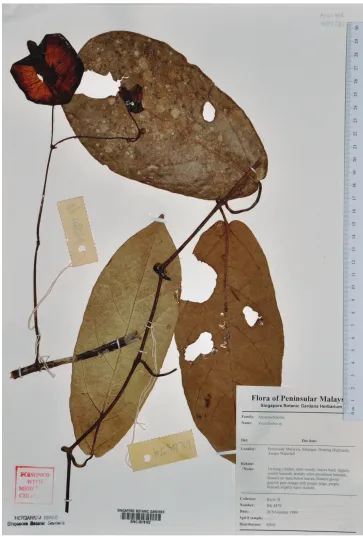
The new species presented here was first collected by a Forest Guard, Kalong (KEP) in 1929 (FMS 24048) from Ulu Kelau, Pahang. The specimen consists of two detached leaves and a detached inflorescence mounted on one sheet. Its vernacular name, Akar telinga berok (the pig-tail macaque’s ear climber in Malay) indicates that it is a climber. After a lag of 70 years, Kiew collected a flowering specimen (RK 4879) in the Awana waterfall area, Genting Highlands, Pahang. The specimen is complemented by good field notes and was identified as Aristolochia sp.
www.phytokeys.com
Copyright Tze Leong Yao. This is an open access article distributed under the terms of the Creative Commons Attribution License 3.0 (CC-BY), which permits unrestricted use, distribution, and reproduction in any medium, provided the original author and source are credited.
Tze Leong Yao / PhytoKeys 14: 15–22 (2012) 16
Recently, I was asked to identify a leaf (Kiew s.n., barcode KEP196081) of a but-terfly larva food plant collected in the Genting Tea Estate, Pahang. This instigated me to make a visit to the estate, which revealed that the plant is conspecific with the two specimens mentioned above. According to H.S. Barlow and S.K.L. Hok (pers. comm.), larvae of the butterfly species, Parides (Atrophaneura) sycorax egertoni (Distant)1 a
mem-ber of the family Papilionidae, commonly known as the White Head Batwing (Malay name: Kepala Putih) feed on the leaves of this species. Their observations in the Gent-ing Tea Estate revealed that its larvaedefoliate young plants and then girdle the stem base just before they metamorphose into pupae. The plant manages to re-sprout later.
taxonomy
Aristolochia vallisicola T.L.Yao, sp. nov.
urn:lsid:ipni.org:names:77120982-1
http://species-id.net/wiki/Aristolochia_vallisicola
Figures 1–3
Note. This species differs from all other Peninsular Malaysian Aristolochia L. species in its lamina with pinnate lateral veins, inflorescence with a long peduncle, its disc-shaped peri-anth limb, annulated hairy periperi-anth mouth and 3-lobed gynostemium. This species is sim-ilar to Aristolochia coadunata Backer in the lanceolate or oblanceolate lamina with pinnate lateral veins but differs in its larger disc-shaped perianth limb, 58–65 mm diam. versus 15–30 mm diam. in A. coadunata and its longer peduncle, 15.5–17 cm long versus up to 2 cm long in A. coadunata. This species is also similar to Aristolochia versicolor S.M.Huang in the lanceolate or oblanceolate lamina with pinnate lateral veins but differs in its longer petiole, 2.5–7 cm long versus 1–2 cm long, broader leaves, at least 7.5 cm wide versus to 6.5 cm wide, and longer peduncle, 15.5–17 cm long versus 2–3(–10) cm long in A.
versi-color. The summary and other characters comparison is presented in Table 1.
Type. Peninsular Malaysia. Pahang: Genting Highlands, Awana Waterfall. 26 November 1999 (fl), R.Kiew 4879 (holotype SING!, barcode 78162).
Description. Slender climber. Stem ca 2.5 mm thick, surface shallowly furrowed, sometimes smooth, puberulent, trichomes hooked. Leaves: petiole twisted, 2.5–7 cm long, ca 2.5 mm thick, puberulent, indumentum a mix of hooked and straight hairs; lamina lanceolate or narrowly oblanceolate or oblanceolate, 15–24 × 7.5–14 cm; base cordate, auricles rounded, sinus 2–3 mm deep, 8–12 mm wide, margin entire, apex acute; leathery; lamina surface above glabrescent, with scattered black gland dots, lami-na surface below puberulent, indumentum a mix of longer straight and shorter hooked hairs; midrib above sunken, below prominent; lateral veins pinnate, above faint, below prominent, basal pair 1, pinnate pairs 5–7; intercostal veins net-like. Inflorescences
1 Paridessycorax egertoni is distributed from Southern Myanmar to Peninsular Malaysia and Sumatra
cauline, solitary; peduncle branched once; 15.5–17 cm long, ca 2 mm thick, puberu-lent, indumentum mainly of hooked trichomes, scattered with long spreading hairs. Bracts ovate, ca 3 × 1.5 mm, pubescence, base cuneate, apex acute. Flowers: pedicel ca 40 mm long, ovary ca 13 × 2 mm, villous; perianth glossy, greyish pale orange with purple tinge, purple beneath, ca 6.5 cm long, outer surface sparsely villose with shorter hooked trichomes, tube geniculately curved, utricle cylindric, ca 30 × 8 mm, inner surface with a glistening white patch of stellate trichomes, perianth tube ca 35 × 8 mm, limb disc-shaped, 5.8–6.5 cm diam., 3-lobed, venation faint, mouth annulate, villous; gynostemium in transverse section faintly trigonal; stamens 6, anthers ca 3 × 0.3 mm; stigmatic lobes 3, conical, ca 0.8 mm long, apex blunt. Fruit and seed unknown.
Vernacular name. Akar telinga berok (Malay).
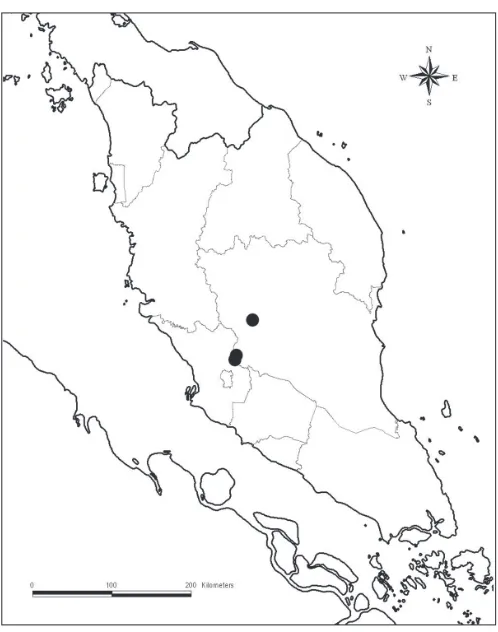
Distribution. Aristolochia vallisicola is endemic in Peninsular Malaysia, Pahang. It has only been found on Titiwangsa Range and its vicinities.
Ecology. This species occurs in highland valleys of lower montane forest about 1000 m altitude and often by rocky streamsides. Specimens with flowers were collected in September and November.
Etymology. The species name vallisicola denotes its habitat preference for valleys.
Tze Leong Yao / PhytoKeys 14: 15–22 (2012) 18 tab le 1. Comparison of Aristolochia v allisicola , A . coadunata and A . versicolor . Characters A. v allisicola *A. coadunata **A. v ersicolor (China) ***A. v ersicolor (Thailand)
Petiole length; indumentum
2.5–7 cm long; puber
ulous
3–9 cm long; pubescent
1–2 cm long; sparsely pilose
1–2 cm long; adpr
essed hair
y
Lamina; length b
y
width (cm)
lanceolate, oblanceolate or broadly oblanceolate; 15–24 × 7.5–14
ov
ate oblong to lanceolate, rar
ely o
vate;
7.5–33 × 4–12
narr
owly elliptic to
lanceolate-elliptic; 14–25 × 4–6.5
oblanceolate, oblong- oblanceolate, or elliptic oblong; 11.2–17.5 × 3.4–4.7
Lamina base; sinus depth (mm)
cor
date; 2–3
cor
date; 5–10
narr
owly auriculate; 5–7
narr
owly
, slightly cor
date
Pinnate lateral v
ein pairs 6–7 4–6 9–10 7–8 Inflor escence
cauline; peduncle 15.5–17 cm long, divided into 4–5 internodes of differ
ent lengths
in axils of foliage leav
es, rar
ely cauline;
peduncle up to 2 cm long
in axils of foliage leav
es,
peduncle 2–3 cm long
in axils of foliage leav
es,
peduncle ca 10 cm long
Bract indumentum pilose puber ulous — pilose Perianth
tube geniculately cur
ved, utricle
cylindric, ca 30 × 8 mm, tube ca 35 × 8 mm; limb disc-shaped, 58–65 mm diam., 3-lobed, mouth annulate
tube geniculately cur
ved, utricle o
void
tubular
, 35–30 × 7 mm, tube cylindric,
30–45 × 6 mm, limb disc-shaped, 15–30 mm diam., obscur
ely 3-lobed,
mouth not annulate
tube geniculately cur
ved, basal
por
tion of tube 30–40 × 6–8
mm; limb disc-shaped, 40–60 mm diam., 3-lobed, mouth annulate
tube geniculately cur
ved, utricle
ov
oid, 8–10 × 8–12 mm, tube
ca 13–23 × 5–7 mm; limb disc- shaped, 46–50 mm diam.
D istribution Peninsular M alaysia Sumatra, J av a,
†Peninsular M
alaysia
(H
ou
1984; I
garashi and F
ukuda 1999) China: G uangdong, G uangxi, Yunnan (H
uang et al. 2003)
N
or
th Eastern Thailand
(P huphathanaphong 1987) * Images of Backer 26130 (L), Bosscha s.n. (BO-108722) (BO), Schouten s.n. (BO-108723 & BO-108735) (BO), van Steenis 4317, 7326, 12625 (L) seen. Com
-parison also based on species description and drawings (Backer 1920; Hou 1984, fig. 12; van Steenis 2006, colour plate 4). ** Type specimen could not be located. Comparison based on species description and line drawings (Hwang 1981, fig. 4; Huang et
al. 2003, fig. 222, 4–6).
*** Comparison based on images of Beusekom and Phengklai 2985 (L) and its line drawing, and species description (Phuphathanapho
ng 1987, fig. 13).
† Igarashi and Fukuda (1997) recognised
Aristolochia coadunata
as occurring in Peninsular Malaysia and mentioned that it is one of the food plants of
Parides ( Atro -phaneura ) sycorax
. I have not seen any
Aristolochia coadunata
Tze Leong Yao / PhytoKeys 14: 15–22 (2012) 20
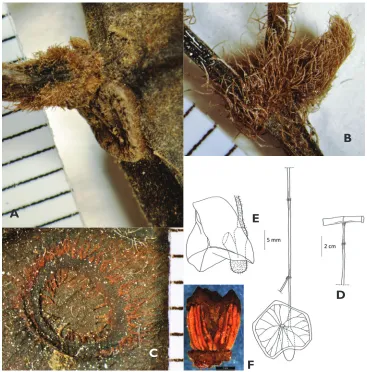
Figure 3.Aristolochia vallisicola T.L. Yao, A insertion of an inflorescence in axil of petiole scar at thick-ened stem node B villous inflorescence bract C annulated perianth mouth D an inflorescence with an opened flower e flower bud F gynostemium. (All from Kiew RK 4879.)
A
B
C
D
F
e
Conservation status. Least Concern. This species occurs above 1000 m altitude, a habitat which is protected by Malaysian legislation.
Specimens examined. Peninsular Malaysia, Pahang: Ulu Kelau, Raub, 24 Sep-tember 1929 (fl), Kalong FMS 20248 (KEP, barcode 196080); Genting Tea Estate, R. Kiew s.n. (KEP, barcode 196081).
Discussion and conclusion
Aristolochia vallisicola with disk-shaped perianth of 3 lobes which valvate in bud,
belongs to Isotrema (Huber 1993). Isotrema consists of ca 50 species distributed in temperate and tropical East Asia and in North and Central America. The new species presented here is its first record in Peninsular Malaysia. The position of Isotrema clade within Aristolochias.l. is confirmed by phylogenetic studies (Kelly and González 2003; Ohi-Toma et al. 2006).
Old World Aristolochia species with a disc-shaped perianth limb are common in northern India (Hooker 1886; Karthikeyan et al. 2010) and southern China (Huang et al. 2003) while 1-lipped or 3-lobed perianth limb are prevalent in Malesian
Aris-tolochia species (Hou 1984). Aristolochia vallisicola is the only species with a disc-liked
perianth limb in Peninsular Malaysia. Apparently, it is a link between the Asian Con-tinental element and Sumatran-Javanese Aristolochia coadunata.
Speciesof Aristolochia, a genus of high climber or woody lianas in Malesian forests, are not easy sighted and are very often represented by meagre herbarium specimens. Furthermore, the plants are rarely found in flower. In the past 15 years, 8 new species
of Aristolochia were described from Thailand (González and Poncy 1999; Hansen and
Phuphatanaphong 1999; Phuphathanaphong 2006). This indicates that the species diversity of Aristolochia in the Old World, especially in South East Asia is still under-estimated. I predict more novelties will be discovered when more specimens from this region are available for taxonomic study.
Acknowledgements
This study is part of the revision of Aristolochiaceae for the Flora of Peninsular Malay-sia Project (01-04-01-0000 Khas) and Documentation & Inventory Flora of MalayMalay-sia Project based at Forest Research Institute Malaysia and fully funded by the Ministry of Science, Technology and Innovation, Malaysia and 10th Malaysian Plan, respectively.
The keeper and manager of the SING herbarium are gratefully acknowledged for al-lowing me to loan and examine specimens under their care. I am grateful to L.G. Saw, R.C.K. Chung, R. Kiew (all KEP) and the anonymous reviewer for their constructive advice and comments on the manuscript. I thank H.S. Barlow for his hospitality dur-ing my visit to Gentdur-ing Tea Estate and S.K.L. Hok for guiddur-ing me to observe the liv-ing plant within the estate. I am grateful to C.K. Phon (FRIM) and P. Wilkie (E) for providing me with obscure literature and to B.E.E. Duyfjes (L) and K. Abdulrokhman (BO) for sending me specimen images.
references
Backer CA (1920) Contributiones ad Cognitionem Florae Indiae Batavae. Bull. Jard. Bot. Buitenzorg ser. III, 2: 315–330.
Corbet AS, Pendlebury HM (1992) The Butterflies of the Malay Peninsula, 4th ed. Malayan
Tze Leong Yao / PhytoKeys 14: 15–22 (2012) 22
González F, Poncy O (1999) A new species of Aristolochia (Aristolochiaceae) from Thailand. Brittonia 51: 452–456. doi: 10.2307/2666529
Hansen B, Phuphatanaphong L (1999) Two new species of Aristolochia (Aristolochiaceae) from Thailand. Nord. J. Bot. 19: 575–579. doi: 10.1111/j.1756-1051.1999.tb01141.x
Hooker JD (1886) Aristolochiaceae. The Flora of British India 5: 72–77. Hou D (1984) Aristolochiaceae. Flora Malesiana, Ser. I, 10: 53–108.
Huang S-M, Kelly LM, Gilbert MG (2003) Aristolochiaceae. Flora of China 5: 246–269. Huber H (1993) Aristolochiaceae. In: Kubitzki K, Rohwer JG, Bittrich V (Eds) The Families
and Genera of Vascular Plants 2. Springer, Berlin, 129–137.
Hwang SM (1981) Materials for Chinese Aristolochia. Acta Phytotaxonomica Sinica 19: 222– 231.
Igarashi S, Fukuda H (1999) The Life Histories of Asian Butterflies 1. Tokai University Press. 1–549.
Karthikeyan S, Sanjappa M, Moorthy S (2010) Flowering Plants of India: Dicotyledons 1 (Acanthaceae – Avicenniaceae). Botanical Survey of India, 1–365.
Kelly LM, González F (2003) Phylogenetic Relationships in Aristolochiaceae. Syst. Bot. 28: 236–249.
Ohi-Toma T, Sugawara T, Murata H, Wanke S, Neinhuis C, Murata J (2006) Molecular Phy-logeny of Aristolochia sensu lato (Aristolochiaceae) based on sequences of rbcL, matK, and phyA genes, with special reference to differentiation of chromosome numbers. Syst. Bot. 31: 481–492. doi: 10.1600/036364406778388656
Phuphathanaphong L (1987) Aristolochiaceae. Flora of Thailand 5: 1–31.
Phuphathanaphong L (2006) New taxa of Aristolochia (Aristolochiaceae) from Thailand. Thai For. Bull. (Bot.) 34: 179–194.