Taxonomic changes in
Oenothera
sections
Gaura
and
Calylophus
(Onagraceae)
Warren L. Wagner1, Kyra N. Krakos2, Peter C. Hoch3
1 Department of Botany, MRC-166, National Museum of Natural History, Smithsonian Institution, P.O. Box 37012, Washington, DC 20013-7012, USA 2 Biology Department, Maryville University, 650 Maryville University Dr., St. Louis, MO 63141, USA 3 Missouri Botanical Garden, P.O. Box 299, St. Louis, MO 63166-0299, USA
Corresponding author:Warren L. Wagner ([email protected])
Academic editor:S. Renner | Received 23 August 2013 | Accepted 18 October 2013 | Published 7 November 2013
Citation: Wagner WL, Krakos KN, Hoch PC (2013) Taxonomic changes in Oenothera sections Gaura and Calylophus (Onagraceae). PhytoKeys 28: 61–72. doi: 10.3897/phytokeys.28.6143
Abstract
The long-recognized genus Gaura was shown recently to be deeply nested within one of two major clades of Oenothera. New molecular data indicate further taxonomic changes are necessary in Oenothera sect.
Gaura. We make these changes here, including three new combinations, in advance of the Onagraceae treatment for the Flora of North America. The new phylogenetic studies show that several pairs of taxa treated as subspecies in the most recent revision by Raven and Gregory (1972) had independent origins within sect. Gaura, and are here elevated to species level (Oenothera nealleyi for Gaura suffulta subsp.
nealleyi; Oenothera dodgeniana for Gaura neomexicana subsp. neomexicana; and Oenothera podocarpa for
Gaura hexandra subsp. gracilis). Also, a nomenclatural problem in Oenothera sect. Calylophus is corrected by adopting the name Oenothera capillifolia Scheele for the species known previously, and nomenclaturally correct, as Calylophus berlandieri Spach. This problem necessitates a new combination Oenothera capil-lifolia subsp. berlandieri.
Keywords Oenothera, Gaura
www.phytokeys.com
Copyright Warren L. Wagner et al. This is an open access article distributed under the terms of the Creative Commons Attribution License 3.0 (CC-BY), which permits unrestricted use, distribution, and reproduction in any medium, provided the original author and source are credited.
Oenothera sect. Gaura
The molecular studies by Hoggard et al. (2004) and Levin et al. (2004) showed that the genus Gaura L. is deeply nested within Oenothera L. Wagner et al. (2007) in an overall revi-sion of the Onagraceae at the generic and sectional level transferred the species of Gaura
into Oenothera and made the group one of 18 sections of Oenothera. Oenothera sect. Gaura
(L.) W. L. Wagner & Hoch is subdivided into eight subsections, with Oenothera subsect.
Gaura (L.) W. L. Wagner & Hoch, which consists of 10 species (13 taxa) as delimited by
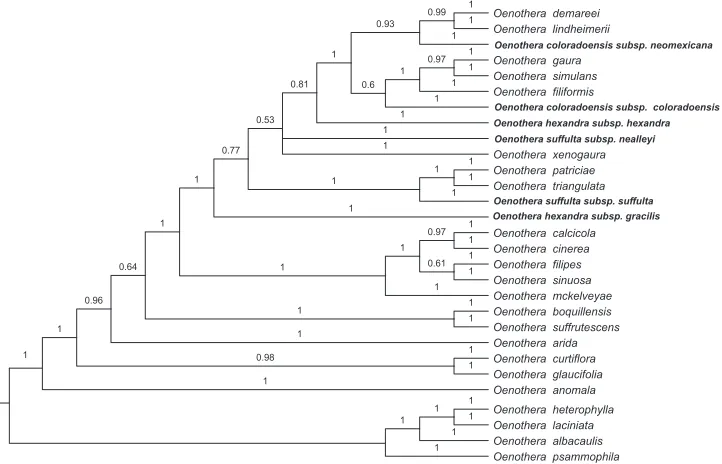
Wagner et al. (2007), shown to be monophyletic by Hoggard et al. (2004) and Levin et al. (2004). Subsequent analyses by Krakos (2011; unpubl.; Fig. 1), which sampled all 13 taxa of subsect. Gaura, showed that none of the three species (O. hexandra, O. suffulta, and
O. coloradensis)subdivided into subspecies by Raven and Gregory (1972) and maintained
in Oenothera by Wagner et al. (2007) were monophyletic. The relevant topologies revealed
by Krakos (unpubl.) that indicate separate origins for these taxa are: 1) a strongly supported clade consisting of O.suffulta subsp. suffulta, O. patriciae W. L. Wagner & Hoch, and
O. triangulata (Buckley) W. L. Wagner & Hoch, but excluding O. suffulta subsp. nealleyi,
which is in a weakly supported grade sister to the O. suffulta subsp. suffulta clade; 2) O. hex-andra subsp. hexandra is the first branch of a well-supported clade consisting of O. demareei
(P. H. Raven & D. P. Gregory) W. L. Wagner & Hoch, O. lindheimerii (Engelmann & A. Gray) W. L. Wagner & Hoch, O. coloradensis subsp. neomexicana, O. gaura W. L. Wagner & Hoch, O. simulans (Small) W. L. Wagner & Hoch, O. filiformis (Small) W. L. Wagner & Hoch, and O. coloradensis subsp. coloradensis, whereas O. hexandra subsp. gracilis is sister to this clade plus the O. suffulta subsp. suffulta clade; and 3) O. coloradensis subsp. coloradensis
and O. coloradensis subsp. neomexicana, come out well-supported in different parts of the
O. hexandra subsp. hexandra clade described in #2. These results are consistent with those
of Hoggard et al. (2004); however, that study did not include either O. suffulta subsp. neal-leyi or O. hexandra subsp. gracilis. These results are also consistent with those of Levin et al. (2004), which did include O. hexandra subsp. gracilis, but not O. suffulta subsp. nealleyi.
Below we provide the nomenclature, revised descriptions, and geographic and eco-logical ranges for all six species of subsect. Gaura involved in these changes. We also provide a key to all 13 species of subsect. Gaura.
Key to species of Oenothera sect. Gaura subsect. Gaura
1a Flowers 3-merous; fruits 3-angled ...2 1b Flowers 4-merous; fruits 4-angled ...5 2a Plants usually unbranched proximally, 60–180 cm tall; fruit narrowly ellip-soid or ellipellip-soid; coastal plain from Florida to North Carolina ...O. simulans
2b Plants usually branched proximally, 15–65 cm tall; fruits ellipsoid or ovoid ...3 3a Sepals strigillose to subglabrous; pollen ca. 50 % fertile; north-central Texas
and Oklahoma ...O. triangulata
4a Sepals 3–10 mm; inflorescence usually glandular puberulent; Mexico and Guatemala ...O. hexandra
4b Sepals 10–15 mm; inflorescence strigillose; Texas, Oklahoma, Louisiana, and Alabama ...O. patriciae
5a Flowers opening near sunrise; plants clumped perennial, usually branching from the base, villous throughout and usually glandular puberulent in the distal parts; southeast Texas and Louisiana ...O. lindheimeri
5b Flowers opening near sunset or rarely sunrise (O. demareei); plants annual or biennial, branched or unbranched; villous, strigillose or short-hirtellous throughout, distal parts usually glandular puberulent, short-hirtellous, strigil-lose, or subglabrous, occasionally villous ...6 6a Fruits angled but not winged; plants (5–)100–400 cm tall ...7 6b Fruits broadly winged on the angles and deeply furrowed between the angles;
plants rarely more than 15–100(–120) cm tall ...12 7a Sepals 2.5–8 mm; stem usually single, branched or unbranched from base
upwards; coastal plain from Florida to North Carolina ...O. simulans
7b Sepals (7–)9–20 mm; stems usually several, branched from base upwards ...8 8a Flowers opening near sunrise; plants exclusively strigillose throughout; south-western Arkansas, and perhaps adjacent Texas and Oklahoma ....O. demareei
8b Flowers opening near sunset; plants with some combination of villous, glan-dular puberulent, short-hirtellous, strigillose, or subglabrous; rarely exclu-sively strigillose ...9 9a Anthers with pollen 35–65% fertile (sterile pollen smaller); plants villous and
glandular puberulent, never strigillose; north-central to north-eastern U.S. .. ...O. gaura
9b Anthers with pollen 90–100% fertile; plants strigillose, villous, short-hirtel-lous, or subglabrous ...10 10a Plants annual; fruit 4.5–7 mm; central U.S. ...O. filiformis
10b Plants biennial; fruit 6–11 mm; Colorado, Nebraska, New Mexico, and Wyoming ...11 11a Plants strigillose proximally, becoming glandular puberulent and strigillose
distally; Colorado, Nebraska, and Wyoming ...O. coloradensis
11b Plants villous and strigillose proximally, becoming also glandular puberulent dis-tally and only sparsely villous; Colorado and New Mexico ...O. dodgeniana
12a Sepals 11–20 mm; floral tube 7–20 mm ...13 12b Sepals 6–15 mm; floral tube 6–12 mm ...14 13a Plants glabrous distally, except sometimes bracts sparsely villous; fruit sessile ...O. suffulta
13b Plants glandular puberulent distally; fruit on a stipe 0.2–2 mm ...O. nealleyi
14a Sepals 6–12 mm long, glandular puberulent, subglabrous or strigillose; Mexico to Arizona, and New Mexico ...O. podocarpa
1. Oenothera nealleyi (J. M. Coulter) Krakos & W. L. Wagner, comb. nov.
urn:lsid:ipni.org:names:77133597-1
http://species-id.net/wiki/Oenothera_nealleyi
Basionym. Gaura nealleyi J. M. Coulter, Contr. U.S. Natl. Herb. 1: 38. 1890. Gaura
suf-fulta subsp. nealleyi (J. M. Coulter) P. H. Raven & Gregory, Mem. Torrey Bot. Club 23:
81. 1973 [“1972”]. Oenothera suffulta (Engelmann ex A. Gray) W. L. Wagner & Hoch subsp. nealleyi (J. M. Coulter) W. L. Wagner & Hoch, Syst. Bot. Monogr. 83: 214. 2007.
Type. United States. Texas: Presidio County, Chenate [Chinati] region, 1889, G. C. Nealley 545 [the species entry number (150) from Coulter’s publication also on sheet below 545] (Holotype: US-00015158!; isotype: F!).
Gaura suffulta Engelmann ex A. Gray var. terrellensis Munz, Bull. Torrey Bot.
Club 65: 121. 1928.
Type: United States. Texas: Terrell County, Sanderson, 1 May 1934, V. L. Cory 8469 (Holotype: POM-200873; Isotype: TAES).
Annual from a stout taproot, usually branched from the base, 20–70 (-100) cm tall, villous proximally, the leaves subglabrous or sparsely villous along the veins and margins, becoming glandular puberulent in the distal portion of the plant, especially on the outside of the floral tube and the sepals. Leaves: rosette leaves lyrate, 3.5–9 × 0.5–1.5 cm, gradually narrowed to the petiole, cauline leaves 1.5–7 × 0.1–0.6 cm, nar-rowly lanceolate to linear, margin sinuate-dentate, undulate, subsessile. Flowers 4-mer-ous, opening at sunset; floral tube 10–20 mm; sepals 11–21 mm; petals 10–15 mm; staminal filaments 8–13 mm, anthers 2–6 mm, pollen 90–100% fertile; style 22–36 mm. Capsule indehiscent, 4.5–8 × 2–5 mm, nut-like, hard, woody, not reflexed, the body ellipsoid or ovoid, broadly winged on the angles and deeply furrowed between the angles, lower angles or projections of the wings at or above the middle prominent; stipe 0.2–2.2 mm long. Seeds 3–4 (-5), 2–3 (-4) mm, ovoid, usually flattened on one or several sides by crowding in the fruit, yellowish to light brown. Gametic chromo-some number: n = 7. Self-incompatible.
Phenology and distribution. Flowering from April to October. Trans-Pecos Tex-as and northern Coahuila, Mexico, north to Bernalillo and Torrance counties, New Mexico, in washes and other sandy places, grasslands, and extending to pinyon-juniper woodlands; 1220–2140 m.
Raven and Gregory (1972) considered O. nealleyi to represent an unevenly inter-grading entity with O. suffulta based on geographical merging of some of the char-acteristics that distinguish them and because the entity from Terrell County, Texas, described as Gaura suffulta var. terrellensis Munz has a combination of characteristics of the two taxa. The origin of these plants from Terrell County should be further explored. For now we here continue to include this name in the synonymy of O. nealleyi. The molecular data (Krakos 2011; unpubl.) suggest that O. nealleyi is not as closely related
to O. suffulta as suggested by Raven and Gregory (1972), given the placement in the
and O. patriciae, while O. nealleyi is a member of a polytomy that consists of other spe-cies of subsect. Gaura, with the O. suffulta - O. triangulata - O. patriciae clade sister to
it. Oenothera nealleyi has a strong sweet scent, characterized by benzaldehyde (almond),
cinnamaldehyde, cinnamic alcohol (cinnamon), methyl salicylate and its methyl ether (wintergreen), neral and geranial (citronella), and nerol and geraniol (lemon) (R. Ra-guso, pers. comm.), whereas O. suffulta does not have a discernible scent. This difference in scent probably plays a key role in the pollination syndromes for these species.
2. Oenothera suffulta (Engelmann ex A. Gray) W. L. Wagner & Hoch, Syst. Bot. Monogr. 83: 214. 2007.
http://species-id.net/wiki/Oenothera_suffulta
Annual from a stout taproot, moderately branched from the base, 25–120 cm tall, villous proximally, the leaves subglabrous or sparsely villous along the veins and around the margins, becoming glabrous distally or rarely sparsely villous on the bracts. Leaves: rosette leaves 7–11 × 0.1–2.3 cm, lyrate, gradually narrowed to the petiole; cauline leaves 1–9.5 × 0.1–2.3, narrowly lanceolate to linear, margin sinu-ate-dentate, undulate, subsessile. Flowers 4-merous, opening at sunset; floral tube 6.5–14 mm; sepals 11–21 mm; petals 10–15 mm; staminal filaments 6–9 mm, an-thers 2–6 mm, pollen 90–100% fertile; style 16–32 mm. Capsule indehiscent, 4.5–8 × 2–5 mm, nut-like, hard, woody, not reflexed, the body ellipsoid or ovoid, broadly winged on the angles and deeply furrowed between the angles, without prominent lower corners or projections of the wings at or above the middle; stipe 0–1 mm long. Seeds (1-)2–4 , 2–2.5 mm, ovoid, usually flattened on one or several sides by crowding in the fruit, yellowish to light brown. Gametic chromosome number: n = 7. Self-incompatible.
Phenology and distribution. Flowering from April to June. Common in western Texas, but rare elsewhere throughout the state and absent in the Trans-Pecos; southern Oklahoma, east to Tulsa, Okfuskee, and Coal counties, and in Woodward County, in open, sandy places; 10–1010 m.
3. Oenothera dodgeniana Krakos & W. L. Wagner, nom. nov.
urn:lsid:ipni.org:names:77133475-1
Basionym. Gaura neomexicana Wooton, Bull. Torrey Bot. Club 25: 307. 1898, non
Oenothera neomexicana (Small) Munz (1931). Oenotheracoloradensis (Rydberg) W. L.
Wagner & Hoch subsp. neomexicana (Wooton) W. L. Wagner & Hoch, Syst. Bot. Monogr. 83: 211. 2007.
Type. United States. New Mexico: Lincoln County, White Mts., 6500 ft, 25 Jul 1897, E. O. Wooton 204(Holotype: US-330429!; Isotypes: AC!, E!, GH!, K!, LE, MIN, MO! ND, NY [2]!, P, US!).
Biennial from a stout fleshy taproot, with a single or a few branches from the base, 50–120 cm tall, villous and strigillose proximally, leaves subglabrous or strigillose, be-coming also glandular puberulent distally, and sometimes also sparsely villous. Leaves: rosette leaves 6–20 × 1–3 cm; cauline leaves 5–10 × 1–2.5 cm, lanceolate to narrowly elliptic, subentire to repand-denticulate. Flowers 4-merous, opening at sunset; floral tube 10–11 mm; sepals 11–15 mm; petals 11–13.5 mm; staminal filaments 6.5–9 mm, anthers 2.5–4 mm long, pollen 90–100% fertile; style 22–28 mm. Capsule indehis-cent, 9–11 × 3–5 mm, nut-like, hard, woody, not reflexed, the body ellipsoid or ovoid, sharply 4-angled, with fairly deep furrows alternating with the angles for 2–3 mm from the apex, ribbed from base of furrow to base of the fruit. Seeds 2–4, 2–3 mm, yellowish to light brown. Gametic chromosome number: n = 7. Self-compatible.
County, New Mexico; Sierra Blanca and Sacramento Mountains in Lincoln and Otero counties, south-central New Mexico. Collected once at Durango, La Plata County, Colorado (Raven and Gregory 1972), but has not since been recollected; found in mountain meadow openings in coniferous forests; 1830–2640 m.
The new name for this species is to honor David and Judy Dodgen of Cloudcroft, New Mexico, landowners who graciously allowed one of us (Krakos) to conduct research on their land, which harbors populations of this rare species. Oenothera
dodgeniana and O. coloradensis were considered by Raven and Gregory (1972) to
represent a relict species along the eastern flank of the Rocky Mountains that arose from more widespread species farther to the east, such as O. filiformis. The new molecular analyses revealed that O. coloradensis is closely related to O. filiformis
(Fig. 1). Oenothera coloradensis is the first branch of a subclade within the subsect.
Gaura clade that includes O. filiformis and a terminal sister pair of O. gaura and O.
simulans. These relationships suggest that O. coloradensis may represent a relictual
species and have a shared ancestry with O. filiformis. Oenothera dodgeniana, on the other hand, belongs to a subclade which is sister to that containing O. coloradensis,
and within that subclade is sister to O. demareei and O. lindheimeri. So, although
O. dodgeniana is fairly closely related to O. coloradensis, the two taxa seem to have
had independent origins that have led to distributions along the eastern flank of the Rocky Mountains.
4. Oenothera coloradensis (Rydberg) W. L. Wagner & Hoch, Syst. Bot. Monogr. 83: 211. 2007.
http://species-id.net/wiki/Oenothera_coloradensis
Basionym. Gaura coloradensis Rydberg, Bull. Torrey Bot. Club 31: 572. 1904. Gaura
neomexicana var. coloradensis (Rydberg) Munz, Bull. Torrey Bot. Club 65: 114. 1938.
Gaura neomexicana subsp. coloradensis (Rydberg) P. H. Raven & Gregory, Mem. Torrey
Bot. Club 23: 63. 1973 [“1972”].
Type. United States. Colorado: Larimer County, Ft. Collins, 5000 ft, 8 Jul 1895, J. M. Cowen s.n. (Holotype: NY-BC00232160!; Isotype: GH!).
Phenology and distribution. Flowering in July and August. In early successional vegetation of the North and South Platte River watersheds on the high plains, slop-ing floodplains, and drainage base in heavy soils, from southern Laramie and Platte counties in Wyoming, northern Weld County, Colorado, formerly near Fort Collins, Larimer County, Colorado, and in western Kimbal County, Nebraska; 1530–1950 m.
The Colorado butterfly plant is currently known from fewer than two dozen popu-lations and has been federally listed as a Threatened species in the U.S. (USDI Fish and Wildlife Service 2000). The primary threats are agricultural use of habitat, herbicide spraying to control weed species, and livestock trampling and grazing (see Fertig 2000, Heideland Handley 2011, NatureServe 2013). Recent study by Krakos (unpubl.) has determined this species to probably be self-compatible.
5. Oenothera podocarpa (Wooton & Standley) Krakos & W. L. Wagner, comb. nov.
urn:lsid:ipni.org:names:77133476-1
http://species-id.net/wiki/Oenothera_podocarpa
Basionym. Gaura podocarpa Wooton & Standley, Contr. U.S. Natl. Herb. 16: 154. 1913. Type. United States. New Mexico: Grant County, Bear Mt., near Silver City, 1500 m, 17 June 1903, O. B. Metcalfe166 (Holotype: US-495277!; Isotypes: DS, E!, G, GH!, LE, MIN!, MO!, NMC! POM, US!).
Oenothera hexandra (Ortega) W. L. Wagner & Hoch subsp. gracilis (Wooton & Standley) W. L. Wagner & Hoch, Syst. Bot. Monogr. 83: 213. 2007.
Basionym. Gaura gracilis Wooton & Standley, Contr. U.S. Natl. Herb. 16: 153. 1913. Gaura hexandra subsp. gracilis (Wooton & Standley) P. H. Raven & Gregory, Mem. Torrey Bot. Club 23: 87. 1973 [“1972”].
Type. United States. New Mexico: Grant County, Ft. Bayard forest nursery, 29 Aug 1905, J. C. Blumer 44(Holotype: US-499693!; isotypes: GH!). Epithet not avail-able in Oenothera as there are two earlier uses: O. gracilis (Phil.) H. Léveillé, 1905 (syn.
for Gayophytum micranthum Hooker & Arnott) and Oenothera gracilis Schrader ex
Fischer & Meyer, 1835 (syn. For O. perennis L.).
Gaura strigillosa Wooton & Standley, Contr. U.S. Natl. Herb. 16: 154. 1913.
Type. United States. New Mexico: Lincoln County, Wingfields Ranch on Ruidosa Creek, White Mts, 8 July 1895, E. O. Wooton s.n. (Holotype: US-561073!).
Gaura brassicacea Wooton & Standley, Contr. U.S. Natl. Herb. 16: 152. 1913.
Gaura glandulosa Wooton & Standley, Contr. U.S. Natl. Herb. 16: 153. 1913.
http://species-id.net/wiki/Gaura_glandulosa
Type. United States. New Mexico: Catron County, Reserve, 9 July 1906, E. O. Wooton s.n. (Holotype: US 561072!; Isotype: US!).
Annual herb from a stout taproot, usually well-branched at the base and above, 15–100 cm tall, villous proximally, the leaves subglabrous to densely short-villous, becoming subglabrous, strigillose and/or glandular puberulent distally. Leaves: ro-sette leaves lyrate, 3–15 × 0.5–1 cm; cauline leaves 1–9 × 0.1–0.8 cm, linear to very narrowly elliptic or narrowly lanceolate, sinuate-dentate to subentire, sub-sessile. Flowers 4-merous, opening at sunset; floral tube 6–10 mm; sepals 6–12 mm; petals 5.5–9.5 mm; filaments 4–6 mm, anthers 2–3 mm, pollen 90–100% fertile; style 11–18.5 mm. Capsule indehiscent, 6–8 × 2–3 mm, nut-like, hard, woody, not reflexed, broadly winged on the angles and deeply furrowed between the angles, the body ellipsoid or narrowly obovoid, narrowed at the base but not stipitate. Seeds 4, 2–3 mm, ovoid, usually flattened on one or several sides by crowding in the fruit, yellowish to reddish brown. Gametic chromosome number: n = 7. Self-compatible.
Phenology and distribution. Flowering from (May) June to October. In Ari-zona from eastern Mohave County south through the mountains of central AriAri-zona to eastern Pima County and the southwestern quarter of New Mexico, and in Mexico southward in the Sierra Madre Occidental to eastern Sonora and throughout the west-ern halves of Chihuahua and Durango, often in disturbed sites in or on sandy washes, slopes, grasslands, meadows, pinyon-juniper or ponderosa pine woodlands, and some-times on volcanic cinders; 760–2750 m.
Oenothera podocarpa is the first species to branch off in the subsect. Gaura clade
(Fig. 1), whereas O. hexandra is nested well within the subsect. Gaura clade. The epi-thet “podocarpa” was selected among the three equally available names at the species rank for this species. Previously, G. gracilis, one of four species published simultane-ously by Wooton and Standley,was selected by Munz (1938), while placing the other three into synonymy. Tidestrom and Kittell (1941) apparently unaware of the Munz publication selected G. glandulosa, but were incorrect as they should have used G.
gra-cilis. They did not establish any new priority.
6. Oenothera hexandra (Ortega) W. L. Wagner & Hoch, Syst. Bot Monogr. 83: 212. 2007.
http://species-id.net/wiki/Oenothera_hexandra
Basionym. Gaura hexandra Ortega, Hort. matr. dec. 14. 1797.
Hin-ton 7688(Neotype, designated, by Wagner et al. 2007: 212: MO-1717467!; Isoneo-types: C, F, G, GH, LL, MICH, NY, US!).
Annual herb from a stout taproot, usually well-branched at the base and above, 15–100 cm tall, villous proximally, the leaves subglabrous to densely short-villous, and becoming subglabrous, strigillose, and/or glandular-puberulent distally. Leaves in a basal rosette and cauline; rosette leaves lyrate, gradually narrowed to the petiole, usually quickly deciduous; cauline leaves 1–9 × 0.1–0.8 cm, linear to very narrowly elliptic or narrowly lanceolate, margin sinuate-dentate to subentire, subsessile. Inflorescence strict to some-what branched, 7–53 cm long, bracts 2–5 cm long, narrowly lanceolate to ovate. Flowers 3-merous, opening at sunset; floral tube 4.5–7.5 mm; sepals 3–10 mm; petals 4.5–7 mm; staminal filaments 3–6 mm, anthers 1–2 mm, pollen 90–100% fertile; style 9–14.5 mm. Capsule indehiscent, 4.5–8 × 2–4.5 mm, nut-like, hard, woody, not reflexed, the body ellipsoid or narrowly obovoid, broadly winged on the angles and deeply furrowed between the angles, narrowed at the base but not stipitate. Seeds 3, 1.75–3 mm, ovoid, usually flattened on one or several sides by crowding in the fruit, yellowish to reddish brown. Gametic chromosome number: n = 7. Self-compatible and highly autogamous.
Phenology and distribution. Flowering from March to November. From Duran-go, Mexico south in the Sierra Madre Occidental to the Trans Mexican Volcanic Belt, where abundant, and in Chiapas, Mexico as well as Guatemala in grasslands, meadows or oak woodlands, or disturbed areas, in sandy soils; 1800–2430 m.
Oenothera sect.Calylophus
A nomenclatural problem in Oenothera sect. Calylophus is corrected here by adopting the name Oenothera capillifolia Scheele for the species known previously, and nomenclatu-rally correct, as Calylophus berlandieri Spach when the genus Calylophus is recognized as distinct from Oenothera; however, when this species is considered to be a member of
Oenothera as it was recently by Wagner et al. (2007) based on molecular data (Levin et
al. 2004), O. berlandieri (Spach) Steudel is not available since it is a later homonym. This problem necessitates a new combination Oenothera capillifolia subsp. berlandieri.
7. Oenothera capillifolia Scheele, Linnaea 21: 576. 1848.
http://species-id.net/wiki/Oenothera_capillifolia
Basionym. Meriolix capillifolia (Scheele) Small, Fl. S.E. U.S. 846, 1335. 1903. Type. United States. Texas: Comal County, NewBraunfels, April (1846?), Ferdi-nand Roemers.n. (not located). — United States. Texas: Comal County, New Braun-fels, May 1850, F. Lindheimer 809(Neotype: here designated, US-502186!; Isoneo-types: ARIZ, DS, F, GH, MO!, NMC, NY, OKL, PH, TEX, UC).
7a. Oenothera capillifolia Scheele subsp. capillifolia
Oenothera berlandieri subsp. pinifolia (Engelmann) W. L. Wagner & Hoch, Syst. Bot
Monogr. 83: 211. 2007.
Basionym. Oenothera serrulata var. pinifolia Engelmann in A. Gray, Bost. J. Nat. Hist. 6: 189. 1850. Meriolix serrulata var. pinifolia (Engelmann) Small, Bull. Torrey Bot. Club 23: 187. 1896. Oenothera serrulata subsp. pinifolia (Engelmann) Munz, N. Amer. Fl., ser. 2, 5: 141. 1965. Calylophus berlandieri subsp. pinifolius (Engelmann) Towner, Ann. Missouri Bot. Gard. 64: 107. 1977.
Type. United States. Texas: Comal County, New Braunfels, Apr-May 1846, F. Lindheimer 394(Holotype: MO-122323!; Isotypes: DS, GH [2]!, K [3]! MO!, NY!, PH, RSA, US!, YU!).
7b. Oenothera capillifolia Scheele subsp. berlandieri (Spach) W.L. Wagner & Hoch, comb. nov.
urn:lsid:ipni.org:names:77133601-1
Basionym. Calylophus berlandieri Spach, Ann. Sci. Nat. Bot., sér. 2, 4: 272. Nov. 1835.
Oenothera berlandieri (Spach) Steud., Nom. Bot., ed. 2. 2: 206. 1841, non D. Dietr. Dec.
1840. Meriolix berlandieri (Spach) Walp., Repert. Bot. Syst. 2: 79. 1843. Calylophus
drum-mondianus Spach subsp. berlandieri (Spach) Towner & Raven, Madroño 20: 243. 1970.
Type. United States. Texas: Bahia del Espiritu Santo[probably in present Cal-houn County, March or May 1829], Jean Louis Berlandier539=1919 (Holotype: P; Isotypes: GH!, PH).
Acknowledgments
We thank Tim Lowrey and Phil Tonne for images of UNM herbarium collections. We appreciate the useful review comments by George Yatskievych, and edits to the manuscript by Nancy Khan.
References
Fertig W (2000) Colorado butterfly plant (Gaura neomexicana ssp. coloradensis) on F.E. Warren Air Force Base. Report prepared for the U.S. Air Force by the Wyoming Natural Diversity Database, University of Wyoming, Laramie, WY.
Air Force Base, Laramie County, Wyoming by the Wyoming Natural Diversity Database, University of Wyoming, Laramie, WY.
Hoggard GD, Kores PJ, Molvray M, Hoggard RK (2004) The phylogeny of Gaura (Onagraceae) based on ITS, ETS, and trnL-F sequence data. American Journal of Botany 91: 139–148. doi: 10.3732/ajb.91.1.139
Krakos K (2011) The evolution and reproductive ecology of Oenothera (Onagraceae). Ph. D., Washington University. Electronic Theses and Dissertations. Paper 601.
Levin RA, Wagner WL, Hoch PC, Hahn WJ, Rodriguez A, Baum DA, Katinas L, Zimmer EA, Sytsma KJ (2004) Paraphyly in Tribe Onagreae: Insights into phylogenetic relation-ships of Onagraceae based on nuclear and chloroplast sequence data. Systematic Botany 29: 147–164. doi: 10.1600/036364404772974293
Munz PA (1938) Studies in Onagraceae XI. A revision of the genus Gaura. Bulletin of the Torrey Botanical Club 65: 105–122. doi: 10.2307/2480964
NatureServe (2013) NatureServe Explorer: An online encyclopedia of life [web application]. Version 7.1. NatureServe, Arlington, Virginia. http://www.natureserve.org/explorer [ac-cessed 10 August 2013]
Raven PH, Gregory DP (1972) A revision of the genus Gaura (Onagraceae). Memoirs of the Torrey Botanical Club. 23: 1–96. [published 22 January 1973]
Tidestrom I, Kittell T (1941) A Flora of Arizona and New Mexico. Catholic University Press. Towner HF (1977) The biosystematics of Calylophus (Onagraceae). Annals of the Missouri
Botanical Garden 64: 48–120. doi: 10.2307/2395236
USDI Fish and Wildlife Service (2000) Endangered and threatened wildlife and plants: Threat-ened status for the Colorado butterfly plant (Gaura neomexicana ssp. coloradensis) from southeastern Wyoming, northcentral Colorado, and extreme western Nebraska. Federal Register 65(202): 62302–62310.