European Journal of Physical Education and Sport Science
ISSN: 2501 - 1235 ISSN-L: 2501 - 1235 Available on-line at: www.oapub.org/edu
DOI: 10.46827/ejpe.v6i5.3223 Volume 6 │ Issue 5 │ 2020
SERIOUS LEISURE CAREER IN STUDENTS' CAREER FUTURE
Tebessüm Ayyıldız Durhani, Suat Karaküçük Gazi University, Faculty of Sports Science,
Turkey
Abstract:
The aim of this research is to examine the current status of university students who are members of the university communities, through their activities in the communities, towards serious leisure and career future. At the same time, the extent to which some variables change these parameters and the impact of a serious leisure career on the future
of the career were evaluated. In this context, “Serious Leisure Career” which is developed
by Ayyıldız, Özdemir and Karaküçük (2020) and “Career Futures Inventory (CFI)” which
is developed by Rottinghaus, Day and Borgen, (2005), translated to Turkish culture by
Ağargün et al., (2005) and which is evaluated about psychometric properties in Turkish
sample by Kalafat (2012) is used. While analysis; descriptive statistics, independent sample T test, one-way analysis of variance (ANOVA) test, Tukey (HSD-LSD) test, Pearson Correlation test and regression analysis were used for in-group comparisons. As a result of the research, it can be said that serious leisure and career future are differentiated by certain variables and serious leisure career, which is an important factor affecting future career, is a tool to increase positive perception of career.
Keywords: student communities, serious leisure career, career future
1. Introduction
As a concept, career can refer to the individual’s movement through time and space. It
can also focus on the intersection of individual biography and social structures. One way
that the term ‘career’, or more specially ‘careers’, is to refer to the patterns and sequences
of occupations and positions occupied by people across their working lives. While this is a common meaning attributed to career in the academic and professional literature, it is even more so in lay understanding (Collin & Young, 2000: 3). Career is the combination of activities required by all life roles that an individual has at any time in life (Özkan, 2017). Career is also used as a construct in academic, professional and lay discourse. By
drawing on common understanding of individual and shared motivations and
institutional and organisational practices, ‘career’ provides a prevailing discourse that
allows both lay persons and professionals to create meaning (Collin & Young, 2000: 3). It can be said that the career represents a complex structure that includes not only roles in career choice and involvement in work life but also other private and social life roles (Güldü & Ersoy Kart, 2017).
Individuals set themselves career goals throughout their lives. In line with reaching these goals, they come to anticipation and strive to achieve their goals. It points to the relationship between the future expectation of the career, achieving the status, gaining status, making progress in career steps by developing the knowledge skills that the person has throughout his life (Üzüm & Uçkun, 2015). It is defined as the whole experience of their roles. The concept of career places great emphasis on the career subject that envisages personal development and growth, as well as career planning, by providing opportunities and opportunities to rise to higher levels. In this respect, it is of great importance to achieve many vital goals for both organizations and individuals
(Taşlıyan, Arı & Duzman, 2011). With the decreased levels of job security, the increased
levels of competition, the increasing rate of change, and the increased use of technology that students will face, preparing students for the future is essential. Career development must be a priority for all students. It is important to encourage and help students develop the kinds of skills, knowledge, and attitudes that will enhance their opportunities for success (Hughey & Hughey, 1999)
Proper use of time is essential for building a career. In this context, leisure time, which is an important time period, constitutes a remarkable direction. Though leisure is an important, yet underdeveloped area of inquiry with respect to career indecision, among gainfully employed emerging adults (Konstam & Lehmann, 2011). Opportunities to occupy oneself during leisure time differ between young people and according to what
is available to them. A young person’s position at an individual and community level can
thus shape the development of their leisure careers (Corr, 2014). A leisure career is the typical course, or passage, of a type of amateur, hobbyist, or volunteer that carries the person from the stage of neophyte into and through a leisure role and possibly into and through a work role (Stebbins, 2014:38).
time occupations are numerous and diverse (Jensen & Naylor, 2000:12). Participants embark upon a career in their activity and may need to occasionally persevere to enable ongoing participation. Significant personal effort is invested in the activity, typically a product of specialized knowledge, training, experience, and/or skills a participant accumulates. Serious leisure is underpinned by durable bene- fits (e.g., self-actualization, self-enrichment, self-gratification) of value to the participant. Finally, participants engage with the unique ethos and social world of their activity and strongly identify with the activity in their projection of self to the world (Lamont, Kennelly & Moyle, 2014).
Emerging adults who are clearly identified and committed with their respective leisure activity preferences demonstrate a capacity for decision making that can enhance the process of career commitment (Konstam & Lehmann, 2011).The leisure career stages of beginning, development, and establishment encompass the period of time during which the participant is most likely to give up (Stebbins, 2014:50). However, it is inevitable to achieve some gains with perseverance and persistence. Individuals who participate in activities aimed at serious leisure career gain specific gains personally and socially. These achievements are given below.
a. Personal rewards
1) Personal enrichment (cherished experiences)
2) Self-actualization (developing skills, abilities, knowledge)
3) Self-expression (expressing skills, abilities, knowledge already developed) 4) Self-image (known to others as a particular kind of serious leisure participant) 5) Self-gratification (combination of superficial enjoyment and deep fulfillment) 6) Re-creation (regeneration) of oneself through serious leisure after a day’s work
7) Financial return (from a serious leisure activity) b. Social rewards
8) Social attraction (associating with other serious leisure participants, with clients as a volunteer, participating in the social world of the activity)
9) Group accomplishment (group effort in accomplishing a serious leisure project; senses of helping, being needed, being altruistic)
10)Contribution to the maintenance and development of the group (including senses of helping, being needed, being altruistic in making the contribution) (Stebbins, 2014:10-11).
In this context devotee work, such as student community works, is an activity in which participants feel a powerful devotion, or, in other words, strong and positive attachment, to an occupation that they are proud to be in. In such work, the sense of achievement is high, and the core activity endowed with such intense appeal that the line between this work and leisure is virtually erased (Stebbins, 2014:4).
construction of the future possible. However, profound and widespread change is both anticipated and being realised; career, in part, constructs our futures (Collins & Young, 2000:1).
The perception of career future in individuals has three sub-dimensions, these are; career perception, career optimism, and perceived knowledge of the job market. Career compatibility is the adaptation of the individual to an unexpected situation related to his job in the future, to changing business conditions. Career optimism is the belief that the individual will have positive things about his career in the future. Perceived information about the labor market is related to how well people perceive the job market and employment (Kalafat, 2014; Rottinghaus et al., 2005).
Involving community members in career development activities is beneficial for students as they plan their careers. Community members, including various workers, can provide first hand occupational information for students. They can also provide students information on the skills required of their particular organization and what it takes to be successful. Some may provide job shadowing experiences for students. These types of experiences provide students information and experience which will hopefully complement and support the career activities implemented in school. These experiences can provide hands-on opportunities and a means to see what they have been taught applied on the job (Hughey & Hughey,1999). Based on all this information; the aim of this research is to examine the current status of university students who are members of the university communities, through their activities in the communities, towards serious leisure and career future. At the same time, it is aimed to examine to what extent some variables change these parameters and the effect of serious leisure career on career future.
2. Material and Methods
The research was prepared with quantitative method and survey model was used. Survey model it is a research approach that aims to describe a situation in the past or still as it exists. The event, individual or object that is the subject of the research is tried to be defined in its own conditions and as it is. No effort is made to change or influence them in any way. There is something to be known and is there. The important thing is to be
able to “observe” it appropriately (Karasar, 2008: 77). In this context, it was tried to
determine what serious leisure career and career future levels of university students who participate student communities in the university, and how the some variables changes these levels, as well as whether serious leisure level had an impact on career future.
2.1 Sample
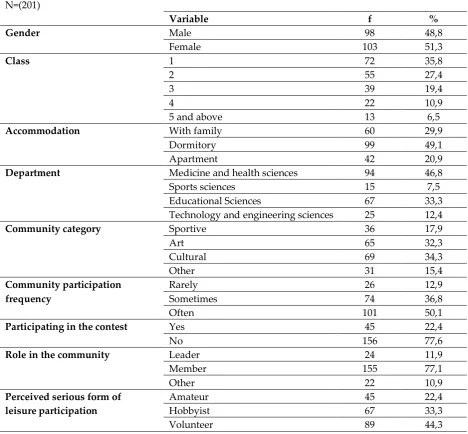
Gazi Bicycle Community, Gazi Youth Program and Development Community, Gazi Air Shooting Group, Gazi Design Community, Gazi Theater Club, Gazi University Planning Group, Gazi Paragliding, Gazi e-sport community, Gazi Folk Dance Group, Gazi photography community, Gazi University Hello World Community and Gazi Earth Doctors Communities. Demographic information of the participants is given in table 1.
Table 1: Frequency and Percentage Distributions of Demographic Variables
N=(201)
Variable f %
Gender Male 98 48,8
Female 103 51,3
Class 1 72 35,8
2 55 27,4
3 39 19,4
4 22 10,9
5 and above 13 6,5
Accommodation With family 60 29,9
Dormitory 99 49,1
Apartment 42 20,9
Department Medicine and health sciences 94 46,8
Sports sciences 15 7,5
Educational Sciences 67 33,3
Technology and engineering sciences 25 12,4
Community category Sportive 36 17,9
Art 65 32,3
Cultural 69 34,3
Other 31 15,4
Community participation Rarely 26 12,9
frequency Sometimes 74 36,8
Often 101 50,1
Participating in the contest Yes 45 22,4
No 156 77,6
Role in the community Leader 24 11,9
Member 155 77,1
Other 22 10,9
Perceived serious form of Amateur 45 22,4
leisure participation Hobbyist 67 33,3
Volunteer 89 44,3
2.2 Instrument
The data were obtained through face to face questionnaire collection technique from student communities. Demographic information form and two scale is used for obtaining
the data. “Serious Leisure Career” which is developed by Ayyıldız, Özdemir and
Karaküçük (2020) and “Career Futures Inventory (CFI)” which is developed by
Rottinghaus, Day and Borgen, (2005), translated to Turkish culture by Ağargün, Beşiroğlu, Kıran, Özer & Kara (2005) and which is evaluated about psychometric
properties in Turkish sample by Kalafat (2012) is used.
The serious leisure career scale consists of 3 sub-dimensions and 11 questions: benefit, social impact and career expectancy. In this study, the internal reliability coefficient for the serious leisure career scale was .84. The maximum score that can be obtained from the scale prepared in the 5-point Likert type is 55 and the minimum score is 12. With the measurement tool, it is aimed to measure the serious leisure career which is defined as the path to dedication from being enthusiastic for a task.
On the other hand, career future inventory consists of 25 questions and 3 sub-dimensions which named Career Adaptability (CA), Career Optimism (CO) and Perceived Knowledge (PK). It was determined as .86 for the scale of career future. The minimum score that can be obtained from the 5-point Likert type measurement tool is expressed as 25, and the maximum score is 125. The measurement tool was developed to evaluate positive career planning attitudes in individuals.
2.3 Analysis of the data
According to the skewness and kurtosis tests conducted for the distribution of the data obtained in the study, it was observed that the data did not deviate from the values of +3, -3 (Cohen and Swerdlik, 2010) and similarly, other normality tests supported this finding. Therefore, since the data were determined to be normally distributed, the data were analyzed by parametric tests. While analysis; descriptive statistics, independent sample T test, one-way analysis of variance (ANOVA) test, Tukey (HSD-LSD) test, Pearson Correlation test and regression analysis were used for in-group comparisons. he significance value was determined as p<0,05 in the measurements. Findings obtained in accordance with the analyzes made in the research are given below.
3. Results
Table 2: Arithmetic mean and standard deviation values for measurement tools
N=(201)
Min. Max. x ss Skewness Kurtosis
Serious Leisure Career 13,00 55,00 34,23 8,80 0,111 -0,393
Benefit 4,00 20,00 10,31 4,13 0,340 -0,422
Social Impact 3,00 15,00 10,62 2,61 -0,352 -0,167 Career Expectancy 4,00 20,00 13,28 4,11 -0,127 -0,841
Career futures 44,00 125,00 86,08 12,93 -0,295 1,366 Career Adaptability 17,00 55,00 39,14 6,83 -0,349 0,864 Career Optimism 19,00 55,00 37,73 6,24 0,273 0,705 Perceived Knowledge 3,00 15,00 9,20 2,10 0,658 0,673
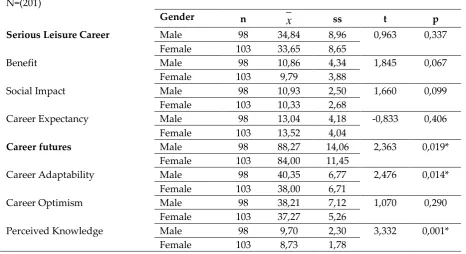
Table 3: Comparison of measurement tools and sub-dimensions by gender
N=(201)
Gender n x ss t p
Serious Leisure Career Male 98 34,84 8,96 0,963 0,337 Female 103 33,65 8,65
Benefit Male 98 10,86 4,34 1,845 0,067
Female 103 9,79 3,88
Social Impact Male 98 10,93 2,50 1,660 0,099
Female 103 10,33 2,68
Career Expectancy Male 98 13,04 4,18 -0,833 0,406 Female 103 13,52 4,04
Career futures Male 98 88,27 14,06 2,363 0,019*
Female 103 84,00 11,45
Career Adaptability Male 98 40,35 6,77 2,476 0,014* Female 103 38,00 6,71
Career Optimism Male 98 38,21 7,12 1,070 0,290
Female 103 37,27 5,26
Perceived Knowledge Male 98 9,70 2,30 3,332 0,001* Female 103 8,73 1,78
*p>0,05
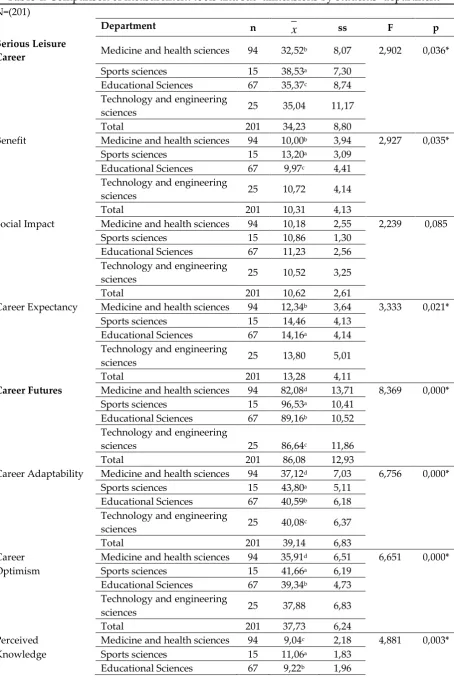
Table 4: Comparison of measurement tools and sub-dimensions by students’ department
N=(201)
Department n x ss F p
Serious Leisure
Career Medicine and health sciences 94 32,52b 8,07 2,902 0,036*
Sports sciences 15 38,53a 7,30
Educational Sciences 67 35,37c 8,74
Technology and engineering
sciences 25 35,04 11,17
Total 201 34,23 8,80
Benefit Medicine and health sciences 94 10,00b 3,94 2,927 0,035*
Sports sciences 15 13,20a 3,09
Educational Sciences 67 9,97c 4,41
Technology and engineering
sciences 25 10,72 4,14
Total 201 10,31 4,13
Social Impact Medicine and health sciences 94 10,18 2,55 2,239 0,085 Sports sciences 15 10,86 1,30
Educational Sciences 67 11,23 2,56 Technology and engineering
sciences 25 10,52 3,25
Total 201 10,62 2,61
Career Expectancy Medicine and health sciences 94 12,34b 3,64 3,333 0,021*
Sports sciences 15 14,46 4,13 Educational Sciences 67 14,16a 4,14
Technology and engineering
sciences 25 13,80 5,01
Total 201 13,28 4,11
Career Futures Medicine and health sciences 94 82,08d 13,71 8,369 0,000*
Sports sciences 15 96,53a 10,41
Educational Sciences 67 89,16b 10,52
Technology and engineering
sciences 25 86,64c 11,86
Total 201 86,08 12,93
Career Adaptability Medicine and health sciences 94 37,12d 7,03 6,756 0,000*
Sports sciences 15 43,80a 5,11
Educational Sciences 67 40,59b 6,18
Technology and engineering
sciences 25 40,08
c 6,37
Total 201 39,14 6,83
Career Medicine and health sciences 94 35,91d 6,51 6,651 0,000*
Optimism Sports sciences 15 41,66a 6,19
Educational Sciences 67 39,34b 4,73
Technology and engineering
sciences 25 37,88 6,83
Total 201 37,73 6,24
Perceived Medicine and health sciences 94 9,04c 2,18 4,881 0,003*
Knowledge Sports sciences 15 11,06a 1,83
Technology and engineering
sciences 25 8,68d 1,81
Total 201 9,20 2,10
*p>0,05 a>b>c>d
On the basis of the department where the participants study, the differences between the measurement tools were tried to be examined and statistically significant differences were observed. Accordingly, it was determined that the students studying in the sports sciences department in all sub-dimensions exhibited a higher level of leisure career and career future level compared to the students studying in other departments. On the other hand, no statistically significant difference was determined in the analyzes made between the classes of the participants, where they live and the measurement tools.
Table 5: Comparison of measurement tools and sub-dimensions by community category
N=(201)
Community
category n x ss F p
Serious Leisure Career Sportive 36 31,69d 8,61 2,985 0,032*
Art 65 33,84c 8,54
Cultural 69 34,24b 8,32
Other 31 37,96a 9,73
Total 201 34,23 8,80
Benefit Sportive 36 8,97c 3,96 5,009 0,002*
Art 65 10,50 4,20
Cultural 69 9,82b 3,94
Other 31 12,58a 3,84
Total 201 10,31 4,13
Social Impact Sportive 36 10,97 2,60 2,316 0,077
Art 65 9,95 2,49
Cultural 69 10,82 2,70
Other 31 11,19 2,46
Total 201 10,62 2,61
Career Sportive 36 11,75 4,74 2,369 0,072
Expectancy Art 65 13,38 3,36
Cultural 69 13,59 3,85
Other 31 14,19 4,96
Total 201 13,28 4,11
Career Futures Sportive 36 85,30 9,46 2,461 0,064
Art 65 82,95 15,23
Cultural 69 88,20 12,41
Other 31 88,87 11,24
Total 201 86,08 12,93
Career Adaptability Sportive 36 40,05 5,44 2,162 0,094
Art 65 37,55 7,89
Cultural 69 39,37 6,46
Other 31 40,93 6,23
Career Sportive 36 36,38d 5,39 4,301 0,006*
Optimism Art 65 36,09c 7,18
Cultural 69 39,28a 5,59
Other 31 39,25b 5,34
Total 201 37,73 6,24
Perceived Sportive 36 8,86 1,49 1,603 0,190
Knowledge Art 65 9,30 2,41
Cultural 69 9,53 2,11
Other 31 8,67 1,90
Total 201 9,20 2,10
p>0,05 a>b>c>d
In the Table 5 there is a statistically significant difference between the serious leisure total scores and the benefit dimension and the career future scale career optimism sub-dimension and the type of community. According to this, t was determined that the scores of those who qualify serious leisure career as the other type of society, and those who qualify culturally in career optimism are higher than the other groups.
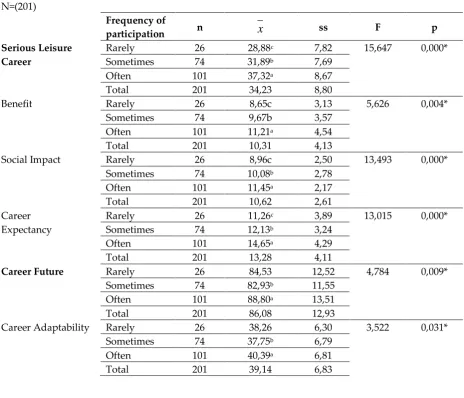
Table 6: Comparison of measurement tools and sub-dimensions by community participation frequency
N=(201)
Frequency of
participation n x ss F p
Serious Leisure Rarely 26 28,88c 7,82 15,647 0,000*
Career Sometimes 74 31,89b 7,69
Often 101 37,32a 8,67
Total 201 34,23 8,80
Benefit Rarely 26 8,65c 3,13 5,626 0,004*
Sometimes 74 9,67b 3,57
Often 101 11,21a 4,54
Total 201 10,31 4,13
Social Impact Rarely 26 8,96c 2,50 13,493 0,000*
Sometimes 74 10,08b 2,78
Often 101 11,45a 2,17
Total 201 10,62 2,61
Career Rarely 26 11,26c 3,89 13,015 0,000*
Expectancy Sometimes 74 12,13b 3,24
Often 101 14,65a 4,29
Total 201 13,28 4,11
Career Future Rarely 26 84,53 12,52 4,784 0,009*
Sometimes 74 82,93b 11,55
Often 101 88,80a 13,51
Total 201 86,08 12,93
Career Adaptability Rarely 26 38,26 6,30 3,522 0,031*
Sometimes 74 37,75b 6,79
Often 101 40,39a 6,81
Career Optimism Rarely 26 37,46 6,20 2,913 0,057
Sometimes 74 36,45 5,38
Often 101 38,73 6,70
Total 201 37,73 6,24
Perceived Rarely 26 8,80 2,00 5,157 0,007*
Knowledge Sometimes 74 8,71b 1,88
Often 101 9,67a 2,20
Total 201 9,20 2,10
p>0,05 a>b>c>d
Statistically significant differences were revealed between the frequency of going to student communities in universities and measurement tools. Career future and serious leisure career increase in favor of participants who frequently go to communities. Therefore, it can be stated in the direction of the findings that students who continue to communities with perseverance have a more positive approach in their future career.
Table 7: Comparison of measurement tools and sub-dimensions by role in the community
N=(201)
Role in the community n x ss F p
Serious Leisure Leader 24 38,58a 9,01 3,607 0,029*
Career Member 155 33,49b 8,65
Other 22 34,72 8,58
Total 201 34,23 8,80
Benefit Leader 24 12,25a 4,34 5,104 0,007*
Member 155 9,82b 4,09
Other 22 11,68 3,35
Total 201 10,31 4,13
Social Impact Leader 24 12,12a 2,25 4,785 0,009*
Member 155 10,38b 2,63
Other 22 10,68 2,35
Total 201 10,62 2,61
Career Expectancy Leader 24 14,20 4,75 1,160 0,316
Member 155 13,27 3,87
Other 22 12,36 4,91
Total 201 13,28 4,11
Career Future Leader 24 92,75a 15,38 4,330 0,014*
Member 155 85,58b 12,38
Other 22 82,40c 11,93
Total 201 86,08 12,93
Career Adaptability Leader 24 43,25a 7,26 5,866 0,003*
Member 155 38,81b 6,57
Other 22 37,00c 6,66
Total 201 39,14 6,83
Career Optimism Leader 24 39,66 7,66 1,682 0,189
Member 155 37,61 6,03
Other 22 36,40 5,83
Perceived Leader 24 9,83 2,25 1,244 0,290
Knowledge Member 155 9,14 2,08
Other 22 9,00 2,09
Total 201 9,20 2,10
p>0,05 a>b>c>d
Another variable that changes serious leisure career and career future scores stands out as the role of the participants in the communities. According to the results of Anova test conducted between serious leisure career and career future scales and the role in the community; In addition to the serious leisure career and career future total scores, the benefit and social impact sub-dimensions from the SLCS sub-dimensions, and a significant relationship in the career compatibility sub-dimension were determined. As a result of Tukey HSD and LSD tests for intra-group relations, it was determined that all significant differences were in favor of those who took the leading role in the community. Therefore, it can be said that the participants who have more and more roles in the community have more positive gains than other groups in terms of serious leisure and career future.
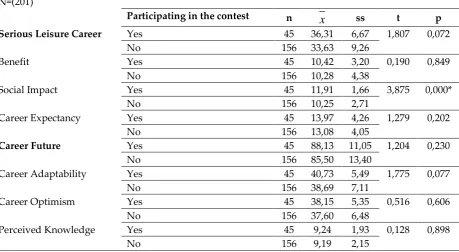
Table 8: Comparison of measurement tools and sub-dimensions by participating in the contest
N=(201)
Participating in the contest n x ss t p
Serious Leisure Career Yes 45 36,31 6,67 1,807 0,072
No 156 33,63 9,26
Benefit Yes 45 10,42 3,20 0,190 0,849
No 156 10,28 4,38
Social Impact Yes 45 11,91 1,66 3,875 0,000*
No 156 10,25 2,71
Career Expectancy Yes 45 13,97 4,26 1,279 0,202
No 156 13,08 4,05
Career Future Yes 45 88,13 11,05 1,204 0,230
No 156 85,50 13,40
Career Adaptability Yes 45 40,73 5,49 1,775 0,077
No 156 38,69 7,11
Career Optimism Yes 45 38,15 5,35 0,516 0,606
No 156 37,60 6,48
Perceived Knowledge Yes 45 9,24 1,93 0,128 0,898
No 156 9,19 2,15
*p>0,05
Table 9: Relationship analysis between measurement tools and sub-dimensions S er io u s L ei su re C ar eer B en efi t Soc ial I mp ac t C ar ee r E x p ec tan cy C ar eer F u tu re C ar ee r A d ap tab il it y C ar ee r Op ti mi sm P er cei v ed K n owl ed g e
Serious Leisure Career 1
Benefit 0,837** 1
Social Impact 0,716** 0,433** 1
Career Expectancy 0,844** 0,510** 0,464** 1
Career Future 0,506** 0,398** 0,432** 0,407** 1
Career Adaptability 0,399** 0,307** 0,384** 0,302** 0,895** 1
Career Optimism 0,492** 0,383** 0,381** 0,427** 0,872** 0,593** 1
Perceived Knowledge 0,352** 0,316** 0,281** 0,256** 0,653** 0,498** 0,470** 1 *p>0,05; **p>0,01
According to Pearson Correlation analysis results, a significant relationship was found between the relationship between serious leisure career and career future. Moderate positive between total serious leisure career and career future (r = 0.506; p < 0.05).
Table 10: Results of simple linear regression analysis of serious career and career future
B Std. error β t p
Benefit 0,588 0,230 0,188 2,562 0,011*
Social Impact 1,305 0,353 0,263 3,693 0,000*
Career Expectancy 0,595 0,235 0,189 2,527 0,012*
R=0,515 F(23,765)=0,000*
R2=0,266
p<0,001 Dependents variable: Career future
According to the regression analysis findings in which the effect of serious leisure career on career future was examined, statistically significant effect was determined. Career
future; benefit (β=0,188, t=2,562 p<0,05), social impact (β=0,263, t =3,693, p <0,05) and
career prospect (β=0,189, t=2,527, p <0,05) tends to increase the values for sub-dimensions. According to the findings, in addition to being statistically significant on serious leisure career types, career future has a minor effect (R = 0.266). It can be said that the serious leisure career, which is an important factor affecting the future of the career, is an intermediary in increasing the positive perception of the career.
5. Discussion and Conclusion
high, and similar to the current research, the perceived knowledge sub-dimension score average was lower than the career compatibility and career optimism sub-dimension average (Sönmez, 2019). Current research findings for serious leisure career and career future; reveals that there is a significant relationship and differences between gender, department, community category, frequency of participation in communities, the role of the student in the community, status of participating in the community and competitions, and measurement tools, and there are no significant differences between classroom and place variables and serious leisure and career future scales.
It was also determined that there was a moderate positive correlation between measurement tools (r = 0.506; p <0.05), and serious leisure career positively affected career future (R = 0.266).
The positive effect of being a member of university communities on students' careers was determined as a result of research. Thus, it would be correct to say that the activities towards career development by participating in serious leisure activities bring success in the future of the career. University communities included in the research, such as photography, folk dances, program development; it is possible to say that it is effective for students to create a positive career future perception. Similar to the student communities evaluated within the scope of the study, it is revealed by different studies that there are individuals who have a career through serious leisure activities such as motor sports, drawing, belly dance and sports (Cunningham et al, 2005; Cuskelly & Auld, 2000; Harrington,; Marnin Distelfels & Dorchin, 2020; Kraus, 2014).
When the literature is analyzed, it is determined that there are studies supporting the research finding. When the research findings that examine the relationship between leisure time and career development of university students are evaluated, the results; It has been shown that students who perceive themselves effectively, competently and in their spare time have a clearer picture of their professional goals, interests and abilities. Moreover, it has been determined that students who are more dependent on the role of leisure, show more competence for career decision as well as more advanced attitudes towards discovering the business world (Munson & Savickas, 1998). Leisure activities provide an additional perspective to understand adults who have emerged in career decision-making processes, some of whom are undecided and need professional help (Konstam & Lehmann, 2011).
organizations, positive findings point to serious leisure activities as an important way to nurture society (Gallant, Arai & Smale, 2013). Similarly, projects and practices have a positive effect on career future through serious leisure career. Another example to be given to this situation is the Autistic Individuals Sports Training Project conducted by Gazi University Faculty of Sport Sciences Recreation Department and Ankara Autistic Individuals Association based on serious leisure with volunteering principles. University students who work voluntarily with the project on weekends and in the summer evaluate their knowledge, experience and experiences on the way to make a positive contribution to their career future (Karaküçük, 2012).
Within the scope of the study, it was determined that the serious leisure time career and the status of the future of the members of the community, who assumed the role of leader, differentiated between the other groups. Bendle and Patterson (2008) conducted similar research. Based on the serious leisure theory of Stebbins (1992; 2001), it has been found that, in accordance with the six aspects of serious leisure time, it is based on members who take leadership roles and responsibilities to manage the activities of their groups, as well as active participation in the creative activities of the community members. These members appear to combine creative amateur or hobby pursuits with the role of a career volunteer in their group. Therefore, as the assigned duties and responsibilities increase, serious leisure career opportunities arise for the future of the career and individuals can be said to be more effective through these responsibilities.
The research findings revealed that there was a significant difference between the frequency of participation in activities in communities and the serious leisure career and career future. Accordingly, it was determined that the participants who frequently participated in activities in university communities achieved higher scores in both measurement tools compared to other groups. Celen Demirtas, Konstam & Tomek (2015) found similar findings by determining that there is a significant difference between the frequency of participation in serious leisure activities and career adjustment.
According to the research findings, it was determined that especially social leisure activities significantly predicted career adaptation. Among the research proposals, it is stated that people who will guide young adults about their career futures can use leisure activities to promote career adaptation. In another study, it has been determined that the individuals who voluntarily participate in sports organizations have decreased their commitment to organizations and organizations in the process from the beginning, but the group that is a career volunteer shows more determination than the other group (Cuskell, Harrington & Stebbins, 2002). Therefore, it is thought that the participants who perseverance and perseverance for the purpose of a career show continuity for a specific purpose and gain in this way.
participants. The studies supporting the research findings are included in the literature
(Çakır, 2019; Güldü & Ersoy Kart, 2017). Contrary to the findings, there are also studies
showing that the average career future of female students is higher than that of men (Özkan, 2017; Üzüm & Uçkun, 2015), and it is also stated in the literature that gender
does not differentiate the career future (Abacıoğlu, 2019; Ömeroğlu, 2014). Therefore, in
the current sample group, it can be stated that the career future scores of boys are significantly higher than the girls, and there are studies in the literature that support all three arguments. In another study, it was aimed to determine the effects of gender role in the perception of career future of women and it was determined that gender role had a positive effect on the perception of career future (Kütükçü, 2018). Given the social norms, the gender factor is thought to be decisive for the future of the career. However, providing equitable career approaches for both genders is important for creating a democratic society. In this context, activities aimed at serious leisure career provide an important basis for providing egalitarian opportunities.
The findings of the study revealed that there was no statistically significant difference between the class variable in which the students studied and the career future. In studies conducted, it is seen that results supporting the research findings are obtained
(Çakır, 2019; Kalafat, 2014; Ömeroğlu, 2014; Üzüm & Uçkun, 2015). According to Kalafat
(2014), it is seen that individuals who are not afraid to make new ventures, have a more positive perspective about their career prospects and are more prepared for changes in their career processes, rather than the class variable, and the lesser the number of obstacles perceived by the individual, their thoughts seem to be more positive.
There is no statistically significant difference between the place of residence and the measurement tools. Üzüm and Uçkun (2015) also obtained similar results in their research with 98 students. On the other hand, Özkan (2017) stated that the career future scores are higher in favor of those who spend their university life with the family. The different results in the literature can be interpreted as the participants being university students in adulthood and having the potential to make independent decisions and participate in activities. Although the argument that the individuals who live with the family have more positive support is supported, the view that students have the perception of career future that is necessary for a healthy career planning process is dominant. It is thought that students who make career plans will have a more positive and productive job finding process, have created a road map, have knowledge about what to do, and have planned what steps to take (Güldü & Ersoy Kart (2017). It was observed that the place of residence did not make any significant difference during the process. Studies seeking relationships between serious leisure career and career future and different measurement tools take place in the literature (Abacıoğlu, 2019; Çakır, 2019; Kütükçü, 2018; Ömeroğlu, 2014; Özkan, 2017). This section contains theoretical and
participating in serious leisure career activities through the opportunities offered by student communities throughout their university life are involved in designing a positive career for their future lives. These studies are the building blocks that carry individuals from amateurism to professionalism. While making a career decision, it is possible to provide a positive career future incentive thanks to the self-confidence and equipment provided by past experiences. Therefore, it is possible to say that doing a serious leisure career plays an important role in bringing individuals into professional life. The inadequacy in research that examines the serious leisure career in depth is outstanding. In this context, it is recommended that future researches reveal the relationship between different characteristics by focusing on the serious leisure career. At the same time, longitudinal studies are thought to contribute to the field.
References
Abacıoğlu, S. (2019). Investigation of Health Students Anxiety Level of Finding Job and
Career Future Levels, Master Thesis, Süleyman Demirel University, Social Sciences Institute Isparta.
Ağargün, M. Y., Beşiroğlu, L., Kıran, U. K., Özer, O. A., & Kara, H. (2005). The
psychometric properties of the COPE inventory in Turkish sample: a preliminary research. Anatolian Journal of Psychiatry, 6, 221-226.
Ayyıldız Durhan, T., Özdemir, A. S., Karaküçük, S. V. (2020). Validity and Reliability
Study of Serious Leisure Career Scale. Turkish Studies- Social, 15(3), 953-963.
https://dx.doi.org/10.29228/TurkishStudies.41728
Bendle, L., Patterson, I. (2008). Serious leisure, career volunteers and the organisation of arts events in a regional Australian city. International Journal of Event Management Research, 4(1), 1-11.
Çakır, B. (2019). The Impact of Cognitive Distortions on Perceived Career Future In High
School Students. Ondokuz Mayıs University Graduate School of Educational
Sciences. Master Thesis, Samsun.
Celen Demirtas, S., Konstam, V., Tomek, S. (2015). Leisure Activities in Unemployed Emerging Adults: Links to Career Adaptability and Subjective Well-Being. The Career Development,63(3), 209-222. QuarTerly, DOI: 10.1002/cdq.12014.
Cohen, R. J., Swerdlik, M. (2010). Psychological testing and assessment: An introduction to tests and measurement (7th ed.). McGraw Hill.
Collin, A., Young, R. (2000). The Future of Career. Cambridge University Press.1-3. Corr, M. L. (2014). Young People’s Early Offending: The Context of Strained Leisure
Careers. Young 22(2): 113–133.
Cuskelly, G., Harrington, M., Stebbins, R. A. (2002). Changing levels of organizational commitment amongst sport volunteers: A serious leisure approach, Leisure/ Loisir, 27:3-4, 191-212, DOI: 10.1080/14927713.2002.9651303.
Gallant, K. Arai, S., Smale, B. (2013) Serious Leisure as an Avenue for Nurturing Community, Leisure Sciences, 35:4, 320-336, DOI: 10.1080/01490400.2013.797324. Güldü, Ö., Ersoy Kart, M. (2017). The Role of Career Barriers and Career Future
Perceptions in the Career Planning Process. Ankara University Journal of the Faculty of Political Science,72(2), 377-400.
Harrington, M. Cuskelly, G. & Auld, C. (2000) Career Volunteering in Commodity intensive Serious Leisure: Motorsport Events and Their Dependence On Volunteers/Amateurs, Society and Leisure, 23:2, 421-452, DOI: 10.1080/07053436.2000.10707538
Hughey, K. F., Hughey, J. K. (1999). Preparing Students for the Future: Making Career Development a Priority. Journal of Career Development 25(3):203-216.
Jensen, C. R., Naylor, J. (2000). Opportunities in Recreation and Leisure Careers. VGM Career Books, 12.
Kalafat, T. (2012). Career Futures Inventory (CFI): The Examination of Psychometric Properties in Turkish Sample. Turkish Psychological Counseling and Guidance Journal 2012, 4 (38), 169-179.
Kalafat, T. (2014). The study of a model testing about factors effect on perception of career future. PhD Thesis, Ankara University, Guidance and Psychological Counseling Program, Ankara.
Karaküçük, S. (2012). Terapatik rekreasyon-bir örnek uygulama: osep (otistik bireyler spor eğitim projesi). Ankara: Gazi Kitabevi.
Konstam, V., Lehmann, I. S. (2011). Emerging Adults at Work and at Play: Leisure, Work Engagement, and Career Indecision. Journal of Career Assessment, 9(2) 151-164. Kraus, R. (2014). Becoming a belly dancer: gender, the life course and the beginnings of a
serious leisure career, Leisure Studies, 33(6), 565-579, DOI: 10.1080/02614367.2013.833284
Kütükçü, A. (2018). The Effect of Gender Role, Locus of Control and Organizational Constraints on the Women’s Perception of Career Future. Duzce University, Division of Business Management, Master Thesis, Düzce.
Lamont, M., Kennelly, M. & Moyle, B. (2014) Costs and Perseverance in Serious Leisure Careers, Leisure Sciences, 36:2, 144-160, DOI: 10.1080/01490400.2013.857623. Marnin Distelfeld, S., Dorchin, U. (2020). I Am Not an Artist, I Make Art: Amateurish
Artists in Israel and the Sense of Creativity. Creativity studies, 13(1), 64–86
https://doi.org/10.3846/cs.2020.9907.
Munson, W. W., Savickas, M. L. (1998). Relation between Leisure and Career Development of College Students. Journal of Vocational Behavior 53, 243–253. Ömeroğlu, S. (2014). The Assessment of Effectiveness Career Adaptability Programs for
Özkan, M. (2017). Examining the Relationship Between Resilience, Emotional Intelligence Traits and Career Future Perceptions of Pre-Service Teachers. Uludağ University,
Institute of Educational Science. Master Thesis, Bursa.
Rottinghaus, P. J., Day, S. X., & Borgen, F. H. (2005). The Career Futures Inventory: A measure of career related adaptability and optimism. Journal of Career Assessment, 13(1), 3-24.
Sönmez, B.-Önal, M., Yıldız, G., (2019). Determining the Correlation Between Career Values and Career Future of the Fourth-Year Nursing Students. Journal of Health Science and Profession, 6(1), 126-135. DOI: 10.17681/hsp.415119.
Stebbins, R. (1992). Amateurs, professionals, and serious leisure. Montreal: McGill-Queen's University Press. Stebbins, R. (2001). New directions in the theory and research of serious leisure. Lewiston, NY: Edwin Mellen Press.
Stebbins, R. (2001). New directions in the theory and research of serious leisure. Lewiston, NY: Edwin Mellen Press.
Stebbins, R.A. (2014). Careers in Serious Leisure from Dabbler to Devotee in Search of Fulfillment. Palgrave Macmillan,4.
Taşlıyan, M., Arı, N. Ü., Duzman, B. (2011). Career Planning and Career Management in
Human Resource Management: A Field Research on the Students of Economics and Administrative Sciences Faculty. Organizasyon ve Yönetim Bilimleri Dergisi.
3(2), 231-241.
Taylor, A., Hallam, S. (2011). From leisure to work: amateur musicians taking up instrumental or vocal teaching as a second career. Music Education Research, 13(3), 307-325.
Creative Commons licensing terms