Resurrection of the genus
Aphyllon
for New World
broomrapes (
Orobanche
s.l., Orobanchaceae)
Adam C. Schneider1
1 Jepson Herbarium and Department of Integrative Biology, 1001 Valley Life Sciences Building, University of California, Berkeley, CA 94720-2465
Corresponding author:Adam C. Schneider ([email protected])
Academic editor:E. Fischer | Received 12 September 2016 | Accepted 28 November 2016 | Published 9 December 2016
Citation: Schneider AC (2016) Resurrection of the genus Aphyllon for New World broomrapes (Orobanche s.l., Orobanchaceae). PhytoKeys 75: 107–118. https://doi.org/10.3897/phytokeys.75.10473
Abstract
Recent phylogenetic studies support a monophyletic clade of New World broomrapes (Orobanche sects.
Gymnocaulis and Nothaphyllon) sister to the Old World genus Phelipanche. I place the New World taxa in the genus Aphyllon, propose 21 new combinations, and provide a list of currently accepted taxa.
Keywords
Aphyllon, broomrape, Gymnocaulis, Myzorrhiza, Nothaphyllon, nomenclature, Orobanche, Orobanchaceae
Introduction
Phylogenetic analysis of broomrapes and related holoparasites using nuclear DNA have found that the small eastern Mediterranean genus Diphelypaea Nicolson is nested within Orobanche sensu lato (s.l.) as circumscribed by Beck (1890) (Schneeweiss et al. 2004a). Morphological and cytological differences between groups of taxa within
Orobanche s.l. have led some botanists to adopt a narrower generic circumscription. In this taxonomic concept, Orobanche sensu stricto is limited to Old World species that lack bracteoles and have a base chromosome number of x = 19, a calyx divided to the base, and generally unbranched stems (Holub 1977, 1990). Other Old World broom-rapes are treated as Phelipanche Pomel or the monotypic genus Boulardia F.W. Schultz http://phytokeys.pensoft.net
Copyright Adam C. Schneider. This is an open access article distributed under the terms of the Creative Commons Attribution License (CC BY 4.0), which permits unrestricted use, distribution, and reproduction in any medium, provided the original author and source are credited.
(syn: O. sect. Trionychon Wallr. and O. latisquama (F.W. Schultz) Batt., respectively; Joel 2009; Schneweiss 2013).
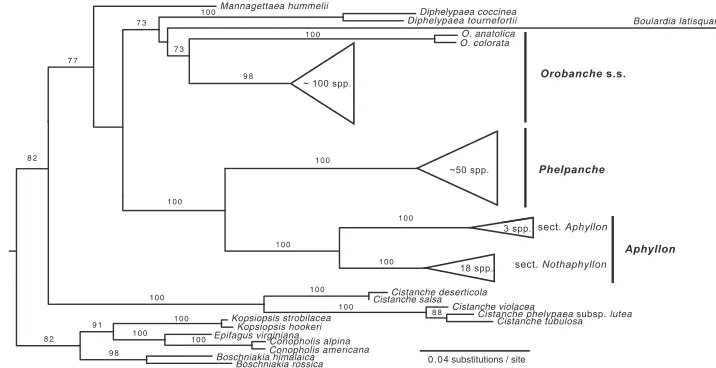
Broomrape species native to the New World constitute two well-supported clades that together form a clade sister to Phelipanche (Schneider et al. 2016). Taxonomically, these clades have been recognized as two separate genera Aphyllon (= Orobanche sect.
Gymnocaulis Nutt.) and Myzorrhiza Phil. (= O. sect. Nothaphyllon (A. Gray) Heckard) by Holub (1977, 1990) and others (Schneweiss 2013), or more rarely, together as
Aphyllon s.l. (Gray 1876). However, neither of these generic taxonomies has been wide-ly adopted among American botanists , in part because of the lack of available names for many taxa. Providing evidence to support the treatment of all New World broomrapes as Aphyllon and a providing list of recognized species (with homotypic synonymns) is the purpose of this paper. New combinations are made where appropriate.
Methods
In order to compare molecular branch lengths of major clades of Orobanche s.l., a max-imum likelihood (ML) phylogram of Aphyllon and related holoparasites was inferred from 3 nuclear DNA loci (ITS, phytochrome A, and phytochrome B). All sequences were downloaded from Genbank, aligned, and concatenated into a supermatrix using SUMAC (Freyman 2015). The ML phylogeny was estimated using RAxML (Stama-takis 2014) with a GTR+Γ nucleotide substitution model and 1000 rapid bootstrap-ping replicates.
Information about type specimens, basionyms, and synonomy of these new com-binations was gathered by examining protologues and images of type specimens us-ing major databases, includus-ing Tropicos (http://www.tropicos.org), JSTOR Global Plants (http://plants.jstor.org), and the International Plant Names Index (http://www. ipni.org). Types for all North American taxa and O. weberbaueri Mattf. have been designated by previous authors and are presented here. For three of the four South American taxa, typification would require more careful efforts beyond the scope of this article. No repository is given in the protologue for two syntypes of Orobanche tac-naensis Mattf. (Woitschach 71 and F. J. F. Meyen s.n.). The current existence of these specimens could not be verified, although a photograph of the Woitscach 71 (possibly from a specimen at B) is available at F. No specimens are cited by Rodolfo Phillipi in the protologues of the two taxa that he described.
Discussion
Molecular phylogenetic analyses have consistently supported a sister-group relationship between two strongly supported two American clades, representing O. sect. Gymnocaulis
Figure 1. Maximum likelihood (ML) phylogram of Aphyllon and related holoparasite species inferred from 3 nuclear DNA loci (ITS, phytochrome A and phytochrome B). Bootstrap support values >70% are labeled. Due to space constraints, several clades have been collapsed. For a more detailed and thorough study of phylogenetic relationships within Aphyllon, see Schneider et al. (2016).
0.04 substitutions / site
Cistanche tubulosa Diphelypaea tournefortii Cistanche deserticola Epifagus virginiana Diphelypaea coccinea Conopholis americana Cistanche violacea Boulardia latisquama Boschniakia rossica O. colorata Boschniakia himalaica O. anatolica Mannagettaea hummelii Cistanche salsa Kopsiopsis strobilacea Conopholis alpina Kopsiopsis hookeri
Cistanche phelypaea subsp. lutea
8 2 100 9 8 8 2 100 100 100 100 100 7 3 100 100 100 100 7 3 9 8 100 100 9 1 100 8 8
Orobanche s.s.
Phelpanche sect.Aphyllon Aphyllon sect.Nothaphyllon 7 7 3 spp. 18 spp. ~50 spp. ~ 100 spp.
taxa (Heckard and Chuang 1975; Schneeweiss et al. 2004b). Holub (1977, 1991) has proposed treating the American broomrapes as two genera rather than one, though this was likely due to his erroneous belief based on vegetative morphology that Orobanche
sect. Nothaphyllon is most closely related to Phelipanche and that O. sect. Gymnocaulis is allied to O. sect. Orobanche (Holub, 1977).
The genus Aphyllon was described by Mitchell (1769), although it was not until nearly 80 years later that Asa Gray made a combination for A. uniflorum A. Gray. This species was the only broomrape included in his Manual of the Botany of the Northern United States (1848), though in the second edition (1856) Gray recognized two ad-ditional species. Gray limited his generic concept for Aphyllon to taxa assignable to O.
sect. Gymnocaulis, instead recognizing O. ludoviciana Nutt. in Phelipaea Tourn. ex Desf. However, after a study of the Californian flora, Gray amended his generic con-cept of Aphyllon to include two sections, Aphyllon and Nothaphyllon, together contain-ing all taxa native to the New World (Gray 1876). Though expanded from Gray’s ini-tial circumscription, it was appropriate given Michell’s original diagnosis of Aphyllon
as having a five-toothed calyx (“semiquinquefidum”), a synapomorphy of New World broomrapes. A generation later, Rydberg (1906) proposed elevating Gray’s Aphyllon
sect. Nothaphyllon to genus rank on the basis of differences in habit and placentation using the available name Myzorrhiza Phil. However, the broader generic concept of
Orobanche used by Beck (1890) has prevailed, particularly among American botanists. Due to the biogeographical, morphological, cytological, and phylogenetic affinities of the New World broomrapes, I recommend treating them in a single genus, Aphyl-lon, composed of sections Aphyllon (= O. sect. Gymnocaulis) and Nothaphyllon (= O.
Aphyllon, proposing new combinations as necessary. Combinations are made at the most recently treated rank for the taxon in Orobanche, with the exception of Orobanche uniflora subsp. occidentale Greene, which is recognized at species rank under the avail-able name Aphyllon purpureum (A. Heller) Holub due to its unique hosts, long molecu-lar branch lengths, and recent discovery of sympatric populations of A. purpureum and
A. uniflorum in southwestern British Columbia (Schneider et al. 2016). The treatment of Aphyllon sect. Aphyllon should be considered tentative; further taxonomic study is underway which will result in the recognition of several additional taxa.
Key to sections of Aphyllon
1 Bracteoles subtending the calyx absent; pedicels much longer than flower (2 -8× length); stems subterranean or rising to about ground level ... ...Aphyllon sect. Aphyllon (syn.: O. sect. Gymnocaulis) 1’ Bracteoles subtending the calyx 2; pedicels equal to or shorter than flower,
occasionally 2x length; stems usually rising above ground level ... ...Aphyllon sect. Nothaphyllon (syn.: O. sect. Nothaphyllon)
Taxonomic treatment
Aphyllon Mitch., Diss. Brevis. Princ. Bot. 43. 1769.
Loxanthes Raf. Neogenyton 3. 1825. [Type: Loxanthes fasciculatus (Nutt.) Raf.]
Anoplanthus Endl., nom. superfl., Gen. Pl. [Endlicher] pt. 10: 727. 1839.
Thalesia Raf. ex Britton, nom. superfl., Mem. Torrey Bot. Club 5: 298. 1894.
Type. Aphyllon uniflorum (L.) Torr. & A. Gray, Manual 290. 1848.
Description. Herb, annual or rarely perennial, achlorophyllous, holoparasitic.
Stems fleshy. Leaves reduced to scale-like bracts. Inflorescences terminal racemes, spikes, corymbs, or panicles. Calyx 5-toothed. Corolla sympetalous, bilabiate to regu-lar, tubular and often curved. Style long, stigma crateriform and peltate, or bilamellar. Fruit loculicidal capsules.
About 22 species: 18 in North America, 4 in South America.
Aphyllon sect. Aphyllon
Orobanche sect. Gymnocaulis Nutt., Gen. N. Amer. Pl. [Nuttall]. 2: 59. 1818.
Description. Stems subterranean or rising to about ground level. Pedicels long and
Aphyllon fasciculatum (Nutt.) Torr & A. Gray, Manual (ed. 2) 281. 1848.
Orobanche fasciculata Nutt., Gen. N. Amer. Pl. 2: 59. 1818.
Phelipaea fasciculata (Nutt.) Spreng., Syst. Veg. [Sprengel] 2: 818. 1825.
Loxanthes fasciculatus (Nutt.) Raf., Neogenyt. 3. 1825.
Anoplon fasciculatum (Nutt.) G. Don., Gen. Hist. 4: 633. 1838.
Anoplanthus fasciculatus (Nutt.) Walp., Repert. Bot. Syst. 3: 480. 1844.
Thalesia fasciculata (Nutt.) Britton, Mem. Torrey Bot. Club 5: 298. 1894.
Type. USA: “Missouri”, ca. 1811, Nuttal s.n., (holotype, PH).
Aphyllon purpureum (A. Heller) Holub, Preslia 70: 100. 1998.
Thalesia purpurea A. Heller, Bull. Torrey Bot. Club 24: 313. 1896.
Orobanche porphyrantha Beck, Pflanzenr. 96[IV,261]: 49. 1930.
Orobanche uniflora var. purpurea (A. Heller) Achey, Bull. Torrey Bot. Club 60: 445. 1933.
Type. USA: Idaho: Nez Perce Co.: near mouth of the Potlatch, 20 May 1896, Heller 3099.
(no holotype designated; isotypes, CAS, DAO, K, MIN, MO, MSC, NDG, PH, US).
Aphyllon uniflorum (L.) Torr & A. Gray, Manual (Gray) 290. 1848
Orobanche uniflora L., Sp. Pl. 2: 633. 1753.
Anoplanthus uniflorus (L.) Endl., Gen. Pl. [Endlicher] 727. 1839.
Thalesia uniflora (L.) Britton, Mem. Torrey Bot. Club 5: 298. 1894.
Type locality. USA: Virginia(lectotype, Clayton 387, BM).
Aphyllon sect. Nothaphyllon A. Gray, Bot. California [W.H. Brewer] 1: 584. 1876
Myzorrhiza Phil., Linnea 29: 36. 1858. [Type: Myzorrhiza chilensis Phil.]
Orobanche sect. Myzorrhiza Beck, Bibliotheca Botanica 4(19): 78. 1890.
Orobanche sect. Nothaphyllon (A. Gray) Heckard, Madroño 22: 41. 1973.
Type. Aphyllon californicum (Cham. & Schltdl.) A. Gray, lectotype designated by
Heckard, Madroño 22: 41. 1973.
Description. Stems clearly rising above ground. Pedicels equal to or shorter than
Aphyllon arizonicum (L.T. Collins) A.C. Schneid., comb. nov. urn:lsid:ipni.org:names:77158997-1
Orobanche arizonica L.T. Collins, Phytoneuron 2015 –48: 16, f. 1, 2, 4, 5, 6A, 7. 2015.
Type. USA: Arizona, Coconino Co.: near Tuba City, 1539 m, 27 September 1935,
Kearney & Peebles 12867 (holotype, ARIZ; isotype, US).
Aphyllon californicum (Cham. & Schltdl.) A. Gray, Bot. California 1: 584. 1876.
Orobanche californica Cham. & Schltdl., Linnea 3: 134–136. 1828.
Phelypaea californica (Cham. & Schltdl.) G. Don, Gen. Hist. 4: 632. 1838.
Myzorrhiza californica (Cham. & Schltdl.) Rydb., Bull. Torrey Bot. Club 36: 696. 1909.
Type. USA: California: Near Port of San Francisco, Aug 1816, Chamisso s.n
(holo-type, LE).
Aphyllon californicum subsp. condensum (Heckard) A.C. Schneid., comb. nov. urn:lsid:ipni.org:names:77159010-1
Orobanche californica subsp. condensa Heckard, Madroño 22: 59–60, f. 1I-L, 5. 1973.
Type. USA: California: San Luis Obispo Co.: Yaro Creek, 25 May 1955, Bacigalupi,
Ferris & Robbins 5242 (holotype, JEPS; isotypes, NY, RSA, US, WTU).
Aphyllon californicum subsp. feudgei (Munz) A.C. Schneid., comb. nov. urn:lsid:ipni.org:names:77159005-1
Orobanche grayana var. feudgei Munz, Bull. Torrey Bot. Club 57: 616–617, pl. 38, f. 8. 1930.
Orobanche californica subsp. feudgei (Munz) Heckard, Madroño 22: 62. 1973.
Type. USA: California: San Bernardino Co.: Baldwin Lake, 2 June 1924, Munz 8177
(holotype, POM).
Aphyllon californicum subsp. grande (Heckard) A.C. Schneid., comb. nov. urn:lsid:ipni.org:names:77159011-1
Type. USA: California: Santa Barbara Co.: dunes at Surf, 22 July 1954, H. M. Pollard
(holotype, UC; isotype, CAS).
Aphyllon californicum subsp. grayanum (Beck) A.C. Schneid., comb. nov. urn:lsid:ipni.org:names:77159006-1
Orobanche grayana Beck, Biblioth. Bot. 4: 79. 1890.
Myzorrhiza grayana (Beck) Rydb., Bull. Torrey Bot. Club 36: 695. 1909.
Orobanche californica subsp. grayana (Beck) Heckard, Madroño 22: 54. 1973.
Type. USA: Oregon: banks of the Columbia River, 1825, Douglas s.n. (lectotype, K).
Aphyllon californicum subsp. jepsonii (Munz) A.C. Schneid., comb. nov. urn:lsid:ipni.org:names:77159007-1
Orobanche grayana var. jepsonii Munz, Bull. Torrey Bot. Club 57: 617, pl. 38, f. 10. 1930.
Orobanche californica subsp. jepsonii (Munz) Heckard, Madroño 22: 57. 1973.
Type. USA: California: Colusa Co.: Princeton, October 1905, H. P. Chandler s.n.
(holotype: POM, isotype: UC).
Aphyllon chilense (Phil.) A.C. Schneid., comb. nov. urn:lsid:ipni.org:names:77158998-1
Myzorrhiza chilensis Phil., Linnea 29: 36–37. 1857.
Orobanche chilensis (Phil.) Beck, Biblioth. Bot. 4: 82–83. 1890.
Aphyllon cooperi A. Gray, Proc. Amer. Acad. Arts 20: 307. 1885.
Orobanche ludoviciana var. cooperi (A. Gray) Beck, Biblioth. Bot. 4(Heft 19): 81. 1890.
Orobanche cooperi (A. Gray) A. Heller, Cat. N. Amer. Pl. 7. 1898.
Myzorrhiza cooperi (A. Gray) Rydb. Bull. Torrey Bot. Club 36: 695. 1909.
Type locality. USA: Arizona: Fort Mojave (lectotype designated by Munz, Bull. Torrey
Aphyllon cooperi subsp. latilobum (Munz) A.C. Schneid., comb. nov. urn:lsid:ipni.org:names:77159008-1
Orobanche ludoviciana var. latiloba Munz, Bull. Torrey Bot. Club 57: 621 –622, pl. 39, f. 18. 1930.
Orobanche cooperi subsp. latiloba (Munz) L.T. Collins, Phytoneuron 2015 –48: 15. 2015.
Type. USA: California: Riverside Co.: Colorado Desert, 22 April 1922, Munz & Keck
4960 (holotype: POM, isotype, US).
Aphyllon cooperi subsp. palmeri (Munz) A.C. Schneid., comb. nov. urn:lsid:ipni.org:names:77159009-1
Orobanche multicaulis var. palmeri Munz, Bull. Torrey Bot. Club 57: 613, pl. 38, f. 2. 1930.
Orobanche cooperi subsp. palmeri (Munz) L.T. Collins, Phytoneuron 2015 –48: 16. 2015.
Type. Mexico, Durango, April-November 1896, Palmer 7 (holotype: GH, isotypes,
MO, UC).
Aphyllon corymbosum (Rydb.) A.C. Schneid., comb. nov. urn:lsid:ipni.org:names:77158999-1
Myzorrhiza corymbosa Rydb., Bull Torrey Bot. Club 36: 696. 1909.
Orobanche corymbosa (Rydb.) Ferris, Contr. Dudley Herb. 5: 99. 1958.
Type. USA: Reynold’s Creek, 2 July 1892, Isabel Mulford s.n. (holotype, NY; isotype, MO).
Aphyllon corymbosum subsp. mutabile (Heckard) A.C. Schneid., comb. nov. urn:lsid:ipni.org:names:77159012-1
Orobanche corymbosa subsp. mutabilis Heckard, Canad. J. Bot. 56: 187 –188. 1978.
Type. USA: Washington: Grant Co.: O’Sullivan Dam, 11 July 1950, S. W. Harris 97
(holotype, WS).
Aphyllon dugesii S. Watson, Proc. Amer. Acad. Arts 18: 132. 1883.
Orobanche dugesii (S. Watson) Munz, Bull. Torrey Bot. Club 57: 613, t. 38, f. 3. 1931.
Aphyllon ludovicianum (Nutt) A. Gray. Bot. California [W.H.Brewer] 1. 585.
Orobanche ludoviciana Nutt. Gen. N. Amer. Pl. 2: 58–59. 1818.
Phelypaea ludoviciana (Nutt) Walp. Repert. Bot. Syst. 3: 461. 1844.
Myzorrhiza ludoviciana (Nutt) Rydb. Fl. S.E. U.S 1338. 1903.
Type. USA: Fort Mandan, 1810-1811, Nuttall s.n. (holotype, PH).
Aphyllon multiflorum (Nutt) A. Gray. Bot. California [W.H.Brewer] 1. 585.
Orobanche multiflora Nutt., J. Acad. Nat. Sci. Philadelphia, ser. 2 1: 179. 1848.
Type. USA: Rio Grande, 1845, Gambel s.n. (neotype designated by White & Holmes,
Sida 19: 623, USA: Texas: Jim Wells Co., 19 April 1944, Lundell & Lundell 12809, LL; isoneotype, LL).
Aphyllon parishii (Jeps.) A.C. Schneid., comb. nov. urn:lsid:ipni.org:names:77159001-1
Orobanche californica var. parishii Jeps. Man. Fl. Pl. Calif. 952. 1925.
Orobanche parishii (Jeps.) Heckard. Madroño 22: 66. 1973.
Type. USA: California: San Bernardino Co.: Bear Valley, 1894, S. B. Parish s.n.
(holo-type, JEPS).
Aphyllon parishii subsp. brachylobum (Heckard) A.C. Schneid., comb. nov. urn:lsid:ipni.org:names:77159013-1
Orobanche parishii subsp. brachyloba Heckard, Madroño 22: 68 –70, 2J, 3N, 5. 1973.
Type. USA: California: Ventura Co.: Dutch Harbor, San Nicolas Island, 23 April
1966, Raven & Thompson 20794 (holotype, JEPS; isotypes, MO, RSA, SBBG).
Aphyllon pinorum (Geyer ex Hook.) A. Gray, Bot. California 1: 585. 1876.
Orobanche pinorum Geyer ex Hook., Hooker’s J. Bot. Kew Gard. 3:297–298. 1851.
Aphyllon riparium (L.T. Collins) A.C. Schneid., comb. nov. urn:lsid:ipni.org:names:77159002-1
Orobanche riparia L.T. Collins, J. Bot. Res. Inst. Texas 3 : 7–10, f. 1A-B, 2. 2009.
Type. USA: Indiana, Gibson Co.: Griffin, 16 August 1931, Deam 50941 (holotype,
IND; isotypes, A, F, GH, IND, MINN, WIS).
Aphyllon robbinsii (Heckard ex Colwell & Yatsk.) A.C. Schneid., comb. nov. urn:lsid:ipni.org:names:77159015-1
Orobanche robbinsii Heckard ex Colwell & Yatsk., Phytoneuron 2016-58: 2.2016.
Type. USA: California: San Francisco Co.: Lands End, 13 August 1956, Robbins 3707
(holotype, JEPS; isotypes, CAS, GH, NY).
Aphyllon tacnaense (Mattf.) A.C. Schneid., comb. nov. urn:lsid:ipni.org:names:77159016-1
Orobanche tacnaensis Mattf., Notizbl. Bot Gart. Berlin-Dahlem 8: 185–186. 1922.
Syntypes. Peru: Tacna, 1890, Woitschach 71 (photograph of type: F); Peru: Tacna,
1833, F. J. F. Meyen s.n.
Aphyllon tarapacanum (Phil.) A.C. Schneid., comb. nov. urn:lsid:ipni.org:names:77159003-1
Orobanche tarapacana Phil., Anales Mus. Nac. Santiago de Chile 1891: 69. 1891.
Aphyllon tuberosum (A. Gray) A. Gray, Bot. California 1: 585. 1876.
Phelypaea tuberosa A. Gray, Proc. Amer. Acad. Arts 7: 371. 1868.
Orobanche bulbosa Beck, Biblioth. Bot. 4: 83–84. 1890.
Type. USA: California: Monterey Co: Gavilan Mountains, 1860-1862, Brewer 743
Aphyllon validum (Jeps.) A.C. Schneid., comb. nov. urn:lsid:ipni.org:names:77159017-1
Orobanche valida Jeps., Madroño 1: 255–256. 1929.
Orobanche ludoviciana var. valida (Jeps.) Munz, Bull. Torrey Bot. Club 57: 621. 1930.
Type. USA: California: Rock Creek, San Gabriel Mountains, 2 June 1923, F. W. Peirson
7937 (holotype: JEPS, isotype: RSA).
Aphyllon validum subsp. howellii (Heckard & L.T Collins) A.C. Schneid., comb. nov. urn:lsid:ipni.org:names:77159018-1
Orobanche valida subsp. howellii Heckard & L.T Collins, Madroño 29: 98–100, f. 1A–E. 1982.
Type. USA: California: Mendocino Co.: Impassable Rock, 14 July 1951, Donald V.
Hemphill s.n. (holotype: UC).
Aphyllon vallicolum (Jeps.) A.C. Schneid., comb. nov. urn:lsid:ipni.org:names:77159004-1
Orobanche comosa var. vallicola Jeps., Man. Fl. Pl. Calif. 952. 1925.
Orobanche vallicola (Jeps.) Heckard, Madroño 22: 64. 1973.
Type. USA: California: Santa Clara Co.: Coyote, 14 October 1914, W. L. Jepson 6196
(holotype: JEPS, isotypes: GH, MO).
Aphyllon weberbaueri (Mattf.) A.C. Schneid., comb. nov. urn:lsid:ipni.org:names:77159019-1
Orobanche weberbaueri Mattf., Notizbl. Bot Gart. Berlin-Dahlem 8: 185. 1922.
Type. Peru: Camaná: Areuipa, Hafen Chala, 26 November 1915, A. Weberbauer 7185
(isotypes: GH, US).
Acknowledgments
References
Beck G (1890) Monographe der Gattung Orobanche. Biblitoheca Botanica 19. Theoder Fischer, Cassel.
Freyman WA (2015) SUMAC: software for constructing phylogenetic supermatrices and assessing par-tially decisive taxon coverage. Evolutionary Bioinformatics 11: 263–266. https://doi.org/10.4137/ EBO.S35384
Gray A (1848) Manual of the botany of the northern United States. James Munroe and Co, Boston.
Gray A (1856) Manual of the botany of the northern United States (edn 2). George P. Putnam and Co, New York. https://doi.org/10.5962/bhl.title.50405
Gray A (1876) Aphyllon. In: Brewer WH, Watson S (Eds) Geological Survey of California Botany. Volume 1, 584–585.
Heckard LR, Chuang TI (1975) Chromosome numbers and polyploidy in Orobanche (Oroban-chaceae). Brittonia 27: 179–186. https://doi.org/10.2307/2805479
Holub J (1977) New names in Phanaerogamae 6. Folia Geobotanica et Phytotaxonmica 12: 417–432. https://doi.org/10.1007/BF02890652
Holub J (1990) Some taxonomic and nomenclatural changes within Orobanche s.l. (Oroban-chaceae). Preslia 62: 193–198.
Joel DM (2009) The new nomenclature of Orobanche and Phelipanche. Weed Research 49: 6 –7. https://doi.org/10.1111/j.1365-3180.2009.00748.x
McNeal JR, Bennett JR, Wolfe AD, Mathews S (2013) Phylogeny and origins of holoparasitism in Orobanchaceae. American Journal of Botany 100: 971–983. https://doi.org/10.3732/ ajb.1200448
Mitchell J (1769) Dissertatio brevis de principiis botanicorum et zoologorum. W. Schwartzkopf. Rydberg PA (1906) Studies on the Rocky Mountain Flora XVI. Bulletin of the Torrey Botanical
Club 33: 137–162. https://doi.org/10.2307/2478824
Rydberg PA (1909) Studies on the Rocky Mountain Flora XX. Bulletin of the Torrey Botanical Club 36: 675–720. https://doi.org/10.2307/2479009
Schneeweiss GM (2013) Phylogenetic relationships and evolutionary trends in Orobanchaceae. In: Joel DM, Gressel J, Mussleman LJ (Eds) Parasitic Orobanchaceae. Berlin Heidelberg: Springer, 243–265. https://doi.org/10.1007/978-3-642-38146-1_14
Schneeweiss GM, Colwell AEL, Park J-M, Jang C-G, Stuessy TF (2004a) Phylogeny of holoparasistic
Orobanche (Orobanchaceae) inferred from nuclear ITS sequences. Molecular Phylogenetics and Evolution 30: 465–478. https://doi.org/10.1016/S1055-7903(03)00210-0
Schneeweiss GM, Palomeque T, Colwell AEL, Weiss-Schneeweiss H (2004b) Chromosome numbers and karyotype evolution in holoparasitic Orobanche (Orobanchaceae) and related genera. American Journal of Botany 91: 439–448. https://doi.org/10.3732/ajb.91.3.439 Schneider AC, Colwell AEL, Schneeweiss GM, Baldwin BG (2016) Cryptic host-specific
di-versity among western hemisphere broomrapes (Orobanche s.l., Orobanchaceae). Annals of Botany 118: 1101–1111. https://doi.org/10.1093/aob/mcw158