Research Article
July
2017
Computer Science and Software Engineering
ISSN: 2277-128X (Volume-7, Issue-7)
Developing and Validating a M-Governance Framework
Adoption Model of a University for Communication
Services to Its Affiliated Institutions
E.Ramganesh1, E. Kirubakaran2, D.Ravindran3, R.Gobi4
1
Bharathidasan University, Tiruchirappalli, Tamil Nadu, India
2
Bharat Heavy Electricals Limited, Tiruchirappalli, Tamil Nadu, India
3 St. Joseph’s College (Autonomous), Tiruchirappalli, Tamil Nadu, India 4
National Institute of Technology, Tiruchirappalli, Tamil Nadu, India
Abstract: The m-Governance framework of auniversity aims to utilize the massive reach of mobile phones and harness the potential of mobile applications to enable easy and round the-clock access to the services of its affiliated institutions. In the current mobile age there is need for transforming e-governance services to Governance as m-Governance is not a replacement for e-m-Governance rather it complements e-m-Governance. With this unparalleled advancement of mobile communication technologies, universities are turning to m-governance to realize the value of mobile technologies for responsive governance and measurable improvements to academic, social and economic development, public service delivery, operational efficiencies and active stakeholder engagement. In this context the present study, aims to develop and validate a m-governance framework of a university by extending Technology Acceptance Model (TAM) with its prime stakeholders so called the Heads of the affiliated institutions. A survey instrument was developed based on the framework and it was administered with 20 Heads of the affiliated Institutions. The results also showed that the Heads of the affiliated Institutions expressed their favorableness towards m-governance adoption.
Keywords: M-governance framework, e-governance, TAM, Institution, Services, Perceived
I. INTRODUCTION
In today’s technology mediated world, assurance of innovative teaching and learning environment is a key issue in ensuring effective learning. Recent study on global higher education reveals that, it has become a multi-billion dollar industry and plays a vital role in nurturing and developing intellectual community and eventually contributes to the economy.Technology based higher education adopted by HEIs provides services to teacher and student community as far as dissemination of education is concerned (Subrata Kumar Dey, 2007). However, for long term benefit and sustainability in today’s competitive environment, it is also important to ensuring transparency, accountability and effectiveness in HEI administration. The model of m-governance in the era of mobile technologies can play a vital role in this regard. External services of HEIs are focused on fulfilling external stakeholders’ needs and expectations satisfactorily by providing simplified interaction through various online services(Ramganesh, E et.al., 2015) Use of these services facilitates speedy, transparent, accountable, efficient and effective e interaction with external stakeholders like students, guardians, suppliers, regulatory authorities. On the other hand, internal services are focused on better management and reduced operational costs of the HEI concerned by providing speedy, transparent, accountable, efficient and effective process for performing administrative activities.
ISSN(E): 2277-128X, ISSN(P): 2277-6451, DOI: 10.23956/ijarcsse/, pp. 484-490
through perceived trustworthiness and perceived mobility. Finally, the actual use of mobile government services will be assessed by user’s satisfaction and the user intention of usingm-governance that ensure the impact of m-governance services in different aspects such as Admission, Affiliation, Curriculum, Examination, Result and General Enquiry.
II. OBJECTIVES OF THE STUDY
The major aim of this research is to develop and validate a m-governance framework, which is designed to be useful for universities considering delivery of m-Governance services to their affiliated institutions, which can assist any decision makers who are involved in communication services to better understand the factors influencing the intention to use m-Governanceservices. This study uses model of TAM as well as enablers in order to test its applicability in the context of the intention to use m-Governance services. Specifically, the objectives of the study are to:
develop and validate the m-governance framework of a Higher Education Institution
develop and validate a survey instrument that is set to examine the perceived characteristics of m-Governance services as perceived by users
determine the effectiveness of m-governance services on communication services to the institutions
III. DEVELOPMENT OF M-GOVERNANCE FRAMEWORK USING TECHNOLOGY ACCEPTANCE MODEL(TAM)
TAM and the Diffusion of Innovation–DOI are two research models and theories frequently used in technology adoption research. The goal of TAM, is “to provide an explanation of the determinants of computer acceptance that is general, capable of explaining user behavior across a broad range of end-user computing technologies and user populations, while at the same time being both parsimonious and theoretically justified” (Davis,F et.al, 1989).
Perceived ease of use and perceived usefulness, fundamental constructs of TAM, have been considered important in determining the individuals’ acceptance and use of IT (Sabramanian, G, 1994 & Moon J et.al. 2001). Perceived ease of use is defined as “the degree to which a person believes that using a particular system would be free of physical and mental effort” and perceived usefulness of the system as “the degree to which a person believes that using a particular system would enhance his or her job performance” (Karavasilis, I et.al, 2010).
There have been many developed models which aim tostudy and investigate the factors that affect the usage oftechnology in a specific society. Amongst those is the TAM(Technology Acceptance Model). The model is based on 5constructs: perceived usefulness, perceived ease of use,attitude towards use, intention to use and actual use. Some ofthese constructs are affecting others, for instance the constructperceived usefulness affects the construct intention to use, andthe construct attitude towards use has an impact on theconstruct intention to use. TAM was used in many studies; so,many changes have been applied to it. Mainly with theaddition of new constraints (D. Gefenet.al, 2003), or editing the links betweenexisting constructs.
By conducting an exhaustive literature review and brainstorming sessions with experts, 15 enablers such as perceived ease of use, perceived usefulness, perceived access, interpersonal influence, perceived trustworthiness, perceived mobility, transparency of governance, compatibility, flexibility, perceived security, perceived enjoyment, network provider service, completeness of service, location influence in the service and emergency management were identified that would positively affect m-governance initiatives of the institution. These enablers are linked to TAM on the five constructs on the basis of the expertise sharing of experts in the field of computer science and m-governance. TAM has been successfully applied to investigations concerning user adoption behavior in virtually any computer-related field and building technology acceptance frameworks in very narrow areas (Serenko, A et.al, 2004). The major advantage of TAM is that it can be extended when new technologies are introduced (Shih, H.P. 2004). Depending on the specific technology context, additional domain-specific constructs and explanatory variables may be needed beyond the ease of use and usefulness constructs. The model adopted in this study consists of TAM extended by including thirteen more components: perceived access, interpersonal influence, perceived trustworthiness, perceived mobility, transparency of governance, compatibility, flexibility, perceived security, perceived enjoyment, network provider service, completeness of service, location influence in the service and emergency management. Various components are detailed in the following m-governance framework:
1. Perceived Usefulness
Perceived usefulness (PU) is one the most significant constructs in TAM. PU stands for the user’s perception about potential benefits of using the specific IT technology, and thusleads to continuing using it (Davis, F, 1989). In the context of this study, PU is defined as the extent to which the users deem that they will benefit from the services of m-Governance in their everyday life. The ability of user to connect to m-m-Governance services should not mainly rely on time and location, which is known as service ubiquity. The ubiquity of services highlights the advantage of such mobile services. For instance, if citizens are aware that they have continuous access to a given service anytime they need it, then they will believe that the service is beneficial for them (Revels,D et.al., 2010). This usefulness of m-Governance services extended by a university will affect the administrator’s attitude towards using mobile governance services. Therefore, the following hypothesis can be formulated:
ISSN(E): 2277-128X, ISSN(P): 2277-6451, DOI: 10.23956/ijarcsse/, pp. 484-490
2. Perceived Ease of Use
Perceived ease of use (PEU) is one of the important components in TAM and influences the users’ intention to use the technology (Davis, F, 1989). In the context of this study, PEU is defined as the extent to which users believe that m-governance services are easy to use and effortless (Revels,D et.al., 2010).. The complexity of use of technology has an impact on user’s attitude towards using mobile government services. From another side, when m-governance services are easy to use, then users will be aware of the benefits of using them; so, users time and effort will be saved, which usually affect their attitude towards the service provided. Therefore, the following hypothesis can be made:
Hypothesis 2: The perceived ease of use positively affects the administrator’s attitude towards using mobile governmentservices.
3. The Attitude
The attitude toward use in the TAM model is defined as themediating affective response between usefulness and ease ofuse beliefs and intentions to use a target system. In otherwords, a prospective user’s overall attitude toward using agiven system is an antecedent to intentions to adopt (Davis, F, 1989).Therefore, there is a relationship between the administrator’s attitudetowards using mobile governance services and intention touse mobile governance services, so the following hypothesiscan be formulated:
Hypothesis 3: The attitude of administrators of higher learning institutions will have a significant positiveeffect on intention to use m-governance Services.
4. User’s Satisfaction
If the user of a specific service is satisfied, he/she willcontinue to use it in the future (Oliver, R. L, 1999). User satisfaction factor hasan impact on long-term organizational success and systemusage (Oliver, R. L, 1999). User satisfaction can be defined as the perception ofa pleasant fulfillment of a service(Oliver, R. L, 1999), or the extent to whichusers believe that the information systems available to them meet their information requirements(B. Ives, B, H. Olson and J. Baroudi, 1993). In the field of m-governance, user satisfaction is an important factor thataffects the quality of delivered services, and thus will affectthe actual use of m-governance services. In order to achievethis satisfaction, user’s needs and perceptions should be takeninto account (B. Ives, B, H. Olson and J. Baroudi, 1993). The study (Wixom, B and Todd, P , 2005)highlights the importance ofintegrating user satisfaction literature with technologyacceptance literature. Therefore, the following hypothesis canbe assumed:
Hypothesis 4: User satisfaction positively affects theactual use of m-governance services
5. Intention to Use
The Intention to Use construct was derived from theTechnology Acceptance Model (TAM). Reference (M. Fishbein and L. Ajzen, 1975) argues that behavioral intention can be seen as a guide of how hardpeople are willing to try to perform a particular behavior.Consequently, Davis, F has extended the Intention to Use definitionto include the intention to use technology. Reference (H. Nysveen, P. Pedersen and H. Thorbjørnsen, 2005) hasalso extended the definition of Intention to Use in the contextof the adoption of mobile governance services. There is the relationshipbetween the intention to use mobile government and theadoption of using mobile governance services. Therefore, thefollowing hypothesis can be assumed:
Hypothesis 5: Intention to use mobile governanceservices positively affects the actual use of m-Governance services.
IV. METHODOLOGY
ISSN(E): 2277-128X, ISSN(P): 2277-6451, DOI: 10.23956/ijarcsse/, pp. 484-490
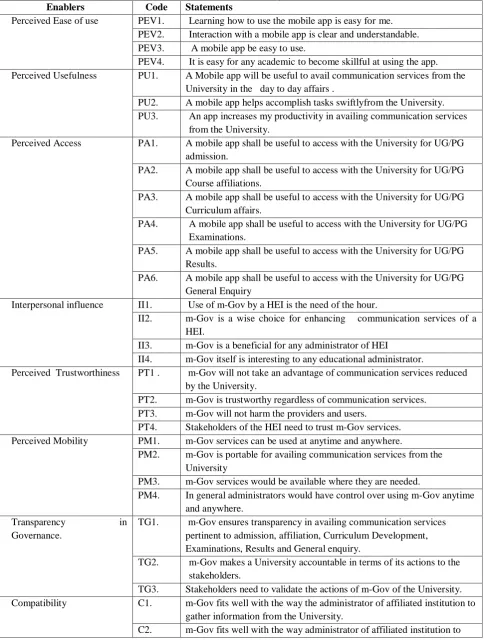
present study. The data were analyzed from SPSS. In order to measure the TAM constructs (perceived ease of use, perceived usefulness, attitude towards use, intention to use and actual use, etc.), 50 items have been used. Table I shows part of data instrument used to collect data (excluding demographic part). Finally, the five-point-Likert-type scale was used to measure items, ranging from “strongly agree” to “strongly disagree”. For all the positive items the score ranges from 5 to 1 ranging from “strongly agree” to “strongly disagree” respectively.
Table I : The items of the Survey Instrument
Enablers Code Statements
Perceived Ease of use PEV1. Learning how to use the mobile app is easy for me.
PEV2. Interaction with a mobile app is clear and understandable. PEV3. A mobile app be easy to use.
PEV4. It is easy for any academic to become skillful at using the app.
Perceived Usefulness PU1. A Mobile app will be useful to avail communication services from the
University in the day to day affairs .
PU2. A mobile app helps accomplish tasks swiftlyfrom the University.
PU3. An app increases my productivity in availing communication services
from the University.
Perceived Access PA1. A mobile app shall be useful to access with the University for UG/PG
admission.
PA2. A mobile app shall be useful to access with the University for UG/PG
Course affiliations.
PA3. A mobile app shall be useful to access with the University for UG/PG
Curriculum affairs.
PA4. A mobile app shall be useful to access with the University for UG/PG
Examinations.
PA5. A mobile app shall be useful to access with the University for UG/PG
Results.
PA6. A mobile app shall be useful to access with the University for UG/PG
General Enquiry
Interpersonal influence II1. Use of m-Gov by a HEI is the need of the hour.
II2. m-Gov is a wise choice for enhancing communication services of a HEI.
II3. m-Gov is a beneficial for any administrator of HEI
II4. m-Gov itself is interesting to any educational administrator.
Perceived Trustworthiness PT1 . m-Gov will not take an advantage of communication services reduced
by the University.
PT2. m-Gov is trustworthy regardless of communication services.
PT3. m-Gov will not harm the providers and users.
PT4. Stakeholders of the HEI need to trust m-Gov services.
Perceived Mobility PM1. m-Gov services can be used at anytime and anywhere.
PM2. m-Gov is portable for availing communication services from the
University
PM3. m-Gov services would be available where they are needed.
PM4. In general administrators would have control over using m-Gov anytime
and anywhere.
Transparency in
Governance.
TG1. m-Gov ensures transparency in availing communication services
pertinent to admission, affiliation, Curriculum Development, Examinations, Results and General enquiry.
TG2. m-Gov makes a University accountable in terms of its actions to the
stakeholders.
TG3. Stakeholders need to validate the actions of m-Gov of the University.
Compatibility C1. m-Gov fits well with the way the administrator of affiliated institution to
gather information from the University.
ISSN(E): 2277-128X, ISSN(P): 2277-6451, DOI: 10.23956/ijarcsse/, pp. 484-490
interact with the University.
C3. m-Gov is interact with the University is compatible.
Flexibility F1. m-Gov provides multiple access.
F2. m-Gov has a greater adaptability.
F3. m-Gov has a real time monitoring system.
Perceived security PS1. Data being accesses through m-Gov are secure.
PS2. m-Gov services are financially secure.
PS3. m-Gov has safeguards to make user comfortable.
Perceived Enjoyment PE1. Accessing information through m-Gov is interesting.
PE2. Using m-Gov by administrators is a wise decision.
Network Provider Service NPS1. Network Provider Service is encouraging to use m-Gov.
NPS2. Network provider services helps administrators in remote areas to avail
communication services from the University through m-Gov.
NPS3. The way in which the providers adjust to the needs of users is good.
Completeness of service CS1. The technical quality of m-Gov services is good.
CS2. The information received from mobile governance is meaningful.
CS3. The overall service extended by m-Gov is satisfactory.
Location Inference LI1. Integration of GPS facility is m-Gov ensures the validity of the users.
LI2. OTP check when the users intend to use m-Gov services from the places
away from their Institutions is good.
Emergency Management EM1. m-Gov is a primary mean of transacting with the University for any
emergency.
EM2. m-Gov is an alternative to traditional way of transacting with the
University for emergency purpose.
EM3. Given the opportunity m-Gov services can be used for any emergency.
V. INSTRUMENT VALIDITY
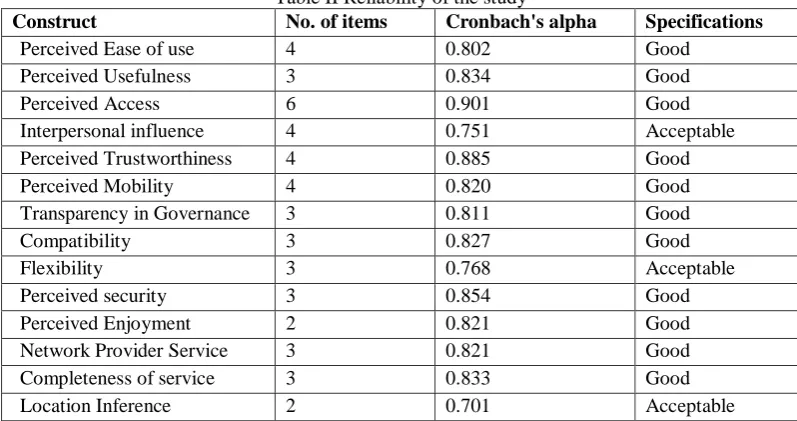
For establishing construction and validation of the instrument, the questionnaire was circulated to 10 experts in the field of m-governance for obtaining their opinion. Based on the opinion the rephrasing and rewording had been done to establish face validity. The reliability of a measure refers to the degree to which the instrument is free of random errors. It is concerned with consistency and stability of the measurement (U. Sekeran, 1992). In this pilot study, detailed item analysis and reliability were used to finetune the measures of each construct. The measurement items were assessed and removed if shown to decrease the reliability of the instrument. To measure the reliability of our tools (questionnaire), we calculated Cronbach's alphas.
According to [24], if the value of Cronbach’s Alpha is smaller than 0.6 it is poor, if it is in the range of 0.60 to 0.80 it is considered acceptable and if it is above 0.80 it is considered good. Table II shows the reliability study tool transactions. The overall reliability coefficient is high (with the averaged one of 0.818) which suggests that the reliability was good for the field of study
Table II Reliability of the study
Construct No. of items Cronbach's alpha Specifications
Perceived Ease of use 4 0.802 Good
Perceived Usefulness 3 0.834 Good
Perceived Access 6 0.901 Good
Interpersonal influence 4 0.751 Acceptable
Perceived Trustworthiness 4 0.885 Good
Perceived Mobility 4 0.820 Good
Transparency in Governance 3 0.811 Good
Compatibility 3 0.827 Good
Flexibility 3 0.768 Acceptable
Perceived security 3 0.854 Good
Perceived Enjoyment 2 0.821 Good
Network Provider Service 3 0.821 Good
Completeness of service 3 0.833 Good
ISSN(E): 2277-128X, ISSN(P): 2277-6451, DOI: 10.23956/ijarcsse/, pp. 484-490
Emergency Management 3 0.816 Good
Overall 50 0.818 Good
VI. RESULT AND DISCUSSION
The chi square test was computed for the testing the hypotheses. After testing them, the research model after validating them is given.Hence chi square tests confirmed that all the five hypotheses were accepted as they were found significant. Hence M-Gov services were found to affect positively the users in the aspects of perceived ease of use, perceived usefulness, attitude, intention and actual use as per TAM model which in turn enhance the effectiveness of M-Governance service of administrators. In the analysis, it was also found that there was no significant difference between male and female administrators in the overall opinion on all the enablers of M-Governance; Qualifications of administrators did not have any impact on mobile governance adoption.
A correlation analysis was run based on each of these constructs, and the results are reported in Table III. As it can be seen from the matrix, there is a significant relationship between actual use of mobile government services and the rest of constructs, although the relationship varies in strength from one construct to the next. For example, the results showed a strong correlation among all variables of the acceptance model.The product moment correlation coefficient was computed to find out the relationship between constructs. Perceived usefulness and Perceived Ease of Use correlate strongly with attitude towards use of mobile governance services. This indicates that users' attitude towards use of mobile government services increases if they perceive the system as useful and easy to use. This result indicates that if users trust the mobile government services and use these services anywhere and anytime, their intention to use it will increase. The results showed also a strong correlation between Intention to Use mobile government services and User’s Satisfaction with Actual use of mobile government services.
VII. CONCLUSION
This study focuses on validating the model that have been developed by integrating the constructs from the TAM(Technology Acceptance Model) and other external variablesderived from the related literature, such as user’s satisfaction,perceived mobility and perceivedtrustworthiness etc. The developed model willprovide more knowledge to the fields of m-Governance andtechnology adoption in general and in Higher Education Institution in particular. The findings of the present study revealed that the mobile governance could enhance the communication services availed by the administrators of affiliated institutions from the university pertinent to admission, affiliation, curriculum, examinations, results and general enquiry. It is certain that the modest effort taken by the study would provide an academic and administrative ambience to the university to develop an architecturefor a complete mobile governance services to facilitate its stakeholders.
Effectiveness of M-Gov
Services
Perceived ease of use •7.58
Perceived Usefulness •12.37
Attitude to use
•8..98 Intention to
use •10.79 Actual Use •15.26
PEU PU ATT IU AU
PEU 0.917 0.862 0.776 0.812
PU 0.917 0.803 0.652 0.682
ATT 0.862 0.803 0.798 0.667
IU 0.776 0.652 0.798 0.709
ISSN(E): 2277-128X, ISSN(P): 2277-6451, DOI: 10.23956/ijarcsse/, pp. 484-490
REFERENCES
[1] Davis, F.; Bagozzi, R.; Warshaw, P. User acceptance of computer technology: A comparison of two theoretical
models. Manag. Sci. 1989, 35, 982–1003.
[2] Davis, F “A technology acceptance model for empirically testing newend-user information systems: Theory and
results”, Doctoral dissertation, Sloan School of Management, Massachusetts Institute ofTechnology, 1989
[3] Fishbein, M and Ajzen, L “Belief, Attitude, Intention, and Behavior: An Introduction to Theory and Research”,
1975, MA, Addison-Wesley.
[4] Gefen,D, Elena,K and Straub, D“Trust and TAM in online shopping:An integrated model. Management
Information Systems Quarterly”,2003, vol. 1, pp. 51–90
[5] Ives, B., Olson B, H. and Baroudi, J. “The measurement of user information satisfaction: A method and critique”, Communications of the ACM, 1993, vol. 10, pp. 785–793.
[6] Karavasilis, I.; Zafiropoulos, K.; Vrana, V. Factors Affecting the Adoption of eGovernance by Teachers in
Greece. In Proceedings of the 10th European Conference on eGovernment, Limerick, Ireland, 17–18 June 2010.
[7] Moon, J.W.; Kim, Y.G. Extending the TAM for a World-Wide-Web context. Inf. Manag. 2001, 38, 217–230.
[8] Nysveen, H, Pedersen, P and Thorbjørnsen, H “Explaining intention to use mobile chat services: moderating
effects of gender”, 2005, Journalof Consumer Marketing, vol. 22, pp. 247-256.
[9] Oliver, R. L, “Whence customer loyalty”, Journal of Marketing, 1999, vol. 4, pp. 33–44.
[10] Ramganesh, E. Kirubakaran, E and R. Gobi, “A Roadmap for a Higher Learning Institution based
m-governance framework in the grey revolution”, International Journal of Advanced Research in Computer Science and Software Engineering, 2015, Vol. 5(8) pp. 152-155
[11] Revels, J, Tojib D and Tsarenko,Y “Understanding consumer intention to use mobile service”, Australian Marketing Journal (AMJ), 2010, vol.2, pp.74-80.
[12] Sabramanian, G. A replication of perceived usefulness and perceived ease of use. Decis. Sci. 1994, 25, 863–874.
[13] Sekeran, U “Research Method for Business”, 1992, A Skill Building Method, 2nd Edition, John Wiley and Sons, Inc. Canada
[14] Serenko, A.; Bontis, N. A model of user adoption of mobile portal. Quart. J. Electron. Commer. 2004, 4, 69–98.
[15] Shih, H.P. Extended technology acceptance model of Internet utilization behavior. Inf. Manag. 2004, 41, 719–
729.
[16] Subrata Kumar Dey, Practicing e-Governance in Higher Education Institutions to enhance Quality of Education,
[17] Wixom, B and Todd, P “A theoretical integration of user satisfactionand technology acceptance”, Information