Abstract
Substance/alcohol abuse is an important public health threat in most countries. Social stigmatization and legal restrictions prevent accurate and direct estimate of prevalence of substance/alcohol abuse in Iran. This study aimed to estimate of the prevalence of alcohol and substance use among Iranian patients who were admitted to operating rooms of a general hospital in Tehran and identified risk factors that may predict alcohol and substance use. This cross-sectional study was conducted among all consecutive patients who were admitted to 16 operating rooms in Vali-e-Asr General Educational Hospital (Tehran, Iran) during March 2014 to September 2015. Data were derived from a medical history form prior to operation by trained nurses who were working in the operating rooms. Among 1136 patients admitted to operating rooms, 105 (28.7%) men and 21 (2.7%) women were substance/alcohol users. The main substance of abuse was opium (57.3%) followed by alcohol consumption (25.6%) and water pipe smoking (14.8%). Cigarette smoking was reported by 110 (30.1%) men and 21 (2.7%) women. Sex, cigarette smoking and family history of alcohol and substance abuse predicted 42.3% of the variance in substance abuse/alcohol consumption. Substance use, especially opium, alcohol, water pipe tobacco and cigarette smoking were found to be significantly high particularly among male patients. Being a man, current cigarette smoking and having a first-degree family member who had abused substances should be considered when planning preventive or therapeutic programs.
Prevalence of Substance Abuse/Alcohol
Consumption and their Predictors among
Patients Admitted in Operating Rooms of a
General Educational Hospital, Tehran, Iran
S. Shohreh Alavi
1, Ramin Mehrdad
1and Jalil Makarem
2*1Center for Research on Occupational Diseases, Tehran University of Medical Sciences, Tehran, Iran 2Imam Khomeini Hospital Complex, Tehran University of Medical Sciences, Tehran, Iran; [email protected]
Keywords: Alcohol Drinking, Prevalence, Smoking, Substance Abuse
1. Introduction
Nowadays, most societies face the serious challenge of substance abuse, which is often associated with social problems. Substance abuse is closely related to cultural, religious, economic, social, and historical aspects of a Community1. Official statistics and indirect estimations
declared the approximate total number of addicts in Iran to be between 700,000 and 4,000,000. However, these estimations are in-accurate and crude2. In other words,
accurate assessment of the prevalence of substance and alcohol abuse and dependence (due to legal and religious restrictions and social stigmatization) is not possible in
Iran, because respondents may not always be honest or accurate about their substance use. On the other hand, substance and alcohol abuse have acute and chronic physical harms to the organs of users3 and complicate the
health problems of the medical patients1,4,5 so using these
substances increase the rate of physical co-morbidities6.
Some of the consequences of opium/opioid use are listed as follows:
• Changes in biochemical parameters of human’s serum7;
• Difficulties in Peri-operative pain management; • A high tolerance for opiate analgesics and a need to
effects and higher probability to be under medicated for pain8;
• Shorter duration of spinal anesthesia9;
• Difficulties in intravenous access in injection drug users due to phlebitis.
• A higher risk of thrombophlebitis, infection at the injecting site, bacteremia, sepsis, Human Immunodeficiency Virus (HIV) and Hepatitis C Virus (HCV)8,10.
• The risk of violent behavior and psychological problems, withdrawal syndrome, and lack of post-operative cooperation5.
Smoking and hazardous drinking can also affect human physiology in different ways. The systems most commonly affected by smoking are pulmonary, cardiovascular and the immune system11. Tissue healing
and hepatic metabolization of many drugs are other complications that may be caused by smoking and drinking12. In addition to system affected by alcohol such
as liver, pancreas, and nervous system, heavy drinking may complicate cardiac function, immune capacity, haemostasis, metabolic stress response and muscular dysfunction13. Furthermore, postoperative infections and
bleeding episodes are among the most occurring alcohol complications14. Given the aforementioned complications,
the patients admitted to operating rooms need supportive cares such as an increased dose of drugs during the operation and recovery in order to deal with the adverse effects of substance and alcohol abuse. Unfortunately, if not considered as the primary disorders, substance and alcohol abuse will be neglected and barely diagnosed15,16.
While this is the case, general hospitals are appropriate places for diagnosis and treatment of substances/alcohol abuse as well as necessary interventions to manage related complications17. A study of the patients suffering from
chronic kidney failure who were admitted in Shiraz (a city in Iran) General Hospitals demonstrated a 14.1% opium abuse followed by tobacco (25.9%) and alcohol (3.1%)18.
Another study of patients with heart diseases reported a 36.5% tobacco, 9% opium and 8% alcohol abuse19. In addition, in a cross-sectional study in Urmia University of Medical Sciences, 2.5% Iranian orthopedic inpatients were opium/opioid users20. Another study among 64
substance abuse and alcohol drinking in Iranian general hospitals and few research were done, only focused on patients with a particular disease or patients hospitalized in a special ward of a hospital. Therefore, the objective of this study is to estimate the prevalence of alcohol and drug use in patients admitted to the operating rooms of a general hospital at Tehran University of Medical Sciences (TUMS), Tehran, the capital of Iran. In addition, present research investigated predictors of smoking, alcohol use, and substance abuse among factors significant in the univariate analysis.
2. Materials and Methods
drug-withdrawal signs and symptoms, it is necessary to be aware of the patient’s history of substance abuse prior to administering anesthesia or analgesia. In addition, identifying alcohol use disorders is necessary because of physical co-morbidities. Therefore, the purpose of the questions has been carefully explained to the patients and they were assured that their responses were regarded confidential and would be used only in clinical decisions. In addition, details of the study were explained to the patients orally before completing the medical history forms and the written informed consent was obtained. The Medical Ethics Committee of TUMS has approved the study protocol. Descriptive statistics were used to find out the participants’ characteristics in a two-sex group (male and female). To compare categorical variables between the sex groups and respondents with or without substance abuse/alcohol consumption, Chi-square test was conducted. Continuous variables were tested by independent samples T-test. Multivariate analyses using binary logistic regression were performed to find out predictors of substance abuse/alcohol consumption. A P-value of <0.05 was considered statistically significant.
3. Results
Of 1136 patients admitted to operating rooms, 366 (32.2%) were male and 770 (67.8%) were female. The mean (± SD) ages of male and female patients were 39.2 ± 16.7 and 38.4 ± 13.3, respectively. Substance abuse/alcohol consumption was reported by 105 (28.7%) male patients and 21 (2.7%) female ones (P<0.001). One hundred and ten men (30.1%) and 21 (2.7%) women had the habit of cigarette smoking which was statistically significant (P<0.001). The results showed that 48 (13.1%) male patients and 70 (9.1%) female ones had a family history of substance abuse/alcohol consumption (P=0.03). Selected characteristics of the patients and significant differences between the sex subgroups are provided in Table 1.
Among the occupational groups, housewives (52.3%), employees (17.3%) and workers (17.0%) were more reported. In addition, workers (38.9%), employees (25.4%) and housewives (11.9%) were occupations with higher rates among abusers (Table 2).
Table 1. Selected participants’ characteristics as regards sex
Variable Total (n=1136)
N (%)
Male (n=366)
N (%)
Female (n=770)
N (%)
P-value
Level of education Lower than
diploma 516 (45.4) 172 (47.0) 344 (44.7) 0.78 High school
diploma 411 (36.2) 124 (33.9) 287 (37.3) Associate 51 (4.5) 14 (3.8) 37 (4.8) Bachelor 131 (11.5) 46 (12.6) 85 (11.0) Master 18 (1.6) 7 (1.9) 11 (1.4) PhD 9 (0.8) 3 (0.8) 6 (0.8)
Marital status
Married 880 (77.5) 233 (63.7) 647 (84.0) <0.001 Single 256 (22.5) 133 (36.3) 123 (16.0)
Occupational status
Employed 456 (40.1) 288 (78.7) 168 (21.8) <0.001 Unemployed 680 (59.9) 78 (21.3) 602 (78.2)
History of medical drugs
Yes 299 (26.3) 66 (18.0) 233 (30.3) <0.001 No 837 (73.7) 300 (82.0) 537 (69.7)
History of associated diseases
Yes 337 (29.7) 83 (22.7) 254 (33.0) <0.001 No 799 (70.3) 283 (77.3) 516 (67.0)
History of psychiatric disorders
Yes 47 (4.1) 11 (3.0) 36 (4.7) 0.12
No 1089
(95.9) 355 (97.0) 734 (95.3) Smoking
Yes 131 (11.5) 110 (30.0) 21 (2.7) <0.001
No 1005
(88.5 ) 256 (70.0) 749 (97.3) Substance abuse/alcohol consumption
Yes 126 (11.1) 105 (28.7) 21 (2.7) <0.001
No 1010
(88.9) 261 (71.3) 749 (97.3) Family history of substance abuse/alcohol consumption Yes 118 (10.4) 48 (13.1) 70 (9.1) 0.03
No 1018
(89.6) 318 (86.9) 700 (90.9)
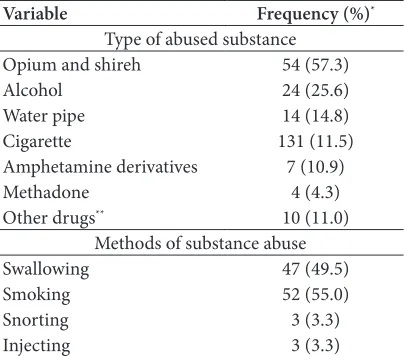
(49.5%) and smoking (55.0%) was the most prevalent methods used by consumers (Table 3).
Table 3. Type and methods of substance abuse
Variable Frequency (%)*
Type of abused substance Opium and shireh 54 (57.3)
Alcohol 24 (25.6)
Water pipe 14 (14.8) Cigarette 131 (11.5) Amphetamine derivatives 7 (10.9)
Methadone 4 (4.3)
Other drugs** 10 (11.0)
Methods of substance abuse Swallowing 47 (49.5)
Smoking 52 (55.0)
Snorting 3 (3.3)
Injecting 3 (3.3)
*Some participants used more than one type of substance or method. **Other drugs consisted of hashish, tramadol, heroin, morphine.
Based on the results, there were a significant relationship between family history of substance abuse/ alcohol consumption (P<0.001), smoking (P<0.001), occupational status (P<0.001), marital status (P=0.001), sex (<0.001) and substance abuse/alcohol consumption (Table 4).
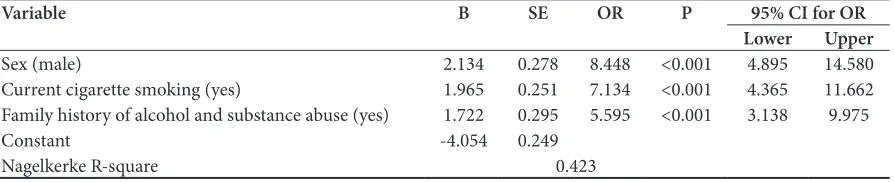
According to the results of the binary logistic regression analysis shown in Table 5, sex, smoking and family history of alcohol and substance abuse were significant predictors of substance abuse/alcohol consumption. Male patients (OR= 8.448, 95% CI: 4.895–14.580), current smokers (OR=7.134, 95% CI: 4.365–11.662) and patients with a history of substance abuse/alcohol consumption
for 42.3% of the total variance in predicting substance abuse/alcohol consumption.
4. Discussion
Social stigmatism and legal restrictions on substance abuse/alcohol consumption in Iran prevent abusers and alcohol consumers from admitting their habits and this situation make it impossible to estimate the prevalence of drug abuse/alcohol consumption directly. Hospitals and medical centers to which patients are referred are one of the reliable sources of information regarding the status of substance abuse/alcohol consumption2. According to this
study, approximately one-third of male patients who were admitted to operating rooms reported substance abuse or alcohol consumption, but the prevalence of drinking alcohol or substance abuse among females were only 2.7%. It was similar to 30.1% and 2.7% prevalence of cigarette smoking among men and women, respectively. However, the number of women in this study was more than twice that of men. In line with this study, several surveys in Iran and the world documented this pattern of gender differences among different study populations over the years2,6,18,20. This represents a significant
prevalence of substance abuse, alcohol consumption, and cigarette smoking among the studied men. Although gender differences were not our primary purpose and this study does not describe their potential reasons, it reveals the fact that these differences exist. This may help to design preventive and curative interventions with a focus on high-risk sex. In addition, a significant relationship between sex and substance abuse/alcohol consumption Table 2. Participants’ occupations as regards substance abuse/alcohol consumption
Occupations Total (n=1136) N (%) No substance abuse/alcohol
consumption (n=1010) N (%) consumption (n=126) N (%)Substance abuse/alcohol P-value
Housewife 594 (52.3) 579 (57.3) 15 (11.9)
<0.001 Employee 196 (17.3) 164 (16.2) 32 (25.4)
Worker 193 (17.0) 144 (14.2) 49 (38.9)
University Student 44 (3.8) 39 (3.9) 5 (4.0) School Student 40 (3.5) 39 (3.9) 1 (0.8)
Jobless 33 (2.9) 20 (2.0) 13 (10.3)
Driver 25 (2.2) 15 (1.5) 10 (7.9)
Doctor 8 (0.7) 8 (0.8) 0 (0)
Table 4. Selected participants’ characteristics as regards substance abuse/alcohol consumption
Variable No substance abuse/alcohol
consumption (n=1010) N (%) Substance abuse/alcohol con-sumption (n=126) N (%) P- value Level of education
Lower than diploma 457 (45.2) 59 (46.8) 0.62 High school diploma 371 (36.7) 40 (31.7)
Associate 44 (4.4) 7 (5.6)
Bachelor 116 (11.5) 15 (11.9)
Master 14 (1.4) 4 (3.2)
PhD 8 (0.8) 1 (0.8)
Marital status
Married 797 (78.9) 83 (65.9) 0.001
Single 213 (21.1) 43 (34.1)
Occupational status
Employed 368 (36.4) 88 (69.8) <0.001
Unemployed 642 (63.6) 38 (30.2)
History of medical drugs
Yes 270 (26.7) 29 (23.0) 0.21
No 740 (73.3) 97 (77.0)
History of associated diseases
Yes 311 (29.9) 26 (27.4) 0.35
No 730 (70.1) 69 (72.6)
History of psychiatric disorders
Yes 40 (4.0) 7 (5.6) 0.30
No 970 (96.0) 119 (94.4)
Smoking
Yes 62 (6.1) 69 (54.8) <0.001
No 948 (93.9) 57 (45.2)
Family history of alcohol and substance abuse
Yes 78 (7.7) 40 (31.7) <0.001
No 932 (92.3) 86 (68.3)
Table 5. Binary logistic regression analysis of independent risk factors potentially predict substance abuse/alcohol consumption
Variable B SE OR P 95% CI for OR
Lower Upper
Sex (male) 2.134 0.278 8.448 <0.001 4.895 14.580 Current cigarette smoking (yes) 1.965 0.251 7.134 <0.001 4.365 11.662 Family history of alcohol and substance abuse (yes) 1.722 0.295 5.595 <0.001 3.138 9.975
Constant -4.054 0.249
Nagelkerke R-square 0.423
Note: Non-significant variables in univariate analyses were not shown in multivariate model.
women together leads to a dilution effect and lowers the total prevalence estimations. Similar to other Iranian surveys, this research revealed that opium was the most commonly used substances2,4,21. It was interesting that
while producing and consuming alcohol is illegal in Iran and consumers try to hide it even from their relatives,
alcohol consumption was the second most commonly used substances. Another study by Ardebili22 in a
because alcohol prohibition policy increases the possibility of drinking house-made and fake alcohols and causes serious adverse effects on health. On the other hand, abuse of alcohol is not considered as a serious health problem because of alcohol prohibition, so sufficient resources for its prevention and treatment are not allocated. Among the most common addictive substances, third place belonged to water pipe tobacco smoking. Many water pipe tobacco smokers believe that this form of tobacco use is benign. Unfortunately, due to this common misconception about water pipe that it is not addictive, or at least not as addictive as cigarettes, its use has become a growing health concern globally and especially among young adults. On the other hand, prevention/treatment interventions often pay little attention to water pipe tobacco smoking22. By including
water pipe smoking in tobacco prevention and control programs, involving people, including physicians, policy makers, and tobacco control advocates can play an important role in eliminating these misconceptions among water pipe users and can be effective in limiting its spread. There was no significant relationship between substance abuse/alcohol consumption and patients’ level of education, history of psychiatric disorders, history of associated diseases and history of medical drugs. The relationship between substance abuse and participants’ level of education has been the subject of much controversy in published literature. For example, a study on the frequency of alcohol and substance abuse among drivers who had been killed in traffic accidents in Hamadan (a city in Iran) revealed that drivers with higher levels of education (high school diploma or higher) were more likely to abuse substance or drink alcohol23. On the
contrary, there was no relationship between education and substance abuse among nephrologic patients admitted in Shiraz general hospitals24. Contradictory findings
concerning the relationship between substance use and a history of psychiatric disorders have been reported. Substance use may be followed by psychiatric disorders or developed as a result of it, it may occur independently of these disorders or they may affect its severity. Substance use and psychiatric disorders may originate from a common vulnerability25. In a review on the relationship
between substance abuse and physical diseases,
increase specific health risks and physical disorders among women27. In line with the present study, McCabe28
showed that medical drug users without a history of nonmedical use were generally not at increased risk of drug abuse. The final regression model indicated that men had a 2.1-fold higher risk of substance abuse/alcohol consumption compared with women. Interestingly, only about one-third of admitted patients to operating rooms were men. However, male sex was a significant predictor of substance abuse/alcohol consumption. This situation was the same in most research conducted on the subject of addiction in Iran and the world18,20,29,30. Cultural
constructs, including gender socialization (i.e., the learning of and conformity to appropriate masculine and feminine traits) and stratification (e.g., unequal economic, educational, and social opportunities) can explain gender-specific etiological differences in substance and alcohol consumption31. The most common theoretical issues
regarding gender differences on alcohol drinking were mentioned by the World Health Organization (WHO) as power, sex, risks, and responsibilities. According to the WHO, alcohol may help aggressive men to increase their power over other people to bully them. It may improve sexual performance and enjoyment in both sexes. Alcohol drinking chemically motivates men to take risks and demonstrate masculinity (but not femininity). The final hypotheses to explain why men and women differ in their drinking behavior states that heavy drinking helps men to ignore their responsibilities. However, in women cases, high responsibility, particularly at home, may restrict their drinking32. Gender must be viewed as more than a
control variable or a sampling consideration. Policy makers must consider it when defining laws, programs, and policies so will be better equipped to meet the drug-related challenges of the twenty-first century. In addition, current smoking was linked with 1.9 times increased risk of substance abuse/alcohol consumption. These findings support those of the study of Degenhardt and Hall33, in
dependence35, nicotine dependence36 and cocaine
dependence37. Given that different substance act upon
the same neurotransmitters, it is possible that vulnerabilities may be similar across different substance types. It suggests that the same vulnerabilities that predispose an individual to smoke may also predispose him/her to alcoholism. Since cigarette smoking can be considered as a predisposing factor of substance/alcohol abuse, smoking treatment could be useful as a method of preventing substance/alcohol abuse. Unfortunately, in our country, Iran, cigarette smoking and water pipe tobacco smoking as serious risk factors for experiencing alcohol and other substances does not receive the necessary attention and there is a strong need to inform people in different ways to convey the message that water pipe and cigarette smoking are addictive and can provide an opening to the more addictive and dangerous substances. Patients with a family history of substance abuse/ alcohol consumption were 1.7 times more likely to abuse substance/consume alcohol than their counterparts without a family history (based on the multivariate model of logistic regression, Table 5). Consistent with our study, a review article on the status of substance abuse in 2002 documented that approximately half of Iranian substance abusers had at least a first-degree family member who had abused substances2. The results of numerous family
studies have repeatedly indicated that relatives of substance users are at greater risk of using substances than both the general population and family members of non-substance users38,39. This relationship can be
explained in different ways. First: individuals from families with a history of substance abuse tend to follow attitudes and behaviors of these relatives and more easily obtain the substances39. Second: family, twin, and
adoption studies have strongly documented that genetic factors, at least in part, influence dependence on alcohol and other substances and their effects on families may continue for generations. This may justify elevated rates of substance addiction among the relatives of substance users40. Third: families may enhance the risk of substance
use and abuse in their offspring through nonspecific mechanisms, which include disrupted family structure, marital discord, impaired parenting, exposure to stress, family psychopathology, neglect and abuse41. Familial
context is a necessary component of successful management/treatment of substance/alcohol abuse. Therefore, substance treatment programs should screen
other family members of abusers for substance use and involve those who screen positive to the program42.
Furthermore, programs of proven effectiveness, which support families, need to be strengthened and developed so that families have the capacity to intervene at an early stage to prevent or delay early substance use. The present study has some strengths and limitations. Integrating all substances and alcohol use into one category and trusting in self-reports of the patients on their substance/alcohol use as well as that of family members were the weaknesses of the study. The strong point of this research was patients’ voluntary cooperation. Patients knew that they would not be legally prosecuted in hospitals so they did not hide their habits. Another strong point was that there was no selection in the patient’s admission in the setting of the study; the operating rooms of the general hospital.
5. Conclusion
According to the current study, it is concluded that, (i) the prevalence of substance abuse/alcohol consumption and cigarette smoking men, were significantly higher than women (the number of women was more than double that of men; whereas in men, the prevalence of drug use and smoking were ten times more than women). Therefore, it is necessary to evaluate substance abuse/ alcohol consumption in terms of gender, (ii) the most frequently used substances included opium, alcohol and tobacco smoking using a water pipe and (iii) being a man, current cigarette smoking and having a first degree family member who abused substances were identified as significant independent predictors of substance abuse/ alcohol drinking. Further studies focused on detection and management of risk factors which facilitate appropriate substance/alcohol prevention or treatment planning. In this regard, longitudinal studies of risk factors for substance/alcohol use are strongly recommended.
6. Conflict of Interest
None declared.
7. Acknowledgements
93-02-109-25029. The authors sincerely appreciate the cooperation of the nurses of the operating rooms. They also acknowledge the valuable suggestions, comments, and English editing by Shervin Javanbakht.
8. References
1. Goreishizade M, Torabi K. A study of comorbidity of sub-stance abuse and psychiatric disorders in self-referred ad-dicts to Tabriz welfare centre. Medical Journal of Tabriz University of Medical Sciences. 2002; 55:49–53.
2. Mokri A. Brief overview of the status of drug abuse in Iran. Arch Iranian Med. 2002; 5(1):184–90.
3. Fox TP, Oliver G, Ellis SM. The destructive capacity of drug abuse: an overview exploring the harmful potential of drug abuse both to the individual and to society. ISRN Addic-tion. 2013; 2013(450348):6.
4. Ahmadi J, Pridmore S, Alimi A, Cheraghi A, Arad A, Par-saeyan H, Mohagheghzadeh MS, Kianpour M. Epidemiol-ogy of opium use in the general population. The American Journal of Drug and Alcohol Abuse. 2007; 33(1):483–91. 5. Rahimi MA, Sharifi V, Mohammadi MR, Farhodian A,
Sa-himi E, Rad R, et al. Researches on substance use in Iran 3 decades evaluation. Hakim Res J. 2006; 8(4):37–44. 6. Okay T, Şengul C, Acıkgöz Ç, Ozan G, Dilbaz N. Prevalence
of alcohol dependence and abuse in a general hospital; sen-sitivity and specificity of MAST. European Journal of Gen-eral Medicine. 2010; 7(1):10–5.
7. Kouros D, Tahereh H, Mohammadreza A, Minoo MZ. Opi-um and heroin alter biochemical parameters of hOpi-uman’s serum. The American Journal of Drug and Alcohol Abuse. 2010; 36:135–9.
8. Kak V, Chandrasekar PH. Bone and joint infections in injection drug users. Infectious Disease Clinics of North America. 2002; 16(1):681–95.
9. Dabbagh A, Dahi-Taleghani M, Elyasi H, Vosoughian M, Malek B, Rajaei S, Maftuh H. Duration of spinal anesthe-sia with bupivacaine in chronic opium abusers undergoing lower extremity orthopedic surgery. Arch Iran Med. 2007; 10(1):316–20.
10. Schoener EP, Hopper JA, Pierre JD. Injection drug use in North America. Infectious Disease Clinics of North Amer-ica. 2002; 16(1):535–51.
11. Warner M, Divertie M, Tinker J. Preoperative cessation of smoking and pulmonary complications in coronary artery bypass patients. Anesthesiology. 1984; 60(1):380–3. 12. Zevin S, Benowitz NL. Drug interactions with tobacco
smoking. Clinical Pharmacokinetics. 199; 36(1):425–38. 13. Spies C, Tønnesen H, Andreasson S, Helander A,
Coni-grave K. Perioperative morbidity and mortality in chronic alcoholic patients. Alcoholism: Clinical and Experimental
general hospital–a prevalence study. Journal of the Indian Medical Association. 1997; 95(1):505–6.
16. Bostwick JM, Seaman JS. Hospitalized patients and alcohol: who is being missed? General Hospital Psychiatry. 2004; 26(1):59–62.
17. Kouimtsidis C, Reynolds M, Hunt M, Lind J, Beckett J, Drummond C, Ghodse H. Substance use in the general hospital. Addictive Behaviors. 2003; 28(2):483–99.
18. Ahmadi J, Benrazavi L. Substance use among Iranian ne-phrologic patients. American Journal of Nephrology. 2002; 22(3):11–3.
19. Ahmadi J, Benrazavi L. Substance use among Iranian car-diovascular patients. European Journal of Medical Re-search. 2002; 7(4):89–92.
20. Afshar A, Asadzadeh M, Kargar H, Aghdashi MM, Mirza-tolooei F. Opium and opioid abuse in orthopedic inpatients: a cross sectional study in Urmia university of medical sci-ences. Acta Medica Iranica. 2012; 50(1):66–9.
21. Tabei S, Heydari S, Mehrabani D, Shamsina S, Ahmadi J, Firouzi SM. Current substance use in patients with gastric cancer in Southern Iran. Journal of Cancer Research and Therapeutics. 2006; 2(1):181–2.
22. Ardebili ME, Salehi M, Gharai B, Daneshamuz B, Nassr M, Halebandi MF. A household study on the prevalence of substance misuse in Tehran: the need for other methods to estimate the prevalence. Iranian Journal of Psychiatry. 2006; 1(4):158–61.
23. Smith-Simone S, Maziak W, Ward KD, Eissenberg T. Wa-terpipe tobacco smoking: knowledge, attitudes, beliefs, and behavior in two US samples. Nicotine & Tobacco Research. 2008; 10(4):393–8.
24. Afzali S, Saleh A, Rabiei MAS, Taheri K. Frequency of alco-hol and substance abuse observed in drivers killed in traffic accidents in Hamadan, Iran. Archives of Iranian Medicine. 2013; 16(1):239–40.
25. Hovens JG, Cantwell DP, Kiriakos R. Psychiatric comorbid-ity in hospitalized adolescent substance abusers. Journal of the American Academy of Child & Adolescent Psychiatry. 1994; 33(1): 476–83.
26. Gordon A, Conley J, Gordon J. Physical diseases and addic-tive disorders: associations and implications. Key Issues in Mental Health. 2015; 179:114–28.
27. Finkelstein NB. Substance abuse treatment: addressing the specific needs of women. Diane Publishing; 2011.
28. McCabe SE. Screening for drug abuse among medical and nonmedical users of prescription drugs in a probability sample of college students. Archives of Pediatrics & Ado-lescent Medicine. 2008; 162(2):225–31.
abuse and dependence in the United States: results from the national epidemiologic survey on alcohol and related con-ditions. Archives of General Psychiatry. 2007; 64(1):830–42. 31. Anderson TL. Drug use and gender. Encyclopedia of
crimi-nology and deviant behavior. 2001; 4(2):286–9.
32. Obot IS, Room R. Alcohol, gender and drinking problems: perspectives from low and middle income countries. Gene-va: World Health Organization. 2005.
33. Degenhardt L, Hall W. The relationship between tobacco use, substance-use disorders and mental health: results from the National Survey of Mental Health and Well-being. Nicotine & Tobacco Research. 2001; 3(2):225–34.
34. Kendler KS, Prescott CA, Neale MC, Pedersen NL. Tem-perance board registration for alcohol abuse in a national sample of Swedish male twins, born 1902 to 1949. Archives of General Psychiatry. 1997; 54(1):178–84.
35. Kendler KS, Prescott CA. Cannabis use, abuse, and depen-dence in a population-based sample of female twins. Amer-ican Journal of Psychiatry. 1998; 155(2):1016–22.
36. Kendler KS, Neale M, Sullivan P, Corey L, Gardner C, Prescott C. A population-based twin study in women of smoking initiation and nicotine dependence. Psychological Medicine. 1999; 29(1):299–308.
37. Kendler KS, Prescott CA. Cocaine use, abuse and depen-dence in a population-based sample of female twins. The British Journal of Psychiatry. 1998; 173(4):345–50.
38. Bierut LJ, Dinwiddie SH, Begleiter H, Crowe RR, Hessel-brock V, Nurnberger JI, Porjesz B, Schuckit MA, Reich T. Familial transmission of substance dependence: alcohol, marijuana, cocaine, and habitual smoking: a report from the collaborative study on the genetics of alcoholism. Ar-chives of General Psychiatry. 1998; 55(2):982–8.
39. Haase T, Pratschke J. Risk and protection factors for sub-stance use among young people. 2010.
40. Dick DM, Agrawal A. The genetics of alcohol and oth-er drug dependence. Alcohol Research & Health. 2008; 31(2):111–2.
41. Ashery RS, Robertson EB, Kumpfer KL. Drug abuse pre-vention through family interpre-ventions. Diane Publishing; 1998.