JPRHC
Research Article
JPRHC Volume 3 Issue 2 Page 38-42
COMPUTATIONAL STUDIES OF SIRTUINS IN THE TREATMENT OF TYPE II DIABETES MELLITUS
DSVGK KALADHAR
For Author affiliations see end of the text This paper is available online at www.jprhc.in
ABSTRACT
Ageing in humans refers to a biological process of life engaged with physical, psychological, and social changes.
Different species of animals age at radically different paces and occurrences of diseases. Drug designing approaches related to an aging factor, Type 2 Diabetes mellitus has been reported in the present study. Resveratrol and human
Sirtuins (1 to 6) are docked against Type 2 Diabetes mellitus HNF-1a motif with PDB ID: 2GYP using Hex 5.1. Resveratrol and Sirtuin 6 shown good results and can use as anti-aging drugs against Type 2 Diabetes mellitus.
Key words: Drug designing, ageing, Type 2 Diabetes mellitus, Docking.
INTRODUCTION
Ageing (British English) or aging (American English) is the accumulation of changes in an organism or object over time1. Ageing in humans refers to a biological and systematic process of life engaged with physical, psychological, and social changes. Various research activities presented that even late in life potential exists for physical, mental, and social growth and development2. Ageing is an important part of all human beings reflecting the biological changes that occur, and is also reflecting cultural and societal conventions. Indeed, aging is not an unavoidable property of life process but it is indeed the result of a genetic program3.
In the early twentieth century, the study of aging focused primarily on biomedical models of pathology, that is, how to diagnose the diseases and chronic disabilities afflicting the elderly, and how best to treat them. It is safe to say that most of scientists studying aging prior to l980s proposed that “aging as a rising wall of mortality”4
.
Aging research crosses all areas of physiology and also relies upon biological, mathematical, and chemical tools for its study. The rapid rise of biological, biomedical and behavioral research on aging beginning in the 1970s was a response to the growing realization of both the scientific and political establishments that the American population was aging and that the Baby Boomers would reach retirement in less than 50 years, an eternity for politicians and a moment for scientists5.
The sirtuin family of genes has been shown to have a significant effect on the lifespan of yeast and nematodes6. Most of the drug companies are currently searching for ways to synthesize and mimic the lifespan-extending effects of caloric restriction without having to severely reduce food consumption.
JPRHC
Research Article
JPRHC Volume 3 Issue 2 Page 38-42
MATERIALS AND METHODS
In this work, we attempted to carry out the drug designing with the following infrastructure.
SYSTEM USED –Intel Pentium 4 GHz, 2GB RAM
OPERATING PLATFORM- Microsoft Windows XP pro 2002 service pack
SOFTWARE PACKAGES - ISIS /Draw 2.5SP4, ARGUSLAB 4.0.1, HEX 5.1
PROTEIN- 2GYP.pdb
One of the PDB Structure related to Diabetes mellitus caused due to a frustrated Schellman motif in HNF-1a with PDB id 2GYP was selected as receptor
Protein sequences related to sertuin is randomly selected from NCBI database with Accession numbers 1NP_036370(Sir1), AAD40850(Sir2), AAD40851(Sir3), NP_036372(Sir4), AAD40853 (Sir5), NP_057623 (Sir6) and NP_057622(Sir7). These sequences are submitted to Swissmodel for identification of template molecules for docking. The ligand designed on ISIS/Draw is Resveratrol, optimized by Argus and is also used for docking process.
Docking studies are done using Hex 5.1 software.
RESULTS AND DISCUSSION
Diabetes Mellitus is the most prevalent chronic disease in the world affecting nearly 25% of the population.
Bioinformatics and cheminformatics are emerging fields with the potential to significantly improve the activity of drugs against diseased molecules commercially supplied to the marketplace13.
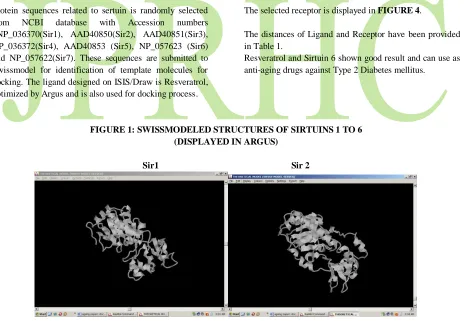
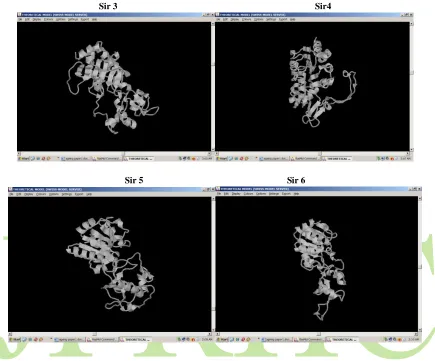
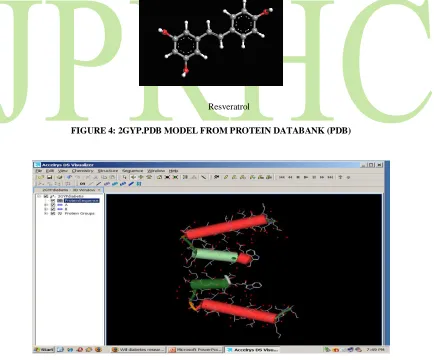
Templates from Sir1 to Sir6 are shown in FIGURE 1. Various sirtuins and Resveratrol are selected as ligands for the present study. FIGURE 2 provides the process of designing and optimization of Resveratrol. The designed and optimized structure of Resveratrol is shown in
FIGURE 3.
The selected receptor is displayed in FIGURE 4.
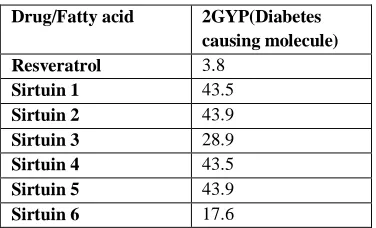
The distances of Ligand and Receptor have been provided in Table 1.
Resveratrol and Sirtuin 6shown good result and can use as anti-aging drugs against Type 2 Diabetes mellitus.
FIGURE 1: SWISSMODELED STRUCTURES OF SIRTUINS 1 TO 6 (DISPLAYED IN ARGUS)
JPRHC
Research Article
JPRHC Volume 3 Issue 2 Page 38-42
Sir 3 Sir4
Sir 5 Sir 6
FIGURE 2: DESIGNING AND OPTIMISATION OF RESVERATROL
A: Resveratrol Designed in ISIS /Draw B:Designed molecule from Argus
JPRHC
Research Article
JPRHC Volume 3 Issue 2 Page 38-42
C:Parameters selected with UFF in Argus D:After running the designed molecule, the optimized structure displayed in Argus
FIGURE 3: DESIGNED AND OPTIMISED DRUG
Resveratrol
JPRHC
Research Article
JPRHC Volume 3 Issue 2 Page 38-42
TABLE 1: DISTANCE FROM LIGAND AND RECEPTOR IN ANGSTROMS Drug/Fatty acid 2GYP(Diabetes
causing molecule) Resveratrol 3.8
Sirtuin 1 43.5
Sirtuin 2 43.9
Sirtuin 3 28.9
Sirtuin 4 43.5
Sirtuin 5 43.9
Sirtuin 6 17.6
CONCLUSION
Studies based on computational approaches can provide better results based on docking. Further studies using phytocompounds can provide cure against aging diseases such as Diabetes, Alzheimer, Parkinson, Rheumatoid Arthritis etc.
ACKNOWLEDGMENT
I acknowledge the support of the Department of Bioinformatics, GITAM University in providing necessary facilities in carrying out this research work.
REFERENCES
1. Michael CP, Handbook of models for human aging, Academic Press, 2006, 45.
2. Leslie AM, Suzanne K, Ageing: The Social Context. 2nd edition, Pine Forge Press, 2007, xix.
3.Roberta R, Paola M, Nesrin O, Jean-Marc Z, Angelo A, Age-dependent increase of collagenase expression can be reduced by α-tocopherol via protein kinase C inhibition, Free Radical Biology and Medicine, 27(7-8), 1999, 729-737.
4. Wayne JU, Gender, Race and the National Education Association: Professionalism and Its Limitations, Taylor & Francis, 2000, 1-4.
5. James EB, Mathematical Modeling and Analysis in Biochemical Engineering : Past Accomplishments and Future Opportunities, Biotechnol. Prog., 14, 1998, 8-20. 6. Leonard G, Cynthia K, Genetic pathways that regulate ageing in modelorganisms, Nature, 408, 2000, 255-262.
7. North BJ, Verdin E, Sirtuins: Sir2-related NAD-dependent protein deacetylases, Genome Biol., 5(5), 2004, 224.
8. Yamamoto H, Schoonjans K, Auwerx J, Sirtuin functions in health and disease, Mol. Endocrinol., 21(8), 2007, 1745–1755.
9. Sandra RR, Juan LFM, Agustin FF, Edelmiro MT, Mario FF, Epigenetic Regulation of Aging,Discov Med.,10(52), 2010, 225-233.
10. Milne JC, Lambert PD, Schenk S, Carney DP, Smith JJ, Gagne DJ, Jin L, Boss O, Perni RB, Vu CB, Bemis JE, Xie R, Disch JS, Ng PY, Nunes JJ, Lynch AV, Yang H, Galonek H, Israelian K, Choy W, Iffland A, Lavu S, Medvedik O, Sinclair DA, Olefsky JM, Jirousek MR, Elliott PJ, Westphal CH, Small molecule activators of SIRT1 as therapeutics for the treatment of type 2 diabetes, Nature, 450(7170), 2007, 712–716.
11. Cal C, Garban H, Jazirehi A, Yeh C, Mizutani Y, Bonavida B, Resveratrol and Cancer: Chemoprevention, Apoptosis, and Chemoimmunosensitizing Activities, Current Medicinal Chemistry - Anti-Cancer Agents, 3(2), 2003, 77-93.
12. Raymond B, Olivier D, Anthocyanin molecular interactions: the first step in the formation of new pigments during wine aging?, Food Chemistry, 51(4), 1994, 365-371 13. Daisy P, Mathew S, Suveena S, Nirmala AR, A Novel Terpenoid from Elephantopus Scaber – Antibacterial Activity on Staphylococcus Aureus: A Substantiate Computational Approach, Int J Biomed Sc., 4(3), 2008, 196-203.
AUTHORS AFFILIATIONS AND ADDRESS FOR CORRESPONDENCE:
Kaladhar DSVGK
Department of Bioinformatics, GITAM University Visakhapatnam-530002