PLEASE CITE AS:Lemelin, R. H., Shruiff, S., Sampson, C., Anderson, C., Anderson, S., Danahy, J., Kolasa, Z., Vantil, K., Plows, M., Smith, S., & MacDougall, W. (2016). Videography and student engagement: The potentials of battlefield tourism. Historical Encounters: A journal of historical consciousness, historical cultures, and history education, 3(1), 17-30. ISSN 2203 7543 | © Author | This work is licensed under a Creative Commons Attribution 3.0 Unported License
Publication Date: 14 May 2016 | Available Online: http://hej.hermes-history.net
Videography and student engagement: The
potentials of battlefield tourism
Raynald Harvey Lemelin,
Sarah Shruiff, Calla Sampson, Corey Anderson,
Shannon Anderson, John Danahy, Zachary Kolasa, Kaithryn Vantil, Matthew
Plows, Samuel Smith, and Wesley MacDougall
Lakehead University, Canada
ABSTRACT: The purpose of this article is to present the findings from a collaborative study conducted by a research team consisting of Canadian university students and a course instructor visiting battlefields and memorials located in Western Europe. The goal of the course was to provide students with an experiential opportunity to learn about the First and Second World Wars, participate in video interviews, and administer surveys on-site. Emphasizing the field component of the course, this paper discusses how visual ethnography can be used to provide a greater understanding of visitor motivations and enhanced tourism learning experiences. Also discussed are the strengths and weaknesses of conducting field research for a university undergraduate level course and the potential contributions that such approaches bring to learning.
KEYWORDS: battlefield tourism, WWI, memory, tourism, visual studies, Vimy memorial, historical
consciousness
Introduction
Drawing on the events pertaining to the First World Centenary (2014-2018), this article presents the findings of a collaborative study carried out by 9 authors (the instructor and 8 undergraduate students attending a course offered by the School of Outdoor Recreation, Parks and Tourism at Lakehead University) visiting battlefields, memorials and museums located in Western Europe and associated with the First and Second World Wars. In-order to add greater authenticity to the article, each co-author is addressed by his/her real name throughout the text (see table 1). This approach, we believe, adds further veracity to the study, while helping to contextualized and personalize the findings and reflections emerging from this study.
tourists. Also discussed is how these approaches enhanced and transformed our understanding of our historical narratives and the management of these sites.
An overview of the literature pertaining to the role of remembrance, pilgrimages and visitation patterns along the Western Front throughout the 20th and early 21st centuries is
provided first. Following is a discussion pertaining to video interviews and semi-structured interviews. The findings profile the research team and the tourist participants. The conclusion re-examines the key findings and discusses some of the challenges and opportunities associated with conducting field research for a university undergraduate level course.
Literature Review
Remembrance
As Winter (2012) explains, remembrance is a social process, thus:
activities relating to the war are performed as symbolic rituals at specific times and places to recall people, events, ideas and values ... Because the memories are developed to satisfy particular social needs, each new generation re-negotiates and re-selects (or forgets anew) aspects of the memories to suit its own needs. (p. 249)
The historicizing of events and memories associated to warfare and traumatic events can be reinforced or discarded by governments (Lederach, 1997), perpetuated by media and family members (Bird, 2013), transmitted inter-generationally (Clark, 2014; Levy & Sznaider, 2002; Volkan, 2001; Weldon, 2009), and contested by groups that have been omitted from certain battlefield narratives (Vance, 2016).
For Australians, Canadians, New Zealanders and South Africans, the collective memory of the First World War is often associated with the “nation-creation mythos” where members of “the Commonwealth entered the Great War as colonies, and although they were still members of the Commonwealth at the conclusion of the First World, these countries, through their contributions to the Great War had distinguished themselves as individual nations” (Brown & Cook, 2011, p. 38). As a result, following the conclusion of the First World War, thousands of memorials were erected throughout Australia, New Zealand and North America to honour the dead (Lloyd, 1998). For its war efforts, Canada was given three parcels of land in Belgium and five in France. After some debate, the Canadian National Vimy Memorial (the Vimy Memorial from here on) was erected on the parcel at Vimy Ridge and designated as Canada’s national First World War monument (Hucker, 2007). Completed in 1936, the Vimy Memorial is comprised of a monument and a 91.18-hectare memorial park (Hucker & Smith, 2012).
The Vimy Memorial
The capture of Vimy Ridge in France on April 10-12, 1917 by the Canadian Expeditionary Force (CEF) solidified the CEF’s reputation among the allies (Brown & Gimblett, 2006). While the CEF would go on to fight in other significant battles in the First World War (Passchendaele July 1917, Amiens August 1918, Cambrai October 1918), Vimy quickly acquired an iconic status in the minds of Canadians and would, until the Second World War, remain Canada’s most celebrated military victory (Brown & Cook, 2011; Hayes, Iarocci, & Betchhold, 2007).
leading up to the pylons are carved male and female mourners surrounded by the names, carved in stone, of 11,285 Canadian soldiers killed in France (Hucker, 2009). At the front of the monument is the sorrowful figure known as “the bereft” and below her is a sarcophagus (Lemelin & Johansen, 2014). Located downhill from the monument is the memorial park featuring an interpretive centre, remnants of the battlefield (i.e., craters, dugouts, trenches, tunnels), and two cemeteries (Givenchy Road; the Canadian Cemetery No. 2) (Parks Canada, 2005). With visitations totalling 700,000 annually, the Vimy Memorial is a popular destination along the Western Front (Lemelin & Johansen, 2014).
Pilgrimage
Tours to the Western Front battlefields in France and Belgium began soon after the Armistice was signed in 1918 and visitors, especially from the allied nations, came from around the world (Brown & Cook, 2011). By 1928-29, Germans were also visiting these battlefields in significant numbers (Eksteins, 2000). For Canadians and Australians, distance proved to be a formidable barrier, but even so, they came; nearly 6,000 Canadian veterans and their families (including French and Japanese Canadians) travelled to France to witness the unveiling of the Vimy Memorial in 1936 (Brown & Cook, 2011).
Pilgrimages made by veterans and their families were given prominence and by 1921 the French parliament passed a law “providing free transportation to war cemeteries for relatives of the dead, thus ensuring the continual flow of ‘pilgrims’ to the former war zone” (Sherman, 1999, p. 39). Visitation to the Western Front remained popular until it was interrupted by the Second World War (Vanneste & Foote, 2013). Although the Western Front continued to attract not only pilgrims but also history enthusiasts and organized youth groups throughout the 20th century, a decline was noted in the 1950s and early 60s (Eksteins, 2000). Concerns regarding these declining visitations in France prompted the French government to construct various memorials dedicated to the First World War like the Mémorial de Verdun in 1963 and the Historial de Péronne in 1992 (Eksteins, 2000).
In the 1980s, a resurgence of visitors from Canada and Australia was noted in Gallipoli and along the Western Front (Clarke & Eastgate, 2011; Fathi, 2014; Hyde & Harman, 2011; Lemelin & Johansen, 2014). Factors influencing these changing visitation patterns include a heightened focus on national narratives and commemorative activities like the First World Centenary, an increase of coverage of the Great War and memorial sites in traditional media like books, documentaries and movies (e.g. Gallipoli, Passchendaele), greater exposure of these events in newer media like social media and podcasts (Clarke & Eastgate, 2011; Winter, 2006; Winter, 2012). Tours (Hyde & Harman, 2011; Seaton, 2000), and organized outings to battlefields by schools, cultural organisations, military or para-military institutions (Fathi, 2014; Lemelin & Johansen, 2014) have also helped to increase the visibility of these events in the national consciousness.
Methodology
video interviews. The on-site surveys were administered by research teams consisting of Calla and Matt, Wesley and Kathryn, Sam and Zachary, and Shannon, who opted to work on her own. John and Sarah conducted their own research projects on other topics pertaining to battlefield tourism, while Corey was assigned the responsibility of creating stock video footage of the field trip as well as helping to conduct the video interviews.
One of the goals of this course was to share our experiences with others, this has been accomplished by presenting some of the findings from our studies at national and international conferences, sharing our experiences on a blog (http://goo.gl/Wzw0K6) and, on a website (http://battletourism.ca/index.html). We have also produced two videos depicting Canada’s role in the First and Second World Wars and recounting our experiences acquired in this course. Both videos can be found on the web (http://battletourism.ca/index.html).
Video Interviews
Scholarship in battlefield tourism over the last three decades reveals that many of these studies continue to use traditional research instruments: questionnaires (Winters, 2012), interviews and participant observation (Clarke & Eastgate, 2011; Dunkley, Morgan, & Westwood, 2011; Seaton, 2010), or journal analysis (Fathi, 2014). While important contributions to the study of battlefield tourism have been made through these traditional research methods, visual studies, which often feature images and videos of participants partaking in an activity (Pink, 2001; Rose, 2001), can help visualize shared commonalities, encourage reflexive encounters, provide moments of contemplation, and accept that mutual vulnerabilities may occur during these discussions between the researcher and participants (Rakik & Chambers, 2009; Scarles, 2010). Although these video interviews as we described next were combined with in-situ interviews, the key aspect of this study is that it was conducted on site with other visitors who were on the same site (in this case the Vimy Memorial Site), the site itself being a significant memorial site.
Conducting Video Interviews in the Field
The video interviews consisted of four semi-structured interviews conducted with all members of the research team. The first interview was conducted prior to the trip, the second following the Normandy visit, the third occurred during our visit to the Western Front, and the final one followed the May 5 ceremonies in the Canadian cemetery in Groesbeek, Holland. For members of the research team, the video interviews facilitated experiential reflection and expansion of ideas and perceptions (Kvale & Brinkman, 2008). The names of the research team are provided below (see table 1).
As we head into mere weeks before leaving for France and Holland, our class has now completed our first interviews, prepared for the research we will be engaging in, and are now preparing ourselves for departure. Many of us have family connections, keepsakes, and personal investment in taking this trip together. Over our growing discussions of what we will be doing and the places we will be visiting, we are now not only preparing for our physical journey, but preparing ourselves for the emotional and spiritual experiences we will be facing as a group and individually. (Shannon)
thoughts. However, as the interviews went on, I found it easier to connect to the places we went to and be able to put into words the complex emotions I was experiencing.” In a similar light, John explained “that visiting the sites enhanced our understanding of these places and deepened our connections to these events, this type of experience was conducive, at least for me, to discussion.” Corey, a member of the interviewing team stated that we “just got better at it”. When asked to elaborate Corey noted that:
As the interviews progressed, we began to notice a growing ease and comfort with each other and even with a subject matter that could be at times, quite heavy. By the third interview I noticed that the interviewer [Harvey] became more sensitive to certain issues, instead of rushing through the interview, or asking the next question, we took our time, allowed for silent breaks, or even turning off the camera and taking a break. This more sensitive approach appeared to alleviate a number of concerns. (Corey)
After the interviews were conducted, the video files underwent a standard video rendering procedure in order to allow the video interviews to be viewable on a variety of computers. This involved two stages: the transferral of video files from the camera to a computer hard drive and back up drive followed by conversion to MPEG files. Rather than utilizing written transcriptions of the video interviews, a widely accepted method of data preparation (Lapadat & Lindsay, 1999; McLellan et al., 2003), a temporal indexing method (indexing short phrases and sentences) was employed which allowed for a quick retrieval of pertinent qualitative data during coding (Saldana, 2009). The video interviews were then analyzed descriptively, using inductive open coding to allow for emergent themes (Saldana, 2009). Crichton and Childs (2005) argue that such methodology allows the research team “to hear and see the gestures, intonation, passion, pauses, and inflections throughout the analysis process” (p. 42). This type of data also allowed us to understand transformations and moments that were particularly engaging.
Semi-Structured, In-Situ Interviews
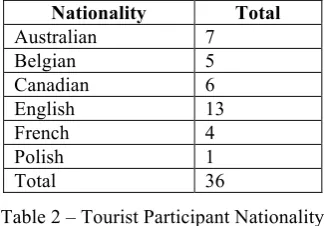
On May 1, 2014, 3 pairs of researchers consisting of Calla and Matt, Wesley and Kathryn, Sam and Zachary and one solo student (Shannon) administered the surveys.As stated earlier, three students (John, Sarah, and Corey) did not participate in the in-situ interviews. With only half-a-day to conduct interviews we completed 36 semi-structured interviews with tourists visiting the Vimy Memorial (see Table 1 and Table 2 below). Managed as a national historic site by the federal government of Canada, the 100 hectares Canadian National Vimy Memorial is composed of a monument rising 27 metres in height, and a memorial park preserving the remnants (e.g., craters, dugouts, trenches, shell holes and tunnels) of the battlefield. Also found at the site are two cemeteries, an interpretive centre, and various other structures associated to the management of the site (Lemelin & Johansen, 2014).
Approved by a university research and ethics board, Parks Canada and Veterans Affairs Canada, the research instrument consisted of questions pertaining to the visitor’s knowledge of the First World War, the Vimy Memorial and other sites they had visited, their perceptions of the interpretation and management strategies (most effective/most innovative) at the Vimy Memorial, and their awareness of the commemorations of the First World War Centenary (2014–2018). Participants were also asked to provide basic socio-demographic information (nationality, age, education, etc.).
and a bit chilly, and there was a damp, quickening wind that had ‘something wicked this way comes’ written all over it. Sure enough, about an hour in the skies opened and dark clouds poured rain all over the ridge while those of us assigned to the site and parking lot dove for the bus, and those of us by the trenches ran for the visitor centre. Dr. Lemelin rounded us up and took an interview count- our minimum sample was 20, and we were still short. We waited out the rain, and then split up again to hopefully get a few more before it was time to leave for dinner. Our guide, Phil, a Czech born Australian-raised Frenchman, helped out by translating some french groups for us. After another hour, we had almost 30 interviews. Damp, tired, and probably more than somewhat emotionally exhausted after the last three days of cemeteries and remembrance monuments, we arrived back at our hotel to crash for about two hours before supper. We all needed it. (Shannon)
These semi-structured interviews were transcribed soon after the interviews had taken place and analysis began in the field. Participant anonymity has been preserved by referring only to respondent nationality and approximate age (e.g., P14, Canadian man in his fifties). Using the transcripts and the interview guide, participant responses describing their knowledge of the Great War, their family affiliations (if any) with the Great War, the reasons for undertaking the trip, on-site experiences, their awareness of the First World War Centenary, and other themes that emerged from the semi-structured interviews, were examined. This preliminary analysis was circulated to and studied by all members of the research team. Excerpts from the interviews were organized into tables based on these themes. Tables were revised and excerpts added or eliminated in various categories as transcripts were read and re-read. In every phase of the analysis, the contents of the different themes were juxtaposed alongside each other to refine the analysis (Saldana, 2009).
Findings
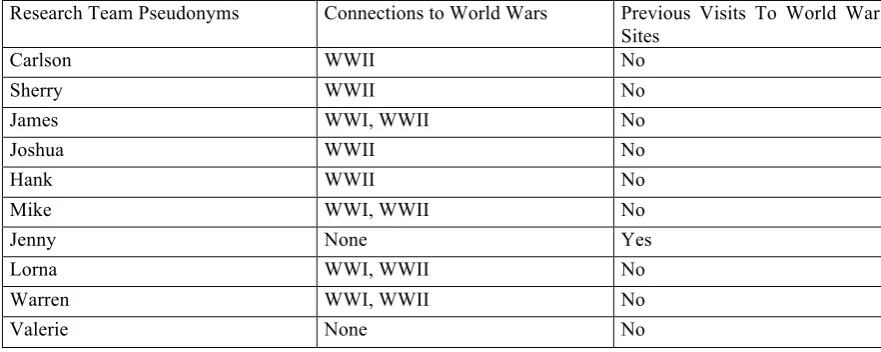
The analysis of the findings profiles our research team and the visiting participants. All members of the research team (with the exclusion of the course instructor)1 were in their early twenties and pursuing undergraduate degrees at a Canadian university. Although only Calla had previously visited many of these sites, four had familial links to the First World War, eight had familial links to the Second World War, four had connections to both World Wars, and two had no connections to either World Wars (see Table 1).
Research Team Pseudonyms Connections to World Wars Previous Visits To World War Sites
Carlson WWII No
Sherry WWII No
James WWI, WWII No
Joshua WWII No
Hank WWII No
Mike WWI, WWII No
Jenny None Yes
Lorna WWI, WWII No
Warren WWI, WWII No
Valerie None No
Table 1 – Student Researcher Profiles
Nationality Total Australian 7
Belgian 5
Canadian 6 English 13
French 4
Polish 1
Total 36
Table 2 – Tourist Participant Nationality
The majority of the participants (of those who reported it) had a post-secondary education (see Table 3). Less than 40 percent of the 36 respondents (n=14) reported any familial links to veterans of the Great War.
Age Group Total Education Total
20–30 5 High School 2
40–50 12 University degree/ College diploma
12
60–70 18 Post-Graduate 4
Total 35 Total 18
Table 3 – Age Group and Education
The Vimy Memorial was but one of many battlefields and museums located along the Western Front that were visited by the participants. However, because the Vimy Memorial was the first site visited by some participants (n=3), the numbers of reported battlefields and memorials visited in Table 4 cannot reflect the total number visited by the participants during their travel. Apart from a few French and Belgian participants who came specifically to visit the monument or to partake in a leisure opportunity provided by the various trails found on site, repeat visitations to the Vimy Memorial were rare (n=4). Participants’ descriptions of sites visited were often vague depicting more general areas (e.g., the Western Front, Flanders Fields, and the Eastern Front) than specific sites like the Tyne Cot Commonwealth War Graves Cemetery and Memorial in Belgium.
Location: First World War
Number of Visits
Location: Second World War
Number of Visits
Ypres 11 WWII (unspecified) 8
Passchendaele 8 Juno 5
Beaumont-Hamel 5 Omaha 4
Thiepval 4
Wellington Quarries 3
Verdun 2
Flanders & the Western Front 2
Eastern Front 1
Total 35 17
Table 4 – Battlefields Visited by Participants
is possible that similar logistical constraints occurred for some of these Canadian visitors and perhaps, limited their travels to other, less well-known battlefields in Western Europe.
Although Australian (n=5), Belgian (n=4) and British (n=8) participants discussed various events planned to commemorate the First World War, no Canadian tourist participant was aware of any plans that Canada might have to commemorate the First World War. These findings should not come as any surprise considering that while millions of dollars are being allocated to exhibitions and galleries, digitizing archives, creating websites, hosting conferences, and youth education throughout Western Europe, Australia and New Zealand (Hopkins & Norton-Taylor, 2013; Lemelin et al., 2013), no new monies are being allocated to First World War Centenary events in Canada. Indeed, government departments, agencies and crown corporations “have been ordered to finance the commemoration costs out of existing budgets” (Granatstein, 2014). Although this government reticence is disappointing, it does provide an opportunity for Canadians to learn, discuss and re-examine issues pertaining to the First World War centenary in less nationalistic terms (Smith, 2014; Vance, 2016).
The Management of the Vimy Memorial
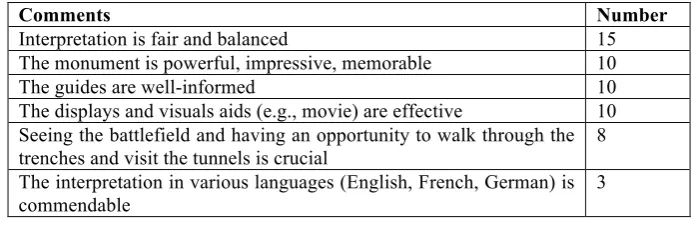
When asked to comment on the interpretation strategies provided at the Vimy Memorial, tourist participants, much like all the members of the research team for that matter, were overwhelmingly positive in their praise of the management approach at this national historic site (see Table 5 below).
Comments Number
Interpretation is fair and balanced 15 The monument is powerful, impressive, memorable 10
The guides are well-informed 10
The displays and visuals aids (e.g., movie) are effective 10 Seeing the battlefield and having an opportunity to walk through the trenches and visit the tunnels is crucial
8
The interpretation in various languages (English, French, German) is commendable
3
Table 5 – Comments Pertaining to the Management and Interpretation of the Vimy Memorial
As some participants noted, the on-site experience was crucial as well as memorable.
Being at the actual place and seeing the surroundings speaks more of an understanding than just reading about it.(P5, Belgian man)
The landscapes speaks for itself. (P22, British woman)
Being here where it happened, feeling the connections, seeing the spaces where the soldiers were. (P36, English man)
Although most visitors were satisfied with their experience at the Vimy Memorial, the Memorial was for many visitors, simply one of many sites to be visited on this trip. As a result, the Vimy Memorial was often compared to other sites recently visited. For example, some participants suggested that visitor experiences would be enhanced if the site provided living history, re-enactments and more experiential opportunities. One participant stated that although they were quite impressed with the monument at the Vimy Memorial, they believed that additional interpretation similar to that used in the trenches and tunnels in the memorial park should be provided at the monument. Although some of us agreed with this observation, it is worth noting that since the monument also serves as a site of remembrance, careful consideration of how to balance interpretation and commemoration at this particular site would be required.
Reflections
A collaborative approach to visual ethnography became instructive as members of the research team engaged in both the video interviews and conducting semi-structured interviews with visitors to the Vimy Memorial. Mitigating unexpected challenges such as conducting video interviews in open space where there were noises and distractions from curious onlookers (Rakik & Chambers, 2009) was educational for all members of the research team, and we reduced these aspects of it, as we proceeded through our trip. Minimizing distractions and making the interviewees more comfortable was a key component for improving how the video interviews were conducted. As Sarah states:
The video interviews ended up being an important part of the trip to me. I feel that without that opportunity for self reflection, I would not have been provoked to truly analyze and critique what I saw. I would not have understood the importance of what I was experiencing. I’ve realized that learning cannot occur without reflection. The video interviews offered me a chance for reflection. Having to put into words what I experienced and saw made a huge difference in my overall experience. I was able to consider how each museum, monument, or cemetary made me feel and this forced me to put those thoughts into words. Merely thinking about an experience can sometimes not be enough; I think it’s important to express in words one’s thoughts and feelings for such an important journey. I had the opportunity to create a video of our trip which included the video interviews. I was deeply moved by the insights and reflections of my peers. The interviews provided us with the opportunity to express our gratitude for those who came before us and to connect us to our emotions. With permission, I was able to include some of the footage in the video I created. I was able to create a lasting memory that I shared with my peers. (Sarah)
Although popular with most of the research team, Calla also noted that she had mixed feelings towards the video interviews:
I understand that through video interviews you can capture the emotion behind what is being said and allows for the interviewer to take the questions further if they wish. For myself though because of what we were seeing and experiencing I would have preferred to answer the questions on paper. My journals went much deeper into what was happening through the trip then what was captured in my interviews. (Calla)
What this insight suggest is that although video interviews are a valuable research tool, we should not discount more traditional approaches (e.g., field diaries) to field research. We should in fact, encourage a multitude of approaches encouraging reflexivity and discuss this with the research team prior to the implementation of the project.
interacting with people and developing sufficient trust that the participants were willing to provide insights and information. This process, as Calla suggest, could be quite intimidating:
I understood why the research was important but there was still the feeling that the individuals would be on a personal and potentially emotional experience causing them to not want to be bothered. The individuals I was able to speak with were kind, for the most part, but you could tell they did not want to talk long. They wanted to continue on their personal journey. (Calla)
The interviews also became an opportunity to acquire a greater understanding of visitor motivations associated with First and Second World Wars. When asked about their knowledge of the Great War, almost half of the participants (n=15) defined themselves as somewhat knowledgeable with the rest of the respondents situating themselves at the two poles of knowledge: very limited or non-existent (n=8) to very well-informed (n=8). In comparison, at the beginning of the course less than one-quarter of our research team had any knowledge of the World Wars (n=3). Although our knowledge of the First and Second World Wars increased throughout the trip, by the end of the trip and conclusion of the course, none of us defined ourselves as ‘experts’.
An emergent theme from this project revealed a possible characteristic of the visitors to war related monuments and battlefields. Our class as a whole did not distinguish between the various nationalities of the fallen soldiers, nor were we particularly drawn by a familial connection; rather, every researcher was profoundly moved by the loss of an entire generation, no matter the country of origin, now known as the “sacrificed generation.” Although you can appreciate the work that goes into managing these cemeteries, after visiting so many of them, whether they be French, German or from the Commonwealth “it is still in the end a cemetery, and watching the ages on the stones was an excruciating exercise- so many men (boys, really)
our age and younger. 16, 19, 24. It turned my stomach after a while.” (Shannon) This was in
contrast to the interviewees who were interested in the particular site because of an attachment to an event usually through a familial relationship or a national discourse. Understanding both segments of the population could guide future interpretive displays and marketing.
Conclusions
References
Bird, G. R. (2013). Place identities in the Normandy landscape of war: Touring the Canadian sites of memory. In. L. White & E. Frew (Eds.), Dark tourism and place identity:
Managing and interpreting dark places (pp. 167–186). New York, NY: Routledge. Brown, A., & Gimblett, R. (2006). In the footsteps of the Canadian corps. Ottawa, ON:
Magic Light Publishing.
Brown, E., & Cook, T. (2011). The 1936 Vimy pilgrimage. Canadian Military History, 20(2), 37–54.
Clark, A. (2014). Inheriting the past: Exploring historical consciousness across the generations. Historical Encounters: A journal of historical consciousness, historical cultures, and history education, 1(1), 88-102.
Clarke, P., & Eastgate, A. (2011). Cultural capital, life course perspectives and Western Front battlefield tours. Journal of Tourism and Cultural Change, 9(1), 31–44.
Crichton, S., & Childs, E. (2005). Clipping and coding audio files: A research method to enable participant voice. International Journal of Qualitative Methods 4(3), 40–49.
Dunkley, R., Morgan, N., & Westwood, S. (2011). Visiting the trenches: Exploring meanings and motivations in battlefield tourism. Tourism Management, 32(4), 860–868.
Eksteins, M. (2000). War, memory, and the modern pilgrimage and tourism to the Western Front. In D. Mackaman & M. Mays (Eds.), World War I and the cultures of modernity (pp. 151–160). Jackson: University Press of Mississippi.
Fathi, R. (2014). Connecting spirits: The commemorative patterns of an Australian school group in northern France. Journal of Australian Studies, 38(3), 345–359.
Granatstein, J. L. (2014). Why is Canada botching the Great War centenary? The Globe and Mail (April 21). Retrieved from: http://www.theglobeandmail.com/globe-debate/why-is-canada-botching-the-great-war-centenary/article18056398/
Hayes, G., Iarocci, A., & Betchhold, M. (Eds.). (2007). Vimy Ridge: A Canadian reassessment. Waterloo, ON: Wilfrid Laurier University Press.
Hucker, J. (2007). After the agony in stony places: The meaning and significance of the Vimy monument. In G. Hayes, A. Iarocci, & M. Bechthold (Eds.), Vimy Ridge: A Canadian reassessment (pp. 279–290). Waterloo, ON: Wilfrid Laurier University.
Hucker, J. (2009). Battle and burial recapturing the cultural meaning of Canada’s national memorial on Vimy Ridge. The Public Historian, 31(1), 89–109.
Hucker, J., & Smith, J. (2012). Vimy: Canada’s memorial to a generation. Ottawa, ON: Sanderling Press.
Hyde, K. F., & Harman, S. (2011). Motives for a secular pilgrimage to the Gallipoli battlefields. Tourism Management,32(6), 1343–1351.
Hopkins, N., and Norton-Taylor R. (2013). Kickabout that captured futility of first world war to be replayed for centenary. The Guardian (February 8). Retrieved from:
http://www.guardian.co.uk/world/2013/feb/08/first-world-war-kickabout-replayed-centenary
Lapadat, J. C., & Lindsay, A. C. (1999). Transcription in research and practice: From standardization of technique to interpretive positionings. Qualitative Inquiry, 5, 64–86. Lederach, J.P. (1997). Building peace: Sustainable reconciliation in divided societies.
Washington D.C.: USIP.
Lemelin, R. H., & Johansen, K. (2014). The Canadian National Vimy Memorial: Managing a management approach one hundred years in the making. International Journal of Culture, Tourism and Hospitality Research, 8(2), 203–218.
Lemelin, R. H., Powys Whyte, K., Johansen, K., Higgins Desbiolles, F., Wilson, C., & Hemming, S. (2013). Conflicts, battlefields, indigenous peoples and tourism: Addressing dissonant heritage in warfare tourism in Australia and North America in the 21st century.
International Journal of Culture, Tourism and Hospitality Research, 7(3), 257–271. Levy, D., & Sznaider, N. (2002). Memory unbound: The Holocaust and the formation of
cosmopolitan memory. European Journal of Social Theory, 5(1), 87-106.
Lloyd, D. (1998). Battlefield tourism: Pilgrimage and the commemoration of the Great War in Britain, Australia and Canada, 1919–1939. New York: Berg.
McLellan, E., MacQueen, K. M., & Neidig, J. L. (2003). Beyond the qualitative interview: Data preparation and transcription. Field Methods, 15, 63–84.
Parks Canada. (2005). Vimy Ridge National Historic Site of Canada. Commemorative integrity statement, October 2005. Retrieved from http://www.pc.gc.ca/eng/lhn-nhs/mb/eastgate/plan/plan2.aspx
Pink, S. (2001). Doing visual ethnography (1st Ed.). New York: Sage Publications.
Rakic, T., & Chambers, D. (2009). Researcher with a movie camera: visual ethnography in the field. Current Issues in Tourism, 12(3), 255-270.
Rose G. (2001). Visual methodologies: An introduction to the interpretation of visual materials. London: Sage.
Saldana, J. (2009). The coding manual for qualitative researchers. New York: Sage Publications.
Scarles, C. (2010). Where words fail, visuals ignite: Opportunities for visual autoethnography in tourism research. Annals of Tourism Research, 37(4), 905–926.
Seaton, A. V. (2000). “Another weekend away looking for dead bodies....”: Battlefield tourism on the Somme and in Flanders. Tourism Recreation Research, 25(3), 63–77. Sherman, D. J. (1999). The construction of memory in interwar France. Chicago: The
University of Chicago Press.
Smith, N. (2014). Memory at 100: The First World War centennial and the question of commemoration. Active History.Ca. (May 12). Retrieved from
http://activehistory.ca/2014/06/memory-at-100-the-first-world-war-centennial-and-the-question-of-commemoration/
Summers, J. (2007). Remembered: The history of the Commonwealth War Graves Commission. London: Merrell Publishers Limited.
Vance, J. (2016). Remembrance. Canada’s History (May 12). Retrieved from
Vanneste, D., & Foote, K. (2013). War, heritage, tourism, and the centenary of the Great War in Flanders and Belgium. In R. Butler & W. Suntikul (Eds.), Tourism and war (pp. 254– 272). New York: Routledge.
Volkan, V. (2001). Transgenerational transmissions and chosen traumas: An aspect of large-group identity. Group Analysis, 34(1), 79-97.
Weldon, G. (2009). A comparative study of the construction of memory and identity in the curriculum in societies emerging from conflict: Rwanda and South Africa. Unpublished PhD thesis, University of Pretoria, 2009.
Winter, C. (2012). Commemoration of the Great War on the Somme: Exploring personal connections. Journal of Tourism and Cultural Change, 10(3), 248–263.
Winter, J. M. (2006). Remembering war: The Great War between memory and history in the twentieth century. New Haven: Yale University Press.
About the Authors
Raynald Harvey Lemelin* is a Professor in the School of Outdoor Recreation, Parks and Tourism at Lakehead University, Canada. His research on the management of national historic sites and battlefields have been published in journal articles and book chapters.
Sarah Shruiff is a graduate of the Honours Bachelor of Outdoor Recreation program at Lakehead University, and currently completing her concurrent Education degree at Lakehead University.
Calla Sampson is a graduate of the Honours Bachelor of Outdoor Recreation program at Lakehead University, and currently working for the School of Outdoor Recreation, Parks and Tourism.
Corey Anderson is a graduate of the Honours Bachelor of Outdoor Recreation program at Lakehead University, and currently pursuing graduate studies at Royal Roads University. Shannon Anderson is currently completing her studies in the Faculty of Social Sciences and Humanities at Lakehead University.
John Danahy is a graduate of the Honours Bachelor of Outdoor Recreation program at Lakehead University, and currently pursuing graduate studies in the Faculty of Natural Resources Management at Lakehead University.
Zachary Kolasa is currently completing the Honours Bachelor of Outdoor Recreation program at Lakehead University.
Kaithryn Vantil is a graduate of the Honours Bachelor of Outdoor Recreation program at Lakehead University.
Matthew Plows is currently enlisted with the Canadian Army.
Samuel Smith is a graduate of the Honours Bachelor of Outdoor Recreation program at Lakehead University.
* Corresponding Author Email: [email protected]
Endnotes
1Since the course instructor had previously visited all of these areas and published on the visitation of some of