International Journal of Advances in Management and Economics
Available online at: www.managementjournal.info
RESEARCH ARTICLE
Trend of Non-performing Assets (NPAS) of Indian Commercial
Banks-An Analysis
M Syed Ibrahim
*Dept. of Commerce, Govt. Arts College (Autonomous), (Affiliated to Periyar University) Salem, Tami Nadu, South India.
Abstract: Banking and financial institutions play a pivotal role in the development of an economy especially in the mobilization and allocation of resources. The sound financial position of a bank is the guarantee not only to its depositors but equally important for the whole economy of any country. Stability of banking sector is considered to be an essential aspect of any country in the world. The banks are lending funds as loans and advances to various sectors such as agriculture, industry, personal and housing and other to meet the productive use of these funds. In recent situations, the banks are facing the problems of Non-Performing Assets (NPAs) and the banks need to be very cautious in extending loans to the needy people, the reason being mounting of NPAs. Now -a –days Non-Performing Assets has been the single largest cause of nuisance of the Indian banking sector. Non-Performing Assets are those assets on which the interest or principal have not been paid by the borrower for the specified period in accordance with the directions/guidelines issued by Reserve Bank of India (RBI) which is the Central Bank of India. The paper emphasizes the conceptual framework of Non-Performing Assets known as NPA in the banking sector. It further discusses and analyses the trend of NPAs in the three sectors of banks namely public sector banks, new private sectors banks and foreign banks for the preceding period of ten years (2007-08 to 2016-17). Finally, this study covers the measures to be taken to reduce the menace of NPA in banks.
Keywords: Non-Performing Assets, Scheduled Commercial Banks, Advances, Gross NPA, Net NPA.
Article Received: 30 July 2019 Revised: 16 August 2019 Accepted: 24 August 2019
Introduction
The Indian banking system comprises commercial banks and cooperative banks, of which the former accounts for more than 90 per cent of banking system’s assets. Besides an entry of few private and foreign banks, the commercial banks comprise nationalized banks (majority equity holdings with the Government), the State Bank of India (SBI-Majority equity holding being with the Reserve Bank of India) and the associate banks of SBI (majority holding being with State Bank of India).
These banks, along with Regional Rural Banks (RRBs), constitute the public sector (state owned) banking system in India. The banking sector has undergone a sea change after the first phase of economic liberalization in 1991. Loans and advances granted by commercial banks are highly beneficial to individuals, firms, companies and industrial concerns. The growth and diversification of business activities are effected to a large extent through banking finance.
Loans and advances granted by banks are helping to meet short-term and long term financial needs of business enterprises. Granting of loans and advances to the needy people for economic growth is the prime duty of commercial banks.
Lending by the banking sector is generally encouraged because it has the most effect of funds being transferred from the system to productive purposes; thereby the country’s economy grows. However, the process of lending also carries a risk called credit risk, which arises from the failure of borrower. Non-performing Asset (NPAs) refers to loans that are in risk of default. Once the borrower has failed to make interest or principal payments for 90 days, then the loan amount is considered to be a Non-performing Asset.
Non-performing Assets (NPAs) are
Statement of the Problem
Broadly speaking, Non-Performing Asset (NPA) is defined as an advance, where payment of interest or repayment of installment of principal (in case of term loans disbursed by the commercial banks) or both remains unpaid for a certain period. In India, the definition of NPAs has changed over time. According to the Narasimhan Committee Report (1991), those assets (advances, bills discounted, overdrafts, cash credit etc.,) for which interest remains due for a period of 180 days should be considered to be NPAs.
Subsequently, this period was reduced, and from March 1995 on wards the assets for which the interest has remained unpaid for 90 days are considered as NPAs. Non-performing Assets (NPA) has emerged since over a long period as an alarming threat to the Indian banking industry. Banking reforms by the Government of India and Reserve Bank of India (RBI) in terms of the two Narasimhan Committee Reports have been neutralized by the sick effects of this surging threat.
Despite various fruitful steps initiated and administered to solve and end this problem, concrete results are elude. The severity of the problem is however acutely suffered by almost all the branches of commercial banks in India. Hence, the present study has focused on the trends of non-performing assets of Indian commercial banks.
Review of Literature
A considerable amount of research has been done on the performance of NPAs in commercial banks in India, by academicians and researchers. The literature obtained by investigators, in the form of reports of various committees, commissions and working groups established by the Union Government, Reserve Bank of India, the research studies, articles of researchers, bank officials, economists and the comments of economic analysts and news, is briefly reviewed in this part.
Kaveri [1] studied the non-performing assets of various banks and suggested various strategies to reduce the extent of NPAs. Prashanth k Reddy [2] in his study focuses on comparative study on Non-Performing Assets in India in the Global context.
Ramu, N [3] has made an attempt to analyze the asset quality in selected UCBs in Tamil Nadu. The researcher also pointed out that, with the tightening of prudential norms, the banking sector has been consistently conforming to and adopting international prudential norms and accounting practices. Meenakshi Rajeev and Mahesh, H.P. [4] in their study concluded that accounting norms have been modified substantially and mechanisms are in place for reduction of bad debts.
Bhavani Prasad and Veera D [5] studied NPAs in Indian Banking sector and concluded that PSBs accounted for 78% of total NPAs and this is due to falling revenues from traditional sources. Ravindra N. Sontakke and Chandran Tiwari [6] studied the trend of NPAs in Scheduled Commercial Banks and in their study concluded that a mounting level of NPA in the banking sector can severely affect the economy in many ways.
Vivek Rajbahadur Singh [7] in his study concluded that the Non-Performing Assets have always created a big problem for the banks in India and the money locked up in NPA has direct impact on profitability of the bank as Indian commercial banks are highly dependent on income from interest on funds lent. Arun D’Souza [8] in his study focuses on securitization of assets.
The study suggests that the securitization market should play a greater role in managing the NPAs in the future to fuel the economic growth. Richa Banerjee, Deepak Verma and Bimal Jaiswal [9] in their study found that the bank’s performance in terms of profitability and expansion or growth has been affected a lot of due to the presence of NPAs.
Objectives
Some Underlying Objectives of the Study are as Follows
To study the status of Non-Performing Assets of Indian Scheduled Commercial Banks;
To highlight the trend of Net NPAs of three sectors of banks namely, Public Sector, New Private Sector and Foreign Banks; To explore the remedies to avoid future
Materials and Methods
Methodology & Data Collection
The study is based on secondary data and highlights the trend of NPA in various banks during the period of 10 years i.e. from 2007-2008 to 2016-2017. The Reserve Bank of India (RBI) publications like, “Report on Trend and Progress of Banking in India”, “Annual Reports of RBI”, and “Reports on Currency and Finance” are the major sources for this study.
To supplement the data, the researcher elicits other relevant data available from the annual reports of the various public, private and foreign commercial banks, journal, websites and text books. The analysis of the data is the core part of any research. The collected data have been processed on computer. To reach certain relevant results, the data collected from all resources have been tabulated, analyzed and interpreted with the help of appropriate statistical techniques. In order to analyze the data and draw conclusions in this study, various statistical tools like Descriptive Statistics and ANOVA-Single Factor have been done using through EXCEL and SPSS Software.
Population & Time Period of the s Study
Banking industry is taken for the study, where aggregate data related to NPAs for Public Sector Banks, New Private Sector Banks and Foreign Banks is used. 10 year’s aggregate data from 2007-08 to 2016-17 is used for the study.
Limitations of the Study
The Following are the Main limitations of the Study
The study is based on secondary data as published in various publications of RBI and other reports. These data are based on historical accounting concept, which ignores the impact of inflation.
The study, as limitations, is confined only to the selected and restricted indicators and the study is confined only for the period of ten years.
NPAs are changing with the time. The study is carried out in the present environment without foreseeing future developments.
Results and Discussion
Gross NPAs
NPA is defined as a credit facility in respect of which the interest and/or installment of principal has remained ‘past due’ for a specific period. Gross NPAs are the sum total of all loan assets that are classified as per the guidelines of Reserve Bank of India (RBI) as on balance sheet. Gross NPA reflects the quality of the loans made by the banks and it consists of all the non-standard assets like sub-standard, doubtful and loss assets.
It is calculated with the help of the following
formula: Gross NPA Ratio= Gross
NPAs/Gross Advances*100. The year-wise amount of Gross Advances, Gross NPAs and the percentage of Gross NPAs of Scheduled Commercial Banks are given in Table 1.
Table 1:Year-wise Gross Advances and NPAs of Scheduled Commercial Banks (Amount in Billions) Years Gross Advances Gross NPA
Amount %
2007-08 25034.31 566.06 2.3
2008-09 30246.52 699.54 2.3
2009-10 32620.79 817.18 2.5
2010-11 39959.82 939.97 2.4
2011-12 46488.08 1369.68 2.9
2012-13 59718.20 1927.69 3.2
2013-14 68757.48 2630.15 3.8
2014-15 75606.66 3229.16 4.3
2015-16 81711.14 6116.07 7.5
2016-17 84767.05 7902.68 9.3
Source: department of banking supervision, reserve bank of india.
Table 1 exhibit the amount of Gross Advances, Gross NPAs and the percentage of Gross NPA during the period of 2007-08 to 2016-17. The amount of Gross Advances has increased from Rs.25034.31 billion in 2007-08
period of study. Similarly, the percentage of NPA of scheduled commercial banks is also showing the rising trend from 2.3 in 2007-08 to 9.3 in 2016-17.
Net NPAs
Net NPAs are those NPAs in which the bank has deducted the provision as per RBI
guidelines. It shows the actual burden of banks. It is calculated with the help of the following formula: Net NPA Ratio= Gross
NPAs-Provisions/Gross
Advances-Provisions*100. The year-wise amount of Net Advances, Net NPAs and the percentage of Net NPAs of Scheduled Commercial Banks are provided in Table 2.
Table 2: Year-wise Net Advances and NPAs of Scheduled Commercial Banks (Amount in Billions)
Years Net Advances Net NPA
Amount %
2007-08 24769.36 247.30 1.0
2008-09 29999.24 315.64 1.1
2009-10 34967.20 391.27 1.1
2010-11 42974.87 417.99 1.0
2011-12 50735.59 652.05 1.3
2012-13 58797.73 986.93 1.7
2013-14 67352.13 1426.56 2.1
2014-15 73881.60 1758.41 2.4
2015-16 78964.67 3498.14 4.4
2016-17 81161.97 4330.10 5.3
Source: department of banking supervision, reserve bank of india.
Table 2 depicts the amount of Net Advances, Net NPAs and the percentage of Net NPA during the period of 2007-08 to 2016-17. The amount of Net Advances has increased from Rs.24,769.39 billion in 2007-08 to Rs.81,161.97 billion in 2016-17. Further, the amount of Net NPA has also increased from Rs.247.30 billion in 2007-08 to Rs.4330.10 billion in 2016-17. The increase over the period was 14 times during the period of study. Similarly, the percentage of NPA of scheduled commercial banks is also showing
the rising trend from 1.0 in 2007-08 to 5.3 in 2016-17.
Trend of Net NPAs (%)
The banking sector has been facing serious problems of rising net NPAs. The year-wise percentage of net NPAs of public sector banks, new private sector banks and foreign banks are portrayed in Table 3.
Table 3: Year-wise Net NPAs (%) of Three Sectors of Banks
Years Public Sector Banks New Private Sector Banks Foreign Banks
2007-08 1.0 1.1 0.8
2008-09 0.9 1.3 1.8
2009-10 1.1 1.0 1.8
2010-11 1.1 0.6 0.7
2011-12 1.5 0.5 0.6
2012-13 2.0 0.5 1.0
2013-14 2.6 0.7 1.1
2014-15 2.9 0.9 0.5
2015-16 5.7 1.4 0.8
2016-17 6.9 2.2 0.6
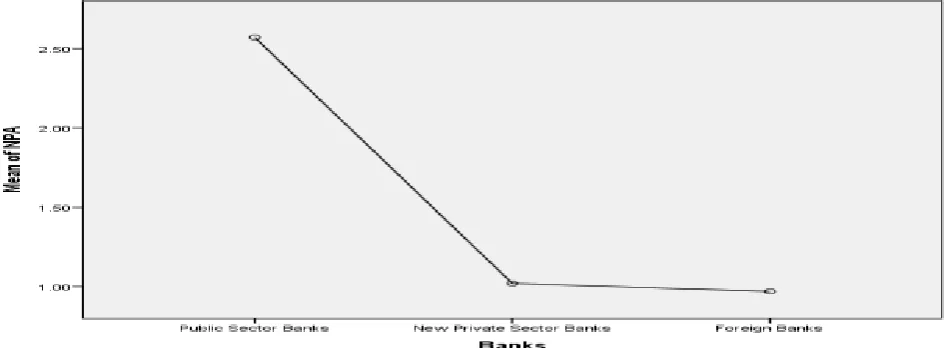
MEAN 2.5700 1.0200 .9700
S.D. 2.10029 .52239 .47387
C.V (%) 81.72 51.21 48.85
Source: department of banking supervision, reserve bank of India.
By comparing the performance on the basis of the mean value for the period, it has been noted that the % of net NPA is high in case of the public sector banks, as the mean value is 2.5700. Next is the place of new private sector banks whose mean value is 1.0200 and it is the lowest in the case of foreign banks as it is .47387. The degree of variation is very low in foreign banks as the CV is 48.85 and the variation of % of net NPAs is very high in case of public sector
banks as the per cent of CV is 81.72. It is found to be more consistent as the CV of the % of net NPAs of foreign banks is less than that of the other two sectors of banks. To test the differences in the performance of percentage of Net NPAs of the public sector, new private sector and foreign banks, ‘Single Factor ANOVA’ has been performed. The hypotheses which are framed as follows:
There is no difference in the performance of % of Net NPAs among the three sectors of bank;
H1
There is difference in the performance of % of Net NPAs among the three sectors of bank. The test results are given in Table 4.
Table 4: ANOVA-Single Factor. (% of Net NPAs of three sectors of banks) ANOVA
Sum of Squares df Mean Square F Sig.
Between Groups 16.550 2 8.275 5.057 .014
Within Groups 44.178 27 1.636
Total 60.728 29
Table 4 represents the results of F-test in one way ANOVA. As shown in Table 4, the p-value (sig p-value) of F-statistics (2, 27) is less than five percent level of significance. Hence, with 95 percent confidence level, the null hypothesis of ‘there is no difference in the % of Net NPAs among the three sectors of bank’ cannot be accepted. Thus, it can be concluded from the results that the performance of % of
Net NPAs among the three sectors are statistically different. The performance with regard to the % of Net NPAs of three sectors of banks are shown in Figure 1 which indicates that the % of Net NPAs of public sector banks is significantly higher than the % of Net NPAs of both new private sector and foreign banks.
Figure 1: Means Plot of % of Net NPAs of Three Sectors of Banks
Conclusion
Non-Performing Assets have always been a concern or the banking sector from the last two decades due to economic slowdown. From the discussions above, it is evident that rising NPAs is worry of Indian banking system. The study highlights the following findings: Analysis of gross advances and gross NPA (amount) in the Scheduled Commercial Banks shows that both are high and percentage of gross NPA of scheduled commercial banks is showing the steep increase from 2.3 in 2007-08 to 9.3 in 2016-17.
Analysis of net advances and net NPA (amount) in the Scheduled Commercial Banks shows that both are high and percentage of net NPA of scheduled commercial banks is also showing the sharp increase from 1.0 in 2007-08 to 5.3 in 2016-17. Foreign banks are better performers than public and new private sector banks as their
average (.9700) is comparatively quite low than the two sectors. New private sector banks are better performers than public sector banks as their average (1.0200) is comparatively quite low.
It is found to be more consistent as the C.V. of the % of net NPAs of foreign banks is less than that of the other two sectors of banks. It is established from the results of ANOVA that the performance of % of Net NPAs among the three sectors is statistically different. Finally, the % of Net NPAs of public sector banks is significantly higher than the % of Net NPAs of both new private sector and foreign banks during the period of study. The main cause for NPAs in Indian commercial banks is the defaulters or bad loans. The Beside these, the following reasons are normally identified which are;
Intentional loan defaults,
Sanctioning loans without pre or proper enquiry,
Most loans are sanctioned for agricultural enquiry,
Banks are competing themselves and as a result disburse unsecured loans,
The Following Suggestions are offered to curb the Accumulation of NPAs of Commercial Banks in India
The management of banks may impart
adequate training to the officials in the art of lending to the different categories, and they may continue to encourage upgrading their knowledge and skills in recovering the loans and advances.
Bank management may possess specialized credit rating agencies to finalize the borrowing capacity of the potential borrowers before offering credit to the needy people.
Steps need to be taken to recover the loan in time by adopting well-equipped recovery mechanism.
There is a wrong opinion in the minds of the farmers that agricultural credit may be waived one day or other. Hence, the agriculturalist who can repay the
agricultural credit may not come forward to repay the loans in time. Therefore, the farmers in our country requires a lot of counseling and the bank officers engaged in this activity should provide necessary advice and counseling.
The Reserve Bank of India (RBI) and the
Government of India have taken
innumerable steps to reduce the volume of NPAs of the Scheduled Commercial Banks.
The remedial measures taken by
Government of India, Reserve Bank of India and the Bank management in recent years, helped to reduce NPAs considerably as recommended by Shri M. Narasimham. To improve the efficiency and profitability, the NPA has to be reduced further.
Government of India keeps on trying to rescue the banks, particularly looking at the downfall of public sectors banks in the country. Recently, the Government had announced recapitalization of public sector banks with Rs.2.11 crores. However, there is still a strong need felt for stricter laws in the management of NPA. Willful defaulters must be treated separate and dedicated Act. Moreover, the commercial banks in India must have rigorous practices to adopt to take corrective decisions in granting loans [10-22].
References
1.
Kaveri VS (2001) “Prevention of NPA Suggested Strategies”, Vinimaya, 23-8.2.
Prashanth K, Reddy (2002) “Acomparative study of Non-performing Assets in India in the global context-similarities and discontext-similarities, remedial measures”, CYTL Paper, Indian Institute of Management, Ahmedabad.
3.
Ramu N (2009) “Dimensions of Non-performing Assets in Urban Cooperative Banks in Tamil Nadu”, Global Business Review, 10(2):279-297.4.
Meenakshi Rajeev, Mahesh HP (2010) “Banking Sector Reforms and NPA: A Study of Indian Commercial Banks”, Working Paper, ISBN No.978-81-7791-108-4, the Institute for Social and Economic Change, Bangalore.5.
Bhavani Prasad G, Veena VD (2011) “NPAs in Indian Banking Sector- Trends and Issues”, Journal of Banking Financial Services and Insurance Research,1(9):67-84.
6. Ravindra N, Sontakke, Chandra Tiwari (2013) “Trend Analysis of Non-Performing Asset in Scheduled Commercial Banks in India”, International Journal of Application or Innovation in Engineering & Management, Special Issue for National Conference on Recent Advances in
Technology and Management for
Integrated Growth.
7. Vivek Rajbahadur Singh (2016)”A Study of Non-Performing Assets of Commercial Banks and it’s recovery in India”, Annual Research Journal of Symbiosis Centre for Management Studies, Pune, 4
8. Arun D’Souza (2017) “Rising
Non-Performing Assets in Scheduled
Commercial Banks of India: Is
Securitization a Solution?”Nitte Management Review, 11 (1):42-48,
Comparative Study of the Indian Commercial Banks”, International Journal of Social Relevance & Concern, 6-2.
10. Avkiran NK (1999) “The Evidence of Efficiency Gains: The Role of Mergers and the Benefits to the Public”, Journal of Banking and Finance, 23:991-1013.
11. Bhatia S, Verma S (1998-99) “Factors Determining Profitability of Public Sector Banks in India: An Application of Multiple Regression Model”, Pranjan, XXVII (4):433-445
12. Chidambaram RM, Alamelu K (1994) “Profitability in Banks, a matter of Survival”, The Banker, 18:1-3.
13. Jaynal Ud-din Ahmed (2011)
“Management of Non-performing Assets of Commercial Banks: The Evidence from Indian Banking Sector”, International Journal of Financial Management, 1-3. 14. Veerakumar K (2012) “Non-performing
Assets in Priority Sector: A Threat to Indian Scheduled Commercial Banks”, International Research Journal of Finance and Economics, 93.
15. Sethi J, Bhatia N (2007) Elements of Banking and Insurance, 2nd Edition, Prentice Hall India Publications.
16. Thiagarajan S, Ayyappan S,
Ramachandran A (2011) “Credit Risk Determinants of Public and Private Sector Banks in India”, European Journal of Economics, Finance and Administrative
Sciences, 34.
17. Reserve Bank of India (2010) Trend and Progress of Banking in India Tracey M, Leon H (2011) “The Impact of Non-performing Loans on Loan growth”, IMF working Paper.
18. Yadav MS (2011) “Impact of Non Performing Assets on Profitability and Productivity of Public Sector Banks in India”, AFBE Journal, 4-1.
19. Sandeep, Parul Mital (2012) “Non-Performing Assets: Comparative Position of Public and Private Sector Banks in India”, International Journal of Business and Management Tomorrow, 2(1):1-17. 20. Siraj KK, Prof. P Sundarsanan Pillai
(2012) “A Study on the performance of Non-Performing Assets (NPA’s) of Indian
Commercial Banking during Post
Millennium Period”, International Journal of Business and Management Tomorrow, 2-3.
21. Zahoor Ahmed, Prof. Jegadeeshwaran M (2013) “Comparative Study on NPA Management of Nationalised Banks”, International Journal of Marketing, Financial Services & Management Research, 2(8):66-78.