International Journal of Advances in Management and Economics
Available online at:
www.managementjournal.info
RESEARCH ARTICLE
Impact of Brand Equity on Consumer’s Purchase Intension- A
Study on Some Furniture Companies in Bangladesh
Syed Hasib Ahsan, Md Alauddin,
Mohammad Masrurul Mowla*
Department of Business Administration International Islamic University Chittagong.
*Corresponding Author: Email: [email protected]
Abstract: This paper attempt to identify the impact of brand equity on Consumer’s Purchase Intension on Some Furniture Companies in Bangladesh. A total of 398 respondents were chosen for data collection. A structured questionnaire was designed based on Aaker model. Convenience sampling techniques was used to collect data from the respondents. SPSS-22 version software was used to analyze the data. Pearson correlation, regression and ANOVA have been used as statistical tools. Results show that there is significant relationship between brand equity and consumer purchase intentions. This research will help the policy makers to make new marketing policy and strategy for the development of furniture industry in Bangladesh.
Keywords:Brand Equity, Purchase Intention, Furniture, Bangladesh.
Introduction
Brand equity has added a new attention in recent years. Building brand equity is measured an important part of building brands [1]. The meaning of Brand equity is the value which can be included with the product additionally [2]. It is said that the brand always helps to a company’s long-term profitability. In the last few decades, the concept of it has increased very rapidly. Brand equity is the proper metric for assessing this long-run impact of marketing decisions [3]. Among several Brand Equity models in literature, we have chosen a model constructed by David Aaker [4] that has gained popularity in branding research over the years.
They developed a multidimensional, customer-based brand equity scale using Aaker’s [4] four theoretically defined dimensions. Previous research focused on testing Aaker’s [4] model in the different contexts such as airlines, hostelling, and beverage, but none of them investigated the effect of brand equity on consumers’ purchase intention in furniture industry in Bangladesh. This study is conducted to determine the effect of the most popularly adopted brand equity dimensions on purchase intention. Brand researchers have developed several conceptualizations of brands and how brands affect consumer
behavior (current and future purchases). The furniture industry in Bangladesh is becoming a popular sector in our country. However, the furniture sector is struggling to reach its full potential due to various factors inhibiting its growth. Inadequate supply of production technology and consultancy services, absence of sufficient raw materials, absence of skilled manpower and limitations in local and international marketing strategy are some of the challenging areas.
It should be developed to gain the international attention to Bangladeshi furniture. Despite Furniture manufacturers’ effort to establish and maintain their brand equity in Bangladesh, a clear measurement of such equity is still lacking. This study looks at relationship between furniture manufacturer’s brand equity and purchase intentions for prospective customers. Traditionally furniture in Bangladesh developed as cottage-based industry
Research Objectives
The Objectives of This Study can be Specified As
To study the Brand Equity model developed
by David Aaker
To examine the impacts of Brand Equity on
impact of Brand Association, Brand Awareness, Brand Loyalty and Perceived Quality on consumer’s purchase intention).
Literature Review
Although branding and brand management was available for many decades, but the brand equity is a prime and important concept for most organizations which are appeared in recent 20 years [5]. Purchase intention is a kind of decision in which we studied why a customer purchases a brand in particular. According to Sproles and Kendall [6], a consumer’s decision-making style is “a mental orientation characterizing a consumer’s approach to making choices”.
Moreover, perceptual and cognitive models assume that brand knowledge affects consumer response to the brand, defined as perceptions, preferences and, most important, behavior arising from marketing mix activity. As mentioned by Schiffman and Kanuk [7], “consumer behavior is about how people make their decisions on personal or household products with the use of their available resources such as time, money and effort”. Gabbott and Hogg [8] and Blackwell et al. [9] further provide a holistic view that defines consumer behavior “as the activities and the processes in which individuals or groups choose, buy, use or dispose the products, services, ideas or experiences”.
The study of consumer buying behavior is of utmost importance in a number of aspects. First of all, consumer behavior is responsible for the financial progress of a nation [9]. Several models are incorporated to explain the consumer buying behaviors. Although they vary in form of presentation, most of them are composed of stages such as pre-purchase, purchase and post-purchase [10- 11].
Blackwell et al. [9] define “consumer behavior as a summation of acquisition, consumption and disposal of products or services”. As far as the consumer decision process model is concerned, consumers need to go through seven steps before reaching their final decisions. These seven steps include “need recognition, search for information, pre-purchase, evaluation, pre-purchase, consumption, post-consumption evaluation and divestment” [9].
The buying process is initiated when people recognize their unsatisfied need. There are two kinds of needs, namely “functional needs” and “psychological needs”. Functional needs are related to the performance of the product whereas psychological needs are intrinsically obtained when customers feel contented with shopping or owning a product which they long for. Stage two is the search of information. The length and depth of search vary for different customers and depend on variables like personality, social class, income, size of purchase, past experiences, prior brand perceptions, as well as customer satisfaction.
Brand Equity
“Brand equity is a set of brand assets and liabilities linked to a brand, its name and symbol that add to or subtract from the value provided by a product or service to a firm and/or to that firm's customers”.[4]. It has also been defined as the effect of brand knowledge on consumer response to the brand. As such, brand equity is the value of the brand name that has the potential of being extended either in the form of line extensions or in conjunction with other brand names as in co-branding [12].
Aaker [4] conceptualized “brand equity as an aggregate variable of the five dimensions of the brand assets: brand loyalty, brand awareness, perceived quality, brand association, and other proprietary assets”.
Brand Awareness
Brand awareness passes on that how to aware current and potential customers towards your product and service [13]. Aaker [14] defines brand awareness as the power of a brand’s presence in the customers’ mind. In other words, brand awareness refers to a customer’s ability to recognize or recall a brand in its product category [4]. However, empirical evidence show that brand awareness and brand association can be combined into a particular dimension named brand awareness/association [15]. The importance of brand awareness in the mind of the customers can be evaluated at various. [14]Thus we may anticipate that
H1
Brand Association
The literature on brand equity [4-14] has recognized brand associations as important bases underlying brand equity. Strong, favorable and unique brand associations can improve brand preference. In addition, enhanced brand preference can increase the trade’s interest in stocking the brand, thus increasing brand choice probability. Brand associations (perceptions) are quite diverse. Conceptualize that “brand associations contribute to brand equity by creating an attribute-based component of brand equity and a non-attribute-based component of brand equity, and provide evidence supporting their conceptualization”. From the above literature we can hypothesize that,
H2
Brand association might have positive impact on consumer’s purchase intention.
Perceived Quality
Perceived quality is another import [4]. It is not the actual quality of the product but the consumer’s subjective evaluation of the product [15]. It is defined as the customer’s perception of the overall quality or superiority of a product or service, Aaker [4], Keller [16] and Yasin [17] . Thus it is hypothesized from the above literature that:
H3
Perceived quality might have positive impact on consumer’s purchase intention.
Brand loyalty
Brand loyalty is “a deeply held commitment to re-buy or re-patronize a preferred product or service consistently in the future, despite situational influences and marketing efforts having the potential to cause switching behavior” [18] . It indicates the motivation to be loyal to a brand, and it is reflected when consumers select the brand as their first choice [19]. Under the influence of brand loyalty, consumers continue to buy the brand, regardless of the superior features, prices and convenience owned by its competitors [4]. The more loyal the consumers are towards the brand, the less vulnerable the customer base would be. Thus it is hypothesize that
H4
Brand loyalty might have positive impact on consumer’s purchase intention.
Theoretical Framework
With an objective to find the nexus between nexus between Brand Equity and Consumer’s Purchase intention a theoretical framework has been formed where consumers’ purchase intention is associated with brand awareness, brand associations, perception of quality and brand loyalty.
Research Methodology
As mentioned above, the objective of this research is to measure the impact of brand equity on customer purchasing intension. In this study, the impact of brand equity dimensions on consumer purchase intension is measured. The type of research used in this study is a quantitative research.
In this study is a questionnaire has been adapted to conduct a survey on a sample of 398 consumers brand furniture users living in Chittagong. A convenience sampling method has been used to select the samples. Tools and techniques used in analyzing the collected data and information were mostly statistical in nature. Statistical Techniques such as reliability analysis and regression analysis were done with the help of SPSS-22 software.
Demographic Profile of the Respondents
Among 450 forms delivered to respondents, only 398 responses were collected. After inputting data and screening questionnaires, 52 missing replies were rejected from the data set and the remaining 398 valid responses have been used to analyze by “SPSS 22.0-version software”. Among the respondents 70% are male and 30% of them are female. Most of the respondent's age is below 30 and their percentage is 50 and 25% of respondents age are between 26 and 40 years. Remaining 25% of respondent’s age is above 40 years.
Reliability and Validity of Data
In this study the reliability of each items of each dimension is tested by computing the Chronbach’s alpha and the value is above 0.70 which is the acceptance value under the rule of thumb.
Table 1: Dimension wise Reliability
Dimensions Cronbach's Alpha N of Items
Reliability of Brand Awareness .891 4
Reliability of Brand Assurance .849 4
Reliability of Brand Loyalty .864 5
Reliability of Purchase Quality .951 4
Reliability of Purchase Intension .670 5
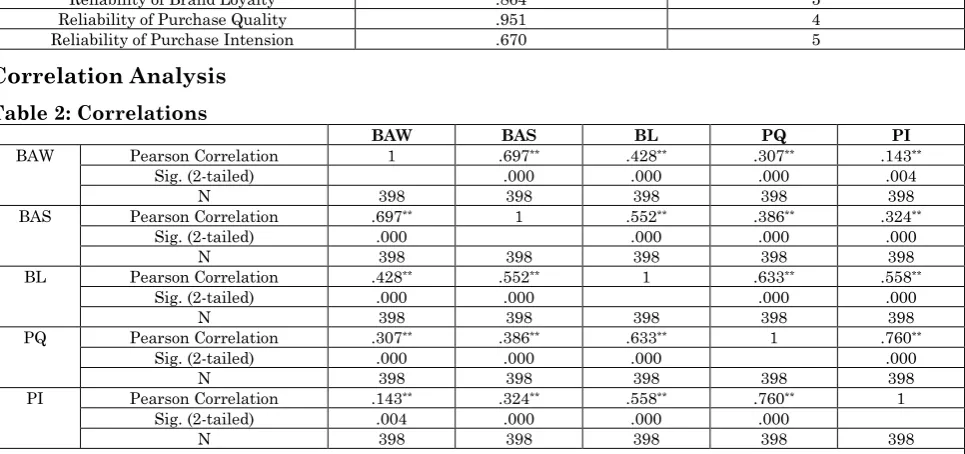
Correlation Analysis Table 2: Correlations
BAW BAS BL PQ PI
BAW Pearson Correlation 1 .697** .428** .307** .143**
Sig. (2-tailed) .000 .000 .000 .004
N 398 398 398 398 398
BAS Pearson Correlation .697** 1 .552** .386** .324**
Sig. (2-tailed) .000 .000 .000 .000
N 398 398 398 398 398
BL Pearson Correlation .428** .552** 1 .633** .558**
Sig. (2-tailed) .000 .000 .000 .000
N 398 398 398 398 398
PQ Pearson Correlation .307** .386** .633** 1 .760**
Sig. (2-tailed) .000 .000 .000 .000
N 398 398 398 398 398
PI Pearson Correlation .143** .324** .558** .760** 1
Sig. (2-tailed) .004 .000 .000 .000
N 398 398 398 398 398
**.Correlation is significant at the 0.01 level (2-tailed)
From the above Table it can be said that the relationship between Brand Assurance and Brand Awareness = .697 which is is positively moderate at 1% level of significance. On the other hand the relationship between Brand Assurance and Brand Loyalty .552 which is also positively moderate at 1% level of significance. Moreover, the relationship between Brand Assurance and Product Quality is.386. That
Table3: Model Summary
Model R R Square Adjusted R Square Std. Error of the Estimate
1 .783a .613 .609 .36411
Predictors: (Constant), PQ, BAW, BL, BAS
Table 4: ANOVAa
Model Sum of Squares df Mean Square F Sig.
1 Regression 82.451 4 20.613 155.483 .000b
Residual 52.101 393 .133
Total 134.553 397
Dependent Variable: PI
Predictors: (Constant), PQ, BAW, BL, BAS
The model is significant. . (000b) and R square is .613. This model explains 61.3% of Purchase Intension in terms of brand
awareness, brand association, Brand loyalty and Purchase quality.
Table 5: Coefficientsa
Model
Unstandardized Coefficients Standardized Coefficients
T Sig.
B Std. Error Beta
1 (Constant) 1.051 .154 6.819 .000
BAW -.170 .033 -.224 -5.091 .000
BAS .117 .041 .135 2.833 .005
BL .139 .043 .147 3.260 .001
PQ .668 .040 .683 16.827 .000
Dependent Variable: PI
From the above Table it can be shown that Regression coefficient of PQ is .683 that means with the change of one unit of Purchase quality (PQ), Purchase Intension increase by .683. Regression coefficient of BL is .139 that means with the change of one unit of Brand Loyalty (BL), Purchase Intension will be increased by .139.
Another Regression coefficient of brand assurance is .117 that means with the change of one unit of brand assurance (BAS), Purchase Intension is increased by 117. Regression coefficient of BAW is -.170 that means with the change of one unit of awareness (BAW), Purchase Intension decrease by .170
Conclusion& Recommendations
Results show that there's a positive relationship between brand awareness, brand
assurance, brand loyalty, product quality with purchase intention. It was seen that the highest relationship was found between product quality and purchase intention and the lowest relationship was found between brand awareness and purchase intention. So the furniture company should emphasize on product quality and it will improve their brand image.
The company should focus heavily on brand awareness because the relationship between brand awareness with purchase intention is very much low so the company should develop brand awareness by following effective marketing and promotional policy. The study is conducted only in Chittagong city for further study should be conducted with more other citifies and the sample size was only 398 further study should be conducted with large sample size[20-21].
References
1. Keller K.L (2008) Strategic brand management: Building, measuring, and managing brand equity. 3rd ed. Upper Saddle River, NJ: Prentice Hall.
2. Chen C, Chang Y (2008) Airline brand equity, brand preference, and purchase intentions-The moderating effects of switching costs. Journal of Air Transport Management, 14:40-42.
3. Simon CJ, Sullivan MW (1993) the measurement and determinants of brand
equity: a financial approach. Marketing Science, 12(1):28-53.
4. Aaker D (1991) Measuring Brand Equity across Products and Markets, California Management Review 38 (spring), New York: Free Press. 1996,102-120.
6. Sproles GB, Kendall EL (1986) A methodology for profiling consumers’ decision-making styles, J. Consum. Aff, 20(2):267-279.
7. Schiffman LG, Kanuk LL (2000) Consumer Behavior, Pearson Prentice Hall, Englewood Cliffs, New York.
8. Gabbott M, Hogg G (1998) Consumers and Services, Chichester: John Wiley & Son.
9. Blackwell RD, Miniard PW, Engel FJ (2006) Consumer Behaviour. Mason: Thomson.
10. Hoyer WD, MacInnis DJ (2001) Consumer Behaviour. 2nd ed., Boston: Houghton Mifflin Company.
11. Rayport JF, Jaworski BJ (2003) Introduction to e-commerce, 2nd edn, McGrawHill, New York. 12. Washburn JH, Plank RE (2002) Measuring
brand equity: An evaluation of a consumer-based brand equity scale. Journal of Marketing Theory and Practice, 10(1):46-62.
13. Gustafson T, Chabot B (2007) Brand Awareness. Cornell Maple Bulletin, 105.
14. Aaker D (1996) Building Strong Brands, the Free Press, NY, 35-71.
15. Yoo B, Donthu N (2001) Developing and validating multidimensional consumer-based brand equity scale. Journal of Business Research, 52 (1):1-14.
16. Zeithaml VA (1988) Consumer Perceptions of Price, Quality, and Value: A Means-end Model and Synthesis of Evidence". Journal of Marketing, 52:2-22.
17. Keller KL (1998) Strategic Brand Management: Building, Measuring, and Managing Brand Equity, Prentice Hall, New Jersey.
18. Yasin NM, Noor MN, Mohamad O (2007) does image of country-of-origin matter to brand equity? Journal of Product and Brand Management, 16 (1):38-48.
19. Oliver R Rust R (1997) Customer Delight: Foundations, Findings, and Managerial Insight, Journal of Retailing, 73 (3):311-337.
20. Srivastava R, Shocker AD (1991) Brand equity: A perspective on its meaning and measurement. Marketing Science Institute Working Paper Series, Report 91-124, Marketing Science Institute, Cambridge, MA.
21. Gupta S (1988) Impact of sales promotions on
when, what, and how much to buy. Journal of