International Journal of Advances in Management and Economics
Available online at:
www.managementjournal.info
RESEARCH ARTICLE
Study of the Impact of International Service Outsourcing Model on
Enterprise Innovation Ability
Yang xue-jun
1, Yuan jia-li
2*International Business School,Jinan University, Qianshan, Zhuhai, Guangdong , China.
*Corresponding Author Email: [email protected]
Abstract: Based on the companies in the information technology industry during 2014 to 2016, the paper
studies the impact of international service outsourcing model on enterprise Innovation ability. The empirical results show that undertaking international service outsourcing has a significant positive impact on enterprise Innovation ability, and the model of international service outsourcing has a significant impact on enterprise Innovation ability. Although international service outsourcing income does not have obvious influence on enterprise Innovation ability, but from the coefficient of regression results, it may suggest that the promoting effects of the three models on enterprise Innovation ability are KPO, ITO and BPO in turn.
Keywords:International service outsourcing;Enterprise Innovation ability;ITO;BPO;KPO
Article Received: 30 Nov. 2018 Revised: 10 Dec. 2018 Accepted: 21 Dec. 2018
Introduction
According to the latest statistical data of the Ministry of Commerce, knowledge process outsourcing (KPO) developed rapidly in 2017, especially in the international business field, with an increase of about 18%, which exceeded 7 percentage points of information technology outsourcing (ITO) and business process outsourcing (BPO).
This shows that the structure of China's international service outsourcing business is constantly optimizing. Faced with the general trend of transformation and upgrading of the national service outsourcing industry, the accumulation of innovation ability is an important way for enterprises to solve the pain of transformation.
Most of the existing literatures focus on the impact of international service outsourcing on enterprise Innovation ability [1-3],lack of discussion on the relationship between three
modes of international service outsourcing (ITO, BPO, KPO) and enterprise Innovation ability. It cannot provide detailed guidance for enterprises to enhance their innovation ability by selectively undertaking different modes of international service outsourcing business. Based on this, the paper puts forward hypotheses through theoretical analysis, and carries out empirical verification by taking listed companies in information technology industry as samples, and finally forms research conclusions and policy enlightenment.
Theoretical Analysis and Research Hypothesis
The Impact of International Service Outsourcing on Enterprise Innovation Ability
enterprise Innovation ability. Kumar [4] studied the situation of Indian software outsourcing and found that undertaking international software outsourcing would enhance the software development ability of Indian local enterprises. Long [5] argues that developed countries often outsource non-core businesses to developing countries with low labor costs in order to reduce costs.
This requires necessary training for employees in developing countries, and technology spillover will occur in the training process. Wang Xiaohong [6] found that foreign-funded design companies in China mainly produce technology spillover through the following four ways: using advanced technology, disseminating new business concepts, personnel flow and imitating products and service models, which promote the innovation ability of local design companies, and then promote design business from the low end of the value chain to the middle and high end. Ren Zhicheng [7].
Found that undertaking international software outsourcing can obtain technology spillovers, which can enhance enterprise Innovation ability. Among the various ways of technology spillover, human capital has the most significant impact on enterprise Innovation ability; corporate culture and system have a certain role in promoting technology spillover; government services and external environment will indirectly promote enterprise innovation ability through technological policies and talents introduction. In summary, these papers argue that enterprises will absorb the spillover knowledge and then enhance their innovation ability by undertaking international service outsourcing. Therefore, the paper proposes the following assumptions:
Hypothesis 1
International service outsourcing has a positive impact on enterprise Innovation ability.
The Impact of International Service
Outsourcing Model on Enterprise
Innovation Ability
From Table 1, we can see that from ITO, BPO to KPO, service outsourcing gradually shifts from low-end technology outsourcing business to middle and high end service process outsourcing business and from auxiliary business to knowledge-intensive core business [8], which promotes enterprises to participate in service outsourcing as an information provider and co-developer. It is helpful for consigner and consignee to reach an agreement on the same thing [10], so as to effectively enhance consignee's innovation ability.
Moreover, from ITO, BPO to KPO, the cooperation relationship between consigner and consignee ranges from tactical partnership with little communication to strategic partnership with increasing exchanges, to transformational partnership with close allies [11].
The cooperation relationship between the two sides is getting closer and closer. the consignee will learn the advanced technology and management experience especially some tacit knowledge which is difficult to express from consigner through observation and close interaction, so as to promote the consignee’s innovation ability[12].
outsourcing modes. The paper puts forward the following assumptions:
Hypothesis 2
The impact of international service outsourcing model on enterprise innovation ability is different.
Hypothesis 3
The positive impact of international service outsourcing income in different patterns on enterprise innovation ability is KPO, BPO and ITO in turn.
Table 1: Comparison of ITO, BPO and KPO
ITO BPO KPO
Basic knowledge
Knowledge of System
Operations, System Application Services, Basic
Technical Services, etc.
Knowledge of product development and
design, human resources, financial services, after-sales services, logistics and
Purchase, marketing, training, etc.
Knowledge of concepts, skills,
technologies, management, research and development,
standards, etc.
Attention Focus Cost arbitrage; Technology Cost arbitrage; business process
Intelligence arbitrage; knowledge flow
Process complexity Basic IT business
processes;simple and clear
Standard procedures and templates;
rule-based
Highly complex and uncertain;
based on judgment.
Staff requirements Software development talents
Process management talents Inter-disciplinary talents
Party Relations Tactical partnership Strategic partnership Transformational Partnership
Source: According to Li Yuanxu, Tan Yuanqing [13] and Liu Fan, Wang Weijun [14].
Research and Design
Variable Design Dependent Variable
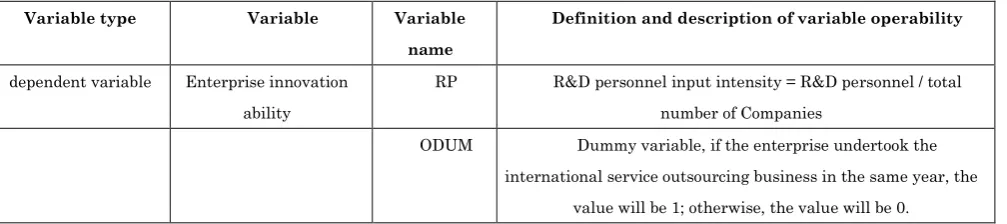
Innovation Ability (RP): The evaluation indexes of innovation ability in existing literature can be divided into two categories: first, innovation input, which can be measured by R&D funds or R&D personnel input; second, innovation output, which can be measured by the number of patents obtained by enterprises in the same year [3]. As the channel and threshold of technology spillover, human capital has the most significant impact on the innovation ability of local enterprises [7].
In view of the fact that consignee mainly enhance their innovation ability through technology spillovers, so the paper use R&D personnel input to measure enterprises innovation ability. The larger the proportion of R&D personnel input, the stronger the innovation ability of enterprises.
Independent Variable
International Service Outsourcing Virtual Variable (ODUM)
If enterprises have international service outsourcing business, the value is 1; otherwise, the value is 0.
International Service Outsourcing Income (OS)
This explanatory variable is measured by the proportion of international service outsourcing income to main business income. However, most enterprises do not disclose international service outsourcing income in financial reports.
Although it may exaggerate international service outsourcing income, it does not affect the final conclusion [15].
Business Process Outsourcing Virtual Variable (BPO) if the international service outsourcing business undertaken by the enterprise in that year is business process business (BPO), the value is 1, otherwise the value is 0. Knowledge Process Outsourcing Virtual Variable (KPO) If the international service outsourcing business undertaken by the enterprise in that year is knowledge process business (KPO), the value is 1, otherwise the value is 0.
Control Variables
In order to control the influence of other important factors on enterprise innovation ability as far as possible, and prevent the endogenous problems caused by missing variables. Referring to existing research literature, the paper chooses following control variables:
Enterprise Scale (LNSIZE)
Small and large enterprises have their own advantages in enterprise innovation. Small enterprises are more flexible in innovation and have behavioral advantages, while large enterprises have material advantages [16]. The paper uses the natural logarithm of total assets at the end of the year which represents the size of the enterprise to control its impact on enterprise Innovation ability.
Grow
It is generally believed that growing
companies are motivated to increase investment in innovation to create growth
opportunities [16]. The growth rate of main business income is one of the key factors affecting the growth of enterprises. Therefore, the paper uses the growth rate of the main business income which reflects the growth of enterprise to control its influence on enterprise Innovation ability.
Leverage Solvency (LEV)
Usually, when the pressure of long-term liabilities is greater and the fixed interest burden is greater, the investment in innovation will be reduced [18]. Therefore, the paper chooses LEV to control its impact on enterprise Innovation ability.
Profitability (OPR)
In general, the more profitable an enterprise is, the more it will invest in innovation [19]. The paper chooses OPR to control its impact on enterprise Innovation ability.
Time (YEAR)
When the company's stock value is overvalued or undervalued, it will affect the enterprise Innovation strategy. However, it is difficult to accurately calculate the company's overvalued or undervalued value in a certain year [18].
Therefore, the paper uses annual dumb variables to control the influence of company's overvalued or undervalued value on enterprise Innovation ability.
Table 2: List of variable definitions
Variable type Variable Variable name
Definition and description of variable operability
dependent variable Enterprise innovation ability
RP R&D personnel input intensity = R&D personnel / total number of Companies
ODUM Dummy variable, if the enterprise undertook the
independent variable International Service
Outsourcing
OS The proportion of enterprise's international service
outsourcing income=enterprise's overseas revenue / annual sales revenue in the current year
BPO Dummy variable, if the international service outsourcing
business that the enterprise undertook in that year is business process business (BPO), then the value is 1; otherwise, the value
is 0.
KPO Dummy variable, if the international service outsourcing business that the enterprise undertook in that year is knowledge
process business (KPO), then the value is 1; otherwise, the value is 0.
control variable
Enterprise scale LNSIZE The natural logarithm of total assets in that year
Enterprise growth GROW
Increase rate of main business income = current year's main
business income - last year's main business income) / last year's main business income
Solvency LEV Asset-liability ratio of the year = total liabilities/total assets
Profitability OPR Operating Profit Rate = Operating Profit/Operating Income
time YEAR Dummy variable, if the enterprise is in the year, then take 1,
otherwise take 0.
The Construction of the Model
According to the above research hypothesis and variable design, the paper uses multiple linear regression models to construct the relationship between variables. The definitions of dependent variables, independent variables and control variables in the model are shown in Table 2. Model (1) examines the impact of undertaking international service outsourcing on the innovation ability of enterprises with a total sample of 453 samples from 151 listed companies in the information technology industry from 2014 to 2016.
RP=α+β1ODUM+β2LNSIZE+β3GROW+β4LEV +β5OPR+β6YEAR+u Model (2) uses 175 samples of undertaking international service outsourcing, and divides samples into three groups: ITO, BPO and KPO according to the different content of undertaking international service outsourcing. Then, based on ITO, the interaction items of BPO, KPO and OS are introduced.
The paper studies the impact of international service outsourcing income in different models on enterprise Innovation ability through studying the relationship between
interaction items and enterprise innovation ability,
RP=α+β1OS*BPO+β2OS*KPO+β3LNSIZE+β4GROW+β 5LEV+β6OPR+β7YEAR+u
Sample Selection and Data Collection
Firstly, the paper chooses the listed companies of "information technology industry" of Shenzhen Stock Exchange and "information transmission, software and information technology service industry" of Shanghai Stock Exchange from 2014 to 2016 as the research objects. There are 151 companies in total.
section IV "Discussions and Analysis of Business Conditions".
If enterprises undertake international service outsourcing business, they will further judges which mode of international service outsourcing business the company undertakes belongs to according to the development plan of China's international service outsourcing industry (2011-2015).
Since the paper takes the enterprise's overseas revenue substitute international service outsourcing income, so if the enterprise does not undertake international service outsourcing business or does not disclose overseas revenue, it is determined that the enterprise does not undertake international service outsourcing business. Under this criterion, 278 samples did not undertake international service outsourcing revenue, 102 samples undertook ITO, 36 samples undertook BPO and 37 samples undertook KPO.
Variables such as total assets, growth rate of main business income, asset-liability ratio and operating profit margin are downloaded and sorted out from CSMAR. And the paper compares and corrects the abnormal value data with the publicly disclosed annual report
to ensure reliability and accuracy of data.
Overseas income and R&D personnel input intensity are manually collected from the annual report.
Empirical Tests and Results
Descriptive Statistical Analysis
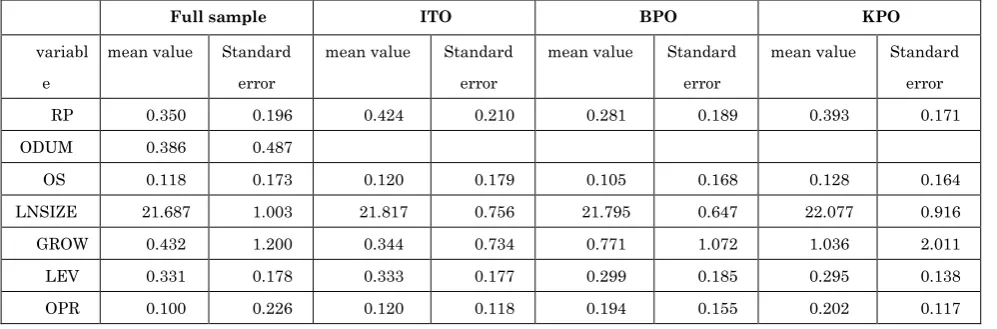
Table 3 is the descriptive statistical results of the main variables in the study. From Table 3, we can see that the average value of ODUM is 0.386, which indicates that 38.63% of the companies in information technology industry undertake international service outsourcing business, which indicates that most of them have not yet undertaken international service outsourcing, there are few outsourcing companies going to the international market.
The average value of OS is 11.8%, which shows that the income from undertaking international service outsourcing business is less, accounting for only 11.8% of their business income. Specifically, KPO enterprises have the highest proportion of international service outsourcing income, accounting for 12.8%.
Table 3: Descriptive statistics of major variables
Full sample ITO BPO KPO
variabl
e
mean value Standard
error
mean value Standard
error
mean value Standard
error
mean value Standard
error
RP 0.350 0.196 0.424 0.210 0.281 0.189 0.393 0.171
ODUM 0.386 0.487
OS 0.118 0.173 0.120 0.179 0.105 0.168 0.128 0.164
LNSIZE 21.687 1.003 21.817 0.756 21.795 0.647 22.077 0.916
GROW 0.432 1.200 0.344 0.734 0.771 1.072 1.036 2.011
LEV 0.331 0.178 0.333 0.177 0.299 0.185 0.295 0.138
OPR 0.100 0.226 0.120 0.118 0.194 0.155 0.202 0.117
Multivariate Regression Analysis
The paper use Stata 12.0 for regression analysis. There is no serious multi-co linearity among the variables in regression. Mean VIF values are less than 2. In order to reduce the influence of heteroscedasticity on
regression coefficients, the standard error was treated by Robust.
Return of International Service
Ability
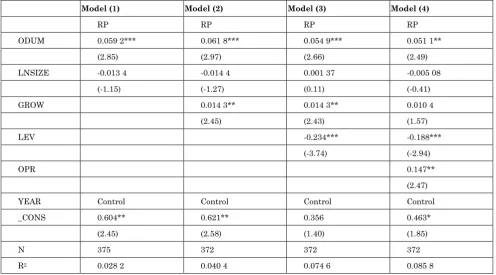
The four models in Table 4 are the regression results of international service outsourcing to enterprise innovation ability after adding control variables in turn. From the results, the goodness of fit of the model R2 becomes better after adding control variables in turn, which shows that the control variables are reasonable.
From model (1) to model (4), the regression results show that there is a significant positive correlation between international service outsourcing and innovation ability, which shows that undertaking international service outsourcing can significantly improve the innovation ability of enterprises, which is consistent with hypothesis 1. Enterprise scale has positive and negative symbols of innovation ability, and it is not significant, indicating that enterprise scale has no significant impact on innovation ability. In the models (2) and (3), the growth of enterprises is positively correlated with
Enterprise Innovation Ability at the level of 5%.
This shows that the faster the growth of enterprises, the more investment in innovation will be increased. In the model (4), the growth and innovation ability of enterprises have no significant impact, which shows that compared with the solvency and profitability, the growth of enterprises has no significant impact on innovation ability. Asset-liability ratio is negatively correlated with innovation ability at the level of 1%, which indicates that enterprises will reduce innovation investment when long-term debt pressure is high. Business profit margin is positively correlated with innovation ability at the level of 5%, which indicates that the better the profit, the greater the investment in innovation.
Table 4: Return of International Service Outsourcing and Enterprise Innovation Ability
Model (1) Model (2) Model (3) Model (4)
RP RP RP RP
ODUM 0.059 2*** 0.061 8*** 0.054 9*** 0.051 1**
(2.85) (2.97) (2.66) (2.49)
LNSIZE -0.013 4 -0.014 4 0.001 37 -0.005 08
(-1.15) (-1.27) (0.11) (-0.41)
GROW 0.014 3** 0.014 3** 0.010 4
(2.45) (2.43) (1.57)
LEV -0.234*** -0.188***
(-3.74) (-2.94)
OPR 0.147**
(2.47)
YEAR Control Control Control Control
_CONS 0.604** 0.621** 0.356 0.463*
(2.45) (2.58) (1.40) (1.85)
N 375 372 372 372
R2 0.028 2 0.040 4 0.074 6 0.085 8
Note: 1) *** P < 0.01, ** P < 0.05, * P < 0.1; 2) Robustness t value is in parentheses
One-way ANOVA of International
Service Outsourcing Model and
Enterprise Innovation Ability
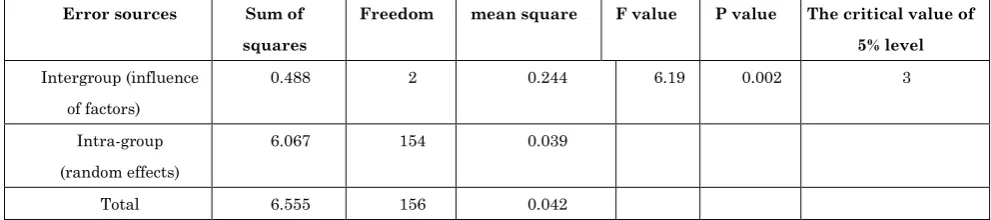
different levels. Table 5 is the one-way ANOVA analysis result of the international service outsourcing model on enterprise innovation ability. From table 5, it can be seen that the P value is 0.0026, which is significantly less than 0.05. It shows that the different international service outsourcing
models have a significant impact on enterprise innovation ability at the 5% significant level.
That is to say, Enterprises undertaking ITO, BPO and KPO have significant differences in innovation ability.
Table 5: Single-factor ANOVA Analysis of International Service Outsourcing Model and Enterprise Innovation Ability Error sources Sum of
squares
Freedom mean square F value P value The critical value of 5% level Intergroup (influence
of factors)
0.488 2 0.244 6.19 0.002 3
Intra-group (random effects)
6.067 154 0.039
Total 6.555 156 0.042
Regression Result of International
Service Outsourcing Income and
Enterprise Innovation Ability in
Different Modes
Table 6 shows the regression results of different modes of international service outsourcing revenue to enterprise innovation ability after gradually adding control variables. In this model, ITO is selected as the base group, and the interaction items of BPO, KPO and OS are introduced.
Therefore, the estimated values of BPO, KPO and OS interaction items reflects the impact of BPO and KPO income on enterprise innovation ability compared with ITO. From the results, we can see that constant coefficient is positive, but not significant. It shows that ITO income has no significant impact on the innovation ability of enterprises.
The underlying reason for the result may be that the proportion of enterprises’ international service outsourcing income in China's information technology industry is too low, which leads to the contribution of undertaking international service outsourcing to the improvement of enterprise innovation ability is low.
From the regression results, the constant coefficient is positive, which indicates that undertaking ITO has a positive impact on enterprise innovation ability. The coefficient of interaction term between BPO and OS is negative. It shows that the impact of undertaking BPO on enterprise innovation ability will be weakened compared with ITO, which is inconsistent with the hypothesis.
It may be that most of the BPO business undertaken by Chinese enterprises are low-end business such as call center, customer service center and data entry. On the contrary, ITO businesses have relative high technology, such as software development, e-commerce platform testing, etc. So the promotion of BPO to enterprise innovation ability is less than ITO business.
The coefficient of interaction between KPO and OS is positive, which shows that compared with ITO; the impact of KPO on enterprise innovation ability will be strengthened, which is consistent with the assumption. It shows that KPO is a high-end service outsourcing business, and its promotion effect on enterprise innovation ability is higher than ITO business.
Model(1) Model (2) Model (3) Model (4)
RP RP RP RP
BPO*OS -0.139 -0.156 -0.165 -0.328*
(-0.96) (-1.06) (-1.07) (-1.79)
KPO*OS 0.167 0.148 0.097 8 0.040 1
(0.86) (0.76) (0.54) (0.24)
LNSIZE -0.006 43 -0.007 17 0.010 8 0.003 00
(-0.30) (-0.33) (0.49) (0.13)
GROW 0.007 10 0.003 36 -0.000 747
(0.72) (0.33) (-0.08)
LEV -0.255** -0.183*
(-2.49) (-1.70)
OPR 0.279*
(1.66)
YEAR Control Control Control Control
_CONS 0.536 0.556 0.245 0.355
(1.16) (1.21) (0.52) (0.76)
N 151 148 148 148
R2 0.012 8 0.015 2 0.057 0 0.079 0
Note: 1) *** P < 0.01, ** P < 0.05, * P < 0.1; 2) Robustness t value is in parentheses
Conclusions and Policy
Recommendations
Based on the samples of Listed Companies in information technology industry from 2014 to 2016, the paper studies the relationship between international service outsourcing model and enterprise innovation ability. The results show that undertaking international service outsourcing has a significant role in promoting enterprise innovation ability. Hypothesis 1 is established. There are significant differences in the impact of international service outsourcing models (KPO, BPO and ITO) on innovation ability of enterprises. Hypothesis 2 is established. However, the impact of different modes of international service outsourcing income on enterprise innovation ability is not significant. Assumption 3 is not established.
The possible reason for the result is that China started to undertake international service outsourcing late, and most enterprises undertook international service outsourcing income accounted for a relatively low proportion of main business income. Under the realistic background, undertaking
international service outsourcing contributes less to enterprise innovation ability. From the coefficient of regression results, it may be suggested that KPO, ITO and BPO in turn play an important role in promoting enterprise innovation ability.
According to the results of the study, the following two policy recommendations are put forward: (1) Optimizing the structure of international service outsourcing and enhancing the innovation ability of enterprises. On the one hand, Chinese enterprises should choose to undertake more high-end service outsourcing business, enhance their innovation ability and high-end service business undertaking ability, so as to undertake more high-end service outsourcing business and form a virtuous circle; on the other hand, government should take innovation drive as the lead to promote the value chain of service outsourcing to a higher level.
process, management and other aspects, and support qualified outsourcing enterprises to participate in major national science and technology bidding projects, and enhance high-end service abilities such as system design, overall solutions.
(2) Strengthening the cultivation of compound talents and improving the ability to undertake high-end service outsourcing. On the one hand, enterprises should encourage employees to take part in the professional qualification examination of service outsourcing industry, strengthen the internal personnel training mechanism, and enhance employees’ ability to undertake high-end service outsourcing business; at the same time, enterprises should establish a fair and just internal environment, and attach retention of talents.
On the other hand, China should innovate the system and mechanism, strengthen the training of compound talents, and improve the introduction policy and incentive mechanism of international high-end talents.
The limitations of the study and future research directions are as follow: (1) Lack of
further analysis on the impact of international service outsourcing model on the meaning of innovation ability. Innovation ability includes product innovation ability, process innovation ability, management innovation ability and technology innovation ability [12]. Different modes of international service outsourcing undertake different services, which may have different impacts on the meaning of enterprise innovation abilities, which need further in-depth study; (2) Sample grouping.
The paper classified samples in different modes according to the outline of China's international service outsourcing industry development plan (2010-2015), but to some extent, there may exists subjective judgment differences. Moreover, a small amount of data after grouping may affect empirical results, and future research should increase sample data to obtain more accurate results.
References
1. Liu Shaojian (2008) Study on Technology Spillover Effect of International Software Outsourcing [J]. Economic Research, 5:105-115.
2. Hu Shuijin, Yu Xiang (2009) undertaking the mechanism and Empirical Study of R&D offshore outsourcing on technological innovation ability [J]. China Science and Technology Forum, 11: 24-28.
3. Cui Ping (2010) The Impact of Undertaking Service Outsourcing on Technological Innovation of Enterprises: An Empirical Study Based on Panel Data of Listed Companies in China's IT Industry [J]. International Economic and Trade Exploration, 8:47-51.
4. Kumar N (2001) Indian Software Industry Development: International and National
Perspective [J]. Economic and Political Weekly, 36 (45): 4278-4290.
5. Long NV (2005) Outsourcing and technology spillovers [J]. International Review of Economics & Finance, 14 (3):297-304.
6. Wang Xiaohong (2008) The Technological Spillover Effect of China's Undertaking International Design Service Outsourcing: An Empirical Analysis Based on 80 Chinese Design Companies Undertaking International Service Outsourcing [J]. Finance and Trade Economy, 8: 84-89.
8. Gan Chunmei, Duan Zhao, Yang Juanjuan (2010) Generation and Development of Knowledge Process Outsourcing [J]. Library and Information Work, 54 (12): 9-12.
9. Fang E (2008) Customer Participation and the Trade-Off between New Product Innovation and Speed to Market [J]. Journal of Marketing, 72 (4): 90-104.
10. Brown JS, Duguid P (2001) Knowledge and Organization: A Social-Practice Perspective [J]. Organization Science, 12 (2): 198-213.
11. Yang Xuejun (2010) International Technology Service Outsourcing Partnership: A Research Model [J]. Research on Science and Technology Management, 30 (4): 140-142.
12. Wang Yonggui, Ma Shuang, Yang Hongen (2015) Measurement, Promotion and Performance Impact of Innovation Ability in Service Outsourcing: An Analysis from the Perspective of Knowledge Transfer between Outsourcing and Contractor [J]. Management World, 6: 85-98.
13. Li Yuanxu, Tan Yunqing (2010) Ways to improve the technological innovation ability of outsourcing enterprises under Offshore Service outsourcing: based on the perspective of spillover effect and absorptive capacity [J]. China's industrial economy, 12:66-75.
14. Liu Fan, Wang Weijun (2010) Research progress of knowledge process outsourcing [J]. Library and information work, 54 (12): 13-16.
15. Li Geng (2012) Undertaking International Software Outsourcing, Technology Spillover Effect and Corporate Performance Analysis [D]. Southwest University of Finance and Economics.
16. Liu Yunguo, Liu Wen (2007) Executive tenure and R&D expenditure of Listed Companies in China [J]. Managing the world, 1: 128-136.
17. Wu Shinong, Li Changqing, Yu (1999) Wei Judgment Analysis and Empirical Study on Growth of Listed Companies in China [J]. Nankai Management Review, 4: 49-57.
18. Xia Yun, Tang Qingquan (2011) Final Controller, Executive Compensation and Technological Innovation [J]. Journal of Shanxi University of Finance and Economics, 33 (5): 86-92.