International Journal of Advances in Management and Economics
Available online at:
www.managementjournal.info
RESEARCH ARTICLE
Hedge Simulation for for Beef Cattle Farmers in Brazil
Arthur Delgado da Silva
1, Flavio Luiz de Moraes Barboza
1*,
Denize Lemos
Duarte
1, Michele Aparecida Cunha
1Faculty of Administration, Federal University of Uberlândia, Brazil.
*Corresponding Author Email:[email protected]
Abstract: Cutting livestock is an important part of the Brazilian economy; consequently, variations in the prices of certain products can impact the whole productive chain of the country, which requires better tools to improve the competitiveness of the products. To improve risk management in fragile companies to fluctuations in commodity prices, the use of derivatives to hedge is a tool known in other countries. However, in Brazil, the necessary technical knowledge is inaccessible to small and medium-sized producers, who have their profit margins dependent on the price of their commodity. In addition, the presence of livestock is strong, so producers need to keep in mind the alternatives that exist to mitigate their risks in relation to the prices. Thus, a questionnaire was applied with producers to understand how the use of derivatives occurs and if it exists, later comparing with other similar studies in different situations. We also examine a hedge simulation, for demonstrating possible results that the financial operation was able to obtain (in the given period) while elucidating the adversities of the tool to the producer. Due to the period chosen in the simulation, the results were positive and presented a good alternative. However, the impact of the costs and the possibility of having reservations to perform the operation were highlighted.
Keywords: Hedge, live cattle, derivative, Risk Management.
Article Received: 20 June 2019 Revised: 24 June 2019 Accepted: 29 June 2019
Introduction
Brazil has significant values in the local and world scenario of beef production, where this product represents a very important element to the local economy, and beef cattle (frozen, fresh or refrigerated) is the 9th most exported product by Brazil from January to September [1]. Alves and Serra [2] also bring more expressive values, with Brazil being the largest commercial herd in the world and the livestock GDP representing 43.27% of the national agricultural GDP.
According to Carvalho and Zen [3], Brazil is the second largest producer and the largest exporter of beef in the world, and agribusiness as a whole presents a promising future. The importance and size of the bovine production in the country besides its distribution among several Brazilian states is great. In the municipal livestock report of 2016 [4], even with the recent growth of the Midwest and North regions, the Southeast is still quite representative in the national scenario, an example would be the milking cows, where Minas Gerais has the highest
the three largest producing municipalities. Already in a regional perspective [5], the 5 largest municipalities of the Triângulo Mineiro have more than 200,000 head in the herd population each. Taking all the data into account, the great importance of livestock and beef cattle for Brazil, besides its strong presence in the Triângulo Mineiro, is remarkable. Carvalho and Zen [3] going deeper into confinement costs and returns on
investment bring comparative results
between producers who have made a previous price lock in the stock market and those who have not.
[6], a study that consists of the application of a questionnaire over the years that was aimed at verifying that the non-financial
companies used derivatives, besides
specifying the mode and which tool was used. This method was replicated in several countries in an efficient way and the use of questionnaires presented satisfactory results for the understanding of the market.
In the Brazilian perspective, Saito and Schiozer [7] present hypotheses and try to replicate the application of questionnaires to understand the use of derivatives by non-financial companies in Brazil. The results obtained did not show a great disparity in the use of derivatives when compared to other countries, however, as the main concerns Brazil presented the tax question more frequently. The instability of the market brings with it greater responsibility in the management of those involved, in this
case both the producers and the
slaughterhouses. In Brazil, different tools have seen its use increase since the 2000s.
An example of this would be the future market that is able to aid in risk control [3]. A recent example of the market price variation was the impact of the Federal Police's Low Fiber operation, which began in March 2017, which affected the prices of various livestock products, mainly the price of beef cattle. According to the historical series of CEPEA-ESALQ [8] the values fell from 141,37 BRL to 132,39 BRL in 5 days only. Given this scenario, this study is necessary to give light to the regional enterprises regarding the possibility of performing the hedge in their productions, disseminating the positive possibilities of the tool.
This scenario also brings to light the situation of small producers who, without hedge, have their profit margins totally exposed and are dependent on the positive price variations. The studies with hedge simulations in the current literature seek to analyze other aspects of the tool that are sometimes more theoretical and more distant from daily practice, see the basic risk that has great attention. Thus, there is little dissemination and simple proof that small producers can make use of the hedge and obtain positive results. Yet, this work is relevant to simulate the possible results in different scenarios.
Thus, taking into account the situation of the region, this work sought to understand the results of possible hedge positions through future contracts using simulations with real values and cosnidering all costs that would be incurred in the operation. For this purpose, data were used as the historical series of the Brazil, Bolsa, Balcão (B3) and the Center for Advanced Studies in Applied Economics (Cepea-Esalq / USP), as well as references to the size of the National Institute of Colonization and Agrarian Reform [10].
The objective of this study is to help the production of small-scale producers of beef cattle in the region of Triângulo Mineiro regarding the use of hedge as well as the advantages and disadvantages that the tool can offer. In addition, the survey also
includes understanding the use of
derivatives by local producers as a tool in risk management. In order to do so, this research seeks to identify and investigate the actual costs and values data for the simulation of the operation, to analyze the simulations and possible impacts for small producers and to understand how the use of derivatives by local producers occurs.
Literature Review
Risk ManagementTo understand the financial market, Hull [11] divides the agents into three types and highlights the perspective of each one, among them it is possible to highlight the hedger whose objective in the market and to reduce the risk that they have to future market variations.
The article also makes clear the beginnings of the development of risk management, being important the contribution of Modigliani and Miller [14] who was able to show that risk management brings impacts on the value of the company. In another aspect, hedge studies have foundations in Stulz [15] and Smith and Stulz [16] which
have developed models for better
understanding and confidence in the use of the technique, as well as making clear the possibility of a positive impact on the value of companies that make use of the tool.
Through the analysis of values in the BM & F, Ribeiro, Machado and Júnior [17] find traces of a pattern of relationship between a
more active risk management, via
derivatives, and the value of which investors are willing to pay, considering a scenario of unstable environment such as Brazil. However, it is important to note that, according to Ribeiro, Machado and Júnior [17], the current literature still needs to determine the specific impact of each tool on the value of the companies and there is still no consensus on the subject.
Taking into account all these theoretical bases Hoji and Costa [18] carry out, in order to carry out feasibility simulations, that risk management is a process that results in the acceptance or reduction of a known risk through the use of the correct tools.
In addition, the authors point out that large companies may have the appropriate knowledge to carry out their activities in this area, however it is not all small and medium-sized companies that get employees trained to use the financial derivative tools for hedge. In dealing with agribusiness, Savelli [19] performs a generalist comparative study and ends up highlighting the use of hedge futures as an effective tool for entrepreneurs who wish to mitigate risks. This category includes the producers and exporters of agricultural commodities, for example, the bulldog.
Hedge in the Future Market
To understand the Future Market one must conceptualize some terms, Amaral defines derivative as any financial instrument that results from another underlying product, having its prices varying with certain relation. Thus, Amaral [20] states that the
most used derivatives are the forward contract; future contracts; put option and swap contracts. Hull defines a future contract as an agreement to buy or sell a certain asset at a predetermined future date for a combined price, it highlights the standardization of specificities such as asset quantity and expiration dates beyond guarantees in the use of this product.
The author also conceptualizes hedge, and states that for its application the company must acquire a position contrary to the one that is or should be in the market, therefore it classifies hedge in: Long Hedge, when the company knows that it should buy certain asset in the future and wishes to lock its price and Short Hedge referring to the position in which the entrepreneur owns the asset and expects to guarantee a certain sale price.
Hardacker et al. [21] highlights the use of futures contracts to carry out the hedge stating that they can be used for protection in price variations by both buyer and seller. Hardacker et al. [21] also details the operation stating that the producer of a commodity should seek a contract whose variation is similar to that of its production and also highlights the possibility of protecting only a fraction of the expectation of sale.
In Brazil, the effectiveness of hedge futures contracts has been studied by Oliveira Neto and Figueiredo [22] who measured through hedge effectiveness and the optimal hedge ratio, a reduction of up to 90% in the risk related to the production of cattle in Goiás, with this they concluded that there is relevance when using the hedge in that situation. Following the level of contract negotiations, according to data from B3 [9], in February, 27th (2018), 548 billion contracts were traded in 5,111 negotiations. This shows a certain liquidity of the financial product that, in February 2016, of the commodities, was behind only the future maize contract, with 42,024 contracts traded, however, a billion contract moved a much larger financial volume of 1,420,490.00.
option taking into account transaction costs and obtains more favorable results when
compared to previous methodologies.
Another example is the work of Jitmaneeroj [24], whose results seek to better understand the tradeoff between hedge effectiveness and the resulting transaction costs.
The Use of Derivatives
The use of futures contracts in companies is studied in several surveys, among them it is possible to highlight the Wharton derivatives survey that preceded several replications in other parts of the world [6]. Saito and Schiozer [7], based on later replications of the Wharton Derivatives Survey, present an international panorama regarding the use of derivatives in order to mitigate risks in non-financial corporations.
In addition, the authors comment on the use of hedge and how in Brazil , companies that do not aim to profit from this activity, only reduce their exposure to risks. The Wharton Derivatives Survey was used as a research reference for the use of derivatives in several other studies, eg, Martin et al. [25] who sought a similar method to study the Peruvian scenario and Sprĉić [26] who sought application in Croatia and Slovenia. Subsequently, Bodnar and Gebhardt [6] conducted a comparative study of the results of the Wharton Derivatives Survey with another survey conducted in Germany, showing a 78% index on the use of derivatives in Germany and 50% in US companies.
The difference is justified by macroeconomic characteristics, but the authors note that despite them, the use of derivatives follows the company's turnover, a fact later statistically confirmed by Sprĉić [26]. In an aspect closer to the Brazilian Martin et al. [25] performs a study in Peru focusing on large companies, the results point to a situation in which among 46% of the firms that said they are exposed to interest rate variations and 66% to the exchange rate only 33% have already used derivatives and 6% make frequent use.
The study also presents as the most striking factor for the non-use of derivatives the lack of knowledge or training as well as scarcity of supplies and organization of the local market. Depicting the situation of Brazilian companies directly linked to commodities,
Mühlen et al. [27] studied local soybean producers in Maracaju, Mato Grosso do Sul, applying a questionnaire that showed low use of commodity derivatives, with only 11% of the sample saying they currently use it and 33% stating that they no longer use it. It is also important to emphasize that the most important factor for non-use was the lack of knowledge and confidence in the process, even if the greatest concern of the producers is the price risk. Saito and Schiozer [7] also show that, in Brazil, the use of derivatives was not kept away from other countries, except in Germany, which shows greater adherence to the tool.
Methodology
According to IBGE [28], from 20
municipalities with the highest bovine population, 12 of them are in the mesoregion of Minas Gerais, called Triângulo Mineiro, including the two largest ones (Prata and Campina Verde). According to the IBGE report [29] Minas Gerais presents relevant numbers in the national scenario of cattle slaughtering, with the 6th Federative Unit being the most representative with 617,848 heads in the first quarter of 2017, with little difference with the other Federative Units except Mato Grosso and Mato Grosso of the South, the two largest that have respectively 1,116,752 and 845,984 heads in their numbers. Similar to the simulation of this article, Hoji and Costa [18] study the case of a company that must manage its market risk from the exchange rate whose variations could nullify the expected result.
Thus the data used sought to be as similar to the billing planning expected by a producer. For the delimitation of costs, the March 2018 value of Scot Consultoria [32] was used, which brought the price of 105,01 R$ / @ to the full cycle production. In addition, the cost of the broker's financial operation was also considered. investment in 70R$ per contract used. Seeking to delimit a division of ports in rural properties, INCRA brings the unit of fiscal modules (measured in hectares according to the productivity of the land where they are) and with that establishes their size classifications. The classification groups are: Minifundio, with less than 1 fiscal module; small property, between 1 and
4 modules; average property, from 4 up to 15 tax modules and large property those that have more than 15 fiscal modules. To consider the size of the properties of the Triângulo Mineiro, a simple arithmetic mean will be calculated between the values of the
fiscal modules of the 30 largest
municipalities. Taking this into account, the fiscal module (m.f.) obtained corresponds to 32.4 hectares, Garcia et al. [33], when searching for the economic feasibility of cattle breeding in a given region, provides a productivity estimate between 3.7 and 12.7 ha / ha using the mean of 6.5 ha / ha (see Table 1).
Table 1: Relationship between size classifications in hectare and the specific production for each productive range
Small Medium Large
Tax Modules Between 1 and 4 m.f. Between 4 and 15 m. f. Greater than 15 m.f. Value used in simulations 2,5 m. f. 9,5 m. f. 16,5 m. f.
Hectares 81 ha 307,8 ha 534,6 ha
Production in @ 525 @ 2000 @ 3475 @
Source: INCRA (2013)
He CEPEA / ESALQ database of its beef cattle indicator ESALQ / BM & FBOVESPA was used to determine the historical price series of arroba in the required time frames. In addition, the simulations were carried out in two ways, the first in which all production, including profits, is protected with contracts and settlement of the transaction in the financial market and the second test in which the quantity of contracts used protects only costs.
This is intended to ensure that there is no loss from the price fluctuation in addition to leaving room for possible profits from the sale of the rest of the production in the spot market, in which case the partial hedge should have the proportion of 50% of the merchandise traded in the spot market and 50% of the value in the financial market.
The purpose of the two approaches is to determine which would be the most effective for the producer when compared to the non-hedged result or spot market result. In addition, to study the possible reduction in operating cost by operating a smaller number of contracts in the partial hedge. nAnother highlight is the use of exclusively financial settlement of the operations in the simulations, with this it is possible to avoid unnecessary costs for the small producer
whose objective would be limited to the protection on the market risk. To determine the use of derivatives among producers, a
questionnaire adapted from Wharton
Derivatives Survey of 1998 [6]. The questionnaire aimed to understand if the producer makes use of the tool and, if not, determine the causes of non-adoption. The questionnaires were applied in person at auctions organized by the union, where many producers were present, and in the
electronic medium through the
dissemination of forms and telephone calls. It should also be noted that the questionnaires were applied in 2016.
Results
Use of Derivatives
Figure 1: Respondents' education
Source: data research
As for the justification for not using the derivatives there was convergence of the answers in two points, the lack of knowledge and believe that the risks are not large enough. In addition, one respondent stated
that capital shortage was a problem and two others believed that the labor force was not affected by the price of arroba because of its involvement only with the animal's genetics (see Figure 2) .
Figure 2 : Reasons stated by respondents not to use derivatives
Source: data research
Finally, it is worth mentioning the
proportion of the size among the
respondents: 43% considered themselves as small; 43% considered themselves to be medium-sized and the remaining 14% considered themselves to be large. As the Hoji and Costa study [18] analyzed the relationship between the different tools for decision making in the use of hedge, it also highlighted the difficulty that small companies have in acquiring the technical knowledge necessary to carry out the operation.
This reality also applies to agribusiness, in which the risk of prices is even greater if it is a commodity. Different from this study, the scenario of Hoji and Costa [18] presented a better operating result if the company did not opt to use the simulated hedge. Although this is a different reality, this difference
brings the reality of the possible outcomes with the hedge, which are not always positive. The cost aspect presented a very positive result and, considering only the costs of the financial operation, the hedge is a very viable option. As for the use of derivatives in the local population, as already pointed out by Hoji and Costa [18], the lack of technical knowledge is often an impediment to producers, which may also reflect some respondents believe that risk was not enough. One respondent also raised the question of the capital needed to carry out the investment, referring to the need to deepen the question of margin of guarantee and accessibility of small producers to the tool.
is possible that the perspective on risk management and its tools has changed. Even so, if compared to similar works there are points of convergence of the results, as of Mühlen et al. [27] , which presents as a major reason for the non-use of derivatives by producers in Mato Grosso do Sul the lack of knowledge in the process. The same study also shows a high educational level in the sample, with around half having complete or incomplete higher education.
On the other hand, in the national aspect, Saito and Schiozer [7] present results that Brazil is not far from other countries in the use of derivatives. However, it should be noted that Saito andSchiozer [7] did not limit their sample to producers directly linked to
commodities, approaching non-financial
companies.
Small Producer
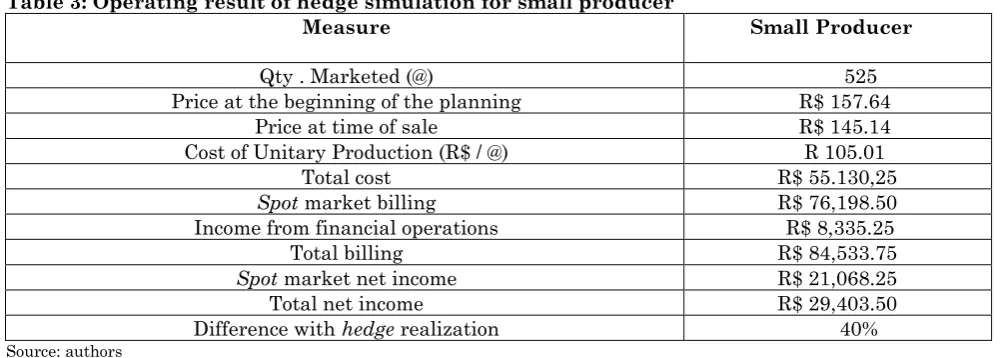
For the small producer, only one contract is sufficient to protect a large part of its production, since it is only 660 arrobas and two contracts filled with manure (see Table 2) should not be used . The same applies to the situation where only 50% of the production is protected, therefore, due to the limitations of the contract the results are the same. Due to the period presenting a fall in the prices of the commodity the options with hedge presented better result in comparison to the negotiation in the spot market only. It is also important to point out that the number of contracts used in the hedge is based on the amount of arrobas per contract filled with bullion (330 arrobas), thus, there
may be unprotected small margins in
production relative to the possible coverage considering the limitations of the contract.
Table 2: Simulation of a hedge financial transaction for small producers
Date Nº. of Contracts Nº of Arrobas Operational costs Price Result
mar/16 1 525 70 R$ 157,64 R$ 82.831,00
sept/17 1 525 70 R$ 142,03 R$ 74.495,75
Income (loss) from financial operations R$ 8.335,25 Source: authors
Nevertheless, both results show that the
producer would improve its results by up to 40% by performing the hedge (see Table 3).
Table 3: Operating result of hedge simulation for small producer
Measure Small Producer
Qty . Marketed (@) 525
Price at the beginning of the planning R$ 157.64
Price at time of sale R$ 145.14
Cost of Unitary Production (R$ / @) R 105.01
Total cost R$ 55.130,25
Spot market billing R$ 76,198.50
Income from financial operations R$ 8,335.25
Total billing R$ 84,533.75
Spot market net income R$ 21,068.25
Total net income R$ 29,403.50
Difference with hedge realization 40% Source: authors
Middleweight
As for the medium-sized producer, it is noticed that the cost of the financial operation begins to present growth due to
the greater number of contracts
negotiated. The financial operations to protect all production and 50% of it (see Tables 4 and 5) .
Table 4: Simulation of a medium-sized total hedge financial transaction
Date Nº. of Contracts Nº of Arrobas Operational costs Price Result
mar/16 6 1.980 420 R$ 157,64 R$ 312.547,20
sept/17 6 1.980 420 R$ 142,03 R$ 280.799,40
Table 5: Simulation of a medium-sized partial hedge financial transaction
Date Nº. of Contracts Nº of Arrobas Operational costs Price Result
mar/16 3 990 210 R$ 157,64 R$ 156.273,60
set/17 3 900 210 R$ 142,03 R$ 140.399,70
Income from financial operations R$ 15.873,90 Source: authors
Consequently, using only half of the contracts, the increase in the result of the operation was only 20% compared to 40%
when using 6 contracts (see Tables 6 and 7) . Even so, operating costs remain very low compared to operating costs.
Table 6: Operational result of the partial hedge simulation for the medium-sized producer
Measure Middleweight
Qty . Marketed (@) 2000
Price at the beginning of the planning R$ 157.64
Price at time of sale R$ 145.14
Cost of Unitary Production (R$ / @) R$ 105.01
Total cost R$ 210,020.00
Spot market billing R$ 290.280,00
Income from financial operations R$ 15,873.90
Total billing R$ 306,153.90
Spot market net income R$ 80,260.00
Total net income R$ 96.133,90
Difference with hedge realization 20% Source: authors
Table 7 :Operational result of the full hedge simulation for the medium-sized producer
Measure Middleweight
Qty . Marketed (@) 2000
Price at the beginning of the planning R$ 157.64
Price at time of sale R$ 145.14
Cost of Unitary Production (R$ / @) R$ 105.01
Total cost R$ 210,020.00
Spot market billing R$ 290,280.00
Income from financial operations R$ 31,747.80
Total billing R$ 322,027.80
Spot market net income R$ 80.260,00
Total net income R$ 112,007.80
Difference with hedge realization 40% Source: data simulation
Large-sized Producer
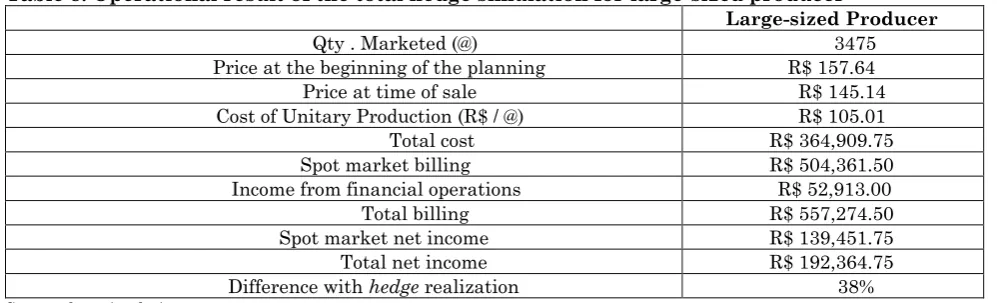
The values maintained some proportionality with the results of the medium-sized, the biggest difference was the absolute values that increase as a consequence of the growth in the quantity traded.
The difference between the hedge and the impact of the cost of the financial operation on the total cost showed a higher dilution, but the values remained constant (see Tables 8 and 9).
Table 8: Operational result of the total hedge simulation for large-sized producer
Large-sized Producer
Qty . Marketed (@) 3475
Price at the beginning of the planning R$ 157.64 Price at time of sale R$ 145.14 Cost of Unitary Production (R$ / @) R$ 105.01
Total cost R$ 364,909.75
Spot market billing R$ 504,361.50 Income from financial operations R$ 52,913.00
Total billing R$ 557,274.50
Table 9 :Operating result of the partial hedge simulation for large producer
Middleweight
Qty . Marketed (@) 3475
Price at the beginning of the planning R$ 157.64
Price at time of sale R$ 145.14
Cost of Unitary Production (R$ / @) R$ 105.01
Total cost R$ 364,909.75
Spot market billing R$ 504,361.50
Income from financial operations R$ 26,456.50
Total billing R$ 530,818.00
Spot market net income R$ 139,451.75
Total net income R$ 165,908.25
Difference with hedge realization 19% Source: data simulation
Table 10: Simulation of financial operation of large-sized producer with partial hedge
Date Nº. of Contracts Nº of Arrobas Operational costs Price Result
mar/16 5 1.650 350 R$ 157,64 R$ 260.456,00
sept/17 5 1.650 350 R$ 142,03 R$ 233.299,50
Income from financial operations R$ 26.456,50 Source: data simulation
Tabela 11: Simulation of the full hedge for large-sized producer
Date Nº. of Contracts Nº of Arrobas Operational costs Price Result
mar/16 10 3.300 700 R$ 157,64 R$ 520.919,00
sept/17 10 3.300 700 R$ 142,03 R$ 467.999,00
Income from financial operations R$ 52.913,00 Source: data simulation
Operational Costs
The results of the operational costs show a very low impact when compared to the production costs, being the highest value of 0.20% reached in the total hedge of the
average size. The low values are justified due to the financial settlement, in which the financial transaction is carried out in isolation in the financial market (see Table 12).
Table 12 :Impact of financial operation costs on production costs
Small 50% Midd. 50% Large 50% Small 100% Midd. 100% Large 100%
Number of Contracts 1 unity 3 unity 5 unity 1 unity 6 unity 10 unity Financial Opportunity
Cost 70 R$ 210 R$ 350 R$ 70 R$ 420 R$ 700 R$ Impact Total Cost 0,13% 0,09% 0,09% 0,13% 0,20% 0,19% Source: data simulation
Conclusion
The use of livestock in Minas Gerais is evident and the inherent risks of the use of commodities also apply. Comparing with other similar studies in other scenarios, it is possible to notice that the results did not present a great difference in the profile of the
regional producers, which have low
adherence to the hedge use.
Similar research has shown that the lack of technical knowledge and trust in the process is a major impediment for producers, a fact corroborated with 36% of the respondents of the questionnaire also applied with this understanding. It is important to note that 43% of the respondents believed that they
were not exposed enough, a fact that may be a reflection of the lack of market knowledge and the implicit risks of dealing directly with commodities, since a decline in the price of arroba as occurred in 2017 impacted several economic sectors significantly.
With this in mind, simulation of possible outcomes with the use of hedge over a past period has shown that it is possible to do the operations necessary to reduce risk in an
accessible manner (using financial
competitiveness of the region's producers, including large and small ones. The performance of the hedge has impacted up to 40% the results for all sizes (except in the cases with the lowest negotiated proportion), these results serve as stimulant to instigate producers to seek more knowledge in the area.
Another encouraging factor is the low impact of operating costs on total production, with a maximum of 0.19 % being able to reduce the risks inherent in the business and becoming more competitive should be an attractive opportunity for many producers. As for the small producer, the size of the contract (330 arrobas) limits the possibilities of strategies to be adopted, however they are not impediments for the hedge to be used effectively as the simulation demonstrates.
Larger producers, in addition to achieving satisfactory results, have a wider range of possible strategies to choose from when reducing business risk to mitigate possible operational costs involved. As limitations of the research it is possible to highlight the difficulty in obtaining data related to the production of beef cattle, mainly the transparency in the results of costs and deadlines used in the calculations. Variety in the mode of production also does not help in the unanimity of only one cost, since in case
the producer chooses to produce otherwise its results could be different. This indicates the absence of studies on the regional productivity of the commodity that presents great variation in its inputs and results according to the region in question. Thus, a generalized study may not be sufficient to understand the viability of local businesses, as local studies do not have the necessary scope to elucidate details of the national production.
In addition, another limitation is the question of the margin of guarantee required by the investment, since it is necessary to set aside a certain amount of capital for this purpose. Thus, a study would need to examine the availability of producers' capital for this type of investment, taking into
account the opportunity cost, daily
adjustments and other factors arising from the operation.
The use of derivatives in risk management is an interesting option that the producer must have in the decision-making process but which is not yet well developed in the region. Based on the presented data, it is expected that it will be possible to assist producers interested in the tool in the analysis of their feasibility and the knowledge of possible results.
References
1. Ministério Da Indústria, Comércio Exterior E Serviço (2017) Balança comercial brasileira: acumulado do ano. Disponível em http://www.mdic.gov.br/comercioexterior/estatis ticas-de-comercio-exterior/balanca-comercial-brasileira-acumulado-do-ano>. Acesso em: 15. 2. Alves AF, Serra MH (2008) Análise dos
Resultados de Operações de Hedging com Contratos Futuros de Boi Gordo da BMF: 2001 a 2006 (No. 1349-2016-106941).
3. DE Carvalho, TB De Zen S (2017) A cadeia de Pecuária de Corte no Brasil: evolução e tendências. Revista iPecege, 3(1):85-99.
4. IBGE (2017) Pecuária - 2016a. Disponível em: <https://cidades.ibge.gov.br/comparamun/compa ra.php ?lang=&order=dado&dir=desc#>. Acesso em: 07.
5. IBGE (2017) Pecuária - 2015. Disponível em: <https://cidades.ibge.gov.br/comparamun/compa ra.php ?lang=&order=dado&dir=desc>. Acesso em: 15.
6. Bodnar GM, Hayt GS Marston RC (1998) Wharton survey of financial risk management by US non-financial firms. Financial management, 70-91.
7. Saito R, Schiozer RF (2007) Uso de derivativos em empresas não-financeiras listadas em bolsa no Brasil. Rausp Management Journal, 42(1): 97-107.
8. Cepeaesalq-Usp (2017) Consultas ao Banco de Dados do site. Disponível em: <http://www.cepea.esalq.usp.br/br>. Acesso em: 06.
9. B3-Brasil, Bolsa Balcão (2017) Volume geral fevereiro/2016. Disponível em: <http://www.b3.com. br/>. Acesso em: 15. 10. INCRA (2017) Classificação dos Imóveis Rurais.
Disponível em: <
http://www.incra.gov.br/tamanhopropriedades-rurais>. Acesso em: 05 .
12. Carter DA, Rogers DA, Simkins BJ, Treanor SD (2017) A review of the literature on commodity risk management. Journal of Commodity Markets, 8:1-17.
13. Guay W, Kothari SP (2003) How much do firms hedge with derivatives?. Journal of Financial Economics, 70(3):423-461.
14. Modigliani F, Miller MH (1958) The cost of capital, corporation finance and the theory of investment. The American, 1-3.
15. Stulz RM (1984) Optimal hedging policies. Journal of Financial and Quantitative analysis, 19(2):127-140.
16. Smith CW, Stulz RM (1985) The determinants of firms' hedging policies. Journal of financial and quantitative analysis, 20(4):391-405.
17. Ribeiro PL, Machado SJ, Rossi Júnior JL (2013) Swap, futuro e opções: impacto do uso de instrumentos derivativos sobre o valor das firmas brasileiras. RAM. Revista de Administração Mackenzie, 14(1).
18. Hoji M, Costa RP DA (2006) Gestão de resultado operacional por meio de um modelo de tomada de decisão de hedge. Contabilidade Vista & Revista, 17- 2.
19. Savelli AD (2009) Proteção contra as oscilações de preço das commodities agrícolas–mecanismos de Hedge. in Congresso Virtual Brasileiro De Administração.
20. Amaral CALVD (2003) Derivativos: o que são e a evolução quanto ao aspecto contábil. Revista Contabilidade & Finanças, 14(32):71-80.
21. Hardaker JB, Lien G, Anderson JR, Huirne RB (2015) Coping with risk in agriculture: Applied decision analysis CABI.
22. Oliveira Neto OJD, Figueiredo RS (2010) Análise das operações de hedge do boi gordo no mercado futuro da BM&F para o estado de Goiás. Gestão & Planejamento-G&P, 9(1). 23. Godin F (2016) Minimizing CVaR in global
dynamic hedging with transaction costs. Quantitative Finance, 16(3):461-475.
24. Jitmaneeroj B (2018) The effect of the rebalancing horizon on the tradeoff between
hedging effectiveness and transaction costs. International Review of Economics & Finance, 58:282-298.
25. Martin MÁ, Rojas W, Eráusquin JL, Yupanqui Y, Edgar Vera D, Bauer W (2009) Derivative usage by non-financial firms in emerging markets: the Peruvian case. Journal of Economics, Finance & Administrative Science, 14(28).
26. Sprčić DM (2007) Corporate Risk Management Rationales: Evidence from Croatian Companies. Ekonomski pregled, 58(9-10):497-521.
27. Mühlen ASRW, Cezar IM, Costa FP (2013) Risco de preço na comercialização da soja: uso de derivativos pelos produtores rurais de Maracaju-MS. Ciência Rural, 43(5), 937-943. 28. IBGE (2017) Produção da Pecuária Municipal
(2016) Rio de Janeiro,44:1-51, 2016b. Disponível em:
<https://cidades.ibge.gov.br/comparamun/compa ra.php?lang=&order=dado&dir=desc#>. Acesso em: 28.
29. IBGE (2017) Estatística da produção
agropecuária ispon vel em ftp.ibge.gov. br/producao_pecuaria/fasciculo_indicadores_ibg e/abate-leite-couro-ovos_201701caderno.pdf>. Acesso em: 22.
30. Investing (2017) Boi Gordo Futuros. Disponível
em: <
https://br.investing.com/commodities/livecattle-historical-data?cid=964528>. Acesso em: 12 mae.
31. Fazenda Sant’anna (2018) Gado Nelore.
Disponível em:
<http://www.fazendasantanna.com.br /i/gado-nelore/>. Acesso em: 12 abr.
32. Scot Consultoria (2018) Custo de Produção-Ciclo Completo. Disponível em: <https://www.scotconsultoria.com.br/cotacoes/cu sto-producao/ciclo_completo/>. Acesso em: 01 de mai.
33. Garcia E, Ramos Filho F, Mallmann G, Fonseca F (2017) Costs, benefits and challenges of sustainable livestock intensification in a major deforestation frontier in the Brazilian Amazon. Sustainability, 9(1):158.