International Journal of Advances in Management and Economics
Available online at:
www.managementjournal.info
RESEARCH ARTICLE
Venture Capital and Valuation of Innovative Start-ups: the
Business Case of Mosaicoon*
Antonio Del Pozzo
1, Salvatore Loprevite
2*,Domenico Nicolo
31.Department of Economics, University of Messina.
2.Department SSMAF, University “Dante Alighieri” of Reggio Calabria.
3.Department DIGIES/ University Mediterranea of Reggio Calabria, Italy.
* Corresponding Author: Email: [email protected]
Abstract: This article analyzes the decline of one of the best well-known and promising European start-ups: Mosaic on L. t. d. The business case is emblematic of many bankruptcies caused by strategies focusing on the expectations of continuous growth of economic capital and based on unconventional performance indicators, without considering the economic-financial results and self-financing. The expectations of return on capital are extremely high and this forces one to undertake risky growth paths with very high expected return rates. This also happens in the absence of an advanced and effective capital market. Venture capitalists, even when they are public, cannot compensate for these excesses. The analysis of the case contributes to the debate on the complex topic of assessing the potentiality of start-ups and it provides useful suggestions to operators (venture capitalists, business angels, start uppers, investors, etc.) for greater prudence in considering the non-financial performance indicators. Start-ups do not produce economic results in the early stage, so they may also be valued by using non-financial metrics. However, unconventional indicators cannot be the only parameters for evaluating. When the firm is a start-up without meaningful financial information, it is more appropriate to refer to a reliable business plan drawn up on rigorous estimates of expected incomes and cash flows.
Keywords:Venture capital, Start-up, Default, Performance indicators, Business case.
Article Received: 20 Jan 2020 Revised: 20 Jan. 2020 Accepted: 22 Feb. 2020
Introduction
In this article we analyse the business case of Mosaicoon L.t.d. (hereafter, Mosaicoon), an innovative Italian start-up which was considered the emblem of the possible success of start-ups in the South of Italy, receiving financial resources provided by state-owned venture capitalists. We know that venture capitalists, so-called “patient capital” which can handle high levels of entrepreneurial risks, can reduce the “value gap” of small-firms with sizeable potential for growth. However, in some cases venture capital could lead to excessively risky choices which lead to bankruptcy, when not all the hypotheses underlying the business project materialize. This situation seems to have occurred in Mosaicoon.
The Analysis of the Business Case has the Following Aims
Understanding the causes of the mismatch between the company's growth expectations based on unconventional indicators and the
performance of the economic-financial indicators;
Verifying if, under certain conditions, the financing model of state-owned venture capitalist can determine the decline of start-ups.
Mosaicoon was formed in November 2009 and started its activity in February 2010; it entered the innovative SMEs section of the Italian register of companies in September 2015 and it was declared bankrupt in June 2018. In this short life of eight years it opened subsidiaries in Italy (Rome and Milan) and abroad (London, New Delhi, Singapore and Seoul), but it maintained its headquarters in Sicily. This generated many hopes for a Sicilian Silicon Valley.
2 to the founder, by two important venture
capital funds, "Vertis" and "Atlante Ventures", which benefited from public financial resources. It also received many national and international awards. Suddenly, in 2018, came the request for self-bankruptcy, and this notwithstanding the fact that it had obtained significant financial support on several occasions. As a consequence, the default in its most concrete form emerged: the abandonment by the shareholders that, according to the literature [1], occurs when the economic value of the asset is lower than the liabilities.
This, even though the company had carried out capital increases up to two years before the bankruptcy with significant goodwill values. The case method is widespread in management studies [2], although it does not allow one to infer general theories [3, 4]. However, due to its similarities with other cases of bankrupt start-ups, Mosaicoon can be considered a "critical case" [5] of great significance. In particular, the case allows us to:
Explore the potential conflict between the qualitative indicators of success and the economic-financial measures (income or cash flows) used for economic capital assessment which, as is well known, are considered unsuitable for start-ups (risks associated with the early stage and innovation in the digital sector, lack of historical data, significant role of intangible assets, etc.) [6];
Provide elements to reflect upon the failure of young dotcoms. Many start-ups attract the interest of venture capitalists, media and universities due to their unconventional performance indicators, but they then go bankrupt resoundingly. As we will see by examining the business case, this can also happen due to the scant regard for traditional economic-financial performance indicators;
Highlight some critical features of venture capital funds with public-partnership, which are starting to form part of the public policies of support for start-ups (in Italy and in many other countries).
The considerations that we will propose from the analysis of this critical case, therefore, may be considered useful to prevent some common errors. Indeed, although the business case does not allow us to build a
universal theory by means of a statistical or mathematical generalization [5, 7], it provides valid insights for a theoretical reflection based on the observation of a highly representative company. As regards the sources of information, we examined the financial statements from 2010 to 2016 (the last deposited before the bankruptcy), management reports and resolutions of the Extraordinary Shareholders' Meeting.
In addition, we consulted the articles (of the press and websites specializing in digital entrepreneurship), which can be effectively used in the analysis of business cases [4, 8, 9]. The paper presents the specificities of the business case: the media successes of Mosaicoon and the prestigious awards within many events targeting start-ups and innovation (section “Successes expressed by unconventional performance indicators”); the share capital increases, with the exponential rising price of the company's shares determined by expectations of development (even shortly before bankruptcy) (section “Increases in equity capital and share issue prices”); on the other hand, the poor economic-financial performance and its deterioration (section “Scale-up and break-even”).
After that, section “Vulnerability as a distinctive feature of start-ups” draws the theoretical framework regarding the vulnerability of start-ups and the selection logics of investment portfolio by venture capitalists. Section “From exorbitant internal rates of return to strategic planning” is dedicated to the extreme uncertainty in the assumptions regarding the "way-out" and to the importance, in this situation, of financial planning, especially in the case of operations with publicly held funds. Section “The lack of a defense strategy” presents a useful matrix, applied to the business case, for interpreting the strategic positioning of start-ups. The last section presents the conclusions.
Successes Expressed by Unconventional Performance Indicators
considered, at least in the collective imagination, a virtuous entrepreneurial example destined for extraordinary success.
These elements, as legitimizing factors of the company, undoubtedly improves the chances of obtaining financial resources from investors [10]. Mosaic on received many national and international awards, which exponentially enhanced its reputation as a highly innovative start-up with a high potential for success and value. The most important awards are summarized in Table 1. As we can see in the table, in the context of qualified national and international sector events, Mosaicoon was very positively assessed with reference to growth prospects and innovation capabilities. Among others, it
repeatedly won awards as one of the top ten Italian companies for innovation and as the most innovative company in Europe ("International Business Awards", conferred on the past to Amazon, Apple, Paypal and Tesla); moreover, it was indicated by many as one of the best European scale-ups.
Venture capital operations carried out on Mosaicoon also won awards as examples of quality (see 2016, “Dematté private equity of the year” award for the best venture capital operation). The experts and operators, therefore, considered Mosaicoon a virtuous example of a start-up which was destined, almost inevitably, for bright success rather than bankruptcy.
Table 1: Main national and international prizes and awards
Year Description
2011 Mentioned by Boston Consulting Group in the report “Fattore internet” as one of the 20 most innovative Italian start-ups
2012 “Italian Master Start-Up Award 2012” by "PNI Cube" (Italian Association of Universities and Academic Business Incubators)
2012 “Bright Future Ideas Awards Vision for Growth”, conferred by “UK Trade & Investment” on the start-up with the greatest internationalization potential
2012 “Ok Italia Award 2012”, conferred by "Unicredit Group" as the best start-up for high innovative level in marketing and communications
2012 "Best Practice for the Innovation Award", conferred by the “Association of Italian Manufacturers”
2012 Awarded a prize by the Israeli Embassy as one of the most innovative start-ups in Europe (“Start Up Nation Award”)
2013 Selected by the Italian Ministry of Economic Development as one of the top 10 innovative Italian start-ups (“Leonardo da Vinci Award”)
2013 “National Innovation Award”, conferred by the President of the Italian Republic
2013 "Italian National Champion" in the "European Business Awards", as one of the 10 best Italian companies for innovation
2014 "Italian National Champion" in the "European Business Awards", as one of the 10 best Italian companies for innovation (second time in a row)
2014 Selected to represent Italy, as an example of best business practices, at the conference "Creativity and innovation as motors for economic growth" at the European Parliament
2015 "Italian National Champion" in the "European Business Awards", as one of the 10 best Italian companies for innovation (the third time in a row) 2015 "Interactive Key Award"
2015 "Forrester Groundswell Awards"
2015 "Vimeo StaddPick for Horizon Viede Project - Farm Cultural Park"
2015 Selected in Silicon Valley as one of the 15 best scale-ups in Europe ("SEC2SV Best European Scaleup") 2015 Selected in London as one of the 50 best Scale-ups in the UK ("SVC2 UK")
2016 "Most Innovative European Company" International Business Awards - Steve Awards (Prize awarded in the past to Amazon, Apple, Paypal and Tesla). 2016 "Dematté Private Equity of the Year Award", for the best venture capital operation
2017 Listed in the prestigious Financial Times reports among the 1,000 European companies with the best growth rate 2018 Cited by "Mind the bridge" as a model company for Italian scale-ups
Over the years, the company was constantly
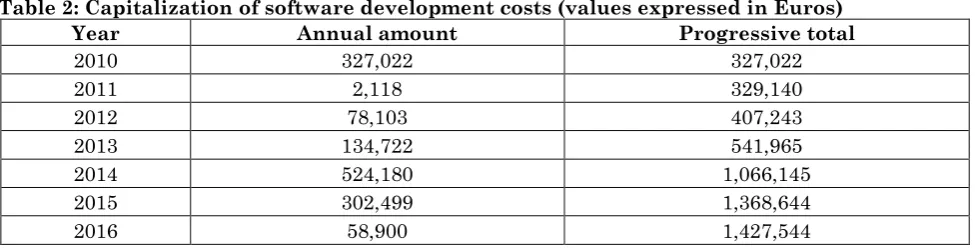
4 "Internally produced software" development
costs for a gross amount of € 1,427,544 (see Table 2). The software development was directed, to a large extent, at the intangible technological assets used for carrying out the activity:
"Plavid", a online distribution platform capable of interacting on a network of partner sites;
"Tracking", a platform used for tracing the results generated by the online distribution
of contents (evaluation of the viral diffusion and its effects);
"Crevity", a platform for the online creation of video content (released from 2013). All the platforms were constantly updated over time, up to version 5 of "Plavid" and "Tracking" and version 2 of "Crevity" (year 2015).
Table 2: Capitalization of software development costs (values expressed in Euros)
Year Annual amount Progressive total
2010 327,022 327,022
2011 2,118 329,140
2012 78,103 407,243
2013 134,722 541,965
2014 524,180 1,066,145
2015 302,499 1,368,644
2016 58,900 1,427,544
Source: our elaboration on financial statements data
In 2016, Mosaic on focused on developing the new "Mosaicoon SaaS" platform, which integrated previous software with additional applications. In the strategy of the company, as explained in the 2016 Management Report, the new platform should have ensured the aim of automating video campaigns and the business model associated with them. On the basis of a new sales model, the CPV +, the company aimed to sell the videos by exploiting the views that a brand decides to buy for the distribution of the contents, testing the market response by the feedback from clients and simultaneously obtaining a platform development. In the wake of these innovations, between 2016 and 2017, Mosaicoon concluded the first contracts with big spenders of the advertising market
(Alitalia, McDonald's, Findus, BettsonGroup, PokerStars, Edison, Sas; Aviva, WeBank, Unilever, Volkswagen, FCA, Pfizer, Poste Italiane, Carrefour, Toyota, Alp tour and Danone). In the same period, it started partnerships with important media centers and it was listed among the Global Creative Partners of Facebook. In July 2017, close to bankruptcy, the company's management claimed to be convinced of the "potential of the new platform, ready for international success". In the financial statements from 2010 to 2014, the company presented some data on the performance of the platforms and the commercial results. The access data on the platforms show an exponential increase in the single users (Fig. 1), 800 million in 2014 (+ 545 million compared to 2013).
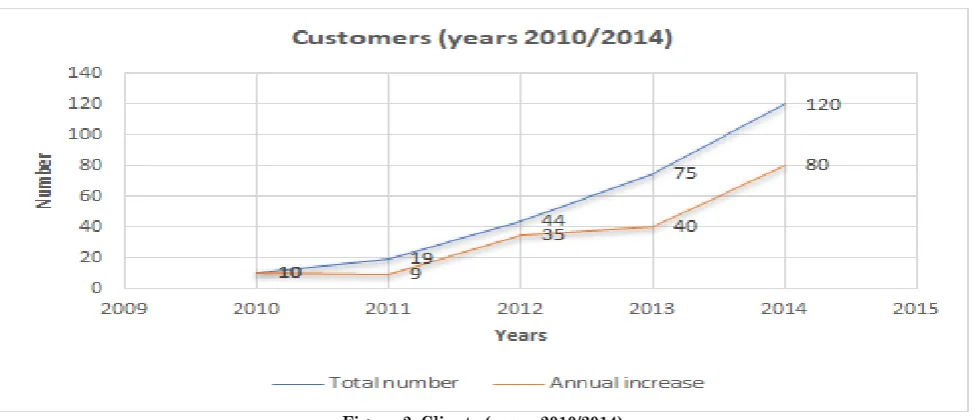
The commercial data, in terms of customers
acquired, also Recorded growth performances from 2010 to 2014.
Figure 2: Clients (years 2010/2014) Source: our elaboration on financial statements data
Increases in Equity Capital and Share Issue Prices
The focus of interest towards financial valuations drove us to examine companies’ financial statements and the special operations on capital. The analysis was conducted to draw out some indications regarding:
The valuation of the share issue prices and the valuations of the economic capital implicit in the increases of equity capital in the various rounds of funding;
The relationships between valuations of capital and the financial performances shown in the financial statements;
The main aspects of the governance that were gradually agreed among the shareholders with the growth of the start-up companies.
The observation of the financial statements and of the increases in equity capital allows one to deduce that the share issue prices incorporated the expectations of growth of the unconventional indicators, hypothesizing direct consequences on the economic values of the capital.
The relationships between economic valuations and unconventional indicators have always been problematic. Corporate literature, however, beginning with the fundamental contribution of Guatri [11], has conferred dignity on the so-called ‘rules of thumb’ and the other methods of valuating
capital based on the operativity of the companies or comparable transactions. In particular, in this specific case the valuations were conducted with the “venture capital method”, which was coupled with expected operational parameters (eg. growth of “likes”, numbers of active users on the platform). The economic values implicit in share issue premiums are the result of the discounting of hypothetical prices of volatile way-out because they are based on very different assumptions. The extreme volatility of financial values hypothesized in the way-out derived from the hoped-for conquest, at the end of the financing cycle, of exclusive technologies, and therefore the opening-up of options for growth.
In Start-ups the Risks of Similar Valuations are Obvious. Indeed, it is Impossible to Identify Significant Correlations Between
Book values and the economic value of company. On the dates of the increases in capital, the financial statement incorporated premiums far higher than the immaterial assets accounted for;
Economic results obtained in the accounting period and economic values assigned. On the dates of the increases in capital even the operational results were extremely negative.
©2012-2020, IJAME. All Rights Reserved 6 the value among the associates were
established even before the value had been generated. The share issue prices were differentiated for categories (3 to begin with, then cancelled and reconfigured in 4) with different rights and valuations. That appears to a be side-effect of excessive financing of the company, which may be attributed to the delicate and problematic relationships between the company, the founding members and the venture capitalists. Mosaic on had three cycles of venture capital and went for a fourth.
The inability to obtain this last one was the prelude to bankruptcy. The first round of funding was at the end of 2009. The company was founded with the transfer of a company branch of “PGMB s.r.l.”, which was itself a start-up company. 60,000 shares were assigned to the transferring company, establishing the share prices at €3.68 (€1 of nominal value and €2.68 of share premium). A few days later, the “Vertis” fund entered in the share capital, giving life to the first cycle of venture capital.
The share prices reserved to “Vertis” amounted to €4.64 (€1 of nominal value and €3.64 of share premium). At the same time though, and the company had only just been founded, the first warrants were issued. Right from the moment of its formation, then, the price credited to the founder was different to the price credited to “Vertis”, that which possible effect of the "warrant" recognized to “Vertis” on the successive increases in capital.
At the end of 2010, the undersigned share capital came to €200,000, paid with a share premium of €670,000. The "Vertis" fund, with a total investment of €650,000, possessed a total of 70% of the capital. Right from the first financing cycle, the shares were subdivided into different categories, to which were assigned different rights (privileges in case of liquidation settlement, the right to nominate bodies, etc). We not enter into the details of the categories of the shares because their rights were modified several times.
The second round of funding took place in 2012. Some modifications were made to the "warrant" and the “Atlante Ventures Mezzogiorno” fund made its entrance into the company, through “SGR IMI” (“Intesa San Paolo”).
The issue price of the 172, 188 new shares were fixed at €13.90 (€1 of nominal value and €12.90 of share premium) and the increase was paid by “IMI” and “Vertis”. The payments were made by the shareholders in 2012 and 2013 and came to a total of approximately €2.4 million. There was, then, a rapid increase in issue prices, which practically tripled(from €4.64 in December 2009 to €13.90 in December 2012). The only logical explanation is that there may have been expectations of consolidation of the business model.
There had indeed been an increase in revenues, in that from 2010 to 2012 sales had amounted to a total of approximately €2 million (of which about 1/3 yet to be cashed) and the EBITDA was positive by about €200,000. But the operating cash flow, because of the increases in account receivables, was negative. The third financing cycle was in 2016. The share price increased tenfold (from when the company was founded) to €40.49, with a waiver of the right of option. It was undersigned in part by “Vertis” and in part by new associates (“Mosaico Invest s.r.l.” and “Viral s.r.l.”).
The payments of capital came to €3 million, and “Atlante Ventures Mezzogiorno” withdrew. The vertiginous increase in share prices seems ascribable, in the minds of the protagonists, to the implementation and consolidation of the platform that allowed the planning of advertising campaigns transmitted on the Web and based on the use of one’s own technology for the analysis of data and the formulation of advertising strategies.
Scale-up and Break-even Fig. 3 shows the trend in revenues and personnel employed with reference to the period 2010/2016.
Figure 3: Revenues and number of employees (years 2010/2016) Source: our elaboration on financial statements data
The two trends show that the start-up progressively accelerated the production of revenues until 2015, although returning in 2016 to lower levels than in 2014; furthermore, it continuously increased the number of employees, which reached 72 units at the end of 2016 (100 units in 2017, as reported by press sources). Mosaic on therefore met the growth expectations of start-ups. The trend of revenues and employees, moreover, are in line with those of growth in single users and the new customers that we have indicated in the previous notes. However, if we consider the company data (unconventional and balance sheet) on growth not in isolation but in relation to other data, signals of structural economic weakness in the company already emerge from 2014. These signals appear to be at odds with the exponential increases in share issue prices. The start-up, in fact, did
©2012-2020, IJAME. All Rights Reserved 8
Figure 4: Relationships between revenues, new single users and number of customers(years 2010/2014) Source: our elaboration on financial statements data
At the same time, the costs of production were increasing exponentially and the company was producing a very low level of income or losses in each financial year (Fig. 5). As we can see from Fig. 5, moreover, the losses became more serious in the years 2015 and 2016, just when the company registered a significant development on the commercial front, closing numerous contracts with big spenders of the advertising market. From a general perspective, the production of losses and negative cash flows over a long period of time may also be a planned event. But in this case there must be a planning of the
financing rounds which are necessary to support the company. Without a proper financial support plan, the company cannot neglect the logic of evaluation and planning of the break-even. Moreover, if there are venture capitalists, they tend to force growth by oversizing the investment compared to the real potential of the company (Sandri, 1988), with the aim of reducing the time required for the way-out. These choices can further compromise the break-even and, if the objective of stock exchange listing is not achieved, the venture capitalists leave the company to fend for it (Sandri, 1988).
Vulnerability as a Distinctive Feature of start-ups
Many start-ups do not survive the impact of reality and fail in the first years of life. Significant mortality is a distinctive trait of young businesses. In various countries and sectors, survival rates of five years after birth are very low. Young enterprises that survive the difficulties of the first stage of life tend to strengthen their ability to survive since in various countries the survival rates of the companies that survived the first stage of life are higher than those of the companies that are still in the first stage of life [12, 14].
Only a very low percentage grows at high rates in the first years of life, becoming a "gazelle", that is young enterprises (with less than 5 years of life) that have at least 10 employees and whose turnover or the number of employees grow to a rate above 20% for 3 consecutive years. Even fewer are the "scale-ups", as the young companies that exceed $100 million in turnover are called. Finally, "unicorns" may be considered exceptions, as young businesses that have a market capitalization of more than $1 billion are called. In Italy, for example, the gazelles represent less than 1% of those that are born every year (ISTAT, 2018).
In the period 2011-16 only 32 unicorns and 2017 scale-ups were born in Europe; in the same years, 264 unicorns and 3887 scale-ups were born in the USA, 64 unicorns and 1444 scale-ups were born in the UK [15]. The picture of business survival and growth during the first stage of life is not encouraging. The success of a few start-ups, however, is sufficient to attract many investors, venture capitalists and business angels to hunt for business. They know that many of the big high-tech corporations that dominate the digital sector have had to overcome great difficulties in the start-up stage. Therefore, they bring in large amounts of capital to cover the losses of the initial stage, with the hope of obtaining substantial gains in the medium-long term [16].
Unconventional performance indicators, such as the analytics of users' accesses to the website (times and duration of accesses, number of pages visited or videos watched, bounce rate, number of conversions, number of downloads and likes, answers to surveys, etc.) and online purchases are taken as
indicators of the potential economic value of companies in place of the fundamental indicators (EBIT, EBITDA, cash flow, ROE, ROA, etc.). The company was born recently and there are no financial performance indicators, or these indicators are available but, since the company has not yet established itself in the market, they have a low or negative value and therefore cannot be used to evaluate the company [6].
However, estimating the value of a company only through unconventional indicators can cause a "bubble" that may easily burst in a short time, highlighting that these indicators are often ephemeral and provide distorted signals on the value of a company [17]. As time goes by, if the start-up does not take off, investors lose confidence and abandon it. Venture capitalists are driven by the logic of splitting portfolio risk: they invest in a large number of companies to earn with the success of a few the money they lose with the failure of many start-ups. When the start-up does not fit harmoniously into this model because it does not provide an adequate return on risk and because it is not possible to exit from the investment, the venture capitalist generally stops investing capital in order not to incur further losses.
The case study examined in this paper, the Mosaicoon company, is very representative of these dynamics. The business model of many internet start-ups is similar to a two-faced Janus. Like commercial television, they invest money to provide an engaging service for free with the aim of greatly increasing the number of users. In this way, they aim to get advertisers who pay to give visibility to their products. Many services are free on the internet because their marginal costs tend towards zero because they are immaterial.
10 not have enough capital to wait for a positive
market response [17].
From Exorbitant Internal Rates of Return to Strategic Planning
Venture capital from public sources is considered a method of financing able to replace the capital market (lack of private investors, reluctance of the banks) to support the growth of innovative SMEs in the South of Italy. Private venture capitalists, indeed, are not very active in the south, especially due to their geographical distance, and the banks do not accept (an attitude often adopted towards innovative business initiatives) particularly high levels of risk. Public venture capital is consequently considered, the “patient capital” to which to entrust at least in part the fortunes of a relaunching of the southern Italian economy. In 2019, Italian law provided for the creation a new management tool (National Fund for Innovation - NFI) which should distribute important financial resources and centralize even the previous experiences of public funds for venture capital.
The NFI should receive an annual endowment from the Treasury and receive a quota of 15% of the profits of the participated state-owned companies. In 5 years, involving jointly private investors, investments of up to 5 billion Euros in innovative start-ups were estimated. Even though “patient” in regard to expecting returns through the way-out, this capital nevertheless demands a very significant remuneration; in this specific case we found expectations of remuneration of an IRR of 35%. These rates are usual for venture capital operations, but do not go well with public venture capital operations. Particularly if the financing cycles have not been clearly identified.
In the Case Examined, the Issue of the “Warrant” at the End of 2012 (Second Round of Funding) is Particularly Indicative of the Uncertainty Assumed in the Valuation of the way-out, Which was Configured with Completely Different Hypotheses
The assumption of a binding commitment on the part of the shareholders to sell shares;
The stock exchange listing;
The liquidation.
Because of the uncertainty, the potential value on exit for venture capital funds oscillated between €11,632,000 (minimum value) and €30,432,000. This demonstrates that the options incorporated in the “venture capital method” were still not stable, it being the round of funding which should have produced results at different stages in the development of the company. In fact, at the beginning of January 2017, Mosaicoon was admitted to the “Elite Project”, as evidence of its aim at a listing on the stock exchange.
The extreme volatility of the expected results led to the choice of a very high Internal Rate of Return (IRR), quantified as a minimum at 35%, hypothesizing that it could reach even 70%, with a consequent sophisticated configuration of the warrants. IRRs that high are indicative of extremely high levels of risk which are incompatible with well-balanced portfolios because of the limited number of investment operations, and because of the limited size of the venture capital funds available to small business managers. The uncertainties of the business model led to an additional requirement of equity capital which, assuming extremely high hypothetical way-out values (even though softened by very high IRRs), was not undersigned. We have already mentioned the difficulties of the digital qualitative performance indicators (“like”, accounts, etc.) to translate into economic values.
But this factor of weakness can be accentuated by venture capitalists, especially when they find themselves operating with limited means and in an ecosystem that cannot guarantee the optimization of portfolio choices. If the venture capitalist is public, the possible difficulties to finance further increases in equity capital can also be attributed to the rules of engagement of public funds that must account for the use of public resources, with the consequent foreseeable limits to efficiency.
The case leads one to reaffirm the central role of financial planning, vital if a company is to be able to complete the cycle of venture capital without finding itself having to pursue increases in capital that were not planned for. In this respect, though, it is necessary to overcome the usual shortcomings of business plans, often made to look more positive to facilitate new subscriptions of capital.
On this point, we emphasize that, when there was the increase in capital in 2016, the auditors (tackling the problem of company’s continuity) gave their assent to the approval of the financial statements referring precisely to the internal industrial plan. What also emerges is the difficulty in maintaining the value in the case where the same may be attributed to digital assets prevalently linked to the work of the founder, and the difficulty in maintaining a value to the digital goods in the case of bankruptcy. On this point, we need only consider that in bankruptcy a base value of €260.000 was attributed to all of Mosaicoon’s intangible assets.
The Lack of a Defense Strategy
Mosaicoon was a start-up with a very interesting business model that aimed to completely transform the model of the advertising video market. In the traditional scheme, companies commission the production of advertising videos from advertising agencies, which produce them following the directives of the clients through a long iterative process of reviewing the various proposals presented to them by the creatives.
This model, as is evident, is inefficient because it is expensive and generally takes a long time to obtain the final product. Here was Mosaicoon’s innovative idea: to eliminate this market cost and time inefficiency by allowing creatives to gain visibility by uploading their videos to their web platform and businesses to choose between many videos on the platform. However, something did not work well in this innovative business model.
The Internet is dominated by large multinational corporations and one certainly cannot survive for long by adopting a strategy that is easily imitable and therefore cannot be defended against the retaliation of these powerful leaders in the sector. Starting a business, by definition, implies entering a
sector. According to Porter, the strategy of entering a sector must comply with the following conditions: 1) have a competitive advantage in terms of cost or sustainable differentiation over time, that is, defensible against imitation and retaliation by the sector leader; 2) not be inferior to the leader of the sector as regards all the other activities; 3) develop defense strategies against the leader's retaliation [20].
In general, the financial reputation of companies [21, 22] depends on their solvency, as well as on their profitability in the medium-long term. The market reputation derives from their ability to satisfy customers and can also be appreciated through unconventional indicators such as, for example, visits to the website, the number of free accounts, the number of "I like" and shares, the approval expressed by the juries of experts in the events for start-ups and victory in the so-called business plan competitions [23, 27].
To appreciate the market reputation, however, in addition to these non-financial indicators, it is also necessary to consider those that express financial performance [28]. Only if customers pay a price do they attribute value to what the company sells. Market reputation and financial reputation must be self-sustaining [29-34]. All young businesses are lacking in corporate reputation. Having no history behind them, they have no balance sheets to show to win the trust of customers and the various categories of social partners [6, 13, 35]. If a satisfactory financial performance comes too late, investor confidence will sooner or later fail and the company will deplete its overall reputation, losing the resources necessary for survival and entering a spiral of crisis which may lead to extinction.
An Internet Company can Have a Very High Value, Even if it Does not Make Profits, but Losses. This can Happen in two Cases
There are prospects of adequate profitability in the medium-long term, it is only necessary to wait for this to happen by financially supporting the coverage of losses in the first years of activity;
12 example, as Facebook did with WhatsApp
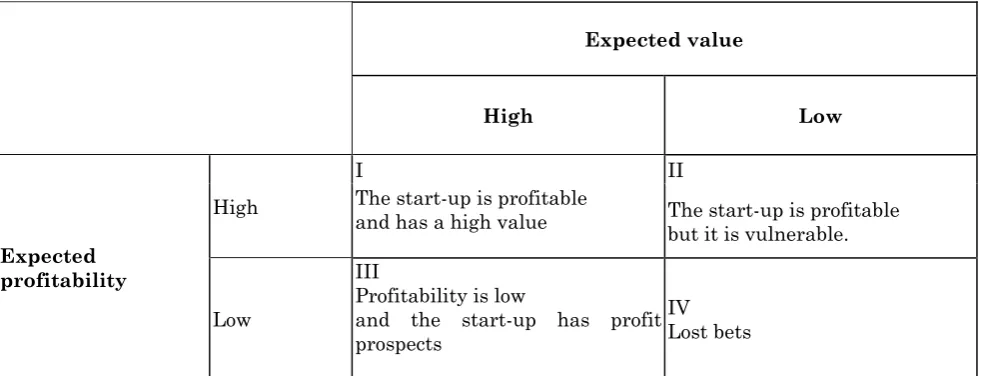
and Instagram). Below is a matrix made up of four quadrants which are useful for analyzing the strategic positioning of companies in the start-up phase under two profiles: profitability expectations and economic value [13, 36]. Start-ups that have good prospects of profitability and value in the medium-long term are positioned in the first quadrant.
They have a competitive advantage which feeds profitability and sustainable economic value in the medium-long term. In the second quadrant, there are those which, despite although having satisfactory profitability, are
not considered capable of acquiring a high economic value, because they are fragile. This is the case of companies that have a business model that exploits a competitive advantage that can be easily imitated and, therefore, cannot be defended over time against the foreseeable attacks by the major players in the sector. Start-ups that are not profitable, but have a high economic value because they have excellent prospects independently, or within a company that can acquire it to exploit synergies, belong to the third quadrant. Finally, in the fourth quadrant, are the start-ups that do not have a reason for being because they have no prospects of profitability and value, even in the medium-long term.
Expected value
High Low
Expected profitability
High
I II
The start-up is profitable
and has a high value The start-up is profitable but it is vulnerable.
Low
III
Profitability is low
and the start-up has profit prospects
IV Lost bets
Figure 6: Start-up’s value/profitability expected matrix
In the initial phase of its existence, Mosaicoon was placed between the second and third quadrants of this matrix. Although profitability was inadequate both in absolute terms and in terms of risk, it had good prospects of increasing its value, so much so that it attracted venture capitalists. These invested in the company because they deemed it capable of making profits or being acquired by some big corporation. The numerous national and international awards and recognitions obtained by Mosaicoon contributed to amplifying the expectations of venture capitalists. It is not uncommon for a dotcom that does not produce revenues and profits to have such a large number of users that they attract the interest of large companies.
Think, for example, of the billionaire acquisitions of WhatsApp and Instagram by Facebook, or those of Skype by Microsoft and YouTube by Google. Over time, however, the
company fell into the fourth quadrant because it did not find a way of confirming the initial expectations of growth in the economic value of both the venture capitalists and the founder himself. The company did not have a strategy to defend itself against the predictable retaliation by big players, in particular, YouTube, Instagram and Facebook. Its service could easily be imitated by other well-known and established companies in the market.
At the same time, the overwhelming growth of Instagram took place, which became in a very short time the reference social network of teenagers from all over the world and influencers, basing its success also on the provision of highly advanced video editing services. Mosaicoon, therefore, was unable to compete with huge corporations such as Google, YouTube, Instagram and Facebook, which have a huge number of users, and should carved out its segment in which to operate through a product / highly differentiated service that cannot be easily imitated by competitors.
Conclusion
Mosaicoon is an emblematic case of an innovative start-up company that gave itself ambitious objectives of rapid growth, to achieve which, it sought venture capital, and which, despite its great success in the media, went bankrupt. This allows us to draw some indications of a theoretical and practical nature, closely interconnected, with regard to the economic- financial valuation of start-up companies and venture capital. Innovative start-ups, because they are new, and in the absence of consolidated economic-financial results, are evaluated prevalently through unconventional qualitative indicators.
The case demonstrates, however, that in such hypotheses, financial planning, forming the basis of a valid business plan, becomes crucial, and that the unconventional valuations of economic capital–even with a view to sale, transfer or way-out–must be analyzed critically with rigorous traditional valuations of an economic-financial nature. It is necessary to have a credible business plan, based on plausible hypotheses and well-founded estimates, which makes it possible to evaluate the concrete possibilities of development of the business and to plan the financial requirements through appropriate stress tests of the scenarios.
It is appropriate that the companies do not go continuously seeking capital when the options for growth have yet to be demonstrated; that is important when the start-up company is aiming prevalently to increase its economic value.
Furthermore, to test the predictive capacity of the non-financial metrics, it is necessary to delineate principles and methods to consider from a systematic viewpoint the
unconventional, as well as traditional, indicators, thus avoiding that the former be emphasized and used without taking into consideration their links with the economic-financial results.
The case, moreover, highlights some of the limits of venture capital. What emerges is the need to critically evaluate the estimate of prices of the way-out in that even extremely high Internal Rates of Return might not succeed in giving meaning to economic capital values. What is needed is a comparison with traditional methods of valuation, in particular when the options for growth are still completely uncertain. Before thinking about how to distribute the value through sophisticated operations of financial engineering (issuing of warrants, issuing of convertible loans, increases in capital with differentiated prices) it is necessary to generate it.
The financing of businesses must be considered a necessary consequence of business success and not the prelude. Venture capital is a so-called “patient” capital that should allow a company to bear particularly high levels of risk, that cannot be borne by the banks. It requires, however, a mature capital market, a stock exchange for small and medium enterprises that can cater for extremely ambitious plans for stock exchange listing, or a widespread financial community capable of facilitating the way-out.
In the absence of these conditions, the disinvestment of the venture capitalist becomes problematic, with high risks that the business may be left to fend for itself. The qualification of venture capital as a “patient capital” is therefore controversial, since it is a question of investments that generally expect a very high remuneration. Public venture capital (that is venture capital from public financial sources) does not appear to be able to soften these excesses and overcome the limits connected to the difficulties of splitting the portfolio risk, in the absence of an efficient capital market.
14 emphasizing the economic balances and the
programmed financing of “normal” losses in the start-up phase; questioning expected exorbitant rates of return, if a mature capital market is still absent; evaluating the economic capital, therefore, also with conventional steady state methods for
comparison. These are all aspects on which scholars are called to express their own valuations, considering the importance of the public resources involved and the objectives of industrial policy pursued by the policy makers.
References
1.
RC (1974) Merton, on the pricing of corporate debt: the risk structure of interest rates, The Journal of Finance, 29(2):449-470.2.
Runfola A, Perna E, Baraldi, GL Gregori (2017)The use of qualitative case studies in top business and management journals: A quantitative analysis of recent patterns, European Management Journal, 35(1):116–127.3.
Mari (1994) Metodi qualitativi di ricerca. I casi aziendali (Turin: Giappichelli editore).4.
PCorbetta (2014) Metodologie e tecnichedella ricerca sociale (Bologna: Il Mulino).
5.
RK Yin (2013) Validity and generalizationin future case study evaluations, Evaluation, 19(3):321–332.
6.
Damodaran (2009) the dark side of valuation: Valuing young, distressed, and complex businesses (Upper Saddle River-New Jersey: Pearson Education, inc).7.
Klandermans, S Staggenborg (2002)Methods of social movement research (Minneapolis: University of Minnesota Press).
8.
KM Eisenhardt, ME Graebner Theory Building from Cases: Opportunities and Challenges, Academy of Management Journal, 50(1); 25-32.9. M Noor, KB Methodology (2008) Case Study: A Strategic Research, American Journal of Applied Sciences, 5(11):1602-1604.
10.
N Di Paola, R Spanò, A Caldarelli, R Vona (2018) Hi-tech start-ups: legitimacy challenges and funding dynamics, Technology Analysis & Strategic Management, 30(3):363–375.11.L Guatri (1988) Trattato sulle valutazioni delle aziende (Milan: Egea).
12.
D Nicolò (2017) Young firms’ sustainability and corporate reputation: Acomparison of the survival rates in the US and EU, in J. Vasile Andrei and D. Nicolò (Eds.), Sustainable entrepreneurship and investments in the green economy (Hershey Pa: IG Global).
13.
D Nicolò (2019) La vulnerabilità delle imprese nella fase di start-up. Analisi ed interpretazione delle cause (Turin: Giappichelli editore).14.
D Nicolò, B Ricca (2019) Under-Capitalization and Other Factors that Influence the Survival of Young Italian Companies, International Journal of Advance s in Management and Economics, 8(2):37-51.15.
S Caselli (2018) Da startup a scale-up: è tempo di cambiare narrativa, Economia e Management, 2(1):85-90.16.
FE Rubino, O Ferraro (2017) La valutazione delle Internet company, in R. Maglio (Ed.), La valutazione d’azienda in particolari settori (Milan: Giuffrè editore).17.
ME Porter (2001) Strategy and theInternet, Harvard Business Review 63-78.
18.
J Rifkin (2011) the third industrialrevolution: how lateral power is transforming energy, the economy, and the world (New York: Palgrave Macmillan).
19.
J Rifkin (2012) the third industrialrevolution: How the internet, green electricity, and 3-d printing are ushering in a sustainable era of distributed capitalism, World Financial Review, 1(1):4052-4057.
20.
ME Porter (1985) Competitive advantage. Creating and sustaining superior performance (New York: The Free Press).21.
JR Nofsinger (2011) WW Determinants ofstart-up firm external financing worldwide, Journal of Banking & Finance, 35(9):2282-2294.
delle relazioni azienda-banche (Turin: Giappichelli editore).
23.
M V Cannice (2004) Getting in on the university business plan competition circuit, Entrepeneur Europe, 19.24.
CT Wen, YW Chen (2007) The innovation process of entrepreneurial teams in dynamic business plan competition: from sense-making perspective, International Journal of Technology Management, 39(3/4):346-363.25.
R Russell, M Atchison, R Brooks (2008) Business plan competitions in tertiary institutions: encouraging entrepreneurship education, J. High. Educ. Policy Manag. 30(2):123-138.26.
L W Ross, KA Byrd (2011) “Business plan competitions: Start-up ‘idols’ and their twenty-first century launch pads,” Journal of Higher Education Theory and Practice, 11(4):53-64.27.
G Mariani, L Bartoloni, D Morelli (2019) “Managing uncertainty in the start-up environment: is a business plan an incentive or a limitation?,” Management Control, 1(1):73-96.28.
L Marchi, A Paolini, A Quagli (2003) Strumenti di analisi gestionale. Il profilo strategico. Turin: Giappichelli editore.29.
PW Roberts, GR Dowling (2002) Corporatereputation and sustained superior financial performance, Strategic Management Journal, 23(12):1077-1093.
30.
R Chun (2005) Corporate reputation:Meaning and measurement, International Journal of Management Reviews, 7(2):91-109.