
Available online at:
www.managementjournal.info
RESEARCH ARTICLE
Including the Excluded LGBT + Minority in Rio de Janeiro: How
Long Is It Going to Last?
Neide Lucia De Oliveira Almeida
1*, Emmanuel Paiva De Andrade
2, Edna
Ribeiro Alves
11. Fluminense Federal University-UFF
2. Department of Production Engineering Knowledge, People and Innovation Research Group (GECOPI),
Fluminense Federal University-UFF
*Corresponding Author: Neide Lucia De Oliveira Almeida
Abstract: The present work, which is a qualitative research, aims to present a case study on what has been done by the municipal public power through the Special Coordination for Sexual Diversity (CEDS) in terms of guaranteeing human rights and the inclusion of the LGBT+ population of the city of Rio de Janeiro, capital of the State of Rio de Janeiro, in the South-eastern region of Brazil, from 2011 to 2016. The objective is to identify the public policies and actions adopted and the impact perceived in the improvement of working conditions and quality of life for this population. Among the possible methodological variations, this article develops a case study on programs implemented by the Coordination for Sexual Diversity (CEDS) of the City Hall of the city of Rio de Janeiro. Seeking to meet the requirement of having multiple sources of evidence required by the case studies, data were collected from documentary evidence obtained at electronic websites of the city of Rio and printed articles pertinent to published achievements, as well as an in-depth interview with the coordinator responsible for the implementation and management of the programs. Steps were taken towards valuing and including LGBT+ minorities through the creation of CEDS/ Rio, which became responsible for the defense of LGBT+ Civil Rights through the care, reception and referral of complaints made by citizens in vulnerable conditions, which contributed to the per- ception of belongingness and solidarity of the State towards its citizens. Including the excluded LGBT+ minority is an example that should be followed in order inequalities are reduced in developed and underdeveloped countries.
Keywords:Reducing Discrimination, Human Rights, and Inclusion of Minority, LGBT+, Gay Friendly City, and Rio de Janeiro.
Article Received: 30 July 2019 Revised: 16 August 2019 Accepted: 27 August 2019
Introduction
In recent decades, organizational leaders have been recognizing that the commitment to equity and inclusion involves not only issues of race, gender and people with disabilities, but also engaging with the needs of LGBT+ workers, and developing and implementing systems and practices to tackle with issues related to this diversity that is as contemporary as it is real, in work environments [1-2-3].
Leaders who are prepared, enlightened, and capable of encouraging the self-development of their team and who have the ability to communicate are able to create a conducive work environment for their employees, making it an ideal place to exercise work activities [4]. Once the worker has his macro necessities met, he will be able to offer his maximum effort and dedication to the organization, allowing, in return, the
attraction and retention of talents that integrate the intellectual capital of these same organizations [5-6]. Thus, the best practices focused on the issues of inclusion of diversity are those that focus on creating positive and respectful relationships among
different stakeholders, reducing
discrimination and generating effective financial returns to organizations [3]. The
friendship established in the work
environment is a resource for mentoring, career management and the development of LGBT+ identities in organizational culture [7].
It is concluded that the sense of belongingness in a 'gay-friendly' work environment through formal signals of a policy of equal opportunities and respect allows the employee to be more productive, as
discrimination by colleagues or superiors [1-8]. In Brazil, the guarantee of human rights and citizenship of the LGBT+ population is stated in four documents entitled "The Brazil Without Homophobia Program", the "Annals of the First National LGBT+ Conference", the "National Plan for the Promotion of Citizenship and LGBT+ Human Rights" and the "National Human Rights Program 3". However, although these events and documents foster dialogue between civil society and governments, there is still resistance in the implementation of plans and programs that would, in turn, have little normative force, generating uncertainty in the fight against homophobia and the promotion of LGBT+ citizenship [9].
The present qualitative research presents a case study on what was done by the municipal public power through the Special Coordination for Sexual Diversity (CEDS) in terms of guaranteeing human rights and the inclusion of the LGBT+ population of the city of Rio de Janeiro, capital of the State of Rio de Janeiro, in the South-eastern region of Brazil, from 2011 to 2016.
The objective is to identify the public policies and actions adopted and the impact perceived in the improvement of working conditions and quality of life for this population. It has been made clear that steps were taken towards valuing and including LGBT+ minorities through the creation of CEDS.
Methodology
The present work is a qualitative research and is thus classified due to the amplitude and multiplicity of interpretations that the theme allows through the understanding of phenomena occurring within specific contexts pertinent to the LGBT+ public. This creates the opportunity of personalizing the study under the prejudice-free gaze of these authors who created empathy for the reality faced by those studied [10-11].
Among the possible methodological
variations, this article develops a case study on the "Rio Sem Preconceito" program, which trained transvestites and transsexual women for the labor market and municipal public servants for the correct treatment of different gender identities and sexual orientations, implemented by the Coordination of Social Diversity (CEDS) of the City Hall of the city of Rio de Janeiro, capital of the State of Rio,
in the South-eastern Region of Brazil. For the investigation of what was done by the CEDS in terms of including LGBT+ minorities in the city of Rio de Janeiro, these researchers started with a review of theoretical literature, examining and comparing data on what has been done abroad and in Brazil in order to build a situated understanding of the problem and its connections with local cultures [11]. Seeking to meet the requirement of having multiple sources of evidence required by the case studies, data were collected from documentary evidence obtained at electronic websites of the city of Rio, printed articles and video recordings pertinent to published achievements, as well as an in- depth interview with the
coordinator responsible for the
implementation and management of the programs.
The in-depth interview was intended to understand "practices that exist in specific place, context and time" [11]. According to Gray [11], information-rich cases allow access to an amplified dimension of reality, particularly when compared to secondary data that dealt with objects and / or behaviors or characteristics similar to the current research.
In accordance to the most recent discussions about subjectivity and identity in human sciences research [12-1314], control was offered over the degree of identification that would be assumed in the research, and the interviewee said there was no problem for him to be identified, even being a public person. The qualitative interview was analyzed in contrast to the documental and bibliographic analysis done previously. A basic script was used in the informal interview, held on November 23, 2018, and burning questions were brought to the center of the debate, which took place in a face-to-face meeting scheduled to deepen the understanding of the vision and opinion of the interviewee.
In order for the respondent to have no doubts about the ethical use of the data collected from the interview, nor any losses of any kind, he was presented with an informed consent form that was duly filled out and signed. After the primary and secondary data collections, the structural analysis was performed by following the cycle of five
interpret and conclude [11]. The final structure of the work begins with this introduction, followed by the methodological aspects assumed in the research. Afterwards, we enter the literature review phase, which allowed for an overview of what has been done and discussed about the inclusion of excluded LGBT+ minorities in private organizations and in public institutions abroad, in Brazil and especially in the city of Rio de Janeiro.
Then, a case study based on analysis of primary and secondary data is presented and interpreted in the light of the qualitative research, allowing us to conclude on the
results obtained with the actions
implemented by the studied project with its target audience, where they fit into or innovate in relation to current practices in other similar experiences.
Hopefully this paper will be able to provide relevant information about the contribution that the city of Rio de Janeiro could give to society in terms of inclusion of diversity and respect for LGBT+ human rights, during the previous government, from 2011 to 2016.
Literature Review
Legitimizing LGBT + People as a
Workforce at the Workplace
The political and social activism of lesbian, gay, bisexual and transgender people has resulted in visibility and greater acceptance for the LGBT+ population, provoking a transformation in the political and legislative models aimed at equity and discrimination towards issues related to sexual orientation and gender identity in different parts of the world in the last few decades [15].
Despite the increasing diversity in the workforce, the element that perpetuates the demands for dif- ferment mechanisms that make sure these minority groups are heard, and changes are made in the legislation, organizational culture and social climate, is how common it still is for LGBT+ individuals to suffer discrimination, harassment and exclusion in professional environments [15].
Reduced satisfaction, hesitancy, the need for care and protection over what to tell colleagues and superiors, LGBT+ people's reduced concentration and commitment to their jobs are the results of a hostile and
negative organizational environment where homophobic experiences are present and the discourse of heteronormativity is repeatedly accepted [1-16]. On the other hand, Yang and Konrad [3] argue that a considerable number of qualitative studies showing positive results on diversity management efforts suggest that effective results have been achieved, from initiatives to diversity management practices among all workgroups.
The fact that the link between diversity management practices and diversity of human capital has been well documented indicates that organizations have been at least somewhat effective in implementing processes with substantive impact Many field research documents suggest associations between diversity management practices and positive work attitudes, which in turn suggests that these practices are often accepted as legitimate by organizational members [3].
Considering that the greater variety in knowledge and experience generated by diversity could benefit the organization by providing a larger set of choices for managing problems and opportunities, organizations should allow employees to bring their entire 'selves' to work. In a positive or gay-friendly environment, LGBT+ people feel happier at work, which facilitates greater openness and leads to the enhancement of job satisfaction, productivity and effectiveness [1].
According to Colgan et al [1], the impact of working in a positive or gay-friendly environment is that LGBT+ people perform better at work. Happiness and openness, freedom to speak, greater confidence, feeling supported, enhancing enjoyment of job, feeling proud and loyal to organization are some of the impacts perceived in a positive environment, of which the result would be a super-or set of products and work processes.
LGBT+ Human Rights in Brazil: what has been done at work and Society
between sexuality and the work environment is not only an organizational issue, but it is also a matter of public order, as it identifies the behavior of the actors involved, constructs expectations, defines positions and positions and includes access to certain privileges. DiMaggio and Powell [19] already stressed out the need to find ways to
encourage diversification rather than
maintenance of homogenization in
organizations.
For them, pluralism adds value to de- liberations in public policies. And this understanding has started to become a fact in Brazil too. In 2013, the Office of the United Nations High Commissioner for Human Rights (OHCHR) launched the "Free and equal births: sexual orientation and gender identity in international human rights law" in Brazil, available in Portuguese for download from the institution's website.
In it, one reads about the five obligations of the State, which are "to protect against homophobic violence, to prevent torture, to decriminalize homosexuality, to prohibit discrimination and to de- fend civil liberties." "Born Free and Equal" addresses the need to ensure protection for people who are victims of homophobic and transphobic violence, to prevent torture and cruel, inhuman and de- grading treatment of LGBT+ people, to repeal laws criminalizing homosexuality.
To enable the prohibition of discrimination based on sexual orientation and gender
identity and to protect the freedoms of
expression, association and peaceful
assembly for intersex and LGBT+ people. Dated back to December 2014, the 8th Forum of Companies and LGBT+ Rights had 14 companies formalizing their engagement in promoting human rights to LGBT+ people, in Brazil. In the occasion, such companies signed the commitment of "improving management practices in companies and influencing the corporate and social environment for adopting practices that respect LGBT+ human rights". It is one more step towards expanding the adoption of internal policies which encompasses people of different sexual orientations.
The Forum of Companies and LGBT+ Rights to fight homo lesbotransphobia and their negative effects on business, people and society, as well as to improve corporate management practices for adding value to their brands. Influencing the corporate environment and society through the adoption of practices that respect LGBT+ human rights is its other objective [20].
In order to do so, it has published a booklet titled "Business Commitment to LBGT
Human Rights", avail- able at
http.//www3.ethos.org.br/cedoc/business-
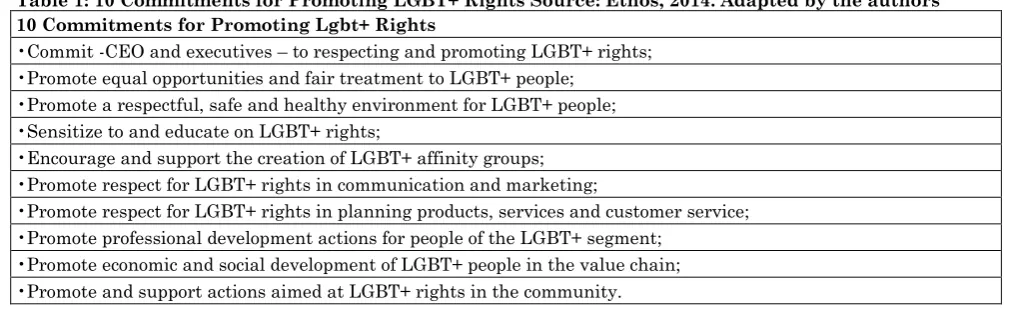
commitment-to-LGBT+human-rights/#.VLVU8kYGDp. In it, there are the "10 Commitments for Promoting LGBT+ Rights" which express the work agenda and the role the companies should adopt. These are shown on Table 1 below:
Table 1: 10 Commitments for Promoting LGBT+ Rights Source: Ethos, 2014. Adapted by the authors 10 Commitments for Promoting Lgbt+ Rights
•Commit -CEO and executives – to respecting and promoting LGBT+ rights; •Promote equal opportunities and fair treatment to LGBT+ people;
•Promote a respectful, safe and healthy environment for LGBT+ people; •Sensitize to and educate on LGBT+ rights;
•Encourage and support the creation of LGBT+ affinity groups; •Promote respect for LGBT+ rights in communication and marketing;
•Promote respect for LGBT+ rights in planning products, services and customer service; •Promote professional development actions for people of the LGBT+ segment;
•Promote economic and social development of LGBT+ people in the value chain; •Promote and support actions aimed at LGBT+ rights in the community.
Another initiative implemented in the national scope was the publication of the booklet "Building equal opportunities in the
world of work: combating
homolesbotransphobia". Created for
promoting the human rights of LGBT+ people in the world of work, this booklet was
developed in partner- ship with UNAIDS and UNDP and is available on the website http.//www.pnud.org.br/arquivos/ MANUAL_ completo_ Direitos Humanos LGBT + % 20 sem% 20 marcas % 20 de %20impressao.pdf.
Brazilian companies are starting to
success it is necessary to attract, retain and develop all employees, creating a diverse workforce where people can be brought together from all backgrounds, producing a more dynamic and cohesive team and more innovative goods and services. Brazilians are starting to understand that, not only abroad, diversity really means business.
Rio: an Admittedly Gay-Friendly City
Capital of the State of Rio de Janeiro, in the South-eastern region of Brazil, Rio de Janeiro ranks 45th among the 5,565 Brazilian municipalities according to the Municipal Human Development Index (IDHM). Among its 6.5 million inhabitants, 70.13% are aged between 15 and 64 years. Considering the adult population aged 25 years or above, 32.4% have completed High School and / or are in Universities and 21.3% have completed their Higher education.
The evolution of income in- equality in the city is described by the Gini Index, which increased from 0.60 in 1991 to 0.61 in 2000
and to 0.62 in 2010. Due to its tourist vocation for its location and geography, the city's city council, through the Special Coordination of Sexual Diversity (CEDS), launched the "Rio sem Preconceito" program in 2011 with the objective of training transvestites and transsexual women for the labor market and civil servants for the correct treatment of different gender identities and sexual orientations. Data published by the LGBT+ Chamber of Commerce and Tourism of Brazil indicate that 70% apprise Rio as a gay-friendly city in a survey conducted by Fundação Cesgranrio with 700 international LGBT+ tourists, between January 2 and 12, 2017.
The objective of the research was to identify the profile of tourists and from it create specific policies to improve the service, as this category of tourist spends two to three times more than a heterosexual tourist as for the negative points, 35% of foreign tourists pointed out the lack of information in the segment and 24% complained about security. Other data are described in Figure 2 below:
Profile of the Lgbt+ Tourist Who Visits Rio during High Season
Gender 75% Men 25% Women
70% Higher education Education level 20% Basic education 10% Elementary level 55% Europe
North America South America 5% Others 80% by Air Form of Transportation Used 15% by Sea 5% Land 65% Hotel 25% Airbnb Accommodation 8% Friends'
2% Holiday apartment 35% 1-3 days
Average Time of Stay 60% 4-7 days
5% More than 8 days 30% 90-150 USD Average Spending Per Day 45% 160-300 USD 25% More than 300 USD 30% 18-27 years
76% own their own Travel Organization 24% Travel Agency
70% Say the city is gay friendly Rio as a LGBT+ Destination 20% Say the city is not gay friendly 10% Say they have no opinion 30% Population receptivity 25% Gastronomy
Main Positive Points of Rio 20% Shopping Malls
15% Tourist information spots 10% Cultural Diversity
35% Lack of information for the segment 24% Safety
17% Homeless population Main Negative Points of Rio 10% urban cleanliness 8% Taxis
6% Tourist information
Profile of LGBT+ Tourists who visit Rio during high season
Source: LGBT+ Chamber of Commerce and Tourism of Brazil, adapted by the authors
Case Study
The present case study investigated what was done by the municipal public power, through the Special Coordination of Sexual Diversity (CEDS), regarding the guarantee of human rights and inclusion of the LGBT+ population in the city of Rio de Janeiro, capital of the State of Rio de Janeiro, in the South-eastern region of Brazil, from 2011 to 2016. Simultaneously with the collection of secondary data, an interview was held with the CEDS' manager, who assumed the Special Coordination of Sexual Diversity (CEDS) on February 2, 2011, with the status of Municipal Secretary, who will be called Mr CT, from now on.
The interviewee was offered control over his identification in the research, and he agreed to be identified by name, as he is a public figure. The informed consent form suggested by Gray [11] was duly completed and signed during the meeting held in a public place on November 23, 2018.
By feeling comfortable for being out, employees become more productive, and that is why organizational leaders should keep on helping their followers appreciate the value of individual differences by using their high status to seek out opportunities to support and encourage followers to apply for their individual differences to improve work processes [17].
Thinking accordingly, Mr CT began the interview, which lasted approximately two hours, reporting that upon assuming the
CEDS he was immediately concerned with the Carnival celebrations in Rio, an event that attracts thousands of domestic and foreign tourists to the city. Until then, the city had never promoted an awareness campaign on the prevention of sexually transmitted diseases. Likewise, there was no concern to offer specific training to the municipal agents involved with Tourism for the better service and receptivity of the LGBT+ public. Mr CT says that because he was gay and a public person, a status which arose from his profession.
He was a militant HIV activist before engaging in LGBT+ human rights activism. Due to his preoccupation with the increase of infection levels in the periods of revelry, especially during Carnival, as manager of the CEDS, he implemented two campaigns for testing (the means to verify the serology and avoid the infection, interrupting the chain of transmission between individuals) and two annual prevention campaigns, leading Rio de Janeiro to be the city that conducts the most HIV tests in the country.
For the first municipal information campaign on prevention, titled "Rio - Carnival without Prejudice", the Secretary invited ordinary friends and famous artists to talk about the prejudice suffered by blacks, women and the LGBT+ community.
The word 'homophobia', introduced in national (Brazil without Homophobia) and state (Rio without Homophobia) campaigns did not cover all minorities, and Mr CT chose to use the word 'prejudice', broadening the message about respect and civil rights of all the minorities. Considering the partnership established with the Mayor, the Secretary emphasized that this and all other programs implemented in his administration were only possible due to the absolute adherence and identification of the municipal leader with the proposals of the Coordination. In Mr CT's words, the Mayor "had this good thing - he was a guy who would see things happening and would make things happen.
He was with us! " CEDS/Rio broke national news when, through the personal friendship between Mr CT and the director of an
entertainment program broadcast on
national network by the broadcaster with the largest market share in the country, he was able to make the show's participants wear the T-shirts of the campaign "Rio: Carnival without Prejudice."
T-shirts featuring the theme of the campaign were worn and aired for three consecutive days during the Carnival period in 2011. The repercussion of the campaign was considered a success and the Coordination gained political strength and space in social media, printed and televised.
The "Rio sem Preconceito" program was launched in May of the same year as an "umbrella" for other programs, each linked to other Municipal Departments, according to their pertinence. The CEDS, located within the Guanabara Palace, headquarters of the State Government, was responsible for the defense of LGBT+ Civil Rights through the care, reception and referral of complaints made by citizens in vulnerable conditions.
The calls were accordingly taken, that is, gays would talk to gays, lesbians to lesbians, and transsexuals to transsexuals. This measure contributed to the perception of belongingness and solidarity of the State towards its citizens.
The Ministry of Health was responsible for HIV prevention campaigns. The "Rio Escola sem Pre- conceito" ("Schools without Prejudice") program coincided with the approval of the Homophobic Bullying Act by CEDS. In Culture, two Cultural public notices, each of which allocated R$ 1 milli- on for the financing of theatrical pieces or audiovisual programs that presented the LGBT+ theme, especially those focused on transsexualism and combating transphobia.
In the words of the interviewee, "there is a spectrum of prejudice towards the LGBT+ public, and transsexual people are the ones who suffer the most." One of the explicit conditions for prioritization in the funds from the tender was for the project to employ transsexual people. Mr CT reports that of all projects, the annual campaign against LGBT+-phobia was the one that had the most positive impact on the population of Rio de Janeiro.
The "Rio without Preconceito" campaign had 8 million viewers on Face book, and although difficult to measure, in her words, "it put on the agenda the fact that Brazil is the country that kills the most transsexuals and homosexuals in the whole world" according to Transgender Europe (TGEU). The CEDS complaint in the video created controversy and brought threats to the Secretary who, as he reiterated, had the unconditional support and protection of the mayor.
As CEDS coordinator, MrCT signed eight decrees. The one he is most proud of is Decree 35,816, of June 28, 2012. Through a CEDS / Rio initiative, the Unified Health System (SUS) started to register cases of homophobia and transphobia in the country, aiming to subsidize future actions of public policies to prevent and combat violence suffered by lesbian, gay, bisexual and transgender.
The Decree began to be used nationally and Rio de Janeiro went on to rank first place among Brazilian cities that protect the rights of LGBT+ citizens. With the defeat of the candidate of the government to the city hall of Rio in the elections of 2016, the Secretaries had their managers exonerated of their positions, team members were fired and the projects were either interrupted or altered.
The current public management in the municipal, state and federal spheres is carried out by politicians, whose speech is declared "heteronormative", which MrCT admits has increased his own pessimism. The CEDS / Rio coordinator, who has been removed from the CEDS and is determined not to run for public office, concludes the interview by expressing concern about the continuity of actions that ensure respect and civil rights for lesbian, gay, bisexual and transgender people.
Results
The objective of identifying the public policies and actions adopted as well as the perceived impacts on the improvement of the working and living conditions of this population has
been achieved, as the case study
demonstrates the steps taken towards valuing and including LGBT+ minorities in the management of CEDS / Rio, carried out in the period from 2011 to 2016. In the words of MrCT, the LGBT+ tourist is a public that
"defines its destiny in terms of destinies that assure their rights".
A series of laws was created in the period from 2011 to 2016 that have re- sulted in the exponential increase of gay tourism. Far from coming just for sex tourism, the interviewee ensures that LGBT+ people come to visit museums, restaurants and stroll through tourist spots, paying a cost of living three times higher than the city of Mykonos, for example.
In his opinion, the Rio lifestyle where people walk around in shorts and bermudas, the location of the beaches in the urban perimeter and respect for diversity and civil rights legally assured to lesbian, gay, bisexual and transgender people, accredit the city as a gay friendly destination. More than just attracting the LGBT+ community, gay tourism provides revenue that the city and its representatives cannot ignore.
Literally, diversity does mean business. As a proposal for future work, these authors suggest that new studies are done to verify the evolution or involution of CEDS/Rio's actions, which projects have had continuity, the impact obtained by those that were altered and the repercussion generated by those that were interrupted by determination of the democratically elected mayor and his staff, whose term began on January 1st, 2017 and will last until December 31, 2020 [21-34].
References
1. Colgan F et al (2007) “Equality and
diversity policies and practices at work: lesbian, gay and bisexual workers”, Equal Opportunities International, 26(6):590-609.
2. Dahling JJ et al (2016) “A stake in the
fight: When do heterosexual employees resist organizational policies that deny marriage equality to LGB peers?” In Organizational Behavior and Human Decision Processes, 132:1-15.
3. Yang Y, Konrad AM (2011)
“Understanding diversity management practices: Implications of institutional theory and resource-based theory”, Group & Organization Management, 36(1):6-38.
4. Barbieri UF (2014) Gestão de Pessoas nas
organizações: An evolução do ser humano na vida e na carreira. Atlas. São Paulo.
5. Marras JP (2011) Administração de
Recursos Humanos: do operacional ao estratégico, 14ª ed., São Paulo, Saraiva.
6. Moraes J, Oliveira SR (2011) Gestão de
Pessoas, Sesi: Uff, Rio de Janeiro.
7. Rumens N (2011) “Minority support:
Friendship and the development of gay and lesbian managerial careers and
identities”, Equality, Diversity and
Inclusion: An International Journal, 30(6):444-462.
8. Fullerton M (2013) "Diversity and
inclusion -LGBT+ inclusion means
business", Strategic HR Review,
12(3):121-125. In
http.//doi.org/10.1108/1475439131134462 (accessed 28 May 2017).
9. Mello L (2012) Políticas Públicas de
10.Gray DE (2012) Pesquisa no Mundo Real, 2ª ed. Penso, Porto Alegre.
11.Yin R (2016) Pesquisa Qualitativa do
Início ao Fim. Porto Alegre: Penso.
12.Araújo CM et al (2017) O sujeito na
pesquisa qualitativa: desafios da
investigação dos processos de
desenvolvimento, Psicologia: Teoria e
Pesquisa, 33, Brasília-DF, DOI
http.//dx.doi.org/10.1590/0102;3772e33316.
13.Barthes R (1976) Introdução à análise
estrutural da narrativa. In R. Barthes, Análise estrutural da narrativa: Pesquisas semiológicas, Petrópolis: Vozes, (19-60).
14.Denzin NK, Lincoln YS (2006) O
Planejamento da Pesquisa Qualitativa: Teoriase Abordagens, Artmed, Porto Alegre.
15.Colgan F, Mc Kearney A (2012) “Visibility
and voice in organizations: Lesbian, gay, bisexual and transgendered employee
networks”, Equality, Diversity and
Inclusion: An International Journal, 31(4):359-378.
16.Almeida et al (2018) ‘People Management
and the Commitment of Brazilian Organizations towards Diversity: The Challenges of Implementing Theory in Practice’, Asian Journal of Business & Management Sciences,07(01):1-15
17.Theodorakopoulos N, Pawan B (2015)
“Diversity and inclusion in different work settings: emerging patterns, challenges, and research agenda”. In Human Resource Management, 54(2):177-197.
18.Irigaray HAR et al (2010) Humor e
Discriminação por Orientação Sexual no
Ambiente Organizacional (1). RAC,
Curitiba 14(5-7):890-906.
19.Di Maggio P, Powell WW (1983) ‘the iron
cage revisited: Collective rationality and
institutional isomorphism in
organizational fields', American
Sociological Review, 48(2):147-160.
20.Forum (2013) in
https://www.revistaforum.com.br/osentend
idos/2017/02/13/tufvesson- fazbalancoperiodo-como-coordenador-da-ceds/ (accessed on 19 November 2018).
21.ACNUDH (2013) Alto Comissariado das
Nações Unidas para os Direitos Humanos. In:
http.//acnudh.org/pt-br/dia-dos-direitos- humanos-2013-acnudh-organiza-painel-sobreorgaos-de-tra- tados (accessed 06 June 2017).
22.ACNUDH (2013) Cartilha Nascidos Livres
e Iguais. In: http.//acnudh.org/wpcontent/ uploads/2013/03/Nascidos-Livres-e-Iguais-Baixa-Resolu%C3%A7%C3%A3o.pdf.
23.Atlas Brasil (2013) in
http.//atlasbrasil.org.br/2013/pt/perfil_m/ri o-de-janeiro_rj (accessed 20 November 2018).
24.Câmara LGBT + (2009) in
http.//www.camaraLGBT+.com.br/LGBT+-70-aprovam-o-rio-comoci-
dade-gay-friendly/ (accessed 25 November 2018).
25.Clark D (2012) Come out of the closet at
work. Whether you’re gay or not. In
Harvard Business Review. In:
http.//hbr.org/2012/07/come-out-of-the-closet-at-work (accessed 28 May 2017).
26.Egan PJ et al (2008) "Gay Rights." In
Public Opinion and Constitutional
Controversy, eds. Nathaniel Persily, Jack Citrin and Patrick J. Egan. Oxford University Press.
27.Egan PJ (2009) “Reducing LGBT+
Inequality in the Age of Obama”. In National Equality March in Washington,
DC, on October 11.
http.//politics.as.nyu.edu/docs/IO/4819/ega n. pathways.pdf (accessed 28 May 2017).
28.Entre Nós (2010) in
https://blogentrenos.wordpress.com/tag/sec
retaria-de-direitoshumanos-da-presidencia-da-republica/ (accessed 25 November 2018).
29.Instituto Ethos (2014) In
http.//www3.ethos.org.br/cedoc/catorze-empresas-assinamcarta- de-compromisso-com-os-direitos-LGBT+/#.WStH2RtViko (accessed 2 June 2017)
30.Mello L (2012) Por onde andam as
Políticas Públicas para a População LGBT+ no Brasil. Revista Sociedade e Estado- 27-2 - May/Aug.
31.Mello L. et al (2012) Questões LGBT+ em
debate: sobre desafios e conquistas. Soc. E Cult., Goiânia, v. 15, n. 1, p. 151-161, Jan/Jun 2012, DOI: 10.5216/sec.v.15i1. 20680.
32.Ministério da Saúde (2016) In
http.//www.aids.gov.br/pt-br/noticias/novo- relatorio-dounaids-sobre-o-90-90-90-cita-o-brasil-como-exemplo-de-que-meta-pode-ser (accessed 25 November 2018)
33.Lucon N (2018) In
https://nlucon.com/2016/11/15/novo-relatorio-da-tgeu-reafirma-quebrasil-e-o- pais-que-mais-mata-pessoas-trans-no-mundo/ (accessed 25 November 2018)
34.UNAIDS (2015) in:
http.//www.pnud.org.br/arquivos/
Manual_ comple to_Direitos Hum anos LGBT + % 20 sem % 20 marcas % 20de%20impressao.pdf .United Nations
Global Impacts. In
![figure. The informed consent form suggested by Gray [11] was duly completed and signed during the meeting held in a public place on](https://thumb-us.123doks.com/thumbv2/123dok_us/7836946.2090331/6.595.52.547.36.271/figure-informed-consent-suggested-completed-signed-meeting-public.webp)
