ISSN: 2501 - 1235 ISSN-L: 2501 - 1235 Available on-line at: www.oapub.org/edu
doi: 10.5281/zenodo.2559317 Volume 5 │ Issue 5 │ 2019
EFFECTS OF CORE STRENGTHENING TRAINING
ON LUNGE PERFORMANCE OF FENCING PLAYERS
Maman Pauli
Dr., Department of Physiotherapy, Guru Nanak Dev University, Amritsar,
Punjab, India
Abstract:
The endeavor of this study was to investigate the effects of Core Strengthening Training on Lunge Performance of Fencing Players. Twenty Four , University level male Fencers of Guru Nanak Dev University, Amritsar between the age group of 18-28 years (Mean ± SD: age 22±2.963yrs, body height 168.391±5.790cm, body mass 66.462±3.398kg) volunteered to participate in the study. The Standing Broad Jump Test was used to measure the Explosive Horizontal Power. Statistical analyses were performed using the Statistical Package for the Social Sciences for Windows version 16.0 software (SPSS Inc., Chicago, IL). Data is expressed as the mean ± SD. Paired sample t-test was utilized to compare the means of the Pre-Test and the Post-Test. The level of significance was set at 0.05. Significant differences were found in Lunge Performance in the experimental group subjected to 6-week training. However, no significant changes over that 6-week period were noted in the control group.
Keywords: core strengthening training, lunge performance, fencing
1. Introduction
Throughout history, fencing has been conceived of and practised as an art form [1, 2]. and has also been presented as a science formally since 1604 [3]. In 1896, fencing as a sporting activity was admitted to the first modern Olympic Games in Athens. Fencers show a greater cross-sectional area (CSA) of the dominant forearm, arm [4, 5], thigh [6, 5-7] and calf [6] which is independent of technical level and years of training.
The issue is gaining importance in combat sports – particularly in fencing. Many experts share the view that the type of body composition in combat sports is primarily associated with an individual combat style and the choice of techniques [8-9]. The knowledge of internal proportions of the body provides extremely relevant
information. As the existing scientific publications confirm, knowledge of these proportions constitutes an important collection of empirical data about athletes [10-11].
2. Material and Methods
2.1 Subjects
Twenty Four, University level male Fencers of Guru Nanak Dev University, Amritsar between the age group of 18-28 years (Mean ± SD: age 22±2.963yrs, body height 168.391±5.790cm, body mass 66.462±3.398kg) volunteered to participate in the study. The subjects were purposively divided into three groups:
Group-I: Control (N1=12);
Group-II: Experimental (N2=12).
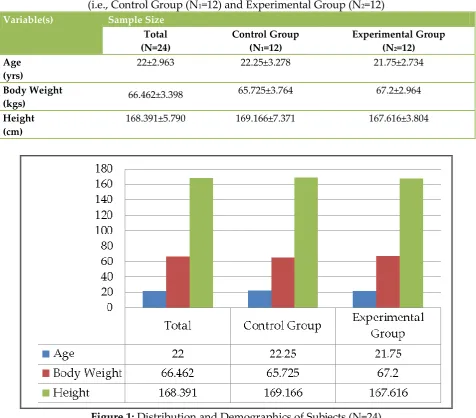
Distribution and demographics of subjects are brought forth in Table 1.
Table 1: Distribution and Demographics of Subjects (N=24) (i.e., Control Group (N1=12) and Experimental Group (N2=12)
Variable(s) Sample Size Total (N=24)
Control Group (N1=12)
Experimental Group (N2=12)
Age (yrs)
22±2.963 22.25±3.278 21.75±2.734
Body Weight
(kgs) 66.462±3.398
65.725±3.764 67.2±2.964
Height (cm)
168.391±5.790 169.166±7.371 167.616±3.804
2.2 Variable
Lunge Performance
The Standing Broad Jump Test was used to measure the Explosive Horizontal Power.
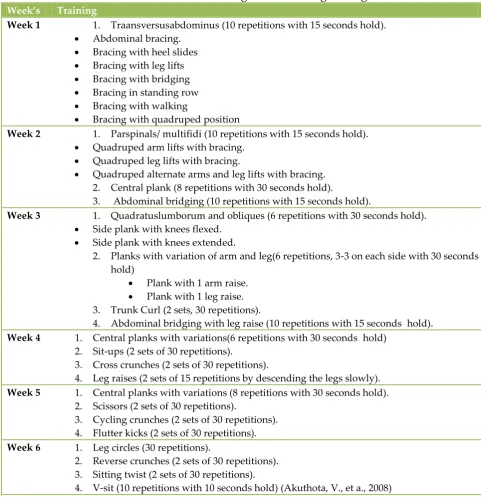
Table 2: 6-Week Training of Core Strengthening
Week’s Training
Week 1 1. Traansversusabdominus (10 repetitions with 15 seconds hold). Abdominal bracing.
Bracing with heel slides Bracing with leg lifts Bracing with bridging Bracing in standing row Bracing with walking
Bracing with quadruped position
Week 2 1. Parspinals/ multifidi (10 repetitions with 15 seconds hold). Quadruped arm lifts with bracing.
Quadruped leg lifts with bracing.
Quadruped alternate arms and leg lifts with bracing. 2. Central plank (8 repetitions with 30 seconds hold).
3. Abdominal bridging (10 repetitions with 15 seconds hold).
Week 3 1. Quadratuslumborum and obliques (6 repetitions with 30 seconds hold). Side plank with knees flexed.
Side plank with knees extended.
2. Planks with variation of arm and leg(6 repetitions, 3-3 on each side with 30 seconds hold)
Plank with 1 arm raise. Plank with 1 leg raise. 3. Trunk Curl (2 sets, 30 repetitions).
4. Abdominal bridging with leg raise (10 repetitions with 15 seconds hold).
Week 4 1. Central planks with variations(6 repetitions with 30 seconds hold) 2. Sit-ups (2 sets of 30 repetitions).
3. Cross crunches (2 sets of 30 repetitions).
4. Leg raises (2 sets of 15 repetitions by descending the legs slowly).
Week 5 1. Central planks with variations (8 repetitions with 30 seconds hold). 2. Scissors (2 sets of 30 repetitions).
3. Cycling crunches (2 sets of 30 repetitions). 4. Flutter kicks (2 sets of 30 repetitions).
Week 6 1. Leg circles (30 repetitions).
2. Reverse crunches (2 sets of 30 repetitions). 3. Sitting twist (2 sets of 30 repetitions).
4. V-sit (10 repetitions with 10 seconds hold) (Akuthota, V., et a., 2008)
2.3 Statistical Technique
3. Results
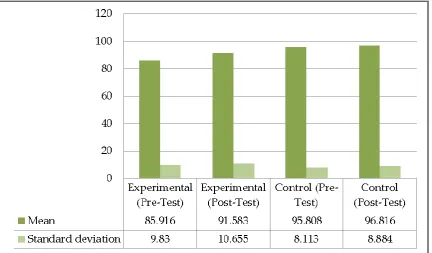
Table 3: Descriptive statistics (Mean & Standard Deviation) and paired sample t-test of Subjects (N=24) (i.e., Control Group (N1=12) and Experimental Group (N2=12) for Lunge Performance
Lunge Performance
Group Number Mean Standard
Deviation
Variance t-value
Experimental (Pre-Test) 12 85.916 9.83 96.628 5.976
Experimental (Post-Test) 12 91.583 10.655 113.537
Control (Pre-Test) 12 95.808 8.113 65.831 1.663
Control (Post-Test) 12 96.816 8.884 78.928
Lunge Performance A. Experimental Group
The means of Group 1 and Group 2 are significantly different at p < 0.05.
The absolute value of the calculated t exceeds the critical value (5.9765>2.201), so
the means are significantly different. B. Control Group
The means of Group 1 and Group 2 are not significantly different at p < 0.05.
The absolute value of the calculated t is smaller than critical value (1.6633<2.201),
so the means are not significantly different.
4. Conclusion
Significant differences were found in Lunge Performance in the experimental group subjected to 6-week training. However, no significant changes over that 6-week period were noted in the control group.
References
1. Porzio L., Mele G. Arte gladiatoria dimicandi. (2002). 15th century
swordsmanship of master Filippo Vadi. Highland Village, (TX): Chivalry Bookshel.
2. Labat. L’art en fait d’armes. (1696). Toulouse.
3. Agrippa C. Trattato di scienza d’arme. (1604). Et un dialogo in detta materia. Venice.
4. Tsolakis C.H., Bogdanis G.C., Vagenas G. (2006). Anthropometric profile and
limb asymmetries in young male and female fencers. J Hum Mov Stud; 50: 201-16.
5. Margonato V., Roi G.S., Cerizza C., et al. (1994). Maximal isometric force and muscle cross-sectional area of the forearm in fencers. J Sports Sci; 12: 567-72.
6. Roi G.S., Mognoni P. Lo spadista modello. (1987). SdS; 9: 51-7.
7. Tsolakis C.H., Katsikas C.H. (2006). Long term effects of a combined physical
conditioning and fencing training program on neuro-Sport muscular performance in elite fencers. Int J Fitness; 2 (1): 35-42.
8. Tumanian G.C., Martirosow E.G. (1976). Fizkultura i sport. Moskwa.
Tiełosłożenie i sport.
9. Socha M., Witkowski K., et al. (2016). Body composition and selected
anthropometric traits of elite Polish female judokas in relation to the performance of right-dominant, left-dominant, or symmetrical judo techniques in vertical posture (tachi waza) Arch Budo; 12:257–26.
10.Milicerowa H. (1956). The use of Perkal’s indicators in the characteristics of boxers’ body builds, Materiały i Prace Antropologiczne: 20.
11.Jagiełło W., Jagiełło M. Wnutrennyje proporci strojenia tela czlenow mużskoj
Creative Commons licensing terms