M
EMBERS ANDL
EADERS INS
ENATEO
BSTRUCTIONNicholas O. Howard
A dissertation submitted to the faculty of the University of North Carolina at Chapel Hill in partial fulfillment of the requirements for the degree of Doctor of Philosophy in the Department of Political Science.
Chapel Hill 2015
Approved by:
Jason M. Roberts
Georg Vanberg
Sarah A. Treul
David W. Rohde
ABSTRACT
NICHOLAS O. HOWARD: Members and Leaders in Senate Obstruction. (Under the direction of Jason M. Roberts)
ACKNOWLEDGMENTS
This dissertation would be impossible without many individuals selflessly giving their time and effort. Jason Roberts has been a great mentor, and it is impossible to overstate my appreciation for all he has done. His guidance has made graduate school a rewarding experience, not only for this project but many others. From assistance with data coding protocols to numerous edits, he has made this a better dissertation and me a better scholar. I would like to thank my dissertation committee. Georg Vanberg, Sarah Treul, David Rohde, and Frank Baumgartner all freely gave of themselves to work through concepts and provide helpful feedback. Each member contributed greatly to this project, helping me work through my ideas toward a completed project. I would not have been able to do this without them.
This project is much better than it would have been without the input of many individu-als. Lauren Bell, Chris Den Hartog, Bill Egar, Larry Evans, Chuck Finochiaro, Greg Koger, Anthony Madonna, Nate Monroe, Tim Nokken, Hong Min Park, Wendy Schiller, and Ryan Williamson have all provided valuable feedback, data, and advice at many stages. I would also like to thank John Aldrich, Sean Gailmard, Arthur Lupia, John Patty, Maggie Penn, Shawn Rodriguez, Gisela Sin, and all the participants at the 2014 Empirical Implications of Theoretical Models (EITM) program. The advice and probing questions provided by these instructors and my fellow participants helped me immeasurably. I would also like to thank Allan Cigler, Mark Joslyn, Burdett Loomis, and especially Michael Lynch, for their assistance during my time at the University of Kansas.
Center provided support for an additional trip to George Mitchell’s archives in Maine and data coding.
TABLE OF CONTENTS
1 OBSTRUCTION IN THE U.S. SENATE... 1
1.1 Forms of Obstruction ... 4
1.2 Outline of the Dissertation... 7
2 OBSERVING OBSTRUCTION: HOLDS IN THE SENATE... 11
2.1 Obstructing Bills ... 13
2.1.1 Bills Targeted by Holds ... 18
2.2 Research Design ... 21
2.3 Results ... 22
2.4 The Effects of Holds on Bills... 30
2.5 Discussion ... 33
3 MANAGING OBSTRUCTION: UNANIMOUS CONSENT AGREEMENTS 36 3.1 UCA History and Purpose ... 38
3.2 UCAs in Senate Procedure ... 42
3.3 Leadership Cues and Complex UCAs ... 44
3.4 Data ... 47
3.5 Analysis ... 52
3.5.1 Complex UCAs and Bill Passage ... 57
3.6 Discussion ... 61
4.1 Origin and Use of the Modern Filibuster ... 65
4.1.1 Past Attention to the Filibuster ... 67
4.2 Why Filibuster Bills? ... 70
4.3 Research Design ... 76
4.4 Analysis ... 77
4.4.1 On-Floor Amendments ... 85
1 OBSTRUCTION IN THE U.S. SENATE
The Senate is one of the most unusual legislative bodies in the world. Often called the “world’s greatest deliberative body,” the chamber can produce both monumental legislation and crippling delay. The capacity for great debate and crippling delay stem from the Senate rules governing debate (Shepsle and Weingast 1981). These rules advantage individual senators, often at the expense of the entire chamber’s ability to govern. This individualism, and how it affects legislative consideration, defines the Senate.
The most well known instance of this Senate individualism is the filibuster. Filibusters are purposefully dilatory speeches given by senators on the floor, often undertaken to delay or kill legislation. The ability for these speeches stems from the lack of a previous question motion, making it difficult to stop debate (Wawro and Schickler 2006; Binder and Smith 1997; Koger 2010). This stands in contrast to the modern House of Representatives, where the majority party controls debate through special rules and agenda control (Rohde 1991; Aldrich and Rohde 2000; Coker and Crain 1994; Cox and McCubbins 2005, 2007). Ex-amples of famous – or occasionally infamous – filibusters abound in popular depictions of the Senate. Huey Long’s 1935 filibuster of the National Recovery Act extension, ac-tions against the 1890 Lodge Bill or Force Act and Rand Paul’s 2013 opposition to John Brennans nomination are among numerous instances of the filibuster.
Court decisions, among many other time-killing methods. Although Thurmond ultimately lost the final passage vote, his filibuster remains among the more famous instances of ob-struction in American history.
The filibuster’s place in public perception extends beyond these examples into how the public sees the Senate. To most of the American public, the filibuster is the Senate in practice. Americans routinely identify the filibuster as an important feature of Congress, both for general practice and specific policy. Approximately 1/3 of respondents report they pay attention to debates over changes to filibuster rules in repeated polls over the last decade.1 This importance given to the filibuster is equally true for the news media supplying information to voters. Almost 50% of news stories covering the debate over the Affordable Care Act referenced the filibuster in some fashion (Smith and Park 2013). While the public may value majority rule or minority rights differently depending on their personal political opinions, the filibuster is routinely identified as an important part of American government. This importance given to the filibuster extends to academic studies of the American political system. Scholars routinely place the filibuster at the center of explanations for the political system. Gridlock, punctuations in policy processes, and moderations in pol-icy are routinely explained through the filibuster (Krehbiel 1998; Binder 2003; Jones and Baumgartner 2005). The filibuster is also at the center of Senate scholarship. Students of Congress have explored the usage of filibusters across time, which individuals are likely to filibuster, and changes in how individuals use the filibuster across both their individual ca-reers and American history (Koger 2010; Bell 2011; Overby and Bell 2004). These studies have concerned themselves with explaining what the public sees as the most important and defining feature of the Senate.
While the filibuster is undoubtedly important, its perceived role does not take into ac-count that the Senate primarily does not function through cloture and floor fights. Much of the time the Senate functions through Unanimous Consent Agreements (UCAs). UCAs are agreements negotiated between party leaders and approved by all 100 senators. These agreements can set time limits for debate, control which amendments are considered in or-der, ban procedural motions, and provide for specific passage procedures. UCAs represent the Senate choosing to limit itself through actions taken by the entire chamber. Many bills have UCAs, and UCAs controlling specific aspects of debate are not uncommon (Smith 2014). Indeed, UCAs controlling debate are far more common than filibusters and may be as common as cloture petitions (Bell 2011).
The Senate’s reliance on UCAs to conduct its business emphasizes the importance of non-public action in the Senate. UCAs are negotiated off-floor, often before debate ever begins. Leaders seek these agreements to manage debate and effectively limit the possi-bility for dilatory actions. Members agreeing to UCAs which limit amendments remove their ability to offer obstructive amendments. Additionally, leaders can know and address possible obstruction before it ever occurs on the floor through holds. Holds are letters by a senator, or groups of senators, to her party leader stating their intent to object to legislation should it come up for debate. These holds often provide a reason that a senator is object-ing to the legislation, allowobject-ing leaders to work with members in order to prevent on floor obstruction from occurring. Leaders can also pull bills from the floor if they are obstructed through holds, effectively killing the bill without a filibuster ever observed.
amendments. Holds, UCAs, and filibusters may be connected activities rather than stand-alone tactics. The usage of one may change the probability of another occurring, with holds likely to shape both UCAs and filibusters. More fundamentally, an exclusive focus on the filibuster explains little about how obstruction shapes the path legislation takes through the chamber. Incorporating more of the tools available to members and leaders provides a more thorough understanding of legislation and obstruction.
The three chapters in this dissertation all focus on how obstruction alters the path of legislation through the Senate. I specifically focus on the effect of obstruction and man-agement efforts at different stages in Senate bill consideration. The ability for senators to register objection before debate occurs has large effects on the filibuster. Bills objected to at earlier stages are much more likely to receive objection at later stages. Leaders know this, and work to manage the floor through UCAs. The limited attention given to these pre-floor proceedings has hidden how obstruction actually works and what the entire process of obstruction means for legislation. This dissertation contributes to an understanding of how the effects of obstruction work at each stage in bill consideration by combining new data on pre-floor bargaining with existing data and approaches for floor debate and member preferences.
1.1 Forms of Obstruction
(Binder, Madonna and Smith 2007). While party leaders gained the right of first recogni-tion in the 20th century, this does not guarantee that an opposed senator will not occupy the floor in an effort to force changes to the bill or kill it outright (Campbell, Cox and Mc-Cubbins 2002; Tiefer 1989). Finally, parties are relatively weak due to both these rules and the leadership of the chamber set by the Constitution. The President of the Senate is the Vice-President, who can be a member of the opposition party. Any changes to chamber or-ganization must account for this fact, leading parties to focus on what little they can directly control while allowing members to independently use the floor (Gold 2013; Smith 2007; Carson, Madonna and Lynch 2011). While senators do behave as members of party teams and supply the majority party with some advantages on the floor, Senate parties suffer at the hands of individualistic rules (Lee and Oppenheimer 1999; Den Hartog and Monroe 2011).
and senators have various goals when engaging in filibusters (Binder 1997).
Another on-floor tactic frequently discussed are amendments and their management by the chamber. Amendments have received attention from scholars looking for obstructive tactics, particularly those exploring killer amendments (Jenkins and Munger 2003; Poole and Rosenthal 2007). Controlling amendments through procedural motions to table and filling the amendment tree, and the advantages these tactics supply to the majority party, have come under increasing focus (Den Hartog and Monroe 2011; Smith 2014; King, Or-lando and Rohde 2012). These non-filibuster tactics allow leaders to control senators’ amending ability while giving advantages to members of the majority party. Amendments on the floor have the ability to undermine legislation, but leadership has tools to control their effects during consideration.
Alternative means of obstruction and management are largely underappreciated among students of the Senate. The Senate rarely presents single members pressing their interests through public debate, but rather usually has bills dying before ever being considered on the floor. Indeed, popular descriptions often note that bills and nominees die in the cham-ber without ever receiving floor attention. Descriptions of recent “do-nothing Congresses” often revolve around this narrative, but largely credit it to the filibuster. Far more often lead-ers could not gain an agreement to manage the chamber, effectively killing the bill prior to public consideration (Smith 1989; Roberts and Smith 2007; Smith 2014). The bill dies without public objection ever registered, but this does not mean that targeted obstruction does not exist. Leaders may be unable to garner consent to proceed due to off-floor ob-struction in the individualistic Senate, and choose not to proceed to consider the bill (Smith and Flathman 1989; Ainsworth and Flathman 1995).
need to publicly object, but rather register their objections and follow through on them if pushed to do so. Thus, what makes filibusters powerful in the eyes of the public may not be that they are effective or represent members standing up for their beliefs, but rather that they represent members acting on previously registered objection.
What this discussion makes clear is that obstruction is not simply a public process played out on the Senate floor. Rather, the Senate presents numerous opportunities for senators to obstruct and leaders to manage consideration. This dissertation asks how the process of legislative consideration works with obstruction and management possible at multiple stages. Specifically, what bills are obstructed in the Senate and how connected are different types of obstruction? Previous scholars have acknowledged the presence of multiple forms of obstruction, but often focus on larger patterns of usage or generalized expectations rather than asking how obstruction works through multiple stages. This dis-sertation incorporates these multiple methods of obstruction and management, working toward establishing a bill-level picture for how obstruction functions throughout Senate proceedings.
1.2 Outline of the Dissertation
modifying the legislation, and even include simply notifying the member before moving to consider (Howard and Roberts 2015; Evans and Lipinski 2005).
The analysis presented in Chapter 2 focuses on which bills are likely to be obstructed in this pre-floor environment. Limiting the analysis to only Senate bills reported from committee, the analysis demonstrates that senators act in predictable, self-interested fash-ions when using holds. First, senators are aware of the probable content of legislation. A bill sponsor’s ideology affects the probability that a bill is targeted by holds, and bills re-ported from high profile policy committees are also more likely to receive holds. Second, I demonstrate that bills more widely supported within the chamber are much more likely to be targeted by holds. Higher numbers of cosponsors for a bill lead to a greater probability for holds, with holds seen across the range of cosponsors. Finally, I demonstrate that holds have powerful effects on passage. Held bills are much less likely to pass the chamber, even controlling for bill and chamber specific details.
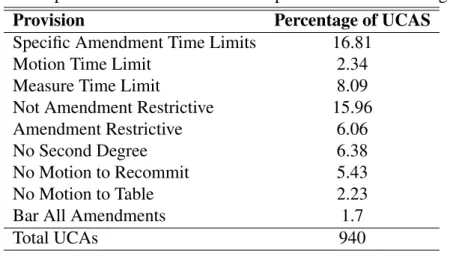
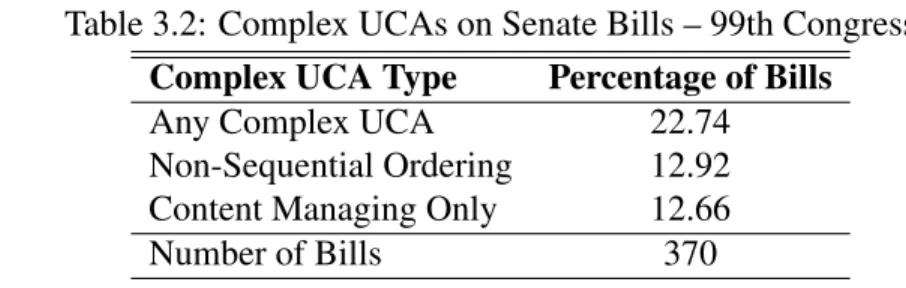
Chapter 3 focuses on pre-floor attempts to manage the chamber by leaders. The modern Senate has become a chamber overwhelmed with proposals and increasingly discontented members. Pre-floor management through Unanimous Consent Agreements (UCAs) has become one of the most important tools for chamber leaders in their efforts to control a potentially unruly floor (Smith 2014). UCAs are agreements negotiated between leaders and agreed to by all 100 senators which set rules for the consideration of specific bills. This chapter focuses more specifically on complex UCAs, those which set specific provisions for consideration rather than setting aside a minor rule. Complex UCAs control which amendments are allowed on the floor, speaking allotments for members, when votes will occur, and can waive specific provisions for consideration. These complex UCAs are the closest tools Senate leaders have to special rules in the House, and can be used to shape public consideration before it occurs.
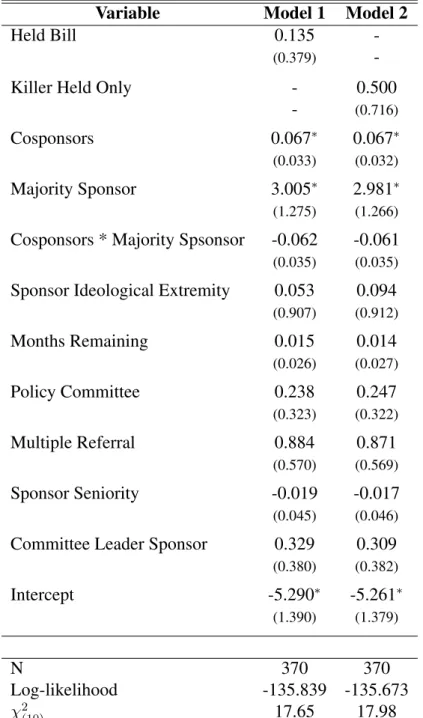
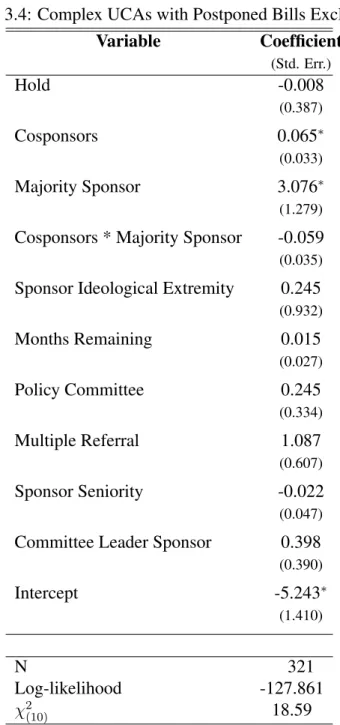
UCAs while others do not. Rather than focusing on the general patterns across time for how leaders use these controlling agreements, I focus on which bills are given these agree-ments. I expected that the holds on a bill would lead to complex UCAs in order to manage this potential obstruction, but did not find a relationship. Rather, complex UCAs are gen-erally used on bills which have a much broader base of support within the chamber. Bills with more cosponsors are more likely to receive complex UCAs, as are bills sponsored by members of the majority party. The second portion of this chapter turns to understanding how these agreements affect passage. Complex UCAs do lead to passage, but not for all Senate bills referred from committee. These controlling agreements do positively predict passage on legislation not indefinitely postponed by the Senate. These agreements appear to serve as a means for leaders to control the Senate floor in order to push legislation toward passage.
In Chapter 4 I move to the floor, analyzing the occurrence of filibusters and their con-nection to other obstructive tactics. As noted above, most work on the filibuster expects that these tactics are relatively unconnected. Filibusters are generally viewed as a standalone tactic, with other tactics dealt with by leaders’ pre-floor management. As Chapter 3 details, leadership management efforts do not appear to respond to holds. This leads to questions about how members use holds and filibusters, and if these tactics may be connected. Sen-ators threatening obstruction prior to floor consideration through holds may see their hold not honored by leaders and respond through on-floor filibusters in protection of their in-terests. Further, senators find value in consistently presenting objection to leaders. This protects their future interests through establishing a reputation for objection if threatened, putting leaders on notice that they will occupy the floor if ignored off of it.
2 OBSERVING OBSTRUCTION: HOLDS IN THE SENATE
A fundamental question in democratic representation is what becomes law. The ability to turn citizen demands into laws centers around questions of legislative rules and legislator interests. Elected officials have an interest in constructing institutions and passing laws to further both individual power and reelection goals. That is, officials desire to deliver action on constituent requests. One of the problems with this process is that individual elected officials need not, and often do not, agree on what should be done. This potential for disagreement is greater when these officials have the capacity to insist on consideration for their preferred policies over others. Legislation can stall if elected officials cannot agree to pass legislation, and this becomes more likely with individualistic legislative rules.
The tension between individual elected officials’ preferences and legislative efficiency appears most clearly in Senate procedure. Classic depictions of Senate obstruction give individuals great abilities to kill legislation through filibusters, but leaders can overcome this through achieving supermajority cloture or exempting a bill from supermajoritarian rules. This traditional thinking on obstruction prioritizes visible obstruction and leaders managing coalitions set against these actions. This classic depiction misses many of Senate obstruction’s forms, however. The following example illustrates why depicting obstruction as public filibusters does not explain much of obstruction’s effects on bills in the chamber. The Hatch Act Reform Amendments of 1988, H.R. 3400 in the 100th Congress, sought to allow civil servants to interact with campaigns for elected office.1 After House passage
and Senate introduction, the bill remained in the Committee on Governmental Affairs until being reported from committee and placed on the calendar on July 7, 1988.2 Committee deliberations were contentious, but party-line divisions within committee were absent, in-dicating that conflicts could be resolved and the bill cleared committee.3 However, the bill remained on the calendar without ever reaching the floor or being subject to a motion to proceed.4 Thus, the Hatch Act Reform Amendments of 1988 died a quiet death with no visible explanation.
The Hatch Act Reform Amendments of 1988’s failure was not due to filibusters or poison pill amendments. This is apparent from the bill’s lack of floor consideration. Rather, it is due to the lack of floor exposure for the bill. Majority leader George Mitchell (D-ME) and minority leader Robert Dole (R-KS) could not procure a Unanimous Consent Agreement (UCA) which would have governed floor procedure and therefore elected to not proceed on the floor. To negotiate a UCA guiding debate, Mitchell and Dole required the consent of all 100 senators, and such consent was not attainable for this bill. Senators Jesse Helms (R-NC) and Bill Roth (R-DE) sent Republican leader Dole hold letters stating their intent to object to the bill should a motion to proceed come to the floor. Thus, these holds undermined unanimous consent, and the leaders decided that the possibility of passing the bill with this objection was not worth the cost of extra time on the floor should Helms and Roth actually follow through with their threats to filibuster. These holds removed the possibility of a UCA, and ultimately undermined any efforts to move the legislation forward.
This example makes apparent a hidden truth in traditional depictions of Senate pro-ceedings, which tend to focus on the filibuster as the tool of choice for obstruction-minded
“Hatch Act Hearings.”Washington Post. May 14, 1987.
2This reporting came after committee substitute amendments and an order to report issued by the full chamber.
3Phillips, Don. “Senate Panel Approves Mild Hatch Act Revision.”Washington Post. May 20, 1988.
senators. In order to understand why some bills become laws while others do not, exam-ining the entire process of obstruction – and not just the filibuster – is essential. While the presence or absence of filibusters provides great insight into how changes within insti-tutions and incentives shape behavior and outcomes, characterizing filibusters as deciding the fate of legislation is incomplete. Fully understanding what bills become law requires understanding member actions at earlier stages of bill consideration. Using new data I col-lected on holds during the period of Republican leaders Howard Baker (TN) and Robert Dole (KS), I address these earlier stages in the obstructive process. This project, like those focusing on the filibuster, takes seriously that members have both an incentive to pass leg-islation and insist on their preferred policy being considered. With both of these premises in mind, I pursue two goals: (1) develop and test theoretical expectations for what bills are likely to be targeted by holds and (2) explore if these holds actually affect bill passage.
2.1 Obstructing Bills
Stating that obstruction is the defining feature of the U.S. Senate provokes relatively few arguments, and Senate rules show the truth of this statement. Individual senators have great power, both in the form of unlimited debate and weak centralized leaders (Smith 2014; Lynch and Madonna N.d.; Koger 2006; Sinclair 1989; Gamm and Smith 2002; Binder and Smith 1997; Binder 1997). Both popular and scholarly attention to obstruction, particularly in the case of the Senate, has produced great insight on public displays of dilatory intent – filibusters in the congressional world (Binder, Lawrence and Smith 2002; Binder 2003; Krehbiel 1998; Koger 2010; Smith 2014; Jenkins and Munger 2003; Lee 2009). Unlimited debate and dilatory amendments can be overcome through supermajority cloture votes on the floor, but is often easier to manage through pre-floor UCAs (Wawro and Schickler 2006; Oppenheimer 1985; Sinclair 2002; Smith 1989; Smith and Flathman 1989).5 UCAs require trulyunanimousconsent, and one member obstructing can undermine debate. Thus,
understanding what bills are targeted by obstruction requires developing an understanding of not only what bills are likely to have publicly observable obstruction but what bills are likely to have any type of obstruction observable to party leaders.
The most prevalent mechanism for obstruction is through holds. As seen in the Hatch Act Reform Amendments example, holds threaten on-floor objection, undermine potential UCAs, and stop legislation before bills ever reach the floor. Figure 2.1 presents an example of a hold from Jesse Helms (R-NC) in the 104th Congress. As can be seen here, the hold is a statement that a senator will obstruct proceedings in some fashion if the Senate chooses to proceed to consideration of the bill. What is obvious here is that while filibusters provide valuable insight into dilatory behavior, the broader context is fundamental to understanding when obstruction can be expected.
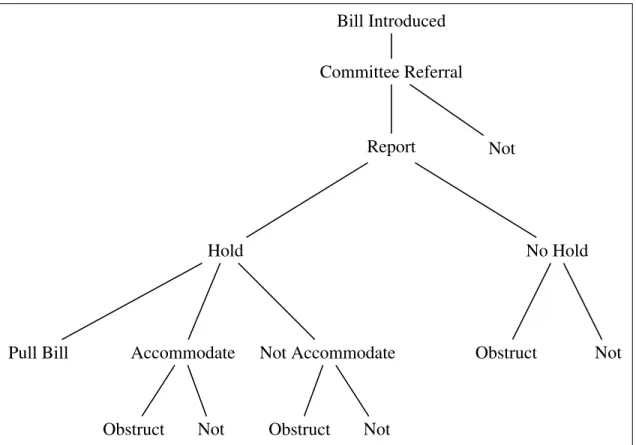
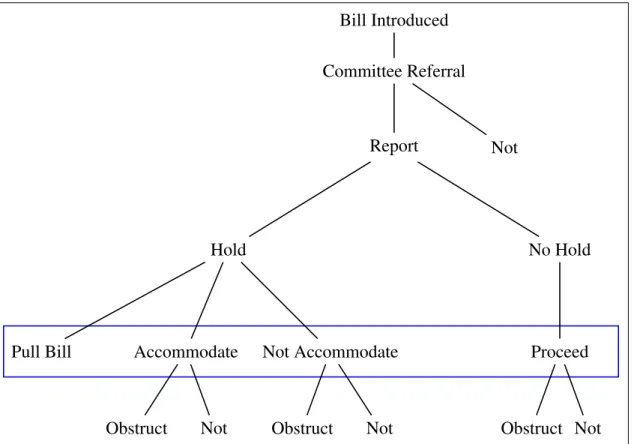
Filibusters, while widely discussed and publicly known, are the end point of the ob-struction process. Multiple other actors make decisions before a filibuster is observed, and I look at the earlier decision of when holds are used to test potential effects of obstruction. To illustrate this difference in approach and focus, Figure 2.2 lays out the obstructive pro-cess. I also make two assumptions about the process’ early stages. First, senators desire to have policy made at their ideal point and will introduce legislation which accomplishes this goal. Second, committees carefully vet all legislation within their defined jurisdiction. Thus, bills that reach the floor are roughly representative of their sponsor and have a chance of passing the Senate.
Figure 2.2 shows that after being received by party leaders from committees and placed on the calendar, senators choose whether to or not to place a hold on the specific piece of legislation at this point.6 While different types of holds are undoubtedly important, and I return to this distinction later in this chapter and dissertation, I choose not to focus on it at
Figure 2.2: Process of Obstruction
Bill Introduced
Committee Referral
Report
Hold
Pull Bill Accommodate
Obstruct Not
Not Accommodate
Obstruct Not
No Hold
Obstruct Not
Not
this point for purposes of clarity while returning to it in later sections.7 Leaders then choose a strategy with which to respond to senators’ holding behavior. If a hold is not observed, the bill is introduced on the floor.8 When senators place holds on a bill, the choice leaders face becomes more complex. Leaders can either choose to pull a bill targeted by a hold from the calendar, move forward with the bill after offering some accommodation to holding senators, or proceed with the bill in its current form by ignoring the hold.9 This choice
7Howard and Roberts (2015) provide extensive treatment of this data and how hold types are distributed across Congresses.
8While undoubtedly an oversimplification, its purpose is twofold. First, filibuster discussions primarily center upon this path, often implicitly assuming holds kill bills. Second, while interest groups, caucuses, and time pressures may push items off the agenda, the focus here is on the connection between senator behavior and leader response.
primarily depends on the action desired, the availability of time, and importance of the legislation. After either of the last two strategies, the bill is placed on the floor and senators choose whether or not to obstruct on the floor.10 Finally, the bill passes or not given the results of the previous stage and its level of support.
Obstructionist research primarily focuses on the No Hold-Obstruct path, as it is as-sumed that this is the path through which observable filibusters occur. Apparent in Figure 2.2 is that this stage, as well as all others, exists as part of a larger process of consideration. That is, while filibusters are valuable means through which senators can register observable objection and are important in their own right, the presence of a filibuster is tied to the pres-ence of a hold. Thus, to understand how floor obstruction occurs we must first understand what is likely to be obstructed before a bill ever reaches the floor.
Unlike much previous research, the question here is not “who places hold letters?” but rather “what is held and why?” A senator prefers to have policy made at her ideal point, regardless of institutional rules or passage procedures. The difficulty in this is that each senator insisting on her ideal point creates unstable political environments (Gilligan and Krehbiel 1987; Krehbiel 1991). More ideologically extreme members hold more often, but this tells us little about what is targeted by holds (Howard and Roberts 2015; Evans and Lipinski 2005). Additionally, while rules changes alter the utility of public filibusters, this tells us little about what is likely to be targeted (Wawro and Schickler 2006, 2004; Koger 2010; Binder and Smith 1997). What I undertake here is to look at how obstruction is utilized on a bill-by-bill basis. Thus, the central question of this chapter is what aspects of a piece of legislation make it more and less likely that it is targeted for obstruction?
2.1.1 Bills Targeted by Holds
The process outlined in Figure 2.2 provides several avenues for legislative consideration and objection. Not every bill that comes up for consideration on the floor will be targeted by objection through holds. Senators must perceive a benefit to placing holds in some situations rather than others – implying that the action has consequences and costs – and leaders cannot successfully construct compromise bills to prevent holds. Holds are indeed observed on legislation, but only on approximately 15% of Senate originated bills reported from committee. Thus, holds occur on a regular basis, but are not utilized as a blanket strategy by members.11 Understanding what drives this variation in hold usage provides a key insight into how senators view bills.
The rationale for senators obstructing individual legislation lies in senators knowing their own interests. While party affiliation may guide many procedural actions on the floor, a senator’s personal policy interests extend beyond simply supporting the party. A senator has legislation she prefers to be made into law, and will take actions to see this happen. Additionally, she has a general worldview that dictates the bills supported and opposed. A senator prefers legislation similar to her own interests and will oppose legislation she dislikes.
I assume a senator desires to have policy made at her ideal point, and is more likely to favor a bill as its content approaches this ideal point.12 Thus, a senator will be more likely to obstruct a given piece of legislation as the ideal point of the policy moves further away from the senator’s ideal point. If, as in the discussion above, we assume that the sponsor introduces policy which maximizes personal policy benefits, then the distinction is between the ideal point of sponsor and the ideal point of the possibly obstructing senator. As the distance between the sponsor’s ideal point and obstructing senator’s ideal point decreases,
11In what follows I build on – but differ in focus from – Krehbiel (1985), which focuses on why an individual member holds a given bill due to logrolling across bills.
12Both linear loss functions ( |x
a bill should be less likely to be held.
Hypothesis 1: As a bill sponsor’s ideology becomes further from a senator’s, holds will be
more likely.
More widely supported bills should be more likely to pass the chamber, with greater support on both procedural motions and final passage votes. Bills following the process shown in Figure 2.2 with a percentage of senators potentially greater than a majority in favor of this bill makes the bill likely to be approved by the chamber median and the supermajority pivot (Krehbiel 1998). This legislation should also be more likely to be the target of holds, however. Opposing senators know that if the bill comes to the floor they will have to obstruct through actions such as filibusters in order to prevent passage – and may lose even with a filibuster. Opposing senators thus engage in pre-floor obstruction on more widely supported Senate bills to prevent them from reaching the floor at all. Leaders, seeing a hold, may decide the bill is not worth managing potential floor objection, even if this objection is likely to be overcome. Thus, while more popular legislation should be more likely to be put on the floor, it is also more likely to be targeted by holds.
Hypothesis 2: As visible support for a bill increases, holds will be more likely.
Time becomes more scarce, and any individual action consumes a larger percentage of remaining time. Any action a senator takes will have a greater effect on the probability a bill she prefers will be considered. Obstruction compounds this time scarcity, with time-killer objection consuming increasingly scarce time that could be used to consider their own legislation. Thus the chance of considering a bill depends more heavily on the senator’s own obstructionist actions. The senator engaging in obstructionist activity has a higher probability of her preferred legislation becoming part of the obstructed backlog due to her own actions. Without changing any of the direct costs of obstruction, such as public visibility and leader recalcitrance, the costs of engaging in obstruction increase as time decreases.
Hypothesis 3: Holds will be more likely on bills introduced early in a Congress.
Finally, bill content presents useful information to senators beyond sponsor details. Separate classes of legislation exist simultaneously in Congress. The most obvious example is ceremonial legislation, such as post office renamings, versus non-ceremonial legislation, such as the Affordable Care Act.13 Legislation that deals with more issues is more likely to be held, as there are more areas on which senators can alter and object. More senators have interests represented in these bills, and thus the probability that one chooses to place a hold increases. Bills with broader implications are more likely to be considered in a few specified and higher profile committees, such as the Government Affairs and Judiciary Committees.14
Hypothesis 4: Bills referred to higher profile committees will be more likely to be targeted
by holds.
In short, senators are perceived to be knowledgeable about both their interests and how exercising their procedural prerogatives alters these interests. What drives their obstructive
13Holds on reported ceremonial bills are rare, with only one in the 95th (1977-1978) and 97th (1981-1982) Congresses combined.
behavior is a combination of bill-specific parameters and institutional circumstance. The specifics of the sponsor, a bill’s popularity, consideration time remaining, and the general bill content pushes members to perceive bills differently. They know that placing a hold causes leaders to react certain ways depending upon these things as well, and adjust their strategy accordingly (Ainsworth and Flathman 1995). With this theoretical basis in place, I now move to translating this theory into observable metrics.
2.2 Research Design
To test the theory outlined above I utilize a dataset of holds I gathered from the Robert J. Dole Archive and a set of holds gathered by Evans and Lipinski (2005) from the Howard Baker Archive to explore this process. This dataset provides a record of holds placed by Republicans in the 95th, 97th, and 99th-104th Congresses. These data provide a summary of the target of the hold, the day the hold was placed, and the general type of hold, providing for a general test of hold dynamics.15
This available holds data relates only to Republican holds. This implies that Sponsor Ideologymeasured through first dimension DW-NOMINATE should be negatively related
to hold placement. Thus, asSponsor Ideologyincreases – becomes more conservative – the probability of a hold on a bill should decrease. Treating sponsors as important actors in bill content and viability requires several controls for sponsors, including Sponsor Seniority
and Sponsor Committee Leader status. Translating visible support is far more direct, as the number ofCosponsorsprovides a close corollary to if a bill is likely to pass (Krehbiel 1998). I also consider time as a steadily decreasing function, with Months Remaining
serving as this proxy.16
15For the 97th and 99th-104th Congresses I have additional information based on the letters. Much of this detail is presented in Howard and Roberts (2015), and some of this will be utilized later in this paper. I utilize the 95th Congress, but acknowledge the lack of letters shown in Figure 2.1.
Choosing how to treat bill content through committee referral proves far less clear. Sev-eral options for this exist, but I begin with the committee classification system provided by Deering and Smith (1997).17 This approach utilizes both the observed behavior of senators through their requests to serve on specific committees and the types of policies committees produce in order to generate categories of committees.18 APolicy Committeeis the highest profile type of committee in which a bill can be considered, thus I utilize a dummy variable for all bills considered in this type of committee.
Also important to consider for both content effects and possible popularity measures is the presence ofMultiple Referralfor bills. These bills should be more likely to receive holds, as they have been considered by a wider range of senators before reporting to party leaders, and therefore opposing senators may believe these bills are more likely to pass. Additionally, this helps control for consideration in non-high profile committees. Finally, I employ controls for institutional circumstances for both the chamber,Republican Majority
and whether a bill has aMajority Sponsor.
2.3 Results
As this study concerns itself with what is held and what affects this behavior the unit of observation will be the individual bill rather than the individual senator. Furthermore, I re-strict my analysis to only Senate originated bills which have been reported from committee, as discussed above with Figure 2.2.19 These are the bills most likely to pass as they have been carefully vetted and approved by committees.20 Holds speak to a senator’s perception
17Two alternatives, controlling for referral to a specific committee through a series of dummy variables and controlling for referral to any category of committee provided by Deering and Smith, exist. Each approach has appeal, but my approach provides a more specific test of the theoretical mechanism with only marginal loss in specific information.
18Policy committees in Deering and Smith (1997) are: Budget, Foreign Relations, Governmental Affairs, Judiciary, and Labor. Several studies have utilized a similar approach to generating categories of committees, including Fenno (1973).
19I focus on “S type” Senate bills which must be passed by both the Senate and House and signed by the president to become laws in the following analysis.
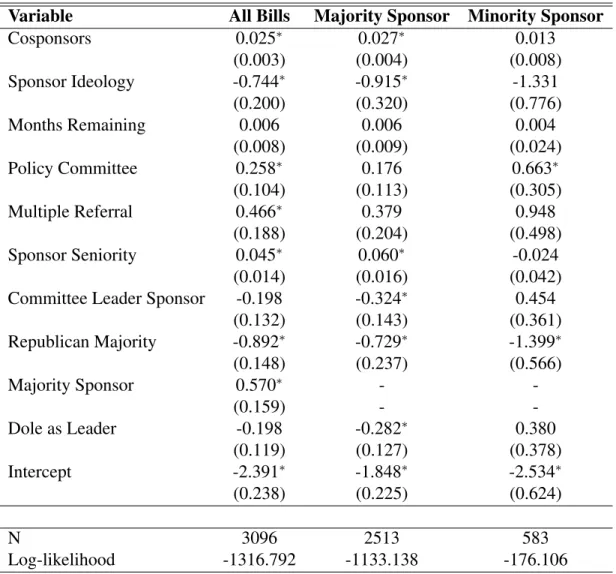
of a bill relative to her own priorities and perceptions, and focusing on bills more likely to pass the chamber accounts for this logic. Table 2.1 provides results for models related to what bills are held. The outcomes variable is Table 2.1 is if a bill received a hold or not, and each bill is a separate observation. Thus, each coefficient in Table 2.1 provides the relationship between the associated covariate and the presence – or absence – of a hold.
Table 2.1: Senate Bills Subject to a Hold
Variable All Bills Majority Sponsor Minority Sponsor
Cosponsors 0.025⇤ 0.027⇤ 0.013
(0.003) (0.004) (0.008)
Sponsor Ideology -0.744⇤ -0.915⇤ -1.331
(0.200) (0.320) (0.776)
Months Remaining 0.006 0.006 0.004
(0.008) (0.009) (0.024)
Policy Committee 0.258⇤ 0.176 0.663⇤
(0.104) (0.113) (0.305)
Multiple Referral 0.466⇤ 0.379 0.948
(0.188) (0.204) (0.498)
Sponsor Seniority 0.045⇤ 0.060⇤ -0.024
(0.014) (0.016) (0.042)
Committee Leader Sponsor -0.198 -0.324⇤ 0.454
(0.132) (0.143) (0.361)
Republican Majority -0.892⇤ -0.729⇤ -1.399⇤
(0.148) (0.237) (0.566)
Majority Sponsor 0.570⇤ -
-(0.159) -
-Dole as Leader -0.198 -0.282⇤ 0.380
(0.119) (0.127) (0.378)
Intercept -2.391⇤ -1.848⇤ -2.534⇤
(0.238) (0.225) (0.624)
N 3096 2513 583
Log-likelihood -1316.792 -1133.138 -176.106
Note:Estimates are from an logistic regression model. The outcome variable is coded1if the bill was targeted by a hold0if it was not. Standard errors in parentheses.⇤=p0.05.
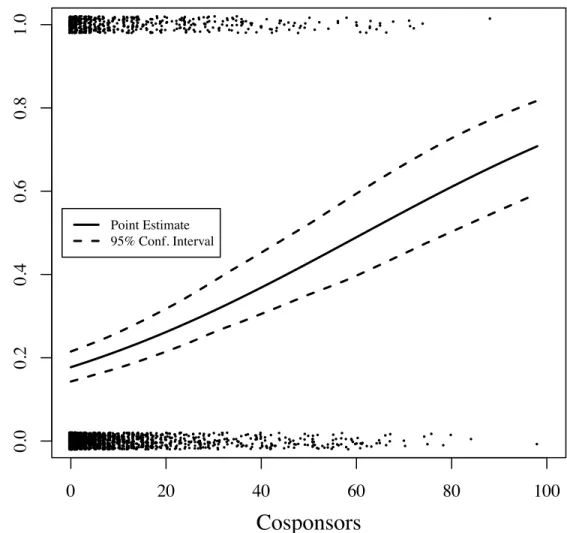
probability that a bill is targeted by a hold, on average. This can be seen graphically in Figure 2.3. Moving from one standard deviation below the mean number of cosponsors to one standard deviation above the mean number of cosponsors makes holds 8% more likely. In short, when a greater number of senators approve of a bill, and the bill is perhaps more likely to pass, holds are more likely to be observed on that bill.
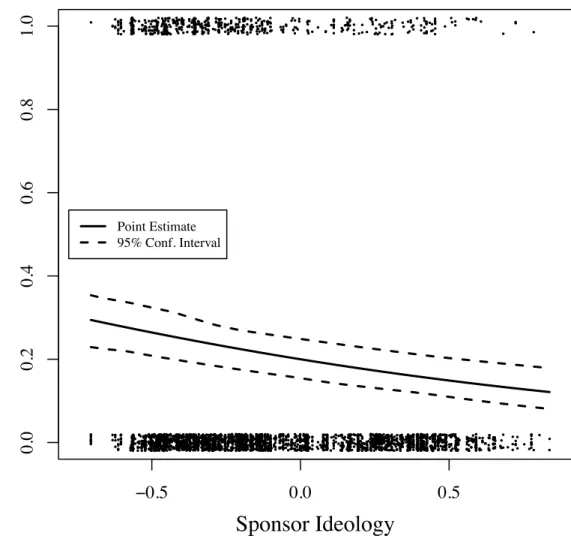
The effects of Sponsor Ideology, measured through DW-NOMINATE, also follows the
above theory. Table 2.1 demonstrates that as a sponsor’s ideology increases, or becomes more conservative, Republicans are less likely to place a hold on this bill. Figure 2.4 demonstrates that as bill sponsors become more conservative, and therefore more like a randomly selected Republican on average, they are less likely to have holds target their bills. Senators are less likely to hold bills whose sponsors are more like themselves, as these bills are more preferred.
The effect of committee type for all Senate bills reported from committee provides clear results, as the effect for Policy Committee is positive and statistically significant. Thus, bills referred to these higher profile committees are more likely to be targeted by holds on average. Senators are more likely to use holds on bills considered in these committees, implying a difference in how obstruction is used across different levels of salience. Bills considered in policy committees are 3.4% more likely to be held than bills considered in other committees. While this result cannot speak to differences across individual bills, the relationship between committee consideration and obstruction usage speaks to how senators perceive obstruction as tool to shape consideration.21
Having moreMonths Remainingbetween a bill’s introduction and the end of a Congress has no statistically significant effect on the probability of a hold on the bill. This non-significant result is not due to the difference between the sessions, as inserting a dummy
Figure 2.3: Effect of Cosponsors on Probability A Bill is Held
0 20 40 60 80 100
0.0 0.2 0.4 0.6 0.8 1.0 ● ● ● ● ● ● ● ●● ● ● ● ● ● ● ●● ● ●● ● ● ● ●● ● ● ● ● ● ● ● ● ● ● ● ● ● ● ● ● ● ● ● ● ● ● ● ● ● ● ● ● ●● ● ● ● ● ● ● ● ● ● ● ● ● ● ● ● ● ● ● ● ● ● ● ● ● ● ● ● ● ● ● ● ● ● ● ● ● ● ● ● ● ● ● ● ●● ● ● ● ● ● ● ● ● ● ● ● ● ● ● ● ● ● ● ● ● ● ● ● ● ● ● ● ● ● ● ● ● ● ● ● ● ● ● ● ● ● ● ● ● ● ● ● ● ● ● ● ● ● ● ● ● ● ● ● ● ● ● ● ● ● ● ● ●● ● ● ● ● ● ●● ● ● ● ● ●● ● ● ● ● ● ● ● ● ● ● ● ●● ● ● ● ● ● ● ● ● ● ● ● ● ● ● ● ● ● ● ● ● ● ● ● ● ● ● ● ● ● ● ● ● ● ● ● ● ● ●● ● ● ● ● ● ● ● ● ● ●● ● ● ● ● ● ●●● ● ● ● ● ● ● ● ● ● ● ● ● ● ● ● ● ● ● ● ● ● ● ● ● ● ● ● ● ● ● ● ● ● ● ● ● ● ● ● ● ● ● ● ●● ● ● ● ● ● ● ● ● ● ● ● ● ● ● ● ● ● ● ● ● ● ● ● ● ● ● ● ● ● ● ● ● ● ● ● ● ● ● ● ● ● ● ● ● ● ● ● ● ● ● ● ● ● ●● ●● ● ● ● ● ● ● ● ● ● ● ● ● ● ● ● ● ● ● ●● ● ●● ● ● ● ● ● ● ● ● ● ● ● ● ● ● ● ● ● ● ● ● ● ● ● ● ● ● ● ● ● ● ● ● ● ● ● ● ● ● ● ● ●● ● ● ● ● ● ● ● ● ● ●● ● ● ● ● ● ● ● ● ● ●● ● ● ● ● ● ● ● ● ● ● ● ● ● ● ● ● ● ● ● ● ● ● ● ● ● ● ● ● ● ● ● ● ● ● ● ● ● ● ● ● ● ● ● ● ● ● ● ● ● ● ● ● ● ● ● ● ● ● ● ● ● ● ● ● ● ● ● ●● ● ● ● ● ● ● ● ● ● ● ● ● ● ● ● ● ● ● ● ● ● ● ● ● ● ● ● ● ● ● ● ● ● ●● ● ● ● ● ● ● ● ● ● ● ● ● ● ● ● ● ●● ● ● ● ● ● ● ● ● ● ● ● ● ● ● ● ● ● ● ● ● ● ● ● ● ● ● ● ● ● ●●● ● ● ● ● ● ●● ● ● ● ● ● ● ● ● ● ● ● ● ● ● ● ●● ● ● ● ● ● ● ● ● ● ● ● ● ● ●● ● ● ●● ● ● ● ● ● ● ● ● ● ● ● ● ● ● ●● ● ● ● ● ● ● ● ● ● ● ● ● ● ● ● ● ● ● ● ● ● ● ● ● ● ● ●● ● ● ● ● ● ●● ● ● ● ● ● ● ● ● ● ● ● ● ● ● ● ● ● ● ● ● ● ● ● ●● ● ● ● ● ● ● ● ● ● ● ● ● ● ●● ●● ● ● ● ● ● ● ● ● ● ● ● ● ● ●● ● ● ●● ● ● ● ● ● ● ● ● ● ● ●● ● ● ● ● ●● ● ● ● ● ● ● ● ● ● ● ● ● ● ● ● ● ● ● ● ● ● ● ● ● ● ● ● ● ● ● ● ● ● ● ● ● ● ● ● ● ● ● ● ● ● ● ● ● ● ● ● ● ● ● ● ● ● ●● ● ● ● ● ● ● ● ● ● ● ● ● ● ● ● ● ● ● ● ● ●● ●● ● ● ● ● ● ● ● ● ● ● ●● ●● ● ● ● ● ● ● ● ● ● ● ● ● ● ● ● ● ● ● ● ● ● ● ● ● ● ● ● ● ● ● ● ● ● ● ● ● ● ● ● ● ● ● ● ● ● ● ● ● ● ● ● ● ● ● ● ● ● ● ● ● ● ● ● ● ● ● ● ● ● ● ● ● ● ● ● ● ● ● ● ● ● ● ● ● ● ● ● ● ● ● ● ● ● ● ● ● ● ● ● ● ● ● ● ● ● ● ● ● ● ● ● ● ● ● ● ● ● ● ● ● ● ● ● ● ● ● ● ● ● ● ● ● ● ● ● ● ● ● ● ● ● ● ● ● ● ● ● ● ● ● ● ● ● ● ● ● ● ● ● ● ● ● ● ● ● ● ● ● ● ● ● ● ● ● ● ● ● ● ● ● ● ● ● ● ● ● ● ● ● ● ● ● ● ● ● ● ● ● ● ● ● ● ● ● ● ● ● ● ● ● ● ● ● ● ● ● ● ● ● ● ● ● ● ● ● ● ● ● ● ● ● ● ● ● ● ● ● ● ● ● ● ● ● ●● ● ● ● ● ● ● ● ● ● ● ● ● ● ● ● ● ● ● ● ● ● ● ● ● ● ●● ● ● ● ● ● ● ● ● ● ● ● ● ● ● ● ● ● ● ● ● ● ● ● ●● ● ● ● ● ● ● ● ● ● ● ● ● ● ● ● ● ● ● ● ● ● ● ● ● ● ● ● ● ● ● ● ● ● ● ● ● ● ● ● ● ● ● ● ● ● ● ● ● ● ● ● ● ● ● ● ● ● ● ● ● ● ● ● ● ● ● ● ● ● ● ● ● ● ●● ● ● ● ● ● ● ● ● ● ● ● ● ● ● ●● ● ● ● ● ● ● ● ● ● ● ● ● ● ● ● ● ● ● ● ● ● ● ● ● ● ● ● ●● ● ● ● ● ● ● ● ● ● ● ● ● ● ● ● ● ● ● ● ● ● ● ● ● ● ● ● ● ● ● ● ● ● ● ● ● ● ● ● ● ● ● ● ● ● ● ● ● ● ● ● ● ● ● ● ● ● ● ● ● ● ● ● ● ● ● ● ● ● ● ● ● ● ● ● ● ● ● ● ● ● ● ● ● ● ● ● ● ● ● ● ● ● ● ● ● ● ● ● ● ● ● ● ● ● ● ● ● ● ● ● ● ● ● ● ● ● ● ● ● ● ● ● ● ● ● ● ● ● ● ● ● ● ● ● ● ● ● ● ●● ● ● ● ● ● ● ● ● ● ● ● ● ● ● ● ● ● ● ● ● ● ● ● ● ● ● ● ● ● ● ● ● ● ● ● ● ● ● ● ● ● ● ● ● ● ● ● ● ● ● ● ● ● ● ● ● ● ● ● ● ● ● ●● ●● ● ● ●● ● ● ● ● ● ● ● ● ● ● ● ● ● ● ● ● ● ● ● ● ● ● ● ● ● ● ● ● ● ● ● ● ● ● ● ● ● ● ● ● ● ● ● ● ● ● ● ● ● ● ● ● ● ● ● ● ● ● ● ● ● ● ● ● ● ● ● ● ● ● ● ● ● ● ● ● ● ● ● ● ● ● ● ● ●● ● ● ● ● ● ● ● ● ● ● ● ● ● ● ● ● ● ● ● ● ● ● ● ● ● ● ● ● ● ● ● ● ● ●● ● ● ●● ● ● ● ● ● ● ● ● ● ● ● ● ● ● ● ● ● ● ● ● ● ● ● ● ● ● ● ● ● ● ● ● ● ● ● ●● ● ● ● ● ● ● ● ● ● ● ● ● ● ● ● ● ● ● ●● ● ● ● ● ●● ● ● ● ● ● ● ● ● ● ● ● ● ● ● ● ● ● ● ●● ● ● ● ● ● ● ●● ● ● ● ● ● ● ● ● ● ● ● ● ● ● ● ● ● ●● ● ● ● ● ● ● ● ● ● ● ● ● ● ● ● ● ● ● ● ● ● ● ● ● ● ● ● ● ● ● ● ● ● ● ● ● ● ● ● ● ● ● ● ● ● ● ● ● ● ● ● ● ● ● ● ● ● ● ●● ● ● ● ● ● ● ● ● ● ● ● ● ● ● ● ● ● ● ● ● ● ● ● ● ● ● ●● ● ● ● ● ● ● ● ● ● ● ● ● ● ● ● ● ● ● ● ● ● ● ● ● ● ● ● ● ● ● ● ● ● ● ● ● ● ● ● ● ● ● ● ● ● ● ● ● ● ● ● ● ● ● ● ● ● ● ● ● ● ● ● ● ● ● ● ● ● ● ● ● ● ● ● ● ● ● ● ● ● ● ● ●● ● ● ● ● ● ● ● ● ● ● ● ● ● ● ● ● ● ● ●● ● ● ● ● ● ● ● ● ● ● ● ● ● ● ● ● ● ● ● ● ● ● ● ● ● ● ● ● ●● ●● ● ● ●● ● ● ● ● ● ● ● ● ● ● ● ● ● ● ● ● ● ● ● ● ● ● ● ● ● ● ● ● ● ● ● ● ● ● ● ● ● ● ● ● ● ● ● ● ● ● ● ● ● ● ● ● ● ● ● ● ● ● ● ● ● ● ● ● ● ● ● ● ● ● ● ● ● ● ● ● ● ● ● ● ● ● ● ● ● ● ● ● ● ● ●● ● ● ● ● ● ● ● ● ● ● ● ●● ● ● ● ● ● ●●● ● ● ● ● ● ● ● ● ● ● ● ● ● ● ● ● ● ● ● ● ● ● ● ● ●● ● ● ● ● ● ● ● ● ● ● ● ● ● ● ● ● ● ● ● ● ● ● ● ● ● ● ● ● ● ● ● ● ● ● ● ● ● ●● ● ● ● ● ● ● ● ● ● ● ● ● ● ● ● ● ● ● ● ● ● ● ● ● ● ● ● ● ● ● ● ● ● ● ● ● ● ● ● ● ● ● ● ● ● ● ● ● ● ● ● ● ● ● ● ● ● ● ● ● ● ● ● ● ● ● ● ● ● ● ● ●● ● ● ● ● ● ● ● ● ● ● ● ● ● ● ● ● ● ● ● ● ● ● ● ●● ● ● ● ● ● ● ● ● ● ● ● ● ● ● ● ● ● ● ● ● ● ● ● ● ● ● ● ● ● ● ● ● ● ● ● ●● ● ● ● ● ● ● ● ● ● ● ● ● ● ● ● ● ● ● ● ● ● ● ● ● ● ● ● ● ● ● ● ● ● ● ● ● ● ● ● ● ● ● ● ● ● ● ● ● ● ● ● ● ● ● ● ● ● ● ● ● ● ● ● ● ● ● ● ● ● ● ● ● ● ● ● ● ● ● ● ● ● ● ● ● ● ● ● ● ● ● ● ● ● ● ● ● ● ● ● ● ● ● ● ●● ● ● ● ● ● ● ● ● ● ● ● ● ● ● ● ● ● ● ● ● ● ● ● ● ● ● ● ● ● ● ● ● ● ● ● ● ● ● ● ● ● ● ● ● ● ● ● ● ● ● ● ● ● ● ● ● ● ● ● ● ● ● ● ● ● ● ● ● ● ● ● ● ● ●● ● ● ● ● ● ●● ● ● ● ● ● ● ● ● ● ● ● ● ● ● ● ● ● ● ● ● ● ● ● ● ● ● ● ● ● ● ● ● ● ● ● ● ● ● ● ● ● ● ● ● ● ● ● ● ● ● ● ● ● ● ● ● ● ●● ● ● ● ● ● ● ● ● ● ● ● ● ● ● ● ● ● ● ● ● ● ● ●● ● ● ● ● ● ● ● ● ● ● ● ● ● ● ● ● ● ● ● ● ● ● ● ● ● ● ● ● ●● ● ● ● ● ● ● ● ● ● ● ● ● ● ● ● ● ● ● ● ● ● ● ● ● ● ● ● ● ● ● ● ● ● ● ● ● ● ● ● ● ● ● ● ● ● ● ● ● ● ● ● ● ● ● ● ● ● ● ● ● ● ● ● ●● ● ● ● ● ● ● ● ● ● ● ● ● ● ● ● ● ● ● ● ● ● ● ● ● ● ● ● ● ● ● ● ●● ● ● ● ● ● ● ● ● ● ● ● ● ● ● ● ● ● ●● ● ● ● ● ● ● ● ● ● ● ● ● ● ● ● ● ● ● ● ● ● ● ● ● ● ● ● ● ● ● ● ● ● ● ● ● ● ● ● ● ● ● ● ● ● ● ● ● ● ● ● ● ● ● ● ● ● ● ● ● ● ● ● ● ● ● ● ● ● ● ● ● ● ● ● ● ● ● ● ● ● ● ● ● ● ● ● ● ● ● ● ● ● ● ● ● ● ● ● ●● ● ● ● ● ● ● ● ● ● ● ● ● ● ● ● ● ● ● ● ● ● ● ● ● ●● ● ● ● ● ● ● ● ● ● ● ● ● ● ● ● ● ● ● ● ● ● ● ● ● ● ● ● ● ● ● ● ●●● ● ● ● ● ● ● ● ● ● ● ● ● ● ● ● ● ● ● ● ● ● ● ● ● ● ● ● ● ● ● ● ● ● ● ● ● ● ● ● ● ● ● ● ● ● ● ● ● ●● ● ● ● ● ● ● ● ● ● ● ● ● ● ● ● ● ●● ● ● ● ● ●● ● ● ● ● ● ● ● ● ● ● ● ● ● ● ● ● ● ● ● ● ● ● ● ● ● ● ● ● ● ● ● ● ● ● ● ● ● ● ● ● ● ● ● ● ● ● ● ● ● ● ● ● ● ● ● ● ● ● ● ● ● ● ● ● ● ● ● ● ● ● ● ● ● ● ● ● ● ● ● ●●● ● ● ● ● ● ● ● ● ● ● ● ● ● ● ● ● ● ● ● ● ● ● ● ● ● ● ● ● ● ● ● ● ● ● ● ● ● ● ● ● ● ● ● ● ● ● ● ● ● ● ● ● ● ● ● ● ● ● ● ● ● ● ● ● ● ●● ● ● ● ● ● ● ●● ● ● ● ● ● ● ● ● ● ●● ● ● ●● ● ● ● ● ● ● ● ●● ● ●● ● ● ● ● ● ● ● ● ● ● ● ● ● ● ● ● ● ● ● ● ● ● ● ● ● ● ● ● ● ● ● ● ● ● ● ● ● ● ● ● ● ● ● ● ● ● ● ● ●● ● ● ● ● ● ● ● ● ● ● ●● ●●● ● ● ● ● ● ● ● ● ● ● ● ● ● ● ● ● ● ● ● ● ● ● ●● ● ● ● ● ● ● ● ● ● ● ● ● ● ● ● ● ● ● ● ● ● ● ● ● ● ● ● ● ● ● ● ● ● ● ● ● ● ● ● ● ● ● ● ● ● ● ● ● ● ● ● ● ● ● ● ● ● ● ● ● ● ● ● ● ● ● ● ● ● ● ● ● ●● ● ● ● ● ● ● ● ● ● ● ● ● ● ● ● ● ● ● ● ● ● ● ● ● ●
Predicted Probability of Hold
Cosponsors
Figure 2.4: Effect of Sponsor Ideology on Probability A Bill is Held
−0.5 0.0 0.5
0.0 0.2 0.4 0.6 0.8 1.0 ● ● ●● ● ● ● ● ● ● ● ● ● ● ● ● ● ● ● ● ● ● ● ● ● ● ● ● ● ● ● ● ● ● ● ● ● ● ● ● ● ● ● ● ● ● ● ● ● ● ● ● ● ● ● ● ● ● ● ● ● ● ● ● ● ● ● ● ● ● ● ● ● ● ● ● ● ● ● ● ● ● ● ● ● ● ● ● ● ● ● ● ● ● ● ● ● ● ● ● ● ● ● ● ● ● ● ● ● ● ● ● ● ● ● ● ● ● ● ● ● ● ● ● ● ● ● ● ● ● ● ● ● ● ● ● ● ● ● ● ● ● ● ● ● ● ● ● ● ● ● ● ● ● ● ● ● ● ● ● ● ● ● ● ● ● ● ● ● ● ● ● ● ● ● ● ● ● ● ● ● ● ● ● ● ● ● ● ● ● ● ● ● ● ● ● ● ● ● ● ● ● ● ● ● ● ● ● ● ● ● ● ● ● ● ● ● ● ● ● ● ● ● ● ● ● ● ● ● ● ● ● ● ● ● ● ● ● ● ● ● ● ● ● ● ● ● ● ● ● ● ● ● ● ● ● ● ● ● ● ● ● ● ● ● ● ● ● ● ● ● ● ● ● ● ● ● ● ● ● ● ● ● ● ● ● ● ● ● ● ● ● ● ● ● ● ● ● ● ● ● ● ● ● ● ● ● ● ● ● ● ● ● ● ● ● ● ● ● ● ● ● ● ● ● ● ● ● ● ● ● ● ● ● ● ● ● ● ● ● ● ● ● ● ● ● ● ● ● ● ●● ● ● ● ● ● ● ● ●● ● ● ● ● ● ● ● ● ● ● ● ● ● ● ● ● ● ● ● ● ● ● ● ● ● ● ● ● ● ● ● ● ● ● ● ● ● ● ● ● ● ● ● ● ● ● ● ● ● ● ● ● ● ● ● ● ● ● ● ● ● ● ● ● ● ● ● ● ● ● ● ● ● ● ● ● ● ● ● ● ● ● ● ● ● ● ● ● ● ● ● ● ● ● ● ● ● ● ●● ● ● ● ● ● ● ● ● ● ● ● ● ● ● ● ● ● ● ● ● ● ● ● ● ● ● ● ● ● ● ● ● ● ● ● ● ● ● ● ● ● ● ● ● ● ● ● ● ● ● ● ● ● ● ● ● ● ● ● ● ● ● ● ● ● ● ● ● ● ● ● ● ● ● ● ● ● ●● ● ● ● ● ● ● ● ● ● ● ● ● ● ● ● ● ● ● ● ● ● ● ● ● ● ● ● ● ● ● ● ● ● ● ● ● ● ● ● ● ● ● ● ● ● ● ● ● ● ● ● ● ● ● ● ● ● ● ● ● ● ● ● ● ● ● ● ● ● ● ● ● ● ● ● ● ● ● ● ● ● ● ● ● ● ● ● ● ● ● ● ● ● ● ● ● ● ● ● ● ● ● ● ● ● ● ● ● ● ● ● ● ● ● ● ● ● ● ● ● ● ● ● ● ● ● ● ● ● ● ● ● ● ● ● ● ● ● ● ● ● ● ● ● ● ● ● ● ● ● ● ● ● ● ● ● ● ● ● ● ● ● ● ● ● ● ● ● ● ● ● ● ● ● ● ● ● ● ● ●● ● ● ● ● ● ● ● ● ● ● ● ● ● ● ● ● ● ● ● ● ● ● ● ● ● ● ● ● ● ● ● ● ● ● ● ● ● ● ● ● ● ● ● ● ● ● ● ● ● ● ● ● ● ● ● ● ● ● ● ● ● ● ● ● ● ● ● ● ● ● ● ● ● ● ● ● ● ● ● ● ● ● ● ● ● ● ● ● ● ● ● ● ● ● ● ● ● ● ● ● ● ● ● ● ● ● ● ● ● ● ● ● ● ● ● ● ● ● ● ● ● ● ● ● ● ● ● ● ● ● ● ● ● ● ● ● ● ● ● ● ● ● ● ● ● ● ● ● ● ● ● ● ● ● ● ● ● ● ● ● ● ● ● ● ● ● ● ● ● ● ● ● ● ● ● ● ● ● ● ● ● ● ● ● ● ● ● ● ● ● ● ● ● ● ● ● ● ● ● ● ● ● ● ● ● ● ● ● ● ● ● ● ● ● ● ● ● ● ● ● ● ● ● ● ● ● ● ● ● ● ● ● ● ● ● ● ● ● ● ● ● ● ● ● ● ● ● ● ● ● ● ● ● ● ● ● ● ● ● ● ● ● ● ● ● ● ● ● ● ● ● ● ● ● ● ● ● ● ● ● ● ● ● ● ● ● ● ● ● ● ● ● ● ● ● ● ● ● ● ● ● ● ● ● ● ● ● ● ● ● ● ● ● ● ● ● ● ● ● ● ● ● ● ● ● ● ● ● ● ● ● ● ● ● ● ● ● ● ● ● ● ● ● ● ● ● ● ● ● ● ● ● ● ● ● ● ● ● ● ● ● ● ● ● ● ● ● ● ● ● ● ● ● ● ● ● ● ● ● ● ● ● ● ● ● ● ● ● ● ● ● ● ● ● ● ● ● ● ● ● ● ● ● ● ● ● ● ● ● ● ● ● ● ● ● ● ● ● ● ● ● ● ● ● ● ● ● ● ● ● ● ● ● ● ● ● ● ● ● ● ● ● ● ● ● ● ● ● ● ● ● ● ● ● ● ● ● ● ● ● ● ● ● ●● ● ● ● ● ● ● ● ● ● ● ● ●● ● ● ● ● ● ● ● ● ● ● ● ● ● ● ● ● ● ● ● ● ● ● ● ● ● ● ● ● ● ● ● ● ● ● ● ● ● ● ● ● ● ● ● ● ● ● ● ● ● ● ● ● ● ● ● ● ● ● ● ● ● ● ● ● ● ● ● ● ● ● ● ● ● ● ● ● ● ● ● ● ● ● ● ● ● ● ● ● ● ● ● ● ● ● ● ● ● ● ● ● ● ● ● ● ● ● ● ● ● ● ● ● ● ● ● ● ● ● ● ● ● ● ● ● ● ● ● ● ● ● ● ● ●● ● ● ● ● ● ● ● ● ● ● ● ● ● ● ● ● ● ● ● ● ● ● ● ● ● ● ● ● ● ● ● ● ● ● ● ● ● ● ● ● ● ● ● ● ● ● ● ● ● ● ● ● ● ● ● ● ● ● ● ● ● ● ● ● ● ● ● ● ● ● ● ● ● ● ● ● ● ● ● ● ● ● ● ● ● ● ● ● ● ● ● ● ● ● ● ● ● ● ● ● ● ● ● ● ● ● ● ● ● ● ● ● ● ● ● ● ● ● ● ● ● ● ● ● ● ● ● ● ● ● ● ● ● ● ● ● ● ● ● ● ● ● ● ● ● ● ● ● ● ● ● ● ● ● ● ● ● ● ● ● ● ● ● ● ● ● ● ● ● ● ● ● ● ● ● ● ● ● ● ● ● ● ● ● ● ● ● ● ● ● ● ● ● ● ● ● ● ● ● ● ● ● ● ● ● ● ● ● ● ● ● ● ● ● ● ● ● ● ● ● ● ● ● ● ● ● ● ● ● ● ● ● ● ●● ● ● ● ● ● ● ● ● ● ● ● ● ● ● ● ● ● ● ● ● ● ● ● ● ● ● ● ● ● ● ● ● ● ● ● ● ● ● ● ● ● ● ● ● ● ● ● ● ● ● ● ● ● ● ● ● ● ● ● ● ● ● ● ● ● ● ● ● ● ● ● ● ● ● ● ● ● ● ● ● ● ● ● ● ● ● ● ● ● ● ● ● ● ● ● ● ● ● ● ● ● ● ● ● ● ● ● ● ● ● ● ● ● ● ● ● ● ● ● ● ● ● ● ● ● ● ● ●● ● ● ● ● ● ● ● ● ● ● ● ● ● ● ● ● ● ● ● ● ● ● ● ● ● ● ● ● ● ● ● ● ● ● ● ● ● ● ● ● ● ● ● ● ● ● ● ● ● ● ● ● ● ● ● ● ● ● ● ● ● ● ● ● ● ● ● ● ● ● ● ● ● ● ● ● ● ● ● ● ● ● ● ● ● ● ● ● ● ● ● ● ● ● ● ● ● ● ● ● ● ● ● ● ● ● ● ● ● ● ● ● ● ● ● ● ● ● ●● ● ● ● ● ● ● ● ● ● ● ● ● ● ● ● ● ● ● ● ● ● ● ● ● ● ● ● ● ● ● ● ● ● ● ● ● ● ● ● ● ● ● ● ● ● ● ● ● ● ● ● ● ● ● ● ● ● ● ● ● ● ● ● ● ● ● ● ● ● ● ● ● ● ● ● ● ● ● ● ● ● ● ● ● ● ● ● ●● ● ● ● ● ● ● ● ● ● ● ● ● ● ● ● ● ● ● ● ● ● ● ● ● ● ● ● ● ● ● ● ● ● ● ● ● ● ● ● ● ● ● ● ● ● ● ● ● ● ● ● ● ● ● ● ● ● ● ● ● ● ● ● ● ● ● ● ● ● ● ● ● ● ● ● ● ● ● ● ● ● ● ● ● ● ● ● ● ● ● ● ● ● ● ● ● ● ● ● ● ● ● ● ● ● ● ● ● ● ● ● ● ● ● ● ● ● ● ● ● ● ● ● ● ● ● ● ● ● ● ● ● ● ● ● ● ● ● ● ● ● ● ● ● ● ● ● ● ● ● ● ● ● ● ● ● ● ● ● ● ● ● ● ● ● ● ● ● ● ● ● ● ● ● ● ● ● ● ● ● ● ● ● ● ● ● ● ● ● ● ● ● ● ● ● ● ● ● ● ● ● ● ● ● ● ● ● ● ● ● ● ● ● ● ● ● ● ● ● ● ● ● ● ● ● ● ● ● ● ● ● ● ● ● ● ● ● ● ● ● ● ● ● ● ● ● ● ● ● ● ● ● ● ● ● ● ● ● ● ● ● ● ● ● ● ● ● ● ● ● ● ● ● ● ● ● ● ● ● ● ● ● ● ● ● ● ● ● ● ● ● ● ● ● ● ● ● ● ● ● ● ● ● ● ● ● ● ● ● ● ● ● ● ● ● ● ● ● ● ● ● ● ● ● ● ● ● ● ● ● ● ● ● ● ● ● ● ● ● ● ● ● ● ● ● ● ● ● ● ● ● ● ● ● ● ● ● ● ● ● ● ● ● ● ● ● ● ● ● ● ● ● ● ● ● ● ● ● ● ● ● ● ● ● ● ● ● ● ● ● ● ● ● ● ● ● ● ● ● ● ● ● ● ● ● ● ● ● ● ● ● ● ● ● ● ● ● ● ● ● ● ● ● ● ● ● ● ● ● ● ● ● ● ● ● ● ● ● ● ● ● ● ● ● ● ● ● ● ●● ● ● ● ● ● ● ● ● ● ● ● ● ● ● ● ● ● ● ● ● ● ● ● ● ● ● ● ● ● ● ● ● ● ● ● ● ● ● ● ● ● ● ● ● ● ● ● ● ● ● ● ● ● ● ● ● ● ● ● ● ● ● ● ● ● ● ● ● ● ● ● ● ● ● ● ● ● ● ● ● ● ● ● ● ● ● ● ● ● ● ● ● ● ● ● ● ● ● ● ● ●● ● ● ● ● ● ● ● ● ● ● ● ● ● ● ● ● ● ● ● ● ● ● ● ● ● ● ● ● ● ● ● ● ● ● ● ● ● ● ● ● ● ● ● ● ● ● ● ● ● ● ● ● ● ● ● ● ● ● ● ● ● ● ● ● ● ● ● ● ● ● ● ● ● ● ● ● ● ● ● ● ● ● ● ● ● ● ● ● ● ● ● ● ● ● ● ● ● ● ● ● ● ● ● ● ● ● ● ● ● ● ● ● ● ● ● ● ● ● ● ● ● ● ● ● ● ● ● ● ● ● ● ● ● ● ● ● ● ● ● ● ● ● ● ● ● ● ● ● ● ● ● ● ● ● ● ● ● ● ● ● ● ● ● ● ● ● ● ● ● ● ● ● ● ● ● ● ● ● ● ● ● ● ● ● ● ● ● ● ● ● ● ● ● ● ● ● ● ● ● ● ● ● ● ● ● ● ● ● ● ● ● ● ● ● ● ● ● ● ● ● ● ● ● ● ● ● ● ● ● ● ● ● ● ● ● ● ● ● ● ● ● ● ● ● ● ● ● ● ● ● ● ● ● ● ● ● ● ● ● ● ● ● ● ● ● ● ● ● ● ● ● ● ● ● ● ● ● ● ● ● ● ● ● ● ● ● ● ● ● ● ● ● ● ● ● ● ● ● ● ● ● ● ● ● ● ● ● ● ● ● ● ● ● ● ● ● ● ● ● ● ● ● ● ● ● ● ● ● ● ● ● ● ● ● ● ● ● ● ● ● ● ● ● ● ● ● ● ● ● ● ● ● ● ● ● ● ● ● ● ● ● ● ● ● ● ● ● ● ● ● ● ● ● ● ● ● ● ● ● ● ● ● ● ● ● ● ● ● ● ● ● ● ● ● ● ● ● ● ● ● ● ● ● ● ● ● ● ● ● ● ● ● ● ● ● ● ● ● ● ● ● ● ● ● ● ● ● ● ● ● ● ● ● ● ● ● ● ● ● ● ● ● ● ● ● ● ● ● ● ● ● ● ● ● ● ● ● ● ● ● ● ● ● ●● ● ● ● ● ● ● ● ● ● ● ● ● ● ● ● ● ● ● ● ● ● ● ● ● ● ● ● ● ● ● ● ● ● ● ● ● ● ● ● ● ● ● ● ● ● ● ● ● ● ● ● ● ● ● ● ● ● ● ● ● ● ● ● ● ● ● ● ● ● ● ● ● ● ● ● ● ● ● ● ● ● ● ● ● ● ● ● ● ● ● ● ● ● ● ● ● ● ● ● ● ● ● ● ● ● ● ● ● ● ● ● ● ● ● ● ● ● ● ● ● ● ● ● ● ● ● ● ● ● ● ● ● ● ● ● ● ● ● ● ● ● ● ● ● ● ● ● ● ● ● ● ● ● ● ● ● ● ● ● ● ● ● ● ● ● ● ● ● ● ● ● ● ● ● ● ● ● ● ● ● ● ● ● ● ● ● ● ● ● ● ● ● ● ● ● ● ● ● ●● ● ● ● ● ● ● ● ● ● ●●● ● ● ● ● ● ● ● ● ● ● ● ● ● ● ● ● ● ● ● ● ● ● ● ● ● ● ● ● ● ● ● ● ● ● ● ● ● ● ● ● ● ● ● ● ● ● ● ● ● ● ● ● ● ● ● ● ● ● ● ● ● ● ● ● ● ● ● ● ● ● ● ● ● ● ● ● ● ● ● ● ● ● ● ● ● ● ● ● ● ● ● ● ● ● ● ● ● ● ● ● ● ● ● ● ● ● ● ● ● ● ● ● ● ● ● ● ● ● ● ● ● ● ● ● ● ● ● ● ● ● ● ● ● ● ● ● ● ● ● ● ● ● ● ● ● ● ● ● ● ● ● ● ● ● ● ● ● ● ● ●
Predicted Probability of Hold
Sponsor Ideology
Point Estimatevariable for each session does not affect this result.22 A likely explanation for this non-statistically significant effect is that senators face cross-pressures when considering time. A senator knows that any bill she obstructs is less likely to pass the chamber, but will also lower the time remaining to consider her own legislation. These cross-pressures likely lead to inconsistent behavior across legislation, providing this non-statistically significant result.
Multiple Referred bills are more likely to be targeted by holds than bills considered in
a single committee, all else constant. That is, even controlling for policy committee con-sideration and level of public support, bills considered within more than one committee are more likely to be obstructed by Republicans. These bills have been approved by a greater number of senators, as they have been considered by multiple committees. Consideration in multiple committees increases the probability of a hold on the bill by 7%. A senator opposing this legislation understands that this bill is more likely to pass the chamber due to increased support from institutional gatekeepers. This senator will act to prevent consider-ation and stop passage, as increased vetting and approval may lead to increased support in a floor vote.23 This result is again indicative that senators act to protect their interests and object to bills they oppose which are more likely to pass.
The controls also present interesting results. Bills with an institutionally powerful Com-mittee Leader Sponsor pushing for passage are no more likely to be obstructed than bills
with non-committee leader sponsors. While increased consideration from multiple commit-tees considering legislation makes holds more likely, the committee position for sponsors has no statistically significant effect. However, greater Sponsor Seniority for bills does make them more likely to be targeted by holds, on average. Thus the potential power for a sponsor does have some effect, but may lie more in the sponsor’s perceived place within
the Senate than her institutional power.
Bills are less likely to held by Republicans when there is a Republican Majoritythan with a Republican minority. A senator is more likely to agree with legislation introduced by members of her own party. A higher percentage of bills will be both sponsored by members of her party and reported from committee when in the majority. As a senator will act less against legislation they support, holds should be less frequent on bills introduced when Republicans are in the majority. Thus this finding fits with expectations about preferences and parties.
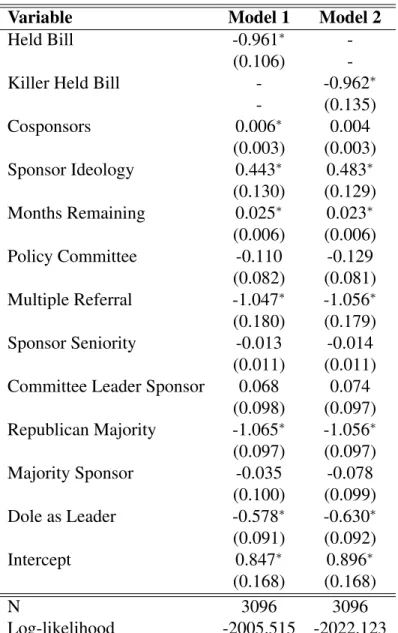
Additionally, bills with aMajority Sponsor are more likely to be the target of a hold, on average. This is most likely due to one of two processes. First, majority party bills are likely to be more numerous as there are more members, but this is unlikely to explain this finding. The alternate possibility is that, as Den Hartog and Monroe (2011) find, majority parties and majority party members have a fundamental advantage in Senate legislative consideration. Bill opponents know that majority sponsored legislation is more likely to pass the chamber due to this advantage, and will be more likely to place a hold on this bill. This corroboration of previous findings related to majority party advantage led to a splitting of the data between majority party sponsored and minority party sponsored legis-lation.24 These results are presented in Columns 2 and 3 of Table 2.1. The primary interest here are similarities – and differences – between Republican senators targeting legislation across majority and minority sponsorship.
The effects of public support for a bill are consistent across both majority and minority sponsored legislation, and corresponds with the finding for all bills. Adding one additional
Cosponsorto a bill increases the probability that said bill is targeted by a hold, on average,
for both majority and minority sponsored legislation. This effect only reaches statistical significance for majority sponsored legislation, however. More popular legislation is more