The Role of Alexithymia in Interoceptive Contributions to Acute Stress
Ava Liccione
University of North Carolina at Chapel Hill Spring 2020
A thesis submitted to the faculty of The University of North Carolina at Chapel Hill in partial fulfillment of the requirements for the Honors Program in the Department Psychology and Neuroscience.
Advisor ____________________ Kristen A. Lindquist, PhD
Reader ____________________ Karen M. Gil, PhD
Reader & Graduate Advisor ____________________
Acknowledgments
Abstract
Informed by the theory of constructed emotion, this thesis explored how people’s beliefs about their internal bodily or interoceptive signals might interact with and be mediated by alexithymia (difficulty identifying and understanding emotions) in predicting subjective and physiological changes during acute stress. Across two sessions, 250 healthy young adults completed measures of interoceptive beliefs and alexithymia and also underwent the Trier Social Stress Test (TSST) to induce acute psychosocial stress. Participants’ cardiac reactivity was measured before, during, and after the TSST. Immediately after the TSST, participants reported what emotions, cognitive appraisals, and somatic sensations they experienced during the stressor. Bivariate correlations revealed that, in particular, body trust beliefs (how much individuals trusted their bodily signals) were negatively associated with alexithymia. Using hierarchical regression analyses, I also found that body trust beliefs predicted less intense negative, high arousal emotions from the TSST. There was also a significant interaction between body trust beliefs and
It takes little effort to recall a time when we felt stressed, and most of us can easily rattle off a list of our own individual stressors. Numerous products, from aromatherapy to weighted blankets, are sold every day with the promise of combating stress. However, growing scientific evidence also demonstrates that prolonged stressors can negatively shape downstream diseases and mental well-being. For example, stress exposure increases the risk for several chronic physical and mental health problems, such as rheumatoid arthritis (Cutolo & Straub, 2006), depression (Kendler, Karkowski, & Prescott, 1999; Monroe et al., 2007), cardiovascular disease (Kivimäki et al., 2006), and chronic pain (Loeser & Melzack, 1999), as well as accelerated biological aging and premature mortality (Epel et al., 2004; Holt-Lunstad, Smith, &
Layton, 2010).
Although stress is a familiar and likely personal concept for most people, defining the precise nature and mechanisms of “stress” continues to pose significant scientific challenges (Epel et al., 2018). Stress researchers have long sought to characterize the types of situations that tend to evoke stressful experiences, including situations where there are high demands on the individual and a certain amount of unpredictability or uncontrollability (Koolhaas et al., 2011; Jamieson, Nock, & Mendes, 2012). Similarly, long-standing work in psychology emphasizes the role of appraisals, rumination, and coping behaviors in determining how intense and prolonged the emotional experience of “stress” is (Jamieson et al., 2012, 2018; Lazarus & Folkman, 1984). However, this literature on stress appraisals largely focuses on how individuals make meaning of their ability to cope with situational demands.
their heart rate reactivity (Stewart, Buffett-Jerrott, & Kokaram, 2001; Yoris et al., 2015; Zoellner & Craske, 1999).
In addition to interoceptive beliefs, which could alter how individuals react to and manage their physiology during a stressor, other work from affective science suggests that the richness of people’s concept knowledge about emotions may be another important factor in shaping both the stress experience and coping behaviors. Alexithymia, a subclinical disorder characterized by difficulty identifying and interpreting one’s emotions, represents a deficit in emotion concept knowledge (Lindquist & Barrett, 2008). Indeed, studies have long known that alexithymia can intensify distress during a stressor and can also increase the likelihood of developing stress-related disorders (Martin & Pihl, 1985, 1986a, 1986b; Martin et al., 1986).
However, no work to date has looked at how interoceptive beliefs and alexithymia could work hand in hand to exacerbate individuals’ distress in the face of stress. Specifically, this thesis explores the role of alexithymia in moderating and/or mediating the association of interoceptive beliefs on both subjective stress (i.e., negative, high arousal emotions) and physiological stress (i.e., cardiovascular reactivity) during an acute stressor.
Knowing your body: The role of interoceptive beliefs in stress
sensitivity, they might still score very low, such that they are not that accurate in perceiving their bodily signals (Garfinkel et al., 2014).
Ultimately, interoceptive beliefs may be especially important for people’s emotional and stress experiences, in part because these beliefs might shape how people try to cope or manage their physiology and other reactions to the situation. There are also strong theoretical justifications for why interoceptive beliefs (as well as impoverished emotion concept knowledge or alexithymia) should matter for people’s emotions. Specifically, the theory of constructed emotion proposes that all mental states, including emotions, are psychological events that are constructed ad hoc from the brain’s predictions, including afferent, interoceptive information from the periphery, incoming sensory information from the environment or current situation, and critically, accumulated concept knowledge and beliefs about emotions and the body (Barrett, 2017; Lindquist, MacCormack, & Shablack, 2015. Therefore, interoceptive beliefs are likely another important “ingredient” in the construction of people’s subjective emotion experiences, including during a stressor. These beliefs likely help inform one’s appraisal of a given affective experience is, including stress intensity (MacCormack, 2020).
Interoceptive beliefs have been previously assessed across two domains: (1) how much people think that they notice and pay attention to their interoceptive sensations—known as body attention beliefs, and (2) how much people believe that interoceptive sensations are beneficial and trustworthy, versus difficult and misleading—known as body trust beliefs. These two different types of beliefs are typically measured through self-report questionnaires such as the Multidimensional Assessment of Interoceptive Awareness Questionnaire (MAIA; Mehling et al., 2012), and the Body Awareness Questionnaire (BAQ; Shields, Mallory, & Simon, 1989). The MAIA includes items that assess both attention and trust beliefs, whereas the BAQ only includes items that assess body attention beliefs.
more exaggerated insular and thalamic activation during an acute stressor (Haase et al., 2016). Another recent study shows that individuals with higher MAIA reports have higher trait anxiety (Palser et al., 2018), but this study confounded attention and trust beliefs, so it is unclear whether one or both types of beliefs are related to trait anxiety. Altogether, although researchers have begun to explore the nature of interoceptive beliefs about bodily attention and trust, there is still very little work that has tested what role these beliefs may have for the stress experience. This thesis will address this gap in the literature by first disentangling the relations of attention and trust beliefs with self-reported emotions and cardiovascular reactivity during an acute stressor.
The role of alexithymia in stress
Alexithymia is often comorbid with other affect-based psychopathologies (Zamariola et al., 2018), and alexithymic individuals are much more likely to under-report experiencing emotions, over-report experiencing somatic sensations (known as somatization), score lower on scales of emotional intelligence, and be at a higher risk for substance abuse issues (Bailey & Henry, 2007; Mattila et al., 2008; Parker, Taylor, & Bagby, 2001; Taylor, Bagby, & Parker, 1991). In the context of stress, individuals with alexithymic tendencies tend to report higher subjective arousal during a stressor and greater difficulty regulating their emotions in the face of stress (Connelly & Denney, 2007; Friedlander et al., 1997). Interestingly, individuals with alexithymia tend to develop somatic disorders, including
hypochondriasis, wherein individuals are more likely to emphasize the physiological or arousal aspects of their affective feelings and report more physical maladies when distressed (Komaki, 2013; Palser et al., 2018). During acute stressors, this heightened focus on bodily sensations manifests as an overestimation of one’s psychophysiological reactivity. For example, in one study of 100 college students during a stress induction, those who scored higher on the TAS-20 reported high subjective stress but displayed less heart rate reactivity compared to less alexithymic participants (Koci et al., 2016). This heightened, but
inaccurate, reporting of physiological symptoms in the context of stress may however be driven in part by difficulties in interoception or internal bodily awareness and how individuals make meaning of their physiological sensations as either emotions (e.g., feeling stressed, anxious, angry) or somatic symptoms (e.g., headache, difficulty breathing).
associated with greater trait anxiety, and that this relationship was partially mediated by greater alexithymia (Palser et al., 2018). As such, alexithymia appears to be an important mediator whereby interoceptive beliefs—whether negative or positive—can impact anxiety and distress. Although it remains unclear whether attention or trust beliefs matter more for alexithymia and the stress response and in what direction, altogether these findings suggest that what individuals believe about their interoceptive
sensations may indeed play a role in how difficult or easy it is for individuals to distinguish between and make meaning more broadly of their affective states as emotions. As such, this thesis examines how attention and/or trust beliefs relate to the three different facets of alexithymia and also how attention and trust beliefs may interact with and even be mediated by alexithymia in the context of people’s emotions and cardiovascular changes during acute stress.
The Present Study
Altogether, previous literature suggests that alexithymia may in part by explained by interoceptive difficulties which, in turn, leads individuals with alexithymia to not clearly identify or distinguish between their emotions. However, it still remains unclear exactly how interoceptive beliefs and alexithymia might work on their own or together in explaining the emotional and cardiovascular dimensions of the acute stress response. This thesis examines how alexithymia may moderate and/or mediate the effects of interoceptive beliefs (attention and trust) on the stress response, which I have primarily operationalized as negative, high arousal emotion self-reports and cardiovascular reactivity. I also examine self-reported negative appraisals and somatic sensations as secondary measures of the acute stress response. In an initial session, participants completed questionnaires assessing interoceptive beliefs and alexithymia. In a follow-up session, participants completed an acute stress paradigm (the Trier Social Stress Task or TSST; Kirschbaum, Pirke, & Hellhammer, 1993). We collected continuous measures of cardiovascular reactivity before, during, and after the TSST. Immediately after the stressor, participants also reported on their subjective stress experience.
alexithymia mediates the effect of maladaptive body beliefs on stress. I hypothesized that greater body attention and body trust beliefs will be negatively associated with greater stress responses
(operationalized as reported negative, high arousal emotion, reported somatic intensity, self-reported negative stress appraisals, and cardiovascular reactivity). I also hypothesized that greater alexithymia would be positively associated with greater stress responses. Specifically, I predicted that greater alexithymia would weaken the relationship between high interoceptive beliefs and stress, such that the presence of alexithymia might undermine the protective relationship that trusting and paying attention to one’s body may have against stress. Similarly, because interoceptive beliefs were measured on a single scale with high/low ratings, this hypothesis can be reversed, such that greater alexithymia would
exacerbate the relation between low interoceptive beliefs and stress. Although correlational, this research provides valuable insight into how interoceptive beliefs and alexithymia may work together to relate to the in vivo psychological and physiological dimensions of the acute stress experience.
Method Participants
We collected data from 250 undergraduate students (57% female) at the University of North Carolina at Chapel Hill who were enrolled in PSYC101 at the time of their participation. As
compensation for their participation, students received course credit. Participants ranged from 17 to 29 years old, with an average of 19 years of age. See Table 1 for sample characteristics.
Participants signed up for both Sessions 1 and 2 via the department’s online Sona Participant Pool. Participants were excluded from the study if they were not native English speakers, as one’s understanding and completion of tasks in the study was dependent upon fluency in the language, and because language itself is related to different ways of categorizing and organizing emotion concepts (Lindquist, 2017). Participants were also excluded if their BMI was greater than 33, or if they had a heart condition or pacemaker, as all of these factors can impede psychophysiology measurements. Participants were excluded if they had mental health disorders, including but not limited to bipolar disorder,
These participants were excluded because of the use of the TSST during Session 2 of the study, because it induces negative, high arousal mood and we did not wish to put any vulnerable populations at risk,. Additionally, this helped us control for atypical emotional, physiological, or interoceptive processes that participants with psychopathology may experience.
Participants were excluded (and rescheduled) on the day of the study if they had participated in behaviors that would compromise psychophysiological measurements. These behaviors include
consuming a large meal less than one-hour prior to their lab session, or consuming caffeine, highly surgery drinks (like juice), or alcohol less than 3 hours prior to the lab visit. Other behaviors that elicit exclusion were engaging in physical exercise enough to sweat within one-hour of their session, and habitual use of nicotine or illicit substances within two weeks of their session.
Design and Procedure
This study was a quasi-experimental and correlational, investigating how interoceptive beliefs and alexithymia relate to and interact together in the context of an acute stressor to predict subjective measures of the stress experience (emotion reports, somatic reports, appraisals) and objective
psychophysiological stress reactivity. The study consisted of two sessions, each lasting approximately two hours. Both sessions were conducted in Davie Hall 329. During Session 1, participants completed counterbalanced and randomized questionnaires in Qualtrics to assess their interoceptive beliefs and alexithymic tendencies. In Session 2, cardiac physiological reactivity was measured before (5-min baseline), during the TSST (2-min speech preparation, 10-min speech, 5-min math task), and after the TSST (5-min recovery) using electrocardiography (ECG) and impedance cardiography (ICG).
Session 1. Upon the participant’s arrival to the lab, the researcher directed the participant to a
After informed consent, participants completed several counterbalanced tasks (some not relevant to the present thesis), but of relevance to this thesis, completed self-report questionnaires on their interoceptive beliefs and alexithymia. At the end of the session, the researcher reminded and confirmed with
participants their Session 2 signup.
Session 2. Over 90% of participants returned for Session 2. Upon arrival, the researcher directed the participant into a larger private testing room with full psychophysiological equipment. As in Session 1, participants completed a Session 2 Daily Health Inventory to confirm session eligibility. Afterwards, the researcher prepared the participant for the physiology data collection and collected a 5-min baseline measure of participants’ electrocardiography and impedance cardiography. After baseline data were collected, the researcher gave the participant a Session 2 Task Consent form (as specified by the IRB). After consent, the researcher introduced the participant to the Trier Social Stress Task and the two interviewers in front of whom they would be performing.
The Trier Social Stress Task (TSST; Kirschbaum et al., 1993) is a gold-standard procedure
inducing robust acute stress experiences. We administered the full version of the TSST wherein
participants had 2-min to prepare a speech, 10-minute to perform the speech in front of two neutral
evaluative interviewers, and 5-mni to perform a difficult mental arithmetic task again in front of the
interviewers. Interviewers were white lab coats and professional clothing, maintained a neutral demeanor
throughout their interactions with the participant, and took notes on a clipboard. Interviewers first
provided participants with instructions regarding the content of the speech. Specifically, participants were
instructed to imagine that they were giving an interview for a desirable job in their chosen field of
interest, and to discuss their strengths, weakness, good and bad habits, and specific examples of their
work ethic throughout the speech. After the 2-min preparation period alone, participants performed the
10-minute speech in front of the two interviewers, who maintained neutral facial expressions and took
notes throughout the TSST. Only if the participant ran out of things to say did the interviewers prompt the
participant with questions. After the speech ended, the interviewers surprised participants with the math
possible. If the task was too easy, interviewers provided a more difficult task (i.e., count backwards from
2043 in steps of 17). If the math task was too hard (wherein the participant made six mistakes),
interviewers provided a slightly easier task (i.e., count backwards from 943 in steps of 5). Regardless of
the specific counting task assigned, all participant counted for a full five-minute duration.
Once the TSST was complete, the interviewers left the room and the researcher administered the post-TSST Qualtrics measures of subjective stress. Recovery physiology measures were also collected for five minutes while the participant completed these questionnaires. Finally, after recovery and
questionnaires were complete, the researcher removed all physiological sensors, debriefed the participant on the true aim of the study and awarded them four psychology credits for their participation.
Session 1 Measures
Interoceptive beliefs. In the present study, I was particularly interested in investigating two dimensions of interoceptive beliefs, body attention beliefs and body trust beliefs. To accomplish this, I collected data from three different self-report questionnaires that assessed one or both of these constructs.
Body attention beliefs. I created a mean score (∝= .72) to represent people’s beliefs about how much they notice and pay attention to their interoceptive sensations using the Body Awareness
Questionnaire (BAQ; Shields et al., 1989) and some subscales from the Multidimensional Assessment of Interoceptive Awareness; Mehling et al., 2012). The BAQ is an 18-item self-report measure of perceived awareness of bodily sensations (∝= .82). Responses for each item fall on a 7-point Likert scale from 1
consists of 7 items (∝= .81; e.g., “I can maintain awareness of my inner bodily sensations even when there is a lot going on around me.”). Participants responded on 6-point Likert scale from 0 (never) to 5 (always).
Body trust beliefs. I created a mean score (∝= .86) to represent people’s beliefs about how much they trust, value, and listen to their interoceptive sensations by combining two MAIA subscales with the mean score of the Bodily Signals Beliefs Questionnaire (BSBQ; see MacCormack, 2020). Specifically, I used the MAIA body listening subscale (3 items, ∝= .74; “I listen to my body to inform me about what to do”), and body trusting subscale (3 items, ∝= .70; “I trust my body sensations”). The Bodily Signal Beliefs Questionnaire includes 7 items (∝= .77) which represent negative meta-cognitive beliefs about the
value and management of interoceptive sensations, including items such as “My body is unpredictable,” “I have a hard time handling my bodily sensations,” “I believe that my body’s feelings can be
misleading,” and “Sometimes I’m afraid of my bodily feelings.” BSBQ items were rated on a 7-point Likert scale ranging from 1 (not at all true of me) to 7 (extremely true of me). Here, I reverse coded each item so that higher endorsements suggest more positive or less negative trust beliefs.
Alexithymia. Alexithymia is commonly measured with the well-validated Toronto Alexithymia Scale (TAS-20; Bagby, Parker, & Taylor, 1994). The TAS-20 is a 20-item instruments using a Likert scale of 1 (not at all) to 5 (extremely) in which each item assesses one of the three subdomains of alexithymia: difficulty describing feelings (5 items, ∝= .78), difficulty identifying feelings (7 items, ∝= .79), and externally-oriented thinking (8 items, ∝= .59). I was most focused on the difficulty identifying feelings subscale, which includes 7 items (“I am often confused about what emotion I am feeling”; “When I'm upset, I don't know if I am sad, frightened, or angry.”).
Session 2 Measures
Psychophysiology. To assess stress-related changes in psychophysiology, we collected
participants’ torso, with one electrode on the right collarbone (-) and two electrodes on the lowermost ribs (+ and ground). For ICG, two spot electrodes were placed at the top (+) and bottom (-) of the sternum and two more electrodes on the spine. ECG and ICG were continuously measured throughout a 5-min
baseline, 2-min TSST prep period, 10-min TSST speech task, 5-min TSST math task, and 5-min post-TSST recovery period as discussed above.
ECG. Heart rate or HR is one of the most common measures of psychophysiological change. It is estimated as the number of beats per minute (bpm). HR reflects activity in both the sympathetic and parasympathetic nervous system and can only be used as a general measure of cardiovascular changes.
ICG. Cardiac impedance quantifies the mechanical activation of the heart by measuring opposition to an alternating current flow within a circuit, specifically the thoracic cavity (Brownley, Hurwitz, & Schneiderman, 2000). In measures of cardiac impedance, a high frequency, low amplitude current is transmitted through the chest, and this current takes the path of least resistance through the aorta. Cardiac impedance thus measures the changes in this resistance. Pre-ejection period (PEP) is one of the gold-standard measures derived from impedance data. It is a measure of cardiac contractility, reflecting how long (in milliseconds) the time is between onset of cardiac depolarization to onset of the left ventricular contraction expelling blood from the left ventricle of the heart. Smaller PEP values suggest faster periods of cardiac contractility driven—in particular—by the sympathetic nervous system. Larger PEP values suggest slower periods of cardiac contractility, such as when individuals are more relaxed or at rest.
Self-Reported Emotions. To measure emotional experience, participants rated their emotions
using the 30-item Circumplex Positive & Negative Affect Scheduled (PANAS; Watson & Clark, 1994),
and asked participants for their appraisals of the tasks in the TSST (such as difficulty and stressfulness)
(high vs. low). This thesis particularly focused on negative, high arousal emotions (∝= .89; 15 items total), which were most likely to be induced during the TSST.
Negative Appraisals. The Negative Appraisal Questionnaire (∝= .94; see MacCormack, 2020) assessed25 different negative descriptors aimed at capturing participants’ appraisals about themselves (e.g., defeated, failure, rejected) and the broader situation (e.g., unfair, uneventful). These items were
selected to represent appraisals of personal responsibility and performance (internal attributions) vs.
appraisals about the controllability and unexpectedness of the situation (external attributions). Items were
rated on a Likert scale from 1 (not at all) to 6 (extremely).
Somatic Sensations. The Somatic Sensations Questionnaire was adapted and expanded from previous measures on somatic symptoms and autonomic sensations (e.g., Shields & Stern, 1979; Søgaard & Bech, 2009; Whitehead et al., 1977). It assesses 42 different somatic sensations (∝= .93) in which participants report on a 7-point Likert scale, ranging from 0 (“not at all”) to 6 (“extremely”), the sensations they experienced during the TSST. These sensations included cardiac changes (e.g. “heart palpitations”), gastric changes (e.g. “pit in your stomach”), respiratory changes (e.g. “rapid or difficulty breathing”), and temperature changes (e.g. “flushed or hot’).
Results
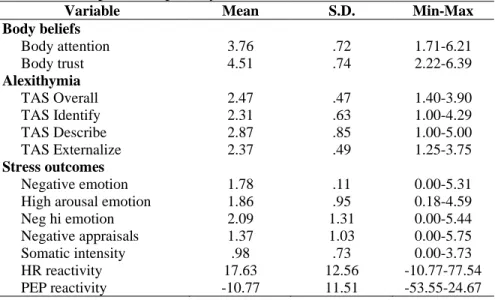
Data preparation. Session 1 had 250 participants with 232 individuals returning for Session 2 (92.8% retention rate). All variables of interest were distributed normally (see Table 1 for participant characteristics and Table 2 for descriptives), with some mild skew for the self-reported emotions and somatic sensations (i.e., people did not report extremely intense experiences). In terms of alexithymia distributions, 53.2% of our participants were not alexithymic (scores <50), 34% had borderline alexithymia scores (scores between 50-60), and 12.8% passed the clinical threshold for alexithymia (scores >60). I also visualized all data using scatterplots and histograms to identify potential outliers. Bivariate Correlations: Predictors
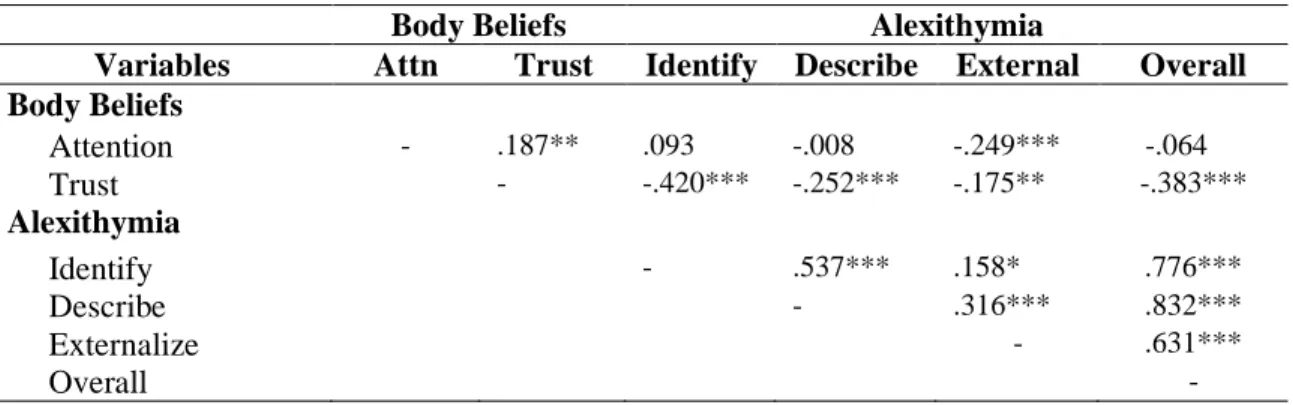
TAS-20 subscales for alexithymia (Table 3). When examining the relation between body attention and body trust beliefs, there was a significant positive association (r=.187, p=.003), such that people who report believing they notice and pay attention to their bodies more also tended to report that they trusted and listened to their bodies. When examining the intra-correlations between each of the three TAS-20 subscales, all were significantly correlated with one another (ps<.01), as would be expected given that the TAS-20 is a well-validated and widely used scale for alexithymia.
Finally, I examined the relation between body attention beliefs and alexithymia, and the relation between body trust beliefs and alexithymia. Notably, body attention beliefs were only related to the externalize subscale (r=-.249, p<.0001), but not with the identify (p=.144) or describe subscales (p=.901). Individuals who reported noticing and paying attention to their bodily sensations more were less likely to externalize their feelings and to focus on external stimuli rather than internal feelings and stimuli. On the other hand, body trust beliefs were significantly and negatively associated with all facets of alexithymia: difficulty identifying emotions (r=-.420, p<.0001), difficulty describing emotions(r=-.252, p<.0001), and externally oriented thinking (r=-.175, p=.006). This indicates that individuals with greater body trust beliefs report lower alexithymia.
Bivariate Correlations: Predictors with Demographics and TSST Outcomes
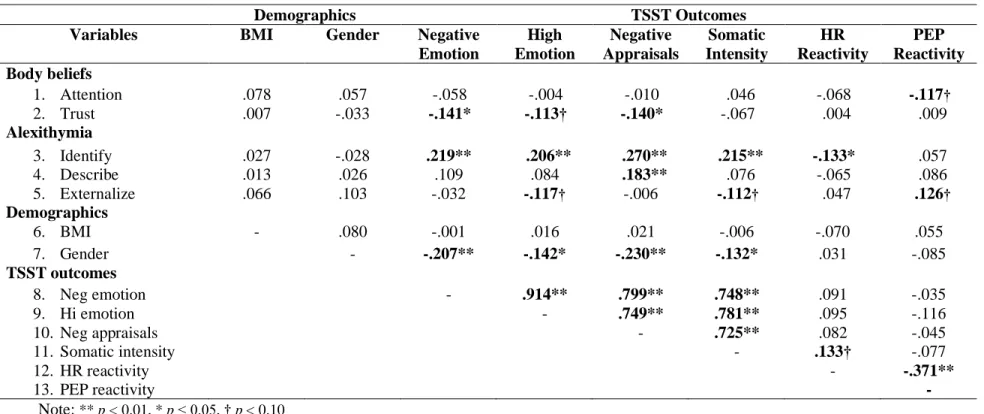
p=.048), such that females endorsed experiencing these more during the TSST than males did. However, BMI was not significantly correlated with any of the TSST outcomes.
Finally, I wanted to examine the bivariate association between my predictors of interest and the TSST outcomes. Body attention beliefs were only marginally significantly associated with PEP reactivity (r=-.117, p=.099) and had no other relations with additional outcomes. However, body trust beliefs were negatively associated with experiences of negative emotion (r=-.141, p=.035) and negative appraisals (r=-.140, p=.036), as well as a weaker, marginal association with high arousal emotion (r=-.113, p=.093). There was no association between body trust beliefs and reported somatic intensity.
Turning to the three facts of alexithymia, greater difficulty identifying emotions was associated with higher reports of negative emotion (r=.219, p=.001), high arousal emotion (r=.206, p=.002), negative appraisals (r=.270, p<.000) and somatic intensity (r=.215, p=.001). Interestingly, individuals with greater difficulty identifying emotions also had lower HR reactivity (r=-.133, p=.049). This subscale was the most predictive of stress among the TAS-20 subscales: difficulty describing emotions was only significantly associated with greater negative appraisals (r=.183, p=.006) and individuals with greater externally-oriented thinking had marginally lower reports of high arousal emotion (r=-.117, p=.082) and somatic intensity (r=-.112, p=.096), but marginally higher PEP reactivity (r=.126, p=.075).
Testing Moderation of Interoceptive Beliefs and Alexithymia
which body beliefs and alexithymia were included as predictors of stress outcomes during the TSST. In each model, we tested one of the six different stress outcomes. In the first step of each model, body beliefs were entered as predictors, then alexithymia subscales were included as the second step, gender and BMI as the third step, and interactions with body beliefs and the TAS identify subscale (the strongest alexithymic predictor) in the fourth and final step.
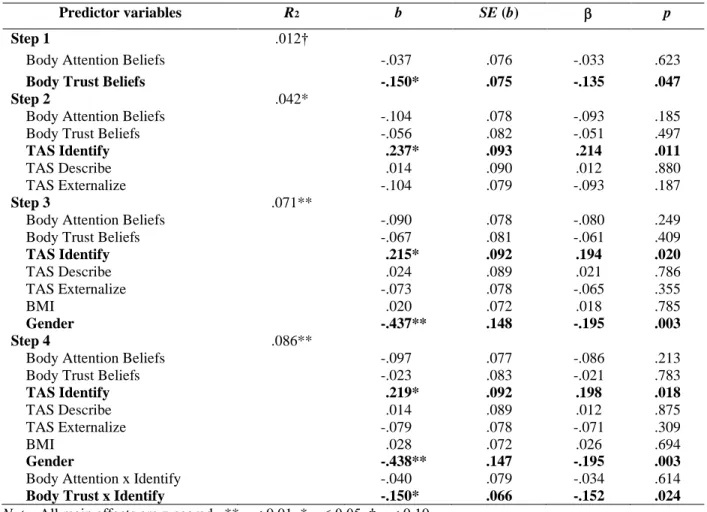
Model 1: Hierarchical regression predicting negative affect (Table 5). Step 1 with body attention and body trust beliefs was marginally significant, F(2, 220) = 2.37, p = .096, adjusted R2=.012. Only body trust beliefs predicted negative affect (b=-.150, p=.047), but not body attention beliefs (p=.623).
With the inclusion of alexithymia in the second model step, the overall model was significant, F(5, 217)= 2.95, p=.013, adjusted R2=.042. Difficulty identifying emotions significantly predicted negative affect (b=.24, p=.011), but body trust dropped from significance (p=.497). Difficulty describing emotions and externally-oriented thinking were not significant.
The third model step, with the addition of gender and BMI, was also significant, F(7, 215)=3.42, p=.002, adjusted R2=.071. In this step, difficulty identifying emotions remained significant (p=.020) as was gender (b=-.44, p=.003).
The fourth and final step included the interactions of body attention beliefs x difficulty identifying emotions and also body trust beliefs x difficulty identifying emotions. This final model was also
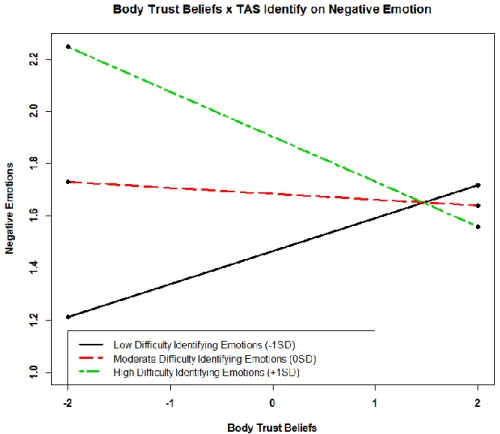
significant, F(9, 213)=3.33, p=.001, adjusted R2=.086, such that altogether, body beliefs, alexithymia, gender, BMI, and the interactions explained around 8.6% of the variance in TSST negative affect. In this final model, difficulty identifying emotions and gender remained significant predictors (bs=.22, -.44, ps=.018, .003 respectively). Additionally, there was no interaction for body attention beliefs x difficulty identifying emotions (p=.614) but there was a significant interaction of body trust beliefs x difficulty identifying emotion on negative affect (b=-.15, p=.024).
trust (see Figure 1 for interaction plot). Altogether, these models suggest that although high body trust beliefs are associated with lower negative affective feelings during the acute stressor, difficulties
identifying one’s feelings was the key driver or explainer for how negative people reported feeling. There was also an interactive effect, such that when body trust beliefs were low, individuals with greater difficulty identifying their emotions were the most likely to report more intense negative emotions from the acute stressor.
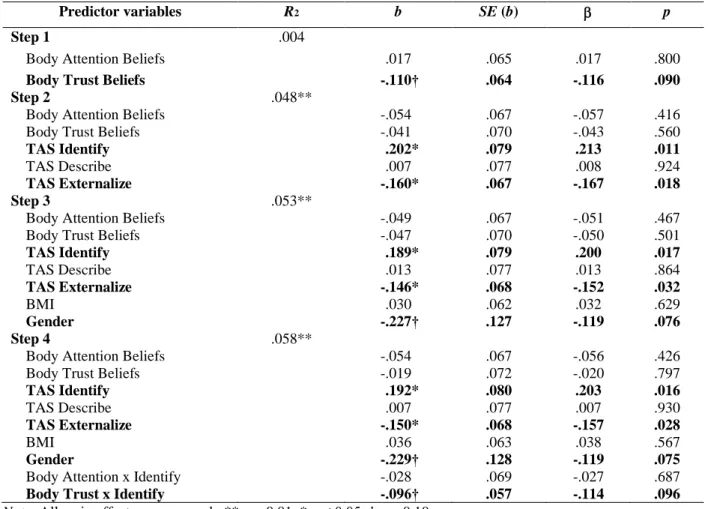
Model 2: Hierarchical regression predicting high arousal affect (Table 6). The first model step, containing body attention and trust beliefs, was not significant (p=.236). Only body trust beliefs marginally predicted high arousal affect (b=-.11, p=.090).
The inclusion of alexithymia in the second model step was overall significant, F(5, 217)= 3.22, p=.008, adjusted R2=.048. In this step, difficulty identifying emotions significantly predicted greater high arousal affective feelings (b=.20, p=.011), while externally-oriented thinking predicted lower high arousal affective feelings (b=-.16, p=.018). Body trust beliefs were no longer significant after accounting for alexithymia (p=.560).
The third model step, including gender and BMI, was also significant, F(7, 215)=2.79, p=.008, adjusted R2=.053. In this step, difficulty identifying emotions and externally-oriented thinking remained significant predictors (bs=.19, -.15, ps=.017, .032). Gender was marginally significant (b=-.23, p=.076).
arousing people reported feeling during the TSST. There was also some evidence for a possible interactive effect between body trust beliefs x difficulty identifying emotion on high arousal affect. Probing this interaction however found no significant differences in slopes.
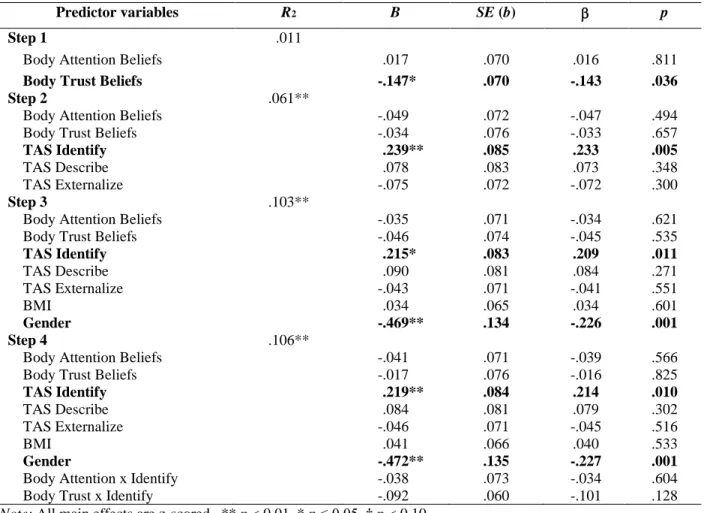
Model 3: Hierarchical regression predicting negative appraisals (Table 7). The first model step, containing body attention and trust beliefs, was not overall significant (p=.109). However, greater body trust beliefs was associated with lower negative appraisals of the stressor (b=-.15, p=.036). The relation between body attention beliefs and negative appraisals was not significant (p=.811).
The inclusion of alexithymia in the second model step was overall significant, F(5, 217)=3.87, p=.002, adjusted R2=.061. In this step, greater difficulty identifying emotions was significantly related to higher negative appraisals (b=.239, p=.005), but body trust beliefs were no longer significant (p=.657). The third model step, including gender and BMI, was also significant, F(7, 215)=4.65, p<.0001, adjusted R2=.103. In this step, difficulty identifying emotions remained significant (b=.22, p=.001) and gender emerged as another significant predictor (b=-.47, p=.001), such that females were more likely to make greater negative appraisals.
The fourth and final model step was also significant: F(9, 213)=3.93, p<.0001, adjusted R2=.106, such that altogether body beliefs, alexithymia, gender, BMI, and the interactions explained around 10.6% of the variance in TSST-related negative appraisals. Difficulty identifying emotions and gender remained significant predictors even after accounting for interactive effects (bs=.22, -.47, ps=.01, .001
respectively). However, no interactions with body beliefs were significant (ps=.604, .128).
Model 4: Hierarchical regression predicting somatic intensity (Table 8). The first model step, containing body attention and body trust beliefs, was not significant, (p=.416). Neither the relation between body trust beliefs and somatic intensity, nor the relation between body attention beliefs and somatic intensity were significant (ps=.257, .379 respectively).
reported more intense somatic experiences, such as dizziness or headache following the TSST. Externally-oriented thinking was associated with lower somatic intensity (b=-.105, p=.044).
The third step, including gender and BMI, was also significant, F(7, 215)= 2.585, p=.014, adjusted R2=.048. In this step, difficulty identifying emotions remained a significant predictor of somatic intensity (b=.171, p=.005), but externally-oriented thinking dropped to only marginal significance (b=-.093, p=.077).
The fourth and final step was also significant F(9, 213)=2.228, p= .021, adjusted R2 =.047, such that altogether body beliefs, alexithymia, gender, BMI, and the interactions explained around 4.7% of the variance in TSST-related somatic intensity. Difficulty identifying emotions remained a significant
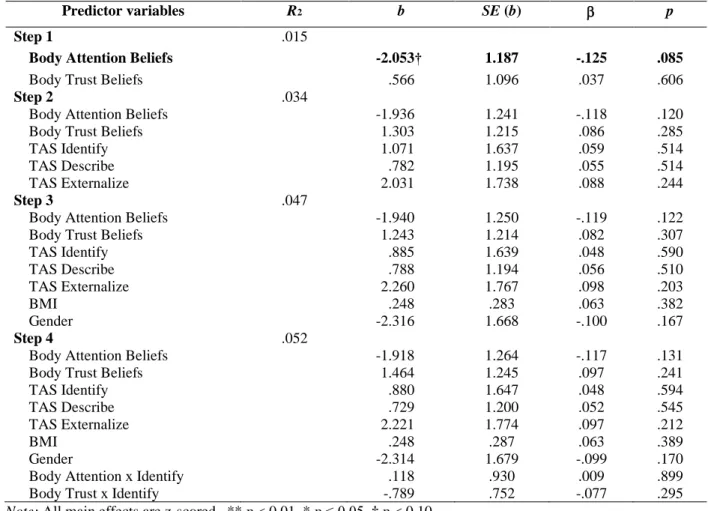
predictor (b=.167, p=.007), However, no interactions with body beliefs were significant (ps=.642, .179). Model 5: Hierarchical regression predicting heart rate reactivity (Table 9). The first model step, containing body attention and body trust beliefs, was not overall significant (p=.592). Neither body trust beliefs nor body awareness beliefs significantly predicted heartrate reactivity (ps=.811, 307).
The second model step, including alexithymia, was also not significant (p=.362). In this step, difficulty identifying emotions only marginally predicted HR reactivity (b=-1.097, p=.081), and there were no other significant predictors.
The third model step, with gender and BMI, was still not significant (p=.483). In this step, difficulty identifying emotions remained marginally significant (b=-1.865, p=.081).
In the fourth and final step, including body beliefs, alexithymia, gender and BMI, and interactions, was also not significant (p= .623). Difficulty identifying emotions also dropped from marginal significance (p=.115), and no interactions with body beliefs were significant (ps=.450, .730).
The second model step, including alexithymia, was also not significant (p=.240), and body attention beliefs dropped from significance (p=.120).
The third model step, with gender and BMI, was still not significant (p=.234). There were no significant predictors of PEP reactivity in this step.
The fourth and final step, including body beliefs, alexithymia, gender and BMI, and interactions, was also not significant (p= .324). There were still no significant predictors, and no interactions with body beliefs were significant (ps=.899, .295).
Testing Mediation of Interoceptive Beliefs and Alexithymia
Finally, given that the inclusion of alexithymia (specifically, difficulty identifying emotions) significantly reduced the explanatory power of body trust beliefs, we reasoned that difficulty identifying one’s emotions could act as a suppressor variable masking or helping mediate the effect of body trust beliefs on individuals’ stress responses. Thus, we conducted mediation modeling to examine whether difficulty identifying emotions mediates the effect of body trust beliefs on negative high arousal emotion, negative appraisals, somatic intensity, and heart rate reactivity (Figure 2). When examining the mediating effect of difficulty identifying emotions on negative, high arousal emotions, we found a significant
Turning to the psychophysiology data, we only focused on heart rate stress reactivity (relative to the within-person baseline), given that there were no effects of alexithymia on pre-ejection period
reactivity. As expected, there was a significant negative direct effect of body trust on difficulty identifying emotions (a path: b=-.41, SE=.06, p<.0001) and a significant negative direct effect of difficulty
identifying emotions on heart rate reactivity (b path: b= -1.99, SE=.92, p=.030), with no direct effect of body trust on heart rate reactivity (c path: b= -.78, SE=.91, p=.391). There was also a significant indirect (a*b) effect (b=.83, SE=.40, p=.039) but no significant total effect (b=.05, SE=.84, p=.956). These mediation models suggest that individuals with lower body trust beliefs have higher difficulties identifying emotions which is then related to lower heart rate reactivity during the stressor.
Altogether, these mediation models suggest that individuals with lower body trust beliefs exhibit higher stress responses across psychological measures (negative, high arousal emotions, negative
appraisals, reported somatic intensity), but not physiological measures such as heart rate reactivity. However, greater difficulty identifying emotions appears to be an important mediator in whether impoverished body trust beliefs translate to more negative and reactive stress responses. For example, greater difficulty identifying one’s emotions was an important mediator in greater psychological stress responses, but may have weakened the mediated negative effects of low body trust beliefs on heart rate reactivity.
Discussion
identifying emotions across the board mediated effects of low body trust beliefs on people’s psychological stress responses (e.g., reported negative and high arousal emotions, negative appraisals, somatic intensity).
One possible interpretation is that not trusting one’s interoceptive signals and sensations could make it more difficult for individuals to differentiate or identify which specific emotions and feelings they are experiencing. In this way, trusting one’s body could make it easier to engage with bodily sensations, perhaps especially during conditions of potentially aversive arousal, and in turn value these sensations as sources of emotional insight. Findings from this study are cross-sectional, so it is also possible that the reverse pattern might be true, where people who have difficulty identifying their emotions are more likely to develop distrust of their bodily signals. Below, I discuss other specific findings that this study provides on the nature of interoceptive beliefs and alexithymia in acute stress experiences.
In addition to these psychological stress effects, I found in both the bivariate correlations and mediation models that greater alexithymic tendencies (specifically, difficulties identifying one’s emotions) was related to lower heart rate reactivity, consistent with classic findings in the alexithymia stress literature (e.g., Linden, Lenz, & Stossel, 1996). This finding suggests that alexithymia likely exacerbates the psychological experience of stress despite alexithymic individuals exhibiting less physiological reactivity. Specifically, individuals with alexithymia may feel worse and more stressed even in the face of less physiological input than non-alexithymic individuals. Interoceptive beliefs, however, did not matter as much for physiological stress reactivity, at least when considering them as main effects or in interaction with alexithymia. There was however a significant mediation effect of lower body trust beliefs on heart rate reactivity via difficulty identifying emotions, indicating that interoceptive beliefs likely do matter for physiological dimensions of stress, but perhaps only via certain mediators like alexithymia. Below, I discuss findings further as well as point out important strengths, limitations, and future directions for this work. Interoceptive beliefs and alexithymia
study suggests that interoceptive beliefs may be protective against aversive stress experiences (especially psychological stress). Moreover, this protective relationship was primarily driven by body trust beliefs, more so than body attention beliefs. One possible reason for this is that body attention beliefs are fundamentally about how much you think you notice your bodily sensations—and although this sort of self-characterization may be useful for self-judgments or motivated interoceptive attention, it is likely that this sort of belief may not relevant or useful in evocative situations like an acute stressor. On the other hand, body trust beliefs are rooted in people’s evaluative schemas about the utility versus harm of bodily sensations. These value-based beliefs may be much more relevant in shaping how people (either implicitly or consciously) react to and interpret their interoceptive signals. Future research should continue to parse apart the difference between these two constructs and study their shared and/or unique contributions to affective experience and stress. For example, research should test whether body attention beliefs are more relevant in situations in which people have the attentional affordances to consciously notice and reflect on their bodily sensations, whereas body trust beliefs could be more relevant for online affective and somatic experiences, or for situations with high cognitive load.
are in direct contradiction to Pollatos et al. (2011)’s findings that greater alexithymia (N=60) was associated with lower electrodermal reactivity.
Notably, these studies all rely upon small sample sizes that are likely insufficient to reliably detect the small effect size of alexithymia in relation to stress outcomes. Also, most of these studies did not break down alexithymia into its subcomponents (although two studies did find effects specifically with difficulty describing feelings). Thus, it remains largely unclear exactly how alexithymia and its facets might interface with acute stressors. The present study demonstrates that difficulties with identifying one’s feelings mattered the most for heart rate reactivity during the stressor, and that alexithymic tendencies are related to lower heart rate reactivity, even though these individuals report more intense stress experiences and appraisals.
Finally, when looking at the relation between interoceptive beliefs and alexithymia, body attention beliefs was negatively associated with externally-oriented thinking whereas body trust beliefs was negative associated with all three alexithymic subscales. The relation between body attention beliefs and externally-oriented thinking suggest that people who don’t think they pay attention to their bodily sensations much are also more likely to report being more focused on external or situational factors in their lives, rather than internal, psychologically rich factors such as emotions. However, body trust beliefs had the clearest and strongest link with alexithymia overall. People who endorse greater distrust of their bodily signals are also more likely to report overall alexithymic difficulties. In the regression models, probing the interaction between body trust beliefs and difficulty identifying emotions further revealed a significant interaction, such that at low levels of body trust, participants with greater identification difficulties reported more negative emotion during the acute stressor than individuals low in that alexithymic facet. However, at high levels of body trust, the difference in negative emotion between low and high alexithymia in participants was not significant, demonstrating the importance of body trust beliefs for stress outcomes.
(especially difficulty identifying emotions) may be a more proximal driver of physiological reactions during stress. However, it remains possible that other facets of interoception, such as interoceptive ability as measured by the Whitehead Heartbeat Detection task, may be more relevant or important for physiological reactivity to stress, while interoceptive beliefs may be more relevant for subjective measures of affective stress. This present study also includes data from the Whitehead Heartbeat Detection task, so a next analysis step will be for us to examine how both interoceptive beliefs and interoceptive ability may interact with or be mediated by alexithymia in predicting psychological and physiological stress responses.
Finally, the mediation model best explained the relationship between body trust beliefs, difficulty identifying emotions, and stress as operationalized as negative, high arousal emotion, as well as negative appraisals, somatic intensity, and heart rate reactivity. The benefit of trusting one’s bodily sensations on acute stress was undermined when individuals had difficulty identifying their emotions. This finding suggests that clinical science could develop intervention strategies that target both body trust beliefs, as well as the identification and differentiation of one’s emotions, such as emotional granularity training, in order to improve mental health treatments for alexithymic populations. Emotional granularity is the ability to articulate emotional states with specificity and precision, and much like alexithymia, low negative emotional granularity has been associated with stronger reactivity to negative affect and higher vulnerability to poor mental health (Bamonti et al., 2010; Demiralp et al., 2012).
Limitations
Additionally, to protect against confounds, we controlled for BMI and age, such that our sample included only healthy college-aged students, with BMIs under 33, and no history of psychiatric illness. Although these were important choices to ensure the quality of our data, one downside is that findings may not generalize to other populations such as older adults or individuals with anxiety disorders. Consequently, future research should give attention to longitudinal studies that examine the development of interoceptive beliefs alongside alexithymia in early life, and how these two might similarly or
differently change across the lifespan, especially as participants experience significant changes in weight, shifts in everyday stress, and the emergence of psychopathology.
Conclusion
Acute stress is a part of daily life. Ultimately, a certain amount of physiological and subjective changes during challenging life events can be “good” in that stressful feelings are motivating (e.g., wanting to resolve the conflict or issue in order to feel less unpleasant) and physiological changes provide the body with resources to cope with situational demands (e.g., giving a speech, running away). However, when stress is unmoderated, such as in chronic life stress, or poorly managed acute stress, there are a multitude of detrimental downstream implications for mental and physical health. Consequently, research is needed to identify the factors that can mitigate, as well as exacerbate, stress responses. Two such factors are interoception and alexithymia. Although ongoing research is still focused on identifying the precise nature of the relation between interoception and stress, this thesis suggests that the interoceptive belief of body trust is protective against stress. Regarding alexithymia, many studies have identified that alexithymia is correlated with more aversive stress experiences, as well as with stress disorders,
References
Abstracts of Posters Presented at the 48th Annual Meeting of the Association for Applied
Psychophysiology and Biofeedback. Appl Psychophysiol Biofeedback 42, 147–161 (2017). https://doi.org/10.1007/s10484-017-9362-4
Bagby, R. M., Parker, J. D. A., & Taylor, G. J. (1994). The twenty-item Toronto
Alexithymia Scale: I. Item selection and cross-validation of the factor structure. Journal of Psychosomatic Research, 38(1), 23-32. http://dx.doi.org/10.1016/0022-3999(94)90005-1 Bailey, P. E., & Henry, J. D. (2007). Alexithymia, somatization and negative affect in a
community sample. Psychiatry Research, 150(1), 13-20. http://dx.doi.org/10.1016/j.psychres.2006.05.024
Bamonti, P. M., Heisel, M. J., Topciu, R. A., Franus, N., Talbot, N. L., & Duberstein, P. R. (2010). Association of alexithymia and depression symptom severity in adults aged 50 years and older. The American journal of geriatric psychiatry : official journal of the American Association for Geriatric Psychiatry, 18(1), 51–56. https://doi.org/10.1097/JGP.0b013e3181bd1bfe
Barrett, L. F. (2017) The theory of constructed emotion: an active inference account of
interoception and categorization, Social Cognitive and Affective Neuroscience, 12(1),1–23 https://doi.org/10.1093/scan/nsw154
Barrett, L. F. (2018). Emotions are constructed with interoception and concepts within a
predicting brain. In A. S. Fox, R. C. Lapate, A. J. Shackman, & R. J. Davidson (Eds.), The nature of emotion: Fundamental questions (2nd ed., pp. 33–38). New York: Oxford University Press. Barrett, L. F., & Russell, J. A. (1999). The Structure of Current Affect: Controversies and
Emerging Consensus. Current Directions in Psychological Science, 8(1), 10– 14. https://doi.org/10.1111/1467-8721.00003
Berntson, G. G., Quigley, K. S., & Lozano, D. (2007). Cardiovascular psychophysiology. In J. T. Cacioppo, L. G. Tassinary, & G. G. Berntson (Eds.), Handbook of psychophysiology (p. 182– 210). Cambridge University Press. https://doi.org/10.1017/CBO9780511546396.008
Brownley, K. A., Hurwitz, B. E., & Schneiderman, N. (2000). Cardiovascular psychophysiology. In J. T. Cacioppo, L. G. Tassinary, & G. G. Berntson (Eds.), Handbook of psychophysiology (p. 224–264). Cambridge University Press.
Chua, E. F., Bliss-Moreau, E. (2016). Knowing your heart and your mind: The relationships between metamemory and interoception. Consciousness and Cognition, 45, 146-158. doi:10.1016/j.concog.2016.08.015.
alexithymia. Journal of psychosomatic research, 62, 649-56. doi:10.1016/j.jpsychores.2006.12.008.
Craig, A. (2003). Interoception: the sense of the physiological condition of the body. Current Opinion in Neurobiology, 13, 500-505. doi: 10.1016/s0959-4388(03)00090-4
Critchley, H. D., & Garfinkel, S. N. (2017). Interoception and emotion. Current Opinion in Psychology, 17, 7-14. http://dx.doi.org/10.1016/j.copsyc.2017.04.020
Cutolo, M., & Straub, R. (2006). Stress as a Risk Factor in the Pathogenesis of Rheumatoid Arthritis. Neuroimmunomodulation. 13. 277-82. doi:10.1159/000104855.
Demiralp, E., Thompson, R.J., Mata, J., Jaeggi, S.M., Buschkuehl, M., Barrett, L.F., Ellsworth, P.C., Demiralp, M., Hernandez-Garcia, L., Deldin, P.J., Gotlib, I.H., & Jonides, J. (2012). Feeling blue or turquoise? Emotional differentiation in major depressive disorder. Psychological science, 23(11), 1410-6. doi:10.1177/0956797612444903
Epel, E. S., Blackburn, E. H., Lin, J., Dhabhar, F. S., Adler, N. E., Morrow, J. D., & Cawthon, R.
M. (2004). Accelerated telomere shortening in response to life stress. Proceedings of the National Academy of Sciences of the United States of America, 101(49), 17312–17315.
doi:10.1073/pnas.0407162101
Epel, E. S., Crosswell, A. D., Mayer, S. E., Prather, A. A., Slavich, G. M., Puterman, E., &
Mendes, W. B. (2018). More than a feeling: A unified view of stress measurement for population science. Frontiers in neuroendocrinology, 49, 146-169. doi: 10.1016/j.yfrne.2018.03.001
Friedlander L, Lumley M.A., Farchione T., Doyal G. (1997). Testing the alexithymia hypothesis:
Physiological and subjective responses during relaxation and stress. Journal of Nervous & Mental Disease.185:233–239
Garfinkel, S., Seth, A., Barrett, A., Suzuki, K., & Critchley, H. (2015). Knowing your own heart:
Distinguishing interoceptive accuracy from interoceptive awareness. Biological Psychology, 104, 65-74. doi: 10.1016/j.biopsycho.2014.11.004
Haase, L., Stewart, J. L., Youssef, B., May, A. C., Isakovic, S., Simmons, A. N., Paulus, M.
P. (2016). When the brain does not adequately feel the body: Links between low resilience and interoception. Biological psychology, 113, 37–45. doi:10.1016/j.biopsycho.2015.11.004 Herbert, B. M., Herbert, C. and Pollatos, O. (2011), On the Relationship Between Interoceptive
Awareness and Alexithymia: Is Interoceptive Awareness Related to Emotional Awareness?. Journal of Personality, 79, 1149-1175. doi:10.1111/j.1467-6494.2011.00717
Hoemann, K. & Barrett, L. F. (2018). Concepts dissolve the artificial boundary between emotion and cognition, uniting body, mind and brain. Cognition and Emotion.
Holt-Lunstad, J., Smith, T. B., & Layton, J. B. (2010). Social relationships and mortality risk: a meta-analytic review. PLoS medicine, 7(7). doi:10.1371/journal.pmed.1000316
Jamieson, J. P., Nock, M. K., & Mendes, W. B. (2012). Mind over matter: reappraising arousal
improves cardiovascular and cognitive responses to stress. Journal of experimental psychology. General, 141(3), 417–422. doi:10.1037/a0025719
Jamieson, J. P., Crum, A. J., Goyer, J. P., Marotta, M. E., & Akinola, M. (2018). Optimizing
stress responses with reappraisal and mindset interventions: an integrated model. Anxiety, Stress & Coping, 31(3), 245–261. https://doiorg.libproxy.lib.unc.edu/10.1080/10615806.2018.1442615 Kendler, K.S., Karkowski, L.M., & Prescott, C.A. (1999). Causal relationship between
stressful life events and the onset of major depression. The American journal of psychiatry, 156(6), 837-41. doi: 10.1176/ajp.156.6.837
Kirschbaum, C., Pirke, K.-M., & Hellhammer, D. H. (1993). The "Trier Social Stress Test": A tool for investigating psychobiological stress responses in a laboratory
setting. Neuropsychobiology, 28(1-2), 76-81. https://doi.org/10.1159/000119004 Kivimäki, M., Virtanen, M., Elovainio, M., Kouvonen, A., Väänänen, A., & Vahtera, J. (2006).
Work stress in the etiology of coronary heart disease—a meta-analysis. Scandinavian Journal of Work, Environment & Health, 32(6), 431-442. doi: 10.5271/sjweh.1049
Kleckner, I.R., Zhang, J., Touroutoglou, A., Chanes, L., Xia, C., Simmons, W.K., Quigley, K.S., Dickerson, B.C., & Barrett, L.F. (2017). Evidence for a Large-Scale Brain System Supporting Allostasis and Interoception in Humans. Nature Human Behaviour, 1, 0069.
https://doi:10.1038/s41562-017-0069
Komaki, G. (2013). Alexithymia and somatic symptoms. Somatization and psychosomatic symptoms (p. 41–49). Springer Science + Business Media. https://doi.org/10.1007/978-1-4614-7119-6_4 Koolhaas, J.M., Bartolomucci, A., Buwalda, B. et al. (2011). Stress Revisited: A Critical
Evaluation of the Stress Concept. Neuroscience & Biobehavioral Review, 35, 1291-1301. http://dx.doi.org/10.1016/j.neubiorev.2011.02.003
Lazarus, R. S. & Folkman, S. (1984) ‘Coping and adaptations.’ In W. D. Gentry (ed.) Handbook of Behavioural Medicine, pp. 282– 325. New York: The Guildford Press.
Linden, W., Lenz, J. W., & Stossel, C. (1996). Alexithymia, defensiveness and cardiovascular reactivity to stress. Journal of Psychosomatic Research, 41(6), 575–583.
doi: 10.1016/s0022-3999(96)00229-2
Lindquist, K. A. (2013). Emotions emerge from more basic psychological ingredients: A modern psychological constructionist model. Emotion Review, 5, 356–368.
Lindquist, K., & Barrett, L. F. (2008). Emotional complexity. Chapter in M. Lewis, J. M.
Haviland-Jones, & L.F. Barrett (Eds.), Handbook of emotions, 3rd edition (p. 513-530). New York: Guilford.
Lindquist, K. A., MacCormack, J. K., & Shablack, H. (2015). The role of language in emotion: Predictions from psychological constructionism. Frontiers in Psychology, 6, 1–15. https://doi.org/10.3389/fpsyg.2015.00444
Loeser, J. D., & Melzack, R. (1999). Pain: An overview. Lancet, 8, 1607-1609.
MacCormack, J. K. (2020). Minding the body: The role of interoception in linking physiology
and emotion during stress. (Unpublished doctoral dissertation). University of North Carolina at Chapel Hill. Chapel Hill, North Carolina.
Martin, J. B., & Pihl, R. O. (1985). The stress–alexithymia hypothesis: Theoretical and empirical considerations. Psychotherapy and Psychosomatics, 43(4), 169-176.
https://doi.org/10.1159/000287876
Martin, J.B. & Pihl, R.O. (1986a). Influence of alexithymic characteristics on physiological and
subjective stress responses in normal individuals. Psychotherapy and Psychosomatics, 45(2), 66-77. doi:10.1159/000287930
Martin, J.B. & Pihl, R.O. (1986b). The relevance of alexithymia for research on stress and stress- related disorders. En Humphrey, J.H. (Ed.) Human Stress, current selected research. Vol. 1 (pp. 99-111). N.Y.: AMS Press, Inc.
Martin, J. B., Pihl, R. O., Young, S. N., Ervin, F. R., & Tourjman, S. V. (1986). Prediction of alexithymic characteristics from physiological, personality, and subjective
measures. Psychotherapy and Psychosomatics, 45(3), 133–14. https://doi.org/10.1159/000287939
Mattila, A.K., Kronholm E., Jula A., Salminen J.K., Koivisto A.M., Mielonen R.L., Joukamaa
M. (2008). Alexithymia and Somatization in General Population. Psychosomatic Medicine, 70, 716-722. https://doi.org/10.1097/PSY.0b013e31816ffc39
Mehling, W. E., Price, C., Daubenmier, J. J., Acree, M., Bartmess, E., & Stewart, A. (2012). The Multidimensional Assessment of Interoceptive Awareness (MAIA). PloS One, 7(11): e48230. https://doi.org/10.1371/journal.pone.0048230
Monroe, S. M., Slavich, G. M., Torres, L. D., & Gotlib, I. H. (2007). Major life events and major chronic difficulties are differentially associated with history of major depressive
episodes. Journal of Abnormal Psychology, 116(1), 116-124. http://dx.doi.org/10.1037/0021-843X.116.1.116
The role of alexithymia and anxiety. Psychotherapy and Psychosomatics, 63(3-4), 193– 200. https://doi.org/10.1159/000288959
Oosterwijk, S., Lindquist, K.A., Anderson, E., Dautoff, R., Moriguchi, Y., & Barrett, L.F. (2012). States of mind: Emotions, body feelings, and thoughts share distributed neural networks. NeuroImage, 62, 2110-2128. doi:10.1016/j.neuroimage.2012.05.079 Palser E. R., Palmer C. E., Galvez-Pol A., Hannah R., Fotopoulou A., Kilner J. M. (2018)
Alexithymia mediates the relationship between interoceptive sensibility and anxiety. PLOS ONE, 13(9): e0203212. https://doi.org/10.1371/journal.pone.0203212
Papciak, A. S., Feuerstein, M., & Spiegel, J. A. (1985). Stress reactivity in alexithymia: Decoupling of physiological and cognitive responses. Journal of Human Stress, 11(3), 135-142.
https://doi.org/10.1080/0097840X.1985.9936750
Parker, J. D. A., Taylor, G. J., & Bagby, R. M. (2001). The relationship between emotional intelligence and alexithymia. Personality and Individual Differences, 30(1), 107-115. http://dx.doi.org/10.1016/S0191-8869(00)00014-3
Pollatos, O., Werner, N. S., Duschek, S., Schandry, R., Matthias, E., Traut-Mattausch, E., & Herbert, B. M. (2011). Differential effects of alexithymia subscales on autonomic reactivity and anxiety during social stress. Journal of Psychosomatic Research, 70(6), 525–533.
doi:10.1016/j.jpsychores.2010.12.003
Schultchen, D., Reichenberger, J., Mittl, T., Weh, T. R. M., Smyth, J. M., Blechert, J., &
Pollatos, O. (2019). Bidirectional relationship of stress and affect with physical activity and healthy eating. British Journal of Health Psychology, 24(2), 315-333.
https://doi.org/10.1111/bjhp.12355
Schulz, A., & Vögele, C. (2015). Interoception and stress. Frontiers in psychology, 6, 993. https://doi.org/10.3389/fpsyg.2015.00993
Shields, S. A., Mallory, M. E., & Simon, A. (1989). The body awareness questionnaire: Reliability and validity. Journal of Personality Assessment, 53, 802–815. https://doi.org/10.1207/s15327752jpa5304_16
Søgaard, H. J., & Bech, P. (2009). Psychometric analysis of Common Mental Disorders —
Screening Questionnaire (CMD-SQ) in long-term sickness absence. Scandinavian Journal of Public Health, 37(8), 855–863. https://doi.org/10.1177/1403494809344653
Stewart, S. H., Buffett-Jerrott, S. E., & Kokaram, R. (2001). Heartbeat awareness and heart rate reactivity in anxiety sensitivity: A further investigation. Journal of Anxiety Disorders, 15(6), 535–553. https://doi.org/10.1016/S0887-6185(01)00080-9
Paradigm for Psychosomatic Medicine. Psychosomatics, 32(2), 153–164. http://dx.doi.org/10.1016/S0033-3182(91)72086-0
Whitehead, W. E., Drescher, V. M., Heiman, P., & Blackwell, B. (1977). Relation of heart rate control to heartbeat perception. Biofeedback and Self-Regulation, 2, 317–392.
doi:10.1007/BF00998623
Yoris, A., Esteves, S., Couto, B., Melloni, M., Kichic, R., Cetkovich, M., Favaloro, R., Moser, J., Manes, F., Ibanez, A., Sedeño, L. (2015). The roles of interoceptive sensitivity and metacognitive interoception in panic. Behavioral and Brain Functions, 11, 1-6. https://doi.org/10.1186/s12993-015-0058-8
Zamariola, G., Vlemincx, E., Corneille, O., & Luminet, O. (2017). Relationship Between
Interoceptive Accuracy, Interoceptive Sensibility, and Alexithymia. Personality and Individual Differences, 125, 14-18. doi:10.1016/j.paid.2017.12.024.
Table 1. Sample characteristics. Demographics Total Self-identified gender
N Female 144 (57.6%)
N Male 106 (42.4%)
Self-identified ethnicity
N African descent 34 (13.6%)
N Asian descent 34 (13.6%)
N European descent 144 (57.6%)
N Latinx descent 16 (6.4%)
N Bi- or multi-racial 15 (6.0%)
N Other 7 (2.8%)
Other demographics
Mean Age 19.20 ± 1.29
Mean BMI (self-report) 22.76 ± 2.86 Somatization a
Mean Symptom reports 1.49 ± .39
Mean Hypochondriasis 1.53 ± .67 Alexithymia b
N Non-Alexithymic 133 (53.2%)
N Borderline Alexithymic 85 (34.0%)
N Alexithymic 32 (12.8%)
a Somatization tendencies were assessed using the Common Mental Disorders somatization and hypochondriasis
subscales (Sogaard & Bech, 2009). b Alexithymia or difficulty identifying and expressing one’s feelings was
assessed using the 20-item Toronto Alexithymia Scale (Bagby, Parker, & Taylor, 1993) included for a secondary question not addressed in this dissertation. Note that I did not assess for depressive or anxious tendencies, given that these were conditions that we screened out during intake.
Table 2. Descriptives for primary variables.
Variable Mean S.D. Min-Max
Body beliefs
Body attention 3.76 .72 1.71-6.21
Body trust 4.51 .74 2.22-6.39 Alexithymia
TAS Overall 2.47 .47 1.40-3.90 TAS Identify 2.31 .63 1.00-4.29 TAS Describe 2.87 .85 1.00-5.00 TAS Externalize 2.37 .49 1.25-3.75 Stress outcomes
Table 3. Within- and between-predictor bivariate correlations.
Body Beliefs Alexithymia
Variables Attn Trust Identify Describe External Overall Body Beliefs
Attention - .187** .093 -.008 -.249*** -.064
Trust - -.420*** -.252*** -.175** -.383***
Alexithymia
Identify - .537*** .158* .776***
Describe - .316*** .832***
Externalize - .631***
Overall -
Table 4. Bivariate correlations between predictors and TSST outcomes.
Demographics TSST Outcomes
Variables BMI Gender Negative
Emotion
High Emotion
Negative Appraisals
Somatic Intensity
HR Reactivity
PEP Reactivity Body beliefs
1. Attention .078 .057 -.058 -.004 -.010 .046 -.068 -.117†
2. Trust .007 -.033 -.141* -.113† -.140* -.067 .004 .009
Alexithymia
3. Identify .027 -.028 .219** .206** .270** .215** -.133* .057
4. Describe .013 .026 .109 .084 .183** .076 -.065 .086
5. Externalize .066 .103 -.032 -.117† -.006 -.112† .047 .126†
Demographics
6. BMI - .080 -.001 .016 .021 -.006 -.070 .055
7. Gender - -.207** -.142* -.230** -.132* .031 -.085
TSST outcomes
8. Neg emotion - .914** .799** .748** .091 -.035
9. Hi emotion - .749** .781** .095 -.116
10. Neg appraisals - .725** .082 -.045
11. Somatic intensity - .133† -.077
12. HR reactivity - -.371**
13. PEP reactivity -
Table 5. Model 1: Hierarchical regression model predicting self-reported negative affect during the Trier Social Stress Task, with main effects and interactions for body beliefs and alexithymia.
Predictor variables R2 b SE (b) p
Step 1 .012†
Body Attention Beliefs -.037 .076 -.033 .623
Body Trust Beliefs -.150* .075 -.135 .047
Step 2 .042*
Body Attention Beliefs -.104 .078 -.093 .185 Body Trust Beliefs -.056 .082 -.051 .497
TAS Identify .237* .093 .214 .011
TAS Describe .014 .090 .012 .880 TAS Externalize -.104 .079 -.093 .187
Step 3 .071**
Body Attention Beliefs -.090 .078 -.080 .249 Body Trust Beliefs -.067 .081 -.061 .409
TAS Identify .215* .092 .194 .020
TAS Describe .024 .089 .021 .786 TAS Externalize -.073 .078 -.065 .355
BMI .020 .072 .018 .785
Gender -.437** .148 -.195 .003
Step 4 .086**
Body Attention Beliefs -.097 .077 -.086 .213 Body Trust Beliefs -.023 .083 -.021 .783
TAS Identify .219* .092 .198 .018
TAS Describe .014 .089 .012 .875 TAS Externalize -.079 .078 -.071 .309
BMI .028 .072 .026 .694
Gender -.438** .147 -.195 .003
Body Attention x Identify -.040 .079 -.034 .614
Body Trust x Identify -.150* .066 -.152 .024