LIBERTY CALL AT SUNSET: BELONGING, AGEING MASCULINITIES AND TRANSNATIONAL MARRIAGE IN SUBIC BAY, PHILIPPINES
Michael Brian Hawkins
A thesis submitted to the faculty at the University of North Carolina at Chapel Hill in partial fulfillment of the requirements for the degree of Master of Arts in the Department of Geography
Chapel Hill 2017
Approved by: Scott Kirsch Banu Gokariksel
Christian Lentz
© 2017
ABSTRACT
Michael Brian Hawkins: Liberty Call at Sunset: Belonging, Ageing Masculinities and Transnational Marriage in Subic Bay, Philippines
(Under the direction of Scott Kirsch)
For much of the twentieth century the American naval base at Subic Bay, Philippines
served as a key overseas US military installation. Today, some twenty-five years after the base’s
closure, thousands of American military retirees have returned to Subic. Suggesting that
quotidian and intimate social relations offer a dynamic place to ground political and cultural
geographic analysis, I explore transnational Filipino-American relationships and marriages in
contemporary Subic. Deploying ethnographic research of Subic’s military retiree bars and
conducting semi-structured interviews with American retirees, Filipina military wives, and
bartenders and waitresses, I explore transnational belonging, ageing masculinities and
American-Filipina marriages. Drawing on literature in cultural and feminist geography and interdisciplinary
studies on gender and militarism, I turn to the highly specific social world of the American
retiree bar to understand contemporary Subic as a crossroads of individual desire situated within
wider networks of militarism, colonialism, globalization and gendered and racialized social
ACKNOWLEDGEMENTS
It’s just a Masters thesis. But of course, it wasn’t just me. The idea for this project
emerged before I started school in Chapel Hill and its intellectual journey was enriched by the
multiple geographies I occupied and friendships I forged along the way. In Tucson, Michael
Greeley, Jen McCormack, and Sallie Marston were incredibly supportive and introduced a young
student to geography. Vin Del Casino did more than he can ever imagine, opening my eyes to
this world, guiding and forcing me through it. In Madison, all my SEASSI teachers and fellow
students created a welcoming environment where I not only started my Tagalog studies but also
introduced me to conversations in Philippine Studies. I want to especially thank Ate Clem
Montero for her patience, humor and Tagalog lessons over those two summers. And of course, I
owe so much of my Madison debt to Mike Cullinane. For two years, with no formal affiliation
with the CSEAS, he regularly let me sit in his office and bother him. He gave me books to read,
never turned me away, talked with me well into the evening and as I began to develop interest in
Subic/Clark once casually mentioned, “you know I was once on a plane to Manila and a guy told
me that there was a whole community of US veterans like him out there.” Madison proved so
formative and much of that was because of Dr. Mike.
I owe the rest of my Madison experience to the SEASSI 2014 cohort. That group led to
some of the most meaningful friendships and relationships I have ever had. After a bizarre,
awkward first encounter, Kat Gutierrez has been an incredibly reliable friend and trustworthy
confident. At various points this last summer, our day trips around Manila and our weekend
In Quezon City, Joseph Palis helped me find a place to stay and helped me navigate
Palma Hall and breakfast tables. Nestor Castro provided a room to rent and necessary
institutional affiliation at the UP library which facilitated my archival work. Everyone at the
CLSC provided a welcoming Tagalog classroom and I especially want to acknowledge Titser
Mark Gabriel’s patience and teaching. In Barretto Edna and Blanche were incredibly helpful.
Kuya Joey helped me find an apartment to rent. Toto and Gilbert shared meals, conversation and
lots of laughter along with everyone else on Pangasinan Street. Thanks to Jaison too. On the
research side of things, I am extremely grateful to the men and women willing to share their
stories to a stranger. John (a pseudonym) welcomed me into his office and helped me set up a
handful of interviews. Belinda also welcomed me into her office without hesitation and invited
me to a support club meeting. Thanks to Tess too.
During these first two years in Chapel Hill, Scott Kirsch has been a fantastic advisor.
Patient, reliable, trusting, inspiring and (sometimes) funny, I greatly look forward to continuing
to work with Scott these next few years. The other members of my committee Banu Gokariksel,
Christian Lentz and Sara Smith are always willing to listen and I have benefited greatly from
their guidance, thoughts and “bakery epiphanies.” Here’s to a few more years of them being
stuck with me. Thanks to the FLOCK Collective for imagining a different university and
rethinking our relationships together inside of it. Outside the halls of Hurston, numerous
friendships have flourished in the Geography Department. It’s a great place to think and also
escape from thinking. I especially want to thank Mark Ortiz, Chris Neubert, Devran Ocal and
Francisco Laso for their friendship, laughter and camaraderie. Outside of geography Ampson
Hagan and Anusha Hariharan have transformed not only into psuedo-geographers but great
people who have been a part of every single one of these geographies, providers of unwavering
love and support-- none of this would be possible without you all and especially the sacrifices of
TABLE OF CONTENTS
LIST OF FIGURES………..…ix
CHAPTER ONE: INTRODUCTION TO AN ETHNOGRAPHIC ANALYSIS OF AMERICAN MILITARY RETIREES IN BARRIO BARRETTO…...……...…..……….1
Study Area and Terminology………...3
Research Subjects and Interviews………..………..…...4
American military retirees………...…………...……….4
Filipina bartenders and waitresses ………..………5
Filipina wives………..….6
Bars and their Distinctions………...8
Sex tourist bars………...8
Retiree bars………...10
Hostess bars………...11
Drinking bars………...12
Participant Observation and the Ethics of Alcohol………13
Chapter Overview and Research Questions……….………..22
CHAPTER TWO: BASE CONVERSION: INCLUSIONS, EXCLUSIONS AND SERVICE-ORIENTED FUTURES………..24
US Bases in the Philippines………...……….………...26
Contentious Histories…...……….……….28
A Less Hostile View in Olongapo………….………30
Hospitality Workers, Conversion and Unkept Promises……….………..35
The LEBC Plan, Dead Labor and Future Economies ………...41
Conclusion……….45
CHAPTER THREE: RETIREE BARS AND RACIALIZED BELONGING…...………..46
Why Belonging?……….…………...47
Emergent Social Relations……. ……….………..…50
Racialized Exclusion…… ……….56
Unbelonging in US……. ………..64
CHAPTER FOUR: AGEING MASCULINITIES AND INTIMATE POSSIBILITIES…..68
Hostess Bars and Masculinities…..………...……….71
Intimate and Spatial Possibilities………...………76
Geographies of Ageing, Sexuality and Masculinity………..………79
Reinvigorating Masculinities: The Bar as Social Reproduction…….………...82
Conclusion………..…………..….90
CHAPTER FIVE: TRANSNATIONAL MARRIAGES…...92
Sexualized Desire and Care………..…………..………...95
Discourses and Idealized Caretakers………....……….98
Economies of Care………..……….101
Wives’ Desires and Meeting Gendered Expectations………..109
Subjective and Spatial Transformations………..115
Conclusion………..……….122
CONCLUSION: THE FUTURE OF MILITARIZED INTIMACIES?……….………..…124
LIST OF FIGURES
CHAPTER ONE: INTRODUCTION TO AN ETHNOGRAPHIC ANALYSIS OF AMERICAN MILITARY RETIREES IN BARRIO BARRETTO
During five weeks of fieldwork between July and August 2016, I conducted an
ethnography to explore the social worlds of an expatriated American military retiree community in Barrio Barretto, Philippines. Barrio Barretto is a barangay, or district, in Olongapo City, Zambales, a city once home to Subic Bay Naval Base. For much of the latter half of the twentieth century, Subic served Cold War era American geopolitical interests as one of the largest US military institutions located in a foreign country. Interested broadly then in how Cold War era geopolitics and histories of US colonialism worked to push American and Filipino bodies together during the time Subic was operational as a US base and in the decades after the base closed in 1992, I conceptualized this project and an ethnography of this military retiree community as a way to explore the intimate legacies of historical social formations like militarism and empire.
those Filipina women who work in the bar and use ethnographic participant observation in bars to unpack the racialized and gendered power dynamics of this space. In later focusing on transnational marriages, I then ask how discrepant desires push American and Filipina bodies together into marriage before inquiring into how in performing their roles as husbands and wives, spouses experience geographical and social transformations over time.
This thesis broadly suggests that quotidian and sometimes intimate social relations shared between people offer a compelling and dynamic place to ground political and cultural geographic analysis. Drawing on literature in social and cultural geography, feminist geopolitics, geographic work on masculinities and interdisciplinary studies on both gender and militarism, I turn to the highly specific social worlds of shared Filipina-American relationships to understand
vignette. This chapter concludes by providing a chapter breakdown of the thesis and briefly states each chapter’s research question.
Study Area and Terminology
During fieldwork, I lived in Barrio Barretto, which is located some seven kilometers from the city center of Olongapo and ten kilometers from the entrance gates of the former Subic Bay Naval Base. A winding highway connects Barretto to Olongapo proper and a small mountain provides separation between the two. As it is physically separated, Barretto is also culturally distinct from the city center of Olongapo. Barretto serves as both a popular destination for local tourists from Manila and elsewhere in the Philippines drawn to its beaches and the recreational activities available inside the nearby former military base. Barretto is also visited by and better known as a destination for foreign sex tourists. Some fifteen to twenty sex tourist bars line the highway that runs through Barretto.
More importantly to my study, Barretto and the broader Olongapo region are today home to a few thousand American military retirees most of whom were stationed at or passed through Subic Bay Naval Base during their time in the military. Most of these men are married to Filipina women they either met during their military service or after moving back to the area in
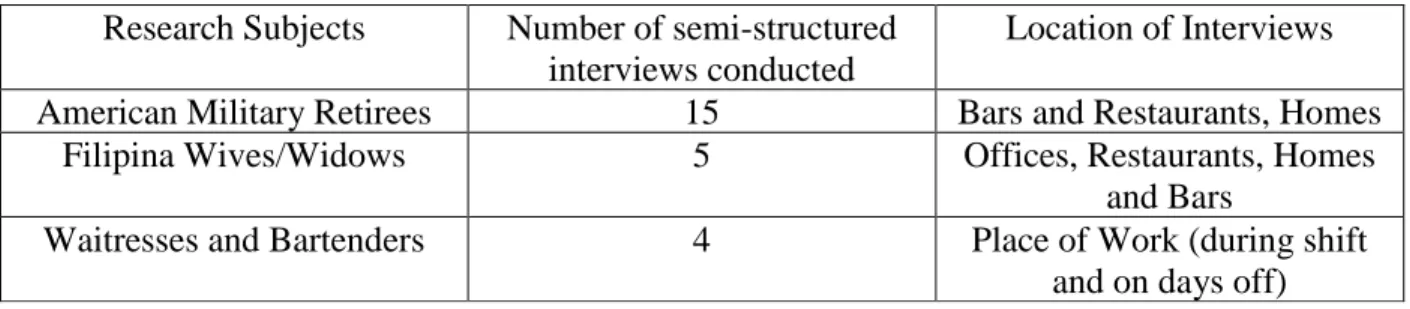
Research Subjects and Interviews (1) American military retirees
I conducted fifteen semi-structured interviews with a group I refer to as “American military retirees.” I also informally talked with a handful of others. All of the men I designate as military retirees in the thesis served in a branch of the US military, most of them during the Vietnam era or in the years after. As the term “veteran” is contested and denotes combat served in a conflict officially recognized by the US government, I largely avoid the term veteran choosing to instead denote research subjects as military retirees. Nearly all of the men I
and one man met his wife, a former bar worker, through mutual friends at a party after retirement. I was not able to ask the other three married men how they met their wives. The largest age gap between spouses was thirty-seven years. This particular couple met in a bar after the man moved back in retirement. Contrary to popular stereotypes and my own preconceived expectations, for most of my research subjects the respective ages of husbands and wives did not significantly deviate. The largest age gaps occurred between retirees who met their spouses in bars after retirement while those who met in other ways were much closer in age and were separated by about ten years or less. While a few of the men I talked to owned bars and did work managing them, most did not work. Men’s monthly source of income was a combination of military pension checks, social security for those who qualified and a military disability check for those certified as disabled.
(2) Filipina bartenders and waitresses
I formally interviewed four Filipina bartenders and waitresses, two who worked in a “hostess bar,” one who worked in a “drinking bar” and one who worked in a “bar and restaurant” (distinctions I clarify in the coming pages). All of these women were in their mid-twenties. I also informally talked with four other bartenders and waitresses. All of our interviews took place in bars either during slow periods during a shift or on days off. I conducted these interviews in a mix of English and Tagalog, with the former constituting the majority of the conversation as it was widely (although not universally) spoken by the bartenders and waitresses I got to know.
referring to wives they met in the bar men often used phrases like “oh she worked in a bar” when I asked how spouses first met without offering a more specific job title. Of the five wives I interviewed, two had previously worked in a bar. One, Belinda, who I profile in Chapter Five described herself as a “waitress” while the other simply explained she previously “worked in a bar.”1 In reading archival documents and literature about the navy base, women employed in
Olongapo’s restaurants, bars, and discos are referred to with a wide array of descriptive
categories: sex workers, prostitutes, waitresses, bar tenders, bar girls, hostesses, entertainers, and “women employed in the hospitality industry.” In Chapter Two, as I survey these archival documents I either defer to the language used in citations or use the umbrella terms
“entertainers” or “hospitality workers.” Again, in Chapters Three, Four and Five I refer to the women who work in the bar today as bartenders and waitresses.
(3) Filipina wives
I conducted interviews with two Filipina spouses married to American men and three widows whose American partners had passed away. In designing this research, I was unsure how I would connect with Filipina spouses and girlfriends, correctly anticipating that I would not simply encounter them in bars. In visiting an office in Barretto during my first week that helps connect retirees to military benefit services and approved medical facilities in the Philippines, I met with an American staff member. He explained how some two years earlier he had helped conceptualize and organize a formal group and setting where Filipina widows could come
together to discuss and share stories following the death of their American partner. Together with the help of some of the widows he founded what I refer to in the thesis as The Support Group.
The group met monthly and had recently expanded to include not only widows but also women currently married to American men.
The American staff member put me in touch with the group’s director, Belinda, who I interviewed. Belinda also invited me to the group’s monthly meeting which unfortunately took place during my last week of fieldwork. According to Belinda, and as I witnessed during the meeting I attended, the group serves as a social space where women share stories about the emotional difficulties of losing a partner. Women also regularly discuss the logistics of the death of a foreign partner. On the day of the meeting I attended they discussed the logistics of paying a hospital bill for husbands who are foreign residents and the payments necessary to formally remove a foreign body from a Philippine hospital.
Figure 1: Semi-Structured Interviews Conducted:
Research Subjects Number of semi-structured interviews conducted
Location of Interviews
American Military Retirees 15 Bars and Restaurants, Homes
Filipina Wives/Widows 5 Offices, Restaurants, Homes
and Bars
Waitresses and Bartenders 4 Place of Work (during shift
and on days off)
Bars and their Distinctions
As bars prove essential to my research, I briefly outline the types of bars that exist in Barretto differentiating between what I designate “retiree bars” and “sex tourist bars.” As it will become clear, retiree bars and the way they differ from sex tourist bars form a central part of the study, especially in Chapter Four. Given the importance of this distinction I introduce and differentiate both types of bars here.
(1) Sex tourist bars
I ultimately did visit three sex tourist bars with my research subjects. However, unless accompanied by a military retiree I explicitly chose not to make them central to my study looking to avoid essentializing renderings of Barretto as solely a space of sex work. Ara Wilson (2004) suggests that Western academic studies of Thailand’s sex trade are “over-represented.” For her hyper-representations of sex work in sites like Thailand produced by Western academics, “reinforce the links connecting racialized and gendered sexual services with particular
developing nations” (73). Similarly Chandra Mohanaty (2003), famously argued, “much of present-day scholarship tends to reproduce particular ‘globalized’ representations of
and ways of being not only for the women engaged in this work but also the thousands of others who carve out lives in a place like Barretto.2
Although they differ by locale, sex tourist bars typically consist of a large stage
surrounded by individual chairs and tables where customers sit. Upon entry a customer is greeted by the mama-san3 usually an older Filipina women. The mama-san typically leads or follows the customer to a table. On the stage a number of women are usually dancing to music. Dancers in Barretto are officially referred to as GRO which stands for Guest Relations Officers. GRO is an official government job classification and these women are required to wear an ID card at all times. This ID card certifies a clean health record and up-to-date employment registration with the local city government. Every two weeks or every month (I could never get an exact answer), GRO are required to go to a local health clinic where they are tested for venereal disease. The health clinic is a direct legacy from the US Navy. Beginning in 1974, American military officials collaborated with the Olongapo City government to implement a venereal disease control
program. In order to be given a work permit to work in a bar while the base was operational women were required to register with the clinic and pass venereal disease testing, a health policy that remains to this day (Mirlao 1990; Sturdevant 1993).
In Barretto, it is illegal for dancers to dance topless or naked and GRO typically wear either short shirts and shorts or bikinis, attire which makes strikingly visible the clinic issued ID cards required to be pinned to their clothes. Foreign customers are encouraged by the mama-san
2 Although Celine Parrenas Shimizu (2007) argues that researchers should not runaway but actively engage with culturally produced representations of hypersexuality as they inhere on Asian and Asian-American women’s
bodies. For Parrenas Shimizu, “any Asian/American woman who must understand her identity and her possibilities must engage hypersexuality in representation. That is, sexuality imbricates them so that Asian women must always engage it as a force for understanding the self and their relations with others who project hypersexuality upon them” (16).
to pick a GRO (or two) from the stage to invite to accompany them at a table. Customers typically order an alcoholic drink for themselves and a drink for the GRO (often mango juice or soda but sometimes alcohol). In the past, if a sex tourist wanted to take an available GRO home for the night, he would typically pay a standard and often advertised “bar fine” to the mama-san. While this practice may remain in place in a few bars, from what I could gather, bars have been discouraged by the government from advertising bar fines and it is now expected that men will negotiate a price directly with a GRO. Upon returning to the bar for their next shift, GRO pay the bar a portion of their earnings from a foreign client. Although prostitution in the Philippines is illegal, in Barretto it is informally decriminalized, as the law is rarely enforced. According to men I talked with bar raids by the police do sometimes occur. During bar raids the police search the bar for drugs and underage GRO and ensure that everyone working is officially registered with the city government and has an updated health card. Beyond the occasional raid, it appears that authorities do not prevent the purchasing of sex.
Nearly all sex tourist bars appear to be foreign owned (including at least one sex tourist bar owned by a former US marine). Although it is illegal for foreigners to own property in the Philippines, the men I talked with explained that foreign men circumvent this requirement by having their Filipina wives sign all official paperwork. Most sex tourist bars open in the early afternoon and stay open well past midnight. During my time in Barretto, I learned through conversations that the going rate for a bar-fine to be negotiated with a GRO for the evening was anywhere between P1,500-P2,0000 ($35-$45).
(2) Retiree bars
“retiree bars.” In contrast to sex tourist bars, retiree bars cater primarily to American military retirees and other expatriate retirees who have moved to the region. Respondents regularly indicated that there was a distinct separation between the lifestyles and geographies of retirees and tourists. Retirees regularly socialized and drank during the afternoon or early evening at retiree bars, while sex tourists usually stayed out late into the night at sex tourist bars. Retirees explained that the two groups remained mostly separate from one another. The four retiree bars I visited were all owned by American military retirees and their Filipina wives. I also spent
significant time at a restaurant and bar which occasionally served as a meeting hall for these men and their various organizations (and once a month for their wives.) The retiree bars and this restaurant/bar are staffed by local Filipina waitresses and bartenders. In the thesis I further differentiate and classify retiree bars splitting them into two groups: hostess bars and drinking bars.
(2A) Hostess bars
Filipina bartenders and waitresses staff hostess bars. Waitresses typically sit with men while they eat and drink, talking to them, putting in drink orders and entertaining them. Despite these flirtations, in hostess bars customers are not allowed to request or negotiate that waitresses or bartenders leave the bar and hostesses, bartenders and waitresses are not required to wear ID cards. During my time in Barretto, I visited three hostess bars, two of which were owned by American military retirees. The hostess bar I spent the most time at was called The Anchor Bar.4 Inside, the Anchor was quite small with a long bar and a handful of small tables. Like all of the retiree bars in Barretto, the walls were full of military memorabilia and mementos including helmets from Vietnam, guns, photos of aircraft carriers and military medals and stickers.
The waitresses and bartenders I met at the Anchor ranged in age from twenty-one to their mid-thirties.Owned by Benjamin, a former Marine, four or five women typically worked during a shift. The bar opened around noon and closed at ten at night. The Anchor Bar had an outside table with seven chairs making it quite popular during good weather. During slow shifts waitresses would often call out to tourists or men they knew from town who were walking by, inviting them to come in for a drink. While The Anchor was a popular spot for retirees, its roadside location and inviting patio did also attract tourists.
(2B) Drinking bars
I visited three of what I designate here as “drinking bars” and regularly hung out at two (one of which also served as a popular restaurant). All three of the drinking bars I visited were US owned and the one I spent the most time at was called The Cove. Inside, The Cove one or two women tended the bar. Somewhat cramped with about six barstools, two small tables, and a dartboard, the Cove’s bartenders were not expected to sit with customers while they drank. The two bartenders I befriended at The Cove were in their early to mid-twenties. At the other two “drinking bars” I visited, bartenders and waitresses were similarly not expected to sit with customers. A twenty-one-year-old bartender who worked at The Cove explained that she preferred working in a retiree drinking bar, contrasting it with others in town by saying, “Like the other bars, the customer is allowed to hawakan ka (grab you). Unlike here, they respect you, this is a very good bar.”5 Similarly in the bar/restaurant, which I call The Canteen waitresses
were not expected to sit with customers. Waitresses were the only staff members and prepared all the food and drinks themselves, usually with two workers present during a busy shift and one during non-busy hours. While expectations of customer-worker interactions differed dramatically
among these bars, in Chapters Three and Four I demonstrate how interactions in the more subdued drinking bars nonetheless explicitly depended on gendered and sexualized labor of its bartenders and waitresses.
Participant Observation and the Ethics of Alcohol
A few weeks into fieldwork, I was having difficulty meeting men and frustratingly
scribbled into my grammatically incorrect fieldnotes “An ethnography of the bars---- do it…hang out.” Partially self-motivation and partially the realization of my failure to leverage the local retiree’s organization into multiple interviews, after writing this note I actively spent many of the following afternoons and evenings, shuffling between the three retiree bars identified earlier: The Cove (a drinking bar), The Anchor Bar (a hostess bar) and The Canteen (a restaurant/ drinking bar). Ultimately, this decision to conduct an “ethnography of bars” proved fruitful as such spaces offered an ideal location to meet men, bartenders and waitresses to interview and provided a space to witness their shared interactions.
In addition to interviews in bars I engaged in participant observation paying particular attention to and emphasizing in my fieldnotes how American men flirted and interacted with bartenders and waitresses. Participant observation, sometimes as little as a thirty minutes and other times as much as four or five hours spread out between bars granted me access to social interactions and insight not available through interviews. As participant observation
complimented (or sometimes contrasted) previously gathered interview material, I also used it to inform interview questions I later asked.
practices, Gillen avoids normative claims to the ethics of consumption explaining that he has no fixed ethical standards by which he chooses to either drink with or abstain from drinking with research subjects at any particular moment. Instead his decisions to drink “are based on a mixture of serendipity, how comfortable I feel at the moment of invitation or arrangement, and how I evaluate the circumstances and intentions of the person or group of people involved in a particular outing (8). During my time in Barretto, I similarly understood my own alcohol consumption as essential to my fieldwork and the research process. Most men drank during interviews and I regularly, although not always joined them. In practice, I deployed Gillen’s subjective model of serendipity, comfort and ethical circumstances in informing both my own decisions to consume and questions regarding the use of material revealed while under the influence. During field work, I turned off my tape recorder or deleted field notes a few times when men seemed particularly intoxicated but again this judgement was entirely subjective. Alcohol certainly loosened up both interviewer and interviewee and it fostered a shared social space and practice that facilitated comfort during interviews. In choosing not to consume I would have likely been denied access to the spatial practices of the bar and those intimate details
revealed to me inside of it. In understanding consumption as essential to this social world, I do not seek to absolve myself of the ethical questions that might arise but like Gillen understand reflexivity as a necessary place to begin.
Intimacy, Shared Social Relations and Ethnography
theoretically rich orientation for social scientists and geographers. Given this, I ground myself in the work of geographers, ethnographers and recent turns in feminist geography that use
seemingly intimate, quotidian and banal fieldsites to unpack the construction of traditionally large scale social formations. Much of this work has emerged from disciplinary
reconceptualizations of scale and within the sub-discipline of feminist geopolitics. Feminist geopolitics often examines how seemingly traditional geopolitical concepts are produced through everyday lived experiences. At its most basic Massaro and Williams (2013) summarize feminist geopolitics as an approach that has re-conceptualized “what counts as geopolitical” (567). Similarly Dixon and Marston (2011) note that feminist geopolitics has led to increased attention to “the diversity of attitudes, emotions and behaviors that make up the ‘matter’ of the
geopolitical” (445). This engagement has led to empirical work that argues love and babies make territory in contested border regions in India (Smith 2012) and everyday decisions about wearing headscarves produce claims to urban space in a secularly and religiously divided Istanbul (Secor 2001).
and the racial composition of the population (47). Similarly, Catherine Lutz (2006) suggests ethnographies can use the intimate as analytic to unravel the contingency, historical
particularities and shifts of geopolitical concepts like empire, writing, “The dilemmas,
contradictions, and vulnerabilities of empire are many, but it is often only in the details that they become visible” (607).
Thus in this study although belonging and masculinity, which later emerge as central themes, are not seemingly “traditional” geopolitical concepts like territory, empire or urban space, work on the intimate in geography and elsewhere helps orient studies to use the intimate to unpack power relations. In this thesis I draw on conceptualizations of the intimate as
theoretical tools that justified my turn to everyday social relations. Such a turn understands spaces like the bar and its social relations as inherently political sites capable of producing senses of belonging and reproducing specific masculinities. As I prioritize the seemingly banal worlds of bars and marriages, I understand the work cited here as theoretically opening up the possibility to explore such spaces and relations as sites flush with ethnographic opportunities for geographic research.
the most part welcomed me into parts of their lives. However, at times I was met with some resistance and use one particular vignette here to think through the questions raised by Smith about ethical responsibilities to research subjects.
About a week before I was scheduled to leave the field, I returned for the second time to a retiree bar owned by a former US marine. I had visited a few weeks earlier but after being introduced to the owner and telling him about my research during this first visit I sensed mistrust and felt that I would not be welcome in his bar. Having avoided the place for most of my stay I gathered the courage to venture back during my last week. This particular bar was quite popular and I was certain I would encounter American military retirees I had yet to interview inside. Upon entering, the bar’s owner made eye contact with me and immediately went outside after I sat down, thus confirming my suspicions that he did not trust me. I casually conversed with another retiree for about half an hour and this man and I agreed to a formal interview to be conducted the following day. At some point during our conversation, I made reference to an emerging scandal in local provincial politics. Earlier in the day, I had heard reports that a mining company had been caught illegally mining and selling dirt to Chinese companies in a town located three hours to the north. Initial rumors suggested that some of the dirt removed was being used by the Chinese to construct artificial islands in the geopolitically contested South China Sea (Manila Times 2016). Triggered by the fact that no one else had mentioned the scandal before I did, the retiree believed I was being disingenuous about my intentions for being in town and thus lying about being a graduate student researcher. After asking the man if he had heard about the news and describing what I knew about the scandal to him, his tone immediately changed.
Mike: You think so?
Bob: Especially with a comment like that, ya I think so. And maybe I should text Belinda [the local director of the Filipina wives’ Support Group] and everyone else you’ve been hanging out with to be careful. Tell them that I don’t trust you anymore and that you should probably stay away.
Mike: Bob, I’m sorry. I’m not hiding everything. It’s all true. I’m sorry. I didn’t mean to…”
Bob: Mike, they taught us if someone keeps blinking their eyes quickly, they’re lying It’s over. Drop it. It’s done. Fuck off.
After this encounter, terrified that Bob would text Belinda, thus closing off my
opportunity to interview the group of Filipina wives and widows married to American retirees, who I had not yet had the chance to meet, I silently and awkwardly remained at the bar. Bob and I did not talk to each other for about twenty minutes. He continued his conversation with
someone else and ignored me next to him while I slowly finished a plate of food, unsure of what to do next and contemplating whether I should just leave. Unprompted he then interrupted the silence, looked at me and with no further explanation said, “Mike, why don’t you come by tomorrow anyway.” We exchanged a few more words, I apologized again and we ultimately did meet as planned.
friends, including Belinda, inquiring about their own interactions with me and gauging their senses of trust in me.
Although perhaps the most dramatic exchange I shared with a skeptical retiree, this moment did not prove exceptional. Another foreigner, an Australian who I got to know via my Filipina landlord, pulled me aside one day and explained that guys around town had started talking about me with one another, asking what I was doing always walking around. He told me that the most widespread rumor suggested that I was CIA. Despite sharing a number of social interactions, the Australian remained unconvinced about my research story, explaining he would be careful about his interactions with me and that, “I really don’t care why you are here.” He advised that given the skepticism it was probably best if I “stuck to the geologist story.” An American retiree similarly admitted that his first impression was that I was an immigration official looking to crack down on men either overstaying their tourist visas or lying about their disability status to the US Veterans Affairs Office. For him “running around with that little black thing” (tape recorder) and knowing some Tagalog raised suspicion.
disingenuous with my research subjects. I never “lied” about who I was, always telling them that I was a researcher and student from the US, was interested in their retired lives and that if they agreed to an interview I would change their name. Nonetheless what caused me pause about Bob’s statement was that I in a sense felt an overwhelming anxiety about having “used” Bob and men like him. I reflected in those field notes on what it meant for me to ask for the revelation of intimacies only to then “use” these intimacies to produce an academic thesis (and later, I hoped, in published papers that would help in building an academic career). Post-colonial theory has pushed social scientists to be more reflexive about the research process, to consider the dynamics of power between researcher and researched and to illuminate histories where research subjects have been exploited by researchers. In my field work the lines and symmetries of power proved blurry. I worked with American retirees in a foreign country whose wealth and citizenship granted them a great degree of social status in this community. In relation to them, I was not positioned higher up in the local social hierarchy.
method offers researchers chances for such reflexive storytelling. For Holmes ethnography broadly weaves vignettes, critical reflection on the circumstances under which research observations were made and theoretical interpretation of participant observation. Through the craft of writing the ethnographic “readers are reminded that position, perspective, and context are always involved in the production of knowledge” (Holmes 200). For me critically and reflexively engaging the details, nuances, and the complexities of social space offers the chance “to do justice to complexity” as the research experience not only provides new perspectives to readers but also forever alters the researcher and their future engagements with teaching and living the world.
As explained here an ethics of the intimate also calls for methodological reflexivity. During fieldwork, I was granted nearly unfettered access to the bar and these social worlds. Outside of those vignettes offered here my access to American retiree bars was rarely
questioned, a status largely dependent on my subject position as a white, foreign male. For the most part my access to these men and women and their social worlds via interviews was similarly unrestricted. The American men I interviewed and got to know often viewed me as a grandson-like figure with whom they shared information and offered life advice to. Many, but not all, were quite willing to talk with me. I was surprised by how much access I was granted to these men’s lives and stories as they often proved quite willing to open up to me upon our very first meeting. I received a similar willingness to participate from bartenders, waitresses and wives.
sometimes nervously laughed or encouraged men to explain more. Bobby Benedicto (2014) aptly describes how his research subjects regularly revealed troubling statements to him and how this willingness to share details with him proves indicative of his own implication in the very systems of power he looks to critique. He writes, “Classist statements were routinely made in my
presence with the tacit understanding that I shared the sentiments being expressed. It is out of a sense of responsibility to those who shared their views with me that I make a concerted effort here not to extricate myself from the violences I make apparent” (22). Again, my access to these stories not only reflects my positionality as whiteness, American citizenship and gender granted access but also how my research subjects made assumptions about me and my worldviews based upon these social markers. Much of Chapter Three relies on a close read of the racialized, nation-based and gendered exclusivity of the retiree bar and as mostly white American retirees assumed I shared views similar to their own, they proved willing to reveal details that helped me
understand the bars racialized exclusivity. Chapter Overview and Research Questions
Before turning to my ethnography, Chapter Two uses the archive of the late 1980s and
early 1990s. As uncertainty loomed regarding the geopolitical future of US bases in the
Philippines, I analyze how government commissioned studies and economic conversion plans for
US military bases in the Philippines imagined Subic’s future following American military
withdrawal. Drawing on sources first accessed at the University of the Philippines-Diliman
library, I look to understand how economic conversion plans were marked by specific inclusions
and exclusions as Filipino politicians and leaders imagined a specific economic future for Subic
in the post-American military period. Chapter Three uses ethnographic research conducted in
social interactions in the highly localized space of the retiree bar. It pays particular attention to the insularity of the bar, emphasizing how racialized divisions and hierarchies of citizenship foster insulating social worlds essential to this sense of American belonging. The fourth chapter turns specifically to the bar’s gendered social relations, asking how retiree bars spatially facilitate an ageing masculinity that augments American retirees’ value as men and for them is seemingly not possible in the United States. I am interested in asking how social relations work to enable the performance of this masculinity, one that I argue “extends the lifetimes” of these ageing men’s masculinities. The final substantive chapter turns specifically to transnational Filipina-American marriages. In it I ask how men articulate their own desires for marriage. I find that men often draw on racialized and colonial scripts conflating Filipina bodies with care as they desire a wife who will take care of them. As wives explain their own motivations for marriage in seemingly discrepant ways as compared to their husbands, I ask how these desires cohere
CHAPTER TWO: BASE CONVERSION: INCLUSIONS, EXCLUSIONS AND SERVICE-ORIENTED FUTURES
At the end of our formal interview I continued drinking at the bar with a military retiree
in his late sixties. At some point, I brought up the 2014 case of Jennifer Laude, a
twenty-six-year-old transgender Filipina sex worker murdered in Olongapo by a nineteen-year old US
marine named Joseph Pemberton. The case received significant local and international attention,
and I was curious as to what retirees thought about it. After I mentioned the case, the man
reached into his pocket, pulled out his cell phone and showed me a picture of Jennifer, whose
face I immediately recognized from the news coverage. In the photo, Jennifer was standing with
a group of other women. Pointing at one of the other women, the man first identified this woman
as his wife before showing me the date the photo was saved into his cell phone: October 11,
2014, the night Laude was murdered. The American told me that his wife was good friends with
Laude’s sister and the group had all been partying together in a nightclub on the night Laude met
the US marine who later killed her in a motel.
A week after the murder the Communist Party of the Philippines (CPP) published the
following in their Party newsletter, Ang Bayan (2014).
Jennifer’s name is only the latest in a long list of Filipino victims of various crimes committed by American soldiers and the US military in the Philippines. In more than a hundred years of US colonization, neocolonial rule and military intervention in the Philippines, there have been myriad cases of killings, rape, massacre, robbery and
In politicizing Jennifer’s death in this way and inciting histories of colonialism and
military occupation, the CPP draws here on language used by anti-base activists during the 1960,
1970 and 1980s. During this time, Subic Bay Naval Base and Clark Air Force Base, separated by
some eighty kilometers, were two of the largest US military bases abroad (McCoy 2016).
Following tense political negotiations in the late 1980s and early 1990s, in 1991 the Philippine
Senate voted against renewing the lease on the US bases, effectively ending decades of
American military presence. But on that October night in 2014, the collision of Pemberton and
Laude’s bodies in an Olongapo City nightclub evoked lasting images of the American era at
Subic—bars, clubs and dancehalls that served American soldiers, militarized sex work and
sporadic violence. Ambyanz Club, where Laude and Pemberton met is located on Magsaysay
Avenue, once an entertainment district in Olongapo and less than a kilometer from the main
entrance of the former naval base. Today the base has been converted into the Subic Special
Economic and Freeport Zone, an economic hub oriented towards manufacturing and the
provision of services to foreign companies.6 Some twenty-five years after American withdrawal,
the hundreds of bars, restaurants and discos that once lined the streets of Magsaysay Avenue
have been replaced by other enterprises-- appliance stores, hair salons, nightclubs that cater to
locals, a mega mall, hotels, fast food restaurants, pawn shops, and stalls where vendors sell
bootleg DVD, clothes, shoes, and other wares.
As it conjured images of the American bases era, Laude’s murder also galvanized
political protests. Days after the murder, women’s and other leftist political groups descended on
Olongapo (Datu 2014). Drawing on nationalist scrips, they explicitly linked Laude’s murder with
recent news of American efforts to remilitarize the Philippines. In 2012, the US and Philippine
governments signed the Enhanced Defense Cooperative Agreement (EDCA) which granted US
personnel access to five Philippine-operated military bases (Whaley 2016). The re-negotiated
treaty also granted increased American access to Subic, which at the time had no active Filipino
armed forces and was not included in the five bases to which the US was approved access to
(McCoy 2016). Following 2012, American ships began using Subic to restock and refuel, staying
in port for a few days. It was during such a port call that Pemberton met Laude. Following the
murder, curfews were implemented and appear to remain in place to this day, restricting
American troops’ access to most of the city. Echoing the discourses of anti-base activists decades
earlier, after Laude’s murder, political groups explicitly linked violence against the bodies of
Filipina women and violations of national sovereignty to processes of US militarization.
US Bases in the Philippines
The US-Philippines Military Bases Agreement was originally signed in 1947 in the
aftermath of WWII. Following the war, destruction in Manila rivaled that of the most heavily
bombed European cities. In exchange for access to and a ninety-nine-year lease on military bases
in the country, the US offered the Philippines some $620 million in war reconstruction payments
(McCoy 2016). American construction at Subic Bay Naval Base first began in 1952, with
Subic’s naturally deep harbor and nearby mountains making it an ideal place for a navy
installation. To convert the setting into a viable military facility, US forces filled in swamps and
moved mountains to create runways and drydocks for ships, also cutting deep caverns into the
nearby mountains to store nuclear weapons. Between 1946 and 1971, the US provided the
Philippines with $704 million in military assistance and training as part of the bases agreement
(ibid). This aid and the US bases in the region proved essential to US Cold War era containment
US military assistance to the Philippines was used by its armed forces against communist
rebellions. Re-negotiations of the original Military Bases Agreement were held in 1966 and the
original ninety-nine-year lease was reduced to twenty-five years with a new expiration date of
1991 in which renewal would be contingent on a Philippine Senate vote (McCoy 2016; Bengzon
and Rodrigo 1997).
In 1986, the popular uprising known as the EDSA Revolution, toppled the twenty-year
dictatorship of then President Ferdinand Marcos, fostering a new political era in Philippine
politics. During his regime, Marcos had been supported by the US in part for his staunch
unwavering support of US bases and his anti-communist military campaigns. Thus, with the
overthrow of Marcos uncertainty surrounded the future of US bases in the Philippines in the late
1980s (Quimpo and Quimpo 2012). Although newly elected President Corazon Aquino
supported and campaigned for base retention, in 1991 the Philippine Senate voted twelve to
eleven against extending the basing agreement and lease (Bengzon and Rodrigo 1997).
During the Marcos era and in the years that immediately followed, leftist political groups
proved vocal critics of the US occupation and their government’s support of the bases. As I look
to demonstrate in the section that follows, in pushing the government against extension in the
1980s, these groups explicitly scripted the US military and individual soldiers as bodies that did
not belong in the Philippines. After briefly examining the contentious politics of the bases in the
1980s, the rest of this chapter turns to the latter part of this decade. Anticipating potential
American withdrawal, the Philippine government commissioned a comprehensive military base
conversion program designed to imagine new economic enterprises for the former military bases
and to assist the communities of Subic and Clark in the aftermath of the US military’s possible
future livelihoods of the tens of thousands of citizens in these communities who directly and
indirectly relied on the bases as a source of income were uncertain. The haziness of the 1991
Senate vote loomed in the background as these potential conversion studies and plans were
carried out.
Contentious Histories
For nationalists during this era Subic and Clark manifested as visible symbols of a US
imperial past and represented continued American political and economic influence in the
Philippines. Advocating the expulsion of US troops and the permanent closure of the bases,
anti-base activists drew on nationalist critiques of sovereignty and appealed to senses of Filipino
morality, especially emphasizing the presence of prostitution in the base communities.
Nationalist critiques largely drew on the presence of US troops as a form of neocolonialism and
an impediment to a fully realized Filipino sovereignty. The threat of nuclear weapons also
loomed large, with anti-base activists suggesting that the storage of nuclear weapons at US bases
(Subic in particular) made the country vulnerable to both a Soviet attack and a potential nuclear
accident. In addition to prostitution these groups also criticized the social and moral problems
attributed to the presence of US troops—venereal disease, violent crime, abandoned mixed race
children, gambling, drugs and alcohol abuse.
In an October 1989 issue of Ang Bayan, the Communist Party laid out the tenets of its
propaganda movement against US bases in the country. They wrote in the newsletter, our “vital
line of attack on the bases and US imperialist rule is to expose the threat to nationalsurvival
posed by US nuclear weapons in the bases and the social and moral damage that the presence of
deploying language about the future of the nation-state itself the CPP wrote, “[Prostitution]
degrades not only those women but the dignity of the nation itself” (February 1981, Ang Bayan).
American anti-base activist and academic Boone Schirmer (1989) noted in a pamphlet,
“Probably the most immediate and obvious effect of the US bases has been their moral and social
impact on Philippine life…fostered [by] the growth of prostitution of women and children, the
traffic in drugs, and the introduction of the disease AIDS.” 7 Similarly Roland Simbulan (1985) a
Filipino anti-nuclear activist and academic offered, “The bases have engendered or promoted a
degrading and dehumanizing social environment that erodes the cultural and moral fiber of our
society. It has spawned social problems such as vice and prostitution, sexual diseases,
blackmarketing, smuggling and illegal trading, drug trafficking and drug abuse, criminality and
warped values” (52).
Such writing echoes the work of civil reformers and anti-militarism activists in other
contexts. In places like Guam, Hawaii and Okinawa, anti-military groups have similarly drawn
upon the links between colonialism, American military bases and national sovereignty (Davis
2015). Stephen Legg’s (2014) study of prostitution in 20th Century India suggests that
independent reformers, charities and other members of civil society framed moral problems like
prostitution as threats to the very survival of the Indian nation-state, in much the same way
Filipino activists and American solidarity organizations did during the 1980s. Recently in South
Korea anti-military groups strategically used the story, image and posthumous life of a Korean
7 Writing from Boston, Boone Schirmer was also affiliated with the Durham, NC based anti-bases group called
“Friends of the Filipino People.” A collection of Boone Schirmer and Friends of the Filipino People’s writings,
sex worker murdered by a US service member to understand US military occupation as a
violation of Korean sovereignty and the nation-state’s future (Schober 2011).
A Less Hostile View in Olongapo
As groups like the CPP, Philippine based academics and solidarity organizations in
America critiqued the US occupation from their respective geographic locations, Filipinos in
Olongapo had a markedly different relationship with the base. The base at Subic provided some
thirty thousand jobs directly. Indirectly it employed even more. During fieldwork one elderly
woman in my neighborhood told me about her father, a taxi driver while the bases were
operational. In Tagalog she remembered, “Money was so easy to come by during the American
period.” Put simply, relationships with Subic were markedly less antagonistic and instead largely
supportive of the bases for those in Olongapo. As Richard Gordon, then the city’s mayor,
explained in 1985, “Olongapo is a company town and the company happens to be the Pentagon”
(Lohr 1985). Estimates suggested that eighty-five percent of the city’s economy was directly or
indirectly dependent on the naval base in the late 1980s (Rocamora 1997). As I will demonstrate
later in this chapter, the US government and its negotiators strategically emphasized the two base
communities’ economic dependence on the bases to argue in favor of base retention in the years
leading up to the 1991 vote (Bengzon and Rodrigo 1997).
Amidst growing public support against the bases, the doubt surrounding the coming
Senate vote, and what would be certain economic displacement if retention failed, in 1988
President Aquino created and commissioned the Legislative Executive Bases Council (LEBC) to
study, propose and draft plans for economic conversions of Subic and Clark following potential
American withdrawal. Chaired by University of the Philippines President Jose Abueva, in
Program: Alternative Uses of the Military Baselands and the Military Camps in Metro Manila.
The publication ultimately informed the government’s official conversion plans. In
Kumbersyon’s opening pages the LEBC explains it designed the plans to “maximize the
economic, social and political development of the baselands and to reduce the displacement of
those in base communities affected.” Kumbersyon represents one of many private and publicly
funded policy papers and conversion studies released in the late 1980s. Together these studies
collectively asked: what form should military base conversion take following American
departure and how should conversion best realize new economic opportunities while stemming
the economic and social losses of those dependent on the bases?
Private business interests simultaneously proposed alternative visions for conversion
during this time, and these private plans offered a wide range of possible solutions. One planner
curiously called for the conversion of the bases into expansive papaya and pineapple plantations
citing the coming of a global “pineapple shortage” (Mariano 1998), while a former military
officer envisioned base conversion as a way to end political violence, calling for the government
to offer portions of the baselands as cooperative land to communist and Muslim rebels who
agreed to put down their arms against the state in exchange for land.8 In this chapter, I briefly
draw on these private conversion plans (Cuyegkeng 1988, Mariano 1988, Tiu 1989, Foreign
Service Institute 1989) but do so only for the manner in which their authors quantify the
economic effects of a potential American pullout.
Focusing less on these more marginal private studies (and thus pineapples and
communists), I instead highlight the Legislative Executive Bases Council’s official plan. I also
carefully read three other publicly funded studies that directly informed Kumbersyon and thus
official government policy. These three studies include one produced by academics at the
University of the Philippines (Diokno 1989) and two from a feminist NGO tasked with
informing the LEBC and government how best to assist the thousands of women working in
Olongapo’s bars, restaurants and hotels (Mirlao 1990, Lee 1992). In turning to these studies and
ultimately the government’s official conversion strategy, I look to understand how these
conversion plans produced future imaginaries of a post-American military landscape for Subic.
In constructing post-withdrawal Subic as a place that needed to be saved from inevitable
economic displacement, I look to understand how these imagined futures (and in turn actual
plans) are marked by inclusions and exclusions. As plans proposed an economically viable
conversion process, the LEBC and government’s way of envisioning Subic’s economic future
valued certain types of industries and people, like stevedores integrated into a global economy,
as it simultaneously excluded others, especially former sex workers, from the conversion
process. I argue that, despite intentions of a conversion process guided by social justice and
minimized displacement, such an imagined future produced Subic as a landscape that reflected
the government’s own interests and values back to Filipino politicians. Such values and
economic visions were rooted in the realization of a future Philippine nation-state’s integration
as a service economy into both emerging Asia-Pacific regional economies and eventually the
nation-state’s larger role in the global division of labor.
The Politics of Measuring Departure
In identifying Subic as a landscape that needed to be saved after withdrawal, conversion
plans first measured and calculated the estimated economic costs of withdrawal. It was widely
accepted that between Subic and Clark, Olongapo’s geographic isolation made it more
researchers from the University of the Philippines explained in their 1989 study Research
Towards Alternative Uses of Military Baselands for Sustainable National Development,
Olongapo’s reliance on Subic meant it would “require greater assistance in conversion” (Diokno
1989). In 1987, the US government estimated that it employed some 37,141 local Filipino
laborers inside of Subic. 15,811 of these workers were considered full time employees while
21,330 were contractual workers. The US also estimated it contributed $359.7 million directly
into the local economy in 1987.9 In total, some 68,000 Filipino workers were employed by the
US government at both Clark and Subic (USIS 1987).
These employment calculations were publicly released and made available via a small
booklet published by an office in the State Department dedicated to international diplomacy.
This office, the United States Information Service (USIS) titled the small booklet Background on
the Bases: American military facilities in the Philippines. It is clear the booklet was produced to
explicitly influence ongoing base debates, making employment and economic figures easily
accessible. Writing its foreword, US Ambassador to the Philippines, Nicholas Platt, notes that
this second edition of the booklet was specifically updated and distributed in 1987 so that policy
makers, researchers and citizens could make “a full and informed evaluation of the role of the
US facilities” (iv). Nearly all of the conversion proposals and conversion plans I consulted, cited
these figures in their own calculations of potentially displaced Filipino base workers. It must be
understood then that measuring the economic contribution of the bases was contested and
explicitly political. While there was little dispute about those formally employed inside the bases
and the direct contributions of military spending to the local economy, indirect employment and
9 USIS suggests that of these 68,000 workers 23,168 were full time, 22,834 were contract workers and 22,068 were
economic contribution was widely disputed and strategically deployed to argue in favor or
against retention
In vague language that is never substantiated, the USIS booklet suggests, “It is reasonable
to estimate” that 3.5-4% of the Philippine GDP and the indirect employment of about 500,000
Filipinos were attributable to the US bases. Some two years later in 1989, without explanation
for his inflation, Ambassador Platt suggested in a newspaper interview that US bases amounted
to 7% of the country’s total GDP. In that interview, he continued “You can’t just rip that out in a
year without having a disastrous effect on the economy” (cited in Diokno 1989). Across other
studies and conversion plans calculations and estimates of indirect employment ranged from
199,000 (FSI 1989), 132,000 (Cuyegkeng 1988) and 120,000 (Abueva 1990). Total contribution
to overall GDP ranged from 7% (Platt), 4% (Cuyegkeng 1988, Mariano 1988) to 1.9% (Diokno
1989).
As one Senator, Ernesto Herrera, asserted in 1989 to a group of political representatives
and policy exports during a summer retreat dedicated to debating the base issue, “We are talking
here of almost 60,000 [directly employed] workers. We multiply that by six members of the
family, that is a small atomic bomb actually kung pabayaan natin yan (if we neglect conversion).
When it explodes that will create a host of problems.” (Aquino 1990, 29).10 As studies deployed
widely discrepant measures of the base’s economic impact, estimated measures of displacement
and its severity proved divisive and central to arguments for and against retention. Thus,
transition plans themselves and their economic calculations were politicized. As pro-base
advocates played up the potential economic devastation of withdrawal, studies that proposed
viable economic alternatives with calculated estimates of potential job creation contributed to the
anti-base movement (Rocamora 1997).
The debate was simultaneously clouded by questions of whether or not US foreign
assistance and military support would continue after possible termination. Although the US did
not pay “rent” for its facilities in the Philippines, annual economic and military aid packages to
the country were considered part of the bases agreement. This aid was distributed in two forms,
Economic Support Funds distributed by US AID to be used for economic development like the
building of roads, schools and other public infrastructure and military assistance provided to the
Armed Forces of the Philippines (Schirmer 1991). Those that calculated higher percentage of
GDP as attributable to the bases often assumed that this aid would disappear following the
termination of the bases agreement. Others (Diokno 1989) argued that US geopolitical interests
would still warrant development and military aid to the country regardless of whether the US
retained its bases. Between 1985-1988 the US paid the Philippines $900 million total- $425
million for military assistance and $475 in Economic Support Funds. Military support funds
could be used to purchase military equipment, usually from the US. It was estimated that during
this period 80% of the budget of the Armed Forces of the Philippines came from the US
(Schirmer 1991). In 1988 in an effort to sway political support in favor of retention, the US
increased assistance to $481 million annually (McCoy 2016).
Hospitality Workers, Conversion and Unkept Promises
Women in the hospitality industry-- sex workers, waitresses, bartenders and masseuses--
constituted the largest sector of those indirectly employed by the bases. Official Philippine
government employment surveys conducted in 1988, estimated that of those workers not directly
employed in the entertainment industry (Diokno 1989, 66).11 Identifying hospitality workers as
particularly vulnerable to the American pullout, the feminist NGO WEDPRO appealed and
advocated for direct government support to entertainers during the transition.12 Weary that
official government narratives and conversion plans would exclude women entertainers in two
self-published studies, the NGO advised the government on how best to assist women in the
transition (Mirlao 1990; Lee 1992).
As conversion plans proposed varying calculations of the economic effect of withdrawal,
there proved little consensus as to the exact number of hospitality workers and thus the exact
number of women potentially displaced. These disparate estimates of women working in bars
reflects the clandestine nature of the work, the irregularity of work itself as it depended on the
coming and going of US ships and the lack of official employment records. One survey
conducted in April of 1987 (FSI) estimated some 405 rest and recreation establishments in
Olongapo including nightclubs, bars, massage parlors and motels. In a WEDPRO analysis
conducted two years later, the NGO tallied 614 such establishments (Mirlao 1990).
Surprisingly city records offered a place to begin estimating the number of entertainers,
sex workers and waitresses in Olongapo. Beginning in 1974, American military officials
collaborated with the Olongapo municipal government to implement an STD control program. In
order to work in a bar or restaurant, women were required to register with the city government
and undergo twice monthly venereal disease testing at the Olongapo Social Hygiene Clinic.
Interested in maintaining the health of its troops, the US military provided training to the local
medical technicians who worked in the clinic and paid for the clinic’s drugs and medical
11 It is important to emphasize that these figures do not include labor performed inside the base as they only
equipment (Miralao 1990 and Sturdevant 1993). Using this clinic’s publicly available medical
records, conversion plans regularly cite Hygiene Clinic registration numbers to estimate the
number of women “legally working” in Olongapo. During the late 1980s, the highest of these
estimates suggests that some 11,600 women were registered with the clinic (Mirlao 1990) while
others put forward estimates of 9,334 (Diokno 1989) and 6,011 (FSI 1989) clinic registrations.
The variation in these estimates likely reflects the months these respective authors surveyed the
clinic’s records. Again, it must be emphasized that such figures only represented women
registered with the clinic. It was widely expected that more than ten thousand women working in
the city were unregistered. WEDPRO estimated there were likely some fifty to fifty-five
thousand women working in the hospitality industry in Clark and Subic in the late 1980s, (Mirlao
1990). US government figures estimated that US personnel spent about $37.2 million on food,
entertainment and other purchases in 1987 in Olongapo while on leave from their military duty
(USIS 1987).
Writing in 1989 Alma Bulawan, a former sex worker then employed by WEDPRO,
highlighted the uncertainty of transition and the concern that women were being neglected in
government narratives, feeling that they prioritized skilled workers employed inside the base
over entertainers in potential conversion plans. In a letter, she specifically calls on decision
makers to consider providing assistance to women working in the hospitality industry.
In one view, the primary problem and obstacle [of American withdrawal] is the loss of jobs for the Filipino workers inside of the bases. This issue is being seriously being thought about by the government and the powerful sectors of the country. However, I wish to remind you that there are other sectors that will require alternatives if we lose the bases. These are the 9,000 women who work in the hospitality industry [in Olongapo]. That’s why I would like to convey to all of you decision makers here their dire needs.13