Developing and Testing aModelto PredictUnderrepresented Students’PlansforGraduate
Study: Analysis of the 1988-2006 Cohorts of a Summer Research Program
Nicole R. Lewis
A dissertation submitted to the faculty of the University of North Carolina at Chapel Hill in partial fulfillment of the requirements for the degree of Doctor of Philosophy in the School of Education
Chapel Hill 2007
Approved by:
Abstract
The percentage of graduate degrees awarded to African American, Hispanic, and Native American students, as a group, remains low. Undergraduate research programs are one strategy currently implemented to increase underrepresented students’participation in graduate
education. Results of several research and evaluation studies indicate that the programs are effective in enhancing participants’perceptionsofand interestsin graduate study, but there is a
lack of understanding concerning how or why the programs are effective.
The current study employed structural equation modeling techniques to develop and test a model toinvestigatetherelationshipsamong program outcomesand underrepresented students’ plans to pursue graduate study. Data for the study were taken from surveys administered to students in the 1988-2006 cohorts of one summer research program, resulting in a sample of just over 600 students. Results indicated that the model had good fit to the data with the initial data
set,2(14, N= 319) = 17.47, p = .23, CFI = 1.00, TLI =1.00, RMSEA = .03, and SRMR = .04
and with the cross-validation data set,2(15, N= 317) = 19.78, p = .18, CFI = 1.0, TLI= 1.0, RMSEA= .03 and SRMR= .04. More specifically, in the cross-validation procedure, seven of the eight paths tested were significant at p < .05, indicating support for the hypothesized
DEDICATION
Table of Contents
LIST OF TABLES…………...………..…………vii
LIST OF FIGURES………...………..………….vii
CHAPTER ONE:INTRODUCTION...………..…1
PurposeofStudy….………..…………...…..………..4
Background Program Information.………..…………...…..…………...6
SignificanceofStudy…...…...…..………...7
CHAPTER TWO:LITERATURE REVIEW………...………..10
Search Procedure….………..…………...…..………...11
Overview of Programs.………..…………...…..………...11
Graduate School Matriculation & Matriculation Plans…...…...…..……….14
Participants’PerceptionsofProgram……….…...…...…..………..18
Interest………..……….…...…...…..………...18
Competence………..……….…...…...…..………...19
Access……… …..……….…...…...…..………...20
Satisfaction.………..……….…...…...…..………...21
Summary ofLiterature……… ...…...…...…..………...22
TheoreticalFramework……….…...…...…..………...23
Research Questionsand Hypotheses…...…...…..………...36
Overview …...………...……….38
DataSourceand Instrument...….………...……….38
Data Analysis Technique ...…….………...………..39
Procedures...……….………...……….40
GenerationOfDataSubsets………..………..40
DescriptiveStatistics………..40
Operationalization ofMeasures……….40
Interest in Graduate School………..………41
OutcomeValueofProgram …………...………..………….………41
KnowledgeofGraduateSchooland Research………..42
LatentVariables………..………42
ProgramSatisfaction………...43
Quality of Faculty PreceptorRelationship….………43
Estimation ofMeasurementModel………43
FitIndicesforLatentVariables………..44
Estimation ofStructuralModel………..47
InitialModel………...47
Model Evaluation………49
Cross-Validation ………….………...49
Conclusion………..49
CHAPTER FOUR:RESULTS………...………..………..50
Descriptive Statistics………53
FitIndicesforLatentVariables………57
Estimation ofStructuralModel………59
Research Question One………59
Research Question Two………...72
ModelExploration………...73
Cross-Validation Procedure………...73
Summary ofResults………78
CHAPTER FIVE:DISCUSSION..……....……….……...…..…....…………79
Limitations………...……….83
Suggested Future Studies………...………...84
Implications………...………85
Conclusion………...………..86
APPENDICES…………...………..…………....88
A SPGRE ExitQuestionnaire………..88
B Coding Scheme for Post-BaccalaureatePlans………...92
LIST OF TABLES
Table Page
1. Demographic Characteristics of Participants ...52
2. Sample One Factor Loadings and R-squares for Measurement Models ...55
3. Sample Two Factor Loadings and R-squares for Measurement Models ...56
4. Fit Indices for the Two Factor Measurement Model...58
5. Parameter Estimates, Standard Errors, Standardized Estimates, and P-values for Initial Model...64
6. Table of Indirect Effects from Faculty Preceptor Relationship to Graduate Degree Plans Through All Paths...66
7. Table of Indirect Effects from Faculty Preceptor Relationship to Interest in Graduate Study Through All Paths...67
8. Table of Indirect Effects from Program Satisfaction to Graduate Degree Plans Through All Paths ...68
9. Table of Indirect Effects from Program Satisfaction to Interest in Graduate Study Through All Paths...69
10. Table of Indirect Effects from Outcome Value to Graduate Degree Plans Through All Paths...69
11. Table of Indirect Effects from Graduate School and Research Process Knowledge to Graduate Degree Plans Through All Paths ...70
LIST OF FIGURES
Figure Page
1 ModelofSocialCognitiveCareerTheory………26
2 ConceptualModel………35
3 ProposedMeasurementModels……….46
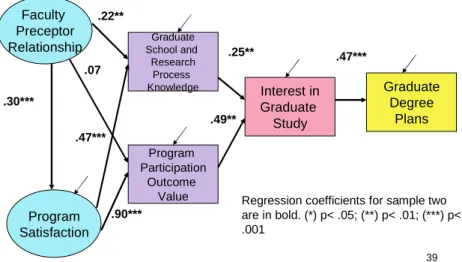
4 InitialStructuralModel………...……….48
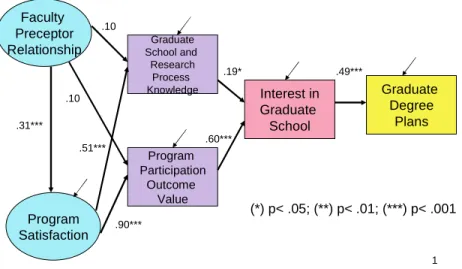
5 StructuralModelwith Standardized CoefficientsforSampleOne……...….…..…60
CHAPTER 1 INTRODUCTION
Educational attainment promotes positive outcomes for individuals and for society. On the individual level, postsecondary degree attainment is associated with increased opportunity for upward mobility, primarily through the economic and social benefits it affords (Carter, 2001; Kazia, Varga, and Hoffman, 2004). Moreover, the rewards of postsecondary degree attainment are not limited to individual benefits, they also contribute to positive societal outcomes. The more educated the U.S. citizenry, the greater the contributions people can make to the workforce and to thecountry’seffortto remain competitivein an increasingly globaland information
driven economy. Bandura (1997) captured this sentiment in stating:
“ Increasing complexities in technologies, social systems, and the international economy present different realities demanding new types of
competencies…Societiespay dearly fortheeducationalneglectoftheir youth…Thenetresultisadeclinein thequality, and standard of living.”
Thus, the more formal education one obtains, the greater their personal resources are to develop as an individual and to contribute to society (Bandura, 1997). While postsecondary education is most commonly associated with undergraduate education, graduate study incorporates all of the aforementioned returns and extends them to a higher level.
modern industrial societies (Bourdieu 1977, 1984; Parsons 1964, p. 342 cited in Stolzenberg, 1994).”Hisstatementdemonstratestheimportantwaysthatgraduatedegreeattainment
broadens career opportunities and points to the intellectual capital and knowledge that are associated with graduate degree attainment. To some extent, the value of graduate education is reflected in part by the increase in the number of degrees awarded each year. During the 37 year period from 1960-1997 the number of bachelor degrees awarded in the United States tripled while the number of graduate degrees awarded quadrupled (Goyette, Mullen, & Soares, 2003). Similarly, NCES (2005) reported that between 1985 and 2004 graduate enrollment increased by approximately 57%. Additionally, between 1992-1993 and 2002-2003 thenumberofmaster’sdegrees awarded increased by 33% while the number of
doctorates increased by 3% (NCES, 2004). Thus, there is a clear indication that graduate degree enrollment is experiencing an upward trend.
Despite the benefits conveyed by a graduate degree, certain segments of the
population remain disproportionately absent from graduate programs. Specifically, African Americans, Hispanic Americans, and Native Americans, attend graduate school at rates far below their representation in the U.S. population. Each year since at least 1977, the
percentage of doctoral degrees received by members of all the underrepresented groups combined was less than the percentage of doctoral degrees earned by nonresident aliens. For example, in 1976-1977, the National Center for Education Statistics (NCES, 2004) reported that nonresident aliens earned 11.3% of all doctorates compared to just 5.7% for all
the 43,354 doctorates awarded (National Opinion Research Center[NORC], 2006). Thus, it is clear that students from certain ethnic groups have historically had low participation rates in graduate study and that the disparity continues today. The chasm in graduate degree
attainment has negative and profound affects on members of underrepresented populations and on society as a whole. In terms of career development, educational attainment can restrict or expand the career opportunities for which individuals qualify, facilitating access to jobs that require specialized knowledge, and limiting or denying access to higher paying and higher status jobs (Pascarella, Wolniak, Pierson, & Flowers, 2004). Additionally, the paucity of underrepresented students receiving graduate degrees decreases the pool of individuals from underrepresented populations who are qualified to serve as college and university faculty (Walters, 1997). Unfortunately, fewer faculty of color also contributes to the lack of same race mentors for underrepresented students and the lack of diverse views and
experiences in academia. Similarly, Leeman, Goeppinger, Funk, and Roland (2003) asserted that the absence of diversity in the research environment creates a void in the perspectives and experiences brought to research. Finally, unequal participation contributes to economic disparity and decreased social mobility for large numbers of individuals for whom graduate education could have improved their economic and social status.
Institutions of higher education (IHEs), government agencies, and various
professional organizations acknowledge the dire consequences of racial/ethnic disparities in graduate study as well as the need to address unequal participation (Malcolm, Chubin, & Jesse, 2004; Government Accountability Office (GAO), 2006). One such effort that has been successful in promoting underrepresented students’participation in graduatestudy isthe
Simpson (2003) to describe interventions that are designed to increase ethnic minority students’preparation for and participation in graduate study. While the initiatives vary in
structure and content, they share the same general mission: to acclimatize participants to conducting research and to prepare students to pursue and complete graduate studies. Research and evaluation studies have documented, in varying degrees, theprograms’ success.However,callsforadditionalresearch and evidenceoftheprograms’effectiveness
continue to resonate. Agencies that fund the initiatives are particularly interested in data showing that the project objectives are being met (NSF, 2000) and that resources are
allocated to maximize results (GAO, 2006). The problem is compounded by the fact that the renewed emphasis on accountability coincides with what Mervis (2006) deemed a“data deficit,”wherein someprogramslack sufficientdatato reportoutcomesand facechallenges
collecting data and tracking former students. Contrarily, individuals who work with the programs tend to be more aware of their impact, but encounter difficulty finding appropriate ways to demonstrate their accomplishments. In referring to the work of one federally funded national initiative, Grimmett, Bliss, Davis, & Ray (1998) asserted thatthe program’s effectivenessin increasing participants’graduateschool matriculation rates has chronically been “underanalyzed and underreported.”Thus indicating that important outcomes can
potentially, and perhaps are likely to, go undocumented. Thus, the aforementioned concerns point to two specific problems pertaining to research on GSPPs: 1) the need for quantifiable data linking outcomes to program experiences and 2) the need for strategies that help programs articulate or model their success.
The purpose of this exploratory study was to investigate the effects among select GSPP program outcomes and to test the salience of those outcomes in predicting
undergraduatestudents’plansforgraduatestudy.Thestudy used datafrom theUniversity of North CarolinaatChapelHill’sSummerResearch Pre-Graduate Research Experience
(SPGRE) program, which has been relatively successful in achieving its goals of reinforcing and promoting participants’interestin graduatestudy.According to Frierson (2006),ofthe
more than 600 students who have completed SPGRE by 2004, approximately 70% have enrolled in graduate study. Of the students who completed SPGRE between 1988 -1998, 27% (94)havereceived master’sdegrees,16% (57)haveentered butnotyetcompleted
doctoral programs, and 28% (100) have earned doctorates. While previous research related to GSPPsreportspositiveoutcomessuch astheSPGRE statisticscited and students’positive
perceptions of the research experiences in the programs, little is known about how various program components relate to each other (Eatman, 2001; Foertsch, Alexander, & Penberthy, 1997) or theirrelationship to participants’educationalplansto pursueagraduatedegree.
Moreover, few studies have empirically examined the associations by which program participation might be linked to plans to pursue graduate study. One exception that was identified, Eatman (2001) examined the influence of GSPP factors along with variables such as educational experiences and family background. The current study seeks to understand the process by which graduate degree plans are developed or maintained through examination of participants’perception ofselected program experiences.Theseprogram outcomesare
represented visually, in a model depicting their relationship to one another, and are tested for goodnessoffitin reproducing thedata.Given thatthestudy’ssampleconsisted ofstudents
candidates for graduate school admission, the study focuses on the social-cognitive outcomes associated with participation in the GSPP program, rather than academic and background characteristics, which typically characterize inquiry in this field.
Background Program Information
The Summer Pre-Graduate Research Experience (SPGRE) Program is a summer research program designed to provide students from underrepresented ethnic populations with an in-depth meaningful research experience and to promote and reinforce interest in graduate study and research careers. The program is university-based and is hosted at a large Research Extensive institution in the southeast region of the country. SPGRE has run
continuously since its inception in 1988 and has served more than 700 students. Recruitment is conducted on the national level, targeting students at colleges and universities across the country. Over the last 10 years, 45-60 students participate in the program each year. Students are pre-screened based on grade point average (GPA), letters of recommendation from faculty, academic classification, and their statement of interest. The mean GPA of accepted students has been 3.5 over the years. Faculty preceptors who work with the program review applications of students who pass the initial screening and select students with whom they would like to work during the summer. The selections tend to be based on mutual research interestand students’academicbackground.Theresearch projectscoverabroad
students are expected to produce a research paper related to their project and to present their research at a program poster session.
A variety of professional development, academic, and social activities are offered to students. Included among them are a weekly seminar series where guest speakers address topics such as writing a personal statement for graduate school admissions, identifying funding sources for graduate study, and developing an effective research poster for
presentation. Additionally, students participate in a GRE preparation course, and engage in social activities such as cook-outs with graduate students and faculty mentors.
There are several benefits of using the SPGRE population for the current study. Primarily, educational plans (EPs) for a graduate degree are most informed at the collegiate level, once students have experienced college and are able to make better judgments about their ability and desire to continue on to graduate study. Secondly, although the population consists of students who have expressed an interest in learning more about graduate study and whose academic credentials make them strong candidates for graduate admission, at the end of the program not all students report plans to attend graduate school. Therefore, the study may inform our understanding of how the program outcomes differ among students who have EPs to pursue graduate study compared to those who do not.
Significance of Study
(Kardash, 2000) by assessing the effectiveness of this type of educational intervention in facilitating participants’development or maintenance of plans to pursue a graduate degree,
and more importantly, it seeks to contribute to our understanding of the program processes associated with participants’plansto pursuegraduatedegrees.Using datathat spans a
19-year time period from 1988-2006, the study analyzes and documents program outcomes and degree plans of almost 700 program participants. This is significant because it allows for analysis of data collected over a considerable time-period and of data pertaining to a large number and wide range of participants. Additionally, this work has significance for policy implications and program improvement, as well as the portability of the program to other sites. Moreover, the findings may be helpful to program administrators and funders in making decisions regarding the allocation of resources and program planning and
implementation. Although data from this study pertain to one particular program, similar initiatives should find the knowledge generated applicable to improve the design and operation of their programs (Grimmett, Bliss, Davis, & Ray; 1998).
In addition to its contributions to the GSPP literature, this study has implications for career development literature, specifically as it relates to educational aspirations. Much of the research related to predicting EPs is based on models that were developed from samples that lacked ethnic diversity (Flores, 2006; Hill, 2005). This may be problematic because the models tend to have poor fit when applied to ethnically diverse students (Carter, 2001; Hamrick & Stage, 2004; Kerka, 2003). Pascarella, Wolniak, Pierson, and Flowers (2004) posit that while model specification and testing to explain and predict EPs have seen “substantialadvances”in thelast20 years,insufficientattention has been directed to the
based differencesin modelfitforpredicting high schoolstudents’educationaland
occupational aspirations, Mau & Bikos (2000) also suggest the creation and testing of models thatincorporate“key variables”based on genderand ethnicity.Thisstudy willinform the
literature by using a sample of more than 95% ethnic minority students, presenting a perspective that goes beyond the traditional singular demographic focus of the field and allowing for inclusion of variables hypothesized to be particularly relevant to the experiences of underrepresented students.
While the overarching goal of GSPPs is to increase graduate degree attainment rates for ethnically underrepresented students, it is also critical to measure intermediate outcomes because of the time lag between program participation and graduate degree attainment (NSF, 2000). In the current context, outcomes can be assessed in three major areas: 1) completion of a graduate program 2) matriculation into a graduate program and 3) educational plans to pursue a graduate degree. Educational plans (EPs) have been shown to be highly correlated with graduate school enrollment (Carter, 2001) and are cited as strong predictors of eventual degree attainment (Mau & Bikos, 2000; Pascarella, Wolniak, Pierson, & Flowers, 2004; Pascarella & Terenzini, 1991). In the context of GSPPs, EPs are significant because they are one of the most immediate program outcomes that can be determined at the conclusion of a program. Additionally, they are important because they represent the value students place on a graduate degree,areaproductofstudents’educationalexperiences(Carter,2001),and
reflect their belief in their ability to matriculate into a graduate program. Finally, EPs
CHAPTER 2 Review of Literature
This chapter provides a review and critique of research on GSPPs (Graduate School Preparation Programs). The chapter is organized in the following sections: 1) an overview of the programs that prevail in the literature; 2) a discussion of literature related to GSPP alumni’sgraduateschoolmatriculation ratesand plansto attend graduateschool;3)a summary ofoutcomesrelated to participants’perceptionsand satisfaction with various
program components; and 4) the types of studies that have been conducted, by examining the conceptual frameworks employed, the types of analyses used, and the research questions investigated.
An exhaustive review of the literature of this emerging field was performed. Six databases were used to search for articles. The databases include the following: Academic Search Premier (a multidisciplinary database), Dissertations and Theses, Educational
Resources Information Center, ICPSR Direct (Institute for Social Research at the University of Michigan), Psych Info, and Sociological Abstracts. The researcher’sfamiliarity with the
field allowed her to know that there would be a limited number of journal publications on the topic and more, though still not extensive, literature in book chapters and conference
in graduate study 2) reported findings of at least one research or evaluation question related to students’ofcolorinterestin ormatriculation into graduate school 3) published or
presented studies in any of the following: peer-reviewed journal, professional conference presentation or proceedings (national or regional level), book chapter, an ERIC document, or an accepted dissertation.
Search Procedure
Phase I of the search used combinations of keywords related to the following three terms: 1) race/ethnicity (i.e., underrepresented, minority, and students of color), 2) degree plans (i.e., degree plans, educational plans, degree aspirations, and educational aspirations, and 3) graduate school (i.e. graduate study, graduate education, and postsecondary
education). Phase II of the search used specific program and agency names like McNair, NSF (National Science Foundation), NIH (National Institutes of Health), MARC (Minority Access to Research Careers); and SROP (Summer Research Opportunity Program). Phase III used the names of authors known to have conducted studies related to GSPPs and the development of educational plans. The number of articles identified is disproportionately low given the significance of this topic and the longevity of the programs. Moreover, most of the articles identified and used have not been published, but are papers from conference
presentations, dissertations, or ERIC documents. The next section of the literature review provides background information on the mission and structure of the GSPPs that are cited most in the literature.
Overview of Programs
Numerous initiatives are in place to expose students from traditionally
experiences that increase their competitiveness for admission to graduate programs. This section provides an overview of the programs that appear frequently in the literature and in most cases referenced in the literature view of this study.
There is great similarity in the overall mission of GSPP programs, which is mainly to provide students with the information and resources needed to give serious consideration to pursuing a graduate degree. On the federal level, the National Science Foundation funds initiativesto increasethediversity ofthenation’sscience,technology, engineering, and math
(STEM) workforce. Programs include the following: the Louis Stokes Alliances for
Minority Participation (LSAMP) program funded since 1991 and the Louis Stokes Alliances for Minority Participation (LSAMP) Bridge to the Doctorate (BD). Similarly, the National Institutes of Health (NIH) sponsors programs through the National Institute of General Medical Sciences (NIGMS). One of thelargestofNIGMS’programsistheMinority
Biomedical Research Support (MBRS) Award, created in 1972 and designed to prepare studentsforresearch careersin thebiomedicalsciencesthrough funding faculty members’
research, increasing the research capability of institutions serving significant minority populations,and increasing students’interestand skilllevelin biomedical research. The
increase participation of ethnic minorities and women in science (Baker, 1998). Thus,
prompted by the desire to strengthen the U.S. STEM workforce and to diversify participation in post-baccalaureate education, federal agencies invest financial and human resources into a range of initiatives.
Another program funded by the federal government is the U.S. Department of Education’sRonald E. McNair program, which is among the TRIO college outreach
programs designed to encourage and support students from economically disadvantaged backgrounds. McNair targets first generation college students, students with disabilities, students from underrepresented populations, and low-income students with strong academic potential and seeks to increase their graduate school matriculation rates.
Institutions of higher education are also spearheading individual and collaborative programs to bring parity to participation in graduate education. Programs that are frequently the subject of applicable research studies include the following: The Committee on
doctoral degrees but that some may need encouragement, the benefit of appropriate advising and appropriate experiences to pursue that path, as well as to increase awareness of graduate programs and opportunities. Furthermore, the programs assume that the services and
activities they offer may positively expand or reinforcestudents’educationaland career plans.
The programs differ in the type of disciplines involved, with Meyerhoff focusing only on STEM fields and others open to STEM, social sciences, and humanities. They also differ in their funding sources, with Meyerhoff receiving a combination of private and public funding, and CIC and RES receiving mostly public funding. Other unique differences among these three initiatives exist. CIC-SROP isaconsortium of“Big Ten”universitiesand the
University of Chicago (Eatman, 2001). SROP began in 1986 and is designed to increase underrepresented students’completion ofdoctoralstudy in areaswheretheycan pursue
research careers. The program is 8-10 weeks in length. Student-faculty pairings are based on students’interestand capabilitiesand thedirection ofthefaculty members’research agenda.
Program activities include educational and social activities and a CIC-wide Research Conference. RES differs in that it is the umbrella for several initiatives at UNC. In addition to providing opportunities for graduate and undergraduate students, it also serves medical and dental students. RES provides research opportunities in the physical, life, and social sciences, along with mathematics and technology and consists of both academic year and summer programs.
Graduate School Matriculation & Matriculation Plans
to the degree to which programs succeed in producing students who formulate plans to pursue a graduate degree and students who enroll in graduate programs. The National Center for Educational Statistics reported that of all the underrepresented students who earned baccalaureate degrees from 1992-1993 only 8.8% had enrolled in graduate school (Foertsch, Alexander, & Penberthy, 1997). Underrepresented students who participate in GSPPs have substantially higher graduate school enrollment rates compared to the national level. One study related to the Ronald E. McNair program at Rutgers, the State University of New Jersey, found that of all the students who completed the program in its first two years of existence, 88% or fourteen of sixteen students from 1993, the first cohort, matriculated into graduate programs and 91% of the 1994 graduating cohort participants were accepted to graduate programs, with 82% or nine of eleven planning to enroll at the time the study was conducted (Thomas, 1994). These numbers are particularly high and encouraging, when you consider that McNair is a TRIO program, serving low-income, first-generation-college, underrepresented minority students. Another study involving McNair undergraduates, which yielded a response rate of 58% (n = 624), surveyed students at 61 institutions, indicated that 10% of624 respondentsplanned to obtain amaster’sdegreeand 72% planned to pursuea
doctorate (Williams, 2005).
In astudy ofNSF’sformer RCMS program, McHenry (1997) reported that more than
Studies of theUniversity ofMaryland,BaltimoreCounty’s(UMBC)Meyerhoff
program report high proportions of participants enrolling in and graduating from professional and graduate programs (Maton & Hrabowski, 2004). Of the 86 participants in its first 10 cohorts, 29.1% had graduated from or were enrolled in a PhD or MD/PhD program. Compared to a comparison group of students who were accepted into the program but declined admission, Meyerhoff students were 5.3 times more likely to have graduated from or be enrolled in a graduate program. Additionally 43.8% of the non-Meyerhoff students did not continue to a STEM graduate program or to medical school, compared to only 29.1% of Meyerhoff students.
Maton and Hrabowski (2004) also state thattheprogram’seffectivenessappearsto increase with time. While the first four cohorts experienced 18.3% of alumni pursuing or completing a PhD or MD/PhD the last 3 cohorts experienced 52.6% of alumni pursuing or completing a PhD or MD/PhD. Notably, Meyerhoff alumni graduated from science,
technology, engineering, and mathematics (STEM) fields, which historically have extremely low participation rates for students of color.
The first graduating cohort of the Research Education Support Program, an academic year program, had positive post-baccalaureate outcomes (Frierson & Zulli, 2002). Half or seven of the fourteen participants who graduated in 1998 entered doctoral programs, while six enrolled in medical school but chose to conduct research as medical students. The next year saw similar success with all five of the graduating participants enrolling in graduate programs.
responses, 75% indicated that they plan to pursue a graduate degree. The specific breakdown was as follows: Doctoral degree 48%, Masters degree 19%, Joint degree (JD/PhD, MD/PhD) 8%. Of the remaining students, 6% were undecided on their post-baccalaureate plans, and 19% intended to pursue a professional degree. While there is a chance of selection bias,
where students who benefitedthemostfrom theprogram orsupported theprograms’mission were the ones most likely to volunteer to participate in the study, the results show that the majority of those students plan to pursue a graduate degree.
Lewis and Frierson (2006) examined data for the 1998-2005 program cohorts of the Summer Pre-Graduate Research Experience Program. They found that 78.9% (n = 295) of students surveyed at the end of the program indicated that the program stimulated their desire to pursue graduate studies (48.5% strongly agree and 30.4% agree) and 83.9% or 234
indicated that they plan to enroll in a graduate program.
Results of a study of the University of Minnesota Summer Undergraduate Research Program also show positive outcomes related to graduate school enrollment and completion. Walters (1997) reports that the 1989-1992 program cohorts, which consisted of women and students of color, experienced rates of 62% to 72% completion or enrollment in graduate or professional degree programs.
This section of the literature reviewed the available empirical studies that reported matriculation rates and plans following participation in GSPPs. Findings indicated the high proportion of former GSPP participants who matriculate in, complete, or have
post-baccalaureate plans to pursue a graduate degree, indicating the possibility of a strong
correlation between program participation and graduate school intentions and matriculation.
Participants’PerceptionsofProgram
In addition to literature delineating participant post-baccalaureate decisions, some studies have also focused on perceptions of and satisfaction with GSPPs. The synthesis of literature related to these outcomes is organized by the following categories: 1) Interest Measures 2) Competence Measures 3) Access Measures; and 4) Satisfaction Measures.
Interest.Given the variability inGSPP’sstructure and content, the high level of consistency is noteworthy. Most of the studies that include interest measures indicate students’interestin graduateschooland research increased as a result of program
participation. For the RES Program at UNC-CH, in terms of numbers, one study indicated that more than 75% of students reported increased interest in graduate school and more than 50% reported increased interest in research careers (Booker & Frierson, 2002; Smith, Lewis, & Frierson, 2006).These findingsarebased on students’responsesto aprogram exitsurvey
administered at the end of the program. Several reasons were given for the heightened interest. Exposure to the research process and environment (Johnson, 2005; Frierson & Zulli, 2002; Smith, Lewis, & Frierson, 2006; and Walters, 1997) was cited, in that it changed students’viewsofresearch from boring and isolating to thatofinteresting and engaging.
notions that those individuals lacked social skills and personality. Thus the program allowed students to develop a more accurate and positive perception of research and graduate school. This new perspective, in turn, made students more comfortable in the research environment and apparently increased their commitment to pursuing graduate study.
Competence.Theliteraturealso documentsGSPP’seffectivenessin fostering
students’graduateschooland research competence.In astudy ofpre- and post-McNair
participants, post-McNair participants had higher levels of academic, research, and social self-efficacy, [F (3, 296) = 108.2, p < .01,] indicating that program participants had more confidence in their academic, research, and social ability to pursue and complete a graduate program of study (Williams, 2005). Regarding academic self-efficacy, the two areas where students were most confident were their ability to obtain a strong letter of recommendation for graduate school from at least one professor and their ability to choose a graduate school appropriate to their needs. They were least confident in their ability to score high enough on the Graduate Record Examination (GRE) to gain admission to one of their top three graduate school preferences. The research self-efficacy items showed that students were most
confident in their ability to discuss research ideas with a professor and least confident in their ability to choose appropriate data analysis techniques. The social self-efficacy items
indicated that students were most confident in their ability to ask a professor to be a mentor. The lowest mean score, although still relatively high (7.37 on a scale of 1-10) was comfort in visiting a professor in his/her home. These findings show that the McNair participants were efficacious at many tasks critical for enrolling and succeeding in graduate school.
program to assess their perceptions of students’performance. The faculty members rated the students’ability to effectively conductresearch morepositively than any otheraspectofthe program.Participants’competencelevelsarealso reflected in studiesthatconcludethat the
programs helped participants prepare for the academic and emotional challenges of graduate school (Booker & Frierson, 2002), enhanced their skills and knowledge (Delatte, 2004), and “validated thatthey were capableofgraduateorprofessionalschoolwork” (Walters,1997 p.
28).
Access. Another aspect of GSPPs is their success in providing students access to research opportunities that may not otherwise be available. Most programs assist students in securing research positions by matching them with faculty members who agree to serve as faculty mentors/research trainers. One study found that 85% of the study participants (16 of 19) stated that if it had not been for the program, they would not have participated in
academic-year research as undergraduate students (Frierson & Zulli, 2002). Because the program oftenworked on thestudents’behalfto maketheinitialcontactwith faculty, students’anxiety did notprecludethem from research engagement.Additionally,students
reported that having program staff assist and advise them in choosing a research site made the process easier to navigate.
Satisfaction.Findingsconcerning students’satisfaction with program componentsare
generally positive and broad in scope. Based on responses to Likert-type and open-ended questionson an exitsurvey,students’perceptionsoftheoverallprogram experience show
that they find the programs worth their time and effort, and that they would recommend the program to others (Booker & Frierson, 2002; Smith, Lewis, & Frierson, 2006). Interviewees in Walters (1997) study reported that they were pleased with the overall environment of their summer program. While some students may have experienced difficulty with an academic or professional aspect of the program, they reported that the social support made up or
compensated for the challenges in other areas. Some studies investigated differences in perceptions of satisfaction based on gender. Despite the fact that GSPPs targeting
underrepresented minority students tend to have female to male student ratios of more than 2:1, and that women now outnumber men in graduate enrollment for all ethnic groups, Rigginsand Frierson’s(1996)analysisofexitsurvey datafound thatmaleand female
students only differed on two variables. When asked about the extent to which the program met their expectations and the extent to which the program was worth their time and effort, male students reported more positive perceptions than female students. This finding is surprising given the low number of males that typically participate in GSPPs. It is also encouraging because it shows that the programs can accommodate men just as well as women, and that despite their low numbers, the men find the experience to be worthwhile.
Anotherstudy investigated differencesin students’satisfaction based on theethnicity
sciencevs.socialscience and humanities,wasalso used to comparestudents’levelof
satisfaction. Chi square test analyses indicated no significant differences in the quality of the mentoring relationship related to field of study, overall impression of the program, or
perception ofresearch,research project,orgraduateschool.Inquiry into students’
satisfaction shows that the program activities appear to be effective and appropriate.
Summary of Literature
In summary, the limited literature on GSPPs indicates that 29-84% of program participants pursue and/or state plans to pursue graduate study. Despite this broad range, these proportions tend to be well above the national averages for underrepresented students. An examination of the investigative literature on GSPPs reveals several limitations. First, many of the studies involve small sample sizes. This is often because studies involve cohorts that may have only 10, 20, or 40 participants. Secondly, and perhaps most problematic, is the fact that few studies examine the link between program experience and positive program outcomes, with the goal of explaining possible linkages. While many factors contribute to students’postbaccalaureateeducationalchoices,itisimportantto understand how program
outcomes are associated with plans for graduate study. Thirdly, it is important to note that there is very little information on the challenges faced or negative outcomes (Thomas, 1994 is one exception) of studies related to GSPPs. Perhaps individuals are reluctant to report challenges or perhaps the questions and methods used thus far have prevented us from discovering them.
about their experiences in GSPPs and the variables or outcomes related to graduate school enrollment. Many of the limitations that were noted can be addressed with moderate effort and resources. Given the current emphasis on accountability, this is an opportune time to examine our research focus and design. As noted by Frierson and Zulli (2002), “In
conclusion, it is important to note that this work is not intended to be an endpoint but instead an initial effort to determine ways that intervention programs can successfully increase
minority studentparticipation.”By considering findingsfrom theinitialeffortand extending
our knowledge and techniques, we ensure that the field continues to advance. This study seeks to add to the foundation for a new line of research directed at modeling programs’
influence onstudents’educationalplans, as well as exploring the applicability of theoretical frameworks that have not typically been applied to GSPPs.
Theoretical Framework
The theoretical framework guiding this study is an adaptation of Lent, Brown, and Hackett’s(1994)SocialCognitiveCareerTheory (SCCT).SCCT suggestspathways that
explain how our experiences and perceptions of those experiences ultimately influence three phases of career development: 1) interest 2) goals or choices to pursue particular academic and occupational options and 3) performance and persistence in chosen academic and occupational pursuits (Lent, Brown, and Hackett, 1994). Empirical evidence supporting the application of SCCT to academic and career choice is found in a wide range of studies, from thoseinvestigating students’intention to pursuea career in the sport and leisure industry
SCTT isbased on Bandura’ssocialcognitivetheory (1986),which viewsbehavioras
a dynamic and reciprocal interaction between person, behavior, and environmental variables. The dynamic nature of the relationship implies fluidity and change while the reciprocity implies that the relationship is not unidirectional, but rather the variables influence each other. Social cognitive theory emphasizes the role of cognitions, particularly how they are shaped by learning experiences, in determining our behavior. More specifically, it posits that behavior is the product of self-regulatory and self-reflective processes, allowing individuals to both influence and be influenced by their environment. SCCT adapts the core social cognitive principles and extends them to vocational domains (Lent, Brown, & Hackett, 1994; Fouad & Guillen, 2006).
Social Cognitive Career Theory is particularly appropriate for the current study for several reasons. First, it is one of few theories that is conceptualized to explicitly apply to both educational and occupational pursuits. It views them as developing in parallel to one another, often being influenced by the same variables and through similar processes. This is significant because anindividual’scareeroptionsareoften constrained orexpanded by their level of education and their field of study. Moreover, individuals may make educational choices based on the career they plan to pursue and vice-versa. The second reason SCCT is suitableforthisstudy isitsfocuson variablesthat“areamenableto change”(Ali&
Saunders, 2006). While factors such as SES (socio-economic status) and parent educational level may contribute to educational and career attainment, they are not easily amenable to change. By incorporating variables that are more dynamic, the framework affords
learning opportunities to which we are exposed. The program examined in the current study provides the opportunity to investigate educational choice within the context of one particular learning opportunity.Whileeach student’sprogram experiencemay differ,in general,they
are exposed to the same activities, within similar contexts.
Adapted from “Toward a Unifying SocialCognitive Theory ofCareer and Academic Interest,
Choice,and Performance” by Lent,Brown,and Hackett,1994 Person Inputs
-Predispositions -Gender -Race/ethnicity -Disability/
Health status
Background Contextual Affordances
Learning Experiences
Self-efficacy Expectations
Outcome Expectations
Interests Choice Goals
Actions Contextual Influences (Environmental Supports & Barriers)
Goals/Choice Intention
Goals are symbolic representations of a desired outcome towards which an individual is working (Lent, Brown, & Hackett, 1994). Bandura (1986) defines goals as the intention to engage in a particular activity or to achieve a particular outcome. Goals are significant because they can motivate individuals to plan and take appropriate action to achieve goal attainment. In educational and career development literature, goals are expressed in various ways, including plans, intentions, and expressed choice (Lent, Brown, & Hackett, 1994).
SCCT suggests that goals are influenced both directly and indirectly by all of the core person variables including: interests, outcome expectations, and self-efficacy expectations. Direct influences are also obtained from proximal environmental factors or contextual variables, while indirect influences are obtained from learning experiences and person inputs (i.e. gender, ethnicity).
Interest
Interest is an important motivational factor, representing patterns of likes and dislikes. Interest in an activity is associated with increased knowledge, value, and positive feelings toward the activity (Hidi & Harackiewicz, 2000). Additionally, interest facilitates greater involvement and further skill development for a task (Lent, Brown, & Hackett, 1994). In SCCT, experiences and environment are indirect but critical factors to interest development, given that our experiences and environment are major determinants of the activities to which we are exposed. Moreover, interests are directly influenced by self-efficacy beliefs and outcome expectations, in that we are more likely to maintain interests in activities for which we think we will excel and for which we value the anticipated outcomes.
According to SCCT outcome expectations are our beliefs about the likely
consequences of engaging in a particular activity and the relative value that we attribute to the anticipated outcomes of those behaviors (Lent, Brown, & Hackett, 1994). This definition departs slightly from the traditional view of outcome expectations that does not include the value component. Outcome expectations are informed by our self-efficacy beliefs and experience, with interest in an activity increasing when we anticipate that the activity will lead to a highly valued outcome, and interests decreasing when we do not anticipate a valued outcome resulting from our behavior (Bandura, 1989). The significance of outcome
expectations lies in the fact that if we deem the consequences of particular actions to be significant and worthwhile, and we feel efficacious to complete the task, then our interest and commitment to the related goals increase. According to Lent and Brown (2006, p.17),
career-related outcomeexpectationscan bedescribed as“people’sbeliefsabouttheextentto
which they will be able to satisfy their primary values if they were to pursue particular career paths.”Essentially,outcomebeliefshavebeen conceptualized in avariety ofways:the belief
that particular actions will lead to a desired result, our belief that the benefits of an action outweigh the cost, and the value one places on the expected outcome (Lent, Brown, & Hackett, 1994).
Outcome expectation and task value are important aspects of career choice and development. For example, Eccles (Parsons), Adler, and Meece (1984) concluded that task valuewasthemostsignificantpredictorofstudents’educationalplansand Meece,Wigfield,
expectations are central to academic and career choices in that individuals are more likely to engage in behaviors and make choices that they anticipate will result in outcomes that they value. According to SCCT, outcome expectations are related to the other variables through a direct influence on interest and goals/choice intentions and through an indirect influence on goals/choice intentions.
Self-efficacy
As defined by Bandura, self-efficacy representsaperson’sbeliefabouthow wellthey
can perform a given task, or their conviction of how successful they will be in achieving a certain activity (1986). Efficacy expectations influence a range of behaviors, including, what activities we choose to participate in, how much effort we exert, how long we persist when faced with obstacles or failure, and our physiological state (Bandura, 1986). In terms of career development, early research relating self-efficacy theory to educational and career domains posits that efficacy expectations influence the range of educational and career options that we consider, our persistence, and ultimately our level of success in desired educational and career pursuits (Betz & Hackett, 1983). It is important to acknowledge the valueofefficacy beliefsin thecontextofstudents’educationaland careeraspirations becausethey affectstudents’perceptionsofwhatgoalsarerealisticand thereby influence
achievement, attitudes, and interest. For example, if a student does not think it is realistic to pass a given course, he is unlikely to put forth effort, will not have a positive attitude about the course, and will likely lose interest. Lent et al. (1994) and Hackett and Betz (1989) maintained that ability and outcomes are mediated by efficacy beliefs.
Bandura, self-efficacy is influenced by learning experiences, specifically the feedback that we receive in such experiences, the role models we have, our performance, and our
perceptions and cognitive appraisals of the experiences (Bandura, 1986).
Learning Experiences
Learning experiences are one of the primary gateways to exposure and engagement in educational and career related activities, providing access to people, information, and
resources that contribute to individuals’perceptionsofpotentialcareerpursuits.Through
participation in learning experiences, individuals achieve various levels of success and subsequently form judgments about their ability. Ability judgments, or self-efficacy beliefs, can be enhanced in learning experiences through the four primary sources identified by Bandura (1977): personal performance accomplishments, vicarious learning (modeling), social persuasion, and physiological states. Personal performance accomplishments or mastery experiences occur when an individual succeeds at a task that is moderate to high in difficulty. Mastering a task is one of the most powerful ways to influence self-efficacy beliefs because when we achieve success we are motivated to repeat the activity and to engage in similar tasks. Additionally, past mastery of a task tends to increase our persistence when we are faced with challenges. Examples of personal performance accomplishments within GSPPs include participants conducting a literature review and producing a written product, as well as participants learning to use a new piece of laboratory equipment properly and without assistance. Accomplishment of these tasks contributes to enhanced self-efficacy beliefs regarding research.
model succeed at the same task. Modeling allows one to acquire skills and knowledge through observing someone else. Wherein, we believe that if we use the same strategies that we observed, then we should achieve similar outcomes. For example, if a student attends a research talk given by her faculty mentor and an intense question and answer session follows, the student may be caught off guard by the tone and intensity of the exchanges. When her faculty mentor diffuses the situation, answers the questions, and restores a sense of order to the session, the student is impressed and now has ideas about how to react if or when she is in a similar situation. The experience equipped her with possible wording to use and other strategies to implement.
Verbal encouragement, the third source, consists of giving positive feedback and conveying supportive appraisals oftheperson’sability and performance.Examplesinclude
commending a student for the quality of the work they completed or telling a student that you are confident that they will do a good job on a task. Physiological state, the last source, relates to somatic and emotional states. Extreme nervousness and anxiety about a task are related to low self-efficacy beliefs, while high self-efficacy beliefs are associated with excitement and positive emotions. For example, a student with low self-efficacy beliefs is likely to be more anxious about leading a discussion in a lab meeting than a student with high self-efficacy beliefs. Consequently, learning experiences provide the environment for
individuals to assess their capabilities and ideally, the opportunity to enhance their
specific behaviors. Therefore, learning experiences make it possible to enhance self-efficacy beliefs and to inform outcome expectations.
Contextual Influences Proximal to Choice Behavior
SCCT asserts the influence of contextual or environmental supports and barriers on career and educational development. Supports are considered factors that facilitate positive experiences and perceptions, while barriers are viewed as factors that hinder progress and lead to negative experiences and perceptions. In line with the cognitive emphasis of the theory, perceptions of supports and barriers are based on both subjective and objective featuresoftheenvironment,relying on theindividual’sinterpretation (Lent,Brown,&
Hackett, 1994). Perceptions of strong support are related to increased likelihood of selecting a goal and conversely, perceptions of substantive barriers are related to decreased likelihood of choosing the goal. In SCCT contextual factors contribute to the relationship between interest and choice goals, helping to determine if interests are translated into goals (Lent, Brown, & Hackett, 2000) and subsequently influencing the level of student persistence and performance level.
Summary of SCCT
Essentially, SCCT provides a theoretical framework that encompasses constructs related to one’sperceived ability,values,interests,and goals,whileincorporating important
contextual factors. A summary of how the variables relate to and influence each other follows.
associated with the experience. Known as self-efficacy beliefs and outcome expectations, these ability judgments and value expectations subsequently influence our interest in particular educational or career domains. More specifically, perceptions of high- ability coupled with positive outcome expectations are hypothesized to promote or sustain interests, where in perceptions of low- ability and negative outcome expectations are hypothesized to lead to disinterest.
Following interest development, the theory postulates that interests are translated to choice/goal decisions to pursue a particular pursuit when an individual has high interest and does not expect to encounter insurmountable barriers. SCCT uses the term contextual factors to refer to “supports”thatencouragepeopleto setthegoaland “barriers”to referto factors
that deter individuals from setting the goal. Thus, a combination of interest and the perception of support or lack of significant barriers is associated with the choice/goal to pursue a particular educational/career path.
SCCT’sutility can beattributed to itsapplicability to both academicand career
research, its focus on variables that can be changed, and its emphasis on the significance of learning opportunities. The model tested in the current study is based on SCCT and contains slight modifications to reflect the population and program under study.
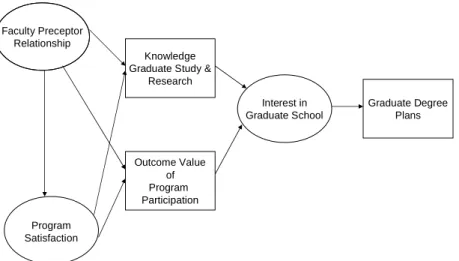
The model developed for the current study is based on the tenets of SCCT in relation to the program context. The model holds that the program experience, which serves as the learning experience, is comprised of three variables: 1) quality of faculty preceptor
(Knowledge) and outcome value of program participation (Outcome Value). Subsequently, Knowledge and Outcome Value directly influence the extent that the program stimulated participants’interestin pursuing graduatestudy.Chapterthreeprovidesadetailed
Program Satisfaction
Outcome Value of Program Participation Faculty Preceptor
Relationship
Knowledge Graduate Study &
Research
Interest in Graduate School
Graduate Degree Plans
Research Questions and Hypotheses
Based on the overarching question: In what ways are the program outcomes associated with participants’post-program plans to pursue graduate study? This study was guided by the
following research questions:
1. How well does the proposed model represent the interrelationships of program outcomes?
2. To what extent does the proposed model predict participants’post-program
educational plans to pursue graduate study?
Hypotheses.Several hypotheses were developed from the research questions. The hypotheses are provided in the following section.
Hypothesis 1: The proposed model will have good fit to the data in explaining the effects among program outcomes.
A. Interest in graduate study will have a direct effect on educational plans for graduate study. B1. Knowledge will have a direct effect on interest in graduate study.
B2. Knowledge will have an indirect effect on plans for graduate study, through Interest. B3. Outcome Value will have a direct effect on interest in graduate study.
B4. Outcome Value of will have an indirect effect on plans for a graduate degree, through Interest.
C1. Faculty preceptor relationship will have a direct effect on program satisfaction. C2. Faculty preceptor relationship will have a direct effect on Knowledge.
C4. Faculty preceptor relationship will have an indirect effect on Interest, through Knowledge and interest.
C5. Faculty preceptor relationship will have an indirect effect on plans for a graduate degree, through Outcome Value and Interest.
D1. Program satisfaction will have a direct effect on Knowledge.
D2. Program satisfaction will have a direct effect on program participation outcome value. D3. Program satisfaction will have an indirect effect on plans for a graduate degree, through Knowledge and Interest.
D4. Program satisfaction will have an indirect effect on plans for a graduate degree, through Outcome Value and Interest.
Hypothesis 2: The initial model will have moderate to good fit and explain at least 15% of the variance associated with the variable plans for a graduate degree.
CHAPTER 3 Methods
Overview
The current study developed and tested the fit of a model designed to predict the program outcomes that are associated with participants’developmentormaintenanceof
educational plans to pursue graduate study following participation in the SPGRE program. This chapter explains the methods used to conduct the study. First, the data source is described, then the data analysis technique is explained, and finally, the procedures guiding data analysis and presentation are discussed.
Data Source and Instrument
Data for the study were taken from the 30 item SPGRE End of the Program
Questionnaire (Appendix A), which is administered each year during the last full day of the program. The self-report questionnaire measures students’perceptionsoftheprogram. The
questionnaire consists primarily of Likert-type responses with some open-ended questions. The items are based on four (1=No, Definitely not to 4=Yes, Definitely) and six-point (1=Very Unfavorable to 6= Very Favorable) scales. The questionnaire is anonymous to encourage honest responses. Internalreliability analysis(Cronbach’salpha)forthe instrument yielded a coefficient of .82 based on 28 items. Advantages of using this instrumentincludetheability to obtain students’immediatefeedback regarding their
minor changes (i.e. the addition of the ethnicity question in 1991 and changes to the forced-choice research disciplines provided).
Data Analysis Technique
Structural Equation Modeling (SEM) was used to build and test the adequacy of the model. SEM is an extension of regression and classical path analysis. It allows the
researcherto specify amodelbased on theory and to testthemodel’sability to reproducethe
data. The process yields information about the strength of relationships between variables or paths and the amount of variance explained each variable. Several factors support the
selection of SEM as the analytic technique. First, it permits the inclusion of observed and latent measures in the model. Latent constructs are not observed directly, but instead are comprised of two or more indicators or factors (Hoyle, 1995). Using latent constructs permits the researcher greater flexibility in operationalizing variables, as compared to using one measured item. Another advantage of using latent constructs is the reduction of
measurement error in the estimation process (Hoyle, 1995). Whereby regression and classical path analysis assume perfect measurement of variables, SEM can account for measurement error, thereby decreasing bias in regression coefficient estimates. A second benefit of using SEM is that it allows testing of complex relationships between variables. More specifically, it permits variables to be tested as both a predictor and an outcome and it permits
flexibility it permits in the design and fit evaluation of models. Mplus version 4.1 was used to conduct analyses. Mplus was selected because of its suitability for a dichotomous outcome variable and its ability to handle ordered categorical data through the use of WLSMV
(Weighted Least Squares with Mean and Variance adjustment) estimation, for data that are nonnormally distributed.
Procedures
Generation of data subsets.A random number generator was used to divide the data into two groups for the purpose of cross validation. Thus, sample one, the derivation sample, was used to test and modify the initial model and sample two was used to estimate the fit of the final model.
Descriptive analysis.Descriptive statistics were generated using SPSS 15.0.
Demographic data pertaining to participants’ethnicity,gender,typeofcollegeattending,and
academic rank will be provided, as well as an analysis of missing data, means and standard deviations, and reliability estimates for scales.
Operationalization of measures.This section discusses the operationalization of measures. The mean and standard deviation for observed variables and the factor loadings and R-Squares for latent variables will be provided in chapter four.
Thedependentvariable,referred to as“graduate degree plans,”ismeasured by participants’responseto an open-ended question asking them to indicate their post-baccalaureate plans. Responses were coded “0”forany responsethatdid notindicate graduateeducation and “1”forresponsesindicating graduatestudy.Responses related to pursuing a professional degree such as MD or JD were coded as“0,”since the goal of the
outcome variable is provided in Appendix B. The one week test-retest reliability analysis of thisvariable(n=38),conducted with the2006 program cohortresulted in Kendalltau’s
coefficient of 1.00.
Selection of the independent variables was guided by Social Cognitive Career Theory (SCCT), literature related to GSPPs, and statistical analyses. Thus, the following variables were examined: a) quality of faculty preceptor relationship; b) program satisfaction; c) increased knowledge of graduate school and research; d) outcome value of program participation; e) increased interest in pursuing graduate study; and f) educational plans for graduate study. While all of the variables are program outcomes to some extent, variables a and b theoretically represent the SPGRE program experience, variables c, d, and e represent the program outcomes, and variable f is the major outcome variable, educational plans for a graduate degree.
Interest in graduate school. Interest is gauged by one item, on a six-point scale, to assess the extent to which program participation stimulated participants’desireto pursue
graduate study.
Outcome value of program participation.The current study uses the term outcome value rather than outcome expectation, which is used in Lent, Brown, and Hackett (1994). While the use of outcome value in the current study is a slight modification of terminology, its meaning remains consistent with SCCT. As indicated in Chapter Two, Lent, Brown, and Hackett’s(1994)definition ofoutcomeexpectationsrefersto thevaluean individualplaces
Outcome Value (Outcome) is measured by one questionnaire item related to how much value students attribute to the general costs and benefits of participating in the program. Respondents used a six-point scale.
Knowledge of graduate school and research. The Knowledge variable is based on participants’perception ofhow much their knowledge of the processes involved in graduate
school and research increased as a result of program participation. While Lent, Brown, and Hackett’s(1994)SCCT modelusesan efficacy measure,thisstudy replacestheefficacy
measure with Knowledge. The change was made for two primary reasons. First, efficacy beliefs have been found to be more predictive of performance rather than intentions or plans, which are the outcome variable in the current study. Therefore, since the current study pertains to plans, knowledge is the more appropriate measure. Secondly, research shows that lack of knowledge about what is involved in research and doctoral study is significantly associated with ethnically underrepresented students’disinterestin doctoralstudy (Smith,
Lewis, & Frierson, 2005; Fleming, 2005). Similarly, Carter (2001) and Boyce (1997) have asserted that African American students tend not to be very informed about postbaccalaureate education options when they enter college and therefore undergraduate experiences play a valuable role in increasing their knowledge and awareness of postbaccalaureate options. The item is measured by one questionnaire item based on a four-point scale.
Latent variables. Latent variables are unobserved factors. Our understanding of what they represent is based on the covariances of their measured items. The initial model
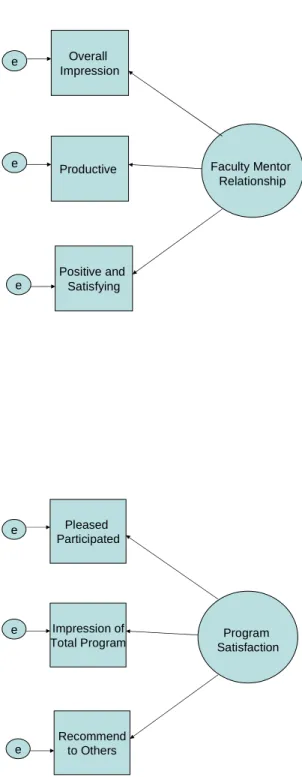
Program satisfaction. Program satisfaction is a latent variable comprised of three questionnaire items related to the following: 1) satisfaction with decision to participate in program 2) overall impression of program 3) and whether they would recommend the program to others. Item one was measured on a four-point scale and items two and three were measured on a six-point scale.
Quality of faculty preceptor relationship.The core of the program is completion of a research project under the guidance of a faculty mentor. The program is designed in such a way thatthementoristhestudent’sprimary socialization agentto graduate levelresearch.
The latent variable, quality of the faculty preceptor relationship is comprised of three items that assess the overall quality of the relationship, the extent to which the relationship was positive and satisfying, and how productive the student perceived the relationship to be. Respondents used a four-point scale for one of these items and a six-point scale for the remaining two items.
Estimation of measurement model.Anderson and Gerbing (1988) suggest a two-step or building process to modeling, whereby the measurement model is tested prior to the structural model. The measurement model represents the relationship between the underlying construct and its indicators. Testing the measurement model first provides statistics on the amount of shared variance between indicators and factors and thus assesses how well the construct represents the indicators (Kline, 1988). If the indicators fail to have good fit with the latent construct, the measurement model should not be inserted into the general model without modification. Confirmatory factor analysis (CFA), a special type of SEM, was used to estimate the measurement model and provide data on how well the
on two criteria: 1) significance of factor loadings, which represent the weights between the item and the factor and 2) degree of overall fit. Significance of factor loadings at the p < .05 level will be considered acceptable. An explanation of the criteria for the overall
measurement model follows.
Fit indices for latent variables.The measurement models that were tested in confirmatory factor analysis consisted of three indicators per variable, making them just identified, and incapable of producing fit indices. Therefore, in order to obtain fit indices the measurement models were tested together as a two factor model with six indicators.
Faculty Mentor Relationship
Positive and Satisfying Productive
Overall Impression e
e
e
Program Satisfaction
Recommend to Others Impression of Total Program
Pleased Participated e
e
e
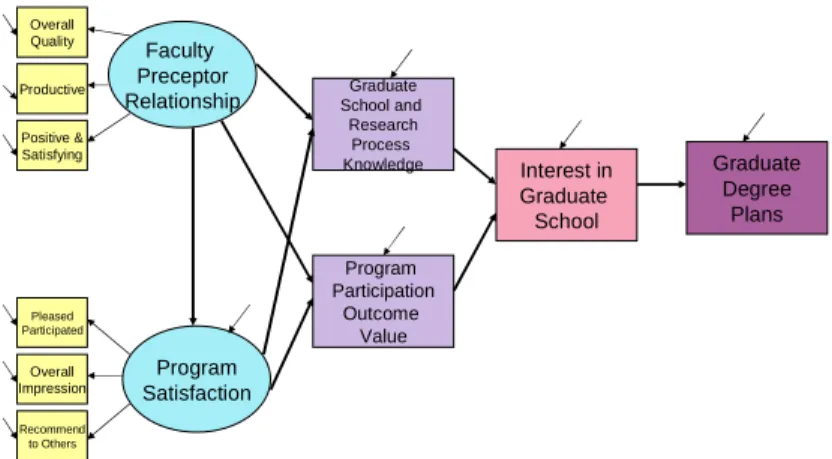
Estimation of Structural Model.Following acceptable specification of the
measurement models, the structural model, which represents the relations between the latent variables from the measurement model and the observed variables, will be estimated.
Figure 4.Initial structural model of the association between program outcomes and plans to pursue graduate study.
Program Satisfaction
Program Participation
Outcome Value
Faculty Preceptor
Relationship School andGraduate Research Process
Knowledge Graduate Degree
Plans
Overall Quality
Productive
Positive & Satisfying
Recommend to Others
Overall Impression
Pleased Participated