There is insufficient data on patients with small body size to determine if this should be considered a risk factor for con-tinuous-flow left ventricular assist device (CF-LVAD) support. We sought to evaluate survival outcomes, adverse events, and functional status of CF-LVAD patients with body surface area (BSA) <1.5 m2 in a large national registry. Adults with BSA < 1.5
m2 (n = 128) implanted with a HeartMate II (HMII)-LVAD from
the Interagency Registry for Mechanically Assisted Circulatory Support registry from April 2008 to December 2012 formed this cohort. Outcomes were compared with HMII bridge to transplant (BTT) and destination therapy (DT) post approval studies. The majority of patients were female (n = 106, 83%). A total of 64% (n = 82) were implanted for BTT and 36% (n = 46) for DT. The median BSA (range) was 1.44 (1.19–1.49) and 1.45 (1.25–1.49) m2 for BTT and DT, respectively. Overall survival 1
year post implant was 81% ± 5% for BTT and 84% ± 6% for DT. The most common adverse events for BTT and DT patients were bleeding (0.91, 0.88 events/patient year) and driveline infection (16%, 0.28 events/patient year). Six months post implantation, 87% of BTT and 77% of DT patients were New York Heart Association functional class I or II. Post implant sur-vival, functional status improvement, and adverse event pro-file for adult BTT and DT HMII patients with BSA < 1.5 m2
are favorable and comparable with outcomes published in the overall patient population. ASAIO Journal 2016; 62:646–651.
Key Words: LVAD, BSA, BMI, INTERMACS, HeartMate II
T
he landscape in the treatment of advanced heart failure is evolv-ing rapidly with the increased use of continuous-flow left ven-tricular assist devices (CF-LVADs) as a bridge to transplant (BTT) or as destination therapy (DT). In the latest Interagency Registry for Mechanically Assisted Circulatory Support (INTERMACS) 7th annual report, there have been more than 15,000 durable Food and Drug Administration (FDA)-approved devices implanted since June 2006.1 The International Society of Heart and LungTransplantation reports that the percentage of patients bridged with a LVAD at the time of heart transplantation has increased from <20% in 2000 to more than 35% in 2011.2 Moreover, there
is increased utilization of these devices as long-term permanent therapy or DT for advanced heart failure now accounting for up to 40% of all indications for CF-LVAD implantation in recent years.3
Outcomes in recent post FDA approval studies have been excel-lent, with 85% survival of those remaining on CF-LVAD support 1 year post implant for BTT patients and 74% for DT patients.4,5
Compared with the earlier technology of pulsatile displace-ment pumps, CF-LVADs are smaller in size and can be implanted in the more restrictive anatomy of small patients. However, there is a paucity of data on the use and safety of CF-LVADs in adult patients with a small body surface area (BSA) < 1.5 m2. The
HeartMate II clinical trial included a small body size cohort of 10 patients which indicated similar outcomes in patients with BSA < 1.5 m2 and those more than 1.5 m2.6 To further address and
clarify the use of CF-LVADs in adult patients with a small BSA in the post approval era, we sought to evaluate the survival out-comes, adverse events, and functional status of patients with BSA < 1.5 m2 implanted with a CF-LVAD in a large national registry.
Methods
Patients
The INTERMACS registry was queried to identify all adult patients
≥ 18 years of age with a BSA < 1.5 m2 who were implanted with
the HeartMate II CF-LVAD (HMII, Thoratec Corporation, Pleasan-ton, CA) between April 2008 and December 2012 (n = 128) for BTT (n = 82) or DT (n = 46) indications. Outcomes were com-pared with the HMII BTT (April to August 2008; n = 169) and DT (January to September 2010; n = 247) post approval studies (PASs).
Data Collection
This was a retrospective registry study using the INTER-MACS database. Data entry into the INTERINTER-MACS database
Outcomes of Adult Patients with Small Body Size Supported
with a Continuous-Flow Left Ventricular Assist Device
S
ANgJINL
EE,* J
ASONN. K
ATz,† U
LRICHP. J
ORDE,‡ N
ADERM
OAzAMI,§ R
ANJITJ
OHN,¶ K
ARTIKS. S
UNDARESwARAN,||
D
AVIDJ. F
ARRAR,||
andO. H. F
RAzIER#
Copyright © 2016 by the ASAIO. This is an open-access article dis-tributed under the terms of the Creative Commons Attribution-Non Commercial-No Derivatives License 4.0 (CCBY-NC-ND), where it is permissible to download and share the work provided it is properly cited. The work cannot be changed in any way or used commercially without permission from the journal.
DOI: 10.1097/MAT.0000000000000430
From the *Richard DeVos Heart & Lung Transplant Program, Spec-trum Health, grand Rapids, Michigan; †Center for Heart and Vas-cular Care, Divisions of Cardiology and Pulmonary & Critical Care Medicine, University of North Carolina, Chapel Hill, North Carolina; ‡Department of Medicine, Division of Cardiology, Albert Einstein College of Medicine / Montefiore Medical Center, Bronx, New York; §Department of Thoracic and Cardiovascular Surgery and the Depart-ment of Biomedical Engineering, Cleveland Clinic, Cleveland, Ohio; ¶Division of Cardiothoracic Surgery, University of Minnesota, Minne-apolis, Minnesota; ||Research and Scientific Affairs, St. Jude Medical, St. Paul, Minnesota; and #Center for Cardiac Support, Cardiovascular Surgery Research, Cullen Cardiovascular Research Laboratories, Texas Heart Institute, Houston, Texas.
Submitted for consideration November 2015; accepted for publica-tion in revised form August 2016.
Disclosures: The following are all conflicts of interest and funding sources, if any, for each co-author: S.L.: Travel grant, Thoratec; J.N.K.: Travel grant, Thoratec; U.P.J.: Consultant Thoratec/Heartware (<$5000 annually); R.J.: Research grant Thoratec/Heartware; K.S.S.: Employee of Thoratec; D.J.F.: Employee of Thoratec; Stockholder of Thoratec.
is voluntary and is specified by each participating center. The adverse events definitions and variables analyzed may be accessed via the INTERMACS website.7
Statistical Analysis
Continuous variables are presented as mean ± SD or median (range). Categorical variables are presented as proportions. Sur-vival, adverse events, and quality of life were compared with the HMII BTT4 and DT5 PAS. Survival was evaluated using the
Kaplan–Meier method. Comparison of survival between two groups was performed using the log-rank test. Adverse events are presented as both percentages and event rates (events per patient
year of support; eppy). Comparisons of adverse event rates were performed using Cochran–Mantel–Haenszel statistics. All statisti-cal comparisons were two sided with a significance level at p < 0.05. Statistical analyses were performed with SigmaPlot (Cranes Software, Chicago, IL) and SAS (SAS Institute, Inc., Cary, NC).
Results
Baseline Characteristics
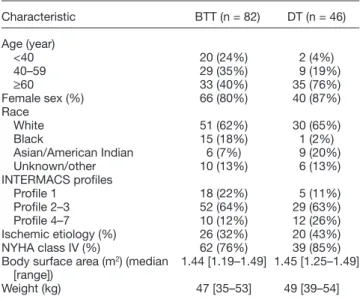
Table 1 shows the baseline characteristics of the small BSA
< 1.5 m2 cohort stratified by BTT and DT. The most striking
demographic characteristic unique to this patient population is that the majority of the patients (80% BTT and 87% DT) were female. The majority of patients were implanted as INTERMACS profile 2–3 (64% BTT and 63% DT) and New York Heart Asso-ciation (NYHA) Class IV (76% BTT and 85% DT). The median (range) BSA was 1.44 m2 (1.19–1.49) and 1.45 m2 (1.25–1.49)
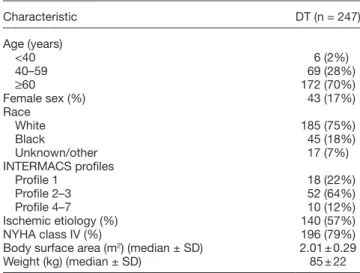
for BTT and DT patients, respectively. Age was greater in the DT group with 76% at least 60 years old compared with 40% for BTT. Tables 2 and 3 show the baseline characteristics of the HMII BTT and DT PAS cohorts, respectively. Females made up 22% and 17% of the BTT and DT PAS cohorts, respectively. The median BSA was 2.03 ± 0.25 and 2.01 ± 0.29 m2 for the
BTT and DT PAS cohorts, respectively.
Outcomes
Survival. The survival of the small BSA cohort was compared
with the survival of the HMII BTT4 and DT5 PASs (Figures 1 and
2). For the BTT population, the 6 month and 1 year post
im-plant survival of the small BSA cohort was 84% ± 4% and 81% ± 5%, respectively, which were similar to and not statistically different from the 6 month and 1 year post implant survival in the post approval BTT population (90% ± 2% and 84% ± 3%, respectively; p = 0.367). For the DT population, the 1 and 2 year post implant survival of the small BSA cohort was 84% ±
Table 1. Baseline Characteristics: Small BSA Cohort
Characteristic BTT (n = 82) DT (n = 46)
Age (year)
<40 20 (24%) 2 (4%)
40–59 29 (35%) 9 (19%)
≥60 33 (40%) 35 (76%)
Female sex (%) 66 (80%) 40 (87%) Race
White 51 (62%) 30 (65%)
Black 15 (18%) 1 (2%)
Asian/American Indian 6 (7%) 9 (20%) Unknown/other 10 (13%) 6 (13%) INTERMACS profiles
Profile 1 18 (22%) 5 (11%) Profile 2–3 52 (64%) 29 (63%) Profile 4–7 10 (12%) 12 (26%) Ischemic etiology (%) 26 (32%) 20 (43%) NYHA class IV (%) 62 (76%) 39 (85%) Body surface area (m2) (median
[range]) 1.44 [1.19–1.49] 1.45 [1.25–1.49] Weight (kg) 47 [35–53] 49 [39–54]
BSA, body surface area; INTERMACS, Interagency Registry for Mechanically Assisted Circulatory Support; NYHA, New York Heart Association.
6% and 79% ± 8%, respectively, and trended higher but was not statistically different from the 1 and 2 year post implant survival in the post approval DT population (74% ± 3% and 61% ± 3%, respectively; p = 0.105).
Adverse Events. The adverse event rates for the small BSA
cohort are similar to the BTT and DT post approval patients (Tables 4 and 5, respectively). However, in the BTT population, bleeding was significantly lower in the small BSA cohort (0.91
vs. 1.44 eppy; p = 0.010). In DT patients, hemolysis occurred more frequently in the small BSA patients (0.16 vs. 0.06 eppy;
p = 0.014).
Functional Status. Both BTT and DT small BSA patients
had a marked improvement in NYHA Classification. Before implant, no patients reported NYHA Class I/II symptoms. At
6 months post implant, more than 75% of small BSA patients had improved to NYHA class I/II with sustained improvement through 12 months (Figure 3A, B).
Discussion
This study represents the largest cohort of adult patients with a BSA < 1.5 m2 implanted with a CF-LVAD and support the use
of CF-LVAD therapy in this patient population.
The post implant survival of small BSA patients are com-parable with the published HMII post approval BTT and DT studies where the mean BSA was 2.03 ± 0.25 and 2.01 ± 0.29 m2, respectively.4,5 The post implant survival of the small BSA
BTT cohort was 84% ± 4% and 81% ± 5% at 6 months and
Figure 2. Kaplan-Meier survival for small BSA DT patients compared to postapproval DT study. BSA, body surface area; DT, destination therapy.
1 year, respectively. Although not statistically significant, the small BSA DT cohort had improved 1 and 2 year post implant survival compared with the DT PAS (84% ± 6% vs. 74% ± 3% and 79% ± 8% vs. 61% ± 3%, respectively; p = 0.105).
The adverse event profile of the small BSA patients is equally as comparable with the post approval HMII BTT and DT studies (Tables 4 and 5). For the BTT population, the small BSA cohort had adverse event rates that were not statistically different from the HMII BTT PAS for all the major adverse events rates studied, with the exception that there was less bleeding noted in the small BSA cohort (0.91 vs. 1.44 eppy). Similarly, the adverse event profile for the DT population was not dissimilar from the post approval DT cohort, although more hemolysis was noted in the small BSA cohort (0.16 vs.
0.06 eppy). The reason for a higher incidence of hemolysis in the small BSA cohort is unclear. Increased hemolysis may be associated with the cannula position in a small BSA patient, smaller relative circulating blood volume passing through the rotor, or other factors all of which require further investiga-tion. However it does not appear to be related to thrombus, which was similar at 0.03 to 0.04 eppy between cohorts, and stroke at 0.04 eppy was actually trending to be lower in the smaller patients but this did not reach statistical significance.
Paralleling comparable post implant survival outcomes and adverse event profiles of the small BSA patients is the marked improvement in NYHA functional class with the majority of patients reporting class I/II post implant, suggesting that the small BSA patients enjoy not only morbidity and mortality benefits but also improved quality of life with LVAD therapy.
The US clinical trial of the HM II also studied two small BSA patient (BSA < 1.5) cohorts, one for DT (n = 24) and one for BTT (n = 10), which were analyzed separately in the trial. The BTT cohort was composed of 10 females and was published in the device labeling.6 All small BSA patients survived to
180 days post implant with 86% improving from NYHA class IV to class I/II after 3 months. Six minute walk distance also increased an average of 230 m in the small BSA cohort versus
247 m in the primary study cohort. Adverse event rates were similar to those measured in the primary study cohort. Patients with small body size were comparable with larger patients in the clinical study; however, the number of small BSA patients was too few to make definitive conclusions.
A recent report by Cabrera et al.8 utilizing the INTERMACS
registry compared outcomes of 28 pediatric patients aged 11
Table 2. Baseline Characteristics: HMII BTT PAS Cohort
Characteristic BTT (n = 169)
Age (year)
<40 26 (15%)
40–59 81 (48%)
≥60 59 (35%)
Female sex (%) 38 (22%)
Race
White 125 (74%)
Black 29 (17%)
Unknown/other 15 (9%)
INTERMACS profiles
Profile 1 41 (24%)
Profile 2–3 96 (57%)
Profile 4–7 32 (19%)
Body surface area (m2) (median ± SD) 2.03 ± 0.25
BTT, bridge to transplant; HMII, HeartMate II; INTERMACS, Interagency Registry for Mechanically Assisted Circulatory Support; PAS, post approval study.
Table 3. Baseline Characteristics: HMII DT PAS Cohort
Characteristic DT (n = 247)
Age (years)
<40 6 (2%)
40–59 69 (28%)
≥60 172 (70%)
Female sex (%) 43 (17%)
Race
White 185 (75%)
Black 45 (18%)
Unknown/other 17 (7%)
INTERMACS profiles
Profile 1 18 (22%)
Profile 2–3 52 (64%)
Profile 4–7 10 (12%)
Ischemic etiology (%) 140 (57%)
NYHA class IV (%) 196 (79%)
Body surface area (m2) (median ± SD) 2.01 ± 0.29
Weight (kg) (median ± SD) 85 ± 22
DT, destination therapy; HMII, HeartMate II; INTERMACS, Interagency Registry for Mechanically Assisted Circulatory Support; NYHA, New York Heart Association; PAS, post approval study.
Table 4. Adverse Events: BTT
HMII Patients With a Small BSA (n = 82)
(Total Duration: 107.9 Patient Years) HMII BTT Post Approval Study (n = 169) (Total Duration: 142 Patient Years) p
% Patients Events (Events/Patient Year) % Patients Events (Events/Patient Year)
Bleeding 35 (43%) 98 (0.91) 75 (44%) 204 (1.44) 0.010
Explant due to device thrombosis 1 (1%) 1 (0.01) NR NR NR
Hemolysis 5 (6%) 6 (0.06) 5 (3%) 5 (0.04) 0.458
Hepatic dysfunction 8 (10%) 8 (0.07) 11 (7%) 12 (0.08) 0.783
Any infection 33 (40%) 112 (1.04) 78 (46%) 142 (1.00) 0.836
Drive line infection 13 (16%) 30 (0.28) 30 (18%) 45 (0.32) 0.626 Pump pocket infection 1 (1%) 1 (0.01) 3 (1.8%) 3 (0.02) 0.467
Stroke 7 (9%) 7 (0.06) 11 (7%) 11 (0.08) 0.723
Renal dysfunction 11 (13%) 11 (0.10) 17 (10%) 19 (0.13) 0.496
Right heart failure 9 (11%) 12 (0.11) 25 (15%) 26 (0.18) 0.177
to 18 years compared with young adults aged 19 to 39 years implanted with the HMII. At 6 months, the composite of sur-vival to transplantation, ongoing support, or recovery was 96% for the pediatric group, not dissimilar to the young adult group (p = 0.330). The median BSA for the pediatric group was 1.91 m2 (1.47–2.65).
Interestingly, the results of the Japanese HMII prospective BTT trial were recently published.9 The six patients enrolled in this
study had a mean BSA of 1.58 ± 0.17 m2. All patients were
ino-trope dependent and failing medical management at baseline. Although a small trial, at 6 months post implant, there were no deaths and all patients were alive with ongoing support. Func-tional status assessed by the 6 minute walk distance increased from 268 ± 92 m at baseline to 399 ± 105 m, and 100% of the patients were reported to be NYHA class I/II in follow-up. All the six patients eventually were successfully transplanted.
Unlike previous studies, but similar to the small patient cohort in the US clinical trial, this report is unique in that the study population is predominantly female. The majority of clinical trials and investigations in heart failure have tradition-ally been comprised of predominantly male populations. In the mechanical circulatory support literature, the female sex is particularly underrepresented. This is especially true histori-cally with the use of the first-generation pulsatile displacement pumps, where smaller anatomies were physically unable to accommodate the larger devices. A recent single center study looked at sex-specific outcomes in the CF-LVADs era.10 Their
study population included 130 patients, 35 (27%) of whom were female. The investigators found comparable short and mid-term post implant survival outcomes, hospital length of stay, readmissions rates, and post operative complications between males and females.
Boyle et al.11 retrospectively analyzed the pre operative risks
for bleeding and stroke during CV-LVAD support in the HMII BTT and DT clinical trials. Of 956 patients, 220 (23%) were female. The authors found an increased incidence of throm-botic and hemorrhagic events in female patients compared with male patients. In this report, 83% of the study popula-tion was female, and with comparable post implant survival outcomes and adverse event rates matching the post approval LVAD studies, it may be suggested that females benefit as much from CF-LVAD therapy as their male counterparts.
Limitations
This study has several important limitations. The PASs included the small BSA cohort but because the majority of patients in the PAS had a BSA > 1.5 m2, the impact of this
inclusion would not be clinically significant. The BTT and DT PAS cohorts were not implanted during the same time-frame which may have influenced outcomes as management strate-gies are expected to improve with time and experience. The INTERMACS database was designed as a registry and not for the purpose of analyzing outcomes in small BSA patients implanted with CF-LVADs. Furthermore, the survival outcomes and adverse event rates of the small BSA patients compared with the post approval BTT and DT studies were not risk adjusted.
In conclusion, this study represents the largest cohort of adult patients analyzed with a small BSA < 1.5 m2 receiving a
CF-LVAD. The majority of the patient population was female. with comparable post implant survival outcomes and adverse event rates comparable with the published post approval BTT and DT studies, this study supports the use of CF-LVADs as BTT or DT in patients with a small BSA < 1.5 m2.
References
1. Kirklin JK, Naftel DC, Pagani FD, et al. Seventh INTERMACS annual report: 15,000 patients and counting. J Heart Lung Transplant 34: 1495–1504, 2015.
2. Lund LH, Edwards LB, Kucheryavaya AY, et al; International Society for Heart and Lung Transplantation: The Registry of the International Society for Heart and Lung Transplantation: Thirtieth Official Adult Heart Transplant Report–2013; focus theme: age. J Heart Lung Transplant 32: 951–964, 2013. 3. Kirklin JK, Naftel DC, Pagani FD, et al: Sixth INTERMACS annual
report: A 10,000-patient database. J Heart Lung Transplant 33: 555–564, 2014.
4. Starling RC, Naka Y, Boyle AJ, et al: Results of the post-U.S. Food and Drug Administration-approval study with a continuous flow left ventricular assist device as a bridge to heart transplan-tation: A prospective study using the INTERMACS (Interagency Registry for Mechanically Assisted Circulatory Support). J Am Coll Cardiol 57: 1890–1898, 2011.
5. Jorde UP, Kushwaha SS, Tatooles AJ, et al; HeartMate II Clinical Investigators: Results of the destination therapy post-food and drug administration approval study with a continuous flow left ventric-ular assist device: A prospective study using the INTERMACS reg-istry (Interagency Regreg-istry for Mechanically Assisted Circulatory Support). J Am Coll Cardiol 63: 1751–1757, 2014.
Table 5. Adverse Events: DT
HMII Patients With a Small BSA (n = 46)
(Total Duration: 55.9 Patient Years) HMII DT Post Approval Study (n = 247) (Total Duration: 386 Patient Years) p
% Patients Events (Events/Patient Year) % Patients Events (Events/Patient Year)
Bleeding 29 (43%) 49 (0.88) 133 (54%) 324 (0.84) 0.836
Explant due to device thrombosis 2 (4%) 2 (0.04) 10 (4%) 12 (0.03) 0.857
Hemolysis 9 (20%) 9 (0.16) 16 (7%) 23 (0.06) 0.014
Hepatic dysfunction 4 (9%) 5 (0.09) NR NR NR
Any infection 16 (35%) 47 (0.84) NR NR NR
Drive line infection 6 (13%) 11 (0.20) 47 (19%) 85 (0.22) 0.749
Pump pocket infection 1 (2%) 1 (0.02) NR NR NR
Stroke 2 (4%) 2 (0.04) 29 (12%) 32 (0.08) 0.245
Renal dysfunction 3 (7%) 3 (0.05) 44 (18%) 58 (0.15) 0.079
Right heart failure 5 (11%) 5 (0.09) 44 (18%) 62 (0.16) 0.223
6. HeartMate II Left Ventricular Assist System Instructions for Use. 106020.g ed. 2014, Pleasanton, CA: Thoratec Corporation. 7. Kirklin JK, Naftel DC, Kormos RL, et al. Fifth INTERMACS annual
report: Risk factor analysis from more than 6,000 mechanical circu-latory support patients. J Heart Lung Transplant 32: 141–156, 2013. 8. Cabrera Ag, Sundareswaran KS, Samayoa AX, et al: Outcomes of
pediatric patients supported by the HeartMate II left ventricular assist device in the United States. J Heart Lung Transplant 32: 1107–1113, 2013.
9. Kyo S, Ono M, Sawa Y, et al; HeartMate II Japanese Clinical Investigators: Results of the prospective multicenter Japanese
bridge to transplant study with a continuous-flow left ventricu-lar assist device. J Artif Organs 17: 142–148, 2014.
10. Tsiouris A, Morgan JA, Nemeh Hw, Hodari A, Brewer RJ, Paone g: Sex-specific outcomes in patients receiving continuous-flow left ventricular devices as a bridge to transplantation or destina-tion therapy. ASAIO J 60: 199–206, 2014.