CONDITIONS OF ACCEPTANCE:
THE UNITED STATES MILITARY, THE PRESS, AND THE “WOMAN WAR CORRESPONDENT,” 1846-1945
Carolyn M. Edy
A dissertation submitted to the faculty of the University of North Carolina at Chapel Hill in partial fulfillment of the requirements for the degree of Doctor of Philosophy
in the School of Journalism and Mass Communication.
Chapel Hill 2012
Approved by: Jean Folkerts
©2012
Abstract
CAROLYN M. EDY: Conditions of Acceptance: The United States Military, the Press, and the “Woman War Correspondent,” 1846-1945
(Under the direction of Jean Folkerts)
This dissertation chronicles the history of American women who worked as war correspondents through the end of World War II, demonstrating the ways the military, the press, and women themselves constructed categories for war reporting that promoted and prevented women’s access to war: the “war correspondent,” who covered war-related news, and the “woman war correspondent,” who covered the woman’s angle of war. As the first study to examine these concepts, from their emergence in the press through their use in military directives, this dissertation relies upon a variety of sources to consider the roles and influences, not only of the women who worked as war correspondents but of the individuals and institutions surrounding their work.
Nineteenth and early 20th century newspapers continually featured the woman war correspondent—often as the first or only of her kind, even as they wrote about more than sixty such women by 1914. Despite the continued presence of women war
correspondents in news accounts, if not always in war zones, it was not until 1944 that United States military considered sex among its “conditions of acceptance” for
presence and visibility of “women war correspondents” not only meant that newcomers competed for facilities, stories, and access but also threatened the public’s perception of “war correspondent”—as not necessarily a man’s job—and “woman war
Acknowledgments
I would like to thank professors Fitz Brundage, Jacquelyn Dowd Hall, Frank Fee, Jean Folkerts, and Barbara Friedman for their guidance and assistance throughout this project. I am especially thankful to Barbara and Jean for their feedback and support, not to mention their time. Jean’s encouragement and coaching in the final stages of this project helped me reach the end just when I began to question whether such a place existed. My history classes, especially those taught by professors Brundage, Dowd Hall, Fee, Friedman, Lisa Lindsay, and Betty Winfield, helped guide my project and informed my work. I would also like to thank my classmates, and professors Rhonda Gibson and Anne Johnston, as well as the staff members at Carroll Hall, whose friendly faces and ready assistance made graduate school a better place.
My graduate studies were made possible by the generous support of the Park Foundation, and my research benefitted from the Mary Gardner Graduate Student
Research Award, the Minnie S. and Eli A. Rubinstein Research Award, and the Joseph L. Morrison Award for Excellence in Journalism History. A generous Schlesinger Library grant allowed me to spend two weeks immersed in the archives (though Schlesinger’s meticulous files made it harder to return to the abyss of World War II documents in the National Archives).
Table of Contents
List of Tables ... viii
List of Acronyms and Abbreviations ... ix
PART I. Study Overview ... 1
Chapter One. Background and Literature Review ... 6
The United States during World War II ... 6
Women and Work during World War II ... 10
The Press during World War II ... 19
Women and Journalism ... 24
Women, Journalism, and World War II ... 29
Chapter Two. Theory and Approach ... 37
Theoretical Framework ... 37
Justification and Purpose ... 41
Method ... 46
PART II. A Womanly View of War ... 52
Chapter Three. A Lady War Correspondent, 1846 to 1914 ... 57
PART III. A Woman’s Province in the Good War ... 78
Chapter Five. To Play Men’s Rules, 1941-1942 ... 83
Chapter Six. Women’s Stuff and the Little Stories, 1942-1943 ... 101
Chapter Seven. As Epitomes of All the Rest, 1943-1944 ... 119
Chapter Eight. A Matter of Special Facility, 1944 ... 134
Chapter Nine. Outstanding and Conspicuous Service, 1945 ... 148
PART IV. Persona Non Grata ... 164
Chapter Ten. Conclusion ... 166
War Correspondents and the Woman’s Angle of War ... 167
Chapter Eleven. Limitations and Future Research ... 174
Bibliography ... 191
Manuscript Collections ... 191
Contemporaneous Articles from Newspapers and Magazines ... 192
Contemporaneous Literature and Autobiographies ... 199
List of Tables
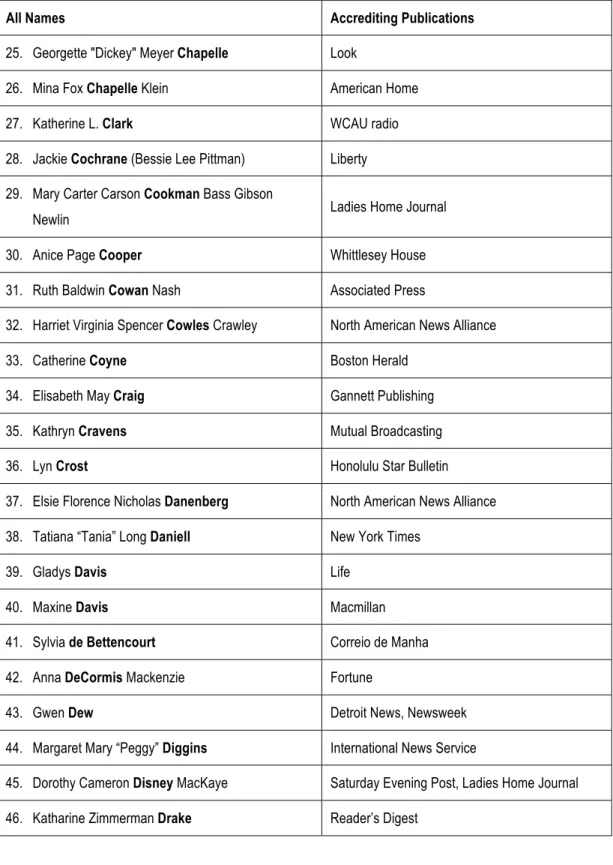
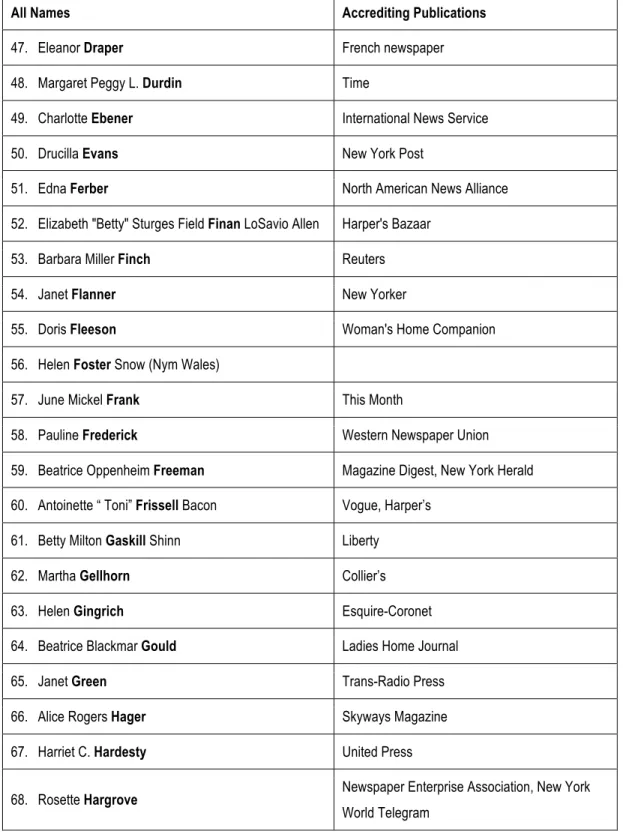
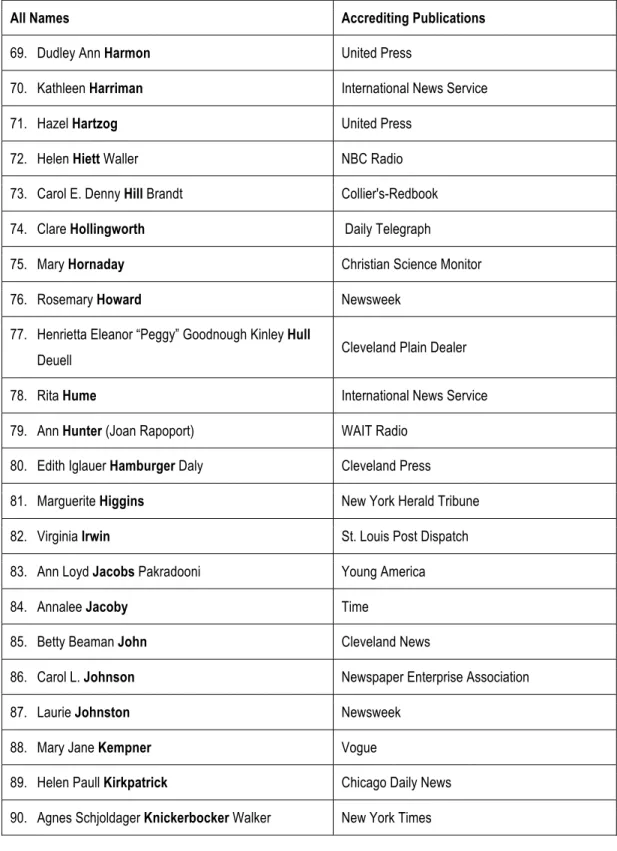
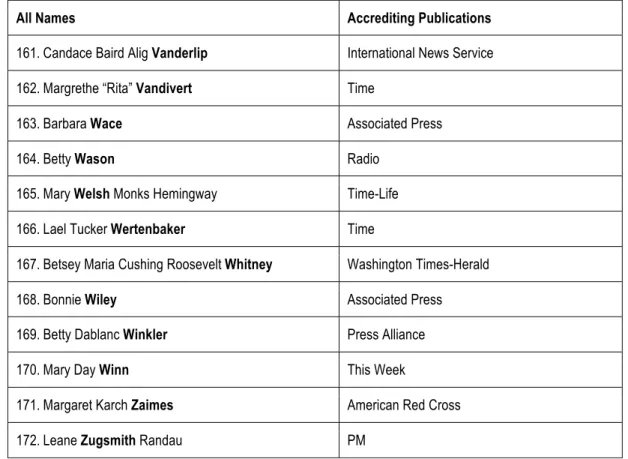
Table 1. American women war correspondents through World War I ...183 Table 2. American women whom Allied Forces recognized or accredited as war
Abbreviations
AGWAR Adjutant General, War Department CBI China-Burma-India Theater
CCS Combined Chiefs of Staff
JCS U.S. Joint Chiefs of Staff OSS Office of Strategic Services PRD Public Relations Division PRO Public Relations Officer SEAC Southeast Asia Command
SHAEF Supreme Headquarters, Allied Expeditionary Force SWPA Southwest Pacific Area
WAAC Women’s Auxiliary Army Corps
WAC Women’s Army Corps
PART I.
Study Overview
Introduction
The chief Berlin correspondent for the Chicago Tribune, beginning in 1926, smoked a pipe, spoke more than five languages, had an uncanny ability to “drink”
German officials under the table, and used covert tactics to scoop reporters worldwide on the impending death of Weimar Germany’s first president, Hitler’s plans for world war, and, finally, confirmation of Hitler’s death.1
The New York Times correspondent who won the 1937 Pulitzer for best
interpretation of foreign affairs was among the first to predict for American readers the rise and wrath of a young, vastly underestimated Mussolini and had once procured a six-hour interview with Stalin at a time when he refused access to all other foreign reporters.2
1Julia Edwards, Women of the World: The Great Foreign Correspondents (Boston:
Houghton Mifflin, 1988), 62-70; Ishbel Ross, Ladies of the Press: The Story of Women in Journalism by an Insider (New York: Harper, 1936), 377; and Lilya Wagner, Women War Correspondents of World War II (New York: Greenwood Press, 1989), 99, 102. Sigrid Schultz paid bartenders to serve her nonalcoholic drinks “that looked like the real thing,” 63.
2Edwards, Women of the World, 75, 77-79; Marion Marzolf, Up from the Footnote: A History of Women Journalists (New York: Hastings House, 1977), 56; John Hohenberg,
Neither of these individuals—both of whom were women—had originally aspired to be a “newspaperman,” yet a strong education, affinity for languages, and knowledge of world affairs, as well as extensive travel experience, earned them recognition and respect among world leaders—and readers. The highest compliment a female reporter could receive from her male colleagues, for much of the 20th century, was to be called a “newspaperman.”3 Sigrid Schultz, the first woman bureau chief for the Chicago Tribune,
was honored in 1969 by the Overseas Press Club with a plaque acknowledging her life’s work: “To a tough competitor, staunch friend, honest reporter. She worked like a
newspaperman.”4 Of her sex, her work and her field, Schultz later said, “I insist that the only thing that counts is efficiency, which is a fact that the leading newspapermen believe.”5
Both Schultz and Anne O’Hare McCormick, the Pulitzer-prize winning New York Times correspondent, were rare individuals as, arguably, were most of the women who wrote about World War II and lived up to their personal ambitions instead of societal expectations. Yet Schultz and McCormick were rare even among the women whom the United States accredited as World War II correspondents, who themselves made up fewer than 10 percent of correspondents accredited by the United States during World War II.6 Historians, journalists, and members of the general public are far more likely to have
3Edwards, Women of the World, 152; and Mark Scott, “Bravo Amerikanski!” And Other Stories From World War II by Ann Stringer as told to Mark Scott (Bloomington, Indiana: 1st Books Library, 2000), 30.
4Edwards, Women of the World, 71. 5Ibid.
6Robert William Desmond, Tides of War: World News Reporting (Iowa City: University
heard about or read about the women war correspondents who were valued as “newspapermen,” such as McCormick and Schultz, than the majority of women war correspondents who were called upon by editors and the United States military to cover the war from a feminine point of view.
Whichever angle they took, though, female war correspondents are easily lost in the larger picture of World War II correspondents, as well as among the vast array of books published by and about World War II correspondents. While stories by women correspondents and anecdotes about their lives and their work exist within larger works about women in wartime and women in journalism, few works have addressed the history of women World War II correspondents as a group. Furthermore, the few works that do explore women World War II correspondents are, primarily, compelling stories about the lives of extraordinary women woven together chronologically and geographically.7 Missing from these works is a broader picture of the accreditation of women war correspondents and their coverage of war, along with persuasive claims about the significance of their work in terms of the war, the world, their profession, or their
audience. Also missing from these works, notably, is a focus on the woman’s angle of the war. Although many authors have reported that the United States military and media agreed to accredit and allow female correspondents to report on the war on condition that women cover the “woman’s angle” of the war, the works about war correspondents in general and female war correspondents in particular largely dismiss or ignore this angle—the coverage itself, its gendered meanings, and even the many writers who
covered it.8 Instead, these works focus on the ways in which women compared to their
male colleagues. But few people viewed or treated women the same as their male colleagues in the 1930s and 1940s. Even today, when women are as likely as men to be United States correspondents in war zones, female correspondents have reported being wary of drawing attention to the fact that they are women—for fear of assault on the job or concern that editors might take them off of the job for their own safety.9 A study that
considers the category of “woman war correspondent,” during a time when the media, the government, and the public was constructing new roles for women and the press during wartime, is overdue.
The purpose of this dissertation is to provide a history of the women whom the United States accredited as war correspondents, while exploring the construction, by the press, the public, and the military, of the category of “woman war correspondent” and the concept of a woman’s angle of war through the end of World War II. Relying on cultural historical methods, including a content assessment and gender analysis, this dissertation explores government documents, as well as the writings of American men and women within the media, the United States military, and the public. While this dissertation considers the lives and work of all women who were accredited as war correspondents, its primary focus is upon the majority who worked for print media. Most women who worked as war correspondents before the end of World War II were writing for newspapers, magazines, or wire services, and technology available at that time, along with radio standards that favored live news coverage, greatly limited war reporting for
8Sorel, Women Who Wrote the War, 211, 242.
broadcast.10 This dissertation considers the ways the concept of a “woman war
correspondent” might have influenced or been influenced by the war, military
regulations, societal norms, politics, and the media. By providing a history of the woman war correspondent and the woman’s angle of war and by answering other unexplored questions about the military’s acceptance and accreditation of women as war
correspondents up through World War II, this historical study informs our understanding of the history of women in journalism, government control of journalists, and gender identities in times of war, while providing further insight into the experiences of women reporting in conflict zones.
Chapter One.
Background and Literature Review
The United States during World War II
For 70 years, World War II has captured the imaginations of people all over the world, with new works of art, entertainment, and scholarship about the war emerging each year. The six years from 1939 to 1945 saw more death and destruction worldwide than arguably any other time since the battles and bubonic plague in the fourteenth century.1 Of more than 70 million people who fought in World War II, about 17 million died, along with at least 20 million civilians.2 Yet these six years were also a time of enormous growth and opportunity, a time unmatched in terms of the development of technology for communications, industry, transportation, and weaponry.As armies destroyed cities, towns, and villages throughout Europe and Asia, countries worked to mobilize their citizens to produce weapons, vehicles, and other materiel, and to develop ever faster and better ways of doing so.
The United States’ involvement in all stages of World War II saved Americans from the Depression—just as the Depression steeled Americans and, ultimately, helped
save them from defeat in World War II.3 The abundance of dormant factories and
unemployed workers during the Depression, along with a growing acceptance of the need for individual restraint and government intervention, had conditioned and prepared the United States for wartime mobilization.4 Roosevelt’s early realization that winning the war would require a great amount of time, men, and materiel, and the ensuing national campaign, led to the prosperity that lifted the nation out of the Depression—and to the productivity that made room for more men and women to enter or move up in the nation’s workforce.5 But the United States’ prosperity came at a great cost. While other countries suffered far greater losses than the United States, nonetheless World War II represented the greatest sacrifice Americans had ever made for a war, with three times as many Americans serving the military and a death toll nearly four times higher than in World War I.6 Between 1941 and 1946, the years of its official involvement in the World War II, more than 16 million Americans served the United States military for an average duration of 33 months; 300,000 died in battle, and more than 100,000 died from causes related to war.7
3David M. Kennedy, Freedom from Fear (New York: Oxford University Press, 1999),
191-192; Susan M. Hartmann, The Home Front and Beyond (Boston: Twayne Publishers, 1982), 1-27; and Gerhard Weinberg, A World at Arms: A Global History of World War II
(Cambridge: Cambridge University Press, 1995), 914.
4Kennedy, Freedom from Fear, 191-192. 5Ibid.
6Robert Goralski, World War II Almanac 1931-1945 (New York: Bonanza Books, 1981);
and “Table No. 523. Armed Forces Personnel—Summary of Major Conflicts,” United States Census Bureau, Statistical Abstract of the United States: 2003 (National Defense and Veterans Affairs), 348.
When Germany invaded Poland in 1939, the American public was unprepared to enter another war. They were already fighting the Depression, and World War I was still fresh in many Americans’ minds. The president and Congress were limited not only by public opposition to the war, but also by the United States Neutrality Act of 1937.8 President Franklin Roosevelt called on Congress and the citizens of the United States to help America to become an “arsenal of democracy,”9 with the quick and unprecedented
production of “more ships, more guns, more planes, more of everything.”10 Roosevelt continually pushed the limits of his short-of-war strategy to shore up the nation’s military and the nation’s allies. Through the Lend-Lease Act, the United States could “lease or provide goods or services to any nation whose defense he thought vital to the defense of the United States.”11 In September 1940, the United States passed its first peacetime
draft, the Selective Training and Service Act.12 Until the morning of December 7, 1941, when Japan’s surprise attack on Pearl Harbor claimed 4,575 casualties, 150 planes and one half dozen battleships, many Americans “still thought it was not their war.”13
At its essence, every war is based on the entangled notion “us against them”—a group identity and a common cause for action, as well as a shared perception of an enemy
8Kennedy, Freedom from Fear, 3-8; and Stokesbury, A Short History of World War II,
52-53, 117-122.
9Michael S. Sherry, In the Shadow of War: The United States Since the 1930s (New
Haven: Yale University Press, 1995), 45.
10Kennedy, Freedom from Fear, 44.
11Stokesbury, A Short History of World War II, 119. 12Ibid., 119.
as different from the group. The strength of each of these concepts affects the meaning and outcome of any battle—and thus drove the desires and fears behind the government’s control of media throughout World War II.14 The government needed Americans to feel united and to believe that the Axis powers posed such a danger to the identity of
Americans that a war was inevitable, necessary, and achievable. Yet, democracy and freedom were integral to the identity of Americans, just as a lack of democracy and freedom was integral to Americans’ perception of the Axis powers—and to the cause for war.15 A democratic nation, by nature, fosters opposing, diverse viewpoints that make unity more difficult to achieve. Among these divergent viewpoints were many
stereotypes, based on sex, class, race, ethnicity, religion, and region, which had only been made worse by the hard times most Americans had faced during the Depression.16 The
United States was a nation of immigrants, but it was a patriarchal nation that had yet to resolve its many racial and ethnic divisions. Thus the government relied on propaganda and a generally cooperative fourth estate to develop and sustain Americans’ belief in a united (yet culturally diverse, economically stratified, and racially segregated) citizenry, their belief in a just and crucial war, and their belief in an evil, expendable enemy—all while ensuring that no information reach the enemy that might hinder the chance of
14See, for example: Gerd Horten, Radio Goes To War: The Cultural Politics of Propaganda during World War II (Berkeley: University of California Press, 2002); George H. Roeder, The Censored War: American Visual Experience during World War Two (New Haven: Yale University Press, 1993); Leila J. Rupp, Mobilizing Women for War: German and American Propaganda, 1939-1945 (Princeton: Princeton University Press, 1978); and Barbara Savage, Broadcasting Freedom: Radio, War and the Politics of Race, 1938-1948 (Chapel Hill: University of North Carolina Press, 1999).
winning the war.17Throughout the war, the government worked to balance its own
interest and authority with the interests and rights of the press and the public, while monitoring, producing, and regulating all kinds of communication relating to all segments of the nation’s population—even, and often especially, women.18
Women and Work during World War II
Until the early 1980s, most scholars believed that war was “an event of such cataclysmic, existential significance,” that it was somehow “ ‘above’ questions of gender identity,” Miriam Cooke noted.19 Since that time, gender analyses of war have not only helped dispel the “age-old story of war as men’s business,”20 they have continued to complicate and illuminate our knowledge and beliefs about war, citizenship, and
politics.21 Scholars have shown citizenship and gender to be inextricably bound together,
17See Horten, Radio Goes To War; Rupp, Mobilizing Women for War; Savage, Broadcasting Freedom; Jeffery Alan Smith, War & Press Freedom: The Problem of Prerogative Power (New York: Oxford University Press, 1999); Michael S. Sweeney,
The Military and the Press: An Uneasy Truce (Evanston: Northwestern University Press, 2006); Michael S. Sweeney, Secrets of Victory: The Office of Censorship and the
American Press and Radio in World War II (Chapel Hill: University of North Carolina Press, 2001); and Patrick Washburn, The Office of Censorship’s Attempt to Control Press Coverage of the Atomic Bomb during World War II (Columbia, S.C.: Association for Education in Journalism and Mass Communication, 1990).
18See Horten, Radio Goes To War; Rupp, Mobilizing Women for War; Savage, Broadcasting Freedom; and Sweeney, Secrets of Victory.
19Miriam Cooke, “Wo-Man, Retelling the War Myth,” in Gendering War Talk, ed.
Miriam Cooke and Angela Woollacott (Princeton: Princeton University Press, 1993), 178.
20Ibid.
21See, for example, Gisela Bock, “Equality and Difference in National Socialist Racism,”
especially during times of war, when governments and individuals depend upon the construction and emphasis of gendered meanings to rationalize violence and oppression and to promote nationalism.22 Nations at war often emphasize and promote gender differences among their own citizens to boost national morale, while alternately
diminishing and exploiting gender differences among their enemies to dehumanize and demonize them.23
Though hundreds of thousands of female combatants fought on every front in World War II, and though the United States had determined that “mixed gender units performed better than all-male units” and that “demands of military efficiency called for assigning women to combat,” the United States military never permitted American women to fight.24 Instead, the United States military employed women in non-combatant
roles, such as clerical work, that could free men to fight, which some men resented
1996); Kathleen Canning, “Gender and the Politics of Class Formation: Rethinking German Labor History,” American Historical Review 97, no. 3 (June, 1992): 736-768; Jean Bethke Elshtain, Women and War (New York: Basic Books, 1987); Emily S.
Rosenberg, “Gender,” Journal of American History 77, 1 (1990): 116-124; and Mrinalini Sinha, “Gender and Nation,” in Feminist History Reader, ed. Sue Morgan (New York: Routledge, 2006).
22Kathleen Canning and Sonya O. Rose, “Gender, Citizenship, and Subjectivity: Some
Historical and Theoretical Considerations,” Gender and History 13, no. 3, (November 2001): 427-443.
23Cooke, “Wo-Man, Retelling the War Myth,” 178; Marianne Hirsch and Leo Spitzer,
“Gendered Translations: Claude Lanzmann’s Shoah,” in ed. Cooke and Woollacott,
Gendering War Talk, 4; Maureen Honey, Creating Rosie the Riveter: Class, Gender, and Propaganda during World War II (Amherst: University of Massachusetts Press, 1984); and Rupp, Mobilizing Women for War.
24D’Ann Campbell, “Women in Combat: The World War II Experience in the United
States, Great Britain, Germany, and the Soviet Union,” The Journal of Military History
because they felt it left them as “cannon fodder.”25 In addition to prohibiting women from
the inner circle26 of war, the United States military also prevented women from sharing the same status or benefits with men. Women who served in the Women’s Auxiliary Army Corps, later the Women’s Army Corps, suffered from public resentment and suspicion as well as the resentment of their male colleagues.27 When, in 1943, the Army was preparing to recognize the WAACs officially as women in service to the Army (eliminating their “auxiliary” status), rumor campaigns about promiscuity and a high rate of pregnancy among the WAACs fueled public scrutiny and suspicion.28 The Air Force considered its 1,000 WASPs, or Women Airforce Service Pilots, to be indispensible for the nation’s noncombat missions, such as test runs and deliveries.29 Yet the Air Force also considered these women to be civilians and had little use for their skills and experience after the war ended, when so many experienced male veteran pilots needed the work.30 Thirty-eight women died while working as WASPS, and the rest who found themselves unemployed after the war received neither military benefits nor veteran status
25Hartmann, The Home Front and Beyond, 39. For more about the “release-a-man”
campaign and its public response, see D’Ann Campbell, Women at War with America: Private Lives in a Patriotic Era (Cambridge: Harvard University Press, 1984), 40.
26Elshtain, Women and War, 183.
27Ann Allen, “The News Media and the Women’s Army Auxiliary Corps: Protagonists
for a Cause,” Military Affairs 50 (April 1986): 77-83; Campbell, Women at War with America, 35-37; and Leisa Meyer, Creating G.I. Jane: Sexuality and Power in the Women’s Army Corps during World War II (New York: Columbia University Press, 1996), 33-50.
28Allen, “The News Media and the Women’s Army Auxiliary Corps”; Campbell, Women at War with America, 35-37; and Meyer, Creating G.I. Jane, 33-50.
until 1977, when Congress finally recognized the WASPs and their service to the nation.31
The actions of government agencies, employers, and individuals during and directly after World War II revealed that most Americans valued the preservation of gendered identities more than prospects of convenience, efficiency, or material gain. Government propaganda and media representations of men, women, and citizenship during World War II conveyed war as necessary for the protection and preservation of women, children, and family life—normalcy—while promoting the binary ideals of male aggression and action versus female peace and passivity.32 These messages prescribed specific and gendered codes of conduct as essential to the outcome of the war. Loose-talking or loose-behaving women could cause the United States to lose the war, as could women who wasted leftovers, used too much sugar or refused to work for the war effort, according to so many propaganda posters.33 The United States government called on women, as the nation’s caregivers, to help with rationing food and resources, controlling information, supporting and repairing male morale (and morality), selling war bonds,
31Hartmann, The Home Front and Beyond, 46-47.
32Amy Bentley, Eating for Victory: Food Rationing and the Politics of Domesticity
(Urbana: University of Illinois Press, 1998); Campbell, Women at War with America; William H. Chafe, The Paradox of Change (New York: Oxford University Press, 1991); Susan Gubar, “ ‘This is My Rifle, This is My Gun,’ World War II and the Blitz on
Women,” in eds. Margaret Randolph Higonnet, Jane Jenson, Sonya Michel, and Margaret Collins Weitz, Behind the Lines: Gender and the Two World Wars (New Haven: Yale University Press, 1987), 227-259; Hartmann, The Home Front and Beyond; Honey,
Creating Rosie the Riveter; and Rupp, Mobilizing Women for War.
33Sonya Michel, “American Women and the Discourse of the American Family during
growing victory gardens, sustaining the ideal of home and hearth, looking out for anyone who might be hindering the war effort, and filling new and vacant jobs in men’s
absence.34 Of these activities, filling new and vacant jobs represented the most dramatic “paradox” of change and continuity for women during World War II.35
Before 1940, women made up less than 25 percent of the workforce. Working women were, for the most part, under 35, single, non-white, and employed in domestic, clerical, sales, or service jobs.36 Many women who had filled jobs during World War I either chose to return home or were forced to give up their jobs upon the soldiers’ return. Even those women who needed or wanted to continue working found it difficult to find jobs during the Depression, when jobs were scarce and public sentiment grew more strongly opposed to women’s employment. A 1936 Gallup poll revealed that 82 percent of Americans felt that women should not work if their husbands had jobs.37 But during World War II, the number of jobs soared and technological advances such as prefab-construction meant that much of the work in defense production, even ship-building, was
34Karen Anderson, Wartime Women: Sex Roles, Family Relations, and the Status of Women during World War II (Westport, Connecticut: Greenwood Press, 1981); Bentley,
Eating for Victory; Campbell, Women at War with America;Chafe, The Paradox of Change; Hartmann, The Home Front and Beyond; Marilyn E. Hegarty, Victory Girls, Khaki-Wackies, and Patriotutes: The Regulation of Female Sexuality during World War II (New York: New York University Press, 2008).
35Chafe, The Paradox of Change, 233. 36Ibid., 66-69.
37Ruth Milkman, Gender at Work: The Dynamics of Job Segregation by Sex during World War II (Urbana: University of Illinois Press, 1987), 28; and Rosalind Rosenberg,
suitable for novice workers.38 As the need for workers quickly outpaced supply, and as
more men were conscripted for service, employers increasingly perceived the vast opportunity that so many women workers presented. In January 1942, a government survey reported that employers expected to hire women to fill just 29 percent of available jobs in defense industries; within six months employers expected to hire women to fill 70 percent of available jobs.39 Women had many incentives to work during the war,
including the availability of better jobs, job training, and record-high wages, a desire for financial independence, and a need, for many of them, to supplement low government allowances from their military husbands.40
Americans’ acceptance of women’s employment and women’s role in the war effort, as Susan Hartmann has noted, was contingent upon three conditions that preserved the gender status quo: women must only work during the war; women must retain their femininity; and women must retain their primary motivation, caring for home and
family.41 Featured in ads, articles, or broadcast programming, these women displayed the ideals of femininity of their time, with slight frames, styled hair, fair skin, fashionable clothes, and plenty of lipstick. Mass-mediated messages in wartime compared women’s work to tasks they had always done—for example, the housewife who can press orange
38Chafe, The Paradox of Change; Hartmann, The Home Front and Beyond; Kennedy, Freedom from Fear; Milkman, Gender at Work, 49, 60-64; and Rosenberg, Divided Lives, 103.
39Chafe, The Paradox of Change, 122-123; and Hartmann, The Home Front and Beyond,
54-55.
40Anderson, Wartime Women; Campbell, Women at War with America, 191; and Chafe, The Paradox of Change, 128.
juice has an easy time with a drill press.42 Jobs open to women were described as
requiring womanly abilities, such as an attention to detail, enthusiasm for the mundane or routine, and an ability to work with small parts.43
For all the jobs and opportunities open to women, none came close to those available to men. While the government and industry actively engaged women’s services and opinions, trying to sway them and trying to use them to sway others, women were rarely provided with positions of power.44 For example, though women’s union
membership climbed to almost 20 percent, women rarely held supervisory roles within unions or the workforce.45The ways in which companies organized and managed their workforce to accommodate women conformed to the conditions that Hartmann noted, as well as the “double-helix effect”—the tendency of gender roles to vary by culture or circumstance while retaining the hierarchy that holds women subordinate to men.46 Wages increased for all men and women, but for women less than men, and still for blacks less than whites.47 Ruth Milkman, in her study showing the hierarchy of sex-segregated jobs in the electrical and automotive industries during World War II, observed that the types of jobs designated as men-only or women-only varied widely from one
42Chafe, The Paradox of Change, 124; and Milkman, Gender at Work, 5. 43Ibid.
44Chafe, The Paradox of Change, 129, 135-136
45Chafe, The Paradox of Change, 129; and Milkman, Gender at Work, 85, 92, 97-98. 46Hartmann, The Home Front and Beyond; and Higonnet et al., Behind the Lines.
47Chafe, The Paradox of Change, 127-128; and Hartmann, The Home Front and Beyond,
factory to another.48 Yet managers insisted that such designations were essential and
fixed, and companies paid more for the jobs held by men.49 Milkman concluded that job segregation helped sustain male morale by constructing gendered meanings for jobs and by ensuring that women earned less than men.50 Companies found it easy to get around government mandates or recommendations to pay women equal wages for equal work by hiring women to do jobs described as “light,” and men to do jobs described as “heavy,” though jobs considered heavy at one company were as likely to be considered light at another.51Despite reporting that they were highly satisfied with female workers overall during the war, companies continued to pay more to hire men for jobs that women could do and, after the war, often refused to hire women at all.52
When the war ended, employers placed labor relations and gender identities above cost-effectiveness and productivity, casting off their female employees and returning to the nearly all-male workforce that existed prior to the war.53 Media messages and societal opinions seemed to reflect that no amount of success in women’s work mattered. If working had been the patriotic thing to do “for the duration,” returning to the home and
48Milkman, Gender at Work, 19. 49Ibid., 19-26.
50Ibid., 19-26. 51Ibid., 71, 75. 52Ibid., 118-123.
53Anderson, Wartime Women, 173; Campbell, Women at War with America, 223;
freeing their jobs for veterans was the only patriotic thing for women to do once peace was restored.54 A surge in marriage and birth rates, along with a desire for normalcy55— which was “encouraged and reinforced by a powerful media appeal”56—also contributed to women’s post-war flight from the workforce. This sustained ideology of home and hearth has led scholars to de-emphasize the impact of World War II on women’s status in society or the workforce.57 Yet within a decade the workforce percentages would begin to
climb again, albeit with most women taking lower-paying positions in office work, sales, and service.58
Whether a catalyst or a blip in continuous progress, the war had given more women than ever before the opportunity to prove themselves equal to men in the workforce and thus had proven false many common arguments for keeping women at home. And certain milestones could not be taken away—such as the military’s acceptance, for the first time, of women physicians; the piecemeal gains women had made in state rights; the confidence women had gained as wage-earners and skilled employees; and the knowledge of sons and daughters that their mothers were capable of independent decision-making and all manner of “men’s” work.59 Among black women,
54Campbell, Women at War with America, 223; and Hartmann, The Home Front and Beyond, 20-27.
55Hartmann, The Home Front and Beyond, 24-26, 170. 56Hartmann, The Home Front and Beyond, 26.
57Anderson, Wartime Women, 8; Campbell, Women at War with America, 3-4, 83-84; and
Hartmann, The Home Front and Beyond, 209-216.
58Chafe, The Paradox of Change, 166-172.
who despite the prevailing racial segregation in most industries had found far greater work opportunities during the war, some advances remained.60 Though they were once again left with the lowest-paying, least-desirable positions, they had benefited from many opportunities to acquire new skills and experiences that had been closed to them before the war. Many professional schools, military units, and employers had finally opened their doors to black women, and those doors remained open.61
The Press during World War II
Much of the government’s success or failure at balancing its interests and authority with the interests and rights of a democratic nation depended on the
“bureaucratization” of censorship and propaganda, as well as on the individuals who were vested with that authority.62 During World War II, three news agencies, three radio
networks, several magazines, and ten daily newspapers in the United States employed international correspondents.63 Working for these media were an estimated 300
international correspondents in the 1930s and more than 2,600 by the end of World War
60Chafe, The Paradox of Change, 127-128; Hartmann, The Home Front and Beyond, 61,
94, 124-125; and Maureen Honey, ed., Bitter Fruit: African American Women in World War II (Columbia: University of Missouri Press, 1999), 7-10.
61Chafe, The Paradox of Change, 128; Hartmann, The Home Front and Beyond, 40-41,
105; and Kennedy, Freedom from Fear, 344.
62Horten, Radio Goes To War; Savage, Broadcasting Freedom; Sweeney, Secrets of Victory; Sweeney, The Military and the Press; Washburn, The Office of Censorship’s Attempt to Control Press Coverage; and Betty Houchin Winfield, “Two Commanders-in-Chief: Free Expression’s Most Severe Test” (Joan Shorenstein Barone Center, 1992), 1-22.
II.64 The United States War Department accredited more than 1,500 war correspondents
during World War II, less than 10 percent of whom were women.65 The military provided accredited correspondents with facilities and transportation, and assigned them the rank of captain.66 As uniformed captains, correspondents were thought to have greater
leverage and protection if captured by the enemy and would be less likely to be mistaken for spies. The title and uniform particularly helped female correspondents, providing a professional appearance and status that was similar, if not equal, to that of men.67
War correspondents had to submit stories to United States censors before their material could be sent to editors. Censors could strike out words, sentences, paragraphs, and whole stories they deemed objectionable. Reporters had to write carefully, with censors in mind, to avoid having their stories transmitted with large gaps in the text, which could render their work incoherent or insignificant. Thus the censors had a chilling effect on the stories journalists wrote. Author John Steinbeck contended that he and other World War II correspondents had “abetted” the war effort, often glossing over incidents and neglecting to report on anything that reflected badly on the war or the military.68
64Desmond, Tides of War, 449. This number also includes reporters who were not
accredited or stationed in war zones, as well as those who wrote for foreign newspapers, who may have written infrequently, and who may not have sought access to the military.
65Wagner, Women War Correspondents of World War II, 159-162. 66Ibid.
67Sorel, The Women Who Wrote the War, 171-172.
68Paul Fussell, Wartime: Understanding and Behavior in the Second World War (New
“The foolish reporter who broke the rules would not be printed at home, and in addition would be put out of the theater by command,” Steinbeck explained.69
Reporters on the home front did not have to clear their stories with censors, yet they often provided cautious or incomplete news coverage.70 The Office of Censorship was headed by Byron Price, a former Associated Press editor whom the press and public respected because they considered his abhorrence for censorship to be rivaled only by his patriotism and desire to win the war.71 Journalism historians have noted that the
respectful and collegial way in which Price approached members of the press, along with his insistence that stateside members of the press could be trusted to follow a wartime practice code with limited oversight, contributed to the media’s successful
self-censorship of news coverage during World War II.72 Rather than prescribing specific
rules for the press, Price asked journalists to refrain from publishing information that might be helpful to the enemy, such as news about weather or military research.73
Censors sought to control information about strategy, weapons, technology, geographic locations, and weather that could make the United States vulnerable to attack
69Ibid., 286.
70Patrick Washburn, “The Office of Censorship’s Attempt to Control Press Coverage of
the Atomic Bomb During World War II,” Journalism Monographs (April 1990).
71Patrick Washburn, “The Office of Censorship’s Attempt to Control Press Coverage,”
1-3, 38-39.
72Sweeney, Secrets of Victory; Sweeney, The Military and the Press; and Washburn,
“The Office of Censorship’s Attempt.”
or protect Axis forces from attack.74 Yet the government was equally concerned about
information that might prove an even deadlier weapon against Americans—information that could divide Americans, make them question the war, or soften them toward their enemies.75 A united front and a sustained fight depended upon engaging Americans in support of the war, developing their hatred for Germany and Japan, and sustaining their confidence in the military.76 The stance that Price took within the Office of Censorship,
and the values of journalists themselves, made it difficult if not loathsome for the government to ask journalists not to publish information that reflected badly on
Americans or the war.77 Instead, the government controlled the release of information and photographs, presenting the public and the media with a “sanitized war.”78 The standards of this sanitization evolved during the war. The military forbid most photos of its own dead soldiers until 1943, when officials believed too many Americans were
over-confident about the war’s outcome.79 Early in the war, the military had avoided releasing photos of slain or injured soldiers to prevent fear and anxiety among Americans. The military also blocked the publication of photographs that depicted accidental or
74Sweeney, Secrets of Victory; Sweeney, The Military and the Press; and Washburn,
“The Office of Censorship’s Attempt.”
75Horten, Radio Goes To War; Savage, Broadcasting Freedom; Sweeney, Secrets of Victory; and Washburn, “The Office of Censorship’s Attempt.”
76Horten, Radio Goes To War; Savage, Broadcasting Freedom; Sweeney, Secrets of Victory; and Washburn, “The Office of Censorship’s Attempt.”
77Sweeney, Secrets of Victory; Sweeney, The Military and the Press; and Washburn,
“The Office of Censorship’s Attempt.”
combat deaths, as well as photographs of soldiers who looked glib, drunk, weak, weary, grimy, or scared.80 The military often blocked the publication of photographs of black American soldiers for fear that photographs portraying black soldiers at ease or dying in combat might stir up racial tensions at home.81
World War II was riskier for correspondents than previous wars because military advances, such as submarine and aircraft technologies, increased the threat of sudden attack away from the front.82 The casualty rate for United States correspondents in Europe during World War II was reported to be 15 to 20 percent between September 1939 and the spring of 1943; dropping to about 5 percent in 1944-1945.83 Close to fifty United States war correspondents lost their lives in combat during the war, all men.84 No American women died in combat-related incidents, as war correspondents, although several were injured or confined to internment camps, and at least two who had worked with their husbands, as a reporting team, were widowed during the war.85
80Roeder, The Censored War. 81Ibid., 57.
82Desmond, Tides of War, 451. 83Ibid., 452-453.
Women and Journalism
Early historians who considered women in journalism began with compensatory and contributory histories86—finding the notable, exceptional woman who could be considered significant even when viewed through the value systems of male-dominated newsrooms.87 While uncovering the stories of exceptional women in journalism was important to our understanding of journalism history, it did little to inform the experiences of the majority of women journalists. Marion Marzolf’s Up from the Footnote: A History of Women Journalists is one example of an early work that sought, essentially, to “add women and stir”88—to provide biographical accounts of “women worthies” without providing a theoretical framework or analysis. Marzolf’s work, and other valuable biographical and descriptive studies of women journalists,89 expanded our
86Gerda Lerner, The Majority Finds Its Past: Placing Women in History (Chapel Hill:
University of North Carolina Press, 1979), 115-116.
87See, for example: Maurine Beasley and Sheila Jean Gibbons, Taking Their Place: A Documentary History of Women and Journalism, (StateCollege, Pennsylvania: Strata Publishing, 2003); Barbara Belford, Brilliant Bylines: A Biographical Anthology of Notable Newspaperwomen in America (New York: Columbia University Press, 1988); Kathleen A. Cairns, Front-Page Women Journalists, 1920-1950 (Lincoln: University of Nebraska Press, 2003); Madelon Golden Schilpp and Sharon M. Murphy, Great Women of the Press (Carbondale: Southern Illinois University Press, 1983); and Marion Marzolf,
Up from the Footnote: A History of Women Journalists (New York: Hastings House, 1977).
88Barbara Friedman, Carolyn Kitch, Therese Lueck, Amber Roessner, and Betty
Winfield, “Stirred, Not Yet Shaken: Integrating Women’s History into Media History,”
American Journalism (Winter 2009): 160-174; and Elaine Tyler May, “Redrawing the Map of History,” The Women’s Review of Books (February 2000): 26.
89Phyllis Abramson, Sob Sister Journalism (New York: Greenwood Press, 1990);
understanding of women in journalism, but this literature needed deepening even more than it needed widening.
Also similar to early women’s historians, early historians of women in journalism relied upon the value systems and measures of significance—visibility, power—
established by male-dominated newsrooms to determine their subjects of study. In the past decade, several scholars have called for a more expansive history of women in journalism—one that would consider those women journalists whose work did not always conform or measure up to the male standards of their time, and one that would interpret the experiences of men and women journalists, rather than considering them separately.90
Catherine Covert noted that the field of journalism history, like any discipline, can be blind to its own paradigms and assumptions.91 Just as American journalism has long valued autonomy, winning, and change, journalism historians have chosen and evaluated their subjects on the basis of these three principles. Covert noted the need for journalism historians to see past the traditional values that defined success in male-dominated journalism to consider those values often dismissed as defining “soft news”92—stories
about the world traditionally dominated by women, such as human-interest stories, stories about social lives, style, entertainment or housekeeping. Hard news includes stories about the world traditionally dominated by men and is characterized by immediacy and
90Maurine Beasley, “Recent Directions for the Study of Women’s History in American
Journalism,” Journalism Studies 2,2 (2001): 207-220; and Friedman et al., “Stirred, Not Yet Shaken.”
91Catherine L. Covert, “Journalism History and Women’s Experience: A Problem in
Conceptual Change,” Journalism History 8,1 (Spring 1981): 2-6.
potential public impact, such as stories about crime, politics, and business. Women journalists have long been measured (by historians and fellow journalists) according to what has been suggested was a male standard of their work, the standard that involved the three principles Covert described: autonomy, winning, and change—their ability to cover hard news topics and “scoop” the competition with breaking, front-page news stories.93 Women who aspired to be successful “newspapermen” typically tried to avoid writing soft news or material for the women’s pages, but so, it seems, did many of the historians and biographers who first wrote about the heroines of journalism.94 The idea of a
woman’s page, or even of women’s news, has held conflicting meaning for many
women:95 the woman’s section presented new opportunities to women who were grateful for work of their own, while also representing confinement to women who saw more expansive opportunities outside of women’s news.
Among scholarship about women who worked in print journalism before the 1960s, few works have included a gender analysis, instead considering women separately from men: as sob sisters, stunt reporters, and the like.96 Three recent history works have shown the value of delving deeper into the work of women journalists, considering the
93Catherine L. Covert, “Journalism History and Women’s Experience.”
94Beasley, “Recent Directions”; Patricia Bradley, Women and the Press: The Struggle for Equality (Evanston: Northwestern University Press, 2005); Linda J. Lumsden, “The Essentialist Agenda of the ‘Woman’s Angle’ in Cold War Washington: The Case of Associated Press Reporter Ruth Cowan,” Journalism History 33,1 (Spring 2007); Jan Whitt, Women in American Journalism: A New History (Urbana: University of Illinois Press, 2008).
95Ibid.
totality of their experience along with interrelationships and influences among male and female colleagues, employers, readers, and government officials. Lumsden’s “The
Essentialist Agenda of the ‘Woman’s Angle’ in Cold War Washington,” Gail Bederman’s
Manliness and Civilization, and Jean Marie Lutes’ Front Page Girls, show how the work of women journalists has influenced and has been influenced by society’s understanding of gender, and, in the case of Bederman’s study, race as well.97 Lumsden’s work on Ruth
Cowan Nash explored the “paradoxical nature” of the woman’s angle of journalism in World War II.98 Bederman’s work showed how journalist and anti-lynching activist Ida B. Wells used the prevailing discourses and anxieties about masculinity, race, and sexuality—those previously used to defend lynching—and “inverted” them, to effect change materially even as she helped to alter these discourses.99 Finally, Lutes has shown
in her study of women journalists up through the 1920s that early women reporters “functioned as both agents and pawns.”100 Editors often hired them for their ability to entertain readers and to provide a female perspective, as much as for their writing and reporting abilities. “By becoming the news, female reporters created fictions of
97Gail Bederman, Manliness and Civilization: A Cultural History of Gender and Race in the United States, 1880-1917 (Chicago: University of Chicago Press, 1995); Lumsden, “The Essentialist Agenda of the ‘Woman’s Angle’ ”; and Jean Marie Lutes, Front Page Girls: Women Journalists in American Culture and Fiction, 1880-1930 (Ithaca, New York: Cornell University Press, 2006).
98Lumsden, “The Essentialist Agenda of the ‘Woman’s Angle.’ ” 99Bederman, Manliness and Civilization, 75-76.
themselves that far outlasted—in scope, depth, and impact—the fleeting news value of the stories they covered.”101
Their ability to provide what editors touted as the female perspective or the woman’s angle helped to expand roles available to women by feminizing those roles—so that society viewed the role of reporter as one that could be fulfilled by women as well as men, even if society was not ready to change its view of women themselves. In fact, by the 1940s, this approach or strategy was nothing new. Throughout the history of women’s struggle for societal rights, recognition, and privilege, women have by turns emphasized that they are similar to men and different from men. For example, during the suffrage movement, women argued at once that they were equal to men, thus deserved equal treatment, and that they were different from men, thus deserved a voice.102 Early women
writers gained access to newspapers by covering domestic subjects eschewed by men, such as childcare, housekeeping, and fashion—covering women’s news was their “Trojan horse into forbidden encampment.”103 Women who wanted to cover forbidden subjects such as politics, war, or sports soon found that the woman’s angle provided an entry point. Like women’s news, the woman’s angle increased professional opportunities for women journalists, but it also held them back. Women who strove to be taken seriously as journalists equal to men often resented having to cover “women’s news” or the
woman’s angle.104 Yet scholars have largely overlooked coverage of the woman’s angle,
as well as the work and lives of women who did not resent its limitations, perhaps
because those who covered it seemed to reflect and perpetuate stereotypes women sought to overcome. Much remains to be done to more fully explore women’s progress in the history of journalism—both as professionals and individuals affected by gender discourse and as the professionals and individuals who are producing mass-mediated messages about gender.
Women, Journalism, and World War II
The first women to report on World War II were those who, like Anne
McCormick and Sigrid Schultz, were veterans of foreign news and were already stationed in Europe as official staff correspondents. Most of these women had originally acquired their knowledge of foreign countries and languages for reasons perhaps unrelated to specific career goals. For example, Schultz’s family lived in Chicago, Paris, and
Germany, and she had graduated from the Sorbonne. The languages she had learned as a child and as a student prepared her to teach English to Jewish children in Germany and eventually led the Chicago Tribune to hire her as an interpreter, a role from which she quickly advanced.105 McCormick had grown up writing poetry, fictional stories, and essays for a Catholic newsletter edited by her mother, before traveling with her husband
104Bradley, Women and the Press, 186. See, for further discussion of the woman’s angle,
Carolyn Edy, “Juggernaut in Kid Gloves: Inez Callaway Robb, 1901-1979,” American Journalism 27, no. 4 (Fall 2010): 83-103; and Lumsden, “The Essentialist Agenda of the ‘Woman’s Angle.’ ”
and his export business during and after World War I.106 She queried New York Times
when she moved with her husband to Italy, and her knowledge of Catholicism and Latin helped her land the assignments that led to her coverage of Mussolini and her eventual hiring as the first woman editorial writer at the New York Times.107
Though the women who had succeeded at foreign correspondence before World War II did forge a path for other exceptional women to follow, the path was narrow and exceedingly steep. The women who stayed the path were those, such as Martha Gellhorn and Helen Kirkpatrick, who often risked their lives and their jobs as they wrote news stories and earned recognition from their editors and peers as real “newspapermen,” and today their work is included in many published anthologies of war correspondence, as well as in books of their own.108 However, the path taken by most women war
correspondents was the one military officials created for them. In the 1940s, most editors still hired and tolerated women because of their sex, not despite it—valuing their abilities to report news of interest to women or to provide a woman’s perspective on news of interest to men. As newspaper editors better understood their audiences (i.e., that their readership included so many women) and as military officials better appreciated having
106Patricia Bradley, Women and the Press: The Struggle for Equality (Evanston:
Northwestern University Press, 2005), 194-195; and Marzolf, Up from the Footnote, 56-57.
107Edwards, Women of the World, 76-81.
108See, for example: Desmond, Tides of War; Martha Gellhorn, The View from the Ground (Boston: Atlantic Monthly Press, 1994); Helen P. Kirkpatrick, Under the British Umbrella: What the English Are and How They Go to War (New York: C. Scribner’s Sons), 1939; Jon E. Lewis, The Mammoth Book of War Correspondents (New York: Carroll & Graf, 2001); Sayre P. Sheldon, Her War Story: Twentieth-Century Women Write About War (Carbondale: Southern Illinois University Press, 1999); and Frederick Voss, Reporting the War: The Journalistic Coverage of World War II: Volumes 1 & 2
an audience, women increasingly found work reporting “the woman’s angle”109or the
woman’s point of view of war, including human interest stories that men considered less appealing, such as the work of the Red Cross and the Women’s Auxiliary Army Corps.110 Thus, newspapers and the military arranged to accredit women whom they otherwise would not have entrusted with matters of war. As the woman’s angle proved successful, and as more husbands and sons were sent to war leaving their desks empty and leaving their families at home to pore over newspapers in search of stories about them or their lives, even those newspapers that previously had refused to hire women, much less send them to a war zone, began sponsoring women correspondents for accreditation. Wire services, too, sought women to cover more areas.111
Some women who were assigned to cover the woman’s angle took advantage of this entry point before quickly discarding it.112 Others obliged and wrote their stories according to editors’ expectations, playing up the irony of a woman traveling in a
decidedly masculine world, learning to wash laundry in her helmet or applying makeup at
109The term “woman’s angle” appears in several articles and books about journalism
history, as well as newspaper clippings as far back as the late 1800s. See, for example: Bradley, Women and the Press, 220; Dave Kaszuba, “Ringside, Hearthside: Sports Scribe Jane Dixon Embodies Struggle of Jazz Age Women Caught Between Two Worlds,”
Journalism History 35, 3 (2009): 141; Linda J. Lumsden, “The Essentialist Agenda of the ‘Woman’s Angle’ in Cold War Washington: The Case of Associated Press Reporter Ruth Cowan,” Journalism History 33,1 (Spring 2007): 2; and “Mrs. Blake Watkins: And How She Proved Herself One of the Boys at Tampa. From The London Mail,” New York Times, July 3, 1898.
110Bradley, Women and the Press: The Struggle for Equality, 185-186; Edwards, Women of the World, 5; and Lumsden, “The Essentialist Agenda of the ‘Woman’s Angle.’ ”
111Sorel, The Women Who Wrote the War, 211.
the front.113 Linda Lumsden, in her discussion of the work of World War II war
correspondent Ruth Cowan Nash, suggested that the female perspective, or woman’s angle, was “an essentialist, male-constructed category intended to keep women journalists and their readers in their place: at home and subservient to men.”114 In
addition to covering the homemaking aspects of war, the woman’s angle included stories about doctors, nurses, and patients—allowing for dramatic stories that could sometimes rival tales from the front.115
Officially, the military accredited women to cover the war so they could write the news for and about women. The Supreme Headquarters Allied Expeditionary Force, or SHAEF, created rules that made it all but impossible for women’s war reporting to equal men’s reporting.116 Until April of 1945, SHAEF prevented most women from visiting
press camps or getting any closer to the front than the nurses or women’s services.117 Women had to secure special permission if they wanted to travel beyond a hospital or WAAC area, and they were supposed to cover woman’s angle stories approved by
military press officers.118 But press camps lacked women’s latrines, which became reason enough, for many military officials, to limit their accommodations to men. Along with latrines, press camps offered war correspondents the use of teletypes, radios, and the
113Edy, “Juggernaut in Kid Gloves.”
114Lumsden, “The Essentialist Agenda of the ‘Woman’s Angle.’ ”
115Sorel, The Women Who Wrote the War, xiv; and Edwards, Women of the World, 22-23. 116Sorel, The Women Who Wrote the War, 246, 316, 330.
ability to have stories censored and transmitted on site.119 Women reported that their
exclusion from press camps meant that they could only use field-message service to send their copy, from wherever they were reporting, to censors in London who would then send it on to the United States, a process that delayed their stories and prevented them from revising their work after censors had rendered much of it incoherent.120
If official rules denied women equal access to information, locations, equipment, and facilities, official, and unofficial individuals could create even greater barriers. Military personnel, government employees, and even fellow correspondents could, and did, do much to bar women reporters from accreditation and access to information. Helen Shipley, the “passport dragon”121who headed United States naturalization and
immigration, did not believe women belonged in war zones and often extended home leaves for women correspondents or delayed or denied their passports. Despite the military’s acceptance of female correspondents, certain generals refused to allow women war correspondents to cover their troops or territories in any capacity.122
Likewise, despite the success of the woman’s angle, some newspaper editors held fast to policies forbidding the hiring of women, and some male journalists stationed abroad did their best to challenge and deter women from working as correspondents. Wes Gallagher, the “woman-hating”123chief of the Associated Press bureau, tried to send back
119Sorel, The Women Who Wrote the War; Edwards, Women of the World, 22-23. 120Sorel, The Women Who Wrote the War, 246, 316.
121Wagner, Women War Correspondents of World War II, 146. 122Sorel, The Women Who Wrote the War, 293.
the first two women ever embedded with a United States military troop as accredited war correspondents, Ruth Cowan Nash for the Associated Press and Inez Callaway Robb for International News Service. The two women remained in North Africa and refused the trip home. Nash, who had worked as an Associated Press reporter for 12 years, called on First Lady Eleanor Roosevelt, an ally Cowan had earned in her days covering woman’s angle stories in Washington. She notified Roosevelt that men did not want women to cover the WAACs—knowing her message would be read first by Gallagher. His behavior toward Nash improved, but barely.124 For all of the challenges women faced in covering the war, some of their male colleagues complained that women had an unfair advantage because they could flirt with GIs to get them to talk or they could trade sex for
information, the latter of which women claimed rarely happened.125
Many of the women who cast aside the woman’s angle and sneaked or bargained their way in to witness the action did manage, despite the obstacles, to write stories of significant news value. They did so at great risk, not only to their lives, as many women discovered in repeated close calls, but to their careers. A datelined story indicating that a woman had reported from a place forbidden to women could cost her a court-martial and her accreditation for the duration of the war.126 Yet the risk often paid off. By December 1944, several women had earned full accreditation to the front, with full access to the
124Edwards, Women of the World, 150-151.
125Sorel, The Women Who Wrote the War, 277, 322.
press camps.127 Women were never officially accredited to military units; the ban against
women at the front was never lifted. Instead the Army made exceptions for the women “who shouted the loudest or who were most adept at breaking the rules”128or whose employers could exert enough influence.
By the end of the war, many women who had fought to work alongside men as equals had earned that right. They had won a victory, having proven themselves equal to men in reporting abilities and having widened their path to war correspondence.129 Victorious or no, when the war ended, women war correspondents returned to safety— but not necessarily to security. Their personal risk had diminished drastically, but so had their professional potential. As Patricia Bradley noted, “the role of women
correspondents in World War II did not clear the way for women in journalism,” and the women returned from the war only to face the same situation they had faced before the war.130 Women journalists faced the shared plight of all working women after the war: post-war propaganda beseeching women to step aside and return home so men could reclaim their jobs.131 Even women whose work had all but guaranteed them lifelong respect and writing assignments faced challenges returning home, as they readjusted to life that was, as Gellhorn described it, “tiresomely superficial” and tried to find work that
127Ibid., 283.
128Edwards, Women of the World, 160.
129Sorel, The Women Who Wrote the War, 388-389. 130Bradley, Women and the Press, 221.
131Anderson, Wartime Women, 161; Campbell, Women at War with America, 223; and